Advances in Environmental Vibration Fifth International Symposium on Environmental Vibration, Chengdu, China, October 20-22, 2011
Dynamic Analysis of High Speed Railway Traffic Loads on Ballasted
Track
Khanh NGUYEN1, Jose Maria GOICOLEA1 and Felipe GALBADON1
1.
Department of Mechanics and Structures, School of Civil Engineering, Technical University of Madrid, Spain
Abstract: This paper reports the studies carried out to develop and calibrate the optimal models for
the objectives of this work. In particular, quarter bogie model for vehicle, rail-wheel contact with Lagrangian multiplier method, 2D spatial discretization were selected as the optimal decisions. Furthermore, the 3D model of coupled vehicle-track also has been developed to contrast the results obtained in the 2D model. The calculations were carried out in the time domain and envelopes of relevant results were obtained for several track profiles and speed ranges. Distributed elevation irregularities were generated based on power spectral density (PSD) distributions. The results obtained include the wheel-rail contact forces, forces transmitted to the bogie by primary suspension. The latter loads are relevant for the purpose of evaluating the performance of the infrastructure.
Keywords: dynamic response, wheel-rail contact, track irregularities, finite element, vehicle-track interaction
1 Introduction
High-speed railway systems have been built and operated in several countries. These are considered a competitive alternative to other modes of transport for medium distances. Spain has now in operation over 2.200 km of high-speed railway lines with international gauge, with ballast track except at singular locations such as tunnels. There is an increasing need for research in order to improve the safety, reliability and efficiency of track infrastructure. The mechanical characteristics of the track and the choice between the ballast and slab track are matters of debate, taking into account flying of ballast, maintenance and durability features, cost and dynamic vertical behavior of track (Melis, 2010). In this work we focus in issues related to the mechanical actions on the track structure, specifically vertical dynamic loads.
The evaluation of the dynamic response of railway track subjected to high speed train loading represents one of the main structural issues associated specifically to the structure design of high-speed railway. The dynamic behavior of railway track structure induced by the traffic is influenced by the interaction between the train and the complete track
structure, and also between several elements of rolling stock. As the operating speed of train becomes higher and reaches 350 km/h or more, accuracy in the analysis of vehicle-track interaction becomes an important factor to be considered in the railway track design. An important number of research works on this subject have contributed to relevant technical advances in this area. In order to simulate the dynamic interaction of vehicle-track many kinds of two dimensional models (Timoshenko and Young, 1995; Fryba, 1996; Esveld, 2001; Sun and Dhanasekar, 2002; Lei and Noda, 2002; Yang, Yau and Wu, 2004) in which the train is treated as independent body, and three dimensional models (Popp, Kaiser and Kruse, 2003; Song, Noh and Choi, 2003; Zhang, Vrouwenvelder and Wardenier, 2003; Dinh, Kim and Warnithcai, 2009) in which the train is modeled more realistically have been presented. Therefore, the optimization of modeling both the rail track and vehicles is an important issue.
irregularity is considered and generated as a stationary ergodic processes. The focus of this work is on obtaining the contact force between the wheel and the rail, the force in the primary suspension. For this purpose analyses, the numerical calculation is performed in the time domain. The relevant results were obtained for several track profiles and speed ranges.
2 Vehicle-track dynamic model
2.1 Track modeling
Generally, the structure of ballast track is composed by rail, railpads, sleepers, the ballast layer, the possible sub-ballast layer, the subgrade (see figure 1). The ballast track models in 2D and 3D have been developed.
Fig.1 Structure of ballast track
2.2.1 Two-dimensional model
In two-dimensional, the track is modeled by beam, truss and 2D continuum finite elements (see Fig. 2). These types of models have been used in other previous works (Cai and Raymond, 1994; Sun and Dhanasekar, 2002; Lei and Noda, 2002; Yang, Yau and Wu, 2004). The rail has been simulated as a continuous Timoshenko beam including shear deformation, supported by pads which are springs and dampers. The sleepers are regarded as a concentrated mass, the ballast is considered as spring and damper. The sub-ballast is not considered in this work. The subsoil is modeled as an infinite linear elastic spring. The track length studied is 90.0 m (table 3)
Fig.2 Ballast track model in 2D
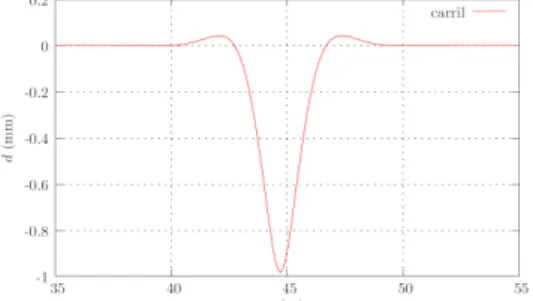
Figure 3 presents the static response of track when the force is applied at the centre of the track length studied, between two sleepers.
Fig.3 Static response of ballast track 2D
Table 1 Parameters of ballast track model
Dimensions
Model length 90.0 m Ballast thickness 40 cm Separation pads 0.60 m
Properties
Rail UIC60
Pads stiffness (kp) 100 kN/mm Damping pads (cp) 0.015 kN s/mm Ballast stiffness (kb) 100 kN/mm Damping ballast (cb) 0.0123 kN s/mm Mass of half sleeper (mt/2) 160 kg Point foundation stiffness 80 kN/mm
2.2.2 Three-dimensional model
Fig. 4 Ballast track model in 3D developed in Abaqus
Fig. 5 Ballast track model in 3D developed in Abaqus
2.2 Vehicle modeling
Often it is undesirable to employ sophisticated and complex vehicle models which are not well understood and whose details play no role in the vertical dynamic loads transmitted to the track infrastructure which is the objective here. The type of models to employ must be well understood and adequately selected. In this study, we developed different vehicle models in 2D and 3D, which takes into account the mass that vibrates with the deformation of the track.
2.2.1 Two-dimensional models
For the 2D analysis, we have considered 5 models of train: from the simplest half axle model (or moving mass) to a more complex model of half vehicle. The vibrating masses considered are the masses of the wheel, bogie and train body. Depending on the model, primary and secondary suspensions consisting of discrete springs and dampers are also taken into account. In these models, the contact between wheel and rail is considered as a Hertz’s
nonlinear spring. It was considered that the rail and wheel are the same material with the elastic modulus E and Poisson’s ratio ν, using Hertz’s normal elastic contact theory (Johnson, 1985) the nonlinear relationship between the vertical contact force Fv and the vertical relative
deformation δv is given by the relation (2).
ܨ௩= ߜ௩ଷ/ଶܥு where ܥு= ଶா
ଷሺଵିࣇమሻሺݎݎ௪ሻଵ/ସ (2)
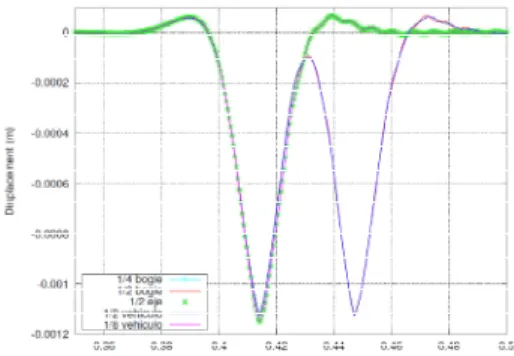
Figure 4 shows the displacement of a point in the rail obtained in the dynamic calculation of vehicle-track interaction with different models considered. It is noted that the structural responses obtained are very similar. However, the 1/2 axle model does not represent the reality of the vehicle, this model only has one natural frequency (about 220 Hz) while the actual vehicle has other relevant frequencies that could give different results in other frequency of excitation by the irregularities, speed, etc ... The model of 1/4 bogie gives results similar to other models and has natural frequencies in the range of interest (f1=220.9 Hz, f2 = 3.82 Hz) compared to other excitation frequencies of the track. Therefore the 1/4 bogie model was used for this work.
Fig.6 Displacement of a point of rail for different vehicle models at speed 360 km/h.
2.2.2 Full three-dimensional model
modeled and the frequencies of the modes are obtained in the range of 0 to 40 Hz.
Fig.7 Full three-dimensional model developed in Abaqus
Table 2 presents the first most representative modes of vibration of the vehicle.
Table 1 Parameters of ballast track model
Vibration modes
No. of mode
Frequency
(Hz) Description
1 0.63973 Lateral movement and rolling car-body
2 0.75975 Vertical movement of car-body
3 0.94684 Pitching car-body
4 1.12670 Rolling bottom of car-body
5 3.28060 Yawing car-body and rolling bogies
3 Numerical results
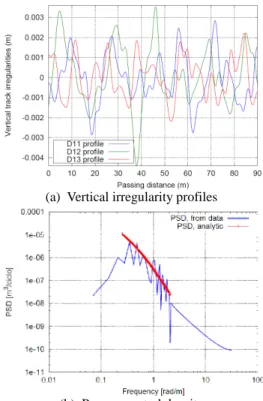
In this part of the study, the train runs on the track with constant speed, taking into account the track irregularity profile (the wavelength is in range [3m-25m]). The irregularity is generated from the power spectral density (see Clauss and Schiehlen, 1998) according to maximum considered limit (intervention limit) defined in CEN, 2008. For dynamic analysis, we have applied three different generated irregularity profiles consistent with such limits (figure 8(a)). And the reverse process has been applied to verify the accuracy of the irregularities created (see figure 8(b)).
3.1 Two-dimensional analysis
As discussed in the previous section 3.2.1, the model of 1/4 bogie is selected for this work. Therefore, we used this model of 1/4 bogie to study the dynamic interaction of vehicle/track.
(a) Vertical irregularity profiles
(b) Power spectral density
Fig.8 Generation of vertical irregularity profiles.
The calculation is done in the time domain, using the HHT time integration method to solve the transient problem. The contact problem is modeled by the method of Lagrange multipliers. The numerical simulations are done with different speeds (from 200 km/h to 360km/h) for each irregularity profile proposed and we have obtained the following results:
• Contact force between the wheel and the rail
• The force in the primary suspension
Fig.9 Contact force at the speed 360 km/h
Fig.10 Envelope of dynamic amplification of contact force
3.2 Three-dimensional analysis
The analyses have been carried out using the 3D coupled vehicle/track model (figure 11).
Fig.11 Three-dimensional coupled vehicle/track model
Contact force at the speed 360 km/h
Envelope of dynamic amplification of
The analyses have been carried out using the 3D
We obtained the contact force and the envelope of dynamic amplification of contact force in function of speed. The results obtained will be compared with the results in 2D dynamic interaction in subsection 3.1. Some representative results are shown in figure 12 and 13. We may observe that the results obtained in the 3D dynamic analysis are similar in amplitude to 2D results. Demonstrating the validity of 2D model used.
Fig.12 Contact force at the speed 360 km/h
Fig.13 Comparison of the results obtained in 3D analysis with 2D analysis
4 Conclusions and future works
In this study, a 2D finite element model for the analysis of high-speed railway interaction was proposed; in which various improved finite elements were adopted to model the structural constituents of railway.
multipliers method. The dynamic responses are very sensitive both to the track irregularities and the vehicle speed.
The model reported in this paper is capable of predicting the dynamic responses of both the vehicle and the rail track components. The model is also capable of examining the influence of the properties of the rail track and the wagon components on the contact force and other dynamic responses of the rail track and vehicle system.
Acknowledgement
The authors acknowledge the financial support of Ministerio de Fomento of Spain-CEDEX to the project “Estudio del comportamiento a medio y largo plazo de las estructuras ferroviarias de balasto y placa” (Ref. PT-2006-024-19CCPM-Proyecto de investigacion del Plan Nacional). Nguyen K. would like to express his gratitude to AECID for the grant of PhD during this study.
References
Cai Z. and Raymond G. 1994. Modelling the
dynamic response of railway track to
wheel/rail impact loading. Structural
Engineering and Mechanics, 2:95–112. CEN. EN 1991-2:2003. Eurocode 1: Actions on
structures - Part 2: Traffic loads on bridges.
European Committee for Standardization, European Union, rue de Stassart, 36B-1050 Brussels, September 2003.
CEN. EN 1990:2002/A1:2005 - Eurocode -
Basis of Structural Design. Annex A2. Application for Bridges. European Committee
for Standardization, European Union, rue de Stassart, 36B-1050 Brussels, December 2005. CEN. EN13848-5:2008. Railway Applications -
Track - Track Geometry quality part 5:
Geometric quality levels. European
Committee for Standardization - European Union, rue de Stassart, 36B-1050 Brussels, march 2008.
Clauss H. and Schiehlen W. 1998. Modeling and
Simulation of railways bogie structural vibrations. Vehicle System Dynamics, 29(S1):
538–552.
Dinh N., Kim K. and Warnitchai P. 2009.
Simulation produce for vehicle-substructure
dynamic interactions and wheel movements using linearized wheel-rail interfaces. Finite
Elements in Analysis and Design, 45: 341– 356.
Esveld C. 2001. Modern Railway Track. MRT Productions.
Fryba L. 1996. Dynamics of railways bridges. Thomas Telford.
Fryba L. 1999. Vibration of solids and structures
under moving loads. Thomas Telford, third
edition.
Johnson K. 1985. Contact Mechanics.
Cambridge University Press, UK, 1985. Lei X. and Noda N. 2002. Analyses of dynamic
response of vehicle and track coupling system with random irregularity of track vertical profile. J. Sound Vib, 258:147–165.
Melis M. 2007. Embankments and Ballast in
High Speed Rail. Fourth part: Highspeed
railway alignments in Spain. Certain
alternatives. Revista de Obras Publicas, 3476:
41–66.
Popp K., Kaiser I. and Kruse H. 2003. System
dynamics of railway vehicles and track.
Archive of Applied Mechanics, 72.
Song M., Noh H. and Choi C. 2003. A new
three-dimensional finite element analysis model of high speed train-bridge interactions.
Engineering Structures, 25:1611–1626. Sun Y. and Dhanasekar M. 2002. A dyanmic
model for the interaction of the rail track and wagon system. International Journal of Solids
and Structures, 39: 1337–1359.
Timoshenko S. and Young D. 1995. Vibration
problems in engineering. Van Nostrand, NY,
third edition.
Zhang Q., Vrouwenvelder A. and Wardenier J. 2003. System dynamics of railway vehicles
and track. Archive of Applied Mechanics, 72.
Zienkiewicz O., Emson C. and Bettess P. 1983.
A novel boundary infinite element. Int. J.