
Establishing Manufacturing Subsidiaries Abroad: The Influence of Interaction Capacity on Technology Transfer Edición Única
289
0
0
Texto completo
(2)
(3) ABSTRACT OF DISSERTATION GRADUATE SCHOOL OF BUSINESS AND LEADERSHIP, INSTITUTO TECNOLOGICO Y DE ESTUDIOS SUPERIORES DE MONTERREY, CAMPUS MONTERREY Degree: Doctor of Philosophy. Program: Doctoral Program in Administration. Name of Candidate: Andreas Michael Hartmann Committee Chair: Bryan W. Husted Title: ESTABLISHING MANUFACTURING SUBSIDIARIES ABROAD: THE INFLUENCE OF INTERACTION CAPACITY ON TECHNOLOGY TRANSFER. This study combines the knowledge-based and the capability views of the firm for building and testing a model of technology transfer between units of multinational corporations (MNCs). Within the model, the technology to be transferred is presented as organizational knowledge, which is partially tacit, distributed, and embedded in a social context. The transfer process can be carried out more or less efficient depending on a firm’s transfer capability, which is decomposed into the sending unit’s emissive capacity, the dyad’s interactive communication capacity, the receiving unit’s absorptive capacity, and the receiving unit’s local adaptation capacity. The empirical study focuses on interaction capacity and seeks to identify those organizational practices that speed up or slow down the transfer process. The transfer event under study is the setup of manufacturing facilities by MNCs. The dependent variable was the time required for setting up a new manufacturing subsidiary. Different versions of the dependent variable were defined by the milestones of start of construction, arrival of machines, first iv.
(4) shipment, full capacity, and corporate-level productivity. The sample consisted of the manufacturing subsidiaries of foreign MNCs set up in the Northeast Mexican state of Nuevo Léon that started operations between 1998 and 2007. Data were gathered through a survey applied to the focal subsidiaries managers. A general finding of the study was that setup times differed by a ratio of up to 1:100. Subsidiary size was not found to be relevant, but complexity was. The mathematical model for analyzing the data was a moderated regression analysis, where four different indicators of the difficulty of the transfer task were used to make the transfer events comparable among each other: supplier diversity, documentation, teachability, and interunit similarity. Supplier diversity made the initial phase of the setup process especially difficult. Contrary to the literature on knowledge codification, documentation of technology was found to be helpful only when combined with face-to-face communication. Teachability proved to be the most reliable indicator of the difficulty of the transfer task. The fourth moderator, namely interunit similarity, showed that firms that replicated an existing organizational structure had an easier task for the initial phase of the setup. Six main hypotheses were tested in the study. H1 posited a positive effect of interunit communication on transfer efficiency. With frequency of incoming visits as independent variable, H1 was confirmed for all phases, while more expatriates were only helpful in the ramp-up phase. H2 concerned the difference between mediated and face-to-face communication. The data not only confirmed H2 but showed a reverse causality in the sense that phone communication increased when the setup was slow, but did not improve the process. H3 predicted a positive effect of interunit trust on transfer efficiency, which was found only for the less well defined tasks within the setup process and when trust had had time to evolve. H4 v.
(5) posited that a buyer-supplier relationship between the sending unit and the receiving unit would help with setup performance, but was not confirmed. To the contrary, new subsidiaries that depended on their MNCs as suppliers took longer for their setup processes. H5 concerned the MNC's host country experience, which was found to be significant for the less structured tasks within the setup process. Finally, H6 predicted that the general manager's setup experience would have a positive effect on transfer times. This effect was found for the ramp-up phase when the technology was easily teachable. Furthermore, host country nationals as general managers had an advantage for starting and ramping up when technology was not too complex; in all other cases, foreign experts achieved higher performances. The study discusses the implications of these findings for management theory and MNC practice and presents suggestions for further research.. vi.
(6) RESUMEN ESCUELA DE GRADUADOS EN ADMINISTRACIÓN Y DIRECCIÓN DE EMPRESAS, INSTITUTO TECNOLÓGICO Y DE ESTUDIOS SUPERIORES DE MONTERREY, CAMPUS MONTERREY Grado: Doctor en Filosofía. Programa: Programa Doctoral en Administración. Nombre del Candidato: Andreas Michael Hartmann Presidente del Comité: Bryan W. Husted Título: ESTABLECIENDO SUBSIDIARIAS MANUFACTURERAS EN EL EXTRANJERO: LA INFLUENCIA DE LA CAPACIDAD DE INTERACCIÓN SOBRE LA TRANSFERENCIA DE TECNOLOGÍA. Esta disertación combina la visión de la empresa basada en el conocimiento y el enfoque de las capacidades para construir y probar un modelo de la transferencia de tecnología entre unidades de corporaciones multinacionales. El modelo presenta la tecnología a transferir como conocimiento organizacional, el que es parcialmente tácito, distribuido y se inserta en un contexto social determinado. El proceso de transferencia puede realizarse con mayor o menor eficiencia, dependiendo de la capacidad de transferencia de la empresa en cuestión, misma que puede descomponerse en capacidad de emisión de la unidad emisora, capacidad de interacción comunicativa del binomio, capacidad de absorción de la unidad receptora y capacidad de adaptación local de la unidad receptora. El estudio empírico se enfoca en la capacidad de interacción y busca identificar aquellas prácticas que aceleren o frenen el proceso de transferencia. El evento de transferencia estudiado es el establecimiento de subsidiarias manufactureras por parte vii.
(7) de corporaciones multinacionales. Se definieron diferentes versiones de la variable dependiente en base a los hitos de arranque de la construcción, llegada de la maquinaria, primer embarque, plena capacidad y nivel de productividad establecido por el corporativo. La muestra consistió en las subsidiarias manufactureras de multinacionales extranjeras establecidas en Nuevo León, México, entre 1998 y 2007. Los datos fueron obtenidos mediante una encuesta aplicada a los gerentes de las subsidiarias en cuestión. Un hallazgo general del estudio fue que los tiempos de establecimiento difirieron a una razón de uno a cien. Se encontró que el tamaño de la subsidiaria no fue relevante, pero la complejidad de la tecnología sí lo fue. El modelo matemático utilizado para analizar los datos fue una regresión múltiple con moderación, en la que se usaron cuatro indicadores para hacer los eventos de transferencia comparables entre sí: diversidad de proveedores, documentación, enseñabilidad y similitud entre unidades. La diversidad de los proveedores dificultó especialmente la fase inicial. Contradiciendo la literatura sobre la codificación del conocimiento, se encontró que la documentación de la tecnología ayudaba sólo cuando se combinaba con la comunicación cara a cara. La enseñabilidad de la tecnología resultó ser el indicador más fiable de la dificultad de la tarea de transferencia. El cuarto moderador, similitud entre unidades, demostró que las compañías que replicaban una estructura organizacional existente tenían una tarea más fácil durante la fase inicial del establecimiento de su subsidiaria. En la disertación se probaron seis hipótesis principales. Según H1, existía un efecto positivo de la comunicación entre unidades sobre la eficiencia de transferencia. Tomando la frecuencia de las visitas a la subsidiaria como variable independiente, H1 fue confirmada para todas las fases, mientras que un mayor número de expatriados sólo ayudaba en la fase de expansión de la producción. H2 se refería a la viii.
(8) diferencia entre la comunicación por medios electrónicos y la directa. Los datos no sólo confirmaron H1 sino que mostraron una causalidad invertida, en el sentido de que la comunicación por teléfono incrementaba en frecuencia cuando el establecimiento se retrasaba, sin que eso haya mejorado el proceso. En H3 se predecía un efecto positivo de la confianza entre unidades sobre la eficiencia de la transferencia, mismo que se encontró sólo para las tareas menos bien definidas dentro del proceso y cuando había tiempo para desarrollar dicha confianza. En H4 se predecía que una relación de proveedor-cliente entre la unidad emisora y la receptora iba a ayudar con el tiempo de establecimiento, pero tal efecto no fue encontrado. Al contrario, las nuevas subsidiarias que dependían de insumos proveídos por sus propias multinacionales necesitaban más tiempo para su proceso de establecimiento. H5 sobre la experiencia de las multinacionales en el país anfitrión se confirmó sólo para las tareas menos estructuradas dentro del proceso de establecimiento. Finalmente, según H6 se predecía que la experiencia de establecimiento del gerente general iba a tener un efecto positivo sobre la eficiencia de la transferencia, mismo que se encontró para la fase de expansión de la producción cuando la tecnología era fácilmente enseñable. Además, los nacionales del país anfitrión tenían una ventaja para el arranque y la expansión de producción cuando la tecnología no era muy compleja, mientras que en todos los demás casos, los expertos extranjeros obtuvieron mejores resultados. Al final de la disertación se discuten las implicaciones de sus hallazgos para la teoría de la administración y la práctica de las empresas multinacionales y se presentan algunas sugerencias para estudios futuros.. ix.
(9) TABLE OF CONTENTS LIST OF TABLES ………………………………………………………….………….. xiv LIST OF FIGURES …………..…………….....................................…….…………….. xv 1. Introduction ..................................................................................................................1 1.1 The Research Problem..........................................................................................1 1.2 Technology Transfer by Multinational Corporations within a Wider Context ....3 1.3 The Task of Setting up New Manufacturing Subsidiaries....................................4 1.4 Delimitation of the Research Topic......................................................................6 1.5 Objective of This Study........................................................................................7 1.6 Structure of This Study.........................................................................................8. 2. Literature Review .......................................................................................................10 2.1 The Current State of Research on Knowledge Transfer.....................................11 2.2 Models and Classifications of Technology Transfer..........................................12 2.2.1 Models of Technology Transfer 1: Communication Theory......................13 2.2.2 Models of Technology Transfer 1A: Translation.......................................14 2.2.3 Models of Technology Transfer 2: Organizational Learning.....................14 2.2.4 Models of Technology Transfer 3: Knowledge Management...................16 2.2.5 Models of Technology Transfer 4: The Knowledge View.........................16 2.2.6 Models of Technology Transfer 4A: Knowledge Flows............................17 2.2.7 Models of Technology Transfer 4B: Knowing As an Activity ..................18 2.2.8 Models of Technology Transfer 5: Project Management...........................18 2.2.9 Models of Technology Transfer 6: Social Networks .................................18 2.2.10 Models of Technology Transfer 7: Controls Theory..................................19 2.2.11 Models of Technology Transfer 8: Expatriate Performance ......................20 2.2.12 Models of Technology Transfer 9: Transfer as a Stagewise Process .........20 2.3 Empirical Studies of Technology Transfer in MNCs.........................................21 2.3.1 The Dependent Variable in Technology Transfer Studies .........................22. 3. Research Model ..........................................................................................................26 3.1 The Concept of Organizational Knowledge and Its Implications for Transfer ..26 3.2 Technology Transfer and the Knowledge-Based View of the Firm...................33 3.3 A Capability View of Knowledge Transfer........................................................35 3.4 The Cost of Technology Transfer.......................................................................40 3.5 The Time Required for Technology Transfer ....................................................42 3.6 The Difficulty of the Technology Transfer Task ...............................................42 3.7 Dyadic Interaction Capacity ...............................................................................48 3.8 Hypotheses 1 and 2: Interunit Communication ..................................................48 3.9 Hypothesis 3: Interunit Trust..............................................................................50 3.10 Hypothesis 4: Commonality of Interests and Incentives ....................................51 3.11 Hypothesis 5: The MNC's Foreign Experience ..................................................52 3.12 Hypothesis 6: The General Manager's Experience.............................................53 3.13 Moderating Hypotheses: Difficulty of the Transfer Task ..................................53 x.
(10) TABLE OF CONTENTS (continued) 3.14 3.15 3.16 3.17. Control Variables Related to the Firm................................................................56 Control Variables Related to Outside Influences ...............................................58 Control Variables Related to the Respondent ....................................................60 Control Variables Related to the Interview ........................................................60. 4. Methodology ..............................................................................................................63 4.1 Choice of Research Method ...............................................................................63 4.2 Operationalizations.............................................................................................64 4.2.1 Operationalization of the Dependent Variable ...........................................64 4.2.2 Operationalization of the Independent Variables .......................................65 4.2.3 Operationalization of the Moderating Variables ........................................66 4.2.4 Operationalization of the Control Variables...............................................67 4.3 Questionnaire......................................................................................................67 4.4 Sample ................................................................................................................68 4.5 Data Collection...................................................................................................70. 5. Data Analysis .............................................................................................................73 5.1 Raw Data ............................................................................................................73 5.1.1 Response Rate and Non-Response Bias .....................................................73 5.1.2 Setup Times ................................................................................................76 5.1.3 Comparing Subsets of the Sample..............................................................79 5.2 Preparing the Data for Regression Analysis.......................................................80 5.2.1 Converting Questionnaire Data into Analyzable Data ...............................80 5.2.2 Data Screening............................................................................................83 5.2.3 Univariate Outliers .....................................................................................83 5.2.4 Missing Data...............................................................................................85 5.2.5 Dimension Reduction .................................................................................90 5.2.6 Normality....................................................................................................96 5.3 Correlation Analysis.........................................................................................106 5.3.1 Correlations among Dependent Variables................................................106 5.3.2 Correlations between Dependent Variables and Control Variables .........107 5.3.3 Correlations between Dependent Variables and Independent Variables .109 5.3.4 Correlations between Dependent Variables and Moderating Variables...110 5.3.5 Correlations among Control Variables .....................................................111 5.3.6 Correlations between Control Variables and Independent Variables.......116 5.3.7 Correlations between Control Variables and Moderating Variables........121 5.3.8 Correlations among Independent Variables .............................................122 5.3.9 Correlations between Independent Variables and Moderating Variables 125 5.3.10 Correlations among Moderating Variables ..............................................127 5.4 Dimension Reduction for Regression Analyses ...............................................131 5.4.1 Reducing the Number of Control Variables .............................................131 5.4.2 Reducing the Number of Independent Variables .....................................133 5.4.3 Reducing the Number of Moderating Variables ......................................135 xi.
(11) TABLE OF CONTENTS (continued) 5.5 Regression Analyses.........................................................................................138 5.5.1 Regression Analyses for DV0: Start of Construction to First Shipment..141 5.5.2 Regression Analyses for DV1: Arrival of Machines to First Shipment ...145 5.5.3 Regression Analyses for DV2: Arrival of Machines to Full Capacity.....146 5.5.4 Regression Analyses for DV3: Arrival of Machines to Corporate-Level Productivity ..............................................................................................152 5.5.5 Regression Analyses for DV4: First Shipment to Full Capacity..............161 5.5.6 Regression Analyses for DV5: First Shipment to Corporate-Level Productivity ..............................................................................................165 5.5.7 Comparison of Regression Analyses across Phases .................................174 6. Results and Discussion.............................................................................................177 6.1 Significance of Findings...................................................................................177 6.2 Control Variables..............................................................................................178 6.3 Moderation Approach.......................................................................................182 6.3.1 Effects of MV2 (RECIP Supplier Diversity)............................................183 6.3.2 Effects of MV5 (Documentation Exists)..................................................185 6.3.3 Effects of MV6 (Teachability) .................................................................191 6.3.4 Effects of MV7 (Similar Manufacturing).................................................196 6.3.5 General Results of the Moderation Approach ..........................................201 6.4 Results for Hypotheses 1 and 2: Communication between the Units ..............202 6.5 Results for Hypothesis 3: Interunit Trust .........................................................205 6.6 Results for Hypothesis 4: Interdependence between Units ..............................206 6.7 Results for Hypothesis 5: MNC Experience ....................................................208 6.8 Results for Hypothesis 6: General Manager's Experience ...............................208. 7. Conclusions ..............................................................................................................210 7.1 Contributions ....................................................................................................210 7.1.1 Contributions to the Theory of the MNC .................................................210 7.1.2 Contributions to the Knowledge-Based View of the Firm .......................214 7.1.3 Contributions to Practice ..........................................................................218 7.2 Limitations........................................................................................................220 7.3 Directions for Future Research.........................................................................221 7.3.1 Alternative Dependent Variables .............................................................221 7.3.2 Exploring Mediation and Three-Way Interaction Effects ........................222 7.3.3 Testing the Unexplored Portions of the Transfer Capability Model .......224 7.4 Some General Conclusions...............................................................................225. 8. References ................................................................................................................227. Appendix 1: Questionnaire in English .............................................................................249 Appendix 1: Questionnaire in Spanish .............................................................................261 xii.
(12) TABLE OF CONTENTS (continued) Biographical Sketch .........................................................................................................275. xiii.
(13) LIST OF TABLES Table. Description. Table 1. Response Rates and Years of Setup. 74. Table 2. Response Rates and Headquarters Countries. 74. Table 3. Response Rates and Headquarters Regions. 75. Table 4. Descriptive Statistics of Raw Data (in Months). 77. Table 5. Means, Standard Deviations, and Correlations for Full Set of Variables (without Interaction Terms). 128. Table 6. Models for Regression Analyses. 140. Table 7. Results of Regression Analyses for DV0 (Start of Construction to First Shipment) and DV1 (Arrival of Machines to First Shipment). 144. Results of Regression Analyses for DV2: Arrival of Machines to Full Capacity. 151. Table 8 Table 9. Page. Results of Regression Analyses for DV3: Arrival of Machines to Corporate-Level Productivity. 159. Table 10 Results of Regression Analyses for DV4: First Shipment to Full Capacity. 164. Table 11 Results of Regression Analysis for DV5: First Shipment to Corporate-Level Productivity. 172. Table 12 Best Models for the Different Versions of the Dependent Variable. 176. xiv.
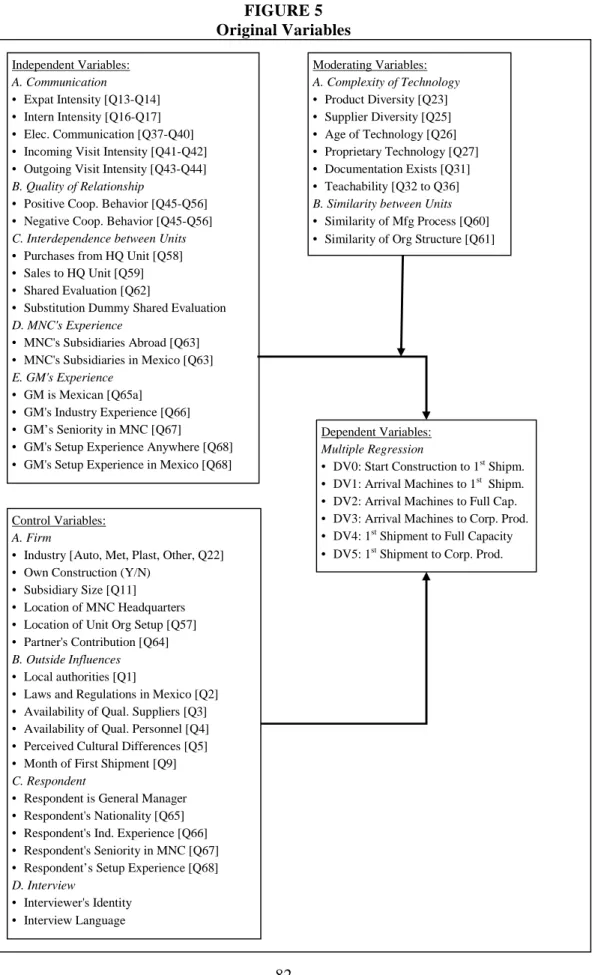
(14) LIST OF FIGURES Figure. Description. Figure 1. International Technology Transfer as Constitution of an Organization with People and Resources from Two Different Countries. 32. Analytical Decomposition of the Internal Transfer Capacity of an MNC. 40. Figure 3. Path Diagram of Hypotheses. 62. Figure 4. Frequency Distributions of Setup Times. 78. Figure 5. Original Variables. 82. Figure 6. Full Set of Variables with Transformations and Numbering. 105. Figure 7. Phases in Plant Setup and Dependent Variables. 107. Figure 8. Reduced Set of Variables with Transformations and Numbering. 137. Figure 2. Page. xv.
(15) 1. Introduction. 1.1 The Research Problem In many sectors of our present-day economy, firms compete against each other on the basis of organization-specific knowledge as their most important asset. In order to exploit economies of scale (cf. Nachum, 2003), to access new markets, and to take advantage of cost differentials, these technology-based companies grow by transferring their knowledge to additional production facilities within the same country or abroad. In principle, the recipients of the transfer can be either internal units or external partners, such as joint venture partners or licensees. There is empirical evidence that multinational corporations (MNCs) are increasingly relying on intrafirm transfer (Desai, Foley, & Hines, 2004) over joint ventures. In this sense, MNCs can be defined as specialists in cross-border knowledge transfer (Kogut & Zander, 1993). From the capability or competence perspective of the firm (cf. Foss, 1993), an MNC’s transfer capability is an important strategic advantage (Argote & Ingram, 2000) that allows for both the expansion of identical production processes and international corporate diversification (Fang, Wade, Delois, & Beamish, 2007). Since Teece (1976, 1977a) showed that transfer processes can be extremely costly, the process of knowledge transfer within MNCs has been the object of many case studies, which demonstrate the practical difficulties of these processes. Since the mid-1990's, there have also been numerous quantitative studies, which build mostly on the concepts of the recipient's "absorptive capacity" (Cohen & Levinthal, 1990) or the "stickiness" (von. 1.
(16) Hippel, 1994)1 of the technology. All these studies clearly show two things: The difficulty of the transfer task varies from one case to another and MNCs differ widely in the efficacy of their transfer processes. For example, in this study, it was found that from the arrival of the machines to the first delivery, setup times for new manufacturing plants varied between less than one month and over nine years, i.e., in a proportion of one to one hundred. Similarly, while new plants took an average of two and a half years from their first shipment to reaching corporate-level productivity, other subsidiaries needed over eight years before they achieved similar results. The sample of the present study even included an MNC where the subsidiary's original general manager had been fired for continuously missing productivity targets. Obviously, these differences in transfer efficiency can have a significant impact on overall performance: When production targets are not met, MNCs risk incurring in higher costs or even in losing their customers. On the other hand, a speedy transfer process can reduce the time for introducing products to new markets before the competitors have theirs available. Finding out which organizational practices increase or diminish transfer performance is the main goal of the present study. Almost all other studies of technology transfer so far have focused on isolated practices; so it is by no means clear if the results from the literature are equally valid for the setup of whole plants. For obtaining an adequate representation of the phenomenon, a comparative study of technology transfer has to fulfill two conditions: First, it must take into account the properties of the knowledge to be transferred, which varies in its degree of complexity 1. For an overview of the field and its literature, cf. Howells (2000), Becker and Praest Knudsen (2003), and Schlegelmilch and Chini (2003).. 2.
(17) while it is always partially tacit, distributed among different members of the organization, and embedded in a specific social context. Second, the study should be framed within a coherent model of technology transfer that takes into account the actors, their motivations, and the channels used for transmission. Building on the literature on knowledge transfer in MNCs, this study presents such a model and applies it to a specific situation of interunit knowledge transfer in the MNC. According to Roth and Kostova (2003), the MNC is an especially adequate context for validating and expanding existing theories of the organization. The study thus hopes to make a contribution to the underlying theories of the MNC and the knowledge-based view of the firm. 1.2 Technology Transfer by Multinational Corporations within a Wider Context Economists classify the cross-border transfer of manufacturing technology and practices between units of international firms under the label of Foreign Direct Investments (FDI). Emerging nations have three major reasons for attracting FDI: The arrival of advanced technology in the country is supposed to lead to so-called “trickledown effects”2 that are expected to help advance the domestic technology. New plants established by international firms also offer jobs to the local population. Finally, the balances of payment of FDI host countries benefit from the export of goods manufactured within their territories, as MNCs play an increasingly important role in global trade. In a broad sense, this study thus belongs to the literature on FDI in emerging economies. Furthermore, the term “technology transfer” covers a variety of different types of activities and relationships (cf. Amesse & Cohendet, 2001), which extend from the sale of. 2. Empirical studies have not found clear evidence for these general spillover effects (cf. Aitken, Hanson, & Harrison, 1997), although it seems to be clear that FDI improves the domestic firms' export capacity (Aitken & Harrison, 1999).. 3.
(18) high technology to developing nations to the transmission of innovations from the lab to the factory floor. This study is concerned exclusively with the setup of new production facilities by multinational corporations in countries other than their home bases. In most cases, the manufacturing technology that is transferred to developing or emerging economies has already been tried out in another country, often the MNC’s home country. To the extent that these technologies are not altered significantly compared to the home country operation, the transfer can be called “horizontal”, as opposed to “vertical” transfers, which run from the development of the pertaining technology to its application in manufacturing processes (Zander, 1991, quoted in Autio & Laamanen, 1995). This theoretical distinction may have to be qualified in today’s speed-oriented, globalized economy, which forces MNCs to apply state-of-the-art technology at all their production sites, so that each site includes at least some elements of new technology that had not been previously tried out in mass production. 1.3 The Task of Setting up New Manufacturing Subsidiaries MNCs can be considered to be specialists for cross-border transfer (Kogut & Zander, 1993), a function they are supposed to perform more efficiently than both alliances and markets (Almeida, Song, & Grant, 2002). In the sense applied here, “[t]echnology transfer is ... the replication of existing activities”, an inherently complex and difficult task where “[t]he goal of the firm is to reduce the costs of this transfer while preserving the quality and value of the technology” (Kogut & Zander, 1992: 390). When an MNC chooses to transfer its technology internally as opposed to licensing or forming a joint venture with a local partner, one of the main rationales is often to keep control over the proprietary rights of patented and non-patented knowledge. 4.
(19) Managers of FDI projects have to integrate a transferred core (machines, technological knowledge, and organizational knowledge) and local resources (workers and physical inputs) to form new socio-technical systems, which vary in their degrees of similarity to existing systems in the sending organization. Conceptually, the overall task can be divided into five groups of activities: •. Sending technology from the home country;. •. Receiving technology in the host country;. •. Adapting the transferred knowledge to local constraints;. •. Acquiring local resources;. •. Integrating transferred and local resources and knowledge to form a functioning system by establishing “routines” (cf. Nelson & Winter, 1982) within a “hybrid” (Lorenz & Lazaric, 2000) organization.. Compared to this set of activities, it becomes clear that both the customary term “technology transfer” and Robinson’s (1991) concept of “communication of technology” oversimplify an FDI project manager’s task and exclude vital elements from it, notably those related to the organizational integration of knowledge (Grant, 1996b) and to the organizational adaptation to local conditions and constraints. The mutual adaptation of technology and organization is a phenomenon that has been documented in case studies of the introduction of new technologies, where “the adaptation process is necessary because a technology almost never fits perfectly into the user environment” (Leonard-Barton, 1988: 252). Similar arguments have been applied to technology transfer (cf. Lachman, Nedd, & Hinings, 1994), although empirical evidence is scant (e.g., Lin, Tan, & Chang, 2002; Malik, 2002; Maritan & Brush, 2003). FDI 5.
(20) projects thus go beyond the information-forwarding paradigm, a fact that most researchers have only hinted at (cf. Amesse & Cohendet, 2001) although it has been recognized that “no definite distinction between transfer of knowledge and creation of new knowledge exists” (Bresman, Birkinshaw, & Nobel, 1999: 444). 1.4 Delimitation of the Research Topic Technology transfer is a phenomenon that takes on many forms (cf. Amesse & Cohendet, 2001) and has been the object of different streams of research. The following paragraphs describe the type of technology transfer that is the topic of this study. Concerning the scope of transfer, this study looks at the whole process with many overlapping and interconnected single transfer events as opposed to the transfer of specific technologies or organizational practices that other researchers have studied (e.g., Kostova & Roth, 2002; Szulanski, 1996). Concerning the temporal unity, this study looks at the transfer process as a succession of stages with specific milestones, similar to Szulanski's (2003) stagewise approach to technology transfer. Concerning the ownership and setting of the focal subsidiary, the sample is limited to greenfield investments implemented and owned by foreign MNCs, excluding joint ventures and other forms of cooperation between national and foreign partners such as mergers, acquisitions, or strategic partnerships because of possible differences in organizational culture and motivation. This choice supposes to minimize problems related to commitment and identity between both units (cf. Kostova, 1999), as the recipient unit is initially highly dependent on the sending unit as the main source of the technology to be used. 6.
(21) Concerning the phase in the life cycle of the transferred technology, this study only considers the (approximate) replication of an existing technology and organizational structure, analogous to Nelson & Winter’s (1982) concept of replicating routines from a “template”. Cases where the results of research and development are applied to production for the first time are explicitly excluded, as they present a completely different set of phenomena. Nevertheless, the study will control for possible deviations from the simplifying assumption that transfer is pure replication. Finally, the study considers the transfer of technologies in manufacturing industries, leaving out the service sector. 1.5 Objectives of This Study On a theoretical level, this study deals with how firms’ specific capabilities build on mechanisms that foster the transfer of knowledge. This supposes a specific case where the capability or competence view of competition is grounded in the knowledge-based view (KBV) of the firm (cf. Grant, 1996b). The comprehensive model that is proposed here aims at bridging the theoretical gap between firm capabilities and organizational practices in order to build a more “fine-grained model of governance” (Grandori, 2001). The goal is to find an answer to Kogut and Zander's (1996) rhetorical question "What do firms do?" applied to the task of technology transfer. From the theoretical point of view, the study applies the general propositions of the KBV about the internal structure of organizations to dyadic relationships within MNCs. Although there has been substantial research on the transfer of isolated organizational practices between MNC units, there is next to zero systematic evidence about the process of setting up whole facilities and making them operational. The literature (e.g. Gupta & 7.
(22) Govindarajan, 2000) suggests that face-to-face communication plays a pivotal role in these kinds of processes, but research results are still missing or contradictory concerning the influence of aspects such as trust, interdependence between units, and transfer experience on transfer performance. On a practical level, the study looks for answers to two empirical questions: First, are there substantial differences between the technology transfer capabilities of different firms? If these differences matter, they could explain why a technological advantage in itself is not sufficient to gain a competitive advantage in the global economy (cf. Jones, 2002). Second, which organizational practices explain these differences? For managers of MNC headquarters and subsidiaries, it is important to know how they can accelerate their technology transfer projects and make them more effective and less expensive. As Almeida, Song and Grant found in interviews with MNC managers, “every company we spoke to recognized the need to improve the efficiency of internal knowledge transfer” (2002: 159). The results of this study are expected to offer practical guidance for managers of MNCs, which should enable them to improve the setup of new subsidiaries not only in Mexico, but worldwide. 1.6 Structure of This Study This introductory section is followed by a systematic review of the literature on knowledge transfer from two different points of view: the underlying models and the dependent variables. Section 3 contains the justification of the research model: The characteristics of organizational knowledge and its implications for transfer. The main axioms of the Knowledge-Based View are reviewed and connected to the concept of 8.
(23) transfer capability, which is developed into a general model. The discussion of the cost and difficulty of technology transfer leads to the formulation of the specific research hypotheses for the MNC’s dyadic interaction capability. The methodology is outlined in section 4, which explains the operationalization of the variables, the establishment of the sample, the method for collecting the data, and the analytical tools used. A substantial part of this study consists of the detailed data analysis in section 5. The results of this study are presented and discussed in section 6. Finally, section 7 summarizes its contributions and limitations and offers an outlook at connected research topics.. 9.
(24) 2. Literature Review Within the research on multinational corporations, technology transfer has become. a common topic: A search performed on May 27, 2007, on the Proquest database using the alternative terms "technology transfer" OR "knowledge transfer" AND various synonyms for "multinational corporation"3 in the "Citation and document text" field plus the additional restriction "scholarly journals, including peer-reviewed" came up with 1,505 articles. There are at least three explanations for this impressive research interest: Firstly, on the level of general focus, it can be taken as evidence for the fact that knowledge or technology and its transfer have been recognized as the key element for the expansion of multinational corporations and their efforts to maintain their competitive advantages, which is the main axiom of the knowledge-based view of the firm (Grant, 1996b). Secondly, the large number of studies points to the lack of a unified research prism, where authors from different traditions focus on similar phenomena using different lenses. The result is a multitude of models that do not allow building on each other but rather coexist independently of each other. Finally, papers on technology transfer in MNCs are so numerous because "technology transfer" and "knowledge transfer" are umbrella terms for a wide range of phenomena. The large number of articles found also demonstrates that a fully comprehensive, detailed review of the whole field of technology transfer is simply not feasible any more. Instead, this review presents some representative examples of the empirical literature on technology transfer that have been published mostly in management journals,. 3. "international corporation" OR "international firm" OR "MNC" OR "MNE" OR "multinational enterprise" OR "multinational firm" OR "multinational corporation" OR ""transnational firm" OR "transnational corporation". 10.
(25) especially in the field of international management. The goal is to present a clearer picture of what the literature really refers to, which aspects have been covered in detail, and where there remain unchartered waters in the collective knowledge on technology transfer. This review presents the literature along two axes: The first part explores the different paradigms that authors have used in their studies for framing the complex phenomena of technology transfer. The second part classifies the empirical studies according to their dependent variables. 2.1 The Current State of Research on Knowledge Transfer Most studies of knowledge transfer within MNCs have focused on formal organizational structure (for a historical review, cf. Martinez & Jarillo, 1989). Notably Bartlett and Ghoshal (1989) have developed this approach into the “transnational solution” of MNC organizational design (cf. Hedlund’s (1994) similar concept of the “Nform”), which has been used as a basis for much international business research (e.g., Lord & Ranft, 2000). On the other hand, it is being recognized that “[w]e currently know little about the micro-processes involved in an intraorganizational search and transfer of knowledge” (Levine, 2003). Gupta and Govindarajan concur that “[c]onceptual work in this area is still in the early stages and empirical work is almost literally in the stage of infancy” (2000: 491). As to conceptualization, some articles contain lists of factors relevant for technology transfer (e.g. Gibson & Smilor, 1991; Goh, 2002), but very few papers develop a comprehensive theoretical perspective on the matter. Two notable exceptions are Seaton and Corday-Hayes’ (1993, quoted from Taschler & Chappelow, 1997) accessibilitymobility-receptivity model and Rebentisch and Ferreti’s (1995) research propositions 11.
(26) built around the concepts of transfer scope, transfer method, knowledge architecture, and organizational adaptive ability. However, both models remain underspecified in important aspects and lack an overarching framework. To date, the empirical paper that builds on the most developed theoretical framework is Gupta and Govindarajan (2000), which served as a starting point for developing this study. 2.2. Models and Classifications of Technology Transfer Technology transfer is a vast topic that has been studied within the disciplines of. economics, sociology, anthropology, and management (Zhao & Reisman, 1992). There have been several attempts to give a systematic view of the different studies of technology transfer. An example is Amesse and Cohendet’s (2001) classificatory quadrant, where different kinds of transfer are presented along two dimensions: A continuum between knowledge production and knowledge use and another continuum between intra- and inter-organizational transfers. A similar framework is Mudambi’s classification of four types of knowledge flows “through source-target characterization” (2002: 2); knowledge flows either from subsidiary to parent (source of network leverage), from location to subsidiary (local competence exploitation and resource utilization), from subsidiary to location (spillovers), or from parent to subsidiary (exploiting home-based knowledge advantage). The latter type of flow is the object of this study. Focusing on the depth of learning, Lall (1997) presented a hierarchy of transfer levels that went from operational to duplicative, adaptive and innovative transfers, depending on the competences acquired by the recipient. The transfer of an innovative competence goes beyond the scope of this study. One might also question if such a learning process can really be transferred or has to originate in the location itself. 12.
(27) One of the most comprehensive treatments of technology transfer is the list of variables assembled by Gibson and Smilor (1991), who did not offer a coherent classification. Similarly, Goh (2002) presented a list of factors helping with knowledge transfer effectiveness, but failed to offer a unified framework. Malik (2002) also presented a list of factors supposed to increase effectiveness, which he inserted rather loosely into a communication model (see section 2.1.1). A model that refers to the internal aspects of knowledge transfer and is therefore more useful for the present study is the one proposed by Rebentisch and Ferreti (1995) linking transfer scope (general knowledge, specific knowledge, hardware, and behaviors) to transfer methods (impersonal communication, personal communication, group interaction, and physical relocation). Rather independently from these meta-analytical approaches, researchers of technology research have always applied an underlying model of technology transfer, whether they made it explicit or not. The following is a list of these models and a brief discussion of their respective advantages and shortcomings. 2.2.1. Models of Technology Transfer 1: Communication Theory. The most frequently used model underlying studies of technology transfer is based on telecommunications and has been applied since the earliest systematic studies of technology transfer (cf. Allen, 1966). Technology transfer is presented as information transmission, where the following elements come into play: a sender as source of the information, a receiver as end point of the transmission, and a message that contains the information. In its more elaborated forms, this approach also allows distinguishing between different channels for transmitting and can include a feedback channel (e.g. 13.
(28) Malik, 2002). Building on the communications metaphor, this model can also account for the influence of codes (foreign languages and/or technical jargon) that might not be fully compatible between sender and receiver and the possibility of noise in the transmission. However, the effect of language has mostly been ignored in the international management literature (Welsh, Welsh, & Piekkari, 2005). Apart from a case study (Buckley, Carter, Clegg, & Tan, 2005), the only quantitative investigation into the effect of language on technology transfer did not find support for the thesis that linguistic distance harms knowledge transfer (Schomaker, 2006). The main advantage of this model for studying technology transfer is its straightforwardness and the fact that it allows for including interaction. On the other hand, the model is built around technical devices and does not consider the subtleties of human interaction. More severely, it supposes that an ideal transfer is a one-on-one copy of the information content and that the explicit information is really all what is needed for a successful implementation of the technology in a different setting. 2.2.2. Models of Technology Transfer 1A: Translation An interesting variation of the communication model has been proposed by. Holden and von Kortzfleisch (2004). These authors establish an analogy between technology and translation, where they look at such phenomena as ambiguity, interference and lack of equivalence. The translation metaphor goes beyond the exact copy in the standard communication paradigm, but remains within the other limitations of the information transmission framework.. 14.
(29) 2.2.3. Models of Technology Transfer 2: Organizational Learning. Although in principle, only individuals can learn, “organizational learning” has become a widespread metaphor for more complex internal processes that can be demonstrated by their outcome: Due to learning, organizations can do things they previously could not accomplish. The most cited theoretical underpinning for this stream of research is Argyris and Schön’s (1978) three-loop framework, which distinguishes between single-loop learning (minor adjustments), double-loop learning (innovations), and triple-loop learning (learning how to learn). Within the strategy literature, most of the literature pertaining to the learning perspective has used the "absorptive capacity" concept, as presented by Cohen and Levinthal (1990)4. Additionally, Seaton and CordeyHayes (1993) coined the conceptually similar term of "receptivity" within their AMR framework. Conceptualizing technology transfer as collaborative learning (cf. Tenkasi & Mohrman, 1995) implies a change of perspective: From transfer as a “push” activity to learning as a “pull” activity, while ignoring the sender. Learning happens at the inside of the organization or unit; transfer from the outside is not explicitly considered. This framework has mostly been applied in the learning curve literature within the operations research tradition (cf. Argote 1996, 1999; Argote, Beckman, & Epple, 1990; Argote & Epple, 1990; Benkard, 2000; Epple, Argote, & Devadas, 1991; Epple, Argote, & Murphy, 1996). Steensma (1996) explicitly proposed that a learning gap could be explained by a discrepancy between learning capability, characteristics of the technology, and collaboration.. 4. See the discussion in section 3.. 15.
(30) The major advantage of this perspective is that it focuses on human beings and their activities. It also allows looking at different degrees of difficulty in the learning process. On the other hand, the connection between the theoretical models and their operationalization is not evident. 2.2.4. Models of Technology Transfer 3: Knowledge Management. When talking about technology transfer within companies, a much touted instrument is computer-based knowledge management. The basic idea is to set up a computer database with a directory and search functions and then design a system of incentives to make knowledgeable employees use it. Information technology can probably be helpful as a support in technology transfer efforts (Albino, Garavelli, & Gorgoglione, 2004; Bolisani & Scarso 1999; Garavellia, Gorgoglione, & Scozzi, 2002). It has also the advantage of appealing to many technology-oriented companies. Its main shortcoming, however, is that databases capture only explicit knowledge, while tacit knowledge has to be transferred through mechanisms that are not included in the model. Furthermore, there are no reliable recipes for involving employees; organizational culture remains the key factor (cf. O’Dell & Grayson, 1998). 2.2.5. Models of Technology Transfer 4: The Knowledge View. The previous models have been enriched by the epistemological distinction between knowledge and information, which presents knowledge as a richer concept than what can be written down. Polanyi (1967) formalized this approach by introducing the concept of the “tacit dimension” of knowledge. This approach is complemented by the further. 16.
(31) distinction between know-what and know-how (originally by Ryle (1949), according to Orlikowski, 2002). The knowledge view has opened up the field for a whole range of subjects that are more or less related to knowledge transfer: The debate about codification (cf. Ancori, Bureth, & Cohendet, 2000) looks at the possibilities and potential benefits of tacit-explicit conversions of knowledge; Nonaka (1994, although based on a misunderstanding, cf. Tsoukas, 1996) has linked this conversion to social processes; Teece (1998) has stressed the importance of “negative” knowledge (about failures). On the other hand, the knowledge perspective leaves unclear whether it is more appropriate to speak of knowledge as an object or of knowing as an activity. In the approaches mentioned above, transfer is not explicitly dealt with. 2.2.6. Models of Technology Transfer 4A: Knowledge Flows. Based on the above perspective, knowledge has been likened to a liquid which flows from one point to another. Von Hippel’s (1988, 1994) concept of “stickiness” –a measure of the difficulty of knowledge transfer– builds directly on this metaphor. The most evident advantage on the knowledge flow approach is its focus on transfer. Many researchers have used this concept in their empirical studies (e.g., Andersen, 1998; Jones, 2002; Riusala & Smale, 2007; Schulz, 2003; Szulanski, 1996, 2000). The liquid metaphor has also been applied in the ‘communities of practice’ approach (cf. Brown & Duguid, 2001; Snyder, 1997) that is concerned with knowledge exchange between experts across organizational boundaries. As discussed below, however, "stickiness" has not been clearly defined, which has led to a confusion between knowledge characteristics on one hand and human and organizational factors, on the other hand. 17.
(32) 2.2.7. Models of Technology Transfer 4B: Knowing As an Activity. Based on Giddens’s (1984) structuration theory, Orlikowski (1992, 2002) has developed an approach that conceives of knowing as an activity rather than knowledge as an object. Besides Orlikowski, the most prominent researchers in this vein have been Brown and Duguid (1991, 1998, 2001). The obvious advantage of this approach for the study of technology transfer is that is directly based on human activities and human relations. However, it seems difficult to come up with a convincing operationalization of these concepts for quantitative studies of knowledge transfer. 2.2.8. Models of Technology Transfer 5: Project Management Some empirical studies of technology transfer (e.g., Bresnen, Edelman, Newell,. Scarbrough, & Swan, 2003; Fernie, Green, Weller, & Newcombe, 2003; Huang & Newell, 2003; Koskinen, Pihlanto, & Vanharanta, 2003; Lin & Berg, 2001; Saad, Cicmil, & Greenwood, 2002; Sicotte & Langley, 2000) have adopted the project management perspective. Focusing on the best methods for managing these processes, they are almost completely descriptive in nature. For case studies, the project management perspective allows gaining a comprehensive view of the phenomenon. On the downside, it does not offer an underlying theory. 2.2.9. Models of Technology Transfer 6: Social Networks. A more person-focused approach to technology transfer is the one based on network theory. As Levine (2003) points out, the main feature of a knowledge exchange network are the persons’ performative ties and the firm’s regime of generalized exchange, which allows offering help even when direct reciprocation cannot be expected. Hansen (1999, 18.
(33) 2002) has carried out quantitative studies linking network structure, tacitness/codification and transfer performance, while Reagans and McEvily (2003) broke down network structure into cohesion and range, establishing a relationship between these two features and the ease of knowledge transfer. These results have the advantage of being built on rigorous mathematical models, but their practical application is limited, as the underlying premise is that the organization could somehow reconfigure the network in order enhance transfer efficiency, even though Reagans and McEvily’s own “results showed that it is easier to transfer all kinds of knowledge in a strong tie and more difficult to transfer all kinds of knowledge in a weak tie” (2003: 262). Other than by enhancing ties through group-wide meetings or job rotation, this seems hardly likely. On the other hand, Tsai (2001, 2002) has applied network analysis to the interunit level, which allowed him to formalize the earlier work on relationships within the MNC (Ghoshal & Bartlett, 1988; Ghoshal, Korine, & Szulanski, 1994). 2.2.10 Models of Technology Transfer 7: Controls Theory Focusing exclusively on a mechanism for feedback based on controls theory from engineering, Kremic (2003) has proposed a model where the sender checks the success of a transfer based on the output. If the result is unsatisfactory, the sender takes corrective action. Of course, this phenomenon can be observed in practice, e.g., when the general management of an MNC changes the head of a subsidiary due to lack of performance. The model, however, treats the organization as a black box and does thus not offer any insights into the internal mechanisms of knowledge transfer. Interestingly, an earlier effort of framing technology transfer within a much more elaborate systems concept (Joshi, 1977) based on matrixes seems to have been ignored by the subsequent literature. 19.
(34) 2.2.11 Models of Technology Transfer 8: Expatriate Performance A substantial part of the cross-cultural human resource literature has dealt with the topic of expatriate performance (for a recent overview of the field, cf. Holopainen & Björkman, 2005). The main line of research has been to relate expatriates’ personal characteristics to their degree of success, in order to help the MNC find appropriate candidates. The motivation for this avenue of research are the numerous examples of MNCs who had unsatisfactory results in their foreign operations and have typically focused on the subsidiary managers’ performance as the decisive factor, although a recent review suggest that the massive expatriate failure might be more a myth than a reality (Harzing & Christensen, 2004). This approach has been adapted to technology transfer by Minbaeva and Michailova (2004), who build their concept of “disseminative capacity” around individual communication behavior. At first sight, this approach to technology transfer looks convincing. It certainly corresponds to how some firms function: If something goes wrong, find someone to blame. The basic problem, however, is that technology transfer is an organizational, i.e., social phenomenon, where a single person can never achieve anything by herself or himself. 2.2.12 Models of Technology Transfer 9: Transfer as a Stagewise Process All models mentioned above look at technology transfer as a unit, although actually transfer projects –even for a single organizational practice– extend over months or even years. Those technology transfer studies that deal with the implementation of new technologies at the shop floor typically adopt a stagewise approach as the corresponding activities tend to be segmented into organizational units, such as R&D, design, process 20.
(35) engineering, and manufacturing. A stagewise approach has also been applied to the process of organizational problem solving in manufacturing (Tyre and Hauptman, 1992). For the interunit transfer of tried technologies, however, it was Szulanski (1996, 2000, 2003) who divided the process into the stages of initiation, implementation, ramp-up, and integration. This micro approach to knowledge transfer can offer new insights with the transfer of specific technologies or organizational practices. Its empirical application hinges on the possibility to clearly separate sequential phases, without too much overlap among them. 2.3. Empirical Studies of Technology Transfer in MNCs Most technology transfers are singular events that happen under specific. circumstances. Therefore, many papers on this subject are case studies, which are published in engineering (e.g., Aase, 1998), in technology management (e.g., Azzone & Maccarrone, 1997; Blachandra, 1996; Carayannis, 1999; Tyre, 1991), international business (e.g., Bonache & Brewster, 2001; Bresman, Birkinshaw, & Nobel, 1999; Chen, Chen, & Ku, 2004), knowledge management (e.g., Perrin, Rolland, & Stanley, 2007; Søndergaard, Kerr, & Clegg, 2007), or project management (e.g., Bresnen, Edelman, Newell, Scarbrough, & Swan, 2003) journals. The fact that case studies continue to be published from such a wide array of disciplines illustrates that there are still many aspects that cannot be coherently explained by the systematic evidence established so far. On the other hand, the number of quantitative studies has also been increasing over the last years. The field was opened by Teece’s (1977a) seminal study and has attracted even more researcher since the publication of Gupta and Govindarajan’s (2000) important paper. 21.
(36) Some researchers have used technology transfer as a predictor variable. For example, Martin and Salomon (2003) looked at how transfer experience was related to the decision to invest in the home country or abroad. Bonache and Brewster (2001) investigated the impact of the characteristics of the knowledge to be transferred on the selection of expatriates within MNCs. On a more micro level, Zhao and Luo (2005) were interested in how the frequency of transfer led to making the knowledge more encapsulated (= codified). Kostova and Roth (2002) linked knowledge transfer to the degree of internationalization and implementation of an organizational practice. Within the strategic management literature, technology has also been related to performance, especially for innovation: Subramaniam & Venkatraman (2001) linked technology transfer to new product development capability, Tyler (2001) related it to the similar concept of competitive advantage in innovation, while Tsai (2001) showed its impact on innovation and business performance at the subsidiary level. 2.3.1. The Dependent Variable in Technology Transfer Studies. One of the classical lines of research about technology transfer looks at whether the knowledge is transferred within the MNC, to a joint venture, or to an external partner (e.g., Almeida, Song, & Grant, 2002; Kogut & Zander, 1993), which constitutes an application of transaction cost theory. On a lower level of aggregation, Foss and Pedersen (2002) have linked the amount of knowledge transferred to the position of MNC units within their network. A number of studies (e.g., Björkman, Barner-Rasmuusen, & Li, 2004; Dhanaraj, Lyles, Steensma, & Tihanyi, 2004; Foss & Pedersen, 2002; Lord & Ranft, 2002) have looked at whether technology transfer between MNC units takes place at all. 22.
(37) Alternatively, these transfer processes have been labeled as subsidiary inflows or outflows (e.g., Gupta & Govindarajan, 2000; Holtbrügge & Berg, 2004; Schulz, 2003). Referring to the same concept, Tsai (2002) baptized his dependent variable "intraunit knowledge sharing". The quantitative study of technology transfer began with a focus on costs. Teece established in his 1977 study that “[t]ransfer costs ranged from 2.25 percent to 59 percent of total project costs with a mean of 19.16 percent” (Teece, 1981: 84). According to his data, these costs were negatively correlated with the existence of firms with similar technology and to the transferee’s manufacturing experience, while the results were less clear for the relationship between costs and the transferor’s transfer experience as well as between transfer costs and the age of technology. The importance of transfer costs has been confirmed in the literature (e.g., Niosi, Hanel, & Fiset, 1995; Teigland, Fey, & Birkinshaw, 2000), but this fundamental measure seems to have disappeared from current management research, while economics treats it at a highly aggregate level (e.g. Norback, 2001; Takechi, 2004). The other objective measure for transfer success is the time required to complete a process. In fact, Teece (1977b) had proposed that cost and time in technology transfer could be traded off against each other. However, transfer studies that use time as the dependent variable (Hansen, 1999; Zander & Kogut, 1995) are also rare. This scarcity of "hard" measures for the success of technology transfer projects could be one of the causes for the disparity of findings in the field. A series of papers have presented measures for the effectiveness of technology transfer. Most of these measures had the form of new constructs, such as "degree of 23.
(38) knowledge transfer" (Minbaeva, 2005, 2007; Minbaeva & Michailova, 2004), "effectiveness of transfer projects" (Lin & Berg, 2001), "inward knowledge transfer" (Li, 2005), "learning" (Lane & Lubatkin, 1998; Lane, Salk, & Lyles, 2005), "scope and diversity of intra-network knowledge sharing" (Cho & Lee, 2004), and "transfer success" (Kostova, 1999; Niosi, Hanel, & Fiset, 1995). These constructs are operationalized either as combinations of individual items or based on the subjective appreciations of managers involved in the transfer processes. On the other hand, there are also more objective measures for transfer effectiveness. For example, Galbraith (1990) looked at the productivity gap between the donor and the recipient sites, which he found to increase with the complexity of the transferred technology and decrease with its age, the recipient unit’s transfer experience and the recipient unit’s commitment to the new technology. Even more specifically, Szulanski, Cappetta, and Jensen (2004) used "accuracy of reproduction" as their dependent variable. While the measures mentioned above focus on the results of technology transfer, others have looked at the process. For lack of a better name, Kogut and Zander (1993) dubbed their measure for the difficulty of transfer "tacitness". Simonin (1999a, 1999b) used the term "knowledge ambiguity" as his label for difficulty to transfer. The most widely used term (e.g., Jensen & Szulanski, 2004; Riusala & Smale, 2007; Szulanski, 1996, 2000; Szulanski & Jensen, 2004), however, is von Hippel's (1994) metaphor of "stickiness"5, although the plain (reverse phrased) "ease of knowledge transfer" also has been applied (Reagans & McEvily, 2003). On the individual level of the expatriate. 5. For a detailed discussion of these concepts, see section 3.. 24.
(39) manager, Minbaeva, Pedersen, Björkman, Fey, and Park (2003) used "ability and willingness to transfer" as their dependent variable. These multiple research lenses have produced rather inconsistent results. Therefore, any attempt to move forward in the field of technology transfer should strive for making the underlying assumptions as clear as possible in order to construct a coherent framework. The approach chosen for this study is outlined in the following section.. 25.
(40) 3. Research Model Based on the preceding analysis of the literature, the following sections describe the. research model for the empirical study. 3.1 The Concept of Organizational Knowledge and Its Implications for Transfer This paper proposes a refinement and application of the knowledge-based view of the firm, where “[f]urther progress is critically dependent upon closer observation of the processes through which tacit knowledge is transferred and integrated” (Grant, 1996a: 384). When speaking about “knowledge transfer”, one should keep in mind that the concepts of both knowledge and transfer are reductionist and therefore inherently problematic. For this reason, I will start with a clarification of the concept of organizational knowledge. The contemporary management literature portrays organizational knowledge as a complex matter. Davenport and Prusak, for example, offer the following, pragmatic definition: Knowledge is a fluid mix of framed experience, values, contextual information, and expert insight that provides a framework for evaluating and incorporating new experiences and information. It originates and is applied in the minds of knowers. In organizations, it often becomes embedded not only in documents or repositories but also in organizational routines, processes, practices and norms (1998: 5). A similarly practical but more structured definition is the one given by LeonardBarton (1992, quoted in Day, 1992) who presented four dimensions of organizational knowledge: employee knowledge and skills, knowledge embedded in technical systems, management systems, and values and norms. On a more theoretical level, knowledge is usually distinguished from data and information. Data can be defined in a straightforward manner as “a set of discrete, 26.
(41) objective facts about events” (Davenport & Prusak, 1998: 2). When someone gives structure to the data, e.g. by categorizing or condensing it, it becomes meaningful; data becomes information. Knowledge, however, becomes evident in the successful application of information to specific situations. Tsoukas and Vladimirou summarize several philosophical conceptions of knowledge as “the individual capability to draw distinctions, within a domain of action, based on an appreciation of context or theory, or both” (2001: 983) Knowledge has thus several characteristics that distinguish it from data and information: First, it is so complex that making it completely explicit, if not impossible, would require too much time and effort, so it always remains partially tacit (Polanyi, 1967). Second, to understand a certain portion of knowledge, one needs to take into account its specific context. Knowledge thus includes data and information but goes beyond these readily transferable elements because it is partially tacit and context dependent or “embedded”, as Badaracco (1991) has called it in opposition to “migratory” knowledge. An additional characteristic of organizational knowledge is that it is distributed among the members of the organization, where the know-who (as opposed to the know-what and the know-how) becomes an important element of the knowledge itself. The organization and its knowledge are path-dependent and historically constituted: Organizational knowledge is the capability [that] members of an organization have to draw distinctions in the process of carrying out their work, in particular concrete contexts, by enacting sets of generalizations (propositional statements) whose application depends on historically evolved collective understandings (Tsoukas & Vladimirou, 2001: 983, italics in original).. 27.
(42) This enriched conceptualization of tacitness, context-embeddedness and distributedness means that technology transfer is a complex task for which organizations require specific mechanisms. Notwithstanding this multidimensional concept of knowledge, previous studies of technology transfer within MNCs (e.g., Gupta & Govindarajan, 2000) have been based on a conceptualization derived from communication theory, where a sender transmits information through a channel to a receiver. This approach is problematic for several reasons: First, as knowledge is always partially tacit (Polanyi, 1958), what can be packaged and sent is only the explicit part of the overall knowledge, while “there will always be gaps and there will always be gap-filling” (Argyris, 1996: 1; quoted in Becker, 2001: 1042). Second, the fact that organizational knowledge is distributed or dispersed among the members of the organization (cf. Becker, 2001; Durnell Cramton, 2001; Tsoukas, 1996; Smith, 2000) means that it can be very difficult to identify senders and recipients of specific portions of knowledge for a point-to-point transfer, more so if the distribution patterns in the two different settings are not identical. Third, technological knowledge is socially embedded and partially dependent on the specific context where it has originally been produced and /or assembled. The fact that these last two aspects are interrelated further complicates the matter 6. The distinction between explicit or codified information and knowledge –which encloses explicit information– and tacit components of knowledge is often not made. This distinction, however, becomes especially relevant for the transfer of an organization6. As Salomon puts its: “… the ‘components’ [of distributed knowledge] interact with one another in a spirallike fashion, whereby individuals’ inputs, through their collaborative activities, affect the nature of the joint, distributed system, which in turn affects their cognitions such that their subsequent participation is altered, resulting in subsequent altered joint performances and products’” (1993: 122).. 28.
(43) embedded technology (a “production model”, cf. Dörrenbächer, 2001), where the information that can be transmitted in tangible form is only the codified part of the overall knowledge required to accomplish the task, while other parts necessarily remain tacit and have to be transmitted orally or by showing. An exhaustive analysis of the reasons why knowledge can be tacit has been given by Collins (2001), who distinguishes between five cases: (1) Concealed knowledge: A does not want to tell the ‘tricks of the trade’ to others, which raises the question of the sender’s motivation. People who are considered experts within an organization derive power from their specific knowledge, because the smooth functioning of the organization depends on them. They thus have an intrinsic motivation not to dilute their bases of power by sharing these “secrets” with others. A sender will only be willing to participate actively in knowledge transfer when he or she is rewarded for it or has a trustful relationship with the recipient. (2) Mismatched salience: A does not realize that B needs to be told to do things in certain ways, and B does not know the right questions to ask, due to a lack of emissive and absorptive capacity (Cohen & Levinthal, 1990), respectively. (3) Ostensive knowledge: Word, diagrams or photographs cannot convey information that can be understood by direct pointing, or demonstrating, or feeling. For Polanyi (1958), this is not the cognitive dimensions (codified vs. tacit) but the “activity” dimension (conceptual/abstract vs. physical) of knowledge., (4) unrecognized knowledge: A performs certain aspects in a certain way without realizing their importance; B will pick up the same habit during a visit while neither party realizes that anything important has been passed on. For Polanyi (1958), this is not the “cognitive” dimension (codified-tacit), but the “awareness” dimension (focal vs. subsidiary) of knowledge. Finally, (5) Collins 29.
Figure
Documento similar
ABSTRACT Transformation of the Specialized Knowledge of Future Primary Teachers on Fraction Division
From the phenomenology associated with contexts (C.1), for the statement of task T 1.1 , the future teachers use their knowledge of situations of the personal
In the preparation of this report, the Venice Commission has relied on the comments of its rapporteurs; its recently adopted Report on Respect for Democracy, Human Rights and the Rule
Díaz Soto has raised the point about banning religious garb in the ―public space.‖ He states, ―for example, in most Spanish public Universities, there is a Catholic chapel
teriza por dos factores, que vienen a determinar la especial responsabilidad que incumbe al Tribunal de Justicia en esta materia: de un lado, la inexistencia, en el
The redemption of the non-Ottoman peoples and provinces of the Ottoman Empire can be settled, by Allied democracy appointing given nations as trustees for given areas under
No obstante, como esta enfermedad afecta a cada persona de manera diferente, no todas las opciones de cuidado y tratamiento pueden ser apropiadas para cada individuo.. La forma
Our results here also indicate that the orders of integration are higher than 1 but smaller than 2 and thus, the standard approach of taking first differences does not lead to
In the “big picture” perspective of the recent years that we have described in Brazil, Spain, Portugal and Puerto Rico there are some similarities and important differences,
