
Ombudsman's Annual Report of the 2013 2014 Academic Year Universitat Oberta de Catalunya
16
0
0
Texto completo
(2)
(3) Introduction The Regulations for the functions and responsibilities of the Síndic de Greuges (Ombudsman) of the Universitat Oberta de Catalunya state that the ombudsman must present an annual report on his/her activities to the FUOC Board of Trustees. This report details the activities of the Office of the Síndic de Greuges in the 20132014 academic year. This was my first year as ombudsman, having been appointed by the Foundation’s Board of Trustees on 25 November 2013 to replace Dr Josep Coll. As the first UOC ombudsman, Dr Coll drew up the initial procedures that ensured the Office of the Síndic de Greuges became an established part of university life, making my work much easier when I took over this role.. Dr Pere Fabra i Abat Síndic de Greuges (Ombudsman). The report summarises the actions carried out by the Office of the Síndic de Greuges, principally dealing with and resolving complaints, together with figures on the number and type of complaints received. Specific details of each case are not provided, but the report does contain general thoughts on the cases seen and discusses the recommendations passed on to the University’s governing bodies following the resolution of certain cases. Following this, my first year as ombudsman, I would like to thank everyone in the University, its governing bodies, academic and management staff, for their goodwill and assistance when I have asked for information, opinions or advice on resolving the issues that have come before me. Most particularly, I wish to thank the Office Manager, Teresa Girona, for her support and efficiency.. “I would like to thank everyone in the University for their goodwill and assistance when I have asked for information, opinions or advice.”. Ombudsman’s Report of the 2013-2014 Academic Year 3.
(4) Statutes and regulations Article 24 of the Organizational and Operational Regulations of the UOC establish that the FUOC’s Trustees, under proposal from the president, will appoint a University ombudsman. This ensures that the University is in compliance with additional provision 14 of Organic Law 6/2001, of 21 December, modified by Organic Law 4/2007, on universities, establishing a requirement for universities to have an ombudsman.1 In compliance with these regulatory requirements, the Board of Trustees of the Fundació per a la Universitat Oberta de Catalunya (FUOC) approved the Regulations for the functions and responsibilities of the Síndic de Greuges (Ombudsman) of the Universitat Oberta de Catalunya, establishing the following: Art. 1. Nature. Art. 2. Scope of action. Art. 6. Functions. “1. The ombudsman is responsible for protecting and defending the academic community concerning issues submitted to him/her or which he/she decides to address. There is also a reporting aspect to the role, whereby the ombudsman may attend meetings of the University’s collegiate bodies as non-voting participant.”. “1. The UOC’s ombudsman is responsible for defending the rights and freedoms of every member of the academic community in the event of any discrimination, abuse of power or arbitrary treatment and for ensuring compliance with the University’s Statutes and rules.”. “6. The University is governed by the principles of legality, justice, equity and proportionality, taking into account and, where applicable, attending to the recommendations of the independent and autonomous internal and external bodies that are responsible for protecting people’s rights and duties, in particular the reports presented by the University’s ombudsman.”. Regulations for the functions and responsibilities of the Síndic de Greuges (Ombudsman) Spanish version: http://www.uoc.edu/portal/_resources/ ES/documents/la_universitat/sindic/reglamento_sg.pdf Catalan version: https://seu-electronica.uoc.edu/ portal/_resources/CA/documents/seu-electronica/ Art_Ins_21_reglament_sindicatura_greuges.pdf. “2. The actions of the ombudsman must always focus on protecting academic excellence (...) and the values of the University as a place for the exchange and creation of knowledge and training (...), defending them against any behaviour that could damage the institution from within or without.”. Rules on rights and duties Spanish version: https://seu-electronica.uoc.edu/ portal/_resources/ES/documents/seu-electronica/ NORMATIVA_DE_DRETS_I_DEURES_20130410_ ESP.pdf Catalan version: https://seu-electronica.uoc.edu/ portal/_resources/CA/documents/seu-electronica/ Art_Ins_12_Normativa_drets_i_deuresxcorrectex.pdf. 1. Additional provision 14 of Organic Law 6/2001, of 21 December, modified by Organic Law 4/2007, of 12 April, on universities, establishing a requirement for universities to have an ombudsman”. Official Gazette of the Government of Spain (BOE), no. 307, of 24 December 2001, pages 49400 to 49425. http://www.boe.es/buscar/act.php?id=BOE-A-2001-24515&tn=1&p=20140917&vd=#dadecimocuarta. 4.
(5) Actions The UOC’s Office of the Síndic de Greuges received 122 written complaints or consultations from students in the 2013-2014 academic year, of which 96 were accepted for scrutiny. The complaints which were not accepted did not meet the conditions and requirements stated in the Regulations or Protocol of the Office of the Síndic de Greuges. For a complaint to be accepted the following are required: >> The complainant must be identified.. In the 2013-2014 academic year, the Office of the Síndic de Greuges ruled in favour of the complainant in 51% of cases.. Decisions. >> The matter must not be the subject of any legal claim or proceedings.. Of the 96 complaints accepted for scrutiny, 66 were examined directly by the ombudsman, who ruled on the case, issuing recommendations to the University in some cases. The remaining 30 were resolved directly by University services on the request of the ombudsman.. >> The claimant must have already made use of the University’s channels for submitting complaints.. The ombudsman ruled fully or partially in favour of the complainant in 49 of the 96 cases.. >> The complainant must be a member of the University’s academic community (student, teacher or member of staff).. 96 accepted for scrutiny. 26 rejected. 21%. 79%. ACTIONS. 122. 47 complaints dismissed. 49 settled in favour of the complainant. 49%. 51%. DECISIONS. 96. Ombudsman’s Report of the 2013-2014 Academic Year 5.
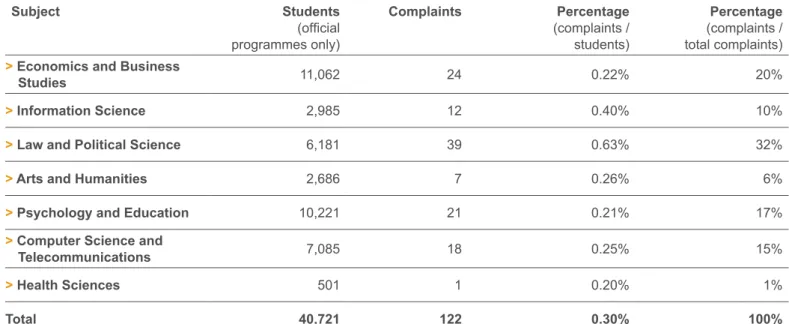
(6) Profile of complainants and type of complaints As there were 52,513 students enrolled in the UOC in the 2013-2014 academic year, the ratio of complaints was 2.3 per thousand students. All the complaints came from students. One consultation was received from a member of the teaching staff while no member of the administrative staff approached the ombudsman. Virtually all the complaints were made by individuals, with just three collective com-. plaints received. The collective complaint with the greatest number of complainants was received from students studying the Psychology degree, demanding changes to the current course plan. The other two were from Law students: one from students on the old pre-EHEA degree course complaining about the removal of continuous assessment from subjects being taken off the curriculum, and the other from students on the Law degree in respect of certain changes made to the activities subject to continuous assessment.. 2.3 complaints were received per thousand students at the UOC.. Table 1. Complaints by subject area. Subject. Students (official programmes only). Complaints. Percentage (complaints / students). Percentage (complaints / total complaints). 11,062. 24. 0.22%. 20%. > Information Science. 2,985. 12. 0.40%. 10%. > Law and Political Science. 6,181. 39. 0.63%. 32%. > Arts and Humanities. 2,686. 7. 0.26%. 6%. 10,221. 21. 0.21%. 17%. 7,085. 18. 0.25%. 15%. 501. 1. 0.20%. 1%. 40,721. 122. 0.30%. 100%. > Economics and Business Studies. > Psychology and Education > Computer Science and Telecommunications > Health Sciences Total. 6.
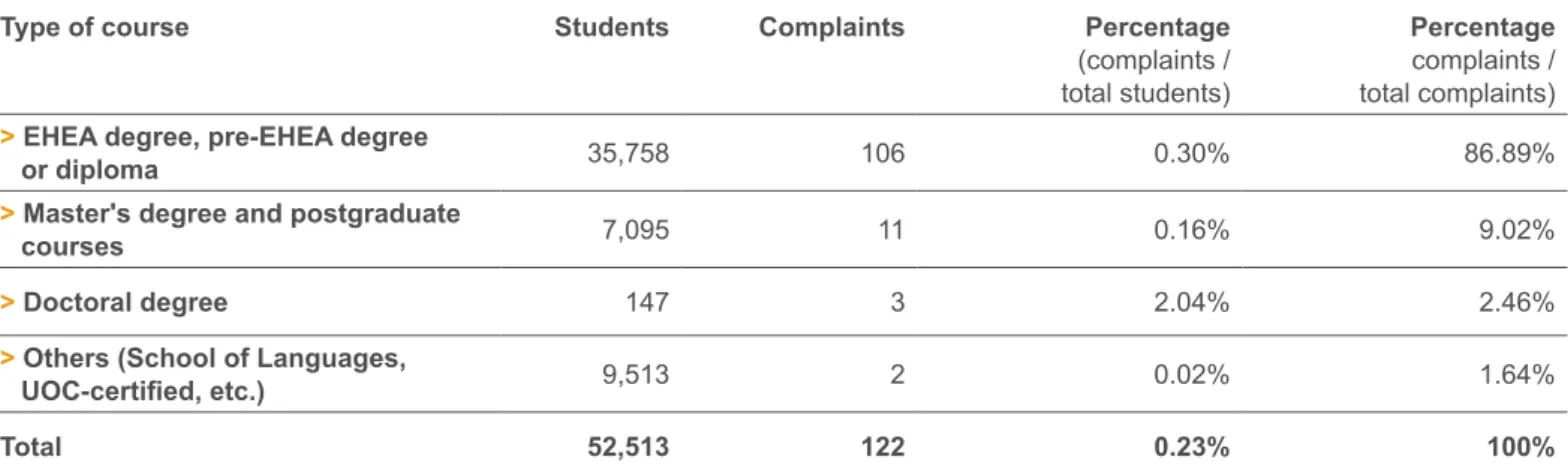
(7) The majority of the complaints received (86.89%) were made by bachelor’s degree students. By subject area, Law students submitted the greatest number of complaints to the Office of the Síndic de Greuges (32%), followed by Economics and Business Studies (20%).. Table 2. Complaints by type of course. Type of course. > EHEA degree, pre-EHEA degree or diploma > Master's degree and postgraduate courses > Doctoral degree > Others (School of Languages, UOC-certified, etc.) Total. Students. Complaints. Percentage (complaints / total students). Percentage complaints / total complaints). 35,758. 106. 0.30%. 86.89%. 7,095. 11. 0.16%. 9.02%. 147. 3. 2.04%. 2.46%. 9,513. 2. 0.02%. 1.64%. 52,513. 122. 0.23%. 100%. Ombudsman’s Report of the 2013-2014 Academic Year 7.
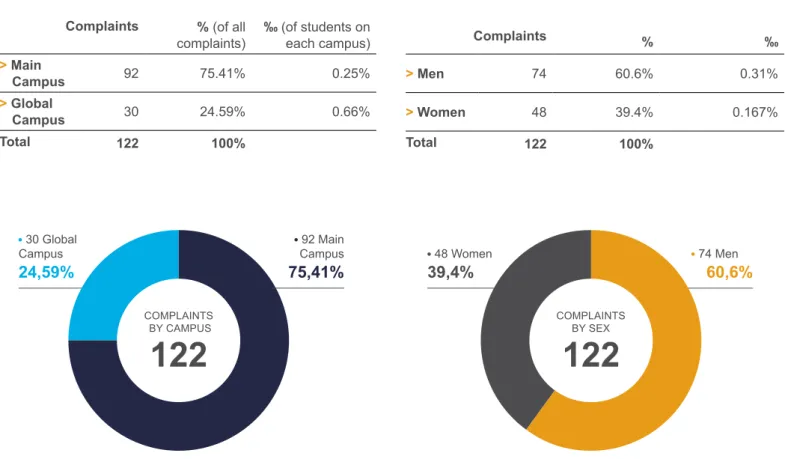
(8) The table shows that three times as many students from the Global Campus submitted complaints (0.66%) than students from the Main Campus (0.25%). There is also a gender bias, with 0.167% of women students submitting complaints compared with 0.31% of men, twice as many.. Table 3. Complaints by campus. Table 4. Complaints by sex. Complaints. % (of all complaints). ‰ (of students on each campus). > Main Campus. 92. 75.41%. 0.25%. > Global Campus. 30. 24.59%. 0.66%. 122. 100%. Total. 30 Global Campus. 75,41%. ‰. > Men. 74. 60.6%. 0.31%. > Women. 48. 39.4%. 0.167%. 122. 100%. 48 Women. 74 Men. 39,4%. 60,6%. Complaints by campus. Complaints by sex. Percentage of total complaints. Percentage of total complaints. 122. 8. %. Total. 92 Main Campus. 24,59%. Complaints. 122.
(9) 32%. The greatest number of complaints received in the year related to teachers’ grading of both continually assessed work and final examinations, a total of 21 cases. This was followed by issues related to the recognition of previously awarded qualifications and professional experience (9 cases). 14% 12%. The greatest number of complaints received in the year related to teachers’ assessments, a total of 21 cases (17.2%).. 5% 3%. Other. Previous qualifications and experience. Examination sessions. Internships. 2% 2% 2%. Non-payment. Cancelling enrolment. Teaching. Assessment. Enrolment (admin/cost). Sanctions copying/plagiarism. Academic record. Amendment lru / deployment of ehea degrees. 2%. Learning resources. 3% 2%. Qualifications. The Ombudsman’s Office also recommended improvements to the rules concerning aspects of enrolment and the financial implications of withdrawing from courses, in respect of 8 complaints. It also made a specific recommendation to teaching staff with regard to five cases of sanction procedures initiated, concerning cheating or plagiarism in continuously assessed work or final examinations.. 6%. 6% 5%. Grants. With respect to complaints received concerning teachers’ assessments, the Office of the Síndic de Greuges dismissed the majority, as it does not have powers to revise the content of specific tests, only to monitor to ensure that assessments are performed in line with the procedures and guarantees set out in the academic regulations. In certain cases the ombudsman did recommend that the University give the students a more detailed explanation of the marks awarded. The ombudsman also stressed the need to standardise criteria on the recognition of previously awarded qualifications and professional experience.. 8%. Ombudsman’s Report of the 2013-2014 Academic Year 9.
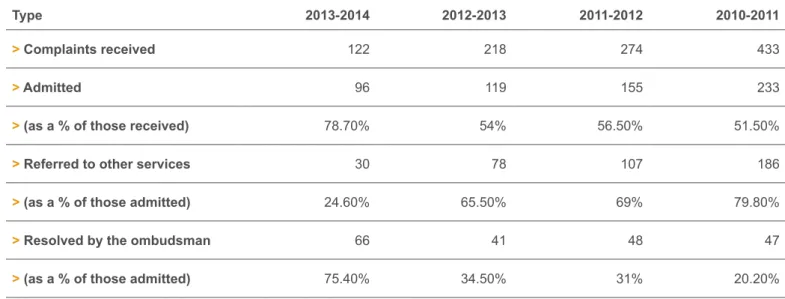
(10) Number of complaints The number of complaints referred to the Office of the Síndic de Greuges has fallen progressively in recent years. This is partly due to a better understanding by students of the role of the Office of the Síndic de Greuges and the University’s internal mechanisms for dealing with complaints, and partly due to better handling of complaints by the University’s student services and complaints services.. Table 5. Number of complaints. Type. 2013-2014. 2012-2013. 2011-2012. 2010-2011. 122. 218. 274. 433. 96. 119. 155. 233. > (as a % of those received). 78.70%. 54%. 56.50%. 51.50%. > Referred to other services. 30. 78. 107. 186. > (as a % of those admitted). 24.60%. 65.50%. 69%. 79.80%. 66. 41. 48. 47. 75.40%. 34.50%. 31%. 20.20%. > Complaints received > Admitted. > Resolved by the ombudsman > (as a % of those admitted). 10.
(11) The number of cases resolved directly by the Office of the Síndic de Greuges, both in total and as a percentage of those submitted, has increased significantly. This is because, although fewer complaints were submitted, they are the most complex cases, for which a solution could not be found via the University’s normal channels.. 433. 274 233 186. 218. 155 107. 119 78. 47. 2010-2011. 48. 2011-2012. 41. 2012- 2013. 122 Complaints received 96 Admitted 66. Resolved by Ombudsman. 30. Referred to other services. 2013-2014. Ombudsman’s Report of the 2013-2014 Academic Year 11.
(12) Institutional activities The UOC’s Office of the Síndic de Greuges participates in a number of Catalan, Spanish and international networks and associations of university ombudsmen: >>. Ombudsmen’s Group of the Vives Network of Universities: http://www.vives.org/en/about-us/. >>. Conferencia Estatal de Defensores Universitarios (CEDU): http://www.cedu.es. >>. European Network of Ombudsmen in Higher Education (ENOHE): http://www.enohe.net/. >>. Red de Defensores de los Derechos Universitarios: http://www.reddu.org.mx/. As a member of these networks, the ombudsman attended the following events during the 2013-2014 academic year: >>. 16th Conference of University Ombudsmen, organized by the CEDU (6-8 November 2013 at the University of Seville and Universidad Pablo de Olavide).. >>. Higher Education Ombudsmen and Empowerment: How to Make it Work. 11th Annual Conference of the ENOHE (15-17 May 2014, University of Warsaw).. >>. 7th Meeting of University Ombudsmen and Mediators of the Vives Network of Universities (3-4 July 2014, Pompeu Fabra University).. The ombudsman held meetings with representatives of the UOC’s Student Council to explain the mission and functions of the Office of the Síndic de Greuges and to listen to students’ concerns. He also met representatives of the Works Council, representing teaching and administration staff.. 12. Article 46 of the UOC’s Code of Ethics specifically states that the ombudsman must meet annually with designated members of the Works Council to review the provisions of the Code..
(13) Following the Code of Ethics The UOC’s Code of Ethics sets out the values, principles and commitments that guide the conduct of all the members of the academic community.. The UOC’s Code of Ethics, approved by the Governing Council in July 2009, sets out the values, principles and commitments that guide the conduct of all the members of the academic community. It not only provides guidelines for the conduct of the individuals and groups that form that community, it also governs the relations of the University and its staff with the external entities and companies that provide services to or work with the University. The Office of the Síndic de Greuges pays particular attention to this document, as well as to the aforementioned principles of legality, fairness, equity and proportionality when considering the disputes referred to it. In addition, articles 43ff of the Code of Ethics state that the University’s ombudsman is responsible for monitoring and assessing compliance with the Code. Any person who refers to the Code of Ethics in any appeal procedure must inform the ombudsman, who will incorporate a note on said procedure in the annual report. During the 2013-2014 academic year, the Office of the Síndic de Greuges was notified of just one case in which a direct appeal to the Code of Ethics was made: https:// seu-electronica.uoc.edu/portal/_resources/CA/documents/seu-electronica/Codietic_ UOC_2012-cat_CA.pdf (in Catalan). Ombudsman’s Report of the 2013-2014 Academic Year 13.
(14) Creative Commons Attribution 3.0 Spain license (http://creativecommons.org/licenses/by/3.0/es/deed.en). PUBLISHED BY: Communications. Digital Communication. DIRECTOR, COMMUNICATIONS: Lluís Rius. DIRECTOR, DIGITAL COMMUNICATION: Yolanda Franco. EDITORIAL COORDINATOR: Maria Boixadera. CORRECTION AND TRANSLATION: UOC Language Service. GRAPHICS COORDINATOR: Xènia Bastida. DESIGN AND LAYOUT: Zona Comunicació. PRINT COORDINATOR: Joan Teixidó. PRINTING: Fermay servicios gráficos, s.l. LEGAL DEPOSIT: B 12138-2015. ADDRESS: Universitat Oberta de Catalunya, av. del Tibidabo, 39-43, 08035 Barcelona..
(15)
(16) Headquarters Avinguda del Tibidabo, 39-43 08035 Barcelona Tel.: +34 93 253 23 00. uoc.edu. @UOCuniversity. Barcelona Rambla del Poblenou, 156 08018 Barcelona Tel.: +34 93 481 72 72. Madrid Plaza de las Cortes, 4 28014 Madrid Tel.: +34 91 524 70 00. facebook.com/UOC.universitat. México D. F. Paseo de la Reforma, 265, piso 1 Col. Cuauhtémoc 06500 México D. F. Tel.: + 52 (55) 55 114206 al 08.
(17)
Figure
Documento similar
Candidates have 78% more chances of being promoted if the committee includes, by luck of the draw, a strong connection such as their doctoral thesis advisor or a co-author; the
A requirement for maintaining the scholarship in the Entrepreneurial Talent Program is that students must study a minimum academic load of 12 academic credits or the equivalent to
In the “big picture” perspective of the recent years that we have described in Brazil, Spain, Portugal and Puerto Rico there are some similarities and important differences,
Gutiérrez, 1987) y (Osborne & Freyberg, El Aprendizaje de las Ciencias. Influencia de las 'ideas previas' de los alumnos., 1995) centrando y destacando la selección de
Díaz Soto has raised the point about banning religious garb in the ―public space.‖ He states, ―for example, in most Spanish public Universities, there is a Catholic chapel
The following analysis addresses the ways in which the teachers lead the students into the academic content of the lesson in four Natural Science classrooms that correspond to year
The expression ((having become common since the spring)) -the French original reads ((etant devenues populaires des le printems»- refers to the spring of 1708 and is
No obstante, como esta enfermedad afecta a cada persona de manera diferente, no todas las opciones de cuidado y tratamiento pueden ser apropiadas para cada individuo.. La forma
