ESCUELA DE CIENCIAS DE LA EDUCACION MENCION INGLES
MODALIDAD ABIERTA Y A DISTANCIA
A DESCRIPTIVE ANALYSIS OF ANGLICISMS USED IN ECUADORIAN MAGAZINES
Research done in order to achieve the Bachelor´s Degree in Teaching
AUTHOR: English as a Foreign Language
LEON BARRRETO MARIA AUXILIADORA
ADVISOR :
LIC. PAZMIÑO HARO PATRICIA MERCEDES
CENTRO UNIVERSITARIO GUAYAQUIL
Certification
Lic. Pazmiño Haro Patricia Mercedes
CERTIFIES THAT :
This research work has been thoroughly revised by the graduation committee. Therefore, authorizes the presentation of this thesis, which complies with all the norms and internal requirements of the Universidad Técnica Particular de Loja.
Loja, May, 2011
Contrato de cesión de derechos de Tesis de Grado
“Yo, María Auxiliadora León Barreto declaro ser autora del presente trabajo y eximo expresamente a La Universidad Técnica Particular de Loja y a sus representantes legales de posibles reclamos o acciones legales.
Adicionalmente declaro conocer y aceptar la disposición del Art.67 del Estatuto Orgánico de La Universidad Particular de Loja que en su parte pertinente textualmente dice: “formar parte del patrimonio de la Universidad la propiedad intelectual de investigaciones, trabajos científicos o técnicos y tesis de grado que se realicen a través, o que el apoyo financiero, académico o institucional (operativo) de La Universidad”.
María Auxiliadora León B. AUTORA
Authorship
The thoughts, ideas, opinions and the information obtained through this research are the only responsibility of the author.
April, 2011
Table of Contents
Certification ii
Contrato de Cesión de Derechos iii
Authorship iv
Abstract 1
Introduction 2
Methodology 6
Discussion 8
Literature Review 8
Results 28
Description, Interpretation and Analysis of Results 58
Conclusions 96
References 98
Annexes 101
Abstract
This research about Anglicisms in Ecuadorian magazines, which has been carried out in Guayaquil, shows a descriptive analysis of them. Three variables have been chosen to carry out this study: Cultural magazines, Scholarly magazines and General interest magazines. The anglicisms were found in each variable. Then, the syntactic, semantic and morphological analysis were done.
This study was done with the main purpose of determining which of them has the highest quantity of anglicisms and the frequency with which they are mostly used.
The quantitative and qualitative methods were used to carry out this study, which provides a linguistic and comparative analysis of the anglicisms found. This study demonstrates that General Interest Magazines use more anglicisms, this represents almost 50%. The other 50% is shared between Scholarly and Cultural magazines. Scholarly magazines, that engages the science, technology and economic fields, have the highest number of repetition of anglicisms, such as : déficit, default. Commodities, football, spread, ranking, swap, internet. Unnecessary anglicisms like: business, online, and skinhead were noticed in General interest magazines.
Introduction
The theme of this work is a descriptive and linguistic analysis of Anglicisms in written Ecuadorian magazines, in which we will focus specifically on lexical terms known as Anglicisms and how they are used in magazines. This research will focus on a descriptive study through which it will be possible to get the linguistic information, in order to indentify and analyze the anglicisms used in Ecuadorian magazines at present. The Qualitative and Quantitative Methods will be used to carry out this research study.
The general objective of this study is to research the linguistic phenomenon of anglicisms used in Ecuadorian magazines.
The specific objectives are to identify the syntactic and lexical anglicisms more commonly used in Ecuadorian magazines. To make a deep analysis of the anglicisms found in Ecuadorian magazines regarding syntactic, semantic, and morphological aspects. To establish which variable (cultural, scholarly, and general interest magazines) contains the highest number of anglicisms. To determine which anglicisms are mostly used.
Six Ecuadorian magazines were selected: two Cultural magazines, two Scholarly magazines and two of General interest. The magazines corresponded to the months of January, March, April and May 2010.
The samples were taken from articles corresponding to these months, and the collection of data was made through record cards, note taking, skimming and skanning.
Previous studies have been made about Anglicisms; therefore, many English expressions have been introduced into a wide variety of languages, making them good Interlingua expressions.
According to Martínez (2007), in his study Towards a Corpus-Based Analysis of anglicisms, the press and TV are the main vehicles to introduce anglicisms. He establishes a comparison between the lexicon used by Latin American people and by Peninsular Spanish people. Through statistics, it was found that 50 percent of the information in the CREA (Corpora of Royal Spanish Academy RAE) comes from Spain, while the other half is shared by twenty American countries and the Phillipines.
Zurita (2006) in her study Economic Anglicisms, points out that we need to know when we are dealing with a word and when we are dealing with a term in specific contexts. It is clear for the author that the Anglo-Saxon language has a predominant influence, especially in the economic field, and that the market is expanding and therefore increasing a number of linguistic terms in other languages.
especially contemporary English as a model for Western languages. The degree of modification of the foreign model and degree of novelty of the foreign form.
This research about anglicisms has contributed in a great deal to the professional field, because it has demonstrated the influence of the English over the Spanish language. Their differences in pronunciation and word meanings. The linguistic changes undergone in a speech community, and how unnecessary anglicisms are used as a tool to better communicate to replace the Spanish words, especially when living in a foreign country.
Since the main purpose of the Universidad Técnica Particular de Loja is to conduct a linguistic investigation through the different graduation programs, the information collected will contribute in great deal as a background study to the University and for further generations.
This research has contributed to identify the morphological, semantic, syntactic and lexical changes that Anglicisms have recently suffered in written Ecuadorian magazines, which will also be of assistance for further investigations.
One of the limitation found in some cases was not finding the Spanish equivalents in technical vocabulary such as commodity or rating are the most evident cases, especially in Scholarly magazines.
Methodology
This research was carried out in the city of Guayaquil. To conduct this investigation, the qualitative and the quantitative methods were used. Six magazines were selected according to the variables established: two Cultural magazines, two Scholarly magazines and two of General interest magazines to search for the anglicisms.
Once the samples were collected, it was found that most of the anglicims were lexical, because they come from a particular kind of text, which identify the language of the magazine.
The words were included in charts to make the qualitative and quantitative analysis. This was done in order to establish the highest number of anglicisms and its frequency, as well as to determine its lexical or syntactic characteristic.
For this purpose, record cards, note taking, skimming and scanning techniques were used for the bibliographic data collection, considering the concepts and definitions of the words that were going to be applied in the Literature Review.
In regard to this process, the anglicisms were investigated first to know their origin, and the grammatical function they had. All the words were registered in charts together with the context in which they were found.
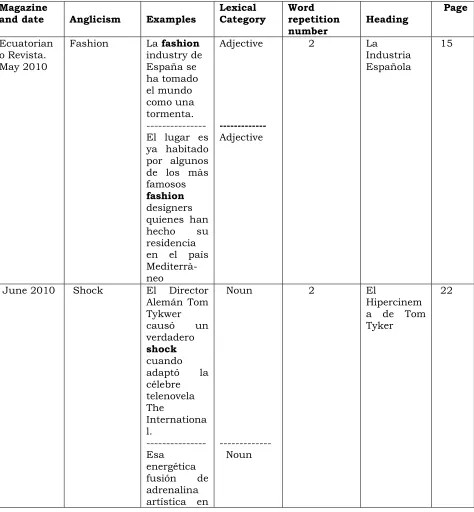
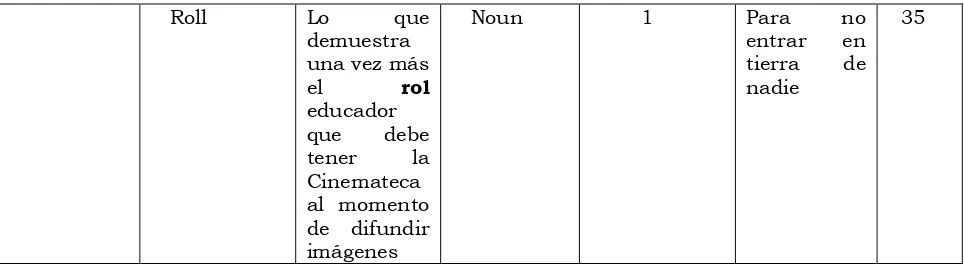
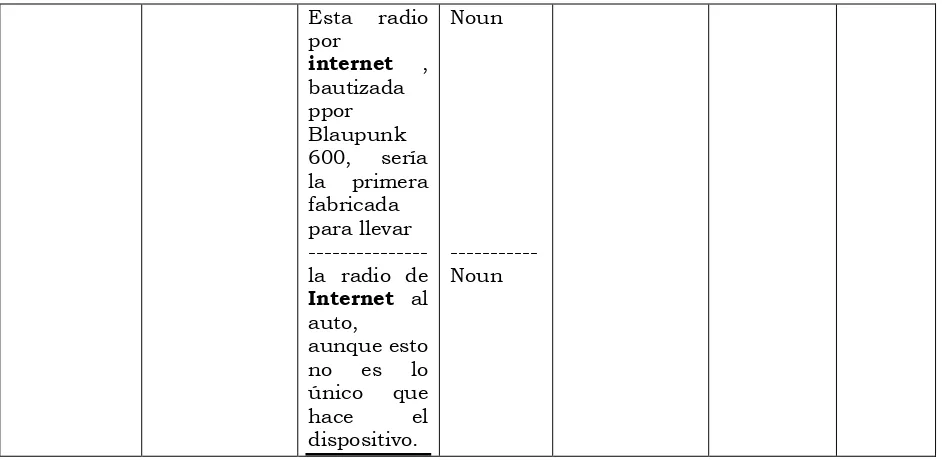
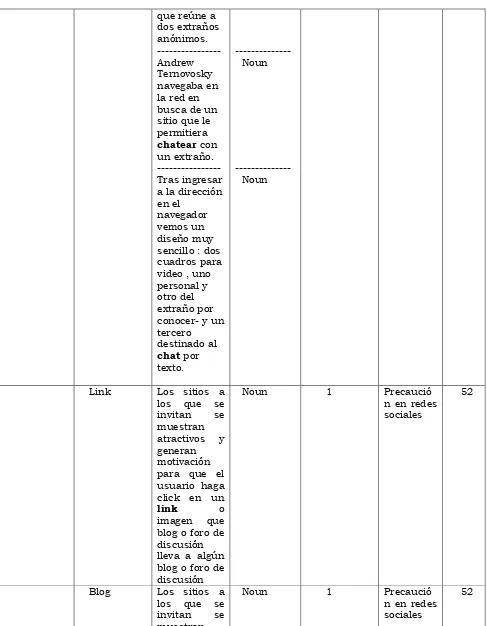
Three tables were established for each variable with the name of the magazine, the anglicism, the lexical category, the word repetition and the paragraph where the anglicism was found.
Another table showed the frequency of the anglicism in each variable.
DISCUSSION
Literature Review
There seems to be a general concern in language specialists about the linguistics consequences, because of the incorporation of
many anglicisms into the Spanish language. The amount of English words in the Spanish language have increased highly due to many reasons such as politics, migration, business, computer science,
religion and tourism.
In order to carry out this research, it is necessary to understand that an Anglicism is a linguistic term; therefore, we need to get into the linguistics field and its history, how anglicisms have developed throughout decades, and especially in magazines, by also analysing the terms magazine, contact languages, barbarisms, borrowings and loans and language vices.
According to Nicholls (2003) previous research has been made on the presence of loanwords or anglicisms through cultural, economics, and social magazines, as well as articles, where the tourism and computer language shows an increasing influence of English.
This study analyses the frequency and usage of anglicisms in the language of any report found in eight different publications
aimed at the public in general. Most of the articles are related to finances, culture, social and scholar magazines (adventure, sports or tourism).
The most habitual terms derived from interference between English and Spanish used in cultural, economic and social magazines are included as a result of this study, lexical categories will be also used in this study.
In order to develop this research project about Anglicisms, different authors´ concepts shall be considered about terms related, which can provide a complete understanding of the topic.
Linguistics
Chomsky (1975, p. 55) says “Linguistic is the study of acquisition and development of a language as a result of unfolding of innate propensities triggered by the experimental input of the external environment”.
human being to structure its experience in order to comprehend it. He also argues that there are qualitative different stages of development and that entrance into a given stage depends upon the kind of structure a child is able to coordinate.
Branches of Linguistics : Morphology, Semantics, Pragmatics, Phonology, and Syntax: (Parts of Speech)
McArthur (1998, p. 56) argues that Linguistics comprises a large number of branches, several of them hybrids with other disciplines. In his opinion, Morphology is the structure of words where there is a systematic relation between words, and Morphemes are the building-blocks of words, the smallest linguistic unit which has a meaning or grammatical function. In contrast, Semantics is the literal meaning of sentences, phrases, words and morphemes.
Pragmatics deals with what is not encoded in language, and applies to all language use. In language teaching, on the other hand, "pragmatics" generally refers to the encoding of particular communicative functions, especially those relevant to interpersonal
exchanges, in specific grammatical
.
Phonology describes the waysounds function within a given language or across languages to encode meaning.Syntax refers to the phrase and sentence structure,
the composition of words.
On the other hand, Hanna (2002) linguistics overlaps and (ideally) cooperates with psychology, sociology, anthropology, philosophy, logic, mathematics, computer, science, speech patology, acoustics, music, crypt-analysis,etc.
According to the above mentioned author, Morphology is the internal construction of words and its study, where there might be a systematic relation between words called Morphemes. A Morpheme is a minimal linguistic unit, or the building-blocks of words, that can not be divided into smaller parts., but can stand alone as a word. Therefore, Semantics is the study or science in meaning in language. It is the literal meaning of sentences, phrases , words and morphemes.
In Hanna`s opinion Phonology is the study of sound patterns, and Pragmatics are the studies of language use, the study of the aspects of meaning and language use that are dependent of the speaker, especially how context influences in the interpretation of utterances. The same sentence can be used to do different things in different situations. Overall, semantics is the literal meaning and pragmatics is the intended meaning.
In contrast, Syntax is the study or rules whereby words or other elements of sentences are combined in order to form grammatical sentences.
Chomsky (1975, p. 55) and his Chomskyan linguistics, begin with his Syntactic Structures, challenge structural linguistics and introduces Transformational Grammar, in particular, a context-free grammar extended with transformational rules. In this views, a child learning a language need only acquire the necessary lexical items (words, grammatical morphemes, and idioms) , and determine the appropriate parameter settings, which can be done based on a few key examples.
He also argues that there are qualitative different stages of development and that entrance into a given stage depends upon the kind of structure a child is able to coordinate.
Baker (2003) claims that for decades, generative linguistics has said little about the differences between verbs, nouns, and adjectives. This study seeks to fill this theoretical gap by presenting simple and substantive syntactic definitions of these three categories.
In his opinion, the various superficial differences found in particular languages have a single underlying source which can be used to give better characterizations of these ‘parts of speech’. These definitions
are supported by data from languages from every continent, including English, Italian, Japanese, Edo, Mohawk, Chichewa, Quechua, Choctaw, Nahuatl, Mapuche, and several Austronesian and Australian languages. Baker argues for a formal, syntax- oriented,
and universal approach to the parts of speech, as opposed to the functionalist, semantic, and relativist approaches that have dominated the few previous works on this subject.
Gómez (1997) pointed out that in grammar a lexical category (also a Word class, a lexical class, or in traditional grammar a part of speech) is a linguistic category of Word (or more precisely lexical items) which is generally defined by the syntantic or morphological behavior of the lexical item in question.
This author also mentioned that common linguistic category includes noun and verb among others. Different languages may have different lexical categories, for example Japanese has as many as three classes of adjectives, where English has one . Chinese, Korean and Japanese have classifiers, while European languages do not grammaticalize three units of measurements (a pair of pants, a grain of rice) .
He also states that many languages do not make any distinction between languages and verbs, adjectives and verbs or adjectives and nouns.
Contact Languages
According to Samarin (1968):
“A contact language is any language which is created through contact between two or more existing languages. This may occur when people who share no native language need to communicate, or simply when a language of one group becomes used for wider communication with other groups, often with significant changes to its grammar as a result. Such languages are one type of lingua franca, a general term meaning a language used for widespread communication. An example of a contact language is the widespread use of Greek koiné in the Eastern Mediterranean around the fourth century AD.”
Peter (2002) notes that a Contact language is a marginal language or a type of lingua franca. It is used for purposes of basic communication by people without a common language.
Ancient Greek around the Mediterranean basin, or later Latin throughout the Roman empire, were both contact languages.
“When the contact between groups of people is prolonged, a hybrid
language can develop known as pidgin. These tend to occur in situations where one language dominates, and there are two or more languages at hand.
According to Werner (1983), languages come in contact because of the speakers who are in contact with each other, not only by themselves. It is always the speakers of the languages who are in
contact. Their attitudes towards each other will affect the way they speak.
If speakers of a language want to identify with each other, they may find themselves the way of adjusting their speech to eliminate the more obvious differences in pronunciation or vocabulary . If the speakers do not want to identify with each other, they may emphasize the differences in their speech, particularly if someone from the "outside" is present. Generally, the reasons why people want to associate with each other or not do not have much to do with the language they speak. It has more to do with the status or prestige of one or the other of the groups of people.
Trinidad (2002) states that speech differences come to represent social, political and geographic divisions between groups of people. These differences may also reflect differences in economic and political power. While we may react to someone's speech with a positive or negative attitude, we are really reacting to the whole complex of social, economic, and political connotations which we have associated with that speech variety.
He also agrees that when one group is very powerful they may use that power, unintentionally or otherwise, to attempt to eliminate
the speakers of another language, or, as is more often the case, to eliminate their speech variety. Differences in economic or political power and prestige almost always put the (speakers of the) less-powerful language at a disadvantage. People may decide to stop speaking it in order to avoid the social stigma of being part of the less-powerful group. Sometimes, however, speakers of such a language resist having their identity (as marked by their language variety) taken away from them and they may react to the pressures to use the more prestigious language by working all the harder to preserve, protect and develop their traditional language of identity.
Wherever languages come in contact with each other there exists a greater need for at least some individuals to become bilingual. Bilinguals have proven to linguists who want to know how people cognitively and mentally organize the structure of their language(s) and how those structures may interact with each other. Bilingualism at the level of an entire society is of great interest to sociolinguists who want to know how communities determine "who speaks what language to whom, and when”.
Shaw, B. (2005) emphasizes that Great Britain and America are ‘two countries divided by a common language’. This point of view can
be also applied to Spain and Mexico, the Spanish-speaking countries
with different language varieties and dialects that have been formed
under the influence of specific historical, cultural, political and social
events.
The study of this author also tries to take into consideration the
differences in pronunciation, the different language varieties and
dialects between the Spanish and Mexican people.
He also argues that despite the fact that Spanish is spoken in many countries, the major varieties of Spanish can be observed in
Latin America and Spain, residents of Mexico and Spain, ( middle
level class) the media. Some words were taken for analysis, such as :
Okay, translated as Sale in Mexico, and as Chungo in Madrid; similarly, the word ‘work’ is rendered as ‘chambear’ in Mexico and as
‘curar’ – in Spain. Another difference that distinguishes Mexican
Spanish from Spanish in Spain is the preservation of archaisms in
the Caribbean and Highland Latin American dialects. Such words and expressions as ‘Órale’ (All right), ‘Ya mero’ (almost) or ‘Qué
pedo?” (What is going on?) are normal for Mexican Spanish, but they
are not utilised in Spain.
Language Vice
immoral practice or habit. A serious moral falling, which corrupts any language. It is also a character representing generalized or particular vice in English morality plays.
The Collins Thesaurus of the English Language – Complete and Unabridged (2nd Ed.) (2002) defines Language Vice as a moral weakness. Fraility, evilness, evil – the quality of being morally wrong in principle or practice; it attempts to explain the origin of evil in the world” , an specific form of evildoing, a vice which offends the moral
standards of the community.
Barbarisms
Foster, John Bellamy; Clark, Brett (2004) in their article Empire of Barbarism say that the concept of “barbarism” has a long and is completely related to social thought in general and in particular the socialist. The Greek word barbarous originally referred to anyone who didn`t speak Greek. The Greeks like all ancient civilizations portrayed themselves as living at the center of the world and all others residing in a geographical and cultural periphery (or semi-periphery). After the Greek triumph in the Persian Wars all barbarians were viewed as inferior.
According to McArthur (1998) :
“A barbarism is a non-technical term for a WORD considered to offend against good taste by combining elements from different languages, especially classical with vernacular, or being used in an unsatisfactory way”.
He also pointed out that the following words were widely considered to be barbarisms when first used: escalate, back-formed from escalator, finalize, GREEK – ize added to LATIN final; a mob a clipping of Latin mobile vulgus”.
Ifversen (1974) argued that barbarism and civilization are salt and pepper concepts that are always linked. In the Western world, “barbarism” is derived from the classical Greek word barbarous
(barbarian) that referred originally to foreigners who did not speak Greek. In the modern world, barbarism carry a negative connotation of unrefined and savage. “Civilization” is derived from the Latin word civis (citizen) that referred originally to those living in a Roman city. In the modern world, civilization carries a positive connotation of education and sophistication.
Anglicisms
Zurita (2006) points out that some lexical everyday interferences are generated by the enormous amount of anglicisms used in Spanish or any other language. This thesis project provides a semantic analysis of the changes in lexis this language contact brings about, through the different linguistic mechanisms of inter-language adaptation involved. When anglicisms come from the current tendency to include English words in Spanish discourse or speaking.
Trinidad (2002) states that a growing number of anglicisms are being exported into the Spanish Language nowadays. Their usage seems to be increasing in Spain, inundating language with new words and expressions, often unnecessary.
An anglicism, is most often defined, as a word borrowed from the English into another language. "Anglicism" also describes English syntax, grammar, meaning, and structure used in another language with varying degrees of corruption. In other words, this author argues that because of the changes that a word suffers when is borrowed from another language, it tends to corrupt the original language.
Guzmàn ( 2002) in The Impact of Lexical Anglicisms in Spanish Film Magazines, points out that these kind of magazines are perhaps one of the most well-known source where there is a huge influence of the English language, as a reflex of the dominating Anglophone
culture of our times, on the languages of the rest of the world, and, especially, on those of the so-called “Western world” 2.
This case study is also a complement of the study of Anglicisms because we can also notice that any change in vocabulary and pronunciation produced sometimes by the accent or dialect can turn into an Anglicism, especially if we refer to Mexican people who is largely influenced by the USA, and consequently the English language.
their original form (species, cerebellum, radius, specimen, apparatus, focus, tedium or antenna, with the same meaning most of the time.
Fischer (2008) argues that the English language has a lot of loan-borrowings on the French language, because English itself borrowed a great amount of French vocabulary after the Norman Conquest. Some anglicisms are actually Old French words that dropped from usage in French over the centuries but were preserved in English and have now come back into French.
For instance, one attested origin of the verb "to flirt" cites influence from the Old French expression conter fleurette, which means "to (try to) seduce". (Other possible origins for the word include flit, E. Frisian flirt (a flick or light stroke) and E. Frisian flirtje (a giddy girl)). This expression is no longer used in French but the English gallicism"to flirt" has made its way back over the Channel and has itself now become an anglicism in French.
Another type of anglicism is a phrase or structure that is calqued from the English. For example, the valediction Sincèrement vôtre is regarded as an anglicism, a direct translation of the English Sincerely yours," when a native French valediction would be more appropriate.
Note that there are also some words that were borrowed from English into French centuries ago, such as clown (pronounced "kloon"), square (meaning "public square") or spleen (meaning "melancholy" rather than the organ). These are not considered anglicisms but rather are perfectly good French words fully accepted by the Académie française.
Other definitions of Anglicisms
According to the American Heritage & Dictionary of the English Language, (4th.ed.) (2009) an anglicism is a uniquely English expression used when speaking or writing Interlingua. Many English expressions have penetrated into a wide variety of languages, making them good Interlingua expressions. Novice speakers sometimes assume that an English expression is example, a novice may use Lassa nos considerar le optiones to mean 'Let's consider the options', as in English.
In Interlingua, an international auxiliary language, which was developed to combine a simple, mostly regular grammar[ with a vocabulary common to the widest possible range of languages, this expression means 'Permit us to consider the options'. A more
Borrowings and loans
Gòmez, (1997). intends to show the present situation about the cultural borrowings from English to the Romance languages, especially contemporary English as a model for Western languages. The degree of modification of the foreign model and degree of novelty of the foreign form.
He argues that Europeans scholars, books about phonetic borrowing, morphological borrowing, syntactic borrowing, semantic borrowing, lexical borrowing, which are typologies of borrowings were chosen according to the linguistic level affected as the most efficient attempts of classification for several reasons:
This kind of typology explains about many particular instances of interferences and borrowings, and bears a clear relation to the phenomena of neology capable of enriching a given language and not as mere incorrectness in normative terms. It allows to detect which levels are in danger (for instance: semantic and syntactic rather than lexical).
In Spanish and Italian some scholars have studies the greater frequency of bien/bene o bueno as a loan translation of English well as initial elements in answers especially in dubbings from American films. (discourse markers) discourse routine and speech rules: The discourse routine when answering a telephone call is : “dìgame “in
Spanish and “pronto” in Italian, because of inappropriate translations
in American films. The same with literal loan translations with: “forget it” quiet common in the dubbing of American films and TV
series.
Nicholls (2003) concluded that borrowed words also often compete with typologies of borrowings. It allows to detect which levels are in danger (for instance: semantic and syntactic rather than lexical) existing words in the borrowing language. That no language ever took a word from another language with the intention of one day returning it.
The selection of words that this author analyzed was taken from the Robert H. Hill Dictionary of False Friends (1982) and also from the pop and youth culture, technology (in particular, the internet, the media and advertising. This means that the collection of data for this study was done considering different types of environments and topics.
The author’s conclusion is that when an English word with an – ing ending is used, it creates a new noun or (rarely) adjective in the borrowing language. Loans take a number of different forms, though many will fall into more than one category, and they can all lead to the creation of False Friends.
Diatiz (2003) states that nowadays English, and especially the US varieties of English, have become far more of a lender than a borrower.
He also emphasizes that in the 20th century and the beginning of the 21st, globalization and the level of contact between countries has meant that English words have spread more widely and in greater number than ever before. This is largely due to the cultural and political predominance of the USA, in particular.
The above mentioned authors recommend to Teachers of English, particularly to beginners, that they need to raise learner`s awareness of the existence of English-origin words in their mother tongues and, most important, of the fact that some can be trusted and some cannot. Writers of courses and reference books for learners of English, too.
Gómez J, (1997, pag.81-94) states that borrowings can even lead to loan words outnumbering indigenous words, as they do in Korea (which borrows heavily from Chinese and English in particular)
by an estimated ratio of 60% to 40%. In Iceland a board has been set up dedicated to translating words for new phenomena into more Icelandic-based words to prevent this happening.
According to Zurita, P. (2006) a loan is a word borrowed from another language; is a word borrowed into modern English.
In his opinion, the enormous number of anglicisms used everyday in Spanish language generates lexical interference between both languages. A semantic analysis of the changes in lexis this language contact brings about, through the different linguistic mechanisms of inter-language adaptation involved. When these anglicisms come from the current trend to include English words in Spanish discourse, we also add appropriate equivalents which could avoid the excess of redundant neologisms.
We have also found out about one of the most important variables of this research, the magazine and the impact created in the public for its current use of anglicisms.
Anglicisms in different kind of Ecuadorian magazines are very common nowadays, that is why we need to find out what a magazine is and how the language used influences a great deal in the public.
Magazine Definitions:
which contains a variety of articles on various subjects, and can be
published weekly, biweekly, monthly and quarterly.
They are usually printed in color on coated paper. He also argues that a standard internationalized language called
Esata is used in magazines. Esata is a Creole or corrupted version
of English, that means “how to speak”, with which publishers expect to gain control over the “vulgarized” form of the language.
Kennedy, J. & Kurt, T. E. (Eds.). (1928) emphasize that the computer programming language is one of the less complex high-level languages with commands similar to English, which can be easily learnt by schoolchildren and novice programmers.
Target Audience
According to the Babylon Spanish/English Dictionary (2006) Target Audience refers to a particular group of people, a target population identified as the receiver or listener of an advertisement or message. He also argues that there are qualitative different stages of development and that entrance into a given stage depends upon the kind of structure a child is able to coordinate. The most habitual terms derived from interference between English and Spanish used in cultural, economic and social magazines are included as a result of this study, lexical categories will be also used in this study.
Quantivative Tabulation
Table Four
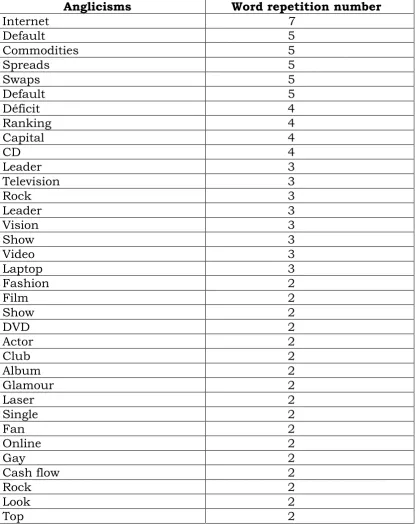
The Most Frequent Anglicisms (in all variables)
Anglicisms Word repetition number
Internet 7
Default 5
Commodities 5
Spreads 5
Swaps 5
Default 5
Déficit 4
Ranking 4
Capital 4
CD 4
Leader 3
Television 3
Rock 3
Leader 3
Vision 3
Show 3
Video 3
Laptop 3
Fashion 2
Film 2
Show 2
DVD 2
Actor 2
Club 2
Album 2
Glamour 2
Laser 2
Single 2
Fan 2
Online 2
Gay 2
Cash flow 2
Rock 2
Look 2
Audiovisual 2 Dollar 2 Best seller 2 High Tech 2 Ranking 2 Resort 2 Skinhead 2 Skycraper 2
Shock 2
Stock 2
Natural 1 Cassette 1 Country 1
Roll 1
Cyber 1
Radio 1 E-mail 1 Original 1
Blog 1
Link 1
Affair 1 Sandwich 1 Marketing 1 Director 1 Slogan 1 Version 1 Total Anglicisms : 60 Total : 142
Table Five
Comparison between variables
Variable F % Cultural
Magazines 17
28.33 Anglicisms Scholarly
magazines
15
25.00 General interest
magazines 28 46.67 Total 60 100 %
Description, Interpretation and Analysis of Results
After analysing the three variables where sixty Anglicisms were found, it can be demonstrated that General interests magazines contained the highest number of Anglicisms, 46.67%, Scholarly magazines 25% and Cultural magazines with 28.33% of the Anglicisms.
Even though General interests magazines showed the majority of anglicisms, Scholarly magazines had the highest number of repetition of words, because most of the economic terms are English, and Latin America people who make business with the United States of America are in the need to use these terms.
Film
It is a noun and also a verb (used without object, re-film) also called movie, un-filmed (adjective) filmlike (adjective), to direct, make, or otherwise engage in the production of motion pictures. This word comes from bef. 1000; 1890–95 for def. 6; 1900–05 for def. 7; ME filme, OE filmen membrane; akin to fell . Old English filmen membrane; related to Old Frisian filmene. It comes from the
19th century in Germany. It is a morphemic transportation, defined a direct transfer of a lexeme, also called lexical borrowing.
This word is a noun in the paragraph found : “Allí el film cobra una vida especialísima, porque comenzamos a entender los orígenes de un trabajo que sale de la sangre.”
It has equivalence in Spanish, but this morpheme has replaced the Spanish word “filme” especially in Latinamerica when referring to
movies, or to record something. However, the word “filme” is very used in Spain, and “film” in Latinamerican countries, which means “película”. It has suffered morphological changes in Spanish, because
a lot of people use this Anglicism also as filmar, instead of grabar. In spite of having similarity in Spanish, it has an extra morpheme “e”. It is accepted by the Spanish and English Real
Academy.
This word has deteriorated our Spanish language because people tend to use the anglicism film instead of grabar, pelìcula.
Ranking
It is defined in the Longman Dictionary as : “categoría or clasificación” with a noun function. It is mostly used in the economy,
culture, tourism, internet and entertainment fields.
In Spanish is also used as : high ranking : de alta graduación, de alto rango, superior de alto cargo, or top-ranking : alto rango.
The word was found in the following context: “La piraterìa ocasionò en España durante el 2005 unos 800 millones de euros de pèrdidas , lo que sitùa al paìs en el primer puesto del ranking de esa pràctica ilegal.” In this case the word ranking is a noun, which determines the classification in which piratery is at the moment.
It has an equivalence in our language Spanish because it means the same: classification, category. The word is mostly used in business in Spanish as well as in English with the same meaning. The above mentioned word is accepted by the RAE. It has deteriorated our Spanish language because this word has its equivalence, which is “categoría”.
Spread
It comes from Middle English spreden, from Old
English -spr dan (as in t spr dan, to spread out); see sper- in Indo-European roots.] Also from Old English sprædan; related to Old High German spreiten to spread, Old Lithuanian sprainas stiff].
It is a verb which has many meanings, such as : to extend or unfold to the fullest with, to extend or cause over a larger expanse
distribute or be distributed over an area or region, to display or be displayed in its fullest extent. It is also an Idiom: spread (oneself) To work on too many projects: to over extend oneself.
In the paragraph found, the word is a noun: “El aumento del riesgo es evidente en los spreads de los CDs para la deuda de los Estados Unidos. In this case, a noun is created from a verb, and the –s is a lexical morpheme called also inflection, under the category of number.
It is a calque or lexical morpheme, a foreign word, which does not have equivalence in our language, but even though this word is used, especially in the economy field, this Anglicism is not used in other Spanish contexts.
This word enriches our Spanish language because it expands our vocabulary and allows business people to understand new terms that globalization brings nowadays. It is accepted by the RAE.
Club
It comes from Middle English clubbe, from Old Norse klubba; akin to Old High German kolbo club . First Known Use: 13th century It is a noun and also an adjective., for example a club sandwich.
Semantically it has different meanings : a heavy tapering staff especially of wood wielded as a weapon., a stick or bad used to hit a ball in any of various games, playing card marked with a stylized figure of a black clover b plural but sing or plural in constr : the suit comprising cards marked with clubs .
Also an association of persons for some common objective usually jointly supported and meeting periodically; also a group identified by some common characteristic <nations in the nuclear club> b : the meeting place of a club <lunch at the club> c : an association of persons participating in a plan by which they agree to make regular
payments or purchases in order to secure some advantage d : nightclub e : an athletic association or team.
It has a straight equivalence and similarity with Spanish because the spelling is the same, and there is no word that can replace it. People use the word club as it is, meaning a place to meet and enjoy for sports, music, dancing, tourism, etc .
Deficit
It is a noun which comes from British dih-fis-it, since 1775 . Dèficit (it) lacks, 3rd. person, singular, present, indicator of ofdèficere.
It means the amount by which a sum of money falls short of the required amount. The amount by which expenditures or liabilities exceed , income or assets., a lack or shortage; deficiency. , a disadvantage, impairment, or handicap: The team's majordeficit is it s poor pitching ,a loss, as in the operation of a business.
It is a negative difference between incomes and expenses of the administrations for a concrete period. Also the lack of money, food or any other thing.
The word was found in the following context: “ tener grandes déficits primarios es el primer factor de riesgo.” the word acts a a noun.
The -s is a grammatical morpheme, called inflection, under the
category of Number. It has not suffered morphological change in
Spanish.
There is no straight equivalence for this word in Spanish, but it has
similarity, because it is also used in the following situations and with
the same meaning: “Déficit presupuestario”, “Déficit commercial”,
and Déficit Alimenticio”.
This term enriches our language, because it expands our vocabulary.
This word can not be replaced with any Spanish equivalent. It is
accepted by the RAE,
Fashion:
It comes from Middle English facioun, from Old French façon, appearance, manner, from Latin factiō, factiōn-, a making, from factus, past participle offacere, to make, do.]
Semantically, it is the prevailing style or custom, as in dress or behavior: out of fashion. Something, such as a garment, that is in the current mode: a swimsuit that is the latest fashion.
The style characteristic of the social elite: a man of fashion.Manner or mode; way: Set the table in this fashion.
A personal, often idiosyncratic manner: played the violin in his own curious fashion. A kind or variety; sort: people of all fashion, shape or form; configuration.
Bell bottom pants are out of fashion, skinny jeans are back in. out of fashion adj (outmoded).
In Spanish this word has equivalence with the English term and is very commonly used to express that a person dresses with the latest of the mode, which means “a la moda” “con ropa de actualidad”, but also means :
carrerilla - desfile - despatarrarse - infantil - moda - modelo - modista - modisto - predisponer - última - último - usarse - árbitro - arrastrar - boca - boga - caletrearse - capricho - casa - corriente - creador - desorden - desordenadamente - diseñador - diseño - estampado –
figurín - grito - imponer - llevar - loro - momento - novedad - ordenadamente - papagayo - paporreta - planta - revista - usar.
Even though the above mentioned word has not totally replaced the above terms in Spanish, it has enriched the Spanish language.
It is also accepted by the RAE.
Download:
It comes from the word downlink , which is a transitive verb , from 1977. It is an internet term of uncertain origin. An act or instance of downloading something, for example: I will download all
the information, which in Spanish means “bajar o descargar información”
In the following paragraph found in a magazine download is a noun: “Espere mientras se lleva a cabo la conversión. Cuando termina haga
click en Download.”
This is a compound word : down-load, which is also considered a morphemic importation, defined as a direct transference of a lexeme, that is, both meaning and form: In fact, importation is usually identified with "lexical borrowing" itself: anglicisms such as club, pop, best-seller, poster, show, CD-Rom, down-load are shared by nearly all the Romance languages, being the largest category of borrowing.
It is also a noun , a calque, which has not got into any morphological term, since it is a new invented computer term.
It is accepted by the RAE, but does not have similar equivalence with Spanish because it means “volcar o bajar información”, and only has replaced the word descargar in the computing field.
In the market field it has not been replaced, because in Spanish it is not said : download the fruit, it is said : descargar la fruta, es bajar la fruta de un camión.
Default
It comes from Middle English defaute, from Old French, from past participle of defaillir, to fail, grow weak : de-, intensive pref.; see de- + faillir; see fail.]
It is a transitive verb, a noun and also an idiom, with the following meanings: with the failure to perform a task or fulfill an obligation, especially a financial obligation, failure to make a required court appearance in the law field, or a situation or condition that obtains in the absence of active intervention. Idiom: in default of : through the failure, absence or lack of. It has not suffered morphological change.
In the context found “ La única otra alternativa será el default puro y duro. El banco dice que la grave posibilidad de un default en la deuda de Grecia “ the word is a noun, and means the failure to
perform a task or fulfill an obligation. It is a Neologism coined in English on classical roots, a semantic Anglicism. a calque or loan translation.
It has not replaced the word “Falla” in the function of something or in the system in Spanish. This Anglicism is only used in the economy field to give more relevance to the topic or to differenciate from the word deficit.
The word has equivalence with Spanish, and is accepted by the RAE, but it has not replaced any word, because it is only used in economic magazines, because the term “falla” or “no aparecer en un juicio” o incumplimiento de contrato” is usually used in our
language in all other contexts.
Gay
From Middle English, from Anglo-French gai, of Germanic origin; akin to Old High German gāhi quick, sudden germany.
It can be used as a noun or as an adjective. It is also a biographical name : Gay or Gay-Lussac.
As an adjective it means : happily excited : a: “ in a gay mood” b : keenly alive and exuberant : having or inducing high spirits: “a bird's gay spring song”, or light, lively, brilliant in colors : gay sunny meadows. As a noun it means homosexual a: “gay men” b : of, relating to, or used by homosexuals “the gay rights movement” “a gay bar”.
The word was found in this paragraph: “Ricky Martin confesó su
homosexualidad en la entrega de premios que celebran anualmente
la Alianza de gays.” In this case the term gay refers to homosexual or
The -s ending is the regular noun inflection to distinguish the
singular noun gay from the plural noun gays.
The anglicisms can sometimes help to take off rawness to words that are pejorative. It is not the same to say “gay” than “maricón” or “homosexual” . In Spanish we have the expression “invertido” but it does not sound natural either, so “gay” fills in that inexistant space
in Spanish.
It is a word which has not had any morphological changes
recently, and it has equivalence in its meaning in Spanish. It has replaced the word homosexual. It is also used as an adjective hombre gay, with the same meaning of homosexual, but never used as light, lively or brilliant.
The above mentioned word is accepted by the RAE, but it has deteriorated our vocabulary because it has its straight equivalence: invertido, maricòn, homosexual.
Laptop
The first use of laptop was in 1984, of uncertain origin, mostly used in the United States. It means a computer of a size and design that makes operation and use on one's lap convenient.
After Desktop, because that computers were kept on tables, people wanted to work out of office, so they wanted to work while travelling,
so the portable computers were developed which could be kept on your lap while travelling, so the name laptop, now recently palmtop has been developed, which can be operated keeping in your palm.
It can be used as a noun or adjective. It is also a compound noun.
In the context found “En medio de espesos bosques, entre animals y caminos de tierra, una profesora pregunta a los alumnos ¿saben ustedes que es una laptop? “una computadora pequeña.” It does not have equivalence in Spanish and has replaced the term “computadora pequeña o portátil in Spanishm and it is not accepted
by the RAE as a compound noun.
The above mentioned word deteriorates our language because it is an unnecessary term.
Cash flow
Modification of Middle French or Old Italian; Middle French casse money box, from Old Italian cassa, from Latin capsa chest. Its first known use was in 1593.
It is a compound word, that has the grammatical function of noun. And it means ready money, or its equivalent (as a check) paid for goods or services at the time of purchase or delivery.
This term was found in the following context : “ Nos fue posible mantener una liquidez estable, pero sin embargo la compañía está buscando nuevas formas de cash flow”. In this paragraph the word
refers to physical money.
In Old French the word cash referred to an object where money was kept. Now the term is a compound noun, which refers to a measure of an organization´s liquidity that usually consist of net income after taxes plus noncash charges against income. But it is also a noun derived from the verb cash.
This term is accepted by the RAE. It is mostly used in economic magazines, in business, in terms of liquidez, but it is not too much in the Spanish lexicon, because when people refers to have an economic solvency they use the word “dinero” , they do not use the word cash.
The word “cash” has equivalence in Spanish, because it is used alone as an informal term, and means: “Estoy sin cash” , cambio, dinero suelto” or “monedas pequeñas” , but cash flow, does not have
equivalence.
It has enriched our language because it is synonym of “Liquidez” in the economic field.
Stock
It comes from Middle English stok, from Old English stocc; akin to Old High German stoc stick . First known use: before 12th century.
This word has three grammatical functions, as a noun, verb or adjective. It is a loan borrowing from German.
It is still very used in economy as merchandise kept in store ready for delivery, a supply of capital : Funds: especially: money or capital invested or available for investment or trading , money given to the creditor in a transaction, a debt or fund due (as from a government) for money loaned at interest;, a portion of such stock of one or more companies.
In the economy magazine where this paragraph was found “ El stock de la compañía ha sufrido bajas sustanciales debido a la nverter mundial” this word means money or capital invested.
In this case the noun stock has equivalence with the word capital in Spanish, as well as with the word merchandise or goods, supplies available. In Spanish it has replaced the words: dinero para nverter en algún negocio, mercadería or existencia de mercadería.
It has not suffered any morphological term from old times, and it is
This word has contributed to enrich our vocabulary because it is very used in Spanish, but has not replaced its synonyms totally.
Commodity
The word commodity came into use in English in the 15th century, from the French commodité, to a benefit or profit. Going further back, the French word derived from the Latin commoditatem (nominative commoditas) meaning "fitness, adaptation". The Latin root commod- meant variously "appropriate", "proper measure, time or condition" and "advantage, benefit".
In the paragraph found is a noun inflection, under the category of number, because it refers to a plural noun. It is a lexical anglicism. The -s is a grammatical morpheme, called inflection, under the
category of Number.
This word was found in the following context : ¨Los paìses en vìa de desarrollo, experimentaron antes de la crisis financiera un prolongado crecimiento que estuvo basado principalmente por el incremento en el precio de los commodities los mismos que sufrieron un cambio en su tendencia¨
In this case the word commodities means a good for which there is demand in the market.
This term commodity is a loan borrowing, which is mostly used in economic magazines, where it also means “benefit”, but in the Spanish language is translated as “producto, mercancía”, which is
always applied in daily commerce.
It is accepted by the RAE and has enriched our vocabulary in terms of business due to the globalization, but it does not have equivalence in the Spanish language.
Television
From television or F. télévision, the first element Gk. telos "far" and the second L. visio "sight".
It’s a noun. The first part of a word, often called the "prefix" may give a clue to its origin. The prefix "tele-," for example, may indicate that the word has been formed from Greek. So we have "telegram," meaning "something written from a distance," and "telescope," which means "looking from a distance."
In the context found “ La televisión Ecuatoriana ante la crítica ciudadana, se defiende” it refers to the group of companies committed
to the TV business.
This word has enriched our vocabulary, and has a straight equivalence with Spanish, since it comes from Latin too. It´s accepted by the RAE.
Resort
This word comes from Middle English, return, source of aid, from Anglo-French, from resortir to rebound, resort, from re- + Old Frenchsortir to go out, leave. First known use: 14th century.
It is a noun, and also a transitive and intransitive verb.
It means frequent, habitual, or general visiting , a place of popular resort , persons who frequent a place, a frequently visited place, a place providing recreation and entertainment especially to vacationers.
In the paragraph found is a noun, an inflection under the category of number that forms a plural noun.
“A tan solo 50 kilòmetros al norte de la frontera con Estados Unidos. Vancouver frente al mar y tan populosa, ha sido reconocida como una de las màs lindas ciudades del continente por sus resorts.”
In Spanish is “un lugar de recreación”, and people do not usually use this word “resort” when they refer to a place for
entertainment. It is mostly used by the touristic sector to give a more attractive and sophisticated name.
It enriches our vocabulary because it does not replace totally the Spanish word. It is accepted by the RAE.
Rock
It comes from Middle English rokken, from Old English roccian; akin to Old High German rucken to cause to move
It is a transitive verb and a noun. It has several meanings: to move back and forth in or as if in a cradle, to cause to sway back and
forth : a boat rocked by the wave. To cause to shake violent, to daze with or as if with a vigorous blow , a hard right rocked the contender, to astonish or disturb greatly , the scandal rocked the community.
It is a morphemic importation from English, as well as from German, which is defined as the direct transference of a lexeme, that is, both meaning and form.
In the context found, this word is an adjective: “De mala calidad o no, en los barcos de los corsarios es osible encontrar
tesoros provenientes de los siete mares, doblones de rock, medallones de jazz y blues.
This term has similarity of meanings in Spanish but has not replaced the meanings of roca, peñón, o piedra preciosa”. It is very used as an idiom: “ whiskey on the rocks.” or when we refer to the dancing style “rock and roll”. In this case “doblones de rock” refers to
the quality of the doblones, which is a precious stone. The word qualifies the word doblones.
It is accepted by the RAE and has contributed to expand our vocabulary.
Internet
This word was first used in 1985 . Middle English nett, from Old English; akin to Old High German nezzi net. Its first known use: before 12th century.
The word internet comes from the word net, first used in 1985. It is an open-meshed fabric twisted, knotted, or woven together at regular intervals , or something made of net. It is an electronic communications network that means connected computer networks and organizational computer facilities around the world.
: It has the grammatical function of a noun, transitive verb and ajective.
In the paragraph found : “Sus canciones sonaron a través del internet en el Sky y MySpace”.
This morpheme is composed by the suffix –inter in order to form the complete word. It is a morphemic importation is defined as the direct transference of a lexeme (inter), that is, both meaning and form.
This term does not have equivalence with its translation in Spanish, so its spelled and pronounced as it is.
It is accepted by the RAE, and has expanded our vocabulary in the computing field.
Skyscraper
The first known use of this word was in 1883. It means a very
tall building .
This is a compound noun, usually identified as "lexical borrowing" or calque. It is a word mostly used in general interest magazines or economics.
spátula), but translated means rascacielos, which is also used in Spanish very often.
In some kind of magazines it has replaced the word rascacielos, maybe because they want to give a major relevance to the term in order to advertise more.
In the paragraph found “La inversión en skycrapers en Japón crece a pasos agigantados”. is a noun inflection, under the category of number, because it refers to a plural noun. It is a lexical anglicism.
It is accepted by the RAE. It is an unnecessary Anglicism which
deteriorates the language. It has not replaced the word “rascacielos”
in Spanish.
Swap
It comes from Middle English swappen to strike; from the practice of striking hands in closing a business deal. First known use: 14th century.
It is a transitive verb which means to give in trade or exchange. To take turns in telling. It is also a noun : swap-per. It has suffered morphological changes.
It is a term mostly used in economics, a lexical loan translation that is usually a neological mean almost exclusive of technical languages .
In the paragraph found “El declive en los spreads de los swaps en EE.UU es otro indicador de que el riesgo soberano ha aumentado” is
a noun.
In this case there is equivalence with its meaning in Spanish, where it is intercambiar, sustituír, and is also used as it is. It has not replaced the Spanish words in other contexts, and it is accepted by the RAE.
It has enriched the Spanish vocabulary, because it has relevance only as a business term.
Football
Rules Football e Canada : Canadian Football.
In some occasions proposals have been made to hide the anglicisms trying to make it match to the Spanish language.
The literal translation of this noun Football in Spanish is “balonpié” , but people pronounce the word as it sounds “fútbol” . Actually this Anglicism football has replaced the word “balonpié” . Nevertheless it
is accepted by the our Real Academy of the Spanish language.
This word has suffered morphological changes in Spanish, because people can be called futbolista or futbolero .
It has contributed to enrich our vocabulary because of its different transformations as a noun.
Skinhead
It is an Asymmetric loan translation in which part of the model is properly translated and part of it is freely translated: skin-head.
It can be used as a noun or as an adjective. It is a compound word or morpheme . A loan translation from English, derived from German.
The -s is a grammatical morpheme, called inflection, under the
category of Number.
In the paragraph found, is a noun: “ skinheads es un término que significa cabezas rapadas, es utilizado para denominar a los miembros de un movimiento juvenil originado en Gran Bretaña en los años 60.”
It is a compound word or morpheme . A loan translation from English, derived from German. The -s is a grammatical morpheme, called inflection, under the category of Number.
This term has equivalence in Spanish : cabeza rapada, but it is
an unnecessary Anglicism which has deteriorated our language, and
only an alternative term in Spanish, since these terms are determined
by the prestige or snobbism that follows that social interaction of the
speakers. Accepted by the RAE.
Show
This word comes from Middle English shewen, showen, from Old English scēawian to look, look at, see; akin to Old High German scouwōn to look, look at, and probably to Latin cavēre to be on one's
guard. Its first known use was in the 12th century
It means to cause or permit to be seen, to display, to exhibit, to point out a direct attention, to perform, to demonstrate. To present so as to invite notice or attention. Expose, which suggests bringing forth from concealment and displaying. Show is the general term but sometimes implies that what is revealed must be gained by inference from acts, looks or words.
Intransitive verb : to be or come in view : 3:15 showed on the clock, to put in an appearance, failed to show, to display one´s cards face up. In Spanish it is very common to say : “vamos al show”, to express a “musical event” or “espectàculo”, or “no hagas un show” to mean “you shouldn´t dramatize” .
The word was found in the following context as a noun : “La discoteca Kaos se alista para presentar uno de los shows más esperados de la marquesina electrónica local.”
This morpheme has replaced the word exhibición in Spanish, especially in the music field, and also in the fashion business.
It has deteriorated our vocabulary because it has a straight equivalence in Spanish . It is accepted by the RAE.