Towards the Integration of Ontologies in the
Context of MDA at CIM level
H´ector J. Ruid´ıas, Mar´ıa Laura Caliusco, and Mar´ıa R. Galli
1 CIDISI, Universidad Tecnolgica Nacional, Facultad Regional Santa Fe, Argentina 2 INGAR, Consejo Nacional de Investigaciones Cient´ıficas y T´ecnicas {hruidias,mcaliusc}@frsf.utn.edu.ar,[email protected]
http://www.frsf.utn.edu.ar/cidisi/
Abstract. In recent years, model-driven engineering has been popular-ized by the Model-Driven Architecture (MDA) initiative. Essentially, in MDA three types of viewpoints on models are distinguished: the Com-putation Independent Model (CIM), the Platform Independent Model (PIM) and the Platform Specific Model (PSM). Many research works of MDA are primary focusing on the PIM and PSM, and transformations between each other. On the other hand, the Semantic Web has popular-ized another notion of model: ontologies. MDA may benefits from on-tologies in formal model of domain semantics and automated reasoning. In this paper an approach for generating an ontology from aLanguage Extended Lexicon (LeL) with the aim of facilitating the tranformation between CIM and PIM is presented. In addition, a software application, calledOntoLEL Tool, that implements this approach is described.
Keywords: ontology,cim, mda
1
Introduction
The Model Driven Architecture (MDA) is a framework for software develop-ment defined by the Object Managedevelop-ment Group (OMG). Key to MDA is the importance of models in the software development process. The MDA approach is composed of: the Computation Independent Model (CIM), the Platform In-dependent Model (PIM), and the Platform Specific Model(PSM). Because these models represent a different abstraction of the same system, a transformation mechanism is required to establish how to go from one level to another. Thus, transformations are a core element in the MDA [12].
interpretations of the imprecisely described CIM [19] . Then, using the MDA often results in a semantic gap between the CIM and the PIM [9]. The semantic gap is the difference between how completely a model represents reality and reality itself [20].
Recently, some proposals have appeared related to processes business model and MDA with the aim of facilitating the transformation into CIM to PIM [11][17]. However, the CIM contains, beside a business model describing a com-pany‘s rules of business, a domain model, describing the concepts of a domain and their relations, and the requirements.
The Semantic Web has popularized another notion of model: ontologies. An ontology gives an explicit definition of the shared conceptualization of certain domain [6]. The integration between ontologies and MDA was primary focused on how the MDA technologies could improved the ontology modeling [3] [5] and how ontology could define the semantics of MDA [8]. Another use of ontologies is for verification checks of mapping models in the course of metamodel com-position [1]. At CIM level, different approaches have been defined that use an ontology for representing the structure of some requirements engineering arte-facts [4][7]. Based on the Language Extended Lexicon(LEL) there is a proposal of an ontology building process for representing the domain knowledge[2].
In [18] a framework that integrates ontologies in the context of MDA with the aim of facilitating the transformation between CIM and PIM was presented. This framework proposes to define a set of ontologies for describing the structure of the requirements artefacts, such as LEL, scenarios and use cases; and derives from them a domain and application ontologies for obtaining a CIM model. However, the requirements artefact ontologies nor the process for deriving the domain ontology were presented. Then, the main contribution of this paper is an heuristic for deriving a domain ontology OntoDom from a LEL and an ontology that models the semantics of a LEL callsOntoLeL. In addition, a software application called OntoLEL Tool is presented.This Tool facilitates the construction of CIM models which today are mainly done manually.
This paper is organized as follow. Section 2 defines the main concepts around this paper. Section 3 presentsOntoLeL
and the heuristic for obtaining a domain ontology from it. Section 4 shows the OntoLEL Tool. Finally, Section 5 discusses the conclusions and future trends.
2
Background
2.1 Ontological Engineering
cardinality. Individuals represent instances of classes, i.e. objects. Additionally, it is possible to use axioms and rules to infer new information. Axioms are logical sentences always true that express the properties of model paradigm. Rules are logical sentences that express characteristics of the domain, i.e. business rules. Formally,
Definition 1. An ontology is a 6-uple O:= {C,R,H, rel,A,T }where:
– Two disjoint sets,C (concepts) and R(relations).
– A concept hierarchy, a directed relationH ⊆ C x C which is called concept hierarchy or taxonomy. So,H(C1, C2) meansC1 is a sub-concept ofC2. – A function rel:R → C x C that relates the concepts non taxonomically. – A set of ontology axiomsAexpressed in appropriate logical language. – A set of ontology rulesT expressed in appropriate logical language.
For implementing an ontology, the most useful language for reasoning is OWL-DL that corresponds to a Description Logic. OWL ontology consists of Classes and their Properties (relations and attributes). The Class definition specifies the conditions for individuals to be members of a Class. A Class can therefore viewed as a set. The set membership conditions are usually expressed as restrictions on the Properties of a Class. It is possible to further constrain the range of a prop-erty with propprop-erty restrictions which always apply to a specific propprop-erty and they come in several types: ”allValuesFrom”, ”someValuesFrom”, ”cardinality” and ”has-Value”. A property restriction can be treated as an anonymous OWL class, which means that it is possible to define another OWL class as a subclass of a property restriction. Property restrictions must only hold in the context of their subclasses, which may only be a small part of the entire property domain. A key feature of OWL and other description logics is that classification (and subsumption relationships) can be automatically computed by a reasoner which is a piece of software able to infer logical consequences from a set of asserted facts or axioms. Considering that the OWL language is the standard for imple-menting an ontology and this is not always enough to do some deduction, then it is needed to combine OWL with other representation formalism as rules. One of the integration approaches is the Semantic Web Rule Language (SWRL), which provides the ability to express Horn-like rules in terms of OWL concepts [14]. In order to extract information from OWL ontologies a query language is needed. The most powerful language is SQWRL, which is based on the SWRL rule lan-guage and uses SWRLs strong semantic foundation as its formal underpinning. It also contains novel set operators that can be used to perform closure opera-tions to allow limited forms of negation as fail-true, counting, and aggregation [13].
2.2 Language Extended Lexicon
expressed in the way they are used in it [15] . This technique focuses on under-standing the vocabulary of the problem, leaving in the background the problem as such. This vocabulary consists of symbols, words or phrases taken from the UofD. Symbols must be obtained from the terms used by those involved in the requirements analysis and the organization employing the vocabulary, as this leads to facilitate understanding between users, analysts and developers. In LeL each symbol is characterized by its name, concept and impact. The symbol name can be a word or phrase used repeatedly in the domain and must be recogniz-able and familiar to the stakeholders. The denotation of the symbol is given by the notion, while the effects of the symbol are established from the impact. The
Fig. 1.A LeL Construction Process [10]
3
Derivation of a domain ontology from CIM
The purpose of this section is to presentOntoLeL
, the ontology which describes the semantics of a LeL, and the process to generate a domain ontology called
OntoDom
, which in our approach constitute a CIM model.
3.1 OntoLeL
In order to build the OntoLeL
we followed theMethontology methodology and the ontology has been implementated in Prot´eg´e (http://protege.stanford.edu).
The main concepts of theOntoLeL
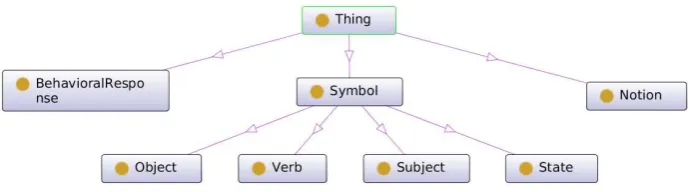
[image:5.595.143.489.351.447.2](figure 2) are the ones of the model pro-posed by Leite[16]. Relations linking those concepts are:hasNotionthat establish relations between instances of typeSymbol and instaces of typeNotion,hasBR does the same betweenSymbol andBehavioralResponse, and the relationship be-tween Symbol andBehavioralResponse and others instances ofSymbol through relationshasObject,hasSubject,hasVerbandhasState. This ontology descriptions of LeL is expressed in DL notation in (1).
Fig. 2.TheOntoLeL Ontology
Object≡Symbol⊓ ∃hasN otion.N otion⊓ ∃hasBR.BehavioralResponse Subject≡Symbol⊓ ∃hasN otion.N otion⊓ ∃hasBR.BehavioralResponse V erb≡Symbol⊓ ∃hasN otion.N otion⊓ ∃hasBR.BehavioralResponse State≡Symbol⊓ ∃hasN otion.N otion⊓ ∃hasBR.BehavioralResponse BehavioralResponse≡ ∃hasObject.Object⊓ ∃hasSubject.Subject
⊓ ∃hasV erb.V erb⊓ ∃hasState.State
N otion≡∃hasObject.Object⊓ ∃hasSubject.Subject⊓ ∃hasV erb.V erb
⊓ ∃hasState.State
Object⊓Subject⊓V erb⊓State≡ ⊥
The main advantages of using an ontology for defining a LeL is that the veri-fication and validation processes can be done by using the reasoning capability of the ontology facilitating these activities. By using a reasoner, the consistency of the LeL can be checked. In addition, SWRL and SQWRL can be defined in order to validates the LeL. Futhermore, theOntoLeL
ontology facilitates fulfillment of the principles of circularity and minimal vocabulary.
3.2 The process to obtain OntoDom
The process to obtain aOntoDom
directly from the instances of theOntoLeL
can be resumed in three steps as is defined in the pseudocode of the algo-rithm 1. In the first step, for each instances of symbolsObject(Lo),Subject(Ls)
and State(Lst), a new class inOnto Dom
is created and stored inC(OntoDom), taken the same name of the individual in OntoLeL . The set of relationships (R(OntoDom
)) are obtained from instances of the symbolVerb(Lv) inOnto LeL
, whose domain and range will be established further ahead. Furthermore, a map-ping relationshipτc is established between classes of Onto
Dom
and instances of
OntoLeL
as well asτrbetween relationships and instances of symbolVerb, these
mapping functions have a two fold objective, one is vinculated to the process itself, to trace forward and backward between both ontologies, and the other to provides a very simple traceability mechanism which could be taken advantage in further stages of the global process.
The second step take all instances of Notion (Lnotion) in order to check at
first place for hierarchical relationship in case whether is the same kind of Sym-bol, and otherwise checking for another kind of relationship determinated for the presence of a hasVerb property. These hierarchical relationships are estab-lished inOntoDom
between classes from a explicit relationship throughnotions of OntoLeL
which relates symbols of LeL and have a hasParent relationship. In order to determinates that relationship, the τc are applies over instances of
symbols eitherLs,Lsor Lst filtered by notion (inotion), obtaining in that way
the corresponding classes which are related.
The last step complete the range and domain of each relations inOntoDom
. To accomplish it the process check for each instance of BehavioralResponse in
OntoLeL
(Lbr) searching for ocurrences of instances of Verb meaning
relation-ships between instances involves either ofObject,SubjectorState. In order to add a class into thedomain of a relationship(domain(τr(rlel))), the class in cuestion
must have a behavioral response with a hasVerb property which matches with the relationship ({i∈Lbr| {rlel} ∈i.hasV erb}). In the other hand, the range is
defined by eitherhasObject, hasSubject or hasState ofbehavioral response, thus therange of relationship incorporates the classes involved.
4
The OntoLeL Tool
Algorithm 1Domain Ontology generation
{Define I as Instances, C as Concepts and R as Relations of a Ontology} Require: OntoLeL
Ensure: OntoDom{Ilel ∈Onto LeL
, Cdom ⊂C(Onto Dom
), Rdom ⊂R(Onto Dom
)|τc:
Ilel7→Cdom∧τr:Ilel7→Rdom}
Ls← {Is|Is∈SubjectOnto
LEL }
Lo← {Io|Io∈ObjectOnto
LEL }
Lv← {Iv|Iv∈V erbOnto
LEL }
Lst← {Ist|Ist∈State OntoLEL
}
Lnt← {Inotion|Inotion∈N otionOnto
LEL }
Lbr← {Ibr|Ibr∈BehavioralResponse OntoLEL
} {STEP 1: Create Concepts and Relations ofOntoDom
fromOntoLeL
} for all i∈ {Lo⊔Ls⊔Lst}do
C(OntoDom
)←i.hasN ame⊂C(OntoDom )
end for
for all i∈Lv do
R(OntoDom
)←i.hasN ame⊂R(OntoDom )
end for
{STEP 2: evaluate symbol’s notions of theOntoLeL
} for all inotion∈Lnotion do
{Check for hierarchical relationship} if inotion.hasP arent∈Ls then
C(OntoDom)
← τc(Ls.select(j | j.hasN otion ∈ {inotion})) ⊂
τc(inotion.hasP arent)
end if
if inotion.hasP arent∈Lo then
C(OntoDom) ← τc(Lo.select(j | j.hasN otion ∈ {inotion})) ⊂
τc(inotion.hasP arent)
end if
if inotion.hasP arent∈Lst then
C(OntoDom) ← τc(Lst.select(j | j.hasN otion ∈ {inotion})) ⊂
τc(inotion.hasP arent)
end if
end for
{STEP 3: evaluate symbol’s behavioral response of theOntoLeL} for allrlel∈Lvdo
for allclel∈ {Lo⊔Ls⊔Lst}do
if #(clel.hasBR∈ {i∈Lbr| {rlel} ∈i.hasV erb})6=∅then
domain(τr(rlel))←domain(τr(rlel))⊔τc(clel)
else
if #({i ∈ Lbr | ({clel} ∈ i.hasObject∨ {clel} ∈ i.hasSubject∨ {clel} ∈
i.hasState)∧ {i} ∈clel.hasBR})6=∅then
range(τr(rlel))←range(τr(rlel))⊔τc(clel)
of the ontologies involved. The main goal of this tool is to offer a comprehen-sive mechanism for building ontologies in very intuitive way for analysts, taking advantage of his knowledge about the analisys tools, in this case, is the LeL artefact. The main window of the software (figure 3) show us a clean interface
Fig. 3.Main Window on OntoLeL Tool
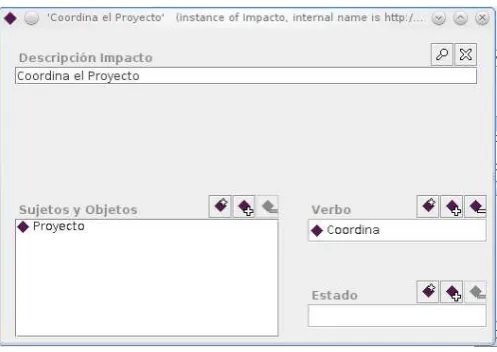
[image:8.595.184.433.468.644.2]where the analyst made a LeL from scratch. The panel at left presents in a intu-itive way for either to add new symbols (plus label button), or to delete symbols of the list (minus label button). In the right panel we can see the Description Nameof symbol, thenotionsand theBehavioralResponse sections. Selecting in a items list the software deploy a window (figure 4) where we can link another symbols or add other on the fly.In the bottom of the main window we can see at the left a button to save the instances of OntoLeL
wich has been created in the tool, and at the right the button to generate OntoDom
. The OntoDom
is implemented in OWL 1.0 and it can be open with any tool that supports it.
5
Discussion and Future Work
In this paper the use of an ontology to describe the domain in term of LeL components was presented. Two goals has been covered with the proposed ap-proach. The first one is to give an structure for the information of the LeL and also to offer a natural way to link symbols, such as Leite proposed it [16]. The second goal consists on the detection of inconsistencies in early stages of a soft-ware development project. In order to achieve it, we run consistence checking and clasification process over the ontology. This offer the posibility either of cor-rect the ontology definitions or obtain a refined ontology over the base of their definitions.
In addition, the OntoLEL tool which implements our approach has been pre-sented. Future work will be focused on improving theOntoDom
by including new ontologies for the rest of the requirements artefacts, and refining the heuristics of transformation according with thats inclusions. In addition, the framework [18] will be completed with transformation rules according to MDA approach tending to obtain a first conceptual model for the design stage of an information system reducing the semantics gap between CIM and PIM.
References
1. Arnarsd´ottir, K., Berre, A.J., Hahn, A., Missikoff, M., Taglino, F.: Semantic mping: ontology-based vs. model-based approach alternative or complementary ap-proaches? In: Missikoff, M., 0001, A.D.N., D’Antonio, F. (eds.) EMOI-INTEROP. CEUR Workshop Proceedings, vol. 200. CEUR-WS.org (2006)
2. Breitman, K.K., Leite, J.C.S.d.P.: Ontology as a requirements engineering product. In: RE ’03: Proceedings of the 11th IEEE International Conference on Require-ments Engineering. p. 309319. IEEE Computer Society, Washington, DC, USA (2003)
3. Cranefield, S.: UML and the semantic web. In: Cruz, I.F., Decker, S., Euzenat, J., McGuinness, D.L. (eds.) The Emerging Semantic Web. Frontiers in Artificial Intelligence and Applications, vol. 75. IOS press (2001)
5. Gasevic, D., Djuric, D., Devedzic, V.: Model Driven Engineering and Ontology Development. Springer Publishing Company, Incorporated, 2nd edn. (2009) 6. G´omez-P´erez, A., Fern´andez-L´opez, M., Corcho, O.: Ontological Engineering: With
Examples from the Areas of Knowledge Management, E-Commerce and the Seman-tic Web. Springer (2004)
7. Groza, T., Schutz, A., Handschuh, S.: SALT: a semantic approach for generat-ing document representations. In: Proceedgenerat-ings of the 2007 ACM symposium on Document engineering. p. 171173. DocEng ’07, ACM, New York, NY, USA (2007) 8. Guizzardi, G.: Ontological foundations for structural conceptual models. Ph.D. thesis, Centre for Telematics and Information Technology University of Twente, Enschede (2005)
9. Jablonski, S., Lay, R., Melier, C., Faerber, M., Volz, B., Dornstauder, S., Gotz, M., Muller, S.: Integrated process and data management for healthcare applications. International Journal of Healthcare Information Systems and Informatics 2(4), 1– 21 (2007)
10. Kaplan, G.N., Hadad, G.D.S., Doorn, J.H., do Prado Leite, J.C.S.: Inspecci´on del l´exico extendido del lenguaje. In: Workshop on Requeriments Engineering (WER). pp. 70–91 (2000)
11. Kardo, M., Drozdov, M.: Analytical method of CIM to PIM transformation in model driven architecture (MDA). Journal of Information and Organizational Sci-ences 34(1), 89–99 (2010)
12. Mellor, S.J.: Mda Distilled: Principles of Model-Driven Architecture. Addison-Wesley Professional (2004)
13. O’Connor, M., Das, A.: SQWRL: a query language for OWL. In: OWL: Experiences and Directions (OWLED), Fifth International Workshop. Chantilly, VA (2009) 14. Oconnor, M., Knublauch, H., Tu, S., Musen, M.: Writing rules for the semantic
web using SWRL and jess. In: 8th International Protege Conference, Protege with Rules Workshop (2005)
15. Pohl, K.: Requirements Engineering: Fundamentals, Principles, and Techniques. Springer (2010)
16. do Prado Leite, J.C.S., Doorn, J., Hadad, G., Doorn, J.H., Kaplan, G.: A scenario construction process. REQUIREMENTS ENGINEERING 5(1), 3861 (2000) 17. Rodr´ıguez, A., Fern´andez-Medina, E., Piattini, M.: CIM to PIM transformation:
A reality. In: Xu, L., Tjoa, A., Chaudhry, S. (eds.) Research and Practical Issues of Enterprise Information Systems II, IFIP International Federation for Information Processing, vol. 255, pp. 1239–1249. Springer Boston (2008)
18. Ruid´ıas, H.J., Caliusco, M.L., Galli, M.R.: Hacia un framework basado en MDA y ontolog´ıas para el desarrollo de software. In: Seminario Argentina-Brasil de Tec-nolog´ıa de la Informaci´on y las Comunicaciones. Rosario, Argentina (2011) 19. Yue, T., Briand, L.C., Labiche, Y.: A systematic review of transformation
ap-proaches between user requirements and analysis models. Requir. Eng. 16(2), 7599 (2011)
![Fig. 1. A LeL Construction Process [10]](https://thumb-us.123doks.com/thumbv2/123dok_es/4758396.60965/4.595.146.478.269.486/fig-a-lel-construction-process.webp)