
Suicide attempts and stressful life events among female victims of intimate partner violence living in poverty in Nicaragua
18
0
0
Texto completo
(2) Suicide attempts and stressful life events among female victims of intimate partner violence living in poverty in Nicaragua.. Introduction The relationship between suicide attempts among women in poverty victims of intimate partner violence (IPV) in less developed countries with experiencing stressful life events (SLE) –experiences that play a key role in one's life and that frequently cause significant changes for the person involved – and perceived social support is an understudied issue. Women who have suffered from IPV are more likely to have attempted suicide at some point in their lives than women who have never experienced partner violence (Ellsberg, Jansen, Heise, Watts, & García-Moreno, 2008; García-Moreno, Jansen, Ellsberg, Herse, & Watts, 2005; Haarr, 2010; McLaughlin, O'Carroll, & O'Connor, 2012). Suicidal behaviours are one of the most important contributors to the global burden of diseases among women (Devries et al., 2011; Mathers et al., 2003). Women in poverty subject to IPV are a particularly vulnerable group, especially in countries with lower levels of development, due to factors such as the lack of support mechanisms that can provide adequate help and the possible existence of a social context that tends to tolerate this kind of behaviour (Adelman, Haldane, & Wies, 2012; Haarr, 2010; Iliyasu et al., 2013; Schuler, Yount, & Lenzi, 2012). While in developed countries there is evidence confirming that suffering from partner violence (Ellsberg et al. 2008) and/or adverse experiences in childhood - sexual abuse, physical punishment/abuse, household dysfunction…- (Dube et al. 2001; Fergusson, Boden, & Horwood, 2008) is associated with suicidal behaviour among women, only a limited number of studies in less developed countries have examined the role of these risk factors in suicidal behaviour (Ahmed et al. 2004; Alem, Kebede, Jacobson, & Kullgren, 1999; Blum et al., 2003; Borges et al., 2008; Maselko & Patel, 2008; Naved & Akhtar, 2008; Pillai, Andrews, & Patel, 2009; Vizcarra et al., 2004), and no study on this subject has been undertaken in Central America. According to Haarr (2010), it is necessary to understand the cultural aspects of suicidal behaviour among women experiencing IPV within a particular society in order to develop culturally appropriate strategies for prevention and support. Various studies have shown that the prevalence of suicide attempts among women is about 18% (Borges et al., 2007; Gureje, Kola, Uwakwe, Wakil, & Afolabi, 2007; Joe, Stein, Seedat, Herman, & Willians, 2008; Kebede & Alem, 1999; Nock et al., 2008; Thanh, Tran, Jiang, Leenaars, & Wasserman, 2006), making it a public health problem of the highest order. However, little is known about the prevalence of suicidal behaviour among women suffering from IPV and potentially modifiable risk factors in low and middle income settings (Vijayakumar, John, Pirkis, & Whiteford, 2005). The relationship between the risk of suicide and suffering from is well established in the scientific literature, and many papers show that both suicides and suicide attempts are to a large extent precipitated by SLE (Cheng, Chen, Chen, & Jenkins, 2000; Foster, Gillespie, McClelland & Patterson, 1999; Gould, Fisher, Parides, Flory, & Shaffer, 1996; Heikkinen,.
(3) Aro & Lonnqvist, 1994; Heikkinen et al., 1997; Paykel, Prusoff & Myers, 1975; Vázquez, Panadero, & Rincón, 2010). In situations of low social support, the loss of relatives and interpersonal conflicts (relationship breakdowns, arguments with partner, family and friends, grief, etc.) have been considered important precipitant factors -situational factors, circumstances, or reasons that led the person to make the attempt (Beautrais, Joyce & Mulder, 1997)- in suicidal behaviour (Pompili et al., 2011; Weyrauch, Roy-Byrne, Katon, & Wilson, 2001). On the other hand, as Kleiman, Riskind & Schaefer (2014) point out, social support may have a direct impact on suicide contemplation, acting at times to prevent the experience of negative events from turning into thoughts about suicide. Although there is not seem to exist a direct relation between suicide rates and development level of a nation, Vijayakumar et al. (2005) indicate that, in general, the suicide rates registered in developing countries would be greater than in developed countries. This could be explicated by the fact that low levels of a nation´s development could result in the suffering by its population of a greater amount of SLE, through high rates of poverty (Vázquez et al. 2010). The suffering of certain SLE has been associated to situations of poverty (Lantz, House, Mero, & Williams, 2005), and an increase in the number and frequency of suffered SLE has been observed among people with greater levels of poverty (Roll, Toro, & Ortola, 1999). According to Devries et al. (2011), the risk factors that most consistently predict suicide attempts among women are IPV, childhood sexual abuse, non-partner physical violence, having been divorced, separated or widowed, and having a mother who experienced IPV. There appears to be a particularly strong correlation between suicidal behaviour and physical, sexual and emotional partner violence (Devries et al., 2011). Similarly, having suffered from physical, psychological and/or sexual abuse during childhood appears to have a significant effect on vulnerability to engaging in subsequent suicidal behaviour in adulthood (Osvath, Vörös, & Fekete, 2004; Pompili et al., 2011; Vázquez et al., 2010), to the extent that Andrews, Corry, Slade, Issakidis, & Swanston (2004) estimated that the fraction of suicide attempts attributable to child sexual abuse was 11% for females. Meanwhile, the relationship between non-partner physical violence and suicidal behaviour among adult women has not been widely discussed in the literature, and it is absent from reviews of suicide risk factors in developing countries (Khan, 2005; Vijayakumar et al., 2005). However, there is some evidence for the significance of physical assaults by family members in suicides among women in Asian settings (Ahmed et al., 2004). Nicaragua, with an estimated population of 5.5 million inhabitants, is one of the countries in Latin America with the lowest levels of development (United Nations Development Programme, 2011). About 12% of Nicaragua's population lives on less than 1.25 US dollars a day, and 46% lives below the national poverty line (United Nations Development Programme, 2013). Nicaraguan society, like many Latin American societies, is characterized by a culture that is traditionally dominated by men. In medium-sized cities, such as León, there is a significant level of social control with strongly prescribed gender roles, so that men are expected to be dominant, while women must be submissive and self-sacrificing (Berrios et al., 2011)..
(4) León, the country's second largest city, has a population of approximately 185,000 inhabitants (Vázquez, Panadero, & Rivas, in press). Estimates suggest that more than half the city's inhabitants live below the poverty line, and that major pockets of the population live in extreme poverty (Vázquez, 2013). The homicide rate in Nicaragua is 8.7 per 100,000 inhabitants (PNUD, 2014). According to data provided by the Commissariat for Women of the Nicaraguan National Police, 34,763 and 33,535 complaints related to IPV were filed in 2010 and 2011, respectively. The same source stated that in Nicaragua 37 women in 2010 and 34 women in 2011 were killed by their partners. According to the Nicaragua Women's Network Against Violence, in Nicaragua the number of women killed by a man (regardless of whether or not they were in a relationship with the victim) was 87 in 2010 and 76 in 2011. In 2012, 85 women were murdered by men in Nicaragua - two of them in the city of León. During that year 2012, the Commissariat for Women of Leon processed 2,195 complaints (212 by men and 1,983 complaints by women), of which 311 were for physical violence, 204 for offenses against freedom of action and 189 for sexual violence. Violence against women is common in Nicaragua, although the IPV among women living in poverty is to a large extent hidden and understudied . This study addressed this gap by examining a sample of female IPV victims living in poverty in Nicaragua. The objectives were to analyze the relationship between experiences of SLE and perceived social support with suicide attempts, and to evaluate the differences in the amount and characteristics of SLE experienced by female suicide attempters versus nonattempters.. Method Sample The participants in the research were 136 female IPV victims living in poverty in León (Nicaragua). The interviewees were accessed by means of two strategies. First, the Commissariat for Women of León sent invitations by letter to participate in the study to women in poverty who had visited the offices due to having suffered from IPV during the year prior to the research. Meanwhile, the associations working with the Commissariat for Women of Leon contacted personally or by telephone to women in poverty who were IPV victims who had not visited the Commissariat. The Commissariat for Women of Leon collaborates closely with the "Ixchen", "Mary Barreda" and "María Elena Cuadras" associations and the "Working Women's Help Centre (CECAMO)", which provide women who are victims of violence with counseling, psychological support and legal advice. Both the Commissariat for Women and the collaborating associations took the necessary measures to ensure the safety of the women interviewed. An interviewer went to the women's homes to conduct the interviews only when these institutions considered this to be safe, and always with the consent of the women concerned. Those meeting the criterion for inclusion in the sample were women above 18 years living in poverty who were currently suffering or had suffered from physical violence inflicted by their spouse or partner. Initially, the Commissariat for Women of León and its.
(5) collaborating associations were responsible for determining whether the women were in poverty, although this was confirmed during the interview process by questions asking the women about their personal and family income. The women were also asked how much time had elapsed since the last episode of IPV involving physical violence. After locating each participant, the trained interviewer began the meeting, explained the objectives of the research and the treatment that would be given to the data, and requested informed consent to carry out the interview, assuring those that took part that their complete anonymity would be respected at all times. Overall, 51.6% of the women were interviewed in their homes, 38.9% in the Commissariat for Women of the Nicaraguan National Police in León, and 9.5% at the headquarters of various associations which collaborated with the research, without any statistically significant differences between the women interviewed in the different places. The interviewees did not obtain any remuneration for participating in the study. Instruments The information was gathered using an structured interview designed for this purpose, which was conducted in Spanish by two female interviewers with experience in this type of work. The interviews lasted between 45 and 80 minutes. In order to ensure the participants' anonymity, no information that would enable their identification was gathered, and the data were processed anonymously. The women's structured interview included the question: "have you attempted suicide at some point in your life?" with possible response options of "yes" or "no". We define suicide attempts as “incident accompanied by self-reported intent to die” (Goldman-Mellor et al., 2014). A listing of 24 selected vital events was used in order to collect information on the SLEs suffered by the interviewed (see table 3). This list was created by revising the SLEs considered in other studies conducted on different Spanish-speaking populations (Vázquez, Panadero and Rincón, 2007; Vázquez, et al., 2010). The participants had to respond if they had suffered each of the SLEs (dichotomizing answer) or not. The interview included the Scale of Perceived Social Support (Arechabala & Miranda, 2002), a Spanish adaptation of the Multidimensional Scale of Perceived Social Support (Zimet, Dahlem, Zimet, & Farley, 1988), consisting of 12 items, which includes information on individuals' perceived social support in three areas: family (4 items), friends (4 items) and significant others (4 items). The instrument was answered using a Likert scale with four response options: 1 = "almost never", 2 = "sometimes", 3 = "often", 4 = "always or almost always". Analysis The database was developed and processed using the SPSS statistical analysis and data management system (version 19.0 for Windows.) The dependent variable was defined as "Having attempted suicide at some point in her life". Participants were assigned a score of 1 if they reported to have ever attempted suicide and a 0 if they have not attempted..
(6) We compared SLE and social support between suicide attempters and non-suicide attempters, using the Chi square statistic for the nominal variables and the Student-t test for independent samples for continuous variables. Two discriminant analyses were subsequently performed using the Wilks λ method in order to ascertain whether a combination of SLE experienced (before 18 years old and after that age) enabled discrimination between two groups of women. Discriminant analyses capture the relationships between a categorical dependent variable and multiple independent variables, calculating a discriminant function score that produce the predicted probability of a case being in a particular category of the dependent variable (Spicer, 2005). This multivariate technique is therefore appropriate to determine which variable/s discriminates between two or more categories and to develop linear classification models (Pohar, Blas & Turk, 2004). We decided to conduct two discriminant analyses to specifically determine the classification power of stressful life events experienced during childhood and adolescence, and of stressful life events experienced during adulthood. We used the stepwise inclusion method and attempted to find models with the smallest possible number of variables and the maximum discriminant power. The independent variables were those SLE that had presented significant differences between the two groups in the previous univariate analysis. Results The mean age of female IPV victims living in poverty interviewed in our study was 31.67 years old, and they had a mean of 2.23 children (SD = 1.655). They began living with the partner who inflicted the assaults on them at a mean age of 19.91 years old (SD = 4.929) and had been living - or had lived - with their attacker for a mean of 9.16 years (SD = 6.789). Other characteristics of the women interviewed are presented in Table 1..
(7) Table 1. Characteristics of the sample of female intimate partner violence victims living in poverty interviewed in León (Nicaragua) (N = 136). Characteristics n % Marital status Single 33 24.3 Married 31 22.8 Common-law union 46 33.8 Separated 22 16.2 Divorced 4 2.9 Number of children 0 12 8.8 1 35 25.7 2 46 33.8 3 or more 43 31.5 57 41.9 Lives with her violent partner Has file an official complaint about the abuse 78 57.4 at some point Level of education Illiterate or no education 4 2.9 Primary education (complete and incomplete) 93 68.4 Secondary education (complete and 24 17.6 incomplete) University education (complete and 15 11.1 incomplete) Approximate level of household income Less than 20 dollars a week 25 20.7 Between 20 and 40 dollars a week 37 30.6 Between 40 and 80 dollars a week 30 24.8 More than 80 dollars a week 29 24.0 Interviewee's income level No independent income 48 35.8 Less than 10 dollars a week 10 7.5 Between 10 and 20 dollars a week 33 24.6 Between 20 and 40 dollars a week 30 22.4 More than 40 dollars a week 13 9.7 As can be seen in Table 1, more than half of the interviewees (56.6%) were married or in a common-law union. One in five interviewees (19.1%) was separated or divorced. Most of the interviewees had no education beyond primary level and a large percentage had no independent income. Approximately 42% of the women lived with their violent partner. Among women interviewed in our study, 43.4% answered in the affirmative to the question "Have you attempted suicide at some point in your life?”. No statistically significant differences were found between the group of attempters and the group of non-attempters.
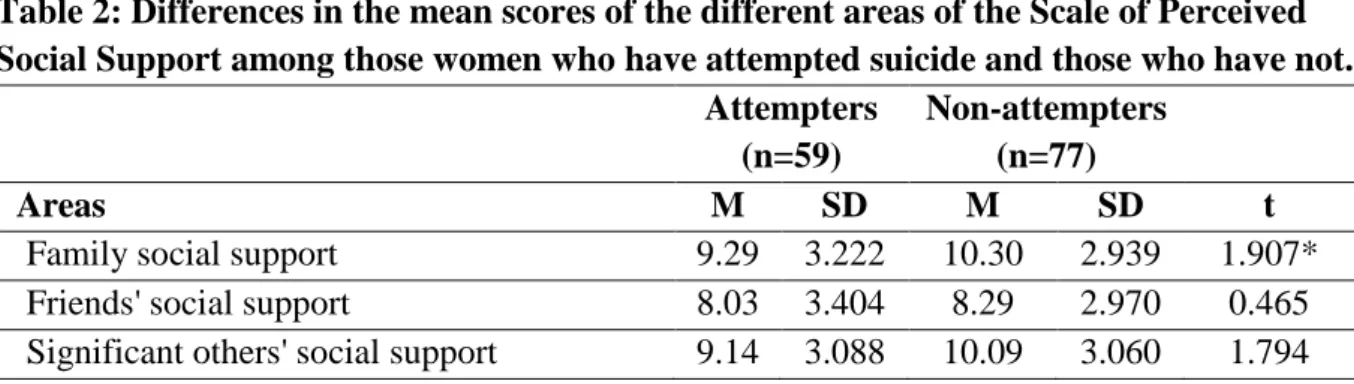
(8) based on sociodemographic characteristics such as age (t (134) = -0.980, p=.329), marital status (χ2 (4) = 4.159, p=.385), level of education (χ2 (3) = 5.590, p=.133), being employed (χ2(1) =0.041, p=.839), or number of children (t (134) = -0.266, p=.791). Table 2 shows the differences in the average scores for the women interviewed in the various areas of the Scale of Perceived Social Support according to whether or not they had attempted suicide at some point in their lives. Table 2: Differences in the mean scores of the different areas of the Scale of Perceived Social Support among those women who have attempted suicide and those who have not. Attempters Non-attempters (n=59) (n=77) Areas M SD M SD t Family social support 9.29 3.222 10.30 2.939 1.907* Friends' social support 8.03 3.404 8.29 2.970 0.465 Significant others' social support 9.14 3.088 10.09 3.060 1.794 *p≤.05; **p≤.01; ***p≤.001. As can be seen in Table 2, the interviewees that had attempted suicide at some point in their life had significantly lower levels of perceived family support than those who had not. No statistically significant differences as regards perceived social support from friends or other significant individuals were observed between women who had engaged in suicidal behaviour and those who had not, although the mean scores of the former were lower than those of the latter on both occasions. Of the 24 SLE contained in the instrument applied, the interviewees who said they had attempted suicide had experienced a mean of 10.61 SLE (SD = 4.327), while the women who reported not having made any suicide attempts had experienced a mean of 6.53 SLE (SD = 3.177), and as such these differences were statistically significant (t (102) = -6.089, p<.001). The attempters had experienced significantly more SLE before the age of 18 years old (M = 4.22, SD = 2.540) than the non-attempters (M = 2.60, SD = 1.90) (t (104) = -4.106, p<.001). Table 3 shows the differences in experiences of the SLE mentioned on the list among the women interviewed, according to whether they had attempted suicide..
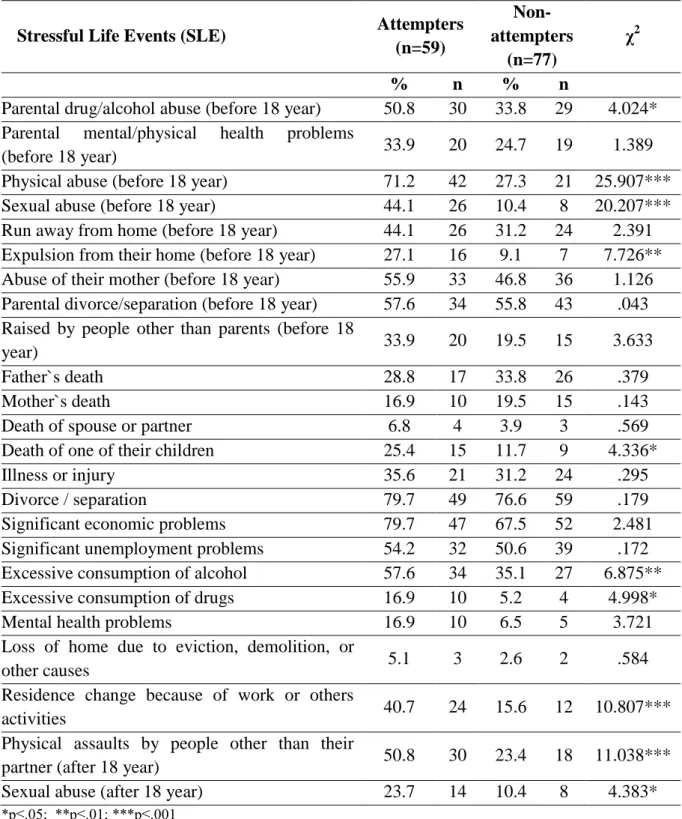
(9) Table 3: Comparison of the occurrence of stressful life events among those women who had attempted suicide and those who had not. NonAttempters Stressful Life Events (SLE) attempters χ2 (n=59) (n=77) % n % n Parental drug/alcohol abuse (before 18 year) 50.8 30 33.8 29 4.024* Parental mental/physical health problems 33.9 20 24.7 19 1.389 (before 18 year) Physical abuse (before 18 year) 71.2 42 27.3 21 25.907*** Sexual abuse (before 18 year) 44.1 26 10.4 8 20.207*** Run away from home (before 18 year) 44.1 26 31.2 24 2.391 Expulsion from their home (before 18 year) 27.1 16 9.1 7 7.726** Abuse of their mother (before 18 year) 55.9 33 46.8 36 1.126 Parental divorce/separation (before 18 year) 57.6 34 55.8 43 .043 Raised by people other than parents (before 18 33.9 20 19.5 15 3.633 year) Father`s death 28.8 17 33.8 26 .379 Mother`s death 16.9 10 19.5 15 .143 Death of spouse or partner 6.8 4 3.9 3 .569 Death of one of their children 25.4 15 11.7 9 4.336* Illness or injury 35.6 21 31.2 24 .295 Divorce / separation 79.7 49 76.6 59 .179 Significant economic problems 79.7 47 67.5 52 2.481 Significant unemployment problems 54.2 32 50.6 39 .172 Excessive consumption of alcohol 57.6 34 35.1 27 6.875** Excessive consumption of drugs 16.9 10 5.2 4 4.998* Mental health problems 16.9 10 6.5 5 3.721 Loss of home due to eviction, demolition, or 5.1 3 2.6 2 .584 other causes Residence change because of work or others 40.7 24 15.6 12 10.807*** activities Physical assaults by people other than their 50.8 30 23.4 18 11.038*** partner (after 18 year) Sexual abuse (after 18 year) 23.7 14 10.4 8 4.383* *p≤.05; **p≤.01; ***p≤.001. As can be seen in Table 3, the participants who had attempted suicide had experienced a significantly higher proportion of 9 of the 24 SLE mentioned in the questionnaire. These included both events experienced during childhood and adolescence (parental drug/alcohol abuse; physical abuse; sexual abuse; expulsion from their home) and events experienced after 18 years old (death of a child; excessive drug or alcohol consumption; change of residence.
(10) because of work or other activities; experiencing physical assaults by people other than their partner; sexual abuse). The discriminant analysis performed based on the SLE experienced by the interviewees during their childhood and adolescence showed that the combination of two independent variables (suffering from physical abuse before 18 years old and sexual abuse before 18 years old) provided the best possible discrimination between attempters and nonattempters. The inclusion of other SLE did not contribute significantly to discrimination between the two groups, and as such they were not included in the discriminant function. The estimated discriminant function was statistically significant, with a Wilks λ value of .770 (χ2 (2) = 34.751, p<.001). The centroid in the group of women who had attempted suicide was .698, and in the non-attempters group it was -.458. The standardized coefficients of the discriminant function were 1.543 (to physical abuse before 18 year), and 1.237 (to sexual abuse before 18 year). The function classified 72.1% of all the original cases correctly. Specifically, 71.2% of the group of women who had never attempted suicide and 72.7% of the group of women who had attempted suicide were assigned to the correct group. The classification accuracy criteria suggested by Hair, Anderson, Tatham, and Black (1999) is met by both groups, and is at least a quarter higher than that obtained by random selection. In the discriminant analysis performed according to the SLE experienced by the women interviewed after 18 years old (Table 5), we found that the combination of two independent variables (suffering from physical assaults by people other than their partner after 18 years old and change of residence because of work or other activities) provided the best possible discrimination between attempters and non-attempters. The inclusion of other variables did not contribute significantly to the discrimination between the groups. The estimated discriminant function was statistically significant, with a Wilks λ value of .868 (χ2 (2) = 18.784, p<.001). The centroid in the attempters group was .442, and in the nonattempters group it was -.338. The standardized coefficients of the discriminant function were 1.533 (to residence change because of work or others activities after 18 year), and 1.439 (to experiencing physical assaults by people other than their partner (after 18 year). The function classified 64.7% of all the original cases correctly. The results show that 64.4% of non-attempters and 64.9% of attempters were assigned to the correct group. The classification accuracy criteria (Hair et al. 1999) are met for both groups.. Discussion Although various studies have shown that the prevalence of suicide attempts among women ranges between 1-8% (Borges et al., 2007; Gureje et al., 2007; Joe et al., 2008; Kebede & Alem, 1999; Nock et al., 2008; Thanh et al., 2006), over 40% of the female IPV victims living in poverty interviewed in León (Nicaragua) said they had attempted to commit suicide at some point in their life. In view of these data, the close relationship observed between experiencing IPV and suicidal behaviour by women (Golding, 1999; Haarr, 2008; McLaughlin et al., 2012; Reviere et al., 2007) also appears to be confirmed in our sample. This is considered a major public health problem worldwide (Devries et al. 2011; GarcíaMoreno et al., 2005)..
(11) People in countries with lower levels of development, and especially those living in poverty, are forced to cope with more SLE (Vázquez et al., 2010; Vázquez et al. 2007). This aspect is once again evident in this study, in which the women living in poverty interviewed say they have experienced a large number of SLE during their lives. The amount of SLE suffered by the interviewees is particularly high among those who reported having attempted suicide at some point during their life. These women had on average experienced 1.6 times as many SLE as the non-attempters (10.61 vs. 6.53 SLE). Among women in Nicaragua, experiencing a large amount of SLE also seems to involve a significant factor of vulnerability to suicide attempts in adulthood (Beautrais et al. 1997; Cooper, Appleby, & Amos, 2002; Kaslow et al., 2005; Osvath et al., 2004; Pompili et al., 2011), especially when the SLE occur during the first years of life and are related to the family environment (Vázquez et al., 2010). In fact, many of the SLE suffered by the women interviewed took place during their childhood and adolescence. This effect was particularly marked among the women who had attempted suicide, who had on average suffered from 1.6 times as many SLE during this period of their life (4.22 SLE vs. 2.60). Among others SLE, a much higher percentage of the attempters had experienced expulsion from their home and in particular, physical or sexual abuse before 18 years old. Consistent with previous studies, some SLE appear to be especially powerful when experienced in the first years of life and are associated with an increased risk of suicidal behaviour in adulthood: both a history of physical and/or sexual abuse during childhood (Beautrais, Joyce, & Mulder, 1996; Silverman, Reinherz, & Giaconia, 1996; Wagner, 1997; Brown, Cohen, Johnson, & Smailes, 1999; Fergusson, Woodward, & Horwood, 2000; Molnar, Berkman, & Buka, 2001; Pompili et al., 2011; Vázquez et al., 2010), and impaired or neglectful parenting (Lewinsohn, Rohde, & Seeley, 1993; Brent et al., 1993; Beautrais et al., 1996; Gould et al., 1996; Hollis, 1996; Johnson et al., 2002). Several studies have highlighted the relationship between low levels of social support and suicidal behaviour (Pompili et al., 2011; Compton Thompson, & Kaslow, 2005). This aspect is to some extent confirmed in this study, in which the women who reported having attempted suicide had less perceived family support and more residence changes. However, no significant differences were observed as regards perceived social support from friends or other significant individuals. The literature has traditionally emphasized interpersonal difficulties and work, financial and legal problems as the main factors fostering suicidal behaviour in the general population (Beautrais et al., 1997; Cooper et al., 2002). However, in this paper, which focused on female IPV victims living in poverty in a less developed country, lower levels of social support and experiences of violence are the SLE that enable the best discrimination between attempters and non-attempters. Devries et al. (2011) state that the most consistent predictors of suicide attempts in women are childhood sexual, non-partner physical violence and IPV. In accordance with these authors, our study showed that the SLE that predicted inclusion in the attempter group were having suffered physical and/or sexual abuse before 18 years old, and after that age, having experienced physical assaults by individuals other than their partner. In addition to these items, the weakening of their social networks appears to be particularly relevant among the attempters interviewed: they reported having been forced to leave their home for work reasons or to engage in other activities, and having received less perceived social support from their family, to a greater extent than the non-attempters..
(12) Although the issue of the participants’ mental health has not been addressed, it is worth pointing out that there are no statistically significant difference between attempters and non-attempters regarding the experience of self-informed mental health problems. However, 58% of those interviewees who stated they had attempted suicide had at some point in their lives consumed drugs, particularly alcohol, excessively; this percentage was higher than for those did not state suicide attempts. Nevertheless, the results of the discriminant analyses suggest that the substance abuse appears not to differ between attempters and non-attempters. Nicaraguan society, like many Latin American societies, is characterized by a culture that is traditionally dominated by men (Berrios et al., 2011). This situation, which is especially marked in the most deprived areas, involves significant levels of control by the community and social sanctions for women who do not adopt prescribed gender stereotypes, according to which they are expected to be submissive and self-denying (Berrios, et al., 2011), while violent behaviour by men is excused. This all affects the existence of a significant level of social tolerance of IPV, and high rates of physical and sexual violence against women from the early years of life onwards. Under these circumstances, perceived shortcomings in family support in this cultural environment, in which the family plays a central role, appears to be an important vulnerability factor for engaging in suicidal behaviour. There are several limitations in the current study that should be considered. First, the sample size and the non-random recruitment procedure limit the generalizability of our findings. As is often the case in this kind of work (Compton et al., 2005; Haarr, 2010; Iliyasu et al., 2013; Revier et al., 2007), it proved impossible to ascertain the exact number of women in situations of poverty who were victims of IPV; nor was it possible to gain access to all women who satisfied the sample inclusion criteria. Consequently, one of this study’s limitations is the representativeness of the simple. Although the strategy adopted for approaching the participants (through the Commissariat for Women and the collaborating associations) was an attempt to circumvent this problem as far as possible, due to the very nature of the IPV phenomenon (it is often the case that women fail to report such acts or apply for help, and everything stays in the family), the chances of obtaining a representative sample of women in poverty situations who undergo this type of violence are remote indeed. Furthrmore, the dependent variable was measured by a single-item asking women if they had attempted suicide at some point in their life and could not be empirically verified. Furthermore, no information was collected about issues that might be relevant such as whether the women had made more than one suicide attempt or the point in time when the attempt had been made. Also, given the cross-sectional nature of the study, the temporal relationship between suicide attempt, social support, and many of the SLE is unknown. Another limitation is that we could not measure certain potential mediators of the relationship between SLE and suicide attempts, such as mental health (Houry, Kaslow, & Thompson, 2005; Tidemalm, Långström, Lichtenstein, & Runeson, 2008; Vijayakumar et al., 2005). Despite these limitations, this study is an attempt on the one hand to help give the problem visibility so that the relevant politicians and social agents become aware of the need to raise finance and create care mechanisms for these women; and on the other to suggest some elements which may be of relevance when devising concrete forms of intervention. To be more precise, our study can help to understand the relationship between suicide attempts.
(13) and SLE among women in poverty who are victims of IPV. Concretely, our study can help to understand the relationship between suicide attempts and SLE among women in poverty victims of IPV. According to Devries et al. (2011), the high prevalence of suicidal behaviour among this population, as well as the strong link between suicidal behaviour and suffering from physical and sexual violence during childhood and adolescence, highlight the need to prioritize the fight against violence among the strategies to be developed to reduce suicidal behaviour among women in Nicaragua. It is therefore essential to combat the physical and sexual violence experienced by women in Nicaragua, which is especially severe in the most deprived contexts, and particularly severe among girls and adolescents. To do so, it is vital to eradicate social tolerance of these practices and foster their prosecution by legal means. In this regard, the recent entry into force of Law 779/2012 - the "Comprehensive Law Against Violence Against Women" has provided the authorities with a tool to facilitate prosecution of these practices. However, there is as yet no available data showing the impact of the legislation on aggressive behaviour towards women. Unfortunately, social education and awareness-raising about the role of women remains an outstanding issue in Nicaragua, despite playing a key role in the empowerment of women living in the most deprived contexts and in the social rejection of physical and sexual violence against them. References Ahmed, K., van Ginneken, J., Razzaque, A., & Alam, N. (2004). Violent deaths among women of reproductive age rural Bangladesh. Social Science & Medicine, 59, 311-319. Adelman, M., Haldane, H., & Wies, J.R. (2012). Mobilizing culture as an asset. A transdisciplinary effort to rethink gender violence. Violence Against Women, 18 (6), 691-700. DOI: 10.1177/1077801212454121. Alem, A., Kebede, L., Jacobson, L. & Kullgren, G. (1999). Suicide attempts among adults in Butajira, Ethiopia. Acta Psychiatrica Scandinavia Supplementum, 397, 70-76. Andrews, G., Corry, J., Slade, T., Issakidis, C., & Swanston, H. (2004). Child sexual abuse. In M. Ezzati, A.D. López, A. Rodgers, & C.J.L. Murray, Comparative Quatification of Health Risks. Geneva: WHO. Arechabala, M.C. & Miranda, C. (2002). Validación de una Escala de Apoyo Social Percibido en un grupo de adultos mayores adscritos a un programa de hipertensión de la región metropolitana [Validation of a Scale of Perceived Social Support in a group of elders under control in a hypertension program in the metropolitan region]. Ciencia y Enfermería, 8(1), 49-55. Beautrais, A.L., Joyce P.R., & Mulder, R.T. (1996). Risk factors for serious suicide attempts among youths aged 13 through 24 years. Journal of the American Academy of Child and Adolescent Psychiatry, 35, 1174-1182. Beautrais, A.L., Joyce P.R., & Mulder, R.T. (1997). Precipitating factors and life events in serious suicide attempts among youths aged 13 to 24 years. Journal of the American Academy of Child and Adolescent Psychiatry, 36, 1543-1551. DOI: 10.1016/S08908567(09)66563-1.
(14) Berrios, A., Díaz, A.I., Herrera, A., Espinoza, B., Panadero, S. & Vázquez, J.J. (2011). Estudio sobre la situación, comportamientos y actitudes de la juventud en situación de riesgo de exclusión en León (Nicaragua). León: Editorial Universitaria UNAN-León. Blum, R.W., Halcon, L., Beuhring, T., Pate, E., Campbell-Forrester, S. & Venema, A. (2003). Adolescent health in the Caribbean: Risk and protective factors. American Journal of Public Health, 93(3), 456-460. DOI: 10.2105/AJPH.93.3.456 Borges, G., Benjet, C., Medina-Mora, M.E., Orozco, R., Molnar, B.E., & Nock, M.K. (2008). Traumatic events and suicide-related outcomes among Mexico City adolescents. Journal of Child Psychology and Psychiatry, 49(6), 654-666. DOI: 10.1111/j.14697610.2007.01868.x Borges, G., Nock, M.K., Medina-Mora, M.E., Benjet, C., Lara, C., Chiu, W.T., & Kessler, R.C. (2007). The epidemiology of suicide–related outcomes in México. Suicide & LifeThreatening Behaviors, 37(6), 627-640. DOI: 10.1521/suli.2007.37.6.627. Brent, D.A., Perper, J.A., Moritz, G., Baugher, M., Roth, C., Balach, L., & Schweers, J. (1993). Stressful life events, psychopathology, and adolescent suicide: A case control study. Suicide and Life-Treatening Behaviour, 23, 179-187. DOI: 10.1111/j.1943278X.1993.tb00178.x Brown, J., Cohen, P., Johnson, J.G., & Smailes, E.M. (1999). Childhood abuse and neglect: Specificity of effects on adolescents and young adult depression and suicidality. Journal of the American Academy of Child and Adolescent Psychiatry, 38, 1490-1496. DOI:10.1097/00004583-199912000-00009 Compton, M.T., Thompson, N.J., & Kaslow, N.J. (2005). Social environment factors associated with suicide attempt among low-income African Americans: The protective role of family relationships and social support. Social Psychiatry and Psychiatric Epidemiology, 40, 175–185. DOI 10.1007/s00127-005-0865-6 Cheng, A.T., Chen, T.H., Chen, C.C., & Jenkins, R. (2000). Psychosocial and psychiatric risk factors for suicide. Case-control psychological autopsy study. The British Journal of Psychiatry, 177, 360-365. DOI: 10.1192/bjp.177.4.360 Cooper, J., Appleby, L., & Amos, T. (2002). Life events preceding suicide by young people. Social Psychiatry and Psychiatric Epidemiology, 37, 271-275. DOI: 10.1007/s001270200019 Devries, K., Watts, C., Yoshihama, M., Kiss, L., Schraiber, L.B., Deyessa, N., Heise, L., Durand, J., Mbwambo, J., Jansen, H., Berhane, Y., Ellsberg, M., García-Moreno, C., & WHO Multi-Country Study Tema (2011). Violence against women is strongly associated with suicide attempts: Evidence from WHO multi-country study on women´s health and domestic violence against women. Social Science and Medicine, 73, 79-86. DOI: 10.1016/j.socscimed.2011.05.006. Dube, S.R., Anda, R.F., Felitti, V.J., Chapman, D.P., Williamson, D.F., & Giles, W.H. (2001). Childhood abuse, household dysfunction, and the risk of attempted suicide throughout the life span. Findings from the adverse childhood experiences study. JAMA, 286(24), 3089-3096. DOI:10.1001/jama.286.24.3089. Ellsberg, M., Jansen, H.A., Heise, L., Watts, C., & García-Moreno, C. (2008). Intimate partner violence and women´s physical and mental health in the WHO multi-country.
(15) study of women´s health and domestic violence: An observational study. Lancet, 371, 1165-1172. DOI: 10.1016/S0140-6736(08)60522-X Fergusson, D.M., Boden, J.M. & Horwood, L.J. (2008). Exposure to childhood sexual and physical abuse and adjustment in early adulthood. Child Abuse & Neglect, 32, 607-619. Fergusson, D.M., Woodward, L.J., & Horwood, L.J. (2000). Risk factors and life processes associated with the onset of suicidal behaviour during adolescence and early adulthood. Psychological Medicine, 30, 23-39. Foster, T., Gillespie, K., McClelland, R., & Patterson, C. (1999). Risk factors for suicide independent of DSM-III-R axis I disorder. British Journal of Psychiatry, 175, 175-179. DOI: 10.1192/bjp.175.2.175 García-Moreno, C., Jansen, H.A., Ellsberg, M., Herse, L., & Watts, C. (2005). WHO Multicountry study on women's health and domestic violence against women. Geneva: World Health Organization. Golding, J.M. (1999). Intimate Partner Violence as a Risk Factor for Mental Disorders: A Meta-Analysis. Journal of Family Violence, 14(2), 99-132. DOI: 10.1023/A:1022079418229 Goldman-Mellor, S.J., Caspi, A., Harrington, H., Hogan, S., Nada-Raja, S., Poulton, R., Moffitt, T.E. (2014) Suicide attempt in young people a signal for long-term health care and social needs. JAMA Psychiatry, 71(2): 119-127. DOI:10.1001/jamapsychiatry.2013.2803. Gould, M.S., Fisher, P., Parides, M., Flory, M., & Shaffer, D. (1996). Psychosocial risk factors of child and adolescent completed suicides. Archives of General Psychiatry, 53, 1155-1162. Gureje, O., Kola, L., Uwakwe, O., Wakil, A., & Afolabi, E. (2007). The profile and risks of suicidal behaviours in Nigerian survey mental health and well-being. Psychological Medicine, 37(6), 821-830. DOI: 10.1017/S0033291707000311 Haarr, R.N. (2010). Suicidality among battered women in Tajikistan. Violence Against Women, 16(7), 764-788. DOI: 10.1177/1077801210374409. Hair, J.F., Anderson, R.E., Tatham, R.L., & Black, W. (1999). Multivariate data analysis. New York: Prentice Hall. Heikkinen, A., Aro, H., & Lonnqvist, J. (1994). Recent life events, social support and suicide. Acta Psychiatrica Scandinavica Supplementum, 377, 65-72. DOI: 10.1111/j.16000447.1994.tb05803.x Heikkinen, A., Isometsä, E., Henriksson, M., Marttunen, M., Aro, H., & Lönnqvist, J. (1997). Psychosocial factors and completed suicide in personality disorders. Acta Psychiatrica Scandinavica, 95, 49-57. DOI: 10.1111/j.1600-0447.1997.tb00373.x Hollis, C. (1996). Depression, family environment, and adolescent suicidal behavior. Journal of the American Academy of Child and Adolescent Psychiatry, 35, 622-630. DOI:10.1097/00004583-199605000-00017 Houry, D., Kaslow, N.J., & M. P. Thompson (2005). Depressive Symptoms in Women Experiencing Intimate Partner Violence. Journal of Interpersonal Violence, 20 (11), 1467-1477. DOI: 10.1177/0886260505278529.
(16) Iliyasu, Z., Abubakar, I.S., Galadanci. H.S., Hayatu. Z., & Aliyu, M.H. (2013). Prevalence and risk factors for domestic violence among pregnant women in northern Nigeria. Journal of Interpersonal Violence, 28 (4), 868-883. DOI: 10.1177/0886260512455872 Joe, S., Stein, D.J., Seedat, S., Herman, A., & Willians, D. (2008). Prevalence and correlates of non-fatal suicidal behaviour among South Africans. British Journal of Psychiatry, 192, 310-311. DOI: 10.1192/bjp.bp.107.037697. Johnson, J.G., Cohen, P., Gould, M.S., Kasen, S., Brown, J., & Brook, J.S. (2002). Childhood adversities, interpersonal difficulties, and risk for suicide attempts during late adolescence and early adulthood. Archives of General Psychiatry, 59, 741-749. Kaslow, N.J., Sherry, A., Bethea, K., Wyckoff, S., Compton, M.T., Bender Grall, M., Scholl, L., Price, A.W., Kellermann, A., Thompson, N., Parker, R. (2005). Social risk and protective factors for suicide attempts in low income African American men and women. Suicide Life-Threatening Behavior. 35(4), 400-12. DOI: 10.1521/suli.2005.35.4.400 Kebede, D. & Alem, A. (1999). Suicide attempts and ideation among adults in Addis Ababa, Ethiopia. Acta Psychiatrica Scandinavica Supplementum, 397, 35-39. Khan, M.M. (2005). Suicide prevention and developing countries. Journal of the Royal Society of Medicine, 98, 459-465. Kleiman, E.M., Riskind, J.H. & Schaefer K.E. (2014). Social support and positive events as suicide resiliency factors: examination of synergistic buffering effects. Archives of Suicide Research, 18, 144-55. DOI: 10.1080/13811118.2013.826155. Lantz, P.M., House, J.S., Mero, R.P., & Williams, D.R. (2005). Stress, life events, and socioeconomic disparities in health: Results from the American’s Changing Lives Study. Journal of Health and Social Behaviour, 46, 274-88. Lewinsohn, P.M., Rohde, P., & Seeley, J.R. (1993). Psychosocial characteristics of adolescents with a history of suicide attempt. Journal of the American Academy of Child and Adolescent Psychiatry, 32, 60-68. DOI:10.1097/00004583-199301000-00009 Mathers, C. D., Bernard, C., Iburg, K. M., Inoue, M.,Ma Fat, D., Shibuya, K., Stein, C., Tomijima, N. & Xu, H. (2003). Global Burden of Disease in 2002: Data Sources, Methods and Results. GPE Discussion Paper No. 54. Geneva: World Health Organization. Maselko, J., & Patel, V. (2008). Why women attempt suicide: The role of mental illness and social disadvantage in a community cohort study in India. Journal of Epidemiology and Community Health, 62, 817-822. DOI: 10.1136/jech.2007.069351. McLaughlin, J., O'Carroll, R. E., & O'Connor, R. C. (2012). Intimate partner abuse and suicidality: A systematic review. Clinical Psychology Review, 32(8), 677-689. DOI: 10.1016/j.cpr.2012.08.002 Molnar, B.E., Berkman, L.F., & Buka, S.L. (2001). Psychopathology, childhood sexual abuse and other childhood adversities: relative links to subsequent suicidal behaviour in the US. Psychological Medicine, 31, 965-977. DOI: 10.1017/S0033291701004329 Naved, R.T., & Akhtar, N. (2008). Spousal violence against women suicidal ideation in Bangladesh. Women´s Health Issues, 18(6), 442-452. DOI: 10.1016/j.whi.2008.07.003 Nock, M., Borges, G., Bromet, E.J., Alonso, J., Angermeyer, M., Beautrais, A.L., & Williams, D. (2008). Cross-national prevalence and risk factors for suicidal ideation,.
(17) plans and attempts. The British Journal of Psychiatry, 192, 98-105. DOI: 10.1192/bjp.bp.107.040113. Osvath, P., Vörös, V., & Fekete, S. (2004). Life events and psychopathology in a group of suicide attempters. Psychopathology, 37, 36-40. DOI: 10.1159/000077018 Paykel, E.S., Prusoff, B.A., & Myers, J.K. (1975). Suicide attempts and recent life events. Archives of General Psychiatry, 37, 327-333. DOI:10.1001/archpsyc.1975.01760210061003 Pillai, A., Andrews, T., & Patel, V. (2009). Violence, psychological distress and risk of suicidal behavior in young people in India. International Journal of Epidemiology, 38(2), 459-469. DOI: 10.1093/ije/dyn166 PNUD –Programa de las Naciones Unidas para el Desarrollo- (2014). Informe Regional de Desarrollo Humano 2013-2014: Seguridad Ciudadana con rostro humano: diagnóstico y propuestas para América Latina. Panamá: Author. Pohar, M., Blas, M., & Turk, S. (2004). Comparison of Logistic Regression and Linear Discriminant Analysis: A Simulation Study. Metodološki zvezki - Advances in Methodology and Statistics, 1 (1), 143-161. Pompili, M., Innamorati, M., Szanto, K., Di Vittorio, C., Conwell, Y., Lester, D., & Amore, M. (2011). Life events as precipitants of suicide attempts among first-time suicide attempters, repeaters, and non-attempters. Psychiatry Research, 186, 300-305. DOI: 10.1016/j.psychres.2010.09.003. Reviere, S.L., Farber, E.W., Twomey, H., Okun, A., Jackson, E., Zanville, H., & Kaslow, N.J. (2007). Intimate partner violence and suicidality in low-income African American women: a multimethod assessment of coping factors. Violence Against Women, 13(11), 1113-29. Roll, C.N., Toro, P.A., & Ortola, G.L. (1999). Characteristics and experiences of homeless adults: A comparison of single men, single women, and women with children. Journal of Community Psychology, 27, 189-198 DOI: 10.1002/(SICI)15206629(199903)27:2<189::AID-JCOP6>3.0.CO;2-M Schuler, S.R., Yount, K.M., & Lenzi, R. (2012). Justification of wife beating in rural Bangladesh. A qualitative analysis of gender differences in responses to survey questions. Violence Against Women, 18(10), 1177-1191. DOI: 10.1177/1077801212465152. Silverman, A.B., Reinherz, H.Z., & Giaconia, R.M. (1996). The long-term sequelae of child and adolescent abuse: A longitudinal community study. Child Abuse & Neglect, 20, 709-723. Spicer, J. (2005). Making Sense of Multivariate Data Analysis. An Intuitive Approach. Chapter 5: Logistic regression and discriminant analysis. Thousand Oaks, California: SAGE Publications. Thanh, T.T.H., Tran, N.T., Jiang, G.X., Leenaars, A., & Wasserman, D. (2006). Life time suicidal thoughts in an urban community in Hanoi, Vietnam. BMC Public Health, 6, 76. Tidemalm, D., Långström, N., Lichtenstein, P., Runeson, B. (2008). Risk of suicide after suicide attempt according to coexisting psychiatric disorder: Swedish cohort study with long term follow-up. British Medical Journal, 337:a2205. DOI: http://dx.doi.org/10.1136/bmj.a2205..
(18) United Nations Development Programme (2011) Human Development Report 2011. Sustainability and Equity: A Better Future for All. New York: UNDP. United Nations Development Programme (2013). Human Development Report 2013. The Rise of the South: Human Progress in a Diverse World. New York: UNDP. Vázquez, J.J. (2013). Happiness among the garbage. Differences in overall happiness among trash pickers in León (Nicaragua). The Journal of Positive Psychology, 8(1), 1-11. DOI:10.1080/17439760.2012.743574 Vázquez, J.J., Panadero, S., & Rincón, P.P. (2007). Stressful life events in countries of differing economic development: Nicaragua, Chile, and Spain. Psychological Reports, 101, 193-201. Vázquez, J.J., Panadero, S., & Rincón, P.P. (2010). Stressful life events and suicidal behaviour in countries with different development levels: Nicaragua, El Salvador, Chile and Spain. Journal of Community & Applied Social Psychology, 20(4), 288–298. DOI: 10.1002/casp.1036 Vázquez, J.J., Panadero, S., & Rivas, E. (in press). Happiness among poor women victims of intimate partner violence in Nicaragua. Social Work in Public Health. Vijayakumar, L., John, S., Pirkis, J., & Whiteford, H. (2005). Suicide in developing countries (2): Risk factors. Crisis, 26(3), 112-119. Vizcarra, B., Hassan, F., Hunter, W.M., Munoz, S.R., Ramiro, L., & De Paula, C.S. (2004). Partner violence as a risk factor for mental health among women from communities in the Philippines, Egypt, Chile and India. Injury Control and Safety Promotion, 11(2), 125-129. DOI: 10.1080/15660970412331292351 Wagner, B.M. (1997). Family risk factors for child and adolescent suicidal behavior. Psychological Bulletin, 121, 246-298. Weyrauch, K.F., Roy-Byrne, P., Katon, W., & Wilson, L. (2001). Stressful life events and impulsiveness in failed suicide. Suicide & Life-Threatening Behaviors, 31, 311-319. Zimet, G.D., Dahlem, N.W., Zimet, S.G., & Farley, G.K. (1988). The Multidimensional Scale of Perceived Social Support. Journal of Personality Assessment, 52, 30–41. DOI:10.1207/s15327752jpa5201_2.
(19)
Figure

Documento similar
