
Automatic detection of signals by using artificial intelligence techniques
285
0
0
Texto completo
(2)
(3) Time waits for none .... ... fortunately, Cristina, Víctor and Diego have known how to wait for this moment.. For this and other reasons, this work is dedicated to them..
(4)
(5) Acknowledgements. I would like to thank my supervisors, Ph.D. Manuel Rosa Zurera and Ph.D María Pilar Jarabo Amores, their advices and support during the research and the writing of this Ph.D. thesis. I would also like to thank Ph.D. José Carlos Nieto Borge his advices during the research. Moreover, I want to thank him the access to the WaMoS II marine radar scans (real-live database) used in the thesis. These radar scans were obtained at the FINO 1 German research platform (North Sea, Germany) and provided by the Federal Marine and Hydrographic Agency of Germany (Bundesamt für Seeschifffahrt und Hydrographie, BSH) and OceanWaveS GmbH, Germany. Without these radar scans, I could not check the magnitude of the contributions made in this thesis and the utility of them for the marine radar community. Finally, I would like to thank all the students that have been working with me in topics close to the one presented in this thesis for making me think in a different way. Even when their research topics were sometimes really far from the topic of the thesis, they have made me think about the way of dealing with research:. “Research is worthless when no applicability is found for people and society.”. Raúl Vicen, 2011. i.
(6)
(7) Resumen. La detección automática de señales (blancos) en interferencia aditiva (clutter más ruido) es un problema no resuelto hoy en día. Muchos y diversos esquemas de detección son propuestos constantemente en revistas especializadas sobre temas de investigación radar y de procesado de señal. Esos esquemas son adaptados normalmente a la casuística del problema, es decir, a los blancos y al tipo de clutter presentes en esos experimentos. Es por ello que la tesis presentada a continuación busca proponer un esquema de detección que trabaje con altas prestaciones en distintos entornos. En esta tesis se pretende resolver dos tipos de problemas: uno centrado en la detección de blancos radar de tipo Swerling 0 en presencia de clutter sintético modelado con una distribución Weibull y ruido blanco Gaussiano; y otro centrado en la detección de barcos en movimiento a partir de imágenes radar provenientes de un radar marino comercial. Se ha comprobado que los datos reales están estadísticamente relacionados con los datos sintéticos simulados, lo cual permitirá proponer un único esquema de detección que trabaje en ambos casos. Teniendo en cuenta los problemas de detección planteados, se asumen varias premisas. Las imágenes radar generadas en entornos simulados tienen en cuenta una correlación temporal entre celdas consecutivas de la imagen y una distribución espacial constante de los parámetros estadísticos del clutter dentro de una misma imagen, pero variable de una imagen a otra. Dentro de este entorno simulado, se asumen distintos tamaños y formas de blanco. Estos entornos han sido simulados mediante el uso de los parámetros estadísticos del clutter descritos en la literatura. Comparando dichos entornos, se observa una gran disparidad en sus parámetros estadísticos, haciendo más difícil aún si cabe la tarea de proponer un detector radar que trabaje correctamente y con altas prestaciones en distintos entornos radar. Para resolver los problemas de detección planteados, se han considerado detectores radar utilizados habitualmente en la literatura. Así, se ha seleccionado como detector de referencia para el caso de trabajar con datos procedente de un radar coherente el detector de blanco conocido a priori (TSKAP: target sequence known a priori). Detectores basados en técnicas CFAR (constant false alarm rate) han sido elegidos para el caso de trabajar con datos procedentes de un radar incoherente. Por otro lado, se ha estudiado el uso de técnicas de inteligencia artificial (IA) para crear detectores que resuelvan los dos problemas de detección planteados. De las posibles técnicas de IA existentes en la literatura, se han elegido dos tipos de redes neuronales artificiales (RNAs): iii.
(8) iv el perceptron multicapa (MLP: Multilayer perceptron) y las RNAs basadas en funciones de base radial (RBFNs: Radial basis function networks). Mediante este tipo de técnicas, se proponen nuevas estrategias de detección para los casos coherente e incoherente. Aparte de la contribución en el uso de técnicas de IA en temas de detección radar, se presenta otra contribución importante: el uso de nuevos modos de selección de celdas de una imagen para la mejora de las prestaciones del detector radar propuesto. Estos modos están basados en esquemas de selección con retardo (en una o dos dimensiones), dentro de los cuales se pueden elegir más celdas para poder realizar una mejor estimación de los parámetros del clutter que rodea al blanco. Además, el uso de estos modos de selección en dos dimensiones en detectores CFAR también puede ser considerado contribución ya que antes no se habían presentado resultados para los modos aquí propuestos. Los experimentos desarrollados consideran entornos simulados de mar, mar helado y tierra para el diseño y test de los detectores coherentes tomados como referencia y los basados en IA. En estos experimentos, se estudió la influencia de los siguientes parámetros durante el diseño de los detectores bajo estudio: las propiedades del clutter presente en las imágenes de los conjuntos de diseño (para entrenar RNAs y establecer el umbral de detección); los modos de selección; el número de celdas seleccionadas; así como el número de neuronas ocultas en las RNAs. A partir de estos estudios, se obtienen los valores de dichos parámetros, de tal forma que se obtienen altas prestaciones, mientras que se mantiene un coste computacional moderado en el detector propuesto. Una vez diseñados los detectores, éstos se testean utilizando un conjunto de datos de test no utilizado previamente. Este conjunto de test está compuesto por imágenes radar con distintas propiedades estadísticas para simular lo que ocurre en entornos reales. Las prestaciones observadas para este conjunto son ligeramente inferiores a los obtenidas en la etapa de diseño. Además, se observa que las prestaciones del detector para las distintas imágenes radar del conjunto, es decir, para distintos condiciones de clutter, presentan pequeñas variaciones. Esto nos indica un alto grado de robustez en los detectores cuando las condiciones de clutter cambian con el tiempo. Teniendo en cuenta estas pequeñas variaciones de las prestaciones del detector, podemos inferir que las mismas prestaciones presentadas aquí se pueden obtener cuando el detector diseñado procese nuevas imágenes radar en el futuro. Por otro lado, se han realizado estudios similares para el caso de detectores incoherentes en entornos simulados de mar, mar helado y tierra. De estos estudios, destacamos las diferencias que existen entre los resultados obtenidos por los detectores coherentes e incoherentes en entornos simulados de clutter de mar. La primera diferencia que se observa es que las prestaciones del detector incoherente son ligeramente menores que las obtenidas por el coherente, aspecto que era de esperar porque sólo considera la información de amplitud. La segunda diferencia observada es la alta reducción de coste computacional que se obtiene, siendo esto debido a que en estos detectores se utiliza menos información a la entrada. Los resultados obtenidos para los entornos simulados de mar helado y tierra no han sido incorporados en la memoria de la tesis porque tanto las prestaciones como el coste computacional obtenidos son similares a los obtenidos para el caso de entornos marinos. Finalmente, se han diseñado y testeado detectores incoherentes para trabajar con imágenes provenientes de un radar marino comercial situado en la plataforma de investigación alemana FINO-1, la cual se encuentra localizada en el mar del Norte (Alemania). Antes de proceder con el diseño de estos detectores, se comprobó que las medidas de clutter contenidas en las imágenes radar seguían una distribución Weibull, tal y como se asumió en el entorno simulado.
(9) v de mar. Acto seguido a esta comprobación, se procedió con el ajuste de los parámetros de cada uno de los detectores bajo estudio (CFAR y basados en técnicas de IA) para obtener las mejores prestaciones posibles, así como un coste computacional moderado. Una vez diseñados los detectores, se procedió a testearlos, llegando a las mismas conclusiones a las que se llegó para el caso sintético: alta robustez frente a cambios en las condiciones de diseño y baja pérdida de prestaciones cuando se procesan nuevas imágenes radar. También se muestra cual es el coste computacional de la configuración seleccionada en los casos de detectores incoherentes basados en MLPs y RBFNs, así como la velocidad de computo necesaria para poder procesar imágenes radar en tiempo real. A partir de estos resultados, se llega a la conclusión final de que como las unidades de procesado disponibles en el mercado permiten trabajar a las velocidades que necesita el sistema, el procesado en tiempo real está garantizado. A partir del análisis de las prestaciones obtenidas para los distintos casos de estudio abordados en la tesis, se llega a la siguiente conclusión general: los detectores basados en técnicas de IA mejoran las prestaciones obtenidas por los detectores de referencia seleccionados de la literatura en todos los casos de estudio presentados. Ésta conclusión se obtiene para radares que trabajan a distintas frecuencias, con distintas resoluciones y con receptores diferentes (coherentes e incoherentes). Además, esta conclusión también es independiente del entorno radar bajo estudio (mar, mar helado y tierra)..
(10)
(11) Abstract. The automatic detection of signals (targets) in additive interference (clutter and noise) is not a problem completely solved nowadays. Many different approaches are reported every year in the specialized literature depending on the targets to be detected and the kind of interference present in the environment where the sensor is working. In this way, a detection approach that is able to work in different environments is searched in this thesis. This thesis tries to solve two detection problems: the detection of moving Swerling 0 targets in synthetic Weibull-distributed clutter and white Gaussian noise; and the detection of moving vessels in marine radar environments. A relationship between these two problems is found in the thesis, allowing to propose a unique detection scheme that works in both cases. According to the detection problems to be solved in the thesis, some premises are set. Synthetic radar scans are generated in simulated environments having: time-correlation between consecutive cells; and constant clutter properties (skewness parameter) inside a scan, but variable scan-to-scan. Targets of different sizes and shapes are included in the synthetic radar scans. Different radar environments have been considered in the thesis by using the statistical parameters of sea, sea-ice and ground clutters reported in the literature. From these environments, it is observed that the clutter statistics are different each other, making the problem of proposing a detector scheme able to work with high performance in different environments more complicated. For solving the detection problems this thesis deals with, Artificial Intelligence (AI) based detectors are proposed, and compared with commonly used detectors selected from the literature. The coherent detector set as reference is the target sequence known a priori (TSKAP) detector. The incoherent detector set as reference is based on constant false alarm rate (CFAR) techniques. From AI techniques, two feed-forward artificial neural networks (ANNs) strategies are selected: the multilayer perceptrons (MLPs) and the radial basis function ANNs (RBF-ANNs, also referred as RBFNs). By using these AI techniques, coherent and incoherent approaches are proposed. An additional contribution is made in the thesis by proposing new modes of selecting the cells to be processed. Thus, not only the commonly used non-delayed selection modes are used, but also additional delayed selection modes are studied. These proposed modes are based on 2-dimension selection templates, instead of the 1-dimension templates commonly used in CFAR detectors. Experiments considering the reference and AI-based coherent detectors have been carried out in simulated sea, sea-ice and ground environments. In these experiments, the influence of the vii.
(12) viii following parameters in the design stage of the detectors is studied: the clutter properties of the data sets used to design the detectors (for training the MLPs and RBFNs, and for setting the detection threshold); the selection modes; the number of selected cells; and the number of hidden neurons in AI-based detectors. From these studies, the values for obtaining the highest performance, while maintaining a low computational cost, are selected. Once the reference and AI-based detectors are designed, they are tested using a set of radar scans never processed before (test data set). This data set is composed of radar scans with different clutter conditions (simulating real environments). The performance obtained for this data set is slightly lower than the one achieved in the design stage. Moreover, the performances achieved for each particular radar scan of the test data set, i.e. for different clutter conditions, present low variations, denoting high robustness of the detector against changes in clutter conditions. According to these low performance variations, we can infer the performance achieved by the detectors when processing new radar scans in the future with similar clutter properties as the ones used here. Similar studies have been made when using reference and AI-based incoherent detectors in synthetic sea, sea-ice and ground environments. From the analysis of incoherent detectors in synthetic sea clutter, we focus on the differences observed with respect to coherent detectors in synthetic sea clutter. First, a low performance decrease is observed, being expected because the incoherent detectors only process the amplitude of the cells. And second, a high computational cost decrease is observed in AI-based incoherent detectors because less information is used at their inputs. The results obtained when designing and testing incoherent detectors in synthetic sea-ice and ground environments are not reported in the thesis because similar performance losses and computational cost decreases as the ones presented above are obtained. Finally, incoherent detectors have been designed and tested when processing radar scans obtained by a standard marine radar. This marine radar was sited in the FINO-1 German research platform (North Sea, Germany). It has been statistically checked that the measurements of the clutter fit the Weibull distribution. In this way, CFAR and AI-based detectors were designed by tuning their parameters in order to obtain the highest performance, while maintaining a reasonable computational cost. Once designed, they were tested obtaining similar conclusions as for the synthetic case: high robustness against clutter condition changes and low performance loss when processing new radar scans. The computational costs of the proposed configurations of MLP and RBFN-based incoherent detectors are reported. The processing speed needed to process radar scans in real-time is also reported. And since commercial processing units can fulfill this processing speed, the proposed AI-based detector can process marine radar scans in real-time. From the analysis of the performance obtained in the different cases of study, this thesis finishes with the following conclusion: the proposed AI-based detectors outperform the reference detectors in all the cases of study presented in the thesis. This conclusion is obtained when processing radar scans from radars working at different frequencies, with different resolutions and with different receivers (coherent and incoherent). Moreover, this conclusion is independent of the radar environment under study (sea, sea-ice and ground)..
(13) INDEX. I. Preliminary Study: Motivation, Radar Data and Reference Detectors. 1. Motivation, State of the Art, Objectives and Structure of the Thesis. 1 3. 1.1. Motivation of the Thesis . . . . . . . . . . . . . . . . . . . . . . . . . . . . . . . .. 3. 1.2. State of the art . . . . . . . . . . . . . . . . . . . . . . . . . . . . . . . . . . . . .. 5. 1.2.1. From measurements to synthetic clutter models . . . . . . . . . . . . . . .. 6. 1.2.2. Automatic target detection in clutter . . . . . . . . . . . . . . . . . . . . .. 8. 1.3. Objectives of the Thesis . . . . . . . . . . . . . . . . . . . . . . . . . . . . . . . .. 16. 1.4. Structure of the Thesis . . . . . . . . . . . . . . . . . . . . . . . . . . . . . . . . .. 16. 2. Coherent and Incoherent Measurement Systems: Radar Data. 17. 2.1. Coherent radar system model . . . . . . . . . . . . . . . . . . . . . . . . . . . . .. 17. 2.2. Generating synthetic radar data: Coherent target and interference models . . . .. 19. 2.2.1. Coherent target models . . . . . . . . . . . . . . . . . . . . . . . . . . . .. 19. 2.2.2. Coherent clutter model . . . . . . . . . . . . . . . . . . . . . . . . . . . . .. 20. 2.2.3. Coherent noise model . . . . . . . . . . . . . . . . . . . . . . . . . . . . .. 28. 2.3. Coherent synthetic radar data . . . . . . . . . . . . . . . . . . . . . . . . . . . . .. 29. 2.3.1. Generation and properties of synthetic radar scans . . . . . . . . . . . . .. 29. 2.3.2. Target data . . . . . . . . . . . . . . . . . . . . . . . . . . . . . . . . . . .. 30. 2.3.3. Sea clutter data . . . . . . . . . . . . . . . . . . . . . . . . . . . . . . . . .. 30. 2.3.4. Sea-Ice clutter data . . . . . . . . . . . . . . . . . . . . . . . . . . . . . . .. 32. 2.3.5. Ground clutter data . . . . . . . . . . . . . . . . . . . . . . . . . . . . . .. 34. 2.4. Incoherent marine radar system . . . . . . . . . . . . . . . . . . . . . . . . . . . .. 34. 2.5. Incoherent real-live marine radar data . . . . . . . . . . . . . . . . . . . . . . . .. 36. 2.5.1. Target data . . . . . . . . . . . . . . . . . . . . . . . . . . . . . . . . . . .. 37. 2.5.2. Sea clutter data . . . . . . . . . . . . . . . . . . . . . . . . . . . . . . . . .. 38. ix.
(14) x. Index. 3. Automatic Detection of Signals in Clutter and Noise 3.1. Principles of detecting signals in clutter and noise . . . . . . . . . . . . . . . . . . 3.1.1. Problem formulation: Detection of signals in clutter . . . . . . . . . . . . 3.1.2. The Neyman-Pearson Detector: Optimum and Suboptimum Approaches . 3.2. Detection of Signals in Gaussian-distributed Interference . . . . . . . . . . . . . . 3.2.1. Coherent Detection: Optimum Approaches . . . . . . . . . . . . . . . . . 3.2.2. Coherent Detection: Suboptimum Approaches . . . . . . . . . . . . . . . . 3.2.3. Incoherent Detection: Optimum Approach . . . . . . . . . . . . . . . . . . 3.2.4. Incoherent Detection: Suboptimum Approaches . . . . . . . . . . . . . . . 3.3. Detection of Signals in Non-Gaussian-distributed Interference . . . . . . . . . . . 3.3.1. Suboptimum Coherent Detection of Signals in Weibull-distributed Interference: The TSKAP Detector . . . . . . . . . . . . . . . . . . . . . . . . 3.3.2. Suboptimum Incoherent Detection of Signals in Weibull-distributed Interference: CFAR Detectors . . . . . . . . . . . . . . . . . . . . . . . . . . .. 39 39 39 40 41 41 45 48 50 51. II. Automatic Detection based on Artificial Intelligence (AI). 61. 4. Detection Scheme based on Artificial Intelligence 4.1. Coherent and incoherent detection schemes based on AI . . . . . . 4.2. Modes of selecting data from radar scans . . . . . . . . . . . . . . . 4.2.1. Non-delayed (ND) selection modes . . . . . . . . . . . . . . 4.2.2. Delayed 1-D selection modes . . . . . . . . . . . . . . . . . 4.2.3. Delayed 2-D selection modes . . . . . . . . . . . . . . . . . 4.3. Detection threshold setting . . . . . . . . . . . . . . . . . . . . . . 4.4. Objective evaluation of the detector performance . . . . . . . . . . 4.4.1. Average Signal-to-clutter ratio (SCR) improvement . . . . . 4.4.2. Receiver operating characteristics (ROC) curves: Pfa and Pd 4.5. Selection of radar data for designing (training) AI-based detectors .. 63 63 66 67 68 69 71 72 72 73 74. . . . . . . . . . . . . . . . . . . . . . . . . . . . . . . . . . . . . . . . . . . . . . . . . . . . . . . . . estimations . . . . . . .. . . . . . . . . . .. 5. Detection based on AI: Feed-Forward ANNs (MLPs) 5.1. Coherent MLP-based detection schemes . . . . . . . . . . . . . . . . . . . . . . . 5.2. Incoherent MLP-based detection schemes . . . . . . . . . . . . . . . . . . . . . . 5.3. MLP-based detector design: MLP training algorithms . . . . . . . . . . . . . . . 5.3.1. Training algorithm for huge and medium-size MLPs: Error backpropagation with adaptive learning rate and momentum . . . . . . . . . . . . . . 5.3.2. Training algorithm for low-size MLPs: Levenberg-Marquardt . . . . . . . 5.4. MLP-based detector computational cost . . . . . . . . . . . . . . . . . . . . . . . 6. Detection based on AI: Radial Basis Function (RBF) ANNs 6.1. Coherent RBFN-based detection schemes . . . . . . . . . . . . 6.2. Incoherent RBFN-based detection schemes . . . . . . . . . . . . 6.3. RBFN-based detector design: RBFNs training algorithm . . . . 6.3.1. Unsupervised stage of the RBFN training algorithm . .. . . . .. . . . .. . . . .. . . . .. . . . .. . . . .. . . . .. . . . .. . . . .. 51 57. 77 78 80 82 85 87 88. 91 . 92 . 95 . 97 . 100.
(15) xi. Index. 6.3.2. Supervised stage of the RBFN training algorithm . . . . . . . . . . . . . . 101 6.4. RBFN-based detector computational cost . . . . . . . . . . . . . . . . . . . . . . 102. III. Research and Results. 105. 7. Dimension and Composition of the Synthetic and Real-live Databases 7.1. Dimension and composition of synthetic databases . . . . . . . . . . . . . . . . . 7.1.1. Dimension of synthetic databases: Sizes of train, validation and test data sets . . . . . . . . . . . . . . . . . . . . . . . . . . . . . . . . . . . . . . . 7.1.2. Composition of the synthetic databases: Statistical properties of the train, validation and test data sets . . . . . . . . . . . . . . . . . . . . . . . . . . 7.1.3. Dimension and composition of the data sets when sea, sea-ice and ground clutter conditions are present . . . . . . . . . . . . . . . . . . . . . . . . . 7.2. Dimension and composition of the real-live database . . . . . . . . . . . . . . . .. 107 107. 8. Coherent Detectors in Synthetic Clutter: Design and Test 8.1. From theoretical to practical situations . . . . . . . . . . . . . . . . . . . . . . . . 8.2. Coherent Detectors in Synthetic Sea Clutter . . . . . . . . . . . . . . . . . . . . . 8.2.1. Design of TSKAP Detectors in Synthetic Sea Clutter . . . . . . . . . . . . 8.2.2. Design of MLP-based Coherent Detectors in Synthetic Sea Clutter . . . . 8.2.3. Design of RBFN-based Coherent Detectors in Synthetic Sea Clutter . . . 8.2.4. Comparison of Coherent Detectors in Design and Test Stages under Synthetic Sea Clutter Conditions . . . . . . . . . . . . . . . . . . . . . . . . . 8.2.5. Conclusions about Coherent Detectors in Synthetic Sea Clutter . . . . . . 8.3. Coherent Detectors in Synthetic Sea-Ice Clutter . . . . . . . . . . . . . . . . . . . 8.3.1. Design of TSKAP Detectors in Synthetic Sea-Ice Clutter . . . . . . . . . . 8.3.2. Design of MLP-based Coherent Detectors in Synthetic Sea-Ice Clutter . . 8.3.3. Design of RBFN-based Coherent Detectors in Synthetic Sea-Ice Clutter . 8.3.4. Comparison of Coherent Detectors in Design and Test Stages under Synthetic Sea-Ice Clutter Conditions . . . . . . . . . . . . . . . . . . . . . . . 8.3.5. Conclusions about Coherent Detectors in Synthetic Sea-Ice Clutter . . . . 8.4. Coherent Detectors in Synthetic Ground Clutter . . . . . . . . . . . . . . . . . . 8.4.1. Design of TSKAP Detectors in Synthetic Ground Clutter . . . . . . . . . 8.4.2. Design of MLP-based Coherent Detectors in Synthetic Ground Clutter . . 8.4.3. Design of RBFN-based Coherent Detectors in Synthetic Ground Clutter . 8.4.4. Comparison of Coherent Detectors in Design and Test Stages under Synthetic Ground Clutter Conditions . . . . . . . . . . . . . . . . . . . . . . . 8.4.5. Conclusions about Coherent Detectors in Synthetic Ground Clutter . . . . 8.5. General Conclusions about Coherent Detection in Synthetic Clutter . . . . . . . .. 119 119 120 122 123 129. 107 112 114 117. 135 139 143 143 145 149 153 160 161 161 161 165 169 173 177. 9. Incoherent Detectors in Synthetic Clutter: Design and Test 179 9.1. Incoherent Detectors in Synthetic Sea Clutter . . . . . . . . . . . . . . . . . . . . 179 9.1.1. Design of CFAR Detectors in Synthetic Sea Clutter . . . . . . . . . . . . . 180.
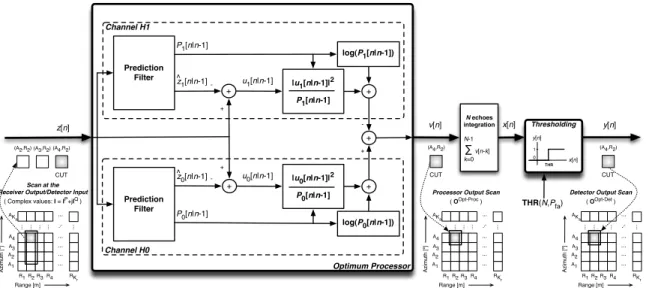
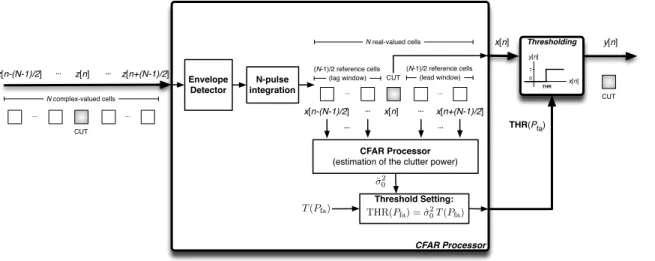
(16) xii. Index 9.1.2. Design of MLP-based Incoherent Detectors in Synthetic Sea Clutter . . . 9.1.3. Design of RBFN-based Incoherent Detectors in Synthetic Sea Clutter . . . 9.1.4. Comparison of Incoherent Detectors in Design and Test Stages under Synthetic Sea Clutter . . . . . . . . . . . . . . . . . . . . . . . . . . . . . . . . 9.2. General Conclusions about Incoherent Detection in Synthetic Sea Clutter . . . .. 184 188 190 195. 10.Statistical Relation between Synthetic and Real-Live Sea Clutter 201 10.1. Statistical Analysis of Real-Live Sea Clutter . . . . . . . . . . . . . . . . . . . . . 201 10.2. Statistical Properties of Training, Validation and Testing Data Sets from Real-Live Sea Clutter . . . . . . . . . . . . . . . . . . . . . . . . . . . . . . . . . . . . . . . 208 11.Incoherent Detectors in Real-Live Sea Clutter: Design and Test 11.1. Incoherent Detectors in Real-Live Sea Clutter . . . . . . . . . . . . . . . . . . . . 11.1.1. Design of CFAR Detectors in Real-Live Sea Clutter . . . . . . . . . . . . . 11.1.2. Design of MLP-based Incoherent Detectors in Real-Live Sea Clutter . . . 11.1.3. Design of RBFN-based Incoherent Detectors in Real-Live Sea Clutter . . . 11.1.4. Comparison of Incoherent Detectors in Design and Test Stages under Reallive Sea Clutter . . . . . . . . . . . . . . . . . . . . . . . . . . . . . . . . . 11.2. General Conclusions about Incoherent Detection in Real-live Sea Clutter . . . . .. 209 209 210 213 216. IV. 227. Conclusions, Contributions and Future Research Lines. 219 225. 12.Conclusions. 229. 13.Future Research Lines. 235. 14.Contributions. 237. V. Bibliography. 241. VI. Appendixes. 257. A. Symbols and Acronyms A.1. Symbols with Latin Letters . . . . . . . . . . . . . . . . . . . . . . . . . . . . . . A.2. Symbols with Greek Letters . . . . . . . . . . . . . . . . . . . . . . . . . . . . . . A.3. Acronyms . . . . . . . . . . . . . . . . . . . . . . . . . . . . . . . . . . . . . . . .. 259 259 263 264. B. Wiener Filtering. 267.
(17) Part I. Preliminary Study: Motivation, Radar Data and Reference Detectors. 1.
(18)
(19) CHAPTER. 1. Motivation, State of the Art, Objectives and Structure of the Thesis. This chapter presents the motivation of the thesis, which can be synthesized as: “the automatic detection of desired signals in presence of interference”, which drives the study of the state of the art about this topic. This study let us find some commonly used detectors, which are taken as reference in our studies. Moreover, from this study, several objectives are set before starting to solve this problem. Finally, according to these objectives, the structure of the thesis is presented to explain how the detectors are designed and validated.. 1.1. Motivation of the Thesis. The automatic detection of desired signals (targets) in presence of interference signals (clutter and noise) is a difficult task, especially when the interference is strong. Moreover, depending on the target and clutter statistics, finding the analytical expressions that characterize the detectors is very difficult and sometimes not possible. In these situations, numerical approximations are used and suboptimum detectors, in the Neyman-Pearson1 sense, are considered. Therefore, it motivates us to search a detection scheme that approximates this detector. The Neyman-Pearson detector can be implemented by comparing the likelihood ratio Λ(z[n]) for a given observation vector, z[n], with a detection threshold (THR) fixed taking into account the Pfa requirements, as stated in Eq. (1.1) [Neyman1933, VanTrees1997]. In this expression, f (z[n]|H1 ) and f (z[n]|H0 ) are the likelihood functions under the alternative (H1 ) and null (H0 ) hypothesis, respectively. Λ(z[n]) =. f (z[n]|H1 ) H1 ≷ THR(Pfa ) f (z[n]|H0 ) H0. (1.1). After analyzing the Neyman-Pearson detection theory, the basic detection scheme used in the thesis is presented in Fig. 1.1. F (z[n]) represents the function approximated by the signal processing technique under consideration. Among other signal processing techniques, some artificial intelligent (AI) techniques, such as artificial neural networks (ANNs), have been satisfactorily used for detecting different kind of tar1. The Neyman-Pearson detector maximizes the probability of detection (Pd ), while maintaining the probability of false alarm (Pfa ) below or equal to a given value [Neyman1933].. 3.
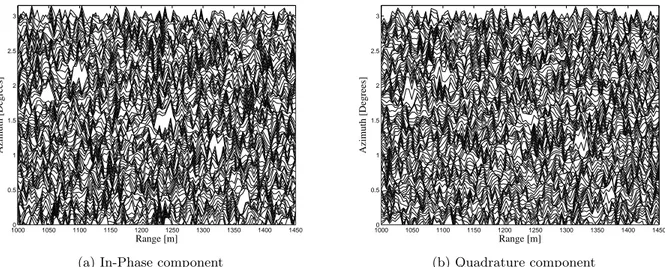
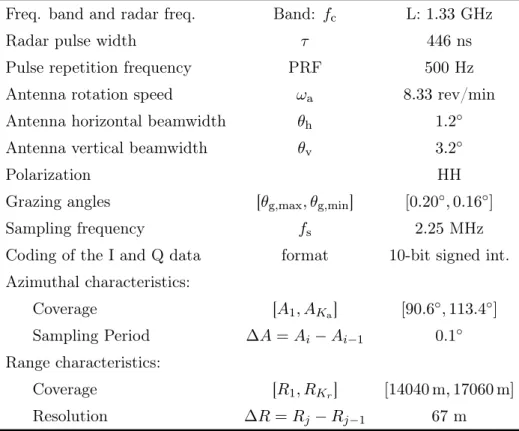
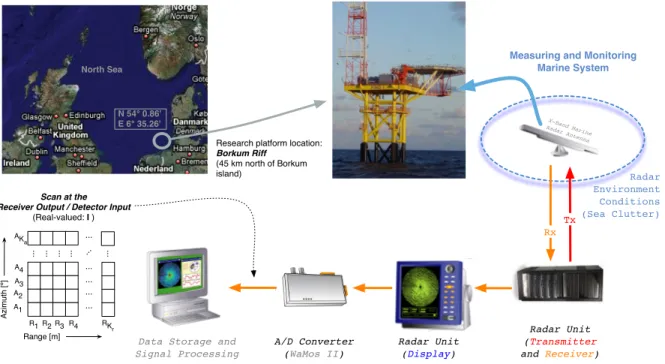
(20) 4. Chapter 1. Motivation, State of the Art, Objectives and Structure of the Thesis. z[n] z[n-1] x[n] .... F( z[n] ). Thresholding y[n]. y[n]: H1/H0. 1 0. x[n] THR. z[n-J+1] THR(Pfa). Figure 1.1: Basic scheme of the proposed detector to approximate the Neyman-Pearson detector. get models in synthetic noise [Jarabo2004, Andina1996, Andina1995a]. Moreover, in [Jarabo2009] and [Jarabo2005] the approximation of the Neyman-Pearson detector by learning machines trained with supervised learning machines, such as ANNs, was described for these detection problems. Considering these studies, this Ph.D. thesis studies the application of these AI techniques to design detectors that are able to detect targets in presence of clutter and noise. The environments where the proposed detectors try to detect the targets are scanned by coherent or incoherent remote sensing systems. For the research carried out in this thesis, real-live measurements are available from an incoherent system. Unfortunately coherent measurements are not available. Some target and clutter models commonly used in the literature are considered in the thesis for coherent measurements. Coherent systems give information about the environment by the in-phase and quadrature components, or, by the magnitude and phase components. One example of the measurements contained in a scan done by a coherent radar are depicted in Fig. 1.2, where the clutter conditions are very strong. The radar configuration and environment are the ones used in modeling the measurements of ground clutter (see Sect. 2.3.5). Observing this scan, the following questions could come to our mind: Is there any target in the scan (environment)? How many targets are there? Where are they? etc. Incoherent systems give only the information about the magnitude of the measurements. One example of the real-live measurements done by a incoherent marine radar is depicted in the scan of Fig. 1.3, where the environment is not so severe as in the previous coherent scan. The radar configuration and environment are presented in Sect. 2.4. Observing this scan, the same questions as in the coherent measurements could rise up again. It is important to note that although the applications considered in the thesis are particularized for radar (radio detection and ranging) systems, the proposals presented in this thesis try to be as general as possible to be applied in other systems where similar problems are found. For instance, as a Weibull distribution is used to model the clutter in our case of study, the proposed detectors could be extrapolated and used in problems like: detection of trends in extreme temperatures modeled by the Weibull distribution [Jandhyala1999]; detection of watermarks in image processing [Cheng2003, Barni2003, Oostveen2000]; detection of outliers in Weibull-distributed problems [Fung1985]; and detection of frailties in lifetime data [Caroni2004]..
(21) 5. 3. 3. 2.5. 2.5. Azimuth [Degrees]. Azimuth [Degrees]. 1.2. State of the art. 2. 1.5. 1. 0.5. 2. 1.5. 1. 0.5. 0 1000. 1050. 1100. 1150. 1200. 1250. 1300. 1350. 1400. 0 1000. 1450. 1050. 1100. Range [m]. 1150. 1200. 1250. 1300. 1350. 1400. 1450. Range [m]. (a) In-Phase component. (b) Quadrature component. Figure 1.2: Example of a synthetic scan obtained with a coherent measurement (radar) system.. Max. High. -"6.(/( *+++. +++*. ,++. ++,. 5$.4. 180. Med. (/.3%-. 90. Low. 210. 4.$5. +. +. 012 +++*ï. ï*+++ Min. (a) Cartesian plot of polar data. -%3./(. ++,ï. ï,++. 0 150 500 900 1300 Range (m). )('&%$#"!. Azimuth (deg.). 270. (/(.6"-. !"#$%&'(). 360. (/(.#.-. -.#.(/( +++* ï*+++. ++, ï,++. ++ )('&%$#"! !"#$%&'(). ++,ï ,++. +++*ï *+++. (b) Cartesian plot of range data. Figure 1.3: Example of a scan obtained with an incoherent marine radar.. 1.2. State of the art. As discussed in the previous section, the main motivation of the thesis is the search of a detection scheme able to work correctly with both coherent and incoherent data. Because real-live coherent data are not available, a study of the models and parameters that are used to synthesize these data is done first. After that, a study of the detection schemes that could be used in our case of study is done. From this last study, several coherent and incoherent detection schemes are selected as reference in our studies. Moreover, several opportunities are found where new.
(22) 6. Chapter 1. Motivation, State of the Art, Objectives and Structure of the Thesis. contributions in this field can be made.. 1.2.1. From measurements to synthetic clutter models. The measurement systems considered in this thesis can work in different environments. For that reason, and taking into account that having access to real-live data is sometimes difficult, accurate clutter models are needed. A study of several clutter models considered in the literature is done according to sea, sea-ice and ground clutter conditions, which will be used in the section concerning to the experimental results of this thesis. Sea clutter From the beginning of the 1970’s decade, several studies have been done about the statistical properties of sea clutter. Trunk et al. studied in [Trunk1970, Trunk1972] the statistics of sea clutter measurements, finding non-Gaussian and non-Rayleigh properties. They proposed the use of models based on the log-normal distribution. In the same decade, Jakeman and Pusey [Jakeman1976] proposed a model for non-Rayleigh sea echo measurements. In this study, log-normal and K distributions were successfully used to model the sea surface radar cross section (RCS), where spatial and temporal correlations were considered. In the 1980’s, non-Gaussian clutter models in the frequency domain were proposed in [Baker1985], where Kdistributed clutter models were successfully used. The same statistical distribution was used by Watts in [Watts1985, Watts1987a, Watts1987b]. The first two works were focused on sea clutter modeling by compound K distribution models, whereas the third one presented the spatial correlation of the K-distributed sea clutter. On the other hand, Farina et al. proposed in [Farina1986b] the use of log-normal clutter models. A different clutter model was used in [Lewinski1983], where the RCS measurements from the sea clutter were modeled by a Weibull distribution. This model was successfully used, not only for sea clutter, but also for other kinds of clutters, as presented Sekine in [Sekine1990]. These works changed the way of modeling the clutter, both for sea clutter and other kinds of clutter, as discussed in the following subsections. From the 1990’s decade, several research works were published about sea clutter modeling. In this way, Haykin et al. presented in [Haykin1997, Haykin2002] that the dynamic of sea clutter is mainly non-linear. As Haykin noted, due to this non-linear dynamic, non-linear signal processing is needed to reduce the level of clutter and to achieve high performance detectors in clutter-governed environments. This author also proposed in [Haykin1997] that non-linear clutter dynamics can be modeled by the chaos theory. In parallel, this work also proposed the use of K and Weibull distributions to model sea clutter. Other studies were done about sea clutter modeling of real-live data using: • Log-normal distribution [Farina1998, Billingsley1999, Gini2000] and [Greco2004]. • K and generalized K distributions [Farina1998, Billingsley1999, Gini2000, Greco2004] and [Ward2006]. • Weibull distribution [Billingsley1999, Gini2000, Greco2004] and [Ward2006]. These studies were compared with the results obtained with the previous distributions, denoting that the Weibull distribution fitted better the real-live data under consideration..
(23) 1.2. State of the art. 7. • Log-Weibull distribution [Sayama2001]. In this study, Weibull, log-Weibull and K distributions were used to model sea and other kinds of clutter. In this case, the Weibull and log-Weibull distributions fitted better their measurements. Sea-ice clutter RCS is greater for sea-ice than for sea waves. It is known that the RCS of sea clutter mainly depends on sea state, while the RCS of sea-ice mainly depends on type (young or multiyear ice) and thickness of sea-ice. In general, sea-ice includes fast ice and pack ice. Fast ice is defined as stationary ice near the coast, while pack ice is a moving ice. Pack ice collides together and hummocks are formed, which grow from a height of a few meters to ten meters. Radar returns from sea-ice depend not only on volumetric structure, but also on surface roughness, dielectric constant, age, thickness, development history and temperature of the ice [Golden1998, Sekine1990]. Moreover, the dynamics of sea-ice clutter is purely non-linear, as Haykin noted in [Haykin1997, Haykin2002], where Weibull and K distributions were considered as valid models. The same distribution was successfully used for the same purpose by Sayama et al. in [Sayama2001, Sayama2002, Sayama2004, Sayama2005], where log-normal and log-Weibull distributions were also used to approximate the statistical behavior of sea-ice clutter. From the previous works we can conclude that the distribution that best fit the radar measurements is the Weibull one. Ground/Land clutter The RCS of ground clutter, also referred as land clutter, has been described in the literature for many types of terrain. This RCS is obtained with radars of different frequencies (L and X bands) and at different grazing angles (angle between the mean horizontal at the scene and the incoming radar illuminator). The considered analytical models predict many of the observed trends in data as a function of range, antenna height, terrain roughness and wavelength. The interest of modeling this kind of clutter starts practically in the 1980’s with the work of Barton [Barton1985], where non-Gaussian and non-Rayleigh clutter models were used. Nevertheless, Schleher [Schleher1976] previously proposed the use of Rayleigh and non-Rayleigh distributions. Both works have a common factor: the authors used the Weibull distribution to model different types of ground clutter and terrains. Schleher’s work is very important because the skewness parameter of the Weibull distribution was given for several kinds of terrain (rocky mountains, wooded hills, forest, cultivated land) and sea states. On the other hand, Rayleigh and Gaussian distributions were used to model ground clutter measured by different radar systems, as discussed in [Billingsley1999, Billingsley2002] and [Diani1996, Billingsley2002, Conte2005], respectively. These and other studies denoted that better models can be obtained using different statistical distributions, such as: • Log-normal distribution [Billingsley1999, Billingsley2002]. • K and generalized K distributions [Sujuan1996, Billingsley1999, Sayama2001, Billingsley2002] and [Davidson2004] to model the measured data. In [Lombardo1999a], K-distributed models were used to model the power spectral density (PSD) of the clutter. On the other hand, in [Oliver1985, Marier1995], correlated K-distributed models were considered..
(24) 8. Chapter 1. Motivation, State of the Art, Objectives and Structure of the Thesis. • Weibull distribution [Sekine1990, Billingsley1999, Sayama2001, Billingsley2002] and [Davidson2004]. These works demonstrate that this model fits better the real-live data than the previous ones. Conclusions about the clutter models From the results presented in the research works studied above for different kinds of clutter, a general conclusion is extracted: The models that best fit the clutter measurements are generally based on the K and Weibull distributions. For that reason, the Weibull distribution is selected to model different kind of clutters considered in this thesis.. 1.2.2. Automatic target detection in clutter. Radar signal detection in clutter is a very complex task, which is generally performed by statistical methods. In this way, if the probability density functions (pdf s) of the target and clutter signals are known, optimum detectors can be obtained [VanTrees1997, Skolnik2001, Richards2005, Skolnik2008]. In real-live data, the statistical properties of the target and clutter signals can vary in time and are not usually known, making the use of optimum detectors unfeasible. Suboptimum detectors can be obtained instead. For these kind of detectors, parametric and non-parametric techniques can be used. Parametric techniques suppose that the target and clutter pdf models are known and their statistical parameters can be estimated. On the other hand, non-parametric techniques do not suppose that the signal pdf s follow a given statistical distribution model. Depending on the different techniques used to automate the process of detection, several kinds of detectors can be found. Most of them are presented in the following subsections. As noted below, several detectors could be grouped in two or more kinds of detectors, but they are mainly classified in one of them because of its relevancy. Clutter reduction techniques in detection systems Different clutter reduction techniques can be used to improve the performance of radar detectors. They usually depend on the clutter model. Only the most relevant ones are analyzed below. Considering clutter environments following a log-normal distribution, Farina et al. presented in [Farina1986b] two processor architectures. The first one, used in current practice, was composed of a linear transversal filter (for clutter attenuation and target enhancement) cascaded with a quadratic envelope detector and a comparison with a suitable threshold. The second processor differed from the previous one in the clutter cancellation filter. In this case, a non-linear homomorphic filter was used to obtain a higher clutter suppression. On the other hand, Almarshad et al. presented in [Almarshad2008] two novel algorithms for automatic censoring of radar interfering targets in different log-normal clutter environments. These algorithms consisted in removing the corrupted reference cells (censoring) before detection. Both steps were performed dynamically by using a suitable set of ranked cells to estimate the unknown background level and set the adaptive thresholds accordingly. The proposed detectors, neither require any prior information about the clutter parameters, nor require the number of interfering targets. Concerning the detection of targets embedded in compound-Gaussian clutter, Conte and De Maio [Conte2004] proposed clutter mitigation techniques. These techniques were used on adap-.
(25) 1.2. State of the art. 9. tive detection schemes for ensuring constant false alarm rate (CFAR). Thus, the threshold could be set independently of the clutter distribution as well as its covariance, even if the environment is highly heterogeneous. Clutter reduction was done by a decision rule based on a recursive clutter covariance matrix estimator. Focusing on Weibull-distributed clutter environments, Farina et al. presented in [Farina1987a, Farina1987b] optimum and suboptimum radar processors to detect a priori known target signals in this kind of clutter. The processors were based on two non-linear estimators of the clutter samples in the two alternative hypotheses (H0 and H1 ). These processors were suitable even in challenging environments including spiky clutter and/or spiky target (e.g. stealth). Because of the relevance of the suboptimum coherent detector presented in these works, it is taken as reference in the thesis to validate the proposed coherent detectors. Finally, it is important to emphasize the work of Farina et al. [Farina1997], where the application of different (linear and non-linear) clutter cancellation techniques in coherent radar detectors were analyzed. From the results, they concluded that non-linear techniques improved the capability of detecting targets with Doppler frequencies close to the clutter mean Doppler frequency, compared to linear techniques. This conclusion is very useful in the thesis because it indicates that non-linear signal processing techniques are better to obtain high performance detectors under non-Gaussian-distributed clutter. Detectors using frequency domain information Frequency domain techniques are successfully used in radar detection because of the relative movement (Doppler effect) between target and clutter. Some examples are the classical approaches moving target indicator (MTI) and moving target detector (MTD) [Skolnik2001]. Next, some works where clutter environments are close to the ones considered in the thesis are analyzed. An adaptive radar detection algorithm for the detection of small pieces of ice floating in an open sea environment was presented in [Battacharya1992]. The detection was carried out in the time-frequency domain, which eliminated the limitations of standard Doppler processing. The detection scheme used an MLP as pattern classifier, where the final decision was done. The detection of incoherent pulse trains in compound-Gaussian disturbance with known spectral density was discussed in [Conte1999]. This work proposed three alternative processors, where only one of them (based on the fast Fourier transform, FFT) was implementable in real clutter and target situations. Although this processor was suboptimum, it works properly even in the presence of very spiky clutter. This processor was independent of the clutter amplitude pdf, what involves CFAR independently of the clutter distribution. Orthogonal frequency division multiplexing (OFDM) techniques were considered in [Sen2009], where the problem of detecting a moving target in clutter environments was considered. The broadband OFDM signal provided frequency diversity to improve the performance of the system. Detectors based on statistical signal processing Statistical signal processing techniques have been widely used during the last decades for radar detection purposes. They are commonly based on: generalized likelihood ratio (GLR) or likelihood ratio (LR) tests; Neyman-Pearson tests; or covariance matrix estimations..
(26) 10. Chapter 1. Motivation, State of the Art, Objectives and Structure of the Thesis. The detection of targets in presence of coherent and incoherent K-distributed clutter was discussed in several works, as presented below. In [Aluffi1992], the detection of a priori known Swerling zero targets embedded in coherent clutter was done by using a LR test. In [Conte1991], the detection of signals with unknown parameters in correlated noise was considered by using the Neyman-Pearson strategy. In [Conte1994], two schemes for detecting targets in clutter were compared: one implementing the GLR test, and the other using a discrete realization of the Neyman-Pearson detector. The results showed that both strategies yield equivalent performance, but the GLR test was simpler in its structure and offered some additional advantages, both at the design and analysis stages. In [Farina1995], the optimum strategy to detect a priori known targets in coherent clutter was presented, which was based on the LR test. But these optimum approaches are not realistic because it is necessary to know the target before detecting it. Because of that, suboptimum approaches are used. In this way, a suboptimum approach for detecting known signals in coherent K-distributed and Gaussian-distributed clutter sources was presented in [Gini1995] and [Gini1997b] by using the LR test. The resulting detection strategy was linearquadratic, clutter distribution free (guaranteeing CFAR behavior) and achieved performances similar to the optimum case. Continuing with the previous problem, an approximation to the optimum detector was determined in [Gini1997a] by thresholding an appropriate LR test in an interference environment with unknown correlation. In [Lombardo1996], another approach to the optimum radar detection of targets embedded in K-distributed clutter with partially correlated texture was studied. Parallel and sequential implementations of the approaches to the optimum detector were given. These detectors were interpreted as the conditional estimate of the Gaussian LR of the speckle averaged over the correlated texture distribution. On this basis, a suboptimum detection scheme was derived, replacing the conditional mean estimation by a maximum a posteriori estimate. Different detection schemes were proposed when other clutter conditions are considered. Rajesh and Prabhu presented in [Rajesh1999] the detection of targets embedded in Weibull clutter. This problem was addressed using modified sample matrix inversion (MSMI) and GLR techniques and adaptive filtering and CFAR control. Although the GLR algorithm is robust for non-Gaussian interference, the MSMI algorithm was quite sensitive and gave rise to false alarms. To deal with non-Gaussian interference, such as Weibull clutter, the Gaussianing-whitening approach was adopted since MSMI and GLR are optimized for Gaussian interference. On the other hand, radar detection in Weibull clutter was examined from a statistical detection viewpoint in [Schleher1976]. Weibull clutter parameters were determined and related to measured values of land and sea clutter. Optimum performance in Weibull clutter was determined and practical receivers that approach this performance were identified. The receiver performances in Rayleigh, log-normal and Weibull clutter were also evaluated and compared. Finally, other statistical signal processing techniques can be used. Thus, for the clutter reduction-based detectors presented in [Conte2004], a covariance matrix estimation was used for maintaining CFAR behavior independently of the clutter parameters. Farina and Russo presented in [Farina1986a] the theory of estimator-correlator receiver to the case of a Gaussian-distributed time-correlated target embedded in clutter and thermal noise. Two equivalent detection schemes were obtained: a batch detector and a recursive detector. The problem of covariance matrix estimation for adaptive radar detection in heavly-tailed correlated clutter with unknown statistics was also dealt with in [Gini2002]. This work presented an approximation to the maximum.
(27) 1.2. State of the art. 11. likelihood estimator. CFAR detectors These techniques can be considered as a part of the previous one, but they are explained in a separate section because of their relevance in target detection. The purpose of these techniques is to maintain a constant false alarm rate by an automatic adaptation of the detection threshold according to the clutter power and characteristics. This threshold adaptation is necessary because the statistical parameters of the clutter distribution are not usually known and may be nonstationary. CFAR techniques are commonly used with incoherent measurements. Some of the commonly used CFAR detectors/processors are presented below. Cell Averaging (CA) CFAR detectors. CA-CFAR detectors are commonly used in the literature as basic reference for comparison purposes. Some modifications of this kind of detector are proposed in the literature, being: Greatest Of (GO) CFAR detector, also known as GOCACFAR; and Smallest Of (SO) CFAR detector, also known as SOCA-CFAR. Starting with the analysis of CA-CFAR detectors, Watts et al. [Watts1990] and Sciotti et al. [Sciotti2001] presented several methods and analytical approximations for the performance of these detectors. In these works, the detection of fluctuating targets in real-live sea clutter (K-distributed) from maritime surveillance radars was presented. Continuing with the analysis of CA, GOCA and SOCA-CFAR detectors, an analytical study of their performances is found in [Gandhi1988]. In this work, multiple environments with one or several interfering Swerling I targets in heterogeneous Gaussian-distributed clutter were considered. El Mashade presented in [Mashade1998b, Mashade2000, Mashade2002] a similar study of these detectors but considering homogeneous and correlated clutter. The targets considered in these studies were modeled by Rayleigh and Chi-square distributions, including moderately fluctuating targets between Swerling I and II models [Swerling1997]. Finally, the application of these detectors was also presented in [Davidson2004] where land clutter was considered. The application of CA-CFAR detectors when Weibull-distributed clutter is present was considered in [Anastassopoulos1995, DeMiguel1998, Liu2003]. The basic principles of the CA-CFAR detection scheme are set in [DeMiguel1998]. Moreover, in this work, analytical expressions that relate the Pfa with the detection threshold are set for Weibull clutter. This work and detector are taken as basic reference in the thesis. Maximum Likelihood (ML) CFAR detectors. ML-CFAR detectors outperform CA-CFAR detectors by doing more accurate estimations of the clutter parameters to set better the detection threshold. The application of ML-CFAR detectors when Weibull-distributed clutter is studied in several works [Ravid1992, Anastassopoulos1995, Mezache2007, Mezache2008]. The first one [Ravid1992] is the most relevant one because it sets the principles of the ML-CFAR detector when uniform clutter and multi-target situations are considered. Its principles are based on the estimation of the shape and scale parameters of the Weibull-distributed clutter to automatically adapt the detection threshold. For that reason, this work is taken as reference in the studies of the thesis.
(28) 12. Chapter 1. Motivation, State of the Art, Objectives and Structure of the Thesis. when incoherent radar data are used. The other works use the ML-CFAR detectors as reference for proposing new and improved detection schemes in Weibull clutter. Ordered Statistics (OS) CFAR detectors. OS-CFAR detectors are usually considered to alleviate the problems of CA-CFAR detectors. These detectors set the decision threshold by processing magnitude-ordered observations within finite moving windows. Analytical expressions of OS-CFAR detectors were derived in [Gandhi1988], demonstrating that these detectors outperform the CA-CFAR ones. The analysis of the OS-CFAR detector and a comparison with CA-CFAR detectors was presented in [Armstrong1991] when correlated, fluctuating and Rayleigh-distributed targets in K-distributed sea clutter are considered. OS-CFAR detectors has also been successfully applied when Weibull-distributed clutter is considered [Levanon1990, Anastassopoulos1995, Liu2003, Mezache2008, Zaimbashi2008]. From these works, the first one [Levanon1990] is the most important one because it sets the basic principles of these kind of detectors. For this reason, it will be considered as a reference in the thesis. The other works make use of the OS-CFAR detector as a reference to validate their proposed detectors. OS-CFAR detectors may resolve multi-target situations quite well. They lack effectiveness in preventing excessive false alarms during clutter power transitions. Even though OS-CFAR detectors allow to achieve high detection performances, several authors proposed modifications and/or combinations of them to outperform their performances. Thus, El Mashade proposed in [Mashade1998b, Mashade1998a] modified OS-CFAR detectors for detecting fluctuating targets in homogeneous clutter. These detectors are the Mean Level OS (MLOS), the Greatest Of OS (GOOS) and the Smallest Of OS (SOOS) CFAR detectors. On the other hand, different combinations of conventional and modified OS-CFAR detectors were proposed in [Zaimbashi2006, Zaimbashi2008] for detecting moderately fluctuating targets in homogeneous Weibull-distributed sea and land clutters. Other combinations were also presented in [Liu2003, Mezache2008], outperforming again the performance of conventional OS-CFAR detectors. Finally, it is important to note that another modified OS-CFAR detector, known as the trimmed mean (TM) CFAR detector was presented in [Gandhi1988]. This detector implements a trimmed averaging after ordering. By judiciously trimming the ordered samples, the TM-CFAR detector outperforms the OS-CFAR detector. Other CFAR detectors. Other CFAR techniques can be found in the literature, such as excision (EX) or censored (CE) CFAR detectors. El Mashade presented in [Mashade1997, Mashade2001] how EX-CFAR detectors, also known as Excision Cell Averaging (EXCA) CFAR detectors, can be implemented. Their performances were reported when detecting multiple targets (moderately fluctuating targets) in homogeneous and heterogeneous clutter. when homogeneous and heterogenous clutter and multitarget (moderately fluctuating targets) situations were reported. His first work [Mashade1997] presented not only the EX-CFAR detector, but also a set of modified EX-CFAR detectors, being: Mean Level EX (MLEX), Greatest Of EX (GOEX) and Smallest Of EX (SOEX) CFAR detectors. These modified detectors outperformed the EX-CFAR detector under these target and clutter conditions..
(29) 1.2. State of the art. 13. EX-CFAR detectors were also studied by Erfanian and Tabataba [Erfanian2008] when Swerling I targets in homogeneous and heterogenous K-distributed sea environments are considered. They made a new proposal by combining an excision processor and a switching-CFAR detector. The results shown that EX-CFAR and the proposed detectors outperform CA-CFAR detectors. After the analysis of the previous works, it can be concluded that EX-CFAR detectors usually outperform the performance of CA and OS-CFAR detectors. This performance improvement is achieved because it removes strong samples exceeding the excision threshold from the reference window prior to calculate the detection threshold. The EX-CFAR detector is usually used in radar systems to control the increase of false alarms that occurs in non-stationary clutter environments. On the other hand, the GOEX operation is included to control false alarms at clutter edges and the SOEX operation is proposed to resolve closely spaced targets. Other CFAR techniques, such as the one based on censoring can be used. An automatic CE-CFAR detector processing multitarget situations and using incoherent pulse integration was proposed in [Farrouki2007]. The proposed detection scheme was based on an optimal selection of the appropriate censored mean level according to the actual background environment. Finally, other not commonly used CFAR detectors are presented in the literature. In this way, a clutter map (CMAP) CFAR detector was proposed in [Hamadouche2000] when Weibulldistributed clutter is present, its shape parameter is known and the fluctuating target is assumed as Swerling I model [Swerling1997]. Closed-form expressions for the Pd and Pfa in terms of shape and scale parameters are determined and the performance of the system is investigated and analyzed. On the other hand, CFAR in non-homogeneous Weibull-distributed clutter was studied in [Gandhi1995]. In this study, the difficulty of estimating the two parameters of Weibull distributions to calculate the appropriate decision threshold was discussed. For this purpose, a log-t detector is commonly used. Detectors based on artificial intelligence (AI) From an empirical perspective, the application of supervised learning machines to approximate the Neyman-Pearson detector has already been studied for detecting signals in noise. In previous works dealing with the design of ANN-based detectors, two possible solutions have been proposed to vary the Pfa , once the ANN has been trained: varying the detection threshold [Andina1995b, Andina1995c, Burian1999, Jarabo2009], or the bias of the output neuron [Ramamurti1993, Gandhi1997]. In [Munro1996] a two-output ANN with outputs in (0,1) was used, comparing the subtraction of both outputs to a threshold. This approach is equivalent to using an ANN with only one output and desired outputs [-1, 1] [Ruck1990]. More recently, RBF-ANNs have also been applied to approximate the Neyman-Pearson detector [Casasent2003a, Casasent2003b, Jarabo2003]. In [Jarabo2005], the possibility of approximating the Neyman-Pearson detector using adaptive systems, such as ANNs, trained in a supervised manner was studied. In this work, the case where the likelihood functions are unknown is considered. This is very similar to the case where the statistical parameters of the likelihood functions are unknown, as occur in our case of study and in real-live situations. For these reasons, ANNs are considered in the problem of detecting targets in clutter in this thesis. The above-mentioned works presented how AI techniques are able to approximate the Neyman-.
(30) 14. Chapter 1. Motivation, State of the Art, Objectives and Structure of the Thesis. Pearson detector when background noise is present. Now, lets study the application of these techniques to the detection of signals in clutter and noise. In this case, non-parametric techniques are usually used because parametric models of clutter and target returns are generally unavailable. So, AI techniques, and exactly ANNs, provide an attractive approach to perform non-parametric identification. Next, several examples of radar target detection in clutter are given, where different kind of ANNs are used. Focusing on the use of MLPs, we can find the work presented by Battacharya and Haykin in [Battacharya1992], where an adaptive radar detection algorithm for detecting small pieces of ice floating in an open sea environment was presented. The detection was carried out in the time-frequency domain, reducing the limitations of standard Doppler processing. This detection scheme used an MLP as a pattern classifier. Cheikh and Faozi presented in [Cheikh2004] an MLPbased radar detector working in a K-distributed environment. The use of MLPs was justified against conventional statistical methods because they work faster and generalize better than the statistical methods. It is due to statistical methods are optimal only for one type of clutter distribution. The results showed that the MLP architecture outperformed the classical CACFAR detector. A different radar detector scheme was presented in [Haykin1994] for detecting a radar target signal buried in strong clutter. This scheme was based on the application of the Wigner-Ville decomposition (WVD) followed by a principal component analysis and by an MLP binary classifier. This work noted the superior performance of the new detection strategy compared to conventional CFAR processors. Focusing on the use of RBF-ANNs, we can find the work of Cheikh and Faozi presented in [Cheikh2006]. The authors presented a radar detector based on RBF-ANNs, which was compared with the MLP-based detector presented in [Cheikh2004] and with CA-CFAR detectors. This comparison emphasizes the performance improvement achieved by both ANN-based detectors with respect to CFAR detectors. A different way of using RBF-ANNs in a radar detector was presented in [Xie2003]. In this case, RBF-ANNs were used to model and predict clutter to mitigate it and enhance the target signal, improving the detection performance. Detectors based on other techniques Other signal processing techniques can be used in radar detection, which cannot be directly classified in any of the previous kinds of detectors. Some of them are presented below. Considering the dwell time as a parameter of a radar detector, two interesting works can be found in the literature [Nohara1994, McDonald2005]. In [Nohara1994], X-band radar measurements were analyzed to determine the characteristics of clutter and growler (small pieces of glacial ice) returns that could lead to their separability. The authors report on the performance of two coherent, medium and long dwell-time, detectors. In [McDonald2005], the difficulty of detecting small maritime surface targets from sea clutter in radar backscattered signals was presented. Incoherent integration, coherent integration, the Kelly detector and the adaptive linear-quadratic detector were considered. Target detectability was improved by combining the results of a single dwell across multiple scans. Analysis of high-range-resolution coherent X-band data of small boats revealed that fast scan rates (short dwell times) improved target detection. The use of asymptotically optimum detectors (AODs) was presented in [Lombardo1999b, Lombardo1998]. In [Lombardo1999b], the use of a multiband case of the AOD was compared.
(31) 1.2. State of the art. 15. to a multiband GLR test linear-quadratic detector when coherent radar target detection in compound-Gaussian clutter background was considered. In [Lombardo1998], the non-CFAR characteristic of the AOD was discussed when K-distributed clutter is present and the target Doppler frequency is varied. Moreover, the AOD presented another problem because it assumes a knowledge of the local clutter power in the cell under test (CUT). A practical scheme was obtained by replacing the known local power value by its estimate, named locally adaptive-AOD (LA-AOD). These detectors shown a CFAR behavior, but yielded strong detection losses in the same Doppler frequency region where the original AOD operated effectively with CFAR. Finally, a combined AOD was proposed, which used the benefits of both AOD and LA-AOD structures. Its detection performance was fully characterized as the clutter spikiness and correlation vary. Multiple-Input Multiple-Output (MIMO) techniques have been recently used in radar detection. Two examples of its application can be found in [Sheikhi2006, Sheikhi2008]. In [Sheikhi2006], the problem of target detection using coherent data was considered for MIMO radars. This work presented how a GLR test was successfully used in two adaptive decision schemes for clutter with unknown statistics. In [Sheikhi2008], the problem of adaptive target detection using coherent data in the presence of non-homogeneous clutter (different clutter statistics in receivers) was considered for MIMO radars. For clutter with unknown statistics, three adaptive decision rules have been developed using the GLR test. The results show the superiority of the MIMO radars with temporal coherent processing over conventional phased arrays in the presence of clutter. The different kinds of detectors presented here are not considered in the studies of the thesis because of their high computational cost.. Conclusions about the detectors under study Since the studies done in thesis consider both coherent and incoherent data, the detection techniques commonly used in the literature for each case are selected. For incoherent systems, both simulated and real-live data are available. Then, the incoherent detectors taken as reference are studied with both kinds of data. On the other hand, synthetic data are only available for coherent systems. Consequently, the coherent detector taken as reference can only be studied with synthetic data. Considering the detection of signals in clutter and noise by using coherent data, the coherent detector presented in [Farina1987a, Farina1987b] is selected, as discussed in Sect. 1.2.2. This detector is based on reducing the level of clutter previous to apply a detection threshold fixed according to a desired Pfa . Considering the detection of signals in clutter and noise by using incoherent data, several commonly used incoherent detectors have been selected. These detectors are based on CFAR techniques, being: CA-CFAR [DeMiguel1998], ML-CFAR [Ravid1992] and OS-CFAR [Levanon1990]. Finally, it is demonstrated in the literature that ANNs are able to approximate the NeymanPearson detector when the unique interference is the noise. Moreover, they are satisfactorily used for detecting signals in clutter with a distribution different of the Weibull one (the one considered in the thesis). Because of these properties, ANNs are considered as candidates to outperform the different detectors taken as reference..
(32) 16. Chapter 1. Motivation, State of the Art, Objectives and Structure of the Thesis. 1.3. Objectives of the Thesis. According to the main motivation of the thesis, and after the analysis of the state of the art about the detection of targets in clutter, the following objective is set as principal in the thesis: “To propose high performance detection schemes working in different environments, outperforming commonly used detectors and having real-time applicability.” The main objective can be divided in four particular objectives, being: • Particular objective 1: To propose detection schemes that work in sea, sea-ice and ground clutter conditions, presenting high performance. • Particular objective 2: To propose detection schemes that outperform detectors commonly used in the literature, regardless of the kind of system (coherent or incoherent) that is making the measurements. • Particular objective 3: To propose detection schemes that maintain the performance obtained in a design stage when processing new data in a test stage. • Particular objective 4: To propose detection schemes with low computational cost to process the data in real-time.. 1.4. Structure of the Thesis. Once a preliminary analysis of the main topic of the thesis is done and its objectives are established, the thesis has been structured in this way: • The first part of the thesis, in which this chapter is included, presents the coherent and incoherent measurement systems considered in the experiments. Moreover, an analysis of the clutter data obtained from them is done, especially for the way the synthetic clutter is generated. Finally, the coherent and incoherent detectors taken as reference are presented. • The second part contains the description of the proposed detectors, from where the main contributions of the thesis are obtained. At the beginning of this part, the general scheme of the proposed AI-based detector is explained. Moreover, the different ways of selecting the data to be processed by the detector and the way to estimate the detector performance are discussed. Afterwards, the particular details of design of the MLP-based and RBFN-based detectors are given. • The third part of the thesis presents the main results obtained during the research. This part starts with an statistical analysis of the databases used for the coherent and incoherent experiments in order to be sure that the performance achieved is statistically correct and highly accurate. After that, the design and test of coherent detectors in sea, sea-ice and ground clutter is presented. Finally, the design and test of incoherent detectors in synthetic and real-live sea clutter data are presented. • The last part of the thesis summarizes the main conclusions obtained from the research. The main contributions as well as some future research lines are also presented..
(33) CHAPTER. 2 Coherent and Incoherent Measurement Systems: Radar Data. The performance of a detector embedded in coherent or incoherent radar systems can be estimated by using real-live and/or synthetic radar data. To use real-live radar data is not often possible because data are not always available. In addition, it is not sometimes the most appropriate option because the available radar environmental conditions do not cover all the possibilities where the system can work. In these situations, the use of signal modeling is needed. In this chapter, two radar systems are presented. The first one is a coherent radar system, which is described in Sect. 2.1. Since real-live data are not available for this kind of systems, signal models are used, being described in Sect. 2.2. These models allow us generating synthetic radar data to simulate different radar environments (sea, ground, etc.), being described in Sect. 2.3. The second radar system is incoherent, being described in Sect. 2.4. The real-live data obtained by this incoherent radar are presented in Sect. 2.5.. 2.1. Coherent radar system model. The system model considered in this thesis for coherent measurements is a coherent monopulse radar working at a given frequency, fc , of a given band (L, X, etc.). This model is composed of a monopulse transmitter and a coherent receiver. The information of the in-phase and quadrature components of the received echo signals is available. The general scheme of the radar model is depicted in Fig. 2.1, where an amplifier and a matched filter is included in the intermediate frequency (IF) stage. The antenna of the radar is rotating (scanning) at a certain speed (ωa ) and pointing to different directions of the environment (Ai , i = 1, 2 . . . Ka ) in the horizontal plane (azimuthal observation). The azimuthal sampling period (∆A) is determined by the antenna rotation speed and the pulse repetition frequency (PRF) as ∆A = Ai − Ai−1 =. 6 ωa . PRF. (2.1). 60 s ◦ The constant 6 comes from the division of 360 rad and min to convert ωa from (rev/min) to ( /s) and to achieve the azimuthal sampling period in degrees (◦ ). For a given azimuthal direction, Ai , the radar transmits an electromagnetic pulse of a certain duration (pulse width), τ (s), which is scattered by the object/s (desired or not desired) present ◦. 17.
Figure
+7
Documento similar
MD simulations in this and previous work has allowed us to propose a relation between the nature of the interactions at the interface and the observed properties of nanofluids:
In the “big picture” perspective of the recent years that we have described in Brazil, Spain, Portugal and Puerto Rico there are some similarities and important differences,
Astrometric and photometric star cata- logues derived from the ESA HIPPARCOS Space Astrometry Mission.
Díaz Soto has raised the point about banning religious garb in the ―public space.‖ He states, ―for example, in most Spanish public Universities, there is a Catholic chapel
The broad “WHO-ICF” perspective on HrWB provided at Figure 1 has a significant implication also for HRQoL. The develop- ment of ICF and its conceptual approach has challenged to
According to previous studies and the theoretical background, the present study infers that customer experience in the case of Islamic banks’ brands influences
In the preparation of this report, the Venice Commission has relied on the comments of its rapporteurs; its recently adopted Report on Respect for Democracy, Human Rights and the Rule
Therefore, these aspects would confirm that improvements possibly would arise from gains in impulse at swim start obtained specifically on lower limbs with the experimental
