343
ANAL
YSIS MUL
TI-LANGU
A
GE JOURNALS
1 Universidad Andres Bello, Facultad de Ciencias Biológicas, Departamento de Ciencias Biológicas. Republica, 217, Piso 2, Santiago, Chile. Correspondencia
para/Correspondence to: E. KRAUSKOPF. E-mail: <[email protected]>.
2 Fundación Ciencia & Vida. Santiago, Chile.
3Universidad de Chile, Instituto de Asuntos Públicos. Santiago, Chile.
Received in 21/7/2016, resubmitted on 3/9/2017 and approved in 4/2/2017.
ORIGINAL
ORIGINAL
Bibliometric analysis of multi-language veterinary journals
Análise bibliométrica de revistas veterinárias multilíngues
Erwin KRAUSKOPF1,2
Fernanda GARCIA2
Robert FUNK3
Abstract
The purpose of this study was to investigate the association between language and total number of citations found among documents in journals written in English and other languages. We selected all the journals clustered together in the Journal Citation Reports 2014 under the subject category “Veterinary Sciences” and downloaded all the data registered between 1994-2013 by Web of Science for the journals that stated publishing documents in languages other than English. We classified each of these journals by quartile and extracted information regarding their impact factor, language(s) stated, country of origin, total number of documents published, total number of reviews published, percentage of documents published in English and the quartile in which each journal ranked. Of the 48,118 documents published by the 28 journals analyzed, 55.8% were published in English. Interestingly, although most of the journals state being multi-language, most documents published in quartile 1 journals were in English (an average of 99.2%), while the percentage was 93.1% in quartile 2 journals, 62.1% in quartile 3 journals and 27.4% in quartile 4 journals. We also confirmed that citation distribution in these journals was highly skewed. The results of this study suggest that journals should consider adopting English as the main language as this will increase citation counts and the impact factor of the journal.
Keywords:Bibliometric. Impact factor. Multi-language. Scientific journal. Veterinary science.
Resumo
O objetivo deste estudo foi investigar a associação entre a escolha do idioma e o número de citações, a partir da análise de revistas publicadas em inglês e em outras línguas. Foram selecionadas as revistas agrupadas no Journal Citation Reports de 2014 sob a categoria “ciências veterinárias”, bem como os dados registrados na Web of Science entre 1994 e 2013 sobre as revistas que declararam documentos publicados em outro idioma que não o inglês. A seguir, as revistas foram classificadas por quartil, extraindo-se informações acerca de: índice de impacto, idioma(s) declarado(s), país de origem, número total de documentos publicados, número total de revisões publicadas, porcentagem de documentos publicados em inglês e quartil em que cada jornal foi classificado. Dos 48.118 documentos editados por 28 revistas analisadas, 55,8% foram publicados em inglês. Interessantemente, apesar de a maioria dessas revistas se declarar multilíngue, a maior parte dos documentos publicados em revistas quartil 1 empregou o inglês (uma média de 99,2%), enquanto para as revistas quartil 2 esse índice foi de 93,1%, para quartil 3 foi de 62,1%, e para quartil 4 foi de 27,4%. A pesquisa também confirmou que a distribuição das citações nessas revistas foi altamente distorcida. Os resultados do estudo sugerem que as revistas deveriam adotar o inglês como idioma principal, o que faz aumentar o número de citações e o fator de impacto da revista.
E. KRA
‘Publish or perish’ has become an expression that best describes the situation of many researchers around the world. Currently, the number of articles published in journals with a high impact factor has become a major criterion for academic success as these account towards the research productivity of scientist, along with the number of articles considered when applying for a research grant. However, publishing on a top-tier journal is becoming increasingly more difficult for a number of reasons. The number of researchers has increased dramatically in recent years, while the availability of research funds has diminished (RABESANDRATANA, 2015; ZHOU, 2015). Additionally, English is the dominating language in top-tier journals. This is a significant barrier for a large number of researchers who are from non-English speaking countries. It is a well-known fact that Chinese and Spanish are the two most-spoken native languages in the world (LEWIS et al., 2016). As a result, many of these researchers depend on peer-reviewed journals that publish documents in languages other than English, although their non-English documents have a smaller possibility of being cited (VASCONCELOS et al., 2007). This scenario is common to all scientific fields of study, including veterinary science.
Veterinary science has contributed greatly to medicine, playing an important role in food safety and public health, preventing the emergence of outbreaks such as food and mouth diseases and H1N1 (KLOEZE et al., 2013; KNIGHT-JONES; RUSHTON, 2013). Furthermore, veterinary research includes research on prevention, control, diagnosis, and treatment of animal diseases as well as basic biology, welfare, and animal care. The outcome of these studies is published in peer-reviewed journals that are clustered together under the category “Veterinary Sciences” (by Thomson Reuters) and “Veterinary” (by Scopus). Depending on the database selected, the quantity of veterinary journals varies from 133 in Thomson Reuters to 215 for Scopus.
In this study, we investigated the impact of the language of the publications on citation frequency of all journals clustered together under the subject
category “Veterinary Sciences” by the Journal Citation Reports (JCR) 2014 and state publishing documents in non-English languages.
Methodological procedures
The JCR 2014 database was used to download all the journals that were clustered under the subject category “Veterinary sciences”. Information about every journal was collected and a subset of journals was built using only those that stated being multi-language or published documents in other multi-languages other than English.
The Web of Science (WoS) database was used to retrieve all the records associated with the journals within the years 1994-2013. Data was processed using Sequel Pro and Excel.
Results
345
ANAL
YSIS MUL
TI-LANGU
A
GE JOURNALS
Table 1. List of journals within the subject category “Veterinary Sciences”.
N° Journal title IF2014 Country Origin Language(s) Q # Docs # Rev % Docs English
1 Comparative Immunology Microbiology and
Infectious Diseases 2,015 England Multi-language Q1 773 42 98.2
2 Avian Pathology 1,639 England Multi-language Q1 1,490 73 99.7
3 Reproduction in Domestic Animals 1,515 Germany Multi-language Q1 7,405 64 99.7 4 Acta Veterinaria Scandinavica 1,377 Denmark Multi-language Q2 1,192 20 100.0
5 Fish Pathology 1,064 Japan Multi-language Q2 745 10 78.9
6 Canadian Journal of Veterinary Research-Revue
Canadienne de Recherche Veterinaire 1,022 Canada Multi-language Q2 1,022 9 99.7 7 Experimental animals 0,965 Japan Multi-language Q2 1,087 59 95.9 8 Revue Scientifique et Technique-Office International
Des Epizooties 0,910 France Multi-language Q2 757 54 90.8
9 Japanese Journal of Veterinary Research 0,889 Japan Multi-language Q3 262 24 100.0 10 Revista Brasileira de Parasitologia Veterinaria 0,869 Brazil Multi-language Q3 520 11 71.5 11 Berliner und Munchener Tierarztliche Wochenschrift 0,819 Germany Multi-language Q3 1,484 38 26.4
12 Inra Productions Animales 0,726 France French Q3 * * N/A
13 Wiener Tierarztliche Monatsschrift 0,600 Austria German Q3 998 51 23.5 14 Canadian Veterinary Journal-Revue Veterinaire
Canadienne 0,516 Canada Multi-language Q3 3,664 41 98.9
15 Acta Veterinaria Brno 0,469 Czech Republic Multi-language Q3 1,302 12 99.9 16 Schweizer Archiv Fur Tierheilkunde 0,451 Switzerland Multi-language Q3 1,534 31 14.2 17 Vlaams Diergeneeskundig Tijdschrift 0,417 Belgium Multi-language Q4 826 93 40.6 18 Pesquisa Veterinaria Brasileira 0,362 Brazil Multi-language Q4 1,531 16 26.0 19 Revista Brasileira de Zootecnia-Brazilian Journal of
Animal Science 0,359 Brazil Multi-language Q4 4,432 3 19.1 20 Revue de Medecine Veterinaire 0,323 France French Q4 1,995 144 59.7
21 Veterinaria Mexico 0,323 Mexico Multi-language Q4 * * N/A
22 Archivos de Medicina Veterinaria 0,306 Chile Spanish Q4 726 74 14.0 23 Journal of The Hellenic Veterinary Medical Society 0,267 Greece Greek Q4 * * N/A 24 Kafkas Universitesi Veteriner Fakultesi Dergisi 0,258 Turkey Turkish Q4 1,147 24 64.7 25 Turkish Journal of Veterinary & Animal Sciences 0,242 Turkey Multi-language Q4 2,129 17 62.1 26 Arquivo Brasileiro de Medicina Veterinaria e
Zootecnia 0,240 Brazil Multi-language Q4 2,991 0 20.2
27 Acta Scientiae Veterinariae 0,222 Brazil Portuguese Q4 * * N/A
28 Ankara Universitesi Veteriner Fakultesi Dergisi 0,219 Turkey Turkish Q4 * * N/A 29 Medycyna Weterynaryjna - Veterinary Medicine -
Science and Practice 0,218 Poland Multi-language Q4 * * N/A
30 Pferdeheilkunde 0,190 Germany German Q4 1,439 19 35.6
31 Revista Cientifica-Facultad de Ciencias Veterinarias 0,190 Venezuela Multi-language Q4 1,311 3 8.9 32 Magyar Allatorvosok Lapja 0,185 Hungary Multi-language Q4 2,969 139 3.0 33 Tieraerztliche Umschau 0,120 Germany German Q4 880 6 1.4
34 Kleintierpraxis 0,079 Germany German Q4 1,507 39 0.9
35 Medicina Veterinaria-Recife 0,022 Brazil Portuguese Q4 * * N/A
36 Ippologia 0,000 Italy Italian Q4 * * N/A
Source: Prepared by the authors (2016) based on data Journal Citation Reports ( 2014) and Web of Science (2014).
Note: *Indicates journals that were registered by WoS after 1994, therefore were not considered for this study. Data used to build table was extracted from JCR 2014 and WoS. The impact factor, language, country of origin and quartile were obtained from JCR 2014. The total amount of documents published by each journal and the percentage of documents published in English between 1994-2013 was obtained using WoS.
E. KRA
The impact factor, language, country of origin and quartile were obtained from JCR 2014. The total amount of documents published by each journal and the percentage of documents published in English between 1994-2013 was obtained using WoS.
Country of origin and editorial management
The geographical distribution of the journals listed on Table 1 reveals a high concentration of European journals (52.8%), followed by American journals (27.8%). A total of 18 countries are represented in this set of journals, in which Brazil is the country with the highest number of journals (6). Since there was a high presence of European countries, we became interested in the editorial board behind each journal. Our analysis revealed that the three journals ranked Q1 from Table 1 are managed by large commercial publishers (Elsevier, Taylor & Francis, and Wiley-Blackwell), as well as Acta Veterinaria Scandinavia (managed by BioMed Central), Berliner und Munchener Tierarztliche Wochenschrift (managed by Schluetersche GmbH und Co), Wiener Tierarztliche Monatsschrift (managed by BWK Public Relations) and Schweizer Archiv fur Tierheilkunde (managed by Hogrefe Publishing Group). None of the journals that were ranked in the fourth quartile are managed by large commercial publishers. The other 29 journals are managed by academic boards such as universities and scientific associations.
Language
Interestingly, despite these journals stating
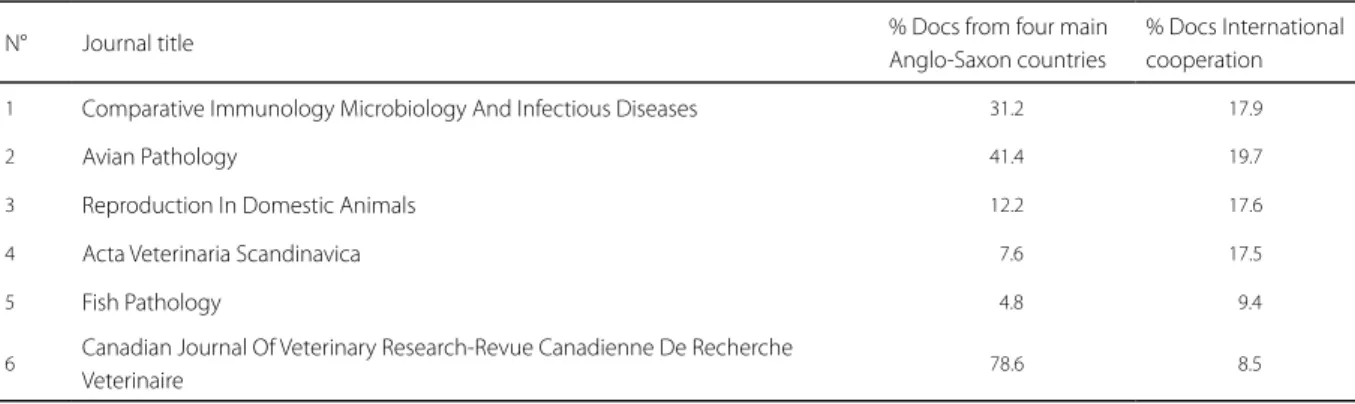
themselves as multi-language, most of the documents published in Q1 journals between 1994-2013 were in English (an average of 99.2%) (Table 1). As for the other quartiles, their averages were 93.1% for Q2, 62.1% for Q3 and 27.4% for Q4. In general, journals that publish documents mainly in English have a higher impact factor as previously described (CAVALCANTI-LIRA et al., 2013; CHRISTOPHER; MARUSIC, 2013; VINTHER; ROSENBERG, 2012). We considered investigating the contribution of the four most productive English-speaking countries according to Scimago (SCIMAGO, 2015) in the generation of these documents. As shown in Table 2, researchers from either Australia, Canada, England or the United States wrote more than 73% of the documents published in two Canadian journals. In contrast, the input of these four countries was below 10% in 21 of the veterinary journals, although ten of these journals were European. In fact, two of the European journals published 99.9% and 100% of the documents in the English language.
We also established the percentage of documents developed by cooperative work of authors from different countries. As expected, Q1 journals obtained the highest percentages (on average 18.4%), while the percentages for Q2 was 10.0%, 7.5% for Q3 and 7.4% for Q4 (Table 2). Even though only five journals were not above the 5.0% threshold of documents produced by international cooperation, it should be noted that only the Canadian Veterinary Journal – Revue Veterinaire Canadienne - presented a high percentage of documents published by researchers from one of the four major English-speaking countries. The other four journals did not reach a percentage of 2.8%.
Table 2. Publication profile of veterinary journals. 1 of 2
N° Journal title % Docs from four main
Anglo-Saxon countries
% Docs International cooperation 1 Comparative Immunology Microbiology And Infectious Diseases 31.2 17.9
2 Avian Pathology 41.4 19.7
3 Reproduction In Domestic Animals 12.2 17.6
4 Acta Veterinaria Scandinavica 7.6 17.5
5 Fish Pathology 4.8 9.4
6 Canadian Journal Of Veterinary Research-Revue Canadienne De Recherche
347
ANAL
YSIS MUL
TI-LANGU
A
GE JOURNALS
Table 2. Publication profile of veterinary journals. 2 of 2
N° Journal title % Docs from four main
Anglo-Saxon countries
% Docs International cooperation
7 Experimental Animals 2.5 5.3
8 Revue Scientifique et Technique-Office International Des Epizooties 39.2 19.0
9 Japanese Journal of Veterinary Research 4.2 14.1
10 Revista Brasileira de Parasitologia Veterinaria 4.6 8.8
11 Berliner Und Munchener Tierarztliche Wochenschrift 2.7 9.2
12 Wiener Tierarztliche Monatsschrift 3.2 8.5
13 Canadian Veterinary Journal-Revue Veterinaire Canadienne 73.7 2.2
14 Acta Veterinaria Brno 2.1 8.8
15 Schweizer Archiv Fur Tierheilkunde 3.1 8.1
16 Vlaams Diergeneeskundig Tijdschrift 2.9 6.5
17 Pesquisa Veterinaria Brasileira 3.9 6.5
18 Revista Brasileira de Zootecnia-Brazilian Journal of Animal Science 2.6 4.2
19 Revue de Medecine Veterinaire 3.7 11.7
20 Archivos de Medicina Veterinaria 8.1 16.5
21 Kafkas Universitesi Veteriner Fakultesi Dergisi 1.1 2.1
22 Turkish Journal of Veterinary & Animal Sciences 2.8 5.4 23 Arquivo Brasileiro de Medicina Veterinaria e Zootecnia 2.9 5.8
24 Pferdeheilkunde 14.7 12.3
25 Revista Cientifica-Facultad de Ciencias Veterinarias 3.7 11.4
26 Magyar Allatorvosok Lapja 2.7 4.5
27 Tieraerztliche Umschau 1.4 4.4
28 Kleintierpraxis 4.2 5.4
Source: Prepared by the authors (2016) based on data Web of Science (2014).
Note: The four Anglo-saxon countries considered are Australia, Canada, England and the United States. Data used to buld this table was extracted from Web of Science.
The four Anglo-Saxon countries were Australia, Canada, England and the United States. Data used to build table was extracted from WoS.
Document type
Since the impact factor is calculated using only the citations received by articles, reviews and
E. KRA
USK
OPF
et al
.
348
A
B
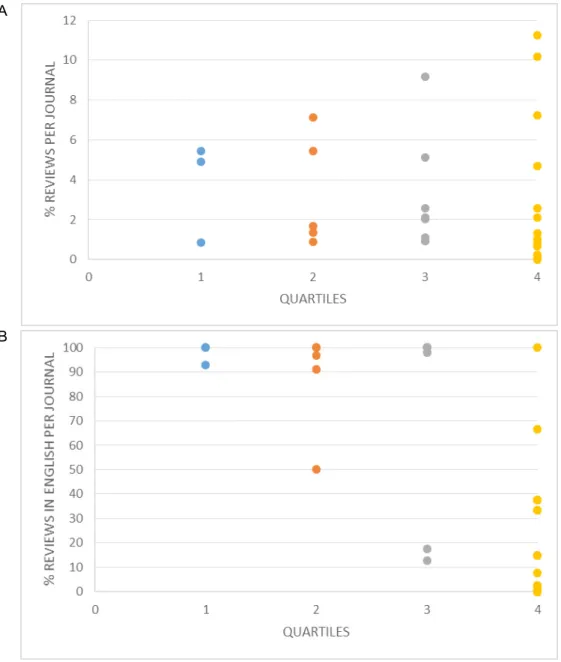
Figure 1. Ratio of reviews published by each journal.
Source: Prepared by the authors (2016) based on data Journal Citation Reports ( 2015) and Web of Science (2014).
Note: (A) Percentage of reviews published by each journal concerning the total amount of documents published between 1994-2003 and sorted by quartile. (B) Percentage of reviews published in English by each journal concerning the total amount of reviews published between 1994-2003 and sorted by quartile. Q: Quartile; Q1: first quartile; Q2: second quartile; Q3: third quartile; Q4: fourth quartile.
Citation distribution
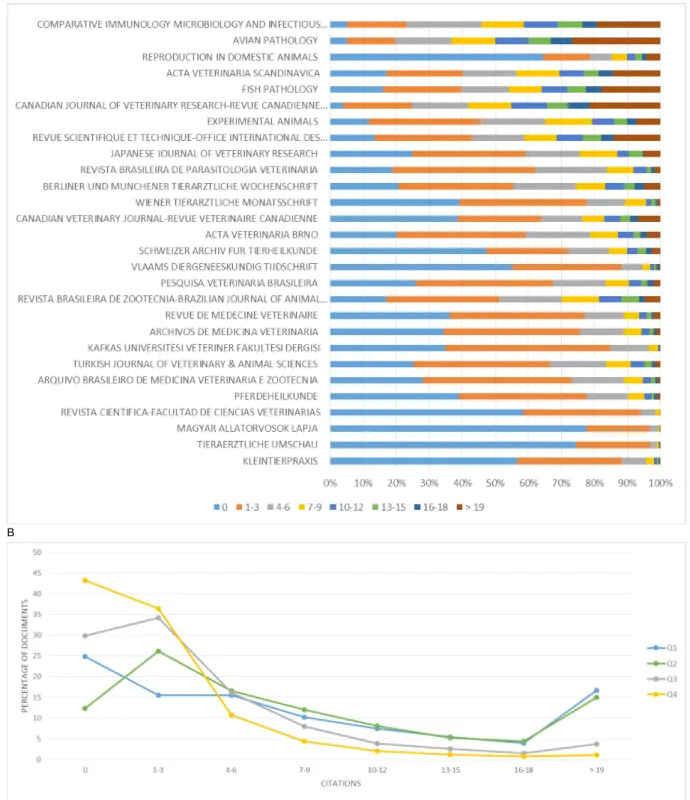
We analyzed the citation distribution of articles published by 28 journals. Figure 2A shows that the degree of correlation between citation distribution and journal quartile was low. For instance, while two Q1 journals present a very low ratio of uncited documents, approximately 64% of the documents published by the third Q1 journal, Reproduction in Domestic Animals, have never been cited. Further analysis revealed that 92.3%
349
ANAL
YSIS MUL
TI-LANGU
A
GE JOURNALS
A
B
Figure 2. Citation distribution of journals.
Fonte Prepared by the authors (2016) based on data Journal Citation Reports (2014) and Web of Science (2014).
Note: A) Citation distribution of documents published by 28 journals. The legend indicates the number of citations received by group of documents. Black dotted lines separate the journals by quartile (Q1-Q4). B) The average percentage of documents was estimated for the 28 journals by quartile and plotted by the number of citations received.
Q: Quartile.
find that some journals were better than others due to the heterogeneity in the quality of the work published.
E. KRA
The citation pattern shown in Figure 2A reveals a highly skewed distribution, characterized by a few highly cited documents (or papers) and a large number of documents that were poorly or never cited, confirming a fact that has been previously described in the field of bibliometrics (AKSNES, 2003; BORNMANN, 2014). However, these differences diminish as the number of citations per document increase as we considered documents that received more than 19 citations.
Among the 48,118 documents published by the 28 journals included in this study, we identified five highly cited papers. These have been defined by Thomson Reuters as documents that have received enough citations to place them in the top 1% of its academic field (in this case Veterinary sciences) based on a high threshold for the field and publication year. Two of these documents were published by the journal Reproduction in Domestic Animals (Q1), one by the journal Wiener Tierarztliche Monastsschrift (Q3), one by the Canadian Veterinary Journal (Q3) and one by the Revista Brasileira de Zootecnia (Q4). An unexpected outcome of this analysis was that one of the five most highly cited papers was not written in English, but in Portuguese.
Discussion
In this study, a bibliometric analysis of multi-language veterinary journals was addressed. It is a well-known fact that citation-based databases such as Web of Science and Scopus are biased towards English-language documents (ALBARILLO, 2014; MAS-BLEDA; THELWALL, 2016). Unfortunately, evidence has shown that documents written in a specific language tend to be cited in other documents by researchers who can read and understand that language (DAVAPARNA; BEHROUZFAR, 2009; LIANG et al., 2013; LI et al., 2014).
According to JCR 2014, 27.1% of the journals listed under the subject category “Veterinary Sciences” published documents in a language other than English. This percentage is similar (23.5%) to the one established for “Agronomy”, a related subject category, during the
same year. These ratios are higher than those reported for non-English language journals (18.0%) for the subject category “Medicine, general and internal” listed in JCR 2010 (VINTHER; ROSENBERG, 2012). However, the share of non-English documents in the medical sciences published by European countries has reduced significantly (VAN LEEUWEN et al., 2001), which may account for a smaller number of non-English language journals in this area.
The fact that the top ten journals (Table 1), according to their impact factor, published an average of 93.4% of their documents in English only confirms it as the universal language of science. Not surprisingly, the top three journals (ranked Q1) are managed by large commercial publishers aware of this fact. Differences in management have an effect on the nature of the published documents as commercial publishing companies design communication strategies to increase visibility and prestige of their journals (VELEZ-CUARTAS et al., 2016). On the other hand, academic management journals are usually managed by academics who dedicate part of their time to this endeavor. Nevertheless, increasing the impact factor should not be a sole argument for changing the publication language since some of the multi-language journals may play an important social role by providing information to local readers.
An analysis of the main countries that published in the subject category “Veterinary Sciences” throughout the 20-year period analyzed in this study revealed that the United States ranked first place, followed by England in the second place, Canada (7th)
and Australia (9th). Therefore, we became interested
351
and Infectious Diseases, only 4.7% of all the documents were from British authors. Likewise, the percentage in the Avian Pathology journal was 16.8%. It could be argued that because the last two journals are owned by large commercial publishers located in England, these estimates could be erroneous. Nevertheless, Fejes and Nylander (2014) reported that British authors published 69.0% of their articles in an England-based journal owned by a large commercial publisher.
An important editorial decision deals with the type of documents published by each journal. Since only citable documents (articles, reviews and proceedings) are considered to estimate the impact factor, we were interested in establishing the ratio of reviews published by each journal given that reviews are on average more cited than any other document types (Sigogneau, 2000). Our results (Figure 1) showed a low ratio of reviews published by Q1 journals and conversely a high ratio of reviews published by Q4 journals. Then, how come Q4 journals have not improved the impact factor of these journals? Further analysis revealed that the language of the reviews played a huge role. As Figure 1B shows, most of the Q4 journals publish non-English reviews, as opposed to Q1 and Q2 journals. In fact, the majority of non-English reviews published by Q3 and Q4 journals were poorly cited.
In contrast, the quantity of highly cited documents was very low for the 28 journals. Nevertheless, one of the documents was written in Portuguese so we analyzed which journals used the article published by Revista Brasileira de Zootecnia in 2008 as a source of information. A total of 175 articles and one review, from 26 different journals, used this highly-cited paper as a reference, 15 of which published documents only in English. Even though it may seem that the language barrier was not a limitation to readers, in reality all
of these documents were authored by at least one Brazilian researcher, as our analysis revealed. This result corroborates the findings of Hicks (1999), who revealed that German and French sociology researchers tend to cite documents written in their own language. Perhaps, it may be in the interest of the authors to publish their study using their local language as their research may be focused on a domestic target.
Conclusion
In conclusion, our results confirm that the publication of documents in languages other than English are systematically less cited, even though these documents are indexed in international databases such as Thomson Reuters. At the end, readership seems to be reduced to a small group of researchers that dominate the language in which the document was written, as we proved with the highly-cited paper written in Portuguese. Researchers should be aware that if they choose to publish in their native language, their work might go unseen although it may be important to the field. One aspect that was not considered in this study was self-citation practices of the journals as this parameter affects the impact factor. A study considering this aspect could provide a different viewpoint on the language issue.
Acknowledgments
The research for this project was funded by Proyecto Fondecyt n°1130918 and Proyecto Financiamiento Basal PFB-016.
Contribution
All the authors contributed to the design of the study, data analysis and writing of the manuscript.
References
AKSNES, D. W. Characteristics of highly cited papers. Research
Evaluation, v. 12, n. 3, p. 159-170, 2003.
ALBARILLO, F. Language in social science databases: English versus non-English articles in JSTOR and Scopus. Behavioral &
Social Sciences Librarian, v. 33, n. 2, p. 77-90, 2014.
BORNMANN, L. How are excellent (highly cited) papers defined in bibliometrics? A quantitative analysis of the literature. Research
Evaluation, v. 23, n. 2, p. 166-173, 2014.
CAVALCANTI-LIRA, R. P. et al. Influence of English language in the number of citations of articles published in Brazilian journals of Ophthalmology. Arquivos Brasileiros de Oftalmologia, v. 76, n. 1, p. 26-28, 2013.
E. KRA
DAVAPARNA, M. R.; BEHROUZFAR, H. International visibility of Iranian ISI journals: A citation study. Aslib Proceedings, v. 61, n. 4, p. 407-419, 2009.
FEJES, A.; NYLANDER, E. The Anglophone international(e): A bibliometric analysis of three adult education journals, 2005-2012. Adult Education Quarterly, v. 64, n. 3, p. 22-239, 2014. HICKS, D. The difficulty of achieving full coverage of international social science literature and the bibliometric consequences.
Scientometrics, v. 44, n. 2, p. 193-215, 1999.
JOURNAL CITATION REPORTS, 2014. Available from: <https:// jcr.incites.thomsonreuters.com/>. Cited: Jan. 10, 2016. JOURNAL CITATION REPORTS, 2015. Available from: <https:// jcr.incites.thomsonreuters.com/>. Cited: Jan. 10, 2016. KLOEZE, H; MUKHI, S. N.; ALEXANDERSEN, S. Swine influenza test results from animal health laboratories in Canada. The
Canadian Veterinary Journal, v. 54, n. 5, p. 501-503, 2013.
KNIGHT-JONES, T. J.; RUSHTON, J. The economic impacts of foot and mouth disease: What are they, how big are they and where do they occur? Preventive Veterinary Medicine, v. 112 n.3-4, p.161-173, 2013.
LEWIS, M. et al. (Ed.). Ethnologue: Languages of the world. 19. ed. Dallas: SIL International, 2016. Available from: <http://www. ethnologue.com>. Cited: June 20, 2016.
LI, J.; QIAO, L.; LI, W.; JIN, Y. Chinese-language articles are not biased in citations: Evidences from Chinese-English bilingual journals in Scopus and Web of Science. Journal of Informetrics, v. 4, n. 8, p. 912-916, 2014.
LIANG, L.; ROUSSEAU, R.; ZHONG, Z. Non-English journals and papers in physics and chemistry: Bias in citations? Scientometrics, v. 95, n. 1, p. 333-350, 2013.
MAS-BLEDA, A.; THELWALL, M. Can alternative indicators overcome language biases in citation counts? A comparison of Spanish
and UK research. Scientometrics, v. 109, n. 3, p. 2007-2030, 2016.
RABESANDRATANA, T. Plan for E.U. research funds raises ire.
Science, v. 348, n. 6233, p. 379-380, 2015.
SCIMAGO. Display countries with at least. Scimago Journal &
Country Rank. 2015. Available from: <http://www.scimagojr.
com/countryrank.php>. Cited: Mar. 2, 2017.
SIGOGNEAU, A. An analysis of document types published in journals related to physics: Proceeding papers recorded in the Science Citation Index database. Scientometrics, v. 47, n. 3, p. 589-604, 2000.
VAN LEEUWEN, T. N. et al. Language biases in the coverage of the Science Citation Index and its consequences for international comparisons of national research performance. Scientometrics, v. 51, n. 1, p. 335-346, 2001.
VASCONCELOS, S. M. R.; SORENSON, M. M.; LETA, J. Scientist-friendly policies for non-native English-speaking authors: Timely and welcome. Brazilian Journal of Medical and Biological Research, v. 40, n. 6, p. 743-747, 2007.
VINTHER, S.; ROSENBERG, J. Impact factor trends for general medical journals: Non-English-language journals are lagging behind. Swiss Medical Weekly, v. 142, w13572, 2012.
VELEZ-CUARTAS, G.; LUCIO-ARIAS, D.; LEYDESDORFF, L. Regional and global science: Publications form Latin America and the Caribbean in the ScieLO Citation Index and the Web of Science. El Profesional de la Información, v. 25, n. 1, p. 35-46, 2016.
WEB OF SCIENCE, 2014. Available from: <https://apps.webof knowledge.com/>. Cited: Jan. 10, 2016.