UNIVERSIDAD DE VALLADOLID
FACULTAD DE FILOSOFÍA Y LETRAS
DEPARTAMENTO DE FILOLOGÍA INGLESA
PROGRAMA DE DOCTORADO EN
ESTUDIOS INGLESES AVANZADOS:
LENGUAS Y CULTURAS EN CONTACTO
TESIS DOCTORAL:
THE ACQUISITION OF ENGLISH
AND SPANISH DATIVE
ALTERNATION STRUCTURES IN
THE LONGITUDINAL
SPONTANEOUS PRODUCTION OF
MONOLINGUAL AND BILINGUAL
CHILDREN
Presentada por Silvia Sánchez Calderón para optar al
grado de doctora por la Universidad de Valladolid
Dirigida por:
Raquel Fernández Fuertes
2018
ii
ABSTRACT
The chief ongoing debate in the domain of dative alternation (DA) structures revolves around the syntactic derivational relationship (or lack thereof) between prepositional and double object constructions (DOCs) in English (i.e. to/for-datives and DOCs) and in Spanish (i.e. a/para-datives and dative-clitic-doubled (DCLD) structures). In English, the debate has centered on the derivation of DOCs from
to/for-datives (e.g. Czepluch 1982; Haspelmath 2006; Larson 2014, 1990, 1988; Oehrle 1976) or to/for-datives from DOCs instead (e.g. Aoun and Li 1989; Dryer 1986; Koizumi 1994). In Spanish, a/para-datives are analyzed as the source structure of DCLDs (e.g. Bruhn de Garavito 2000; Demonte 1995, 1994; Kempchinsky 2004). Non-derivational approaches have proposed that DA constructions stem from two different structures (e.g. Marantz 1993; Mulder 1992 in English; Cuervo 2003a, 2003b in Spanish) or establish a common underlying configuration (e.g. Snyder and Stromswold 1997; Snyder 2001, 1995). Yet, prepositional structures are also argued to be subject to additional syntactic and semantic requirements that double object constructions are not (e.g. Larson 1990, 1988; Marantz 1984; Pesetsky 1985; Snyder and Stromswold 1997). Semantically, there is also a debate in the literature as to whether the two DA structures share a similar theta role distribution (Baker 1988) or whether they denote a semantic difference (e.g. Colleman 2010; Colleman and De Clerk 2011 in English; Demonte 1994; Romero Morales 2008 in Spanish).
Monolingual (L1) and bilingual (2L1) acquisition works on English and Spanish DA are rather scarce and there is no consensus in the findings reported. While some L1 English studies (e.g. Bowerman 1990; Campbell and Tomasello 2001) and 2L1 English studies (e.g. Gu 2010) point to the later emergence of to/for-datives, other L1 English works (e.g. Snyder and Stromswold 1997) report a similar emergence for English DA structures. In Spanish, only the study conducted by Torrens and Wexler (2000) reports the early onset of DCLDs from the initial L1 acquisition stages.
Data analyses in the present dissertation show that prepositional and double object constructions emerge at an approximately similar age in English and in Spanish alike, as analyzed in the L1 children’s data and in each of the 2L1 English/Spanish children’s two languages. Biological gender differences are not seen in the two language groups either. These data point to the syntactic non-derivational relationship (e.g. Marantz 1993; Mulder 1992; Snyder and Stromswold 1997; Snyder 2001, 1995; in English; Cuervo 2003a, 2003b in Spanish) and to the semantic analogy (Baker 1988) between DA constructions in English and in Spanish. Although the two DA constructions mature at a similar age, prepositional structures show a later onset and a lower incidence through language development when compared to double object constructions, as equally seen in the L1 and in the 2L1 children’s data in each language. These findings might be related to the additional properties required in the production of English to/for-datives and Spanish a/para-datives and/or the role played by adult input in child output. Similar results appear when comparing across English and Spanish in the case of the production of both the two L1 groups (inter-group comparison) and the 2L1 children (intra-(inter-group comparison). Thus, as per the acquisition pattern, the properties that characterize double object and prepositional constructions indicate a cross-linguistic parallelism in English and Spanish and the amount of exposure to these constructions could also have played a similar role in the children’s output across the two languages.
iii
ACKNOWLEDGEMENTS
I am extremely thankful to the many people who have contributed, in many different ways, to the elaboration of this dissertation. The research reported in this dissertation is the result of all their help.
I owe a special debt to my supervisor, Raquel Fernández Fuertes, because her dedication and her time are reflected in this dissertation. I am thankful for her thought-provoking questions that helped me to structure my ideas. I cannot forget her constant guidance in times of need and her thorough feedback provided in several drafts of this dissertation, in papers and in conference abstracts; let alone her kindness and her emotional support. I give her thanks for her contagious enthusiasm and for the knowledge she has shown me through her unimpeachable attributes as a researcher. I will be eternally thankful.
I would also like to thank the financial support provided by the University of Valladolid, Spain, co-funded by Santander bank from 06/02/2014 to 14/10/2014, and by the Castile and León Regional Government, Spain (ORDEN EDU/1083/2013, 27 December), co-funded by the European Social Funding from 17/10/2014 to 31/04/2018.
This dissertation is framed in the project ‘latransmisión de estereotipos de género a través de la canción y su relación con la violencia de género’ (‘the conveyance of gender stereotypes through song and its relation with domestic violence’), granted by the Women Institute (Health, Social Services and Equality Department, Spain), BOE 22
February 2013, 039/12. I am very grateful to the principal investigator, Laura Filardo Llamas, for her worthwhile comments, her advice and her generous help whenever I needed them.
During the realization of this dissertation, I had the opportunity of carrying out a research stay at the Institute of Linguistics (University of Malta) from 01/06/2015 to 01/09/2015 where I benefitted from several experts’ knowledge on quantitative and qualitative techniques of selection and classification of data. I would like to express my sincere gratitude to Marie Alexander, Stavros Assimakopoulos, Ray Fabri, Albert Gatt, Sarah Grech, Natalie Schembri and Lonneke van der Plas. I am immensely grateful for their advice, their kind words, their involvement and their encouragement.
iv
Yuan (University of Valladolid). I benefitted enormously from their expertise, their comments and their suggestions.
I would like to give thanks to the audience for their valuable comments and their
helpful discussions while presenting results at the XXIX Congreso Internacional de la Asociación de Jóvenes Lingüistas (University of Murcia, Spain, 2014), the VII
Congreso Internacional de Lingüística de Corpus (University of Valladolid, Spain, 2015), the Linguistics Circle (University of Malta, Malta, 2015), the I International UCM Predoctoral Conference on English Linguistics (Complutense University of Madrid, Spain, 2015), the XXXIII International Conference of the Spanish Society for Applied Linguistics (AESLA, University of Alicante, Spain, 2016), the IV Congreso Internacional de Lingüística y Literatura (University of Cantabria, Spain, 2016), the XXXIV International Conference of the Spanish Society for Applied Linguistics (AESLA, University of Jaén, Spain, 2017), the Multilingual Language Theories and Practices (University of Valladolid, Spain, 2018) and the III Lancaster Conference on Infant and Early Child Development (University of Lancaster, UK, 2018).
I would like to mention those professors who played an important role in the first stages of my knowledge on linguistic theory (Cayetano Estébanez Estébanez, University of Valladolid, Spain; Axiotis Kechagias, University of Salford, UK; Luis Santos Domínguez, University of Valladolid, Spain). Special thanks go to Ismael Iván Teomiro García, who served as my supervisor during my Master’s thesis at the National University of Distance Education (Spain), for having introduced me to the study of child language acquisition.
My fellow colleagues at the Department of English studies have also provided me
with much-needed moral support and wise advice. I am particularly thinking of Esther Álvarez de la Fuente, Diana Carrascal Tris, Laura Filardo Llamas, Eduardo Gómez
Garzarán, Sonja Mujcinovic, Ana Sáez Hidalgo, Radoslava Stankova and Qianting Yuan.
I would also like to give thanks to the two anonymous reviewers for their careful reading and for providing insightful comments and suggestions. Their valuable supportive work has considerably improved this dissertation.
v
vi
TABLE OF CONTENTS
ABSTRACT II
ACKNOWLEDGEMENTS III
TABLE OF CONTENTS VI
LIST OF TABLES X
LIST OF FIGURES XIII
LIST OF ABREVIATIONS XV
INTRODUCTION 1
CHAPTER 1 FORMAL APPROACHES TO ENGLISH AND SPANISH DATIVE
ALTERNATION STRUCTURES 9
1.1 Argumenthood and general defining properties 9
1.2 Case marking 16
1.3 Syntactic (non-)derivational relationship 19
1.3.1 English DOCs and to/for-datives 21
1.3.2 Spanish DCLDs and a/para-datives 30
1.4 Thematic role assignment 35
1.5 Concluding remarks: English and Spanish dative alternation structures 38
CHAPTER 2 ON THE ACQUISITION OF DATIVE ALTERNATION
STRUCTURES 42
2.1 Monolingual and bilingual first language acquisition 42
2.1.1 Language developmental stages: Age and mean length of utterance 42
2.1.2 The role of biological gender 47
vii
2.1.4 The role of dual input in child dual output 62
2.2 Previous studies on the acquisition of dative alternation structures 67
2.2.1 Age of onset 68
2.2.1.1 English DOCs and to/for-datives 68
2.2.1.2 Spanish DCLDs and a/para-datives 75
2.2.2 The effect of adult input in child output 82
CHAPTER 3 RESEARCH QUESTIONS 87
3.1 English dative alternation structures in the production of monolingual and
bilingual children 88
3.2 Spanish dative alternation structures in the production of monolingual and
bilingual children 91
3.3 Dative alternation structures across English and Spanish 93
3.3.1 Inter-group comparison: English and Spanish monolingual children
93
3.3.2 Intra-group comparison: English and Spanish bilingual children 96
CHAPTER 4 METHODOLOGY 99
4.1. Corpora selection from the CHILDES database: Monolingual and simultaneous
bilingual participants 99
4.2 Measuring linguistic development: MLUw and age 102
4.3 Data extraction and codification criteria 106
4.3.1 The search for the target structures: The KWAL program and manual
extraction 107
4.3.2 Codification criteria of dative alternation structures 110
4.3.2.1 English to/for-datives and DOCs 111
4.3.2.2 Spanish a/para-datives and DCLDs 112
viii
4.4. Frequency distribution of English and Spanish structures 119
4.5 Statistical methods for data analyses 120
CHAPTER 5 THE PRODUCTION OF ENGLISH AND SPANISH DATIVE
ALTERNATION STRUCTURES IN MONOLINGUAL AND IN BILINGUAL
CHILDREN 122
5.1 Dative alternation in monolingual and bilingual English 124
5.1.1 The age of onset 124
5.1.2 Dative alternation through language development 130
5.1.2.1 Age stages 131
5.1.2.2 MLUw stages 135
5.1.3 The influence of adult input in children’s output 139
5.1.5 Main findings 143
5.2 Dative alternation in monolingual and bilingual Spanish 144
5.2.1 The age of onset 144
5.2.2 Dative alternation through language development 151
5.2.2.1 Age stages 151
5.2.2.2 MLUw stages 155
5.2.3 The influence of adult input in children’s output 160
5.2.5 Main findings 163
5.3 Dative alternation across English and Spanish 164
5.3.1 Inter-group comparison: English and Spanish dative alternation in the
production of monolingual children 164
5.3.2 Intra-group comparison: English and Spanish dative alternation in the
production of bilingual children 168
ix
CONCLUSIONS 173
x
LIST OF TABLES
Chapter 2. On the acquisition of dative alternation structures
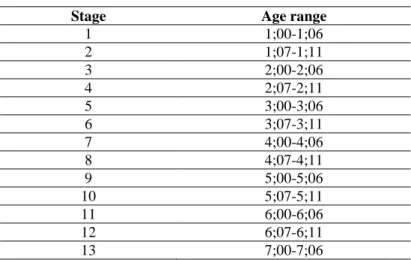
Table 1. Correspondence between the 5 linguistic stages in child language development and the 13 age stages established for the study of English and Spanish dative alternation structures………...44 Table 2. MLUm stages (Brown 1973: 79)……….………..45
Table 3. MLUm-age correspondence in monolingual acquisition (Brown (1973: 79) and adapted from Crain and Lillo-Martín (1999))……….………...47
Table 4. Mean vocabulary production scores in monolingual Swedish children as a function of biological gender, birth order and childcare (Berglund et al. 2005: 489)………..49
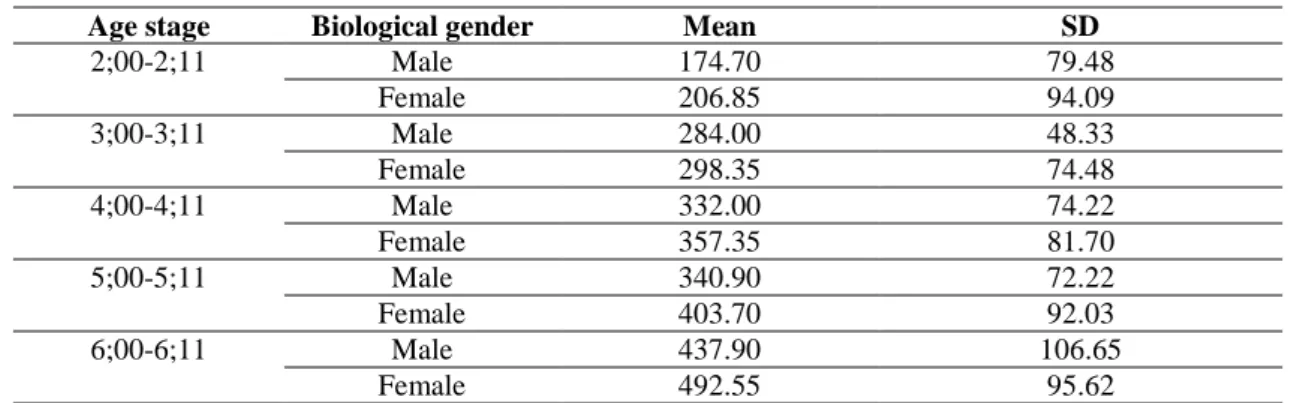
Table 5. Developmental Sentence Scoring means and standard deviations in the production of subject-verb utterances by monolingual English children (Koenigsknecht and Friedman 1976: 1111)…50
Table 6. Developmental Sentence Scoring means and standard deviations in the production of words by monolingual English children (adapted from Koenigsknecht and Friedman 1976: 1112)………...51
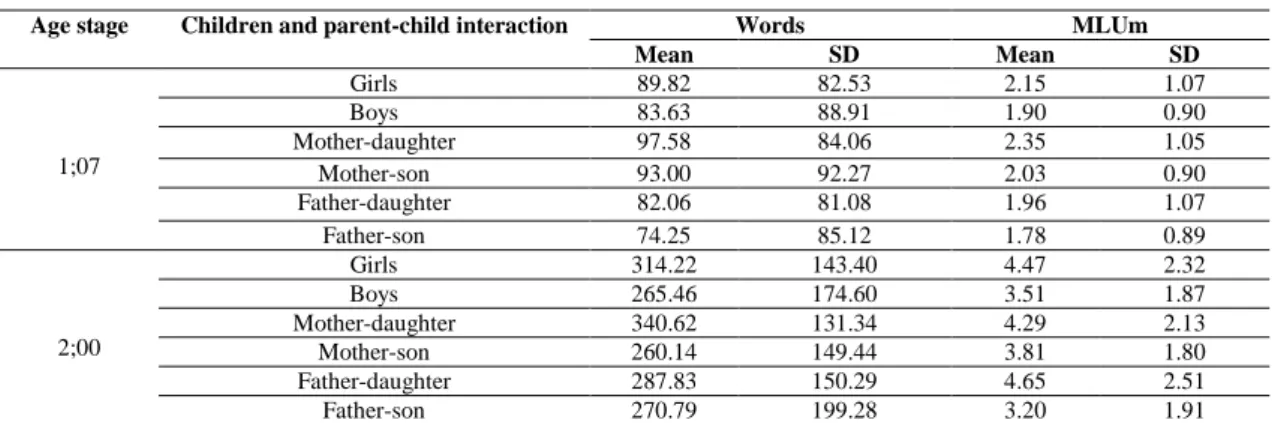
Table 7. Means and standard deviations in the production of words and MLUm values by monolingual English children (adapted from Lovas 2011: 92)………...53
Table 8. Non-adult-like use of auxiliary in English wh-questions by bilingual English/Spanish and by monolingual English children (# of cases (%)) (Hsin 2012: 112)………...58
Table 9. Age of onset of English dative alternation constructions in bilingual English/Cantonese children and in monolingual English children (adapted from Gu 2010: 72 and 80)………60
Table 10. The production of overt and null subjects in Spanish by bilingual English/Spanish and by monolingual Spanish children (# of occurrences (%)) (Paradis and Navarro 2003: 380)…...…..64
Table 11. Parents’ production of overt and null subjects in Spanish declarative utterances (# of occurrences (%)) (adapted from Paradis and Navarro’s (2003: 382-383) tables 4 and 5)…...….65
Table 12. Age of emergence and verb type in the production of DOCs and to/for-datives by monolingual English children (adapted from Gropen et al.’s (1989: 213-216) tables 2 to 6)………...69
Table 13. Ages of acquisition of DOCs and to-datives by monolingual English children (Snyder and Stromswold 1997: 290)……….…...70
Table 14. Age of first use of DOCs, to-datives and for-datives by monolingual English children (Campbell and Tomasello 2001: 256)………....……...73
Table 15. Acceptability Judgement Task ratings on the (un)grammaticality of dative alternation constructions by monolingual English children (%) (Mazurkewich and White 1984: 281)…….75
Table 16. Elicited production of simple and clitic doubling mono-transitive constructions in monolingual Romanian children’s data (Ungureanu 2017: 23)……….………...77
Table 17. The production (# of occurrences) of DOCs and to-datives by monolingual English children and by adults (adapted from De Marneffe et al 2001: 5 and 16)……….…...…84
xi
Table 19. The production of DOCs and to-datives per verb type by monolingual English children and by adults (# of occurrences) (adapted from Campbell and Tomasello 2001: 258)………..85-86
Chapter 3. Research questions
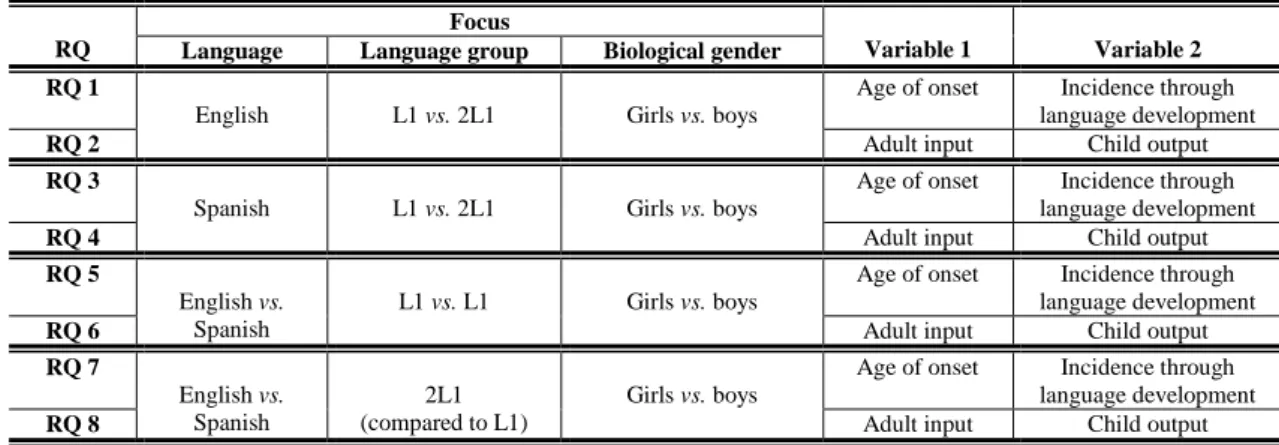
Table 1. Summary of the focus and the variables targeted in the research questions formulated in the study……….……..…87
Chapter 4. Methodology
Table 1. Monolingual English children
selected……….………..…..100 Table 2. Monolingual Spanish children selected………...100
Table 3. Simultaneous English/Spanish bilingual children selected………..…...100
Table 4. Adult input in the simultaneous English/Spanish bilingual children selected………...101
Table 5. Sample of the MLUw computation per file based on the production of English dative alternation structures [Ross, the MacWhinney corpus, CHILDES]………...104
Table 6. MLUw stages for the study of dative alternation constructions………..………...104
Table 7. Age stages for the study of dative alternation constructions………..………...105
Table 8. Sample of data classification in terms of age stages and MLUw stages in Simon’s longitudinal production of DOCs [the FerFuLice corpus, CHILDES]………..………...……...106
Table 9. Corpora selection procedure via the KWAL program……….…..…108
Table 10. Manual corpora selection
procedure………..…..………...109
Table 11. Frequency distribution of English and Spanish structures in the production of monolingual and bilingual children (# of cases (%))………...….118
Chapter 5. The production of English and Spanish dative alternation structures in monolingual and in bilingual children
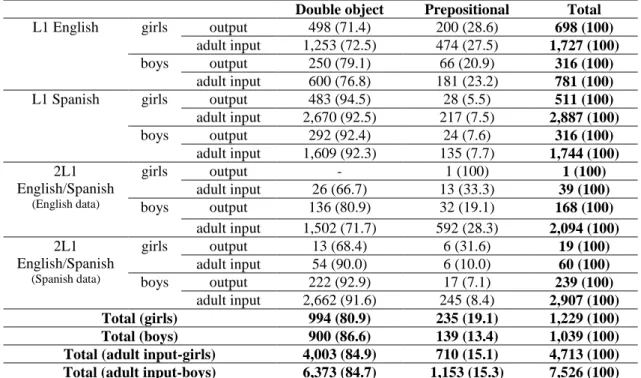
Table 1. English and Spanish dative alternation structures in child and in adult monolingual and bilingual speech (# of cases (%))………...…121
Table 2. English and Spanish dative alternation structures in girls’ and in boys’ monolingual and bilingual speech and in adult input (# of cases (%))………...…...…122
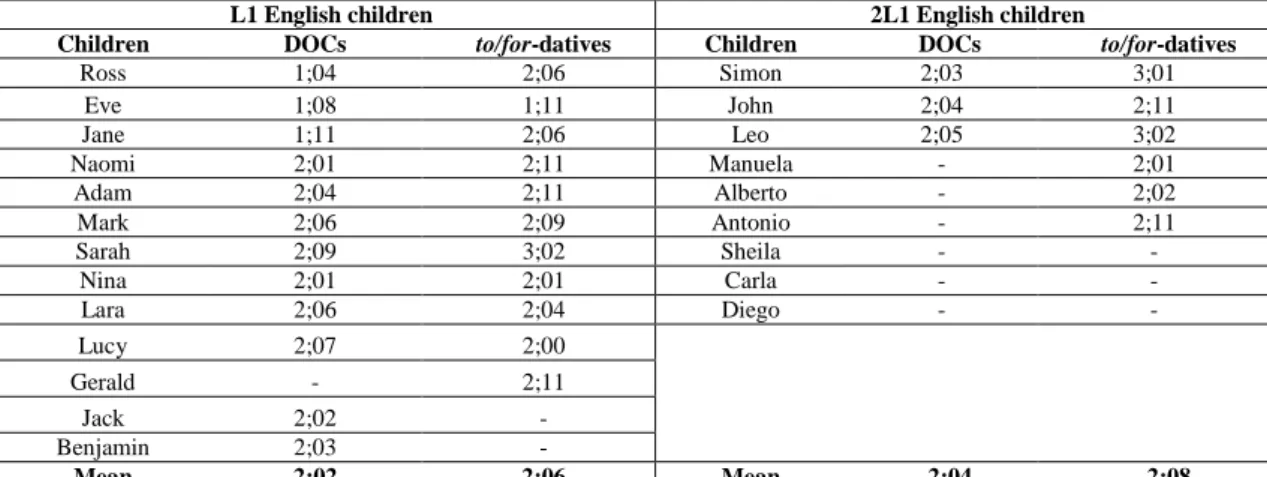
Table 3. Age of onset of English dative alternation structures in monolingual and in bilingual child speech………...….…...…124
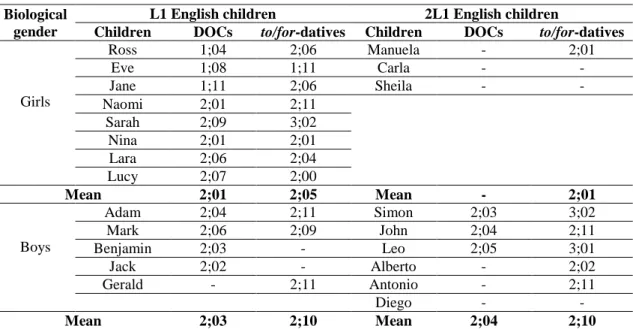
Table 4. Age of onset of English dative alternation structures in monolingual and in bilingual girls’ and boys’ speech……….………....……125
xii
Table 6. Age of onset of Spanish dative alternation structures in monolingual and in bilingual child speech………...…144
Table 7. Age of onset of Spanish dative alternation structures in monolingual and in bilingual girls’ and boys’ speech……….………....…146
xiii
LIST OF FIGURES
Chapter 4. Methodology
Figure 1. The MLUw command
line……….………...103
Figure 2. MLUw CLAN output window [Ross, the MacWhinney corpus, CHILDES, file 07a1.cha]………...103
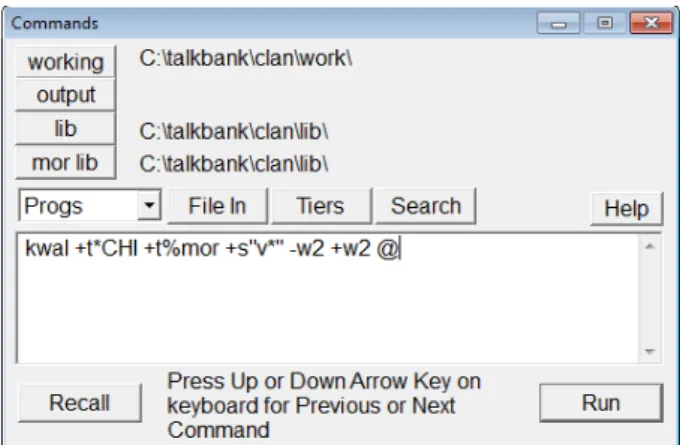
Figure 3. KWAL command string on the basis of the keyword ‘verb’……….….108 Figure 4. KWAL output of trimmed English dative alternation utterances [Ross, the MacWhinney corpus, CHILDES].………..…….109
Figure 5. KWAL output of trimmed Spanish dative alternation utterances [María, the Ornat corpus, CHILDES].………..…….109
Chapter 5. The production of English and Spanish dative alternation structures in monolingual and in bilingual children
Figure 1. The monolingual English children’s production of dative alternation structures per age stages……….…..….130
Figure 2. The production of dative alternation structures in the monolingual English girls and in the
monolingual English boys per age
stages………....…131
Figure 3. The bilingual English children’s production of dative alternation structures per age stages………....……132
Figure 4. The production of dative alternation structures in the bilingual English girls and in the bilingual English boys per age stages………133
Figure 5. The monolingual English children’s production of dative alternation structures per MLUw stages………134
Figure 6. The production of dative alternation structures in the monolingual English girls and in the
monolingual English boys per MLUw stages……….………..…….135
Figure 7. The bilingual English children’s production of dative alternation structures per MLUw stages………...…….136
Figure 8. The production of dative alternation structures in the bilingual English girls and in the
bilingual English boys per MLUw stages…………...……….…137
Figure 9. The production of English dative alternation structures in the adult input and in the
monolingual children’s output…………..………..…….…..….139
xiv
Figure 11. The production of English dative alternation structures in the adult input, the monolingual girls’ output and the monolingual boys’ output…………..……….………..………..….140
Figure 12.The production of English dative alternation structures in the adult input, the bilingual girls’ output and the bilingual boys’ output…………..……….……….…………....140
Figure 13. The monolingual Spanish children’s production of dative alternation structures per age stages………....150
Figure 14. The production of dative alternation structures in the monolingual Spanish girls and in the
monolingual Spanish boys per age stages….………...151
Figure 15. The bilingual Spanish children’s production of dative alternation structures per age stages……….…...152
Figure 16. The production of dative alternation structures in the bilingual Spanish girls and in the
bilingual Spanish boys per age
stages………..…..153
Figure 17. The monolingual Spanish children’s production of dative alternation structures per MLUw stages………..…..155
Figure 18. The production of dative alternation structures in the monolingual Spanish girls and in the
monolingual Spanish boys per MLUw stages………...………...……..156
Figure 19. The bilingual Spanish children’s production of dative alternation structures per MLUw stages………..…..157
Figure 20. The production of dative alternation structures in the bilingual Spanish girls and in the
bilingual Spanish boys per MLUw
stages………...………..………...158
Figure 21. The production of Spanish dative alternation structures in the adult input and in the
monolingual children’s output……….………...159
Figure 22. The production of Spanish dative alternation structures in the adult input and in the bilingual children’s output……….……..159
Figure 23. The production of Spanish dative alternation structures in the adult input, the monolingual
girls’ output and the monolingual boys’ output…………..………..………...…..….…..160
xv
LIST OF ABREVIATIONS
A Adjunct
Acc Accusative Case
ADH Autonomous Development Hypothesis
AJT Acceptability Judgment Task
APPL Applicative Affix
Appl Applicative Argument
Asp Aspect
BP Beta Phrase
C Complementizer
CHAT Codes for the Human Analysis of Transcripts
CHILDES CHIld Language Data Exchange System
Cl Clitic
CLAN Computerized Language ANalysis
CP Complementizer Phrase
DA Dative Alternation
Dat Dative Case
DCLD Dative-CLitic-Doubled
DClP DO DOC
DOCD parameter
Dative Clitic Phrase Direct Object
Double Object Construction
The Direct Object Clitic Doubling Parameter
DP Determiner Phrase
DSS Developmental Sentence Scoring
D-Structure Deep-Structure
ECP Empty Category Principle
EN English
EPP Extended Projection Principle
GB Government and Binding
IAP Inner Aspect Phrase
IDH Interdependent Development Hypothesis
Inf Inh IO Infinitive Indirect Object Inherent Case
IP Inflectional Phrase
KWAL Key Word And Line
L1 First Language
L2 Second Language
2L1 M
Two First Languages Masculine
MCDI MacArthur-Bates Communicative Development
Inventory
MLU Mean Length of Utterance
MLUm Mean Length of Utterance measured in morphemes
MLUw Mean Length of Utterance measured in words
MVPH Multiple-headed Verbal Phrase Hypothesis
Nom Nominative
xvi
P Person
Part Participle
Perf Perfect Tense
PF Phonological Form
Pl Plural
PO Primary Object
PP Prepositional Phrase
Pres Present Tense
Pron Pronoun
Refl Reflexive
RG Relational Grammar
RQ Research Question
SC Small Clause
SCS18 Swedish Communicative Screening at 18 Months
SD Standard Deviation
Sg Singular
SO Secondary Object
SP Spanish
SPSS Software Package for the Social Sciences
SU Subject
Subj SVO
Subjunctive
Subject-Verb-Object
T Trace
T Tense
TEGI Test of Early Grammatical Impairment
TP UG
Tense Phrase Universal Grammar
UTAH Uniformity of Theta Assignment Hypothesis
V Little Verb
V Verb
VP Verb Phrase
V-Raising Verb-Raising
Vs Versus
VS Constructions Verb-Subject Constructions
1
INTRODUCTION
The present dissertation is concerned with the acquisition of the so-called dative alternation (DA) structures in English (e.g. Dryer 1986; Larson 2014, 1990, 1988; Pylkkänen 2002; Snyder 2001; Snyder and Stromswold 1997) and in Spanish (e.g. Bruhn de Garavito 2000; Cuervo 2007, 2003a, 2003b; Demonte 1995, 1994; Kempchinsky 2004). More specifically, it analyzes the spontaneous longitudinal production of monolingual (L1) and bilingual (2L1) children in order to provide further insight into the syntactic and the semantic properties that underlie and connect prepositional and double object constructions, as two instances of DA structures. While, in English, to/for-datives of the type in (1a-b) alternate as double object constructions (DOCs) of the type in (1c), in Spanish, a/para-datives, as in (2a-b), alternate as dative-clitic-doubled (DCLD) constructions, as in (2c), in which a pre-verbal dative clitic ‘le’ (‘him’ or ‘her’; singular) or ‘les’ (‘them’; plural) is doubled by a prepositional complement, headed by ‘a’ (i.e. ‘to’), sharing gender, number and person features as well as Case and theta role properties.
(1) a. I give that to you [to-dative]
[Nina, 2;01, the Suppes corpus, CHILDES]
b. I buy cereal for my baby [for-dative]
[Ross, 2;08, the MacWhinney corpus, CHILDES]
c. Give me some [DOC]
[Ross, 1;04, the MacWhinney corpus, CHILDES]
(2) a. Estoy sacando algo a la mamá [a-dative]
be.1p.sg.pres. take.ing. something to the mummy ‘I am taking something out for the mummy’
[Koki, 2;05, the Montes corpus, CHILDES]
b. Tú sabes cocinar papilla para Simon [para-dative]
you know.2p.sg.pres. cook.inf. baby food for Simon ‘You know how to cook baby food for Simon’
[Leo, 2;08, the FerFuLice corpus, CHILDES]
c. Lei voy a hacer un regalo [ a Mónica ]i [DCLD]
her.dat.cl. go.1p.pres. to make.inf. a gift to Mónica ‘I am going to give Mónica a gift’
2
The objective of this dissertation is twofold. First, it investigates the production of English and Spanish DA constructions through language development in L1 and in 2L1 children. In this case, findings can contribute to shed light on the syntactic derivational
relationship (or lack thereof) between the two DA constructions in English and in Spanish; that is, whether double object and prepositional constructions are the source or
the derived structure or, rather, whether the two DA structures do not undergo a syntactic derivational relationship. Second, it examines the relationship that exists in the acquisition process of these constructions across English and Spanish. In this case, findings can elucidate whether the syntactic (non-)derivational relationship between double object and prepositional constructions is analogous or differs across the two languages.
Formal approaches on the DA of prepositional and double object constructions are divided into those that take the two structures to derive from its DA counterpart (e.g. Dryer 1986; Oehrle 1976; Haspelmath 2006; Larson 2014, 1990, 1988 in English; Demonte 1995, 1994 in Spanish) and into those that argue for the lack of a syntactic derivational relationship between the two DA constructions (e.g. Marantz 1993; Mulder 1992; Snyder and Stromswold 1997 in English; Cuervo 2003a, 2003b in Spanish). Within the derivational approaches, prepositional or double object constructions have usually been claimed to be derived by a lexical rule (Czepluch 1982), by a transformational rule (Oehrle 1976) or by a passive-like mechanism (Aoun and Li 1989; Demonte 1995, 1994; Dryer 1986; Haspelmath 2006; Larson 2014, 1990, 1988). Alternatively, and under the light of non-derivational approaches, prepositional and double object constructions are analyzed as having two different base structures
(Cuervo 2003a, 2003b; Marantz 1993; Mulder 1992) or a shared underived complex predicate or small clause (SC) structure. This last view is captured in the Complex
Predicate Parameter (Snyder 2001, 1995) whereby English is a [+complex predicate] language and Spanish is a [-complex predicate] language. This is so given the unavailability of English-like DOCs in Spanish and, thus, double object constructions are argued to differ in the syntactic status across the two languages.
3
equally proposed for English (e.g. Colleman 2010; Colleman and De Clerk 2011; Goldberg 1995, 1992) and for Spanish (e.g. Demonte 1994; Romero Morales 2008). More specifically, while prepositional DA structures (i.e. English to/for-datives and Spanish a/para-datives) are argued to involve caused motion (cause-to-GO), double object constructions (i.e. English DOCs and Spanish DCLDs) are said to denote transfer
of possession (cause-to-HAVE).
Previous empirical studies on DA have mainly focused on L1 English children’s data (Bowerman 1990; Campbell and Tomasello 2001; Gropen et al. 1989; Snyder and Stromswold 1997) and, to the best of our knowledge, only Gu’s (2010) study investigates the 2L1 children’s acquisition of DOCs and to/for-datives in English in contact with those in their other L1, Cantonese. Within the domain of Spanish DA structures, earlier works on the acquisition of DCLDs and a/para-datives have primarily targeted second language (L2) learners (Bruhn de Garavito 2000; Cuervo 2007; Perpiñán and Montrul 2006; among others). To date, only Torrens and Wexler (2000) have examined the emergence of DCLDs in L1 Spanish children’s data, but no information is provided in relation to a/para-datives. In view of the bulk of L1 and 2L1 research on the acquisition of English and Spanish DA structures, further empirical investigation is required to better inform on the syntactic relationship between prepositional and double object constructions in English and in Spanish, be it derivational or non-derivational. What could be inferred from these analyses is that a later onset, and possibly a lower incidence through language development, of one of the two DA structures may imply a grammatical complexity that could be associated with its derivational status. In other words, the grammatical properties of the derived DA
structure would be subject to language maturation and, therefore, they would cause a delay in their production. Nevertheless, if prepositional and double object constructions
emerge at an approximately similar age, and possibly show an analogous incidence through language development, what could be suggested is that the two structures are not derivationally related from one another and, thus, they mature at around the same age.
4
DA structures, most research has been carried out with L1 English children and the findings reported do not clearly elucidate whether the amount of exposure to DOCs and
to/for-datives plays a crucial role in L1 English children’s use of these structures (Campbell and Tomasello 2001; De Marneffe et al. 2012; Snyder and Stromswold 1997). To the best of our knowledge, analogous empirical works have not been
conducted in Spanish.
Biological gender is also considered as part of the analysis. Although there is not a great bulk of studies that have addressed the differences between girls and boys in terms of maturational patterns, there are a few precedents in this respect. With regards to L1 acquisition works, an agreement appears in the literature regarding girls’ earlier maturation when compared to boys in motor movements (e.g. Nagy et al. 2007), in lexical use (e.g. Berglund et al. 2005; Eriksson et al. 2012), and in syntactic development (e.g. Cornett 2014; Lovas 2011). In the case of bilinguals, only one empirical study (Eriksson et al. 2012) has reported on the 2L1 girls’ higher rate in the lexical production of different word types in their dominant language when compared to 2L1 boys. Most of these divergences have been argued to stem from brain lateralization (e.g. Burman et al. 2008; Shakouri et al. 2016) or from different parent-child interactions when parents engage in conversations with their sons or with their daughters (e.g. Gleason 1990; Lovas 2011). Based on these empirical works, we seek to examine whether biological gender differences exist in the case of English and Spanish DA structures. In particular, we analyze whether girls differ from boys in (a) the monolingual and in the bilingual acquisition processes of these constructions and in (b) the role played by adult input in child output when addressing boys or girls.
Considering the above-mentioned theoretical and empirical works as a point of departure, four analyses are carried out to explore the acquisition process of the
5
acquisition of these structures. Moreover, we examine whether the relative frequency rate with which the two English and Spanish DA structures are used in the adult input is consistent with the children’s output.
The data analyzed in this dissertation come from 25 longitudinal corpora available in the CHIld Language Data Exchange System (CHILDES, MacWhinney 2000). These
corpora include the production of 13 L1 English children (age range: 0;06 to 8;00; 8 girls and 5 boys), 9 L1 Spanish children (age range: 0;11 to 4;08; 6 girls and 3 boys), and 9 2L1 English/Spanish children (1;01 to 6;11; 3 girls and 6 boys). We have also considered the production of the adults that the children interact with (mainly parents, as well as other caregivers and researchers).
The extraction of English and Spanish DA structures in the production of the 31 children selected and in that of the child-directed speech combines automatic morpho-syntactic searches with manual extraction. In the former, the contexts in which a verb is used are extracted via KWAL (Key Word And Line), one of the CLAN (Child Language ANalysis) programs, in those selected corpora that have a +t%mor (morphology dependent tier) available in the CHAT (Codes for the Human Analysis of Transcripts) written format. On the contrary, manual data extraction includes those selected corpora that do not include a +t%mor in their transcripts.
The results of this dissertation contribute to shed light on the parallel syntactic non-derivational relationship between the two DA structures across English and Spanish, as reflected in the significantly similar emergence of prepositional and double object constructions in the L1 and in the 2L1 children’s data, both in girls and in boys. This suggests that, despite the different properties that the phenomenon of DA presents
across the two languages, as per the Complex Predicate Parameter (Snyder 2001, 1995), the two English and Spanish DA structures could be construed under a shared
6
and 2L1 English/Spanish) show a later onset and a lower incidence of English to/for -datives and Spanish a/para-datives when compared to English DOCs and Spanish DCLDs, respectively, and biological gender differences do not appear in this respect.
These findings could lend support to the additional properties of the prepositions ‘to/for’ in English and ‘a/para’ in Spanish (e.g. Larson 1990; 1988; Marantz 1984; Pesetsky 1985; Snyder and Stromswold 1997) and/or the role played by adult input in child output (e.g. Legate and Yang 2002; Lust 2006; Pullum and Scholz 2002; Sampson 2002; Yang 2016, 2011, 2002).
The results accomplished in the present dissertation also contribute to fill the gap between theorical and empirical research on the syntactic status and on the acquisition of English and Spanish DA structures, respectively. With regards to acquisition, this study provides with novel spontaneous production data analyses that focus on the acquisition of DA constructions by L1 Spanish children and by 2L1 English/Spanish children. Previous empirical works have not investigated the acquisition of Spanish DA structures (with the exception of Torrens and Wexler 2000 who analyze the acquisition of DCLDs only) or their acquisition in contact with other languages such as English. Moreover, the present dissertation also contributes novel English data on DA structures since it investigates L1 English and 2L1 English children’s acquisition of these constructions following different data classification criteria from what has been reported in the literature (e.g. Campbell and Tomasello 2001; De Marneffe et al. 2012; Snyder and Stromswold 1997, see chapter 4). This study also examines the possible biological differences (or lack thereof) in L1 and in 2L1 children’s acquisition of English and Spanish DA structures, an issue that earlier L1 and 2L1 empirical works have not
looked into from this perspective.
This dissertation is structured into 5 chapters preceded by this introduction and
7
account of the differences and the similarities of English and Spanish DA structures is provided in section 1.5.
The backbone of chapter 2 is organized into two main sections. Section 2.1 deals
with four general L1 and 2L1 acquisition properties that are later present in the analysis of DA structures in chapter 5: (a) Age and mean length of utterance (MLU), as two
language developmental measures; (b) the role of biological gender; (c) cross-linguistic influence in 2L1 acquisition, that is, whether one language influences the course of development of the other language, as per the Interdependent Development Hypothesis (IDH, henceforth; Meisel 2004, 2001, 1989; Paradis and Genesee 1996; among others), or whether each of the two languages follows analogous developmental paths to their respective L1 peers, as per the Autonomous Development Hypothesis (ADH, henceforth; Álvarez de la Fuente 2007; Bergman 1976; Clark 2009; Genesee et al. 1995; among others); and (d) the role of dual adult input in 2L1 child dual output1. Section 2.2 is concerned with previous L1 and 2L1 acquisition works on English and Spanish DA structures. Issues such as the age of onset and the influence of adult input in child use of prepositional and double object constructions are addressed in this section.
Chapter 3 is divided into three main sections and formulates the research questions (RQs) under investigation. Sections 3.1 and 3.2 explore the syntactic derivational and non-derivational relationship between the two DA structures in English and in Spanish, respectively, as well as the role played by adult input in child output. This is analyzed in the production of L1 and 2L1 children. Section 3.3 seeks to answer whether prepositional and double object constructions share an analogous syntactic
(non-)derivational relationship across English and Spanish, and whether adult input-child output patterns are equally observed across the target languages. This is analyzed
in the production of L1 children (inter-group comparison, section 3.3.1), on the one
1We refer to dual adult input when 2L1 children are exposed to two languages from birth via the one
8
hand, and in the production of 2L1 children (intra-group comparison, section 3.3.2), on the other hand.
Chapter 4 is concerned with the methodological issues of the present study. It
provides a detailed description of the participants (i.e. children and adults) (section 4.1), the methods used for data analysis (section 4.2), namely, developmental stages based on
age and on MLU values measured in words (i.e. MLUw), the procedure of data extraction and data codification criteria (section 4.3), along with the frequency distribution of English and Spanish structures (section 4.4) as well as the statistical methods for data analyses (section 4.5).
Chapter 5 presents the analysis of English and Spanish DA structures and discusses the findings observed in line with previous formal accounts (chapter 1) and empirical works (chapter 2). This chapter is organized into three core sections. Section 5.1 presents the production of English DA structures (i.e. DOCs and to/for-datives) in both L1 and 2L1 children. Section 5.2 focuses on the production of Spanish DA structures (i.e. DCLDs and a/para-datives) in both L1 and 2L1 children. Section 5.3 offers a comparative analysis of English and Spanish DA structures, as it appears in the production of L1 children (section 5.3.1) and in the production of 2L1 children (section 5.3.2). In the discussion of results, each of these three sections considers the following variables under analysis: Age of onset, incidence through language development (in terms of age and MLUw values), biological gender, and the role played by adult input in child output. Moreover, a partial overview of the main findings is provided at the end of each section. The results reported in the data analyses lead to give an answer to the initial RQs formulated in chapter 3.
Once the data analyses are presented, the conclusions drawn from the present dissertation are outlined and some relevant suggestions for further research are also
9
CHAPTER 1
FORMAL APPROACHES TO ENGLISH AND SPANISH DATIVE
ALTERNATION STRUCTURES
This chapter offers an overview of previous linguistic theoretical works that constitute the basis for the English-Spanish comparative empirical study of DA constructions. The description that is provided in this chapter is not comprehensive; rather, it aims at shedding light on the basic syntactic and semantic properties of English and Spanish DA structures as well as determining their cross-linguistic similarities and differences.
We start in section 1.1 with the general properties that define the two types of DA structures in English and in Spanish, namely, prepositional and double object. Syntactically, two issues have focused the debate on DA in different formal studies: Case marking properties (Aranovich 2012, 2011; Chomsky 1996, 1981; Radford 1990;
among others), as discussed in section 1.2, and the syntactic (non-)derivational relationship of DA constructions (Aoun and Li 1989; Dryer 1986; Larson 2014, 1990, 1988; Marantz 1993; among others in English; Cuervo 2003a, 2003b; Demonte 1995, 1994; among others in Spanish), as addressed in section 1.3. Thematic role assignment is also discussed across the two languages in section 1.4. A summary of the main points appears in section 1.5.
1.1 Argumenthood and general defining properties
DA refers to the possibility of a verb to alternate the argument structure between prepositional and double object constructions. This phenomenon appears in English (Den Dikken 1991; Larson 2014, 1990, 1988; Malchukov et al. 2007; Oehrle 1976; Pylkkänen 2002; Quirk et al. 1985; Rill 2011; Sadler and Camilleri 2013; Snyder 2001; Snyder and Stromswold 1997; Zhang 1998; among others) and in Spanish (Anagnostopoulou 2003; Anderssen et al. 2012; Bruhn de Garavito 2000; Cuervo 2007, 2003a, 2003b; Demonte 1995, 1994; Kempchinsky 2004; Marantz 1993; Pineda 2012; among others).
10
(1) a. John gave a book to Mary [to-dative]
b. John gave Mary a book [DOC]
c. John bought a book for Mary [for-dative]
d. John bought Mary a book [DOC]
In Spanish, prepositional DA structures divide into a-datives, as in (2a), and
para-datives, as in (2c), while double object ones include DCLD constructions, as in (2b) and (2d), in which a prepositional complement introduced by the preposition ‘a’ (‘to’) doubles a pre-verbal dative clitic ‘le’ (‘him’ or ‘her’; singular) or ‘les’ (‘them’; plural).
(2) a. Juan dio un libro a María [a-dative]
John give.3p.sg.past a book to Mary ‘John gave a book to Mary’
b. Juan lei dio un libro [ a María ]i [DCLD]
John him.cl.dat. give.3p.sg.past a book to Mary ‘John gave Mary a book’
c. Juan compró un libro para María [para-dative]
John buy.3p.sg.past a book for Mary ‘John bought a book for Mary’
d. Juan lei compró un libro [ a María ]i [DCLD]
John him.cl.dat. buy.3p.sg.past a book to Mary ‘John bought Mary a book’
11
Snyder (2001: 325) includes the complex predicate constructions in (3) and argues that they all constitute a natural syntactic class which depends on a shared parametric property2.
(3) a. John painted the house red [resultative] b. Mary picked the book up/picked up the book [verb-particle]
c. Fred made Jeff leave [make-causative]
d. Fred saw Jeff leave [perceptual report]
e. Bob put the book on the table [put-locative] f. Alice sent the letter to Sue [to-dative]
g. Alice sent Sue the letter [double-object dative]
To the list of complex predicate structures in (3), Snyder (2001) adds Noun-Noun compounds. Out of the eight structures in the parameter, two of them will be examined in the present study: to-datives (3f) and DOCs (or double-object datives) (3g). In particular, the verb ‘sent’ in (3f) subcategorizes for a DO-DP ‘a letter’ and an IO-PP ‘to Sue’, headed by the preposition ‘to’, while the linear order of the internal arguments in the DOC (3g) is reversed form that of to-datives, where no preposition ‘to’ appears. This means that, comparing to-datives and DOCs in (3f) and in (3g), respectively, the form of the IO changes from a PP ‘to Sue’ in to-datives to a DP ‘Sue’ in DOCs.
Although for-datives are not considered in Snyder’s (2001) classification as complex predicates, they exhibit a similar syntactic pattern with to-datives in undergoing DA and, therefore, having an alternative DOC (Drosdowski 1984; Goldberg 2006; Hudson 1991; Larson 1990; Williams 1970). As in (4a), the verbal head ‘prepared’ subcategorizes for a DO-DP, ‘a cake’, as well as an A-PP, ‘for Peter’, headed by the preposition ‘for’. In turn, the verbal head ‘prepared’ can take the form of a DOC, as in (4b), where no preposition ‘for’ appears in the A-DP ‘Peter’.
(4) a. He prepared a cake for Peter [for-dative]
b. He prepared Peter a cake [DOC]
2Snyder (2001) confirms the syntactic analysis with language acquisition data. According to his proposal,
12
As an optional A, the PP ‘for Peter’ does not render the sentence ungrammatical when it is not overtly realized, as in (5). On the contrary, the IO-PP ‘to his best friend’ in the to-dative (6a) and the IO-DP ‘his best friend’ in the DOC (6b) are required by the verbal subcategorization framework, regardless of the nature of the IO, that is, whether it is overt, as in (6a) and (6b), or null, as in (6c).
(5) He prepared a cake [mono-transitive]
(6) a. He sent a letter to his best friend [to-dative] b. He sent his best friend a letter [DOC]
c. He sent a letter e [to-dative or DOC; null PP]
The Complex Predicate Parameter (Snyder 2001, 1995) determines whether a language permits the syntactic formation of complex predicates in (3), in general, and
the syntactic formation of to-datives and DOCs, in particular. The availability of complex predicates is not universal, and it varies across languages (Kayne 1975; Larson 2014, 1990, 1988; Snyder 2001, 1995); so, for instance, while English is a [+complex predicate] language, Spanish (and Romance languages, in general) is a [-complex predicate] language. In particular, it is argued that Spanish lacks direct counterparts of the four types of complex predicates in English, namely, resultatives, verb-particles,
make-causatives and double-object datives (i.e. DOCs) even if examples of these could be found in the language; in other words, these complex predicates in Spanish do not share the same status as those in [+complex predicate] languages. Therefore, there is a parametric distinction between the availability of complex predicates in English and in Spanish, and more specifically, with regards to the two types of DA structures (Beavers and Nishida 2009; Bleam 2003, 2000; Cuervo 2007, 2003a, 2003b; Delbecque 1992; Demonte 1995, 1994; García Maroto 1985; Gutiérrez Ordoñez 1999; Kayne 1975; Masullo 1992; Ormazabal and Romero 1999; Uriagereka 1988). While the prepositions ‘a’ and ‘para’ in Spanish a/para-datives cannot be removed in the formation of DCLDs (and this could suggest the unavailability of English-like DOCs), they show similar grammatical properties when compared to English to/for-datives. In terms of the parametric variation of double object constructions across the two languages, Spanish DCLDs are characterized by the verbal subcategorization for a DO and a prepositional complement headed by the preposition ‘a’ that, in turn, doubles a dative clitic ‘le(s)’ in gender, number, person, Case and theta role properties. A different status is given to
13
arguments, an IO and a DO (if they alternate as to-datives) or a DO as well as an A (if they alternate as for-datives).
Regarding a-datives, the verb ‘mandó’ (‘he sent’), as in (7a), subcategorizes for a DO-DP ‘una carta’ (‘a letter’) and an IO-PP ‘a María’ (‘to María’), headed by the preposition ‘a’. These types of canonical a-datives can reverse their internal arguments, as in (7b), since Spanish is a free constituent order language (Cuervo 2007, 2003a, 2003b; Demonte 1995, 1994; Romero Morales 2008; Hernanz and Brucart 1987). However, non-canonical a-datives might not be judged entirely grammatical by some speakers and they are, in fact, considered illicit by some others in that, as argued by Demonte (1994: 85), (7b) ‘asks for a clitic’.
(7) a. Juan mandó una carta a María [a-dative; canonical]
John send.3p.sg.past a letter to Mary ‘John sent a letter to Mary’
b.*/?Juan mandó a María una carta [a-dative; non-canonical]
Juan send.3p.sg.past to María a letter ‘John sent a letter to Mary’
[Demonte 1994: 84]
Contra the Complex Predicate Parameter (Snyder 2001, 1995), double object structures have been argued to be available in Spanish, and so, a-datives, of the type in (7), with a prepositional complement doubling a pre-verbal dative clitic (singular le,
plural les), alternate as DCLDs (Aranovich 2012, 2011; Beavers 2003; Bleam 2003; Beavers and Nishida 2009; Bruhn de Garavito 2000; Cuervo 2007, 2003a, 2003b; Demonte 1995, 1994; among others). As pointed out by Romero Morales (2008: 16),
‘son dativas todas aquellas construcciones en las que aparece el clítico le(s)’ (‘all constructions with a clitic ‘le(s)’ are considered to be dative constructions’). Similar to
14
(8) a. Lei di el libro [ a María ]i [DCLD; canonical]
him.cl.dat. give.3p.sg.past the book to María ‘John gave Mary the book’
b. [ A María ]i lei di el libro [DCLD; non-canonical]
to María him.cl.dat. give.3p.sg.past the book ‘John gave Mary the book’
[Demonte 1994: 86]3
The IO-PP, doubling a dative clitic, may be null (e), as in (9), and the sentence still remains grammatical.
(9) Sara le envió un libro e [DCLD; null IO-PP]
Sara him.cl.dat. send.3p.sg.past a book ‘Sara sent him a book’
Dative clitics in DCLDs agree in gender, person, number, Case and theta role with the prepositional complement given that they must conform to the Matching Hypothesis (Suñer 1988). As an example, the dative clitic ‘le’ in (8) and the prepositional complement ‘María’ constitute a well-formed co-indexed chain with shared agreement features (i.e. feminine, third person, singular), so that only one Case (i.e. dative) and only one theta role (i.e. recipient) are assigned to the chain via the preposition ‘a’, thus meeting the Case Filter (Chomsky 1996, 1981) and the Theta Criterion (Baker 1988; Carrier-Duncan 1985; Chomsky 1981), respectively.
When the dative clitic ‘le(s)’ is combined with a pronominal accusative clitic ‘lo(s)/la(s)’, as in (10a), it is replaced by an impersonal dative pronoun ‘se’, as in (10b), via a phonological dissimilation process (Alonso Cortés 1939; Aranovich 2012, 2011; Bruhn de Garavito 2000; García Maroto 1985; Jaeggli 1986; Romero Morales 2008).
(10) a.*Sara le lo envió [DCLD]
Sara him.cl.dat. it.cl.acc. send.3p.sg.past ‘Sara sent him a book’
3Although Demonte (1995, 1994) argues that Spanish DA constructions share the syntactic properties of
15
b. Sara se lo envió
Sara him.cl.dat. it.cl.acc. send.3p.sg.past ‘Sara sent him a book’
[Romero Morales 2008: 16]
Similar to English for-datives, Spanish para-datives are analyzed as mono-transitive predicates with an optional A-PP headed by the preposition ‘para’. As in (11a), the verbal head ‘cocinó’ (‘she cooked’) subcategorizes for a DO-DP ‘un pavo’(‘a turkey’) as well as an A-PP ‘para los invitados’ (‘for the guests’). Given the adjunct status of the PP, its non-overt realization does not render ungrammaticality, as in (11b) (Aoun and Li 1981; Bleam 2000; Creissels 2010; Givón 1990; Hurtado 1984; Jaeggli 1986; Romero Morales 2008).
(11) a. Luisa cocinó un pavo para los invitados [para-dative] Louisa cook.3p.sg.past a turkey for the guests
‘Louisa cooked a turkey for the guests’
b. Luisa cocinó un pavo [mono-transitive]
Luisa cook.3p.sg.past a turkey ‘Luisa cooked a turkey’
Nevertheless, as opposed to the DA between a-datives and their DCLD variant,
para-datives do not allow to alternate with DCLDs when the IO-PP in the latter is headed by the preposition ‘para’, as in (12a). Rather, the IO-PP in DCLDs can only be headed by the preposition ‘a’, as in (12b).
(12) a.*Luisa lesi cocinó un pavo [ para los invitados ]i [DCLD]
Luisa them.cl.dat. cook.3p.sg.past a turkey for the guests ‘Louisa cooked the visitors a stuffed turkey’
b. Luisa lesi cocinó un pavo [ a los invitados ]i [DCLD]
Luisa them.cl.dat. cook.3p.sg.past a turkey to the guests ‘Louisa cooked the visitors a stuffed turkey’
[Demonte 1994: 86]
16 1.2 Case marking
Both prepositional DA structures, English to/for-datives and Spanish
a/para-datives, equally conform to the Case Filter requirements. This means that the arguments
and the adjuncts of to/for-datives and a/para-datives are allocated analogous Cases in English and in Spanish. That is, the external (i.e. the subject-DP) and the internal (i.e. the DO-DP and the IO-DP) arguments of English to-datives and Spanish a-datives are allocated nominative, accusative and dative Cases by the verbal inflection, by the verb and by the prepositions ‘to’ and ‘a’, respectively. In the case of English for-datives and Spanish para-datives, the external argument, the internal argument (i.e. the DO-DP) and the adjunct (i.e. the A-PP) are assigned nominative, accusative and dative Cases by the inflection, by the verb and by the prepositions ‘for’ and ‘para’, respectively, in the two languages.
As in (13) and (14), the verbs ‘gave/dio’ and ‘bought/compró’ assign accusative (acc.) Case to their adjacent DO-DPs ‘a book/un libro’ and ‘a present/un regalo’, respectively. In turn, the prepositions ‘to/a’ and ‘for/para’ allocate dative (dat.) Case to their adjacent prepositional complement ‘Mary/María’.
(13) a. John gave a book to Mary [to-dative]
nom. acc. dat. [Case theory]
b. Juan dio un libro a María [a-dative]
nom. acc. dat. [Case theory]
‘John gave a book to Mary’
(14) a. John bought a present for Mary [for-dative]
nom. acc. dat. [Case theory]
b. Juan compró un regalo para María [para-dative]
nom. acc. dat. [Case theory]
‘John bought a present for Mary’
17
As far as English DOCs are concerned, there is only one Case assigner (i.e. the verbal head) which is able to assign accusative Case to its adjacent complement (i.e. the IO-DP) or adjunct (i.e. the A-DP); thus, leaving the DO-DP Caseless. This scenario
would violate the Case Filter since all DPs need to receive Case. As in (15a) and (15b), the verbs ‘sent’ and ‘bought’ can only assign accusative Case to their adjacent IO-DP
and A-DP ‘Mary’, respectively. In order for the DO-DPs ‘a letter’ and ‘a present’ to avoid violating Case Filter conditions, Radford (1990) proposes the Proper Antecedent Condition which resorts to null categories (e) as Case assigners via an SC approach.
(15) a. John sent [SC Mary (e) a letter] [DOC]
nom. acc. inh. acc. [Case theory]
b. John bought [SC Mary (e) a present] [DOC]
nom. acc. inh. acc. [Case theory]
Under the Proper Antecedent Condition (Radford 1990: 192), ‘an empty head can only function as a Case assigner if it has a proper antecedent (i.e. if it has a linguistic antecedent which has the same categorial status as an empty category, and which assigns Case in the appropriate way’. Under this condition, the DO-DPs ‘a letter’ in (15a) and ‘a present’ in (15b) receive inherent (inh.) Case from the empty head (e) since they have a proper verbal antecedent (i.e. ‘sent’ and ‘bought’, respectively) from which they can inherit the accusative Case properties. Recall that inherent Case is assigned if and only if the Case receiver (i.e. DO-DP) is in the SC domain of the Case assigner (i.e. the empty head).
An alternative explanation to the Case assignment of DOCs is offered by Larson (2014, 1990, 1988). The verbal heads ‘sent’ and ‘bought’ in (16a) and in (16b), respectively, base-generate in a lower VP-shell domain and they move, via V-Raising, to a higher VP-shell domain to assign (structural) accusative Case to their adjacent IO/A-DP ‘Mary’; this movement leaves a trace of the verbal heads in their base VP positions and creates a sequence of co-indexed V positions. Inherent accusative Case assignment to the DO-DPs ‘a letter/a present’ in (16a) and in (16b), respectively, is licensed by their adjacent and governing complex transitive predicate [V ti tj]. This is
done via V’ Reanalysis which states that ‘let α be a phrase [V’…] whose theta-grid
18
(16) a. John [VP [V’ senti [VP Maryj [V’[Vti]tj] [a letter]]] [DOC]
nom. acc. inh. acc. [Case theory]
b. John [VP [V’ boughti [VP Maryj [V’[Vti]tj] [a present]]] [DOC]
nom. acc. inh. acc. [Case theory]
[adapted from Larson 1990: 617]
Under the light of V’ Reanalysis, the verbs ‘sent/bought’ in (16a) and in (16b) assign a recipient/beneficiary theta role to the IO/A-DP ‘Mary’ which undergoes, in turn, DP-movement to be allocated accusative Case once their corresponding verbal heads have undergone V-to-V movement. This movement leaves a trace (tj) of the
IO/A-DP in its base position and, thus, the IO/A-DP ‘Mary’ is discharged. Because the
lowest V’ has one unsaturated theta role (that is, the DO-DP-theme ‘a letter/a present’), V’ Reanalysis allows the recategorization of the lowest V’ [V’ [ti] tj] as a complex
transitive predicate [V [ti]tj]. Hence, it is the relation between the verbal trace (ti) and the
trace of the IO/A-DP (tj) in the reanalyzed complex transitive predicate the one that
allows the DO-DP ‘a letter/a present’ to receive inherent accusative Case. In other words, [V [ti]tj] inherits the Case assigning properties of the verbal heads ‘sent/bought’.
Therefore, the conundrum of Case assignment to the DO-DP in English DOCs is solved under the Proper Antecedent Condition (Radford 1990) and under V’ Reanalysis (Larson 1990). Hence, the result is that the Case Filter requirements are met for both DPs in DOCs, that is, the IO/A-DP and the DO-DP.
In the case of Spanish DCLDs, what is at stake is Case assignment to the dative clitic ‘le(s)’ since, apparently, there is no Case assigner for the clitic. To begin with, as in (17), the verbal head ‘dio’ (‘he gave’) assigns accusative Case to its adjacent DO-DP ‘un libro’ (‘a book’).
(17) Juan lei dio un libro [a María]i [DCLD]
nom. inh. dat./affixal acc. dat. [Case theory] ‘John gave Mary a book’
19
(Aranovich 2011; Cuervo 2003a, 2003b; among others) or (b) dative clitics are considered to be verbal affixal morphemes (Anagnostopoulou 2006, 2003; Beavers and Nishida 2009; Borer 1984; among others).
There are some studies which propose that dative clitics in DCLDs are doubled arguments of prepositional complements and, as such, they share Case properties
(Aranovich 2011; Cuervo 2003a, 2003b; Demonte 1995, 1994; Torrens and Wexler 2000). This means that in order to avoid violating the Case Filter in which only one Case can be assigned to one and only one argument, dative clitics and prepositional complements are understood as part of a chain and, therefore, they receive the same Case from the preposition ‘a’. As in (17) above, the prepositional complement ‘María’ receives dative Case from the preposition ‘a’, while the dative clitic ‘le’ shares this dative Case as per the co-indexation with ‘María’.
Other studies consider dative clitics to be morphological verbal affixal agreement markers which, akin to verbal inflectional affixes, are adjoined to the verb in pre-verbal position (Anagnostopoulou 2006, 2003; Aranovich 2012, 2011; Baker 1988; Beavers and Nishida 2009; Bleam 2000; Borer 1984; Durán Arboisiere 2004; García Maroto 1985; Gerlach 2002; Jaeggli 1986, 1982; Kayne 1975; Masullo 1992; Strozer 1976; Suñer 1988). Under this proposal, the dative clitic and the verb behave as one single Case assigner; however, dative clitics are argued to be bound morphemes which are affixed onto verbs, as opposed to verbal inflectional affixes which are verbal features. In other words, dative clitics are not seen as verbal arguments, but they are part of the verbal phrase and, as such, the verb and the dative clitic are able to assign accusative Case to their adjacent DO-DP. This means that the dative clitic is a Case assigner, while
under the co-indexation approach, as discussed earlier, it is a Case receiver.
Therefore, although different formal analyses have been proposed to account for
the Case assignment of the two types of DA constructions in English and in Spanish, the Case Filter requirements are met to guarantee the grammatical distribution of nominal arguments.
1.3 Syntactic (non-)derivational relationship
20
With regards to the syntactic derivation of English DA structures, two standpoints appear. One of these views lends support to the derivation of DOCs from to/for-datives following either a transformational rule, as put forward by Oehrle (1976), or a
passive-like movement which is discussed in terms of (a) an advancement rule under Relational Grammar (RG; Haspelmath 2006; Perlmutter 1980) or (b) a DP-movement under
Government and Binding (GB) theory (Larson 2014, 1990, 1988). Conversely, to/for -datives are also argued to derive from DOCs via (a) a lexical rule, as an alternative proposal to Case theory within GB theory (Czepluch 1982) or (b) a passive-like mechanism which is accounted for by either an advancement rule, in contrast to the one proposed by RG (Dryer 1986), or a DP-movement (Aoun and Li 1989; Koizumi 1994), as an alternative analysis to the one argued in Larson (2014, 1990, 1988). Other studies do not assume a syntactic derivational relationship between the two types of DA constructions in English and they argue for the formation of two syntactically and semantically different structures (Marantz 1993; Mulder 1992) or a shared underlying (complex predicate or SC) structure (Snyder and Stromswold 1997).
21 1.3.1 English DOCs and to/for-datives
One of the first linguists to address the issue of a derivational account of DOCs from to/for-datives in English is Oehrle (1976). As in (18), a scale of prominence4 based on the linear constituent order of to/for-datives (i.e. the base structure) assumes that a N(oun) P(hrase) (DO)-3 precedes an NP (prepositional complement)-5, headed by a preposition-4 ‘to’ or ‘for’. Taking this hierarchy of prominence into consideration, the NP (prepositional complement)-5 in (18) takes an NP (DO)-5 position, triggering the derived transformational rule in (19). Moreover, the NP (DO)-3 in the base structure (that is, to/for-dative) occupies a lower position than the NP (prepositional complement)-5 in the derived DOC. As a result of the derivational process, the preposition-4 in (18) is deleted in (19).
(18) X-V-NP-to/for-NP [to/for-dative; base structure]
1 2 3 4 5
(19) X-V-NP-NP [DOC; derived structure]
1 2 5 3
[Oehrle 1976:169]
However, Oehrle (1976) does not offer a detailed explanation as to whether the syntactic derivational process of DOCs from to/for-datives is lexically, syntactically or semantically driven.
Taking Oehrle’s (1976) prominence hierarchy of grammatical relations into consideration, the syntactic derivational relationship of English DA structures is defined in RG (Haspelmath 2006; Perlmutter 1980) as the advancement of IO-3 over DO-2 (also known as 3-to-2 advancement), assuming, therefore, that to/for-datives are the base structure from which DOCs derive. This means that this advancement rule changes the
4According to Oehrle (1976: 168), ‘prominence (or linear order of constituents) is defined with respect to
22
grammatical relation of the IO-3 ‘to Aisha’ at the underlying (i.e. ‘initial’) to-dative structure in (20) to a DO-2 position at the surface (i.e. ‘final’) structure in the derived DOC in (21) without being headed by the preposition ‘to’. Furthermore, the DO-2 ‘his e-mail address’ in (20) is demoted to an adjunct (or chômeur) position in (21) as a result of this advancement, akin to by-phrases in passives.
(20) Pedro gave his e-mail address to Aisha [to-dative; base structure]
SU-1 DO-2 IO-3 [grammatical relations]
(21) Pedro gave Aisha his e-mail address [DOC; derived structure]
SU-1 IO-3 DO-2 [grammatical relations-initial]
SU-1 DO-2 chômeur [grammatical relations-final]
[Haspelmath 2006: 3]
Larson (2014, 1990, 1988) accounts for the derivation of DOCs from to-datives via an analogous process to the derivation of passives from active mono-transitives, that is, via DP-movement. The constructional process of the base to-dative takes place in an underlying clause-like VP domain, as in (22), where the verbal head ‘sends’ base-generates in a lower VP-shell and subcategorizes for an internal object-like PP ‘to Mary’ as well as an external subject-like DP ‘a letter’, developing the complex VP [a letter sends to Mary].
(22) John [VP sendsi [VP a letter [V’ ti to Mary]]] [to-dative; base structure]
[Larson 1988: 342-343]
In order for the internal arguments of the to-dative in (22) to satisfy the Case Filter requirements (Chomsky 1996, 1981; Haegeman and Guerón 1999), the IO-PP ‘to Mary’ is assigned dative Case by the preposition ‘to’. However, due to the fact that Case is allocated under adjacency and government conditions, the DO-DP ‘a letter’ would remain Caseless and, consequently, it would violate the Case Filter since there is no adjacent Case assigner in the lower VP-shell structure. Thus, the verb ‘sends’ undergoes V-Raising (or head-to-head movement; see section 1.2) to the empty position of the higher VP-shell so that the DO-DP ‘a letter’ is able to receive accusative Case from the verbal head. This movement leaves a trace (ti) and ‘it creates a sequence of

![Table 8. Sample of data classification in terms of age stages and MLUw stages in Simon’s longitudinal production of DOCs [the FerFuLice corpus, CHILDES]](https://thumb-us.123doks.com/thumbv2/123dok_es/5823737.748432/122.892.130.771.140.561/table-sample-classification-stages-longitudinal-production-ferfulice-childes.webp)