FACULTAD de FILOSOFÍA Y LETRAS
DEPARTAMENTO de FILOLOGÍA INGLESA
Grado en Estudios Ingleses
TRABAJO DE FIN DE GRADO
The analysis of English sentential subjects in the spontaneous
production of English/Spanish simultaneous bilingual children
Andrea San José Prieto
Tutora: Raquel Fernández Fuertes
ABSTRACT
This dissertation presents a study on the analysis of the production of English sentential
subjects on the part of simultaneous English/Spanish bilingual children and on the
examination of the children’s development on the realization of the subject element in
English from the age of 2;11 to 5;11. The data collected are spontaneous and have been
selected from CHILDES. Data analysis focuses on three variables: referentiality,
overtness and grammatical correctness; and the objective is to test the children’s
linguistic production of sentential subjects, both overall and by developmental stages.
The results obtained are in line with what previous studies have found: the children
reveal an early consciousness on how subjects are used in English; and the children
present some patterns in their subject production which could be related to
crosslinguistic influence from Spanish into English.
KEY WORDS: Null Subject Parameter, language acquisition, crosslinguistic influence,
English, sentential subjects, bilingualism.
RESUMEN
Este trabajo presenta un estudio de los sujetos oracionales del inglés en la producción
espontánea de niños bilingües simultáneos inglés/español además de un análisis del
desarrollo lingüístico en la producción del sujeto desde los 2;11 años de edad hasta los
5;11. Los datos que se han estudiado son espontáneos y han sido extraídos del proyecto
CHILDES. El análisis de este estudio se centra en tres variables: la referencialidad del
sujeto, la presencia de sujetos nulos o explícitos y la corrección gramatical del sujeto. El
objetivo se centra en examinar la producción lingüística del sujeto oracional del inglés
de los niños tanto en la producción global como a lo largo de las distintas fases del
desarrollo. Los resultados obtenidos coinciden con los de estudios previos: los niños
muestran una conciencia temprana sobre cómo se usan los sujetos en inglés; y los niños
presentan algunos patrones en su producción de sujetos oracionales que podrían estar
relacionados con la influencia interlingüística del español al inglés.
PALABRAS CLAVE: parámetro del sujeto nulo, adquisición del lenguaje, influencia
Table of contents
1. Introduction ... 1
2. Theoretical Framework ... 2
2.1.The Grammatical Properties of Subjects ... 2
2.2.Principles and Parameters ... 3
a.The Extended Projection Principle ... 3
b.The Null Subject Parameter ...4
3. Previous Works ... 6
4. Methodology ... 9
4.1. Research Objectives and Hypotheses ... 9
4.2. Data Selection ... 10
4.3. Participants ... 10
4.4. Data Classification Criteria ... 13
5. Data Analysis and Discussion ... 16
5.1. Referentiality of Sentential Subjects ... 17
5.2. Subject Overtness ... 21
5.3. Grammatical Correctness ... 25
6. Conclusion ... 28
1
1.
Introduction
Lyons (2008) defines language acquisition as the process whereby children achieve a
fluent control of their native language and considers that the study of language
acquisition has been strongly influenced by Chomsky’s (1968) theory of generative
grammar, which suggests that children are born with a knowledge of universal formal
principles that determine the grammatical structure of language. Moreover, during the
developmental process of language acquisition there are some factors that intervene: the
input children are exposed to and the time they are exposed to language which will
enable them to acquire the different properties of a specific language, or the problems
children might deal with when acquiring a language.
This dissertation is focused not only on the analysis of the production of sentential
subjects on the part of simultaneous English/Spanish bilingual children; but also, on the
examination of the children’s development regarding the realization of the subject
element from the age of 2;11 to 5;11 - which is the age in which children are expected
to have acquired the basic properties of the language they are exposed to. Hence, the
present dissertation takes previous studies on bilingual language acquisition together
with some theoretical implications about the subject element so as to establish the basis
of this study.
This dissertation is divided into eight sections starting with the introduction. The second
section deals with the theoretical framework which presents a discussion on sentential
subjects and the different properties that define them, with a special emphasis on The
Extended Projection Principle and The Null Subject Parameter. Then, in section three,
an overview of the previous studies on bilingual language acquisition is provided.
Section four presents the objectives and the different hypotheses of the study together
with the methodology followed in order to perform the analysis. Next, section five
presents the results gathered from the analysis of the data and the discussion of those
results. The following section (section six) deals with the conclusion reached once the
results have been analysed and discussed. And, finally, section seven provides all the
2
annexed includes the Excel database where data selection and data classification have
been compiled.
2.
Theoretical Framework
This section presents a discussion on sentential subjects and the properties that define
them in agreement with different scholars. Furthermore, a concise explanation about
each of the principles that characterize the subject element will be presented together
with the divergences that could emerge when this grammatical category is analysed in
two different languages which, in this case, are English and Spanish. Moreover, a
specification of the characteristics and the different situations where the Null Subject
Parameter occurs will be included due to the fact that the major issue dealt with in this
paper revolves around the subject element.
2.1.
The Grammatical Properties of Subjects
Andrews (1985) explains that there are 5 different properties which are usually
shared by subjects. The first property states that subjects normally take the form
of a DP (1a), but also, they can adopt the form of a clause (1b) or a PP (1c).
(1) a. The child is playing
b. Reading a book is relaxing
c. Between 1 or 2 is enough
Furthermore, subjects are the external argument of a verb and, therefore, they are
usually marked with nominative case because of verbal inflection.
The third property deals with verbal-agreement since subjects agree in person
and number with the verb that follows them. For example, in English verbs are
marked with an -s for the third person singular in the present tense (2a); and in
Spanish, verbal-agreement appears in all verb forms since, in this language,
verbal inflection almost uniquely identifies which person performs the action
3
(2) a. She plays the piano
b. Yo como macarrones, pero mis hermanos prefieren sopa.
The fourth property is related with the preverbal position subjects typically
occupy. That is, subjects are normally recognized as the leftmost constituent
within a sentence, as in (3); however, sometimes other elements whose function
are pragmatic, or emphatic can also appear in this initial position typically
associated with subjects, as in (4).
(3) Peter likes playing football
(4) Last week, I went to the cinema
Finally, the last property deals with the fact that subjects assign person, number
and gender to the co-referential reflexive pronoun that appears within the
sentence. This property can be seen in example (5), where the pronoun she
assigns person, number and gender features to the reflexive pronoun herself (i.e.
third person singular and feminine) which functions as the direct object of the
sentence.
(5) She kicked herself
2.2.
Principles and Parameters
The properties aforementioned typify subjects across languages although they
are focused on English. Therefore, a more in-depth discussion of the abstraction
of subjects in Universal Grammar (UG) is worthily mentioned. Accordingly, UG
was proposed by Chomsky (1965) as a way to capture that human beings not
only have innate capacities connected with language acquisition, but also, that
all human languages share a set of systems and categories which, together with a
series of principles and parameters, constitute UG. Consequently, due to the fact
4
going to be taken into consideration is the Extended Projection Principle and in
the case of parameters the parameter at stake is the Null Subject Parameter.
a.
The Extended Projection Principle
The Extended Projection Principle was first developed by Chomsky in 1986.
This principle states that “a lexical structure must be represented categorically at every syntactic level” (Chomsky, 1982:8); that is, any verb demands a particular
number of arguments.
Following Chomsky (1995), and according to the formulation of the Extended
Projection Principle, the [Spec, IP] position (specifier of the inflectional phrase)
- which is the subject of IP - is a compulsory slot in any sentence. This may be
so as a morphological property of inflection (I) or due to the predicational
character of the VP (verbal phrase). To put it in a different way, “the EPP
(Extended Projection Principle) demands that a clause have a subject at every
syntactic level” (Chomsky, 1995:65); in other words, all clauses must have a
subject. Due to the fact that principles are universal, they must appear and be
obeyed in all languages. Nevertheless, even though all clauses in any language
require a subject, the nature of the subject could change depending on the
language at issue. This is identified as subject variability across languages which
is condensed in the Null Subject Parameter.
b.
The Null Subject Parameter
As previously stated, the Null Subject Parameter and the Extended Projection
Principle are the focus of this study. The Null Subject Parameter is also
identified as the ‘pro-drop’ parameter. According to Hyams (1989), this
parameter explains how in languages like Spanish or Italian the production of
null subjects in tensed sentences is allowed (Hyams, 1989:215); in other words,
this parameter assesses whether a language can omit the subject element or not.
The Null Subject Parameter divides languages into two types: [+ null subject]
languages, and [- null subject] languages. The fact that a language is classified
5
number of properties, but the remarkable one is related with the possibility of
null subjects with inflected verbs.
Due to the fact that this dissertation is concentrated on the analysis of English
and Spanish, it is important to take into account that English is set as a [- null
subject] language while Spanish is a [+ null subject] language; therefore, the
explanation of the Null Subject Parameter that will be presented hereafter will
show a divergence between the two languages.
While the projection of the subject position is obligatory (as per the Extended
Projection Principle), there are some languages that permit its omission, as
Spanish in (6), where the pronominal subject tú is omitted. In other words, this
means that in [+ null subject] languages like Spanish the lexical subject is
completely optional because verbal inflection (-s in vas) indicates the person and
number of the subject; thus, there is no necessity of having an explicit subject. In
(7), the inflection of the verb -n indicates third-person plural and, consequently,
the explicit pronominal subject can be omitted. Subject omission is indicated by
the null category pro.
On the other hand, English is a [- null subject] language as it has weak verbal
inflection. Therefore, the inflection of the verb does not provide enough
information to grammatically identify the person and number of the subject.
Consequently, the subject has to be overtly expressed, as in (8).
(6) pro vas a comprar chocolate
(7) pro cantan
(8) they sing
In addition, the subject element has some referential properties that give way to
two subject types: referential and non-referential. Referential subjects are
subjects which have a referent. In Spanish, referential subjects present two
6
can be observed in (9a), but also, overt referential subjects through the use of
DPs and pronouns, as in (9b) and (9c) respectively.
(9) a. pro me mandó un mensaje esta mañana
b. Laura me mandó un mensaje esta mañana
c. Ella me mandó un mensaje esta mañana
On the contrary, non-referential subjects deal with subjects that do not have a
referent. In Spanish, non-referential subjects are always null, as in (10).
(10) pro ha nevado.
English, as opposed to Spanish, requires its subjects to always be overt whether
they are referential and non-referential subjects because it is a [- null subject]
language. In this case, referential subjects are presented through pronouns (11a)
and DPs (11b), two of the three options Spanish has.
(11) a. She is dancing.
b. My sister is dancing.
English non-referential subjects need to be overt, too, and thus expletives are
used. Expletives do not have lexical meaning but are used due to syntactic
reasons. This can be observed in (12).
(12) It is snowing.
Summarizing, the Null Subject Parameter presents two different settings and
while English is a [- null subject] language in which the subject cannot be
omitted; Spanish is a [+ null subject] language since it allows the presence of
null elements in subject position. With regards to the referentiality of subjects,
Spanish allows the presence of null elements both in the case of referential
7
subjects (where null elements are obligatory); while in the case of English, both
referential and non-referential subjects must be overt.
3.
Previous Works
Sentential subjects have long been studied in the case of acquisition works. Thus, due to
the fact that this dissertation is focused on the analysis of the acquisition and production
of sentential subjects on the part of simultaneous English/Spanish bilingual children, a
selection of previous works regarding the study of subject realization on simultaneous
bilingual children have been used in order to establish the basis of the present study (i.e.
Paradis & Navarro, 2003; Juan-Garau & Pérez-Vidal, 2000; Serratrice et al. 2004).
Consequently, the results of these works will show some important perceptions and
implications which will serve to put in context the issue under analysis in this
dissertation. Moreover, as the children whose English production is analysed are
bilingual, and given the differences between English and Spanish discussed in the
previous section, the question is how children acquire these distinct properties. That is,
if each of the languages of the bilingual has a different setting of the Null Subject
Parameter, will bilinguals’ English production be affected by their other language, that
is, Spanish?
Paradis and Navarro (2003) centre their study on several hypotheses. The first one is
related to whether crosslinguistic influence occurs in the domain of subject realization
in Spanish in a bilingual acquisition context; and, the second hypothesis explores
whether the source of the interference is due to child-internal crosslinguistic contact
between English and Spanish, or due to the nature of the language input the child
receives in a bilingual family.
Paradis and Navarro (2003) examine the use of overt subjects in Spanish by two
Spanish monolingual children, one Spanish-English bilingual child and their parental
interlocutors. They calculate the rates of overt versus null subjects as well as the
discourse pragmatic contexts where overt subjects are used by the children so as to find
out both bilingual and monolingual differences in the distributional properties and the
8
investigate the potential influence of the adult’s input on the children’s output. The
results obtained suggest that the bilingual child showed patterns in her subject
realizations in Spanish which could be interpreted as a consequence of crosslinguistic
effects from English (that is, the child uses more overt subjects in Spanish than her
monolingual counterparts because there is an influence from the obligatory nature of
overt subjects in English); however, the authors also found evidence that this result may
have its origin in the input the child is exposed to, instead of resulting from internal
crosslanguage contact (that is, the Spanish variety this child is exposed to - Caribbean
Spanish - makes her more exposed to overt subjects in Spanish than the Spanish variety
the monolingual children are exposed to - Peninsular Spanish).
Juan-Garau and Pérez-Vidal (2000) report on a case study of bilingual first language
acquisition in Catalan, which is a [+null subject] language, and English, which is a [-
null subject] language. They focus their study on the subject realization in the two
contrasting languages the child is acquiring simultaneously. The main aim of
Juan-Garau and Pérez-Vidal is to research on language separation in the early stages of
acquisition and to prove whether there is evidence of crosslinguistic influence on the
child’s development; for example, as the authors explain, they want to ascertain that, if
the child maintains subject optionality in English for an extended period of time, it
could be interpreted as a result of Catalan interference since Catalan would be the
language in which the child develops faster. On the contrary, if the child acquires
subject obligatoriness in English, it would provide evidence that the child’s different
grammatical systems evolve separately from an early stage.
Juan-Garau and Pérez-Vidal (2000) analyse one bilingual participant that has been
exposed to the two languages, Catalan and English, from birth. After organizing the
data, the results they obtain suggest a connection between the optional subject
phenomenon and the development of the inflection component in the child’s
grammatical system for Catalan, but not so clearly for English. In essence and according
to their conclusions, the child seems to have developed an early awareness that subjects
are required in English but not so in Spanish and he appears to follow separate routes in
9
Finally, Serratrice et al. (2004) focus their study on testing the interaction between
syntax and pragmatics, and on the comparison of the distribution of subjects and objects
in the Italian and English of a bilingual child, so as to demonstrate the existence of
crosslinguistic influence. Their main hypotheses are connected not only with the fact of
finding any evidence of crosslinguistic influence in the distribution of subject and object
arguments in an English-Italian bilingual child, but also with the use of overt
pronominal subjects in Italian by the bilingual child in contexts where monolinguals
would use a null subject. The results they obtain confirm their predictions and support
the argument that crosslinguistic influence may occur in bilingual first language
acquisition in specific contexts in which syntax and pragmatics interact. However, they
only find evidence of crosslinguistic influence in the distribution of overt pronominal
subjects in Italian and not from Italian into English.
All in all, these studies on bilingual acquisition and subjects show that some kind of
interaction may occur between the two grammars the bilingual is acquiring. Taking
these studies as the point of departure, the next section deals with the methodology
carried out to select the data so as to do the analysis that will lead to address objectives
of the present study and to confirm or reject the different hypotheses put forward.
4.
Methodology
This section of the dissertation discusses the methodological process followed in order
to perform the analysis of the data as well as the research objectives and hypotheses that
guide the analysis. This section is divided into different subsections in which the
research objectives and hypotheses, the data selection procedure, the description of the
participants’ profile, and the data classification process will be described.
4.1.
Research Objectives and Hypotheses
Bearing in mind the preceding discussion of comparative analyses, both
empirical (section 3) and theoretical (section 2) on subject production, the
present research has two aims: to provide an analysis of the production of
10
test the children’s development on the realization of the subject element from
the age of 2;11 to 5;11. For that purpose, the children’s subject production has
been analysed both overall as well as by stages. In this last case, it has been
assessed every six months until the age of 5;11, the age at which it is considered
that children have fully acquired the basic properties of the language they are
exposed to.
Additionally, the hypotheses that will be tested against the data gathered are as
follows and the three of them will be addressed considering the overall
production of the children as well as their production by developmental stages:
1. Bilingual English/Spanish children would produce more referential subjects
than non-referential ones in English.
2. Bilingual English/Spanish children would produce more null subjects than
overt subjects in English during their early stages of acquisition.
3. With regard to ungrammaticality in English, bilingual English/Spanish
children would produce more commission cases than omission cases during
their process of acquisition.
With regards to hypothesis 1, children are expected to produce more referential
subjects (13) than non-referential subjects (14), because referential subjects are
directly tied to a referent while non-referential subjects are grammatical
categories that contribute no meaning.
(13) My brother is eating an ice-cream
(14) Yesterday, it was raining
As for hypothesis 2, the focus is to examine whether the over-production of null
subjects in English during the early stages of acquisition is due to the contact
with the Spanish language; in other words, whether in the simultaneous
acquisition of English and Spanish, there is crosslinguistic influence on the
11
because null subjects are frequently used in Spanish and they are a grammatical
option.
As for hypothesis 3, children are intended to produce more commission cases
(15), which are those errors related with the selection of the correct pronoun that
functions as the subject; than omission cases (16), which refer to the omission of
the subject element, during their acquisition process.
(15) because it (i)s all my toys
(16) pro don't see it
As it can be observed in (15), the children have produced a commission case by
using the pronoun it so as to refer to more than one toy (they); while, in (16), the
child has produced an omission case because he has completely omitted the
subject (I).
4.2.
Data Selection
With the aim of selecting the data for this dissertation, the corpora accessible in
CHILDES (MacWhinney, 2000) have been used. It is important to mention that
CHILDES is a database where a collection of corpora containing the
spontaneous production of children and the adults that interact with them is
included; in other words, it contains audio/video recordings and the
corresponding transcriptions of the original oral production. Furthermore, each
corpus incorporates information of the children’s linguistic environment and of
how the data were collected.
Due to the fact that the core issue of this study is the analysis of the subject
production in English/Spanish simultaneous bilingual children, the selected
corpus was the FerFuLice corpus. The FerFuLice corpus contains a longitudinal
study of the spontaneous production of a set of English/Spanish bilingual
identical twins. Therefore, the transcriptions are sorted in different folders
12
recordings. Due to the fact that the objective of the present dissertation is to
analyse sentential subjects in the children’s English production, the English
recording folder is the one from which data have been selected.
4.3.
Participants
The participants in the FerFuLice corpus are Simon and Leo. Simon and Leo are
two identical English/Spanish bilingual twins from a middle-class family of
Salamanca (Spain). Their father is a native speaker of Peninsular Spanish while
their mother is a native speaker of American English. The parents use the one
parent-one-language principle when they communicate with their children. The
parents mostly use the Spanish language when communicating with each other
except when there is a monolingual English speaker present, or during summer
when they go to the United States. In addition, during the first year of the
children, the mother was the children’s main caretaker while the father was
present all-day during weekends and less on weekdays. When the twins were
1;10, they experienced some more contact with Spanish since they went to day
care. Moreover, the children had additional contact with English not only during
sporadic visits by their maternal grandparents, but also during their residence in
the United States each summer.
Once the selection of the specific files containing the participants’ production
has been carried out, the MLU (Mean Length of Utterances) of both children in
the different stages of language production was calculated through the use of the
MLU program available in the CLAN software. Thus, the MLU value illustrates
the linguistic productivity of the children and their linguistic development.
Table 1 presents a general view of the data selected divided into the 7
13
Table 1: Participants Selection
Stage File selected Age Simon
MLU-English
Leo MLU-English
Stage 1 “021105” 2;11.05 2.592 2.274
Stage 2 “030404” 3;04.04 3.905 3.278
Stage 3 “031000” 3;10.00 3.915 3.914
Stage 4 “040400” 4;04.00 4.846 4.356
Stage 5 “041013” 4;10.13 4.527 3.992
Stage 6 “050426” 5;04.26 4.275 3.041
Stage 7 “051123” 5;11.23 4.745 5.456
As shown in Table 1, 7 files have been selected each corresponding to a
developmental stage as indicated by the different ages and MLU values each
child has in each of these stages.
4.4.
Data Classification Criteria
The classification of the data selected for the present dissertation has been
compiled in an Excel database adjoined to this dissertation in electronic format.
Hereafter, the classification sheet that has been designed and the different
variables used to classify the data will be explained.
Three blocks of information have been considered: a first block containing
general contextual information; a second block containing the specific subject
instance produced; and a third block with the syntactic classification of the
subject instance. The information in the first block includes the name of the
participant (Simon and Leo), the age, the developmental stage, the MLU and the
file. The third block includes the three syntactic variables considered for the
analysis of the subject element: referentiality, overtness, and grammatical
14
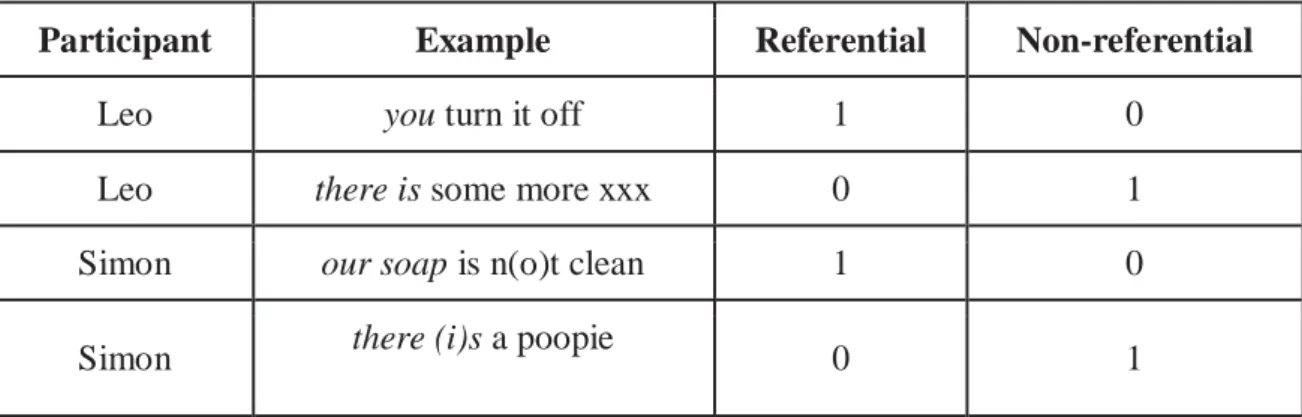
In relation to the variable of referentiality, the data are classified into referential
and non-referential depending on whether the subject has a referent or not,
respectively. Therefore, sentences like (17a) and (17b) produced by Leo; and
(18a) and (18b) in the case of Simon are codified as in Table 2.
(17) a. you turn it off
b. there is some more xxx
(18) a. our soap is n(o)t clean
b. there (i)s a poopie
Table 2. Referentiality
Participant Example Referential Non-referential
Leo you turn it off 1 0
Leo there is some more xxx 0 1
Simon our soap is n(o)t clean 1 0
Simon there (i)s a poopie 0 1
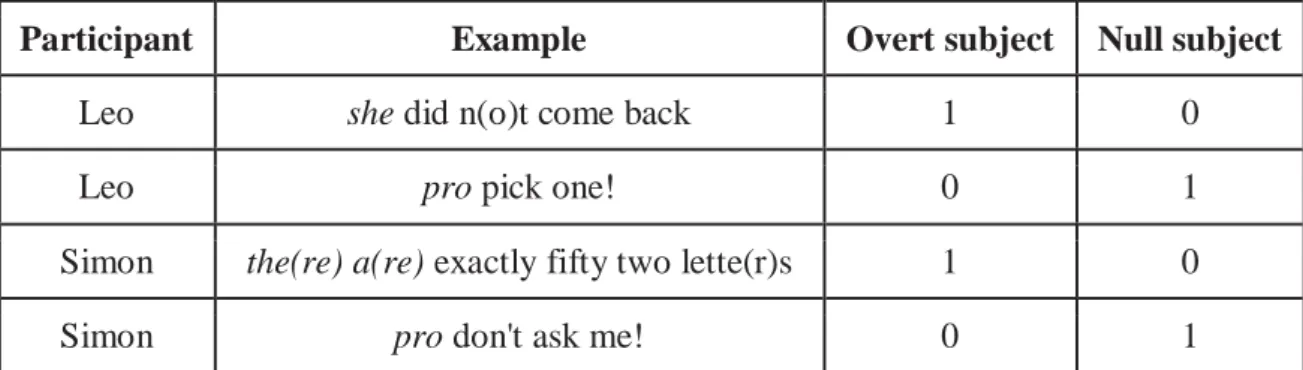
Regarding the variable of overtness, the data are classified into overt subjects
and null subjects. Sentences with overt subjects as (19a) and (19b) in the case of
Leo; and sentences with null subjects like (20a) and (20b) in the case of Simon
were classified as in Table 3.
(19) a. she did n(o)t come back
b. pro pick one!
(20) a. the(re) a(re) exactly fifty two lette(r)s
15
Table 3. Overtness
Participant Example Overt subject Null subject
Leo she did n(o)t come back 1 0
Leo pro pick one! 0 1
Simon the(re) a(re) exactly fifty two lette(r)s 1 0
Simon pro don't ask me! 0 1
Concerning grammatical correctness, this third variable is linked to the second
one (overtness) as it focused on null subjects (omission cases) and on wrong
used of subjects (commission cases). In this case, data are classified into
grammatical null subjects and ungrammatical null subjects. Consequently,
sentences like (21a) and (21b) produced by Leo; and (22a) and (22b) produced
by Simon are classified as in Table 4.
(21) a. pro come downstairs!
b. here *pro (i)s a window
(22) a. pro close your eyes!
b. *pro can't believe he got a match
Table 4. Grammatical Correctness
Participant Example Null subject *Null subject
Leo pro come downstairs! 1 0
Leo here *pro (i)s a window 0 1
Simon pro close your eyes! 1 0
16
Finally, during the data classification process, some instances were excluded.
These correspond to fixed expressions and unclear language productions. As
excluded from the classification they were not taken into account in the analysis
either.
With regard to fixed expressions, examples like (23a) or (23b) were not taken
under consideration as they did not reveal productive language use.
(23) a. come on please
b. see?
Moreover, unclear instances produced by the children were only included in the
analysis when they were clarified by the researchers in the transcription. For
instance, examples of unclear productions like (24a) and (24b) were included in
the study as the information added in square brackets by the transcribers was
enough to clarify the child's production. On the contrary, if those problematic
instances were not solved, not easy to understand, or appeared with the “xxx”
symbol used to mark incomprehensible material, they were not useful for the
analysis and thus, they had been discarded. This is the case of example (25).
(24) a. ya [: you] folf [: wolf] or bea(r) ?
b. dey [: they] don('t) get sca(r)e
(25) xxx wanna play
5.
Data Analysis & Discussion
In this section, the results obtained from the analysis of the data will be discussed.
Furthermore, as the results serve to confirm or reject the different hypotheses stated in
the methodology section, this section will follow the same organization as that in the
research hypotheses. Consequently, the children’s results related with the referentiality
of sentential subjects would be firstly argued; next, the issue of subject overtness will be
explained; and, finally, the children’s results connected with grammatical correctness in
17
5.1.
Referentiality of Sentential Subjects
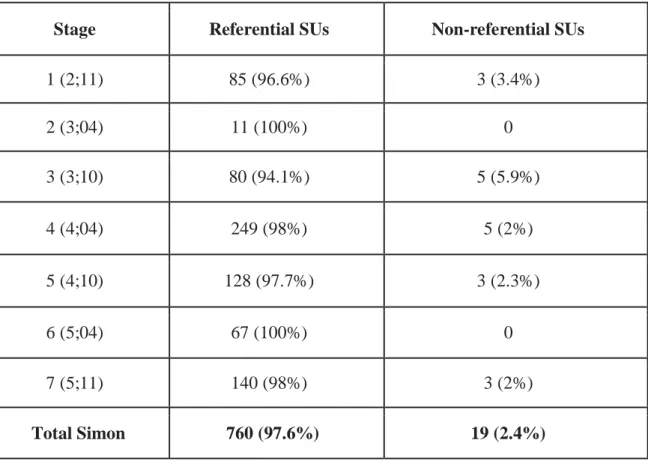
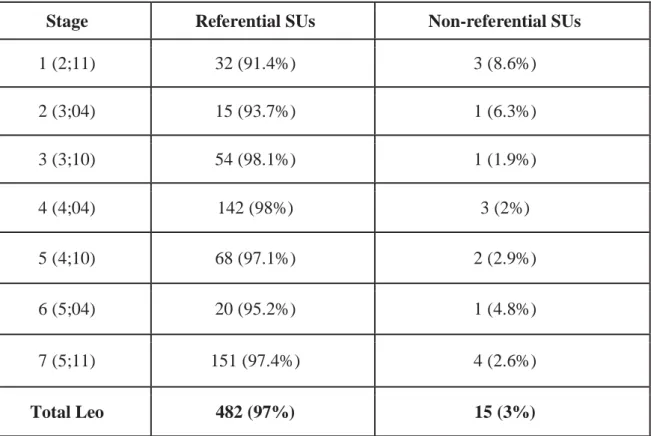
As for the referentiality of subjects in which children are supposed to produce
more referential subjects than non-referential subjects (hypothesis 1), the
relevant information appears in Table 5a and 5b.
Table 5a. Referential and Non-referential Subjects by stages and overall (Simon)
Stage Referential SUs Non-referential SUs
1 (2;11) 85 (96.6%) 3 (3.4%)
2 (3;04) 11 (100%) 0
3 (3;10) 80 (94.1%) 5 (5.9%)
4 (4;04) 249 (98%) 5 (2%)
5 (4;10) 128 (97.7%) 3 (2.3%)
6 (5;04) 67 (100%) 0
7 (5;11) 140 (98%) 3 (2%)
18
Table 5b. Referential and Non-referential Subjects by stages and overall (Leo)
Stage Referential SUs Non-referential SUs
1 (2;11) 32 (91.4%) 3 (8.6%)
2 (3;04) 15 (93.7%) 1 (6.3%)
3 (3;10) 54 (98.1%) 1 (1.9%)
4 (4;04) 142 (98%) 3 (2%)
5 (4;10) 68 (97.1%) 2 (2.9%)
6 (5;04) 20 (95.2%) 1 (4.8%)
7 (5;11) 151 (97.4%) 4 (2.6%)
Total Leo 482 (97%) 15 (3%)
Table 5a and 5b illustrate the classification of subjects produced by both
children on each of the 7 developmental stages and overall in terms of
referentiality. As it can be observed, both children produce more referential
subjects than non-referential subjects; in other words, Simon produces a total of
779 subjects where 760 (97.6%) of them are referential - that is, the subjects
have a referent, as in (26); and where only 19 (2.4%) subjects are non-referential
- those subjects do not have a referent, as in (27).
(26) we won't be able to see
(27) there (i)s (a) letter here
Leo follows the same pattern, as he produces a total of 497 subjects, 482 (97%)
are referential subjects and 15 (3%) are non-referential subjects.
Additionally, it can be said that, overall, Simon produces more subjects (781)
19
Simon (2.4%), although the difference in both cases is not very significant.
Moreover, if the results are observed through each of the 7 developmental
stages, the children also produce more referential subjects than non-referential
ones on each of the stages; for example, on stage 4 for both children, Simon
produces 250 (98%) referential subjects and 5 (2%) non-referential subjects; and
Leo produces 142 (98%) referential subjects and 3 (2%) non-referential subjects.
Thus, bearing in mind the results obtained, hypothesis 1 in which children were
expected to produce more referential subjects than non-referential subjects has
been confirmed.
Furthermore, the subject realization of Simon and Leo in terms of referentiality
has been classified in concordance with the adult grammar as in Table 6a and
6b.
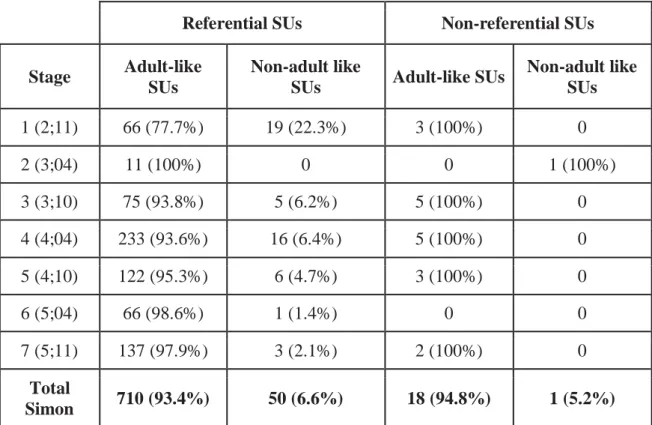
Table 6a. Referentiality in compliance with the adult grammar (Simon)
Referential SUs Non-referential SUs
Stage Adult-like SUs
Non-adult like
SUs Adult-like SUs
Non-adult like SUs
1 (2;11) 66 (77.7%) 19 (22.3%) 3 (100%) 0
2 (3;04) 11 (100%) 0 0 1 (100%)
3 (3;10) 75 (93.8%) 5 (6.2%) 5 (100%) 0
4 (4;04) 233 (93.6%) 16 (6.4%) 5 (100%) 0
5 (4;10) 122 (95.3%) 6 (4.7%) 3 (100%) 0
6 (5;04) 66 (98.6%) 1 (1.4%) 0 0
7 (5;11) 137 (97.9%) 3 (2.1%) 2 (100%) 0
Total
20
Table 6b. Referentiality in compliance with the adult grammar (Leo)
Referential SUs Non-referential SUs
Stage Adult-like SUs Non-adult like SUs
Adult-like SUs
Non-adult like SUs
1 (2;11) 25 (78.1%) 7 (21.9%) 3 (100%) 0
2 (3;04) 15 (100%) 0 1 (100%) 0
3 (3;10) 49 (90.8%) 5 (9.2%) 1 (100%) 0
4 (4;04) 135 (95%) 7 (5%) 1 (33.3%) 2 (66.7%)
5 (4;10) 63 (92.7%) 5 (7.3%) 1 (50%) 1 (50%)
6 (5;04) 15 (75%) 5 (25%) 1 (100%) 0
7 (5;11) 142 (94%) 9 (5,9%) 4 (100%) 0
Total Leo 444 (92.1%) 38 (7.9%) 12 (80%) 3 (20%)
Table 6a and 6b show the children’s subject realization by stages and overall
according to the adult grammar; that is, in this case, the data have been classified
into ‘adult-like’ and ‘non-adult like’. On the one hand, Simon produces a total of
779 referential subjects and 19 non-referential subjects, as previously explained;
if the data are observed through each of the 7 developmental stages, it can be
said that in both cases (referential and non-referential subjects) Simon produces
more adult-like subjects than non-adult like ones; as an example, in stage 1 -
which is the stage in which children are supposed to produce more incorrect
grammatical instances - Simon produces more adult-like referential (77.7%) and
non-referential subjects (100%) respectively than non-adult like ones - 22.3% in
the case of referential subjects and 0% in the case of non-referential subjects.
Furthermore, in an overall view, Simon produces more adult-like referential
subjects (93.4%) and non-referential subjects (94.8%) than non-adult like ones
(6.6% in the case of referential subjects and 5.2% in case of non-referential
21
On the other hand, Leo - who produces a total of 482 referential subjects and 15
referential subjects - also produces more adult like referential and
non-referential subjects on each of the developmental stages; except on stage 5
where Leo produces a 50% of adult-like non-referential subjects and 50% of
non-adult like non-referential subjects; nevertheless, in an overall view, Leo
follows the same pattern as Simon since he produces more adult-like referential
subjects (92.1%) and non-referential subjects (80%) than non-adult like ones.
In essence, bearing in mind the results obtained, it can be said that in terms of
subjects’ referentiality, both children have acquired the adult grammar since the
early stages of acquisition.
5.2.
Subject Overtness
As for the overtness of subjects in which children are supposed to produce more
null subjects than overt subjects in English during their early stages of
acquisition (hypothesis 2), the relevant results appear in Table 7a and 7b.
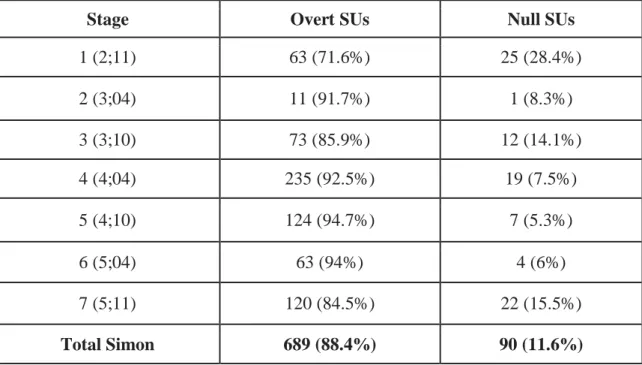
Table 7a. Overtness in English by Stages and Overall (Simon)
Stage Overt SUs Null SUs
1 (2;11) 63 (71.6%) 25 (28.4%)
2 (3;04) 11 (91.7%) 1 (8.3%)
3 (3;10) 73 (85.9%) 12 (14.1%)
4 (4;04) 235 (92.5%) 19 (7.5%)
5 (4;10) 124 (94.7%) 7 (5.3%)
6 (5;04) 63 (94%) 4 (6%)
7 (5;11) 120 (84.5%) 22 (15.5%)
22
Table 7b. Overtness in English by Stages and Overall (Leo)
Stage Overt Sus Null SUs
1 (2;11) 27 (77.1%) 8 (22.9%)
2 (3;04) 16 (100%) 0
3 (3;10) 49 (89%) 6 (11%)
4 (4;04) 134 (92.4%) 11 (7.6%)
5 (4;10) 59 (84.3%) 11 (15.7%)
6 (5;04) 14 (66.7%) 7 (33.3%)
7 (5;11) 127 (82%) 28 (18%)
Total Leo 426 (85.7%) 71 (14.3%)
Table 7a and 7b show the children’s subject production in terms of overtness. In
the case of Simon, out of the 779 subjects that he produces, 88.4% are overt
subjects and 11.6% are null subjects. In addition, Leo produces a total of 497
subjects, from which 85.7% are overt subjects and 14.3% are null subjects.
These results illustrate that, in an overall view, Simon’s rate of overt subjects
(88.4%) is higher than that of null subjects (11.6%); and, in the case of Leo, he
also produces a higher rate of overt subjects (88.7%) than that of null subjects
(14.3%). Moreover, when comparing the results of both children, it can be
observed that Leo produces a higher rate of null subjects (14.3%) than Simon
(11.6%); however, the difference between both children is not very significant.
Additionally, if the results are observed on each of the 7 developmental stages,
Simon and Leo produce more overt subjects than null subjects even in the early
stages of acquisition; for example, in stage 1, which is the stage in which
children are expected to produce more errors according to the adult grammar,
Simon produces more overt subjects (71.6%) than null subjects (28.4%); and in
the case of Leo, he also produces more overt subjects (77.1%) than null subjects
(22.9%). Therefore, the rate of null subjects produced by Simon and Leo in each
of the stages and overall is lower than the rate of overt subjects due to the fact
23
and null subjects are heavily restricted. Consequently, hypothesis 2, which states
that the children would produce more null subjects than overt subjects during the
early stages of acquisition due to crosslinguistic influence from the Spanish
language, has not been confirmed. That is, these children do not show any sign
of crosslinguistic influence in their English production in the case of sentential
subjects.
Moreover, the children’s null/overt subject production has also been classified
according to its compliance with the adult grammar, as in Table 8a and 8b.
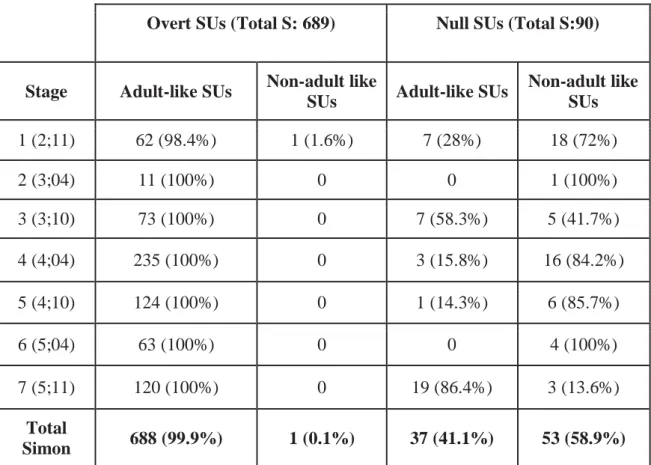
Table 8a. Overtness in compliance with the adult grammar (Simon)
Overt SUs (Total S: 689) Null SUs (Total S:90)
Stage Adult-like SUs Non-adult like
SUs Adult-like SUs
Non-adult like SUs
1 (2;11) 62 (98.4%) 1 (1.6%) 7 (28%) 18 (72%)
2 (3;04) 11 (100%) 0 0 1 (100%)
3 (3;10) 73 (100%) 0 7 (58.3%) 5 (41.7%)
4 (4;04) 235 (100%) 0 3 (15.8%) 16 (84.2%)
5 (4;10) 124 (100%) 0 1 (14.3%) 6 (85.7%)
6 (5;04) 63 (100%) 0 0 4 (100%)
7 (5;11) 120 (100%) 0 19 (86.4%) 3 (13.6%)
Total
24
Table 8b. Overtness in compliance with the adult grammar (Leo)
Overt SUs (Total L: 426) Null SUs (Total L: 71)
Stage Adult-like SUs
Non-adult like SUs
Adult-like SUs Non-adult like SUs
1 (2;11) 26 (96.3%) 1 (3.7%) 2 (25%) 6 (75%)
2 (3;04) 16 (100%) 0 0 0
3 (3;10) 49 (100%) 0 1 (16.7%) 5 (83.3%)
4 (4;04) 132 (98.5%) 2 (1.5%) 4 (36.4%) 7 (63.6%)
5 (4;10) 59 (100%) 0 5 (45.5%) 6 (54.5%)
6 (5;04) 14 (100%) 0 2 (28.6%) 5 (71.4%)
7(5;11) 127 (100%) 0 19 (67.9%) 9 (32.1%)
Total
Leo 423 (99.3%) 3 (0.7%) 33 (46.5%) 38 (53.5%)
Table 8a and 8b show the children’s realization of overt and null subjects
according to the adult grammar. In the case of Simon, out of the 779 subjects he
produces, 11.6% are null subjects; and, out of the 90 null subjects he produces,
53 (58.9%) are non-adult like null subjects - which is the equivalent to 6,8% of
the total number of subjects Simon produces. In case of Leo, out of the 497
subjects he produces, 14.3% are null subjects; and, out of the 71 null subjects he
produces, 38 (53.5%) are non-adult like null subjects - which is the equivalent to
7.6% of the total number of subjects Leo produces. Hence, most of these
incorrect null subject rates are produced during the process of the simultaneous
acquisition of both languages (English and Spanish); thus, this production of
non-adult like null subjects in English could be attributed to the contact with the
Spanish language; in other words, there are some signs of crosslinguistic
influence from Spanish into English on the realization of sentential subjects
because null subjects are a grammatical option in Spanish. However, given that
25
copula verbs, among other categories, these low percentages of non-adult-like
subject omission in English could also be the result of a developing grammar (as
in Liceras and Fernández Fuertes 2018).
As it can be seen in example (28a) in the case of Simon and (28b) in the case of
Leo, both children produce non-adult like subjects at some point of their
acquisition process.
(28) a. *pro now go to nursery school
b. *pro don't know
However, in essence, the rate of null subjects in both children is lower than that
of overt subjects; consequently, it can be inferred that, in an overall view, Simon
and Leo have definitely acquired the English adult grammar during their
acquisition process.
5.3.
Grammatical Correctness
When dealing with grammaticality, two error types could be detected: omission
cases (as discussed above in the case of non-adult-like null subjects) and
commission cases. As for omission cases, example (28) illustrates this error
type; in this case, the subject of the sentence has been omitted and, therefore, it
is ungrammatical since English is a [- null subject] language in which subjects
are required to be overt. On the contrary, a commission case is identified when
the subject of the sentence is not the correct one (as discussed in the
methodological section), as seen in (29a) and (29b) where the child has used an
incorrect subject. In (29a) the child has used the non-nominative subject
pronoun me instead of the nominative subject pronoun I and in (29b) the child
has used the third person singular form of the verb to be (is) instead of using the
pronoun it.
(29) a. *me know
26
The children are expected to produce more commission cases than omission
cases in English during their process of acquisition (hypothesis 3). The
classification of results taking this into account appear in Table 9a and 9b.
Table 9a. Types of Ungrammaticality (Simon)
Stage Omission cases Commission cases
1 (2;11) 18 1
2 (3;04) 1 0
3 (3;10) 5 0
4 (4;04) 16 0
5 (4;10) 6 0
6 (5;04) 4 0
7 (5;11) 3 0
Total Simon 53 (6.8%) 1 (0.1%)
Table 9b. Types of Ungrammaticality (Leo)
Stage Omission cases Commission cases
1 (2;11) 6 1
2 (3;04) 0 0
3 (3;10) 5 0
4 (4;04) 7 2
5 (4;10) 5 1
6 (5;04) 5 0
7 (5;11) 9 0
27
Table 9a and 9b show the two types of ungrammaticality (omission cases and
commission cases) produced by the children during the process of acquisition of
the subject element. In the case of Simon, out of the 779 subjects he produces,
6.8% are omission cases (as in (28) above); and 0.1% are commission cases (the
pronoun which functions as the subject is not correct as previously seen in (29).
Additionally, out of the 497 Leo produces, 7.4% are omission cases and 0.8%
are commission cases. These results suggest that Simon’s omission rate (6.8%)
is higher than that of commission (0.1%); moreover, results show that Leo
follows the same pattern since he also produces more omission cases (7.4%)
than commission cases (0.8%). However, it is also true that when comparing the
results of both children, Leo produces more commission cases (0.8%) than
Simon (0.1%); this could occur because Leo’s overall subject production is
lower (497) than that of Simon (779). All in all, the rate of omission cases
produced by Simon and Leo in each of the 7 developmental stages and overall is
higher than that of commission cases; consequently, hypothesis 3 in which
children were expected to produce more commission cases than omission cases
during their acquisition process has not been confirmed. This is could be linked,
as in the case of the analysis in section 5.2. above, to omission being a defining
property of early grammars.
6.
Conclusion
This section presents the final conclusions achieved in this paper. The present
dissertation has presented a study not only on the analysis of the production of English
sentential subjects on the part of simultaneous English/Spanish bilingual children, but
also on the examination of the children’s development on the realization of the subject
element from the age of 2;11 to 5;11. Once the grammatical properties of subjects have
been explained with a particular focus on The Extended Projection Principle and The
Null Subject Parameter, this dissertation has illustrated some relevant studies on
language acquisition used for establishing the basis of the present study. Furthermore,
despite the fact that this dissertation might help to expand our knowledge on the
acquisition of sentential subjects on the part of simultaneous bilingual children, there is
28
methodological process followed to perform the analysis; in this section, the objectives
and research hypotheses have been presented. As aforementioned, the objectives of this
dissertation dealt with the analysis of the subject production from simultaneous
English/Spanish bilingual children and their development on the realization of the
subject element from the age of 2;11 to 5;11. So as to carry out the analysis, the data
were extracted from CHILDES and collected and classified into different variables in an
excel database.
The analysis of data, which was explained in section 5 of this paper, showed the
different variables used to test the children’s realization of sentential subjects:
referentiality, overtness and grammatical correctness. With regard to referentiality, both
children were expected to produce more referential subjects than non-referential
subjects as stated in hypothesis 1. The results obtained confirmed that hypothesis
because Simon and Leo produced more referential subjects than non-referential subjects
in each of the 7 developmental stages as well as overall. Also, the children’s production
of referential and non-referential subjects was assessed according to the adult grammar,
and the results showed that neither of the two children produce high percentages of
non-adult like subjects in terms of referentiality.
Moreover, as for the variable of overtness, the children were expected to produce more
null subjects than overt subjects during the early stages of acquisition due to
crosslinguistic influence of the Spanish language, which is a [+ null subject] language
and their other L1. However, the results did not confirm this second hypothesis because
both children produce more overt subjects than null subjects on each of the stages as
well as overall. Hence, these children do not show any sign of crosslinguistic influence
in their English production in the case of sentential subjects. This may happen because
English is a [- null subject] language in which an overt subject is required. Nevertheless,
the presence or absence of crosslinguistic influence on the children’s linguistic
production of sentential subjects would need further research since the data collected in
this study are not enough to determine whether there is crosslinguistic influence or not
due to the fact that English monolingual speakers have not been included in the
29
also tested according to the adult grammar and, once again, the results showed that both
children produced more adult-like null subjects than non-adult like ones.
Finally, regarding the variable of grammatical correctness, the children were expected
to produce more commission cases than omission cases as stated in hypothesis 3. The
results did not confirm the hypothesis since the children produce more omission cases
than commission cases on each of the 7 developmental stages as well as in an overall
view of their production. These results are in line with some of the conclusions reached
on previous studies: the children show some patterns in their subject production which
could be understood as a consequence of crosslinguistic influence (Paradis & Navarro,
2003); and, the children seemed to have developed an early awareness on how subjects
are used in English (Garau & Pérez-Vidal). However, the present study includes a small
part of all the reachable topics that could be under analysis in this area; consequently,
there are some grammatical instances which would need further research in order to
provide more linguistic details connected with the realization of sentential subjects on
the part of simultaneous bilingual children.
In essence, once the analysis of the subject production of simultaneous bilingual
children has been done, it can be said that the children produced some misstatements
during the process of acquisition. But both children showed an early development in
terms of subject realization in English because they have mostly produced adult-like
30
7.
Bibliography
Andrews, A. 1985 «The major functions of the noun phrase.» Language typology and
syntactic description, 62-154.
Bloom, P. 1990 «Subjectless sentences in child language.» Linguistic inquiry 21 (4),
491-504.
Chomsky, N. 1965 Aspects of the theory of syntax. MIT.
Crystal, D. 2003 A dictionary of linguistics and phonetics. Blackwell.
Freidin, R. (ed.) 1991 Principles and parameters in comparative grammar. MIT.
Haegeman, L. and J. Guéron 2002 English grammar: a generative perspective.
Blackwell.
Hyams, N., and K. Wexler 1993 «On the grammatical basis of null subjects in child
language.» Linguistic inquiry 24, 421-459.
Huddleston, R. and G.K. Pullum 2002 The Cambridge grammar of the English
language. CUP.
Jaeggli, O. and K. Safir 1989 The null subject parameter. Kluwer.
Juan-Garau, M. and C. Pérez-Vidal 2000 «Subject realization in the development of a
bilingual child. » Bilingualism: language and cognition 3 (3), 173-92.
Liceras, Juana M., and R. Fernández Fuertes 2016 «Subject omission/production in
child bilingual English and child bilingual Spanish: The view from linguistic
31
MacWhinney, B. 2000. The CHILDES project: Tools for analyzing talk. 3rd ed.
Lawrence Erlbaum.
Paradis, J. and S. Navarro 2003 «Subject realization and crosslinguistic interference in
the bilingual acquisition of Spanish and English: what is the role of the input? » Journal
of child language 30, 1-23.