MASTER IN ADVANCED ENGLISH STUDIES: LANGUAGES AND CULTURES IN CONTACT
Departamento de Filología Inglesa 2015-2016
Final Master Thesis
The Acquisition of Copula Verbs in English/Spanish and Bulgarian/Spanish Bilingual Children: Language Contact in Early Bilingualism
Radoslava Stankova Laykova
The work presented in this MA thesis is, to the best of my knowledge and belief, original and my own work, except as acknowledged in the text. The work in this thesis
has not been submitted, either in whole or in part, for a degree at this or any other university.
This thesis is submitted in partial fulfillment of the requirements for the degree of
Master in Advanced English Studies: Languages and Cultures in Contact
to
Universidad de Valladolid
by
Radoslava Stankova Laykova
June 2016
Student’s signature__________________________________________
Approved
Dr. Raquel Fernández Fuertes
Acknowledgments
I am using this opportunity to express my sincere gratitude to all those people who supported me throughout the whole MA program and, especially, throughout the course of this MA dissertation.
I express my warm thanks to my supervisor, Raquel Fernández Fuertes, for all her work, invaluably constructive criticism, and friendly advice during the project work as well as for allowing me to collaborate with her and her research team, UVA-LAL, throughout this year.
I would also like to acknowledge Prof. Roumyana Slabakova (University of Southampton), Prof. Antoinne Hawayek (Universidad Autónoma Metropolitana-Iztapalapa), and Prof. Kjetil Ra Hauge (University of Oslo) for providing me with some materials which were essential for this dissertation.
1 Contents
Abstract
1. Introduction ... 3
2. Theoretical background: the grammatical properties of copula verbs ... 8
2.1.Similarities among the copula verbs in English, Spanish, and Bulgarian ... 8
2.2.Differences among the English, Spanish, and Bulgarian copula verbs ... 14
2.2.1.The copula verb in English ... 15
2.2.2.The copula verbs in Spanish ... 16
2.2.3.The copula verb in Bulgarian ... 20
3. Empirical background ... 22
3.1.L1 acquisition of the English copula verb ... 23
3.2.L1 acquisition of the Spanish copula verbs ... 25
3.3.2L1 acquisition of the English and Spanish copula verbs ... 27
4. Hypotheses ... 31
5. Empirical study ... 32
5.1.Participants ... 33
5.2.Methodology ... 34
6. Data analysis ... 37
6.1.The acquisition of the English, Spanish, and Bulgarian copula verbs and the nature of their predicates ... 37
6.1.1.The omission or presence of the English copula verb in relation to IL and SL predicates ... 37
6.1.2.The omission or presence of the Spanish copula verbs in relation to IL and SL predicates ... 38
6.1.3.The omission or presence of the Bulgarian copula verb in relation to IL and SL predicates ... 40
6.2.The monolingual and bilingual acquisition of the English copula verb ... 41
6.3.The monolingual and bilingual acquisition of the Spanish copula verbs ... 42
6.4.The 2L1 English/Spanish and Bulgarian/Spanish acquisition of the copula verbs ... 44
6.4.1.Language dominance in the 2L1 English/Spanish bilingual twins ... 44
6.4.2.Language dominance in the 2L1 Bulgarian/Spanish bilingual child ... 46
7. Discussion ... 48
8. Conclusions ... 50
2 Abstract
This dissertation investigates the 2L1 English/Spanish and 2L1 Bulgarian/Spanish acquisition of the English, Spanish, and Bulgarian copula verbs, i.e. to be, ser and estar,
and съм (sam) respectively. Previous studies on monolingual language acquisition
dealing with this topic have argued that English children’s production is characterized by high omission rates in stage-level (SL) predicates as opposed to individual-level (IL) predicates; while that of Spanish children’s show virtually no omission. In the case of bilingual language acquisition, children acquiring English and Spanish simultaneously have been said to acquire the English copula verb earlier than L1 English speakers and to present much lower omission rates. Spontaneous data from five children have been analyzed for this study in order to determine whether these children produce higher rates of null copulas with IL or SL predicates. Moreover, it aims at establishing whether bilingual children acquire this grammatical item sooner (i.e. there is acceleration), later (i.e. there is delay), or at the same pace (i.e. no bilingual effect) as their monolingual counterparts (i.e. L1 English and L1 Spanish). Finally, this study addresses the issue of dominance in order to determine whether the bilingual children are Spanish dominant or English dominant, in the case of the two 2L1 English/Spanish children, or Bulgarian dominant, in the case of the 2L1 Bulgarian/Spanish child. Results show that in the one-copula languages, i.e. English and Bulgarian, the omission of the one-copula verb is linked to the predicate type since higher rates of omission have been found with SL predicates in all the children’s output. However, this is not the case for Spanish, the two-copula language. From a developmental point of view, no bilingual effect has been detected in the Spanish data from the three bilingual children. However, the acquisition of the English copula verb in the case of the 2L1 English/Spanish children is delayed with respect to their L1 counterpart. This suggests that the bilingual children under analysis are Spanish dominant in terms of the copula verb.
Keywords: copula verbs, IL predicates, SL predicates, simultaneous bilingualism,
3 1. Introduction1
Language acquisition has been attracting linguists’ and psychologists’ attention for decades. Some of the interesting questions they have been asking themselves, according to Lightbown and Spada (2006, p. 1), are the following: what enables a child to produce meaningful sentences? Why do children develop complex grammatical language if their early simple communication is successful? Does child language develop similarly in all languages? How do bilingual children acquire more than one language? Although all these questions do not have a straight-forward answer and much research needs to be done to tentatively start answering them, some properties that define the early stages of the language acquisition process are clear. One of these undisputable properties is that children across languages do not produce functional categories in their speech during the initial stages (Brown 1973) and this affects both monolingual first language (L1) acquisition and the simultaneous acquisition of two first languages (2L1).
Contextualizing the omission of functional categories, two basic questions emerge: why is child grammar different from the adult target? and how does child grammar develop into adult grammar? This can be explained by means of Chomsky’s general assumption that humans are biologically predisposed to acquire language, and that all languages share a set of innate universal principles, the so-called Universal Grammar (UG). However, this predisposition that we all have is not enough without an adequate input which will activate the Language Acquisition Device (LAD). Nonetheless, the UG and input hypotheses do not explain why lexical categories are acquired earlier than functional ones since both lexical and functional categories are present in the linguistic input that children receive.
Consequently, some researchers developed the following two hypotheses which are concerned with the availability of functional categories throughout the process of language acquisition. Firstly, Borer and Wexler (1987; 1992) claim that language acquisition is not an abrupt process, but it rather takes a certain period of time; thus, some linguistic principles depend on maturation which is biologically determined, and that is the reason why functional categories are absent from child grammar. And secondly,
4
authors such as Hyams (1986) argue that functional categories are present from the onset of acquisition, and the fact that some of them are omitted is because of the lack of knowledge children have of other features related to them.
For the present study, I assume, in the line of Hyams (1986), that functional categories are available throughout the process of acquisition, but they are not instantiated because they are not independently motivated but linked to the lexical items that a child has acquired.
These two hypotheses have been said to characterize both L1 and 2L1 acquisition. However, in the case of 2L1 acquisition other phenomena, which will be developed in subsequent paragraphs, might interfere given the specific properties of this acquisition process. A bilingual has been defined in two ways: firstly, as a speaker having an identical command in two different languages (Marouzeau 1951), a rather idyllic definition that is no longer used nowadays, or as a speaker having a similar or a different command of two languages (Edwards 2004). Furthermore, Butler and Hakuta (2004) hold that there are different types of bilingualism. Firstly, they argue that bilingualism can be either simultaneous, when two languages are acquired at the same time, or sequential, i.e., firstly, an L1 is acquired and then an L2. Depending on the age of the speaker, they claim that bilingualism can be early, if the two languages are acquired early in life, or late, if a speaker learns an L2 after his L1 has been fully established. Moreover, regarding the command that the speaker may have of the two languages, the bilingualism can be symmetric, if the command is equal for the different linguistic skills, or asymmetric, if the command of the two languages is different. Finally, bilingualism can be individual, if the society in which the speaker lives is monolingual, or societal, if the society in which a speaker lives is bilingual. In the present dissertation, the term 2L1 bilingualism will be used to refer to simultaneous early bilingualism, a term that is often used in bilingual acquisition research. However, as will be seen below, this term is nothing short of debate.
5
exposed to another language after that moment, it would be an example of sequential bilingualism. Finally, de Houwer (1990) argues that simultaneous bilingualism occurs in contexts in which more than one language is used on a daily basis and the exposure to both languages has no more than a week of difference. There is still an ongoing debate as to which age should be considered the cut-off point distinguishing 2L1 acquisition from sequential acquisition which involves the acquisition of a second language (L2). For the present dissertation, McLauglin’s (1978) view will be followed.
The specific properties of 2L1 acquisition affect three main areas: the development of the two grammars, the notion of dominance, and the effect of interlinguistic influence. When two L1s are being simultaneously acquired the question is whether the two grammars develop interdependently or autonomously. There are three main hypotheses regarding this issue which are the unitary language hypothesis, the interdependent language hypothesis, and the autonomous language hypothesis. The former claims that when children are exposed to two languages simultaneously, they go through an initial period in which they do not differentiate them (Volterra and Taeschner 1978). During the second period of language acquisition, according to this hypothesis, children differentiate between the two lexicons, but not between the grammatical systems. It is in the third stage when children start to fully distinguish their two languages. However, the maturational schedules of monolingual and bilingual speakers may be exactly the same, that is, L1 and 2L1 speakers acquire a particular grammatical item at the same pace, or different, i.e. 2L1 speakers acquire a grammatical property sooner (acceleration) or later (delay) than their L1 counterpart. The second hypothesis claims that there is a systemic influence of one language into the other and, therefore, the rate of language development in bilingual and monolingual children is different (Paradis and Genesee 1996). The last hypothesis claims that the two language systems of bilingual children are completely separated from the very beginning; consequently, their two languages develop at the same rate as those of their respective monolingual counterparts (Paradis and Genesee 1996).
6
dominance is linked to the “underlying competence and [it is] not merely a measure of performance or language use” (Yip and Matthews 2006, p. 101).
Language dominance is connected to the input children are exposed to. In fact, it is assumed that input is a determining factor for language dominance, and so bilingual children are considered dominant in the language in which they receive a higher amount of input, usually the L1 of their main caretaker. Hence, language dominance is not static as it may change if a child starts receiving more input in the other language (Romaine 1995).
Birdsong (2014) distinguishes between two different areas within language dominance: dimension and domain. The former deals with the linguistic competence, production, and processing of language, whereas the latter is related with the situation and context of language use. Therefore, morphosyntactic knowledge is linked to dimension-based dominance, while child-directed speech (i.e. input) would be domain-based dominance. Nevertheless, Liceras et al. (2008) propose a new approach to language dominance, i.e. the Grammatical Features Spell-Out Hypothesis (GFSH)
These authors do not consider language dominance to be linked to either language external factors or whole inventory of properties that characterize a particular language. Rather, their view on dominance is more focused on the nature of the specific functional categories, and the way these are specified in a particular language. They claim that “in the process of activating the features of the two grammars, the bilingual child, who relies on one functional abstract lexicon, […] will favor functional categories containing highly ‘grammaticized features’” (Liceras et al. 2008, p. 829). This means that a bilingual child’s dominant language regarding a particular grammatical feature is that in which this item has more salient properties, regardless of the amount of input the child receives in this particular language. This language-internal approach to language dominance will be the one considered in the present study.
7
performance will be worse when compared to that of monolingual children since they transfer properties from one of their languages into the other, and this will make their production less adult-like.
If 2L1 bilingual children could have different maturational schedules in each of their languages (that is, if a specific grammatical property emerges sooner in one language), if they could have an unbalanced dominance of the two languages, and if the grammatical properties of the two languages can interact, then, their acquisition could be affected by development, by dominance, and by interlinguistic influence. Taking into account this previous contextualization on bilingual acquisition in general and on the acquisition of functional categories by 2L1 bilingual children in particular, the present dissertation deals with the acquisition of a particular functional category (i.e. copula verbs) in three languages (i.e. English, Spanish, and Bulgarian) in the spontaneous production of two 2L1 English/Spanish children and one 2L1 Bulgarian/Spanish child
In this master thesis, I approach three copula systems: the Spanish one, which is a two-way system as it has two copulas (i.e. ser and estar), and the English and Bulgarian
ones, which are one-way systems as they only have one copula (i.e. to be and sam
respectively). Considering this, this dissertation has two main objectives: firstly, to determine how the English, Spanish and Bulgarian copula verbs are acquired by the children under analysis considering the GFSH. Consequently, I aim at verifying if the fact that the Spanish copula verbs have more salient properties allows these children to acquire this grammatical item earlier in Spanish than in their other first language, which in both cases has only one copula verb.
8
bilingual acquisition can be pointed out (bilingual effect) and, in this last case, whether these differences point to acceleration or delay of the bilingual production.
This dissertation is organized as follows: in section 2, I discuss the similarities and differences in terms of the copula verbs in English, Spanish, and Bulgarian. Section 3 addresses the previous empirical studies on the topic under discussion in this dissertation. Firstly, I focus on L1 English acquisition; afterwards, I concentrate on L1 Spanish acquisition, and finally, I deal with the empirical works on 2L1 English/Spanish acquisition. In section 4, the hypotheses which this dissertation aims at confirming are expounded. Afterwards, in section 5, the empirical study carried out is presented in terms of participants and methodology. The results obtained from the data analyses are presented in section 6 and discussed in section 7. Finally, section 8 presents the conclusions reached in the light of the analysis carried out.
2. Theoretical background: the grammatical properties of copula verbs
In this section, firstly, the similarities among the three languages under discussion in this dissertation, i.e. English, Spanish, and Bulgarian, are presented regarding the copula verbs (subsection 2.1.). Afterwards, the peculiarities of this grammatical item in each language individually are expounded in subsections 2.2.1. (English), 2.2.2. (Spanish), and 2.2.3. (Bulgarian).
2.1.Similarities among the copula verbs in English, Spanish, and Bulgarian
9
(1) a. Peter is a man. ENGLISH IL
b. Pedro es un hombre. SPANISH IL
[Peter is man]
c. Петър е мъж. BULGARIAN2 IL
‘Petar e maj’ [Peter is a man]
(2) a. Peter is in the supermarket. ENGLISH SL
b. Pedro está en el supermercado. SPANISH SL [Peter is in the supermarket.]
c. Петър е в магъзина. BULGARIAN SL
‘Petar e v magazina’ [Peter is in the supermarket]
Adjectives in these three languages are a more complex category as they can belong to the IL and SL groups, as examples (3) and (4) illustrate, depending on their meaning.
(3) a. Peter is blond. ENGLISH IL
b. Pedro es rubio. SPANISH IL
[Peter is blond]
c. Петър е рус. BULGARIAN IL
‘Petar e rus’
[Peter is blond]
(4) a. Peter is young. ENGLISH SL
b. Pedro es joven. SPANISH SL
[Peter is young]
c. Петър е млад. BULGARIAN SL
‘Petar e mlad’
[Peter is young]
Example (3) illustrates a case in which the adjective is used to designate an intrinsic property of the subject; therefore, it is an IL predicate. Contrarily, example (4) contains an adjective that indicates a temporary characteristic of the subject; consequently, in this case, the adjective behaves as an SL predicate.
While languages such as English (1a, 2a), Spanish (1b, 2b), and Bulgarian (1c, 2c) require an overt copula verb regardless of whether the copula structure is IL or SL, some others languages such as Russian (see example 5) allow the omission of the copula verb especially in the present tense, as indicated by the null element .
(5) a. Татяна студентка. RUSSIAN (Sarage 2014, p. 120) ‘Tatyana studentka’
[Tatiana (is) a student]
b. Tatiana is a student. ENGLISH
c. Tatiana es estudiante. SPANISH [Tatiana is a student]
10 d. Татяна e студентка BULGARIAN ‘Tatyana e studentka’
[Tatiana is a student]
However, even in languages where the copula is typically overt, some omission cases do appear, as in (6), in some context-dependent situations where often not only the copula but also the subject are typically null3.
(6) a. A: Where are you? ENGLISH
B: In the supermarket. [(I) (am) in the supermarket]
b. A: ¿Dónde estás? SPANISH
[Where are you?]
B: En el supermercado. [(I) (am) in the supermarket]
c. A: Къде си? BULGARIAN
‘Kade si?’
[Where are you?]
B: В магъзига.
‘V magazina.’
[(I) (am) in the supermarket]
From the point of view of the linguistic presentation of predicates, the distinction between nominal (IL) and locative (SL) predicates occurring with copula verbs has also been addressed where semantic and syntactic criteria intertwined (e.g. Carlson 1977, Kratzer 1995, Chierchia 1995).
Carlson (1977) argues for a semantic distinction between nominal and locative predicates. He claims that most locatives (typically PPs) are SL predicates since they apply to stages rather than to individuals. Contrariwise, all nominals are IL predicates as they apply directly to individuals. For him, “a stage is conceived of as being, roughly, a spatially and temporally bounded manifestation of something […]. An individual, then is (at least) that whatever-it-is that ties a series of stages together to make them stages of the same thing” (1977, p. 15).
Carlson explains this dichotomy by focusing on the semantic and syntactic characteristics of these predicates. He claims that IL predicates can only have a generic reading, whilst SL predicates can have both generic and existential readings.
Kratzer (1995) draws a semantic distinction between IL and SL predicates in terms of their syntactic structure. According to her, SL predicates project a semantic event
11
argument which influences the subject position, as it can be observed in the tree diagrams in (7) and (8).
(7) SL predicate
(8) IL predicate
The VP-internal subject hypothesis claims that the subject originates in the specifier of the VP (SpecVP), and, from that position, it can move to the specifier of the IP (SpecIP). In the structure of the SL predicate in (7), the subject remains in SpecVP as SpecIP is occupied by the event argument which is an external argument. In the structure of IL predicates in (8), the subject is generated in SpecIP and occupies this position. This violates the VP-internal subject hypothesis, and that is why Becker (2000) suggests that, as “predicative expressions are raising constructions, [they are] independent arguments for generating the thematic subject low in the structure” irrespective of the nature of the predicate (p. 38).
Kratzer (1995) differs from Chierchia (1995) in that Kratzer assumes that only SL predicates project event arguments, while Chierchia holds that all predicates project this type of argument. In order to support his analysis, Chierchia states that IL predicates are inherently generic, while SL predicates can be generic or not depending on the reading they have in a given context. In IL predicates, the situation variable is locally bound by
IP
Spec I’
Event argument I VP
Spec. V’
Subject V …
SLP
IP
Spec I’
Subject I VP
Spec. V’
12
the generic operator (Gen-operator); on the contrary, this variable is unbound in SL predicates. The Gen-operator is adjoined to the VP and the situation argument is projected in both nominal and verbal predicates. This is illustrated in example (9).
(9) Mary is a doctor. (Chierchia 1995, p. 207)
In (9), the [+Q] features must be locally bound by the Gen-operator, but it is only projected in the semantic representation. Chierchia also claims that “the location of IL predicates is unrestricted” (1995, p. 207); thus, sentences like (10) are not rendered ungrammatical, but as strange (thus the question marks preceding the examples). In (10), the locative “in his car” restricts the situations in which “John is a linguist”.
(10) ?? John is a linguist in his car. ENGLISH (Chierchia 1995, p. 207)
?? Juan es lingüista en su coche. SPANISH [?? John is a linguist in his car]
??Джон е лингвист в колата си. BULGARIAN
‘John e lingvist v kolata si’
[?? John is a linguist in his car]
In the grammatical description of copula constructions temporal anchoring, i.e. “the binding relation between tense (T) and tense operator (TOP)” has been argued to be a defining factor (Fernández Fuertes and Liceras 2010, p. 529), as developed by Guéron and Hoekstra (1995) and Becker (2000; 2004). What these authors suggest is a relationship between the sentence temporal anchoring and the distinction between IL predicates and SL predicates (Guéron and Hoekstra 1995). This relationship is established between TOP and the inflection category (IP) as in (11) and (12).
IP
DP I’
I SC
DP DP
Gen. DP [+Q]
Maryi is ti a doctor
Maríai es ti medico
Марияi е ti лекар
13
(11) Mary is a doctor. ENGLISH (IL)
María es médico. SPANISH (IL)
[Mary is a doctor]
Maria e lekar. BULGARIAN (IL)
[Mary is a doctor]
(12) Peter is here. ENGLISH (SL)
Pedro está aquí. SPANISH (SL)
[Peter is here]
Petar e tuk. BULGARIAN (SL)
[Peter is here]
However, Becker (2000) suggests that in child grammar, this relation can be created either between the TOP and the aspect category (AspP), as in SL predicates, or between TOP and IP, as in IL predicates, which lack the aspect category. That is why children are likely to omit the copula verb in this type of constructions. In example (13), the temporal anchoring of SL predicates in child grammar is illustrated.
IP
spec I’
I SC
DP DP
Maryi is ti a doctor Maríai es ti medico Mariai e ti lekar
IP
spec I’
I AspP
Spec Asp’
Asp EvP
[+ perf] spec Ev’ Ev SC
DP PP
Peteri is ti here
Pedroi está ti aquí
14
(13) Child temporal anchoring of SL predicates:
Peter here. ENGLISH
Pedro aquí. SPANISH
[Peter (is) here]
Petar tuk. BULGARIAN
[Peter (is) here]
In this example, the copula is omitted, and temporal anchoring is ensured by the AspP. 2.2. Differences among the English, Spanish, and Bulgarian copula verbs
The main difference among English, Spanish, and Bulgarian is that English and Bulgarian have one copula, to be and sam respectively, which is used for both types of
predicates, while Spanish uses two different copula verbs, ser and estar, depending on
the type of predicate that follows it, as in (14), (15), and (16).
(14) a. Peter is a man. ENGLISH
b. Peter is in the supermarket.
(15) a. Pedro es un hombre. SPANISH
[Peter is a man]
b. Pedro está en el supermercado.
[Peter is in the supermarket]
(16) a. Petar e maj. BULGARIAN
[Peter is a man]
b. Petar e v magazina.
[Peter is in the supermarket]
Further differences among the target languages of this dissertation are discussed in 2.2.1. (English), 2.2.2. (Spanish), and 2.2.3. (Bulgarian).
IP
spec I’
I AspP
Spec Asp’
Asp EvP
[+ perf] spec Ev’ Ev SC
DP PP
Peteri ti here
Pedroi ti aquí
15 2.2.1. The copula verb in English
A peculiarity of the copula verb in English is their forming part in existential constructions. Following Stowell’s (1978) proposal for there-insertion, the copula verb to be has been analyzed as a raising verb whose complement is a small clause (SC).
Consequently, instead of assuming that sentences such as (17a) derive from (17b), he assumes that the deep structure of such a clause is (18c).
(17) a. There is a dog in the park. b. A dog is in the park. c. e is a dog in the park
What this means is that, instead of assuming that the thematic subject of the clause moves rightward and there is inserted (17b and 17a respectively), he claims that there is inserted
to fill the empty subject position (17c and 17a respectively). If this insertion does not occur, the DP is raised to the subject position as in English it cannot be left empty. In order to support his view, Stowell argues that existential constructions cannot derive from a “DP be DP” structure because, if the thematic subject is moved rightward and there is
placed in the subject position, the sentence is rendered ungrammatical, as in example (18) below. This can be explained by the fact that the verb to be, as an accusative verb, takes
a DP object which can be followed by a PP or an AdjP.
(18) A friend of mine is a jerk. (Stowell 1978, p. 461) *There is a friend of mine a jerk.
In addition, as IL predicates cannot have an existential reading, existential constructions cannot have an IL predicate in their coda; therefore, only SL predicates occur in there-constructions, as the contrast between (19) and (20) shows.
(19) There is a man inebriated. (20) *There is a man clever.
Moreover, Chierchia (1995) explains the fact that IL predicates cannot occur in existential constructions by claiming that the Gen-operator functions as a “strong determiner”. Furthermore, he argues that IL predicates cannot occur in when-clauses
16
Finally, Carlson (1977) concludes that there are two homophonous verbs to be: one
which is semantically empty and used when followed by an IL predicate, and another which does have a semantic function and is used when an SL predicate follows it. 2.2.2. The copula verbs in Spanish
The most outstanding feature of this grammatical item in Spanish is that there are two different copula verbs (i.e. ser and estar); therefore, the distinction between IL and SL
predicates is made even clearer than in other languages since nominal predicates tent to occur with ser and locative predicates with estar. In the case of adjectives, it is more
difficult to determine with which copula verb each type of adjective occurs as it depends on the context, and on how the adjective is used. However, this IL-ser and SL-estar
correspondence does not capture the intricate patterns of Spanish copulas, as discussed below.
In Spanish, all nominal predicates occur with ser irrespective of whether they are IL
or SL predicates. In other words, regardless of the semantic properties that the nominal denotes, a nominal predicate occurs with the copula ser, as illustrated in examples (21)
and (22) below.
(21) Pedro es un hombre. IL [Pedro is a man]
(22) Elisa fue reina por un día. SL (Sera 1992, p. 409)
[Elisa was queen for a day]
Example (21) illustrates a structure in which the nominal indicates an intrinsic characteristic to the subject; therefore, it is an IL predicate. However, example (22) shows a copula construction in which the nominal predicate denotes a temporary characteristic of the subject using the verb ser. In the second case, an SL predicate is used.
Being location a temporary characteristic, these predicates are expected to appear with the copula estar, yet locations of events occur with ser, while locations of objects
and animate entities occur with estar, as in (23), (24), and (25) respectively.
(23) La merendola es en el pinar. SL
[The picnic is in the pine forest]
(24) María está en la universidad. SL
[María is at the university]
(25) Mi casa está en Valladolid. SL
17
Some adjectives are able to occur with either copula denoting different meanings, as shown in examples (26) and (27).
(26) El color blanco es sucio. IL
[White is a dirty color]
(27) La camisa blanca está sucia. SL
[The white t-shirt is dirty]
In these examples, it can be observed that, even though the same adjective is used (sucio/sucia ‘dirty’), an intrinsic property of the subject is shown in (26), while, in (27),
the characteristic is accidental.
Another aspect regarding adjectives is that, some of them, which typically appear with
ser in certain contexts, are allowed to occur with estar, as in (28) and (29).
(28) La película es interesante. IL
[The movie is interesting]
(29) La película está interesante. SL
[The film is interesting (now)]
The adjective interesante (‘interesting’) typically occurs with the copula verb ser, as in
(28), where an IL predicate can be found. However, in certain contexts, this adjective is allowed to occur with the other copula verb, estar, causing a slight change in the meaning,
and transforming the predicate from an IL into an SL predicate, as in (29). A different nuance can then be said to appear between (28) and (29).
Finally, there are adjectives which are expected to appear with the copula ser, but they
occur with estar, as in (30), and vice-versa, as in (31).
(30) Pedro está muerto. IL
[Peter is dead]
(31) Pedro es joven. SL
[Peter is young]
Since muerto (‘dead’) indicates a permanent characteristic of the subject, that is, it is an
IL predicate, it is expected to occur with the copula ser instead of estar. On the contrary,
denoting joven (‘young’) a temporary characteristic of the subject, it is expected to appear
with the copula estar instead of ser.
As seen below, generally speaking, in Spanish, the copula ser is used in clauses which
denote permanent or essential characteristics of the subject, while estar is used in clauses
18
a tendency, rather than a grammatical principle per se. This dichotomy has been more specifically addressed by Schmitt et al. (2004, p. 2) as well as by other authors following a semantic, a pragmatic, and a syntactic-semantic perspective, as shown below.
The semantic accounts, which involve some pragmatic consequences, hold that the difference between ser and estar is aspectual (Schmitt 1992; 2004). The former lacks any
aspectual content, “i.e. it is unspecified for a subevent type (STATE, EVENT)and therefore
can appear in various different contexts” (Schmitt et al. 2004, p. 2). On the contrary, estar
indicates a subevent of the EVENT type. Consequently, the tendency of estar to occur with
temporary predicates is due to the fact that it asserts eventuality, which ser does not since
it is devoid of aspectual properties.
As argued by Schmitt and Miller (2007), both ser and estar are stative predicates.
Stativity can be understood in two ways: as being a-temporal (Bach 1981) or as indicating state. In this case, states are defined as “having the subinterval property […] every open subinterval I’ of an open interval I where a state is true is also an interval where the same state is true” (Schmitt and Miller 2007, p. 1913). All this leads to the distinction between
ser and estar. The former is semantically empty, hence, there is no reference to temporal
subevents or intervals. Because of this lack of inherent meaning, ser can be used with
participles, it can be shifted to temporary by means of adverbs, and it can be used to represent activity reading (BE ACT). From all this, it can be concluded that the only role
of ser is to lexicalize tense. Conversely, estar “contributes to the VP a subevent of the
(STATE) type, so it carries the implicature that the state does not always hold beyond the
relevant interval” (Pérez-Leroux et al. 2010, p. 211).
The pragmatic accounts establish that ser and estar differ in that the latter presupposes
a discourse anchorage which the former does not (Clements 1988; Maeinborn 2003). Therefore, speakers are allowed “to mark different predication in a particular discourse” (Schmitt et al. 2004, p. 2).
The syntactic-semantic accounts claim that the differentiation between ser and estar
19
Camacho (2012) reviews several accounts about the Spanish copula verbs. This author claims that ser is the unmarked copula verb as it has the opposite value of estar,
i.e. ser is [-Perfective]. Therefore, the problem arises when dealing with estar.Following
Fernández Leborans (1995), Camacho claims that the copula verb estar entails an event,
which is comprised of a transition (T) and an end state (ES). According to this author, although T establishes a relationship with another event, it is sometimes hard to perceive as in evidential constructions of estar, as in (32). Besides, ES should not always be
understood as the consequence of an event.
(32) Este jamón serrano está fenomenal4. SL (Camacho 2012, p. 8)
[This serrano ham is phenomenal]
According to Zagona (2010), estar contains a prepositional feature, [uP], which must
be checked by the predicate. This predicate should have two basic features: (i) “it must be prepositional [and (ii)] it cannot contain a certain lexical-aspectual content [that is] Path” (Camacho 2012, p. 464). Consequently, sentences such as (33) are not grammatical in Spanish, while sentences as (34) are.
(33) *María está camarera.
[María is a waitress]
(34) María está de camarera.
[María is a waitress]
Example (33) is ungrammatical because the predicate that the verb estar takes is a DP,
therefore, it is not prepositional, and the [uP] feature cannot be checked. Being the
predicate in (34) both prepositional and not indicating a Path, it allows for the checking of [uP], and the sentence is grammatical.
As it has been abovementioned, some locatives in Spanish occur with the copula estar
and others with the copula ser, depending on the type of subject they take, eventive or
non-eventive. The former involves a Path interpretation which blocks the checking of [uP] by the lower P, as in (35) (where blocking is signaled by a vertical line), while the
latter, (36), entails a pure-location interpretation and the checking of the [uP] feature is
possible.
20 (35) La merendola está en el pinar.
Está [uP] [VP [DPPASP la merendola] [P en [el pinar]]] [The picnic is in the pine forest]
(36) María está en la universidad.
Está [uP] [VP [DP María] [P en [la universidad]]]
[María is at the university]
As estar is considered [+Perfective], it should encompass beginning or end
boundaries. According to Camacho, estar selects for the beginning boundary of a state;
consequently, Zagona’s (2010) rule is reformulated as follows: estar contains an
uninterpretable feature [uP] which has an inchoative value [INCH]. Therefore, the analysis of sentences (23) and (24) is reformulated as in (37) and (38) below. In (37), the [uP]
feature cannot be checked because the [+DUR] feature of the eventive subject blocks it. (37) La merendola está en el pinar.
Está [uP] [SC la merendola [+DUR][INCH] en el pinar]
[The picnic is in the pine forest]
(38) María está en la universidad.
Está [uP INCH] [VP María [INCH] en la universidad]
[María is at the university]
All in all, this section illustrates that the distinction between IL and SL predicates in Spanish does not correspond to the ser/estar distinction since there is not a
straightforward and complete correspondence. Consequently, the use of ser or estar is
motivated by factors other than the IL/SL dichotomy. 2.2.3. The copula verb in Bulgarian
A relevant feature of the Bulgarian copula verb is that it is considered a clitic in the present tense, but not in the past or in the future tenses (Hauge 1995). It is considered a clitic because it follows all the rules that are applied to these morphemes. First of all, as Bulgarian is a [+ null subject] language, the copula verb is expected to be able to appear in sentence initial position irrespective of the tense; however, this is not possible in the present tense, as depicted in (39).
(39) *Е в магазина. ‘*E v magazina’
21
As Spencer (2000) holds, Bulgarian copula verb in the present tense is sensitive to the Tobler-Mussafian Law which does not allow clitics to appear sentence initially. Therefore, a clitic in Bulgarian such as the copula verb must “be placed on the right of a word [and] initial in its syntactic/prosodic domain” (Spencer 2000, p. 371). As such, the corresponding grammatical example to (39) should be as in (40).
(40) Toi e v magazina. ‘Toi e v magazina’
[He is in the store]
Legendre (2000) and Spencer (2000) apply the Optimality Theory (OT) developed by Prince and Smolensky (1993) to the Bulgarian clitics. First of all, the aim of OT is to rank the different constraints in a grammar “in a strict hierarchy dominance” (Prince and
Smolensky 1993, p. 2). Hence, in Bulgarian the NONINITIAL constraint dominates EDGEMOST, i.e. EDGEMOST is violated in order to satisfy NONINITIAL which is in a higher
position in the classification of the constraints that apply to Bulgarian clitics. The result is that the clitics in Bulgarian must appear in second position or, if it is a clitic cluster, the first clitic must occupy the second position in the sentence. According to Legendre (2000), the domain of NONINITIAL is V’; therefore, it is correct to claim that the clitic
occupies the second position in null subject constructions given the basic ranking
NONINITIAL>EDGEMOST, as in (41).
(41) В магазина съм. ‘V magazina sam’
[In the store (I) am] [I am in the store]
Moreover, when the subject of the clause is overt, the clitic cannot appear in other position but the second, as examples (42) and (43) illustrate.
(42) Аз съм в магазина. ‘Az sam v magazina’ [I am in the store]
(43) *Аз в магазина съм. ‘*Az v magazina sam’
[*I in the store am]
However, if V’ is the domain of NONINITIAL, then (43) should be grammatical and (42) ungrammatical as (42) violates the higher-ranked constraint NONINITIAL.The domains of the clauses in (42) and (43) are presented in (44) and (45) respectively.
(44) [VP/IntP Az [V’ sam v magazina]]
22 (45) *[VP v magazina [IntP/V’ sam]]
*[VP in the store [IntP/V’ (I) am]]
In the case of (44) where there is an over subject, there is no conflict between
EDGEMOST and NONINITIAL constraints because the intonational domain of NONINITIAL
and the syntactic domain of EDGEMOST are different. Contrariwise, in (45), where a null
subject is found, the intonational and the syntactic domains coincide; consequently,
EDGEMOST is violated in order to satisfy the higher-ranked constraint NONINITIAL.
Nevertheless, the Bulgarian copula verb is only claimed to be a clitic in its present tense forms, as in all the other tenses, it behaves as a lexical verb. Hence, in the past, the Bulgarian copula verb can occupy initial position like in Spanish, as illustrated in example (46).
(46) Бях в магазина. ‘Bqh v magazina’
[(I) was in the store]
In the future, the Bulgarian copula verb does not occupy the initial position as this tense is formed with a future particle, which appears in bold type in the examples in (47) and (48).
(47) Це бъда в магазина. ‘Shte buda v magazina’
[(I) will be in the store]
(48) Аз це бъда в магазина. ‘Az shte buda v magazina’
[I will be in the store]
As Hauge claims, this future particle is non-movable; therefore, “it will always appear to the left of the verb […], and it may stand at the very beginning of the sentence or after an intonational pause” (1995, p. 105). That is, it appears either in sentence initial position (as in 45, given the use of a null subject) or after the overt subject of the clause (as in 46), but it will never follow the predicate unless there is an emphatic movement such as fronting.
3. Empirical background
23
2008; Fernández Fuertes and Liceras 2010; Holtheuer and Rendle-Short 2013; Holtheuer 2013). Generally speaking, as it has been discussed in previous sections, the former denotes permanent characteristics of the subject whilst the latter indicates temporary characteristics of the subjects, as it can be observed in examples (1) and (2) above which are repeated here in (49) and (50).
(49) a. Peter is a man. ENGLISH
b. Pedro es un hombre. SPANISH
[Peter is a man]
c. Petar e maj. BULGARIAN
[Peter is a man]
(50) a. Peter is in the supermarket. ENGLISH
b. Pedro está en el supermercado. SPANISH [Peter is in the supermarket]
c. Petar e v magazina. BULGARIAN
[Peter is in the supermarket]
The review of the acquisition works concerned with the analysis of the copula verbs is divided into three subsections: those works focused on L1 English, those that discuss L1 Spanish, and those that deal with 2L1 acquisition. No reference is made here to the acquisition of the copula verb in Bulgarian, the third target language in the present dissertation, as no previews research on this topic has been found.
3.1. L1 acquisition of the English copula verb
The acquisition of the English copula verb by L1 English speakers has been previously discussed in Becker (2004) and Skinner (2005). Becker (2004) establishes that at the early stages of language acquisition (around the age of 2), children go through a period of copula omission, as examples (51) and (52) illustrate.
24
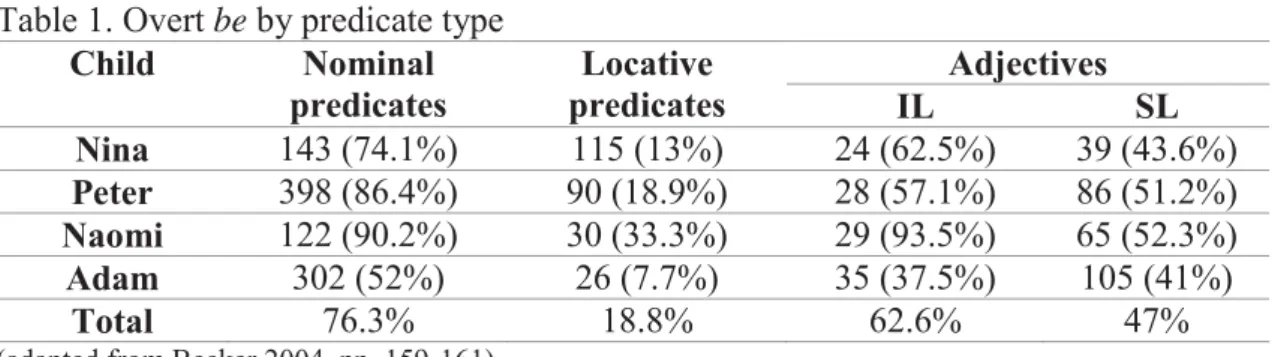
The results she obtains from the four English monolingual children, whose data are taken from the CHILDES Project (MacWhinney 2000), appear in table 1:
Table 1. Overt be by predicate type
Child Nominal
predicates
Locative predicates
Adjectives
IL SL
Nina 143 (74.1%) 115 (13%) 24 (62.5%) 39 (43.6%)
Peter 398 (86.4%) 90 (18.9%) 28 (57.1%) 86 (51.2%) Naomi 122 (90.2%) 30 (33.3%) 29 (93.5%) 65 (52.3%)
Adam 302 (52%) 26 (7.7%) 35 (37.5%) 105 (41%)
Total 76.3% 18.8% 62.6% 47%
(adapted from Becker 2004, pp. 159-161)
What these data show is that these children produce more over copula verbs with nominal (76.3%) or IL-adjective predicates (62.2%) than with locative (18.8%) or SL-adjective predicates (47%).
Table 2. Overt be by the sentence length and predicate type
Sentence length Nominal predicates Locative predicates
Two words 206 (73.8%) 28 (42.9%)
Three words 457 (75.3%) 73 (12.3%)
Four words 216 (73.6%) 107 (15.9%)
Five words 54 (74.1%) 35 (14.3%)
(adapted from Becker 2004, p. 163)
What these data show is that, even if the copula constructions are classified by sentence length, there is a significant difference between the amount of overt copula verbs found with nominal predicates and with locative predicates. Moreover, it can be observed that there is a decrease in the amount of overt copula verbs as sentences become longer; consequently, although predicate type emerges as a determinant factor, sentence length may also play a role in the production or omission of this grammatical item.
This leads Becker to conclude that the grammar-based explanation, which relies on the distinction between IL and SL predicates, accounts better than the processing-based one for this phenomenon of copula omission in English early grammars.
Skinner (2005) examines the English copula verb in the wh-questions which appear
in the early stages of language acquisition since statements and wh-questions differ in that
the latter require a movement from IP to CP of the wh-element, and this may interact with
25
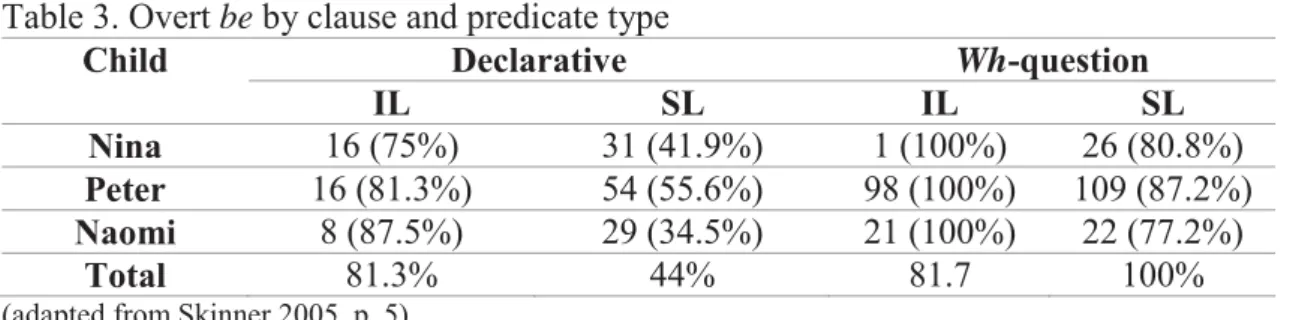
omission of the copula verb is similar in both clause types. In order to carry out his study, Skinner analyzes data elicited from Nina, Peter, and Naomi available in CHILDES and compares his results for wh-questions with those obtained by Becker (2000) for
statements.
Table 3. Overt be by clause and predicate type
Child Declarative Wh-question
IL SL IL SL
Nina 16 (75%) 31 (41.9%) 1 (100%) 26 (80.8%)
Peter 16 (81.3%) 54 (55.6%) 98 (100%) 109 (87.2%)
Naomi 8 (87.5%) 29 (34.5%) 21 (100%) 22 (77.2%)
Total 81.3% 44% 81.7 100%
(adapted from Skinner 2005, p. 5)
These data show that these children produce more overt copula verbs with IL predicates irrespective of whether they are in declarative (81.3%) or wh-interrogative
clauses (81.7%). Moreover, it shows that the rate of omission of the English copula verb in the case of these children is substantially higher in declarative clauses containing an SL predicate (44%) than in interrogative clauses containing the same type of predicate (100%).
He concludes that the rate of omission of the copula verb in wh-questions is similar
to that of declarative statements, and that this is higher with SL predicates. Therefore, as Becker (2004) claims, the syntactic properties of the clause play an important role in the production or omission of the copula verb in early child grammar.
3.2. L1 acquisition of the Spanish copula verbs
The acquisition of the Spanish copula verbs, ser and estar, has been addressed by
26 Table 4. L1 Spanish copula production
Child Total copula
production
Number of errors Errors corrected by parents
1 75 20 (26.7%) 10 (50.0%)
2 33 19 (57.6%) 11 (57.9%)
3 41 17 (41.5%) 0 (0.0%)
4 34 13 (38.2%) 4 (30.8%)
5 54 18 (33.2%) 10 (55.6%)
6 60 21 (35.0%) 8 (38.1%)
7 121 5 (4.1%) 4 (80.0%)
8 42 7 (16.7%) 6 (85.7%)
9 56 14 (25.0%) 4 (28.6%)
10 69 35 (50.7%) 9 (25.7%)
(adapted from Holtheuer and Rendle-Short 2013, p. 162)
These results show that those participants who produce a higher amount of copula constructions produce fewer errors. In addition, it can be observed that one parent does not correct the errors of his or her child at all while the amount of correction of the other parents vary.
In order to determine if children benefit from parental input, these authors correlated the amount of corrective input and the amount of errors children produced. If their hypothesis is true, there should be a negative correlation between the amount of errors and that of correction, and this is what they actually found in the data.
Another study by Holtheuer (2013) concentrates on how children benefit from their input to acquire the Spanish copula verbs, ser and estar, with adjectives. The main
purpose is to study what type of linguistic information is present in the input of the children. As adjectives are a more complex category as part of the predication of copula constructions, children are required to know the syntax, semantics, and pragmatics of ser
and estar as well as how they are used with the different adjective types. Holtheuer
presents three hypotheses: firstly, she holds that, given that estar contains an additional
layer (i.e. AspP), ser is acquired earlier. Secondly, she claims that the subset interpretation
is acquired first and, considering estar a subset of ser, the former is acquired earlier.
Finally, she argues that the usage frequency benefits acquisition.
27
Table 5. Frequency of ser and estar in the children's production and input
Ser Estar Total
Children 37 (45.1%) 45 (54.9%) 82
Input 168 (48.6%) 178 (51.4%) 346
(adapted from Holtheuer 2013, p. 35)
These data illustrate that more constructions of the type estar + adjective were found
both in the input children received and in their own productions.
This author concludes that the children’s usage of ser/estar + adjective is adult-like
and, as it is the case of the data analyzed from their input, children do not produce many copula constructions with adjectives. However, with respect to the type of adjectives, this author establishes that children’s copula choice is closely linked to the semantic and morphological properties of the adjectives with which copulas appear.
3.3. 2L1 acquisition of the English and Spanish copula verbs
In the case of 2L1 bilingualism, studies such as that conducted by Silva-Corvalán and Montanari (2008) who deal with the acquisition of the Spanish copula verbs in a 2L1 English/Spanish child can be found. These authors analyze the production of Nico, a 2L1 English/Spanish child, from the age of 2;00 until the age of 3;00. They study the cross-linguistic influence that may exist and the distributional frequency of the copula constructions in the child’s speech in relation to that of the adults. Their data are summarized in table 6 below.
Table 6. Be, ser, and estar used as copula verbs
Participant Be-copula Ser-copula Estar-copula
Nico 218 (73.6%) 158 (39.5%) 165 (41.3%)
Adults 71 (60.7%) 161 (41.0%) 144 (36.6%)
(adapted from Silva-Corvalán and Montanari 2008, p. 346)
These data show that, in the case of the English copula verb, the amount of production of the child is slightly superior to that of the adults. In the case of the Spanish data, the scenario is different. Regarding the copula ser, the amount of copula
constructions produced by the adults is higher than that produced by the child, while, in the case of estar, the child’s production of copula constructions is higher than that of the
28
Other issues that these authors discuss are the conceptual frames in which each copula occur, the occurrence of the English and Spanish copula verbs regarding the type of predicate from the point of view of the type of phrase that the copulas take, and the tense of the copula verbs that are present in the adult and the child output.
They conclude that copula constructions develop autonomously in this child as it seems that there is no bilingual effect, that is, no interference between English and Spanish in his production has been found. Regarding the distributional analysis, they conclude that there is a parallelism between the use of copula constructions by this child and by the adults; therefore, the interaction between the child and the surrounding adults guides the acquisition of copula constructions.
Gaulin (2008) investigates the acquisition of the Spanish and English copula verbs in 2L1 English/Spanish speakers from the FerFuLice corpus in CHILDES. The purpose of this study is to understand the possible cross-linguistic influence within language use. She establishes that previous studies show that L1 English speakers, at the age of 2, tend to omit the copula verb, but it seems that this does not happen in the case of the L1 Spanish children. Gaulin compares monolingual and bilingual data. Her results of the bilingual data are presented in the following table:
Table 7. Copula structures in the FerFuLice corpus
Child Nominal predicates Locative predicates
Overt copula Null copula Overt copula Null copula
Leo 114 12 22 3
Simon 126 11 25 2
(adapted from Gaulin 2008, p. 30)
These data show that bilingual children barely produce cases of null copula. Consequently, it seems that these children have acquired the copula verb by the age of 3;11 when the study ends.
cross-29
linguistic influence from one language into the other but with a specific directionality (i.e. from Spanish into English).
Fernández Fuertes and Liceras (2010) deal with the English copula verb in 2L1 English/Spanish children compared to their monolingual counterparts as analyzed by Becker (2004). These authors establish three hypotheses: firstly, they argue that if both monolingual and bilingual children follow the same developmental path, higher omission rates will be found with SL predicates than with IL predicates in the 2L1 data, as it happens in the English monolingual data analyzed by Becker (2004). Secondly, they claim that if there is transfer from Spanish into English, the omission of the copula verb with SL predicates will be higher than that of monolingual speakers as the double lexicalization of the Spanish copula verb (i.e. ser and estar) makes the difference between
both types of predicates more obvious. Finally, the two copulas in Spanish can positively affect English by means of accelerating the acquisition of the English copula verb, and consequently bilinguals will produce fewer instances of omission than monolinguals.
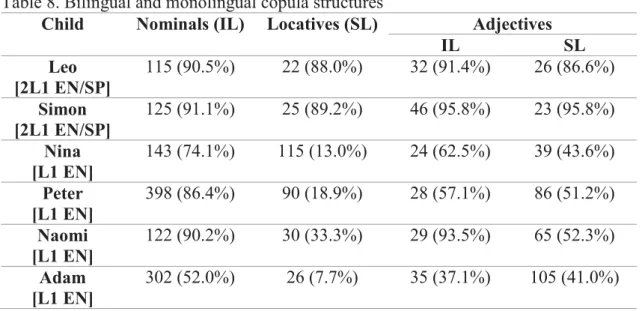
These authors compare their data with that of Becker (2004) and such comparison appears in table 8:
Table 8. Bilingual and monolingual copula structures
Child Nominals (IL) Locatives (SL) Adjectives
IL SL
Leo [2L1 EN/SP]
115 (90.5%) 22 (88.0%) 32 (91.4%) 26 (86.6%) Simon
[2L1 EN/SP]
125 (91.1%) 25 (89.2%) 46 (95.8%) 23 (95.8%) Nina
[L1 EN]
143 (74.1%) 115 (13.0%) 24 (62.5%) 39 (43.6%) Peter
[L1 EN]
398 (86.4%) 90 (18.9%) 28 (57.1%) 86 (51.2%) Naomi
[L1 EN]
122 (90.2%) 30 (33.3%) 29 (93.5%) 65 (52.3%) Adam
[L1 EN]
302 (52.0%) 26 (7.7%) 35 (37.1%) 105 (41.0%)
(adapted from Fernández Fuertes and Liceras 2010, pp. 539-541)
These data show that both bilingual and monolingual children produce more overt copula be with nominal predicates than with locative predicates. However, if the rate of
30
Adam, the data present a higher production of the English copula verbs with IL-adjectives than with SL-adjectives. Finally, the same happens if the production of copula verbs with SL-adjectives is compared between the two types of speakers since the bilingual children show a higher rate of production than their monolingual counterparts.
These authors conclude that, contrary to what Becker (2004) found, the difference in the omission of English copula verbs with both types of predicates is not significant in the case of bilingual English. What is more, the rate of omission they found in the 2L1 data is rather scarce which they suggest points to Spanish accelerating the acquisition of this grammatical item.
31 4. Hypotheses
In this section, I present my main hypotheses for this dissertation which are linked, firstly, to the production of the English, Spanish, and Bulgarian copula verbs regarding the predicate type they take, i.e. IL or SL predicates. Secondly, I consider the bilingual effect that may exist in the English and Spanish bilingual data in contrast with their L1 counterparts. As it has been previously mentioned, Bulgarian bilingual data cannot be compared with L1 Bulgarian data since no corpus is available on L1 Bulgarian. Finally, I consider language dominance in the two language pairs (English/Spanish and Bulgarian/Spanish) in order to determine which is the dominant language of these children, and in which language the grammatical item at stake is acquired sooner.
In line with Becker (2000; 2004) and Skinner (2005), my first hypothesis focuses on copula omission. I argue that in the one-copula languages (i.e. English and Bulgarian), the participants are expected to omit the copula verbs more with SL predicates as opposed to IL predicates, since they temporally anchor these clauses by Asp rather than by Infl. Contrarily, and in line with Fernández Fuertes and Liceras (2010) and Gaulin (2008), I argue that the omission of the copula verbs in Spanish, the two-copula language, is not related to predicate type.
32
and bilingual Spanish is like monolingual Spanish, in the line of Silva-Corvalán and Montanari’s (2008) work.
My third hypothesis deals with language dominance from the point of view of the GFSH as developed by Liceras et al. (2008). The GFSH argues that depending on the characteristics that a grammatical feature has in a specific language, a bilingual person will be dominant, in terms of a particular grammatical feature, in the language in which this grammatical feature has more salient properties. Hence, in the case of the copula verbs, I claim that the children from the FerFuLice corpus are Spanish dominant as in this language the copula verb is lexically specialized. This means that, depending on the type of predicate that the clause contains, the use of one copula or the other is required, whereas in English the same copula is used for all predicate types. In the case of the 2L1 Spanish/Bulgarian child, I claim that she is also Spanish dominant because, although the Bulgarian copula verb has the peculiarity of being a clitic, only one copula verb is used for both IL and SL predicates. Therefore, these three children are expected to acquire the Spanish copula verbs sooner than the English and Bulgarian copula verbs, and no influence is expected from their respected one-copula languages (i.e. English and Bulgarian) into the lexically specialized language (i.e. Spanish).
5. Empirical study
In order to carry out this study, I use data from four corpora: the FerFuLice corpus to study 2L1 English/Spanish acquisition, the Vila corpus to analyze L1 Spanish acquisition, the Sachs corpus in order to study L1 English acquisition, and my own data (the Stankova corpus) to examine the 2L1 Bulgarian/Spanish acquisition. The first three corpora are available in the CHILDES project, and the Stankova corpus has been compiled during the academic year 2015-2016 as part of the research work to elaborate the present master’s thesis.
33 5.1. Participants
The Vila corpus contains spontaneous data from a Spanish monolingual child, Emilio. He was audio-recorded from the age of 0;11.09 until the age of 4;08.15.
The Sachs corpus is comprised of 93 files containing spontaneous data elicited from one English monolingual child, Naomi. She was recorded from the age of 1;01 until the age of 5;01.
The FerFuLice corpus contains spontaneous data elicited from Simon and Leo who are identical twins born in a mixed middle class family in Salamanca, Spain. These children were video recorded form the age of 1;10.22 until the age of 6;11.00. Their father is a native speaker of Peninsular Spanish, and their mother is an L1 speaker of American English. Each of them addresses the children in his or her native language, i.e. they follow the one parent one language approach, except if there is a monolingual speaker present when they use the L1 of that speaker and in summer when they travel to California, USA. Until the age of 1;10, the main caretaker of the children was their mother; consequently, their main language of communication was English. At that age, they started attending a nursery school where the language of communication with the other children and the staff was Spanish. From all this it can be established that their bilingualism is individual rather than societal (Bathia and Ritchie 2004).
The Stankova corpus includes the spontaneous production of a 2L1 bilingual child, Neli. In this case, the corpus contains longitudinal data recorded from the age of 2;02.26 until the age of 2;09.08. This child was born in a Bulgarian family in Valladolid, Spain. Her parents speak Bulgarian to her while her babysitter addresses her in Spanish. Consequently, she has been exposed to both languages from birth. Until the age of 1;05, her primary caretakers are her babysitter in the mornings and her mother in the afternoons. At this age, she starts attending a nursery school where the language of communication with the rest of the children and the staff is Spanish. The family spends a month in summer in Bulgaria where the only spoken language is Bulgarian. From all this, it can be determined that the type of bilingualism of this child is individual rather than societal as it is the case of the bilingual twins in the FerFuLice corpus.
34
corpora which include English data, i.e. the Sachs corpus and the FerFuLice corpus, focus on American English.
5.2. Methodology
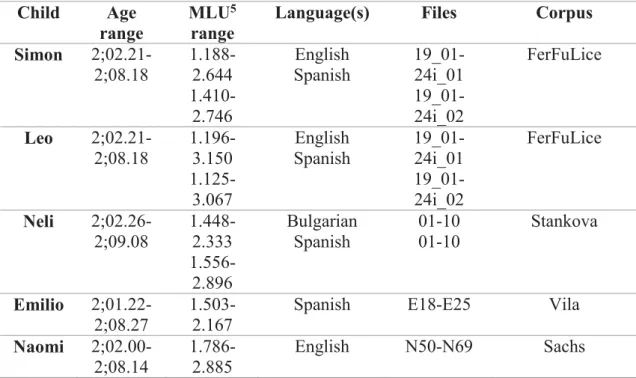
For my study, I analyze data selected from the abovementioned corpora, as illustrated in table 9 below.
Table 9. Data selection
Child Age
range MLU
5
range Language(s) Files Corpus
Simon 2;02.21-2;08.18 1.188-2.644 1.410-2.746 English Spanish 19_01-24i_01 19_01-24i_02 FerFuLice
Leo
2;02.21-2;08.18 1.196-3.150 1.125-3.067
English
Spanish 19_01-24i_01 19_01-24i_02
FerFuLice
Neli 2;02.26-2;09.08 1.448-2.333 1.556-2.896 Bulgarian Spanish 01-10 01-10 Stankova
Emilio 2;01.22-2;08.27
1.503-2.167
Spanish E18-E25 Vila
Naomi 2;02.00-2;08.14
1.786-2.885
English N50-N69 Sachs
From table 9, it can be determined, on the one hand, that the data selected from all the children considered for this dissertation comprise approximately the same age range and, on the other and given the corresponding MLU values, that their language is developed to a similar extent. Therefore, these children’s data are fully comparable.
The different copula constructions produced by these 5 children have been isolated. All the data, i.e. English, Spanish, and Bulgarian, have been classified according to two major variables: non-adult-like constructions, as in (53), and adult-like constructions, as in (54).
(53) My dish over here. (Sachs corpus, Naomi, 2;02)
[My dish (is) over here]
(54) It is mine. (FerFuLice corpus, Leo, 2;05)
35
The non-adult-like constructions have been further subdivided into two groups in the case of English and Bulgarian, (i.e. null copula in English, as in (55), and in Bulgarian, as in (56)), and into three groups in the case of Spanish (i.e. non-adult-like usage of the copula ser, that is, overextension of ser, as in (57), non-adult-like usage of the copula estar, that is, overextension of estar, as in (58), and null copula, as in (59)).
(55) Where Max? (FerFuLice corpus, Simon, 2;05)
[Where (is) Max?]
(56) И на бебе студено. (Stankova corpus, Neli, 2;05) ‘I na bebe (e) studeno’
‘I na bebe(to) (mu) (e) studeno’
[The baby is cold too]
(57) Es pupa aquí. (FerFuLice corpus, Leo, 2;04) ‘(La) pupa está aquí’
[(The) wound is here]
(58) Estás mía. (FerFuLice corpus, Leo, 2;05)
‘Eres mía’
[(You) are mine]
(59) Pato piscina. (Vila corpus, Emilio, 2;03) ‘(El) pato (está) (en) (la) piscina’
[(The) duck (is) (in) (the) swimming pool]
Regarding the adult-like constructions, they have been further subdivided into the copula they take, i.e. be in the case of English, as in (60), ser, as in (61), and estar, as in
(62), in Spanish, and sam, as in (63), in Bulgarian.
(60) What is the other? (FerFuLice corpus, Simon, 2;03)
(61) No es tuyo. (Vila corpus, Emilio, 2;02)
[It is not yours]
(62) Baba@s no está. (Stankova corpus, Neli, 2;08)
[Granma is not here]
(63) Къде е вики? (Stankova corpus, Neli, 2;08) ‘Viki kade e?’
[Where is Viki?]
In all cases, data have been classified into the type of predicate that the copula takes, that is, IL and SL. These variables are presented in tables 10, 11, and 12 for each of the three languages.
Table 10. Classification of the copula constructions in English
Non-adult-like Adult-like
Null Be