
Disaster preparedness : A study in community perspectives
78
0
0
Texto completo
(2) Contents Chapter I. II. Pages 1. I ntroduction. Anticipation of Disasters 6. and Damage. III. Attitudes Towards Preparedness. IV. The Warning Process and. .-. Public Response. V. VI. VII. 13. 20. Self Help, Mutual Aid and Outside Assistance. 26. Discussion and Conclusions. 41. Education and Training Programmes. Appendices. Profile of Sample Villages. J• •. ,. 49. 57. 62.
(3) zILI C.) C". u. N. Ta luk Hqrs. U. 4/. Villages Survey e d. A ffe ctedArea. 2 o. •..... •• ..... :. a. cc —J. z <. Z. cc. 151 et•. < < y ,... < D.z_bc. 1 •. • • s- •. •. •. '. .21CC. V. < --•• ■••• Z. 1 --"••+ «4« ••.:.1. •. • • •. CC. NELLORE DI STRICT CUDDAPAH DISTRICT. MAHABOOBNAGAR. I— CC I— = Cn CD O.
(4) PREFACE Cyclones from the Bay of Bengal hit the east coast of India almost every year and those from the Arnbian sea hit the Gujarat-Maharashtra coasts, though less frequently, but both cause extensive loss of lives and property in the coastal districts. The Government of India (GOi) is responsible for the detec tion, tracking and warning of cyclones - and the State Governments for taking disaster prevention measures. The National Cyclone Warnirg System has been in e.xistence since 1865 and functions under the India Meteorological Depart ment (IMD) of GOi. Detection of cyclones at sea improved considerably with the establish ment of meteorological satellite monitoring facilities by IMD in 1963. Cyclone Warning Radars (CWS) were set up along the east and west coast of India from 1970 onwards and track cyclones continuously from distances of 400 KM out at sea. The lndian National Satellite (I NSAT-la) positioned over the equator in April 1982 can keep a continous watch of cyclones all over the Bay of Bengal and Arabian Sea and transmit their pictures every half hour to the Meteorological Data Utilization Centre (MDUC) at Delhi. India has thus cyclone detection and tracking capability second to none in the world. In order to provide disaster prevention measures in coastal districts GOi appointed in 1970 a Cyclone Distress Mitigation Committee (CDMC) for Andhra Pradesh which submitted its report in 1971.* The Government of Orissa and West Bengal appointed similar committees in 1972 and 1974 respec tively. The CDMCs recommended suitable precautions to be taken by Central and State Goverments before, during and after a cyclone for disaster prevention. 1 n spite of the simple and practica! steps suggested by CDMC 1970 to evacuate coastal villagers threatened by a tidal wave accompanying a cyclone to places of safety inland, a ghastly tragedy occured in Andhra Pradesh in Novem ber 1977 when nearly 8,000 people and tens of thousands of cattle perished in Divi Taluk in Krishna District in a severe cyclone that crossed the south Andhra coast. Apparently something had gone wrong somewhere. *. Dr. P. Koteswaram was the Chairman of these comm1ttees - D1r. ARTIC..
(5) Aid and Succour was rushed from all corners of the World to the heipless victims of the cyclone. An Appropriate Reconstruction Training and Information Center (ARTIC) was started in Jan 78 as a Non-Governmental Organization (N.G.0) at Vijayawada close to the scene of disaster. Apart from its dedicated and notable service to the public in rehabilitation and relief after the cyclone ARTIC undertook to investigate the possible underlying causes shortcomings and human failures that might have led to the occurrence of the human tragedy and recommend steps to prevent their repetition in future. ARTIC convened a seminar at Vijayawada in Aug. 1978 and a workshop in cooperation with the Administrative Staff College of India (ASCI) at Hyderabad in Feb. 1980. The findings of the seminar and workshop should be useful to the State and Central Governments and voluntary organization to design more effective Disaster Prevention measures in future cyclones and floods. What is the reaction of the people at the grass root levels who are, or have been exposed to the ravages of cyclones and floods, to the disaster prevention measures recommended and/or taken by Governments and N.G.Os ? In advanced countries where literacy is high, the threatened people take immediate precautions on receipt of Cyclone (Hurricane, Typhoon) Warnings and save their lives by evacuation to safer places. Loss of property is minimised by suitable protective measures. In a developing country like India where the literacy rate is Iow, simple coastal villagers have to be educated property to protect themselves against onslaught of cyclones, tidal waves, floods etc. Science and Technology have provided tools by vvhich reliable warnings can be issued 12-24 hours in advance for these cyclones and concerned public can be evacuated to safer places well in time. Losses of lives due to drowning in tidal wave or storm surges and floods can be totally prevented. Losses to buildings and crops can also be considerably minimised In a cyclone that hit Southern Andhra Coast in May 1979, the Govt. of Andhra Pradesh did suceed in preventing loss of lives in the coastal districts by evacuating people in advance on a mass scale. The evacuation was however overdone as the State Government did not have information about the exact arcas where storm surges were to be expected. Some Iosses however occured in the inland taluks of Prakasam district by floods due to breaching of tank bunds. Here was an example to iliustrate that advance warnings by IMD and advance evacuation by State Governments can save lives totally. After the cyclone of May 1979, ARTIC sponsored a research project in Prakasam and Nellore districts of Andhra Pradesh with financial aid from UNICEF and under the Ieadership of Dr. C.V. Raghavulu of the Andhra University, Waltair, to investigate the attitudes and behaviour of the population. ii.
(6) affected by the cyclone and accompanying floods. The findings of Prof. Ragha vulu and co-workers contained in the present report entitled "Disaster Prepared ness - a study in community perspectives" should be of considerable interest and assistance to disaster prevention workers in India and other developing countries in the world. In a sample of fairly poor people - fishermen, Jabourers, farmers etc, with !iteracy of 43% - the investigation has identified behavioural patterns indicating readiness to evacuate to places of safety and save lives although they are averse to permanent shift of their abodes where they have been seeking a living for generations. This should serve as a pointer to planners who seek permanent remedies by shifting fishing villages well inland. The fisherman all over the world feels at home on or near the sea except when the sea grows furious and he would like to stay away from it. The separation will be only temporary since he will return to its bosom when the sea resumes its normal playful self! Another significant finding of Prof. Raghavulu has been the pre ference of villagers for the radio as a reliable means of communication of weather warnings. The purchase of transistor radio sets increased in these villages after the disaster! CDMCs rightly emphasised the crucial role of radio for disaster prevention and recommended hourly broadcast of cyclone war nings round the clock. With the latest picture of the cyclone being available on the radar, the cyclone forecaster should be able to inform the public about the latest position of its center and intensity not more than an hour ago instead of dishing out stale information of the cyclone sorne six or eight hours earlier. Although Prof. Raghavulu's research was not directed towards asses sing the accuracy, timeliness and useful of the cyclone warnings, which are important factors to instil credibility and confidence in the public, he has however identified a case of a false alarm in Aug. 1979 which the villagers rightly ignored. The fisherman can sense an oncomin g cyclone based upon their observations of winds and state of the sea. As far as 1 am aware, Prof. Raghavulu's investigation of public res ponses in Andhra Pradesh during the 1 O May 1979 cyclone is the first of its kind in the country. ARTIC has rendered distinct public service by sponsoring such an useful study and UNICEF in funding it. With the growing awareness of Central and State Governments of their responsibility for disaster prevention from cyclones and floods, it is most desirable that organization like ARTIC and the universities should take interest to undertake similar investigations of the social behaviour and reactions of people in future disasters ali over the country. 111.
(7) While designing future rese-arch, attention should also be given to t� technical aspects of cyclone warnings like their accurancy, tlmeliness and U adequacy or otherwise of P & T telecommunications for quick transmission e cyclone warnings to the public. Cases of false alerts or overwamings shoufd also be identif ed and inve:. tigated since they erode credibility and public confidence and necessita1 infructuous expenditure on the part of state Governments, port authorities et1 With sophisticated equipment like radars and the geostationery satellite an reliable communications it should not be necessary for any cyclone forecaster 1 cry wolf whenever a cyclone passes near his coast without approaching t cross it. Findings of research studies of poputatron behaviour in natural calamitie should be carefully taken into account in designing and/or revising disaste prevention measures by central and state Governments and voluntary agencie in the country.. P. KOTESWARAM Retd. Director General of Observatorie Varsha, 8-1-11, Waltair Vplands Visakhapatnam (AP.) lNDLA.. iv.
(8) ACKNOWLEDGEMENTS A number of individuals and institutions have contributed to the outcome of this research project. 1 am thankful to UNICEF for funding the research project and to ARTIC for sponsoring it. 1 n this connection, 1 am thankful to Mr. H. R. Prakash (Director, ARTIC), and Mr. Katkar and Mr. Daniel o· dell (UNICEF). A very special debt of gratitude goes to prof. Stephen P. Cohen of the University of lllinois (Urbana-champaign, U.S.A.) for initiating me into disaster studies. This research project was started while I was on the faculty of the Andhra University and completed after I moved to Nagarjuna University. 1 am thankful to the authorities of both th,ese Universities and especially their successive Vice-Chancellors, Sri M. R. Appa Rao and Sri A Sambasiva Rao (Andhra University), Professors B. Sarveswara Rao, B. Swamy and D. Bhaskara Reddy (Nagarjuna University) who evinced keen interest in the progress of the 1 am also thankful to Sri M. Gopalakrishna Reddy (Registrar, study. Andhra University), Dr. K Anjanappa, (Registrar, Nagarjuna University) and professor K. Venkateswarlu (Head of the Department of Politics & Public Administration, Andhra University) for providing the necessary facilities for carrying out the work. 1 am indebted to Dr. Aqueil Ahmad (faculty member, Administrative Staff College of India) and Dr. C. R. Prasada Rao (Head of the Department of Sociology, Andhra University) for their criticisms on an earlier draft of the Report Field work was carried out by Messers. B.P.C. Bose, P. Krishna Prasad, P K.M. Patnaik, B. Radhakrishna, V. Poornachandra Rao, and E.A. Narayana. In addition to field work, Mr. Bose and Mr. Prasad have assisted me at severa! stages of the project work. 1 am grateful to them for their sincere effort. Finally, 1 am thankful to a large number of respondents-civil servants, politicians, social workers, and disaster victims-for extendíng their cooperation, Special mention must be made of the discussions I had on various issues of relevance to this Project, at different points of time over the last three years, with Mr. Daniel o· dell (UNICEF), Mr. Fred Kaufman (MCC), Mr. Nagendra V.
(9) Swamy (VRO), Mr. R. Srikanth (OXFAM) and Mr Allan Taylor (INTERTECT). Discussions with severa! senior administrators—Messers A. Krishna Swamy, B. K. Rao M. Gopalakrishnan, U. B Raghavendra Rao, R. Vidyanatha Iyer, C. R. Kamalanathan, C. Arjuna Reo, C. S. Rao, T. Gopal Rao, R. K. Aggarwal, all members of the K Sujatha Rao, A. V. S. Reddy, J. M. Girglani, Indian Administrative Service and Messers. M. V. S Prasad, V. M. M. Prasad, and M. Rambabu—were helpful in understanding the complexities of disaster management. I owe a debt of gratilude to all these indívidua's for their time and attention. My association with the relief and rehabilitation work of the Vizag Citizens Committee for Cyclone and Flood Relief enabled me to gain some insights. In Chis connection, thanks are due to Sri M. R. Appa Rao (Chairman), Sri S. Alwardas (Secretary) and Prof. K. V. Ramana (Convenor) of the Citizens Mr. Durai lyer for handling the Thanks are also due to Committee. proof reading. And, finally, my sincere thanks to Smt. Sridevi, my wife, for her co-operation. C. V. Raghavulu. vi.
(10) CHAPTER 1 INTRODUCTION Two major trends seem to underline the approaches of the developing �ountries in regard to the problems posed by disasters. First, their response is predominantly post- impact oriented. Second, a lot more attention is paid to �hort- run adjustments than to long-range preparedness. As a consequence of - these policy options, training and education of the public in disaster prepared ress has received a low priority. Reflecting on this theme, the United Nations yvater Conference (1977) observed : "High priority should be given to education, training and public inforrnation in disaster prevention and prepared ness, both by individual Governments and international organisatíons. This should be directed, ínter c.lia, to public officials, decision-rnakers, professionals in building and construction industries, national health planners, public health workers and the general public situated particularly in vulnerable a reas" .1 lf the need for long-range preparation is recognized and handled 1 p �p ropriately, damage to loss of lite and property could be reduced consideraf'Y· Also, the adjustment of victims to disaster situations and quick restoration of normalcy tend to be significantly easier. Developing long-range measures ¡ of disaster preparedness is all the more pressing in the light of the projections �bout the frequency of disasters and tha severity of their human effects in the next two decades.2 The problem itself is so gigantic that it requires multi-level rnd multi-agency efforts from Governrnent, non-governmental organisations (N.G Os) and the cornmunities vulnerable to disasters. Further, policy shifts in. 1. )' ¡ !. 1. 1. Offlce of the Un1ted Nations D1saster Relief Coordinator (UNDRO), Water: Resource and Hazard, Geneva, 1977. See G1een, Stephen, International Disaster Relief- Toward A More Responsive System, New York, McGraw-Hill, 1977 and Dav1s lan, "Appropriate Technology: The Modif1cat1on of Unsafe, Hou,;ng foflow,ng o;saste,s", hchi"ct.rnl De.<ign, July 1979, pp, 193-94,.
(11) this sphere a!so require sufficient knowledge-base. Hitherto, our understanding is based on rudimentary evidence in many spheres. The perceptions and atti tudes of the communities toward disaster preparedness, is one such sphere. lt was in this context that the present study w as attempted. Based on the evidence of the attitudes and behaviour of the popu!ation affected by the May 1979 Cyclone/Flood that ravaged the Prakasam district and parts of the Nel!ore dis trict in Andhra Pradesh, the study aims at extrapolating the role of the commu nity/communities in disaster preparedness and disaster mitigation 3 A study of how individuals, families and communities behaved in a d1s2ster may provide us sorne clues about the social mechanisms and patterns of human adjustment that emerge in response to crisis. ldentif ication and delineation of their res pective roles will be helpful in working out programmes of d1saster prepred ness and in designing training programmes. lt should, however, be cautioned at the very outset that highlighting the community's role does not discount the role of Governmental agencies or that of N G. Os. On the contrary, it assumes that knowledge about this component-perceptions and attitudes of the victims and the range of responsibilities undertaken- by the cornmu nities in the recent disaster-provides a necessary basis of formu!ating specific and effective disaster mitigation measures. Viewing the problems from the perspective of the victims and the affected communities would allow us to offer alternatives to policies and programmes. lt also helps to identify the problems the commu nities cannot tackle by themselves without externa! intervention on a large scale. In recent years, there has been a reviva! of interest on the part of both academics and action-oriented agencies, in identifying the patterns of community self-help and mutual aid and the potential for collect1ve action. The upsurge of interest, is not borne out of any romantic view of the vi!!age communities lt is the result of a coalescence of severa! factors. Recognition of the need for a systems approach in analyzing the perceived linkages and patterns of interaction between the primary and secondary systems, is one such. The popularity of the participative ethic in the realm of politica! and administrative organisaticn, based on both faith and expediency, is yet another. 4 3.. The Study also draws sorne ev1dence from rhe 1977 Andhra Cyclone and the Srikakulam Floods (Andhra Pradesh) of 1980.. 4.. In arder to sustain change introduced by outs1de action agencies, the develop ment of a grass-root organ1sat1on is considered essential by votanes of the part1c1pat1ve approach. Bes1des, 'consc1ent1zing· the clients towards eff1cac1ous social act1on, 1t also 1nculcates the values of human d1gn1ty and self-esteem. Many act1on agencies also consider this approach exped1ent because the problems are overwhelm1ng relat1ve to the1r abil1t1es and resources. Only people have to tackle them.. 2.
(12) Methodology The research under report was based on field observation and inter views carried out during May-July and December 1979 and January and Apri: May 1980 in Prakasam and Nellore Districts comprising the area severely affec ted by the May 1979 cyclone/flood. During the first phase (May-July 1979) field observation and unstructured interviews were carried out The next phase (December 1979 and January 1980) was utilized mainly for structured interv1ews of a sample of 318 respondents. Following the procedure of multi stage sampling, four taluks in Prakasam District (Kandukur, Kanigiri, Ongole and Chirala) and one (Kaval1) in Nellore Oistrict were selected. For each of the talul<s a list of the "worst-affected" villages/hamlets was prepared. Seventeen main villages and 48 hamlets were selected at random from the_ five taluks sampled. About 48�/� of the sample of respondents was drawn from the coastal villages and hamlets with a high degree of vulnerability to cyclone/storm surge. A detailed descriptive account of the sample is appended to this Report (Appendix-1) To ascertain the degree of commitment to disaster preparedness, the current research project utilizad two separata sets of questions, both d rafted in One set consisting mainly of structured questions was the vernacular. designed to el1cit information about their disaster-related behaviour, referring particularly to the 1979 May Cyclone, and their level of awareness of the need for precautions in a future disaster. 1 t covers items relating to background about his/her family; previous disaster expertence; perceptions about future disasters; attitude s toward migration and aid received from various sources; expectation of aid in future; and disaster preparedness and community in for:-nation structure about weather. 1 n the se<rnnd set, unstructured questions were posed through a sentence completion test to tap the emotive side of the responses and broJd att1tudes towJrd disaster m1tigation. The third stage of field work consisted of qualitative interviews of 30 informants drawn from the coastal villages of Prakasam, East Godavari and V1sakhapatnam D1stricts. These interviews were intended to compensate for the pitfalls of survey research and to facilitate consideration of somewhat more complex items (community structure, communication of weather data at the village leve 1, propensity for self-help and aid preference, etc.) in greater depth. 1 nformation available in our files about the 1977 Andhra Cyclone has been Similarly, impressionistic data from the utilized wherever it is relevant. Srikakulam flood of 1980 also constituted supportive background material for the final write-up.. 3.
(13) The difficulties encountered in carrying out the study and the li mitations should be noted here. There was a constant danger of the researchers being misperceived as aid-givers by the respondents. We had to struggle a lot to disabuse them of such feelings. Another problem concerned the vaiidation of two scales constructed to measure community solidarity. These scales were used on a tria! basis which yielded responses, giving rise to prob!ems of validation.s lt was, therefore, decided not to analyse the data concerning the two scales. The study did not aim at covering all aspects of respondent attitudes. lnitially, we intended to include personality variables, such as risk propensity. But these were given up. to keep the interviews short and unclut tered a s the interview-schedule had to incorporate additional items on dam age, housing, aid etc (These items were not included in the project proposal ). Profile of the Respondents Nearly 43% (136) of the respondents are from Kandukur, 20% from Ongole and about 12.5% each from Kanigiri, Chirala and Kavali taluks. About 89% of the respondents are Hindu, 9% Christian and 2�� Muslim. Nearly 43% of the sam;Jle is literata, the mean years of schooling being 6.5. The occupational breakup of the respondents is presented below :. TABLE- 1 -. OCCUPATIONAL STATUS OF THE RESPO:\l'D.ENTS SI. No. 1.. 2. 3. 4.. 5.. 6.. 7.. 8.. Occupations Fishing Labourer (farm and non-farm) Farming (owner and tenant) Trade and Commerce Artisan Employee Service Occupations Others Total: 5.. Respondents. %. Nos. 95 75 66 20 19 18 16 8. 29.87 23.58 20.75 6.30 5 96 5.67 5.03 2.84. 318. 100.00. Reliance on a computer for processing the project data d1d not become necessary partly because these scales did not tie· in. A shift in t'1e research procedures, w1th greater reltance on additional qualltative data rather than on quantitative analys1s of the existing data through advanced statisttcal techniques was suggested by a member of an informal review comm1ttee. With the shift of emphasis from quantif1cat1on to qual1tative analys1s most of the survey data was processed on desk calculators.. 4.
(14) Distribution of the respondents, by social background (religion and cas is shown in Appendix-11. About 8% (26) of the respondents, suffered hurr ...._loss within their familias and 6% {19) severe injuries due to the 1979 Cyclo. At the time of the interview, three-fourths of the respondents were living thatched houses or huts with brick walls and the remainder in pucca or ser pucca houses. Only 7 respondents had cement-concrete, single or doub storeyed houses. After the disaster, 290 (91 %) families were living in how similar to those before the disaster, 23 (7%) in better houses and 5 (1.6 < in worst houses.. 5.
(15) CHAPTER. 11. ANTICIPATION OF DISASTERS ANO DAMAGE The implementation of realistic disaster p reparedness measures at the community level is directly dependent upan the ability of the affected population to anticípate the occurrence of potentially destructive or harmful events and to assess their nature, frequency and effects. Their ability to relate 1he incidence of damage of past disasters to that of future ones indicate their predicative potential. Besides, there are líke!y to be dífferences in the human perception of risk. A high level of information coupled with analytic capacity in these spheres would directly contribute to better prepared ness. 1 ndividual respondents were, therefore, asked to rate the recent Cyclone at their places of residenca as being high, moderate, or low. Ninety-one per cent of the victims sampled perceive the 1979 disaster as one of high intensity, whereas the remaínder (9%) categorise it as one of medium intensity. The categorization of the disaster as of high intensity by almost nine-tenths of the respondents is hardly surprising in view of the fact that our sample was drawn from the worst-affected villages. lt does, however, indicate the absence of any significant disagreement about the respondents' assessment of what constitutes a hazard. Respondents were asked to indicate the extent of damage to their houses and other built· up proper1y. About two-fifths (42%) of them claim that damage to their houses was above 75% Nearly a third consider damage to their houses as moderate. Each individual research investigator also made his own assessment of the damage to the houses of the respon dents covered by him. In about 35% of the cases, respondents' perceptions of damage were on the high side and in less than 2% of the cases on the lower side. There is greater divergence in the extent of non- housing damage reported by the respondents. About half of them report of a 'high' leve! of darnage; a third consider it as of 'medium', and 6% hav0 not suffered any non-housing damage. Despite widespread awareness about the characteristics of a disaster, the level of individual anticipation about the frequency of disasters (cyclone/ floods) is low. While a sixth of the sample consider them as a persistent. 6.
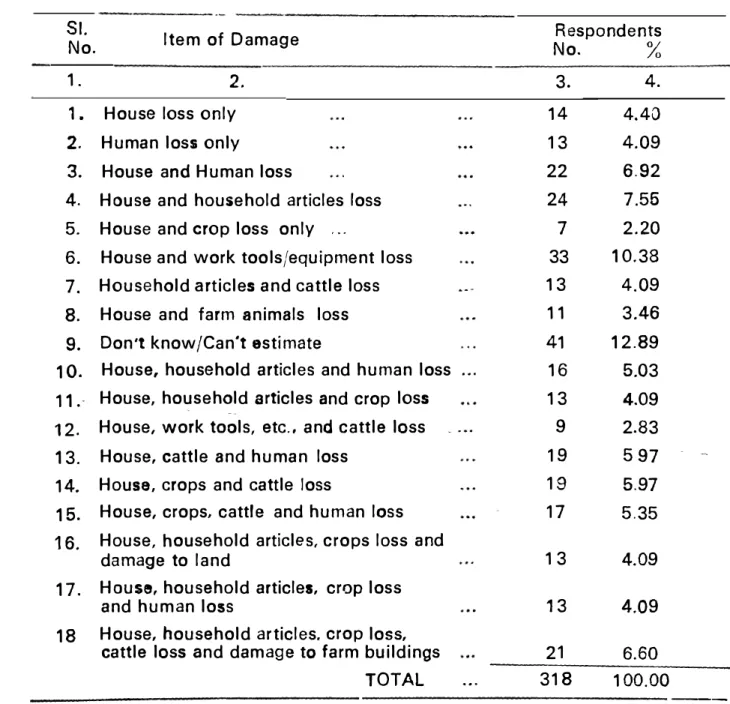
(16) problem, occurring almost every year or alternate years, about seven per c1 expect them, once in a few years. Those who speak of regularity in · occurrence of cyclones/floods do not claim support for meteorological de They seem to claim validity on the basis of the experience of recent years. 1 proportion of respondents who do not anticípate a disaster in future negligible (1 .26%). Significantly, three-fourths of the sample do not see e regularity in their occurrence, but consider disasters to occur at random. 1 indeterminacy of the occurrence of disasters in future reflects a refusal speculate. sorne even consider it un-Godly and evilsome to indulge guesswork. To them, much would depend upon the merey of God. Th reluctance to guess or indulge in probablistic judgments is understandable the context of their overall perception of causality. Natural calamities are r man-made. They are acts of God, only the Gods can prevent them, ass1 47 per cent of the respondents. To test the attitudes of respondent, on the extent of likely damage in future disaster, they were asked the question lf by sorne misfortune, this area is affected by natural hazards (cyclone, storm surge, flood, etc.) in what way do you think it would affect your family /household? (List the effects volunteered by the respondent). The replies to the item are presented in Table-2:. 7.
(17) TABLE - 2 PERCEPTION OF DAMAGE IN A FUTURE DISASTER. SI. No. 1.. Respondents No. %. ltem of Damage. 2.. 3.. 4.. 1.. House loss only. 14. 4.40. 2.. Human loss only. 13. 4.09. 22. 6.92. 24. 7.56. 7. 2.20. 3. House and Human loss. 4. House and household articles loss. 5.. House and crop loss only . . .. 6.. House and work tools/equipment loss. 33. 10.38. 7.. Household articles and cattle loss. 13. 4.09. 8.. House and farm animals loss. 11. 3.46. 9.. Don't know/Can't estímate House, household articles and human loss .... 41. 12.89. 16. 5.03. 13. 4.09. 9. 2.83. 10.. articles and crop loss 11.- House, household -12. House, work tools, etc .• and cattle loss 13.. House, cattle and human loss. 19. 5 97. 14.. House, crops and cattle loss House, crops, cattle and human loss. 19. 5.97. 17. 5.35. 16. House, household articles, crops loss and damage to land. 13. 4.09. 13. 4.09. 21 318. 6.60. 15.. 17. 18. House, household articles, crop loss and human loss House, household articles. crop loss, cattle loss and damage to farm buildings TOTAL. 100.00. ---. Table 2 indicates respondent perceptions of the type of damage(s) most likely to occur in the event of a disaster in future. Less than 13 per cent of the respondents are unwilling to speculate on this item. The perceptions of others responding to t his item are much more categorica! than that concerning the frequency of disasters. However, their estimates are at variance with the damage suffered by them in the previous disaster. An item-wise break-up. 8.
(18) of the damage from the data (Appandix-l ll) shows that housi ng has the highest frequency (79<;�); about a third are concerned about cattle loss (34.3%) and crop loss (32 4%). Anxiety about loss of human lives figures next, with 31.5%, followed closely by damage to household articles. Damage to work tools and farm equipment and I and are mentioned by less than one-eighth of the respondents. The items of loss as perceived by the respondents, and espacially the high frequency of house damage and the low frequency of farm-related items, should be understood in the background of a skewed sample. Our sample is delibera House constitutes the major, tely biased in favour of the poorer stratum. and often the only, asset for many of the respondents. Equally significant is the high frequency of housing damage (79% relative to that of human loss (31.5%). Exclusive concern about human loss is expressed by tour per cent. From the precedmg discussion it can be seen that the respondents not only have high awareness about the range of damage in a disaster but also about the short-term precautions. The precautions suggested by them are quite realistic in that they are within the range of possibility, and sorne were Recourse to evacuation was the widely adopted in the most recent disaster. most popular precautionary measure. There are two types evacuation : (a) voluntary evacuation by the victims to a pucca house or better house in the neighbourhood/main village 1 and (b) evacuation by Government to safe places away from the v�ulnerable zone. -. Nearly 55% of the sampled population from the coastal villages was evacuated by the Government. About one-half of the evacuees express the view that the Government's role was crucial in evacuating them from the village ; otherwise they would not have left the villages. Undoub1:edly, many lives are saved due to Government's initiative in this regard Most people are generally reluctant to leave their respectiva settlements unless and until they are convinced of the severity of the hazard.. n Precautions, such as evacuation prevent loss of life although not perma nently. They do not contribute to long-term preparedness by individuals and Realizing the n eed for long-term communities to any significant degree. preparedness, Government has contemplated two policy measures; 1.. In either case victims gonerally move the children, women and the old people in the first stage· When they sense danger, the able-bodted males move out later.. 9.
(19) a). encouraging the subsidies ; and. construction of pucca. houses through. loans and. b). inducing people living within the 0-5 kms. zone from the coast to shift their settlements to safer places, away from the c:rnst.. Besides these, construction of link roads and raising the tidal bund of the coast, have been taken up on a small scale. The construction of nearly 500 cyclone shelters across the 1000 kms. coast line and other flood-prone areas is being taken up by the Government in collaboration with the league of Red Cross Societies and 35 other N.G.Os. The �onstruction of nearfy 12,000 pucca houses (plinth area ranging from 150 to 200 sq. ft.) has been completed. 2 The construction of about 6, 000 pucca houses is in progress. Schemes are also afoot for another 2500 pucca houses. In all these schemes, participation by N.G.Os is on a massive scale, both in terms of financia! contribution and res ponsibility for construction. Quite a few of the fishermen's settlements have shifted 100 to 300 meters away from theír original locations, pucca housing projects, taken up mostly in Krishna, Guntur and to a limited extent, in Prakasam and Neliore districts chose locations with ground elevations at a safe distance from the coast. 3 Nevertheless, considerable opposition prevails against the idea of shifting villages beyond the 5 kms. zone from the coast. A flood of anger swept through many of the fishermen communities against this proposal. 4 Responses to one of the items in our questionnaire also reveal an extremely low level of public acceptability to the proposal. lf an incentive such as a pucca house is offered at a place 3 kms. away from the coast, about 6% of the respondents are willing te migrate and less than 2;\ would se riously think about it. An overwhelming majority (86%) would not move that far from the hazard-prone areas. A clean majority (55%) object to the proposal because they eke out a living from the resources (fish and other marine products) of the sea. Pushing them farther from the coast would mean cutting off their livelihood. About 27% of the respondents advance other reasons, such as social ties (15%) and imrnovable properties (12%) for lack of interest in migration. Detaíls 2.. 3. 4.. See Government of Andhra Pradesh, " Position Papar on Cyclones 1n Andhra Pradesh State and D1saster Preparadness " (mimeo.), papar presentad at the ARTIC/ A SCI Workshop on Disaster Management, Hyderabad, February 16-18, 1980. Government provided incentives far these projects by granting ownership rights to Jand freely The opposition was so intense that a rumour was in circulat1on that the C hiaf M1nister who sponsored the move was in league with tha lobby of mechan1sed fishing boat owners.. 10.
(20) concerning the distributions of this item are shown in Appendices-lV and V There is an importan t difference between the fishermen and non-fishermer groups in the assumptions underlying theír responses to migration. The fisher. men are well aware of the risk-propensity of the area in which they live. The) seem to accept the situation despite its vulnerability to hazards. Howeve, most of the non fishermen groups lack sufficient information about the availabi· lity of economic opportunities in alternafrv e areas with lessE-r cyclone/flocc hazard. Their pres E nt locations offer employment. Their family ties are alsc strong. There is also the e xpectation that in times of severe hazards, the Government would rush relief and rehabilitation assistance which though no1 substantial is adequate to keep them out of starvation. These factors seem to induce them to take risks and dissuade them from migrating to safer places. Government's efforts to direct human settlements away from the hazards prone areas are primarily exploratory. They are not backed by any zoning regulations or land-use controls for the countryside. 5 Ser.sing the extent of public opposition Government seem to have dropped this strategy. Moreover, the strategy of shifting the people away from the vulnerable areas, coastal and inland, is beset with serious practica! difficulties. The numbers involved is staggering. Finding housing and livelihood for them is no easy task. 6. UI Current measures of preparedness, especially evacuation, concentrate upon preventing human loss, but not property loss or production losses. Schemes relating to pucca housing and cyclone shelters also aim at the same goal. The farming sector seems to be the most neglected one in this respect. Neither awareness of the existence of the cyclone hazard, nor indeed past experience with it, are sufficient to produce eftective precautionary actions. The available evidence has only faint indications of an answer. The options open to farmers seem to be restricted because of severa! factors. limíted information about the space and time of an event like the occurrence of a cyclone-a factor common to other sectors-lands them in an area of uncertainty. Most of the f armers feel that they have to endure the los ses till better times carne along. Cyclones, in combination with other factors (drought, crop disease, price fluctuations) have produced major diff1culties to the farmers of the region, 5.. far a cross-nat1onal analys1s of the legal problems involved see United Nations, Disaster Preventio11 a11d Mitigation, Legal Aspects, Vol, 9, Geneva, UNDRO, 1980.. 6.. In Prakasam d1strict alone there are 61 v111ages across the 155 KM. coast with an est1mated populat1on of 50,000 w1thin the 0-5 KM zona. Considering the size of the target area and the number of people mvolved, 1t 1s foolhardy to think of resettlement.. 11.
(21) causing increasing economic hardship.7 After the May, 1979 Cyclone, there has been a shift in the cropping pattern of Prakasam District. The area under tobacco, a high-risk, capital intensive and export-oriented commercial crop, has been reduced by nearly 40 per tent. In its place, traditional subsistenceoriented crops have been raised. The response of the farmers respresents an adjustment at a sub-optima( level. Given the current levels of indebtedness, the range of alternative adjustments is narrow. A subsistence oriented agricultural strategy matches their potential for investment and risk absorbing ability rather than soil fertility of the cropping. Agronomic and economic considerations are often sacrificed for survival and security needs. Preparedness on the part of the owners of middle-sized and large farms is reflected in another sphere too. Ownership of a few pairs of hybrid bullocks has been considered for long, a status symbol as well as a requirement for various agricultura) operations. Many of them have lost a sizeable proportion of their cattle wealth In the 1979 Cyclone. The heavy losses seem to have induced a preference for inanimate power They are no longer thinking of restoring their stock of bullocks to predisaster levels. When their economic position improves, they intend to go in for tractors instead of bullocks. The preference for tractors is a feasible alternative to minimise losses. The trade-off between a high-risk animate power and a low-risk technology represents an adjustment with a higher leve! of rationality. Such decisions would have long-term consequences, but their exposition falis outside the scope of this report.. 7. Statistics of damage to land and croes for the pariod 1953 to 1978 from floods in India show that on an average an area of 82 lakh nectares is affected About 26.5 million people are also affected. Crop damage alone works out to Rs. 185 crores (S 230 millions), See Sain, Kanwar,. The flood problem in India,. New Delhi, Birla Institute of Scientific Research, 1979. pp. 12-18.. 12.
(22) CHAPTER. 111. ATTITUDES TOWARD PREPAREDNESS The adjustment alternatives available to potential victims of disasters may be conveniently divided into two groups: (a) the short-term and long-range precautions adopted by individuals and (b) those adopted by collective bodies, such as the community, Data from the current project in both the structured and unstructured question sets converge to provide evidence supportive of a high level of short-range preparedness. Virtually ali the respondents p r (97.5 per cent} e ort awareness of the need for taking precautions against sur vival risks of a disaster. The precautions observed by the people in the 1979 Cyclone differ sharply between the coastal and non-coastal regions. As noted in the preceding chapter 55 per cent of the sample - or 48 per cent of the sample from coastal villages - report of bemg evacuated. Evacuation was done largely at the instanca of the Government. Government officers and, in a couple of instances the elected functionaries, went to the vulnerable areas with trucks to induce - and at times coerce - the potential victims to move out to the shelter or relief camps. lnterestingly enough, not a single person from the non coastal villages covered in our sample, was evacuated. The response from the people affected in the non-coastal region was mostly voluntary. About 28 per cent of the non-coastal respondents moved to pucca houses in the neighbourhood or to that of the neighbouring villages. 1 The proportion of respondents who took sorne precaution or the other is higher - by 11 per cent - in the coastal region_relative to the non-coastal region. The dif ference between the coastal and non-coastal regions in terms of precautions taken is hardly surprising in view of-the greater frequency of cyclones affecting the coastal region as well as initia tives taken from time to time by the Govern ment. l t is also worth recalling, that the interior villages accounted for mora lt appears that precautions aimed at than 80 per cent of the deaths in 197�. goals other than saving human lives, had a low priority. Less than 5 per cent of the sample report of having taken st eps to take care of household materials 1.. The latter category refers to moving from the hamlets to ths pucca houses located in the main v1llage.. 13.
(23) and other assets, farm animal or essential commodities. Respondents were also asked whether they would take the same precautions if another cyclone/flood occurs in future. Half of them will take the same precautions; 47 per cent will take sorne other precautions too; and the remainder (2.5 per cent) are not sure what they will do. To ascertain further the attitudes of the respondents toward preparedness the following ítem was used in the santence completion test : lf I am forewarned about a cyclone or flood, 1 would The responses to the item are summarised in Table 3. TABLE-3 SI. No.. No. of respondents. Response category. 1.. Evacuate to an elevated place/ main village/safe place/pucca house. 2,. Save myself / take precautions/go somewhere/escape/run away. 3.. Move to neighbour's house/ neighbouring village/the hill top. 4.. % of total. 129. 40.57. 135. 42.45. 19. 5.98. Stay at home. 7. 2.20. 5.. Not do anything/not take any precautions/God would save me. 10. 3.14. 6.. Think about it/act suitably. 9. 2.83. 7.. Don't know/no response. 9. 2.83. 318. 100.00. TOTAL. Total% in each cluster. 91.20. J. 1. 1. 8.80. The above Table shows that an overwhelming proportion (91.20 per cent) of the respondents are favourably inclined to adopt short-range precautions if advance notice of the threat is given. A substantial propotion (83 per cent) of them would take precautions aimed at mitigating the loss of human lives only. Surprisingly, less than a tenth of those favourabl_� to taking precautions have specific ideas as to where they would go in the event of a disaster; they are not sure about the localitY or the place Lack of knowledge about the specifics need. 14.
(24) not be considered a majar problem. G iven the high proportion of respon dents with a favourable attitude,. educating them about the specifics of pre paredness may not be d1fficult. The proportion of respondents who are indeci l t is also likely that sive or would not initiate any precautions is not sizable. sorne of them are residents of safe houses in which case precautions, such as evacuation do not arise. Let us now turn to the next item on the sentence com pletion test : In facing difficulties (associated with a hazard) the most helpful thing to peo ple is ....•.......... ..............••.. The responses to this item are noted in Table 4.. --·--·. - .-. TABLE-4 -----------------------. SI. No.. Response category. 1. Government/Government aid 2. Buses/Trucks/transport facilities. %. No. of respondents. of total. 88 9. 27.68 2.83. 3.. Pucca house/Good house/double storeyed house/terrace. 85. 26.73. 4.. Elevated place /safe place/ cyclone shelter. 13. 4.09. 5.. Essential commodities/rice/money -. 9. 2.83-. 6.. Radio. 3. 0.94. 7.. Mutual aid/working together/ good advice/fellow be1ngs/ v1 llagers/vil lage elders;'goodness. 63. 19 81. 8.. Self-help/self-reliance. 3. 0.94. 9.. Courage/imagin ation/intelligence/ precautions. 11. 3.46. 13. 4.09. 3. 0.94. 18. 5.66. 318. 100 00. 1 O. God's grace/faith in God. 11. Others 12. Don't know/No response TOTAL:. 15. Total 1� in each cluster. }. 30.51. 35.59. iJ. 24.21. 4.09.
(25) The responses noted in the above Table concern a number of issues, not all of them are directly rel ated to the theme of this section. Respondent perceptions of precautions (item 2 to 6) account far nearly 38 per cent of the total, indicating the extent of significance attached to preparedness in the series of adjustments related to the pre-impact and post-impact stages. Sorne of the precautions, especially on housing, belong to the category of long-range preparedness. From among the responses noted in Table-4, sorne clusters seem to emerge, indicating the dominant source of action. ltems 1 to 6, grouped under clusters one and two account for- nearly two thirds of the responses Of these, the responsibility for the first cluster impinges directly upan the Government. A sizable percentage of the respondents expect the Government to come to their rescue, thus conferring legitimacy on its role. The items under the second cluster are basically concerned with a wide range of precautions, including access to reliable information through radio broadcasts . The source of action for the first and second clusters-falls broádly within- the sphere of the environ ment of the affected population. Nevertheless, there are exceptions to this generalisation as in the case of housing and essential commodities. The responses lend themselves to ambiguities in interpretation about the source of action. lt is, therefore, fair to categorise them in an overlapping zone of environmental and individual action. A similar overlap is discernible from the responses concerning short-run and long-range adjustments. Government and community aid could be concerned with the immed,ate as well as the long-run adjustments. One significant feature of the response pattern is that solutions concerned with housing, primarily pucca housing, are salient to more than a quarter of the respondents. Turning to aid from community sources of self-help, we note that nearly a quarter of the sampled individuals f eel it efficacious to rely on community action and individual initiative. Although the proportion of respondents in this category is somewhat lower (24.1 per cent) than those opting for direct Governm ent intervention (30.5 per cent), it is still significant in view of the spontaneous nature of the response.2 The responses under item 1 O are salf-evident. The low proportion of responses (4 per cent) under this category indicate that fatalistic att1tude or re2. Strictly speak1ng, responses to item 9 should be categorised under personal1ty tra1ts. Our decis on to club the 1tem with community and individual sources is based on the assumpt1on that emphH 1 s on these traits 1s linked to self-rel1ance.. 10.
(26) 1 iance on super-natural forces is not widespread. 1 t is a positive indication that the vict,m s are generally seeking pragmatic and realistic solutions. HoVvever. our discussion on this point is inconclusive. We shall return to a discussion of this th6me a little later. The next two items on the sentence completion test are aimed at tapping directly the emotions of the respondents. One item reads: lf caught in a disaster without prior information I would Table - 5 summarises the responses to this item:. TABLE-5 SI. No. 1.. Response category Die/Can't do anything/keep quiet/feel sorry/lose courage/get into trouble. 2.. Pray /Think of God/fate (Karma) destiny. 3 L1.. Try to rescue myself/put in effort to save myself/take precautions/try to escape/no f ear Help other s. 5.. Others. 6.. Don't know/No response TOTAL. No of res pondents. % to total. 164. 51.57. 38. 11.95. 98. 30.82. 1. 0.31. 4. 1.26. 13. 4.09. 318. 100.00. Total% in each cluster. }. 31.13. The pattern of response to this item stands in contrast with that of the first ítem on the sentence completion test (Table-3). Both the items are phra sed in hypothetical terms The difference is that while the first ítem is based on advanced information and the latter without it. The percentage of respon dents reporting of indecision or inaction is less than 1 O per cent if an alert is given. In the abstnce of advance information the proportion of respondents indicating attitudes falling in this category (inaction, indecision, helplessness. 17.
(27) and anxiety) increases dramatically, to nearly 52 per cent. Similarly, the proportion of respondents inclined to fatalism almost trebles. The proportion of respondents who think of precautionary measures is down to nearly one third of the counterparts under ltem-1. The differences in the pattE:rns of response are significant in that they point out to the need far information. Obviously, advance warnings and accurate information make a lot of difference in terms of disaster preparedness. Turning to tha response pattern of the fifth stem on the sentence comple tion test we note that fatalistic attitude is more widespread. Given below ar e the stem and the table presenting the responses : 1 would ............ on God far saving my life (in the event of a disaster). -. TABLE-6 SI. No. 1. 2.. Response category. Depend/rely/leave it/faith (in God) /trust/prey Not depend/rely on self-effort/ not believe (in God)/lean (on God). No. of respondents. % to total. 263. 82.71. 35. 11 00. 3. Depend to sorne extent/combine. l. self-effort with dependence (on God)/not depend entirely. 4.. -. Don't know /No response. -. 12. 3.77. 8. 2.52. 318. 100.00. Table-6 shows that more than four-fifths of the respondents would rely on God or pray almighty for saving their lives in the event of a disaster; eleven per cent would not rely on God, but exclusively on their self-effort; and abou t four per cent would combine faith with self-effort. lt appears reasonab le to argue that those who appear to be more fatalistic ar who acknowledge the dependence of their lives on supernatural forces would not take significant steps toward disaster preparedness ar enchance one's own range of capabilitres. 18.
(28) to cope with the situation presentad by a disaster. Relating those attitudes with those concerning reliance on radio as a credible means of communication and the response patterns of items 1 and 2 (Tables 3 & 4) of the sentence completion test we are somewhat puzzled at the inconsistency. It seems appropriate to suspect errors ín methodology or interpretation. A close look at the design of the stems on the sentence completion test seems to explain part of the problem. In contrast to the other items of the sentence completion test the wording of the preceding item is too directive. more so its telugu translation. It did not measure what it is expected to : instead of eliciting the extent of fatalistic attitudes relative to other possible adjustments it captured the respondents' faith in God. The item was too emotive for most respondents, to disclaim faith in God. It should be emphasísed that the sentence completion items were used in en experimental way and with a great dee! of hestitation. The responses should, therefore, be mterpreted with caution and circumspection. To ascertain the attitudes of the respondents on this point, subsquent probinig was done with a sub-sample of the respondents (1979 study). We have also analysed the qualitative data from the tapes of the 1977 Andhra Cyclone study. These exercises enable us to offer a different interpretation of the link between this cultural belief (faith in God) and its implication for the range of seif-effort. 3 A belief in God would not by itself preclude the possibility of initiative and selfeffort in the event of a calamity. In other words, it is not highly salient when individuals have more effective options and prior information in their struggle for survival. But then it tends to be one more of the severa! adjustments a disaster victim summons to rescue himself. It involves prayers, appeals and offerings to supernatural forces. These acts of propitiation are performed in conjunction with or supplementary to other behaviours aimed at rescuing oneself or the dear ones. Viewed in this sense, one's faith in supernatural forces in times of distress•would not turn them finto inaction; instead, it fulfills an important psychological function of instilling confidence that one has mobilised al! the forces at his command—individual, familia!, communal, corporate and spiritual. The response pattern may be viewed as a continuing, multi-phased process, the most rational and efficient phase coming first, to be substituted by a fess rational and more uncertain phases, finally leading to the fatalistic verification as a mode of adjustment. The (atter can as well be a suplementary mode, not the exclusive mode. lnterestingly enough, the survival instinct operates stronger than the instinct of faith in disaster contexts. lt must also be reiterated that information (advance warning) tends to be a critica) variable in shaping the response mode. 3. See Cohen, Stephen P, and Raghavulu C. V. The Andhra Cyclone of 1977: Individual and Institutional R ,sponses to Mass Death, New Delhi, Vikas Publishers, 1977, Ch. u.. 19.
(29) CHAPTER. IV. THE WARNING PROCESS ANO PUBLIC RESPONSE The precedíng discussion demonstrates clearly the role of communícation Government intervention and corporate action in the degree of disaster preparedness. The transmission and dissemination of weather data should be considered part of a communícation process which includes the cyclonic weather itseif, radío broadcasts, interpretation of the warnings by the villagers (non-official com'llunícators) and official alerts. The credíbílity, the timing, the completeness, the specificity and effectiveness of this communication process seem to deter mine the range of short-run precautionary measures initiated by the victims. This ch3pter deals with public response to changes in weather, the warning process and factors associated with the level of acceptability of offícial alert for evacuation. The following Table presents the sources of information about weather concerning the 1979 Cyclone, as reported by the respondents :. TABLE-2 SOURCES OF INFORMATION ABOUT WEATHER DATA. s 1. !'!Jo.. Medíum/media of communication 2. No. of respondents. % total 4. 3. Radio and Government officers 2. Radio 3. Radio message through neighbours 4 Neighbours, relatrves or other villagers 5. Village officers 6. Radio and newspapers 7. Othe r Government officers 8. Others 9. Don't know/None. 96 82 55 39 11 6 6 5 18. TOTAL:. 318. 1.. 20. 30.18 25.79 17.29 12.27 3.46 1.89 1.89 1.57 5.66. 1. ºº·ºº.
(30) The aboye Table shows that almost 95 per cent of the respondents had prior information about the 1979 Cyclone flood. One-half of the sample report of having received the information through a single source. The data also indicate that reliance on the radio is more widespread than any other single source (25.8 per cent). Radio is also the most popular medium, with threefourths of the respondents claiming reliance on radio messages either directly or indirectly or in combination with other sources of communication. Government officers were either a supplementary source or the main source of information for about 35 per cent of the respondents. Nearly 30 per cent of the respondents were alerted by other villagers (neighbours, relations, friends, etc.)' .■. In order to assess the human response to cyclone warnings, we looked at data on this point from diverse sources : evidente from the 1977 Cyclone, unstructured interviews with two different sub-samples of the population, affected by the 1979 Cyclone and those not affected by a cyclone or flood in recent years. Relating data from these sources, we arrive at some inferences about the communication process. Undoubtedly, the radio is becoming the most potent medium of communication. Its credibility has been increasing dramatically, more so among the people living in the vulnerable areas. Radio's increasing popularity as a credible source of information can be gauged from the fact that nearly a third of the radio sets were bought after the disaster. Many from the lower stratum of the population consider it as a worthwhile investment to buy a transistor. The frequency of - Iistening to radio for weather information has multiplied three times since the 1976 Nellore Cyclone. In times of inclement weather, almost twice the normal number of listeners assemble to listen to weather bulletins on the radio. Besides the frequency and clarity of the messages, there are three major factors associated with the degree of human response to weather warnings. These are : (a) the existence of a second-line of communication from the official sources; (b) the experience of the people with a disaster in the recent past; and (c) the prevalence and use of traditional expertise in weather forecasting. Our survey indicates that less than a sixth of the sample consider taking precautions on the basis of a single medium. Further, it was found that evacuation was most effective when radio warnings are followed by a second-line of communication either through Government channels or village leaders. 1. The Sub—totals exceed 100 per cent because of access to multiple sources of communication.. 21.
(31) rt is difficult to evaluate, on the basis of our own data and analyses reported here, the extent to which prior experience with a disaster can herp people to Lake precautions in the event of a mejor disaster. The meteorological warnings broadcast in connection with the 1977 Andhra Cyclone — officially known as the Chirala Cyclone — were beset with ambiguities about the path, intensity and target area of the Cyclone. An analysis of the broadcast and the meteorological warnings issued to the local port authorities indicate that the predictions and forecasts left something to be desired.2 As a consequence, there vvas scn- e deley in official response to the Cyclone threat, more so in the worst-affected region, The survivors who heard the broadcasts did not consider it necessary to evacuate. Part of the rea son for the complacency of the victims was lack of specificity. in the warnings. Although the frequency of broadcasts. (15 to 20 per day), few of them were abre to pinpoint was high the target area and the intensity of the storm surge. As a consequence, the villagers, especially of Divi and Bander taluks, perceived it to be a routine cyclone with which they were familiar.. They were confident that it. would not be on a big scale. Lack of prior experience on the part of the villagers with a storm surge of that magnitude (20 feet high) and the absence of any large-scale official alerta compounded the problem and contributed to lack of preparedness. The net result was a mejor disaster that devoured nearly 8,000 lives in two taluks, besides extensive damage to crops, cattle, housing, and land. It appears that experienca with minor or routine disasters, such as floods might engender erroneous assumptions. For instance, most people, in several of the delta districts on the east coast, are familiar with cyclones and floods of a lower intensity and floods. On such occasions, people living in the low-lying areas moya to places of higher altitudes. Even in the case of a mejor disaster, the response of the people might be similar because of erroneous assumptions underlying the community's disaster sub-Culture.. Ambiguities in the official. weather bulletins might compound the problem of apathy of the potential victims. They fail to appreciate the vague and complex sets of information about the impending danger. The magnitude, gravity and the specific locus of the damage may not be perceived and people may not comply with the warnings because of their complacency, induced by habitual experience of cyclones. This attitude — behaviour complex—may be termed disaster sub-culture.. The latter's chief. characteristic is short-run adjustment, leading to gross error of perception and misplaced optimism, especially so if the official information is not sufficiently 2. 3.. For a ctetaired analysis see Cohen and Raghavulu, op cit., pp. 64-68. While there was an official alert for evacuation in Bander, there was none in Divi. The response to the alert for evacuation in Bander was also extremely lirmted.. 22.
(32) specific It is, therefore, immensely important to see that the degree or force of certainty of the information is increased and this should be matched by an equally quick mobilisation of emergency action. One of the sources of interpretation and communication of weather data, he within the occupation-related sub-culture of the vulnerable communities themselves. By sensing the direction of the wind, its velocity and the height of the waves (in the case of fishing villages) they arrive at judgments about the severíty of the threat. When the direction of the wind changes suddenly the físhermen predict a cyclone. They also cognise to other indications that help prediction. A couple of days prior to a cyclone, some varieties of fish disappear to the ocean depths whereas some other varieties come within the fishing range. If the fishermen are on the high seas they could also sense the changes in the under current of the sea.. When they sense a severo cyclone the. fishermen do not go for fishing. Evidently, the indigenous methods of forecasting — folk knowledge — are helpful in minimising the loss of human lives on the high seas. Traditional expertise in forecasting a cyclone is not widely distributed among the fishermen. However, more than a quarter of the físhermen and farmers on the coast and the interior villages are familiar with the implications of the wind direction. Respondents' evaluation of the extent of reliability of official weather bulletins seems to be related to their prior experience with a disaster. A major difference does emerge between the response patterns of the communities frequently affected by cyclones/flood and those not affected. In contra-distinction to the response pattern of the sample of Prakasam and Nellore districts, the sample of the unaffected seem to rely to a much greater extent upon their own assessment of the weather situation. Corresponding to this, they seem to repose much less trust in the authenticity of the radio bulletins. On the whole, the people living in areas not frequently affected by disasters have a lower level of preparedness than those with prior experience of disasters. Within the village communities in coastal Andhra there is a human comm– unications network, for disseminating information about weather, be it from indigenous or official sources. This network is activated in times of disasters. It operates through neighbours, fellow-workers, extended family and community leaders or members of other reference groups. They usually seek confirmation for information received through word-of-mouth from other channels—radio or official alert. In other words, the convergence of information about weather from more than one source increases the leve! of its acceptability and action-. 23.
(33) inducing potential. The normal authority structures and roles tend to be important for conveying information based on local expertise. Far disseminating information from radio broadcasts these structures are much less salient. T he village youth who are frequent Iisteners of the radio pass on the informatian from thls source to others. Our survey indicates that the radio bulletins are clearly understood by nearly two-thirds of the listeners. The village yo uth also play a prominent role in explaining and interpreting the content af the messages. The role of the community/caste leaders is significant in making an appraisal of the accuracy and completeness of the information received through official channels. A comparison of evidence concerning the levels of response to tha May 1979 and August 1979 official alerts for evacuation demonstrates how communities tend to make their own evaluation of official information. In May 1979, the response to a call for evacuation was overwhelming whereas in August 1979, the response to a similar official alert was very poor. On the earlier occasion, many of them felt that the situation was critica!, but nat so in August 1979. 1 n the latter event, residents, and most significantly the commun1t y leaders, felt that the official alert was a false afarm, not authenticated by their knowledge of the weather situation or their estímate of the potential severity of the hazard. The prevalence of a disaster sub-culture in the coast�I villages seems to be a mixed blessing : While ensuring a minimal level of response from the communities, it also inhibits them to prepare sufficiently in f acing majar disas ters. lt may even turn out to be a negative factor in the case of flash floods. Because flash floods occur due to heavy rain in the catchment area, usually far from the affected zone, there may not be any inclement weather in the latter zone. With the result, the victims would go about their routine without taking precautions, as they did in sorne villages affected by the Vamsadhara flood in Sríkakulam in 1980. An official alert would make ali the difference in such contexts. In the case of the Vamsadhara flood, everything appeared t o ba normal to the victims until they noticed a sudden rise in the water level of the river. 4 Even then their initial response was geared to a routine fl0od of the sort they had experienced in the recent past. 5 1 n instances of this categary, Government intervention, through an official alert, is crucial far the cammunity 4. 5. lt took le,s than 13 r.iours for the water leve, 1n the river to 1ncrease by 16 feet. The flood level was 5 to 7 feet h1gher than that ot a maJor flood exper1enced by them. u, 1972.. 24.
(34) to take short-range precautions. It is in this context that improvements to the warning system, including the installation of rain guages in the catchment areas of major and minor rivers, assumes significance. Since the submission of the report of the Cyclone Distress Mitigation Committee (CDMC)6 progress in this sphere has been rather slow, One Cyclone Warning Station was set up at Visakhapatnam. Although the proposal to set up a radar station at Machilipatnam was cleared in the early 70s its installation got delayed until very recently (May 1981). Meanwhile, two major cyclones lashed the coast around Machilipatnam, causing considerable human loss and property damage. Before closing this section, a couple of observations concerning the content and the lead time of official bulletins may be cited. A few fishermen respondents complain that the weather bulletins are not comprehensive enough : they tend to concentrate on wind, rain and precipitation, but not estimate the height of the waves till the day or reckoning. They consider advance information about the height of the waves as crucial to their decisions; it determines whether they should go for fishing or not. A further complaint is that the early warnings are not early enough. These complaints suggest the need for more completeness in the content of the official weather bulletins as well as the communication of weather data sufficiently in advance.7 6.. See Government of India. Cychne Distress Mitigation Conunittee (1971) Report, New Delhi, Ministry of Irrigation and Power.. 7.. Given the current leveis of technical sophistication of the Indian warning system no significant improvements are possible. Its capability will improve once the ISRO satellite comes into oparation. 25.
(35) CHAPTER V SELF HELP, MUTUAL AID AND OUTSIDE ASSISTANCE. The primary response earfy in an emergency must reiy on local resources and capabilities. Disaster research has repeatedly confirmed three observations. Firstly, human communities have tremendous adaptability and resourcefulness, in coping with problems during the first -phase. Secondly, disasters tend to draw together people within a community and integrate them into a united front to face challenge. Thirdly, the various social control mechanisms developed to insure conformity to group expectations become operatively intensified during disasters, thereby enhancing group morale and collective action.1 Some of the oid structural alignments begin to reassert themselves in the face of challenges to survival. Sometimes, the oid norms may completely be abandoned in favour of new norms, generated by the crisis situation. This happened in Divi in the aftermath of the 1977 Cyclone when orphaned children were adopted by parents who lost their own offspring in the cafamity. When husbands and wives who lost their spouses contracted marriages among themselves ignoring normal structural regulations. Alternatively, an effective state of corporateness may also be short-lived and may disappear once the crisis wears off. The aftermath of crísis situations may also engender or aggravate conflicts between social groups over the distribution of relief and rehabilitation assistance.2 The population of disaster victims can be defined in various ways—as individuals, families, neighbourhoods, homesteads, hamiets, communities, villages, regions, and so on. What role each or some of these collectivities can play in disaster preparedness ? The answer would depend opon a number of factors : the form of distinct social life, degree of solidarity within the group (s), and the resources, especial/y leadership, information and technology, at their command. Turning to evidence from our field study we note that there are 1. 2.. See Fritz, C E., "Disaster la Merton R. and Nisbet R. Conternporary Social Problems, New York, Harcourt Bruce Er World, 1961. Politicization of the relief and rehabilitatron process of the 1977 Cyclone is discussed in Cohen and Raghavutu, op cit , Chs. IV to VI. In the immediate aftermath of the disaster there was also a temporary disappearance of the social organísation because of the fact that almost entere villages were washed away in some cases,. 26.
(36) many ranges and degrees of community as perceived by the respondents. From this diversity, we could identify at least three majar types of communities. These are : i). The family. ii). the neighbourhood/hamlet/human settlement within a contiguous territory, and. iii). the revenue or panchayat village, usually consisting of one main village and several hamlets territorially dispersed.. These typologies are based on the prevalence of several characteristics, such as community sentiment ("we - feeling"), social bonds based on kinship, caste or class ties and perceived dependence on each other. Empirical data from our project show that the family continues to be the basic unit of social organisation, fulfilling these criteria. The hamlets covered in our sampie are mostly uni-caste settlements. Many of these hamlets are losing their former coherence patterns. This is evident in more than half of the and mutual aid fishermen communities despite the fact that fishing continues to be a groupcentred activity and the caste Panchayats still perform the basic functions, such as enforcement of caste norms/codes, arbitration of disputes and maintenance of intercaste relations. A distinctive part of the situation in the fishermen communities, is that the demands posed by a disaster, are not likely to- be completely unexpected. With the result, community members are familiar with pre-existing, traditional authority relationships as to what they should do when a disaster occurs. In nearly a third of the sampled hamlets, the caste elders called the general body to discuss the issue of evacuation, both in May and August 1979. Their decisions were generally followed by the members of the Neighbours and kinsmen and other viliagers communicated community. weather information from the official warnings to others within the community. These channels of communication did not follow the legitimate sources of authority within the village. lnstead, the youth piayed a prominent part in communicating official messages about weather. In both the coastal and noncoastal villages there was ello a spontaneous enactment of the Irescue" role by able-bodied persons. In the first phase, they took care of the old, the disabled and the children. In the second phase, women were led to, safer places. In the third phase, respondents took care of themselves. Neighbours rushed to assist others in difficulty. There was no prior assignment of responsibilities for disaster-relevant tasks in any of these communities.. 27.
(37) We have some evidence concerning the attitudes towards self-help (seo Table-4.) It shows that about one-fifth of the respondents, perceive mutual aid and self-reliance, the most helpful things in a disaster context. In contrast, Government's role/aid is considered important by about 30 per cent of the sample. The broad distribution of attitudes ranging from self-reliance (0.9 per cent) and mutual aid (19.8 per cent) to dependence on Government points to some divergence in respondent attitudes. However, such divergence in the attitude pattern is to be expected. In a disaster of colossal dimensions individual's faith in his ability to cope with it or rehabilitate himself and his family may utteriy be shaken and the victim would ordinarily look to external sources of help, either from one's own community or the Government or a supenatural source. Such an interpretation of the evidence is consistent with our earlier conceptualisation of a multi-dimensional response system. Viewed from another angle, there is some evidence indicating decline in customary attitudes toward self-help. Although we have no base line information on this point, data from unstructured interviews with a sub-sample of the respondents indicates a declining trend in self-reliance and mutual aid patterns. This can be seen from the following illustration. In the past, most fishermen communities used to take care of the families of individuals losing their lives on the high seas. The norm was that other fishermen teamed with the deceased individual who loses life should take care of the bereaved family for at least an year and the entire community would contribute for the funeral expenses. The norm is no longer operativo in any of the communities sampled. Only in a few communities, the family in distress, is being helped until the first funeral ceremony. The common practice now obtaining in most of the communities is to petition the Government for an ex-gratia payment. The response from the Government is positive in a majority of the cases. The artisan groups—weavers in particular— have been used to receiving aid (grants, loans and subsidies) from the Government. Of course, disasters offer mejor opportunities to petition the Government successfully for aid. Unquestionably, the family continues to be the most significant unit of the social organisation, with sentimental and social bonds. One of the items on the sentence completion test attempted to elicit the respondent attitudes concern his social responsibility in a disaster. The relevent item and the responses are noted in the following Page.. 23.
Figure
Documento similar
In the “big picture” perspective of the recent years that we have described in Brazil, Spain, Portugal and Puerto Rico there are some similarities and important differences,
1. S., III, 52, 1-3: Examinadas estas cosas por nosotros, sería apropiado a los lugares antes citados tratar lo contado en la historia sobre las Amazonas que había antiguamente
Keywords: Metal mining conflicts, political ecology, politics of scale, environmental justice movement, social multi-criteria evaluation, consultations, Latin
In the previous sections we have shown how astronomical alignments and solar hierophanies – with a common interest in the solstices − were substantiated in the
While Russian nostalgia for the late-socialism of the Brezhnev era began only after the clear-cut rupture of 1991, nostalgia for the 1970s seems to have emerged in Algeria
teriza por dos factores, que vienen a determinar la especial responsabilidad que incumbe al Tribunal de Justicia en esta materia: de un lado, la inexistencia, en el
Even though the 1920s offered new employment opportunities in industries previously closed to women, often the women who took these jobs found themselves exploited.. No matter
– Spherical Mexican hat wavelet on the sphere software (developed by the Observational Cosmology and Instrumentation Group at
