PENÍNSULA OF SANTA ELENA STATE UNIVERSITY FACULTY OF SCIENCES OF EDUCATION AND LANGUAGES
ENGLISH LANGUAGE TEACHING CAREER
TOPIC:
“DIDACTIC MATERIALS TO TEACH ENGLISH VOCABULARY TO THE FIRST YEAR PRESCHOOL STUDENTS AT UNIDAD EDUCATIVA “CARRERA SÁNCHEZ BRUNO”, BALLENITA, SANTA ELENA PROVINCE, 2015 - 2016”
RESEARCH PAPER
AS A PREREQUISITE TO OBTAIN A: BACHELOR’S DEGREE IN ENGLISH
AUTHOR:
CIELO NORMA PEÑAFIEL VITERI
ADVISOR:
LCDA. SARA GONZÁLEZ REYES, MSc.
UNIVERSIDAD ESTATAL PENÍNSULA DE SANTA ELENA FACULTAD DE CIENCIAS DE LA EDUCACIÓN E IDIOMAS
CARRERA DE LICENCIATURA EN INGLÉS
TEMA:
“DIDACTIC MATERIALS TO TEACH ENGLISH VOCABULARY TO THE FIRST YEAR PRESCHOOL STUDENTS AT UNIDAD EDUCATIVA “CARRERA SÁNCHEZ BRUNO”, BALLENITA, SANTA ELENA PROVINCE, 2015 - 2016”
TRABAJO DE TITULACIÓN
Como un pre-requisito para obtener el título de: LICENCIADA EN INGLÉS
AUTORA:
CIELO NORMA PEÑAFIEL VITERI
TUTORA:
LCDA. SARA GONZÁLEZ REYES, MSc.
PENÍNSULA OF SANTA ELENA STATE UNIVERSITY FACULTY OF SCIENCES OF EDUCATION AND LANGUAGES
ENGLISH LANGUAGE TEACHING CAREER
TOPIC:
“DIDACTIC MATERIALS TO TEACH ENGLISH VOCABULARY TO THE FIRST YEAR PRESCHOOL STUDENTS AT UNIDAD EDUCATIVA “CARRERA SÁNCHEZ BRUNO”, BALLENITA, SANTA ELENA PROVINCE, 2015 - 2016”
RESEARCH PAPER
AS A PREREQUISITE TO OBTAIN A: BACHELOR’S DEGREE IN ENGLISH
AUTHOR:
CIELO NORMA PEÑAFIEL VITERI
ADVISOR:
LCDA. SARA GONZÁLEZ REYES, MSc.
LA LIBERTAD – ECUADOR
iv La Libertad, July 15th 2016
ADVISOR’ S APPROVAL
In my role as advisor of the research paper under the title “DIDACTIC MATERIALS TO TEACH ENGLISH VOCABULARY TO THE FIRST YEAR PRESCHOOL STUDENTS AT UNIDAD EDUCATIVA “CARRERA SÁNCHEZ BRUNO”, BALLENITA, SANTA ELENA PROVINCE, 2015-2016” prepared by CIELO NORMA PEÑAFIEL VITERI undergraduate student of the English Teaching Career, Faculty of Education and Languages at Península of Santa Elena State University, I declare that after having guided, studied and reviewed the project, I approve it in its entirety, because it meets the requirements and is sufficient for its submission to the evaluation of the academic tribunal.
Sincerely,
________________________________ Lcda. Sara González Reyes, MSc.
v La Libertad, July 15th 2016
STATEMENT OF AUTHORSHIP
I, CIELO NORMA PEÑAFIEL VITERI, with ID number 092020869-1, undergraduate student from the Península of Santa Elena State University, Faculty of Sciences of Education and Languages, as a prerequisite to obtain a Bachelor’s degree in English, in my role as author of the research paper “DIDACTIC MATERIALS TO TEACH ENGLISH VOCABULARY TO THE FIRST YEAR PRESCHOOL STUDENTS AT UNIDAD EDUCATIVA “CARRERA SÁNCHEZ BRUNO”, BALLENITA, SANTA ELENA PROVINCE, 2015-2016” certify that this research is of my authorship, except for the quotes and reflections used in this research paper.
Sincerely,
___________________________________ Cielo Norma Peñafiel Viteri
vi BOARD OF EXAMINERS
__________________ ____________________
Dra. Nelly Panchana Rodríguez, MSc. Lcda. Glenda Pinoargote Parra, M.A. Ed.FACULTY OF EDUCATION AND ENGLISH TEACHING LANGUAGES DEAN CAREER DIRECTOR
___________________________ ____________________________
Lcda. Sara González Reyes, MSc Ing. Xavier Almeida Briones, MSc. ADVISOR SPECIALIST______________________________ Ab. Brenda Reyes Tomalá, MSc.
vii DEDICATION
This work is dedicated with love to my heavenly parents and kings, God and the Virgin because they knew how to guide my way, giving me the strength and all I need for not giving up in adversity as presented in this long and difficult path of my life. Furthermore, I dedicate this investigative work to my family since they have been my support all the time and through all the difficulties that we had to live during these years of hard studying.
To my daughters: they are very important parts in my life, since each one gave me the support I needed to continue; they were always there for me. I have never missed a word of encouragement or motivation from them. To my sister Jazmin Lara, despite of our physical distance, the feeling is always with me, for their love and advice I know that this moment is so special for me and for them. To my friends and colleagues from the university, thank you for their advice. To a special person who eased my hard times; I am still in his thoughts and as part of his life.
viii ACKNOWLEDGMENT
God and the Virgin are always first; they are the foundation that must be present in my life. Thanks to them I have been able to rise out from many falls, because life is full of them. Moreover, thanks for empowering me each passing day, thanks for their magnificent power. That helps me to succeed in every one of my goals.
Thanks to Península of Santa Elena State University that opened its door to start my first steps in my professional life.
A special recognition to the Director of the English Language Teaching Career; MSc. Glenda Pinoargote Parra with no exception for her patience, enthusiasm and dedication shown throughout the process of my career.
I would also like to sincerely thank to my professors; thanks for their time, patience, advice and support as well as the wisdom shared in the development of my training, trying to give the best with that unique charisma that characterizes them, the same way their professionalism.
Finally, I want to thank to Unidad Educativa “Carrera Sánchez Bruno” and all authorities, especially to my dear headmistress, Dra Verónica Chavarria Tomalá for providing the necessary conditions to finish my research paper.
ix DECLARATION
The content of the following graduation work is my responsibility; the intellectual property belongs to Peninsula of Santa Elena State University.
___________________________________ Cielo Norma Peñafiel Viteri
x TABLE OF CONTENTS
ADVISOR’ S APPROVAL ... iv
STATEMENT OF AUTHORSHIP... v
BOARD OF EXAMINERS ... vi
DEDICATION ... vii
ACKNOWLEDGMENT ... viii
DECLARATION ... ix
TABLE OF CONTENTS ... x
CHARTS ... xvi
GRAPHICS ... xvii
ILLUSTRATIONS ... xviii
APPENDIX ... xix
ABSTRACT ... xx
INTRODUCTION... 1
CHAPTER I ... 3
1.1 Title ... 3
1.2 Statement of the Problem ... 3
1.3 Context ... 3
1.4 Critical Analysis ... 4
1.5 Formulation of the Problem ... 7
1.6 Guideline Questions ... 7
1.7 Delimitation of Research Object ... 7
1.8 Significance ... 8
1.9 Objectives ... 9
1.9.1 General Objective... 9
1.9.2 Specific Objectives... 10
CHAPTER II ... 11
THEORETICAL FRAMEWORK ... 11
2.1 Previous Research ... 11
xi
2.2.1 Characteristic of a Preschool Child ... 14
2.2.2 Development of Preschool Children ... 16
2.2.3 Physical Development ... 17
2.2.4 Cognitive development ... 18
2.2.5 Language Development ... 20
2.3 PSYCHOLOGICAL BASIS ... 21
2.3.1 Development Psychology Theories... 21
2.3.2 The Theory of Learning versus Language Acquisition... 23
2.3.3 Language Input... 24
2.3.4 Preschool child as a learner ... 24
2.4 PEDAGOGICAL BASIS ... 25
2.4.1 Various Conditions of Learning English... 25
2.4.2 Early Language Learning ... 26
2.4.3 Advantages of Early Language Learning ... 27
2.4.4 Disadvantages of Early Language Learning ... 28
2.4.5 Teaching English to Preschool Children ... 29
2.4.6 Principles of Preschool Teaching ... 31
2.4.7 The Role of Teacher ... 33
2.4.8 Languages in the Classroom ... 33
2.4.9 Assessing Very Young Learners ... 35
2.4.9.1 Observations ... 36
2.4.9.2 Portfolio... 36
2.4.9.3 Assessment by parents ... 36
2.4.10 What Is Vocabulary? ... 37
2.4.11 Teaching Vocabulary ... 37
2.4.12 Ludic Activities ... 38
2.4.13 Flashcards ... 39
2.4.14 Using Rhymes, Songs and Chant ... 39
2.4.15 Rhymes ... 40
2.4.16 Songs ... 40
xii
2.4.18 Art and Craft Activities ... 41
2.4.19 Methodology ... 41
2.5 FUNDAMENTAL CATEGORIES ... 42
2.6 LEGAL BASIS ... 43
2.7 HYPOTHESIS ... 45
2.7.1 Independent variable ... 45
2.7.2 Dependent variable... 45
CHAPTER III... 46
METHODOLOGY ... 46
3.1 Research Approach ... 46
3.1.1 Qualitative Method... 46
3.1.2 Quantitative Method... 46
3.2 Type of Research... 47
3.2.1 Descriptive Research ... 47
3.2.2 Bibliography Research ... 47
3.2.3 Field Research ... 47
3.3 Population and Sample ... 48
3.3.1 Population ... 48
3.4 Operationalization of Variables ... 49
3.4.1 Independent Variable: Didactic Materials ... 49
3.4.2 Dependent Variable: English Vocabulary ... 50
3.5 Data Collection Techniques ... 51
3.5.1 Survey ... 51
3.5.2 Interview ... 51
3.5.3 Evaluation ... 51
3.6 Instruments for Collecting Information ... 51
3.6.1 Video – camera ... 51
3.6.2 Questionnaire ... 52
3.6.3 Written tests ... 52
3.7 Data Collection Plan ... 53
xiii
3.9 Analysis and Interpretation of Results ... 55
3.9.1 Interview directed to the principal ... 55
3.9.2 Interview to the English language teaching specialist ... 57
3.9.3 Survey directed to Preschool Students’ Parents ... 60
3.9.4 Survey directed to English teachers ... 67
3.9.5 Parents’ Survey Result Chart ... 74
3.9.6 English Teachers’ Survey Results Chart ... 76
3.10 Conclusions ... 78
3.11 Recommendations ... 78
CHAPTER IV ... 79
THE PROPOSAL... 79
4.1 INFORMATIVE DATA ... 79
4.1.1 Title of the Proposal ... 79
4.1.2 Executing Institution ... 79
4.1.3 Beneficiaries ... 80
4.1.4 Location... 80
4.1.5 Estimated Time for Execution ... 81
4.1.6 Responsibles ... 81
4.1.7 Budget ... 81
4.2 Proposal Background ... 81
4.3 Justification ... 82
4.4 Objectives of the Proposal ... 83
4.4.1 General Objective... 83
4.4.2 Specific Objectives... 83
4.5 Design and Development of the Proposal ... 84
4.5.1 Didactic Resources ... 84
4.5.2 Benefits of Using Didactic Resources... 84
4.5.3 Didactic Resources for the Proposal Implementation ... 85
4.5.3.1 Flashcards ... 85
4.5.3.2 Posters ... 86
xiv
4.5.3.4 Cards ... 87
4.5.3.5 Picture books ... 88
4.5.3.6 Realia... 88
4.5.3.7 Worksheets ... 89
4.5.4 Implementation of a Teaching Material Manual ... 90
4.5.5 Activities of the Proposal ... 91
Activity Nº 1: Numbers from 1 to 10 ... 91
Activity Nº 2: Means of Transportation ... 92
Activity Nº 3: Association of Occupations with Pictures ... 93
Activity Nº 4: Colors ... 94
Activity Nº 5: Geometrical Shapes ... 95
Activity Nº 6: Commands ... 96
Activity Nº 7: Classroom Objects ... 97
Activity Nº 8: School Supplies ... 98
Activity Nº 9: Parts of the Body ... 99
Activity Nº 10: Parts of the Face ... 100
Activity Nº 11: Left and Right (Laterality and Coordination) ... 101
Activity Nº 12: Family Members ... 102
Activity Nº 13: My Senses ... 103
Activity Nº 14: Clothes ... 104
Activity Nº 15: Animals ... 105
4.6 Strategies of Improvement ... 106
4.7 Evaluation ... 106
4.8 Results of Proposal Implementation ... 107
4.9 Preschool Students’ Improvement ... 107
4.10 Conclusions ... 109
4.11 Recommendations ... 110
CHAPTER V ... 111
ADMINISTRATIVE FRAMEWORK... 111
5.1 Budget ... 111
xvi CHARTS
Chart Nº 1: Characteristics of Young and Old Learners ... 12
Chart Nº 2: Principles of Preschool Teaching ... 32
Chart Nº 3: Population of the Research ... 48
Chart Nº 4: Independent Variable Operationalization ... 49
Chart Nº 5: Dependent Variable Operationalization ... 50
Chart Nº 6: Data Collection Plan ... 53
Chart Nº 7: Data Processing Plan ... 54
Chart Nº 8: English Language Expert's Information... 57
Chart Nº 9: Importance of Learning English ... 60
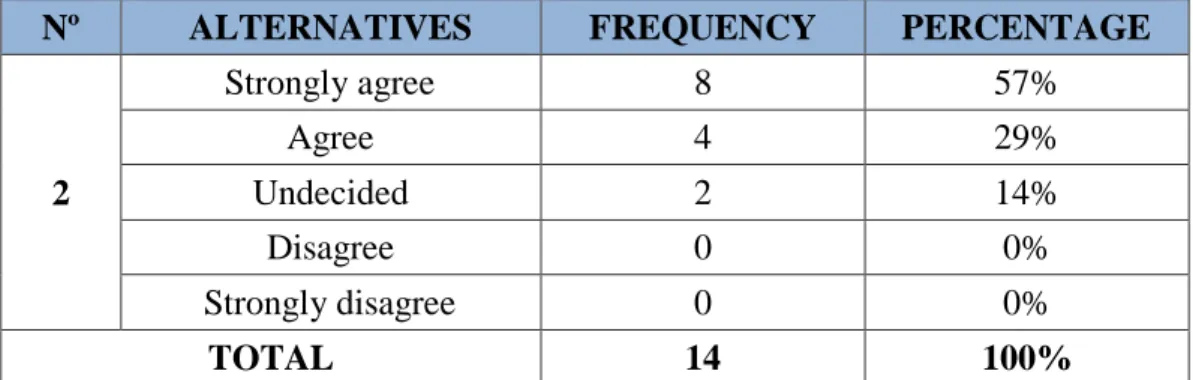
Chart Nº 10: Vocabulary role in the English Language Acquisition ... 61
Chart Nº 11: Application of Complementary Activities ... 62
Chart Nº 12: Activities for Learning or Practicing Vocabulary ... 63
Chart Nº 13: Didactic Resources for Teaching Vocabulary ... 64
Chart Nº 14: Didactic Resources to Facilitate the Vocabulary Learning ... 65
Chart Nº 15: Parents’ Willingness about Didactic Materials Application ... 66
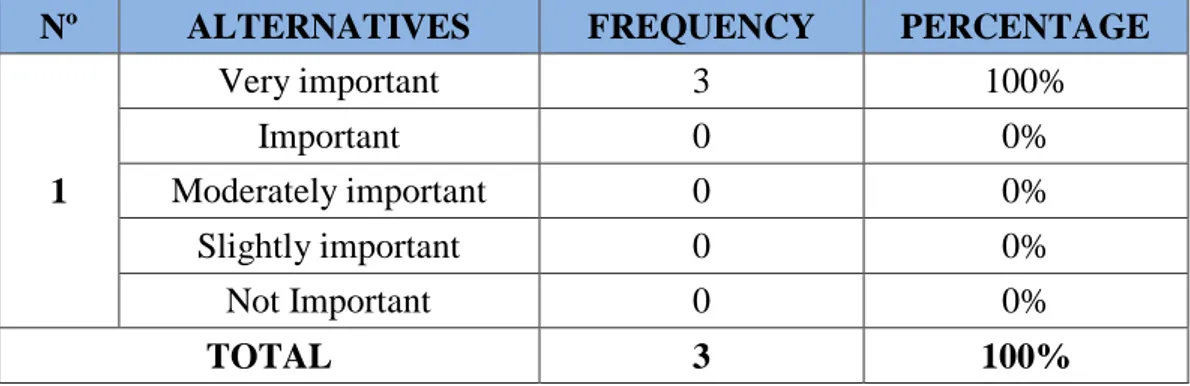
Chart Nº 16: Significance of Learning English for Students ... 67
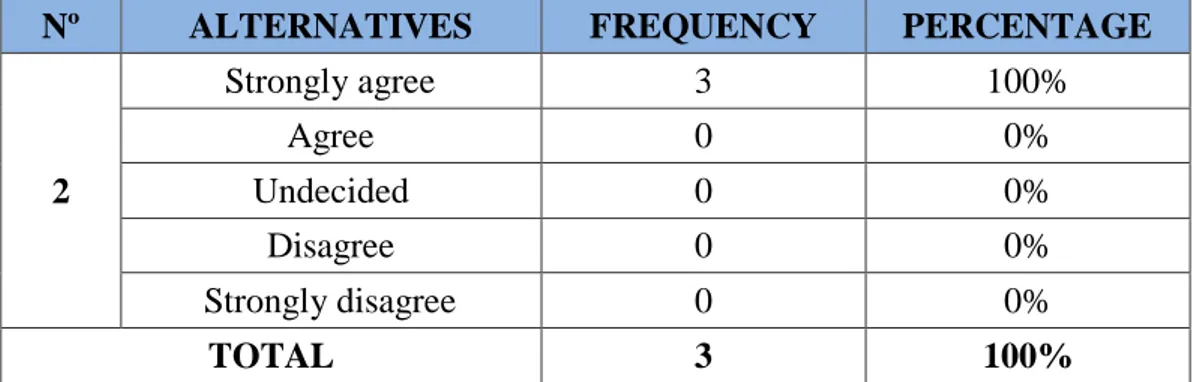
Chart Nº 17: Vocabulary Significance for Learning English Language ... 68
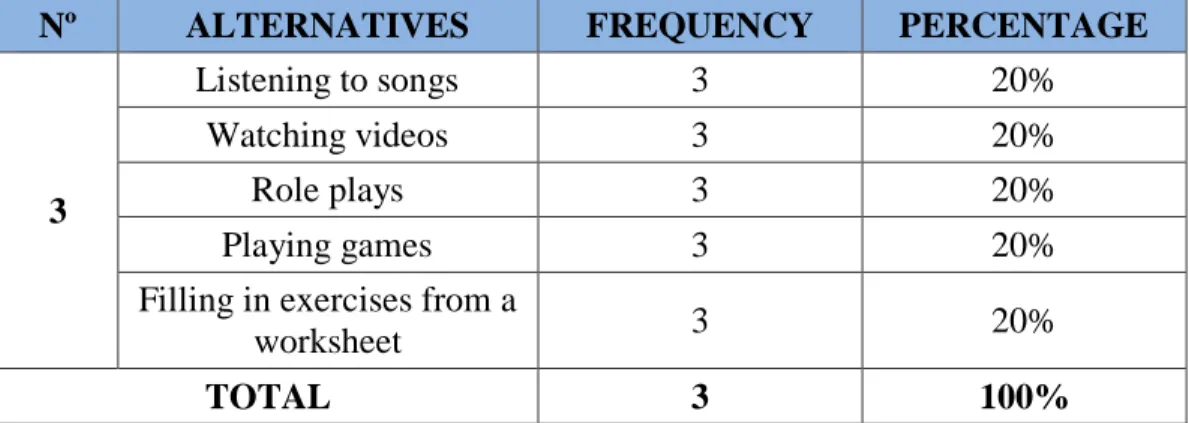
Chart Nº 18: Activities Used for Practicing Vocabulary ... 69
Chart Nº 19: Didactic Resources Applied by English Teachers ... 70
Chart Nº 20: Application of Didactic Materials ... 71
Chart Nº 21: Frequency of Didactic Resources Application... 72
Chart Nº 22: Benefits of Using Didactic Resources ... 73
Chart Nº 23: Results of Proposal Implementation ... 107
Chart Nº 24: Preschool students' improvement ... 108
Chart Nº 25: Timetable ... 112
Chart Nº 26: Laws from Constitution of Ecuador ... 134
Chart Nº 27: Laws from Childhood and Adolescence Code ... 136
Chart Nº 28: Articles from Educational and Intercultural Law ... 137
xvii GRAPHICS
Graphic Nº 1: Importance of Learning English ... 60
Graphic Nº 2: Vocabulary role in the English Language Acquisition ... 61
Graphic Nº 3: Application of Complementary Activities ... 62
Graphic Nº 4: Activities for Learning or Practicing Vocabulary ... 63
Graphic Nº 5: Didactic Resources for Teaching Vocabulary ... 64
Graphic Nº 6: Didactic Resources to Facilitate the Vocabulary Learning ... 65
Graphic Nº 7: Parents’ Willingness about Didactic Materials Application ... 66
Graphic Nº 8: Significance of Learning English for Students ... 67
Graphic Nº 9: Vocabulary Significance for Learning English Language ... 68
Graphic Nº 10: Activities Used for Practicing Vocabulary ... 69
Graphic Nº 11: Didactic Resources Applied by English Teachers ... 70
Graphic Nº 12: Application of Didactic Materials ... 71
Graphic Nº 13: Frequency of Didactic Resources Application... 72
Graphic Nº 14 : Benefits of Using Didactic Resources ... 73
xviii ILLUSTRATIONS
Illustration Nº 1: Problem Tree Analysis ... 5
Illustration Nº 2: Unidad Educativa “Carrera Sánchez Bruno” ... 79
Illustration Nº 3: Preschool Students ... 80
Illustration Nº 4: Location of Unidad Educativa "Carrera Sánchez Bruno" ... 80
Illustration Nº 5: Flashcards ... 85
Illustration Nº 6: Posters ... 86
Illustration Nº 7: Puzzles ... 87
Illustration Nº 8: Cards ... 87
Illustration Nº 9: Picture Books ... 88
Illustration Nº 10: Realia ... 89
Illustration Nº 11: Worksheets ... 89
Illustration Nº 12: Students recognizing numbers from 1 to 10 ... 91
Illustration Nº 13: Students recognizing transportation means ... 92
Illustration Nº 14: Students recognizing occupations ... 93
Illustration Nº 15: Students identifying colors ... 94
Illustration Nº 16: Students identifying geometrical shapes ... 95
Illustration Nº 17: Students recognizing commands ... 96
Illustration Nº 18: Students recognizing objects from the classroom ... 97
Illustration Nº 19: Students recognizing school supplies ... 98
Illustration Nº 20: Students identifying parts of the body ... 99
Illustration Nº 21: Students identifying parts of the face ... 100
Illustration Nº 22: Students identifying geometrical shapes ... 101
Illustration Nº 23: Students playing with their finger puppets ... 102
Illustration Nº 24: Students recognizing senses ... 103
Illustration Nº 25: Students coloring clothes ... 104
xix APPENDIX
Appendix Nº 1: Survey Applied to Preschool Students’ Parents ... 119
Appendix Nº 2: Survey Applied to English teachers ... 122
Appendix Nº 3: Interview Applied to the Principal ... 125
Appendix Nº 4: Interview Applied to the English Language Expert ... 127
Appendix Nº 5: Pre Test Applied to Preschool Students ... 129
Appendix Nº 6: Post Test Applied to Preschool Students ... 132
Appendix Nº 7: Laws from Constitution of Ecuador ... 134
Appendix Nº 8: Law from Childhood and Adolescence Code ... 136
Appendix Nº 9: Articles from Educational and Intercultural Law... 137
Appendix Nº 10: Preschool students’ names ... 138
Appendix Nº 11: Investigator during the interview with the principal ... 139
Appendix Nº 12: Students working on class ... 139
Appendix Nº 13: Students working on the proposal ... 140
Appendix Nº 14: Preschool Students working in class ... 140
Appendix Nº 15: The investigator during the proposal application ... 141
Appendix Nº 16: The investigator working with students ... 141
Appendix Nº 17: Request letter to apply the proposal ... 142
Appendix Nº 18: Acceptance letter to apply the proposal ... 143
Appendix Nº 19: Certification of the proposal application ... 144
Appendix Nº 20: Urkund report ... 145
xx PENÍNSULA OF SANTA ELENA STATE UNIVERSITY
FACULTY OF SCIENCES OF EDUCATION AND LANGUAGES ENGLISH LANGUAGE TEACHING CAREER
TOPIC:
“DIDACTIC MATERIALS TO TEACH ENGLISH VOCABULARY TO THE FIRST YEAR PRESCHOOL STUDENTS AT UNIDAD EDUCATIVA “CARRERA SÁNCHEZ BRUNO”, BALLENITA, SANTA ELENA PROVINCE, 2015-2016”
Author: Cielo Norma Peñafiel Viteri Advisor: Lcda. Sara González Reyes, MSc. ABSTRACT
The research paper “Didactic teaching materials to improve English vocabulary in preschool students” is divided into the theoretical and the practical part. The theoretical part provides a general aspect in teaching languages to children and their development. It also explains the basic terms and principles of teaching students and methods for children, suitable for these activities at this age. Recreational activities denote an important motivation for learning, because when the child plays, at the same time are learning or acquiring new information, experimenting, exploring and discovering their environment, and introducing them into games as teaching strategies provides them fun to stimulate the development of communicative competence. For the development of this investigation, it was important the application of different methods, such as, qualitative, quantitative, and deductive-indictive.for each method previously mentioned, different instruments were applied in order to collect information. The application of the qualitative method allowed the implementation of surveys; therefore, the principal from Unidad Educativa “Carrera Sánchez Bruno” and one English language teaching expert were interviewed providing current information about the vocabulary instruction and the importance of using didactic resources during this process. Moreover, the quantitative method allowed the application of surveys to the fourteen preschool students’ parents and English teachers; this collected information was included in this research paper by using charts and statistical graphics in order to present parents and teachers’ responses.
1 INTRODUCTION
The encouraging force and inherent interest in children for learning include games and ludic activities which constitute their own epistemological nature of human beings. Children’s play is considered as an activity of great potential in their social development and academic learning. It is also important to point out that child’s play is a psychological scenario where they can communicate with their peers; this process allow children inquire into their own thinking, test their knowledge and develop progressively in the interactive use of actions and conversations among equals.
Ludic activities refer to dynamic strategies that promote active learning involving students in doing things out of the routine and thinking about what they are doing. A ludic activity is a pedagogical task designed and applied in order to provide fun, enjoyment, and self-confidence, while attempting to increase learners’ motivation in a language learning experience. However, the application of ludic or recreational activities requires the application of certain didactic resources. Didactic resources are those teacher can use in order to improve the teaching process facilitating students’ comprehension and increasing their motivation in an objective way. The application of didactic materials, as pedagogical instruments or tools, contributes teachers to achieve any goal and students to develop their knowledge.
2 The implementation of didactic materials significantly improved the vocabulary knowledge of preschool students from Unidad Educativa “Carrera Sánchez Bruno” since they were applied during the vocabulary instruction. The design, creation and application of didactic resources mainly benefit preschool students since their application facilitate the understanding and assimilation of information and didactic resources motivate everyone involved in this process by implementing creativity that favors the emergence and formation of preschool students from the educational institution previously mentioned.
This research is structured in five chapters, which are divided into:
Chapter I – The Problem: In this chapter, the problem is described with its causes and consequences, it s also established its importance and it it also indicated the objectives of this research paper.
Chapter II – The Theoretical Framework: It provides details about previous studies about vocabulary instruction, legal basis and philosophical basis.
Chapter III – Methodology: This chapter explains the methodological strategies in order to make a successful investigation. This chapter also contains the levels of research, population, samples, techniques and tools for data collection, with graphical and statistical description of the results of the survey of teachers and preschool students’ parents of the Unidad Educativa "Carrera Sanchez Bruno” with the analysis and interpretation.
Chapter IV – The Proposal: In the proposal is detailed the didactic resources and activities implemented in order to improve the vocabulary instruction and knowledge of preschool students. Moreover, it provides the improvement results of students once the proposal was applied.
3 CHAPTER I
STATEMENT OF THE PROBLEM
1.1 Title
“DIDACTIC MATERIALS TO TEACH ENGLISH VOCABULARY TO THE FIRST YEAR PRESCHOOL STUDENTS AT UNIDAD EDUCATIVA “CARRERA SÁNCHEZ BRUNO”, BALLENITA, SANTA ELENA PROVINCE, 2015-2016”.
1.2 Statement of the Problem
1.3 Context
English is an important language for international communication. English is the world’s common language; it is spoken by more people around the world than any other language, and it is regularly defined as a really ‘global’ language. English has been established in different areas, such as, social, political and cultural factors which have influenced in its development. Furthermore, English has acquired a great place for lots of people around the world since it is necessary to communicate with people from other nations where English is the official or second spoken language.
4 Currently, the province of Santa Elena is not being left behind learning English as a foreign language. This province has a state university which bears its name and it has specialized in the English language career, where students develop their general ability to listen, speak, read and write in English. In private and public schools, the teaching of English is improving due to the necessity of share information with foreign people.
Unidad Educativa “Carrera Sánchez Bruno” is an institution that is upgrading its teaching methods and techniques. The various English presentations provide people a general knowledge about the advances of their students. Excellence in early childhood education is a wonderful goal that all teachers and authorities would like to achieve for all young children but, unfortunately, students from first basic year do not have enough didactic materials to work on their classes. The lack of didactic resources make teachers have to prepare their classes and try to find the adequate materials to use in the classroom, even by using their own things. It is real that there is not a specific guide or book for this level of education. Therefore, the design of didactic resources may allow students to facilitate their English learning.
In brief, this research intends to describe the most appealing and adequate didactics resources for teaching young students with fine and gross motor skills which are involved in smaller movements that occur in the wrists, hands, fingers, and the feet and toes. They participate in smaller actions, such as, picking up objects between the thumb and finger, writing carefully, and even blinking. These two motor skills work together to provide coordination.
1.4 Critical Analysis
5 Illustration Nº 1: Problem Tree Analysis
Source: Unidad Educativa “Carrera Sánchez Bruno” Author: Cielo Peñafiel Viteri
LOW ENGLISH VOCABULARY KNOWLEDGE OF PRESCHOOL STUDENTS FROM UNIDAD EDUCATIVA “CARRERA SÁNCHEZ BRUNO”
Application of traditional methods and strategies
by English teacher
Lack of didactic resources during the vocabulary instruction
Few hours for English language vocabulary
lessons Lack of ludic or
recreational activities for activating students’
motivation Students do not have the
opportunity to practice vocabulary
Preschool students do not have the opportunity
to practice vocabulary
Preschool students are not motivated for learning vocabulary
Vocabulary instruction is not constant and students forget vocabulary easily
CAUSE Nº 1 CAUSE Nº 2 CAUSE Nº 3 CAUSE Nº 4
6 As it was previously established in the problem tree, there are different reasons for the low level of English vocabulary knowledge of preschool students from Unidad Educativa “Carrera Sánchez Bruno”. One of the main reasons is the application of traditional methodologies and strategies by English teacher. Consequently, preschool students were being instructed in a non-didactic way.
Furthermore, the lack of didactic resources also affects the acquisition of new vocabulary since preschool students do not have suitable materials for working on English classes. Therefore, students may not feel engaged with the various topics that teacher introduces them; additionally, students do not have the opportunity to practice and they will not assimilate vocabulary. Didactic materials have an immense educative value since it gives students the opportunity of practicing and reinforcing what they have learnt in class.
A different reason for this problem is that teachers do not find interesting activities to encourage students practice vocabulary. Some English books do not include additional activities which promote the constant practice of vocabulary. As a consequence, preschool students are not engaged during the vocabulary instruction because oral or written drilling exercises are not the most appropriate exercises for preschool students; they do not want to learn new vocabulary and they are not participative.
7 To conclude, preschool students need to learn the more words they can since they have the ability to remember easily what they have heard before and obviously, it will be more practical for them when they have to use words in other aspects. Unidad Educativa “Carrera Sánchez Bruno” is open to receive new ideas or solutions for the problems that affect negatively in the English language learning of its students. Children love learning by working on interesting and educative tasks, but they do not have a special material designed for them. Therefore, the creation of activities and exercises will contribute preschool learners to increase their knowledge in this second language.
1.5 Formulation of the Problem
How can the learning of English vocabulary be improved to help preschool students at Unidad Educativa Carrera Sánchez Bruno?
1.6 Guideline Questions
What activities are preschool teachers applying to develop vocabulary?
How do preschool students learn a foreign language?
What are the activities that will allow preschool students to practice English vocabulary?
1.7 Delimitation of Research Object FIELD: Education.
AREA: English.
8 TITLE: “DIDACTIC MATERIALS TO TEACH ENGLISH VOCABULARY TO THE FIRST YEAR PRESCHOOL STUDENTS AT
UNIDAD EDUCATIVA “CARRERA SÁNCHEZ BRUNO” OF
BALLENITA, SANTA ELENA PROVINCE. SCHOOL YEAR 2015-2016”.
PROBLEM: Low English vocabulary knowledge of preschool students from Unidad Educatuva “Carrera Sánchez Bruno”
TIME LIMITATION: The research will be held during the academic year 2015-2016.
POPULATION LIMITATION: First Year Preschooler Students from Unidad Educativa Carrera Sánchez Bruno
SPACE LIMITATION: Unidad Educativa Carrera Sánchez Bruno
CONTEXT LIMITATION: This research will be focused on the influence of the creation of didactic materials for teaching English to the first year of Preschool students from Unidad Educativa “Carrera Sánchez Bruno”.
1.8 Significance
Watts (2014) states that “Pre-school and young school ages represent a unique time for a child to acquire a foreign language naturally, similarly to the mother tongue”. The vocabulary is the first thing that children learn from home, but in their native language. Children do not learn grammar to express themselves; they just use words they need to use according to their needs.
9 language by working either through games, worksheets or any didactic material that is entertaining for them. As a result of this, children will learn quickly and effectively.
This study will have a big impact on the improvement of English language teaching to preschool students who do not have specific material for practicing and updating their English knowledge. Children from the preschool level at Unidad Educativa “Carrera Sánchez Bruno” are going to benefit thanks to the development of this proposal since they will have the opportunity to work with special didactic material including a lot of didactic exercises.
These exercises will have different contents which will be very significant for the beneficiaries. It is known that kids have the power of learning all what adults teach them; words, phrases, expressions, and even attitudes. Through this investigation students will acquire new words of the English language which for sure will be useful for them when they learn to develop the other English skills; speaking, listening, reading and writing.
This research is possible since it has the approval of the principal of Unidad Educativa “Carrera Sánchez Bruno” and because the investigator has the desire of working on this assignment carefully and very motivated hoping that it has excellent results for children. Moreover, there are enough material, resources, and tools to achieve and develop this task.
1.9 Objectives
1.9.1 General Objective
10 1.9.2 Specific Objectives
1. To establish the most outstanding author’s investigations from different books, journals, and online publications for the development of the theoretical framework
2. To collect important information about the investigated topic by using surveys and interviews in order to present this information in charts and statistical graphics
11 CHAPTER II
THEORETICAL FRAMEWORK
2.1 Previous Research
The impact of a child’s early years on later development is widely recognized by early childhood educators and researchers. Economic, politic, and social forces are all focusing attention on the importance of these years for the child’s physical, emotional, language, cognitive, and cognitive development. Recreational learning has a significant power in the development of the foreign language learning in early education of children and in this process of starting school studies it is where it is required to find ways and alternatives to implement and strengthen interest in this learning. As a consequence of that, different investigations have carried out in order to determine the way in which preschool students acquire a language in a didactic way.
The teaching of English to young children has become especially important during the recent years. One reason for this has been the introduction of primary English as a Foreign Language teaching in a number of countries around the world becoming in a worldwide phenomenon. Scott and Ytreberg (1990) establish that some children develop early, some later: some children develop gradually, others in leaps and bounds.
According to Scott and Ytreberg (1990), it is not possible to say that children at certain ages can do certain actions. However, it is possible to point out certain young children’s characteristics which preschool teachers should be aware and take into consideration in their teaching process.
12 different characteristics and indentifies “younger” and “older” learners; these features are described in the illustration below:
Chart Nº 1: Characteristics of Young and Old Learners
Young Learners Old Learners
Children are at pre-school or in the first couple of years of schooling.
Children are well established at school and feel comfortable with school routines.
Generally, they have a holistic approach to language, which means that they understand meaningful messages but cannot analyzed language yet.
They show growing interest in analytical approaches, which means that they begin to take an interest in language as an abstract system.
They have lower levels of awareness about themselves as well as about the process of learning.
They show a growing level of awareness about themselves as language learners and their learning.
They have limited reading and writing skills, even in their first language.
They have well-developed skills as writers and readers.
Generally, they are more concerned about themselves than others.
They have a strong awareness of other people and their points of view.
They enjoy fantasy, imagination and movement.
They begin to show interest in real-life issues.
Source: Adapted from Nunan (2011) Author: Cielo Peñafiel Viteri
13 Therefore, language learning is understood as a major opportunity for the widening of children’s horizons.
Nunan (2011) claims that the term “young learner” covers a large chronological age span: from around three years of age to five and mentions that these learners have special characteristics and necessities. Nunan, in his same 2011 publication, manifests that the aim of teaching English to young learners (TEYL) is to provide them knowledge and skills in order for preschool learners to begin the acquisition process of a new language.
Weiss (2008) carried out an investigation about the learning process of preschool students from a public school in South Florida in which it was identified that 92% of preschool language-delayed students at the host facility did not make significant learning gains in receptive, expressive and overall language to master appropriate communication skills. This applied research aimed to increase receptive, expressive and overall language by implementing a multimodal program which involved the application of music. Such an intervention program supported preschool students mitigate their lack of expressions for communicating with their peers. As a result, preschool students were more motivated when engaging in the musical activity and then using words or expressions in short conversations, increasing overall language for later cognitive development.
2.2 PHILOSOPHICAL BASIS
2.2.1 Preschool Children
14 There are several definitions explaining the term preschool child in the context of the learning language. The term frequently relates to a very young learner corresponding to the children at the age of three to six, usually appearing in a kindergarten.
2.2.1 Characteristic of a Preschool Child
Although the average age of a very young learner has been defined, it is a big difference among children who are the same years old and those who are six, even older. Every child is different and develops a different method and pace. Phillips (1993) points out that it is the maturity of children that is more significant than their age. She also remarks a lot of issues that can influence how mature they are, including culture, environment, sex, expectation or their parents, and others. However, teachers should be aware about some specific characteristic of preschool children as they can significantly affect the learning process. The following characteristic can be considered as characteristic of the regular preschool child.
First, the most evident is the children’s request for individual attention. Children at this age try to get the teacher’s attention as much as possible by using numerous means; talking them, touching them or hugging them. Moreover, they are not able to pay attention for a long time and they get bored easily. It is supposed that they have a very short attention span. This fact should be taken into consideration when planning a class, and preparing activities for children for these ages.
15 children do not say anything during lessons, but start speaking or saying something in the target language at homes. Teachers should admit it as a normal thing.
Therefore, two different kinds of skills have to be separated receptive skills and productive skills. During the preschool period the focus is mainly on receptive skills (something known as passive skills) i.e. listening, because children do not need to produce the language, they receive and understand it with the help of their teachers.
On the other hand, main productive or active skills during preschool period are speaking; a lot of activities contain both receptive and productive skills. Children are regularly able to produce words by doing repetitive activities, such as, songs, rhymes, games, and plenty of choral work. However, when children do not want to produce anything, it is right to remain silent without teachers putting pressure on them.
Other characteristics of preschool children are defined by Scott and Ytreberg in their 1990 investigation. These features are listed below:
a) Children at this age are self-centered and cannot see things from someone else’s point of view. This usually results in unwillingness to play in a group or to share; they choose playing alone. Especially because they have their own playing habits and do not understand how others play and want them to do.
16 c) They know that there are some rules that they have to obey and even if they
may not understand some of them, it gives them the feeling of security.
d) For understanding children, they mainly use their hands, eyes and ears, which determine the physical world as leading.
e) Children generally love playing games. Learning process is more successful when children are enjoying themselves. On the other hand, they also like when something is done seriously since it gives them the sense of real work.
f) Children are positive about learning and want to learn. Therefore, teachers should encourage them and praise them all the time. It develops their enthusiasm and creates a good relation to learning.
2.2.2 Development of Preschool Children
This age is very important for children since it is the age of an enormous development in all the areas of their personality. It is both physical and mental development that should be considered when preparing teaching and practice materials for preschool children.
Children develop differently; some of them develop early, some later. There are also different types of development; children can develop gradually, in leaps or bounds. Dunn (2011) mentions that periods of rapid and focused development and limited advanced periods can appear at this age. Although it is a period of great changes, it is not possible to define exactly when the changes occur.
17 (1990) present the difference between five year old children and seven year old or older children on an example of joke as it is shown below:
Dad: “did you get a good place in the exams, Julie?”
Julie: “Yes, Dad, next to the heater.”
Five year old children would possibly laugh even when they do not understand the point of the joke. The reason why children laugh is because other people laugh as well. On the contrary, seven year old children find the jokes funny, but may not understand the point. Older children (about ten years old) are able to understand the point pretty easily.
2.2.3 Physical Development
Physical growth is connected with typical activeness and liveliness of children of this age. O’Connor and Daly (2016) determine that physical development is clearly about the development of movement and all the relevant stages contributing to locomotion, but it also includes the development of the brain, which is inextricably linked with the body development and vice versa. Children are dynamic; they run, jump and explore the world around them, which results from children’s natural interest.
Likewise, Meggitt (2006) establishes that children across the world pass for the same sequences of development, and within the same brad of time. Although the pattern is generally the same, it is important to point out that every child is unique. However, it is relevant to understand these patterns of change in order to promote children’s health and stimulate their all-around or holistic development.
18 that, Dunn (1988) suggests that teachers should let children move during lessons and so prepare some motored activities. On the other hand, Dunn (1988) also states that some activities may be difficult without development of muscular control. The quality of their motored coordination is improving and children are able to swim, ride a bike, ski and do other activities without problems.
Physical development is linked with children’s health and their ability to thrive and flourish. It is also important to point out that physical development has a fundamental role to play in all the other areas of learning. Preschool children’s fine motor skills are developing as well, including the development of eye-hand coordination. Children are able to use objects such as a pencil, scissors, spoon fork, knife, and toothbrush. Then, they can do simple actions, i.e. cutting and sticking. They can draw from simple animals or creatures to producing a very creative and meticulous work.
2.2.4 Cognitive development
Piaget (1977) identifies four developmental stages through which children demonstrate progress from their birth to adolescence. These stages are: sensori-motor, pre-operational, concrete-operational, and formal-operational. At the initial stage (sensori-motor), the child learns to interact with the environment by manipulating objects. Linguistically, this stage is characterized by the rapid growth of the child’s vocabulary. At the pre-operational stage, which extends from two to seven years old, children are egocentric and think the world revolves around them. Linguistically, at this stage children consolidate their grammar knowledge and acquire more vocabulary for the language production.
19 marks the end of the developmental process of children. At this period, children develop abstract thinking; this stage also marks the onset of puberty.
As it was established, learners go through significant developmental changes in their journey from childhood to adulthood. These stages and their psychological and social characteristics need to be taken into account at the moment of designing learning experiences and creating tasks and materials for learners at different stages. Nunan (2011) mentions that word-play activities, such as, rearranging unscrambled letters to make words are excellent for motivating children to learn vocabulary. Learning new vocabulary with a great agility and speed is one children’s feature, but their learning is dependent on the range of words they are exposed to. Teachers can naturally facilitate children’s vocabulary using a variety of tactics, including making conversations, role plays, simulations, and others using appropriate material.
Furthermore, it is important to encourage children’s vocabulary development since it is required to develop the language and knowledge in order to succeed in school. In fact, the number of words a child is exposed by their parents, relatives, or peers directly relates to the magnitude of the child’s vocabulary. Preschool English language learners arrive in school with a very limited vocabulary. According to Graves, August, and Mancilla-Martinez (2012), preschool students need to acquire oral vocabulary since they are not able to produce the language in its written way and, for such children, building a basic oral vocabulary of the most frequent words is of utmost importance, and they need to acquire this vocabulary as soon as possible.
20 starts to play an important role. Thus, it is important to support mental development by constant repletion.
Social development includes the growth of children’s relationships with other people. Meggitt (2006) states that “Socialization is the process of learning the skills and attitudes that enable the child to live easily with other members of the community”.
2.2.5 Language Development
Children are born with the inherent ability of learning a language by listening to it in their environment. Parents are the first language instructors since they provide their kids basic words and thus children start developing the language. Soon, children move from using language to state needs and identify objects and people to express opinions, ideas, questions, and answers.
According to the general idea of language development, children should be capable of understanding the major grammar rules and syntax in their own language at the preschool age. Scott and Ytreberg (as cited in Cameron, 2001) mention that preschool children have several skills about general language development, namely “to understand abstract, understand symbols and generalize and systematize”. Likewise, when young learners begin producing texts, it is motivating, engaging, and fun to get them copy and replicating a wide range of words since they are likely to encounter those words in the world outside the classroom.
21 also which mother tongue the children speak as well as some emotional and social influences should be involved.
Besides, children are able to recognize what is similar and what is different; they also understand how to sort, classify and match things. Teachers can include jigsaw, puzzles, pair, and “odd one activity”. They are able to follow a story, predict what might come next and ask questions about it. They can use imagination to invent their own stories”.
2.3 PSYCHOLOGICAL BASIS
2.3.1 Development Psychology Theories
One of the most important psychologists who have dedicated his life studying children’s cognitive development is Jean Piaget (1896 – 1980). His constructivist theory was completed after long observations of children doing activities and exercise prepared for them. Children face a problem that they have not met before. Cameron (2011) arguments that knowledge after solving the problem is “actively created” by the children. Piaget was worried especially with “how young children function in the world that surrounds them, and how this influences their mental development”.
22 Piaget (1977) distinguishes four stages in which thinking is developed. It is a process of gradual growth during which children experience some changes. “At every stage the child is capable of some type of thinking but still incapable of others.”
The most famous representative of social constructivism is Lev Vygotsky (1896-1934), a famous Soviet psychologist as contradictory to Piaget, he considered the role of language is more important in children’s cognitive development. The main difference between Piaget’s and Vygotsky’s opinion is that Piaget emphasized children’s own actions and the way they solve new problems, but Vygotsky found that the company of other people is crucial for the learning of children. According to Vygotsky’s theory, every child is different and so he/she learns certain skills in different ways when compared to another, depending on their intelligence; their intelligence then cannot be measured when the child is alone, but when he/she is accompanied by other people.
Vygotsky (as cited in Charlesworth, 2010) emphasized learning self-regulation through play; that is, children learn rules of social interaction though play. Vygotsky (1980) states that “Scaffolding is a process through which an adult supports the child’s language development reinforcing the child’s efforts at verbal expression”. On other words, Vygotsky (1980) sees the role of other people as an essential part of children’s development. Such people adopt the role of educators and help children to do actions they are not able to do alone until they are capable of doing them on their own. Vygotsky’s ideas can significantly influence teachers, especially in the question of lesson planning since they should understand that they are those who are in charge of a very important decision “what next the child can learn”.
In addition to above, Vygotsky (1980) defines the zone of proximal development.
23 This concept divides the knowledge which is achieved by their own and that achieved with the help of other people or educators. Both agree that children are learners who actively construct knowledge.
2.3.2 The Theory of Learning versus Language Acquisition
Krashen (2013) claims that there is a difference between learning and acquisition: While acquisition is a subconscious process that is identical to the process used in the first language acquisition, learning is conscious knowledge, or knowing about language. According to Krashen (2013), there are two separate systems of second language acquisition; the acquired system and the learnt system. The acquired system is the result of a subconscious procedure, almost identical to the procedure children follow when they acquire their first language. It requires the natural communication and interaction with native-speakers. The learnt system is the result of a formal guidance and it involves a conscious process resulting in deliberated knowledge about the language.
Taking into account assumptions from this theory, Harmer (2012) arguments that language which is acquired subconsciously, it is language we can easily use in spontaneous conversation since it is instantly available when we need it. Language that is learnt, on the other hand, taught and studied as grammar and vocabulary is not available for spontaneous use.
24
2.3.3 Language Input
In the area of foreign language acquisition, it is more relevant the concepts of language input (reception) and language output (production) than speech skills. Experts are debating an empirical answer on the question about which role is more important, whether the one of language input or output.
The main language input that children are exposed is maternal speech – the speech of mothers communicating with children. Mother usually speaks slower, use shorter words and simple structures, repeat questions and there is also frequency of diminutives. Moreover, mothers are supposed to have a very important ability to adapt their speech to a phase of children’s language development which they can recognize. Therefore, teacher’s speech should be like mothers’ speech in order to achieve successful acquisition.
2.3.4 Preschool child as a learner
Very young learners are generally known as adaptive learners. However, this is achieved only when optimal conditions for learning are established. It means that children should be allowed to learn in their own way and step and they should give opportunity to follow their natural curiosity and need of exploring the world.
Slattery and Willis (2003) give a description of children as learners:
a) They develop very fast as individuals.
b) There are various ways in which they learn, such as, observation, listening or actions.
25 d) They try to understand the given situation by the practice of non-verbal
means.
e) They use their mother language to speak about thinks they understand and about what there are doing.
f) They are usually able to imitate sounds they hear.
g) They are natural curious.
h) They involve their imagination in learning,
i) They accept known and repeated activities well, they like routine,
j) They are able to pay attention for a very short period of time, they need variability in learning.
As it was already mentioned, every child is unique. Teachers should realize that every learner acquires information or knowledge in different ways; children have their own learning style. The teaching approach that incorporates all types of learning styles (visual, auditory and kinesthetic) is known as multisensory approach. It is based on the belief that learners learn best when the given information is presented in different modalities, such as, hearing, seeing, touching or tracing. Thus, children can use their hands, eyes and ears to learn and understand.
2.4 PEDAGOGICAL BASIS
2.4.1 Various Conditions of Learning English
26 different teaching strategies to meet the aims and objectives of the learners”. In the Republic of Ecuador, children can learn English in several environments and attend various courses. Most of the courses take place in kindergartens.
Learning English language at preschool age is very common, nowadays; a lot of English teachers who are teaching older learners or adults have become teachers of very young children. They may be well trained and aware of specific teaching methods since children learn in a different way than adults. However, they usually see their learners once per week (for 45 minutes) and so there is not enough time to know them properly; the teaching process is not the adequate and learning process is not constant. Additionally, the time of the lesson is determined and children have participated even if they are not in the right mood for learning, or they are even forced by their parents.
This kind of learning has to be contrasted with activities done in an abstract level and out of context. In order to achieve a successful learning, children need to develop their thinking and critical skill since they need to solve problems using their critical reflection; as an active process, learning is most effective and efficient when learners are engaged in learning by doing.
2.4.2 Early Language Learning
Early language is the precursor to literacy. Language experiences help children acquire the auditory discrimination skills they need to identify speakers and then to discriminate between specific sounds. Gunzenhauser and Fisch (2012) state that “Children learn sentence structure, vocabulary, and meaning through oral language. They then look for and apply these conventions as they acquire literacy”. Hence, the more meaningful language experience preschoolers have, the more easily they strengthen their communicative skills.
27 foreign language is about ten years old or even before those years. The reason is because very young children have not developed their communication skills yet, and they always need to be given the most attention, which can significantly spoil the learning process. She also thinks that they are not able to pay attention to a foreign language and so cannot use it properly.
Nevertheless, Pinter (2011) claims that although children in non-English environments have limited opportunities to practice the language outside school and do not have an immediate need or clear motivation to use and learn English, introducing children to a new language offers opportunities to extend their horizons and awaken their early enthusiasm and curiosity about languages.
Bland (2015) claims that it has often been stated that one of the principal advantages of learning languages at early ages is the high level of motivation for engaging in enjoyable and new experiences that children have. It is important to emphasize on the relevance of balancing enjoyment with cognitive engagement of the activity in order to stimulate motivation. This argument is related to the role of play in early childhood as part of the developmental process of children.
2.4.3 Advantages of Early Language Learning
28 Dunn (2011) states that “children learn language naturally and unconsciously”. For an effective language development, children need to be stimulated: Children at this age are very good at imitating, which enables them to catch and produce intonation and pronunciation very well. As a result, children can develop their skills and abilities at the level of a native speaker when they are given the opportunity to experience. Dunn (2011) lists the main advantages of learning a new language from early ages. These advantages are listed below:
a) It has a great impact on improvement of their study skills.
b) Children learn how to learn.
c) Children become more adaptable and tolerant.
d) It helps them to see their mother tongue from different points of view, i.e. by means of different grammar.
2.4.4 Disadvantages of Early Language Learning
On the contrary, there are several authors and experts who point out that learning a new language from early ages has some disadvantages. It is known that children, in some cases, are not cooperative since they want to do what they want; this may be followed by common changes of mood; this is because children are emotionally unstable. Sometimes it might even happen that children are misbehaving and angry in order to achieve what they want. For this reason, their behavior can significantly spoil the lesson and children’s strong emotiveness can affect the development of classes and teachers may loss the control over children’s activity.
29 concluded that all teachers of preschool children must be patient enough even if it means that they spend a lot of time just organizing children.
Humlíčková (2015) mentions that early language learning does not always have positive results. It depends mostly on teachers and quality of their teaching methods. Although teachers may have a great deal of enthusiasm and they may love young children, they are usually not well-trained in the methodology of preschool teaching. Unfortunately, there some teachers who do not apply didactic strategies during the development of their lessons. Moreover, it is important to emphasize that teachers are the main responsible for children’s success since it depends on his/her ability to set up positive and friendly learning environment for children.
Krashen (2013), who is famous for his theory of language acquisition, also hesitates whether early language learning (i.e. English in this case) brings benefits. He thinks that when children do not live in English environment e.g. an English speaking country, they are not given many opportunities to speak English and the intended effect is not achieved, as well as native accent that is not acquired.
2.4.5 Teaching English to Preschool Children
Teaching preschool children is very specific and sometimes difficult. However, according to Cameron (2001), teaching children is seen as an extension of mothering rather than as an intellectual process. Teachers from preschool students are often given less training and lower status than their colleagues in the same educational system who teach older children or teenagers.
30 understandings towards more formal, more extensive and differently organized concepts. Cameron (2001) stresses that preschool teachers need to understand how children make sense of the world and how they learn.
Therefore, it brings some advantages as well as difficulties for teachers. Teachers in primary and secondary educational institutions follow syllabuses, written tests, and assign homework to their students very often. As opposed to that, teachers of preschool children can enjoy the lessons more. They are not forced to include particular activities and follow severe curriculum, therefore, children’s favorite game or activity can be repeated several times, even every lesson. Reilly and Ward (1997) establish that children are also less shy and so they are not afraid to be imaginative and they are not yet bound by the constraints that demand that adults be logical.
Teaching young children depends on their development stage. Activities that demand some skills that are not yet developed cannot be included. For those reasons, teachers should choose activities that are appropriate for the group not bellow their intellectual level or too childish for them (Phillips 1993). Preschool children have also typical characteristics that have to be followed.
Children are not in a good mood every lesson, but they can be selfish and uncooperative. The most important fact that teachers should know about teaching preschool children are summarized by Phillips (1993):
a) The activities should be simple enough for children to understand what is expected from them.
b) The task should be within their abilities: it needs to be achievable but at the same time sufficiently stimulate for them to feel satisfied with their work,
31
2.4.6 Principles of Preschool Teaching
Teaching preschool children should be done in an enjoyable way, because it determinates their attitude towards language learning. Children should feel safe and do not be afraid of participating in all activities and games. Teachers’ task is to set up a friendly atmosphere and prepare activities suitable for them, such as, games, songs, chants, and others. According to Hennovà (as cited in Humlíčková, 2015), at the moment of teaching preschool children and preparing lessons, several principles have to be followed:
a) Adapt activities to current situation and atmosphere in the classroom.
b) Revise and repeat everything children have already learnt, it gives them sense of security and develops their self-confidence.
c) Change activities very quickly, calming activities are followed by dynamic, and creative.
d) Do not include grammar rules, children do not understand them.
e) Do not be angry when children use their mother tongue, but encourage them to use the target language.
f) Use authentic songs, rhymes, poems, stories, and others.
g) Use gestures, mimes and non-verbal expressions that children understand easily.
h) Make the lesson entertaining; use fantasy to develop natural curiosity of children.
32 j) Use familiar topics based on children’s experiences, family and home.
k) Repeat activities and games that children know and like.
Chart Nº 2: Principles of Preschool Teaching
COMPETENCE ACTIVITIES
Learning Competence
Vocabulary tool, Activities focused on both gross and fine motor Skills (especially eye-hand coordination), introduction to the foreign language learning and its motivation, revision of vocabulary and things they learn, using visual and other aids
Communication competence
Drama and story acting, development of pronunciation and intonation using songs, chants etc., giving the foreign language in the same way as the mother tongue, imitation
Problem–solving competence
Working with worksheets, using gestures and movements to express the meaning, finding out the differences (i.e. two pictures). Categorization of terms
Social and personal competence
Communication in the classroom (groups, pairs), expressing own feelings or feelings characters from stories, using puppets or other characters from stories, praising and evaluating children`s results, reminding children`s birthday and national festivals (i.e. Christmas) Civil and
professional competence
Working with different materials, using gestures, signals and other symbols in order to change an activity,
beginning and ending the lesson Source: Taken from Humlíčková (2015)
33
2.4.7 The Role of Teacher
Preschool children, who are at their beginnings of learning, are not responsible for their own learning it is the teacher who children depend on. Teacher’s task is to apply methods in order to develop children’s English language knowledge. There is a kind of personal relationship that is necessary for successful learning process. According to Dunn (2014), teachers present not only language but also culture that is associated with learning foreign languages
According to Horkà and Syslavà (as cited in Humlíčková, 2015), there are certain qualities that preschool teachers should possess, and they are necessary for the development of each individual:
a) Acceptance (to tolerate others and accept everyone positively).
b) Empathy (to be able to identify other people’s feelings and try to understand them).
c) Authenticity (to behave truly, naturally, do not hide emotions and be yourself)
Other qualities of preschool teachers are methodology competences and good attitude to the target language and motivation to its studying.
2.4.8 Languages in the Classroom