
INSTITUTO TECNOLÓGICO DE COSTA RICA
VICERRECTORÍA DE INVESTIGACIÓN Y EXTENSIÓN
DIRECCIÓN DE PROYECTOS
ESCUELA DE INGENIERÍA FORESTAL
CENTRO DE INVESTIGACIÓN EN INNOVACIÓN FORESTAL
INFORME FINAL DE PROYECTO DE INVESTIGACIÓN
MODELAJE DEL PORCENTAJE DE DURAMEN, MÓDULO DE ELASTICIDAD DINÁMICO Y DENSIDAD DE PLANTACIONES FORESTALES DE Tectona grandis L.f. DE RÁPIDO
CRECIMIENTO ESTABLECIDAS EN COSTA RICA
Código: 1401063
(DOCUMENTO I)
INVESTIGADORES:
Ing. Alexander Berrocal J. Dr. Ing. Roger Moya R. Dr. M.Sc. Johanna Gaitán Álvarez
INFORME FINAL DE PROYECTO
“Modelaje del porcentaje de duramen, módulo de elasticidad y densidad de plantaciones forestales de Tectona grandis L.f. de rápido crecimiento establecidas en
Costa Rica”
ÍNDICE GENERAL
Pág.
1.
Intrducción ... 4
2.
Artículo 1. Heartwood formation and prediction of heartwood parameters
in Tectona grandis L.f. trees growing in forest plantations in Costa Rica. ... 9
3.
Artículo 2. Modelos de predicción de la altura máxima, diámetro, volumen
y trozas con duramen en árboles de Tectona grandis creciendo en
plantaciones de rápido crecimiento en Costa Rica. ... 28
4.
Artículo 3. Development of heartwood, sapwood, bark, pith, specific
gravity and dynamic modulus of elasticity of teak (Tectona grandis) in
fast-growth plantations in Costa Rica. ... 55
INFORME FINAL DE PROYECTO
“Modelaje del porcentaje de duramen, módulo de elasticidad y densidad de plantaciones forestales de Tectona grandis L.f. de rápido crecimiento establecidas en
Costa Rica” Resumen general
La madera de duramen es la parte más importante del árbol en
Tectona grandis
L.f.
Aunque existen varios modelos de predicción de volumen total (albura y duramen) en
esta especie, no existen modelos de predicción de duramen únicamente. El objetivo
del presente trabajo fue desarrollar modelos matemáticos para predecir la altura
máxima del duramen (HWh), el diámetro (HW
diameter), porcentaje (HW
percentage),
volumen y cantidad de trozas comerciales con duramen, de árboles de
T. grandis
de
plantaciones de rápido crecimiento, utilizando variables de fácil medición como
diámetro a la altura de pecho (DBH), altura total (Ht) y edad. Diferentes modelos
fueron utilizados para establecer las ecuaciones de los parámetros del duramen con
las variables predictoras. Se muestrearon en total 54 plantaciones en cinco regiones
de Costa Rica, seleccionando 3 árboles por plantación. Los modelos seleccionados
para predecir el HWh, HW
diametery para el volumen de duramen incluyen el DBH y
la Ht en
los
modelos.
Para HWh y
volumen
el
modelo
propuesto
es
Y= β1+β2*Ht+β4*DBH con coeficientes de correlación de R=0.85 y 0.75
respectivamente y la ecuación del perfil del fuste para determinar los
diferentes HW
diameterfue diHW2DBH2=−1.56
∗
(hiHt−1)+0.90
∗
(hi2Ht2−1), con R=0.96.
En relación a la cantidad de trozas con duramen (diámetro mínimo de 7 cm) y la
cantidad de trozas varía de 1, en árboles de 12 a 14 cm al DBH a 8 en diámetro de
INFORME FINAL DE PROYECTO
“Modelaje del porcentaje de duramen, módulo de elasticidad y densidad de plantaciones forestales de Tectona grandis L.f. de rápido crecimiento establecidas en
Costa Rica” 1. Intrducción
La teca (Tectona grandis L.f) es la especie tropical de mayor importancia en los climas
tropicales para la reforestación comercial (Moya et al., 2014). Esta especie es originaria del
sureste asiático específicamente de la India, Laos, Myanmar y Tailandia (Gyi & Tint 1998;
Pandey & Brown, 2000). Sus plantaciones se han expandido ampliamente a las zonas
tropicales de América Latina, Asia, África y Oceanía (Ball et al., 1999 FAO, 2006) y es de
considerable importancia comercial dentro de Costa Rica (Pérez y Kaninnen, 2005a; Moya,
2002) y otros países de esta región. En el último tiempo ha sido identificada como una
especie con potencial para producir madera de alta calidad (Bhat, 2000; Bhat et al, 2001),
esto debido a sus propiedades superiores (Moya y Pérez, 2008) y su color que la favorecen
dentro del mercado (Tewari, 1999; Thulasidas etal, 2006; Zobel y Sprague, 1998)
Por otra parte, la presencia de una relativa alta proporción de duramen en los árboles de teca,
hacen que sea una especie excelente para la industria del aserrío y elaboración de productos
de mayor valor agregado (Hegde et al., 2014). Por tanto, el duramen presente en los árboles
de T. grandis representa la parte del tronco más valiosa para su comercialización (Lourenço
et al., 2015).
Así mismo, otra propiedad que está relacionada con la calidad en la madera, que además
puede considerarse una caracterización mecánica de la misma, es el módulo de elasticidad
dinámico (MOEd); que mide la rigidez en la madera, esta propiedad cambia con la edad y
posición de la pieza en el árbol (Kuprevicius et al., 2013). Las características anatómicas de la
madera se relacionan directamente con el MOEd (Zheng y Martínez, 2013), por lo que las
condiciones de crecimiento del árbol afectan esta propiedad.
Finalmente de las propiedades ampliamente estudiadas en teca, pero que es altamente
relevante, es la densidad; ya que este parámetro es una medida indirecta de otras
propiedades (Sinha et al., 2017); que se relacionan con la anatomía de la madera (Zobel y
Van Buitjen 1989). La densidad de teca se caracteriza por ser sumamente variable, en
especial en la madera proveniente de plantaciones de rápido crecimiento (Moya et al., 2014).
INFORME FINAL DE PROYECTO
“Modelaje del porcentaje de duramen, módulo de elasticidad y densidad de plantaciones forestales de Tectona grandis L.f. de rápido crecimiento establecidas en
Costa Rica”
adecuadamente establecidos para las diferentes condiciones de crecimiento en las nuevas
áreas de reforestación.
Basados en lo anterior, el objetivo de este estudio fue modelar la variación del porcentaje de
duramen, módulo de elasticidad dinámico y perfiles de densidad de árboles de Tectona
grandis de plantaciones forestales de rápido crecimiento establecidas en Costa Rica.
El estudio se realizó en distintas zonas de Costa Rica y fueron muestreadas un total de 54
plantaciones con edades entre 2 y 24 años. De cada plantación se extrajeron 3 árboles, para
un total de 162 árboles provenientes de diferentes edades, procedencias, sitios y manejo
silvicultural. Diferentes análisis para evaluar y caracterizar el volumen, el MOEd y los perfiles
de densidad por edad, por sitio y por altura fueron realizados.
Los resultados mostraron que el ancho de albura es mayor entre los 2 y 10 años que entre los
10-22 años. El duramen comienza a aparecer en la parte basal de los árboles entre los 2 y 3
años, pero no aparece al dap (diámetro a la altura del pecho) hasta los 3 a 4 años de edad. El
duramen desaparece a un rango de altura entre el 0 a 90 % de la altura total, dependiendo
de la edad del árbol. Finalmente modelos de predicción fueron desarrollados para el espesor
de albura, radio de duramen, altura máxima del duramen, porcentaje y volumen de duramen
utilizando el modelo Y = K0 + K1*(espesor de albura) + K2*(altura relativa) + K3*(dap) + K4*(edad
del árbol). Estos modelos mostraron coeficientes de 70 %, 90 %, 95 %, 73 % y 31 %,
respectivamente.
Los modelos seleccionados para predecir la altura de duramen, diámetro de duramen y para
el volumen de duramen incluyen el dap y la altura total en los modelos. Para la altura de
duramen y volumen el modelo propuesto es Y= β1+β2*Ht+β4*DBH con coeficientes de
correlación de R=0.85 y 0.75 respectivamente y la ecuación del perfil del fuste para
determinar los diferentes diámetros de duramen fue diHW2
DBH2 = −1.56 ∗ (
hi
Ht− 1) + 0.90 ∗
(Hthi22− 1) con R=0.96. En relación a la cantidad de trozas con duramen (diámetro mínimo de 7
cm), la cantidad de trozas varía de 1 en árboles con un dap entre 12 a 14 cm, hasta 8 en
INFORME FINAL DE PROYECTO
“Modelaje del porcentaje de duramen, módulo de elasticidad y densidad de plantaciones forestales de Tectona grandis L.f. de rápido crecimiento establecidas en
Costa Rica”
La región donde las plantaciones crecieron no mostró efecto en el dap, altura total, diámetro
de duramen y de médula y espesor de albura y de corteza. La edad y la densidad de rodal
mostraron correlación estadísticamente significativa con el dap y la altura total del árbol. El
duramen comienza a desarrollarse a los 4 años de edad y su proporción incrementa con la
edad. La proporción de corteza permanece constante a lo largo del árbol, mientras que el
porcentaje de corteza incrementa en árboles antiguos y a mayores alturas. El diámetro de
corteza y el módulo de estabilidad dinámico (MOEd), medido para los árboles en pie, no
mostraron correlación con la edad, mientras que el peso específico presentó una correlación
positiva con la edad.
Finalmente, en el estudio se encontró que el perfil de densidad de la madera muestra un
comportamiento creciente de la densidad con respecto a la edad del árbol. En la marcación
de los anillos de crecimiento se establecieron 5 tipos de perfiles de densidad a través del
anillo anual. Además se encontró que los árboles con edades inferiores a 8 años o en la parte
interna de los árboles, el perfil de densidad de la madera no mostró adecuadamente el límite
del anillo de crecimiento; por lo que en esta condición se debe complementar la identificación
de los anillos con una preparación visual. En árboles adultos, el perfil de densidad de la
madera sí mostró la marcación de los anillos de crecimiento, no obstante si se acompaña con
una identificación visual es más acertada la marcación de los anillos. Entonces el estudio
dendrocronológicos de estos árboles debe ser una combinación de densitometría rayos-X con
una identificación visual. En relación con el límite entre albura y duramen, el perfil de densidad
de la madera mostró un descenso de la densidad de la madera en esta sección, sin embargo
no es una técnica apropiada para su uso como indicador de esta zona, debido a la
variabilidad existente.
En relación a los principales logros obtenidos en este proyecto se pueden mencionar:
1. Una tesis del programa de Maestría en Ciencias Forestales titulada: “Modelado de
parámetros de albura y duramen en árboles de Tectona grandis L.f. en plantaciones
forestales de distintas edades en Costa Rica” del estudiante David Fernández Solís
INFORME FINAL DE PROYECTO
“Modelaje del porcentaje de duramen, módulo de elasticidad y densidad de plantaciones forestales de Tectona grandis L.f. de rápido crecimiento establecidas en
Costa Rica”
2. Cuatro artículos científicos, uno de los cuales ya fue publicado (Revista Bois et Forests
des Tropiques), otro fue aceptado con modificaciones (Revista Journal of Forestry
Research), uno fue sometido (Revista Annals Forest Research) y uno está en edición
para ser sometido a la Revista Dendrochronologia.
A partir de los resultados generados surgen algunas interrogantes que deberían ser
abordadas a través de estudios posteriores en la misma línea:
a) Ampliar el número de unidades de muestreo en las regiones, idealmente en la Zona
Norte, con el fin de abordar el estudio de duramen, resistencia mecánica y perfiles de
densidad por zonas de crecimiento y su relación con los datos obtenidos a nivel
nacional.
b) Profundizar en el estudio de la relación entre la altura de la última rama con formación
de duramen y la altura máxima del fuste donde se observa madera de duramen, con el
fin de crear un indicador que permita caracterizar la calidad de plantaciones forestales,
donde el volumen de duramen es muy relevante.
c) Ahondar el estudio de los perfiles de densidad de la madera, técnica que permitiría
generar un mayor conocimiento de las propiedades fisicomécanicas de la madera de
teca con un nivel de dealle mayor que las técnicas tradicionales, considerando el
hecho que la densidad es un excelente predictor de otras tantas propiedades físicas y
mecánicas de la madera.
Finalmente, con respecto a los beneficios inmediatos y futuros de los resultados obtenidos se
debe destacar:
a) Un incremento en el acervo de información de teca disponible a nivel nacional, con
información relevante de plantaciones de rápido crecimiento en diferentes zonas del
país, con posibilidad de ser utilizada a nivel regional en materia de modelación del
INFORME FINAL DE PROYECTO
“Modelaje del porcentaje de duramen, módulo de elasticidad y densidad de plantaciones forestales de Tectona grandis L.f. de rápido crecimiento establecidas en
Costa Rica”
b) Un aportar significativo la productividad académica de la Escuela de Ingeniería
Forestal y del Instituto Tecnológico de Costa Rica, a través de cuatro publicaciones en
índices superiores (Scopus y Web of Science).
c) Haber generado modelos matemáticos para diferentes variables tales como espesor
de duramen, volumen de duramen, diámetro de duramen, espesor de albura, espesor
de corteza, espesor de médula, MOEd, peso específico entre otros, que contribuyen al
manejo de plantaciones forestales de rápido crecimiento de teca. Mención especial
especial es para el modelo predictor del diámetro de duramen, que tendría una
aplicación práctica relevante por la forma en que se cuantifica y comercializa la
madera en el país.
d) Contar con una base científica adecuada para futuros relacionados con los temas
abordados en el proyecto, de tal forma que pueda incrementarse la información de
propiedades de la madera de teca proveniente de plantaciones de rápido crecimiento,
incrementando de esta forma la información existente a nivel nacional e internacional
INFORME FINAL DE PROYECTO
“Modelaje del porcentaje de duramen, módulo de elasticidad y densidad de plantaciones forestales de Tectona grandis L.f. de rápido crecimiento establecidas en
Costa Rica”
2. Artículo 1. Heartwood formation and prediction of heartwood parameters in Tectona grandis L.f. trees growing in forest plantations in Costa Rica.
HEARTWOOD FORMATION AND PREDICTION OF HEARTWOOD PARAMETERS IN
Tectona grandis L.f. TREES GROWING IN FOREST PLANTATIONS IN COSTA RICA
David FERNÁNDEZ-SÓLIS
Instituto Tecnológico de Costa Rica, Escuela de Ingeniería Forestal, Apartado 159-7050, Cartago, Costa Rica. Email: [email protected]
Alexander BERROCAL
Instituto Tecnológico de Costa Rica, Escuela de Ingeniería Forestal, Apartado 159-7050, Cartago, Costa Rica. Email: [email protected]
Róger MOYA*
Instituto Tecnológico de Costa Rica, Escuela de Ingeniería Forestal, Apartado 159-7050, Cartago, Costa Rica. Email: [email protected]
INFORME FINAL DE PROYECTO
“Modelaje del porcentaje de duramen, módulo de elasticidad y densidad de plantaciones forestales de Tectona grandis L.f. de rápido crecimiento establecidas en
Costa Rica”
Heartwood formation and prediction of heartwood parameters in Tectona grandis L.f. trees growing in forest plantations in Costa Rica
Abstract
The aim of this work is to establish heartwood variations (percentage, diameter, radius, volume) in relation to tree height and sapwood thickness. In addition, the age at which heartwood formation begins and the maximum heartwood height in Tectona grandis trees were studied. Statistical prediction models were also produced for sapwood thickness, heartwood radius, maximum heartwood height, heartwood proportion and heartwood volume. Sixteen plantations from different zones of Costa Rica, with ages ranging between 2 and 22 years, were sampled. The results showed that sapwood thickness is thicker at 2-10 years than at 10-22 years of age. Heartwood begins to appear at the basal part of trees at 2 and 3 years of age but does not appear at breast height until 3 to 4 years of age. The heartwood disappears at a height ranging from 0 to 90 % of the total height, depending on the age of the tree. Finally, prediction models were developed for sapwood thickness, heartwood radius, maximum heartwood height, heartwood percentage and heartwood volume utilizing the model Y = K0 + K1*(sapwood thickness) + K2*(relative sampling height) + K3*(diameter at breast height) + K4*(tree age). Those models showed determination coefficients of 70 %, 90 %, 95 %, 73 % and 31 %, respectively.
Key words: heartwood, sapwood, Tectona grandis, vertical variation, prediction models.
Abbreviations
SWT2.3: sapwood thickness at 2.3 m height. HWdiameter: heartwood diameter
HWradius: heartwood radius HWvolume: heartwood volume
Introduction
Tectona grandis L.f. grows naturally in India, Myanmar, Laos and Thailand, and its wood is highly valuable in the international market (Minn et al., 2014). In other regions of the tropical zones in countries of Africa, Central America and South America (Koskela et al., 2014), it was introduced as part of fast-growth forest plantations for small-diameter log production. T. grandis timber coming from plantations has been widely studied, mainly regarding silvicultural development and genetic improvement programs and their effects on wood properties (Moya et al., 2014).
INFORME FINAL DE PROYECTO
“Modelaje del porcentaje de duramen, módulo de elasticidad y densidad de plantaciones forestales de Tectona grandis L.f. de rápido crecimiento establecidas en
Costa Rica”
the timber sawing industry. For this reason, many studies have investigated heartwood formation during the growth of the tree (Moya et al., 2014). For example, Miranda et al. (2011), Kumar and Dhillon (2015), Anish et al. (2015), and Galeano et al. (2015) observed a decrease in the diameter and proportion of heartwood as the total tree height increases. García et al. (2011a and 2011b) developed a prediction model that relates the variation of heartwood diameter to total tree height and to the diameter at breast height (DBH) for 2- to 14-year-old plantations of T. grandis.
Other investigations have determined the variation of the percentage of heartwood (HWpercentage) with management conditions and DBH, among other morphological parameters of the tree. For example, Serrano et al. (2015) and Arce and Moya (2015) show that different site and climatic conditions, soil fertility and management of the plantation affect sapwood thickness (SWT) and HWpercentage at DBH. Thulasidas and Bhat (2009) found great differences in HWpercentage and heartwood diameter (HWdiameter) between wet and dry sites in India, with the wet sites presenting larger heartwood diameters. In contrast, Pérez and Kanninen (2003) and Crespo et al. (2008) reported, for studies conducted in Costa Rica and Ecuador, respectively, significantly greater HWdiameter in plantations growing at dry sites.
Moya et al. (2014) mentioned that heartwood formation is affected by variables such as DBH, age of the tree and total tree height. On the other hand, studies by Pâques and Charpentier (2015), Nocetti et al. (2015) and Kennedy et al. (2014) found that SWT varies slightly, and this variable is little affected by tree morphology (height or diameter), growing conditions or types of wood. Based on this theory, the authors expect that through statistical methods, it is possible to estimate the heartwood parameters at a specific height, considering SWT, diameter at a specific height and age of the tree.
As mentioned, HWdiameter is a feature correlated to tree age and total height of the tree (Knapic et al., 2014). Zhang and Jiang (2015) established a model of the variation of HWdiameter, considering the tree age and height accurately and precisely. Miranda, Gominho and Pereira (2015) carried out some estimations for predicting HWdiameter and maximum heartwood height in Eucalyptus globulus trees and developed a model involving DBH and total height of tree.
In the specific case of T. grandis heartwood, there are various models to estimate HWdiameter based on DBH (Pérez and Kanninen, 2003; Okuyama et al., 2005; García et al., 2011a and 2011b); however, these models are restricted to tree age, and only DBH is used. Therefore, there are no models to predict these features in standing trees while considering multiple factors such as tree age, DBH, total tree height, and SWT, among other types of variables affecting heartwood development.
INFORME FINAL DE PROYECTO
“Modelaje del porcentaje de duramen, módulo de elasticidad y densidad de plantaciones forestales de Tectona grandis L.f. de rápido crecimiento establecidas en
Costa Rica” Methodology
Sampled plantations
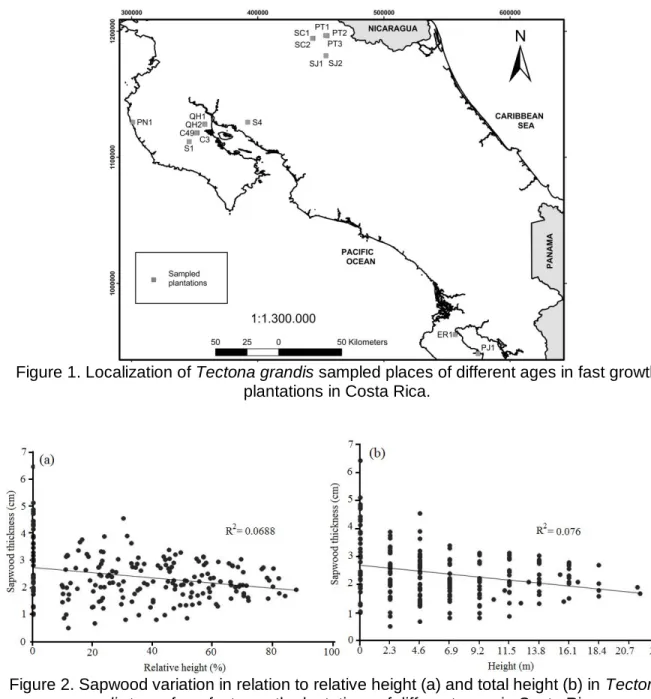
Sixteen fast-growth plantations of T. grandis (teak) were sampled in different regions of Costa Rica: the North Pacific, South Pacific and northern regions (Figure 1). The dasometric parameters of the trees are presented in Table 1. The plantations presented different ages, altitudes and silvicultural management. Age categories varied from 2 to 22 years (Table 1). These ages represent the age range of the tree before it is cut for sawlog production in Costa Rica; the age rotation for cutting is 20-25 years. A 13-m-radius (531 m2) temporary plot was established in each plantation, in which all trees were measured by their DBH, total tree height and height up to the beginning of the crown, marked by the first living branch, or height of the crown. The plantation density was determined using the number of trees in the plot, as detailed in Table 1.
Sampling within the plantation and tree variables measured
From each plantation, three trees with diameters within the category of variation present in the plantation were selected randomly. A total of 48 trees was sampled, corresponding to a total of 3 samples x 16 sites. DBH was measured in each sampled tree. After the tree was cut, the height of the crown and total tree height were recorded. Then, a disc approximately 4 cm thick was cut at the base of the tree and additional discs every 2.3 m from the base of the tree to the highest part. During this process, the height in meters at which each disk was cut―which corresponds to the distance from the base of the tree to the height of this sampling―was recorded. Next, the maximum heartwood height (HHW) of the tree was located based on the disks at the different heights. Once located, the distance from the tree base to maximum heartwood height was measured.
Measurements in cross-sections
In each disc, two perpendicular radial directions were marked, passing through the pith. In each direction, diameter without bark, heartwood diameter and pith diameter were measured. The sapwood-heartwood boundary was determined by the difference in color.
Data analysis
The following parameters were determined from the measurements with the discs: relative sampling height, SWT, HWradius, HWpercentage, HWvolume, HHW maximum heartwood height and HWrh. The relative sampling height of each disc obtained from the tree was estimated as the height in meters of the disc, taken at different heights, divided into the total height of that tree and expressed as a percentage.
INFORME FINAL DE PROYECTO
“Modelaje del porcentaje de duramen, módulo de elasticidad y densidad de plantaciones forestales de Tectona grandis L.f. de rápido crecimiento establecidas en
Costa Rica”
where HWvolume is the heartwood volume, estimated from the base of the tree to the highest heartwood height in the trunk; ab is the cross-section area of the heartwood at the tree base, estimated through Equation 2; maximum heartwood height is the maximum height of the heartwood in meters; and diameter is the heartwood diameter at the measured height.
It should be mentioned that some authors (Berthier et al., 2001; Climent et al., 2003; Sousa et al., 2012) did not take into account the measurements at the tree base while studying the variation of properties because of the irregularity in the shape of the tree at that height. This work considered those measurements in the analysis except in the plantations of Pueblo Viejo and Hojancha, where discs at the base of the trunk could not be obtained due to trunk base rotting. The parameters of the cross-sections were measured using the small and large diameters of the cross-sections.
Statistical methods
First, SWT behavior with respect to the sampled height was studied through the variation of SWT along the tree-trunk height. SWT normality was confirmed; and then a one-factor analysis of variance (ANOVA) was applied for each age of the plantation, using the sampling height (in meters) as the independent variable and SWT as the dependent variable. The Tukey test was used for the comparison of this analysis of variance at a statistical level (p) of 0.05. Another analysis performed was the linear correlation between the variables in the study, compared through Pearson’s correlation coefficient analysis (95 % significance). This test established the most significant variables for the multiple linear regression models.
Prediction models
The multiple linear regression method was used to obtain the prediction models for the tree variables SWT, HWradius, maximum heartwood height, HWpercentage, HWrh and HWvolume. The Ryan-Joiner normality test was used to test the normal distribution of the data of each variable. A suitable transformation was applied to the variables to be modeled that did not present a normal distribution. The models were tested with the best-fitting independent variables according to correlation with the variables to be modeled. Residual plots were analyzed to evaluate the validity of the models.
Results
Sapwood thickness variation along the trunk
INFORME FINAL DE PROYECTO
“Modelaje del porcentaje de duramen, módulo de elasticidad y densidad de plantaciones forestales de Tectona grandis L.f. de rápido crecimiento establecidas en
Costa Rica”
tree height, whereas other tree ages do not present significant differences in SWT in the entire trunk.
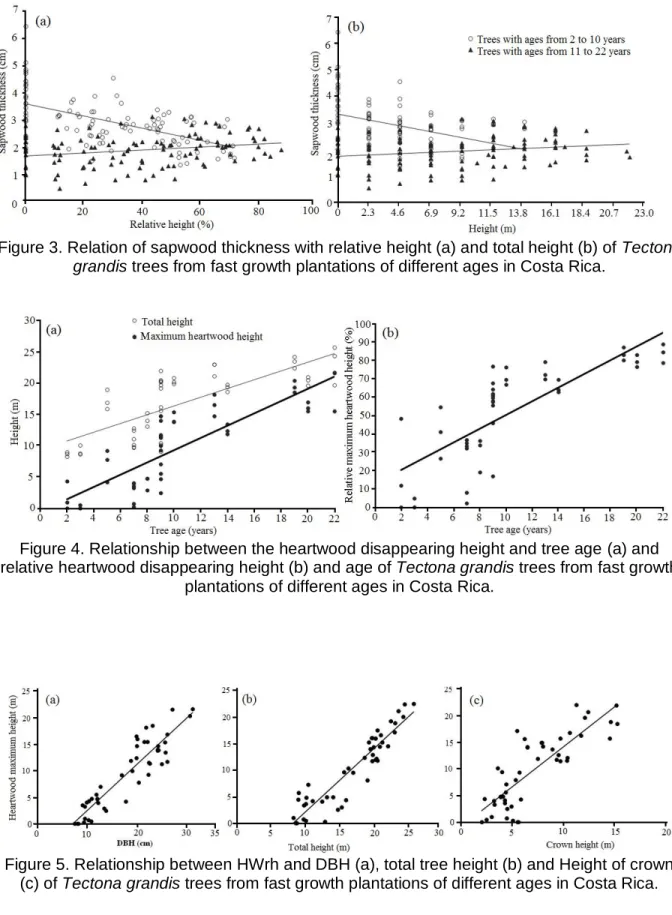
SWT separation by tree age showed two distribution patterns (Figure 3a-b). The first pattern occurred in trees from plantations aged 2 to 10 years, with SWT showing a tendency to decrease with increasing total tree height. The second pattern is associated with trees from plantations aged 11 to 22 years, with SWT showing no increasing or decreasing pattern relative to total tree height. The t-student test of the two age ranges (trees less than and equal to 10 years and trees over 10 years) showed that there are significant differences between the two groups in sapwood thickness ( = 0.05; T = 9.83; P value = 0.00); therefore, trees aged 11 to 22 years have a statistically lower SWT than trees 2 to 10 years old. In the former age category, SWT is 0.5 to 3.2 cm, and for trees aged from 2 to 10 years, SWT is 1.4 to 6.5 cm.
Age of formation and maximum height of heartwood
Heartwood formation at the base of sampled trees 2-3 years of age was found in only two trees of each age (Figure 4a) and not in the rest of the heights analyzed at these ages. Meanwhile, maximum heartwood height was proportional to the age of the plantation; i.e., as the tree ages (Figure 4a), heartwood disappears at greater heights (R2 = 72.29 %). Additionally, maximum heartwood height tended to approach the total height of trees (Figure 4a). In younger trees, the distance between maximum heartwood height and the apex of the tree tends to diminish as the tree ages. HWrh presented a significant proportionality with tree age (R2 = 63.00 %) (Figure 4b): the older the plantation, the greater the height at which heartwood disappears.
Relationship between maximum heartwood height and dasometric variables of the tree
In addition to the relationship between tree age (Figure 4) and maximum heartwood height, it was found that this height was positively correlated with other variables of the trees (Table 2, Figure 5a-b-c). DBH, total tree height and height of crown are proportional to maximum heartwood height. Moreover, HWradius, HWpercentage and HWvolume presented a positive correlation with maximum heartwood height.
INFORME FINAL DE PROYECTO
“Modelaje del porcentaje de duramen, módulo de elasticidad y densidad de plantaciones forestales de Tectona grandis L.f. de rápido crecimiento establecidas en
Costa Rica” unnecessary. In contrast, HWradius, HWpercentage and HWvolume did not show a normal distribution; therefore, transformation by means of the square root was required to achieve normality (P value < 0.01; RJ value of 0.98. 0.97 and 0.94, respectively).
After transformation in the case of SWT, the best fit for the determination of this parameter was obtained with the variables SWT at 2.3 m height, height of sampling, relative sampling height and total tree height. This fit explained 70 % of the variation of SWT at different heights of the tree in addition to presenting adequate error distribution (model 1 in Table 3, Figure 6a).
In the estimation of HWradius with the best fit, based on the coefficient of determination and standard error, the multiple square root should be considered with DBH, HWradius at 2.3 m height, the height of sampling and relative height. This model explains 89 % of the variation of HWradius at different heights (model 2 in Table 3), and the error distribution was appropriate, as shown in Figure 6b.
The maximum heartwood height is a difficult feature to measure. A prediction model was adjusted in this case (explaining 95 % of the variation), including the fitting variables of SWT at 2.3 m height (SWT2.3), DBH and total height of the tree (model 3 in Table 3). The error distribution was significantly appropriate for the model (Figure 6c).
The HWpercentage present in a cross-section was modeled based on the transformed variables of the multiple square root of SWT at 2.3 m, the HWradius at 2.3 m, relative sampling height, total tree height and the height of sampling in the individuals, for a precision of 73 % (model 4 in Table 3), being the least adjusted model. The distribution of the errors of the model, as shown in figure 6d, is not significantly adequate.
Finally, for HWvolume, the best fit was achieved with the inclusion of the transformed variables of the multiple square root of DBH and tree crown height (model 5 Table 3). This prediction model accounts for 31 % of the dependent variable, with a uniform distribution of the data error (Figure 6e).
Discussion
Sapwood variation along the trunk
The correlation between SWT and relative sampling height or height of sampling was not significant (Figure 2a-b), which means that SWT is uniform in the tree trunk. These results agree with those affirmed in Moya et al. (2014), who hypothesized that SWT for different ages of trees of T. grandis is stable with height, varying from 2 to 5 cm in SWT. However, this study of SWT is lower than 0.5 to 6.5 cm.
INFORME FINAL DE PROYECTO
“Modelaje del porcentaje de duramen, módulo de elasticidad y densidad de plantaciones forestales de Tectona grandis L.f. de rápido crecimiento establecidas en
Costa Rica” biochemical transformation occurring in an already existing tissue (sapwood). The wood cells are still the same in terms of position, dimensions and composition of the cell walls. Thus, the cell is still xylem that has lost its sap transportation and stocking functions (Taylor et al., 2002). Although knowledge of the formation of heartwood is extensive in the case of conifers (Yang et al., 1994), it is less so for tropical species (Taylor et al., 2002) and very limited for teak trees from young plantations (Moya et al., 2014). However, after applying the concepts developed by Taylor et al. (2002) in the present study, it is possible to affirm that the tree regulates its physiological processes to maintain sapwood, preventing the formation of heartwood during the first years of growth, since the tree invests its physiological processes in reaching a greater height quickly. Therefore, higher SWT is expected during the juvenile period (trees under 10 years of age) than in older trees, as found in the present study.
This same behavior was found by Pérez and Kanninen (2003), who in their study on T. grandis plantations 5 to 47 years old observed a greater proportion of sapwood in juvenile plantations, while as heartwood develops with age, SWT decreases until it reaches constant variation. Furthermore, Kokutse et al. (2004), in a study on the presence of heartwood in trees from different life zones in Togo, found that heartwood is already present in trees with diameters from 10 to 20 cm, while its transformation occurs between 11 and 13 years of age. On the other hand, the variation in SWT can be expected to decrease with the utilization of clone trees or of plantations with similar silvicultural management because the properties are uniform in clones (Moya et al., 2013) or plantations with uniform management properties (Moya and Berrocal, 2010).
Age of formation and maximum height where heartwood is present
Early formation of heartwood was found in only two trees from plantations aged 2 to 3 years, unlike the rest of the trees of the same age (Figure 4a). These two trees presented an average DBH of 9.9 and 9.4 cm, and the presence of heartwood was evidenced at the base of the tree instead of at DBH. Although a number of studies have addressed heartwood formation in T. grandis, few have studied in detail the age at which such formation starts. For example, Solórzano et al. (2012a and 2012b) found 12 % heartwood on average at DBH in a four-year-old plantation of T. grandis, although the age at which heartwood formation started was not mentioned. This result contradicts the assumptions made by Moya et al. (2014), who suggested that the differentiation between sapwood and heartwood occurs between the ages of 4 and 6 years in fast-growth plantations, with diameters at breast height between 6 and 10 cm. Therefore, the results of this study suggest, along with other references, that heartwood formation begins at the age of 2 years at the base of the tree and that if there is more accelerated development of the diameter, such as 10 cm DBH, heartwood can begin its earliest formation at the base of the tree at the age of 2 years.
INFORME FINAL DE PROYECTO
“Modelaje del porcentaje de duramen, módulo de elasticidad y densidad de plantaciones forestales de Tectona grandis L.f. de rápido crecimiento establecidas en
Costa Rica”
heartwood can start at 12 years old. This indicates that the fast-growth conditions of T. grandis trees produce an early appearance of heartwood by accelerating the physiological processes that transform sapwood into heartwood (Taylor et al., 2002).
Relationship between maximum heartwood height and some dasometric variables of the tree The maximum heartwood height and HWrh relative to total tree height show a positive relationship to tree age (Figure 5a-b). This result was to be expected, for as the tree ages, the height at which heartwood can be found increases (Yang et al., 1994). Anish et al. (2015) agree with the results of this study, indicating that heartwood growth increases with increasing age until reaching a maximum point in the tree height in fast-growth T. grandis plantations.
This study found that T. grandis heartwood reaches a maximum height from 0 to 90 % (0.27 to 21.7 m) of total tree height (Figure 4b). Gominho et al. (2001) observed for the hybrid Eucalyptus urograndis that the heartwood reaches up to 65 % of total tree height in 5-year-old trees, slightly lower than in the present study. On the other hand, Gominho and Pereira (2000) found maximum heartwood height varying from 65 to 70 % of total tree height in 9-year-old E. globulus trees, again a lower value than the maximum value found in T. grandis trees. Meanwhile, mature Pinus radiata (Wilkes, 1991) tree sampling found heartwood at 17.6 m in height, while in Pinus pinaster (Pinto et al., 2004) trees with mature ages between 42 and 83 years, heartwood was found even at a height of 20 m and in some branches. These references show an increase in the height at which heartwood disappears with tree age, suggesting that in the case of T. grandis trees, the maximum heartwood height is expected to increase with age, and heartwood could be present even in the branches.
Prediction models
The variation of the different parameters of heartwood observed within and between trees in this study demonstrates that HWradius, maximum heartwood height, HWpercentage and HWvolume are statistically predictable with the following variables: DBH, height of sampling, Hr, and total tree height (Table 3). On the other hand, SWT showed no variation regarding tree height when this parameter was evaluated in two age ranges (1-10 and 10-25 years) (Figure 2a). However, the model can explain 70 % of the variation in total tree height and relative sampling height (Table 3). Moya et al. (2014) did not define prediction models for SWT, as it remained invariable along the trunk, and they observed a category between 2 and 5 cm thickness for the different ages and heights. For that reason, their results are not consistent with those presented in this work. However, the predictions of the model can increase if the information comes from clone trees, where the variation decreases (Moya et al., 2013), or from plantations with similar silvicultural management because the properties are more uniform in managed than in un-managed plantations (Moya and Berrocal, 2010).
INFORME FINAL DE PROYECTO
“Modelaje del porcentaje de duramen, módulo de elasticidad y densidad de plantaciones forestales de Tectona grandis L.f. de rápido crecimiento establecidas en
Costa Rica”
of maximum heartwood height with the variables HWradius at DBH and total tree height in Pinus canariensis growing in natural forests. This coincides with the relationships found for maximum heartwood height in this study on T. grandis with the variables DBH and total tree height (Table 3).
Of the variation in HWpercentage, 74 % is explained by the SWT and HWradius variables at the height of 2.3 m, height of sampling, relative sampling height and total tree height (Table 3). This trend coincides with the results of Miranda et al. (2011), who obtained the relationship between the decrease of HWpercentage and the increase of the height of the tree. Finally, HWvolume at different heights is explained at 31 % by means of DBH and height of crown (Table 3). According to Víquez and Pérez (2005), HWvolume correlates with DBH and total height of the trees, which can be affected by silvicultural management in T. grandis plantations, meaning that plantation management can help increase the HWvolume.
It is important to clarify that in this study on T. grandis trees, SWT and HWradius were incorporated in some models at a tree height of 2.3 m because the sampled trees were obtained during a commercial cutting, and arrangements had not been made to extract discs at DBH. For a future variable prediction with the developed models, HWradius and St at the height of 2.3 m can be obtained by means of a drill as a non-destructive technique to characterize standing wood.
Conclusions
St with respect to tree height in the plantation of T. grandis presented variations from 0.5 to 6.5 cm. Regarding the age of the plantation, it was observed that for juvenile trees between 2 and 10 years old, SWT (1.4 to 6.5 cm) is greater than for 11- to 22-year-old trees (0.5 to 3.2 cm).
The present study found that heartwood formation occurred between 2 and 3 years of age in T. grandis fast-growth plantations among trees of 10 cm DBH. However, heartwood formation starts at this age at the base of the tree but not at DBH height. Heartwood formation at DBH starts later, at 3-4 years of age. The maximum heartwood height in trees that presented heartwood growth is in the category of 0.27 to 21.7 m.
Prediction models were developed for sapwood thickness, heartwood radius, maximum heartwood height, proportion of the area of the heartwood and heartwood volume at different heights. Those models showed goodness of fit of 70 %, 90 %, 95 %, 73 % and 31 %, respectively. These models can be incorporated by commercial plantations for more accurate data in heartwood production and thus for greater security in sawlog commercialization.
Acknowledgements
The authors wish to thank the Vicerrectoría de Investigación y Extensión at the Instituto Tecnológico de Costa Rica and all companies for the providing raw material and other assistance in carrying out this study.
INFORME FINAL DE PROYECTO
“Modelaje del porcentaje de duramen, módulo de elasticidad y densidad de plantaciones forestales de Tectona grandis L.f. de rápido crecimiento establecidas en
Costa Rica”
Anish, M.C., Anoop, E.V., Vishnu, R., Sreejith, B., Jijeesh, C.M., 2015. Effect of growth rate on wood quality of teak (Tectona grandis L. f.): a comparative study of teak grown under differing site quality conditions. Journal of the Indian Academy of Wood Science, 12(1), 81-88.
Arce, N., Moya, R. 2015. Wood characterization of adult clones of Tectona grandis growing in Costa Rica. Cerne, 21(3), 353-362.
Berthier, S., Kokutse, A.D., Stokes, A., Fourcaud, T. 2001. Irregular heartwood formation in maritime pine (Pinus pinaster Ait): consequences for biomechanical and hydraulic tree functioning. Annals of Botany, 87(1), 19-25.
Climent, J., Chambel, M.R., Gil, L., Pardos, J.A., 2003. Vertical heartwood variation patterns and prediction of heartwood volume in Pinus canariensis Sm. Forest Ecology and Management, 174(1), 203-211.
Crespo, R., Jiménez, E., Suatuance, P., Law, G., Sánchez, C., 2008. Comparative analysis of physical-mechanical properties of teak (Tectona grandis LF) from Quevedo and Baltazar. Ciencia y Tecnologia, 1, 55-63.
Galeano, E., Vasconcelos, T.S., Vidal, M., Mejia-Guerra, M.K., Carrer, H., 2015. Large-scale transcriptional profiling of lignified tissues in Tectona grandis. BMC Plant Biology, 15(1), 221.
García, H., da Silva, M.L.M., Binoti, D. H. B., Fardin, L., Takizawa, F.H., 2011a. Estimation of inside-bark diameter and heartwood diameter for Tectona grandis Linn. trees using artificial neural networks. European Journal of Forest Research, 130(2), 263-269.
García, H., de Oliveira Neto, R.R., Monte, M.A., Fardin, L., de Alcantara, A. M., Binoti, M.D.S., Castro, R.V.O., 2011b. Models of heartwood of Tectona grandis Lf. Scientia Forestalis, 39(89), 53-59.
Gominho, J., Figueira, J., Rodríguez, J.C., Pereira, H.. 2001. Within-tree variation of heartwood, extractives and wood density in the eucalypt hybrid urograndis (Eucalyptus grandis× E. urophylla). Wood and Fiber Science, 33(1), 3-8.
Gominho, J., Pereira, H., 2000. Variability of heartwood content in plantation-grown Eucalyptus globulus Labill. Wood and Fiber Science, 32(2), 189-195.
Hegde, H.T., Kalkoor, M.A., Jha, S.K., Thakur, N.S., 2014. Evaluation of variation in physical properties of wood among some tropical tree species of South India. Indian Forester, 140(1), 70-75.
Hillis, W.E., 1999. The Formation of heartwood and its extractives. In Phytochemicals in Human Health Protection, Nutrition, and Plant Defense (pp. 215-253). Springer US. Kennedy, S.G., Yanchuk, A.D., Stackpole, D.J., Jefferson, P.A., 2014. Incorporating non-key
traits in selecting the Pinus radiata production population. New Zealand Journal of Forestry Science, 44(1), 1-10.
Knapic, S., Oliveira, V., Makkonen, M., Pinto-Seppä, I., Pereira, H., 2014. Circumferential variation of heartwood and stem quality in maritime pine stems. European Journal of Forest Research, 133(6), 1007-1014.
Kokutse, A.D., Bailleres, H., Stokes, A., Kokou, K., 2004. Proportion and quality of heartwood in Togolese teak (Tectona grandis Lf). Forest Ecology and Management, 189(1), 37-48. Koskela, J., Vinceti, B., Dvorak, W., Bush, D., Dawson, I. K., Loo, J., Kjaer E.D., Navarro, C.,
Padolina, C., Bordács, S., Jamnadass, R., Graudal, L., Ramamonjisoa, L., 2014. Utilization and transfer of forest genetic resources: A global review. Forest Ecology and Management, 333, 22-34,
INFORME FINAL DE PROYECTO
“Modelaje del porcentaje de duramen, módulo de elasticidad y densidad de plantaciones forestales de Tectona grandis L.f. de rápido crecimiento establecidas en
Costa Rica”
Lourenço, A., Neiva, D.M., Gominho, J., Marques, A.V., Pereira, H., 2015. Characterization of lignin in heartwood, sapwood and bark from Tectona grandis using Py–GC– MS/FID. Wood Science and Technology, 49(1), 159-175.
Minn, Y., Prinz, K., Finkeldey, R., 2014. Genetic variation of teak (Tectona grandis Linn. f.) in Myanmar revealed by microsatellites. Tree Genetics and Genomes, 10(5), 1435-1449. Miranda, I., Sousa, V., Pereira, H., 2011. Wood properties of teak (Tectona grandis) from a
mature unmanaged stand in East Timor. Journal of Wood Science, 57(3), 171-178. Miranda, I., Gominho, J., Pereira, H., 2015. Heartwood, sapwood and bark variation in
coppiced Eucalyptus globulus trees in 2nd rotation and comparison with the single-stem 1st rotation. Silva Fennica, 49(1), id 1141.
Moya, R., Berrocal, A., 2010. Wood colour variation in sapwood and heartwood of young trees of Tectona grandis and its relationship with plantation characteristics, site, and decay resistance. Annals Forest Science, 67, 109-129.
Moya, R., Bond, B., Quesada, H., 2014. A review of heartwood properties of Tectona grandis trees from fast-growth plantations. Wood Science and Technology, 48(2), 411-433. Moya, R., Marin, J.D., Murillo, O., Leandro, L. 2013. Wood physical properties, color, decay
resistance and stiffness in Tectona grandis clones with evidence of genetic control. Silvae Genetica, 62(3), 142-152
Moya, R., Marín, J. D., 2011. Grouping of Tectona grandis (Lf) clones using wood color and stiffness. New Forests, 42(3), 329-345.
Nocetti, M., Della Rocca, G., Berti, S., Brunetti, M., Di Lonardo, V., Danti, R., 2015. Genetic growth parameters and morphological traits of canker-resistant cypress clones selected for timber production. Tree Genetics and Genomes, 11(4), 1-11.
Okuyama, T., Yamamoto, H., Wahyud, I., Yusuf Sudo Had, Y., Bhat K.M., 2005. Some wood quality issues in planted teak. In: Quality timber products of teak from sustainable forest management. Proceedings of the international conference on quality timber products of teak from sustainable forest management, 2–5 December. Peechi, India
Pâques, L.E., Charpentier, J.P., 2015. Perspectives for genetic improvement in heartwood size and extractive content in relation to natural durability and aesthetics in interspecific hybrid larch (Larix× eurolepis). European Journal of Forest Research, 134(5), 857-868. Pérez, L.D., Kanninen, M., 2003. Heartwood, sapwood and bark content, and wood dry
density of young and mature teak (Tectona grandis) trees grown in Costa Rica. Silva Fennica, 37(1), 45-54.
Pinto, I., Pereira, H., Usenius, A., 2004. Heartwood and sapwood development within maritime pine (Pinus pinaster Ait.) stems. Trees 18(3), 284-294.
Serrano, R., Moya, R., Berrocal, A., González, G., Córdoba, R., 2015. General, physical and mechanical properties, termites resistance and drying defects of lumber of Tectona grandis from plantations of different climatic and sites fertility condition. Journal of the Indian Academy of Wood Science, 12(1), 63-73.
Solórzano, S., Moya, R. Chauhan, S., 2012a. Early genetic evaluation of morphology and some wood properties of Tectona grandis L. clones. Silvae Genetica, 61, 58-65.
Solórzano, S., Moya, R., & Murillo, O. (2012b). Early prediction of basic density, shrinking, presence of growth stress, and dynamic elastic modulus based on the morphological tree parameters of Tectona grandis. Journal of Wood Science, 58(4), 290-299.
Sousa, V. B., Cardoso, S., Quilhó, T., Pereira, H., 2012. Growth rate and ring width variability of teak, Tectona grandis (Verbenaceae) in an unmanaged forest in East Timor. Revista de Biología Tropical, 60(1), 483-494.
INFORME FINAL DE PROYECTO
“Modelaje del porcentaje de duramen, módulo de elasticidad y densidad de plantaciones forestales de Tectona grandis L.f. de rápido crecimiento establecidas en
Costa Rica”
Thulasidas, P. K., Bhat, K.M., 2009. Log characteristics and sawn timber recovery of home-garden teak from wet and dry localities of Kerala, India. Small-Scale Forestry, 8(1), 15-24.
Víquez, E., Pérez, D., 2005. Effect of pruning on tree growth, yield, and wood properties of Tectona grandis plantations in Costa Rica. Silva Fennica, 39(3), 381.
Wilkes, J., 1991. Heartwood development and its relationship to growth in Pinus radiata. Wood Science and Technology, 25(2), 85-90.
Yang, K.C., Chen, Y.S., Chiu, C., Hazenberg, G., 1994. Formation and vertical distribution of sapwood and heartwood in Cryptomeria japonica D. Don. Trees, 9(1), 35-40.
Zhang, X.L., Jiang, L.C., 2015. Inside bark diameter prediction models for dahurian Larch. Forest Research, 1, 0-13.
Table 1. Dasometric parameters and age of the Tectona grandis Lf fast growth plantations sampled in different places in Costa Rica.
INFORME FINAL DE PROYECTO
“Modelaje del porcentaje de duramen, módulo de elasticidad y densidad de plantaciones forestales de Tectona grandis L.f. de rápido crecimiento establecidas en
Costa Rica”
Table 2. Correlation coefficients of tree parameterssampledin Tectona grandis fromfast growth plantations in Costa Rica.
Table 3. Adjusted regression for sapwood thickness and maximum heartwood height prediction models for Tectona grandis treesfromfast growth plantations in Costa Rica.
Stand
√HWradius = −1.523 + 0.201√DBH + 0.6518√HWrb − 1.058√Hs
+ 0.487√Ht + 0.2518√Hr (2)
INFORME FINAL DE PROYECTO
“Modelaje del porcentaje de duramen, módulo de elasticidad y densidad de plantaciones forestales de Tectona grandis L.f. de rápido crecimiento establecidas en
Costa Rica”
Figure 1. Localization of Tectona grandis sampled places of different ages in fast growth plantations in Costa Rica.
INFORME FINAL DE PROYECTO
“Modelaje del porcentaje de duramen, módulo de elasticidad y densidad de plantaciones forestales de Tectona grandis L.f. de rápido crecimiento establecidas en
Costa Rica”
Figure 3. Relation of sapwood thickness with relative height (a) and total height (b) of Tectona grandis trees from fast growth plantations of different ages in Costa Rica.
Figure 4. Relationship between the heartwood disappearing height and tree age (a) and relative heartwood disappearing height (b) and age of Tectona grandis trees from fast growth
plantations of different ages in Costa Rica.
INFORME FINAL DE PROYECTO
“Modelaje del porcentaje de duramen, módulo de elasticidad y densidad de plantaciones forestales de Tectona grandis L.f. de rápido crecimiento establecidas en
Costa Rica”
Figure 6. Error distribution for prediction models: SWT (a), HWradius (b), MAXIMUM HEARTWOOD HEIGHT (c), HWpercentage (d) and HWvolume (e) for Tectona grandis treesfrom
fast growth plantations in Costa Rica.
INFORME FINAL DE PROYECTO
“Modelaje del porcentaje de duramen, módulo de elasticidad y densidad de plantaciones forestales de Tectona grandis L.f. de rápido crecimiento establecidas en
Costa Rica”
Photo 1: Tectona grandis plantation of 9 years growing in wet tropical (c) and dry tropical
climatic (b) in Costa Rica.
Photo 2: heartwood formation in Tectona grandis trees in basal area of 2 years old (a) and 21
INFORME FINAL DE PROYECTO
“Modelaje del porcentaje de duramen, módulo de elasticidad y densidad de plantaciones forestales de Tectona grandis L.f. de rápido crecimiento establecidas en
Costa Rica”
INFORME FINAL DE PROYECTO
“Modelaje del porcentaje de duramen, módulo de elasticidad y densidad de plantaciones forestales de Tectona grandis L.f. de rápido crecimiento establecidas en
Costa Rica”
3. Artículo 2. Modelos de predicción de la altura máxima, diámetro, volumen y trozas con duramen en árboles de Tectona grandis creciendo en plantaciones de rápido crecimiento en Costa Rica.
Modelos de predicción de la altura máxima, diámetro, volumen y trozas con
duramen en árboles de Tectona grandis creciendo en plantaciones de rápido
crecimiento en Costa Rica
Róger MOYA*
Instituto Tecnológico de Costa Rica, Escuela de Ingeniería Forestal, Apartado 159-7050, Cartago, Costa Rica. Email: [email protected]
Alexander BERROCAL
Instituto Tecnológico de Costa Rica, Escuela de Ingeniería Forestal, Apartado 159-7050, Cartago, Costa Rica. Email: [email protected]
Johana GAITAN-ALVAREZ
Instituto Tecnológico de Costa Rica, Escuela de Ingeniería Forestal, Apartado 159-7050, Cartago, Costa Rica. Email: [email protected]
Edgar ORTIZ-MALAVASSI
Instituto Tecnológico de Costa Rica, Escuela de Ingeniería Forestal, Apartado 159-7050, Cartago, Costa Rica. Email: [email protected]
David FERNÁNDEZ-SÓLIS
Instituto Tecnológico de Costa Rica, Escuela de Ingeniería Forestal, Apartado 159-7050, Cartago, Costa Rica. Email: [email protected]
INFORME FINAL DE PROYECTO
“Modelaje del porcentaje de duramen, módulo de elasticidad y densidad de plantaciones forestales de Tectona grandis L.f. de rápido crecimiento establecidas en
Costa Rica”
Modelos de predicción de la altura máxima, diámetro, volumen y trozas con duramen en árboles de Tectona grandis creciendo en plantaciones de rápido crecimiento en
Costa Rica
Resumen
La madera de duramen es la parte más importante del árbol en Tectona grandis L.f. Aunque existen varios modelos de predicción de volumen total (albura y duramen) en esta especie, no existen modelos de predicción de duramen únicamente. El objetivo del presente trabajo fue desarrollar modelos matemáticos para predecir la altura máxima del duramen (HWh), el diámetro (HWdiameter), porcentaje (HWpercentage), volumen y cantidad de trozas
Palabras Claves: Duramen, variación vertical, modelo de regresión, volumen, trozas comerciales.
Introducción
La teca (Tectona grandis L.f), es considera como una de las especie tropicales comercialmente más importante a nivel mundial (FAO, 2013). Es originaria del sureste asiático específicamente de la India, Laos, Myanmar y Tailandia (Gyi & Tint 1998; Pandey & Brown, 2000). Sus plantaciones se han expandido ampliamente a las zonas tropicales de América Latina, Asia, África y Oceanía (Ball et al., 1999 FAO, 2006). La madera de teca posee un alto valor comercial en la fabricación de productos, debido a su alta resistencia mecánica y buenas propiedades físicas, de durabilidad natural y agradable aspecto estético (Sanwo 1990; Kjaer et al., 1999 Thulasidas et al., 2006). Debido a estas propiedades es que esta especie de madera está aumentando el área plantada a nivel mundial (Kollert et al., 2012).
INFORME FINAL DE PROYECTO
“Modelaje del porcentaje de duramen, módulo de elasticidad y densidad de plantaciones forestales de Tectona grandis L.f. de rápido crecimiento establecidas en
Costa Rica”
oscuro apreciado por el mercado, así como una buena durabilidad y resistencia estructural (Miranda et al 2011; Moya & Pérez, 2008). Debido a la importancia de la madera de duramen en los árboles de teca es que a lo largo de los años muchas investigaciones se han centrado en el estudio de la formación, variación y mediciones de esta madera durante el crecimiento de los árboles (Moya et al., 2014; Miranda et al., 2011; Kumar and Dhillon, 2015; Anish et al., 2015).
El duramen es la parte central del tronco, donde no existen células vivas y las células que lo componen en su mayoría sirven de soporte estructural (Hillis, 2012). La formación de duramen ocurre cuando las células vivas, del parénquima de la zona cambial comienzan a morir, y las sustancias que contienen son utilizadas como energía para alimentar la producción de fenoles y quininas, que protegen al árbol de agentes patógenos y del ataque de insectos, las cuales se sitúan en la parte central (Datta y Kumar, 1987, Kampe and Magel, como la especie, la edad de los árboles, la clase social de los árboles, la posición del árbol, el tipo y propiedades del suelo, la tasa de crecimiento, la altura y dimensiones del árbol (Bamber and Fukazawa 1985; Nawrot et al. 2008; Wang et al. 2010). En teca algunos estudios han demostrado que la formación de duramen está relacionado con la edad de los árboles (Okuyama et al., 2005) y las practicas silviculturales de las plantaciones principalmente (Morataya et al., 1999. Un grupo importante de investigaciones han relacionado el duramen, sea su diámetro o su porcentaje de la sección transversal), con otras variables del árbol, tales como la edad, contenido de algunos nutrientes, altura del árbol entre otras aspectos (Bamber and Fukazawa 1985, Climent et al., 2003; Hillis 2012).
Específicamente en árboles de teca algunos estudios han demostrado que la formación de duramen comienza cuando el árbol tiene entre 4 y 6 años de edad (Moya et al 2014). Estudios llevados a cabo por Solórzano et al (2012a,b) confirman el anterior resultado, ellos encontraron que la proporción de duramen es de 12% en árboles de 4 años en Costa Rica, lo cual concuerda con Trockenbrodt and Josué (1999) en árboles de plantaciones en Malasia. Miranda et al. (2011) Moya (2001) con árboles entre los 50 y 70 años en East Timor y a 5 años de edad en Costa Rica, respectivamente, presentaron el perfil de variación del duramen con la altura del árbol. Finalmente, una destacada investigación es llevada a cabo por García et al., (2011a,b) en árboles de teca entre los 2 y 14 años de edad, donde estableció un modelo de variación del diámetro del duramen con altura total y DBH en las edades antes mencionadas. Más recientemente, Berrocal et al. (2018) hace un descripción de los principales parámetros del duramen (diámetro y porcentaje) en árboles creciendo en plantaciones de diferentes edades y en diferentes alturas en Costa Rica.
INFORME FINAL DE PROYECTO
“Modelaje del porcentaje de duramen, módulo de elasticidad y densidad de plantaciones forestales de Tectona grandis L.f. de rápido crecimiento establecidas en
Costa Rica” diámetro a la altura del pecho (DBH) y la altura total.
Otra variable importante que puede ser utilizada para predecir el duramen, es la edad de los árboles. Por ejemplo Pérez and Kanninen (2005a) con árboles de teca en Costa Rica entre edades de 5 a 47 años desarrollan un modelo polinomial para diámetro del duramen DBH utilizando la edad y DBH. A su vez Víquez and Pérez (2005), evaluaron el efecto de la edad y la densidad de plantaciones de teca de los 2 a los 8 años en el duramen. Otros autores como Okuyama et al., (2005) utilizaron como variable dependiente la edad para describir el duramen, y propusieron dos modelos lineales uno para arboles de teca menores a los 12 años y otro para mayores a esa edad.
Un aspecto importante de destacar es que varios estudios presentan los modelos de variación del volumen de madera en árboles de teca. Entre los que destacan son los llevados a cabo por Tewari et al (2014) en la India, utilizando edades de 11 y 38 años y desarrollando dos tipos de modelos basados uno en la altura total de los árboles de teca y otro en el área basal de la plantación, respectivamente. Nunifu and Murchison (1999) en Ghana utilizando arboles de teca entre 3 y 40 años derivó los volúmenes de teca a partir de altura total y DBH. En tanto que Pérez y Kanninen (2003a) utilizando árboles de teca 5 a 47 años en Costa Rica, desarrollo modelos de predicción del volumen utilizando el DBH, la altura total y la altura de muestreo. Sin embargo, a pesar de estos estudios, los modelos desarrollados son establecidos para el volumen total del árbol y no para el duramen que es la parte comercial más importante (Moya et al., 2014).
Pese a múltiples estudios y modelos realizados a la actualidad y sumado la importancia del duramen en la comercialización de madera de teca, existe un faltante de información necesaria para predecir el desarrollo de duramen en los arboles de teca que se producen en Costa Rica, en diferentes regiones, condiciones climáticas, tipos de suelos y distintos manejos silviculturas. Por lo que el objetivo del presente trabajo es caracterizar y desarrollar modelos matemáticos para predecir la altura máxima del duramen, el diámetro, porcentaje, volumen y cantidad de trozas comerciales del duramen de árboles de Tectona grandis creciendo en plantaciones de rápido crecimiento en Costa Rica, utilizando variables de fácil medición como DBH, altura total y edad.
Metodología
Área de estudio
INFORME FINAL DE PROYECTO
“Modelaje del porcentaje de duramen, módulo de elasticidad y densidad de plantaciones forestales de Tectona grandis L.f. de rápido crecimiento establecidas en
Costa Rica”
anual de 3743 mm, distribuida en los meses de abril a diciembre temperatura media anual de 26.89 °C y humedad relativa de 84.08%. (iii) Pacífico sur: es la región con la mayor cantidad de precipitación anual, con 4453.9 mm distribuida alrededor de todo el año, sin embargo en setiembre y octubre son los meses de mayor precipitación, temperatura promedio de 26.84 °C y humedad relativa de 74.83 %.(iv) Zona Atlántica: presenta una precipitación anual de 3566.6 mm, el régimen de precipitación se mantiene constante durante todo el año siendo el mes más seco en setiembre, temperatura de 26.67 °C y humedad de 85.92. (v) Zona Norte: la distribución de lluvias se presenta entre los meses de mayo a enero con una precipitación anual de 1732 mm, una temperatura de 23.67 y humedad relativa de 85.92 % (Figura 1) (IMN, 2017).
La cantidad de plantaciones muestreadas varía en cada una de las regiones, en el Pacifico Central se muestrearon 16 plantaciones, en Pacifico Norte 12, Pacifico Sur 7, Zona Atlántica 1 y Zona Norte 18 (Figura 1). Es importante hacer notar que en el caso de la zona Atlántica la cantidad de plantaciones muestreadas fue solamente una ya que en esa región la T. grandis ha sido plantada en un área bastante reducida y no fue posible obtener permiso de corta de más árboles en esa región.
Figura 1. Localización de los puntos de muestreo en plantaciones de rápido crecimiento de Tectona grandis de diferentes edades en Costa Rica.
Muestreo de plantaciones y árboles
INFORME FINAL DE PROYECTO
“Modelaje del porcentaje de duramen, módulo de elasticidad y densidad de plantaciones forestales de Tectona grandis L.f. de rápido crecimiento establecidas en
Costa Rica” aproximadamente 4 cm de espesor en la base del árbol, y adicional se cortaron discos cada 2.3 m desde la base hasta la altura máxima del duramen (HWh). Durante este proceso, se registró la altura en metros a la que se cortó cada disco, que corresponde a la distancia desde la base del árbol hasta la altura de muestreo (hi).
Mediciones en los discos
En cada uno de los discos extraídos fueron medido los siguientes parámetros: el diámetro total, diámetro sin corteza y diámetro de duramen (HWdiameter). Estos diámetros fueron determinados tomando en cuenta el promedio de dos mediciones sobre el disco, uno en sentido norte-sur y el otro en sentido oeste-este. También fue necesario determinar el porcentaje de duramen (HWpercentage) el cual fue calculado como el área de duramen con respecto al área de sección total de la sección transversal del disco expresada en porcentaje.
Modelos de predicción
Varios modelos de predicción del duramen fueron realizados: (i) un primer modelo fue desarrollado para estimar la HWh, (i) un segunda modelo fue aplicado para predecir el HWdiameter y HWpercentage a diferentes alturas del árbol y (iii) un tercer modelo para estimar el volumen de duramen en un árbol y (iv) finalmente fue estimado la cantidad de trozas comerciales que se pueden extraer de los árboles con diferentes diámetros.
(i) Modelo para estimar Hwh: en el desarrollo de este modelo fue utilizada las mediciones de la HWh en los árboles muestreados. En esta parte primeramente fue presentado gráficamente la relación HWh con la edad, altura total del árbol y el DBH. Seguidamente fueron aplicados diferentes modelos para predecir HWh considerando la región de crecimiento de Costa Rica, edad, Ht y DBH. En estos modelos, HWh es medida en metros (m), edad en años (años), Ht del árbol en metros (m) y el DBH en centímetros (cm).
(ii) Modelo de predicción del HWdiameter y HWpercentage a diferentes alturas: para este modelo se utilizaron los datos de HWdiameter medido en centímetros (cm) y diámetro total medido en centímetros (cm) a diferentes alturas del árbol medida en metros (m). También fue desarrollado un análisis de perfil de fuste, en donde primeramente se graficó la relación diámetro total/ DBH con respecto a la altura de muestreo (di) y Ht (di/DBH vrs hi/Ht). También se graficó la relación de HWdiameter con DBH con la relación de hi y Ht (diHW/DBH vrs hi/Ht). Con estas relaciones se desarrollaron los modelos propuestos por Coffre (1982) y Kozak (Kozak et al., 1969) para perfil de fuste de árboles. En el caso de Coffre ha sido aceptado como un modelo para análisis fustal (Rojo et. al., 2005). Cada uno de los modelos se desarrolló para el diámetro total (di) a diferentes hi, y para HWdiameter a diferentes hi. Desarrollados estos modelos se predijo el HWdiametery diámetro total a diferentes alturas, así como el HWpercentage a diferentes alturas de los árboles de teca.


![Figura 6. Distribución del error del modelo de Coffre para el diámetro total [variable 1 (a), variable 2 (b) y variable 3 (c)], y para el diámetro de duramen variable [1 (d), variables 2 (e) y variable 3 (f)] de árboles de Tectona grandis de plantaciones](https://thumb-us.123doks.com/thumbv2/123dok_es/3696292.639845/40.918.225.739.94.657/distribución-diámetro-variable-variable-variable-diámetro-variables-plantaciones.webp)


