According to Pitcher, Piek, and Hay (2003), it is necessary to gain a better understanding of the relationship between attention defi cit hyperactivity disorder (ADHD) and motor coordination diffi culties, considering the relative absence of reliable and objectively assessed information related to the motor abilities of children with ADHD and movement ability. Some studies have identifi ed that motor ability of ADHD children is frequently and signifi cantly lower than would be expected for their age, and this motor control defi ciency is not associated with culture or ethnicity, and moreover, these symptoms are present in all three ADHD subtypes, affecting both genders (Meyer & Sagvolden, 2006). Moreover, studies by Flapper and colleagues (Flapper, Houwen, & Schoemaker, 2006) on fi ne motor skills in children
with both attention-defi cit-hyperactivity disorder (ADHD) and developmental coordination disorder (DCD) demonstrated that children’s functional motor performance defi cits are not explained by their chronological or intellectual age or by other neurological or psychiatric disorders.
Researchers who have studied the implication of motor performance in ADHD children (Pitcher et al., 2003) in fi ne and gross motor skill of males with ADHD found no signifi cant differences in fi ne motor ability between children with only ADHD and the control group, whereas fi ne motor ability was signifi cantly better than in children categorized with both ADHD and DCD. A poorer fi ne motor ability observed in children with ADHD was argued to be due to factors relating to their motor ability rather than to defi cits in attention and concentration. Cardo, Casanovas, De la Banda, and Servera (2008) also suggest that motor coordination diffi culties in children with ADHD are associated with a specifi c motor defi cit that cannot be attributed exclusively to the symptoms of inattention and hyperactivity.
It is considered that approximately 50% of children with ADHD may have motor diffi culties or suffer motor coordination problems
Proprioceptive diagnostics in attention de
fi
cit hyperactivity disorder
Tania Iglesias
1, Liudmila Liutsko
2and José María Tous
2 1 Universidad del Norte and 2 Universidad de BarcelonaAbstract
Resumen
Background: Previous studies have shown the importance of motor control in children with attention defi cit hyperactivity disorder. The objective of our study was to verify any statistically signifi cant differences of fi ne motor performance in children with attention defi cit hyperactivity disorder (ADHD) symptoms compared to the control group in proprioceptive sensory condition. Method: Proprioceptive Diagnostics of Temperament and Character was used for the measurement of fi ne motor precision (proprioceptive sensory condition). The biases from the linear models (lineograms) and line length were registered for three movement types (frontal, transversal and sagittal) in both hands. Line length variability was obtained from the parallels. Results: MANOVA with Bonferroni correction for multiple comparisons revealed signifi cant statistically differences between the ADHD and control group in fi ne motor graphical performance in four variables. Age and sex differences were taken into account and discussed. Discriminant analysis confi rmed that both groups can be classifi ed at a statistically signifi cant level. Conclusion: This is the fi rst empirical study to compare differences between children with and without ADHD symptoms in fi ne motor precision performed in the proprioceptive condition. Discriminant analysis confi rmed the capacity of some specifi c movement type to classify the groups.
Keywords: Fine motor precision, ADHD, proprioceptive sensory
condition.
Diagnóstico propioceptivo en el Trastorno por Défi cit de Atención con
Hiperactividad.Antecedentes: estudios han demostrado la importancia
del control motriz en niños con Trastorno por Défi cit de Atención con Hiperactividad. El objetivo fue comprobar diferencias signifi cativas en el funcionamiento de la precisión motriz fi na en niños con síntomas de un Trastorno por Défi cit de Atención con Hiperactividad (TDAH) en comparación con el grupo de control, en condiciones sensoriales propioceptivas. Método: el diagnóstico propioceptivo de temperamento y carácter fue utilizado para medir la precisión motriz fi na. Registrando los desvíos de lineogramas y de la longitud de la línea modelo en tres tipos de movimientos (frontales, transversales y sagitales) en ambas manos. Y la variabilidad de la longitud de la línea fue obtenida de los paralelos. Resultados: MANOVA con correcciones de Bonferroni para comparaciones múltiples mostraron diferencias signifi cativas entre el grupo experimental y el grupo control en la respuesta gráfi ca motriz fi na en cuatro variables. Tomando en cuenta diferencias de edad y género, el análisis discriminante confi rmó que ambos grupos pueden ser clasifi cados en un nivel estadísticamente signifi cativo. Conclusiones: este es el primer estudio empírico que tiene como objetivo comparar las diferencias en la precisión motriz fi na entre niños con y sin síntomas de TDAH.
Palabras clave: TDAH, diagnóstico propioceptivo, motricidad fi na.
Received: November 15, 2013 • Accepted: July 2, 2014 Corresponding author: Tania Iglesias
Facultad de Psicología Universidad del Norte
(Barkley, DuPaul, & McMurray, 1990; Hartsough & Lambert, 1985; Kadesjö & Gillberg, 1998; Lorenzo, Díaz, Ramírez, & Cabrera, 2013; Piek, Pitcher, & Hay, 1999). Other researchers (Mostofsky, Newschaffer, & Denckla, 2003; Uslu, Kapci, & Oztop, 2007) also observed diffi culty in the synchronization and coordination of motor response in children with ADHD. Dazzan and Murray (2002) indicated that patients with excessive movement can have poor performance on measures of motor response inhibition or lack the integration of the sensory and motor systems.
Fine motor precision changes depending on hand use, movement type and sensory condition in healthy people were reported by Tous, Muiños, Liutsko, and Forero (2012). The authors explain that most physiology texts describe two kinds of receptors of motor action which provide the information needed for motor control: extereoceptors and proprioceptors, which in normal conditions, are interrelated and play an integrative role in perception. According to Enoka (2002), proprioceptive muscular activity is generated by the organism itself and recorded by muscular sensorial receptors or proprioceptive organs, and therefore not infl uenced by external stimulation.
Studies have concluded that proprioception is necessary for the individual to carry out precision tasks (Fuentes & Bastian, 2010; Lateiner & Sainburg, 2003; O’Dwyer & Neilson, 2000), and that it is a reliable indicator of individual motor disposition, which underlies the movements that constitute the behavior (Tous, Muiños, Tous, & Tous, 2012). The study of the effects of proprioceptive information on the generation of movements should consider the possibility that the result of the motor behavior generated by this information is a reliable indicator of motor disposition.
The assessment instrument (DP-TC) proprioceptive diagnosis of temperament and character allows us to obtain measures of the relation between the features of motor behavior and its expressive component based on proprioceptive information available in each person. This assessment system digitized proprioceptive information in the fi ne motor movements of the upper limb behavior and it is focused on the information of muscular condition which comes from proprioceptive organs (Tous, 2008). The assessment instrument DP-TC was designed to facilitate this information, in order to offer movement types that are characterized as control motor deviations due to a bias caused by the observed proprioceptive information according to the non-dominant and dominant hand of each person.
The main basis of the DP-TC is motor control with special reference to the study of the mechanisms of control of movement in people. The main objective is to understand, describe and explain how people make proprioceptive movements and how proprioceptive information handles and maintains the behavior in a specifi c way in each person, depending on their muscle tone and tension. This information can be registered when the movement takes place without information from the exteroceptive organs, primarily vision, in which the motor mental scheme can only work with proprioceptive information and therefore, those movements reveal the role of proprioceptive information in behavior (Tous, Muiños, Tous et al., 2012).
From the clinical practice, it appeared relevant to start a study which would enable us to analyze the expression of motor behavior in ADHD. Considering these fi ndings and observations about the motor defi ciency in ADHD children and the scarcity of research related to the relationship of the proprioceptive state and fi ne motor behavior in ADHD children, the aim of our study was to check the precision of fi ne motor performance in children with ADHD symptoms compared to the control group (children without ADHD symptoms) in the proprioceptive sensory condition.
Therefore, this study aims to determine possible statistically signifi cant differences in proprioceptive fi ne motor performance in children with ADHD symptoms compared to the age-matched control group (without ADHD symptoms). And if so, what types of proprioceptive movements may be associated with clinical symptoms of ADHD.
Method
Participants
The study involved a total of 105 children within an age range of 7 to 14 years old (52 children with ADHD and 53 children without ADHD, as a control group). For the analysis, we selected only right-handed children, and the fi nal sample was 90 children (45 for each group with ages M = 9.7 ± 1.7 for ADHD group and M = 9.6 ± 1.3). The selection criteria for control group participants were to not present any symptoms associated with ADHD, and be matched in age. In the experimental group, the selection criteria were: symptoms or diffi culties associated with ADHD such as impulsivity, hyperactivity or attention defi cit.
Procedure
Prior to the study, the consent and corresponding authorizations were obtained from academic tutors, parents and children, respecting the ethical protocol associated with data use and confi dentiality. The study was approved by the research committee of the University of Barcelona, as well as by the ethics committee of the centers which participated in this study.
Instrument
The equipment for the proprioceptive diagnostic test included a PC connected to a touch screen and a special software (Tous, 2008; Tous, Muiños, Tous et al., 2012) to register and measure fi ne motor graphical movements in both hands and three movement types (frontal, transversal and sagittal).
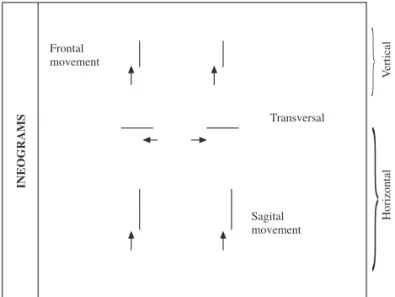
Stimuli represented graphical models, lineograms (Figure 1) and parallels (Figure 2) that appear on a touch screen and should be traced or drawn by each participant individually.
Participants traced these lines according to the graph model presented on the screen with continuous and repeated movements backward and forward over the 40mm long line model (Figure 3). In the case of the parallel model, the fi rst two model lines should be traced, lifting the pen after each line and returning it to the starting point at following line. All graphical performances began with visual guidance and after several efforts, participants had to repeat the task without visual stimulus and continue afterwards with only proprioceptive sensory condition. The instruction to participants was to be as accurate as possible during the performance of all the tasks. The following type of observable variables were registered and used for further analysis:
LL: line length: change in line length (compared to the 40-mm long model), with the corresponding indexes: LLnd and LLd, for dominant and nondominant hands, respectively.
D: Directional bias (deviation, measured parallel to the model line) classifi ed for different movement types (frontal, transversal and sagittal) and hand (dominant and non-dominant, with the following indexes:
DF: Directional bias in frontal movement type: Directional bias in frontal movement type, with the corresponding indexes: DFd and DFnd.
DS: Directional bias in sagital movement type. Directional bias in sagittal movement type with the corresponding indexes: DSd and DSnd.
DT: Directional bias in transversal movement type. Directional bias in sagittal movement type with the corresponding indexes: DTd and DTnd.
Data analysis
The descriptive statistics, test for normality of Kolmogorov-Smirnof, MANOVA and discriminant analyses were conducted to represent the results of this study and performed with the use of SPSS v.19.
Results
The absolute values for biases in fi ne motor precision (tracing and drawing of graphical models lineograms and parallels) in the proprioceptive sensory condition are presented in Table 1, in the descriptive statistics. Some variables, such as directional errors (deviations from the model line) in transversal and sagittal movement types for both hands (DTnd, DTd, DSnd and DSd) respectively, directional bias in frontal movement in dominant hand and line lengths in both hands (LLnd and LLd) were performed similarly by both groups (children with and without ADHD). Other variables, such as directional bias in non-dominant hand (DFnd), formal errors (displacements that occur perpendicular to line models: FFnd and FFd for the non-dominant and dominant hands) and line length variability in both hands (LVnd and LVd) were performed differently in both groups. In directional and formal errors types, the children with ADHD performed with more precision and higher variability, whereas in line length variability, the average values were smaller in the ADHD group (Table 1).
All observable variables had normal distribution in both groups as per the Kolmogorov-Smirnoff test. Therefore, parametric statistics were applied to determine whether the differences reached a statistically signifi cant level, (MANOVA analysis with Bonferroni correction for multiple comparisons). To control for the variables of age and sex, MANOVA was performed for three factors: sex, age and group differences in fi ne motor precision. Only one of the twelve types of the observed variables showed a signifi cant difference in performance between sexes (DSd – directional error in sagittal movement and dominant hand); however this variable did not show any signifi cant effect in group differences. The only variable that revealed signifi cant differences in performance between groups in terms of age was (LVnd) line length variability in non-dominant hand (Table 1).
According to the MANOVA results in group differences, statistically signifi cant differences were found in directional error (frontal movement and non-dominant hand, DFnd), formal error in dominant hand (FFd) and line length variability in both hands (LVnd and LVd). For all signifi cant group differences, sample size (Cohen’s d) had moderate and high values (Table 1).
Finally, in order to determine whether both groups (children with and without ADHD) can be separated according to the variables of the fi ne motor control in the proprioceptive sensory condition, a discriminant analysis was performed. The auto-value of the canonical discriminant function was .713, and the canonical correlation was .645. Wilks’ Lambda had a value of .584, however the transformed parameter, χ2(12) = 44.158, p<.001, allowed us to distinguish the results between both groups. The coeffi cients of a structural matrix of the discriminant function are presented in Table 2 and confi rm the results of MANOVA, showing the most important variables in group classifi cations, line length variability in hands (LVnd and LVd), formal error in dominant hand (FFd) and directional error in frontal movement type and non-dominant hand (DFnd).
Frontal movement
Sagital movement
Transversal
INEOGRAMS
}
}
V
ertical
Horizontal
Figure 1. Representation of DP-TC stimuli for lineograms: six lines for
three directions (transversal, sagittal and frontal) and both hands (right and left)
Parallels (A) Parallels (B)
Figure 2. Parallels (A) Graphic Representation of the ascendant parallels
in the DP-TC test. Parallels (B) Graphic Representation of the descendent parallels in the DP-TC test
Figure 3. Performing the DP-TC test: right hand, frontal movement
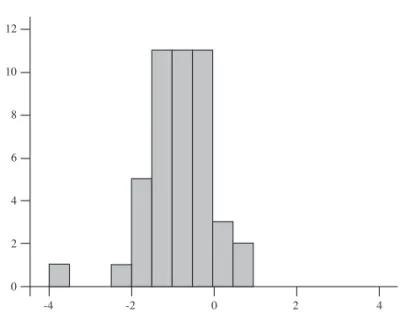
The centroids for ADHD and control groups have a corresponding positive or negative sign (Madhd= 0.84 and Mc= -0.84) and the graphical representation of the discriminant canonical functions for both groups is shown in Figure 4.
Discussion
MANOVA results showed that both groups, children with and without symptoms of ADHD, performed differently in four observable variables, the former group having poor performance in some types of the directional (DFnd) and formal (FFd) biases. However, in line length variability (LVnd and LVd), which measures the fl uctuations in line length during the determinant interval (obtained from the parallels), the mean values and range were lower in the group of children with ADHD symptoms compared to the control group, although the variability in performance in the ADHD group was greater (13.58 ± 13.28 mm versus 22.60 ± 7.21 mm in the non-dominant hand and 17.80 ± 14.63 vs. 25.64 ± 7.03 mm in the dominant hand). This difference in the average group means, which was lower in children with ADHD symptoms (about 8 mm in absolute value), can be interpreted as more rigid behaviour compared to the control group, although the ADHD group demonstrated more precise performance in drawing the parallel lines. These fi ndings point out one of the most signifi cant differences in fi ne motor performance in the proprioceptive sensory condition of the children with ADHD symptoms.
Sex differences, as per MANOVA results, were found in one variable, directional bias in sagittal movement with the dominant hand (DSd), which did not coincide with the variables that were observed for the group differences. Therefore no specifi c effect on the ADHD symptomatology was observed. With regard to age, however,
Table 1
Descriptive statistics and MANOVA results (with Bonferroni correction for multiple comparison)
Variables (types)
Group M DT d Cogen
MANOVA results, F
ET MT Hand Short Sex Age Group
Directional errors
Frontal
ND DFnd ADHD
Control
23.60 15.64
18.15
09.51 0.56 1.697 0.479 3.965*
D DFd ADHD
Control
14.62 16.80
10.06
12.86 -0.19 0.712 1.097 1.251
Transversal
ND DTnd ADHD
Control
13.02 16.84
10.37
14.72 -0.30 0.025 0.902 1.870
D DTd ADHD
Control
13.62 13.67
12.27
11.26 0.00 2.065 1.083 0.258
Sagital
ND DSnd ADHD
Control
17.82 19.71
15.24
12.93 -0.14 0.219 0.248 0.556
D DSd ADHD
Control
18.80 17.56
12.23
11.54 0.11 4.540* 0.169 0.074
Formal
errors Frontal
ND FFnd ControlADHD 17.8411.98 14.4211.85 0.45 0.007 1.669 3.837
D FFd ControlADHD 16.9108.62 15.4408.74 0.67 0.033 0.992 8.228**
Line length sum
ND LLnd ADHD
Control
48.64 44.29
15.67
13.83 0.30 1.128 1.337 0.909
D LLd ADHD
Control
39.91 41.62
14.36
12.14 -0.13 0.029 0.509 0.381
Length
variability sum
ND LVnd ADHD
Control
13.58 22.60
13.28
07.21 -0.85 0.248 3.944* 15.533***
D LVd ADHD
Control
17.80 25.64
14.63
07.03 -0.69 0.519 3.891 7.84**
Note: Legend: ET: error type (D: directional, bias parallel to the model line; F: formal, bias perpendicular to the model line; LL: line length, and LV: line length variability; indexes nd and d stands for the non-dominant and dominant hand correspondently). Directional and formal error variables represent their absolute value in bias. Signifi cance level: * p≤.05; ** p≤.01; *** p≤.001
Table 2
Structural matrix of the discriminant function
Function
1
LVnd -0,505
LVd -0,409
FFd 0,396
DFnd 0,329
FFnd 0,266
DTnd -0,180
LLnd 0,176
DFd -0,113
DSnd -0,080
LLd -0,077
DSd 0,063
DTd -0,002
the only variable that discriminated between the target groups was the line length variability in the non-dominant hand (LVnd).
This is an exploratory study providing results that can lead to similar investigations in the direction of the relationship between proprioceptive fi ne movement control and the presence of ADHD symptoms and shed light on the issue of motor control in this pathology.
Very few studies exist with similar research to compare with our fi ndings with. The only similar results, concerning the reduced line length variability, were found in our previous study, in patients with Parkinson’s disease, and this effect was statistically signifi cant only in men (Gironell, Luitsko, Muiños, & Tous, 2012).
This study has several limitations which could affect the fi nal results and should be taken into account. On the one hand, the children who were chosen by their tutors as a control group (without visual signs of having ADHD symptoms) all had a high academic level (good or excellent marks) and were enrolled in sports activities (such as dancing or physical education). On the other hand, there was a limited amount of data concerning the ADHD group in the register provided by the ADHD association (ADANA), with only a general description of symptoms such as hyperactivity, impulsivity, attention defi cit and diffi culties in reading and writing. For these reasons, it would be challenging to carry out further research to check fi ne motor performance in different types of ADHD. Also,
the study would need to be replicated in the adult population to determine whether these differences are constant with age.
In summary, this was an exploratory study from which we can draw the following conclusions: signifi cant differences were found in fi ne motor performance in children with symptoms of ADHD compared to the control group, which were not related to sex differences in this case, and one variable could present the synergetic effect of age only (LVnd). In the directional and formal error types, where the group differences were signifi cant, the ADHD group showed poorer precision, whereas in line length variability, this group was more precise in drawing the lines compared to the control group. However, as their movements were less variable in mean and range values, one of the negative interpretations of this result can be related to rigidness of movements. With discriminant analysis, all four variables which were found to refl ect differences in the performance of both groups were confi rmed to be inductors of ADHD symptomology.
Acknowledgements
We express our gratitude to ADANA association primary schools (Oriol Martorell, Rosa dels Vents and Europe International School) for their help in carrying out this study and all the children who participated and their parents.
12
10
8
6
4
2
0
-4 -2 0 2 4
12
10
8
6
4
2
0
-4 -2 0 2 4
Discriminant canonical functions
ADHD group: M = 0.84, SD = 1.183, N = 45 Control group: M = -0.84, SD = 0.776, N = 45
Figure 4. Discriminant canonical functions for both groups
References
Barkley, R.A., DuPaul, G.J., & McMurray, M.B. (1990). Comprehensive evaluation of attention defi cit disorder with and without hyperactivity as defi ned by research criteria. Journal of Consulting and Clinical Psychology, 58(6), 775-789.
Cardo, E., Casanovas, S., De la Banda, G., & Servera, M. (2008). Soft neurological signs: Are they of any value in the assessment and diagnosis of attention defi cit hyperactivity disorder? Revista de Neurología, 46(1), 51-54.
Dazzan, P., & Murray, R.M. (2002). Neurological soft signs in fi rst episode psychosis: A systematic review. The British Journal of Psychiatry, 181(43), 50-57.
Enoka, R.M. (2002). Neuromechanics of Human Movement. U.S.A.: Human Kinetics.
hyperactivity disorder and developmental coordination disorder. Developmental Medicine & Child Neurology, 48(3), 165-169.
Fuentes, C.T., & Bastian, A.J. (2010). Where is your arm? Variations in proprioception across space and tasks. Journal of Neurophysiology, 103(1), 164-171.
Gironell, A., Luitsko, L., Muiños, R., & Tous, J.M. (2012). Differences based on fi ne motor behaviour in Parkinson’s patients compared to an age matched control group in proprioceptive and visuo-proprioceptive test conditions. Anuario de Psicología, 42(2), 183-197.
Hartsough, C.S., & Lambert, N.M. (1985). Medical factors in hyperactive and normal children: Prenatal, developmental, and health history
fi ndings. American Journal of Orthopsychiatry, 55(2), 190-210. Kadesjö, B., & Gillberg, C. (1998). Attention defi cits and clumsiness in
Swedish 7-year-old children. Developmental Medicine and Child Neurology, 40(12), 796-804.
Lateiner, J.E., & Sainburg, R.L. (2003). Differential contributions of vision and proprioception to movement accuracy. Experimental Brain Research, 151(4), 446-454.
Lorenzo, G., Díaz, M., Ramírez, Y., & Cabrera, P. (2013). Motricidad fi na en el Trastorno por Défi cit de Atención con Hiperactividad. Revista Cubana de Neurología y Neurocirugía, 3(1), 13-17.
Meyer, A., & Sagvolden, T. (2006). Fine motor skills in South African children with symptoms of ADHD: Infl uence of subtype, gender, age, and hand dominance. Behavioral and Brain Functions, 2(33).
Mostofsky, S.H., Newschaffer, C.J., & Denckla, M.B. (2003). Overfl ow movements predict impaired response inhibition in children with ADHD. Perceptual and Motor Skills, 97(3), 1315-1331.
O’Dwyer, N.J., & Neilson, P.D. (2000). Metabolic energy expenditure and accuracy in movement: Relation to levels of muscle and cardiorespiratory activation and the sense of effort. In W.A. Sparrow (Ed.), Energetics of human activity. U.S.A.: Human Kinectics.
Piek, J.P., Pitcher, T.M., & Hay, D.A. (1999). Motor coordination and kinaesthesis in boys with attention defi cit-hyperactivity disorder. Developmental Medicine & Child Neurology, 41(3), 159-165. Pitcher, T.M., Piek, J.P., & Hay, D.A. (2003). Fine and gross motor ability
in males with ADHD. Developmental Medicine & Child Neurology, 45(8), 525-535.
Tous, J.M. (2008). Diagnóstico propioceptivo del temperamento y el carácter DP-TC [software]. Barcelona: Laboratorio Emilio Mira y López. Tous, J.M., Muiños, R., Liutsko, L., & Forero, C.G. (2012). Effects of
sensory information, movement direction, and hand use on fi ne motor precision. Perceptual and Motor Skills, 115(1), 261-272.
Tous, J.M., Muiños, R., Tous, O., & Tous, J.M. (2012). Diagnóstico propioceptivo del temperamento y el carácter. Barcelona Publicacions i Edicions Universitat Barcelona.