Acta Botanica Malacitana 26: 47-68 Málaga, 2001
ECOLOGY AND STRUCTURE OF DROSOPHYLLUM
LUSITANICUM (L.) LINK POPULATIONS IN THE
SOUTH-WESTERN OF THE IBERIAN PENINSULA
Jonas MOLLER 8z Ulrich DEIL
ABSTRACT. Ecology and structure of Drosophyllum lusitanicum (L.) Link populations in the south-western of the Iberia!, Peninsula. The population size and the demographic structure of the autogamous and nautochoric Drosophyllum lusitanicum were studied in two areas in the South-western Iberian Peninsula. Its coenological character is documented by a synoptic phytosociological table, based upon the published relevés and new data. In the Serra de Monchique (Portugal), the distribution was mapped. 21 populations are growing there with an average size of 165 individuals. In the Campo de Gibraltar (Spain), the biggest population with severa] thousands of individuals occurs in the Sierra del Aljibe. Plant size, rosette diameter and lignification rate from 700 measured individuals are used as indirect indicators for the age-structure in 19 populations.
Drosophyllum has a certain pioneer character. It occurs mostly in open Ericion umbellatae-heathland communities (Stauracantho-Drosophylletum. Querco lusitanicae-Stauracanthetutn, Genisto tridentis-Stauracanthetutn etc.). It is able to colonize disturbed habitats like roadside verges and fire prevention strips and is an apophyt in the Drosophyllo-[Stauracanthenionl-basal community. As a re-seeder the species is favoured by fire events of medium frequency. In open Myrto-Quercetum suberis-woodland and in dense Erica austraiis-heathland, large and tall-growing specimens predominate; there the populations are over-aged. Some deficits in the knowledge of its reproductive biology and further research topics are outlined and the needs for conservation efforts in the Portuguese study area are strengthened.
Key words. Fleathland vegetation, Ericion umbellatae, Portugal, Serra de Monchique, Spain, phytosociology, endemism.
RESUMEN. Ecología y estructura de poblaciones de Drosophyllum lusitanicum (L.) Link en el suroeste de la Península Ibérica. Drosophyllum lusitanicum es una planta autógama y nautocórica cuyo tamaño y estructura de población han sido estudiados en dos áreas del suroeste de la Península Ibérica. Su carácter cenológico se documenta mediante una tabla fitosociológica sintética basada en inventarios ya publicados y datos nuevos. En la Sierra de Monchique (Portugal) se cartografían 21 poblaciones cuyo tamaño medio es de 165 individuos. Sin embargo, en el Campo de Gibraltar (España), se encontró la población de mayor tamaño, con varios miles de individuos en la Sierra del Aljibe. Aquí se estudió el tamaño de las plantas, el diámetro de la roseta basal y el grado de lignificación de 700 individuos, lo que se utilizó como indicador indirecto de la estructura de edades de 19 poblaciones.
48 J. Miiller & U. Dei]
los individuos grandes, siendo éstas poblaciones maduras. Finalmente, se aportan algunos datos poco conocidos de su reproducción y ecología que indican la necesidad de un mayor esfuerzo para la conservación del área portuguesa estudiada.
Palabras clave. Brezales, Ericion umbellatae, Portugal, Serra de Monchique, España, fitosociología, endemismos.
INTRODUCTION
Unlike the Calluno-Ulicetea-heat hl and in the perhumid climate of Western Europe, dominated by eurychorous taxa, the hcathland associations of the suballiance Stauracanthenion boivinii (Ericion umbellatae, Calluno-Ulicetea), distributed in the mountainous arc from the Serra de Monchique in Southern Portugal via the Sierras de Algeciras (SW Spain) to the Western Rif Mountains (Morocco), are characterized by a remarkable degree of endemism and species richness (Arroyo & Marañón, 1990; Galán de Mera & Vicente Orellana, 1996; Ojeda et al., 1995, 1996a). One reason might be that this southwestern part of the Mediterranean region is a centre of origin of this type of vegetation. The occurrence of heliophilous low shrub endemics like Drosophylium lusitanicum, Nothohartsia aspera, Odonates foliosa, Teucrium afrum ssp. ruhriflorunt etc. indicate that there exist — at least in small arcas — primary habitats for those characteristic heathland species.
In their area of distribution, however, Calluno-Ulicetea-communities must be considered as secondary (man-made) communities in most cases, replacing acidophilous forests (mostly cork-oak forests) after cutting and burning. During the last few decades, the heathlands in Southern Portugal and in Andalusia were affected by severe land-use changes. Some major trends are the decline or even the total abandonment of traditional rotating cultivation practises, a decreasing grazing impact, the afforestation with
allochtone taxa like Eucalyptus and Pinus and the change of fire frequency and intensity (Krohmer & Dell, 1999). Are the Stauracanthenion-species threatened or favoured by these current land-use trends ?
A first step to answer this question is to have a closer look upon the ecological requirements and coenological val ue of keystone species in primary and secondary habitats, and to study their life cycle and population structure in different situations. One of those southwest-Iberian-northwest-Moroccan elements, upon which the phytogeographical province Tingitano-Onubo-Algarviense within the superprovince Iberomarroquí- atlántica (Galán de Mera & Vicente Orellana, 1996; Pérez Latorre et al., 1996) is based, is Drosophyllum lusitanicum (L.) Link. It is a carnivorous, low growing perennial plant, lignified in its basal shoots (half shrub, chamaephytic growth from). This monotypic genus has quite an isolated position within the Droseraceae-family and is sometimes even separated from Droseraceae as the monospecific family Drosophyllaceae (Williams eta!., 1994). It shares its distribution, sociology, life form, and isolated taxonomic position with the still rarer Nothobartsia capera (for the latter species see Galán de Mera et al.,
1996).
o
Pos
,
seo
a/qUI A
de Mo
o
/queFaro
o
Seville•
0
Evora
•,•;
A
Li on
100km
eÇc)
Porto
Madrid
' A • A
410,:
A (Yo'00i4
A / • Badajoz
A
HERNAN MARTIN (736m) 14,0° 1373
a9
Tangier r*t_k
.e*
OROCCC
„ ,sopo de
0G,.
o
/far
MONCHIQUE (465m) [31) 15,5' 1345
III
A
TARIFA (20m) 18,0° 795L
Drosophyllum lusitanicum of the Iberian Peninsula 49
50 J.
Willer
&U.
DeilTingitano-Onubo-Algarvian province). In Morocco, Drosophyllum is restricted to the Tangier Peninsula. Inland populations occur at both sides of the Portuguese-Spanish border (Serra de San Mamede and Extremadura), isolated outposts are recorded from the eastern Sierra Morena. In Spain and in Andalusia, Drosophyllum is listed among the threatened species (Valdés, 1996; Ocaria et al. 2000) and the plant community Stauracantho-Drosophylletum ranges among the protected habitats according to the EU-directive (Gil Jiménez et al., 1996).
Some aspects of the life cycle and reproductive biology of Drosophyllum lusitanicum have been investigated in recent years. Ortega Olivencia et al. (1995) studied the floral biology in Extremadura populations and recorded the predominance of autogamy. Garrido Díaz & Ortiz Herrera (1996) carried out field studies in the Campo de Gibraltar and glasshouse experiments in Seville. They underline the role of prey capture for seedling survival rates in soils with low nutrition level. Until now, no data are available about the population structure of Drosophyllum. Efficient conservation strategies for rare plant species, however, must be based upon knowledge of their demography (Holderegger, 1996). This is why we collected data about population size, demographic structure, and reproductive behaviour of Drosophyllum lusitanicum. These data should allow us to evaluate how the present land-use changes might affect the populations of this species in the future.
To answer the questions, what are the primary respectively the secondary habitats of Drosophyllunt lusitanicum and in which plant communities does it occur, we present a synoptic view of the available plant sociological studies and gathered new data from Southern Portugal. Populations of Drosophyllum in pine and cork-oak woodlands are recorded by Ortega Olivencia eta!. (1995); herbarium records from clearings and in coastal
rock communities are presented by Boesewinkel (1989) and Cheers (1992). None of these authors mention the whole set of associated plant species. What is the state of knowledge according to the plant sociological literature '?. Drosophyllum lusitatticum is often recorded from open heathland: Rivas-Martínez (1979) mentions it as a character species of Ericion umbellatae- communities. Quezel et al. (1988) separated the open type of the Erica umbellata-Stauracanthus
communities as an association of its own and named it Stauracantho-Drosophylletum. This community, first described from Northern Morocco, also
occurs
in the Cadiz Peninsula (Dell, 1 997a). It is differentiated in the Aljibian sector by Satureja salzmanii (Drosophyllo-Stauracanthetum saturejetosum salzmanii, Galan de Mera & Vicente Orellana, 1996). Further Andalusian records come from Genista tridens- and Erica australis-heathl and (Pérez Latorre et al., 1993) and from cork-oak woodland Myrto-Quercetum suberis (Pérez Latorre et al., 1993).In Portugal, the observations are quite scanty (Braun-Blanquet et al., 1964; Malato Beliz 1982; Rivas-Martínez et al., 1990). We therefore concentrated our field observations upon the Serra de Monchique in Portugal and collected data from natural, seminatural and man made habitats (cork-oak woodland, heathland, roadside verges, fire prevention strips etc.).
THE STUDY AREAS
Saboia n„,490
ctftvinho 'N. ro Redondo
Estebe Was
ipan
1 \, ,
.,
i
\I '. o 6° o
4
Mannitikt
(4
, V 4'4 ,,, '77/, l,VIalgca ° i; AV '' w 46 egh
4 , ,
• Foote Santa
er
da Velha, ada Velha 2
was Ruivas
do Bufo
scale
01 5km
North
Portirrtio
Drosophyllum lusitanicum of the Iberian Peninsula 5!
Figure 2. Distribution of Drosophyllum lusitanicum (I) in the Serra de Monchique. The syenite area is marked with grey colour.
Malaga provinces, Andalusia, Spain). Both areas have been selected because they shelter important populations of Drosophyllutn lusitanicton, they offer quite similar physical conditions and they are subjected to different trends in land-use changes (Dei!, 1997a).
The study areas have a Mediterranean climate with Atlantic character (see climatic graphs in figure 1). Westerly winds, high air humidity and frequent clouds in the summit parts reduce the severity of summer drought. The central part of the Serra de Monchique consists of a sycnite intrusion, surrounded by Palaeozoic schists and greywakes. The
weathering of the coarse-grained syenite results in cambisols with a sandy texture and a high water holding capacity, whereas on the schists stony leptosols with low nutrient content develop. The Sierras of the Campo de Gibraltar are part of the betic-riphaean mountain ridge, consisting of several Cretaceous and Tertiary flysch layers. Most of the Drosophyllutn-populations there grow on sandy soils over Aljibe-sandstone.
!ter syente rock
52 J. Muller & U. Deil
Figure 3. Erico australis-Cistetum populifolii with Drosophyllum lusitanicum. Vertical and horizontal structure of this tall-growing heathland community on a rocky slope near Cerro da Mal hada Vel ha in the Serra de Monchique. Abbreviations: Au: Arbutus unedo, Cl: Cistus ladantfer, Cv: Ca/luna vulgaris, DI: Drosophyllum lusitanicum, Ea: Erica australis, Es: Erica scoparia, Gt: Genista tridentata, Ls: Lavandula stoechas, Pp: Pious pinaster, QI: Quercus lusitanica, TI: Tuberaria lignosa.
mesomediterranean by dense oak forests (Sanguisorbo-Quercetum suberis typictan in the humid parts and quercetosum canariensis in the hyper-humid parts) (Malato Beliz, 1982; Rivas-Martínez et al., 1990; Seng & Deil, 1999). The Phillyreo-Arbutetum unedonis as the first degradation step of Quercus suber-forests is widespread and traditionally and currently used to harvest fruits from the strawberry tree. Further degradation results in heathland communities. They have expanded under human impact (fire, grazing, cutting) from a few original sites (mountain ridges heavily exposed to wind, rocky outcrops with
superficial soils, hyperhumid sites with stagnant water and pseudogley) and currently cover vast areas. The Erica-heathlands and Cistus-shrublands show a clear bioclimatic zonation. There is a transition from Cisto-Lavanduletea in the thermomediterranean, dry and subhumid zone to Calluno-Ulicetea in the mesomediterranean, humid and hyperhumid zone. The attitudinal series is Cellist° hirsutae-Cistetum ladaniferi, Cisto ladaniferi-Uliceturn argentei, Querco lusitanicae-Stauracanthetum boivinii, Erico australis-Cistetum populifolii to Cisto salvifolii-Ulicetutn minoris. On syenite outcrops at mid-altitude, the attitudinal zonation starts with Halitnio calycini and Ericetum australis-Rosmarinus community med. and with Si/ene mellifera-Ranunculus bupleuroides community, goes on to Stauracantho-Drosophylletum and ends up with the Osyrio quadripartitae-Juniperetum turbina rae.
E]non-lignified
r-plignified, non-flowering
lignified, flowering
60
(1) 1D0
N Co' ,\N' t.Co
height classes
[cm]
Um.
0 N. <,) çz) „Ço
<0^" <0`6
Drosophyllum lusitanicum of the Iberian Peninsula 53
Figure 4. Height classes, lignification and flowering rate in Portuguese populations of Drosophyllum lusitanicum
METHODS
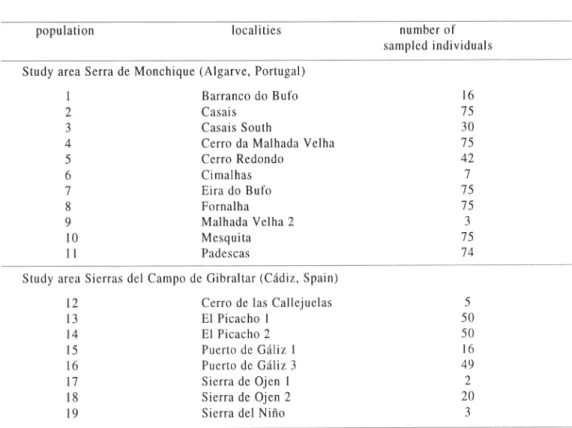
Field data were collected between April and July 1998. In the Serra de Monchique, the local distribution of Drosophyllum lusitanicutn was mapped (fig. 2) and the number and size of all populations was documented. Additional data were collected in the Sierra del Aljibe and in other mountains of the Campo del Gibraltar. In total, 700 individuals in 19 different populations were measured. Table 1 shows the sample sizes per population and per study area. All studies have been restricted to non-destructive observations. Subterranean parts were not investigated; every shoot rooting independently was treated as an individual. Small sample sizes are due to a low number of individuals in the respective population.
To analyse the population structure of Drosophyllum, vegetative morphometric parameters, which can be interpreted as age-states or life-age-states (Barkham, 1980;
Holderegger, 1997), were measured. These parameters are plant height, rosette diameter and degree of lignification in the basal parts of the specimen. To get an insight into the generative reproduction strategy, the following data were noted: number of buds, flowers, fruits, seeds per fruit and seedling occurrence and establishment.
's(° q‘e') ^)<'
height classes [cm]
54 J. Willer & U. Deil
non-lignified
Dlignified, non-flowering Mlignified, flowering
Figure 5. Height classes, lignification and flowering rate in Spanish populations of Drosophyllum lusitanicum
presented in a constancy table (tab. 3), which is reduced to the diagnostic and frequent species. The locations of the relevés are documented in figure 1. Classification and nomenclature of the plant communities are according to the Zurich-Montpellier school (Braun-Blanquet, 1964; Dierschke, 1994). Impoverished stands are typified following the concept of basal communities according to Kopecky & Hejny (1974). Plant communities are typified and named according to Rivas-Martinez et al. (1990) in Portugal, and Deil (1997a) and Pérez Latorre et al. (1999) in Spain. In both countries nomenclature of plant species follows Valdés et al. (1987).
RESULTS
Local distribution and size of the
populations: In the Serra de Monchique, 21
populations have been found (tab. 2). The altitudes of the localities range between 290m
and 560m a.s.1., i.e. from the thermo- to the mesomediterranean bioclimatic level. A higher density of the populations can be stated in the leeward, southern and southeastern parts of the Serra (fig. 2). 10 populations occur on syenite, 11 on schists and greywakes. The average population size (statistical mean) is about 165 individuals. The most important population with about 800 specimens is near Chilr5o. In the Sierras of the Campo de Gibraltar, the studied populations of Drosophyllunt lusitanicum are all growing on Aljibe-sandstone. The biggest population with several thousands of individuals occurs near the summit of Picacho in the Sierra del Aljibe at an altitude of about 830m a.s.i. in the mesomediterranean bioclimatic level.
Sociology and autecology of
o
60
40
20
O
total population
2
3
8
4
in
cork-oak woodlands9
1
10
7
11
6
in
heathlands
and on disturbed groundDrosophyllum lusitonicunz of the Iberian Peninsula 55
Figure 6. Mean height and height variability (standard deviation) of nine Drosophyllum populations in Portugal (numbers of populations like in table 1)
silty slopes on Aljibe-clay. This vegetation type was first described by Quézel et al. (1988) from the Tingitanian sector in northern Morocco as Stauracantho-Drosophylletum, based upon Drosophyllum lusitatticum as the only character species. In the type releve, Cistus monspeliensis is very abundant, indicating the high fire frequency at this site in the Tangier area. The association also occurs in the Aljibian sector (Nezadal et al., 1994; Perez Latorre et al., 1996; Deil, 1997a). Besides the typical subassociation (tab. 3, column I), the subassociation saturejetosum salzmanii (tab. 3, column 2) with a high frequency of Satureja salzmanii was stated for the Gaditanian Peninsula by Galan de Mera & Vicente Orellana (1996).
If the fire frequency is lower and the relief moderate, surface runoff decreases and soils are deeper. At such sites, the Erica
umbeHata-heathlands have a dense vegetation canopy and Drosophyllum occurs in low frequency and with only some scattered individuals. These habitats can be enclosed in the Sierras of the Campo de Gibraltar into the Genista tridentis-Stauracanthetum in its typical subassociation and into the subassociation with Quercus lusitanica on profound, podsolic soils (tab. 3, columns 3 and 4). In Morocco, the succession advances from the Drasophyllo-Stattracanthetum to the Erica umbellata-Cistus crispus-community (Deil, 1997a). The investigated populations in the Campo de Gibraltar can be assigned to Drosophyllo-Stauracantheturn and to Genisto tridentis-Stauracanthe turn.
56 J. Muller & U. Deil
Figure 7. Correlation between rosette diameter and height in the population Mesquita in Portugal (n = 75, Spearman's correlation coefficient rs)
is endemic in the Serra de Monchique. It is concentrated in the western and northwestern schistous parts of the Serra and occurs exclusively on wind exposed mountain ridges with stony soils with a shallow or even completely missing humus layer. From these sites, which seem to be original heath habitats, the heathlands have been expanded under human impact to Phillyreo-Arbutetum-cli max sites and to originally open Quercus suber-woodland sites. Today, the traditional land-use (burning and pasturing) is abandoned and high growing shrubs are invading the secondary Erica umbellata-heathlands. Like in the closed Genisto-Stauracanthetum, Drosophyllum lusitanicum occurs in the dense and intact Querco-Stauracanthet um only with low frequency and very limited numbers of individuals (tab. 3, column 5).
In the Serra de Monchique, the former secondary heathlands have been transformed to a large extent into Eucalyptus-plantations within the last few decades (Malato Béliz, 1982; Krohmer & Deil, 1999). In the ground layer of these forests, the floristic composition
is very similar to the non-reforested sites. Character species of Querco-Stauracanthetum, like Centaurea crocata and
C.
fraylensis, are still occurring, but with lower frequency and abundance (tab. 3, column 6). The plant cover, however, is much more open, the sites are often terraced before planting. This vegetation type was called "matas artificiais" by Malato Béliz (1982). It is identical with type 10 (Eucalyptus afforestations in Quercus lusitanica heathland) in Seng & Deil (1999). According to the nomenclature of Kopecky & Hejny (1974), it can be named Drosophyllo-[Stauracanthenion1-basal community. Drosophyllutn lusitanicum has a good capability of recolonizing these terraced Eucalyptus-forests if the tree layer remains open and if vital populations of Drosophyllunt are nearby. It can even expand to sites with high disturbance like roadside verges, timber storage areas and firebreak strips. The apophytic character of Drosophyllum is indicated by its higher frequency in disturbed (tab. 3, column 6) than in undisturbed (tab. 3, column 5) sites of the Querco-Stauracanthetum.Most of the 21 populations of Drosophyllum found in the Serra de Monchique occurred in the Querco-Stauracanthetum or in [Drosophylloi-Stauracanthenion-basal communities. In higher altitudes and at northern slopes, Querco-Stauracanthetum respectively Genisto tridentis-Stauracanthetum is replaced by Erico australis-Cisteium populifolii. The Erica austra/is-heathland is taller and growing more densely than Erica umbellata-dominated heathland; Drosophyllum lusitanicum becomes less frequent (tab. 3, column 7). Populations with high numbers of individuals occur at disturbed sites (Eucalyptus- and
Pinos
pinaster-plantations), where the plant canopy is open (fig. 3).Ial
4 5 1 10 7 11
I I
im
6 total 18 15 16 13 14 Portugal
total
Spain
100 %
80
60
40
20
o
EJ lignified
mnon-lignified
Drosophyllum lusitanicum of the Iberian Peninsula 57
Figure 8. Lignification rate in different populations of Drosophyllum lusitanicum (for localities see table I )
Monchique was documented by Braun-Blanquet et al. (1964). In the heavily grazed Erica umbellatae-Ulicetum micranthi (tab. 3, column 10) as well as in the Ulici minoris-Ericetum umbellatae from the Serra de San Mamede (tab. 3, column 9) Drosophyllum lusitanicum appears with low frequency.
In cork-oak woodland, Drosophyllum lusitanicum remains restricted to the Myrto-Quercetum suberis (thermomediterranean subhumid bioclimate) (tab. 3, column 8) where it prefers small disturbed areas, resulting from digging animals or from ploughing. Drosophyllum lusitanicum does not occur in closed thermo- and mesomediterranean humid cork-oak woodlands with dense litter (Teucrio-Quercetum suberis in Spain respectively Sanguisorbo-Quercetum suberis in Portugal). Population structure: Plant height, lignification rate and rosette diameter are parameters which can be easily measured in a non-destructive way and arc indirect parameters of the age of the individuals. Figures 4 and 5
show the correlation between height classes, lignification in the basal parts and flowering rate in all measured specimen in Portugal respectively Spain. In Portugal (fig. 4, 505 individuals measured in total), the proportion of the non-lignified individuals decreases continuously in the first three height classes, whereas the proportion of flowering individuals increases in the same way. > 6cm is the minimum size for flowering, individuals > 25cm are nearly all flowering. A maximum height of 72cm was stated in Portugal. All flowering specimen are lignified in the basal parts of the shoots. The Spanish populations (fig. 5, 195 individuals measured in total) show similar tendencies. > 5cm is the minimum size for flowering, all flowering individuals are lignified. In contrast to the Portuguese populations, the specimen are dwarfishly growing (> 40cm) and the rate of flowering is during flowering peak much lower.
58 J. Miiller & U. Deil
population localities number of
sampled individuals Study area Serra de Monchique (Algarve, Portugal)
1 Barranco do Bufo 16
2 Casais 75
3 Casais South 30
4 Cerro da Malhada Velha 75
5 Cerro Redondo 42
6 Cimalhas 7
7 Eira do Bufo 75
8 Fornalha 75
9 Malhada Velha 2 3
10 Mesquita 75
11 Padescas 74
Study area Sierras del Campo de Gibraltar (Cádiz, Spain)
12 Cerro de las Callejuelas 5
13 El Picacho 1 50
14 El Picacho 2 50
15 Puerto de Gáliz I 16
16 Puerto de Gáliz 3 49
17 Sierra de Ojen 1 2
18 Sierra de Ojen 2 20
19 Sierra del Niño 3
Table 1: Location of the studied populations and number of sampled individuals of Drosaphylluni lusitanicum
and the competitiveness of Drosophyllum, populations in different communities have been studied. fig. 6 shows the mean height and height variability of nine populations in Portugal (no data available from Spain). The average height (statistical mean) is about 25cm, individuals in opened cork-oak woodlands (populations 2, 3, 4 and 8) and tall-growing heathland (population 7) being significantly taller than those in low-growing heathland and in open areas. Height class distribution is different: in open areas low classes predominate, populations in cork-oak woodlands have a balanced distribution, tall specimens dominate in heathlands of the Erico australis-Cistetum
The parameter rosette diameter confirms these results. The mean rosette diameter for all measured individuals is about 21cm. There are no significant differences between all
Portuguese and all Spanish populations and between the different Spanish populations (p = 0,165, Kruskal-Wallis H-test, (Sachs 1993)). A comparison of the Portuguese populations, however, shows significant di fferences between the studied populations (tab. 4). Individuals in the cork-oak woodlands and tall-growing heathland have significantly larger rosette diameters (about 30cm) than those in low-growing heathland and open habitats (about 23cm, p <0,001, Mann-Whitney U-test, Sachs 1993). The measured parameters plant height and rosette diameter are significantly correlated to each other in almost al I populations in Portugal and Spain (tab. 5). A correlation diagram of the population 10 "Mesquita" is shown as an example (fig. 7).
Drosophyllum lusitonicum of the Iberian Peninsula 59
altitude number of
population / locality m a.s.l. aspect substrate individuals
Aldobreira
250
NE, E
schist450
Barranco do Bufo
450
S
syenite
50
Barrciras Ruivas
325
E
syenite
85
Casais
420
S,
SWsyenite
265
Casais
South385
SSEsyenite
32
Cerro da Malhada Velha
560
SE
syenite
80
Cerro do Covao da Loba
415
SE
schist121
Cerro Redondo
460
S
schist
42
Chilrdo
460
NE, E
schist800
Cimalhas
430
NWschist
7
Eira do Bufo
a,
Estebeiras
390
330
SE
SE
syenite
schist
450
Fonte Santa
270
NE
schist
87
Fornalha
290
SE
syenite
95
Malhada Velha 2
515
SWsyenite
3
Mesquita
490
S, E
schist165
Morgado
415
S
syenitc
205
Padescas
335
S,
SSE schist80
Picota
400
SSWsyenite
20
Taipas
340
SE
schist44
Zevinho
440
NE, SE
schist
385
Cerro de las Callejuelas 4
590
SWAlljibe-sandstone
117
Cerro de las Callejuelas 5
570
SWAlljibe-sandstone
8
Cerro de las Callejuelas 6
550
S
Alljibe-sandstone
2
Cerro de las Callejuelas 7
540
SE
Alljibe-sandstone
45
.z El Picacho 1
690
SE
Alljibe-sandstone
187
El Picacho 2
770-830
SE
Al 1 jibe-sandstone
8000
Puerto de Gáliz 1
420
SWAlljibc-sandstone
16
Puerto de Gáliz 2
470
NWAlljibe-sandstone
24
Puerto de Gáliz 3
610
S
Allj ibe-sandstone
91
Sierra de Ojén 1
450
S
Al 1 j i be-san dstone
2
Sierra de Ojén 2
450
SE
Alljibe-sandstone
51
Sierra del Niño
240
SE
Alljibe-sandstone
3
60 J. MOHer & U. Deil
Column 1 2 3 4 5 6 7 8 9 10
Number of relevés 14 5 32 26 32 10 23 35 15 21
Stauracantho-Drosophylletum lusitanici CS
Drosophyllum lusitanicum V V I II I III I I I 1
Stauracantho-Drosophylletum saturejetosum DS
Satureja salzmanii I V II Ill
Genisto tridentis-Stauracanthetum boivinii CS
Genista tridens III IV V
Klasea alcalae III II III IV
Bupleurum foliosum I I I
Querco lusitanicae-Stauracanthetum hoivinii CS
Lavandula stoechas ssp. luisieri IV III 1 II
Centaurea crocata III III II I
Centaurea fraylensis S II IV
Klasea monardii O 11 I
Lavandula viridis O 1
Stauracanthenion boivinii DS
Stauracanthus boivinii V V V V V IV I
Avenula sulcata s.l. III II III Ill IV IV 11 I I 1
Ulici minoris-Ericetum umbellatae CS
Ulex minor I I II I
Erico umbellatae-Ulicetum micranthi CS
Ulex micranthus S V
Ericion umbellatae CS
Erica umbellata II IV III III V II 1 V V
Genista triacanthos II II II 1 III I III I III Ill
Genista tridentata II Ill II V V II I V IV
Erica australis 11 II IV IV Ill V 1 11 I
Halimium alyssoides ssp. lasianthum II I I IV I IV II
Thymus villosus III I IV II II
Polygala microphylla I I 11 II I 1
Quercus lusitanica 11 II V V IV II . .
Halimium ocymoides IV Ill 1 III 1
Ornithogalum broteroi IV II I I II .
Erica cinerea IV IV
Calluno-Ulicetea CS
Calluna vulgaris III III IV V V V IV I IV V
Agrostis curtisii II I IV IV IV III I . V V
Simethis planifolia II . 1 I II II I I IV IV
Erica scopari a III I IV IV II II I I
Cisto-Lavanduletea, Lavanduletalia CS
Tuberaria lignosa III III III III Ill IV II I I I
Cistus salvifolius II I IV III III II V III
Cistus crispus III I II I 1 II
Lavandula stoechas IV I IV III I II I II
Halimium halimifolium III II I I
Cistus populifolius ssp. major S I I III II I III I
Cistus ladanifer I II V IV V 1
Drosophyllum lusitanicum of the Iberian Peninsula 61
Quercetea ilicis CS Quercus suber Arbutus unedo Erica arborea Daphne gnidium Scilla monophyllos Carex depressa Crepis tingitana
CS: character species, DS: differential species
1 1
11
IV
11 1 I II I II II
Ill
I
1II I IV II
II 11
V
II III IV
ii
1: Stauracantho boivinii-Drosophylletum (Quezel eta!., 1988 Morocco; Dell, 1997a Spain and Morocco);
2: Stauracantho-Drosophylletum saturejetosum salzmanii (Galan de Mera & Vicente Orellana, 1996 Spain); 3: Genisto tridentis-Stauracanthetum (Rivas-Martínez, 1979 Spain; Galan de Mera & Vicente Orellana 1996 Spain; Deil, 1997a Spain and Morocco and own material); 4: Genisto tridentis-Stauracanthetum quercetosum lusitanicae (Perez Latorre et al., 1993 Spain; Galan de Mera & Vicente Orellana, 1996 Spain and own material); 5: Querco lusitanicae-Stauracanthetum (Malato Béliz, 1982 Portugal; Galan de Mera & Vicente Orellana 1996 Spain; Dell et al., in prep. Portugal and own material); 6: [Drosophylloj-Stauracanthenion basal community (own material) 7: Erico australis-Cistetum populifolii (Braun-Blanquet
eta!., 1964 Portugal; Malato Beliz, 1982 Portugal; Pérez Latorre et al. 1993 Spain; Deil eta!., in prep.
Portugal and own material); 8: Myrto-Quercetum suberis (Rivas-Martínez et al., 1990 Portugal; Nieto Caldera et al., 1990 Spain; Pérez Latorre et al., 1993 Spain and own material); 9: Ulici minoris-Ericetum umbellatae (Braun-Blanquet et al., 1964 Portugal); 10: Erico umbellatae-Ulicetum micranthi (Braun-Blanquet et al., 1964 Portugal)
Table 3. Sociology of Drosophyllum lusitanicum in the South-western Iberian Peninsula and in Northwest Morocco (constancy table, reduced to frequent and diagnostic species)
be used as a differentiating character of adult versus juvenile plants. On average, the proportion of juvenile plants is about 20% in Portuguese as well as in Spanish populations (fig. 8). We can however state an enormous variability of the rate of juveniles from one population to the other. Some populations in Portuguese cork-oak forests are nearly without any juvenile plants (populations 2 and 8). They must be interpreted as over-aged. Population 4 is too small to be significant. A very low rate of non-lignified specimens was further stated in the mass population (> 8000 individuals) near Picacho summit in Spain. This population has re-established itself after a fire event. It has a strong cohort structure and nearly the whole cohort is already in the lignified stage. Since this event, new seedling establishment seems to he extremely rare.
In both study areas, Drosophyllum
lusitatticum flowers from April to July. Most
of the rosettes develop one, seldom two, flowering shoots. The flowering rate ranges
between 13 and 96%, depending on the habitat and the age, as determined by the size-structure (height, rosette diameter, lignification) of the population (fig. 4 and 5). With increasing plant size, the flowering rate increases (tab. 5). In the cork-oak woodlands and in the tall-growing
Erica australls-heathlands, the flowering rate was constant during the observation period
from April to June, in open Erica
umbellata-heathland it increased with a flowering peak end of June.
62 J. Muller & U. Dei]
2 3 8 4 9 1 10 7 11
3 ns
8 ** ns
4 *** **
9 *** *** ***
1 *** *** *** *** ns
10 *** *** *** *** ns ns
7 ns ns ** *** ** *** ***
II *** *** *** *** ns ns ns ***
6 *** *** ns *** ns ns ns ** ns
ns = not significant, * = p <0,05, ** =p <0,01, = p <0,001 (Mann-Whitney- U-test)
Table 4. Significance test of the parameter "rosette diameter" related to populations
in
Portugal.constant number within the populations of both study areas. There is however a significant difference (p < 0,001, Mann-Whitney U-test) between both study areas with about 10 seeds per fruit in Portugal and 14 in Spain. Because of its constancy, seed number per fruit is not a suitable character to measure vitality.
The observations about seedling density and seedling patterns are very preliminary; data about seedling survival rates in the field are still missing. Most of the seedlings have been observed on open sites with shallow soils and without any litter. Within those habitats, seedlings are mostly established in the shadow of dwarf shrubs, which seem to offer safe sites for seedling survival. In cork-oak woodlands, seedlings are very rare and appear only in places where the humus layer is disturbed by animal activity or by ploughing.
The generative strategy of Drosophyllum lusitanicurn is supported
by
vegetative sprouting.In
Quercus suber-forests we observed a few specimens with long superficial creeping shoots (up to 40cm). These shoots are able to develop adventitious roots and daughter rosettes.DISCUSSION AND CONCLUSIONS
Drosophyllum lusitanicum occurs in several acidophilous heathland communities
in the southwestern part of the Iberian Peninsula and in northwestern Morocco. The species is most frequent in low growing and open heathland and can — in accordance with Rivas-Martinez (1979) — in a broader sense be evaluated as a character species of Ericion umbellatae. The highest densities and the most numerous populations occur in the Drosophyllo-Stauracanthetum where this heathland is original: wind exposed mountain ridges in the mesomediterranean belt and stony/ loamy slopes in the thermo- and mesomediterranean belts. In both situations, periodical fire is an intrinsic factor of the ecosystem. The community can expand to less shallow soils, favoured by a higher, man-made fire-frequency and by clearing of the forests.
Drosophyllum lusitanicum of the Iberian Peninsula 63
thermomediterranean hiocl i mate (Myrto-Quercetunt suberis). This is not obvious in so far as Pérez Latorre et al. (1993) placed the Stauracatztho-Drosophylletum in the Teucrio-Querceto suberis S. series. Nieto eta!. (1990) did not mention Drosophyllum lusitanicum in Spanish Myrto-Quercetum suberis-communities.
Drosophyllum lusitanicum can be considered as a potentially endangered species. It occurs in isolated populations and often in small individual numbers. In Spain, most of the populations are situated within the Natural Park "Los Alcornocales" and their protection status is sufficient. In the Serra de Monchique, there exists not a single nature reserve at the moment. Apart from the extremely rare Rhododendron-ravines, the most interesting places in the Serra from the botanical point of view are some mountain ridges in the schistous part of the Serra with Querco-Stauracatahetum and its endemics Centaurea crocata and C. fraylensis and some rocky outcrops in the central syenite area. In the latter sites, Drosophyllum occurs in a vegetation complex with some other communities like Halimio calycini-Ericetutn australis rosmarinetosum med., Sileno melliferae-Rattunculetum bupleuroidis incd., Osyrio quadripartitae-Juniperetum turbinatae, Lauretaio-Juncetum, Isoeto histricis-Radioletum linoidis, Loto subbiflort-Chaetopogotzetum fasciculati, Arenariaconimbricensis-Sedum andegavense-community etc. (Rudner et al., 1999). These sites should be protected from Eucalyptus-plantations, changes to the hydrological system and from the direct destruction by syenite exploitation.
Open soil seems to facilitate the establishment and the regeneration of Drosophyllum. Opening of the plant canopy can either occur by human or animal activities or be induced by natural disturbance (erosion, fire). The species has a certain pioneer character. It can recolonize burned sites,
terraced slopes and disturbed roadsides. Its strategy reacting to disturbance is that of a re-seeder (Ojeda eta!., 1996b). This is supported by the fact that autogamy is prevailing (Ortega Olivencia et al., 1995). Autogamy is widespread in species with a pioneer character at extreme habitats.
The current land-use trends can affect the populations in different and contradicting ways. A diminishing anthropo-zoogenic disturbance in oak forests will reduce the germination niches, but favour the life span and the vegetative regeneration. The abandonment of the traditional pasture use and the burning management of secondary Ericion umbellatae-heathland in Spain and Portugal will allow the regrowth of dense Erica austrahs-heathland and of the tall-growing Phillyreo-Arbutetum and Cytiso-Arbutetum-Maquis. This will reduce the area of the Drosophyllo-Stauracanthetum to its original sites. The effect of land-use in Morocco is opposite of that in Portugal and Spain. In Morocco, the populations of endemic Ericion umbeHatae-heathland taxa are threatened by a very high fire frequency and by an ongoing rotating cultivation even on steep slopes.
* * t C * * NO 00 00. 6 9
ao
O s v-1 -oo .0
6 9' * 'fl 0 N NN 005 O o O O o 6 0000 DO
II II II CCC
0 N N V) N N II II II COO
000
I I II 0'
LO N N II 11 II
O, N V'. • - N II II C C C
o O O O 00. c O N 1-00 o000, -0001 II II II COO
*
tr, °
NhL
c?
I-- a LO
II II II a a a
oo * 00 N r" 00 °C.
059
lf 1 00 00
N ("1 r'", II II Ii 0 0
N 1-0, 00 ‘.0 Cj.
t*,
II II II c
* * * * N O
059
‘fl N r^, N N N II II II
O .0 LO V.,
00 N c5
NNN
II II II 000 4 ó, ; • ti cr 00 vz, 059 . - -c
'; •>_ 5 0 E o
• g
o o • cc.+ 00
c E
4.0 00 0)000.0.
• E.) 2 2
a. a
Drosophyllum lusitonicum of the Iberian Peninsula 65
Drosophyllum lusitanicum populations in open habitats. This interpretation is supported by the flowering behaviour which is significantly correlated with height and lignification. In a further research study it would be an interesting question whether the differences between Portuguese and Spanish populations, for example the different seed numbers per fruit, are phenotypic modifications or are based upon a genetic separation. In a gardening experiment, the correlation between age, lignification, basal shoot diameter, plant height and rosette diameter should be investigated in a planted population to get better data about the age structure of the field populations.
Following the age-state-concept, the populations in Myrto-Quercetum and in Er/co australis-Cistetum populifolii are over-aged. A further reason for the occurrence of large and rich flowering plants in cork-oak woodland could be the better nutritional situation at those sites. Seedling survival should be better than in open heathlands because nutrient supply from the soil or from prey capture favour germination and seedling survival (Garrido Díaz & Ortiz Herrera, 1996). Seed rain should be sufficient in cork-oak forest populations of Drosophyllum hut hard data are still missing. The insufficient regeneration might be due to the rarity of germination niches. The continuous litter and the undisturbed soil might be responsible for the over-aging of those populations. The low generative regeneration in Quercus suber-forests is, to some extent, compensated by vegetative regeneration. Further studies should include investigations about germination and seedling establishment under field conditions. Especially, the influence of chamaephytes and litter for the germination should be a topic in further research.
For the moment it is unknown to what extent Drosophyllum lusitanicum is able to tolerate or recover from heavy disturbances like terracing for Eucu/yptus-plantations or after forest harvesting. Drosophyllum is
nautochoric and its seeds can be transported by runoff. Exact data about other dispersal agents (ants ?), the dispersal efficiency and distance are missing. We also do not know whether it performs a transient or permanent seed bank.
SYNTAXONOMICAL CONSPECTUS
QUERCETEA ILICIS Br.-B1. ex A. & O. Boles 1950 + Quercetalia ilicis Br.-B1. ex Molinier 1934 CM.
Rivas-Martínez 1975
* Querco rotundifoliae-Oleion sylvestris Barbero, Quézel & Rivas-Martínez in Rivas-Martinez, Costa & Izco 1986
Teucrio baetici-Quercetum suberis Rivas-Martínez ex Díez Garretas, Cuenca & Asensi 1988 [dense cork-oak woodland, in subhumid, humid and hyperhumid climate, mainly on sandy soils, typical for the Aljíbico sector]
Myrto communis-Quercetutn suberis Barbéro, Quezel & Rivas-Martínez 1981 [silicicolous cork-oak woodland with south-west Ibero-Atlantic distribution, thermomediterranean, subhumid-humid bioclimate]
Rusco hypophylli-Quercetum canariensis Rivas-Martínez 1975 [silicicolous cork-oak woodland, therm°. and mesomediterranean, humid and hyperhumid bioclimate, Aljíbico sector]
* Quercion broteroi Br.-B1., Pinto da Silva & Rozeira 1956 em. Rivas-Martínez 1975 corr. V. Fuente 1986 Sanguisorbo hybridae-Quercetutn suberis Rivas Goday 1959 em. Rivas-Martínez 1975
typicum [mesomediterranean cork-oak woodland, subhumid-humid bioclimate, west-Iberian distribution]
quercetosum canariensis Rivas-Martínez, Lousa, Díaz, Fernandez González & Costa 1990 [mesomediterranean cork-oak woodland with Quercus canariensis]
+ Pistacio lentisci-Rhamnetalia alaterni Rivas-Martínez 1975
* Juniperion turbinatae Rivas-Martínez 1975 corr. 1987 Osyrio quadripartitae-Juniperetum turbinatae (Rivas-Martínez 1975) Rivas-Martínez, Lousa, Díaz, Fernández-Gonzáles & Costa 1990 [thermomediterranean shrubland in coastal areas of the Gaditano-Onubo-Monchiquense-Sadense sectors]
66 J. Muller & U. Deil
Cytiso baetici-Arbutetum unedonis Nieto Caldera, Perez Latorre & Cabezudo 1990 [thermo-mesomediterranean Arbutus unedo-Cytisus-Genista shrub in the Algibian sector]
CALLUNO-ULICETEA Br.-B1. & R. Tx. ex Klika & Hadac 1944
+ Calluno-Ulicetalia (Quantin 1935) R. Tx. 1937 em. Rivas-Martínez 1979
*Ericion umbellatae Br.-BI., Pinto da Silva, Rozeira & Fontes 1952 ampl. Rivas-Martínez 1979 - Ericenion umbellatae Rivas-Martínez 1979 Cisto salvifolii-Ulicetum minoris Br.-BI., Pinto da Silva, Rozeira 1964 [endemic heathland in Portugal (Bajo Alentejano-Monchiquense subsector), humid to hyperhumid bioclimate]
- Stauracanthcnion boivinii Rivas-Martínez 1979 Querco lusitanicae-Stauracanthetum boivinii Rothmaler 1954 ex Malato Beliz 1982 [low-growing heathland only on schists, degradation community of the Myrto communis-Quercetum suberis, endemic in Portugal, humid and hyperhumid bioclimate] Genisto tridentis-Stauracanthetum boivinii Rivas-Martínez 1979
typicum [silicicolous, low-growing heathland in the Aljíbico sector]
quercetosum lusitanicae Perez Latorre, Nieto Caldera & Cabezudo 1993 [subassociation with high frequency of Quercus lusitanica on deeper soils] Stauracantho boivinii-Drosophylletuin lusitanici Quézel, Barbero, Benabid, Loisel & Rivas-Martínez 1988 [open, low-growing, silicicolous scrub on sandy soils, Aljíbico and Tangcrino sector]
saturejetosum salzmanii Galán de Mera & Vicente Orellana 1996 [differs by the high frequency of Satureja salzmanii, Aljíbico sector]
Drosophyllo-[Stauracanthenio Id-basal community [floristically impoverished Stauracanthenion-community on habitats which are heavily disturbed by man, mainly in the Monchiquense sector]
Erica umbellata-Cistus crispus-community Dell 1997 [fire-promoted heathland community in the Tangerino sector]
Halimium calycinum-Erica australis-Rosmarinus community [dwarf heathland on syenit outcrops in the Monchiquense sector, mesomediterranean, subhumid bioclimate, transitional association between the Ericion umbellatae and the U/ici-Cistion]
Silene mellifera-Ranunculus bupleuroides community [in crevices and between consolidated sandstone and syenit boulders, endemic in the Monchiquense sector, mesomediterranean, a dynamic transition from Asplenietea to Calluno-Ulicetea]
CISTO-LAVANDULETEA Br.-B1. in Br.-B1., Molinier & Wagner 1940
+ Lavanduletalia stoechadis Br.-131. in Br.-BI., Molinier & Wagner 1940 em. Rivas-Martínez 1968 * Ulici argentei-Cistion ladaniferi Br.-B1., Pinto da Silva & Rozeira 1964
Cisto ladaniferi-Ulicetum argentei Br.-B1., Pinto da Silva & Rozeira 1964 em. Rivas-Martínez 1979 [thermo- and mesomediterranean Cistus-shrubland with Mediterranean and lbero-Atlantic distribution] Genisto hirsutae-Cistetum ladaniferi Rivas Goday 1954 em. Rivas-Martínez 1979 [Cistus-shrubland on relatively nutrition-rich, siliceous soils, Luso-Extremadurense province]
Erico australis-Cistetum populifolii Rivas Goday 1954 [Bajo-Alentejano-Monchiquense sectors, mesomediterranean, subhumid bioclimate, transitional association between the Cisto-Lavanduletea and the Calluno-Ulicetea]
ACKNOWLEDGEMENTS. The financial support by the German Research Foundation (DFG) is greatly acknowledged (Az. De 402/3). We thank the administration of the "Parque Natural de los Alcornocales" for the permission to study the populations in the Andalusian Mountains and two anonymous reviewers for valuable remarks. We are indebted to R.J. Byer for the linguistic correction and to A. Galán de Mera for valuable remarks and the translation of the Spanish abstract.
BIBLIOGRAPHY
ARROYO, J. & T. MARAÑÓN -1990- Community ecology and distributional spectra of Mediterranean shrublands and heathlands in Southern Spain. J. Biogeography 17: 163-176. ASENS1, A. y B. DÍEZ GARRETAS -1987-Andalucia occidental. In: Peinado Lorca M. & S. Rivas-Martínez (eds.) La Vegetacion de España: 197-230. Alcalá de Henares. BARKHAM, J.P. -1980- Population dynamics of
the wild daffodil (Narcissus pseudonarcissus). I. Clonal growth, seed reproduction, mortality and the effects of density. J. Eco! 68: 607-633. BOESEW1NKEL, F. D. -1989- Ovule and seed development in Droseraceae. Acta Bot. Neerlandica 38: 295-311.
Drosophyllum lusitanicum of the Iberian Peninsula 67
BRAUN-BLANQUET, J., A.R. PINTO DA SILVA & A. ROZE1R A -1964- Resultats de trois excursions géobotaniques á travers le Portugal septentrional et moyen — Ill Landes á Cistes et Ericacées (Cisto-Lavanduletea et Calluno-Ulicetea). Agronomic, Lusitana 23: 229-313. CHEERS, G. -1992- LetCs Guide to Carnivorous
plants of the World. London.
DE1L, U. -1 997a- Zur geobotanischen Kennzeichnung von Kulturlandschaften. Erdwissenschaftliche Forschung Vol. 36. Stuttgart.
DEIL, U. -1997b- Distribution and ecology of some rare plant species in Northern Morocco I: Teucrium afrum ssp. rubri florum and Euphorbia transtagana. Acta Rot. Malacitana 22: 250-254. DIERSCHKE, H. -1994- Pflanzensoziologie.
Grundla gen uncí Methoden. Stuttgart. GALÁN DE MERA, A., U. DEIL, J.A. VICENTE
ORELLANA & I. SÁNCHEZ GARCÍA. -1996-Nothobartsia aspera (Scrophulariaceae): nuevas localidades, ecología y fitosociología. Acta Bot. Malacitana 21: 309-310.
GALÁN DE MERA, A. & J. A. VICENTE ORELLANA -1996- Phytosociological study of the plant communities with Stauracanthus boivinii of the SW of the Iberian Peninsula and NW of Africa, using multivariate analysis. Bol. He/v. 106: 45-56.
GARRIDO DÍAZ, B. y J. M. ORTIZ HERRERA -1996- Introducción a la biología de Drosophyllum I usitanicum (L.) Link. Almoraima
15: 233-243.
GIL JIMÉNEZ, Y., P. NAVAS FERNÁNDEZ, D. NAVAS FERNÁNDEZ, A.V. PÉREZ LATORRE y J.M. NIETO CALDERA -1996-Tipos de habitats naturales contemplados en la directiva 92/43 C.E.E. presentes en el Campo de Gibraltar y espacios naturales de interés para su conservación. Almoraima 15: 255-266. HOLDEREGGER, R. -1996- Reproduction of the
rare monocarpic species Saxifraga mutata L. Dot. J. Linnean Society 122: 301-313. HOLDEREGGER, R. -1997- Intrapopulational size
structure of the monocarpic species Saxifraga mutata and its relationsship to succession. Flora 192: 151-156.
KOPECKY, K & S. HEJNY -1974- A new approach to the classification of anthropogenic plant communities. Vegetatio 29: 17-20.
KROHMER, J. & U. DEIL -1999-Landnutzungswandel in der Serra de Monchique (Stidportugal) in Abhangigkeit von nattirlichen und anthropogenen Bedingungen. Geoiikodynamik 20: 169-192.
MALATO BELIZ, J. -1982- A Serra de Monchique. Flora e VegetaÇiio. Colecgdo "Parques Naturais", Vol 10. ServiÇo Nacional de Parques, Reservas e Património Paisagístico. Lisboa. NEZADAL, W., DEIL U. & W. WELSS
-1994-Karte der aktuellen Vegetation des Campo de Gibraltar (Provinz Cadiz. Spanien). Hoppea, Denkschrift Regensb. Bol. Ges. 55: 717-756. NIETO CALDERA, J.M, A.V. PÉREZ LATORRE
y B. CABEZUDO -1990- Datos sobre la vegetación silicícola de Andalucía I. Acta Dot. Malacitana 15: 179-192.
OCA ÑA, M. E., B. VALDÉS, E. MORENO SOCÍAS y R. PARRA -2000— Drosophyllum lusitanicum (L.) Link. In: G. Blanca et al. (eds.) Libro Rojo de la Flora Silvestre Amenazada de Andalucia. Tomo II. Especies Vulnerables. Consejería de Medio Ambiente. junta de Andalucia. Sevilla. OJEDA. F., ARROYO J. & T. MARAÑÓN -1995-Biodiversity components and conservation of Mediterranean heathlands in southern Spain. Biological Conservation 72: 61-72.
OJEDA, F., T. MARAÑÓN & J. ARROYO -1996a-Patterns of ecological, chorological and taxonomic diversity at both sides of the Strait of Gibraltar. J. Veg. Science 7: 63-72.
OJEDA, F., T. MARAÑÓN & J. ARROYO -1996b-Post fire regeneration of a Mediterranean Heathiand in Southern Spain. hit. J. Wild/and Fire 6: 191-198.
ORTEGA OLIVENCIA, A. O., J. P. CARRASCO CLA VER & J. A. DEVESA ALCARAZ -1995-Floral and reproductive biology of Drosophyllum lusitanicum (L.) Link (Droseraceae). Bol. J. Linnean Society 1 18: 331-351.
PÉREZ LATORRE, AV., J.M. NIETO CALDERA y B. CABEZUDO -1993- Contribución al conocimiento de la vegetación de Andalucia II. Los Alcornocales. Acta Dot. Malacitana 18: 223-258.
68 J. Milner & U. Dei!
L.. Acta Bol. Malacitana 19: 169-183. PÉREZ LATORRE, A. V., A. GALÁN DE MERA,
U. DEIL y B. CABEZUDO -1996— Fitogeografía y vegetación del sector Aljíbico (Cádiz-Málaga, España). Acta Bot. Malacitana 21: 241-267. PÉREZ LATORRE. A.V., A. GALÁN DE MERA,
P. NAVAS, D. NAVAS, Y. GIL y B. CABEZUDO -1999- Datos sobre la flora y vegetación del Parque Natural de los Alcornocales (Cádiz-Málaga, España). Acta Bol. Malacitana 24: 133-184.
QUÉZEL, P., M. BARBERO, A. BENABID, R. LOISEL & S. RIVAS-MARTÍNEZ -1988-Contribution a l'étude des groupements pré-forestiers et des matorrals rifains. — Ecologia Mediterranea 14: 79-122.
RIVAS-MARTÍNEZ, S. -1979- Brezales y jarales de Europa occidental (Revisión fitosociológica de las clases Calluno-Ulicetea y Cisto-Lavanduletea). Lazaron 1: 5-127.
RIVAS-MARTÍNEZ, S., M. LOUSA, T.E. DÍAZ, F. FERNÁNDEZGONZÁLEZ y J.C. COSTA -1990- La vegetación del sur de Portugal (Sado, Alentejo y Algarve). ¡linera Geobotanica 3: 5-126.
RUDNER, M., U. DEIL & A. GALÁN DE MERA -1999- Zwergbinsengesellschaften im Südwesten der lberischen Halbinsel. Mitt. Bad. Landesver. Naturkunde u. Naturschutz NF., 17 (2) : 427-448.
SACHS, L. —1993- Statistische Methoden. Planung und Auswertung. T" • Ed.. Berlin.
SENG, M. & U. DEIL, -1999- Forest vegetation types in the Serra de Monchique (Portugal): Anthropic changes of Oak forests. Silva Lusitanica 7: 71-92.
SILVERTOWN, J., M. FRANCO, I. PISANTY & A. MENDOZA -1993- Comparative plant demography — relative importance of life-cycle components to the finite rate of increase in woody and herbaceous perennials. J. Ecol. 81: 465-476.
VALDÉS, B. -1996- El elemento endémico en el Campo de Gibraltar. Almoraima 15: 13-33. VALDÉS, B., S. TALAVERA & E.
FERNANDEZ-GALIANO (eds.) -1987- Flora Vascular de Andalucia Occidental. vol. 1411. Barcelona. WERNER, P.A. & H. CASWELL -1977- Population
growth and age versus stage-distribution models
for teasel (Dipsacus sylvestris Huds.). Ecology 58: 1103-1111.
WILLIAMS, S.E., V.A. ALBERT & M.W. CHASE -1994- Relationships of Droseraceae: a cladistic analysis of rbc1 sequenced morphological data. Am. J. Bol 81: 1027-1037.
Aceptado para su publicación en junio de 2001