
Factors associated with farmers' perception of agricultural extension in Antioquia, Colombia
191
0
0
Texto completo
(2) ACKNOWLEDGEMENTS The author wishes to express sincere appreciation to. Dr. Lynn L. Pesson, chairman of his graduate cornmittee and Professor and Head of the Department of Extension and International Education, for his encouragement and patient guidance throughout this study and during the period of graduate study and to the other members of the graduate cornmittee:. Professors Quentin Jenkins, Edward W. Gassie,. J. H. Jones, Jr., E. P. Roy and Bruce Flin t , for their. support and helpful assistance during the graduate study.. •. Appreciation is al SO given to Dr. Jaime Gutierrez, temporary associate member of the Graduate Faculty of. L.S.U. and Director of the Social Sciences Department of. rCA in Colombia for his counsel and guidance during the collection of data and analyses made in Colombia and to. Dr. Prentiss Schilling for his help with the analysis of data.. •. The helpful financial assistance of the W. K. Kellogg Foundation which sponsored the author's training at L.S.U. and the financial assistance of lCA for the collection of the data for this study is greatful1y acknowledged.. ii. •.
(3) •. The author is especially appreciative of his wife Maria Isabel and daughter Sandra Victoria who supported the. •. rigors of graduate school cheerfully and sacrificed many of their personal desires to help their student. Acknowledgements are also extended to the following:. the. National University of Colombia, the students who helped in the collection of data and to Mrs. Betty Broussard for typing the final copy of this manuscript.. •. •. •. lii. •.
(4) • -, TABLE OF CONTENTS. •. •. PAGE ACKNOWLEDGEMENTS. ii. LIST OF TABLES •. ix. LIST OF FIGURES.. xi. ABSTRACT. xii. CHAPTER I.. II.. •. •. INTRODUCTION.. 1. The Prob1em.. 1. Purpose of the Study. 3. THE GEOGRAPHICAL AND INSTITUTIONAL SETTING. • • • • • • ••• • •. 8. Co1ombian Agricultural Institute. 11. History of Extension. 11. Credit ••. 16. Personne1 Training. 17. C1iente1e and Area. 17. Extension Agent's Function. 19. Coffee Growers Federation.. • •. History of Extension. 21. Credit Program . •. 27. Personnel Training. 30. The Use of Friendship Groups. 31. iv. •. 21.
(5) •. P~E. •.. 32. Extension Agent's Functions.. 32. C1iente1e and Area . ,. •. Secretariat of Agricu1ture in Antioquia. ••••. •. History of Extension. 35. Credit Programs ••. 41. Personnel Training. 41. Clientele and Area. 42. Extension Agent's Function. 42. Comparison of the Three Extension Service Organizations.. •. 111.. •. • w.. 35. REVIEW OF LITERATURE ••. 44 49. Behavior and Perception.. 49. Past Experiences and Perception.. 50. Attitudes and Perceptions.. 51. Perception and Learning . •. 53. Perception and the Teacher. 54. Perception and Adoption ••. 57. Extension Agent Perception in Colombia • • •. 58 60. RESEARCH DESIGN. Objective and Hypothesis. 60. Sampling • . • • • • • •. 63. v.
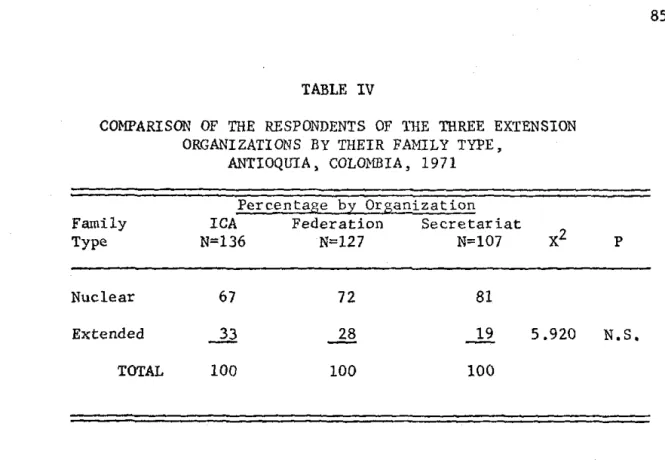
(6) •. PAGE. •. V.. Data Collection • • •. 64. The Perception Scale. 67. Classification of the Independent Variables. • .. 69. Economic Status.. 70. Knowledge of Agricultural Concepts. 72. Contact with Extension Agents.. 74. Method of Analysis • •. 76. ANALYSIS AND INTERPRETATION OF DATA. Comparison of the Three Extension Organizations • • • • •. •. •. •. •. 78 78. Principal Occupation. 79. Place of Residence. 81. Size of Families. 81. Type of Fami1y .. 83. Extrinsic Motivation. 84. General Knowledge About the Extension Service . . .. 86. Knowledge of Extension Organization. 88. Sources for Advice. 89. Effects of Practices Adopted. 92. Relationship of Practices Learned with Sources of Incame. 94. Use of Credit • • • • •. 97. vi.
(7) PACE Know1edge of Agricu1tura1 Concepts • •. •. Fertilizers.. 101. Vaccines. 103. Improved Seed.. 103. C1ient's Perception and Nu11 Hypotheses .. •. '*. •. VI.. 103. Perception. 104. Extension Agent Perception. 104. Schoolíng.. 107. Age • • •. 113. Econornic Status.. 114. Practices Learned.. 117. Practices Adopted.. 119. Knowledge of Agricultura1 Concepts. 121. Exposure to Mass Media. 123. Contact with Extension Personne1. 125. Know1edge of Extension Organizations . .. 126. SUMMARY, CONCLUSIONS AND SUGGESTIONS. 128. Research Design.. 128. Findings. 130. Conc1usions.. 144. Sugge s tions .. 149 vii. •. 100.
(8) PAGE. •. BIBLIIXRAPHY. 154. APPENDIX. 161. VITA ••. 175. •. •. •. •. viii. •.
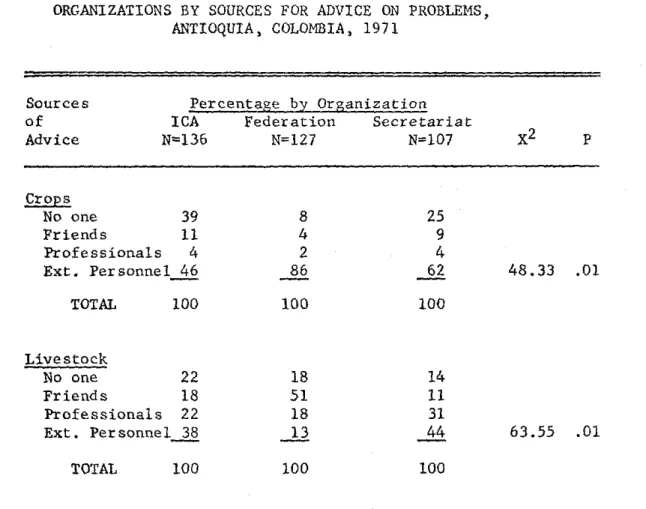
(9) LIST OF TABLES. •. PAGE. TABLE I.. 11.. 111.. IV.. • V.. •. COMPARISON OF THE RESPONDENTS OF THE TRREE EXTENSION ORGANIZATIONS BY TREIR PRINCIPAL OCCUPATION, ANTIOQUIA, COLOMBIA, 1971 • • • . • . . .. 80. COMPARISON OF THE RESPONDENTS OF THE TRREE EXTENSION ORGANIZATIONS BY TREER PLACE OF RESIDENCE, ANTIOQUIA, COLOMBIA, 1971. .. .....•. 82. COMPARISON OF TRE RESPONDENTS OF TRE TRREE EXTENSION ORGANIZATIONS BY THE NUMBER OF PERSONS WHO LIVED IN TRE SAME HOUSE, ANTIOQUIA, COLOMBIA, 1971.. 82. COMPARISON OF TRE RESPONDENTS OF THE TRREE EXTENSION ORGANIZATIONS BY TREIR FAMILY TYPE, ANTIOQUIA, COLOMBIA . .. 85. COMPARISON OF TRE RESPONDENTS OF TRE TRREE EXTENSION ORGANIZATIONS BY ACTIONS TAKEN BY TRE RESPONDENTS TO INCREASE YIELDS, ANTIOQUIA, COLOMBIA,. VI.. COMPARISON OF TRE RESPONDENTS OF TRE TRREE EXTENSION ORGANIZATIONS BY TREIR GENERAL KNOWLEDGE ABOUT EXTENSION AND TREIR SPECIFIC KNOWLEDGE ABOUT EXTENSION ORGANIZATIONS, ANTIOQUIA, COLOMBIA, 1971 • • • • • • • • • • ••. •. VII.. COMPARISON OF RESPONDENTS OF TRE TRREE EXTENSION ORGANIZATIONS BY SOURCES FOR ADVICE ON PROBLEMS, ANTIOQUIA, COLOMBIA, 1971 . . . •. ix. .. 85. 1971 . . . . . . . . .. ,. ,. . . .. ••••. 87. 91.
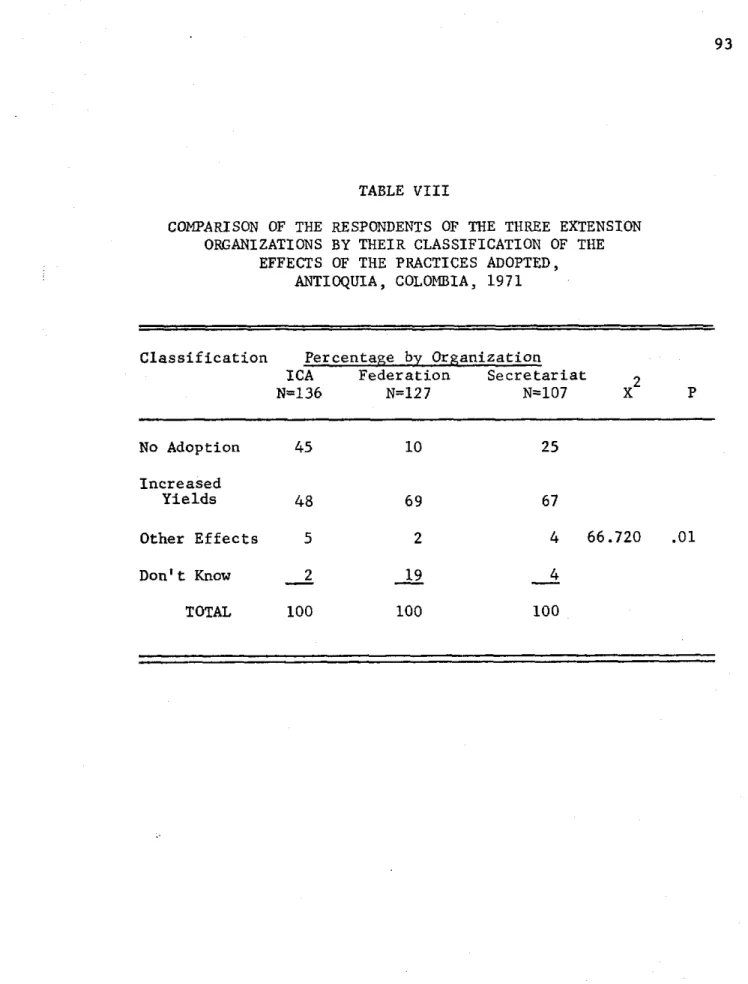
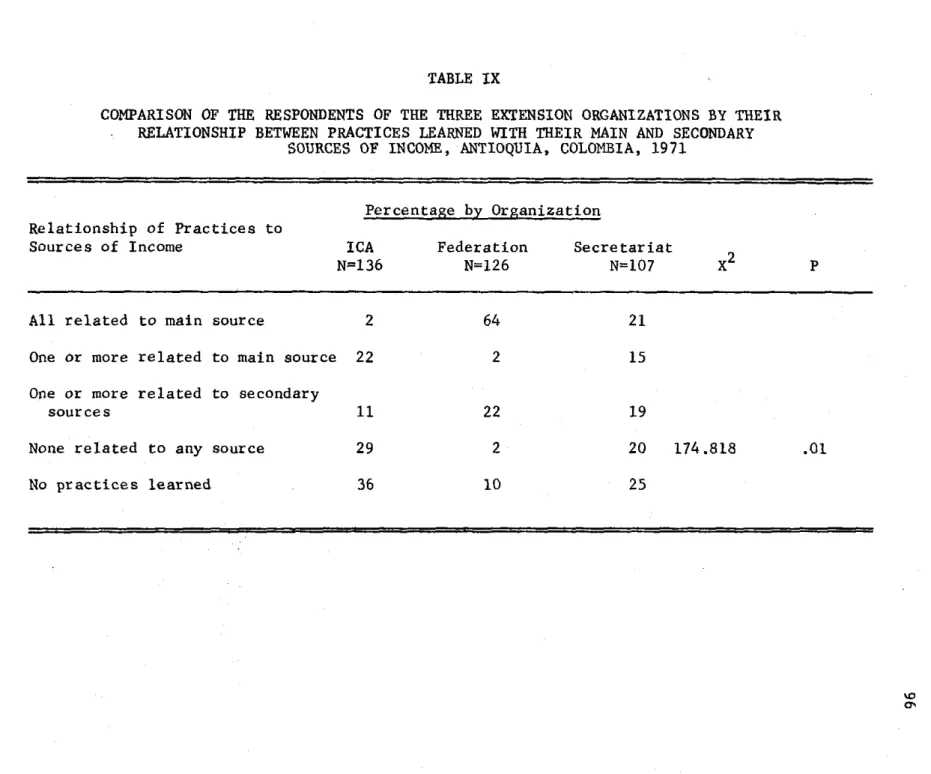
(10) TABLE. •. •. VIII.. IX.. X.. XI.. • XII.. XIII.. XIV.. PAGE COMPARISON OF THE RESPONDENTS OF THE TRREE EXTENSION ORGANIZATlONS BY THEIR CLASSIFICATION OF THE EFFECTS OF THE PRÁCTICES USED, ANTIOQUIA, COLOMBIA, 1971 • • • • •• •••.•••. 93. COMPARISON OF TRE RESPONDENTS OF THE TRREE EXTENSION ORGANIZATIONS BY THEIR RELATIONSRIP BETWEEN PRACTICES LEARNED WITH TREIR MAIN AND SECONDARY SOURCES OF INCOME, ANTIOQUIA, COLOXBIA, 1971 .. 96. COMPARISON OF THE RESPONDENTS OF THE THREE EXTENSION ORGANIZATIONS BY TREIR USE AND NEED OF CREDIT, ANTIOQUIA, COLOMBIA, 1971 • • •• •••••••. 98. COMPARISON OF TRE RESPONDENTS OF TRE TRREE EXTENSION ORGANIZATIONS BY TREIR KNOWLEDGE OF SELECTED CONCEPTS, ANTIOQUIA, COLOMBIA, 1971 . • • . • •. 102. COMPARISON OF THE THREE EXTENSION ORGANIZATIONS BY CLIENTS' PERCEPTION OF THE EXTENSION AGENT AND THE EXTENSION SERVICE, ANTIOQUIA, COLOMBIA, 1971 • • • • • • • • ••••. 105. COMPARISON OF THE THREE EXTENSION ORGANIZATIONS BY TRE SELECTED VARIABLES USED IN TRE STUDY, ANTIOQUIA, COLOMBIA, 1971 • • •. 109. RELATIONSHIPS OF PERCEPTION SCORES OF TRE RESPONDENTS TOWARD TRE EXTENSION AGENT AND TRE EXTENSION SERVICE WITH TRE VARIABLES CONSIDERED IN THE STUDY ACCORDING TO ORGANIZATIONS, ANTIOQUIA, COLOMBIA, 1971 •• '". 111. •. x.
(11) LIST OF FIGURES. •. PAGE. FIGURE l.. 2.. 3.. 4.. A MAP DEPICTING ANTIOQUIA I S LOCATION IN COLOMBIA.. ....... . A MAP DEPICTING THE COLOMBIAN AGRICULTURAL INSTITUTE EXTENSION AGENCIES IN ANTIOQUIA.. •... 18. A MAP DEPICTING THE COFFEE GROWERS FEDERATION EXTENSION AGENCIES IN ANTlOQUIA. . • . . . . . . . • •. 33. A MAP DEPICTING THE SECRETARIAT OF AGRICULTURE OF ANTIOQUIA EXTENSION AGENCIES IN ANTIOQUIA. . . . • . •. 40. •. •. •. •. xi. •. 9.
(12) •. ABSTRACT This study was an attempt to determine the clients' (farmers') perception of the extension agent and the extension service in Antioquia, Colombia.. lt also sought to determine. the factor s associated with these perceptions. The study included the three main extension organizations operating in Antioquia and 370 clients were interviewed.. A. combination of probability and non-probability sampling was used in order to include approximately equal numbers of clients for each organization.. •. A Likert-type Bcale was used to. measure clients perception.. The Bcale was pretested twice and. an item analysis by the method of comparison of extreme quartiles was made, using the interviews of the second pretest.. •. Selected independent variables were defined, using comparative rating scales.. The statistical. Kruskal-Wallis. One-Way Analysis of Variance, Analysis of. techniq~es. used were Chi-square,. Variance and Correlation Coefficient, when appropriate.. •. The study revealed that the organizations' clientele were as different as the organizations themselves.. The Federation's. clientele were the ones who requested more advice from. •. xii. •.
(13) lO. extension personnel, learned more practices, used more practices, had more practices related to sources of income and had better perception of the extension agent than the clientele of lCA and the Sect:etariat.. ... A positive association was found between the favorableness of clients perception of the extension agent and years of schooling, economic status, practices learned, practices used, knowledge of agricultural concepts, mass media exposure, contact with and knowledge of extension organizations.. No. association was found for age. rt was found that the clients' perception of the extension lO. service was not associated with clients schooling, economic status, level of contact and age. When perception was examined within the organizations, the. ... associations found were somewhat differentto those found for the whole sample.. For lCA clients,' perception was associated. with economíc status, practices used, mass medía, knowledge of agricultural concepts, level of contact with and knowledge of extension organizations.. •. Perception of the Extension Service. was associated only with knowledge of agricultural concepts and knowledge of extension organizations. For Federation clients, there were associations only with practices learned and practices used with perceptions of the Extension agent.. For perception of the Extension Service, there. was an association only with practices used.. .. xiii.
(14) •. For Secretariat clients, positive associations were found with practices learned, practices used and level of contacto There Were negative associations with economic status and knowledge of agricultural concepts with perceptions of the Extension agent.. •. For perception of the Extension Service. positive associations were found with practices learned, practices used and levels of contacto. There were negative. associations with years of schooling and economic status. !he most significant finding was that only the number Of} practices used was associated with favorableness of clients' perception for all of the three organizations.. •. Three main conclusions were drawn from the study:. l.. Some problems must exist with Extension work in. Colombia;. •. 2.. lt is necessary for each organization to revise. its extension program and the methodology used to carry it out; and. 3.. The most important thing for extension is what the. farmer (client) does, and that he does it successfully.. •. economic aspect is the most important factor.. •. xiv. •. The. ~.
(15) •. CHAPTER 1 lNTRODUCTlON This chapter presents the problem where the relation. •. of perception with the extension service i8 emphasized as well as the purpose of the study as it applies to Antioquia and the extension organizations under study.. lt also includes the. definition of terms. The Problem The main fuction of extension is informal education. •. in order to bring about changes in knowledge, attitudes and skills in people which will aid individual and social development (8, p. 23).. •. Writers, su eh as Byrness (38, pp. 242-. 256) and Niehoff (12, pp. 13-40) have stressed the importance that the perception of new techniques by people plus perception of the extension agent, had on the cIient (farmer) in the adoption of new techniques.. This seems to be a transfer of. the findings made by psychologists of the importance that the perception of the task, as we1l as the perception of the teacher, has on the learning process.. •. 1. •.
(16) • 2. This study, consequent1y,is trying to determine the way the c1ients or users of the extension services in Antioquia see. •. or perceive the extension services and the extension agents. Favorable perception towards the service and the agent is an important factor in carrying out programs designed to bring. •. about sociocultural changes in the c1ients. As W. 1. Thomas (11, p. 421) said, "If men define situations as real they are real in their consequences".. This. means that if the c1ients define or see the extension service and the extension agent as he1pfu1 or important for them in f1nding ways to solve their own prob1ems, they are likely to accept their teachings, otherwise they wi11 be uninterested. The efforts of the extension men wil1 be futile and resistance to change will be evident.. •. Although there is not an economic focus per se, the three organizations in the study are investing money and human resources trying to raise the socio-economic level of the campesinos (peasant farmers).. By this study of perception one can get. an idea of the impact they are having on their clients, and. •. based on it to determine the type of organization that is likely to produce better results.. •. •.
(17) • 3. Purpose of the Study This study is important not only for the extension. •. organizations involved but for the whole country because: l.. It will show how the clients or users of the extension services in Antioquia perceive the. •. services and the agents in charge of teaching them to use new agricultural practices and techniques. 2.. By knowing the clients' perception of the extension services, it is possible to reinforce. those aspects which are related to more. •. favorable perceptions and to develop new strategies for helping those who have unfavorable perceptions. 3.. •. It can give an idea of the effectiveness of the extension service and its employees in reaching people with their programs.. 4.. It will suggest, hopefully, sorne aspects which need more emphasis in arder to make the extension services. •. more effective, particularly in developing good relationships between clients and the extension organizations.. •.
(18) • 4. 5.. lt explores and suggests new research which will answer more specific questions.. 6.. From a theoretical point of view, thís study can be used to develop new policies and new philosophies in the different extension organizations.. • Definition. 2i. ~. For the purpose of the study the following terms are defined: Agricultural Extension Service:. As used here is the. services organized by Colombian Agricultural lnstitute (lCA), Secretariat of Agriculture of Antioquia or the Coffee Growers. •. Federation to extend to clients (farmers) new techniques and technology. Extension Agent:. •. A professional (Agronomist, Veterinarian,. etc.) employee of the Agricultural Extension Service who carries on work with farmers. /. Practico:. A non-professional technician employed by the. Agricultural Extension Service who works under the direct. •. supervision of the extension agent.. The práctico sometimes. has more direct contact with farmers than does the extension agent.. •. •.
(19) 5. Work Front:. This term is used here to refer to an area. in which a Práctico works where extension projects are carried. •. out in order to improve the community. part of a Municipio.. lCA's work fronts are. For the Secretariat of Agriculture it. includes several Municipios, except in the Experimental Nucleos. •. which include only one Municipio. Extension Agency:. This term is used here to refer to an. area in which an extension agent works. includes from one to six work fronts.. The extension agency Tbe extension agency. may have two extension agents,an agronomist, a veterinarian, and a home economist and perhaps other personnel whose work is coordinated by the extension agent chairman. Municipios: States.. •. This. is. similar to a county in the United. It is a local government unit.. It is usually. organized around a city or town that serves as the marketing center to which most people come once a week. Credit:. As it is used here it refers to the practice of. borrowing money by clients. lmproved Practices:. •. As it is used here refers to those new. practices derived from improved technology that are taught to .. /. the clients by the extension agents or practicos.. •.
(20) • 6. Clients:. Usually farmers (campesinos) that appear on the. /. list that practicos or extension agents have in their office.. •. These clients are called users of the extension service.. Only. men were considered eligible for the study, although sorne lists included WOmen too.. •. •. •. • •. •.
(21) CHAPTER II. • THE GEOGRAPHICAL AND INSTITUTIONAL SETTING This chapter presents the geographical setting of the study. •. and a brief historical review of each one of the three extension organizations under study, the Colambian Agricultura1 lnstitute, the Coffee Growers Federation, and the Secretariat of Agriculture of the State of Antioquia.. The main objective of the historical. review is to familiarize the reader with sorne key aspects of the evolution of the extension services of these organizations.. •. The extension concept in Colombia has been in existence for about forty years, but different factors have made it impossible for it to achieve ful1 development.. •. Under the Ministry of. Agricu1ture, an extension service began initially in 1930 when extension was mentioned for the first. t~me. in Colombia in a. report, but on1y in 1947 as resu1t of the Johnson Mission did Extension start to work with a fu11y developed philasophy. In the Caffee Grawers Federation, extensian started in 1927-8. •. when the federation was created in arder to help the caffee gr'ower.. •. Within the Secretariat of Agriculture, extensian began. in 1946, a1thaugh the Secretariat itse1f was established in 1929.. 7.
(22) • 8. The three extension organizations have tried to avoid. •. dup1ication of effort.. In 1959 an agreement was signed between. the Secretariat of Agriculture, the Coffee Growers Federation. •. and the Ministry of Agriculture by which the state was divided in 22 sectors, twelve for the Secretariat, five for the Coffee Growers Federation and five for the Ministry of Agricu1ture (59, pp. 2-6). Geographical Setting Colombia is divided politica11y and administratively into 22 States, three Intendencias ano five Comisarias.. •. Antioquia. is one of the States and is located in the Northwest part of Colombia {see Figure l}. Antioquia is composed of 62,870 square kilometers and its. •. topography is determined by the two Anoean mountain ranges (West and Central) that cross its territory from South to North.. The. Central range in Antioquia is divided and sub-divided into several ranges which make it, the most mountainous state of the. •. country.. This condition causes Antioquia to have a wide. variation in climates from hot to cold. Antioquia has one of the largest popu1ation growth rates in the country.. According to the 1964 census, Antioquia had a. 3.52 per cent popu1ation growth rate compared with 3.20 per cent for the nation.. The population for Antioquia in 1969 was. estimated at 3,019,160 inhabitants out of 20,449,503 in Colombia (49 )..
(23) 9. •. •. •. • • Figure 1.. A MAP DEPICTING ANTIOQUlA'S LOCATION IN COLOMBIA.
(24) 10. Antiquia's popu1ation break-clown 1 in urban and rural segments were as fol10ws:. •. Urban. 1,720,719 - 56.9 per cent. Rural. 1,298,441 - 43.1 per cent. According to provisional data from the 1970 agricultura1 census (48, p. 11) in the 37,626 square ki10meters of farm land in Antioquia, there were 196,297 farms, of which 122,883 were operated by owners, 10,969 were renters and 62,445 were c1assified as others.. The rest of Antioquia's area (25,244 square kilometers). includes free 1and or state land, roads, urban areas, rivers, etc. According to the 1970 coffee growers census (20, pp. 8-10), Antioquia had 50,169 coffee tarms in an area ot 8,431 square. •. ki10meters.. The average size coffee farm was 16.8 hectares and. each one had an average of 3.09 hectares in coffee.. Out of these. farms, 49, 874 were operated by owners, 218 by renters and 77. •. were classified as others. Based on the 1ist of clients obtained in August 1971 for the study and assuming they are representative, in Antioquia the. •. ,. lFor the break-down of urban and rural, it has been considered that cornmunities with 1,500 or more inhabitants were urban; those with les s were rural. See Departamento Administrativo Nacional de Estadistica. Boletin Mensual #202 pp. 6-8..
(25) 11. three agencies of the Colombian Agricu1tura1 Institute were assisting 1,401 c1ients (see Appendix B).. The eight agencies. of the Coffee Growers Federatíon were reaching 5,580 farm c1ients (see Appendix e) and the 31 agencies of the Secretariat oí Agricu1ture were working with 3,131 íarm c1ients, based On an average of 101 clients for the ten agencies that provided 1ists (see Appendix F). As the State of Antioquia had a total of 196,297 farm familíes and the three extension organization. were reaching. an approxímate total of 10,000, these represent about 5 per cent oí the farm íami1ies of Antioquia. COLOMBIAN AGRICULTURAL INSTITUTE History oí Extension In 1930 the chairman of the Department oí Agrícu1ture and Animal Science reported that agronomists were in charge of carrying out campaigns to stop insects and p1ant diseases, and stressed the need for research as the basis for extension work. In thís report of the Ministry of Industries to the Co1ombian Congress, the word "Extension" was mentioned for the first time (56, p. 76). In 1947 a United States Mission carne to Colombia.. This. Mission was headed by a Mr. Johnson, a specia1ist on research, and it inc1uded Mr. Kenneth Guthrie, a specia1ist in extension. •.
(26) 12. work.. The Mission formulated a series of recommendations. and. suggestions that were studied and adapted by the Ministry.. Among. the suggestions were the creation of three Divisions, research, extension and natural resources.. At this time extension started. to work for the first time in the country with a philosophy of extension as it is generally accepted today (56, p. 156). In 1952 the Ministry of Agriculture was organized into the three divisions suggested by the Johnson Mission - research, extension and nstural resources - and in November of that same year a contract was signed with the United States Department of Agriculture tor the establishment of the "Servicio Tecnico Agrico1a Colombiano - Americano" (STACA) for the purpose of developing "Proyecto Piloto de Extension" in the State of Boyaca. The project started in June 1953 as part of the Ministry of Agriculture, and in the State of Boyacá the Extension Service began in 1954.. This was a systematic project that brought to. the country the extension agent, the home economist and the 4-H Club assistant and this organizational form was adopted by the Ministry of Agriculture, the Coffee Growers Federation and the Secretariat of Agriculture in Antioquia (56, pp. 186-190). The Extension Service estab1ished by STACA diffused throughout the country and in 1960 the Ministry of Agriculture had 46 extension agencies which ",orked through the "Zonas Agropecuarias" (56, p. 287).. The Zonas Agropecuarias were.
(27) • 13. created by Executive Order 1169 of July 3, 1958, based at the Experiment centers and stations of the Department of Agricu1tura1 Research.. Here for the first time there was an intent to put to. work research and extension together since, although they were under the Ministry of Agriculture, they worked independently. STACA was closed out in 1962 with debatable results. According to Rice (27, pp. 141-142), this was the only U.S. type extension program not to survive out of twe1ve attempted in Latin America.. Out of its three main objectives - 1) increased. incomes in the area, 2) trained Colombians in extension, and. 3) a developed and stable extension organization - only the training aspect was successful1y concluded, at least to the extent of preparing a group of Colombians skilled in the method of "demonstrations".. The emphasis of the training project was. on extension methods rather than technology.. The main reason. for the fai1ure of this project was that the initiative was never transferred from the United States to a Colombian programo The Ministry organized the Department of Agricultural Research (OlA) in 1955, and the extension division was made part oí the Board, but without a vote.. DIA became the. Division of Research in 1963 when the Colombian Agricultura1 lnstitute (ICA)l was created by Executive Order 3116 of 1963. 1From this point on the term lCA will be used to signify the Colombian Agricu1tural lnstitute..
(28) • 14. (Dec. 18).. lCA was created in order to integrate research,. teaching, and extension. In 1966 by Executive Order 603 the "Institutos Tecnicos Agricolas" (ITAS) were created and they began operation in. 1967 to train extension practicos. In 1966 lCA also presented for consideration of the Ministry a project by which the extension service division would be transferred to lCA.. This project was agreed to and. on August 1, 1967, lCA received from the Ministry 23 Agronomists,. 23 Home Economists and 23 agricultural practicos to begin its extension operations (56). This contract, signed by lCA and the Ministry of Agriculture, set up as the main function of extension the promotion of the use of research results for the purpose of producing an integral development of agriculture and livestock in the country and to set up an information service at the national level to inform the farmer and the cattleman of techno1ogical research results (26, pp. 42-48). The first major undertaking by lCA was to set up a policy for the organization of the extension service and the re10cation of Extension agencies (26, pp. 5-29). most important aspect of this p01icy were:. Among the. 1) work with the. users or clients through organized groups where the clients.
(29) • 15. took part in planning and programming of work; budgetary prob1ems, there was a. 2) as there were. 1imitation of the number of. agencies and their final location was determined by a selection process which included among others the fo11owing criteria:. area of actual and potentia1 production, no 1arge. coffee plantations or commercial farms, high number of agricu1tural farms and farmers, large area of influence, land Dwnership, availability of public services, etc;. 3) extension. was to work through four roain programs - agriculture and livestock, horne improvement, rural youth and farmers organizatioD;. 4) training of personnel to make them capable of transmíttíng complex agricultural technology.. lt al so included cooperation. with schools of agriculture and other organizations. In 1968 lCA, by Executíve Orders 2420 and 3120 of September 24 and December 26, received new functions in the form of the extension servíces of the "Instituto de Fomento Algodonero, Instituto Tabacalero and Zooprofilactico" (Cotton, Tobacco and Veterinary Institutes). The new functions made it necessary to restructure lCA. The name, agricu1tural extension service, was changed to rural extension service in order to provide it with a wider conceptual base than the ear1íer description..
(30) • 16. Due to financing problems, leA used the following criteria to organize the rural exterision service (25, pp. 7-18):. 1). To. work only with organized groups of farmers, using mass media cornmunication methods and giving priority to real needs rather. than felt needs; 2) Do not consider as stationary the extension agency headquarters.. After a 3-5 year period, it would be moved. to another place which required help, based on the criterion of improvement for the largest number of people; 3) Use of technical mobile groups; and 4) Determination of problems based on simple socio-economic studies.. ICA's extension service set up quantitative goals of reaching 2000 families by each agency in the three year period of service in a locality.. The goal was to be achieved in this. way; first year - 700, second year - 1,500 and third year 2,000 families. Credit Credit was considered important by ICA.. In June 1, 1968,. lCA signed a contract with the Agricultural, Industrial and Mining Credit Bank to coordinate extension work and credit in order to help increase the production of small and mediurn-sized farmers.. Through this contract lCA agreed to provide technical. assistance to the farmers and to inform the bank of its program of work and the credit needed.. The Bank agreed ·to provide.
(31) 17. credit to those farmers. ~ho ~ned. an economic unit and met all. of the requírements demanded by the bank in order to. all~. credít. (24, pp. 107-111). The extension personne1 of lCA had used this type of credit and in the annual report for 1970 region four,. ~hich. included. the three extension agencies oí Antioquia, had 176 loans made to ies clíents (23, p. 16). Personnel Training This aspect was consídered important by lCA.. When it. received the extension service from the Ministry of Agriculture, the first step was to conduct an intensíve training course for the personnel who had been transferred (26, pp. 7-8).. lCA also. had an extension trainíng program sponsored by the Kellogg Foundatíon and the Nebraska Mission, for the development of personnel through overseas training. done, unfortunate1y.. There is still much to be. The training of practicas and extension. agents was not very good as reported by Gutierrez (52, p. 46). He observed that most of the demonstrations had little relevance. •. to clíent situations and the tapies were considered inappropriate. Clieneele and. •. ~. lCA had three extension agencies in Antioquia in the Municipios of Frontino, Urrao and Sonson (see Figure 2). each agency it had four or five work fronts.. •. Each work. For.
(32) • 18. •. •. • •. Extension agency headquarter. mArea where interviews were made. • Figure 2.. •. A MAP DEPICTING THE COLOMBIAN AGRICULTURAL INSTITUTE EXTENSION AGENCIES IN ANTIOQUIA.
(33) • 19. front covered two or three neighborhoods (veredas).. This. reduced the area covered by the extension agency to only part. •. of the Municipio because a Municipio eould have 30 or more veredas.. The target elientele of the extensien service were. those farmers who were living in the work fronts and could. •. increase production and productivity (25, p. 3). Extension Agent's Functions. The extension agent was an Agronomist.. He was responsible. for the organization and work of the extension ageney.. His. main function was edueation and it was expeeted that through his actions changes would be produced in attitudes, related to. •. majar economic. returns~. Among other functions he was expected to apply all extension methods adapted to the locality in order to achieve adoption of. •. new knowledge by the clients.. He was responsible fer supervising. and eoerdinating the work of the agency personnel, especially its four to five practicios.. He worked on the four basie programs,. adapting them to the real needs of the locality. Extension work was carried out maínly through individual. •. contacts, group meetings, result demonstrations and regional field trials.. •. The extension agent was expected to follow the. procedure stated in the pubIication of extension No. 4 (24, pp. 27-29) in the conduct of his jobo. •.
(34) •. 20. Although lCA expects for projects to emerge from meetings with local people, this was done only in a few cases.. •. The. standard procedure was that the practicos from their own contacts with clients, presented projects which were approved by the extension agent and the upper hierarchical levels.. •. Gutierrez. (52, p. 45) in a few cases found evidence of local agricultural coordinating committees, but the committees were made up by directors of local government agricultural agencies with little or no clientele participation. Gutierrez (52, p. 39) mentioned that the extension agents were expected to comply with instructions from regional directors, national directors of extension and national coordinators on one. •. side and for the other side utilize the clients' recommendations. This often became conflicting and was a source of dissonance and dissatisfaction for local extension agents.. •. •. •. •.
(35) •. COFFEE GROWERS FEDERATION. •. Coffee growing began in Colombia about 1723, but it did not become commercial until 1821 when the government by law forbade the introduction or importation of coffee.. •. In 1834 the first exportation was made of 156 tons of coffee which equalled 2.62 per cent of the total Colombian exports.. After sorne ups and downs in production due to the. civil wars, coffee production grew. In 1927 coffee exports were 71 per cent of the total value of Colombian exports, consisting of 2,659,577 sacks of coffee (42, p. 4).. • History of Extension In 1904 twenty coffee growers met and created the. •. association called "Sociedad de Productores de Café".. This. society brought certain economic advantages for the growers, but in 1906 the Society becarne a member of the "Sociedad de Agricultores de Colombia" where a coffee sectionwas forrned.. •. In the rniddle of a coffee price crisis, the First National Congress of Coffee Growers was convened in July, 1920 (54, pp. 2324).. •. 21. •.
(36) • 22. This congress produced several recommendations but none were carried out.. •. In June 1927 they met at Medellin for the. second National Coffee Growers Congress that produced "Agreement 2" by which a "National Coffee Growers Federatíon" was created as an organization made up of individuals ínterested in the. •. coffee industry throughout the cauntry.. The newly formed. Coffee Growers Federatian l in its ordinary meeting of August 11, 1927 approved a project by which the government was authorized to levy a 10 cent tax on each 60 kilograms of coffee to be exported.. This tax was designed to produce annually about. $250,000.00 pesos for Federation activities (42, pp. 4-5). This project became Law Number 76 of 1927 (Nov. 14) which among. •. other things established that the Federation was responsíble for the implementatíon of better systems of coffee cropping and bean processing.. •. The Government sígned a contract with the Federatíon On October 15, 1928 and ít included a by-law by whích the Federation wou1d maintain not less than ten Co10mbían emp10yees who were experts on coffee and bean processing in order to make recOrnmen-. •. dations to the coffee growers on the best systems of cropping, use of fertilizers, tools, machínery, etc (21, pp. 11-20), and. • lFrom this point On the term Federatíon wil1 be used to signify the Coffee Growers Federation.. •.
(37) • 23. •. in 1929 the first Agronomist Was appointed for extension in the State oi Caldas (56, p. 75). In order to train farmers and to conduct research, an. •. Experiment Station and severa1 combined Experimental Agricultura1 Station-Schools were authorized in the States in 1929 by the third National Coffee Growers Congress.. The Experiment Station. started in June as "Granja Escuela Central del Cafe" (41, pp. 5370) and in 1930 the Federation appointed the first two "Practicos Cafeteros" alumni of this Station-Schoo1 who were to be in charge of diffussion. •. of techno1ogy and development of coffee production.. Here, it seems began the Federation po1icy of hiring sole1y "practicos" who had finished studies at its own schools.. The. Federation Extension Service grew at such speed that by 1939 it had 12 Agronomists, 85 Practicos and 31 Coffee Mechanics (56, p. 80).. In 1934 the Federation asked the Government for a higher tax on each bag of coffee for export raising it froID 10 cents to. •. 25 cents for a bag of 75 ki10grams (21, p. 253).. In 1937 the. Federation contracted the services of Dr. Paul Shauferberger to begin a systematic study of the soils in the coffee area and it started the "Campaña de Café" (Coffee Campaign) of the extension service (56, p. 101).. ¡ i.
(38) • 24. In 1938 the Federation established three campaigns: a) plant protection, b) soil conservation, e) coffee beans. •. processing (21, p. 336).. A1so in 1938 the bountyl system was. established by "agreement 4" stating that those growers who had less than 10,000 trees and in a poor economic situation. •. should do what the extension personnel recommend.. The State. Commíttees were forced to ínvest not less than 40 per cent of theír budgets in the campaign, "coffee improvement" (saneaminento de plantaciones) (21, p. 337). In 1945 the Federation added two campaigns to its extension work, soil conservation and crop diversification (22, pp. 409-. •. 410).. In 1946 due to a shortage of food production in the. country, the Federation adopted a plan of intense activities directed at food production and a plan to teach children and farmers through the "concentraciones rurales" (45, pp. 73-90). These types of scho01s opened in 1947 with 97 students and by 1970 they had 7,000 students. children of coffee growers.. They had trained by 1970 31,000 These school programs were. transferred to the Extension Service in 1959.. •. The alumni of. each sehool had been organized in the "Club Futuros Agricultores de Colombia" whieh had their own regulations and whieh promoted. •. leadership development.. 1. Bounty refers to a subsidy offered by the extension service organizations to induce their clients to do whatever was suggested by the extension agents or its personnel.. •.
(39) • 25. In 1957 a campaign called "tecnificació'n de cafetales" was established.. •. It consisted of planning and supervision of. the resources lent by the coffee bank to the coffee grower.. .-. In 1959 a stage originated that was described by Suarez and Arze (44, pp. 53-74) as extension work based mainly on. •. individual assistance.. In effect that year the 21st National. Coffee Growers Congress (40, pp. 77-79) met, and by Agreemént 3 decided to group under the generic name of extension the following campaigns that were working with independent budgets, 1) soil conservation, 2) extension work on coffee and others (campañas tecnicas de extension), 3) directed credit and advertising, 4) soil studies, and 5) fertilízers and compost.. •. The Congress. also included within the extension service the formal education programs because the main function of extension was to train the coffee grower and his family in imporved agricultural techniques so that through their application they could increase théir income and level of living. According to Valenzuela (34), this was a fact of significant importance because it put an end to the paternalistic period. •. and brought on the age of education in the field.. In this report. Valenzuela asked that the bounties be converted to a fund for a special type of credit.. •. ... The amount of the bountles were less and. less every year and at the time of the study they no longer existed ..
(40) • 26. In 1965 Valenzuela (32) reported that the acceptance by the coftee grower of the extension agent's recornmendations. •. without the use of bounties shows the effect of the educational work and the coffee growers freedom from paternalism. The extension service organization, according to Rodríguez. •. (28), was based on the extension district, which was similar to a work front.. It was directed by a practico under the supervision. of the extension agent who was the head of the section.. The. area of the district was between 1,000 to 1,500 hectares and with a popu1ation that ranged from 200 to 400 fami1ies on coffee farms.. Above the District carne the "Secciona1" made up. by. several Municipios which because of importance in growing. •. coffee, locale, roads, etc., could be grouped under the direction of the extension agent or section head.. The extension. agent was responsible for programming, supervision, execution. •. and coordination of the work of the practicos in order to carry out the philosophy of extension, based on the Nationa1 guidelines. In 1962, a mission carne to the State of Caldas from "Comite Interamericano de Desarrollo Agricola" (CIDA).. •. Its purpose was. to prepare an integrated and comprehensive program for social and economic development in the State of Caldas, this being one of the most important steps taken towards an integral and harmonious economic development program for a region (33)..
(41) • 27. In 1966 one of the most revo1utionary ways of work was originated by the Federation; the friendship groups.. •. Arze. (37, pp. 75-59) presented a discussion project (ponencia) to the first Nationa1 Meeting on Agricu1tura1 Extension, where he made. .. an analysis of fami1ies and neighborhoods in the coffee region (State of Caldas) and concluded that the group of friends among neighborhoods could and should be used by the extension agents in their work. diffussion and adoption. He stated that neighborhoods affected the processes in the 10ca1ity and they. must be used to ace1erate techno1ogical change. The Federation po1icy on personne1, other than training,. •. was characterized by stabi1ity.. Antioquia State had 8 extension. agents and on1y one of them had less than five years of service with the Federa"ion and four had more than ten years.. •. In July. 1971 the extension personnel of Federation in Antioquia consisted of 8 Agronomists, 38 practicos and 6 coffee mechanics. Credit Programs Credit was one of the things which concerned the Federation for a long time as something absolutely necessary in helping the coffee growers.. In 1932 the Fifth National Coffee Growers Congress. by agreement 3 created the "Fondo Rotatorio", with $50,000 Colombian pesos set aside to lend money to the sma11 coffee growers (21, p. 212)..
(42) • 28. In 1957 the Federation made the first attempt to direct and orient the credit systems offered by the banks towards the. •. coffee regions.. In 1959 the Federation created the "Credito. de Sustitucion" as the resu1t of an agreement between the Extension Service and the Agricu1tura1, Industrial and Mining. •. Credit Bank.. It was considered the first trai1 for credit. diversification and the Federation created a1so the "Credito de Fondo Rotatorio" to be managed by the Coffee Bank (43, pp. 2973). In 1961 the Coffee Growers had an operationa1 "Fondo Rotatorio" and the Federation reached an agreement with the coffee bank to deve10p a type of direct credit for the renovation. •. of old coffee fie1ds (43, pp. 29-73).. This seemed to be what. was ca11ed the first tria1 in coordinating credit with the extension service (19, pp. 110-129).. •. At the time of the study the Federation had in Antioquia two main types of credit for the Coffee Growers.. These credits were. managed by the Coffee Bank and were as fo11ows: Fondo Rotatorio de Credito:. •. The Fondo Rotatorio of Coffee. Growers Credit was a specia1 credit service for coffee growers, estab1ished by Agreement 6 of 1959, 21st Nationa1 Congress of Coffee Growers.. •. This fund had as its main object credit for. improvement of coffee growers, socia11y and economica11y, which cou1d not be hand1ed direct1y by the Coffee Bank (16, p. 1).. ".
(43) • 29. Credito Cafetero planeado por. ~. Servicio de Extension: This. type of credit was a joint effort from the Coffee Bank and the. •. Extension Service of State Coffee Cornmittees. efficiency in their work.. It looked for more. Credit and technical assistance was. coordinated in order to provide for the coffee growers the. •. resources necessary for their economic and social improvement. by an increase in production and diversification of their income. ~. Farmers Got Credit: A client or potential client of the. Federation Extension Service by his own initiative or induced by the extension agent asked the extension agent for a loan.. The. extension agent and the farmer filled out an application form with a detailed plan of investments, indicating the specific amounts. •. of money needed for each practice and a repayment plan based on 50 per cent of the net income increase for the use of the money. •. (credit). After this was done, the extension agent mailed the application to the Bank who in turn informed the extension agent of its approval or rejection.. If approved the client went to. the Bank for the first time with the extension agent where he. •. received the first installment and signed the contract by which he cornmited himself to accept the technical assistance and supervision of the extension agent and to pay back the loan. •. ,. according to plan.. The extension agent had to report to the.
(44) • 30. Bank about the usage of the money by the client.. If done. according to plan, the client was eligible for another installment.. •. If not, the loan was cancel1ed and the Bank called back the money advanced.. This process was repeated as needed, according to the. size of the loan and the type of work to be done.. • Personnel Training This was another aspect that worried the Federation for long time as a means of developing more capable personnel to carry out its functions of teaching and diffussion. In 1934 the Sixth National Coffee Growers Congress by agreement 4 authorized the Federation Director to send some eolombian Agronomists to. •. study in foreign countries (21, p. 249). In 1937 the Federation established a required course on coffee for al1 agronomists, experts and practicos in order to. •. make them more capab1e of carrying out their functions of teaching and diffussion (21,p. 297). When the extension service was reorganized in 1960, an intensive training program on the new philosophy and work. •. techniques was started.. At the end of 1960 all extension. personne1 had taken a short course on extension (28). By 1970 the Federation had offered 147 courses on agricultura1. •. extension, rural sociology, program evaluation, 1eadership, social groups, etc. (19, p. 110) to its extension professionals and to. •.
(45) •. 31. many of its practicos at the local level, directed by the extension agents working at the regional level (43, p. 29-35).. •. The Federation policy of emphasizing training for its personnel still holds today.. Every year all extension agents and. practicos must complete at least one course.. •. The Use of Friendship Groups The friendship group concept had its origin in a study made by Arze (37, pp. 75-79) in the State of Caldas in 1966.. It. was implemented in 1967 when the Federation started a training program for its extension personnel on social groups and leadership. The friendship groups were organized in this manner.. •. The. extension agents first located the leaders in their are a of work. held meetings with them to explain what the plans were. •. and tried to interest the identified leaders.. If the leaders. were interested, the extension agent asked each one to gather his friends for a talk.. At this meeting or in subsequent ones,. the farmers chose the projects they were interested in, and democratically elected a coordinator to serve as the link. • •. between the group and the extension agent •.
(46) 32. The work with the friendshíp groups showed that ít was possib1e to renew coffee fie1ds in small p10ts without credit (19, pp. 113-114).. Rodríguez (43, p. 36) stated that the work. with friendship groups changed the work of extension agents from individual contacts in which only a sma11 number of farmers -~. were worked with to a system of work whích offered contact with a 1arger number of coffee growers and their fami1ies. By June 1971 there were 819 friendship groups in the country with 8,849 members, and in the state of Antioquia there were 67 groups with 810 members (51, p. 8). C1iente1e and. ~. The Federation c1íentele were basica11y coffee growers. The extension agent or practico he1ped any farmer who asked for advise On any crop, but their interest was main1y in the coffee. •. grower who was the one who was payíng for his services. The Federation in Antioquia had 8 extension agencies or Secciona1es (see Figure 3), distributed over the coffee area of Antioquia.. The area covered by the extension agency decreased. as the production of coffee increased. Extension Agents' Functíons. •. The extension agents were expected to plan work for the coffee year, starting in October.. In this plan the extension. agent or practico wrote down a11 the activities he p1anned to.
(47) 33. •. •. •. ,. •. Extensíon Agency Headquarter. ¿r. Area Where Interviews Were Made. Figure 3.. A MAP DEPICTING THE COFFEE GROWERS FEDERATION EXTENSION AGENCIES IN ANTIOQUIA.
(48) 34. carry out:. •. demonstrations, farm visits, meetings, attendance. at courses, etc .. The extension agent had from four to six practicos working under his supervision.. He and the practicos worked mainly. through individual contacts and through friendship groups.. The. most powerful tool used by the extension agents waS their role played in the credit system in the sense that supervision by the extension agent was a credit requirement. Most of the extension agents lived in the area of the extension agency. work fronts •. • •. •. The practicos lived in the area of their.
(49) SECRETARIAT OF AGRICULTURE OF ANTIOQUIA. •. History oí Extension The Extension Service of the Secretariat of Agricu1ture had its roots in State-Law 25 of Apri1 26, 1929 (21, p. 500). It created the Secretariat of Agricu1ture and Deve10pment which had two sections, agricu1ture and industry, and pub1ic works.. The Agricu1tura1 Section was in charge of research,. teaching, p1ant protection, agronomic serv1ces, etc. In 1930, State-Law Number 23 created a bounty system for tobacco farmers in Antioquia, according to the recommendations made by the Agronomists working for the Secretariat of. •. Agricu1ture and Deve10pment (35, pp. 5-12). In 1930 there existed a demonstration station for tobacco at Barbosa and many demonstration fields for wheat, potatoes rice. and cabuya (sissal-1ike fiber) conducted by Agronomists.. At the Experiment Station, Tu1io Ospina, many experimental trials were conducted on many crops. On. June 15, 1944 (18, pp. 43-45) an advisory committee was. created by State Law and among its functions were the advising on methods of teaching and the diffussion of new techniques and systems of cropping.. This state Law a1so mentioned research,. diffussion agricultural education and extension.. •. 35. In other.
(50) 36. words, it established a rudimentary type of agricultural. •. extension service .. On May 23, 1946 (17, pp. 9-11), the Secretariat of Agriculture and Development l re-established by State Law Number 3, in arder to work ior the development oi agriculture and livestock and for the general economic development of the rural people.. This State Law had a flaw in that it left the. organization of the Secretariat to the criteria of Secretaries who served as administrators in that they were selected on the basis of changing political. considera~ions.. In a 1949 report (31, pp. 8-20) an increase in yields oi about 25 per cent was reported as being due to the free distribution of selected corn and bean seeds and the use of demonstration iields which induced iarmers to imitate the new systems of cropping. In 1949 the Secretariat (31, p. 12) defined extension as a system oi teaching done in the homes, in the fie1d itse1f on specific problems of interest to the rural peop1e and the. ... diffussion of new techniques which wi1l be beneficia1 for man and his crops; therefore helping col1ective development.. Rere. the influence of Denneth Guthrie, could be observed.. IFrom this point on the term Secretariat will be used to signify the SeCl·etariat of Agriculture and Development of the State of Antioquia .. •.
(51) 37. In 1948 the Secretariat had six Agronomists and two veterinarians.. •. The number of personnel was increased in 1949. to 18 agronomists, 8 veterinarians, 14 practicos and 5 vaccinators who were conducting campaigns on fruits, pastures, extension,. cocoa, cotton, rice, tohaceo, cassava, etc. (30, pp. 6-20).. In 1950 the Secretariat also had a section called "Ensenañza Rural Agricola y Ganadera" (Rural Teaching in Agriculture and Livestock) and in 1957 the Station-School at Rionegro was training rural youth on agricultural techniques. The original name of the extension agencies were "Agricultural Sectors", but in 1957 they were changed to "Extension Regional Centers" of which there were twelve that supposedly covered the whole State.. In 1959 the state was. rearranged into 22 sectors, keeping twelve for the Secretariat, but the Secretariat worked only in nine due to a lack of personnel.. The extensionists had a fifteen day training. course and began organizing districts in their respective sectors (59, pp. 2-6). The Secretariat organized in each sector ane or two. extension districts.. In each extension district a practico. was located whose responsibility it was to work with a11 the families included in the district.. Each district included. around 200 fami1ies and an area of 1,000 to 1,500 hectares •. •.
(52) 38. Several socio-econornic studies were made in the districts in order to suggest programs and future plans of work. The Secretaríat continued to use the bounties and free distribution of seeds and input s in order to rnake an extension. service in the "Antioquena" way, hopefu11y developing a good perception of itself among its clients (29, pp. 14-15). The Secretariat was reorganized in May 1969 (58, pp. 3-36). With this reorganization the Regional Centers were again established, along with sub-offices of the Regional Centers and the experimental nucleos.. The purpose was to make a better. distribution of human and economic resources because the previous. work done was in very specific areas and there was need for more integratíon of activities, as "e11 as the need to diffuse the service to the whole state (58, p. 36).. The activitíes of. the Secretariat were grouped in four main programs, agricultural productivity, livestock productivity, extension education and forest. resources~. Theoretically, the first two programs, agricu1ture and livestock productivity, were to be carried out with a service orientation for the clients who had obtained credit from an officia1 institution or who had enough resources to pay for the services.. The other two programs had more of an extension. education orientatíon.. In August 1971 the four programs were. further dívided into twelve sub-programs •. •.
(53) 39. In August 1971, the personnel of the Secretariat in the field. l. included:. 25 agronomists, one forest engineer, 18. veterinarians, 9 animal husbandmen and 79 practicos and experts. These personnel were located in 31 extension agencies (see Figure 4 and Appendix E).. It was interesting to note that all. but two of the professionals in the field had been working with the Secretariat for less than five years.. In part, this. was due to the faet that the Secretariat paid very low salaries before the reorganization of 1969, forcing the professionals to search for better salaries with other organizations, and also because in 1969-1970 the total personnel were more than doubled as a consequenee of the new reorganization.. In September 1971. the Seeretariat was paying a basie sa1ary of $5,165.00 Colombian pesos ($250) per month for a professional-level agronomist, that joined the organization.. This salary was relatively good.. Alvarez (47, p. 7) in his report of extension activities, stated that the Secretariat on many occasions discontinued programs already studied and in exeeution, or left a sector forgetting the work and cooperation already obtained from farmers. This seemed to be the case since great variation was found in the report of extension agency loealities from year to year.. lpersonal information obtained from Orlando Machado, Assistant Director, Operations Division and Julio C. Sanin, Director, Operations Division of the Secretariat of Agriculture..
(54) o. Regional Center. •. Sub-Office of Regional Center. O. Experimental Nucleos. Ar. Area Where Interviews Were Made. Figure 4.. A MAP DEPICTING THE SECRETARIAT OF AGRICULTURE OF ANTIOQUIA EXTENSION AGENCIES IN ANTIOQUIA.
(55) 41. Credit Programs In 1959 the Secretariat of Agriculture began trying to reach an agreement with the Agricultural, Industrial and Mining Credit Bank, and the Coffee Bank to start a program of supervised credit.. A contract was signed, finally with the. Agricultural, Industrial and Mining Credit Bank on February 11, 1971 by which the Secretariat would provide the technical assistance required by the Bank to make loans to farmers or cattlemen who met all the requirements. The Secretariat provided this service free of charge and attempted to give priority to small, medium and large farmers, respectively in that order.. Unfortunately, this contract has. not worked as was expected, due to multiple problems. l Personnel Training In the literature review made, the author did not find much information about training programs for extensionists in the Secretariat.. They have sent a few employees on sorne occasions to. different courses in the pasto. Only in 1969 a series of short. courses for extensionists were initiated in cooperation with the. lpersonal information of Dr. Julio C. Sanin. Operations Division Director Secretariat of Agriculture. September 1971..
(56) 42. "Servicio Nacional de Aprendizaje"l, the School of Agriculture at the National University and School of Veterinary Medicine at the Antioquia University (57, p. 28). The Secretariat has not had training programs for its new extension employees who usually were new graduate s.. The new. employees have generally had informal talks with experienced men about their work, immediately before beíng sent to the fíeld. There were no descríptions of job functions. As a result new extensíonísts have generally been free to do whatever they wanted to do which usually has meant a change in the type of work.. In the future, it ís hoped that through. the work by newly organized sub-programs and projects, a type of continuity can be obtained. Clientele and Area The Secretariat clíente1e and area covered included a11 farmers in the Minicipios of Antioquia (see Figure 4) that did not have an integral technical assistance program from other organizations (58, p. 36). Extension Agents' Functions The extensíon agents have not had a fixed number of practicos under their supervision.. 1. The reorganization of the Secretariat. lt is an intermediate level training sehool for nonprofessionals •. •.
(57) 43. set up functions of the regional centers and the experimental nucleos based On coordination, direction and execution of plans covered by its four main programs, as well aS coordination with other entities, but the functions of the extension agents were not defined. The work of the extension agent was based mainly on his interpretation of State Executive Order 431 and from guide1ines of the Operations Division. The extension agents and practicos worked mainly through demonstrations, visits, meetings, etc.) witb the clients,. giving special emphasis to demonstrations.. This could be. considered their main tool and they were carried out in cooperation with other organizations, such aS lCA.. Due to. budgetary problems and not as a principIe, the bounties were very reduced at the time of the reorganization •. •.
(58) COMPARlSON OF THE THREE EXTENSION SERVICE ORGANIZATIONS Sorne rudimentary roots of what we know as extension started in the three organizations in the 1920's.. They were high1y. inf1uenced by the teachings of Denneth Guthrie in 1947 and 1ater by the extension personne1 brought to the country ·to organize the "Proyecto Piloto de Extension" in 1952 by the so ca11ed "Servicio Tecnico Agrico1a Colombo-Americano" (STACA). At this time the concept of the extension agent, horne econornist, 4-H specia1ists, etc. were introduced into the country and adopted by the three organizations. Although the three extension organizations have had as the. •. main objective to educate the farmers in order to increase production and as a 10gica1 consequence raise their socioeconomic conditions, they have had sorne similar as wel1 as contrasting aspects.. Sorne that were mentioned in the historica1. review include: 1). Origin:. The coffee growers federation started as a. private organization which signed a contract with the Government to provide extension service for coffee growers.. The other two. organizations were originated by the Government, although at different 1eve1s.. 44. ,.
(59) 45. 2). Political influence:. The Coffee Growers Federation. has been the organization traditionally which has had more freedom from political influence.. The Secretariat has. continued to be dependent upon the changing criteria of the Secretaries who are selected on the basis of changing political considerations.. lCA's extension service has had a certain. amount of freedom because it depends only to sorne extent upon the Ministry of Agriculture, being a semi-official organization. 3). Extension Agencies:. Of the three organizations the. extension agencies of Federation have been in one locality longer. The extension agencies at the Secretariat have been moved. •. according to political influences.. lCA has had a policy of. movirig the extension agencies every 3-5 years. 4). Policies:. These have been more stable relatively in. the Coffee Growers Federation, due to the fact that it has not had very many changes at the administrative level.. The. Secretary has changed continually in the Secretariat and lCA has been affected by changes. 5). Budget:. Although this was not analyzed in the. historical review, one can deduct that the Coffee Growers Federation has had less problems with budgets than did the other two organizations.. The extension service of lCA since. 1968 has had less problems than earlier.. The budgetary.
(60) 46. problems have had great effect on the stability of the extension agencies and on other important factora, such as salaries for extensionists. 6). Personnel:. Personnel policies presented striking. differences in several aspects. a). Training:. The most important were:. The Federation has trained its. extensionists through short courses.. On the other side lCA. has had a program oi foreign training and the Secretariat has not had any training programo b). •. Stability:. The Corfee Federation has had greater. personnel stability where one out of nine extensionists has haa less than five years of work, compared with the Secretariat where only 2 out of 53 have had more than five years oi experience.. The stability of rCAfs personnel could. not be compared because it i8 a very new agency. c). Morale:. As a consequence of the differences in. buagets, changes in policies, etc., one coula deduct that there were differences in personnel morale. 7). Credit:. !he Federation has always been concerned with. the credit aspect as a way to foster development and it has cieated several funds aud signed contracts to work en this problem.. The other two organizations were cencerned but they. have not been able to do much about it..
(61) 47. 8). Methodology:. This area presented an important. variation - friendship groups.. •. ~.. Although the three extension. organizations have used the traditional techniques of demonstrations, meetings, visits, etc., with debatable results, the Federation developed and has been using the friendship groups with striking effects. 9). Clientele:. The Federation's clientele have been. specific; especially with the medium and large coffee growers. lCA's clientele have been those farmers in their work fronts who can increase production and productivity and the Secretariat's clientele supposedly have been all of the farrners oi Antioquia. 10). Area covered:. differences.. The area covered also presented some. The Federation has worked in are as where coifee. was grown and especially where coffee production was heavier. lCA has had very limited coverage area-wise because of the nature of its program while the Secretariat has been trying to cover the entire state with its 31 extension agencies. 11). Bounties:. Actually the Federation did not use them.. lCA has done so at times in spite of its philosophy of not using them (52, p. 47) while the Secretariat has continued using them, although limited due to budgetary problems. 12). Extensionists functions:. very well by lCA.. •. These have been described. The Federation used to have descriptions of.
(62) 48. functions in the ear1y 1960's, but recently the traíníng and stabílíty of personnel have made it unneeessary.. The. Secretaríat has not had speeified job funetions for its extensionists.. 13). The three extension organizations have had programs. of formal training for youth and in home economics.. The. Federation more recently has left out 4-H-type programs and substituted instead friendship groups and "Club futuros agricultores de Colombia" (Future Farmer-type program). In this chapter a brief history was presented of the extensíon services in the three organizations in the study. It showed that a rudimentary type of extension service started 41. in Colombia in the 1920's, but the more modern philosophy of extension as such began after the recornmendations of Dr. Guthrie in 1947.. After 1952 the concept of the extension agent and the. home economist, and 4-H Club assistants were introduced. Of the three organízatíons, the Coffee Growers Federation has been the one which showed more contínuity and better organization, due primarily to the many facts that were mentioned in the comparíson of the three organizations. The author hopes that this brief history will he1p the reader to understand the evo1ution of the three extension organizations, the factors that affected them, and the manner in which the work was done in arder to eva1uate better the findings of this study..
(63) CHAPTER III. REVIEW OF LITERATURE This chapter presents a review of literature on perception and the role it plays in individual behavior. The individual' s past experiences determine the way he percéives a thing and perception is one of the two components of an attitude. The chapter al so deals with the role that perception plays in individual learning behavior as well as the importance. •. that the client's. p~rception. of the extension agent has on. client learning of new techniques or ideas. Behavior. ~. Perception. Psychologists have found that an individual's behavior is a function of his perception of the events to which he is exposed and not a function of the physical stimulus.. They have. concluded that for a person the important or crucial aspect of behavior is the meaning of events and not the externally observed nature of events (39, pp. 662-673).. 49.
(64) 50. A definition oE perception was given by Extevan and Estevan (15, p. 117) who defined it as "an awareness or interpretation of a situation (stimuli) in terms of which the individual responds, and which he maintains or modifies in light of his experience". Weiss (15, p. 117) summarized the thinking of sorne psycho1ogists and defines percention as "part of the process of living by which each one of us, from his own particular point of view crea tes for himself the world within, in which one has experiences and through which one strives to gain satisfactions". Past Experiences and Perception. •. The definition of perception indicates that perception is personal and originates in the meaning the individual gives to a particular situation based on his life's experiences.. •. As the. experiences can be real or imaginary and no two persons can occupy the same position at the same time and place, it is evident that two persons can not have identical experiences or the same perceptions.. Since there are individual differences,. these will contribute to differences in perception. The extension service in Antioquia was more than 20 years ald.. There has been enough time far the farmers, and especially. its clients or users, to becorne familiar with it because as.
(65) SI. Cantril (7, p. 164) aaid, "a11 ideas of what things are, where they are, what they are good for and so on, are based on • . • assumptions built up from past experience because they have proved good bets for action".. If the clients have. had bad experiences with the extension agents, we can have what Byrness (38, pp. 242-256) called "learned resistance", due to unfavorable experiences with extension workers, especially when they fail to keep their promises. The reasons that Foster (5, p. 120) used to explain why peop1e of different cultures often perceive the same phenomenon in a different fashion is that the perception of a thing depends largely on past experiences and past experiences are largely determined by culture.. Weiss (15,. p. 118) stated, "whatever man knows or thinks he knows he has. .. learned through the experiences of others" • Attitudes. ~. Perceptions. Attitudes are acquired through experiences which have a pronounced affective component.. Attitudes are learned through. imitation more than anything else. According to Blair, et. al (2, p. 216), attitudes have both perceptual and affective components; attitudes help to determine not on1y what the individual sees but how he sees it..
(66) 52. ,t. When an individual has aequired a negative attitude toward a person, he is ready to respond with those modes oi behavior which show dislike or defense.. He is often ablc to notice in. that person the slightest gesture or suggestion, while others are unaware of those detalla.. He ascribes motives to that. person based on his existing biases or past experiences.. As. attitudes operate on pereeption, an individual tends to see what he is looking for and therefore reinforces his attitudes even when there ls evidence to the contrary.. For these reasons,. attitudes are sometiroes highly resistant to change.. •. As attitudes are learned, it is reasonable to assuroe that people have learned froro those in their immediate groups and other contacts.. •. Ir. an individual has learned to distrust. extension agents and he undergoes an experienee which indicates that extension agents are trying to help him and other media reinforce this idea, his perception of the extension agent could change completely from the one established through association with his close friends.. However, if an extension agent i8. unfriendly and not helpful, this attitude will be reinforced whieh will then be more difficult to change..
(67) 53. Perception. ~. Learning. When an individual has a problem, he purposefully tries new approaches based on his past experiences. He perceives the effects of those approaches and based on it he will accept or reject them as valid for the solution of his problem. Frandsen (6, pp. 276-305) states that "perception guides learning" .. For this reason the extension agent must provide. the clients with favorable perceptions of the effects, if the clients are to learn new things. The extension service's main function is education, rnainly to teach farmers or clients new agricultural practices, techniques and ideas.. •. Each one of these ernbodies concepts. which hopefully later on is going to have meaning for the person who learned it.. Speaking on concept learning, Klausmeir. and Goodwin (10, p. 251) stated that concepts are learned through "rneaningful perception learning and purposeful discovery learning" • According to Ausubel (10, p. 84) the critical feature of perceptual learning is that the entire content of what is to be learned is presented to the client (learner) in its final form and the client internalizes it, being able to reproduce it latero The essential condition for meaningful perceptual learning is that the client assirnilates new content into his already existing.
(68) • 54. knowledge so that. i~/has some meaning.. The new material i8. incorporated into the cognitive structure and the. •. individual has learned a new concepto In human behavior concepts serve two main functions. First, they funetion as responses to objects and events by. •. which they are categorized and classified.. In this case. concepts help the individual to deal more effectively with the phY8ical and social environment.. Second, they serve as. mediators between stimulating events and subsequent behavior. Rere concepts help the individual to learn more efficiently. (10, p. 219). Based on what was said, one can deduct that the extensíoníst's. •. maín job i8 to make the clients (farmers) perceive that the practice or idea being taught is good for them and to make them understand why it is good so that they will understand the meaning of it. Perception. ~. the Teacher. The extension agent i8 a teacher.. Ris main function is. to teach farmers or clients new practices and ideas, helping them to apply new agricultural techniques on their farms.. ,-.
Figure


+7


Documento similar
It is generally believed the recitation of the seven or the ten reciters of the first, second and third century of Islam are valid and the Muslims are allowed to adopt either of
In the preparation of this report, the Venice Commission has relied on the comments of its rapporteurs; its recently adopted Report on Respect for Democracy, Human Rights and the Rule
1. S., III, 52, 1-3: Examinadas estas cosas por nosotros, sería apropiado a los lugares antes citados tratar lo contado en la historia sobre las Amazonas que había antiguamente
In the previous sections we have shown how astronomical alignments and solar hierophanies – with a common interest in the solstices − were substantiated in the
Therefore, the results for club convergence support weak convergence for the whole sample of countries, as the null hypothesis of overall convergence is rejected
Díaz Soto has raised the point about banning religious garb in the ―public space.‖ He states, ―for example, in most Spanish public Universities, there is a Catholic chapel
In the “big picture” perspective of the recent years that we have described in Brazil, Spain, Portugal and Puerto Rico there are some similarities and important differences,
The present study was aimed at determining the prevalence of chronic periodontitis, its severity and extension and characterizing the factors associated with it in adult males in
