KEYWORDS / Assessment / Catchability / Mesodesma donacium / Standard Error of Regression / Stock / Received: 09/30/2003. Modified: 03/15/2004. Accepted: 03/31/2004.
Eduardo P. Pérez E. Marine Biologist, M.Sc. and Ph.D. Professor, Departament of Marine Biology, Universidad Católica del Norte, Chile, and researcher, Centro de Estudios Avanzados en Zonas Áridas. Address: Casilla 117 Coquimbo, Chile. email: [email protected]
Javier E. Chávez V. Marine Biologist. Specialist, National Fishery Service, Coquimbo, Chile. email: [email protected]
MODELLING SHORT-TERM DYNAMIC BEHAVIOUR
OF THE SURF CLAM (Mesodesma donacium)
FISHERY IN NORTHERN CHILE USING STATIC
AND DYNAMIC CATCHABILITY HYPOTHESES
EDUARDO P. PÉREZ E. and JAVIER E. CHÁVEZ V.
deally, fishery modeling may be used to predict the effects of manage-ment methods and regulations applied to a given fishery (Hilborn and Walters, 1992; Seijo et al., 1997). All models are, however, based on fundamental assump-tions. One of these is related to the spa-tial/temporal constancy of the catchability coefficient (q), defined as a technical co-efficient that represents the proportion of individuals of a stock captured per unit effort applied (Peterman and Steer, 1981; Gulland, 1983).
From this point of view the catch per unit effort (CPUE) is the result of a relation between the level of biomass of the stock and the catchability coefficient (Arreguín-Sánchez, 1996). Thus, in absence of a direct assessment (fishing surveys, for example) the bio-mass of the population, an important variable in fisheries management that cannot be directly observed, may be in-ferred by means of an observable indica-tor such as the CPUE and from knowl-edge of the catchability coefficient (Richards and Schnute, 1986; Crecco and Overholtz, 1990; Ye and Mohammed, 1999). However, there have been failures with the assumption of constant catch-ability (Winters and Wheeler, 1985; Crecco and Overholtz, 1990). In fact, a large variability of this coefficient can be
found in the literature due to, among other factors, the behavior of the resource in aspects such as reproductive aggrega-tion, patterns of abundance in space and time (Ulltang, 1976; Peterman and Steer, 1981), changes in fishing power (Gulland, 1983) or in the distribution area (Winters and Wheeler, 1985) associated with envi-ronmental factors (Swain et al., 2000). These factors should influence the pro-portion of stock removed per unit of ef-fort applied. Simultaneous space-time variability has been reported for q. Evi-dence was recently presented (Pérez and Defeo, 2003) which suggested spatial and temporal variability in q in the fishery of the nylon shrimp Heterocarpus reedi in Chile’s northern zone. The implications of this variability of q in modelling of fisheries have not been evaluated as yet, although it has been proposed that the biomass would decrease at a higher rate than calculated following a model based on the supposition of a constant q (Pérez, 1996; Chávez, 2000). Also, the effect on estimates of the performance variables of the model based on the variability of the estimations of q (static or dynamic) needs to be evaluated. In general, only the tra-jectories of the performance variables which have been obtained by determinis-tic analyses have been reported, without considering errors associated with the models.
In order to evaluate the effect of uncertainty associated with the estimation of q on two indirect estimates of a stock of the bivalve Mesodesma
donacium in Coquimbo Bay, Chile
(29º55'S), two methods based on different hypotheses or assumptions about q were used: i) assumes this coefficient to be constant over time, and as such it is used to evaluate the dynamics of the stock, while ii) supposes a density dependence in the local abundance of the resource; that is, as the biomass of the resource de-clines, the catchability increases. The al-ternatives concerning the static or dy-namic nature of the catchability were separately incorporated into a modified depletion model which utilized data from the M. donacium fishery. Finally, the ex-pected values for the models based on each one of the hypothesis and its uncer-tainty associated with direct observations from the fishery under typical conditions in the field were compared.
Materials and Methods
M. donacium and its fishery
The surf clam
Meso-desma donacium inhabits sandy beaches
0-5m deep. In Chile, fishermen operating from 24ft boats with outboard motors harvest the clam using a semiautonomous
diving hookah. In many localities, in ad-dition to divers, fishermen operating from the beach, called “orilleros”, exploit that fraction of the resource at depths of 0-1.5m. The fishery operates under an open-access regime with one regulation: a minimum size restriction of 60mm of valve length. There is an exception, how-ever, in Coquimbo Bay (Figure 1; Pérez, 1996), where the resource has been sub-ject to a community based management since 1989 (Ariz et al., 1994). The com-munity has established a license quota of 64 small-scale boats. This voluntary col-lective action has been recognised and backed by the New Law of Fishery and Aquaculture, in force since 1991 (Castilla, 1994). Nevertheless, the law es-tablishes that this method of self-regula-tion can be legal only if there has been a technical analysis previously approved by authorities. As a consequence, some fleet dynamic analyses and sample programs have been implemented. In Coquimbo Bay the fleet operates an average of 3 days per week (156 days per year) with annual landings of around 1500tons per year. There is no information about the activity of “orilleros”, but total landings of 600ton per year are estimated (Pérez
et al., 1998).
The area of distribution of the resource on the bank is approxi-mately 1.5x10⁶m2 (Ariz et al., 1994; Pérez, 1996; Chávez, 2000). The intensity of the fishery is spatially heterogeneous (Pérez, 1996) and different harvesting
where Bt: biomass (tons) and Ct: the pre-vious capture at time t (in weeks, for this particular model), Rt: recruitment (in bio-mass terms) in time t, and M: natural weekly mortality as obtained by Pérez (1996) for the M. donacium bank in Coquimbo Bay (Ms=0.00865 per week). The use of the expression B exp–M/2 in equation (1) is based on the assump-tion that all individuals in the stock have an average length and weight. This lets the above expression be
equiva-lent to , where is
the number of individuals of average length, and w– is the average weight at that length. In this way equation (1) be-comes equivalent to the usual expression in terms of number of individuals (Kirkwood et al., 2001; Restrepo, 2001).
The catch is obtained as Ct = q Et Bt (2) where q: catchability (per hour) and Et: effort observed (hours of collection by diving) in time t.
The CPUE (kg per hour) is obtained using
CPUEt = Bt q (3) The DeLury estimator was used for calculation of the static co-efficient of catchability (Hilborn and Walters, 1992). This is based on a linear model to obtain the coefficient by relat-ing the CPUE values observed and the cumulative effort observed by means of the expression
(4) where ln(CPUEt): natural log of the ob-served CPUE (kg per hour of diving) at time t, q: slope, B1: biomass available be-fore the first harvest, and : cumula-tive effort observed (hours diving) of divers from port j at time t. This is re-quired since two organizations of artisanal fishermen operate in Coquimbo Bay. The main group operates in the Peñuelas sector using approximately 50 boats; a second fleet of about 14 boats operates in the Coquimbo sector about 8km north from the first (Figure 1). The efforts of both fleets were summed and considered in the calculations.
Dynamic of the CPUE with variable catchability
The variability of the catchability coefficient was calculated weekly using the equation of Baranov (1918) which established that
qt = at / A (5) grounds can be clearly identified based
on the CPUE of each area (Chávez, 2000). The method of operation of a diver includes collecting M. donacium in-dividuals and placing them in tubular col-lector bags (“chinguillos”) which extend over the substrate as the diver advances. Once the bag is completely extended the diver returns to the initial position and repeats the collection in a different direc-tion. The process is continued until the diver’s daily quota is filled. Pérez (1996) suggested that as the biomass diminished within a fishing ground, the area har-vested by each diver was increased until a satisfactory capture was obtained; in this case the coefficient of catchability (sensu Baranov, 1918) increased as the resource decreased. This hypothesis was evaluated with the fishermen, and the length and width of the swept area by each diver was measured during his fish-ing operation. With this information it was possible to place a value on q over time in relation to the swept area, and thus obtain a value for q independent of it’s relation to either the CPUE or the biomass.
Dynamics of the CPUE with constant catchability
If the catchability does not change over time, the biomass at each time t is given by
Bt+1= (Bt+Rt)exp-M - C
t (1)
where at: area harvested by the diver at time t. The expression A denotes the area of distribution of the resource. Caddy (1975) and Seijo et al. (1994) recom-mended this as a useful calculation tool for bottom-resource fisheries. Following this, the change in the value of q would be given by the function proposed by Pérez (1996), who defined the harvesting area of the diver as
at = (SLC · W) NCCt (6) where SLC: standard length of the collector bag used by the diver, W: width of the strip harvested by the diver in meters (W= 1m; Pérez, 1996), and NCCt: number of changes in the position of the bag effected by the diver during his collection over time t. The data required for the calculations were obtained in coordination with divers according to a design agreed upon for col-lecting the information. The area of distri-bution of the resource (A) was taken from Ariz et al. (1994) and Chávez (2000).
In this case the depen-dency relationship between CPUE and catchability over time is given similarly to MacCall (1976), using CPUE as an in-direct biomass index
qt = αCPUEt-β (7)
where α and β are parameters. Given that CPUEt is, in our interpretation, an indica-tor of relative abundance of the resource in time t, then the biomass at time t may be expressed as
Bt = CPUEt / qt (8) Substituting Eq. (4) in (5) leads to
Bt = CPUEt / αCPUEt-β (9) Similarly, in Eq. (2) and (4) the relation between biomass and catchability over time t can be directly modeled using equation (7) from MacCall (1976):
qt = χBt-δ (10) where χ and δ are parameters.
Analogous to the dy-namic biomass model described for the catchability constant (Eq. 1) the model that
Bt+1= [{Rt+ (CPUEt/αCPUEt-β
)}e-Ms]- {B t(χBt
-δ )} considers q as a variable, which is a func-tion of the availability of biomass, would be given by
(Pérez, 1996; Chávez, 2000). However, in or-der to evaluate the usefulness of Eq. (1) and (11) only one of the important grounds
Figure 2. a: Static catchability coefficient calculated by DeLury method. b: Relation between CPUE and catchability. c: Relation between estimated biomass and catchability. All slopes are significant at p<0.05.
(11) where foj,t: observed effort for the port j at time t. From Eq. (8) the CPUE can be esti-mated as
CPUEt = {Bt(χBt-δ)} (12) Thus, the term {Bt(χBt-δ)} represents total catch at all ports j. The weekly catches, as well as the effort of both fleets were summed and considered in the calculation.
Inclusion of variability in estimations of the q parameter
The standard error (Zar, 1995) for the parameters of Eq. (4), (7) and (10) was calculated using non linear fit routines available in the SYSTAT 8.0 software. From these estimates of vari-ability, 800 possible values of q were cal-culated by Monte Carlo analysis (Manly, 1991). Each of these values was entered into the respective simulation model, and the results were interpreted using “box and whiskers” plots.
Eq. (1) and (10) were parameterized using information based on the M. donacium fishery in Coquimbo Bay on the Northern Chilean coast (Figure 1).
More than 20 collecting grounds were identified within the bank
TABLE I
SUMMARY OF PARAMETER ESTIMATIONS AND VARIABILITY FROM EQUATIONS (4), (7) AND (10)
Confidence Interval (95%)
Equation Parameter Estimate St. Error Lower Upper
(4) a 3.34 0.0348 3.26 3.41 b -0.0001454 0.0000213 -0.0001902 -0.0001005 (7) a 0.0092385 0.0086063 -0.0092203 0.0276972 b -1.6138215 0.3012282 -2.2598917 -0.9677512 (10) c 0.0011725 0.0007301 -0.0003934 0.0027385 d -0.4980744 0.1056820 -0.7247398 -0.2714086
(termed “Zanahoria” by the fisher-men, Figure 1) was selected for study, based on its area and number of boat trips observed (Chávez, 2000).
Comparisons among the observed data and simulated output were made using percentiles and medians.
Results
Estimation of static and dynamic catchability
The analysis performed showed lower values when q was esti-mated through a dynamic approach. The DeLury method gave a catchability value of 0.0001454h-1 (Figure 2a), while the method based on Eq. (7) showed an in-verse relation with lower values, between 0.00003 and 0.0008h-1 (Figure 2b). The same tendency was evident when con-trasting catchability with estimated bio-mass (Figure 2c).
Error associated with the estimations
The standard error of the estimations of Eq. (4) was less (Table I) than those calculated for Eq. (7) and (10). Thus, for the slopes of these equa-tions, the error with respect to the values estimated were 1% in the case of static q (Eq. 4) and 19% and 21%, respectively, for Eq. (7) and (10) in which a dynamic q was assumed.
Comparison between results from the models and observations
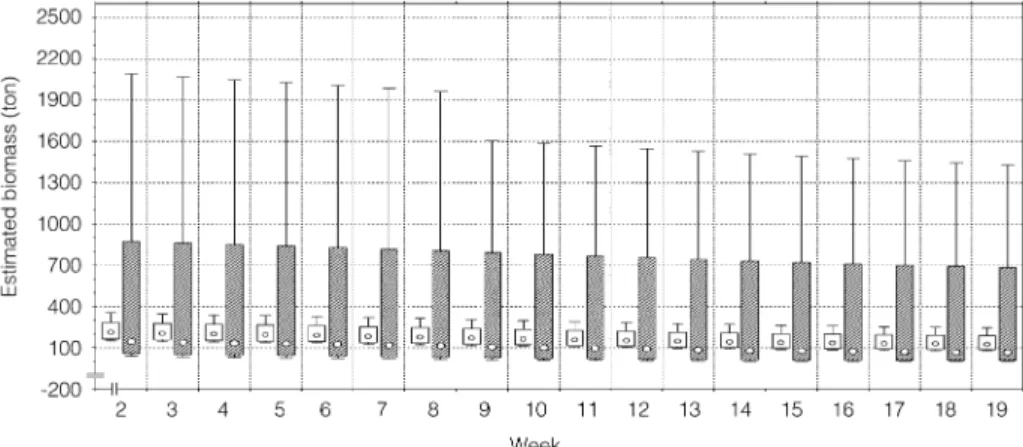
Biomass. Figure 3 shows
the distribution of 95% of the calculated data. Each “whisker” represents 2.5% of the information, while the “box” repre-sents the remaining 90%; within this is represented the median of the results ob-tained using the Monte Carlo simulation. A larger variability was observed in the model that included a dynamic q, with respect to the alternative model in which q was static. With the latter condition, the range of biomass values was 78-352tons (median=166ton), while with a dynamic q, this range was 2-5907tons (median= 103ton).
Catch. In most of the
cases the catch observed was within the range of values expected from both mod-els (Figure 4). As observed for biomass, the dynamic q model showed greater variation, while the variation was reduced with the static q model. Another aspect to note is that with the dynamic q model the tendency for the variability in the catch estimation increases from the 7th week, a fact which was not observed with the other model.
Catch per unit of effort.
The range of values for the CPUE ob-served was within the range of variation expected from both models (Figure 5), al-though its variability was smaller. The tendency with this indicator showed that, in the case of the dynamic q model, its variability increased progressively begin-ning at the 5th week, a pattern that was not observed with the static q model.
Discussion
The results support the hypothesis of temporal variability in the catchability coefficient, associated with variations in local abundance of the re-source, as higher q values were associ-ated to lower biomass levels. This finding is against the general assumption that this coefficient is a constant. On the other hand, the standard error associated with the estimation of parameters by regres-sion analysis caused the variability calcu-lated for the performance variables to be higher with the variable q model than for those obtained with the static q model.
Although temporal varia-tion in catchability has been demon-strated in diverse pelagic and demersal fisheries (MacCall, 1976; Peterman and Sterr, 1981; Bannerot and Austin, 1983; Crecco and Savoy, 1985; Gordoa and Hightower, 1991; Swain et al., 2000), and for crustaceans (Ye and Mohammed, 1999; Pérez and Defeo, 2003), we have
Figure 3. Dynamic trajectories of the biomass expected by the static (open boxes) and the dynamic (stripped boxes) model of q. The box represents 90% of the information, while the whisker represents 5% of the obtained value for the models. The symbols within the box indicate the median.
Figure 4. Dynamic trajectories of captures, showing directly observed catch (+), and catch predicted by the static (open boxes) and the dynamic (stripped boxes) model of q. The box represents 90% of the information, while the whisker represents 5% of the obtained value for the models. The symbols indicate the median.
Figure 5. Dynamic trajectories of the directly observed CPUE (open box and +) and that predicted by the static (open box) and by the dynamic (stripped box) model of q. The box represents 90% of the information, while the whisker represents 5% of the obtained value for the models. The symbols within the box indicate the median.
As a result of the above, Eq. (7) and (10) produced negative values for the confidence interval, which was lower than the parameters a and c respec-tively (Table I). This implies a result of
negative biomass, which is obviously without meaning. Of the 800 iterations, 38 values fell within this category for each week simulated. These values were omitted from all subsequent calculations.
found no references to the behavior of q in artisanal fisheries for benthic re-sources, specifically mollusks.
Various explanations have been proposed for the observed variabil-ity. Atran and Loesch (1995) carried out an analysis of weekly fluctuations in catchability of Brevoortia tyrannus, as-suming that variations in the q coefficient could remain relatively constant when measured on an annual scale. This condi-tion is generally violated, if ever fulfilled at all, when the analysis is carried out seasonally, as is verified in the present study by the finding of temporal varia-tions in catchability when analyzed over short periods of time. This fact raises questions about the correct time scales needed to account for small variations in catchability which may affect the evalua-tion of the resource under study.
A second explanation has been associated with behavioral as-pects of the resource (Arreguin-Sánchez, 1996, Godo et al., 1999; Swain et al., 2000). Species that form schools show strong inverse correlation between bio-mass and catchability (Paloheimo and Dickie, 1964; MacCall, 1976; Ulltang, 1976; Peterman and Steer, 1981; Crecco and Savoy, 1985; Angelsen and Olsen, 1987; Crecco and Overholtz, 1990; Han-sen et al., 2000). Following drops in abundance per unit area after extraction efforts, the schools tend to regroup and maintain their density. When maintaining density with declining biomass, each unit of effort extracts a greater proportion of the remaining stock, so that as catchabil-ity increases, the stock is reduced. The preceding becomes evident as a strong density-dependent relationship.
In the case of M.
dona-cium, however, the explanation seems to
be related to the behavior of the divers, more than to the behavior of the re-source. Pérez (1996) postulated a density-dependent effect between q and the abun-dance of this resource, since upon de-clines in abundance the diver must har-vest a greater surface area to obtain the same catch. In this way the numerator in Eq. (11) increases, the denominator re-maining constant. Thus, the catchability increases. This characteristic is present in the dynamic estimations of catchability in each fishery ground; as CPUE increases catchability decreases and vice-versa (Chávez, 2000).
Another aspect that emer-ges from the results obtained relates to the assumption that establishes that the CPUE would be a relative estimator of the resource abundance. Seijo et al. (1997) indicated that the assumption that the CPUE was a relative index of
abun-dance for sedentary species would be limited, given changes in the value for catchability (Collins, 1987; Swain et al., 2000). Thus, in quantitative terms, the CPUE estimated on the basis of the dy-namic model of q (Eq. 10) always showed a better fit of CPUE to the values obtained directly than did the CPUE ob-tained for these values using constant catchability. Thus, the CPUE may be considered as an efficient estimator of the abundance if and only if the b parameter in Eq. (7) is significantly less than and statistically different to zero. This conclu-sion is the same as that reached by Ulltang (1976) for Clupea harengus.
However, despite the above statements, the results suggest that although there was a significant inverse relation between biomass and catchability, the variability in the observations that serve as inputs to the regression equa-tions cause the dynamic q model to have weaknesses (ie. negative biomass values) associated with the high standard error of the calculated parameters. In contrast, al-though the hypothesis of the constancy of q was falsified, the results of the model based on this assumption produced num-bers within the range of values observed for the performance values (catch, CPUE) with greater precision than that of the model using dynamic q. As a conse-quence, for the case of the M. donacium fishery in Coquimbo Bay, it is possible to work with a “biomass depletion” model using a static q without making an im-portant estimation error. In this sense, this result represents an advantage, as it is simpler to estimate this coefficient from routine information of fishery ac-tivities instead of producing new records for the area harvested by each diver. In relation to the variability in the harvested area, it is possible that within the fishery zone analyzed (known to the fishermen as “Zanahoria”) there are loci character-ized by particular density and size struc-tures. Loci were defined under the basic assumption that the stock can be subdi-vided into different such loci, each as-suming different resource densities. A
lo-cus becomes the smallest geographical
unit considered in which the population density can be considered effectively uni-form (Caddy, 1975). Each locus would contain several age classes, all of which would have different densities. Thus, the distribution of the resource may be het-erogeneous, even within the same fishery area, and may produce a high degree of variability within the area harvested by each diver and, therefore, a higher error in the model.
In a management con-text these results can be useful to make
decisions with a relatively simple predic-tive model. This is particularly important when only historical data about CPUE are available for fisheries analysts. Fur-thermore, CPUE requires lower costs (in money and time consumed) compared with a more sophisticated statistical de-sign. In order to evaluate the best tools to support management decisions, all these aspects must be considered in discussing a fishery monitoring system.
REFERENCES
Angelsen KK, Olsen S (1987) Impact of fish density and effort level on catching effi-ciency of fishing gear. Fish. Res. 5: 2171-2178.
Ariz L, Jerez G, Pérez E, Potocnjack C (1994)
Bases para la ordenación y desarrollo de las pesquerías artesanales del recurso macha
(M. donacium) en Chile Central. Informe Fi-nal. Instituto de Fomento Pesquero (IFOP). Valparaiso, Chile. 61 pp.
Arreguín-Sánchez F (1996) Catchability: a key parameter for fish stock assessment. Rev.
Fish Biol. Fisheries 6: 221-242.
Atran SM, Loesch JG (1995) An analysis of weekly fluctuations in catchability coeffi-cients. Fish. Bull. 93: 562-567.
Bannerot SP, Austin CB (1983) Using frequency distribution of catch per unit of fishing effort to measure fish-stock abundance. Trans. Am.
Fish. Soc. 112: 608-617.
Baranov TY (1918) On the question of the bio-logical basis of fisheries. Proc. Inst. Icht.
In-vest. 1: 81-128.
Caddy JF (1975) Spatial models for an exploited shellfish population, and its application to Georges Bank scallop fishery. J. Fish. Res.
Board Can. 32: 1305-1328.
Castilla JC (1994) The Chilean small-scale benthic shellfisheries and the institutionaliza-tion of new management practices. Ecol.
Internat. Bull. 21: 47-63.
Chávez J (2000) Análisis dinámico del
coeficien-te de capturabilidad y sus implicancias en la modelación de pesquerías: Mesodesma
dona-cium en el banco de bahía Coquimbo, un
estudio de caso. Tesis. Universidad Católica
del Norte. Chile. 90 pp.
Collins JJ (1987) Increased catchability of the deep monofilament nylon gillnet and its ex-pression in a simulated fishery. Can. J. Fish.
Aquat. Sci. 44(Suppl. 2): 129-135.
Crecco VA, Overholtz W (1990) Causes of den-sity-dependent catchability for Georges Bank haddock Melanogrammus aeglefinus. Can. J.
Fish. Aquat. Sci. 47: 385-394.
Crecco VA, Savoy TF (1985) Density-dependent catchability and its potential causes and con-sequences on Connecticut River American Shad, Alosa sapidissima. Can. J. Fish. Aquat.
Sci. 42: 1649-1657.
Godo OR, Walsh SJ, Engas A (1999) Investigat-ing density dependent catchability in bottom trawl surveys. ICES J. Mar. Sci. 56: 292-298.
Gordoa A, Hightower JE (1991) Changes in catchability in a bottom-trawl fishery for Cape Hake (Merluccius capensis). Can. J.
Gulland JA (1983) Fish Stock Assessment. A
manual for basic Methods. Wiley. New York,
USA. 223 pp.
Hansen MJ, Beard TD, Hewett SW (2000) Catch rates and catchability of walleyes in angling and spearing fisheries in Northern Wisconsin lakes. North Am. J. Fish. Manag. 20: 109-118. Hilborn RF, Walters CJ (1992) Quantitative
fish-eries stock assessment. Choice, dynamics and uncertainty. Routledeg, Chapman and
Hall. New York, USA. 570 pp.
Kirkwood GP, Aukland R, Zara SJ (2001) Catch
effort data analysis (CEDA), Version 3.0.
MRAG. London, UK.
MacCall AD (1976) Density-dependence of catchability coefficient in the California Pa-cific sardine, Sardinops sagax caerulea, purse seine fishery. California Coop. Ocean.
Fish. Inv. Rep. 18: 136-148.
Manly BFJ (1991) Randomization and Monte Carlo methods in biology. Chapman and Hall. New York, USA. 281 pp.
Paloheimo JE, Dickie LM (1964) Abundance and fishing success. In ICES Rapp. P. – v. Réun.
155: 152-162.
Pérez EP (1996) Análisis de la pesquería de Me-sodesma donacium en el banco de Peñuelas
(Chile, IV región), bajo condiciones de ries-go e incertidumbre. Thesis.
CINVESTAV-IPN. Merida, Yucatan. Mexico. 82pp. Pérez EP, Defeo O (2003) Time-space variation
in the catchability coefficient as a function of match per unit of effort in Heterocarpus
reedi (Decapoda, Pandalidae) in
North-Cen-tral Chile. Interciencia 28: 178-182. Pérez E, Arias JL, Arias E, Defeo O, Stotz W,
Valdebenito M (1998) Caraterización bioeconómica de la pesquería del recurso macha en la zona norte y centro sur de Chile. Final Report. Universidad Católica del Norte/Fondo de Investigación Pesquera (FIP). Coquimbo, Chile. 232 pp.
Peterman RM, Steer GJ (1981) Relation between sportfishing catchability coefficients and salmon abundance. Trans. Am. Fish. Soc.
114: 436-440.
Richards LJ, Schnute JT (1986) An experimental and statistical approach to the question: Is CPUE an index of abundance ? Can. J. Fish.
Aquat. Sci. 43: 1214-1227.
Restrepo VR (2001) Dynamic depletion models. In Regional Workshop on the assessment of
the Caribbean spiny lobster (Panulirus
argus). FAO Fisheries Report Nº619. Rome, Italy. pp. 345-356.
Seijo JC, Caddy JF, Euán J (1994) SPATIAL:
space-time dynamics in marine fisheries. A software package for sedentary species. Comp.
Inf. Ser. Fish. Nº6. FAO. Rome, Italy. 116 pp. Seijo JC, Defeo O, Salas S (1997) Bioeconomía
pesquera: Teoría, modelación y manejo.
Documento técnico de pesca Nº 368. FAO. Rome, Italy. 176 pp.
Swain DP, Poirier GA, Sinclair AF (2000) Effect of water temperature on catchability of At-lantic cod Gadus morhua) to the bottom-trawl survey in the southern Gulf of St Lawrence. ICES J. Mar. Sci. 57: 56-68. Ulltang Ø (1976) Catch per unit of effort in the
Norwegian purse seine fishery for Atlanto-Scandinavian herring. Fao Fish. Tech. Pap.
155: 91-101.
Winters GH, Wheeler JP (1985) Interaction be-tween stock area, stock abundance, and catchability coefficient. Can. J. Fish. Aquat.
Sci. 42: 989-998.
Ye Y, Mohammed H (1999) An analysis of varia-tion in catchability of green tiger prawn,
Penaeus semisulcatus in waters off Kuwait. Fish. Bull. 97: 702-712.
Zar J (1995) Biostatistical Analysis. 3rd ed. Prentice-Hall. Englewood Cliffs, NJ, USA. 718 pp.