Accepted Manuscript
Concordance of Genetic Variation that Increases Risk for Anxiety Disorders and Posttraumatic Stress Disorders and that Influences their underlying Neurocircuitry
Celia van der Merwe , Neda Jahanshad , Josh W. Cheung , Mary Mufford , Nynke Groenewold , Nastassja Koen , Rajkumar Ramesar , Shareefa Dalvie , ENIGMA
ConsortiumPGC-PTSD, James A. Knowles , Derrek P. Hibar , Caroline M. Nievergelt , Karestan C. Koenen , Israel Liberzon , Kerry J. Ressler , Sarah E. Medland , Rajendra A. Morey , Paul M. Thompson , Dan J. Stein
PII: S0165-0327(18)31178-9
DOI: https://doi.org/10.1016/j.jad.2018.11.082
Reference: JAD 10300
To appear in: Journal of Affective Disorders Received date: 31 May 2018
Revised date: 2 November 2018
Accepted date: 11 November 2018
Please cite this article as: Celia van der Merwe , Neda Jahanshad , Josh W. Cheung , Mary Mufford , Nynke Groenewold , Nastassja Koen , Rajkumar Ramesar , Shareefa Dalvie , ENIGMA ConsortiumPGC-PTSD, James A. Knowles , Derrek P. Hibar , Caroline M. Nievergelt , Karestan C. Koenen , Israel Liberzon , Kerry J. Ressler , Sarah E. Medland , Rajendra A. Morey , Paul M. Thompson , Dan J. Stein , Concordance of Genetic Variation that Increases Risk for Anxiety Disorders and Posttraumatic Stress Disorders and that Influences their underlying Neurocircuitry, Journal of Affective Disorders (2018), doi:https://doi.org/10.1016/j.jad.2018.11.082
This is a PDF file of an unedited manuscript that has been accepted for publication. As a service to our customers we are providing this early version of the manuscript. The manuscript will undergo copyediting, typesetting, and review of the resulting proof before it is published in its final form. Please note that during the production process errors may be discovered which could affect the content, and all legal disclaimers that apply to the journal pertain.
ACCEPTED MANUSCRIPT
Highlights
Little work on the concordance of genetic variation between PTSD or anxiety disorders and brain volume has been conducted
There is evidence for genome wide concordance between genetic risk factors for anxiety disorders and smaller amygdala volume
A genetic variant that contributes to both reduced putamen volume and PTSD plays a key role in the glutamatergic system
ACCEPTED MANUSCRIPT
Concordance of Genetic Variation that Increases Risk for Anxiety Disorders and
Posttraumatic Stress Disorders and that Influences their underlying Neurocircuitry
Celia van der Merwe (1) Neda Jahanshad (2) Josh W. Cheung (2) Mary Mufford (1) Nynke Groenewold (3) Nastassja Koen (3) (4) Rajkumar Ramesar (1) Shareefa Dalvie (3) (4) ENIGMA Consortium PGC-PTSD James A. Knowles (5) Derrek P. Hibar (6) Caroline M. Nievergelt (7) (8) Karestan C. Koenen (9) (10) (11) Israel Liberzon (12) (13) Kerry J. Ressler (14) Sarah E. Medland (15) Rajendra A. Morey (6) (16) Paul M. Thompson (2) Dan J. Stein (3) (4)
ACCEPTED MANUSCRIPT
1. Division of Human Genetics. University of Cape Town. Cape Town. South Africa
2. Imaging Genetics Center. Mark and Mary Neuroimaging & Informatics Institute. Keck School of Medicine of the University of Southern California. Marina del Rey, CA. USA
3. Department of Psychiatry and MRC Unit on Risk & Resilience. University of Cape Town. Cape Town. South Africa
4. Groote Schuur Hospital. Cape Town.South Africa
5. Department of Psychiatry and the Behavioral Sciences. Zilkha Neurogenetic Institute. Keck School of Medicine. University of Southern of Southern California. Los Angeles, CA. USA
6. Department of Psychiatry and Behavioral Sciences. Duke University Medical Center. Durham, NC. USA
7. Veterans Affairs San Diego Healthcare System and Veterans Affairs Center of Excellence for Stress and Mental Health. La Jolla, CA. USA
8. Department of Psychiatry. University of California San Diego. La Jolla, CA. USA 9. Broad Institute of MIT and Harvard. Stanley Center for Psychiatric Research.
Boston, MA. USA
10. Psychiatric and Neurodevelopmental Genetics Unit. Center for Human Genetic Research. and Department of Psychiatry. Massachusetts General Hospital. Boston, MA. USA
11. Department of Epidemiology. Harvard T. H. Chan School of Public Health. Cambridge, MA. USA
12. Department of Psychiatry. University of Michigan. Ann Arbor, MI. USA 13. Ann Arbor Veterans Affairs Hospital. Ann Arbor, MI. USA
ACCEPTED MANUSCRIPT
14. Division of Depression and Anxiety Disorders. McClean Hospital. Belmont, MA. USA
15. QIMR Berghofer Medical Research Institute. Brisbane. Australia 16. Durham VA Medical Center. Durham, NC. USA
Corresponding author: Prof. Dan J. Stein [email protected],
Tel: +21 404 2174, Fax: +21 448 8158 Department of Psychiatry and Mental Health J-Block, Groote Schuur Hospital
Observatory Cape Town 7935
ACCEPTED MANUSCRIPT
Abstract
Background: There have been considerable recent advances in understanding the genetic
architecture of anxiety disorders and posttraumatic stress disorder (PTSD), as well as the underlying neurocircuitry of these disorders. However, there is little work on the
concordance of genetic variations that increase risk for these conditions, and that influence subcortical brain structures. We undertook a genome-wide investigation of the overlap between the genetic influences from single nucleotide polymorphisms (SNPs) on volumes of subcortical brain structures and genetic risk for anxiety disorders and PTSD.
Method: We obtained summary statistics of genome-wide association studies (GWAS) of
anxiety disorders (Ncases=7016, Ncontrols=14745), PTSD (European sample; Ncases=2424,
Ncontrols=7113) and of subcortical brain structures (N=13171). SNP Effect Concordance
Analysis (SECA) and Linkage Disequilibrium (LD) Score Regression were used to examine genetic pleiotropy, concordance, and genome-wide correlations respectively. SECAs
conditional false discovery was used to identify specific risk variants associated with anxiety disorders or PTSD when conditioning on brain related traits.
Results: For anxiety disorders, we found evidence of significant concordance between
increased anxiety risk variants and variants associated with smaller amygdala volume. Further, by conditioning on brain volume GWAS, we identified novel variants that associate with smaller brain volumes and increase risk for disorders: rs56242606 was found to increase risk for anxiety disorders, while two variants (rs6470292 and rs683250) increase risk for PTSD, when conditioning on the GWAS of putamen volume.
Limitations: Despite using the largest available GWAS summary statistics, the analyses were
limited by sample size.
Conclusions: These preliminary data indicate that there is genome wide concordance
ACCEPTED MANUSCRIPT
which is consistent with research that supports the involvement of the amygdala in anxiety disorders. It is notable that a genetic variant that contributes to both reduced putamen volume and PTSD plays a key role in the glutamatergic system. Further work with GWAS summary statistics from larger samples, and a more extensive look at the genetics underlying brain circuits, is needed to fully delineate the genetic architecture of these disorders and their underlying neurocircuitry.
Keywords
ACCEPTED MANUSCRIPT
1. Introduction
Anxiety disorders and posttraumatic stress disorder (PTSD) are the most common class of mental disorders (Kessler et al., 2010) and are among the most debilitating (Costello et al., 2005). In the fifth edition of the Diagnostic and Statistical Manual of Mental Disorders (DSM-5), a decision was taken to move PTSD into a separate chapter on trauma- and stressor-related disorders, but at the same time it has been emphasized that there are
important overlaps in phenomenology and psychobiology across these conditions (Friedman et al., 2011; Hoge et al., 2016). Although many considerations contribute to nosological decisions, ongoing work on the neurogenetics and neurocircuitry of these conditions is needed.
There are significant genetic contributions to the etiology of these disorders with heritability estimates ranging between 10-50% (Hettema et al., 2001; Otowa et al., 2016) and 15-52% (Duncan et al., 2017; Mataix-Cols et al., 2013), respectively. There have been significant recent advances in the understanding of the genetic architecture of anxiety disorders and PTSD. Several genome wide association studies (GWAS) have been undertaken in anxiety disorders; the largest included a total of 18,186 participants from the Anxiety Neurogenetics Study Consortium (ANGST). Taken together these suggest that variants affecting calcium signalling and transmembrane proteins, which are highly expressed in the brain, may play a role (Erhardt et al., 2012; Erhardt et al., 2011; Otowa et al., 2016; Otowa et al., 2009). The largest GWAS of PTSD to date included 20,070 participants from the Psychiatric Genomics Consortium-Posttraumatic Stress Disorder group (PGC-PTSD) found informative polygenic results such as evidence of PTSD heritability (15%) and overlapping genetic risk with other psychiatric disorders (Duncan et al., 2017).
ACCEPTED MANUSCRIPT
There have also been ongoing advances in understanding the neurocircuitry of anxiety disorders and PTSD. Large collaborations have formed to pool together resources and neuroimaging data for reliable and reproducible findings; these have emphasized structural and functional abnormalities of the amygdala in anxiety disorders (Bruhl et al., 2014;
Hattingh et al., 2013; Krain et al., 2008; Massana et al., 2003; Milham et al., 2005), although several other regions have also been implicated in individual studies, including smaller grey matter volumes in the bilateral dorsal and rostral anterior cingulate cortices, bilateral
posterior part of the anterior cingulate cortex, and left lenticular nucleus (Radua et al., 2010). Smaller hippocampal volume has been identified in a number of PTSD studies as well as structural anomalies in the dorsal and rostral anterior cingulate cortices, ventromedial
prefrontal cortex, amygdala and insula (Gilbertson et al., 2002; Karl et al., 2006; Logue et al., 2018).
Relatively little work to date has, however, focused on examining the genetic overlap between risk for disease and risk for altered brain structure. Exploring genetic correlations and concordance between brain structure and genetic risk for these conditions will provide insight into the pathways affected by the underlying biology of the disorders. The Enhancing Neuroimaging Genetics through Meta-analysis (ENIGMA) consortium performed a GWAS of structural brain MRI scans of 30,717 individuals (Hibar et al., 2015). This study identified novel genetic variants associated with the volumes of the putamen, caudate nuclei,
hippocampi as well as the full intracranial volume (Hibar et al., 2015).
ANGST, PGC and ENIGMA freely release summary results of their GWAS, which provides an opportunity to examine the relationship between GWAS data in anxiety disorders and PTSD with the genetic contributions to brain volume. Using SNP Effect Concordance Analysis (SECA)(Nyholt, 2014), we have previously noted evidence of significant positive
ACCEPTED MANUSCRIPT
concordance between OCD risk variants and variants associated with greater nucleus accumbens (P=2.0x10⁻⁴) and putamen volumes (P=8.0x10⁻⁴)(Hibar et al., 2018). Here we expand this analysis to anxiety disorders and PTSD, with the aim of assessing genetic concordance with subcortical volumes and risk variants for these disorders.
ACCEPTED MANUSCRIPT
2. Methods
2.1 Description of original association studies
We analysed summary statistics from GWASs of the Anxiety NeuroGenetics STudy (ANGST), PGC-PTSD and the ENIGMA Consortium meta-analysis of subcortical brain volumes (Duncan et al., 2017; Hibar et al., 2015; Otowa et al., 2016). The anxiety disorder GWAS was based on case-control samples from 7 European groups contributing to the ANGST Consortium, totalling 7,016 cases and 14,745 controls (Otowa et al., 2016). The ANGST studies included participants with generalised anxiety disorder, panic disorder, social phobia, agoraphobia and specific phobias. Two phenotypic approaches were applied:
quantitative phenotypic factor scores and categorical case-control comparisons, resulting in two sets of GWAS results. The PGC-PTSD GWAS was based on case-control samples from 11 contributing groups (totalling 4,522 cases and 15,548 controls of which 87.7% were trauma-exposed) (Duncan et al., 2017). For the purposes of this study, we used the European Ancestry (EA) data, totalling 2,424 cases and 7,113 controls.
The ENIGMA Consortium GWAS of subcortical brain volumes included a meta-analysis of 50 cohorts (Hibar et al., 2015). These data comprised separate GWASs of seven subcortical brain volumes (nucleus accumbens, amygdala, caudate nucleus, hippocampus, globus
pallidus, putamen, thalamus), and total intracranial volume. Summary statistics of the GWAS results were available from 13,171 subjects that made up the discovery sample. Brain
volume data were extracted following a harmonized protocol that uses validated, robust segmentation algorithms (Fischl et al., 2002) in order to ensure maximum cross-site comparability. All subjects were of European ancestry as verified by MDS analysis and GWAS test statistics were genome-controlled to adjust for spurious inflation factors. The ENIGMA GWAS contain cohorts with healthy controls as well as patients diagnosed with
ACCEPTED MANUSCRIPT
neuropsychiatric disorders including anxiety, but diagnostic status was controlled for in the analysis (see Hibar et al., 2015 Methods, and Supplementary Table 1 for more details).
2.2 Post-processing of genetic data
After applying quality control and filtering rules to the imputed EA PTSD GWAS data, 13,203,811 SNPs remained (see Duncan et al., 2017 Supplementary Materials for imputation and quality control details). For the anxiety GWAS data, 6,306,613 SNPs remained after filtering (see Otowa et al., 2016 Supplementary Methods for imputation and quality control details). Post-filtering for all 8 brain structures resulted in a final number of 8,398,366 SNPs for the imputed brain volume GWAS data (see Hibar et al., 2015 Methods for imputation and quality control details). To statistically compare the EA PTSD and eight brain volume
GWASs, we used the 8,156,675 SNPs that passed quality control and filtering rules. To compare the anxiety GWAS with the ENIGMA GWASs, 5,642,909 SNPs were used for the factor score dataset, and 5,661,273 for the case control dataset.
With each dataset, clumping was performed in PLINK (Purcell et al., 2007) to identify an independent SNP from every linkage disequilibrium (LD) block across the genome. This was done separately for each of the eight brain volume GWASs using an 500 Kb window, with SNPs in LD (r2 > 0,2), in the European reference samples from the 1000 Genome Project (Phase 1, version 3). The index SNP held the lowest p-value within each LD block, and all other SNPs in the LD block were dropped from the analysis. This resulted in a total of eight independent sets of SNPs, which represented the total variation explained across the genome conditioned on the significance in each brain volume GWAS. The corresponding PTSD and anxiety GWAS test statistic was determined for each independent SNP in the eight sets of SNPs, and used for subsequent analyses.
ACCEPTED MANUSCRIPT
2.3 Tests of pleiotropy and concordance
SECA (Nyholt, 2014) was used to determine the extent of genetic overlap between PTSD or anxiety and each subcortical volume. A global test of pleiotropy was performed using a binomial test at 12 p-value levels: P ≤ (0.01, 0.05, 0.1, 0.2, 0.3, 0.4, 0.5, 0.6, 0.7, 0.8, 0.9, 1). For a given subcortical region and PTSD or anxiety paired set, SNPs were ranked based on their p-value for association with each trait. The total number of SNPs overlapping between the two traits at each p-value threshold was determined and compared to the expected random overlap under the null hypothesis of no pleiotropy, using a binomial test. Each of the 12 p-value levels in the subcortical volume GWAS was compared to all levels of the PTSD and anxiety GWASs (144 comparisons for PTSD and 144 comparisons for anxiety), and the number of comparisons with evidence of overlap was tallied at a nominally significant level of P ≤ 0.05. To evaluate the global level of pleiotropy we generated 10,000 permuted datasets for a given subcortical region versus PTSD or anxiety comparison and determined if the number of significance thresholds with genetic overlap was significantly greater than chance.
In addition, concordance (the agreement in SNP effect directions across two traits) was estimated using SECA. A significant (P ≤ 0.05) positive or negative trend in the effect of the overlapping SNPs at each of the 12 p-value thresholds was estimated using a two-sided Fisher’s exact test. The direction of effect for each SNP was determined by the sign of the beta value of the SNP regression coefficient from each meta-analysis. In the anxiety disorder and PTSD GWASs, a positive beta value for a SNP was associated with an increased risk of developing anxiety disorders and PTSD (a negative beta value indicates a protective variant). A positive beta value for a SNP in a brain volume GWAS indicates that that SNP is
ACCEPTED MANUSCRIPT
with a reduction in brain volume). The global level of concordance between a given brain volume phenotype and anxiety disorders or PTSD was estimated by generating 10,000 permuted datasets, repeating the Fisher’s exact test procedure, and determining if the number of significant overlapping thresholds was significantly greater than would be expected by chance (see Nyholt et al., 2014 for details of the SECA analysis).
A Bonferroni-corrected significance level of P=0.05/2tests*8structures*2disorders=0.00156 was set, based on the number of tests performed for pleiotropy and concordance between anxiety disorders and PTSD and all eight brain structures.
2.4 Conditional false discovery rate to identify risk variants for anxiety disorders and PTSD
We further examined if conditioning the anxiety disorders and PTSD GWAS results on genetic variants that influence subcortical regional volume could improve our ability to identify variants associated with these disorders (Andreassen et al., 2013). For a given subcortical volume phenotype, a subset of SNPs was selected at 14 false discovery rate (FDR) thresholds q-values ≤ (1x10⁻⁵, 1x10⁻⁴, 1x10⁻³, 0.01, 0.1, 0.2, 0.3, 0.4, 0.5, 0.6, 0.7, 0.8, 0.9, 1). The corresponding p-values for each SNP subset in the PTSD and anxiety GWASs were then observed, and the False Discovery Rate (FDR) method was applied to each subset of p-values in the PTSD and anxiety GWASs (Benjamini and Hochberg, 1995). Significance for individual SNPs was established if the p-value was lower than the significance threshold allowing for a FDR of 5% conditioned on any subset of SNPs from the subcortical volume GWASs. The LD-pruned data are still required for the conditional FDR SNP analysis because the size of an LD block can affect the ranking and re-ranking of SNPs under the conditional models. However, the chosen SNP included in the model is likely a “proxy” for
ACCEPTED MANUSCRIPT
SNPs in the LD block and should not necessarily be considered the causal variant or even the most significant SNP in terms of its overlap between traits.
We identified variants in LD (r2 > 0.5) within 500kb either side of the significant SNPs using LDLink (https://ldlink.nci.nih.gov/) and SNiPA
(https://snipa.helmholtz-muenchen.de/snipa/). Genes that variants were either in, close to, or associated with were annotated using the Gene2Function link on FUMA (http://fuma.ctglab.nl/gene2func/) and Enrichr (http://amp.pharm.mssm.edu/Enrichr/), a pathway analysis software. Further, significant SNPs were annotated using Regulome (http://www.regulomedb.org/index), CADD (https://cadd.gs.washington.edu/), GTeX (https://gtexportal.org/home/) and HUGIn (https://yunliweb.its.unc.edu/hugin/) online software.
2.5 Estimating genetic correlation using LD score regression
We undertook LD score regression (LDSR), which estimates a genetic correlation between two traits based on the GWAS summary statistics of each trait analysed separately (Bulik-Sullivan et al., 2015a; Bulik-(Bulik-Sullivan et al., 2015b). LDSR estimates a genetic correlation with a fitted linear model of Z-scores obtained from the product of significance statistics for each SNP in a given set of GWAS results compared to the level of LD at a given SNP. SNPs in high LD are expected to have high Z-scores in polygenic traits with common genetic overlap (Bulik-Sullivan et al., 2015a; Bulik-Sullivan et al., 2015b). Similar to SECAs concordance test, the genetic correlation from LDSR incorporates the sign of the regression coefficients for each SNP tested in order to determine the direction (positive or negative) of the relation between traits. This amygdala GWAS has previously been shown to have insufficient power for LDSR (Franke et al., 2016). As the amygdala is one of the main structures of interest for anxiety disorders and PTSD, LDSR was not our main analytic choice, and we used it only post-hoc to confirm possible findings with other structures.
ACCEPTED MANUSCRIPT
Results
3.1 Evidence for pleiotropy between subcortical volume and anxiety disorders and PTSD
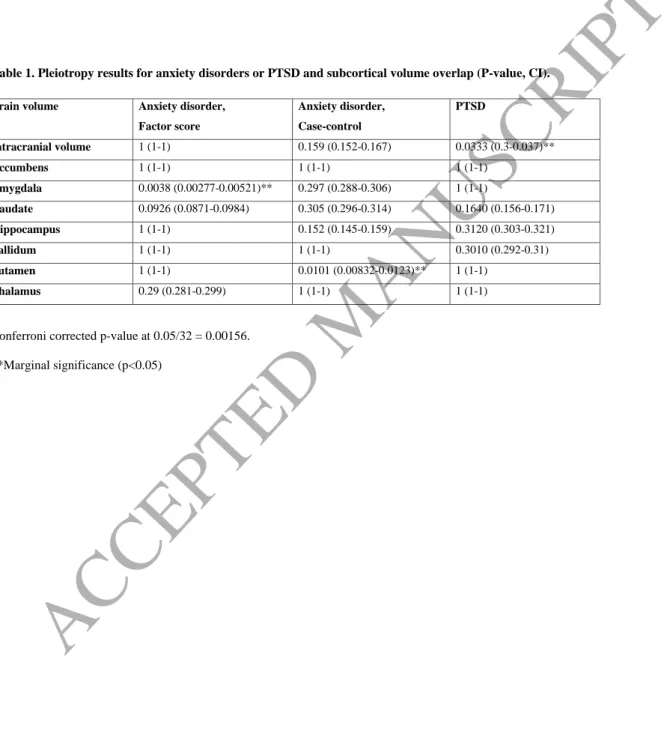
Using SECA, we did not find significant evidence of global pleiotropy (regardless of effect direction) for either anxiety disorders or PTSD in any of the subcortical structures studied after correction for multiple comparisons (Table 1).
For anxiety disorders, the evidence of pleiotropy was suggestive between variants affecting amygdala volume and risk using factor score analysis (Table 1, p=0.004), as well as for between variants affecting putamen volume and risk using case-control analysis (Table 1, p=0.01), but this was not significant after correction for multiple testing. For PTSD, suggestive evidence of pleiotropy was observed between variants affecting intracranial volume and risk for PTSD (Table 1, p=0.03), but was not significant after correction for multiple testing.
3.2 Evidence for concordance between the genetics underlying brain volume and anxiety disorders or PTSD
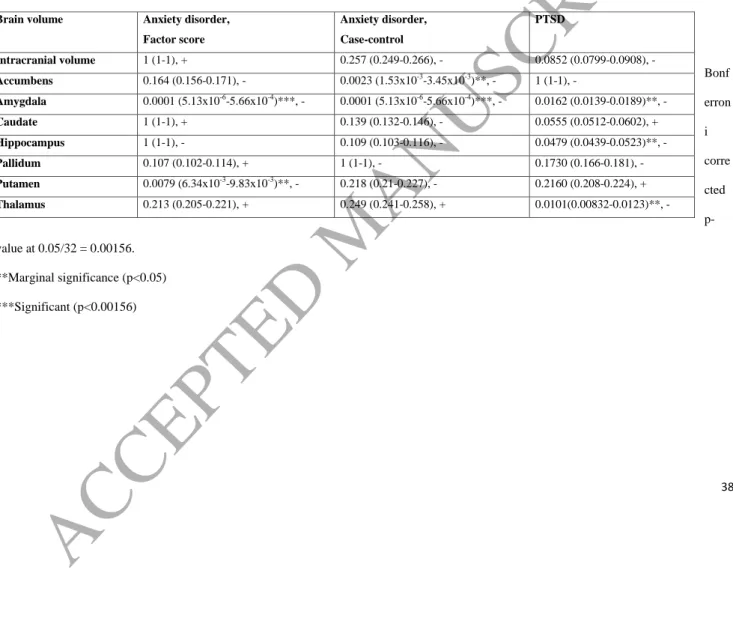
We found significant evidence of concordance (same SNP, direction of effect) between risk variants for anxiety disorders brain volumes. Specifically, we found negative concordance such that variants that increase risk for anxiety disorders, decrease the volume of the amygdala; this was found using both factor score analysis (Table 2, p=0.0001) and case-control analysis (Table 2, p=0.0001). While we observed some evidence for negative concordance in anxiety disorders genetic risk and variants associated with putamen volume when using the factor score dataset (Table 1, p=0.008) and nucleus accumbens volume when using the case-control dataset (Table 2, p=0.002), these findings were not significant after correction for multiple testing.
ACCEPTED MANUSCRIPT
For PTSD genetic risk, suggestive negative concordance was found for variants associated with amygdala volume (p=0.016), hippocampal volume (p=0.048) and thalamic volume (p=0.01) (Table 2), but these were not significant after correction for multiple testing.
3.3. Genetic variants influencing brain volume regions provide improved ability to detect anxiety risk variants
A conditional false discovery rate (FDR) analysis was performed to separately condition the anxiety disorder and PTSD GWASs on each of the eight brain volume GWASs. Using the factor score dataset for anxiety disorders, we identified three novel variants influencing risk for anxiety disorders when conditioning on the GWAS of amygdala volume (rs77520376, q=0.028), hippocampal volume (rs78587286, q=0.029) and putamen volume (rs56242606, q=0.04) (Table 3a). Furthermore, using the case-control GWAS we found variants
influencing anxiety disorders when conditioning on the GWAS of the hippocampal volume (rs28373923, q=0.032), pallidum volume (rs12751736, q=0.041) and thalamic volume (rs2740360, q=0.01) (Table 3b).
For PTSD, two variants were found to significantly influence disorder when conditioned on putamen volume (rs6470292, q=0.048; rs683250, q=0.048) (Table 4).
SNP-based annotation showed there was minimal binding evidence, no associated deleterious effect, and few single tissue eQTLs for the significant variants (Supplementary Material). Expression, gene set and pathway analysis of genes associated with significant variants and variants in LD are available in the Supplementary Materials.
3.4 LD score regression
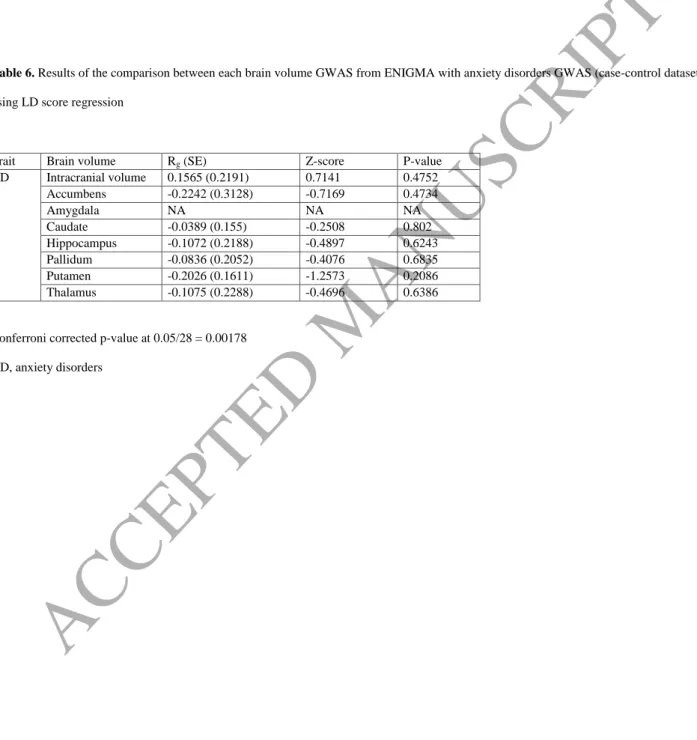
LDSR findings were consistent with SECA findings for both anxiety disorders and PTSD. A negative genetic correlation between risk for anxiety disorders and putamen volume was
ACCEPTED MANUSCRIPT
observed (Table 5, p=0.007, rg=-0.48; Table 6), while a positive genetic correlation was
suggested between risk for PTSD and caudate volume (Table 7, p=0.093, rg=0.35).
4. Discussion
The key findings of this study were 1) a significant concordance between risk variants for anxiety disorders and variants that decrease the volume of the amygdala (p=0.0001) using both factor score and case-control methods for assessing anxiety, and 2) a variant influencing decreased amygdala volume, rs77520376, was significantly associated with anxiety
disorders. Although PTSD concordance findings were non-significant after multiple corrections, two variants associated with decreased putamen volume (rs6470292 and rs683250) were also associated with PTSD.
The anxiety disorder findings are consistent with previous work, which has identified
decreased grey matter volumes in the amygdala amongst patients with social anxiety disorder (Irle et al., 2010) and panic disorder (Asami et al., 2008; Hayano et al., 2009; Massana et al., 2003). There is, however, also evidence of increased amygdala volume in patients with anxiety disorders (Roth et al., 2018; Schienle et al., 2011; van der Plas et al., 2010). Involvement of the amygdala in anxiety disorders is further supported by functional neuroimaging studies. Hyperactivation of the amygdala in response to various stimuli compared to healthy controls has been observed (Guyer et al., 2008; Hattingh et al., 2013; Monk et al., 2008; van den Heuvel et al., 2005; Wendt et al., 2008), with decreases after successful treatment of specific phobia (Goossens et al., 2007; Ipser and Stein, 2012) and social anxiety disorder (Furmark et al., 2004; Labuschagne et al., 2010).
The variant rs77520376, which is associated with risk for anxiety disorder and decreased amygdala, is located within an intron of the protocadherin-7 (PCDH7) gene. PCDH7 plays a role in cell adhesion and calcium ion binding, crucial processes in early brain development
ACCEPTED MANUSCRIPT
including neural migration, synaptogenesis and axonal growth (Pham et al., 2016). Variants within PCDH7 have been associated with a number of psychiatric disorders, with trending significant associations with PTSD (Ashley-Koch et al.), bipolar disorder (Le‐ Niculescu et al., 2009) and epilepsy (Poduri, 2015). Little information is available on this variant, and further attention to its role across a range of psychiatric phenotypes may be useful.
SECA and LD score regression results found marginal significance of putamen volume association with anxiety disorders and PTSD. However, conditioning of anxiety and PTSD GWAS results on genetic variants that influence brain volume showed one variant
(rs56242606) significantly associated with decreased putamen volume and anxiety disorders, and two variants (rs6470292, rs683250) significantly associated with decreased putamen volume and PTSD. The variant rs56242606 is located on an intron within the VWDE gene, which is in a region of significance recently shown to be associated with anxiety disorders (Purves et al., 2017). Two significant eQTL associations for this variant and VWDE were observed (Supplementary Material). The variant, rs683250, associated with decreased putamen volume and PTSD, is found within the DLG2 gene, which encodes a protein
involved in nervous system development, N-methyl-D-aspartate (NMDA) receptor signalling and glutamate receptor binding. NMDA receptors play a central role in modulating fear, anxiety, depression and PTSD (Barkus et al., 2010; Pitman et al., 2012; Yamamoto et al., 2007).
Two additional observations in this study should be considered. First, there were
inconsistencies in the results of pleiotropy and concordance for both anxiety disorders and PTSD analyses. Thus, while there was significant concordance between anxiety disorders and amygdala volume, significant pleiotropy was not observed. Whereas pleiotropy indicates that there are variants that affect both phenotype and brain volume, concordance indicates the
ACCEPTED MANUSCRIPT
specific decrease or increase in a particular subcortical structure. The anxiety and amygdala findings, where concordance is significant and pleiotropy is not, suggest those SNPs that contribute to concordance have predominantly positive or negative effect sizes. Second, there are discrepancies between the findings of factor score analysis and case control analysis; although this is not unexpected given the differences in these approaches, it again suggests that even larger sample sizes would be useful.
Indeed, a number of limitations of this study should be emphasized. First, despite using the largest sample sizes from the brain volume, anxiety and PTSD GWASs to date, false negative findings due to insufficient power cannot be excluded. Second, the relatively small samples do not allow for analyses to be stratified by sex; these may be useful given heritability
differences in PTSD in females (29%) compared to males (7%). Third, in theory, the analysis could be biased if overlapping participants were present in the studies contributing to the consortia. LDSR takes possible overlap across studies into account. The relative similarity between the LDSR results and the concordance results therefore suggests that such overlap is likely to be minimal. Fourth, the ENIGMA GWASs of brain volumes contain cohorts with healthy controls as well as patients diagnosed with neuropsychiatric disorders (including anxiety, Alzheimer’s disease, attention-deficit/hyperactivity disorder, major depression, bipolar disorder, epilepsy, and schizophrenia), which may bias the interpretation of our findings and how they relate to anxiety disorders and PTSD. However, the brain volume GWASs controlled for diagnostic status, and a direct comparison of the GWAS summary statistics between the full ENIGMA results (including patients) and a subset of ENIGMA results (excluding patients) showed that they were very highly correlated (Pearson’s r > 0.99) for all brain traits (Hibar et al., 2015). This suggests that the pattern of effects in the brain volume GWAS is not likely driven by disease status. Fifth, the relationship between genetic
ACCEPTED MANUSCRIPT
confounders, including environmental factors such as stress and medication effects, which have effects on brain volume and disease risk independent of genetics (Navari and Dazzan, 2009). Discovering the pathway by which gene variants influencing brain volume also create risk for anxiety disorders and PTSD may be hindered by environmental factors, which might obscure genetic relationships. However, this endeavour to find the genetic overlap between brain volume and disorder risk using the largest datasets to date shows important and promising insights suggesting that our understanding may only be improved when further incorporating environmental influences.
The analyses here complement previous work on OCD, where we found significant positive concordance between OCD risk variants and variants that increase the volume of the nucleus accumbens (P = 2.0 x 10⁻⁴) and variants that increase the volume of the putamen (P = 8.0 x 10⁻⁴)(Hibar et al., 2018). Investigation of the overlap in genetic variants associated with disorder risk and subcortical neurocircuitry may provide information that could help clarify how anxiety disorders, PTSD, and OCD are related to one another. The findings here arguably support the decision to separate out anxiety disorders and trauma- and stressor-related disorders from obsessive-compulsive stressor-related disorders (OCRD) in the fifth edition of the DSM-5 (American Psychiatric Association, 2013; Möller et al., 2015). At the same time, we would emphasize that decisions about the DSM-5 meta-structure are complex and a range of other data are needed to inform the debate (Stein, 2008; Stein et al., 2011).
This work is the first to show an overlap between genetic risk for anxiety disorders and brain circuitry. The negative genetic concordance between both measures of anxiety and amygdala volume is consistent with a broad range of previous work implicating the amygdala as a critical region for anxiety disorders (Shin and Liberzon, 2009). Emerging collaborations and consortia, such as ENIGMA-PTSD aim to continue to increase sample size, which will
ACCEPTED MANUSCRIPT
enhance statistical power in future iterations of this analysis. Future work focusing on a range of other methodologies to assess genetic overlap may also be useful, following along the lines of recent work in schizophrenia (Franke et al., 2016; Lee and Huang, 2016). Such studies have used partitioning-based heritability analysis (Yang et al., 2011) and conjunction analysis (Nichols et al., 2005) to identify genetic variants associated with both schizophrenia risk and altered brain volumes, and such approaches, together with analyses such as
Mendelian Randomization, may also be useful in future work on anxiety disorders and PTSD, when more powerful GWASs summary statistics are available from larger samples.
Contributors:
All authors approved the final version of the manuscript and participated in the
research and article preparation
Celia van der Merwe – incorporation of data in manuscript, writing manuscript, organisation and management of manuscript
Neda Jahanshad – data analysis, manuscript review Josh W. Cheung – data analysis, manuscript review Mary Mufford - manuscript review
Nynke Groenewold - manuscript review Nastassja Koen - manuscript review Rajkumar Ramesar - manuscript review Shareefa Dalvie - manuscript review James A. Knowles - manuscript review Derrek P. Hibar - manuscript review
Caroline M. Nievergelt - manuscript review Karestan C. Koenen - manuscript review
ACCEPTED MANUSCRIPT
Israel Liberzon - manuscript review Kerry J. Ressler - manuscript review Sarah E. Medland - manuscript review Rajendra A. Morey - manuscript review Paul M. Thompson - manuscript review
Dan J. Stein – conception, design and implementation of study, finalizing manuscript
Acknowledgements
Consortium authors:
PGC-PTSD: Laramie E. Duncan1, 2, 3, Andrew Ratanatharathorn4, Allison E. Aiello5, Lynn M. Almli6, Ananda B. Amstadter7, Allison E. Ashley-Koch8, Dewleen G. Baker9, 10, Jean C. Beckham11, 12, Laura J. Bierut13, Jonathan Bisson14, Bekh Bradley15, 16, Chia-Yen Chen2, 3, 17, 18, Shareefa Dalvie19, Lindsay A. Farrer20, Sandro Galea21, Melanie E. Garrett8, Joel E. Gelernter22, 23, 24, Guia Guffanti25, Michael A. Hauser8, Eric O. Johnson26, Ronald C. Kessler27, Nathan A. Kimbrel11, 12, 28, Anthony King29, Nastassja Koen19, 30, Henry R. Kranzler31, Mark W. Logue32, 33, Adam X. Maihofer34, Alicia R. Martin2, 18, Mark W. Miller32, 35, Rajendra A. Morey12, 36, Nicole R. Nugent37, 38, John P. Rice39, Stephan Ripke2, 18, 40, Andrea L. Roberts41, Nancy L. Saccone42, Jordan W. Smoller2, 17, 43, Dan J. Stein19, 30, Murray B. Stein44, 45, Jennifer A. Sumner46, Monica Uddin47, Robert J. Ursano48, Derek E. Wildman49, Rachel Yehuda50, 51, Hongyu Zhao52, Mark J. Daly18, Israel Liberzon29, 53, Kerry J. Ressler6, 25, 54 , Caroline M. Nievergelt9, 10, Karestan C. Koenen2, 4
1
Department of Psychiatry, Stanford University, Stanford, CA 94305
2Broad Institute of MIT and Harvard, Stanley Center for Psychiatric Research, Boston, MA 02113
3Department of Medical and Population Genetics, Broad Institute of MIT and Harvard, Boston, MA 02113 4Department of Epidemiology, TH Chan School of Public Health, Harvard University, Boston, MA 02113 5
Department of Epidemiology, Gillings School of Global Public Health, University of North Carolina, Chapel Hill, NC 27599
6Department of Psychiatry and Behavioral Sciences, Emory University, Atlanta, GA 30322 7Department of Psychiatry, Virginia Institute for Psychiatric and Behavioural Genetics, Virginia
Commonwealth University, Richmond, VA 23298
8Department of Medicine, Duke Molecular Physiology Institute, Duke University Medical Center, Durham, NC
27701
9Veterans Affairs San Diego Healthcare System and Veterans Affairs Center of Excellence for Stress and
Mental Health, San Diego, CA, 92061
10Department of Psychiatry, University of California San Diego, San Diego, CA, 92093 11Veterans Affairs Durham Healthcare System, Durham, NC 27705
12Department of Psychiatry and Behavioral Sciences, Duke University Medical Center, Durham NC 27705 13
Department of Psychiatry, Washington University School of Medicine, St. Louis, MO 63110
14Division of Psychological Medicine and Clinical Neurosciences, Cardiff University, Cardiff, UK 15Atlanta VA Medical Center, Atlanta, GA 30322
16Department of Psychiatry, Emory University, Atlanta, GA 30322 17
Psychiatric and Neurodevelopmental Genetics Unit, Center for Human Genetic Research, and Department of Psychiatry, Massachusetts General Hospital, Boston, MA 02114
ACCEPTED MANUSCRIPT
19Department of Psychiatry and Mental Health, University of Cape Town, Cape Town, South Africa 7935 20
Biomedical Genetics, Boston University School of Medicine, Boston, MA 02118
21Boston University School of Public Health, Boston, MA 02118
22Department of Psychiatry, Yale University School of Medicine, New Haven, CT 06510
23Department of Genetics and Neuroscience, Yale University School of Medicine, New Haven, CT 06510 24Department of Psychiatry, US Department of Veteran Affairs, West Haven CT 06516
25
Department of Psychiatry, McLean Hospital, Belmont, MA 02478
26RTI International, Research Triangle Park, NC 27709
27Department of Health Care Policy, Harvard Medical School, Boston, MA 02138
28VA-Mid Atlantic Mental Illness Research, Education, and Clinical Center (MIRECC), Durham, NC 27705 29
Department of Psychiatry, University of Michigan, Ann Arbor, MI 48105
30MRC Unit on Anxiety & Stress Disorders, Groote Schuur Hospital, Cape Town, South Africa 7935 31Department of Psychiatry, University of Pennsylvania Perelman School of Medicine and VISN 4 MIRECC,
Crescenz VAMC, Philadelphia, PA 19104
32VA Boston Healthcare System, Jamaica Plain, MA 02130
33Department of Medicine, Boston University School of Medicine, Boston, MA 02118 34Department of Psychiatry, University of California, San Diego, La Jolla, CA 92093 35
Department of Psychiatry, Boston University School of Medicine, Boston, MA 02118
36Durham VA Medical Center, Durham, NC 27710
37Division of Behavioral Genetics, Department of Psychiatry, Rhode Island Hospital, Providence, RI 02903 38Department of Psychiatry and Human Behavior, Alpert Medical School of Brown University, Providence, RI
02903
39Department of Psychiatry, Washington University, St. Louis, MO 63110
40Department of Psychiatry and Psychotherapy, Charit, Campus Mitte, 10117 Berlin, Germany
41Department of Environmental Health, Harvard T. H. Chan School of Public Health Cambridge, MA 02138 42
Department of Genetics, Washington University, St. Louis, MO 63110
43
Department of Psychiatry, Massachusetts General Hospital, Boston, MA 02118
44Veterans Affairs San Diego Healthcare System, San Diego, CA, 92061
45Department of Family Medicine and Public Health, University of California, San Diego, La Jolla, CA 92093 46
Center for Cardiovascular Behavioral Health, Columbia University Medical Center, New York, NY 10032
47Department of Psychology and Carl R. Woese Institute for Genomic Biology, University of Illinois at
Urbana-Champaign, Urbana, IL 61801
48Center for the Study of Traumatic Stress, Department of Psychiatry, Uniformed Services University of the
Health Sciences, Bethesda, MD 20814
49Department of Molecular & Integrative Physiology and Carl R. Woese Institute for Genomic Biology,
University of Illinois at Urbana-Champaign, Urbana, IL 61801
50James J. Peters Bronx Veterans Affairs and Department of Psychiatry, Icahn School of Medicine at Mount
Sinai, Bronx, NY 10468
51Department of Psychiatry, Icahn School of Medicine at Mount Sinai, Bronx, NY 10468 52Department of Biostatistics, Yale University, New Haven, CT 06510
53VA Ann Arbor Health System, Ann Arbor, MI, 28105 54
Department of Psychiatry, Harvard Medical School, Boston, MA 02118
ENIGMA Consortium: Derrek P. Hibar1, Jason L. Stein1,2, Miguel E. Renteria3, Alejandro Arias-Vasquez4,5,6,7, Sylvane Desrivières8, Neda Jahanshad1, Katharina Wittfeld9,10, Lucija Abramovic11, Rolf Adolfsson12, Micael Andersson12, Nicola J. Armstrong13,14, Manon Bernard15, Marc M. Bohlken11, Marco P. Boks11, Janita Bralten4,6,7, M. Mallar Chakravarty16,17, Qiang Chen18, Christopher R. K. Ching1, Gabriel Cuellar-Partida3, Anouk den Braber19, Nhat T. Doan20,21, Aaron L. Goldman18, Oliver Grimm22, Tulio Guadalupe23,24, Johanna Hass25, Girma Woldehawariat26, Avram J. Holmes27,28, Martine Hoogman4,7, Deborah Janowitz10, Tianye Jia8, Sungeun Kim29,30,31, Marieke Klein4,7, Bernd Kraemer32, Phil H. Lee33,28,34,35, Loes M. Olde Loohuis36, Christine Macare8, Karen A. Mather13, Manuel Mattheisen37,38,39, Yuri Milaneschi40, Kwangsik Nho29,30,31, Martina Papmeyer41, Adaikalavan Ramasamy42,43, Shannon L. Risacher29,31, Roberto Roiz-Santiañez44,45, Emma J. Rose46, Philipp G. Sämann47, Lianne Schmaal40, Andrew J. Schork48,49, Jean Shin15, Lachlan T. Strike50, Alexander Teumer51, Marjolein M. J. van Donkelaar4,7, Kristel R. van Eijk11, Lars T. Westlye21,52, Christopher D. Whelan53, Anderson M. Winkler54, Marcel P. Zwiers7, Saud Alhusaini55,53, Lavinia Athanasiu20,21, Stefan Ehrlich25,28,56, Marina M. H. Hakobjan4,7, Unn K. Haukvik20,57, Angelien J. G. A. M.
ACCEPTED MANUSCRIPT
Matarin58, Marlies A. M. Naber4,7, David R. McKay60,61, Allison C. Nugent26, Benno Pütz47, Li Shen29,30,31, Emma Sprooten41,60,61, Daniah Trabzuni43,62, Saskia S. L. van der Marel4,7, Kimm J. E. van Hulzen4,7, Esther Walton25, Christiane Wolf47, Laura Almasy63,64, David Ames65,66, Sampath Arepalli67, Amelia A. Assareh13, Henry Brodaty13,68, Sven Cichon69,70,71, Aiden Corvin46, Joanne E. Curran63,64, Michael Czisch47, Greig I. de Zubicaray72, Allissa Dillman67, Ravi Duggirala63,64, Thomas D. Dyer63,64, Susanne Erk73, Iryna O. Fedko19, Luigi Ferrucci74, Tatiana M. Foroud75,31, Peter T. Fox64, Masaki Fukunaga76, Raphael Gibbs67,43, Harald H. H.
Göring77,64, Robert C. Green78,34, Sebastian Guelfi43, Narelle K. Hansell50, Catharina A. Hartman79, Katrin Hegenscheid80, Andreas Heinz73, Dena G. Hernandez67,43, Dirk J. Heslenfeld81, Pieter J. Hoekstra79, Florian Holsboer47, Georg Homuth82, Jouke-Jan Hottenga19, Masashi Ikeda83, Clifford R. Jack Jr84, Mark Jenkinson85, Robert Johnson86, Ryota Kanai87,88, Peter Kochunov89, John B. Kwok90,91, Stephen M. Lawrie41, Xinmin Liu26,92, Dan L. Longo93, Katie L. McMahon94, Ingrid Melle20,21, Sebastian Mohnke73, Grant W. Montgomery3, Jeanette C. Mostert4,7, Thomas W. Mühleisen71,70, Michael A. Nalls67, Thomas E. Nichols95,85, Markus M. Nöthen70,96, Kazutaka Ohi97, Rene L. Olvera64, Rocio Perez-Iglesias98,45, G. Bruce Pike99,100, Steven G. Potkin101, Simone Reppermund13,102, Marcella Rietschel22, Nina Romanczuk-Seiferth73, Knut Schnell103, Peter R. Schofield90,91, Colin Smith104, Vidar M. Steen105,106, Jessika E. Sussmann41, Anbupalam Thalamuthu13, Bryan Traynor67, Juan Troncoso107, Jessica A. Turner108, Dennis van ’t Ent19, Marcel van der Brug109, Nic J. A. van der Wee110, Marie-Jose van Tol111, Dick J. Veltman40, Thomas H. Wassink112, Eric Westman113, Ronald H. Zielke86, Alan
Zonderman114, Francis J. McMahon26, Derek W. Morris115,46, Han G. Brunner4,7,116, Randy L. Buckner28,117, Jan K. Buitelaar6,7,118, Wiepke Cahn11, Vince D. Calhoun119,120, Gianpiero L. Cavalleri53, Benedicto Crespo-Facorro44,45, Anders M. Dale121,122, Gareth E. Davies123, Norman Delanty124,53, Chantal Depondt125, Srdjan Djurovic105,126, Wayne C. Drevets26,127, Thomas Espeseth52,21, Randy L. Gollub28,56,34, Beng-Choon Ho128, Wolfgang Hoffmann51,9, Norbert Hosten80, René S. Kahn11, Stephanie Le Hellard105,106, Andreas
Meyer-Lindenberg22, Bertram Müller-Myhsok47,129,130, Matthias Nauck131, Lars Nyberg12, Massimo Pandolfo125, Brenda W. J. H. Penninx40, Joshua L. Roffman28, Sanjay M. Sisodiya58, Jordan W. Smoller33,28,34,35, Hans van
Bokhoven4,7, Neeltje E. M. van Haren11, Henry Völzke51, Henrik Walter73, Michael W. Weiner132, Wei Wen13, Tonya White133,134, Ingrid Agartz20,57,135, Ole A. Andreassen20,21, John Blangero63,64, Dorret I. Boomsma19, Rachel M. Brouwer11, Dara M. Cannon26,136, Mark R. Cookson67, Eco J. C. de Geus19, Gary Donohoe115,46, Guillén Fernández6,7, Simon E. Fisher23,7, Clyde Francks23,7, David C. Glahn60,61, Hans J. Grabe10,137, Oliver Gruber32, John Hardy43, Ryota Hashimoto138, Hilleke E. Hulshoff Pol11, Erik G. Jönsson135,20, Iwona
Kloszewska139, Simon Lovestone140,141, Venkata S. Mattay18, Patrizia Mecocci142, Colm McDonald136, Andrew M. McIntosh41, Roel A. Ophoff36,11, Tomas Paus143,144, Zdenka Pausova15,145, Mina Ryten43,42, Perminder S. Sachdev13,146, Andrew J. Saykin29,31,75, Andy Simmons147,148,149, Andrew Singleton67, Hilkka Soininen150,151, Michael E. Weale42, Daniel R. Weinberger18,152, Nicholas G. Martin3, Margaret J. Wright50, Gunter Schumann8, Barbara Franke4,5,7, Paul M. Thompson1, Sarah E. Medland3
1Imaging Genetics Center, Institute for Neuroimaging & Informatics, Keck School of Medicine of the
University of Southern California, Los Angeles, 90292, USA.
2Neurogenetics Program, Department of Neurology, UCLA School of Medicine, Los Angeles, 90095, USA. 3QIMR Berghofer Medical Research Institute, Brisbane, 4006, Australia .
4Department of Human Genetics, Radboud University Medical Center, Nijmegen, 6525 ,The Netherlands. 5
Department of Psychiatry, Radboud University Medical Center, Nijmegen, 6525, The Netherlands.
6Department of Cognitive Neuroscience, Radboud University Medical Center, Nijmegen, 6525, The
Netherlands.
7Donders Institute for Brain, Cognition and Behaviour, Raboud University, Nijmegen, 6525, The Netherlands. 8
MRC-SGDP Centre, Institute of Psychiatry, King’s College London, London, SE5 8AF, UK.
9German Center for Neurodegenerative Diseases (DZNE) Rostock/Greifswald, Greifswald, 17487, Germany. 10Department of Psychiatry, University Medicine Greifswald, Greifswald, 17489, Germany.
11
Brain Center Rudolf Magnus, Department of Psychiatry, UMC Utrecht, Utrecht, 3584, The Netherlands.
12
Umeå Centre for Functional Brain Imaging (UFBI), Umeå University, Umeå, 901 87, Sweden.
13Centre for Healthy Brain Ageing, School of Psychiatry, University of New South Wales, Sydney, 2031,
Australia.
14Mathematics and Statistics, Murdoch University, Perth, Australia. 15
Hospital for Sick Children, University of Toronto, Toronto, M5G 1X8, Canada.
16Cerebral Imaging Centre, Douglas Mental Health University Institute, Montreal, H4H 1R3, Canada. 17Department of Psychiatry and Biomedical Engineering, McGill University, Montreal, H3A 2B4, Canada. 18Lieber Institute for Brain Development, Baltimore, 21205, USA.
19
Biological Psychology, Neuroscience Campus Amsterdam, VU University & VU Medical Center, Amsterdam, 1081 BT, The Netherlands.
ACCEPTED MANUSCRIPT
21NORMENT - KG Jebsen Centre, Division of Mental Health and Addiction, Oslo University Hospital, Oslo,
0315, Norway.
22Central Institute of Mental Health, Medical Faculty Mannheim, University Heidelberg, Mannheim, 68159,
Germany.
23Language and Genetics Department, Max Planck Institute for Psycholinguistics, Nijmegen, 6525 XD, The
Netherlands.
24
International Max Planck Research School for Language Sciences, Nijmegen, 6525 XD, The Netherlands.
25Department of Child and Adolescent Psychiatry, Faculty of Medicine of the TU Dresden, Dresden, 01307
Germany.
26National Institute of Mental Health Intramural Research Program, Bethesda, 20892, USA. 27
Department of Psychology, Yale University, New Haven, 06520, USA.
28Department of Psychiatry, Massachusetts General Hospital, Boston, 02114, USA.
29Center for Neuroimaging, Radiology and Imaging Sciences, Indiana University School of Medicine,
Indianapolis, Indiana, 46202, USA.
30Center for Computational Biology and Bioinformatics, Indiana University School of Medicine, Indianapolis,
Indiana, 46202, USA.
31Indiana Alzheimer Disease Center, Indiana University School of Medicine, Indianapolis, Indiana, 46202,
USA.
32Center for Translational Research in Systems Neuroscience and Psychiatry, Department of Psychiatry and
Psychotherapy, University Medical Center, Goettingen, 37075, Germany.
33Psychiatric and Neurodevelopmental Genetics Unit, Center for Human Genetic Research, Massachusetts
General Hospital, Boston, Massachusetts, 02114, USA.
34Harvard Medical School, Cambridge, Massachusetts, 02115, USA.
35Stanley Center for Psychiatric Research, Broad Institute of MIT and Harvard, Boston, Massachusetts, 02141,
USA.
36
Center for Neurobehavioral Genetics, University of California, Los Angeles, California, 90095, USA.
37
Department of Biomedicine, Aarhus University, Aarhus, DK-8000, Denmark.
38The Lundbeck Foundation Initiative for Integrative Psychiatric Research, iPSYCH, Aarhus and Copenhagen,
DK-8000, Denmark.
39
Center for integrated Sequencing, iSEQ, Aarhus University, Aarhus, DK-8000, Denmark.
40Department of Psychiatry, Neuroscience Campus Amsterdam, VU University Medical Center, Amsterdam,
1007 MB, The Netherlands.
41Division of Psychiatry, Royal Edinburgh Hospital, University of Edinburgh, Edinburgh, EH10 5HF, UK. 42Department of Medical and Molecular Genetics, King’s College London, London, SE1 9RT, UK.
43Reta Lila Weston Institute and Department of Molecular Neuroscience, UCL Institute of Neurology, London,
WC1N 3BG, UK.
44Department of Psychiatry, University Hospital Marqués de Valdecilla, School of Medicine, University of
Cantabria-IDIVAL, Santander, 39008, Spain.
45Cibersam (Centro Investigación Biomédica en Red Salud Mental), Madrid, 28029, Spain.
46Neuropsychiatric Genetics Research Group, Department of Psychiatry and Trinity College Institute of
Psychiatry, Trinity College Dublin, Dublin 8, Ireland.
47
Max Planck Institute of Psychiatry, Munich, 80804, Germany.
48Multimodal Imaging Laboratory, Department of Neurosciences, University of California, San Diego, 92093,
USA.
49Department of Cognitive Sciences, University of California, San Diego, 92161, USA. 50
Queensland Brain Institute, University of Queensland, Brisbane, 4006, Australia .
51Institute for Community Medicine, University Medicine Greifswald, Greifswald, 17489, Germany. 52NORMENT - KG Jebsen Centre, Department of Psychology, University of Oslo, Oslo, 0373, Norway. 53
Molecular and Cellular Therapeutics, The Royal College of Surgeons, Dublin, 2, Ireland.
54
The Oxford Center for Functional MRI of the Brain, Nuffield Department of Clinical Neurosciences, Oxford University, Oxford, OX3 9DU, UK.
55Department of Neurology and Neurosurgery, Montreal Neurological Institute, McGill University, Montreal,
H3A 2B4, Canada.
56
Martinos Center for Biomedical Imaging, Massachusetts General Hospital, Charlestown, 02129, USA.
57Department of Research and Development, Diakonhjemmet Hospital, Oslo, 0319, Norway. 58UCL Institute of Neurology, London, United Kingdom and Epilepsy Society, WC1N 3BG, UK. 59Department of Medicine, Imperial College London, London, SW7 2AZ, UK.
60
Department of Psychiatry, Yale University, New Haven, Connecticut, 06511, USA.
ACCEPTED MANUSCRIPT
63South Texas Diabetes and Obesity Institute, University of Texas Rio Grande Valley School of Medicine
Brownsville/Edinburg/San Antonio, TX, USA
64University of Texas Health Science Center, San Antonio, 78229, USA.
65National Ageing Research Institute, Royal Melbourne Hospital, Melbourne, 3052, Australia. 66Academic Unit for Psychiatry of Old Age, University of Melbourne, 3101, Australia.
67Laboratory of Neurogenetics, National Institute on Aging, National Institutes of Health, Bethesda, Maryland,
20892, USA.
68Dementia Collaborative Research Centre - Assessment and Better Care, UNSW, Sydney, 2052, Australia. 69Division of Medical Genetics, Department of Biomedicine, University of Basel, Basel, 4055, Switzerland. 70Institute of Human Genetics, University of Bonn, Bonn, 53127, Germany.
71
Institute of Neuroscience and Medicine (INM-1), Research Centre Jülich, Jülich, 52425, Germany.
72Faculty of Health, Queensland University of Technology, Brisbane, 4072, Australia.
73Department of Psychiatry and Psychotherapy, Charité Universitätsmedizin Berlin, CCM, Berlin, 10117,
Germany.
74Clinical Research Branch, National Institute on Aging, Baltimore, Maryland, 20892, USA.
75Medical and Molecular Genetics, Indiana University School of Medicine, Indianapolis, 46202, USA. 76Division of Cerebral Integration, National Institute for Physiological Sciences, Okazaki, Japan 77
Texas Biomedical Research Institute, San Antonio, Texas, 78227, USA.
78Division of Genetics, Department of Medicine, Brigham and Women’s Hospital, Boston, Massachusetts,
02115, USA.
79Department of Psychiatry, University of Groningen, University Medical Center Groningen, Groningen, 9700,
The Netherlands.
80Institute of Diagnostic Radiology and Neuroradiology, University Medicine Greifswald, Greifswald, 17489,
Germany.
81Department of Psychology, VU University Amsterdam, Amsterdam, 1081 BT, The Netherlands. 82
Interfaculty Institute for Genetics and Functional Genomics, University Medicine Greifswald, Greifswald, 17489, Germany.
83Department of Psychiatry, Fujita Health University School of Medicine, Toyoake, 470-1192, Japan. 84Radiology, Mayo Clinic, Rochester, Minesota, 55905, USA.
85
FMRIB Centre, University of Oxford, Oxford, OX3 9DU, UK.
86NICHD Brain and Tissue Bank for Developmental Disorders, University of Maryland Medical School,
Baltimore, Maryland, 21201, USA.
87School of Psychology, University of Sussex, Brighton, BN1 9QH, UK. 88
Institute of Cognitive Neuroscience, University College London, London, WC1N 3AR, UK.
89Department of Psychiatry, University of Maryland, Catonsville, Maryland, 21201, USA. 90Neuroscience Research Australia, Sydney, 2031, Australia.
91School of Medical Sciences, UNSW, Sydney, 2052, Australia. 92
Columbia University Medical Center, New York, 10032, USA.
93Lymphocyte Cell Biology Unit, Laboratory of Immunology, National Institute on Aging, National Institutes of
Health, Baltimore, Maryland, 21224, USA.
94Centre for Advanced Imaging, University of Queensland, Brisbane, 4072, Australia. 95
Department of Statistics & WMG, University of Warwick, Coventry, CV4 7AL, UK.
96Department of Genomics, Life & Brain Center, University of Bonn, 53127, Germany.
97Department of Psychiatry, Osaka University Graduate School of Medicine, Osaka, 565-0871, Japan. 98Institute of Psychiatry, King’s College London, London, SE5 8AF, UK.
99
Department of Neurology, University of Calgary, Calgary, T2N 2T9, Canada.
100Department of Clinical Neuroscience, University of Calgary, Calgary, T2N 2T9, Canada. 101Psychiatry and Human Behavior, University of California, Irvine, California, 92697, USA. 102
Department of Developmental Disability Neuropsychiatry, School of Psychiatry, UNSW Medicine, Australia
103
Department of Psychiatry and Psychotherapy, University Heidelberg, Heidelberg, 69117, Germany.
104Department of Neuropathology, MRC Sudden Death Brain Bank Project, University of Edinburgh,
Edinburgh, EH8 9AG, UK.
105NORMENT - KG Jebsen Centre for Psychosis Research, Department of Clinical Science, University of
Bergen, 5021, Norway.
106Dr. Einar Martens Research Group for Biological Psychiatry, Center for Medical Genetics and Molecular
Medicine, Haukeland University Hospital, Bergen, 5021, Norway.
107Brain Resource Center, Johns Hopkins University, Baltimore, Maryland, 21287, USA. 108
Georgia State University, Atlanta, Georgia, 30302, USA.
ACCEPTED MANUSCRIPT
111Neuroimaging Centre, University of Groningen, University Medical Center Groningen, Groningen, 9713
AW, The Netherlands.
112Department of Psychiatry, Carver College of Medicine, University of Iowa, Iowa City, 52242, USA. 113Department of Neurobiology, Care Sciences and Society, Karolinska Institutet, Stockholm, SE-141 83,
Sweden.
114Research Resources Branch, National Institute on Aging, National Institutes of Health, Bethesda, Maryland,
20892, USA.
115Cognitive Genetics and Therapy Group, School of Psychology & Discipline of Biochemistry, National
University of Ireland Galway, Galway, SW4 794, Ireland
116Department of Clinical Genetics, Maastricht University Medical Center, Maastricht, 6200 MD, The
Netherlands.
117Department of Psychology, Center for Brain Science, Harvard University, Cambridge, Massachusetts, 02138,
USA.
118
Karakter Child and Adolescent Psychiatry, Radboud university medical center, Nijmegen, 6525 GA, The Netherlands.
119The Mind Research Network & LBERI, Albuquerque, New Mexico, 87106, USA. 120Department of ECE, University of New Mexico, Albuquerque, New Mexico, 87131, USA. 121
Center for Translational Imaging and Personalized Medicine, University of California, San Diego, 92093, California, USA.
122Departments of Neurosciences, Radiology, Psychiatry, and Cognitive Science, University of California, San
Diego, 92093, California, USA.
123
Avera Institute for Human Genetics, Sioux Falls, 57108, USA.
124Neurology Division, Beaumont Hospital, Dublin, 9, Ireland.
125Department of Neurology, Hopital Erasme, Universite Libre de Bruxelles, Brussels, 1070, Belgium. 126Department of Medical Genetics, Oslo University Hospital, Oslo, 0450, Norway.
127
Janssen Research & Development, Johnson & Johnson, New Jersey, 08560, USA.
128
Department of Psychiatry, University of Iowa, Iowa City, 52242, USA.
129Munich Cluster for Systems Neurology (SyNergy), Munich, 81377, Germany.
130University of Liverpool, Institute of Translational Medicine, Liverpool, L69 3BX, UK. 131
Institute of Clinical Chemistry and Laboratory Medicine, University Medicine Greifswald, Greifswald, 17489, Germany.
132Center for Imaging of Neurodegenerative Disease, San Francisco VA Medical Center, University of
California, San Francisco, 94121, USA.
133
Department of Child Psychiatry, Erasmus University Medical Centre, Rotterdam, 3015 CE, The Netherlands.
134Department of Radiology, Erasmus University Medical Centre, Rotterdam, 3015 CE, The Netherlands. 135Department of Clinical Neuroscience, Psychiatry Section, Karolinska Institutet, Stockholm, SE-171 77,
Sweden.
136
Clinical Neuroimaging Laboratory, College of Medicine, Nursing and Health Sciences, National University of Ireland Galway, Galway, SW4 794, Ireland.
137Department of Psychiatry and Psychotherapy, HELIOS Hospital Stralsund, 18435, Germany. 138Molecular Research Center for Children’s Mental Development, United Graduate School of Child
Development, Osaka University, Osaka, 565-0871, Japan.
139Medical University of Lodz, Lodz, 90-419, Poland.
140Department of Psychiatry, University of Oxford, Oxford, OX3 7JX, UK.
141NIHR Dementia Biomedical Research Unit, King’s College London, London, SE5 8AF, UK. 142
Section of Gerontology and Geriatrics, Department of Medicine, University of Perugia, Perugia, 06123, Italy.
143Rotman Research Institute, University of Toronto, Toronto, M6A 2E1, Canada. 144Departments of Psychology and Psychiatry, University of Toronto, M5T 1R8, Canada. 145
Departments of Physiology and Nutritional Sciences, University of Toronto, M5S 3E2, Canada.
146
Neuropsychiatric Institute, Prince of Wales Hospital, Sydney, 2031, Australia.
147Department of Neuroimaging, Institute of Psychiatry, King’s College London, London, SE5 8AF, UK. 148Biomedical Research Centre for Mental Health, King’s College London, London, SE5 8AF, UK. 149Biomedical Research Unit for Dementia, King’s College London, London, SE5 8AF, UK. 150
Institute of Clinical Medicine, Neurology, University of Eastern Finland, Kuopio, FI-70211, Finland.
151Neurocentre Neurology, Kuopio University Hospital, FI-70211, Finland.
152Departments of Psychiatry, Neurology, Neuroscience and the Institute of Genetic Medicine, Johns Hopkins
ACCEPTED MANUSCRIPT
Role of the Funding source
ENIGMA was supported in part by a Consortium grant (U54 EB020403 to PMT) from the NIH Institutes contributing to the Big Data to Knowledge (BD2K) Initiative, including the NIBIB and NCI. The funders had no role in study design, data collection and analysis, decision to publish, or preparation of the manuscript.
Conflict of interest
ACCEPTED MANUSCRIPT
References
Andreassen, O.A., Thompson, W.K., Schork, A.J., Ripke, S., Mattingsdal, M., Kelsoe, J.R., Kendler, K.S., O'Donovan, M.C., Rujescu, D., Werge, T., Sklar, P., Roddey, J.C., Chen, C.H., McEvoy, L., Desikan, R.S., Djurovic, S., Dale, A.M., 2013. Improved detection of common variants associated with schizophrenia and bipolar disorder using pleiotropy-informed conditional false discovery rate. PLoS genetics 9, e1003455.
Anttila, V., Bulik-Sullivan, B., Finucane, H.K., Walters, R.K., Bras, J., Duncan, L., Escott-Price, V., Falcone, G.J., Gormley, P., Malik, R., Patsopoulos, N.A., Ripke, S., Wei, Z., Yu, D., Lee, P.H., Turley, P., Grenier-Boley, B., Chouraki, V., Kamatani, Y., Berr, C., Letenneur, L., Hannequin, D., Amouyel, P., Boland, A., Deleuze, J.-F., Duron, E., Vardarajan, B.N., Reitz, C., Goate, A.M., Huentelman, M.J., Kamboh, M.I., Larson, E.B., Rogaeva, E., St George-Hyslop, P.,
Hakonarson, H., Kukull, W.A., Farrer, L.A., Barnes, L.L., Beach, T.G., Demirci, F.Y., Head, E., Hulette, C.M., Jicha, G.A., Kauwe, J.S.K., Kaye, J.A., Leverenz, J.B., Levey, A.I., Lieberman, A.P., Pankratz, V.S., Poon, W.W., Quinn, J.F., Saykin, A.J., Schneider, L.S., Smith, A.G.,
Sonnen, J.A., Stern, R.A., Van Deerlin, V.M., Van Eldik, L.J., Harold, D., Russo, G., Rubinsztein, D.C., Bayer, A., Tsolaki, M., Proitsi, P., Fox, N.C., Hampel, H., Owen, M.J., Mead, S.,
Passmore, P., Morgan, K., Nöthen, M.M., Schott, J.M., Rossor, M., Lupton, M.K., Hoffmann, P., Kornhuber, J., Lawlor, B., McQuillin, A., Al-Chalabi, A., Bis, J.C., Ruiz, A., Boada, M., Seshadri, S., Beiser, A., Rice, K., van der Lee, S.J., De Jager, P.L., Geschwind, D.H.,
Riemenschneider, M., Riedel-Heller, S., Rotter, J.I., Ransmayr, G., Hyman, B.T., Cruchaga, C., Alegret, M., Winsvold, B., Palta, P., Farh, K.-H., Cuenca-Leon, E., Furlotte, N., Kurth, T., Ligthart, L., Terwindt, G.M., Freilinger, T., Ran, C., Gordon, S.D., Borck, G., Adams, H.H.H., Lehtimäki, T., Wedenoja, J., Buring, J.E., Schürks, M., Hrafnsdottir, M., Hottenga, J.-J., Penninx, B., Artto, V., Kaunisto, M., Vepsäläinen, S., Martin, N.G., Montgomery, G.W., Kurki, M.I., Hämäläinen, E., Huang, H., Huang, J., Sandor, C., Webber, C., Muller-Myhsok, B., Schreiber, S., Salomaa, V., Loehrer, E., Göbel, H., Macaya, A., Pozo-Rosich, P., Hansen, T., Werge, T., Kaprio, J., Metspalu, A., Kubisch, C., Ferrari, M.D., Belin, A.C., van den
Maagdenberg, A.M.J.M., Zwart, J.-A., Boomsma, D., Eriksson, N., Olesen, J., Chasman, D.I., Nyholt, D.R., Anney, R., Avbersek, A., Baum, L., Berkovic, S., Bradfield, J., Buono, R.,
Catarino, C.B., Cossette, P., De Jonghe, P., Depondt, C., Dlugos, D., Ferraro, T.N., French, J., Hjalgrim, H., Jamnadas-Khoda, J., Kälviäinen, R., Kunz, W.S., Lerche, H., Leu, C., Lindhout, D., Lo, W., Lowenstein, D., McCormack, M., Møller, R.S., Molloy, A., Ng, P.-W., Oliver, K.,
Privitera, M., Radtke, R., Ruppert, A.-K., Sander, T., Schachter, S., Schankin, C., Scheffer, I., Schoch, S., Sisodiya, S.M., Smith, P., Sperling, M., Striano, P., Surges, R., Thomas, G.N., Visscher, F., Whelan, C.D., Zara, F., Heinzen, E.L., Marson, A., Becker, F., Stroink, H.,
Zimprich, F., Gasser, T., Gibbs, R., Heutink, P., Martinez, M., Morris, H.R., Sharma, M., Ryten, M., Mok, K.Y., Pulit, S., Bevan, S., Holliday, E., Attia, J., Battey, T., Boncoraglio, G., Thijs, V., Chen, W.-M., Mitchell, B., Rothwell, P., Sharma, P., Sudlow, C., Vicente, A., Markus, H., Kourkoulis, C., Pera, J., Raffeld, M., Silliman, S., Boraska Perica, V., Thornton, L.M., Huckins, L.M., William Rayner, N., Lewis, C.M., Gratacos, M., Rybakowski, F., Keski-Rahkonen, A., Raevuori, A., Hudson, J.I., Reichborn-Kjennerud, T., Monteleone, P., Karwautz, A., Mannik, K., Baker, J.H., O’Toole, J.K., Trace, S.E., Davis, O.S.P., Helder, S.G., Ehrlich, S., Herpertz-Dahlmann, B., Danner, U.N., van Elburg, A.A., Clementi, M., Forzan, M., Docampo, E., Lissowska, J., Hauser, J., Tortorella, A., Maj, M., Gonidakis, F., Tziouvas, K., Papezova, H., Yilmaz, Z., Wagner, G., Cohen-Woods, S., Herms, S., Julià, A., Rabionet, R., Dick, D.M.,
ACCEPTED MANUSCRIPT
S.W., Aschauer, H., Schosser, A., Alfredsson, L., Padyukov, L., Halmi, K.A., Mitchell, J., Strober, M., Bergen, A.W., Kaye, W., Szatkiewicz, J.P., Cormand, B., Ramos-Quiroga, J.A., Sánchez-Mora, C., Ribasés, M., Casas, M., Hervas, A., Arranz, M.J., Haavik, J., Zayats, T., Johansson, S., Williams, N., Elia, J., Dempfle, A., Rothenberger, A., Kuntsi, J., Oades, R.D., Banaschewski, T., Franke, B., Buitelaar, J.K., Arias Vasquez, A., Doyle, A.E., Reif, A., Lesch, K.-P., Freitag, C., Rivero, O., Palmason, H., Romanos, M., Langley, K., Rietschel, M., Witt, S.H., Dalsgaard, S., Børglum, A.D., Waldman, I., Wilmot, B., Molly, N., Bau, C.H.D., Crosbie, J., Schachar, R., Loo, S.K., McGough, J.J., Grevet, E.H., Medland, S.E., Robinson, E., Weiss, L.A., Bacchelli, E., Bailey, A., Bal, V., Battaglia, A., Betancur, C., Bolton, P., Cantor, R., Celestino-Soper, P., Dawson, G., De Rubeis, S., Duque, F., Green, A., Klauck, S.M., Leboyer, M., Levitt, P., Maestrini, E., Mane, S., De-Luca, D.M.-., Parr, J., Regan, R., Reichenberg, A., Sandin, S., Vorstman, J., Wassink, T., Wijsman, E., Cook, E., Santangelo, S., Delorme, R., Rogé, B.,
Magalhaes, T., Arking, D., Schulze, T.G., Thompson, R.C., Strohmaier, J., Matthews, K., Melle, I., Morris, D., Blackwood, D., McIntosh, A., Bergen, S.E., Schalling, M., Jamain, S., Maaser, A., Fischer, S.B., Reinbold, C.S., Fullerton, J.M., Grigoroiu-Serbanescu, M., Guzman-Parra, J., Mayoral, F., Schofield, P.R., Cichon, S., Mühleisen, T.W., Degenhardt, F., Schumacher, J., Bauer, M., Mitchell, P.B., Gershon, E.S., Rice, J., Potash, J.B., Zandi, P.P., Craddock, N., Ferrier, I.N., Alda, M., Rouleau, G.A., Turecki, G., Ophoff, R., Pato, C., Anjorin, A., Stahl, E., Leber, M., Czerski, P.M., Edenberg, H.J., Cruceanu, C., Jones, I.R., Posthuma, D., Andlauer, T.F.M., Forstner, A.J., Streit, F., Baune, B.T., Air, T., Sinnamon, G., Wray, N.R., MacIntyre, D.J., Porteous, D., Homuth, G., Rivera, M., Grove, J., Middeldorp, C.M., Hickie, I., Pergadia, M., Mehta, D., Smit, J.H., Jansen, R., de Geus, E., Dunn, E., Li, Q.S., Nauck, M., Schoevers, R.A., Beekman, A.T., Knowles, J.A., Viktorin, A., Arnold, P., Barr, C.L., Bedoya-Berrio, G., Bienvenu, O.J., Brentani, H., Burton, C., Camarena, B., Cappi, C., Cath, D., Cavallini, M., Cusi, D., Darrow, S., Denys, D., Derks, E.M., Dietrich, A., Fernandez, T., Figee, M., Freimer, N., Gerber, G., Grados, M., Greenberg, E., Hanna, G.L., Hartmann, A., Hirschtritt, M.E., Hoekstra, P.J., Huang, A., Huyser, C., Illmann, C., Jenike, M., Kuperman, S., Leventhal, B., Lochner, C., Lyon, G.J., Macciardi, F., Madruga-Garrido, M., Malaty, I.A., Maras, A., McGrath, L., Miguel, E.C., Mir, P., Nestadt, G., Nicolini, H., Okun, M.S., Pakstis, A., Paschou, P., Piacentini, J., Pittenger, C., Plessen, K., Ramensky, V., Ramos, E.M., Reus, V., Richter, M.A., Riddle, M.A., Robertson, M.M., Roessner, V., Rosário, M., Samuels, J.F., Sandor, P., Stein, D.J., Tsetsos, F., Van Nieuwerburgh, F., Weatherall, S., Wendland, J.R., Wolanczyk, T., Worbe, Y., Zai, G., Goes, F.S., McLaughlin, N., Nestadt, P.S., Grabe, H.-J., Depienne, C., Konkashbaev, A., Lanzagorta, N., Valencia-Duarte, A., Bramon, E., Buccola, N., Cahn, W., Cairns, M., Chong, S.A., Cohen, D., Crespo-Facorro, B., Crowley, J., Davidson, M., DeLisi, L., Dinan, T., Donohoe, G., Drapeau, E., Duan, J., Haan, L., Hougaard, D., Karachanak-Yankova, S., Khrunin, A., Klovins, J., Kučinskas, V., Lee Chee Keong, J., Limborska, S., Loughland, C., Lönnqvist, J., Maher, B., Mattheisen, M., McDonald, C., Murphy, K.C., Murray, R., Nenadic, I., van Os, J., Pantelis, C., Pato, M., Petryshen, T., Quested, D., Roussos, P., Sanders, A.R., Schall, U., Schwab, S.G., Sim, K., So, H.-C., Stögmann, E., Subramaniam, M., Toncheva, D., Waddington, J., Walters, J., Weiser, M., Cheng, W., Cloninger, R., Curtis, D., Gejman, P.V., Henskens, F., Mattingsdal, M., Oh, S.-Y., Scott, R., Webb, B., Breen, G., Churchhouse, C., Bulik, C.M., Daly, M., Dichgans, M., Faraone, S.V., Guerreiro, R., Holmans, P., Kendler, K.S., Koeleman, B., Mathews, C.A., Price, A., Scharf, J., Sklar, P., Williams, J., Wood, N.W., Cotsapas, C., Palotie, A., Smoller, J.W., Sullivan, P., Rosand, J., Corvin, A., Neale, B.M., 2018. Analysis of shared heritability in common disorders of the brain. Science (New York, N.Y.) 360.