
Landscape architectures in Norway The influence of AHO masters on the National Tourist Routes of Norway
16
0
0
Texto completo
(2) CUADERNO DE'. NOTAS 20 • 2019. CRE'.DITOS. cuaderno de Notas. PUBLICACIÓN SOBRE TEMAS DE TEORIA E HISTORIA DE LA ARQUITECTURA. Cuaderno de Notas, núm. 20 Departamento de Composición Arquitectónica Escuela Técnica Superior de Arquitectura Universidad Politécnica de Madrid. Julio 2019 DIRECTOR DE REDACCIÓN Y EDITOR Rafael Garcla Garcla AUXILIAR DE EDICIÓN Delia Sancha Guijarrubia COMITÉ EDITORIAL Rafael Garcla García José Manuel García Roig Roberto Osuna Redondo Manuel de Prada Pérez de Azpeitia María Teresa Valcarce Labrador COMITÉ CIENTÍFICO José Ramón Alonso Pereira Silvia Arango Franziska Bollerey Juan Calatrava Escobar J. Antonio Cortés Vázquez de Parga Pablo Fuentes Axel F0hl Kenneth Frampton Ramón Gutiérrez Leon Krier Manuel J. Martín Hernández J. Maria Montaner Martorell Jan Molema Víctor Pérez Escolano Nina Rappaport Hugo Segawa Panayotis Tournikiotis DISEÑO Y MAQUETACIÓN Rafael Garcla Garcla Delia Sancha Guijarrubia. Cuaderno de Notas es una publicación realizada por ini ciativa de profesores del Departamento de Composición de la Escuela de Arquitectura de Madrid. Los criterios y opiniones expuestos son responsabilidad exclusiva de los autores. Los derechos de autor y la propiedad intelec tual del material publicado pertenecen, así mismo, a sus autores, quienes son responsables de los permisos sobre derechos del material publicado.. Revista incluida en el Indice Avery (AIAP), valorado por la CNEAI a efectos de sexenios de investigación. Incluida también en REBIUN, E-REVISTAS (CSIC), ISOC, DIALNET, LATINDEX (35 estándares de 36 desde el número 17), MIAR y DOAJ.. IMAGEN CUBIERTA Imagen tratada sobre original de Positano, 1924, Fernando García Mercada!. ISSN: 1138-1590 Depósito Legal: M-15279-1993 ETSAM Dirección: Avenida de Juan de Herrera, 4, 28040 Madrid Teléfonos: 910 674 960 Email: [email protected] PÁGINA WEB http://composicion.aq.upm.es/webcnotas/ EDICIÓN DIGITAL http://polired.upm.es/index.php/cuadernodenotas.
(3) CUADERNO DE NOTAS 20 · 201 9. SUMARIO. Editorial..................................................................................................................................................... Rafael García García Resúmenes.............................................................................................................................................. ii. ARTÍCULOS. 'Arquitectura luminosa' y modernidad El fenómeno de la 'lichtarchitektur' en la arquitectura moderna de entreguerras en Alemania y España................................................................................... 1 'Light Architecture' and modernism. The 'lichtarchitektur' phenomenon in German and Spanish modern architecture during the inter-war period.. Rodrigo Almonacid Canseco Espacios homotérmicos Una historia de la calefacción central en la arquitectura del siglo XIX................................................................................................................................................ 11 Homothermal Spaces. A History of Central Heating in 19th-Century Architecture.. Eduardo Prieto El papel de lo vernáculo en la arquitectura moderna Cuestiones de forma, identidad y adecuación al contexto............................. 29 The Role of the Vernacular in Modern Architecture: Form, Identity and Contextuality Issues.. Alejandro García Hermida Modern to Contemporary A Historiography oí the Global in Architecture....................................................... 43 Modernidad a contemporaneidad: una historiografía de lo global en arquitectura.. Macarena de la Vega de León Los herederos de Olmsted La American Society of Landscape Architects y la dificil definición del paisajista moderno...................................................................................... 53 Succeeding Olmsteél: the American Society of Landscape Architects and the Difficulties to Define Modern Landscape Architecture.. Nicolás Mariné Objeto de contradicción Aproximaciones al ready-made en la obra temprana de Robert Venturi, 1959-1968......................................................................................................................... 71 Object of contradiction. Approaches to the ready-made in the early works of Robert Venturi, 1959-1968.. Enrique Encabo Seguí e Inmaculada Esteban Maluenda Landscape architectures in Norway The influence oí AHO masters on the National Tourist Routes oí Norway...................................................................................................................................................... 89 Arquitecturas del paisaje en Noruega. La influencia de los maestros de la AHO en el Plan Nacional de Rutas turísticas Noruegas.. Iván J. Rincón Borrego.
(4) CUADERNO DE NOTAS 20 • 2019. SUMARIO. Arquitectos y contratistas modernos en México Vínculos internacionales entre De Lemas & Cardes y Milltken Brathers, 1898-1910.................................................................................................................... 101 Modern architects and contractors in Mexico. International l inks between De Lemas & Cardes and Milliken Brathers, 1898-1910. Mónica Silva Contreras 'Spain: Paetics af Madernism', 1986 La arquitectura española en Architectural Review a través de la. mirada de Peter Buchanan...................................................................................................... 119 'Spain: Paetics af Madernism', 1986. Spanish architecture in Architectural Review through the eyes of Peter Buchanan. Pablo Arza Garaloces. Ciudad Horizonte El desencuentro entre Sáenz de Oíza y el equipo de arquitectos del Hogar del Empleado............................................................................................................. 133 Ciudad Horizonte. The disagreement between Sáenz de Oíza and the Hogar del Empleado architects team. Maria Antonia Fernández Nieto y Jorge Gallego Sánchez-Thrija. Paisaje de interior Estrategias proyectuales para habitar el bancal................................................... 145 Indoor Landscapes. Design Strategies to Inhabit Terraced Slopes José de Coca Leicher y Marta García Carbonero. La Arquitectura de las Centrales Nucleares en España (1963-1972)...... 157 Architecture on the nuclear power plants in Spain (1963-1972). Carlos Gonzalvo Salas. La arquitectura del diario Ya, una obra de Víctor López Morales La modernidad oficial y la prensa tolerada en la España de 1950.......... 173 The architecture of the newspaper Ya, a piece by Víctor López Morales. Official modernity and tolerated press in the Spain of 1950. Armando Valenzuela Moyana. RESEÑAS DE LIBROS.................................................................................................................. 191 INSTRUCCIONES A AUTORES ............................................................................................... 203. Edición digital Además de la presente edición en papel existe a disposición de los lectores una versión digital accesible y descargable en: http://polired.upm.es/index.php/cuadernodenotas. En dicha versión están disponibles también los con tenidos en color de los artículos originales..
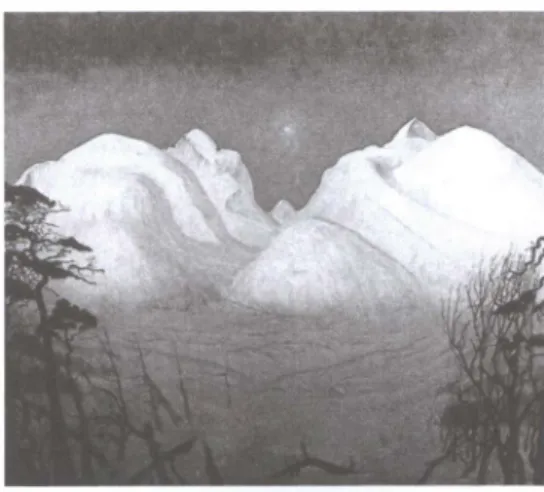
(5) CUADERNO DE NOTAS 20 • 2019. LANDSCAPE ARCHITECTURES IN NORWAY. Iván l. Rincón Borrego. ARTÍCULOS B9. Landscape architectures in Norway. The influence of AHO masters on the National Tourist Routes of Norway Keywords: Landscape architecture, Nonuay, AHO, Knut Knutsen, Christian Norberg Schulz, Svere Fehn During the 1990s the Nonuegimi govemment developed the National Tourist Routes Plan, focusing on upgrading 18 local road routes. The interesting program irwolved thoroughjares designated for road vehicles, bringing about the recovery of the epic sense of car road trips, access to remate spots, and sustainable enhancement oftheir value. Many ofthe projects were carried out by young Nonuegian architectural and landscaping teams trained at the Oslo School of Architecture and Design (AHO) under the influence of Knut Knutsen, Christian Norberg Schulz, and Svere Fehn. Through analysis, the objective of the research is to unravel the links between these landscape projects and the thought of the AHO masters.. Introduction The endless plain upon which I stood was bathed in halflight and mysterious shadow. I saw deformed, twisted and overtumed trees, mute indications of nature's inconceivably powerful forces, for the storms might and fury. (...) Befare me in the distance rose a ran ge of rrwuntains, beautiful and majestic in the moonlight, like petrified giants. The scene was the most magnificent and filled with fantastic stillness that I have ever experienced. Over the white contours of a Nordic winter stretched the sky's endless vault, filled with myriad glimme ring stars. It was like a holy service in a great cathedral. Wintemight in Rondane (1914), Ha. rald Sohlberg (Norberg Schulz 1996: 11).. Nature is imposing and majestic in Norway. From the sudden outcrops of rocks that break up the dark coast of Varan ger to the natural amphitheatre formed by the fiords of Sognejjellet, the scenery alterna tes among forests of impenetrable thickness, Figure l. Harald So hlberg. Wintemight in Rondane, 1914. (Nor berg Schulz 1996: 11).. Doctor Arquitecto por la Escuela Técnica Superior de Arquitectura. Universidad de Valladolid.. glaciers impossible to encompass at a glance, mountain peaks of perpetual snow, tundra and icefalls, ali bathed in the diffuse tones of the mists and the glow of the midnight sun. A sublime and mercurial beauty. Since time immemorial, nature in Norway has been the source of life for its inhabitants and the inspiration for their beliefs. The ex tremely rugged landscape, together with the extremes of climate, has pushed them to face the environment to ensure their survival. But at the same time, this has impregnated the Scandinavian character with a sense of respect, almost veneration, for the mysteries found in Midgard -the world Odin and his brothers Vili and Ve created for humankind to live in- which drives the denizens to venture into its most inhospitable locations. Towards National Tourist Routes Plan of Norway. Norwegian literature and art are teeming with brilliant examples of this feeling. Begin ning with the odyssey of Peer Gynt (1876) wri tten by Henrik Ibsen (1828-1906), an uncon trollable traveller if there ever was one, and continuing through the novels of Knut Ham sun (1859-1952) -for example, Pan (1894) and Growth of the Soil (1917)- Norwegian litera ture has cemented the myth of the solitary Scandinavian traveller, who feels lost in civili zation, constantly attracted by the irresistible call of native forests. The painter Harald Sohlberg (1869-1935) crafts an image of this call in Wintemight in Rondane (1914), a doorway that leads him to the Blue Mountains (figure 1). Under the cold northem light, the scene is presented.
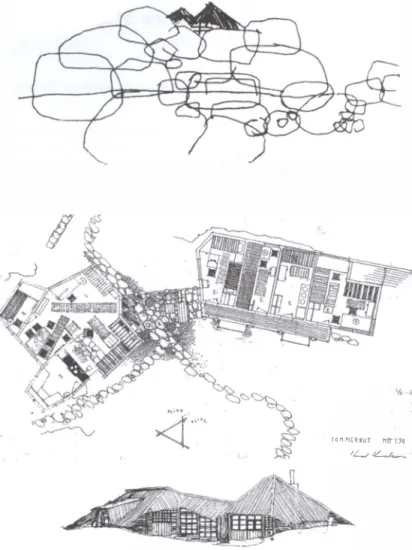
(6) ARTÍCULOS. CUADERNO DE NOTAS 20 • 2019. LANDSCAPE ARCHITECTURES IN NORWAY. in layers of shadow that shroud the forests while the snow-capped mountain ranges in the background glow enigmatically from the reflection of the moon, which makes them ghostly apparitions. The vision, far from being troubling, calms the painter after having seen "deformed, twisted and overtumed trees, mute indications of natures inconceivably powerful forces, for the storms might and fury. (. . .) Be fore me in the distan.ce rose a range of moun tains, beautiful and majestic in the moonlight, like petrified giants." The scene highlights a sublime perspective of Norwegian nature. But even more than this, it reveals the artist's own experience, the roving restlessness of the modern Scandinavian individual, of the wan derers that live to the extent that they disco ver exciting unexplored settings, places where they become self-aware in the escape. In 1975 the historian Robert Rosenblum published his study on the evolution of sce nery in painting, Modem Painting and the Northem Romantic 'Iradition: Friedrich to Ro thko, (Rosemblum 1993), ranging widely from the Romanticism of the 19th century to the Abstract Expressionism of the mid-1900s. This study moulds the concept of the abstract sublime; panorama as origin and basis, the romantic vision as a seed of the more modern vision. While it is true that the romantics taught us how to look at the scenic view, the landscape is no longer the frame for a scene, it has become the scene itself. Like literature and art, Norwegian archi tectural culture has also been nourished by the indisputable natural heritage surroun ding it, especially throughout the 20th cen tury. Many Scandinavian architects and theorists have linked a good part of their ou tput to this landscape, a legacy that has also been transmitted positively to architectural students around the country, fundamentally in the Oslo School of Architecture and Design (AHO). Proof of this is the Norwegian Natio nal Thurist Routes Plan, a programme which, together with the ambitious Oslo Fjord Plan, both symbolise the change of a whole new ge neration of young architects in Norway. 1 The Norwegian National Tourist Routes Plan was launched by the National Admi nistration of Norwegian Roads to regenerate 18 roadways along the country's coast using small-scale scenic and architectural projects. By 2023, 250 initiatives will have been com pleted, making it one of the most extensive landscape intervention programs in contem porary culture (R0nning 2016).2 Jonas Gahr St0re expresses that the essence of this chan-. 90. fOMtll::uur. MJ'fl:fO. IG�·. ge is basically generational. He underlines the idea of Norwegian architecture as a way to tell stories and explain places and the world.3 The Influence of the Oslo School of Archi tecture Masters. Knut Knutsen One of the first authors to sense the ad vantageous dialog between architecture and the environment was the architect AHO pro fessor Knut Knutsen (1903-1969). In his 1961 text People in Focus he tells us how he always tried to teach his students during his classes that every "building -it can be a really good one- will always be weakened by its surroun dings ifthere is no connection between them." (Knutsen 1961: 248). Words that emphasize the idea that constructing is far from subor dinate to the environment (that is, leaving it untouched); it should rather become invol ved with it to enhance it and make it visible: "Respect and reverence for a landscape must. Figure 2. Knut Knut sen. Summer house in Portor, 1949. (Knutsen 1952: 126)..
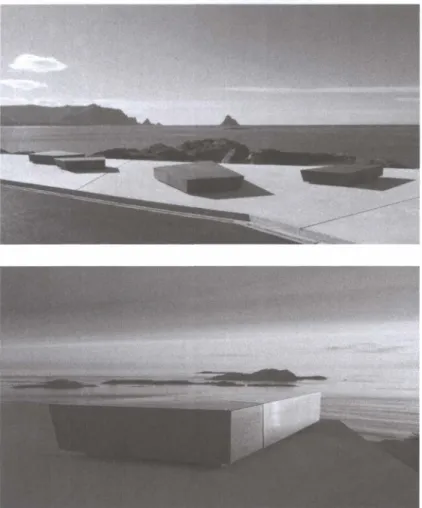
(7) C U A D E R N O DE N O TA S 20 - 2 0 1 9. LANOSCAPE ARCH I TECTURES IN N □ RWAY. Figures 3 and 4. Inge Dahlman. Kleivodden viewpoint, 2013. (Vi llalobos 2018: 36).. Figure 5. Code Arki tektur. Tungeneset viewpoint, 2008. (Vi llalobos 2018: 38).. be prevailing values. Respect is notjust a ma tter of making buildings subordinate to the landscape, but also to emphasize it, develop it - maybe even create new nature." (Knutsen 1961: 249). Establishing not only a formal link with it, but also an empathetic one. Knutsen's own summer house in Portor (1949) provides a good example of this idea. Initially inspired by the eye-catching Sorlandhuser (bright-co loured summer residences built on the coast of southern Norway),4 his project differs from. ARTÍCU L O S 91. them in that it hides from indiscrete glances, attempting to leave the setting intact. lt fo llows a strategy of "insertion between things." (Nicola Flora 1999: 43). The floor plan is divi ded into two small masses that seem like a natural feature; these volumes are minimized using slanted dark wooden roofs that emer ge from the ground among trees and grani te bluffs, giving the entire house, a geomor phic look (Knutsen 1952: 126-129), (figure 2). In that sense, severa! scenic viewpoints built within the National Tourist Routes Plan framework are worthy representatives of the postulates upheld by Knut Knutsen. The first is the Kleivodden viewpoint on the island of Arufuya (2013), on the north coast of Norway. The landscape architect Inge Dahlman,5 planned a project of great restraint and sen sibility at the edge of the sea. The place is close to the And0ya Rocket Range, a facility today renamed And0ya Space Center (ASC) that has been used since the 60's for the launch of stratospheric balloons. The team designed an angular concrete platform from which four blocks of black Ledingen granite emerge. lts pointed shapes guide the visitors toward the wide maritime view that opens in front of them, while its sharp, polished look mixes with the sophisticated rock crystals that appear on the surface from the passage of time. Formal exercise is reduced to a mini mum. Everything is aimed towards the sea, not only the organization of the car park, but also the concrete promenade, as well as the furniture that looks like abandoned rocks. Therefore, the place is re-qualified as an exce llent point from which to observe the Aurora Borealis, emphasizing the sense that links it to the original space project itself (figures 3 and 4). A second vantage point linked to the man ner Knutsen understands the place is that of Tungeneset, líes on the tip of the promontory that separates the Steinsfjord and the Ersf jord (2008). The Code Arkitek:tur studio desig ned a light structure of steel and wood plat forms resting gently on the terrain. lts lines flirt with each other as they descend toward the sea, establishing an intense formal dialog with the steep mountain peaks in the back ground. The layered wood walkway evokes the whimsical course of the cost, the angular walkway shapes recalling the geological folds that have formed the coastline. The construc tion dramatizes the experience of the location and the view, (figure 5). In this sense, the architects Jensen and Skodvin6 stand out for one of the first inter-.
(8) C U A D E R N O DE N OTAS 2 □. ·. 20 1 9. ARTfC U L D S. LANDSCAPE ARCHITECTURES I N N □ RWAY. 92. Figure 6 . Jensen and Skodvin. Viewpoint at Videfossen waterfalls, 1997. (Ref. web 2: www.jsa.no).. ventions of the National Tourist Routes Plan, the viewpoint over the Videfossen waterfalls (1997). It is a structure of concrete and rein forced steel plates suspended over the wa terfall giving the impression of being on the riverbed just when gravity breaks it. The structure is designed to support the impact of frequent avalanches of snow that occur in the area, it behaves like a topographical re creation of regularized rock. From a formal point of view, the planes acquire angles pre sented in the drawing of the handrail that va ries from the lightest elements, at the begin ning of the walk, to the heaviest steel plates point-welded, just above the waterfall and the precipice. The solution stops avalanches but leave the view unobstructed acting as snow barriers during especially snowy winters. The result is a combination in which the rhythm of the natural form of water and rocks echoes in the rhythm of the built forms, (figures 6 and 7). These designs mentioned share an attitu de evoked by Sverre Fehn himself in explai ning Knut Knutsen·s work: "It was his lovefor. "the whole» that gave his relation with nature new dimensions, while the key to understan ding the formal expression of his architecture líes in his reading ofthe lay ofthe land», (Sve rre Fehn 1999: 126). Knutsen's ideas, espe-. Figure 7. Jensen and Skodvin. Viewpoint at Videfossen waterfalls, 1997. (Ref. web 2: www.jsa.no)..
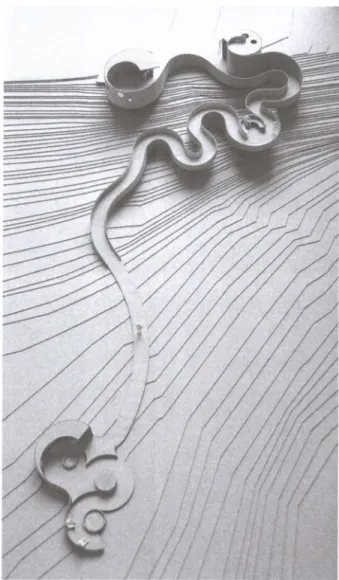
(9) C U A D E R N O DE N O TAS 20 • 20 1 9. LANO SCAPE ARCHITECTURES IN N □ RWAY. ARTÍCULOS 93. ordinary codified by means of architecture. This becomes the second concept, the ge nius loci or principie of identity of place, when applied in a territorial scale According to Norberg Schulz, the codes of nature are what make the architect cons cious of the setting. These codes are divided into categories: "object, arder, character, light, and time» (Norberg Schulz 1975). The first two have to do with spatial qualities, and the fo llowing two categories refer to the atmosphere of the setting. Finally, the last -time- alludes to the idea of constancy and change inscribed in the eternal cycle of time. Sensitivity toward these codes makes the architectural space a participant in a live event represented as a specific setting, as a genius loci, an exis tential reality born in the landscape. Natural events respond to the idea of place present in the ancient theory of the universe where the sky, land, rocks, trees, and water (that is, the primary "things") mark settings filled with meaning for the architect (Norberg Schulz 1979: 24). In the book Principies ofModem Architec. Figures 8 and 9. Arild Wage (Nordplan-AS) and Igne Dahlman. Helldga uiewpoint,. 2006. (Ref. web 2: www.nasjonaleturis tveger.no).. cially those expressed through his house in Portor, set up parallelisms between the forms of nature and the language of human crea tion. A kind of formal analogy that is also pre sent in the above-mentioned interventions, as they adopt forms that evoke the natural envi ronment in an abstract way.. Christian Norberg Schulz The theorist and historian of architecture who best represents Norwegian sensitivity toward its own landscape is Christian Nor berg Schulz (1926-2000), an AHO profes sor of architecture theory and history since 1966. Books such as Intentions inArchitecture (1963) and Existence, Space and Architecture (1971) constitute the basic works in a proli fic output in which he fashions concepts still detectable today in the youngest Norwegian architects: the ideas of existential space and genius loci. Existential space is defined as "a. relatiuely stable system ofperceptiue schemes ar 'images' of the surrounding enuironment» (Norberg Schulz 1975: 19), a backdrop of hu man actions made up of the meanings of the. ture. About the new tradition of the 20th cen tury (2000), Norberg Schulz translates the existential concepts of genius loci to architec tural concepts associated with the identity of place. The Scandinavian historian views the principies of "uisualization" and "complemen tarity» as project strategies worthy of conside ration (Norberg Schulz 2000: 187). According to the uisualization principie, buildings tend to repeat and emphasize the features of a specific setting. An example would be a city carved into the heights of a hill, which reveals the topography inherent to the rock on which it is set. This principie is used by Arild Wage,7 from the Nordplan-AS team of architects, together with Igne Dahl man, in the Hellága viewpoint on the Helge landskysten route (2006). The Hellága rest area lies by the Sjonafjord, with steps that curve gently down the steep rocks to the wa ter. The design reflects the long lines of the mountain formations on the other side of the fjord, as well as improves accessibility to the water's edge. Visitors are guided down to the sea below through an enigmatic granite stairway carved out over the granite coast, coming to an end in the sea, which is poetica lly blurred by the action of the tides and wa ves. According to the uisualization principie, the stairs emphasize the material the coast is made of and vice versa, both of them sharing the same fate from nature's actions, (figures 8 and 9)..
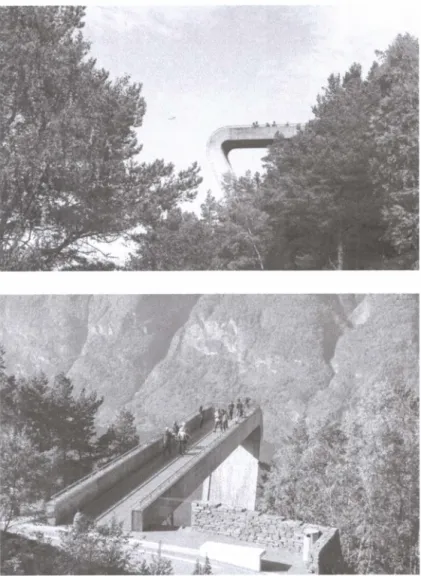
(10) CUADERN O DE N OTAS 2D • 2019. ARTÍCULOS. LANDSCAPE ARCHI TECTURES IN NORWAY. In contrast, the complementarity principle is a strategy in which the buildings intention ally seek to oppose the features of their sur roundings, in order to establish a meaning ful link between the two. The rammed-earth fortresses in southern Morocco are a good example; they delimit enclosed spaces against the undifferentiated immensity of the desert. The National Tourist Routes Plan also inclu des notable projects that use this strategy. The rest area designed by Reiulf Ram stad in Selvika (2012) is the first of two cases we can consider. 8 It is located on the route from Kokelv to Haveysund. A heavy concrete structure snakes its way from the road to the sandy Sandbukta beach inviting the visitor to explore landscape from various perspecti ves. From a distance, the rest area looks like a grey concrete sculpture with references to the rock formations in its environment. But walking its interior, the architect contrasts the openness of the marine horizon with the architecture formed by curved concrete spa ces that surround the visitors, (figures 10 and 11). The Stegastein viewpoint (2005) in Aur land, one of the largest fjords on Norway's west coast, has been designed by architects Todd Saunders and Tommie Wilhelmsem, and is probably one of the most well-known and recognisable works of the National Tou rist Routes Plan. The idea was to build a viewpoint that leaves landscape untouched, but at the same time gives an illusion of ho vering in space as it reaches 30 metres out over the pine trees; an impressive experience facing the attraction of the abyss, 650 me tres above the Aurl.andsjjord, where visitor is driven ªto the limit of visual intensity" (Álva rez-Álvarez 2017: 15). In order to do this, a 4-meter wide footbridge is built with a metal structure and covered with timber. Thanks to the only two points of support on the slo pe, the element seems to be suspended on the landscape, drawn on the sky. In order to make the effect more intense, its shape cur ves downwards like a vertical toboggan, en ded only by a glass that prevents the fall of the viewer. The result is a wonderful frame of the village at the bottom of the fjord, (figures 12 and 13). Conceptions mentioned above, those of Hellága, Selvika and Stegastein, share the common goal of transforming the design into a meaningful enclave. Their designs work with the quoted ideas of existential space and genius loci highlighting the idea of architec tural space as a premature intuition of place.. 94. The architectural space defined by Nor berg Schulz is composed of attributes, rela tionships and processes that are sensed by the body, in other words, by qualities. (Nor berg Schulz 1971: 19) Martin Heidegger's phi losophy is key to understanding this notion because of his ability to bridge the intellectual gap between man and his environment. (Nor berg Schulz 1971: 16) For him, architecture. Figure 10. Reiulf Ram stad. Selvika rest area, 2012. Model. (Ref. web 2: www.reiulframsta darchitects.com). Figure 11. Reiulf Ram stad. Selvika rest area, 2012. (Villalobos 2018: 41)..
(11) ARTÍCULOS. C U A D E R N O DE N OTAS 20 • 2 0 1 9. LANDSCAPE ARCHITECTURES IN NORWAY. Figure 13. Todd Saun ders and Tommie Wilhelmsem. Stegas tein uiewpoint, 2005. (Villalobos 2018: 22). may have the purpose of responding to this need for orientation. Subtracting importance from the purely visual and rational aspects of the architectural space, promotes its con ception as a place capable of impelling the visitor's action in the landscape. To draw a point of departure or arrival, to establish an enclave where to stop along the way or a place of rest, are qualities present in the mentioned examples of the National Plan ofTourist Rou tes influenced by the ideas of Norberg Schulz. Sverre Fehn. Figure 14. Sverre Fehn. Norwegian Glacier Museum, Fjrerland, 1989-91. Sketch of the building in landscape. (Source: The National Museum of Art, Architecture and Design, Oslo).. The foremost author for the current gene ration of Norwegian architects is Sverre Fehn (1924-2009), an AHO professor since 1971 and the only Norwegian architect awarded the Pritzker Architecture Prize (1997). The considerable legacy of this author is remarka ble both because of his work and because of his way of explaining it. Fehn considered that the teacher-architect's task is to narrate the world and its constructions, to explain their raison d'etre, consequently nourishing the. 95. knowledge of those who listen; because tea ching architecture also creates it, and only in this way -creating- can others be helped to imagine it. As in the tradition of the Viking sagas, this author created fables for his stu dents. With them, he symbolized architec tural resources based on rhetorical figures, especially environmental analogies and me taphors. Examples are the structures of the sky and the sea linked by the horizon, the fli ght of birds against the diving of fish, and the shadowless light of the midnight sun, all figu res that he applied to architecture and place.9 An exceptional case in that sense is his fable The Skin, the Cut & the Bandage (Fehn 1994), which he adapts to include in the ope ning conference at the Pietro Belluschi Lectu res at the Massachusetts Institute of Techno logy (MIT). Using the same plot Fehn weaves most of his projects together in this speech, thanks to the use of the three concepts that give rise to its title, applied to the relation ship between the building and the landscape. First of all, we find the Skin, understood to be the surface layer that covers the Earth's crust and houses the footprints left by hu mans and cultures as they pass by. Next co mes the Cut, embodied in the crevices in the land, in whose depths time and memory slip in. And finally, we have the Bandage, which is the architectural layer: the buildings that cover the skin and suture the cut or, to put it in other terms, that emphasize the meaning of the setting. Much of Fehn's work, especially his mu seum projects, incorporate these symbolic concepts. They are found in projects such as the Vasa Museum in Stockholm (1982), which sinks into the Earth's skin; in others like the R0ros Museum-Olav's Mine in Ser-'Jrondelag. \. \. \ ''. �. / \. \. \. \. \' 1. 1/. /4. \ /. \. \\. 1/ /. Ie�. ��,-z,. /.
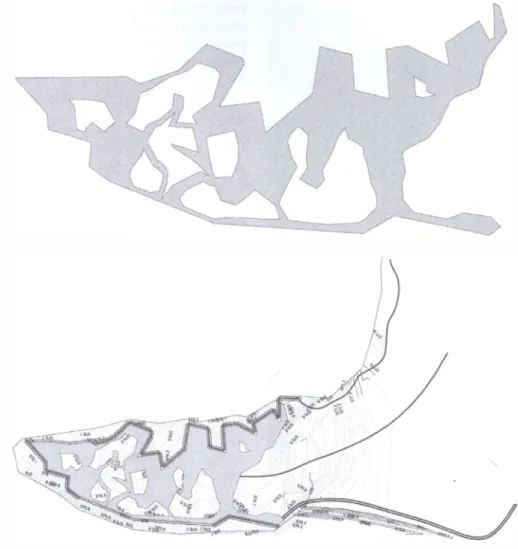
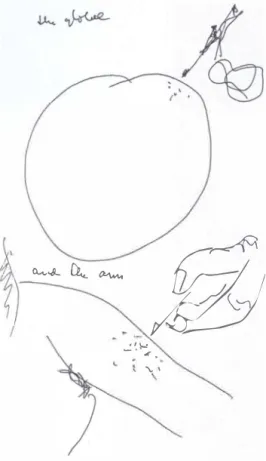
(12) C U A D E R N O DE N OTAS 20 • 2 0 1 9. ARTfCULDS. L A N O S C A P E A R C H I T E C T U R E S I N N □ R WAY. (1979-80), which sutures the incision in the land that the Glamma River represents; or, finally, in the Norwegian Glacier Museum in Fjrerland (1989-91), which marks the exact spot from which to contemplate the largest glacier in Europe, "like an altar in a great ca thedral, as the nature is, with mountains far walls and the sky as the rooj" (Fehn 1994: 30), a plinth among the immensity of the walls of rock in which to feel the dimension of the stay in the panorama (figures 14 and 15). Sverre Fehn pays special attention to ar chitecture conceived from a bird's-eye view through the idea of Tattooing (Fehn 1994: 34), a variation that straddles the line between the Cut and the Bandage, an imprint that is simultaneously an extension of the skin and a new layer of meaning deposited on it. His drawing entitled ªThe Globe and the Arm" por trays the architect as a tattoo artist working on the Earth (figure 16). His architecture, ac cordingly, could be understood as a footprint left on the landscape, a creation that parti cipates in both the land's spatial component and in its meanings, a construction carved into the Earth's crust. There can be no doubt that Land Art in fluenced the story of The Skin, the Cut & the Bandage. Following a path parallel to that of the show Earth Works (1968), the Norwegian's fable redefines the action on the landscape by cancelling the objective value of the work in favour of the guiding process of the land that nurtures the intervention, as well as its observation from above. Works such as Line in Tula Desert (1969) by Walter de María, Dou ble Negative (1969-70) by Michael Heizer, and Relocated Burial Ground (1978) by Dermis Oppenheim, (figure 17) among others, exem plify eloquent interchanges of counterparts between landscape and architecture, with a sensitivity that Sverre Fehn made his own and transmitted to his students. This is illus-. 96. Figure 16. Sverre Fehn. The Globe and the Arm, non dated. (Source: The National Museurn of Art, Archi tecture and Design, Oslo).. �. ¡,. o.....,� {).,_ �. ...=��. ÍiY. ..,. _. '\, '. trated by his reference to the German artist Hannsjorg Voth (an inspiration for him}, close to American Land Art during his speech at MIT: "I don't remember why but, when desig. ning the Glacier Museum, I was thinking also about a big figure, wrapped in cloth, made by the German artist Hannsj6rg Voth. (. . .) I looked and looked at pictures ofiC (Fehn 1994: 29).10 Hannsjorg Voth's work is composed of what are called "Zero landscapes" (Weilacher 1999: 56), with strongly utopist and critica! perfor mances that embed geometric shapes and imaginary topographies in the landscape. They are examples stressing, just as Sverre Fehn did, the formal relationship between de sign and nature as a way to understand that. . ... Figure 15. Sverre Fehn. Norwegian Glacier Museum, Fjrerland, 1989-91. (Source: Fehn, S. and Mauritzen, M. O. 1994. The Norwegian Glacier Center. Living Architecture, 13)..
(13) CUADERNO DE NOTAS 2D - 201 9. LANDSCAPE A R C H ITECTU R E S I N N. □ R WAY. ARTÍCULOS 97. idea of memory of place, faced with a location where, according to him, "the Earth's skin has been dissolved» (Fehn 1994: ll). The setting is the archaeological site of the ancient palace in Hamar, of which barely a few walls in ruins remain, and where the ground gradually di sappears as archaeological studies excavate it. Under such circumstances, the architect is focused on two factors: first, on the findings that might be buried in the soil, "objects that. Figure 17. Dennis Oppenheim. Relocated Burial, 1978. (Source: Tiberghien, G. A. 1995. Land art. Lon don: Art Data). Figure 18. Sverre Fehn. Hedmark Mu. seum and Bishop's Pa lace, Hamar, 1967-79.. (Source: Iván l. Rincón Borrego). Figure 19. Carl-Viggo H0lmebakk. Sohlberg. plassen uiewpoint,. 2003. Model. (Villalo bos 2018: 55).. they complement each other. (Rincón-Borre go, l. 2014) Acting on the setting from the assump tions of Land Art means accepting before hand the timeless nature of architecture and, likewise, accepting the counterparts of the landscape as being such, its emblematic na ture, and the grand scale accompanying it. This attitude is, if possible, even more trans cendent if we consider sorne of the breathta king Norwegian spots where Sverre Fehn's are placed and the National Tourist Routes Plan projects. In the Hedmark Museum and Bishop's Palace (1967-79) Sverre Fehn expands the. are essential for traeing the history of the past»; and second, on the user, under who se steps the land melts. The raison d'etre of the museum is thus to mediate between the two to "help the visitor, who should be provi ded with a horizon, a firmfioor», Sverre Fehn stresses, "with the Earth's skin, you shape it, to show that which is hidden in it» (Fehn 1994: 11). The solution comes through a simple sys tem of concrete platforms raised above the ground that are intertwined with the existing walls (figure 18). The blueprint is a setting of architectural structures that the user always views from above, of ruins that are read like a stone book. The museum makes the archaeo logical site understandable, sutures the cuts, and restores the sensation of a lost place. The concrete platforms of the Hedmark Museum bring the memory of the Hamar archaeological site to light; and, similarly, Carl-Viggo H0lmebakk's Sohlbergplassen viewpoint (2003)1 1 takes us back to the ex periences initially mentioned by Harald Sohl berg in Wintemight in Rondane. The architect designs a single concrete platform of curvy lines on the slopes of Antsi0en, a platform that interlaces with the existing fir trees, side stepping them, adding itself to the forest like a suspended layer that lifts the visitor to the right height to admire the Blue Mountains (fi gures 19 and 20). The viewpoint harmonizes with the museum, given that both encourage reading the landscape as if it were a palimp sest of memories and experiences. We almost seem to hear Carl-Viggo H0lmebakk, a past student of Sverre Fehn, remembering Fehn's words: "[When] history occurs as a layering of signs, nature and history remember their rhythm and blend together in a single organic reality thanks to architecture» (Fehn 1980: 3255), or perhaps his other motto from the pre viously-mentioned MIT conference: "the best [architectural] poems have few words» (Fehn 1994: 7). Little more than a sheet of concre te helpfully oriented in the setting, placed to adapt to the trees, is enough to encode the atavistic values of this unforgettable passage of Scandinavian culture..
(14) CUADERNO DE NOTAS 20 - 2019. ARTÍC ULOS. LANDSCAPE ARCH I TECTURES IN NORWAY. 9B. Conclusion and Outlook. Over the last decades, Norway has expe rienced a change of cycle with respect to its architecture. It has been a change promoted by the institutions thanks to initiatives like the Oslo Fjord Plan and the National Tou rist Routes Plan, whose projects have been carried out to a great extent by young, but none-the-less consolidated, architecture stu dios. Clearly, delving into this new generation would require mentioning Jan Olav Jen sen, Rune Grov, Knut Hjeltnes, Hilde Haga, Jensen & Skodvin, and the Sn0hetta team, among many others. The famous project the last group mentioned for the Norwegian Na tional Opera and Ballet (2000-08) would be the showcase piece, an eloquent represen tative of the legacy of masters such as Knut Knutsen, Christian Norberg Schulz, and Sve rre Fehn. In fact, during the inauguration of the exposition Srwhetta, architecture - lands capes - interiors in May 2009, Jonas Gahr St0re, representing the Norwegian Ministry of Foreign Affairs, indicated that the essence of this change is mainly generational. He em phasized the idea of Norwegian architecture as a way to tell stories and explain the place and the world, a message that (as we have no ted) their educators had implicitly endorsed before. In short, all of them converge directly and indirectly agree on the importance of establi shing a relationship with landscape and its memory through architecture. The projects of the National Tourist Routes Plan really began a long time ago in classrooms for workshops like Bygg 3 in Oslo School ofArchitecture and Design (AHO), 12 where Per Olaf Fjeld, Neven Fuchs-Mikac, Turid Haaland, Finn Kolstad, Terje Moe, and Ole Frederik Stoveland colla borated together with Sverre Fehn over the years.Or even before, when Sverre Fehn him self reminds us that many of his colleagues were constantly wondering: "What would Knut Knutsen have said?", (Sverre Fehn 1999: 126). Jan Olav Jensen, of the architectural firm Jensen & Skodvin, confirms that, to sorne extent, everything began in the AHO lectu re halls. There, the classes were designed to open the students' minds, "the creative lie» (Jensen 2008: 295): intellectual fictions to channel the project toward the setting: "Whe. ther or not the colourful and oflen baroque sto ries ha told in his lectures had any counter part in life, for many of us who studied with him, there was something cultic both about the. concept ofprecision an about how far it was possible to take it. It was a matter of uncove ring one·s inner source.» (Jensen, J. O. et al.. 2008) and of the world.. Notes The Oslo Fjord Plan concerns the architectural recovery of 225 hectares of the city's waterfront, which is divided into 13 zones. Its composi tion includes such notable interventions as the Sn0hetta Opera and National Ballet, 2000-08; the unch/Stenersen Museum, by Alberto Herre ros; the Deitchman Library in Bj0rvika and the urban development of Barcode commissioned from the a-lab team. 2 Since the end ofthe 90s, architecture in Norway has experienced a change in the cycle promo ted by institutions. Initiatives such as the Oslo Fjord Plan or the National Thurist Routes Plan have been developed by young teams of archi tects, mostly Norwegian. A turning point in thi s sense were the exhibitions Architect Sve rre Fehn: Intuition, Reflection, Construction, in March 2008, and the exhibition Snehetta, ar chitecture - landscapes - interiors, in May 2009. At the opening of the latter, Jonas Gahr St0re expressed the value of this change. (Yvenes y Madshus 2008). 3 The speech of Jonas Gahr St0re, representati ve of the Norwegian Ministry of Foreign Affair s , was published on the Norwegian Government's website http://www.regjeringen.no. The website also contained the working document architec ture.now - Norwegian Architectural Policy, which constitutes a statement of intent regarding the identity and architectural aspirations of con temporary Norway. 4 Although Knutsen considers this house a Sor landhuser, a typical summer house built in a natural setting in southern Norway, the house. Figure 20. Carl-Viggo H0lmebakk. Sohlber gplassen viewpoint,. 2003. View towards Blue Mountains. (Vi llalobos 2018: 55)..
(15) CUADERNO DE NOTAS 20 - 2 0 1 9. ARTÍ CULOS. LANDSCAPE ARCHITECTURES I N N □ RWAY. is the opposite, as it is hidden from indiscreet glances unlike other Sorlandhuser, as if it were a secret hiding place. It can only be accessed by knowing the exact place where it is set up be cause it mimics the rocks and Knutsen hardly leaves any marks that guide the visitor. (Knut sen 1952: 126-129). 5 Inge Dahlman graduated at NLH (Norwegian University ofLife Sciences) in 1985. This Norwe gian University has historically taught the de gree of landscape architect, being in the orbit of the AHO where Inge Dahlman has taught nu merous lectures.. 99. References A.A.V.V. 2009. Architecture now. Norwegian Archi tectural Policy. Oslo: Ministry of Culture and Church Affair s . ÁLVAREZ-ÁLVAREZ, D . 2018. Pai sajes Románticos 1 Miradas Contemporáneas. In Villalobos, D (ed.), Arquitectura y Paisaje. Ca"eteras que emocio. nan. Arquitectura y Paisaje en la Noruega Con temporánea. Valladolid: Universidad de Vallado. 6 Jan Olav Jensen and B0rre Skodvin graduated at AHO in 1985 and 1988, respectively. Jan Olav Jensen remembers the importance of his AHO professors (Jensen 2008: 295).. lid y Real Embajada Noruega en España. FEHN, Sverre. 1980. The tree and the horizon. Spa zio & Societa, 10: 32-55. FEHN, S. 1999. Knut Knutsen. In Nicola F., Giarde llo, P. and Postiglione, G. Ame Korsmo - Knut Knutsen. Due Maestri del Nord. Roma: Officina Ed.. 7 Arild Wage graduated at NTH (Norwegian Ins titute of Technology) in 1975 before it becomes part of the AHO.. FEHN, Sverre. 1994. The Skin, the Cut & the Ban dage. In Anderson, S. (ed.) The Pietro Belluschi Lectures. Boston: The MIT Press.. 8 Although Reiulf Ramstad obtains his PhD at the University of Venice, many of his main partners graduate at the AHO; Anja H. Strandskogen, Christian Skram Fuglset or Anders Tj0nneland, among others.. FJELD, Per Olaf. 2009. Sverre Fehn: the pattern of thoughts. New York: The Monacelli Press.. 9 Talking about the way Sverre Fehn taught, Per Olaf Fjeld writes "He has a unique ability. to visualize and then simplify the most complex thoughts. In this sense, his teaching was similar to Louis Kahn's: they were both seductive, never imperative, in their approach. • (Fjeld 2009: 173).. 10 The enormous deployment that the German author performs between May 30 and June 5, 1978 ends up being consumed by fire. It is a critica! claim of the "fossilized society in which we live, which is capable of wasting enormous. sums of money and unlimited resources in the preservation of things and increasing their va lue• according to Voth himself (Weilacher 1999:. 65). 11 Carl-Viggo H0lmebakk graduated at the AHO in 1984 and at Cooper Union in New York 1984-85. AHO's relationship with the Cooper Union will be intensified through Sverre Fehn's stay at the American University in 1986.. 12 Bygg 3, which translation would be Building 3, is. the didactic block led by Sverre Fehn at the Oslo School ofArchitecture (AHO). Despite the title, in. fact the subject includes the teaching of design of projects, theoretical classes of composition and history of architecture. Per Olaf Fjeld, Ne ven Fuchs-Mikac, Turid Haaland, Finn Kolstad, Terje Moe and Ole Frederik Stoveland collabora ted in this laboratory over the years.. FLORA, N. 1999. Between Artefact and Nature: the Domestic Project of A. Korsmo and K. Knutsen. In Nicola F., Giardello, P. and Postiglione, G. Ame Korsmo - Knut Knutsen. Due Maestri del Nord. Roma: Officina Ed. JENSEN, J. O. 2008. Affinity. In Andersen, M. A. (ed.). Nordic Architects Write. A Documentary Antholo gy. New York: Routledge. 295. KNUTSEN, Knut. 1952. A holiday house. Byggekunst, 8: 126-129.. KNUTSEN, K. 1961. People in Focus. In Andersen, M. A. (ed.), Nordic Architects Write. A Documentary Anthology. New York: Routledge. 249. NoRBERG ScttuLz, Christian. 1971. Existence, Space and Architecture. London: Praeger Publishers. NoRBERG ScHULZ, Christian. 1979. Genius Loci. Pae saggio, Ambienta Architettura. Milan: Electa. NoRBERG ScHULZ, Christian. 1996. Nightlands. Lon don: The MIT Press. NoRBERG ScHULZ, Christian. 2000. Principies of Mo dern Architecture. London: A. Papadakis. REF. WEB 2. www.regjeringen.no/en/search.html? querystring=Sn%C3%B8hetta,+architectu re+%E2%80%93+landscapes+%E2%80%93+in teriors&id=86008 [visited January, 2013]. R1NcóN-BORREGO, l. 2014. The Skin, the Cut, the Bandage. Legado y crítica en Sverre Fehn. In critic I al! I Intemational Conference on Archi tectural Design & Criticism. Madrid: critic lall PRESS. 978 - 986. RosENBLUM, Robert. 1993. La pintura moderna y la. tradición del romanticismo. De Friedrich a Ro thko. Madrid: Alianza. R0NNING, Svein. 2016. Nasjonale turistveger. Die Norwegischen Landschaftsrouten National. Tou rist Routes in Norway. Oslo: Forlaget Press. V1LLALOBos, Daniel (ed.). 2018. Arquitectura y Pai saje. Carreteras que emocionan. Arquitectura y paisaje en la Noruega contemporánea. Vallado lid: Universidad de Valladolid y Real Embajada Noruega en España..
(16) CUADERNO DE NOTAS 20 • 2019. L A N D S C A P E A R C H I T E C T U R E S I N N O RWAY. A RT I C U L C S 1 00. Udo. 1999. Between Landscape Archi tecture and Land Art. Basilea: Birkhii.user.. WEILACHER,. YvENES, Marianne and Madshus, Eva (ed.). 2008.. Architect Sverre Fehn: Intuition, Refiection, Construction. Oslo: The National Museum of. Art, Architecture and Design.. Fecha final recepción artículos: 25/04/2019 Fecha aceptación: 01/07/2019 Articulo sometido a revisión por dos revisores independientes por el método doble ciego..
(17)
Figure
+5

Documento similar
In the “big picture” perspective of the recent years that we have described in Brazil, Spain, Portugal and Puerto Rico there are some similarities and important differences,
It is generally believed the recitation of the seven or the ten reciters of the first, second and third century of Islam are valid and the Muslims are allowed to adopt either of
ABSTRACT Transformation of the Specialized Knowledge of Future Primary Teachers on Fraction Division
From the phenomenology associated with contexts (C.1), for the statement of task T 1.1 , the future teachers use their knowledge of situations of the personal
In the preparation of this report, the Venice Commission has relied on the comments of its rapporteurs; its recently adopted Report on Respect for Democracy, Human Rights and the Rule
The main goal of this work is to extend the Hamilton-Jacobi theory to different geometric frameworks (reduction, Poisson, almost-Poisson, presymplectic...) and obtain new ways,
The paper is structured as follows: In the next section, we briefly characterize the production technology and present the definition of the ML index as the geometric mean of
Highest ef ficiencies for CZTS cells reported up to this date have been deposited via a process first reported by Shin et al in 2013 using co-evaporation of the elements at low
Díaz Soto has raised the point about banning religious garb in the ―public space.‖ He states, ―for example, in most Spanish public Universities, there is a Catholic chapel
