
Assessing the impact of a revenue neutral tax shift away from labour income in Spain
8
0
0
Texto completo
(2) ECFIN Country Focus. Issue 7 | June 2014. Employment protection legislation and job mobility. Excessively strict EPL adversely affects employment and job mobility. Employment protection legislation (EPL) consists of a broad set of rules and procedures, grounded primarily in legislation, court rulings, collectively-andindividually-bargained conditions of employment and customary practice, defining limits to firms' freedom to terminate private employment relationships. Its rationale is to address the risks to job security for workers by imposing a series of legal requirements on firms with respect to termination of employment. The impact of EPL on labour market outcomes has been the subject of numerous studies. Both empirical evidence and theoretical arguments suggest that, EPL can have both positive and negative effects. EPL stabilises employment across the cycle and has positive impact on employment duration and on the investment rates of firms. In the presence of high job mobility, transaction costs and sunk costs at firm level (in the form of investment in job-specific training) discourage employers from investing in the development of skills.. Excessive job mobility can be detrimental to productivity growth Yet low job mobility may lead to allocative inefficiencies. At the aggregate level, nevertheless, very low job mobility is also detrimental to growth. Job mobility facilitates structural economic changes by reallocating employment in the face of changing economic conditions. Moreover, it can contribute significantly to innovation, particularly in knowledge-intensive sectors, to the extent that movement of workers across firms and sector allows for transmission of knowledge and experience. The fact that, both in Spain and in other countries characterised by high labour market duality, employees hired on open-ended contracts typically display higher education levels further potentially limits knowledge and technology spill-overs. Finally, in cyclical upswings, increased on-the-job search by employees keeps the costs of job creation more contained for firms, since it expands the pool of potential hires from which firms can draw. Consequently, wages are less volatile and incentives to post vacancies remain high (Krause and Lubik, 2007). Furthermore, excessively strict EPL adversely affects job and employment mobility:1 it obstructs job creation and labour reallocation by discouraging firing and hiring and lengthens the duration of unemployment. The negative effects of excessively strict EPL are particularly harmful to vulnerable workers (Neumark, 2000). A recent study by Gielen and Tatsiramos (2012) finds that workers are less likely to quit their jobs in countries with excessively strict job protection and relates the lower job-tojob mobility to higher expected risk of subsequent layoffs and job mismatch. The authors also find that the wage increase demanded by workers when changing jobs is significantly higher in countries with higher EPL. Where expectations of the net gains of job mobility are lower, on-the-job search rates are also likely to be lower and probably less responsive to business cycle, as larger (expected) wage increases are needed in order to trigger a more intense on-the job search. Graph 1 shows how search rates vary across EU Member States, reflecting to some extent the degree of external labour market flexibility: as expected higher and more volatile search rates are generally found in countries with relatively less strict EPL.2. Generous tenure related severance payments negatively affect job mobility. In this paper, we consider the impact of the severance payment regime on job-to-job mobility. Spain is characterised by a relatively generous severance payment system by international standards,3 with entitlements rising relatively steeply with increasing tenure. As severance payment entitlements are lost when changing employer, tenured employees hired with an open-ended contract face a substantial disincentive to job mobility. Indeed, as shown in Graphs 1 and 2, the search intensity is particularly low amongst Spanish employees hired with open-ended contracts from an international perspective and not particularly responsive to the business cycle.. 2.
(3) ECFIN Country Focus. The 2012 reform reduced the generosity of the severance payment regime. Experiences in other countries show that reform of the severance payment regime may have a positive effect on job-mobility. Whereas the impact on job mobility will be observed in the long run, the. Issue 7 | June 2014. The 2012 labour market reform eliminated some of the obstacles to employment mobility in Spain by increasing the predictability of dismissal costs, increasing internal flexibility, reducing the segmentation between the employment conditions of permanent and temporary workers and reviewing the system of collective bargaining.4 A further important element of the reform was to introduce a cap on severance payments for all employees hired on open-ended contracts and to reduce the accrual rate of entitlements, in order to stimulate permanent job creation. Specifically, the severance payment for unjustified dismissals was reduced from 45 to 33 days per year of service, up to a maximum of 24 months. The implementation of the reform was phased in at different rates for different typologies of workers in order not to retroactively affect established rights. The full impact of this measure in terms of job creation and employment mobility will only materialise in the long run, with output growth gaining some traction. A potential "side effect" of the reform, which will likewise only be visible in the long term, is to increase job-to-job-mobility.5 A reform of the severance payment regime was also implemented in Austria in 2003.6 The new system, designed to remove obstacles to job mobility, allowed every employee to collect entitlements irrespective of the duration of employment. The medium-term impact of the Spanish reform on job mobility cannot be tested directly, mainly due to the current adverse macroeconomic context and the limited time since the implementation of the reform. Instead, we analyse the impact of the reform on the search rates of employees hired on open-ended contracts – the so-called on-the-job search rate. We argue that an increase in the on-the-job search rate is a lead indicator that is likely to anticipate higher rates of job-to-job mobility, which will emerge as soon as employment creation gains some traction. To our knowledge, this is the first paper assessing the impact of severance payments on the on-the-job search rate. The only comparable work is a study by Hofer et al. (2012) on the impact of the new severance payment regime in Austria. The results reveal that the medium-term impact of the reform on job mobility are statistically significant, but all in all quantitatively rather limited. Other factors, such as economic conditions, seem to play a much larger role in affecting job mobility. Graph 1: On-the-job search rate amongst employees hired with open-ended contracts in Spain and other EU countries. Graph 2: On-the-job search rate amongst employees hired with open-ended contracts and unemployment rate in Spain. Source: LFS, own calculations. Source: LFS, own calculations. As shown in Graph 2, the average search rate in the 7 quarters following the reform (2012q3-2014q1) is 4.5% as opposed to 3.6% in the period before the reform (2005q12012q1). Mechanically attributing the increase in the search rate to the reform is not advisable as other variables might also have affected the observed outcome. The population of employees hired before and after the reform is likely to display. 3.
(4) ECFIN Country Focus. reform should already produce an intensification of on-the-job search in the short run. Issue 7 | June 2014. significantly different characteristics (age, education, tenure, etc.), which affect the search rate. Moreover exogenous events – e.g. the sharp increase in unemployment – might likewise contribute to an increase or a decrease in search behaviour. Finally, as clarified in the following section, the reform did not affect all employees in the same way, but had a differentiated impact according to their tenure and the entitlements accrued at the time when the reform entered into force.. Estimating framework. The impact of the reform is derived by comparing preand post-reform search rates. In the typical micro-econometric evaluation framework (the “potential outcome approach”, most commonly called the Roy (1951) Rubin (1974) model), the treatment effect is given by a comparison of the treatment outcome (Y1) with a hypothetical situation where the same individual does not receive treatment (Y0). The evaluation problem arises because we can never observe both potential outcomes for the same individual at the same time. The lack of a counterfactual at the individual level is overcome by comparing different groups – one of which has been treated and the other not (the control group). In our case the control group is composed of all employees with an open-ended contract in the years before the reform, while the treated group is composed of all employees with an open-ended contract in the years after the reform. However, a simple comparison between outcomes of treated and control group is not possible if the groups differ in terms of individual characteristics or other exogenous conditions that may influence the outcome, in other words, when E(Y0|D=1) ≠ E(Y0|D = 0), where D is a binary treatment indicator. In this specific case, one might expect that changes in the composition of the workforce affect the search rate. The direction is difficult to predict ex-ante: with employment shrinking – for example – the share of more educated and more tenured workers has increased with ambiguous impacts on the search rate as more tenured workers usually feature lower job-to-job mobility, while more educated workers on the contrary tend to be more mobile. However, changes in macroeconomic conditions might also affect the search rate. On the one hand, a particularly tight labour market could increase wage pressure and induce a higher job search. Likewise, greater slack would decrease job-search. However, a inverse relation is also possible: recessions might increase the sense of job insecurity and push workers to intensify their search as a form of insurance against the risk of involuntary unemployment. On the other hand, expectations about the future evolution of the economy might also be relevant in explaining search behaviour. Improving expectations about the economy might push employees to search for another more remunerative job.. We control for different macroeconomic conditions and composition in the labour force preand post-reform…. Furthermore, we differentiate the impact of the reform on different target groups. Econometric techniques allow us to control for differences in the characteristics of the treated and the control group that – just like the implementation of the reform – might affect the difference in the search effort. In particular, we account for age, gender education, nationality and contract tenure. Clearly, individuals observed before and after the reform are also different in other dimensions – i.e. they are likely to display non observed heterogeneity. Nevertheless, we assume that unobserved characteristics are randomly attributed to the treated and control groups. We also control for different macroeconomic conditions and expectations at the moment of the data collection, by introducing for each quarter the corresponding quarterly rate of unemployment and the quarterly average of the monthly sentiment indicator. A further complexity is represented by the fact that, in this specific case, the reform affects workers differently according to their work tenure. We identify four target groups. Group I is composed of all employees hired with an open-ended contract after the reform. After the reform, this group enjoys a lower accrual rate and their entitlements are limited to 24 months of severance payments. Group II is composed of all employees hired before the reform, who have not yet reached the ceiling on severance payment entitlements. After the reform this group maintains the entitlements. 4.
(5) ECFIN Country Focus. Issue 7 | June 2014. accrued at the higher rate until the introduction of the reform, but is subject to the lower accrual rate thereafter and is likewise limited by the ceiling on maximum entitlement. Group III is composed of all employees hired with an open-ended contract before the reform, who had already exceeded the ceiling of 24 months on entitlements at the moment of the reform. After the reform this group basically stops accruing additional entitlement and the maximum entitlement is that at the time of entry into operation of the reform. Finally, group IV includes employees not affected by the reform. These are those who had already reached the maximum entitlement of 42 months at the time of the reform. The econometric framework relies on a parametric approach. The outcome variable (i.e. job-to-job search) is modelled as a function of observed characteristics of the employee and state variables. The observed outcome being binary (i.e. 1 if the employee has searched for a job in the reference period – i.e. in the four weeks preceding the day of the interview, and 0 otherwise), we use a probit model. Observed characteristics include a treatment dummy taking the value of 1 if the worker was surveyed after the reform and zero otherwise. 7. The data. The model is estimated using consecutive waves of the Labour force Survey, from 2005. We rely on 33 consecutive waves of the Labour Force Survey, starting from Q1 of 2005 to Q1 of 2014.8 The estimation sub-sample includes all employees with an open-ended contract, since only the latter are affected by the reform. We further restrict the estimation sample to private sector workers. As discussed above, we also identify four different target groups which we expect to be differently affected by the reform. The identification of the subgroups is based on tenure at the time of entry into force of the reform. Table 1 reports descriptive statistics for the whole estimation sample and the four target groups, disaggregating observations before and after the reform. Differences for the whole sample of employees are small – but noteworthy. Differences are due to both cohort effects and the intense labour shedding that occurred following the crisis. The employed population after the reform is in general older, more educated, and more tenured while the share of female and foreign employees is larger. Table 1: Descriptive statistics-Characteristics of the sample and the target groups (before and after the reform) Estimation subsample. Target Group II. Target Group III. Target Group IV. Before After Before After Before After Before After Before After 58.1 53.6 44.1 54.0 50.9 66.0 64.6 73.4 70.5 5.6 7.0 12.5 7.3 8.1 1.4 1.5 0.8 0.7 41 43 39 38 40 46 49 53 56 0.2 0.2 0.2 0.2 0.1 0.2 0.1 0.3 0.3 2.0 1.3 1.5 1.8 1.1 2.4 1.4 3.2 1.9 12.1 8.1 8.8 10.2 7.1 13.4 8.9 23.1 16.4 31.0 30.6 33.6 31.8 30.4 30.3 30.2 26.6 29.9 13.3 13.1 12.8 12.8 12.5 13.7 14.2 15.5 17.5 9.9 10.5 10.9 10.4 11.0 8.9 9.1 7.5 8.4 31.5 36.2 32.2 32.8 37.7 31.1 36.0 23.7 25.6 115 128 7 53 88 209 265 380 424 3.6 4.4 12.1 4.6 4.5 1.2 1.0 0.3 0.3 853530 220241 18606 614379 155370 149868 32138 89283 14127. Male (%) Non-European (%) Age No education (%) Uncompleted primary education (%) Primary education (%) Lower secondary education (%) Upper secondary education (general) (%) Upper secondary education (professional) (%) Tertiary education (%) Contract tenure (months) Searched for another job (%) Observations Source: Labour force statistics. There are significant differences in the composition of the employed labour force before and after the reform. Target group I. As already suggested by Graph 2, the search rate is on average higher after the reform than before the reform: on the basis of the selected sample, about 3.6% of employees with an open-ended contract looked for another job in the reference period, while the post-reform rate is about 4.4%.9 Target group I does not have a specific "counterfactual" group before the reform. It is on average younger and better educated. Moreover, it displays – by construction – a very low tenure, which probably largely explains the high search rate. Target groups II, III and IV display similar trends in terms of demographic variables: in the observations after the reforms, they are more educated, older, and more. 5.
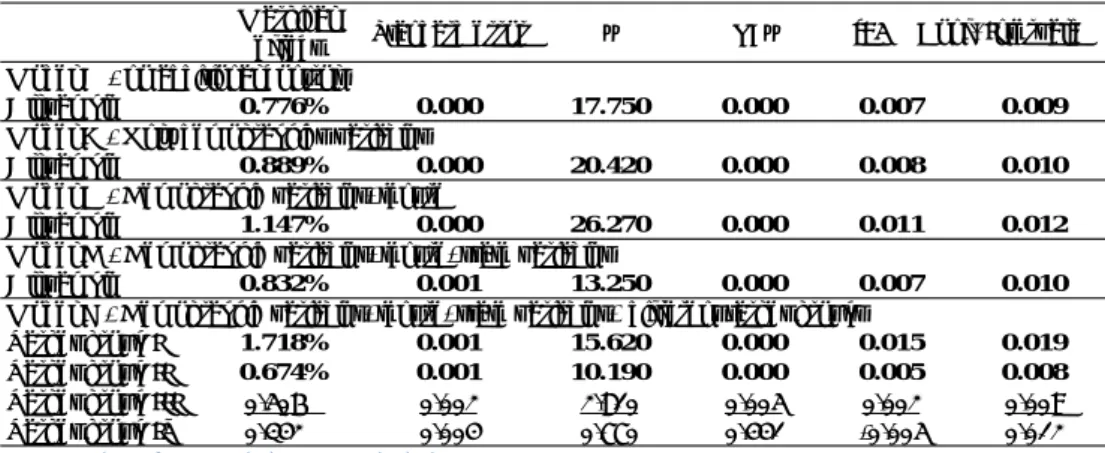
(6) ECFIN Country Focus. We estimate different models with increasing numbers of control variables. Issue 7 | June 2014. tenured. Surprisingly, the search rates for group III and IV are on average lower after the reform, though the difference is very small – especially for target group IV. It would nevertheless be erroneous to infer that, following the reforms, these target groups are less likely to undertake search on-the-job: the lower search rates observed after the reform can in fact be entirely attributed to the differences in the observed characteristics of the sub-samples before and after the reform.. Results. Results unambiguously point to a significant impact on the search activity of employees hired under open-ended contracts. The impact of the reform on the search activity is estimated with alternative specifications. Model A simply regresses the outcome variable on the reform dummy variable. Model B additionally controls for composition effects, by including the demographic variables described in the previous section, with the exception of job tenure – namely gender, age, education and nationality. Model C includes tenure as an additional control variable (and tenure squared to account for non-linearity) and model D further adds state variables, namely the current unemployment rate and the aggregate short-term sentiment indicator. Finally model E disaggregates the previous result, by estimating the impact of the reform on the four target group. Table 2 reports the marginal effects of the reform dummy, which can be interpreted as the impact of the reform on the expected search rate.10 Table 2: Marginal effects of the reform (alternative control groups and model specifications) Marginal [95% Conf. Interval] Standard error z P>z effect Model A - no additional controls 0.776% 0.000 17.750 0.000 0.007 0.009 All sample Model B - Only demographics variables 0.889% 0.000 20.420 0.000 0.008 0.010 All sample Model C - Demographic variables, tenure 1.147% 0.000 26.270 0.000 0.011 0.012 All sample Model D - Demographic variables, tenure, state variables 0.832% 0.001 13.250 0.000 0.007 0.010 All sample Model E - Demographic variables, tenure, state variables, different target groups 1.718% 0.001 15.620 0.000 0.015 0.019 Target group I 0.674% 0.001 10.190 0.000 0.005 0.008 Target group II Target group III 0.506% 0.002 2.810 0.005 0.002 0.009 Target group IV 0.342% 0.004 0.770 0.441 -0.005 0.012 Source:Labour force statistics, own calculations Figures in bold indicate significance at the 1‰ level, underlined figures indicate significance at the 1% level.. Model A gives an estimated marginal effect of about 0.8 pp. - the value of the estimated coefficient is hardly surprising since, in a regression with a single dummy variable, it corresponds to the difference between the search rate pre- and post-reform. More interesting is the fact that the difference is highly significant. Correcting for composition effects, model B reveals a highly significant and slightly higher impact of the reform: 0.9 pp. This result suggests that the impact of the reform is actually higher than a crude comparison of the search rates would suggest since the population of employees after the reform is ceteris paribus on average less likely to search for another job than the population before the reform. The impact of higher education and foreign citizenship on mobility is positive, while the impact of age is negative. Male employees are, moreover, less likely to search a new job while in employment. All in all, the negative age effect prevails over the other characteristics, so the additional control variables actually yield a higher estimated impact of the reform. Model C introduces contract tenure as an additional control variable: the impact of the reform becomes significantly larger – more than 1 pp. As we have seen, the average tenure after the reform is much higher than before the reform (mostly due to selective. 6.
(7) ECFIN Country Focus. Issue 7 | June 2014. labour shedding during the crisis). Since tenure negatively affects search intensity, controlling for this dimension leads to a further increase in the estimate of the impact of the reform.. Econometric evidence supports the initial hypothesis that the reform has increased on-thejob search intensity. Model D includes the state variables as additional controls: the current unemployment rate and the current sentiment indicator. Both variables have a significantly positive impact signalling that the deterioration of the labour market conditions induces more active search – probably due to a job insecurity effect – while positive expectations about the future state of the economy likewise favour more intensive search behaviour.11 This model reduces the estimated impact to just above 0.8 pp. Finally model E shows the impact of the reform on different target groups. It is interesting to see that this more sophisticated model supports the ex-ante expectations of decreasing marginal effect of the reform as one moves from group I to group III and no effect on group IV.12. Conclusions. Although significant, the impact remains relatively small. The full impact of the recently-implemented reform of the severance payment regime will require a significant time-lag in order to be assessed empirically. The current situation of the labour market – and in particular the slack demand – does not allow a fully separation of structural and cyclical components in employment dynamics. Whereas the key aim of the reform of dismissal regulation was to reduce disincentives for employers to hire using open-ended contracts, the reform may have generated other side effects. In particular, reducing the accrual rate of severance payment entitlements may also have a positive impact on job-to-job mobility. This hypothesis is tested not by looking at job-to-job mobility per se, but rather at on-the-job search. The econometric evidence supports the hypothesis that the cap on severance payments and the reduced accrual rate may have significantly increased on-the-job search amongst employees hired with open ended-contracts. As expected, the impact is differentiated across different groups of employees: the change is highest amongst new hires and decreases progressively for groups that are only marginally affected by the reform. No change in behaviour is observed amongst the group of employees already having accrued the maximum entitlement. The differentiated impact over the different target groups suggests that, as the composition of the employment population is affected by the entry of employees hired after the reform, the aggregate search rate is likely to further increase. This change in search behaviour – if confirmed in the long run – is likely to lead to greater job-to-job mobility. The exact extent impact on job-to-job transitions is, nevertheless, difficult to foresee as other elements of the reform may have affected how search behaviour leads to actual job transitions. An empirical assessment of the actual increase in job-to-job mobility will require some time and, probably, more favourable macroeconomic conditions. If confirmed, greater job-to-job mobility might lead to increased productivity through faster spread of technology and knowledge embedded in human resources. More contained wage dynamic could also result in periods of tighter labour market conditions – though arguably the latter effect will only be visible in the medium-to-long run given the current level of slack on the labour market. Although significant in statistical terms, the increase in the on-the-job search rate is still relatively contained, leaving the on-the-job search rate in Spain relative low in comparison to other countries.. 7.
(8) ECFIN Country Focus. Issue 7 | June 2014. References Andersen, T. et al (2008): “Job Mobility in the European Union: Optimising its Social and Economic Benefits”, Danish Technological Institute, Final report to European Commission, DG Employment, Social Affairs and Inclusion. European Commission (2014): “Macroeconomic imbalances – Spain 2014”, European Economy, Occasional Papers, 176. Gielen, A. and Tatsiramos, K. (2012): “Quit behaviour and the role of job protection”, Discussion Paper 6540, IZA. Hofer, H., Schuh, U. and Walch, D. (2012), “Effects of the Austrian Severance Pay Reform”, in Holzmann, R. and Vodopivec, M. (eds.) (2012), Reforming Severance Pay. An International Perspective. The World Bank. Washington, pp. 177-194. Krause, M. and Lubik, T. (2007): “On-the-job search and the cyclical dynamics of the labour market,” ECB Working paper series, 779. Neumark, D. (2000): “Changes in job stability and job security: a collective effort to untangle, reconcile and interpret the evidence”, National Bureau of Economic Research Working Paper series, 7472. OECD Employment Outlook (2013): “Protecting jobs, enhancing flexibility: A new look at employment protection legislation”. Roy, A. (1951): “Some Thoughts on the Distribution of Earnings,” Oxford Economic Papers, 3(2), 135–145. Rubin, D. (1974): “Estimating Causal Effects to Treatments in Randomised and Nonrandomised Studies,” Journal of Educational Psychology, 66, 688–701. 1 Job mobility refers here specifically to mobility from one job to another and is therefore conceptually distinct from employment mobility i.e. the rate of transition from one employment status to another, which covers movements in and out of the labour market as well as among different types of employment contracts - permanent or temporary employment and part-time or full-time employment. 2 According to Andersen et al. (Andersen et al., 2008) the highest levels of job mobility are found in the United Kingdom, Denmark, Sweden, Finland, the three Baltic states, and – to a smaller extent– Ireland. The relatively lowest levels of job mobility are found in Central European Member States (Poland, Czech Republic, Slovakia, Slovenia, and, to a smaller extent, Hungary), in continental European Member States (Germany, Belgium, Austria) and in Mediterranean countries (Italy, Greece, and, to a smaller extent Spain and Cyprus). 3 For recent comparative data and description of the degree of stringency of EPL in OECD countries, see OECD Employment Outlook 2013 at http://www.oecd.org/employment/emp/oecdindicatorsofemploymentprotection.htm 4 For a description of the main features of the 2012 labour market reform in Spain, see EC (2014). 5 To our knowledge this aspect has not been explored in recent evaluations or studies on the impact of labour market reform. 6 In order to combine the benefits of relatively high job mobility with a system of increasing workers' protection, the new system (Abfertigung Neu) set up individual savings accounts managed by employee provision funds (Mitarbeitervorsorgekassen). Job mobility costs for employees are expected to be reduced as employees do not lose their entitlement to severance payment when quitting a job. 7. The latent variable describing the propensity of an employee i to look for a job at time t is defined as: y ∗ = α + βx + γα + δD + ε. where α is a constant; α accounts for differences in macroeconomic conditions at time t; x is a set of covariates controlling for differences in individual characteristics; and D is the dummy for the treatment effect. ε is an error term which includes other unobserved characteristics. We assume that the unobserved characteristics are randomly attributed to employees that were hired before and after the reform, i.e. E(D ,ε ) = 0. The additional hypothesis made is that no other change – other than those controlled for – occurred at the time of implementation of the reform. In reality, several reforms were introduced more or less simultaneously, including change in unemployment benefit entitlements, clarification of collective dismissal procedures, wage setting procedures and amendments to bargaining practices. Whereas several of these reforms have had a deep impact on the functioning of the labour market, they are not likely to have affected the search behaviour of insiders. A possible exception could be represented by the wage setting agreements at firm level. By changing the evolution of wages at firm level, it is likely that the expected net value of changing job may be modified. This hypothesis is implicitly tested by assessing the impact of the reform on the fourth group referred to above. Indeed, if no significant change in behaviour is observed for this group, we can assume that the change observed is exclusively attributable to the change in the severance payment regime. Incidentally, the hypothesis is tested ex-post and the correlation coefficient between regression residuals and the treatment dummy is not significantly different from zero. 8 It is an ongoing survey carried out every quarter and it targets households. Its main objective is to monitor labour force dynamics. The average quarterly sample is 65,000 households. We rely on the information at personal level and use only a sub-sample as clarified in the text. 9 Note that these figures are partly different from those of the graph, discussed in the introduction, since the latter refer to the average of the average search rate per quarter, and not to the average search rates across the pooled sample before and after the reform. 10 We do not report the marginal effects or the estimated coefficients of all control variables, as we are mainly interested in the impact of the reform. Detailed results are available upon request. 11 Statistics on vacancies were also considered, but finally discarded as sentiment indicators – to the extent that they proxy perceptions about future possibilities - were considered more appropriate. 12 The impact on the third group is slightly less significant and not very different from the impact on group II. It is however likely that the average group effect conceals significant differences between groups with higher and lower tenures. More interestingly, the disaggregated result also support the hypothesis of dynamic effects of the reform: as all new entrants will be fully affected by the reform, the aggregate search intensity is likely to increase over time.. 8.
(9)
Figure

Documento similar
It is generally believed the recitation of the seven or the ten reciters of the first, second and third century of Islam are valid and the Muslims are allowed to adopt either of
In the preparation of this report, the Venice Commission has relied on the comments of its rapporteurs; its recently adopted Report on Respect for Democracy, Human Rights and the Rule
In the previous sections we have shown how astronomical alignments and solar hierophanies – with a common interest in the solstices − were substantiated in the
Díaz Soto has raised the point about banning religious garb in the ―public space.‖ He states, ―for example, in most Spanish public Universities, there is a Catholic chapel
teriza por dos factores, que vienen a determinar la especial responsabilidad que incumbe al Tribunal de Justicia en esta materia: de un lado, la inexistencia, en el
The redemption of the non-Ottoman peoples and provinces of the Ottoman Empire can be settled, by Allied democracy appointing given nations as trustees for given areas under
Our results here also indicate that the orders of integration are higher than 1 but smaller than 2 and thus, the standard approach of taking first differences does not lead to
In the “big picture” perspective of the recent years that we have described in Brazil, Spain, Portugal and Puerto Rico there are some similarities and important differences,
