
Efecto de la tenacidad del asfalto en la resistencia a fatiga de las mezclas asfálticas Asphalt toughness effect on bituminous mixture fatigue behavior
16
0
0
Texto completo
(2) Alfredo H. Noguera, Rodrigo Miró. 225. Dicha energía depende del trabajo termodinámico de la tenacidad, mecánica de fractura y reología (E. H. Fini et al., 2007; Arago et al., 2011). De acuerdo con el moderno punto de vista sobre este tema, durante la acción de la fuerza de tensión se desarrolla un trabajo que se almacena en forma de energía de deformación. Cuando esta energía alcanza la magnitud de la densidad de energía de fractura superficial del material Gf, ocurre la fractura y la pieza se separa en dos partes liberando la energía en forma de fractura, tal que cada una de las partes relaja inmediatamente sus tensiones. La energía de fractura Gf ha probado ser un buen parámetro de diseño que puede ser usado en la mecánica de fractura para analizar la propagación de la grieta de un pavimento (Shen et al., 2007; Kim et al., 2009; E. Denneman, 2010). Asociado a la tenacidad existe otro fenómeno de disipación de energía de una mezcla asfáltica y es la fatiga del sistema agregado-asfalto, donde el compuesto va perdiendo gradualmente su energía disponible debido a cargas de corta duración cada vez que pasa un vehículo (Adhikari et al., 2009). En la especificación actual de SUPERPAVE, se considera que la fatiga no se presenta si el asfalto cumple con un valor reológico mínimo de G*sen . Este valor representa una disminución del módulo complejo y está relacionado con el total de la energía disipada por ciclo de carga (D´Angelo et al., 2007). Sin embargo, diversos estudios han demostrado que no existe una correlación entre los valores reológicos y el comportamiento de la mezcla en servicio. Con la finalidad contribuir a un mejor entendimiento de los procesos internos del sistema agregado-asfalto y su correlación con la fatiga del mismo, se ha desarrollado este trabajo, empleando el ensayo Barcelona Tracción Directa (BTD) para determinar la tenacidad de diferentes asfaltos (Pérez Jiménez et al., 1997) y el ensayo de flexotracción de 3 puntos (NLT350/90), para determinar la fatiga de una mezcla fabricada a partir de estas asflatos.. This energy depends on the thermodynamic work of toughness, fracture mechanics and rheology (E. H. Fini et al., 2007; Arago et al., 2011). According to modern views regarding this subject, during the action of tension force a work develops and it is stored as strain energy. When this energy reaches the magnitude of the density of fracture energy Gf material surface, the fracture occurs and the piece splits in two parts, releasing energy in the form of fracture, in such a way that each part immediately relaxes its tensions. The fracture energy Gf has proven to be a good design parameter that can be used in fracture mechanics to analyze the crack propagation of a pavement (Shen et. al., 2007; Kim et al., 2009; E. Denneman, 2010).. 1.2 Significancia de la investigación Aunque numerosos trabajos han propuesto varios métodos o ensayos para determinar la fatiga en mezclas asfálticas, como los ensayos de compresión cíclica o los ensayos de flexotracción dinámica, aún actualmente estos ensayos son complejos, requieren mucho trabajo para la fabricación de probetas y el tiempo de ensayo es largo. Por tanto, lo ideal sería poder establecer una relación con la fatiga a partir de ensayos en los asfaltos o másticos.. 1.2 Research significance Even if numerous studies have proposed various methods or tests to determine fatigue in asphalt mixtures, such as cyclic compression tests and dynamic flexural tests, even today these tests are complex and they require a lot of work for test tubes production, and also trial time is long. Therefore, the ideal would be to establish a relationship with fatigue from tests on asphalt or mastic.. Associated with toughness there is another phenomenon of energy dissipation of bituminous mixture and it is fatigue of aggregate-asphalt system, wherein the compound gradually loses its available energy due to short duration loads every time that a vehicle passes (Adhikari et al., 2009). In the current SUPERPAVE specification, it is considered that fatigue does not occur if asphalt meets a minimum rheological value of G*sen . This value represents a decrease of complex modulus and is related to total dissipated energy per load cycle (D´Angelo et al., 2007). However, several studies have shown that there is no correlation between the rheological values and mixing behavior in service. In order to contribute to a better understanding of the internal processes of asphalt-aggregate system and its correlation with its fatigue, this study has been developed using the essay Barcelona Direct Traction (BDT) to determine toughness of different asphalt (Pérez Jiménez et al., 1997) and testing of 3-point flexural (NLT350/90), to determine the fatigue of a mixture made from these asphalts.. Revista Ingeniería de Construcción Vol. 26 No2, Agosto de 2011 www.ing.puc.cl/ric.
(3) Efecto de la tenacidad del asfalto/Asphalt tenacity effect. En este trabajo se pretende establecer una relación entre la tenacidad que ofrecen distintos asfaltos y el comportamiento a fatiga de sus correspondientes mezclas asfálticas. Conociendo esta relación, podría tenerse una idea del comportamiento a fatiga de la mezcla a partir de los ensayos de tenacidad del asfalto, que son monotónicos y por lo tanto, más fáciles y rápidos de hacer, y con ello, poder tener en cuenta esta propiedad en la etapa de diseño.. This paper aims to establish a relationship between the toughness that offer different asphalts and fatigue behavior of the corresponding bituminous mixture. Knowing this relationship, one could have an idea of the fatigue behavior of the mixture from the toughness tests of asphalt, which are monotonic and therefore easier and faster to make, and be empowered to take account of this property in the design stage.. 2. Materiales. 2. Materials. Los asfaltos utilizados en los ensayos experimentales son, dos asfaltos de penetración, B-60/70 y B-13/22; dos asfaltos modificados con polímeros, BM3c y BM-3b, recogidos en el pliego de prescripciones técnicas generales (PG-3). Además, se ha empleado un asfalto modificado con polvo de neumático BM-PN. Las propiedades de cada uno de los asfaltos son recogidas en la siguiente Tabla:. Asphalt used in experimental trials are: two penetration asphalts, B-60/70 and B-13/22; two asphalts modified with polymers, BM-3c and BM-3b, collected in the General Technical Specifications (PG-3). It has also been used a modified asphalt with crumb rubber BMPN. Asphalts properties are the following:. Tabla 1. Caracterización de los asfaltos empleados Table 1. Characterization of asphalts used Propiedades/Properties. Unidades/Units B-60/70 B-13/22 BM-3c BM-3b BM-PN. Penetración a 25ªC/Penetration at 25ªC. 1/10 mm. 63. 20. 56. 60. 65. ºC. 50.6. 68. 67.2. 64.6. 58.7. -----. -0.5. 1. 2.7. 2.4. 1.5. Pto. fragilidad Fraass/Fragility point Fraass. ºC. -13. 1. -17. -----. -19. Recuperación elástica/Elastic Recovery. %. -----. -----. 76. 64. 42. Pto. Reblandecimiento anillo y bola/Softening point ring and ball Índice de penetración/Penetration index. Residuo TFOT/Residue TFOT Variación de masa/Mass variation. %. -0.14. 0.5. -0.24. -----. -0.07. Penetración a 25ºC retenida/Retained penetration at 25ºC. %. 65. 60. 59. -----. 59. Variación del Pto. de reblandecimiento/Variation of Softening point. ºC. 6.4. 7. 8.4. -----. 8.9. En la fase experimental de la investigación, se utilizan 3 tipos de agregados en la elaboración de las probetas a ensayar, uno de tipo granítico para evaluar la tenacidad y una mezcla de agregados de sílice y caliza para evaluar la fatiga.. In the experimental phase of research, 3 types of aggregates are used in the preparation of the test tubes to be used; a granitic type to evaluate toughness, a mixture of silica and limestone aggregates to assess fatigue.. Revista Ingeniería de Construcción Vol. 26 No2, Agosto de 2011 www.ing.puc.cl/ric. 226.
(4) Alfredo H. Noguera, Rodrigo Miró. 227. 3. Metodología. 3. Methodology. La fase experimental se realiza en dos etapas. En la primera, se determina la tenacidad de diferentes asfaltos mediante el empleo del ensayo BTD, y en la segunda, se determina la vida a fatiga de una mezcla, fabricada con los mismos asfaltos, mediante el ensayo de flexotracción dinámica. El procedimiento de ensayo BTD, consiste en someter una probeta cilíndrica, con un entalle en la base a un esfuerzo de tracción paralelo a ésta base y perpendicular al entalle de la probeta. Las bases de entalladura son colocadas dentro de un molde cilíndrico de 101,6mm de diámetro, para poder ser utilizado en el compactador Marshall, aplicando 50 golpes únicamente en la cara superior. El ensayo se realiza a una velocidad de desplazamiento constante de 10mm/min y dentro de una cámara climatizada para mantener la temperatura durante la realización del ensayo. La entalladura se abre a medida que provoca la fisuración de la probeta. Para elaborar la probeta se emplea una mezcla patrón en dos tamaños, según los tamices UNE: • 80 % del agregado que pasa por el tamiz de 5mm y queda retenido en el de 2.5mm • 20 % del agregado que pasa por el tamiz 2.5mm y queda retenido en el 0.63mm • 4.5% contenido de asfalto. The experimental phase is conducted in two stages. The first is to determine the toughness of different asphalts using the BTD test, and the second to determine the fatigue life of a mixture, made with the same asphalts through dynamic flexural testing.. La finalidad de utilizar una mezcla patrón, sin finos ni fíller, es dejar como única variable el tipo y naturaleza del asfalto, por lo que la resistencia dependerá exclusivamente de las propiedades del asfalto utilizado. La temperatura de ensayo fue de 20ºC (Tabla 2). De igual manera, para evaluar la fatiga mediante el ensayo de flexotracción a desplazamiento controlado, se han empleado los mismos asfaltos con la finalidad de poder establecer posibles relaciones con la tenacidad. La mezcla fabricada es una de tipo S-12 (semidensa tamaño máximo 12mm), compuesta por dos tipos de agregados, uno calizo y el otro silíceo con una proporción de asfalto sobre agregado de 4,5%. El ensayo se ha realizado a la temperatura de 20ºC y a una frecuencia de 10 Hz. El rango de desplazamiento fijado para los asfaltos convencionales varía desde 160 a 220 m; en los asfaltos modificados la amplitud aplicada es mayor, varía de 220 a 360 m (Tabla 3). Como se puede apreciar, se han utilizado dos tipos de granulometrías, ya que con el ensayo BTD se pretende estudiar la tenacidad del asfalto de manera individual, mientras que la otra (tipo S-12) corresponde a un tipo de mezcla asfáltica real, empleada usualmente en la construcción de la carpeta asfáltica.. The purpose of using a standard mixture, without fines or filler, is to leave as only variable the type and nature of asphalt, so that resistance will depend exclusively on the properties of the asphalt used. Test temperature was 20 º C (Table 2). Similarly, to assess fatigue by testing flexural to displacement control, the same asphalt have been used in order to establish possible relationships with toughness.. BTD test procedure consists of subjecting a cylindrical test tube with a notch at the base to a tensile stress parallel to this base and perpendicular to the notch of the tube. Recess bases are placed into a cylindrical mold of 101.6 mm in diameter, to be used with Marshall compactor, applying 50 strokes only at the top side . The test is performed at a constant displacement rate of 10mm/min and within a chamber heated in order to maintain the same temperature during the trial. The notch is opened as cracking of the test tube is produced. To prepare the test tube it is used a standard mixture in two sizes, according to the sieves UNE: • 80 % of agregate passes through a sieve of 5mm and is retained by the one of 2.5mm • 20 % of agregate passes through the sieve of 2.5mm and is retained by the one of 0.63mm • 4.5% asphalt content. The mixture produced is of type S-12 (semidense 12 mm maximum size), composed by two types of aggregates, a limestone one and the other siliceous with a ratio of asphalt aggregate of 4.5%. The test was carried out at a temperature of 20 ° C and with a frequency of 10 Hz. Shift range set for conventional asphalt varies from 160 to 220 m; in modified asphalts amplitude applied is higher, ranging from 220 to 360 m (Table 3). As it can be seen, two types of grain sizes were used, because with BTD test it can be studied the toughness of individual asphalts, while the other (type S-12) corresponds to a real type of asphalt mixture, usually used in asphalt construction.. Revista Ingeniería de Construcción Vol. 26 No2, Agosto de 2011 www.ing.puc.cl/ric.
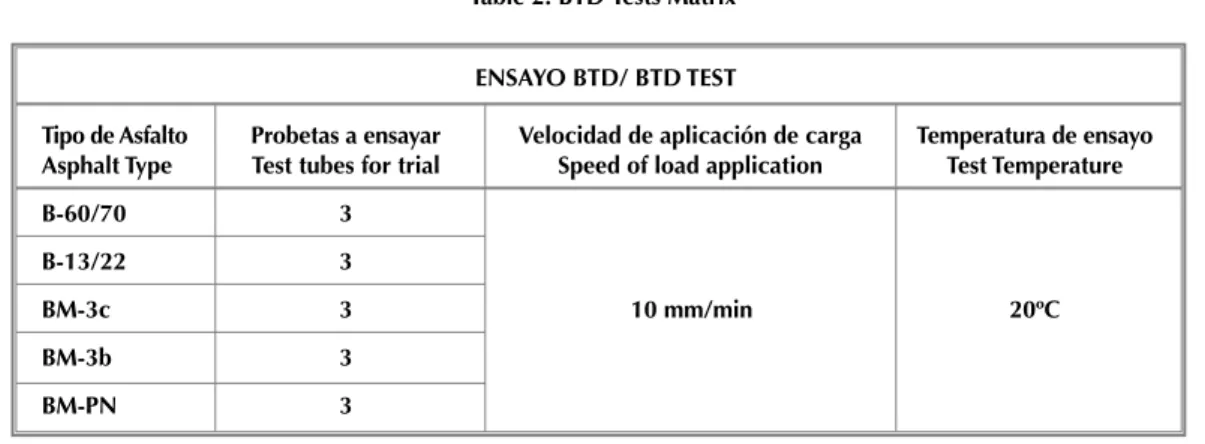
(5) Efecto de la tenacidad del asfalto/Asphalt tenacity effect. Tabla 2. Matriz de ensayos BTD Table 2. BTD Tests Matrix ENSAYO BTD/ BTD TEST Tipo de Asfalto Asphalt Type. Probetas a ensayar Test tubes for trial. B-60/70. 3. B-13/22. 3. BM-3c. 3. BM-3b. 3. BM-PN. 3. Velocidad de aplicación de carga Speed of load application. Temperatura de ensayo Test Temperature. 10 mm/min. 20ºC. Tabla 3. Matriz de ensayos a fatiga Table 3. Matrix fatigue tests ENSAYO DE FATIGA A FLEXOTRACCIÓN DINÁMICA/FATIGUE TESTING OF DYNAMIC FLEXURAL. Granulometría Grading S-12. Tipo de Asfalto Asphalt Type. Probetas a ensayar Test tubes for trial. Amplitud de desplazamiento Displacement amplitude. Temperatura de ensayo Trial Temperature. B-60/70. 10. 160 – 220 m. 20ºC. B-13/22. 10. 160 – 220 m. BM-3c. 10. 220 – 360 m. BM-3b. 10. 220 – 360 m. BM-PN. 10. 220 – 360 m. 4. Análisis de resultados. 4. Results Analysis. 4.1 Tenacidad En los ensayos a tracción directa se registra, para cada asfalto ensayado, el desplazamiento provocado por la variación de la fuerza a tracción. El ensayo se ha realizado a la temperatura de +20ºC. En la Figura 1, se aprecia la curva característica de un asfalto sometido a tracción directa. Dicha curva, presenta una pendiente inicial pre-pico que alcanza un valor de fuerza a tracción máxima y desciende con una pendiente post-pico hasta que la fuerza se reduce a cero. Al analizar la curva característica podemos observar algunos parámetros relevantes como, la fuerza máxima, el módulo secante, el desplazamiento de rotura, la pendiente post-pico y la energía total.. 4.1 Toughness In the direct tensile test it is recorded for each tested asphalt the displacement caused by variation of tensile strength. Test was carried out at a temperature of +20º C. Figure 1 shows the characteristic curve of asphalt under direct tension. This curve shows an initial pre-peak steep that reaches a maximum tensile strength and falls with a post-peak slope until force is reduced to zero. Upon analyzing the curve we can observe some relevant parameters such as maximum strength, secant modulus, fracture displacement, the slope post-peak and total energy.. Revista Ingeniería de Construcción Vol. 26 No2, Agosto de 2011 www.ing.puc.cl/ric. 228.
(6) Alfredo H. Noguera, Rodrigo Miró. Figura 1. Curva característica de un asfalto sometido a tracción directa Figure 1. Characteristic curve of pavement subjected to direct tension. 229. - Fuerza máxima (Fmáx) Se define como la fuerza máxima que es capaz de soportar el asfalto sin sufrir una deformación permanente (rango elástico). La fuerza máxima que es capaz de soportar el asfalto, está relacionada con la temperatura. A bajas temperaturas el asfalto soporta una mayor fuerza de tracción que a temperaturas intermedias o altas.. - Maximum strength (Smax) It is defined as the maximum force that can withstand the asphalt without suffering permanent deformation (elastic range). The maximum force that pavement is capable of supporting is related to temperature. At low temperatures the asphalt supports a greater tensile strength than intermediate or high temperatures.. - Módulo secante ( ) Se obtiene dividiendo la fuerza máxima entre el desplazamiento producido por dicha fuerza máxima. El módulo secante también se conoce como módulo elástico.. - Secant modulus ( ) It is obtained by dividing the maximum force by the displacement produced by such maximum force. The secant modulus is also known as elastic modulus.. - Desplazamiento de rotura ( ) En la curva de comportamiento del asfalto podemos distinguir tres tipos de desplazamientos que pueden considerarse de rotura; el primero corresponde al desplazamiento ( Fmáx) que se produce cuando se alcanza el valor máximo de la fuerza a tracción (Fmáx); el segundo, corresponde al desplazamiento ( 50%máx) que se alcanza cuando la carga máxima se ha reducido un (50%Fmáx) en la curva post-pico y el tercero corresponde al desplazamiento total ( máx), cuando la fuerza a tracción se reduce a cero.. - Fracture displacement ( ) At the asphalt performance curve we can distinguish three types of movements that can be considered of braking type; the first one corresponds to the displacement ( Smáx) that occurs when reached the maximum tensile force (Smax); the second one corresponds to displacement ( 50% max) reached when the load has been reduced (50% Smax) at the post-peak curve and the third one corresponds to total displacement (max) when the tensile strength is reduced to zero.. Revista Ingeniería de Construcción Vol. 26 No2, Agosto de 2011 www.ing.puc.cl/ric.
(7) Efecto de la tenacidad del asfalto/Asphalt tenacity effect. En la anterior, se representan los tres criterios de fallo descritos anteriormente; el primer criterio (FmáxFmáx), no refleja la tenacidad de la mezcla, ya que no considera todo el rango de desplazamiento que el asfalto ofrece. El tercer criterio (máx), es difícil de determinar ya que, dependiendo del tipo de asfalto analizado, especialmente los asfaltos modificados, la curva puede llegar a ser muy tendida y no llegará a un valor cero de tracción. En cambio, el segundo criterio (50%Fmáx50%máx), se considera más adecuado para representar la tenacidad, ya que representa el desplazamiento que se produce en la curva post-pico, considerando el rango elástico y plástico del material. Este desplazamiento aumenta cuanto mayor es la temperatura.. Here the three failure criteria described above are represented; the first criterion (Smax-Smax) does not reflect toughness of the mix because it does not consider the full range of movement that the asphalt offers. The third criterion ( max), is a difficult one to determine because, depending on the analyzed type of asphalt, especially modified asphalts, the curve can become very stretched and will not arrive at zero traction. In contrast, the second criterion (50% Smax-50% max), is considered more appropriate to represent toughness, because it represents the displacement that occurs in the post-peak curve, considering the elastic range and the plastic of the material. This shift increases the higher the temperature is.. - Pendiente post-pico Al analizar la pendiente de caída de las curvas, se advierte que a bajas temperaturas, la pendiente es prácticamente vertical ya que la rotura se produce de forma frágil. A temperaturas intermedias, la rotura es más dúctil y la pendiente post-pico se va tendiendo con un desplazamiento de rotura mayor, y a altas temperaturas la pendiente se vuelve casi plana.. - Slope post-peak Analyzing the slope of decline curves, we see that at low temperatures, the slope is almost vertical since the break occurs in a fragile way. At intermediate temperatures, the rupture is more ductile and post-peak slope tends to be of higher rupture displacement, and at high temperatures the slope becomes almost flat.. - Energía total o tenacidad La energía total se obtiene a partir del área bajo la curva fuerza-desplazamiento dividida entre el área de fractura. A continuación se presentan las curvas fuerzadesplazamiento obtenidas del trabajo experimental del grupo de asfaltos a la temperatura de +20ºC (Figura 2).. - Total energy or tenacity Total energy is obtained from the area under the force-displacement curve divided by the fracture area. Below are the force-displacement curves obtained from the experimental work of the group of asphalt at a temperature of +20 ºC (Figure 2).. Figura 2. Variación de la tenacidad del grupo de asfaltos a 20ºC Figure 2. Variation of toughness of the asphalts group at 20 °C. Revista Ingeniería de Construcción Vol. 26 No2, Agosto de 2011 www.ing.puc.cl/ric. 230.
(8) Alfredo H. Noguera, Rodrigo Miró. Tabla 4. Valores de energía obtenidos Table 4. Energy values obtained. Asfalto/Asphalt. Fmax/Smax (KN). Wf (KJ). Gf (KN/m). B-60/70. 6.90. 0.00137. 5.48. 0.061. B-13/22. 16.98. 0.00288. 11.20. 0.082. BM-3c. 4.92. 0.01647. 6.64. 0.073. BM-3b. 7.73. 0.02316. 9.94. 0.075. BM-PN. 8.95. 0.02073. 8.66. 0.087. Estos valores son los que se emplean posteriormente para establecer las correlaciones con el comportamiento a fatiga.. These are the values that are used later in order to establish correlations with fatigue behavior.. 4.2 Fatiga A continuación se muestran las leyes de fatiga obtenidas para el grupo de asfaltos mediante el ensayo de flexotracción dinámica (Figura 3).. 4.2 Fatigue Below are the laws of fatigue obtained for the asphalts group through dynamic flexural test (Figure 3).. Tabla 5. Leyes de fatiga obtenidas de los asfaltos considerados Table 5. Fatigue laws obtained from the asphalts considered. 231. Ley de fatiga Fatigue Law. R2. Tipo de Asfalto Asphalt Type. Módulo dinámico (MPa) Dynamic Modulus (MPa). B-60/70. 4.000. = 0.0018N-0.181. 0.90. B-13/22. 7.500. = 0.0015N-0.199. 0.74. BM-3c. 2.100. = 0.0022N-0.134. 0.88. BM-3b. 2.900. = 0.0023N-0.140. 0.84. BM-PN. 5.900. = 0.002N-0.190. 0.84. Revista Ingeniería de Construcción Vol. 26 No2, Agosto de 2011 www.ing.puc.cl/ric.
(9) Efecto de la tenacidad del asfalto/Asphalt tenacity effect. Figura 3. Leyes de fatiga a flexo-tracción dinámica Figure 3. Fatigue Laws in dynamic flexion traction. Otro procedimiento para evaluar el comportamiento a fatiga de la mezcla, es por medio del ratio de energía disipada a fatiga (Disipated energy ratio, DER), obtenido a partir de la suma acumulada de energía, ciclo a ciclo, hasta el momento de fallo considerado en la probeta.. Another way to evaluate the fatigue behavior of the mixture is through the ratio of energy dissipated upon fatigue (Disipated energy ratio, DER), obtained from the cumulative sum of energy, cycle to cycle, until failure moment considered in the test tube.. n. DER =. ∑π 1. σ ε senφ. π σ ε senφ. (1). DER = ratio de energía disipada = Esfuerzo aplicado = Deformación aplicada = ángulo de fase. DER = ratio of energy dissipated = Applied stress = Applied deformation = phase angle. Al graficar los valores de tensión y deformación de cada ciclo se obtienen los bucles de energía. En los asfaltos convencionales tienen una forma definida, casi elíptica, y a medida que la probeta se va fatigando, los bucles se inclinan y se deforman (Figura 4).. By plotting values of stress and strain of each cycle the energy loops are obtained. In conventional asphalts they have a defined form, almost elliptical, and as the test tube fatigues, loops bend and deform (Figure 4).. Del mismo modo, se pueden graficar los bucles de energía para los asfaltos modificados (Figura 5), donde se percibe que los bucles se mantienen en un mismo rango de deformación y sobre él, ocurre la distorsión; esto no ocurre en el asfalto convencional donde los bucles se presentan a diferentes niveles de deformación.. Similarly, the loops of energy for the modified asphalts can be graphed (Figure 5), perceiving that the loops are kept in the same strain range and above it, distortion occurs; this does not occur in conventional asphalt where loops are present at different levels of deformation.. Revista Ingeniería de Construcción Vol. 26 No2, Agosto de 2011 www.ing.puc.cl/ric. 232.
(10) Alfredo H. Noguera, Rodrigo Miró. Figura 4. Bucles de energía disipada de un asfalto convencional Figure 4. Loops of energy dissipated in conventional asphalt. Figura 5. Bucles de energía disipada de un asfalto modificado Figure 5. Loops of dissipated energy in modified asphalt. A partir de la energía acumulada hasta el ciclo de rotura y el número de ciclos de rotura para cada probeta ensayada, es posible dibujar una ley de energía (Figura 6), parecida a la ley de fatiga presentada anteriormente, que en este caso representa la energía total disipada (DER) frente al numero de ciclos que puede resistir la mezcla.. 233. From the accumulated energy to the breaking cycle and the number of cycles of failure for each test tube assayed, it is possible to draw a power law (Figure 6), similar to the law of fatigue presented above. In this case it represents the total energy dissipated (DER) versus number of cycles that the mix can withstand.. Revista Ingeniería de Construcción Vol. 26 No2, Agosto de 2011 www.ing.puc.cl/ric.
(11) Efecto de la tenacidad del asfalto/Asphalt tenacity effect. Figura 6. Ley de energía de los asfaltos considerados Figure 6. Energy Act of asphalts considered. 4.3 Correlaciones entre tenacidad y fatiga En base a los ensayos realizados al grupo de asfaltos, se trata, de ver si existe relación entre algunos de los parámetros que definen el comportamiento a tracción directa (ensayo estático) y algunos de los que definen el comportamiento a fatiga (ensayo dinámico). La posible relación entre ambos ensayos permitiría tener una idea de la respuesta a fatiga de una mezcla a partir de los resultados obtenidos en el ensayo a tracción directa, mucho más rápido y sencillo, y poder tener en cuenta esta propiedad en la fase de diseño.. 4.3 Correlations between toughness and fatigue Based on tests performed at the asphalts group, it deels on seeing whether a relationship exists between some of the parameters that define the behavior to direct tension (static test) and some of the ones that define the fatigue behavior (test). The possible relationship between the two tests would give an idea of the response to fatigue of a mixture based on the results obtained in direct tensile test, much faster and easier, and to take into account this property in the design phase.. 4.3.1 Relación entre desplazamiento de rotura al 50% de la fuerza máxima a tracción y la deformación en el ciclo 1 obtenida de la ley de fatiga En primer lugar, se ha estudiado la relación entre el desplazamiento de rotura al 50% de la fuerza máxima a tracción directa y la deformación en el ciclo 1 de fatiga (Figura 7). El desplazamiento de rotura adoptado es el que se produce cuando la carga inicial se ha reducido al 50% ya que se considera representativo de la tenacidad (pendiente de la curva de caída) y más fácil de determinar que el desplazamiento de rotura total, que para los asfaltos modificados a veces no llega a obtenerse. La deformación a flexotracción en el ciclo 1 de carga se ha obtenido a partir de la ley de fatiga sustituyendo el valor N=1.. 4.3.1 Relationship between fracture displacement of 50% of the maximum tensile strength and strain obtained in cycle 1 of the law of fatigue First, the relationship between displacement at break at 50% of maximum force to direct tension and strain in fatigue cycle 1 has been studied (Figure 7). The displacement of fracture adopted is the one that occurs when the initial charge has been reduced to a 50% and it is considered representative of the toughness (slope of the decay curve) and easier to determine than the displacement of total failure, that sometimes cannot be obtained for modified asphalts. Flexural deformation in loading cycle 1 was obtained from the fatigue law substituting the value N = 1.. Revista Ingeniería de Construcción Vol. 26 No2, Agosto de 2011 www.ing.puc.cl/ric. 234.
(12) Alfredo H. Noguera, Rodrigo Miró. Figura 7. Relación entre desplazamiento de rotura y deformación en el ciclo 1 de fatiga Figure 7. Relationship between displacement at break and strain in the fatigue cycle 1. 235. En la Figura anterior se aprecia que los asfaltos modificados BM-3c y BM-3b tienen un mayor desplazamiento de rotura a tracción directa y también, una mayor deformación a fatiga. El asfalto BM-PN, como en los casos anteriores, se sitúa entre los asfaltos modificados y los de penetración. Después, se sitúan los asfaltos de penetración B-60/70 y B-13/22, respectivamente.. The above figure shows that BM-modified asphalts BM-3c and BM-3b have a higher direct tensile fracture displacement and also a greater fatigue deformation. Asphalt BM-PN, as in previous cases, is among the modified asphalt and the penetration ones. Then the asphalt penetration B-13/22 and B-60/70 can be find.. 4.3.2 Relación entre desplazamiento de rotura al 50% de la carga máxima a tracción y la deformación crítica en fatiga Además de considerar la deformación a fatiga en el primer ciclo de carga, también se ha considerado la deformación critica de rotura de la mezcla. La deformación critica de rotura corresponde a un valor de deformación a partir del cual la fisura de la probeta se propaga de manera imparable hasta la rotura total, este valor corresponde a la deformación en que la curva de evolución de la deformación presenta un cambio de pendiente brusca (Figura 8).. 4.3.2 Relationship between fracture displacement at 50% of the maximum tension load and fatigue critical strain Aside from considering the strain to fatigue in the first charge cycle, it was considered also the critical breaking strain of the mixture. The critical breaking strain corresponds to a strain value from which the crack of the test tube propagates in an unstoppable way until total failure; this value corresponds to the deformation of the evolution curve of deformation and its change into abrupt slope (Figure 8).. Revista Ingeniería de Construcción Vol. 26 No2, Agosto de 2011 www.ing.puc.cl/ric.
(13) Efecto de la tenacidad del asfalto/Asphalt tenacity effect. Figura 8. Deformación critica en fatiga Figure 8. Fatigue critical strain. En la siguiente Figura, se representa la relación entre estos dos parámetros. En ella se aprecia que los asfaltos modificados BM-3c y BM-3b tienen un mayor desplazamiento de rotura a tracción directa y también, una mayor deformación critica a fatiga en la mezcla fabricada con ellos. El asfalto BM-PN, como en los casos anteriores, se sitúa entre los asfaltos modificados y los de penetración. Después, se sitúan los asfaltos de penetración B-60/70 y B-13/22, respectivamente.. The following figure shows the relationship between these two parameters. It shows that the modified asphalts BM-3c and BM-3b have a higher tensile fracture direct displacement and also a more critical fatigue deformation in the mix made with them. Asphalt BM-PN, as in previous cases, is among the modified asphalt and also among the penetration ones. Then, the asphalt penetration B-60/70 and B-13/22 are placed respectively.. Figura 9. Relación entre desplazamiento de rotura y deformación crítica de fatiga Figure 9. Relationship between fracture displacement and critical fatigue deformation. Revista Ingeniería de Construcción Vol. 26 No2, Agosto de 2011 www.ing.puc.cl/ric. 236.
(14) Alfredo H. Noguera, Rodrigo Miró. 4.3.3 Relación entre desplazamiento de rotura al 50% de la carga máxima a tracción y la pendiente de la ley de fatiga en el ensayo a flexotracción Otra de las posibles relaciones entre los dos ensayos (tracción directa y flexotracción), se establece entre el desplazamiento de rotura a tracción directa y la pendiente de la ley de fatiga, para cada unos de los asfaltos, a la temperatura de 20ºC (Figura 10).. 4.3.3 Relationship between fracture displacement at a 50% of maximum load in tension and the slope of fatigue law upon flexural test Another possible relation between the two tests (direct tension and flexural) can be established between the displacement at fracture with direct tension and the slope of fatigue law for each of the asphalts, at a temperature of 20 ° C (Figure 10 ).. Figura 10. Relación entre el desplazamiento de rotura a tracción y la pendiente de la ley de fatiga Figure 10. Relation between tensile fracture displacement and the slope of fatigue law. 4.3.4 Relación entre módulo secante del asfalto obtenido del ensayo a tracción directa y el módulo dinámico de la mezcla obtenido en el ensayo a flexotracción Por último, es posible relacionar el módulo secante a tracción directa y el módulo dinámico a flexotracción (Figura 11). En este caso, los asfaltos modificados con menores módulos (secante y dinámico), se sitúan en la parte inferior de la recta de tendencia, seguidos en orden ascendente por el asfalto convencional B-60/70, el asfalto BM-PN y al final el asfalto B-13/22, ya que estos últimos al tener una mayor dureza presentan mayores módulos, tanto a tracción directa como a flexotracción.. 4.3.4 Relationship between secant modulus of asphalt obtained from direct tensile test and dynamic modulus of the mixture obtained from flexural test Finally, it is possible to establish a relationship among the direct tensile secant modulus and flexural dynamic module (Figure 11). In this case, the modified asphalts with fewer modules (drying and dynamic), are at the bottom of the trend line, followed in ascending order by B-60/70 conventional asphalt, asphalt BM-PN and at the end by B-13/22 asphalt, since the latter ones having higher hardness present larger modules, both of direct and flexural tension.. Figura 11. Relación entre el módulo secante a tracción y el módulo dinámico a flexotracción Figure 11. Relationship between tensile secant modulus and flexural dynamic module. 237. Revista Ingeniería de Construcción Vol. 26 No2, Agosto de 2011 www.ing.puc.cl/ric.
(15) Efecto de la tenacidad del asfalto/Asphalt tenacity effect. 5. Conclusiones. 5. Conclutions. Las correlaciones obtenidas demuestran que la tenacidad del asfalto y la fatiga de la mezcla están, por lo menos, relacionadas, y que por tanto una tiene efecto sobre la otra. Esta posible relación entre algunos de los parámetros que definen el comportamiento a tracción directa (ensayo estático) y algunos de los que definen el comportamiento a fatiga (ensayo dinámico), permitiría tener una idea de la respuesta a fatiga de una mezcla a partir de los resultados obtenidos en el ensayo a tracción directa, mucho más rápido y sencillo, y poder tener en cuenta esta propiedad en la fase de diseño. En primer lugar, se han relacionado los valores de desplazamiento al 50% de la carga máxima a tracción directa y la deformación a fatiga en el primer ciclo de carga. En los resultados obtenidos se aprecia que los asfaltos modificados BM-3c y BM-3b tienen un mayor desplazamiento a tracción directa y, también, una mayor deformación a fatiga. El asfalto BM-PN, se sitúa entre los asfaltos modificados y los de penetración. Después, se sitúan los asfaltos de penetración B-60/70 y B-13/22, respectivamente. En segundo lugar, se relacionaron las energías obtenidas a tracción directa y a fatiga; los resultados obtenidos ponen de manifiesto que aunque es difícil establecer una relación cuantitativa entre los valores de energía de los dos ensayos, ambos están relacionados. Una más de las posibles relaciones obtenidas de los dos ensayos, tracción directa y flexotracción, es entre el desplazamiento de rotura a tracción directa y la pendiente de la ley de fatiga para cada uno de los asfaltos. Los asfaltos modificados presentan un mayor desplazamiento a tracción y una menor pendiente en sus leyes de fatiga que los asfaltos convencionales, con una deformación a tracción menor pero con una mayor pendiente de la ley de fatiga. De manera similar, otra posible relación se establece entre el desplazamiento de rotura a tracción directa y la pendiente de la ley de energía. En este caso, se aprecia que la relación es inversa a la anterior. Los asfaltos convencionales, con un menor desplazamiento de rotura que los asfaltos modificados, tienen una menor pendiente en su ley de energía. Los módulos secantes a tracción directa y dinámico en flexotracción están también relacionados: cuanto mayor ó menor es uno, mayor o menor es el otro. Los asfaltos modificados con polímeros son los que presentan menores módulos, seguidos por el asfalto convencional B-60/70, el asfalto BM-PN y el asfalto B13/22, que al tener una mayor dureza, presentan mayores módulos, tanto a tracción directa como a flexotracción.. Correlations obtained show that asphalt toughness and mix fatigue are related, and therefore one has effect on the other one. This possible relationship between some of the parameters that define behavior in direct tension (static test) and some that define fatigue behavior (test), would allow to have an idea of the response to fatigue of a mixture from the results obtained in direct tensile test, in a much faster and easier way, and to be in conditions of taking into account this property during the design phase. First, are the deplacement values related to 50% of the direct tensile maximum load and strain at fatigue in the first charge. The results obtained shows that modified asphalts BM-3c and BM-3b have a greater shift to direct tension, and also a greater strain to fatigue. Asphalt BMPN is among the modified asphalts and penetration ones. Then, the penetration asphalts B-60/70 and B-13/22 are respectively placed.. Second, the energies obtained were related to direct tension and fatigue, the results show that although it is difficult to establish a quantitative relationship between the energy value of the two trials, both are related. One more possible relationship obtained from the two trials, flexural and direct tension, is between the displacement at fracture of direct tension and the slope of the law of fatigue for each of the asphalts. Modified asphalts have an increased traction displacement and a lesser steep in their fatigue laws than the ones of conventional asphalts, with a lower tensile deformation but with a steeper slope of the law of fatigue. Similarly, another possible relationship is established between the displacement at fracture to direct tension and the slope of the energy act. In this case, the relationship is inverse to the previous one. Conventional asphalts, with a smaller displacement of modified asphalts, have a lower slope on their energy act. Secant modules to direct tension and dynamic flexural strength are also related: the greater or smaller is one, greater or smaller is the other one. Polymermodified asphalts are those with smaller modules, followed by B-60/70 conventional asphalt, asphalt BM-PN and B13/22 asphalt, that being harder, present greater modules both of direct and flexural tension.. Revista Ingeniería de Construcción Vol. 26 No2, Agosto de 2011 www.ing.puc.cl/ric. 238.
(16) Alfredo H. Noguera, Rodrigo Miró. 6. Referencias / References Adhikari Sanjeev, Shen Shihui y You Zhanping (2009), Evaluation of fatigue models of hot-mix asphalt through laboratory testing. In Transportation Research Record: Journal of the Transportation Research Board, No. 2127, TRB, National Research Council, Washington, D.C., 36-42. Aragao Francisco Thiago, Kim Yong-Rak, Lee Junghun y Allen David H. (2011), Micromechanical model for heterogeneous asphalt concrete mixtures subjected to fracture failure. Jounal of materials in civil enginering, 23, 30. Centro de Estudios y Experimentación de Obras Públicas (CEDEX) (1990), Ensayo de Fatiga en Flexotracción Dinámica de Mezclas Bituminosas. D´Angelo John, Kluttz Robert, Dongre Raj, Stephens Keith y Zanzotto Ludo (2007), Revision of the SUPERPAVE high temperature binder specifications: The multiple stress creep recovery test. Journal of the Association of Asphalt Paving Technologists, Vol. 76, 123-162. Denneman E. (2010), Method to determine full work of fracture from disk shaped compact tension test on hot mix asphalt. Proceedings of the 29th Southem African Transport Conference (SATC 2010), Pretoria, South Africa. ISBN: 978-1-920017-47-7 Fini E. H., Al-Qadi Imad y Masson Jean Francois (2007), A new blister test to measure bond strenght of asphaltic materials. Journal of the Association of Asphalt Paving Technologists, Vol. 76, 275-302. Kim Hyunwook y Buttlar William G. (2009), Discrete fracture modeling of asphalt concrete. International Journal of Solids and Structures, 46, 2593-2604. Kowalski Karol J., McDaniel Rebecca S. y Olek Jan (2008), Development of a laboratory procedure to evaluate the influence of aggregate type and mixture proportions on the frictional characteristics of flexible pavements. Journal of the Association of Asphalt Paving Technologists, Vol. 77, 35-70. Kringos N., Scarpas A. y De Bondt A. (2008), Determination of moisture susceptibility of mastic-stone bond strength and comparación to thermodynamical properties. Journal of the Association of Asphalt Paving Technologists, Vol. 77, 435-478. Kvasnak A. Andrea y Williams R. Christopher (2007), Evaluation of interaction effects between asphalt binder and fillers using a moisture susceptibility test. Journal of the Association of Asphalt Paving Technologists, Vol. 76, 163-200. Pérez Jiménez F., Miró Recasens R. y Fonseca Rodríguez C. (1997), Essai BTD pour la Dètermination de la Ténacitè et Resístanse à la Fissuration des Mélanges Bitumineux. Mechanical Test for Bituminous Materials, RILEM, 391-396. Shen Shihui y Carpenter Samuel. (2007), Development o fan asphalt fatigue model based on energy principles. Journal of the Association of Asphalt Paving Technologists, Vol. 76, 525-574. Wagoner Michael P., Buttlar William G., Paulino Glaucio H., Blankenship Philip. (2005), Investigation of the fracture resistance of hotmix asphalt concrete using a disk-shaped compact tension test. In Transportation Research Record: Journal of the Transportation Research Board, No. 1929, TRB, National Research Council, Washington, D.C., 183-192.. 239. Revista Ingeniería de Construcción Vol. 26 No2, Agosto de 2011 www.ing.puc.cl/ric.
(17)
Figure



+7


Documento similar
que hasta que llegue el tiempo en que su regia planta ; | pise el hispano suelo... que hasta que el
dente: algunas decían que doña Leonor, "con muy grand rescelo e miedo que avía del rey don Pedro que nueva- mente regnaba, e de la reyna doña María, su madre del dicho rey,
Entre nosotros anda un escritor de cosas de filología, paisano de Costa, que no deja de tener ingenio y garbo; pero cuyas obras tienen de todo menos de ciencia, y aun
d) que haya «identidad de órgano» (con identidad de Sala y Sección); e) que haya alteridad, es decir, que las sentencias aportadas sean de persona distinta a la recurrente, e) que
Ciaurriz quien, durante su primer arlo de estancia en Loyola 40 , catalogó sus fondos siguiendo la división previa a la que nos hemos referido; y si esta labor fue de
En este trabajo estudiamos la obra poética en español del escritor y profesor argelino Salah Négaoui, a través de la recuperación textual y análisis de Poemas la voz, texto pu-
Las manifestaciones musicales y su organización institucional a lo largo de los siglos XVI al XVIII son aspectos poco conocidos de la cultura alicantina. Analizar el alcance y
اهعضوو يداصتق�لا اهطاشنو ةينارمعلا اهتمهاسم :رئازجلاب ةيسلدنأ�لا ةيلاجلا« ،ينوديعس نيدلا رصان 10 ، ، 2 ط ،رئازجلاب يسلدنأ�لا دوجولاو يربي�لا ريثأاتلا
