Facultad de Educación
Programa de Magíster en la Enseñanza del Inglés como Lengua Extranjera
The impact of the use of the Corrective
Feedback perceived by EFL teachers on students’
oral production
Tesina para optar al grado de Magíster en la Enseñanza del Inglés como
Lengua Extranjera
Autor: RAMÓN CÁCERES ARAVENA
Profesora Guía: DRA. ROXANA BALBONTÍN ALVARADO Concepción - Chile.
ii
DEDICATION
I dedicate this research study to my family who supported me during this process
iii
AKNOWLEDGEMENTS
First of all, I would like to express my gratitude to my thesis supervisor, Roxana Balbontín Alvarado, for her infinite patience, dedication and knowledge that have helped me to conduct this study successfully. My sincere gratitude also goes to all the Professors I had throughout this master program who helped me to increase my knowledge regarding teaching.
I would also like to express thanks to my dear classmates for their friendship,
dedication and collaboration in classes, assignments and group activities who were always there trying to help and give their best suggestions and support. My deepest gratitude also goes to my friend Marcelo.
iv
Abstract
Although many experimental and classroom studies show the benefits of oral corrective feedback for second language acquisition, very little is known about the actual practice of oral feedback in classrooms and to what extent this practice reflects teachers' beliefs. The present study presents an analysis of the insights of 28 EFL teachers and their stated perceptions about Oral Corrective Feedback. It appeared that most of the teachers were not fully aware of the frequency and the amount of feedback they tended to provide and when to do it, nor of the different types of correction they used. Even though all the teachers acknowledged the importance of feedback, they expressed concerns about interrupting students and provoking negative affective responses. Informing teachers of the results of corrective feedback research can encourage them to use a wider variety of techniques and possibly make their teaching more effective and at the same time improve students’ oral proficiency. The findings of this study contributed to the comprehension of teachers’ perceptions on students’ feelings and attitudes towards oral corrective feedback. These findings will be further developed and complemented by the results of future empirical studies in the field.
Keywords:
v
Resumen
Aunque muchos estudios experimentales y en el aula demuestran los beneficios de retroalimentación correctiva oral para la adquisición de un segundo idioma, se sabe muy poco acerca de la práctica real de retroalimentación oral en las aulas y en qué medida esta práctica refleja las creencias de los profesores. El presente estudio presenta el análisis de las visiones de 28 profesores de inglés y sus percepciones acerca de la retroalimentación correctiva oral. Al parecer, la mayoría de los docentes no estaban plenamente conscientes de la frecuencia y la cantidad de realimentación que tendían a proporcionar y cuándo hacerlo, ni tampoco de los diferentes tipos de corrección que se utilizan. A pesar de que todos los profesores reconocen la importancia de la retroalimentación, éstos expresaron su preocupación por interrumpir a los estudiantes y provocar respuestas afectivas negativas. Informar a los profesores acerca de los resultados de la investigación sobre
retroalimentación correctiva puede motivarles a utilizar una mayor variedad de técnicas y posiblemente hacer que su enseñanza sea más eficaz y al mismo tiempo mejorar la competencia oral de los estudiantes. Las conclusiones contribuyeron a la comprensión de las percepciones de los profesores acerca de los sentimientos y actitudes de los estudiantes hacia la retroalimentación oral correctiva. Se espera que los hallazgos de este estudio sean más desarrollados y complementados por investigaciones futuras en el área.
vi
TABLE OF CONTENTS
Page
Dedication………..……….ii
Acknowledgements……….……..…………...iii
Abstract………...………...iv
Chapter 1 Introduction………....1
1.1Rationale………...……...3
1.2Statement of the problem……….………...……...3
1.3Research question………....………...4
1.4Research objective………....………...5
1.4.1. General objective……….…...…………..………...5
1.4.2. Specific objectives………...5
Chapter 2 Contextual Framework……….6
2.1 Introduction……….……....6
2.2 English teaching and learning in Chile………….……….………….……….7
2.3 Feedback and Corrective Feedback...11
Chapter 3 Theoretical Framework……….………...…….…..15
3.1 Introduction……….………...………15
3.2 Teachers’ beliefs and perceptions………….………..……17
3.3 Errors and mistakes……….………...…….19
3.4 Guidelines for Corrective Feedback………….……….……….22
3.5 Taxonomies……….………24
vii
3.5.2 Lyster and Ranta’s Taxonomy……….25
3.6 Oral production……….……..26
Chapter 4 Methodological Framework……….……28
4.1 Research methodology………28
4.2 Paradigms………30
4.3 The sample………..31
4.4 Data gathering instruments……….33
4.4.1 The Likert scale Survey………..……….…………33
4.4.2 The focus group……….……..34
4.5 Limitations of the study……….……….…35
Chapter 5 Data analysis and results……….………….…...36
5.1 Data analysis……….….….36
Chapter 6 Conclusions and Discussion ………51
6.1 Answering the research questions………...51
6.1 Conclusions and Discussion…………..……….53
6.2 Recommendations………..55
References……….………….………....….57
INTRODUCTION 1
CHAPTER 1 1.0 Introduction
Today, the importance of the English language as a tool of communication among people from different countries is extensively accepted. This language has become one of the most widely spoken languages by speakers of other languages, largely due to the role it plays in the social and academic world. Therefore, at the present time, it has become essential for people to learn English as a basic instrument of access to knowledge and society. It is imperative to acquire communicative competence and cultural knowledge of the language for its appropriate use in given social contexts Hymes (1972), cited in Richards (2001). Consequently, governments of non- English-speaking countries around the world have implemented different policies to overcome the barriers of global
communication. Most governments have also standardized their curricular proposals to The Common European Framework (2001), which describes what language learners have to learn in order to be able to communicate.
However, learning a second or foreign language, aside from public policies that facilitate it, is linked to the adoption of a given teaching approach. In this respect, the history of Teaching English to Speakers of Other Languages (TESOL for short), presents a history of at least 100 years, wherein different language teaching approaches have proposed different ontological, epistemological, and methodological views on language, language teaching, and language learning.
INTRODUCTION 2
the 1970s, and still enjoys importance in formal instruction of a language among
educational institutions. American and British proponents see Communicative Language Teaching as an approach that aims “to (a) make communicative competence the goal of language teaching and (b) develop procedures for the teaching of the four language skills that acknowledge the interdependence of language and communication” Richards
(2001,p.155).
Our country, along with a number of countries, has openly embraced the
Communicative Approach, yet the aforementioned ultimate aims have not become a reality despite the governmental efforts such as special programs and policies aimed to enhance the teaching process of learning English as a foreign language. Undoubtedly, this relative failure results from multiple factors such as government investment, initial teacher
education, socio-cultural background of teachers and students, and so forth. Whichever the various reasons for our modest success in English teaching and learning, it is necessary to determine whether the principles advocated by the Communicative Approach correlate with teachers’ actual teaching practices.
INTRODUCTION 3
1.1 Rationale
The study of English as a Foreign Language is a mandatory requirement for Humanist and Technical Education nationwide. English for General Purposes (EGP) and English for Specific Purposes (ESP) curricula engage students into language writing rather than speaking. But despite language curricula include systematic exposition to the language use in the classroom, there are weak oral-language production outcomes once student complete with their language requirements.
This study examines teachers’ perceptions toward performance and interaction in L2 oral production during EFL classrooms which main research question is the following: What are the perceptions of EFL teachers about the impact of oral corrective feedback techniques as a means to enhance students’ oral production?
1.2 Statement of the problem
While corrective feedback clearly relates to both oral and written discourse, the focus of this research is centered on the most common, effective and frequently used oral corrective feedback techniques and their implications perceived by 28 EFL English
teachers coming from different educational levels in the seventh and eighth regions in Chile as a means to enhance students’ oral production.
INTRODUCTION 4
mistakes and It should not become a way of intimidating or to make feel students ashamed when the teacher uses these strategies, on the contrary, It helps develop student’s awareness on their own progress in their learning process. In this research different views, definitions and applications of corrective feedback in English language classes are going to be
explored and also strategies used by teachers to deal with this topic in order to be a positive and useful source of monitoring and improvement of student’s oral production in
utterances, interactions, dialogues and reports in classroom activities analyzed during a four- month period of study.
The information, data analysis, conclusions and recommendations presented in this research reveal the importance and necessity for teachers to know and use corrective
feedback techniques effectively in the teaching-learning process and also how to implement these strategies in their classroom and in the Chilean educational context.
1.3 Research question
As this study examines teachers’ perceptions and beliefs toward the students’ oral communication achievement in EFL classrooms and to what extent they can affect learners’ speaking performance in classes, the research question selected and used in this project was the following:
What are the perceptions of EFL teachers about the impact of oral corrective
INTRODUCTION 5
1.4 Research Objectives.
1.4.1 General Objective.
To explore the perceptions of EFL teachers about the impact of oral corrective
feedback techniques as a means to enhance students’ oral production.
1.4.2 Specific Objectives
To research about the use of the most common and effective oral corrective
feedback techniques used by EFL teachers.
To explain the circumstances in which teachers use oral corrective feedback.
To describe how students feel when they are corrected according to teachers’
perceptions.
To assess the frequency in which teachers use corrective feedback techniques in
their lessons.
CONTEXTUAL FRAMEWORK 6
CHAPTER 2
2.0 Contextual Framework 2.1 Introduction.
This chapter discusses the research context related to the study. The ability to speak other language is something complex to achieve for many students as well as difficult to teach for many foreign language teachers. The students’ ability to speak to their friends and classmates is something natural, but performing a conversation in another language and being able to be understood is surely a goal achievable after a relatively long time. But after classes training and practice, how can students be sure that they are performing in a proper way? Teachers can use different tools in the classroom in order to help students discover how they are performing in a specific ability as speaking. After a period of a unit or lessons an assessment is performed. Normally, formative or summative assessment strategies are used.
CONTEXTUAL FRAMEWORK 7
understanding, making errors may be potentially crucial for developing learners’ competence Vicente-Rasomalala (1998). In any Second Language Classroom (SLC), performance, producing language orally, and communicative competence- knowing how, when and where to use an utterance appropriately- are two main goals to be achieved by language teachers. “However, when it comes to producing language orally and using the language in communicative contexts teachers are faced with a very difficult problem to tackle, that of students’ errors and how to treat them” Véliz (2008, p. 285). That is why error correction becomes so important in the language learning process. Now, regarding error correction and feedback, it is found a concept that unites these two broad concepts to make it one, corrective feedback.
2.2 English teaching and learning in Chile.
CONTEXTUAL FRAMEWORK 8
an effort from the language teacher to engage learners in meaningful activities in and out of the classroom as cited in Abrahams & Farias (2010, p. 114).
In the Chilean context, the government has carried out different policies in order to increase Chileans’ levels of proficiency in the English language, especially at school level. In 2003, a program called English Opens Doors was launched in Chile. The main purpose of this initiative was to support English teaching and learning and promote the English language as a general and fundamental skill for every learner to successfully face the global demands. To achieve this, the level of proficiency in the English language of Chilean teachers of English was tested to establish their command of the language. As a consequence of the test results, which were lower than the expected ones, English and methodology courses were offered for teachers so they could improve their teaching and language skills and meet the established international standards with the purpose of enhancing students’ learning processes of the foreign language. Similarly, special immersion programs were offered for students to foster the use of the target language so that they could succeed when facing standardized tests and using English for real
communicative purposes.
In 2004, Chilean school students sat for a diagnostic test aimed to determine their levels of proficiency in the English language. This test was taken by students of 8th grade elementary school and 4th grade high school. The results showed that 67% of students from elementary school achieved a basic understanding of the language and 46% of the high school students reached the same level. The tested students scored far below the acceptable levels to perform adequately in educational and work spheres. Also, it was deemed
CONTEXTUAL FRAMEWORK 9
command of the English language. Therefore, in 2005 a sample of more than 2,000 in-service teachers of English was tested. This diagnostic evaluation showed that 28 % of the teachers were placed in ALTE 2 (basic user of the language) and 27% in ALTE 3
(intermediate user of the language), according to the descriptors stated by the Common European Framework.
In 2010, a formal measurement of students’ English proficiency levels was conducted. The selected test to be applied was TOEIC Bridge; however, this evaluation came to be known as English language SIMCE. This acronym stands for Sistema de Medición de Calidad de la Educación in Spanish (Measurement System of Education Quality in English); there are SIMCE standardized tests for different school subjects, administered at different points in time in the school curriculum. In the case of the English subject SIMCE test, it is applied to 3rd grade secondary school students.
CONTEXTUAL FRAMEWORK 10
After all the poor aforementioned results, a new effort was made in 2012: The Chilean government released a document that adapts the National Curriculum, which is the main policy that guides the whole educational process in the country. The adjustment to the curriculum was called Bases Curriculares and they were only made in fifth and sixth grades at elementary school (in 2013, Bases Curriculares from seventh elementary school to second high school were enacted). The aim of this proposal is to allow students reach the necessary standardized levels to use the English language as a communicative tool to meet the global demands of communication, access new knowledge and education, and so forth.
It is expected that Chilean students will develop the four basic skills of the English
language through meaningful authentic or adapted communicative tasks. It is also expected that learners will develop cognitive skills that allow them to organize and internalize information in order to be able to meet the continuous changes of this postmodern era.
CONTEXTUAL FRAMEWORK 11
2.3 Feedback and corrective feedback
Within a teaching and learning setting, teachers and learners need feedback. By feedback, Crystal (2008) referred to “the process whereby the sender of a message obtains a reaction from the receiver which enables a check to be made on the efficiency of the
communication” (p. 187). While providing learners with feedback during and after an oral language production activity, “speakers are able to monitor their own performance (both by self-observation, and by observing the response-signals of others) “(p. 187).
Taking into consideration corrective Feedback (CF), it has been the target of several studies in language teaching and learning and it has been considered by many international experts Black, Harrison, Lee, Marshall, & Wiliam (2003); Clarke (2003); Hattie (2009); Hattie & Timperley (2007). Brown, Harris & Harnet (2012) pointed out that CF is “the most critical influence on students learning” (p. 968), becoming the most important element of Assessment for learning. According to Kluger & DeNisi (1996) feedback can increase learner satisfaction and persistence. Even more, Vollmeyer & Rheinberg (2005) stated that feedback contributes to students adopting more productive learning strategies. On the other hand, when feedback is provided in an inappropriate way, can lead to negative or even harmful effects.
Similarly, Leahy, Lyon, Thompson, & William (2005) stated that feedback
CONTEXTUAL FRAMEWORK 12
specific situation. The beliefs that teachers have about the nature and purpose of feedback will likely to affect the Assessment for learning approach, as cited in Brown et al. (2012, pp. 968-969).
Then, different questions arise in the light of an error in the learning process and the first one is if the error should be corrected or not, and how or when. In this context it will be considered error as “mistakes in spontaneous speaking” Crystal (2008, p. 173). Brown et al. (2012) pointed out that the how and when feedback is delivered affect or influence the student. The issue of grades as feedback is controversial, with some claiming “they negatively affect students’ motivation, distracting learners’ attention away from more constructive narrative feedback” (p. 969). Feedback’s timing is an important variable according to Hattie & Timperly (2007) and Shute (2008). The consensus among the author leads to the idea of feedback” is best provided during, not after the learning process” (p. 969). Another issues related to CF are even more complicated, for example, the fact that the teacher has to make quick decisions once having noticed the error in an student’s utterance. Lyster, Saito and Sato (2013) provided clear definitions for the concept of corrective feedback, understood as ‘responses to learner utterances containing an error” and as a “complex phenomenon with several functions”.
CONTEXTUAL FRAMEWORK 13
In this case, regarding the issues of how and when feedback is delivered, there are different views that have enriched the literature. In the case of the how, verbal teacher feedback, when privileged, is describe by Cowie and Bell (1999) as “interactive formative assessment,” where teachers notice, recognize and respond to students thinking in an unplanned and spontaneous manner during teacher-student interactions within the learning process (as cited in Brown et al., 2012, p. 969). On the other hand, some researchers as Kluger and DeNisi (1996) and Shute (2008) claimed that written comment are preferable to verbal feedback as students can revisit them (as cited in Brown et al., 2012, p. 969).
Regarding the issue of when, Hattie & Timperley (2007) and Shute (2008) stated that timing is an important variable, with consensus that the best time to provide corrective feedback to learners is during, not after, the learning process. Hattie & Timperley (2007) suggested that feedback’s content may determine the optimal timing for the feedback provision. While simple error correction may be most effective if provided immediately. In the case of feedback related to processes (e.g. reading fluency) or complex tasks, the feedback provided after may be more effective because allows the student to develop the task without interruption.
CONTEXTUAL FRAMEWORK 14
However, the results of these studies have been diverse. Russel and Spada (2006) pointed out the following:
The different findings across descriptive and experimental CF studies may be related to the explicit/implicit nature of the corrective feedback type, the extent to which type of feedback is dependent on context…and the intensive/extensive nature of CF. Nonetheless, there is growing evidence that CF can be helpful for L2 learning. (p. 135).
THEORETICAL FRAMEWORK 15
CHAPTER 3 3.0 Theoretical Framework
3.1 Introduction
A variety of terms have been used in identifying errors and mistakes providing corrective feedback (CF) in the SLA literature. As it is shown in several studies, researchers investigating the role of corrective feedback in SLA have made remarkable progress in the last two decades, especially in the 90s. As progress is made, and as the questions become more complex, more sophisticated methods will need to be developed in the future.
Nevertheless, research on the impact of corrective feedback on second language learning development has been dynamic and continues to grow, however it is not enough. In an area of research as diverse and as significant as that of corrective feedback, no single literature can cover all aspects of all the issues involved.
Negative feedback in second language (L2) learning has been of considerable interest to SLA researchers, generating a substantial amount of research several authors as Ammar and Spada (2006); Ellis et al. (2001); Ellis et al. (2006); Ishida (2004); Iwashita, (2003); Lyster and Ranta (1997); Mackey and Philp (1998), among others.
THEORETICAL FRAMEWORK 16
is often provided some time after a text has been produced. Because of the aim of this reasearch, only oral corrective feedback will be considered in this study.
On the one hand, Lightbown and Spada (1999) defined corrective feedback as any indication to the learners that their use of the target language is incorrect, this includes various responses that the learners receive. When a language learner says, ‘He go to school everyday’, corrective feedback can be explicit, for example, ‘no, you should say goes, not go’ or implicit ‘yes he goes to school every day’, and may or may not include
metalinguistic information, for example, ‘Don’t forget to make the verb agree with the subject’ Lightbown and Spada, (1999 p. 171-172).
According to Schachter (1991), corrective feedback, negative evidence, and negative feedback are three terms used respectively in the fields of language teaching, language acquisition, and cognitive psychology. For him the feedback could be explicit (e.g., grammatical explanation or overt error correction) or implicit. Implicit correction includes: Confirmation checks, repetitions, recasts, clarification requests, silence, and even facial expressions that express confusion.
As Susan Gass and Selinker (2008) stated that Interactional feedback is an important source of information for learners. Most generally, it provides them with
THEORETICAL FRAMEWORK 17
sections, I address the role of feedback and suggest ways that different types of feedback may impact learning.
3.2 Teachers’ beliefs and perceptions.
As Borg (2006) stated in his work that teacher cognition “is an amalgam of what teachers know, believe, and think, which has been traditionally described by constructs such as knowledge, belief, attitude, value, perception, and rationale”. In Borg's words, teacher cognition “embraces the complexity of teacher's mental lives” (p. 49).
During the past thirty years, different studies have made important contribution to the exploration of teachers’ beliefs, and the relationship between teachers’ beliefs and teachers’ practice. Several researches have demonstrated that, through their conscious or unconscious participation, “individual teachers have the power to create or break trends. They shape the curriculum according to their own beliefs, teach their own personal values, through the implicit curriculum, and operate their classroom in accordance with their own particular definitions of teaching and learning” Shinde and Karekatti (2012, p. 70).
THEORETICAL FRAMEWORK 18
Teachers’ beliefs have already been classified into various sets of categories by some researchers as Johnson (1992); William & Burden (1997). William and Burden (1997) divided their discussion of teachers’ beliefs into three areas: (1) about language learning, (2) about learners, and (3) about themselves as language teachers. On the one hand, a number of studies have attempted to investigate the beliefs of ESL teachers through questionnaires or inventories such as Hsieh & Chang (2002); Johnson, (1992); Kern (1995); Liao & Chiang, (2003); Yang, (2000). Yang (2000) discussed prospective teachers’ beliefs in four areas: (1) general beliefs about child development, (2) general beliefs about
language learning, (3) specific beliefs about teaching English to children, and (4) self-efficacy and expectations, as cited in Shinde et al. (2012, p. 73).
Research into beliefs has also shown that they are affected by contextual factors as curriculum mandates, availability of resources and the instructional setting as in Borg (2003); Crookes & Arakaki (1999); Johnson (1996). This is a reason for studying teachers’ beliefs of traditional L2 teachers and establishes a comparison from those teachers working in immersion schools, and beliefs differ among teachers of different foreign language, as cited in Kissau, Algozzine, & Yon, (2012, p. 582).
THEORETICAL FRAMEWORK 19
3.3 Errors and Mistakes. Errors are no longer looked at as a result of ‘no learning', rather it is viewed as the
'outcome' of natural development’ in language learning" Sultana, (2009, p. 11). Within the context of learning and teaching English, errors and mistakes are terms commonly used to refer to the student's wrong performances in the language. It is important to make a distinction between errors from mistakes. An error is seen as resulting from learner's lack of proper grammatical knowledge and the mistake as being failed to use a known system correctly.
As Brown (2000) defined mistakes as performance error. Such mistakes are
generally made by both the native speakers and second language learners. However, native speakers are generally able to correct themselves quickly. Additionally, Brown (2000) has defined linguistic errors as “a noticeable deviation from the adult grammar of a native speaker, reflecting the interlanguage competence of the learner”. He cites an example Does John can sing? where a preceding do auxiliary verb has been used as an error. Such
mistakes include slip of the tongue, accidental misuse of grammatical structures. On the other hand, errors are systematic, in that they occur repeatedly and are not recognizable by the learner. They are a part of the learner's interlanguage, and the learner does not generally consider them as errors (p. 207).
THEORETICAL FRAMEWORK 20
try to correct his/her own incorrect form , if he/she is unable to do it, that deviations is an error; if he is successful to correct it, that is a mistake.
Moreover, Brown (2001) argued that when an error occurs, teachers must decide at first whether to “treat” or to “ignore” the error learners make which is to some extent affected by their view of language; if teachers consider language as a “perfectible grammatical system”, they would correct all errors, but if they view language as a
“functional communicative system”, they would focus on comprehension and meaning of learners’ utterances. Then, if treatment is called for, there are various options to be
considered such as when and how to correct (p. 292).
Because of possible confusion arising from the use of this terminology, a brief review of the definitions of terms and the different types of feedback to treat errors and mistakes are going to be presented in this current study. Swain (1985), Pica (1988) and Pica, Holliday, Lewis, and Morgenhaler (1989) suggested corrective techniques, such as clarification requests, elicitation, and confirmation checks, that lead to modified output and self-repair are more likely to improve learners’ ability to monitor their output and lead to IL development.
THEORETICAL FRAMEWORK 21
However, Krashen felt that error correction directed at simple and portable rules such as third person –s, was of value because it would enable learners to monitor their production when the conditions allowed (i.e., the learner was focused on form and had sufficient time to access learned knowledge)
In the same way, VanPatten (1992) promulgated a similar view to Krashen’s, arguing that correcting errors in learner output has a negligible effect on the developing system of most language learners (p. 24). However, other SLA researchers, especially those working within the interactionist framework, have viewed CF as facilitative of language acquisition. Their views are reflected in VanPatten’s later position on CF. In VanPatten (2003), for example, he acknowledged that CF in the form of Ellis Corrective Feedback of negotiating for meaning can help learners notice their errors and create form-meaning connections, thus aiding acquisition. There is increasing evidence that CF can assist
THEORETICAL FRAMEWORK 22
3.4 Guidelines for corrective feedback
Now, regarding the issues of how and when feedback is delivered, there are different views that have enriched the literature. In the case of the how, verbal teacher feedback, when privileged, is describe by Cowie and Bell (1999) as “interactive formative assessment,” where teachers notice, recognize and respond to students thinking in an unplanned and spontaneous manner during teacher-student interactions within the learning process as cited in Brown et al. (2012).
Drawing broadly on both interactionist/cognitive and SCT views of CF, Ferris, would like to propose the following general guidelines for correcting learner errors. These guidelines constitute an explicit set of principles that teachers can reflect on when
determining their own policy for CF.
1. Teachers should ascertain their students’ attitudes towards CF, appraise them of the value of CF, and negotiate agreed goals for CF with them. The goals are likely to vary according to the social and situational context.
2. CF (both oral and written) works and so teachers should not be afraid to correct students’ errors. This is true for both accuracy and fluency work, so CF has a place in both.
THEORETICAL FRAMEWORK 23
4. Teachers should ensure that learners know they are being corrected (i.e., they should not attempt to hide the corrective force of their CF moves from the learners). Whereas it will generally be clear to learners that they are being corrected in the case of written CF, it may not always be clear in the case of oral CF.
5. Teachers need to be able to implement a variety of oral C.F strategies and to adapt the specific strategies they use to the particular learner they are correcting. One way of doing this is to start with a relatively implicit form of correction (e.g., simply indicating that there is an error) and, if the learner is unable to self-correct, to move to a more explicit form (e.g., a direct correction). This requires that teachers be responsive to the “feedback” they get from learners on their own corrective feedback.
6. Oral CF can be both immediate and delayed. Teachers need to experiment with the timing of the CF.
7. Teachers need to create space following the corrective move for learners to uptake the correction. However, whether the correction is or is not appropriated should be left to the learner (i.e., the teacher should not require the learner to produce the correct form).
8. Teachers should be prepared to vary who, when, and how they correct in accordance with the cognitive and affective needs of the individual learner. In effect this means they do not need to follow a consistent set of procedures for all students.
THEORETICAL FRAMEWORK 24
10. Teachers should monitor the extent to which corrective feedback causes anxiety in learners and should adapt the strategies they use to ensure that anxiety facilitates rather than debilitates. These guidelines should not be presented to teachers as mandatory but rather as a set of propositions that they can reflect on and debate. They serve as a basis for teacher development.
3.5 Taxonomies
3.5.1 Pishghadam and Kermanshahi’s taxonomy (2011) pointed out that based on the tasks and the situations in which errors occur, teachers might apply different types of correction. Nine types of correction are presented as follows:
a) Explicit/Direct: When the teacher indicates an error and supplies the correct form Brown (2007). b) Implicit/Indirect: When the teacher points out the problem and asks the learner to correct
it if possible. Richards & Schmidt (2002). c) Self-correction: It helps learners in “pushing their output in the direction of improved
accuracy” Swain (1985). d) Peer-correction: When other learners cannot understand or when they see someone “gets stuck” Paulston & Bruder (1976). e) Recast: When the teacher repeats learners’ ill-formed utterance with a minute change in
THEORETICAL FRAMEWORK 25
g) Metalinguistic feedback: When the teacher gives comments and information or asks
questions, Brown (2007). h) Elicitation: When the teacher gives a prompt to help learners self-correct, Brown (2007).
i) Repetition: When the teacher repeats what the learner had said with a change in intonation, Brown (2007).
3.5.2 Lyster and Ranta's Taxonomy (1997). Corrective feedback episodes were coded according to oral feedback types. This consists of the following six types:
1. explicit correction: “the explicit provision of the correct form” where the teacher
“clearly indicates that what the student ha[s] said [is] incorrect (e.g. “Oh you mean”, “You should say”).”
2. recasts: “the teacher's reformulation of all or part of the student's utterance, minus
the error”
3. clarification requests: “indicate to students either that their utterance has been
misunderstood by the teacher or that the utterance is ill-formed in some way”
4. metalinguistic feedback (MF): “comments, information or questions related to the
THEORETICAL FRAMEWORK 26
5. elicitation: “teachers elicit completion of their own utterance by strategically
pausing to allow students to fill in the blank”
6. repetition: “the teacher's repetition, in isolation, of the student's erroneous
utterance (usually with adjusted intonation).”
3.6 Oral production
One of the most important types of data for feedback research is oral production, with the utterances of both feedback provider and feedback recipient receiving attention. Considerable research has investigated the amount and types of feedback in naturally-occurring classrooms as in the case of Chaudron (1977); Ellis et al. (2001); Loewen (2003); Lyster and Ranta, (1997); Sheen (2004); Yoshida, (2008). Such studies have high
ecological validity because they describe actual classroom discourse. However, these studies are limited in the conclusions that they can draw about the effectiveness of feedback since they do not employ measures of L2 learning.
THEORETICAL FRAMEWORK 27
the amount and types of feedback that occur given these different variables. The utterances produced in both classroom and laboratory contexts have been analyzed using several similar taxonomies that take into account all or some of the following categories: the erroneous utterance that triggers the feedback, the feedback move itself, and the optional response to the feedback. The triggers are often coded for the general types of linguistic errors they contain, whether morphological, syntactic, phonological, or lexical. The
METHODOLOGICAL FRAMEWORK 28
CHAPTER 4
4.0 Methodological framework
4.1 Research Methodology
First of all, an important task to carry out is identify the study’ research design. Harwell (2011) expressed “identifying a study’s research design is important because it
communicates information about key features of the study, which can differ for qualitative, quantitative and mixed approach”.
The present research study was carried out using a mixed-methods approach (MM) to describe the specific situation of the use of oral corrective feedback techniques and their results in students regarding the sample teachers’ perceptions of the study. The data collection also involved gathering both numeric information (analysis of a survey) as well as text information (focus group). It is an approach to inquiry that combines or associates both qualitative and quantitative forms of research, it involves philosophical assumptions, the use of qualitative and quantitative approaches, and the mixing of both approaches in a study Creswell (2009).
METHODOLOGICAL FRAMEWORK 29
appropriate than the use of a single research methodology. Quantitative and qualitative research traditions can be complementary and the combination of both approaches might add more credibility to the findings.
Quantitative evidence was collected from the Likert scale surveys applied to a group of 28 EFL teachers from different educational contexts and levels; whereas qualitative data was collected from the responses of a focus group of six teachers out of the total of 28 participants from the survey, whereas all the data collected was considered for an overall data analysis.
Bearing in mind the general objective of this research, which was to explore the perceptions used by EFL teachers in their classes about the impact of oral corrective
feedback techniques to enhance students’ oral production. According to Denscombe (2010) “The use of more than one method can enhance the findings of research by providing a fuller and more complete picture of the phenomenon being studied”. Sometimes the use of a single methodology does not ensure substantial findings, for this reason a mixed-methods approach was the most suitable to work with, since the data analysis procedures include information about the different phases of analysis of qualitative and quantitative methods and the integration of findings.
4.2 Paradigms
METHODOLOGICAL FRAMEWORK 30
Positivism:
Positivism is sometimes referred to as 'scientific method' or 'science research', is "based on the rationalistic, empiricist philosophy that originated with Aristotle, Francis Bacon, John Locke, August Comte, and Emmanuel Kant", Mertens (2005, p.8) and "reflects a deterministic philosophy in which causes probably determine effects or outcomes" Creswell (2003, p.7). Positivism may be applied to the social world on the assumption that "the social world can be studied in the same way as the natural world, that there is a method for studying the social world that is value free, and that explanations of a causal nature can be provided" Mertens (2005, p.8). Positivists aim to test a theory or describe an experience "through observation and measurement in order to predict and control forces that surround us" O'Leary (2004, p.5).
The Likert scale survey allows the collection of quantitative data, where the information will be discovered, measured and explained in terms of cause and effect. Likewise, this approach allows finding out an objective reality “out there” waiting to be discovered; which in this case, refers to data related to in-service teachers’ perceptions about the impact of the use of oral corrective feedback techniques on students’ oral production. The emphasis is in the value-neutral stance of social researcher and his/her tools of investigation.
Interpretivism:
METHODOLOGICAL FRAMEWORK 31
interpretive understanding called hermeneutics Mertens (2005, p.12) citing Eichelberger (1989). Interpretivist approaches to research have the intention of understanding "the world of human experience" Cohen & Manion, (1994, p.36), suggesting that "reality is socially constructed" Mertens (2005, p.12). The interpretivist researcher tends to rely upon the "participants' views of the situation being studied" Creswell (2003, p.8) and recognises the impact on the research of their own background and experiences.
In this case, a social phenomenon is measured; i.e., teachers’ beliefs about the most common and effective oral CF techniques; through a focus group, the emphasis was on human action. In addition, there is a concern with the socially constructed nature of reality and the multiplicity of meanings and interpretations that can be attributed to it. Teachers have different views about their cognitive processes. Thus, the interpretation of their certainties varies according to multiples internal and external parameters of social contexts and personal backgrounds. Social reality is subjective thus, the meaning to different events or circumstances are given by people rather than by existing objectively out there.
4.3 The Sample
METHODOLOGICAL FRAMEWORK 32
Cohen, Manion & Morrison (2007) stated that “the non-probability sample derives from the researcher targeting a particular group, in the full knowledge that it does not represent the wider population; it simply represents itself. Another characteristic of the sample is that it is a convenience sample, “which involves choosing the nearest individuals to serve as participants” (p. 113). In words of Mackey and Gass (2005), a convenience sample is the selection of individual who happen to be available for the study. According to the authors, there is an obvious disadvantage in using convenience sampling, and that is likely to be biased and should be not taken to be representative of the population. However, this type of sampling is quite common in second language research (p.122).
The participants of the present study, as stated earlier, were 28 teachers of English from the 7th and 8th region. All of them belong to a master program in a private university in the eight region of Chile. From the total sample group, 9 people were male (32 %) and 19 people were female (68 %). Their ages ranged between 24 and 56 years old. Most of them were experienced teachers with more than five years of teaching experience who are currently working at elementary (39 %), high school (43 %) and university levels (18 %).
METHODOLOGICAL FRAMEWORK 33
clear that the focus in phenomenology is experience, and what can the subjects, in this case teachers, express related to a specific phenomenon from their own practice and reality.
4.4 Data gathering instruments
In order to collect the necessary data to conduct this investigation, the following instruments were applied: a Likert scale survey and a focus group interview.
4.4.1 The Likert scale survey
Various kinds of rating scales have been developed to measure attitudes directly (i.e. the person knows their attitude is being studied). The most widely used is the Likert Scale. Likert (1932) developed the principle of measuring attitudes by asking people to respond to a series of statements about a topic, in terms of the extent to which they agree with them, and so tapping into the cognitive and affective components of attitudes.
Likert-type or frequency scales use fixed choice response formats and are designed to measure attitudes or opinions as cited in Bowling (1997); Burns, & Grove (1997). These ordinal scales measure levels of agreement/disagreement.
A Likert-type scale assumes that the strength/intensity of experience is linear, i.e. on a continuum from strongly agree to strongly disagree, and makes the assumption that attitudes can be measured. Respondents may be offered a choice of five to seven or even nine pre-coded responses with the neutral point being neither agree nor disagree.
METHODOLOGICAL FRAMEWORK 34
A Likert scale survey was used in order to find out about teachers’ perception of the use of oral Corrective Feedback in the EFL classrooms regarding students’ feelings and opinions. This survey was especially designed on four dimensions: students’ feelings towards error correction, students’ perceptions towards error correction, frequency in which students are corrected, teachers’ reactions towards students’ mistakes. The survey is made up of 20 statements. For complete details of the survey (See Appendix C).
4.4.2 The focus group
As an adjunct to group interviews, the use of focus groups is growing in educational research, albeit more slowly than, for instance, in business and political circles. Focus groups are a form of group interview, though not in the sense of a backwards and forwards between interviewer and group. Rather, the reliance is on the interaction within the group who discuss a topic supplied by the researcher, Morgan (1988:9). Hence the participants interact with each other rather than with the interviewer, such that the views of the participants can emerge—the participants’ rather than the researcher’s agenda can
METHODOLOGICAL FRAMEWORK 35
tend to produce less data than interviews with the same number of individuals on a one-to-one basis.
In the current study, as stated before, six teachers from the total of the same 28 educators participating in this study were selected as a sample to participate in a focus group, since it allows to go into more depth in the information requested. The sample in this research is a non-probability, convenience sampling. For more details (See appendix D).
4.5 Limitations of the study.
DATA ANALYSIS AND RESULTS 36
CHAPTER 5
5.0 Data analysis and results. 5.1 Data analysis
The following overall data analysis attempts to display gathered information from the results of combining quantitative and qualitative methods (a mixed method approach), dealing with 20 statements from the Likert scale survey and also from the information gathered from a focus group consisting of six selected participants out of the 28 total respondents. They have to express their opinions about eight enquires about the use of oral corrective feedback techniques in the EFL classroom, regarding teachers and students’ feelings about them. This study was divided into four dimensions.
Dimension 1: “Students’ feelings towards error correction”
I- Please, rate following statements regarding your students’ feeling towards error correction in your classroom.
How do you perceive the students feel when:
Statement 1: You correct them right after the mistake is made. Statement 2: Students are corrected by their own peers.
Statement 3: Their errors are ignored and not corrected.
Statement 4: The students are corrected at the end of their reports or responses, not at the moment when the error is made.
DATA ANALYSIS AND RESULTS 37
Figure 1 Students’ feelings towards error correction
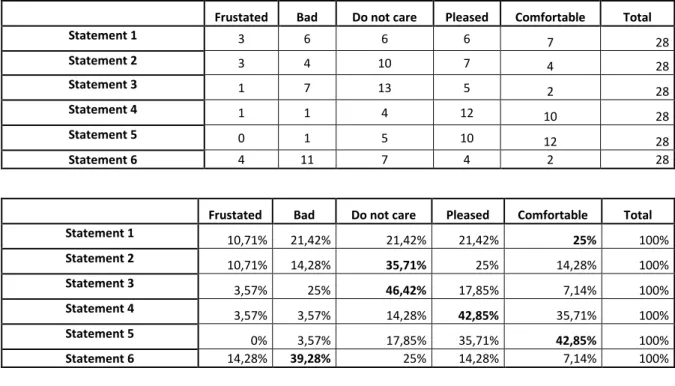
As observed in Figure 1 “Dimension 1: Students’ feelings towards error correction” percentages show that with respect to statement 1 “You correct them right after the mistake is made.”, most of the teachers opted for the option “Comfortable” (25%), followed by
“Pleased” (21%), slightly demonstrating they believe that 7 and 6 students out of 28 feel
0 5 10 15
Statement 1 Statement 2 Statement 3 Statement 4 Statement 5 Statement 6
Dimension 1: Students' feelings towards error correction
DATA ANALYSIS AND RESULTS 38
that they have positive attitudes towards correction soon after when they make mistakes, as one of the teachers from the focus group indicated:
“ I think that first of all we have to correct the mistake when it is made, after that it is good
to do a reinforcement at the end of the class.”(Teacher 6).
Regarding statement 2 “Students are corrected by their own peers.”, teachers opted
for the option “Do not care” (36%) demonstrating that this issue is not very relevant, a neutral position, since they think that teachers are in charge of making corrections, but most of teachers agree on peer correction also helps in the process.
With respect to statement 3 “Their errors are ignored and not corrected”, most of the teachers selected “Do not care” (46%) showing that they perceive that students do not mind being corrected during the lessons. However, one participant from the focus group
expressed:
“ Well…I believe that in general we as teachers think that students get annoyed being
corrected, but in several opportunities I have asked about this issue to some groups and
they request to be corrected…” (Teacher 2)
DATA ANALYSIS AND RESULTS 39
corrected at the end of their reports because they do not want to be interrupted immediately, as teacher 5 from the focus group indicated:
“ When there is a report, I think that in the end is the best moment, I personally call the
group while the next group is preparing to present, in the meantime I give them immediate
feedback.” (Teacher 5)
With respect to statement 5 “The students are corrected in private by the teacher throughout the lesson” most teachers favored the option “Comfortable” (43%) since
students sometimes feel embarrased in front of the whole class or even get nervous or feel anxiety, following this opinion teacher 1 said:
“ If it is an activity in which one is monitoring how students interact, it is not a good idea
to interrupt and correct them, but also you can take notes and at the end of their activities
you can provide them with feedback individually and in private, then you can comment the
most common mistakes made by most of them.”(Teacher 1)
DATA ANALYSIS AND RESULTS 40
“No, personally I believe that this produces anxiety and can be a bit noxious for the
confidence that your student have in you” (Teacher 2)
Dimension 2: “Students’ perceptions towards error correction”.
II- Categorize these statements with regard to your experience on students’ perception of error.
Statement 1: Most of the students do not want to be corrected by their teachers when expressing in English.
Statement 2: Most of the students think teachers must correct every single error when speaking in English.
Statement 3: Most of the students think teachers should correct only the most important error that cause them trouble in communicating.
Statement 4: Most of the students prefer to be corrected by their peers instead of their teachers in group work activities.
Table 2 Dimension 2 scores results Completely
disagree Disagree
Partially
Agree Agree Completely Agree Total
Statement 1 6 10 6 6 0 28
Statement 2 2 8 8 9 1 28
Statement 3 3 6 8 8 3 28
DATA ANALYSIS AND RESULTS 41
Completely
disagree Disagree
Partially
Agree Agree Completely Agree Total
Statement 1 21,42% 35,71% 21,42% 21,42% 0% 100%
Statement 2 7,14% 28,57% 28,57% 32,14% 3,57% 100%
Statement 3 10,71% 21,42% 28,57% 28,57% 10,71% 100%
Statement 4 7,14% 46,42% 14,28% 7,14% 7,14% 100%
Figure 2 Students’ perceptions towards error correction
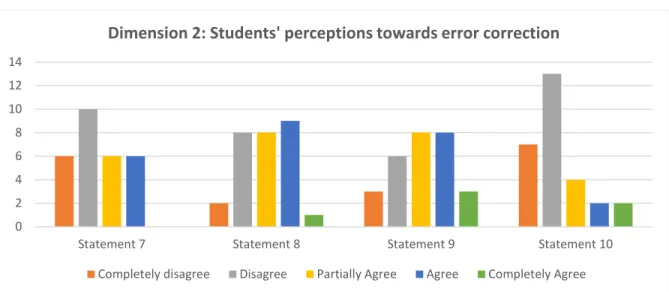
As observed in figure 2: Dimension 2 “Students’ perceptions towards error
correction” with respect to statement 1 “Most of the students do not want to be corrected by their teachers when expressing in English” the highest percentage of teachers favored
DATA ANALYSIS AND RESULTS 42
“It all depends on how the teacher makes the correction, because if it is done in an offensive way, obviously the students are going to be frustrated, but if you correct them in a
fraternal way, they are going to be grateful…” (Teacher 3)
“I think that everything is going to depend on the student’s real interest in learning the
language, he will not care if he is corrected, he/she is even going to appreciate it and
he/she will want to be corrected…” (Teacher 1)
Regarding statement 2, “Most of the students think teachers must correct every single error when speaking in English” the tendency shows that most of the teachers
selected “Agree” (32%), followed by “Partially agree” (29%) illustrating from the results of the survey that they are for correcting every single mistake, differently, a teacher from the focus group expressed that:
“In my opinion, we must correct the mistakes which are commonly repeated, but not every
single mistake, only the most recurrent and important ones…” (Teacher 5)
The opinion expressed above illustrates that she agrees with Freiermuth’s (1998) suggestion about correcting according to the importance of the error.
In the case of statement 3 “Most of the students think teachers should correct only
the most important error that cause them trouble in communicating”, teachers’ responses
DATA ANALYSIS AND RESULTS 43
than others aspects which supports Freiermuth (1997) and Hagége’s (1999) “The error must impede communication before it should be considered an error that necessitates correction.” As it is reflected in a teacher’s opinion:
“I consider that we must only correct the errors that really hinder the comprehension and
legibility of the message” (Teacher 4)
Regarding statement 4 “Most of the students prefer to be corrected by their peers instead of their teachers in group work activities” most of the respondents favored the option “Disagree” (46%) since it can be inferred that they prefer to be corrected by the expert in this case the teacher instead of their peers, as stated by Paulston & Bruder’s (1976) peer correction. In contrast, they consider self-correction as more effective as one of the teachers from the focus group stated:
“…I also believe that is important help the students in order to be able to
self-correct themselves so that they do not always depend on the teacher, if they are not in a
formal class.”(Teacher 2)
Dimension 3: “Frequency in which students are corrected”
III- Asses the frequency in which YOU correct students in the following aspects:
DATA ANALYSIS AND RESULTS 44
Figure 3 Frequency in which students are corrected
0 5 10 15
Statement 11 Statement 12 Statement 13 Statement 14
Dimension 3: Frequency in which students are corrected
DATA ANALYSIS AND RESULTS 45
As it shown in figure 3: Dimension 3 “Frecuency in which students are corrected” regarding statement 1 “Pronunciation, rhythm, intonation patterns” teachers’ responses are
mainly divided into the options “Often” (36%) and “Sometimes” (36%) demonstrating that most of them consider that correction especially in pronunciation is relevant since they are interested in their students to pronounce properly in order to enhance their oral production, coinciding with the research question of the current study, as it is reflected in the extract shown below:
“…I would give more emphasis to the pronunciation, since if we want that the student
really speaks clearly and fluently, me must do it, otherwise he/she is going to speak in an
abrupt way and we want to improve that…” (Teacher 4).
With respect to statement 2 “Grammar” most teachers selected the option “Sometimes” (43%) followed by “Often” (36%), demonstrating they believe that most students want to be corrected on grammar errors. However, the tendency nowadays favors the communicative approach, in which grammar is not the core as it used to be in the past, the aim is to communicate ideas, not correcting every single mistake in this aspect, this is the main opinion from the focus group participants.
DATA ANALYSIS AND RESULTS 46
“…Well…it depends on what you want to emphasise, if the aim is communication, for
example a role play, so I am going to focus on vocabulary and pronunciation” (Teacher 1).
With respect to statement 4 “Idiomatic expressions” teachers favored the option “Sometimes” (43%) demonstrating that this is not a core issue to correct frequently, giving priority to the previous ones (Pronunciation and vocabulary).
Dimension 4: “Teachers’ reactions towards students’ mistakes”
IV. According to YOUR experience in the classroom When a student makes a mistake, the most proper reaction is:
Statement 1: Do not correct the error, ignore it.
Statement 2: To indicate there is a mistake, but giving the opportunity to the student to correct it.
Statement 3: To identify the error and give the correct answer immediately.
Statement 4: To indicate the error and give the student the chance to correct it by himself. Statement 5: To identify the error and let another student give the correct answer.
DATA ANALYSIS AND RESULTS 47
Agree Agree Completely Agree Total
Statement 1 5 14 7 2 0 28
Agree Agree Completely Agree Total Statement 1 17,85% 50% 25% 7,14% 0% 100%
Statement 15 Statement 16 Statement 17 Statement 18 Statement 19 Statement 20
Dimension 4: Teachers' reactions towards students' mistakes
DATA ANALYSIS AND RESULTS 48
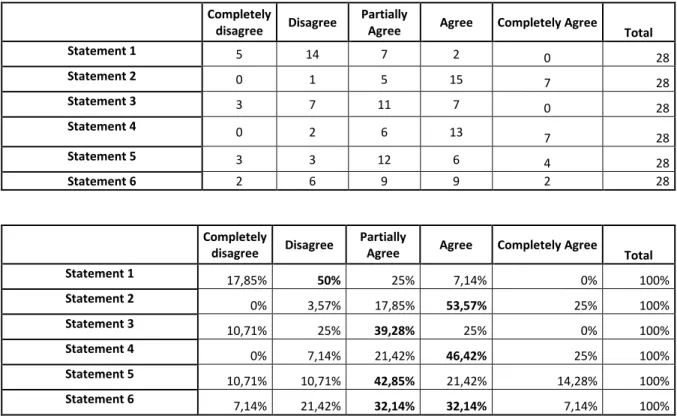
As observed in figure 4: Dimension 4 “Teachers’ reactions towards students’
mistakes” considering statement 1 “Do not correct the error, ignore it” most of the teachers opted for the option “Disagree” (50%) demonstrating that from their point of view the correction of mistakes is crucial to learn from their own mistakes, differently in the first dimension, statement 3 “Their errors are ignored and not corrected” the teachers’ opinions regarding students’ feelings towards error correction selected “Do not care” (46%) showing that they perceive that students do not mind being corrected during the lessons, which illustrates a controversy in both opinions, supporting the first result of this dimension a teacher from the focus group expressed:
“The students need to know in what aspects they make mistakes and we must provide them
with the information so that they can corroborate their errors or mistakes and learn from
them.” (Teacher 3)
With respect to statement 2 “Toindicate there is a mistake, but giving the
opportunity to the student to correct it” the vast majority of the teachers favored the option
“Agree” (54%) demonstrating once again that Swain’s self-correction (1985) is very
important to promote autonomy in the learners, as it is reflected in the extract shown below:
“…We as teachers… have to show them the way, the manner how to correct themselves, by
teaching them the techniques in order to promote self-correction, and in some way they can
DATA ANALYSIS AND RESULTS 49
Regarding statement 3 “To identify the error and give the correct answer
immediately” teachers favored the option “Partially agree” (39%) indicating a neutral position towards this issue. Nevertheless, most of them think that immediate feedback could cause interruption in students’ utterances or conversations in English,Similarly, in the
“dimension 1: Students’ feelings towards error correction” percentages show that with respect to statement 1 “You correct them right after the mistake is made.”, most of the teachers opted for the option “Comfortable” (25%), considering students’ feelings.
With respect to statement 4 “To indicate the error and give the student the chance to correct it by himself” most of the respondents opted for the option “Agree” (46%)
demonstrating once again that self-correction is very important for the learning of a language, as it is reflected in the results of the statement 2 of this dimension.
In relation to statement 5 “To identify the error and let another student give the correct answer” the participants favored the option “Partially agree” (43%), showing a neutral opinion about peer correction as it was shown by the results from the dimension 2, statement 4, in which most of the respondents favored the option “Disagree” (46%) since it can be seen that students prefer to be corrected by their teachers instead of their peers.
DATA ANALYSIS AND RESULTS 50
“I think that we use most of the CF techniques, but I believe the most frequently used
among teachers is the explicit correction.”(Teacher 3)
DISCUSSION AND CONCLUSIONS 51
CHAPTER 6
6.1 Answering the research questions.
To begin with this chapter, the research question and objectives are answered and explained below.
• What are the perceptions of EFL teachers about the impact of oral corrective feedback techniques as a means to enhance students’ oral production?
DISCUSSION AND CONCLUSIONS 52
teachers only have to correct the errors that really hinder the comprehension and legibility of the message. Regarding the frequency in which teachers correct pronunciation, fluency, grammar and vocabulary, their responses demonstrated that most of them consider that correction especially in pronunciation and vocabulary is relevant since they want their students to pronounce properly in order to enhance their oral production, coinciding again with this research question and the specific objectives.
In relation to the most frequently used CF techniques regarding Lyster and Ranta’s taxonomy as it was shown in the focus group interview, most of the teachers classify them in the following order: Explicit correction, recast, metalinguistic feedback, repetition, clarification requests and elicitation. It is important to highlight that they added self-correction as a commonly used strategy, in spite of not belonging in the aforementioned taxonomy.
DISCUSSION AND CONCLUSIONS 53
6.2 Conclusions and Discussion
The current descriptive study showed a positive attitude of students about the provision of corrective feedback as part of the teachers’ assessment procedure. They stated in their opinions that they rely on receiving corrective feedback. As stated before, errors emerged as a variable while coding the gathered information after the survey was administered to the teachers resulting into four categories. Nevertheless, from the focus group interview responses it is recognizable that teachers showed significant awareness of errors while students are speaking. As Crystal (2008) stated errors are “mistakes in
spontaneous speaking.” Moreover, Brown (2001) argued that when an error occurs,
teachers must decide at first whether to “treat” or to “ignore” the error learners make which is to some extent affected by their view of language; as it is shown in the results from the survey applied. Then, if treatment is called for, there are various options to be considered such as when and how to correct as stated in the earlier chapters.
With regards to the survey results and the focus group analysis it was found out that participants were providers of oral corrective feedback during the process of oral
DISCUSSION AND CONCLUSIONS 54
acknowledged that CF in the form of Ellis Corrective Feedback of negotiating for meaning can help learners notice their errors and create form-meaning connections, thus aiding acquisition. On the other hand, the findings of the administration of the instruments reveal clearly the how and when the teachers provide corrective feedback to their students as part of the oral assessment procedure, regarding the issues of how and the frequency in which feedback is delivered, there are different views that have enriched the literature. In the case of the how, verbal teacher feedback, when privileged, is described by Cowie and Bell (1999) as “interactive formative assessment,” where teachers notice, recognize and respond to students thinking in an unplanned and spontaneous manner during teacher-student interactions within the learning process (as cited in Brown et al., 2012, p. 969).
With respect to the overall data analysis, teachers demonstrated that they actually provide corrective feedback to their students in different ways, regarding the
aforementioned taxonomies and in different times (frequency) as part of the oral assessment procedure (see appendices C and D). These findings to some extent cover the objective of the study, stating that teachers deliver corrective oral corrective feedback techniques that enhance students’ oral skills. However, a further study is suggested to accomplish with the complexity of this study.
Based on the research findings some issues can be observed. Teachers are
concerned about the importance of corrective feedback delivered to learners as they provide corrective feedback in the moment they believe is most appropriated for their students. Also teachers are interested in providing CF to their students so they can express orally in