Some consistent finite element formulations of
1-D beam models: a comparative study
J.
M. Ortuzar
&A. Samartin
A consistent Finite Element formulation was developed for four classical 1-D beam models. This formulation is based upon the solution of the homogeneous differential equation (or equations) associated with each model. Results such as the shape functions, stjffness matrices and consistent force vectors for the constant section beam were found. Some of these results were compared wilh the corTespooding ones obtained by the standard Finite Element Method (i.e. using polynomial expansions for the field variables).
Some of the difficulties reported in the literature concerning some of these models may be avoided by this technique and some numerical sensitivity analysis on this subject are presented.
Key words: finite element formulation, differential equations, polynomial functions.
1 INTRODUCTION
Piecewise polynomial functions were extensively used to express the expansion of the field variables in the Finite Element Method. 1 However, this approach, in the stmctural
analysis, presents some difficulties even in simple 1-D
elements when shear strain is included.2
An alternative to the use of polynomial functions is to consider the solution of the boundary value field problem. Some inconsistencies described in the previous reference about the formulations developed in the references' 6 can
be in this way overcome. In some of those fom1ulations, overstiff solutions for long slender beams were obtained
(shear locking); iu some cases more than two nodes per element were used, or, in other cases, only two nodes were required, but with more than two degrees of freedom
at each node; in all those formulations a significant number
of elements was required to accurately represent the beha
-viour of sh01t beams under complex distributions of the
load.
Here, the previously mentioned alternative is applied to the following four beam models and in some or them the
results are compared with the standard FEM solutions: I. Navier-Bemoulli beam model
2. Timoshenko beam model, i.e., shear strain included 3. Beam-column model
4. Beam-column model considering shear strain. The notation used in Sections 2-7 is given in Appendix A. The abscissa ~ of the beam element is defined along an element length L = I, i.e. ~ E [0, I]. Other variables related to the beam of unitary length are denoted by an overline. However, for sake of clarity in the figures the overline was dropped. The properties (bending and shear stiffncsses, El and GA respectively) are functions of the abscissa ~.
This study can be easily extended to a beam of arbitrary length L according to Appendix A.
2 NA VIER- BERNOULLI BEAM MODEL
This model, for the case of non-existence of body forces is described by the following boundary value problem:
la) External forces
'""'Trnrn-rrm q(x) -=--+='=...-.-=-...,,..-=,:----.-=-'=-=...-='--=--=--'=-'-n( x) in(X)
(b) Deformed shape
~dx (c) Section A: Internal forces Fig. I. Navier-Bemoulli beam.
and the boundary conditions at ~; for i = 0,1
dw
-d[
=O
;
(2)
where ~ 0 = 0 and ~ 1 = I , and
w
and8
are the unknown deflection and slope at the abscissa ~ of the beam.w;,
0;
,
Q;
andM;
are data (see Fig. 1). The solution of this problem is(3)
where
(4)
T
A
= (A0, At> A2 , A3)f
~
duf~
udu:FtCO= o(~-u)El(u)' :!1(0= o(~-u)El(u) The arbitrary constants A; can be obtained in terms of the essential boundary conditions, i.e.
(5)
where
(6)
0 0 0
0 0 0
Gd=
Uo-
11) (11-lz
)
0
Io
it
and
f
l d~fo= oEJ(O'
f
l d~
1 -
-1 -
o
~ EI
(~
)'
(7)
The deflections can be expressed in terms of the shape functions:
W(~)
=
t.
mc
;;
'd=
N
w
<O
d
(8)where
~;rm =
<Nt".
rv2·
.
Nf, N:)
(9)~ 0 0 0
c-
~
-~
0 ~ 0 0- d - ~
-/1
-
12
I, -(~-[2) (I 0)lo
r,
- fo Uo-I
,
)
and
[, I.
NJ"(O= 1-
-f.
~F
,
+
f.:J
2
( 11)The shape functions for the slope can be found from the previous functions:
- dw .,8
O(t)
=
-
=
/V
"
dc; d~ - - ( 12)
!!
=(N/,Ni,/1/j,~)From the consideration of natural boundary conditions the
arbitrary constants A; can be related to the boundary forces
in the following way
where
and
0
0
0
0 0 - 1
0
0
0
0
0
0
- I
Then, the stiffness matrix is:
e.
=
G/J.d" '!i=Kd
with
fo
K=~
I,
- ~ -la
Uo-
lJ)J,
[2
-
1,
(J,-!2)
(13)
(14)
(15)
(16)
- /o Uo- 1,)
-11 (!1- !2)
la
-Cla-1,)
(1, -
l
a)
Ua-
2!, + !2) (17)If there were body forces applied in the beam, the right
hand side of eqn ( 1) should be replaced with a tem1
con-taining these forces. The solution of the new boundary
value problem permits to obtain tbe consistent equivalent
forces.
The results for the case of the beam with constant section
were obtained and they are summarised in Appendix B as a
special case of the Timoshenko beam described in the
fol-lowing section (fomlUiac (B.l.l) to (8.1.4)).
(a) External forces
I'TTTrrlrrrrrm q( X)
--=~=-'-,...-=.:---.-'--='=-'"-.--=--=--='=-'=-",..---,o-=.._1 n( x)
m(x)
(b) Deformed shape
r -
e
t
eo
_,_,-~ ~-H- -~ -~_;:;;-->
-....:-
-WO ~
•w
3 TIMOSHENKO BEAM MODEL
The boundary value problem describing this model is
dw
-~ E (0, 1) "j = d~ - f)
G=
E
2(1
+
v)and the boundary conditions at ~; for i = 0, I
- ( d w -)
-w
=
w;
or CAdf
-
fJ ; = Q;8
=
0;
or(El~~}
=M;
(18)
(19)
where wand
8
are the unknown deflection and rotation ofthe normal section at the abscissa~ of the beam and A is the shear area. W;,
0;
,
Q.
andM;
are data and ~ 0 = 0 and ~ 1 = 1(see Fig. 2). Note that the rotation (J is no longer the deri-vative of the deflection
w.
Similarly to the previous section, the shape functions, stiffness matrix, and consistent equivalent loads can be
obtained. The results for the case of constant section are
summarised in Appendix B (formulae (B.l.1) to (8.1.4)).
It is interesting to point out that now, the shape function
coefficients depend on the material properties given by the
dimensionless coefficient J-1., where
(20)
w
Section A
MoOo QIMI
t
~~I --!-- -+--
-
-0
-
-
..
X - ·dx
(a) E"1ernal forces
~
'''''
i
"
l
'
J::r::n,,.,,,,
,
l,q(
x
)
• • - • • • • - • • ,... - • • n(x) l., .. .. ... ~.. ~ .. .. .. .. '.. ~.. .. '.. .. .. \' 1n(x) (b) Deformed shapeX - d x
(c) Section A: Internal torccs
Fig. 3. Beam-column.
4 BEAM-COLUMN MODEL
It is assumed here that the axial forces of the beam-column
are applied only at the beam ends. The boundary value
problem is defined (see for example reference7) by:
(21)
and the boundary conditions at ~; for i = 0, I
w
=
w;
or -:~
(£<~~)
i -P(
~;)
i =Q,
(22)~;
=0;
or(El~~~);
=M;where Pis the axial compressive force applied at both ends
of the beam and
w
and0
are the unknown deflection andslope at the abscissa~ of the beam. w;,
0;
,
Q;
andM;
aredata and ~0 = 0 and ~ 1 = 1 (see Fig. 3).
The shape functions, stiffness matrix, and equivalent
force vectors for the case of constant section were obtained;
(a) External fur~es
rr:::r:r
.
r
'
]
'.
j
..
l!
:
r
:
:r
1
" '
1
".
:
q(~
)
• • • • • • • • • • • • • • • • n(x)• • • r:. • • '• • • • '· • • • • • '• m(x)
(b) De formed shape
they are presented in Appendix B as a special case of the
general beam-column model with shear strain to be
described later ((8.2.1) to (B.2.4)).
5 BEAM-COLUMN MODEL WITH SHEAR STRAJN
This model is a Timoshcnko beam in which axial forces arc
applied at the beam ends similarly to the previous case.
Then the problem is defined by the equations:
dd~
(GA-y
-
lfl)
=o
where
dw
-~ E (0, 1)
'Y
= d~ - 0C
=
E
2( I
+
v)- dx
(~)Section A: lnlemal forces
(23)
and the boundary conditions at ~ i for i = 0,1
or
CA(dw
-
e)
-
#). = Q-·d~ j I I
O=Oj
or(El~:);
=M;
(24)
where A is the shear area, Pis the axial compressive force applied at both ends of the beam, and
w
ande
are the unknown deflection and rotation of the nonnal section atthe abscissa~ of the beam. w;,
0
;,
Q
andM;
are data and~0
=
0 and ~ 1=
I (see Fig. 4). In Appendix B the shapefunctions, stiffl1ess matrix and equivalent forces vector for
the constant section situation are presented (formulae (B.2.1) to (B.2.4)).
It can be observed that in all the previous models the
shape functions satisfy the following well known properties in the limit i.e.:
I. Interpolation
2. Rigid body movements 3. Constant strain properties
6 FINITE ELEMENT APPROXIMATIONS
6.1 Introduction
An alternative to the earlier described approach is to trans-form tbe corresponding boundary value equations into weak fotms that are suitable for appljcation of the FEM. In this case the following results are reached:
Stiffness matrix for Navier-Bernoulli and Timoshenko beam models:8
Ji =
f
~llT
DBd~
(25a)Stiffness matrix for beam-column model
(25b)
Stiffness matrix for beam-column model with shear strain
(25c)
Consistent force vector
(26)
where the matTices
ll
andJ2
are dependent on the modelunder consideration and
q
andm
are the distributed vettical forces and moments along the beam (see Fig. l).ln the case of the Navier-Bemoulli beam and in the beam-column model, the expressions for matrices
ll
andJ2
can he written as follows:B=
(d
2
!:r)
D
=
El
-
d
e
-
(27)For the Timoshenko beam and the beam-colwnn model with shear strain the expressions for the earlier mentioned matrices become:
(
(
dt)
)
(El
0 )
I!~
(
d~
-ft'
)
!2~
0 CA (l&)If the shape functions
H.
correspond to the ones obtained in the previous sections for the beam of constant section and are used in eqns (25) and (26), then the results forK and f~q are identical to those presented in Appendix B.However these shape functions can be introduced in the fomlUla even for the cases of beams with variable section and the result obtained then represents a good approxi-mation of the exact solution, which in many cases cannot
be analytically found.
In order to estimate the accuracy of this type of
approxi-mation, the stiffness matrix of some constant section beam models will be computed using eqns. (25) with shape func-tions corresponding to different and simpler beam models. Namely, two cases will be analysed:
(a) Beam-column model using Hennitian polynomials
as shape functions.
(b) Beam-column model with shear strain using the shape functions of the Timoshenko beam model.
6.2 Beam-column model
The expression eqn (25a) for the stiffness matrix becomes
now:
K=
El
f
1
{
(d
2
!:r)T
d2
!:r
-
c:lt~lN}dt
- o de d~2 - - .,
=
Ko-alKa
(29)where N" and!! are the shape functions vectors defined in (B.l.l), for the special case of the Navier Bernoulli model, and a is given by the following expression:
a=
.
r;,
(30)K
o
represents the stiffness matrix of Navier- Bemoullibeam (B.1.2) (for the particular case of Navier Bernoulli
model), and the expression for K.a is as follows:
36 3 -36 _) ..,
..,
4 .., - I
f(
=El
_) - _)
_Q 30
-36 -3 36 -3 (31)
0.8
N 0.6 .-<
0.4
0.2
0.8
N 0.6
~· 0.4
0.2
(I
2
1.5
.,.
~·
0.5 ()
IE-0.5
IE-0.5
1&-0.5
I E--D.S Consistent solution
IEO.O a
IEO.O
a
IEO.O a
IEO.O
(J.
---IEO.S
IEO.S
IEO.S
IEO.S Lincari7:cd solution
Fig. 5. Coefficients of the stiffness matrices of the beam column in func.tion of the load.
lt is interesting to compare the coefficients of this approxi
-mate stiffuess matrix with those of the 'exact' or consistent one, derived in Section 4. This comparison will be carried out as a function of the dimensionless coefficient a. ln order to nonnalize the stitli1ess matrix coefficients for dif·
ferent values or a they are divided by the corresponding
ones for a = 0, i.e. the following quotients Aij are
introduced:
ku(a) i<U
A;i= - - = I
k;j(O) kij (32)
with
fS.
= { kij}, and,k;j
andk;j
,
which represent thecoefficients kij of the stiffness matrices of models 1
(Navier-Dernoulli beam) and 3 (Beam-column), respec -tively, which can be obtained as particular cases in the tables in Appendix B.
In Fig. 5, two sets of values of Aij are represented, in a semilogarithmic scale. The first one corresponds to the coef -ficients kij(a), given in (B.2.2) for the particular case of the beam column without shear strain, which can also be cal
6.3 Beam-column model with shear strain
Similarly to the previous case, the stiffness matrix for a beam element becomes:
+
_!_ ( df!v-
JI)
T ( df!v _t1)
JJ- d~ - d~
--
ci
[
(
d~)
T!!
+
~
(
d~v)
-
fiT!!]
}
d~
=
Ko-a?K.
G
(33)with
(34)
where~ and!/ are the shape functions vectors defined in (B .1.1 ),
K.o
corresponds here to the stiffness matrix of Timoshenko beam (B.I.2), and theKo
can be expressed as follows:cl c2 - cl c2
KG=El
cz
c) - c2 '4 (35)-cl - C':l cl - c2
- c2 CJ
where
(36)
c
,=
-
I ( -l - 72JJ-2)-
~6 10c3 =
~
6
(
2JJ-[1
- 1
2tt]
+
~
~~)
c4 = -
~
~
(2tt[24JJ-+
1
]
+ 3
'o)
~o
=
I+ 1
2tt.
The coefficients of the stiffness matTix
K
obtained in (33) will be next compared to their respective ones obtained in Section 5, in function of the dimensionless parameters aand IL· As in the beam column model without shear strain, it is interesting to introduce the following coefficients f...ij , where
kij(a, tt)
/<ft(O, JJ-) (37)
with
K.
= { kii}, and kij can beJ0
or kij. These represent the coefficients kij of the sti ll'ness matrices or models 2(Timoshenko beam) and 4 (Beam-column with shear
strain), respectively.
Jn Fig. 6, six sets of values of f...ij are represented in a semilogarithmic scale: three different values of the dimen-sionless parameter IL are chosen and tor each of them, the two sets of values of
'-u
are plotted in function of a. Simi-larly to paragraph 6.2, from these two sets, the first one corresponds to the coefficients kij(et,tt), given in (8.2.2), that can be calculated consistently using eqn (25) with the shape functions in (8.2.1), and the second one corresponds to those coefficients but calculated according to the approx-imate eqn (33).6.4 Numerical stability
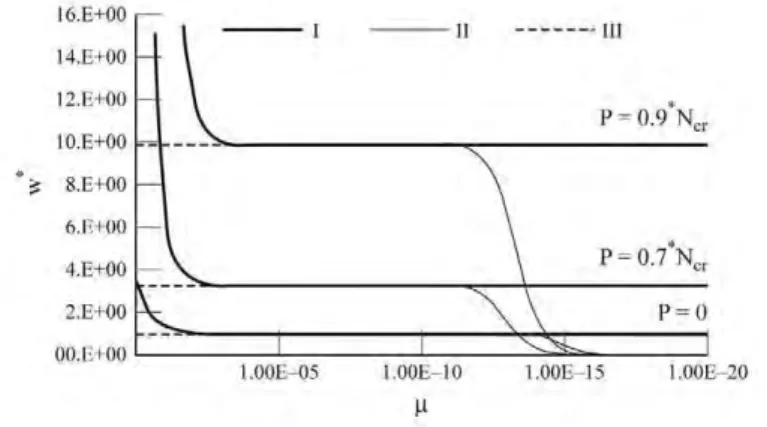
Typically, the use of the Timoshenko and the beam column with shear strain models is limited to a range of beams with a dimensionless parameter p, greater than a critical value. This critical value is dependent on the computer word length, and in general it is not possible, with these two models, to simulate the limit cases represented by the Navier-Bemoulli and the beam column models, because numerical difficulties arise in the computation of t11e struc -tural response.
The use of the previously presented consistent shape functions in the f.E. formulation practically avoids these numerical problems produced by the shear overstiffness,
i.e., the well-known locking phenomenon. In fig. 7 the dimensionlcss deflection:
* w
w
=
(
VL3)3El
ora cantilever beam with v
=
0, subjected to a concentrated load V at its tip is represented for different values of the axial load P given as a fraction of the Euler critical load of the cantilever. These results were obtained using two dif-ferent computer word lengths, namely, single precision reaJ values (i.e. occupying 4 bytes) and double precision realvalues (occupying 8 bytes). It can be observed that with single precision, the results are deteriorated beyond p,
=
10-10
, but for double precision this critical value of p, is not reached even tor small values such as I 0-20 in all analysed cases of the axial load P.
6.5 Comments on the results
0.8
0.6
~ 0.4
-0.2
-0
IE-0.5
2
1.5
"' ~
H.S
-0
IE-0.5
0.8
;
:
0.6 -0.40.2
lE-0.5
2
1.5
..,.
~:
0.5
0
IE-0.5
Consistenl solution
Lincarized solution
for 1.1 e4ual to 0.001
IEO.O
a
IEO.O
a
IEO.O
a
!EO.O
a
-
-0.01
IEO.S
---,,
IE0.5
IE0.5
---
-
---0.1
\ \
\
\
\ \
'
'
'
Fig. 6. Coefficients of the stiffuess matrices of the beam column with shear strain in function of the load.
results of the two last models are compared, namely beam -column and beam-column with shear strain.
In the case of the beam column, from Fig. 5 it can be observed that in general the stiffi1ess matrix obtained for the
linearized solution is stiffer than the consistent one for values of IX greater than 10°'5• However, the linearized
coefficient k11 has a negligible difference from the consistent one for the range of normal values of IX. The largest differences between coefficients of both stiffness
matrices occur for coefficients k22 and k24 for large values of a.
Similarly, in Fig. 6, the coefficients of the consistent and linearized stiffness matrices of the beam column with shear strain are compared for three different shear
strain levels. In general, for p. less than 0·00 l the comments given previously for the beam column without shear
strain are valid. For very large values of the shear
16.E+OO
- --1
14.E+OO 12.E+OO
::: 8.E+OO
6.11+00
2.E+OO 00."+0()
l.OOE-()5
- - - 1 1
I.OOE-10
J.l
--- I ll
I.OOE-15
P=O
I.OOE-20
Fig. 7. Cantilever beam of length L su~jccted to an axial load P and a lateral load V at its tip
(material properties El and CA):
w•
=
~=
~· p.=
-dJh =
Z,
N;,,.=
~=
..l
[i
where w represents the vertical deflection under the load at the tip.\ID) \)m)
In addition: 1: w* computed in double precision. 11: w* computed in single precision. Ill: w* computed in double p1•ecision neglecting the
effect of shear strain.
increase, but these differences become very large for k22
and k24•
7 CONCLUSIONS
The use of shape functions derived from the solutions of the homogeneous differential equations governing a given
beam model in the FEM (these functions are not necessarily polynomials), leads to results that are much more accurate
than those obtained with the standard polynomial ft.mctions of the FEM when one element is used.
The consistent formulation avoids some of the
inconsis-tencies reported in the literature concerning the use of finite elements to model beams with shear strain.
The consistent shape functions determined may also be used to obtain the vectors and matrices of elements with
longitudinal variation of the cross sections using the Finite
Element technique. The results found in this way, although
approximate, would be more accurate than those obtained
with the standard polynomial shape functions.
However, the determination of the consistent shape func-tions demands an important programming and computing effort for each one of the different beam models considered,
unlike standard polynomial functions which are much more versatile.
APPENDIX A
The four consistent beam models considered were presented
in the main text for a beam of unity length. The abscissa,~,
is equal to:
~
=
~
Lwhere xis the abscissa of the general beam of length L.
The other variables used in the beam of unitary length are denoted in the paper by an overline. They are equal to the
corresponding variables of the general beam of length L, except for the following ones:
- El
El=
[2'-
M=y·
M
q= qL, n= nL(AI)
where w,
El,
M, q and n are the deflection, llexural s tiff-ness, end moment and distributed vertical and horizontal forces, respectively of the beam of length L (E is Young's modulus and 1 is the moment of inertia).These expressions pem1it to transfom1 the expressions of
the unitary length beam into a general form for a beam of length L.
APPENDIX B
In the following tables, the shape functions, stiffness matrices and consistent load vectors for two load cases
rele-vant to the four consistent beam models are presented.
The shape functions correspond to a beam of unity length and satisfy the following equations:
(B 1.5)
and
o
m=!!Ii
(B 1.6)where
(B 1.7)
Table 1. Timoshenko beam. The Navier Bernoulli beam formulae are found from the Timosbenko beam by assuming p.
=
0 andLlo
=
1.Timoslleuko beam
Shape functions
Deflection
w
sllape functionsNlw(~) =_!_((I+ I21J.) -I21J.~-3~2+2~3)
~0
N,w(~} =_!_((I +6j.J.}~ -(2 +6j.J.}~~+~3}
- ~0
N
3
w(~} =_!_(l2j.J.~+ W-2~3) ~0Nt
(~) = _!_(( -6J.l)~ +(6J.1-I )~2 +~3) ~0Rolation '9" sllapc functions
N
1
8(~) = _!_( -6~ +6~2)~0
a I 2
N, (~) = -((l•I2J.1)-2(2+61J.)~ •3~)
- ~0
N
3
6(~= _!_(6~- 6~2)
~0 N
4
6(~l= _!_(2(61J. -1 >~
•
3e)~0
Stiffness malrix
[ 12
6 -12 6
El 6 4(1 +3j.J.) -6 2(1-6J.l) K=
-~(l -1~ -6 12 -6 2(l-6J.1) -6 4(1 +3J.l)
Consistent force vectors
Distributed vertical force
q
q
(
-
(
+)
;
-
(
1 12) ; -(
+)
;
(
1 12) )
Distributed moment
m
-~(I ; -6J.l; -I
Ao : -6J.l )
Stiffness matrices and load vectors correspond also to a beam of unity length. They satisfy the equation:
e=Kd (8 1.8)
Vector pis an end load vector (see Fig. 1). The consistent load vectors presented in this appendix are a function of a distributed load or moment.
The following notation was used in the Table 1 and Table 2: E is Young's modulus and, T the moment of inertia.
For the Timoshenko beam model, specific notation was
used:
Fl
El
.10 =I+ 12~-t ~-t= CA= GAL2 (82.5)
[B.l.l.a]
[B.l.l.b)
[B.l.2]
[B.l.J]
(lU.4]
where
G
is the shear modulus andA
the shear area. For the ordinary Navier Bemoulli beam J.t = 0 and .10 = 1.For the beam-colwllll model the following notation is applied:
a=
a=r:f
c=cosas=sina .11 =2(1 -c)-sa (82.6)
where
P=
Pis the applied axial load, and if shear strain isincluded then the new variables are introduced:
0! = aJI
+
a2p. c= cos 0! S= sin 0!.12 = 2(1 -c)( I
+
a1
Table 2. Beam-column with shear strain. The beam-column without shear strain expressions are found by assuming p. = 0.
Bcaru column with shear strain
Shape function.~
Deflection
w
shape functionsNt<~> = ~ Cl(I •a\1)(J -c) -siX] ·s~ •1(1 •a"J.t)O-c)Jcos(iX~Hs(l •a2
11
)Jsin(a~)l2
-N,w(~) = _a_((
ea
-s( 1 •a211)J
•<
1 -c)iX~-
(
ea
-se 1 +a111)Jcos(iX~) •1(1 -c)( I •a"11)-siXJsin(iX~))- a~Ll.2
w 1 ') - - - ., - - - ,
-N3 (~) = -(((l +a·J.l)(l -c)] -s ~ -((1 +a·ll-)(1-c)]cos(a~) -+(s(l +a·l!)]sin(a~)) ~
-N4w(~) = ~((s(l •a211) -iXH 1 -c)~ -(s(l +a2~t)-a]cos(a~)-((1• a2~t)O-c))sin(a~))
a-.0.2
[B.2.l.a]
Rotation l1 shape functions
2 N
1
6(~)= ~(s(l ... a2J.t)-((l +a2!!)0-c))sin(iX~)-Is(l •a2~t)]cos(~))
a.0.2
N,6(~)
=
...!...
c
<
r
-c)( I •a211)+tciX-s(l •a~
11
)Jsin(iX~)+I(l-c)(l •a211
)-sa)cos(a~))- .0.2
2
N36(~)
= ~ ( -s(l +a2~t)• ((I • a2J.l){l -c)]sin(~) •Is( I •a2J.l))cos(~))
a.0.2
N4 6
m
= -k<<I-c)(l •a211)-tiX-s(I •a2
11
)Jsin(iX~H(l-c)(l +a211
)]cos(~))(B.2.l.b]
Stiff uess matrix
--
(I+ a2J.l)(l-c)--(I •a2
11)( 1 -c)
as -as
(I •a211)(1-c) ~(so •a211l -ea) -(1 •a2
11)(1-c) a - - .,
-a~ 0 -;(a -s(l +a"jt))
a· a·
K=E l -
--
--
[B.2.2].0." -as -(I •a2
11){1-c) as -(1 •a:ll)(J -C)
-
-(I •a=11)(1-c) -a. -(a-s(l•a-- ., 11)) -(1 •a=11)(I-c) ~(s(l a - +a"• ll)-- -c a)
a2 a·
Consistent force vectors
Di~tributed vertical force
q
Distributed moment iii-a2~
[
··-
~(1
:
''
-((%2(1 +c) • 2.0.2-2s
a( I
+a21!)(-_q_ m (I -c)a·ll
-
-
[B.2.4]2a2.0.: -a=.o.2 .0.2 2(1-c)-sa
1(%20 ..
c)
.
2~ -2sa(I•a2J.t>l (l-c)a211fB.2.31
where a and Jl have already been defined. It is found that
for the case of the beam column without shear strain:
2. Friedman, Z. and Kosmatka, J. B., An improved two-node
Timoshenko beam finite element. Computers and Slruclures,
1993, 47(3), 473-481.
(82.8)
REFERENCES
I. Turner, M. J., Clough, R. W., Martin, H. and Topp, L. J., Stiffness and deflection analysis of complex structures. ].
Aeron. Sci., 1956, 23, 805-823.
3. Nickell, R. E. and Secor, G. A., Convergence of consistently derived Timoshenko beam finite elements. lnt. }. Numer. Meth. Engng., 1972, 5, 243-253.
4. Thomas, D. L., Wilson, J. M. and Wilson, R. R., Timoshenko beam finite elements. j. Sound Vibr., 1973, 31, 315-330. 5. Hughes, T. R. J., Taylor, R. L. and Kanoknukulchoii, W., A
6. Tessler, A. and Dong, S. B., On a hierarchy of confonning
Timoshenko beam elements. Cam put. Stmct., J 981, 14, 335
-344.
7. Samartln, A., Teoria elemental de la viga-columna con ap li-cacion al estudio de la estabilidad elastica de estructuras.
Publicacion AE-84-4, E.T.S.I.C.C.P. de Santander, Universi
-dad de Santander, 1984.
8. Zienckiewicz, 0. C. and Taylor, R. L., The Finite Element