
States, elites, and inequality in Latin America
19
0
0
Texto completo
(2) Study #1: States, Elites, and Inequality in Latin America*. In this article I review the literature on elites and inequality in Latin America with a focus on the emergence of uneven state structures and how they came to foster the needs of elites for protection. States in Latin America are traditionally thought of as facilitating processes of top-down modernization that transformed traditional agrarian economies into complex urban polities, while maintaining extreme inequality. The state is thus central in the genealogy of inequality and elite privilege in Latin America. The synergy between states and elites continues to mark Latin American societies, and it helps us to understand how major economic and political changes occur without significant changes in inequality. For the most part, Latin America’s current uneven states emerged as the result of exclusionary projects of citizenship during the first half of the 20th century and were advanced by the advent of repressive regimes during the 1960s and 1970s. After democratic transitions during the 1980s and 1990s, Latin American states came to be characterized, on the one hand, by procedural democratic institutions, and on the other by high levels of state violence, exclusion, and segmented citizenship. The present situation is one of a problematic equilibrium between states, elites, and inequality. Keywords: Citizenship, Elites, Inequality, Latin America, States * A revised version of this manuscript was published as López, M., 2018. States, elites, and inequality in Latin America. Sociology Compass, 12(8), p.e12598. Introduction Latin American societies seem to have special talent for disappointing political economists and political scientists. We observe in the region how contexts of increasing inequality triggered successful transitions to democracy, as in Brazil (Ansell and Samuels 2014), how weak states at times succeed in promoting growth, as in Peru (Dargent et al. 2017), and also how democratization can lead to losses in social and political cohesion, as in Mexico (Schedler 2014, Sorj and Martuccelli 2008). The patterns reveal uneven states that are not poor - and in many cases are resource abundant – but that reproduce severely segmented forms of citizenship, political participation, and economic distribution. As in other cases of late modernization, the interaction between elites and the state played a key role in Latin American developmental history. This led some authors to recover Barrington Moore Jr.’s (1966) now classic theory of revolution from above or conservative modernization, which is a framework for the emergence of authoritarian states (Domingues 2000, Filgueira et al. 2011, Reis 1979). Nonetheless, most countries transitioned toward democracy in the past decades and have remained democratic for.
(3) the most part, puzzling our understanding of the incentives and constrains that circumscribe elites’ decision making in the region. In this review I highlight how elites adapted to contexts of rapid social change by promoting the emergence of repressive authoritarian regimes in the 1960s and 1970s and by fostering the emergence of durable democratic regimes from the 1980s onward. The region’s social landscape, political institutions, and economy changed radically during this period, but one feature remained fairly constant: extreme inequality. The role for inequality in this process, as well as its conceptualization, is a frequent subject of debate in the fields of political studies. In the past, scholars explained inequalities in Latin American countries as resulting from different patterns or different speeds of economic and social modernization. For example, Taylor and Bacha (1976) offered the metaphor of Belindia (Belgium + India), and before them Lambert ([1957] 1967) highlighted the existence of “two Brazils”. Much earlier, Sarmiento ([1845] 2009) pointed to the coexistence of “civilization” and “barbarism” in Argentina. Many political scientists and economists still explain certain inequalities in terms of dual forms of economic and political development, as in the literature on subnational authoritarianism (e.g. Benton 2012, Gervasoni 2010, Gibson 2013). Several other studies focus on the long-term effects of colonial and early institutions in current patterns of state capacity (Centeno 2002, Dell 2010, Kurtz 2013) and democratization (Mahoney 2001). Such studies highlight the role of labor repressive institutions (Dell 2010, Kurtz 2013), internal war (Centeno 2002), and economic institutions (Mahoney 2001) in shaping both the regimes of citizenship rights (in the form of democracy or autocracy) and the capacity that states have to implement them. These long-term roots of inequality are relevant because they allow us to distinguish the path of states that deny citizenship rights (authoritarian states) from those that grant rights but fail to secure them evenly within their territories (Luna and Soifer 2017). To explore the role of elites vis-à-vis inequality it is important to first account for the concept of “elites.” Some authors define elites as those concentrating the main resources in society, be them material, symbolic, cultural, political, or educational resources (Bourdieu 2013, Kahn 2012, Reis and Moore 2005). Others define elites in political terms, i.e. elites as individuals capable of affecting political outcomes regularly and substantially due to their position in powerful organizations and movements (Higley and Burton 2006). As noted elsewhere (see López 2013a), the latter definition of elites relates to the Weberian concept of power as the probability that an individual or group have of carrying through their will against the resistance of others, regardless of the basis in which this probability lies on (Weber, 2005 [1922]: 696). According to the classical elite theory framework, there will always be a minority making decisions and a majority following them, and history has not yet provided a case of an eliteless society to disprove the.
(4) point. Yet the “law of elite circulation” (Pareto 1935) or the “iron law of oligarchy” (Michels 2009 [1915]), which express this view, only hold logical consistency when assuming a power-based definition of elites. Power, in the Weberian definition, cannot be equally distributed as it implies a losing side (the one offering resistance). Regarding the study of inequality, the power-based concept of elites holds an analytical advantage over the resource-based concept because it prevents tautologies (e.g. elites reproduce inequality but are also defined by inequality). Another important trait of the concept of elites is the possibility of sub-types, differentiated by their power sources, such as the economic elite, the political elite, the bureaucratic elite, and the military elite. As will be shown, inter-elite dynamics (i.e. between different elite types) is key for a large section of the literature on elites and inequality in Latin America.. Toward the end of understanding how elites shape the distribution of social and political goods, I highlight common patterns in the region. Despite the diversity of historical experiences, some of the main economies in Latin America converged toward similar technocratic authoritarian regimes during the mid-1960s and the 1970s (O’Donnell 1973, Stepan [1978] 2015), and subsequently toward the democratic regimes we observe today. Transitions to democratic rule during the mid-1980s surprised many Latin Americanists. At the time, most theories emphasized affinities between authoritarian rule and the accumulation strategies of elites (Collier and Cardoso 1979, O’Donnell 1973, Stepan [1978] 2015, Reis 1979), the local political culture (Almond and Verba [1966] 2015, Wiarda 1973), psychological constraints to democratization (Huntington [1968] 2006), and of course the enduring income inequality (Cheibub et al. 1996, Rueschemeyer et al. 1992,). But not only did democratization occur, it did so without significant changes in those attributes that were and still are often considered to be main causes of authoritarianism, especially income inequality. These democratic outcomes raise questions about the role played by inequality in the political arena, and they force researchers to refine theories in light of today’s prevalence of unequal yet durable democracies in Latin America. In addition to gross inequality, current Latin American democracies have social landscapes marked by high levels of state violence (Arias and Goldstein 2010, Brinks 2007, 2014, O’Donnell 1993), by a segmentation of party politics across the social spectrum (Luna 2014), and by informal and precarious models of welfare (Holland 2016). Rather than impeding democracy, these attributes can be thought of as aspects of a new and problematic equilibrium, one in which elites obtain relatively high levels of security afforded by repressive states and regressive policies. Today’s Latin American democracies are repressive because state institutions, particularly the police and other security forces, continue to violate the citizenship rights of the poor. They are regressive because the relative tax burden tends to decrease as incomes increases..
(5) I will proceed as follows: first, I revisit Moore’s concept of “modernization from above” to explain the emergence of developmental states early in the early 20th and how they paved the way for an exclusionary version of European corporatism. I then portray authoritarian regimes of the 1960s and 1970s as elites’ reactions to what they regarded as inefficient and dangerous forms of political participation, and the subsequent roles of elites during transitions to democracy. Finally, I will discuss the consolidation of democracy and how residues of past repressive structures as well as new forms of political participation and new elite strategies have created a complex mosaic in which violence, ineffective states, and limited welfarism constitute an unexpected new equilibrium, as well as a trap for both elites and the poor. Modernization from above and uneven incorporation In 1966, Barrington Moore Jr. published The Social Origins of Democracy and Dictatorship, a milestone of comparative politics. As the other side of his well-known “no bourgeoisie, no democracy” rule, Moore argued that, in countries like Germany and Japan, the lack of a strong bourgeoisie allowed landed elites to coordinate conservative processes of revolution “from above” that transformed rural societies into modern urban and industrialized but authoritarian ones. These were conservative processes because they did not alter the distribution of power resources within society, maintaining the privilege of the old owning elites. Yet they were at the same time revolutionary because they did alter the economic organization of society from rural-traditional to urban-industrial. By “from above”, Moore implies that such processes of social change were promoted by the old landed elites themselves, rather than by emerging urban groups. Revolution from above is thus a process of top-down social change that at the same time transforms economic relations and maintains power asymmetries. As a consequence, in Moore’s theory, the resulting political organization tends toward authoritarianism. Revolution, or modernization, from above came to be seen as an accurate description of the processes of state-building in the main Latin American economies (Domingues 2000, Filgueira et al. 2011, Reis 1979). In Latin America the idea of modernization from above related to incentives provided by developmental states and a particular version of corporatism that simultaneously empowered economic and state elites. As Latin American states promoted industrialization, urban working classes emerged and demanded incorporation. In countries where the working-class was strong, incorporation processes were more likely to lead to competitive regimes, as argued by Rueschemeyer and colleagues (1992). But these authors claimed that it was not in the interest of elites to enfranchise the poor, and it could therefore be expected that elites would try to prevent this unless pressures from below were too great. Early democracies thus arose in countries with less inequality where urban workers were able to organize and negotiate with elites, according to this argument..
(6) Rueschemeyer and his colleagues also employed some of Moore’s ideas about modernization “from above” by highlighting the role of states in Latin American development. Because colonial rule had involved a symbiosis between authority structures and economic structures, elites were accustomed to using the state to perpetuate privilege. Given pressures from the emerging urban proletariat, strategies of incorporation varied greatly and resulted in divergent party systems that facilitated or complicated democratizing efforts during the first half of the 20th century (Collier and Collier 1991). In common, Latin American political elites favored top-down modes of incorporation of the working class through mechanisms resembling European corporatism. In Europe corporatism was characterized by corporations and interest groups serving as channels for the distribution of social goods. Access to goods was typically tied to formal employment. European corporatism was a pattern located between liberal and social-democratic versions of a welfare state (Esping-Andersen 1991) as those observed in France and Germany. But because urban and organized working classes comprised only a small part of the poor in Latin America, political inclusion through corporatism tended to have regressive consequences, i.e. both income and political inequalities were exacerbated rather than relieved (dos Santos 1979). Developmentalism or statism was another trait of conservative modernization (Reis 2000): states were in charge of transforming national economies from rural and export-oriented to industrialized and strong domestic markets. This became known as “import substitution industrialization” model (ISI). Argentina, Brazil, Chile, Mexico, Uruguay, and other countries followed this pattern. If corporatist projects shaped much of the structure of income and political inequality in Latin America, they also heightened the role of the state in organizing the economy and, consequently, affected incentives perceived by elites (Leão 2013). The deliberate attempt to create a developmental state empowered increasingly autonomous bureaucratic elites, transformed states into economic actors in bed with national capitalists, and helped to sustain political-economic systems conceptualized as hierarchical capitalism (Schneider 2013). This occurred not as a natural or direct consequence of statism, but as a consequence of close ties between political elites and rent seeking economic elites. Despite the persistence of gross inequalities, ISI accounted for a fairly long period of economic growth in the region during the first half of the 20th century, which ultimately resulted in some material benefits for the working class. Citizenship rights also increased, despite their uneven distribution, creating new constituencies of benefitted blue collar workers.. New authoritarianism and transitions to democratic rule.
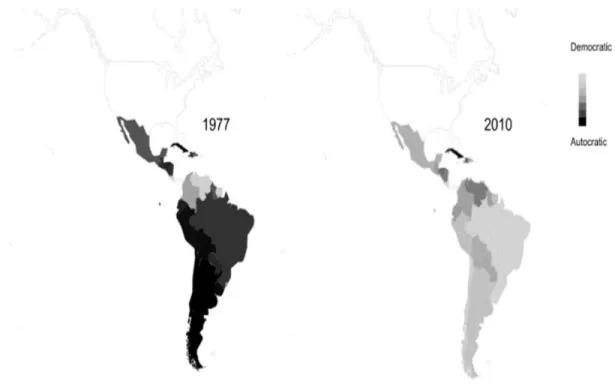
(7) By the 1960s, Latin American states had succeeded in transforming societies from predominantly rural to urbanized and industrialized. Nonetheless, the promise of continuous economic growth did not materialize and most countries found themselves experiencing years of stagnation and increasing popular discontents. O’Donnell (1973) and Huntington (1966 [2006]) observed that working-class poor and middle-classes were prone to disappointment, because they demanded more benefits than governments were capable of allocating without creating major fiscal crises. Meanwhile, economic elites were attracted to partnering with international capital, although they were prevented from “verticalizing” their economies by ISI restrictions. According to O’Donnell, business elites saw opportunities in contexts of crisis, allying with state bureaucrats and the military to forge coups and implement new authoritarian but technocratic regimes that were put in charge of tailoring economies and societies to suit business needs. O’Donnell coined the term “bureaucratic-authoritarianism” (see also Collier and Cardoso 1979, Linz 2000) to describe the regimes that followed military coups first in Argentina (1966) and Brazil (1964), and later in Chile and Uruguay (both in 1973). A related concept was organic statism, which Stepan (2015) used to describe military rule in Peru. By the mid1970s, most of the continent was under authoritarian rule, either in the form of bureaucratic-authoritarian or single-party regimes. Military regimes in the Southern Cone countries dismantled the ISI model and invested in strong repressive apparatuses, the origins and results of which seemed to meet business elites’ desires for greater financial returns and more effective repression of public unrest. Contemporary political economists tend to portray costs of repression as lower than costs of redistribution in contexts of high inequality (Acemoglu and Robinson 2005, Boix 2003), which should result in elite sponsorship of authoritarian regimes. Latin America in the 1970s and early 1980s seems to illustrate this. Authoritarian regimes repressed the poor, empowered technocrats to rationalize economic policies, and excluded politicians from the core of decision-making. Yet these regimes soon came to an end. By the mid1980s, Argentina, Bolivia, Brazil, Peru, and Uruguay had transitioned to democracy. Chile and Paraguay joined in the 1990s, and in 2000 an opposition party was elected for the first time in Mexico, which had experienced single-party rule for some 70 years. As seen in Figure 1, between the 1970s and current times the region went from predominantly autocratic to predominantly democratic. What happened?.
(8) Figure 1: Regime Change in LA. At the time, some scholars highlighted the role of disenchanted elites (Weffort 1984) and cleavages among rulers (O’Donnell and Schmitter 2013) as likely causes of authoritarian breakdowns in the region. Other scholars focused on how elites moved toward pacts and settlements that closed old fissures and paved the way to regime change (Higley and Burton 2006, Higley and Gunther 1992). However, these analyses overlooked an important continuity, namely, that several alleged structural causes of authoritarianism remained in place despite democratization, among them income inequality. If anything, inequality had greatly increased during authoritarian rule in most of the countries. One way in which inequality co-exists with democratization has to do with what is often referred to as the distributive conflict approach. In it, elites use democratization to signal income redistribution if the poor pose a credible revolutionary threat (Acemoglu and Robinson 2005). In other words, elites only extend the franchise if they have reasons to believe that the poor are going to expropriate them through revolutionary means. However, a systematic analysis of democratic transitions, including many in Latin America, by Haggard and Kaufman’s (2016).
(9) finds little evidence to support this hypothesis. They find that some kind of clear distributive conflict preceded only about half of the transitions studied. It is indeed hard to explain why Latin American elites did not forcefully resist democratization and in some countries even promoted it, given high inequality and low pressures from below. Building on this puzzle, Ansell and Samuels (2014) gathered evidence of just the opposite relationship, with greater inequality helping to predict transitions toward democracy. The reason, they claim, is that inequality increases as societies become more complex, which implies the growing size and importance of upper and middle classes whose members benefit from inequality but also feel threatened by a lack of constraints on authoritarian rulers. Democratization thus results from elites trying to prevent expropriation by establishing liberal institutions, which amounts to Moore’s “no bourgeoisie, no democracy” thesis. Albertus and Gay (2017) move in a similar direction by arguing that economic elites can update regime preferences when autocrats fail to signal a commitment to property rights. Democracy does not serve only the interests of urban bourgeois elites, however. Albertus (2016) illustrates this with an analysis of landed elites in Latin America facing threats of agrarian reform. Landed elites are commonly viewed as pillars of autocratic regimes, because their reliance on fixed assets (i.e. land) makes them vulnerable to expropriation (Boix 2003). But even these elites can become “unlikely” democrats (Albertus 2016). Democratization in Latin America is not just puzzling because it occurred in context of high inequality and presumably well-protected elites, but also because the new democratic regimes did not trigger redistribution, nor did they succeed in preventing violations of human rights for the poor. Some scholars argue that this is precisely a reason for the success of democratic transitions. There are, at least, three possibilities in which the prospect of persisting inequalities relates to elite action before democratization consolidates. First, Acemoglu and colleagues (2011) argue that, when suffering pressures from below, economic elites can build coalitions with bureaucratic elites in order to put forward inefficient state structures with the purpose of compromising a state’s capacity to redistribute in future democratic times. The argument resembles O’Donnell’s elite-bureaucrats coalition behind bureaucratic-authoritarianism, but in this analysis elites act because democratization is in sight. With a similar but less demanding theory, Soifer (2013) shows that the relationship between inequality and democratization (which is assumed to be negative in mainstream political economy) is mediated by state capacity, with weaker states showing a higher probability of regime change toward democracy. Soifer concludes that this occurs because elites expect states to fail in redistributing due to low extractive capacities, and that such expectations attenuate elite resistance to regime change..
(10) A second possibility that might explain the resilience of inequality concerns elites’ actual participation in the transition process. When elites participate in making the constitutional and institutional rules that guide an emergent competitive regime, they can actively install roadblocks and traps to prevent redistribution (Albertus and Menaldo 2014, Albertus 2016, Hagopian 1990, 2007, Schmitter 2010, Ziblatt 2006). Finally, Mainwaring and Pérez-Liñán (2013) argue that economic elites switched attitudes toward democracy following changes in political projects of the left. In yet another systematic analysis of regime change in Latin America, the authors argue that, with the collapse of the Soviet bloc, the idea of revolutionary socialism was mostly abandoned and left-wing parties adopted a more consociational stance in order to participate effectively in future political competitions. With a deradicalized left at the negotiation table, economic elites had less reason to fear a competitive political regime. Rather than being mutually contradictory, these incentives, taken together, do much to explain observed elite shifts in political preferences. First, it is quite possible that sectors of elites anticipated the continuity of their privileges in what at the time were still hypothetical democratic regimes. This does not exclude the possibility that other elites, though preferring autocratic rule during transitions, altered their preferences after implementing favorable institutional rules and observing a de-radicalization of the left. In sum, rival theses may not be rival after all, but instead encapsulate accurate descriptions of different dimensions and motivations that made elite interests compatible with democracy.. The new age of unequal democracy Democratic transitions are now part of the past for Latin American elites. Most Latin American countries have experienced decades of reasonably stable democratic rule. By “stable” I do not imply an absence of distributive conflicts, nor predominantly good economic times, much less good governance. In actuality, the decade following democratization was virtually everywhere a decade of fiscal crisis, rising urban violence, mass protests, and political crises. But I want to highlight the fact that post-transition elite responses to crises have, more often than not, been circumscribed by liberal democratic institutions and rules. For instance, Pérez-Liñan (2007) highlights how deep crises, which in the past propelled military coups, are now dealt with by recurrent impeachment proceedings and trials. These tend to abate crises and placate popular dissatisfaction, at the same time that they maintain the institutional order and, for the most part, do not entail significant changes for elites. In a nutshell, impeachment undertakings function as a response to popular demands but do not eliminate the sources of popular insatisfaction..
(11) During the 1990s, governments with different ideological backgrounds, including laborist/leftist ones in Argentina and Chile, converged toward a neo-liberal agenda of privatization, social security reform, and financialization (Levitsky 1999). Some argue that elites’ commitments to democracy came only after they observed the effects of this agenda and learned that democratically elected governments could be market-friendly, even if headed by the left (Campello 2015, Levitsky 1999, Levitsky and Roberts 2011, Weyland 2002, Roberts 2014). There is another trait in the current period of unequal democracies in Latin America, and it is continuity in patterns of state violence and repression. In his account of police killings, Brinks (2007) suggests that higher inequality is linked with police brutality and less judicial response to such acts. As one would expect, the heavy arm of the state repressive apparatus falls upon the poor and marginalized groups rather than on elites, and this occurs in part because of the success of liberal institutions in protecting the top layers of Latin American societies and their relative failure to do the same for the underprivileged. In previous authoritarian regimes, elites could find themselves as eventual victims of state repression and state arbitrariness. As Weffort (1984) argued, the daughters and sons of elite persons often held radical political views and eventually joined activist student groups or even clandestine oppositions, and were targeted and at times jailed or even killed under authoritarian rule. This is hardly a possibility for elites and their offspring in today’s democratic times, though it remains part of the risks that poor persons are subjected to in the name of fighting crime. Such contrasts individual fortunes today account for processes of state segmentation of citizenship rights (see López and Luna 2016). Segmented states can be observed along other dimensions, too. Latin American states vary in state presence and allocation of social goods (Luna and Soifer 2017, O’Donnell 1993), yet it is not entirely clear when state weakness results from low capacity (i.e. states cannot enforce authority and citizenship) and when it is a governing strategy. Other forms of segmentation have to do with party politics in contexts of gross inequality. Luna (2014) argues that a key mechanism in the reproduction of inequality in Latin America is the development of segmented party-voter linkages, in which politicians seek to represent the interests of both upper and lower classes. To the former they offer continuity of fiscal responsibility, low taxes, and policy predictability. To the latter they offer clientelistic and targeted social goods. As a result, opposite poles in society end up voting for the same candidates and political groups, whose loyalties are to both assist the poor and maintain privileges. A related argument can be found in Holland’s (2017) conception of forbearance. According to Holland, politicians in Latin America turn to informal means for ensuring income and care for the poor. She focuses on the lack of law enforcement in informal commerce and housing as deliberate on the part of elected officials, who might face electoral punishment if they complied with relevant laws. The result of such informal ties is a reproduction of limited and perverse modes of welfarism and citizenship..
(12) Figure 2: Evolution of inequality as measured by the Gini Index. Latin American elites seem to have found the goose that lays the golden egg in unequal democracies, because they benefit from the protection of effective property rights under liberal institutions, but do not have to bear income and wealth redistributions (see Figure 2). Yet this only seems possible due to incentives provided by uneven state structures created unintentionally during historical processes of state-building and political incorporation, and boosted during the developmental authoritarian regimes that followed. In the new political arena of today, left-wing parties often cope with the preferences of market actors (due to segmented representation), political crises are resolved through impeachment proceedings and trials that imply no substantive change, the poor are attended through informal or targeted policies that involve no substantial redistribution, and states continue to repress marginalized sectors. But this is not the full story. Elites also have reasons to feel threatened by unintended consequences of inequality. Research on elite attitudes toward inequality has found that elites associate inequality with crime and violence, and perceive themselves as victimized (Reis and Moore 2005, Reis 2000, López 2013b, 2014, 2016). In a similar vein, elites in countries such as.
(13) Brazil appear to see inequality as a threat to liberal institutions that they have learned to treasure and as fuel for political phenomena, such as left-wing populism, that they despise. Starting with the election of Hugo Chavez in Venezuela in 1998, the continent has experienced a wave of left-wing governments in what is called Latin America’s “left turn” or “pink tide” (Levitsky and Roberts 2011). The left-wing administrations of the 2000s were blessed with high commodity prices in the international trade market, creating an optimal scenario for distribution and inclusion. Yet from the point of view of income redistribution, the degree of improvement is much less clear. While some studies point to decreasing Gini indexes after the left-turn (López-Calva et al. 2010, Lusting et al. 2013), others highlight the persistence of income inequality in alternative and often more robust measures (see Alvaredo 2010 for Argentina and Souza and Medeiros 2015 for Brazil), as well as the presence of ceiling effects in processes of inequality reduction (Cord et al. 2016). Some of these governments have continued the economic policies that pleased economic elites during the 1990s, as well as with the segmented patterns of political representation. As several authors portray (Campello 2011 Levitsky and Roberts 2013, Roberts 2014), the shift from radical rhetoric to fiscal responsibility and policy continuity accounted for liberal left-wing administrations in Brazil, Chile, and Uruguay, while more belligerent and expropriative (or illiberal) left-wing governments held power in Venezuela, Bolivia, and Ecuador. The latter cluster became known as “Bolivarian” in reference to Chavez’s leitmotif of a “Bolivarian revolution,” associated with new forms of populism (Padoan 2017, Roberts 2006). These patterns served as examples of the “dangers” of political competition in the eyes of elites, and were frequently invoked by mainstream media as rhetorical devices aimed at limiting or preventing redistributions (López 2016). Externalities of inequality, i.e. unintended negative consequences, show that current Latin American democracies may be in equilibrium but are not optimal for elites. Discontent is widespread in the region in what has been viewed as an enduring crisis of political representation (Luna and Zechmeister 2007, Luna and Filgueira 2009, Mainwaring 2008). Yet elites and average citizens are likely to have very different sources of discontent. In the end, elites seem to be victimized by some of their own choices, because the maintenance of extreme levels of income inequality has fueled crime, populism, and other externalities that compromise elite security. Yet inequality may also be the main reason preventing elites from acknowledging that some income distribution can actually work in their favor. As Blofield (2011) and Reis (2008) argue, extreme inequality increases social distance and blocks the empathy needed to comprehend mechanisms of interdependence. As a consequence, elites regard the poor as irrational actors and often cannot foresee ways of connecting with them on the bases of shared interests (Silva and López 2015). In other words, elites cannot establish a connection with the.
(14) poor because stratification places them at virtually unconnected poles of socialization. The literature on elite reproduction in cultural sociology has not addressed this issue directly, but one can speculate about the role of closed circuits of privilege and symbolic distinction (eg. Bourdieu 1984, Khan 2012, Lamont 1992) in processes that lead elites toward distributional dead ends. Conclusion Latin America has been seen as synonymous with inequality, but also with rapid modernization and social change. As I have tried to show, the region has inspired theories about the effects of inequality in political life and vice versa, many of which focus on the roles of states and elites. Developmental states managed to urbanize and industrialize the main Latin American economies, while restricting access to citizenship and inaugurating regressive welfare structures and truncated forms of political inclusion. Power asymmetries helped elites impose exclusionary authoritarian regimes during the 1960s and 1970s, which were, at first glance, tailored to their needs for protection. The regimes boosted repression and hierarchical capitalism. Nonetheless, elite support for such regimes oscillated once elites began to question rulers’ commitment to property rights and free markets. In that context, elites made space for top-down processes of democratization. Inequalities continued in the emergent democracies and electoral competition did not prevent elites from continuing to take advantage of uneven states. The exclusionary patterns inaugurated decades earlier also remained in place, states continued to be severely repressive toward the poor, and social policies were effective in co-opting poor constituencies without incremental taxation for the rich. Recent developments portray a new era of durable yet unequal democracies. This is so because Latin American elites have learned that there are ways and devices to overcome political crises other than military coups, and that by avoiding ruptures they can safeguard their own rights to private property. However, this apparent equilibrium is not perfect, certainly not in the eyes of the poor, but also not from the viewpoint of elites, because inequality gives rise to significant threats in the form of criminal violence and political uncertainty. Yet sociological, more than economic, forces seem to prevent elites from cooperating to seek a more virtuous equilibrium.. References Acemoglu, Daron, and James A. Robinson. Why nations fail: The origins of power, prosperity, and poverty. Crown Business, 2013. Acemoglu, Daron, and James A. Robinson. Economic origins of dictatorship and democracy. Cambridge University Press, 2005..
(15) Albertus, Michael. Autocracy and redistribution. Cambridge University Press, 2015. Albertus, Michael, and Victor Menaldo. "Gaming democracy: elite dominance during transition and the prospects for redistribution." British Journal of Political Science 44.3 (2014): 575-603. Albertus, Michael, and Victor Gay. "Unlikely Democrats: Economic Elite Uncertainty Under Dictatorship and Support for Democratization." American Journal of Political Science 61.3 (2017): 624-641. Almond, Gabriel Abraham, and Sidney Verba. The civic culture: Political attitudes and democracy in five nations. Princeton university press, 2015. Altman, David. Direct democracy worldwide. Cambridge University Press, 2010. Alvaredo, Facundo. "The rich in Argentina over the Twentieth Century, 1932-2004." In Atkinson, Anthony Barnes, and Thomas Piketty, eds. Top incomes: A global perspective. Oxford University Press, 2010.Ansell, Ben W., and David J. Samuels. Inequality and Democratization. Cambridge University Press, 2014. Arias, Enrique Desmond and Daniel M. Goldstein (eds) Violent Democracies in Latin America. Duke University Press, 2010. Benton, Allyson Lucinda. "Bottom-Up Challenges to National Democracy: Mexico's (Legal) Subnational Authoritarian Enclaves." Comparative Politics 44.3 (2012): 253-271. Bourdieu, Pierre. Distinction: A social critique of the judgement of taste. Harvard university press, 1984. Blofield, Merike, Christina Ewig, and Jennifer M. Piscopo. "The Reactive Left: Gender Equality and the Latin American Pink Tide." (2017): 345-369. Blofield, Merike. The politics of moral sin: Abortion and divorce in Spain, Chile and Argentina. Routledge, 2013. Boix, Carles. Democracy and redistribution. Cambridge University Press, 2003. Brinks, Daniel M. The judicial response to police killings in Latin America: inequality and the rule of law. Cambridge University Press, 2007. Brinks, Daniel M. Inequality and the rule of law: ineffective rights in Latin American democracies. In Brinks, Daniel, Marcelo Leiras, and Scott Mainwaring, eds. Reflections on Uneven Democracies: The Legacy of Guillermo O'Donnell. JHU Press, 2014. Campello, Daniela. The politics of market discipline in Latin America: globalization and democracy. Cambridge University Press, 2015. Campello, Daniela. "The Politics of Redistribution in Less Developed Democracies: Evidence from Brazil, Ecuador, and Venezuela." The Great Gap: Inequality and the Politics of Redistribution in Latin America (2011): 185-216. Centeno, Miguel Angel. Blood and debt: War and the nation-state in Latin America. Penn State Press, 2002. Chant, Sylvia and Craske, Nikki. Gender in Latin America. New Brunswick, NJ: Rutgers University Press, 2003.
(16) Collier, Ruth Berins, and David Collier. "Shaping the political arena: Critical junctures, the labor movement, and regime dynamics in Latin America." (2002). Collier, David, and Fernando Henrique Cardoso. The new authoritarianism in Latin America. Princeton University Press, 1979. Cord, Louise, et al. "Inequality stagnation in Latin America in the aftermath of the global financial crisis." Review of Development Economics 21.1 (2017): 157-181. Dargent, Eduardo, Andreas E. Feldmann, and Juan Pablo Luna. "Greater State Capacity, Lesser Stateness: Lessons from the Peruvian Commodity Boom." Politics & Society 45.1 (2017): 3-34. Dell, Melissa. "The persistent effects of Peru's mining mita." Econometrica 78.6 (2010): 1863-1903. Deere, Carmen Diana, and Magdalena León. "The gender asset gap: land in Latin America." World Development 31.6 (2003): 925-947. Domingues, José Maurício. A dialética da modernização conservadora e a nova história do Brasil. Red Dados, 2000. Dos Santos, Wanderley Guilherme. Cidadania e justiça: a política social na ordem brasileira. Vol. 1. Editora Campus, 1979. Došek, Tomáš, Freidenberg, F., Caminotti, M., & Muñoz-Pogossian, B. (Eds.). Women, Politics, and Democracy in Latin America. Palgrave Macmillan, 2017. Filgueira, Fernando, et al. "Shallow states, deep inequalities and the limits of conservative modernization: the politics and policies of incorporation in Latin America." The Great Gap: Inequality and the Politics of Redistribution in Latin America( 2011): 245-77. Haggard, Stephan and Robert R. Kaufman. Political Economy of Democratic Transitions. Princeton NJ: Princeton University Press, 1995.Gervasoni, Carlos. "A rentier theory of subnational regimes: Fiscal federalism, democracy, and authoritarianism in the Argentine provinces." World Politics 62.2 (2010): 302-340. Gibson, Edward L. Boundary control: Subnational authoritarianism in federal democracies. Holland, Alisha C. Forbearance as Redistribution: The Politics of Informal Welfare in Latin America. Cambridge University Press, 2017. Higley, John, and Michael Burton. Elite foundations of liberal democracy. Rowman & Littlefield Publishers, 2006. Higley, John, and Richard Gunther, eds. Elites and democratic consolidation in Latin America and Southern Europe. Cambridge University Press, 1992. Higley, John, and Michael Burton. Elite foundations of liberal democracy. Rowman & Littlefield Publishers, 2006. Huntington, Samuel P. Political order in changing societies. Yale University Press, 2006. Khan, Shamus Rahman. "Elite identities." Identities 19.4 (2012): 477-484. Cambridge University Press, 2013. Kurtz, Marcus J. Latin American state building in comparative perspective: Social foundations of institutional order. Cambridge University Press, 2013..
(17) Lambert, Jacques. "Os dois brasis." Brasiliana (1967). Lamont, Michèle. Money, morals, and manners: The culture of the French and the American upper-middle class. University of Chicago Press, 1992. Leão, Luciana. "Bringing historical sociology and path-dependence together: a case study of the Brazilian political economy (1930-2000)." Historical Social Research/Historische Sozialforschung (2013): 172-196. Levitsky, Steven. From Laborism to Liberalism: Institutionalization and Labor-Based Party Adaptation in Argentina (1983-1997). Vol. 1. University of California, Berkeley, 1999. Levitsky, Steven, and Kenneth M. Roberts. "Latin America's Left Turn. " (2011). López, Matias. "Elite Theory." Sociopedia.isa. (2013a) Available at http://www.sagepub.net/isa/resources/pdf/elitetheory.pdf. Access on 05/09/2018 López, Matias. "The state of poverty: elite perceptions of the poor in Brazil and Uruguay." International Sociology 28.3 (2013b): 351-370. López, Matias. "Elite perception of inequality as a threat to democracy in six Latin American countries." Political Inequality in the Age of Democracy: Cross-national Perspectives. London: Routledge (2014): 95-109. López, Matias. "Elite Framing of Inequality in the Press: Brazil and Uruguay Compared." Brazilian Political Science Review10.1 (2016). López, Matias, and Juan Pablo Luna. "Inequality, democracy, and the state: failed predictions and a research agenda." Working paper presented at the XXIV IPSA World Congress of Political Science, available at http://paperroom.ipsa.org/papers/paper_49639.pdf Luna, Juan Pablo. Segmented representation: Political party strategies in unequal democracies. OUP Oxford, 2014. Luna, Juan P., and Elizabeth J. Zechmeister. "Political representation in Latin America: a study of elite-mass congruence in nine countries." Comparative political studies3 8.4 (2005): 388-416. Luna, Juan Pablo, and Fernando Filgueira. "The left turns as multiple paradigmatic crises." Third World Quarterly 30.2 (2009): 371-395. Luna, Juan Pablo, and Hillel David Soifer. "Capturing Sub-National Variation in State Capacity: A Survey-Based Approach." American Behavioral Scientist 61.8 (2017): 887-907. Mainwaring, Scott. The crisis of democratic representation in the Andes. Stanford University Press, 2006. Mahoney, James. The legacies of liberalism: Path dependence and political regimes in Central America. JHU Press, 2001. Michels R (2009 [1915]) Political Parties: A Sociological Study of the Oligarchical Tendencies of Democracy. New Brunswick, NJ: Transaction Publishers. Moore Jr, Barrington. Social Origins of Dictatorship and Democracy: Lord and Peasant in the Making of the Modern World. Beacon, 1966. O’Donnell, Guillermo A. Modernization and bureaucratic-authoritarianism: Studies in South American politics. No. 9. Univ of California Intl &, 1973..
(18) O'Donnell, Guillermo. "On the state, democratization and some conceptual problems: A Latin American view with glances at some postcommunist countries." World Development 21.8 (1993): 1355-1369. O’Donnell, Guillermo, and Philippe C. Schmitter. Transitions from authoritarian rule: Tentative conclusions about uncertain democracies. JHU Press, 2013. Padoan, Enrico. "The Populist Re-Politicization. Some Lessons from South America and Southern Europe." Partecipazione e conflitto 10.2 (2017): 517-543. Pareto V (1935) The Mind and Society. London: Jonathan Cape Limited. Reis, Elisa P. "Modernization, citizenship, and stratification: historical processes and recent changes in Brazil." Daedalus1 29.2 (2000): 171-194. Reis, Elisa P. The agrarian roots of authoritarian modernization in Brazil, 1880-1930. Diss. Massachusetts Institute of Technology, 1979. Roberts, Kenneth M. "Populism, political conflict, and grass-roots organization in Latin America." Comparative Politics (2006): 127-148. Roberts, Kenneth M. The politics of inequality and redistribution in Latin America’s post-adjustment era. Oxford University Press, 2014. Rueschemeyer, Dietrich, Evelyne Huber Stephens, and John D. Stephens. "Capitalist development and democracy." Cambridge, UK (1992). Sarmiento, Domingo Faustino. Facundo o civilización y barbarie. Vol. 2. Eduvim, 2009. Schedler, Andreas. "The criminal subversion of Mexican democracy." Journal of Democracy 25.1 (2014): 5-18. Schneider, Ben Ross. Hierarchical Capitalism in Latin America. Cambridge University Press, 2013. Silva, Graziella Moraes, and Matias López. "" Brazilian people" in the eyes of elites: repertoires and symbolic boundaries of inequality." Sociologia & Antropologia 5.1 (2015): 157-182. Silva, Graziella Moraes. "After racial democracy: Contemporary puzzles in race relations in Brazil, Latin America and beyond from a boundaries perspective." Current Sociology 64.5 (2016): 794-812. Stepan, Alfred C. The state and society: Peru in comparative perspective. Princeton University Press, 2015. Sorj, Bernardo, and Danilo Martuccelli. The Latin American challenge: social cohesion and democracy. Centro Edelstein, 2008. Taylor, Lance, and Edmar L. Bacha. "The unequalizing spiral: A first growth model for Belindia." The Quarterly Journal of Economics (1976): 197-218. Telles, Edward. Pigmentocracies: Ethnicity, race, and color in Latin America. UNC Press Books, 2014. Weffort, Francisco. "Porque democracia." São Pauko, Brasiliense (1984). Weyland, Kurt Gerhard. The politics of market reform in fragile democracies: Argentina, Brazil, Peru, and Venezuela. Princeton University Press, 2002..
(19) Wiarda, Howard J. "Toward a framework for the study of political change in the Iberic-Latin tradition: the corporative model." World Politics 25.2 (1973): 206-235..
(20)
Figure

Documento similar
In the preparation of this report, the Venice Commission has relied on the comments of its rapporteurs; its recently adopted Report on Respect for Democracy, Human Rights and the Rule
The draft amendments do not operate any more a distinction between different states of emergency; they repeal articles 120, 121and 122 and make it possible for the President to
This project involves the design, preparation and evaluation of new gold (I), palladium (II) and rhodium (I) catalysts as soluble and MCM-41 supported forms, with particular
Since such powers frequently exist outside the institutional framework, and/or exercise their influence through channels exempt (or simply out of reach) from any political
"critical social science in which the values of justice and freedom (interpreted in terms of participation and democracy) are as indispensable to the character of scientific
Likewise, the increasingly important role of new media among young people has led to a debate on the potential of the internet as a means of political communication that
On the other hand, after observing the evolution of users in correspondence to the appearance of new social networks and new tools, as well as the formats themselves, which the
In order to innovate companies have to take into account, therefore, the economic, political, social and technological changes, as well as the dynamics of the market
