FOSTERING WRITING SKILLS IN STUDENTS FROM TENTH GRADE AT A PUBLIC SCHOOL THROUGH CREATIVE WRITING STRATEGIES AND
THE PROCESS WRITING APPROACH
CAROLINA NAVARRETE GARZÓN
Thesis Director
Esperanza Vera Rodríguez M.Sc.
UNIVERSIDAD PEDAGÓGICA NACIONAL FACULTAD DE HUMANIDADES
MAESTRÍA EN ENSEÑANZA DE LENGUAS EXTRANJERAS
ANÁLISIS Y PROGRAMACIÓN DE LA COMUNICACIÓN DIDÁCTICA
FOSTERING WRITING SKILLS IN STUDENTS FROM TENTH GRADE AT A PUBLIC SCHOOL THROUGH CREATIVE WRITING STRATEGIES AND
WRITING PROCESS APPROACH
CAROLINA NAVARRETE GARZÓN
Thesis Director Esperanza Vera M Sc.
A thesis submitted as a requirement to obtain the degree of Magister en
Enseñanza de Lenguas Extranjeras
UNIVERSIDAD PEDAGÓGICA NACIONAL FACULTAD DE HUMANIDADES
MAESTRÍA EN ENSEÑANZA DE LENGUAS EXTRANJERAS
ANÁLISIS Y PROGRAMACIÓN DE LA COMUNICACIÓN DIDÁCTICA
Note of acceptance
Esperanza Vera M. Sc
Thesis Director
_____________________________________
Juror
_____________________________________
Juror
Derechos de autor
FORMATO
RESUMEN ANALÍTICO EN EDUCACIÓN – RAE
Código: FOR020GIB Versión: 01
Fecha de Aprobación: 10-10-2012 Página 5 de 131
1. Información General
Tipo de documento Tesis de grado de maestría en investigación
Acceso al documento Universidad Pedagógica Nacional. Biblioteca Central
Título del documento Fostering writing skills in students from tenth grade at a public school
through creative writing strategies and process writing approach.
Autor(es) Navarrete Garzón, Carolina.
Director Vera Rodríguez, Esperanza.
Publicación Bogotá, Universidad Pedagógica Nacional, 2020.144p.
Unidad Patrocinante Universidad Pedagógica Nacional (UPN).
Palabras Claves
Estrategias de escritura creativa, enfoque de la escritura como proceso, escritura efl, influencia, investigación de acción, análisis de contenido.
1. Descripción
estructuradas, diario de campo del profesor y artefactos producidos por los estudiantes, el paradigma bajo el cual se trabajó fue la investigación-acción , también se empleó la técnica de análisis de contenido para desarrollar el análisis de datos, obteniendo como resultados principales de la investigación el fortalecimiento de las habilidades escriturales en Lengua Extranjera mediante las estrategias trabajadas y la validación del trabajo con literatura en el aula de idiomas y la escritura como proceso.
2. Fuentes
Arizpe, E. & Styles, M. (2014). Lectura de imágenes los niños interpretan textos visuales.
México: Fondo de Cultura Económica.
Ávila, H. (2015). Creativity in the english class: Activities to promote EFL learning. How, 22(2), 91-103.
Brand. A. (1980). Creative Writing in English Education: A Historical Perspective.
Journal of Education, 162(4).
Brown, D. (2000). Teaching by principles: An interactive approach to language pedagogy.
San Francisco: Longman.
Browne, A. (1990). Cambios. México: Fondo de Cultura Económica.
Burns, A. (2010). Doing action research in English language teaching: A guide for practitioners. New York: Routledge.
Carle, E. (1969). The very hungry caterpillar. Connecticut: World Publishing Company. Clavijo, A. & Quintana, A. (2003) Creación de hiperhistorias una estrategia para promover
la escritura. Íkala, revista de lenguaje y cultura, 8 (14), 59-78. Cohen, L. (2007). Research methods in education. New York: Routledge. Congreso de Colombia. (2013). Ley de bilingüismo (N°1651). Retrieved from
Dawson,P. (2005). Creative writing and the new humanities. London: Routledge.
Earnshaw, S. (2007). The handbook of creative writing. Edinburgh: Edinburgh University Press.
Flower, L. & Hayes, J. (1981). A cognitive process theory of writing. College composition and communication, 32(4), 365-387.
Gabrielatos, C. (2002). EFL writing: product and process. Retrieved from:
https://www.researchgate.net/profile/Costas_Gabrielatos/publication/234624105_EF L_Writing_Product_and_Process/links/585e677b08ae6eb871a30157.pdf
Gedovius, J. (1997). Trucas. México: Fondo de Cultura Económica.
Glarden, B. (1980). Creative writing in English education: a historical perspective. Journal of education, 162(4), 63-82.
Harper,G.& Kroll, J.(2008).Creative writing studies practice, research and pedagogy.
Toronto: Library of Congress Cataloging in Publication Data.
Healey, B. (2019).How children experience creative writing in the classroom. Australian journal of language and literacy, 42(3), 184-194.
Hayes, J.(1996).The science of writing theories, methods, individual differences and applications. Lawrence Erbaum Associates, Publishers, chapter 1, 1-27.
Heigham, J. & Croker, R. (2009). Qualitative research in applied linguistics. London: Palgrave Macmillan.
Hyland, K, (2009). Teaching and researching writing. Edinburgh: Pearson.
Kalmbach, D & Carr, K. (2010). Becoming a teacher through action research. New York: Routledge.
Knapp, P & Watkins, M. (2005). Genre, text, grammar. Technologies for teaching and assessing writing. Sydney: UNSW Press Book.
Koshi, V. (2005). Action research for improving practice: A practical guide. New Delhi: Paul Chapman Publishing.
Kumar, Y. (2006). Fundamental of research methodology and statistics. New Delhi: New Age International Publishers.
Lerner, D. (2014). Leer y escribir en la escuela: lo real, lo posible y lo necesario. México, D.F.: Fondo de Cultura Económica.
Mayring, P. (2014). Qualitative content analysis: theoretical foundation, basic procedures and software solution. Klagenfurt: Beltz.
Mayring, P. (2000). Qualitative Content Analysis. Forum: Qualitative Social Research, 1(2), Art. 20.
Merriam, S. (2009). Qualitative research: A guide to design and implementation. San Francisco: CA, Jossey Bass.
Ministerio de Educación Nacional. (2006). Estándares Básicos de competencias en lenguas extranjeras: Inglés. Retrieved from https://www.mineducacion.gov.co/1621/articles-115174_archivo_pdf.pdf
Ministerio de Educación Nacional. (2004). Programa nacional de bilingüismo. (2004-2019). Retrieved from:
Ministerio de Educación Nacional. (2006). Programa nacional de inglés. (2015-2025).
Retrieved from: https://www.mineducacion.gov.co/1759/articles-343837_Programa_Nacional_Ingles.pdf
Nasir, L. & Meenoo, S. (2013). Enhancing student’s creative writing skills: an action research project. Acta didacta napocensia, 6 (2), 1-6.
Pérez, F. & Vargas, C.(2019). Shaping narrative writing skills through creating picture books. Gist education and learning research journal, 19, 148-171.
https://files.eric.ed.gov/fulltext/EJ1053632.pdf
Porras, S. (2005). Gianni Rodari y la infancia. Retrieved from:
https://accedacris.ulpgc.es/bitstream/10553/5215/1/0235347_01992_0062.pdf Richards, J. (2010). Curriculum development in language teaching. Cambridge University
Press: New Delhi.
Rivers, W. (1983). Communicating naturally in a second language. Cambridge: Cambridge University Press.
Rodari, G. (1973). The grammar of fantasy. New York: Library of Congress.
Scardamalia, M. & Bereiter,K. (1992). Dos modelos explicativos de los procesos de composición escrita.Infancia y aprendizaje,15 (58), 43-64.
Seliger, H. (2008). Second language research methods. Oxford: Oxford University Press. Shabani, K. (2010). Vigotsky´s zone of proximal development: instructional implications
and teacher´s professional development. English language teaching, 3(4), 237-248.
Uso, E. (2006). Current trends in the development and teaching of the four language skills.
Berlin: Editorial Mouton de Gruyter.
3. Contenidos
Este documento consta de 6 capítulos que refieren los siguientes contenidos:
En el capítulo 1 Introducción: se presenta la contextualización del proyecto, la descripción del problema, la justificación, la pregunta y los objetivos de investigación.
En el capítulo 2 Marco Teórico: se describen las bases teóricas del proyecto, se definen los constructos del proyecto y se discuten investigaciones previas.
En el capítulo 3 Metodología de la investigación: se desarrolla el marco metodológico de la investigación. Se relaciona el paradigma y enfoque de investigación, el contexto de los participantes, el rol del investigador y los instrumentos utilizados y procedimientos efectuados.
En el capítulo 4 Intervención e implementación pedagógica: se describe la teoría del enfoque pedagógico en que se basa la propuesta, los ciclos de intervención que incluye y la descripción de cada uno de ellos.
En el capítulo 5 Análisis de datos y hallazgos: se evidencia el análisis de los datos y se discuten las categorías resultado de la investigación.
En el capítulo 6 se muestran las conclusiones, implicaciones, limitaciones, recomendaciones, comparación con otros estudios similares y posibles rumbos investigativos asociados con este proyecto.
4. Metodología
Este proyecto de orden cualitativo empleo la investigación-acción implementando una propuesta pedagógica que buscaba indagar por la influencia de las estrategias de escritura creativa y el enfoque de la escritura como proceso en las habilidades de escritura en lengua extranjera de un grupo de 12 estudiantes de grado décimo. La recolección de datos se llevó a cabo mediante entrevistas semi estructuradas, diario de campo del profesor y artefactos elaborados por los estudiantes; dichos datos fueron analizados siguiendo la técnica de análisis de contenido permitiendo la categorización de los textos transcritos y los artefactos recogidos a través del análisis para la posterior triangulación de los datos obtenidos de los tres instrumentos concluyendo en las categorías y subcategorías expuestas en las conclusiones del presente documento.
5. Conclusiones
Los hallazgos evidencian que la implementación de las mencionadas estrategias mediante la intervención pedagógica facilitaron y motivaron la creación de textos creativos por parte de los estudiantes en lengua extranjera, dicho proceso estuvo marcado por el uso consciente de una rejilla de pre- escritura y se logró validar el uso de la literatura como input en el aula de inglés como herramienta que permitió el desarrollo de la imaginación, el disfrute de las ilustraciones, además de la autonomía y reflexión de los participantes acerca de sus propios procesos de escritura en Lengua Extranjera , aunado a todo lo anterior la creación de textos en LE más complejos en términos de número de frases, del cuidado acerca de la correspondencia del texto a las características del género trabajado además de que los estudiantes fortalecieron su proceso de autorreflexión acerca del sistema gramatical del inglés y del proceso de escritura en sí mismo todo con el fin de crear sus propios textos creativos en LE de la manera más correcta posible .
Elaborado por: Carolina Navarrete Garzón
Revisado por: Esperanza Vera Rodriguez
Fecha de elaboración del
Abstract
The present qualitative action research study reveals the influence of the creative writing strategies and process writing approach on the EFL writing of a group of 12 tenth graders at a public school in Bogotá. This type of research implied 3 cycles through 9 interventions; during these interventions three instruments were implemented to gather data, two semi structured interviews, teacher’s field notes and written student’s productions (artefacts).
The data gathered were analyzed as follows: artefacts produced by the students were analyzed with a grid developed by the researcher, while semi-structured interviews and the field notes were analyzed following the steps proposed in content analysis, triangulating all the three instruments. The main findings are those related to the guided writing and imagination as valuable resources to develop writing skills on the students, the literary input as a motivational element for students to produce their own texts, the significant role of images in the enjoyment of the texts and also images as inspirational elements for the imagination when writing and finally the process writing approach as a practical tool for students to follow a process and get a final refined text.
Resumen
El presente estudio de investigación acción cualitativa, revela la influencia de las estrategias de escritura creativa y el enfoque de la escritura como proceso en la escritura en lengua extranjera de un grupo de 12 estudiantes de grado décimo, en una escuela pública en Bogotá. Los resultados encontrados se presentan aquí gracias al análisis de todo el ciclo de investigación acción, además del análisis de contenido aplicado a los instrumentos
implementados en este estudio. Los datos recopilados durante las sesiones en las que se utilizaron las estrategias creativas de escritura y el enfoque de la escritura como proceso mediante una intervención pedagógica, se analizaron de la siguiente manera: los artefactos producidos por los estudiantes se analizaron con una cuadrícula desarrollada por el
investigador, mientras que las entrevistas semiestructuradas y el diario de campo se
analizaron siguiendo los pasos propuestos en el análisis de contenido, triangulando los tres instrumentos. Los principales hallazgos son aquellos relacionados con la escritura guiada y la imaginación como recursos valiosos para desarrollar habilidades de escritura en los estudiantes, el input literario como elemento motivador para que los estudiantes produzcan sus propios textos, el papel significativo de las imágenes en el disfrute de los textos y también las imágenes como elementos inspiradores para la imaginación al escribir y, finalmente, el enfoque del proceso de escritura como una herramienta práctica para que los estudiantes sigan un proceso y obtengan un texto final refinado.
Acknowledgements
I want to dedicate this thesis to all the peasant women in our country that face day
by day difficulties to reach a professional study, and that finally could in a similar way as me finish a postgraduate study, and demonstrate that education is a key to develop and
improve not only our lives but our students ‘and communities´ lives.
In a more personal way, I want to thank my daughters Sofia and Valentina for their patience and support along all this academic challenge and for teaching me to be mother and student at the same time.
To my academic parents, my professors, who walked with me and taught me new perspectives of language and teaching in the postgraduate studies, in this, my
Universidad Pedagógica Nacional. Special thanks to professor Esperanza Vera for encouraging me in the process and for offering me her guidance.
I want to make a unique acknowledgment for the professors Luis Fernando Gomez Rodriguez (R. I. P) and Jaime Ruiz Vega (R.I.P.), who taught me the essence of being a committed teacher researcher, nothing better than teaching with the example ...what they did while being with us, the students of this Master degree.
To the one that followed this path of education, my pupil and now colleague Yesid Contreras for all your faith in my work.
Finally, to all my colleagues, students of the Master’s program, who were
Content
Data collection instruments and procedures 54
Semi structured Interviews. 54
Field notes. 56
Artefacts. 57
Procedures 57
Design and validation of the instruments. 60
Ethical Issues. 61
Trustworthiness. 62
Chapter 4. Pedagogical intervention and implementation 62
Vision of learning and teaching 63
Vision of curriculum 64
Instructional design 65
Chapter 5. Data analysis and findings 71
Data analysis framework of reference 71
Validation 75
Categories 75
Discussion of categories. 77
Taking advantage of creative writing to boost imagination. 77
The Process Writing Approach as a Motivational Tool for the Development of
Good Writing. 98
Comparison of results with previous studies’ results. 102
Chapter 6. Conclusions and Implications 104
Conclusions 104
Appendix A: English level test 113
Appendix B: Sample English perception survey 117
Appendix C. Teacher´s Survey 118
Appendix D. Sample Questionnaire piloted 119
Appendix E Semi structured interviews 120
Appendix F. Field notes sample 121
Appendix G Consent form 123
Tables and figures
Table 1. Participants’ conventions Group 1 53
Table 2. Participants’ conventions Group 2 53
Table 3. Map of all the course of action 57
Table 4. Final categories scheme 76
Figure 1. Action Research Cycles, 2020 (Personal Collection). 46
Figure 2. Process Writing approach phases, Flower and Hayes (2004). 66
Figure 3. Pedagogical sequence cycle 67
Figure 4. Lesson plan sample 71
Chapter 1. Introduction
This chapter focuses on exposing the general aspects of this research, the context, the statement of the problem, the research question, the objectives and the rationale of the study.
For many years, writing skills were treated as the ugly stepsister of reading
skills. Tests of “verbal aptitude” and “verbal ability” comprised assessments
of vocabulary, reading comprehension, and verbal reasoning. Writing was
nowhere to be found. (Kaufman,S & Kaufman, J.2009,p.15)
Language teaching and learning have become a central issue for governments and citizens nowadays. The globalization process demands interactions, exchanges and a better connection among countries, that is why citizens are required to have the domain of a foreign language. With the aim of improving foreign language teaching and learning, some countries have developed policies, which have established some guidelines to regulate the foreign language teaching and learning processes. The Common European Framework of Reference for Languages (CEFR) is one of the most widespread frameworks that has had an impact on the way the Colombian government develops policies in language teaching and learning.
El Gobierno Nacional tiene el compromiso fundamental de crear las
condiciones para que los colombianos desarrollen competencias
comunicativas en otra lengua. Tener un buen nivel de inglés facilita el
acceso a oportunidades laborales y educativas que ayudan a mejorar la
calidad de vida. (p.3).
The previous quote shows the commitment that the Colombian Government has regarding the creation of the needed conditions for Colombians to develop communicative skills in the English language, which facilitates the access to job and educational
opportunities that help to improve the quality of life.
Following the CEFR, the Colombian government is inclined to the development of communicative competence in English in the citizens by guiding the teaching and learning processes with the leadership of the Ministry of Education, through the program Colombia Bilingüe and some specific strategies developed in the different regions of the country including the provision of a series of books, and teacher’s trainings led by the British Council in association with the educational authorities. The attainment of such
communicative competence is framed in the development of the four macro skills (reading, writing, listening and speaking).
specifical situation with this standardized exam but it would be necessary an adjustment in this sense for this exam .
In my experience it is not strange to find Colombian students that are not able to maintain a conversation, to fill a form or to interact when they travel to an English- speaking country besides the recent CEFR (2018) presents a new reference to creative writing as the personal response to creative texts, but this guiding principle is named but has not been really implemented in the school curricula although there are not recent reports on the implementation of creative writing at a big scale the fact that the population of students in this particular context comes from different schools as it is explained in the contextualization, then as product of the diagnosis implemented with this group of students specifically it was visible that only a few students mentioned that they have the opportunity to write in english classroom in a creative way. .
The tenth graders from Jorge Mario Bergoglio School are not an exception to this phenomenon, as they lack proper usage of writing and speaking skills. One possible reason for this situation is that in the EFL classes these pupils have received, they have not been exposed to activities in which the production skills have been developed; instead, the core point seems to be most of the time reading and grammar. Therefore, the students do not produce proper oral and written texts with a certain degree of autonomy and creativity, as it is demanded by the new CEFR (2018).
about their immediate environment. It is important to mention that the speaking skill was also tested by means of a short personal interview with each student.
The test implemented was intended to know the students’ English level, these results were not the expected ones at the stage of the schooling process they are in. It is essential to say here that this school opened in 2018 and as a result, all the students came from different schools; therefore, their EFL knowledge was not homogeneous.
In view of the current conditions of the writing level of the tenth graders, the present work was addressed to foster the development of the writing skills of this group of students, for this purpose 9 pedagogical interventions were carried out.
The research was focused on tackling the problem through an action research project, in which the development of writing skills with tenth graders at Jorge Mario Bergoglio School was worked with the help of creative writing strategies and process writing approach.
Characterization
International Context.
From a global perspective, the historical moment we are living in demands the domain of a foreign language. The European community has been trying to standardize English language teaching and learning through specific guidelines and descriptors of the skills a citizen must develop to become an active member in the global society through the command of a foreign language. This guidance has been defined in the CEFR (2018).
because they are interconnected in the communication process and, however, in the institution where this study took place the writing macro skill had not been practiced as it should have been practiced, and it had been forgotten in everyday practice as it was declared by the participants of the study in a survey as part of the diagnosis.
Another important aspect that guides the path to follow in languages teaching, derived from the international policies for languages learning, is the language common reference levels, which are given in the CEFR (2018), six reference levels from A1, A2, B1, B2, C1 and C2. Each one of these categories establishes the expected competencies and skills that a learner should demonstrate in performance to reach an optimal communicative competence.
The European Council is concerned with improving the quality of communication among Europeans of different language and cultural backgrounds. This is because better communication leads to freer mobility and more direct contact, which in turn leads to better understanding and closer cooperation (CEFR, 2006, p.4).
This European Framework became relevant to build local bilingual policies in different countries. This document has been taken as reference, because it provides a clear,
descriptive and useful scheme for foreign language learning, teaching and assessment. As it is declared in the CEFR (2006), “By providing a common basis for the explicit
National context.
The Colombian Government has not been indifferent to the world’s requirement of learning a foreign language. In this endeavor this Government has undertaken some specific actions and plans to prepare the Colombian citizens to achieve the command of a foreign language, specifically the English language.
To begin with, the Colombian government adopted the Common European
Framework of Reference for Languages (CEFR), and it was taken as the academic model to structure all the strategies conducted by the Ministry of Education (MEN). The strategies have been developed through documents that provide guidelines to Institutions in charge of the English teaching processes; these documents are addressed especially to schools.
In this process of shaping bilingual citizens, the Government has designed the following plans to be implemented. In a chronological order, the Guide 22: Basic
Competence Standards for English as a Foreign Language (2006), Bilingualism Law (Ley 1651 de 2013), Bilingual Colombia Program 2014-2018 (2014), and the National English Program: Colombia Very Well 2015-2025 (2014).
Local context.
elaborated with an important support and guidance from the British Council. In this Plan there are different strategies created with the purpose of enhancing the English language learning in the city learners.
The local government SED developed three different strategies into a plan called Plan Distrital de Segunda Lengua; the first action carried out was an English level exam offered only to some students that belonged to focused schools, as second strategy the immersion rooms which the local government made public because this involved the presence of native speakers in a co-teaching process with the Colombian teachers in specialized rooms with more resources than a normal classroom has.
In a third place, the trainings offered to the English teachers to prepare them to present the International standardized test IELTS and receive this international certification, unfortunately the training can not cover all the teachers and not all the English teachers are interested in taking this kind of exams.
Despite all the efforts from the National and Local Government, the results in English language learning of the students continue to be not the expected ones, according to a report from the Local Newspaper “El Espectador” from 5th July 2018 the English level of students from public schools is as shown in the following report (Redacción Bogotá - [email protected], 2018):
Institutional Context.
Having established the International, National and Local context it is necessary to say that in the School Jorge Mario Bergoglio there are many different conditions that typify the Institution.
This establishment opened in February 2018, for this reason the Educational project is being formulated in the current moment. Nevertheless, the main lines of the Proyecto Educativo Institucional (PEI) were already defined; music, reading, writing and oral ability are the core points. These elements benefit the learning processes because they strengthen the emotional, intellectual and physical processes, it is relevant here to mention that the EFL teaching has been considered in the PEI in general terms as an element that can contribute to the development of the communicative ability, but as it was already mentioned the PEI is under development when this research was carried out and in this sense it has not deepened in the conception of EFL and its importance to the educational project of this institution.
One of the most important features to analyze in Jorge Mario Bergoglio School is the diversity of students, given the fact that it is a new school, all the students come from other schools belonging to the same geographical area. In every classroom of the secondary school there is a wide diversity in terms of the previous EFL educational experiences they had in 2017, because all of them had different teachers and different EFL learning
experiences that is why it was necessary to implement an English diagnostic test.
Learners from the ninth grade at that moment participated in the diagnostic phase in this research report, this showed a considerable weakness to write texts in English
intended to tackle this difficulty in the writing skill with this group by means of an action research that was implemented with creative writing strategies and process writing approach to foster writing skills in the foreign language.
Statement of the Problem
This research began in 2018 with the students from ninth grade at Jorge Mario Bergoglio School and continued in 2019 with the same students who were in 10th grade in 2019. The students had not developed the writing skill in English language. From the beginning of the school year, February 2018, it was noticeable that the learners did not write texts in English language, and not even factual texts when asked and guided by the teacher.
It was a touching concern, because these students did not have the ability to write short compositions on familiar topics for them, such as descriptions of their closer environment in which the text length asked was only a paragraph and the knowledge of the English language required was the simple present tense. Sadly, although the writing skill seemed to be the most difficult and marginalized for them, they did not practice in general the English language.
It was observed that the perception of the students about the real use of English in daily life was almost 0% of use, In Colombia English is not used in everyday life so contact with real communicative situations is insufficient.
there was not any dialogue in English language in the family, and not even in the
neighborhood that was the frequent space where students spent their time, although this situation is usual in our Colombian context it is necessary to evidence it here because the students showed awareness of this situation which implies that they see necessary to learn English in their daily life context.
Students’ comments about the use of English for practical purposes, were mainly referred to video games instructions in which they could interpret words such as: Play, fight, next, game over according to what they mentioned. To establish what the specific problem was, it was necessary to do a diagnosis phase, composed of a language diagnosis test, a student's perception test about their insights of their EFL learning process and some observations and informal chats with the researcher with the students.
Then it was necessary to tackle the writing as this was the weakest skill evidenced in the diagnosis phase , if we did not face this problematic the opportunities for this group of students to express in the written form would be less fruitful given the fact that they would not have the possibility to interact by means of the written language and, to express feelings, points of view, topics of personal relevance and texts related to the field of their interests as The Common European Framework of Reference for Languages (CEFR) expresses they will be able to do in the expected level the students should have by the end of the secondary school, also from the point of view of citizenship and globalization if the population of students do not write in EFL, it will be less probable for them to participate in a democratic way in decisions if they imply to write in English which is a nowadays need.
Research Question.
● How do creative writing strategies and process writing approach shape EFL writing skills in a group of tenth graders at a Colombian public school?
Research Objectives.
General:
● To analyze how the usage of creative writing strategies and the writing approach process shape on the EFL writing skills.
Specific:
● To identify what procedures tenth graders, perform when writing a creative text in an EFL class.
● To describe how process writing approach shape on their EFL writing skills when using creative writing strategies
Rationale
It becomes necessary to analyze the consequences that ignoring this issue can have, the lack of writing skills in foreign language in this group of students has become a
problem this year, and if a solution is not found, they will not be able to meet even the basic requirements of writing skills planned by the Ministry of Education (MEN) in the National Standards, and there will not be enough progress in the remaining years at school until they graduate.
creativity processes can be activated, then if they do not write there will not be any
significant growth in the writing skill and in what it implies. If they do not write there will not be any challenge for them because writing implies an important contribution from oneself and a personal effort.
The process of learning to write is a continuous growth, it is important to consider the epistemological function of writing, the notions of knowledge telling and knowledge transforming through writing according to Scardarmalia, M & Bereiter,K. (1992) imply a process in which the writing learner is immerse into a gradual process where the first stage is known as immature writer who needs the guidance with certain processes that allow them to reach a mature writing, evidencing a structural progress in the texts developed, all this evolution as a result of the comprehension reached by the pupils through the way and sequence in the educational practice.
Learning to write in an EFL context allow students to improve gradually because from the epistemological point of view, there is a need to help the students to transform the knowledge and to express it by giving them instruction on their compositions strengthening their confidence to write, influencing in this way the creativity and the personal challenge to develop their knowledge.
elements found in the diagnosis phase, such as the little freedom the students mention they had to create their own texts, in this vein the creative writing could offer this group of students a space to think, imagine, reflect and develop their own texts with literature as the input that could provide them with examples on how to write a text, with ideas derived from the images that could inspire them to predict, develop and write a story based on an image giving them the opportunity to be empowered of their own process creating imaginary events. The creative writing could open the possibility to look for more
elements from the English language in a self-motivated manner such as vocabulary which was a complete contrast with the filling gaps from the traditional practices they mentioned where the only element they could provide into a text was the simple conjugation or a verb already provided in the text.
Finally, Guidance and creativity are two elements that emerged in the analysis of the diagnosis step determining the way this research followed.
Chapter 2. Literature Review
The present chapter deals with the theories, concepts and notions of the key foundations that support this study and the exposition of the four main constructs of this document: Creative writing, creative writing strategies, process writing approach and EFL writing.
Writing remains, of course, a central topic in applied linguistics
of disciplines. It´s complex, multifaceted nature constantly evades adequate
description and explanation, and many forms of enquiry have been summoned to help
clarify both how writing works and how it should best be taught. Hyland (2009, p.1).
In the field of Foreign Language Teaching there have been different studies related to the four macro skills because it is evident that in the language learning process all the four capabilities present in the macro skills are necessary to be an efficient user of a
Foreign Language. In this study the relevance has been given to the written skill, because as it was explained in the introduction of this document, the writing skill is the most
noticeable weakness of the target group of 12 students from tenth grade.
This study considers writing from Lerner’s stance (2014), it is a long and complex process constituted by resourceful cognitive processes planning, textualising and reviewing all this involving writing as an instrument that allows us to rethink the world and to
organize our own thought, abandoning the idea of writing as a simply mechanical activity deprived of sense.
Hyland (2009), one of the important theorists of writing, offers a wide theory on why researching in the writing field is necessary, in his own words “Writing research aims to help us understand writing more clearly or to teach writing more effectively and this is an enormous field with many unresolved issues and potential areas of enquiry” (p.141).
It is relevant to this study to research deeper into the concepts of creativity, creative writing, creative writing strategies and EFL writing. This will be developed considering the international context of theory in this field as well as the national context.
Creative Writing
Creativity to this study is considered since the stance of Sternberg (1996). The concept of creativity inserted here has been put with the consciousness that is related to an educational context: creativity is a potential, an ability to generate new ideas, establish connections between them being a creative thinker able to generate innovative practices, all these abilities that can be natural on children might need to be fostered in the case of high school students.
Sternberg (1996) sets creativity in educational contexts and gives three practical abilities that constitute creativity taken as the major ability. A synthetic ability which is in brief to generate novel and interesting ideas, an analytic ability that is the skill to analyze and evaluate ideas and a practical ability which means to translate theory into practice and following the previous stated ideas the role of the teacher to develop those abilities must be to help students to balance the three abilities mentioned to be creative.
To continue the development of the concept of creativity and its implementation to this specific project according to Sternberg (1996) there are two main ways to develop creativity: modeling creativity and building self-efficacy in students.
spreading the teachings with enthusiasm, building self-efficacy is understood here as the guidance given by the teacher to help the student to gain confidence highlighting their capabilities to solve difficulties, apply the concepts and examples to their own works in a critical way being aware of the process and making the necessary adjustments to their works to refine their ideas, projects, productions where the teacher’s feedback plays an important role in the awareness of the students .
The two previously mentioned processes are reflected here with the use of the process writing approach in which the teacher gives the students a model to help them to produce new ideas in the prewriting step joined with the literature stimulus given as genre and language input, and to have the ability of self-efficacy by providing them the
possibility of correct, analyze and evaluate their ideas in their own written productions also taking into account the teacher’s feedback given before the last stage of the writing process to have a final written product in which the students put the writing model into practice, offering the students in this sense and from this stance of creativity in the educational context the possibility to expand their creativity.
The vision of Creative writing, it is taken here initially from Ken Hyland who has done an extensive work about teaching and researching writing. Hyland (2009) states:
Creative writing attempts on students ‘self-expression. Input normally involves
critical appraisal of literature and the development of writing techniques such as
editing, idea generation and overcoming writer’s block. Courses normally follow a
workshop format where students develop skills through process techniques of
drafting and rewriting and submitting their original work for peer critique.
It should be also mentioned that creative writing helps to express feelings and ideas in an imaginative way, as part of the footprint of this research emerges the possibility for the pupils to play with the language to create fiction, using writing techniques, literature input and the presentation of a final product.
It is relevant to mention that the English teacher has not implemented yet the creative writing in this specific EFL context, taking into account the definition aforementioned in which the students create new language and express themselves appealing not only to their creativity but also as Hyland (2009) mentions to a format aimed to develop writing skills using techniques, then it is relevant to explicit the connection between creative writing and writing techniques.
Creative Writing has also been defined as a list of advice for people wishing to become writers, Earnshaw, S. (2007)in his book the handbook of creative writing describes creative writing for young writers as the techniques on how to become a writer, publishing, writing in the different genres and some other topics that could result interesting for those writers in development. However, in this document the vision of Creative Writing considers Grendel Brand’s (1980) overview of this topic from a historical and educational
perspective, defining Creative Writing as a concept that emerged after the II World War because it was necessary by then that students produced homogenized texts with utilitarian aims, but after the war, it was seen that Creative writing was a challenge to traditional teaching of writing:
“Creative writing activities thus would foster feelings of self- confidence, respect for personal experience and language competence” (Grandel,1980, p.67) because one of the main features of this kind of production of texts is the freedom and the aesthetic function which is more relevant than the pure pragmatic produced text, in this vein of thought, the written production allows students to express more creatively and use some resources taken from literature.
students narrated simple stories supported in the creation of picture books there was a meaningful effect on the student’s writing process.
Creative Writing Strategies
Rodari (1973), an Italian writer, journalist and pedagogue who did an extensive work aimed to renew the education and more specifically addressed to the creation of stories proposes strategies that can invigorate the writing processes and try to stimulate the imagination, helping the students to produce texts with more confidence. Rodari’s
strategies have been worked in EFL teaching, Clavijo, A. & Quintana, A. (2003)
conducted a study in which they implemented creative writing strategies and the remarked that those strategies in the EFL class are the starting point of a writing process that is not the usual, and this study showed effectiveness because the students did creative
contributions when they wrote and weaved their own stories.
The use of Rodari’s writing strategies to promote writing is a key element of this research, given the fact that it provided data on how its implementation can open a new possibility to work writing in the classroom in a fun and more effective manner. Rodari (1973) referred to those strategies as follows:
[…] The third and most substantial reason for my happiness was due to
the fact that I was being given the opportunity to have long and detailed
discussions about the function of the imagination and about techniques to
stimulate it. There would be constant questions, demonstrations of my
work, and conversations with the participants. In addition, I could discuss
them, for example, as instruments for the linguistic education of children,
but not just for this purpose alone. (Rodari, 1973, p.3).
As a result of reflection and after examining the answers of the participants in a diagnosis test mentioned in the introduction of this document, in which the lack of freedom to write in the English subject tasks and the desire to express themselves, brought the need to adapt some of the strategies designed by Rodari to EFL teaching of writing. The adaptation of them in this school EFL context was aimed to foster written production in tenth graders and here is where the innovation took a place in lesson planning and in teacher’s practices.
From this point of view, writing as freedom of expression is essential to describe what a Creative Writing Strategy is, bearing in mind Gianni Rodari the author who designed different activities for children to motivate the process of writing, strategies that arose from his own experiences and that are presented in the book “The Grammar of Fantasy” (1973) all of which are techniques that propitiate the use of imagination, also potentiate the creative thinking. Rodari´s Creative Writing Strategies are basically games where the words and the imagination converge in the creation of a text.
The aforementioned techniques are procedures that help teachers to foster creativity and imagination in the classroom tending to create enriched environments to ease writing, such techniques comprehend:
images to nourish the imagination on what would happen if an element is changed in the image, to originate a new story.
The second strategy is the fantastic hypothesis, this is to develop a story based on a very well known fact when a complete new foreign element is introduced in the story or it can begin with a fantastic hypothetical question such as “What would happen if the human race could live 200 years old?” in this case it is the starting point for students to begin creating their own stories.
As a third strategy, the fantastic plot which consists of presenting the image of a character to the students and to ask them questions such as who is this?, where do you imagine he lives? and so on aiming to weave stories with the answers and imaginary situations students express, in this case this strategy can be applied in a collective or individual way.
The fourth strategy is called the creative analysis, it consists of analysing a word and saying all the possible words, terms and situations that can be associated to that word or that such word inspires, this strategy needs more guidance because it implies teaching the students to produce metaphors based on the associations they did with the word.
Process Writing Approach
From the cognitive models emerged an important theory about the writing process by Flower and Hayes (1981); their model was cognitive and consisted of three stages:
Planning that had subdivisions as generating ideas, organizing ideas, as a second stage:
Translating which means the writer articulates and writes the thoughts originated in the first stage. As third stage reviewing, which is the evaluation and revision of the text by the writer, the strong point here is the conception of writing as a process.
The writing techniques: Prewriting, drafting, reviewing, editing and publishing established by Flower and Hayes (1981) in the process writing approach are here essential for the students to express following specific steps in a way that helps them to organize ideas and ensures the production of a structured text.
The conception of process writing approach is taken here as Flower and Hayes (1981) expressed, is the writing composition as a series of stages that allow the writer to make the compositions, and this concept is also conceived as cyclical taking into account that the writer begins with the prewriting stage, then the drafting, the editing and
representations, the author also proposes that the processes such as : text production, text processing (critical reading) are not in a specific sequence they can happen in a cyclical, interactive but not necessarily as separated stages.
Then for this study the writing process is taken from the point of view of Hayes, J.(1996) whose stance opened a wider vision of the process writing approach taking into account motivation as a key factor that connects this approach with the creative writing strategies aiming to gain a progress in the EFL writing in this specific research.
EFL writing teaching
Another important concept to review was EFL writing, it was taken here based on the work of Usó-Juan, (2006). EFL teaching has changed over time, at the beginning of the 1960´s due to the behaviorist psychology presented the language learning as a mechanical process where the speech was more important, and then writing had a secondary role as it was seen only in terms of orthographic representation and its main emphasis was in the correctness of the written task by means of imitation and the writing was completely controlled by the teacher, with no possibility for the pupils to develop a free and autonomous writing.
need in the moment the writer is required to have some knowledge of writing plans, after the planning which is organizing the ideas and establishing the goal subsequently the writing of those ideas that includes a monitoring of the ongoing text to finally review the text such revision crossed by monitoring the text, evaluating and revising it to have the final product.
In the proposed path of this research, it was already clarified its EFL writing
conception, but now is a must to define under the light of language teaching which are the micro skills referred of writing macro skill that were pursued here. Following Brown (2000), the micro skills the pedagogical intervention addressed were: use acceptable grammatical systems (e.g., tense, agreement, pluralization), patterns and rules, produce an acceptable core of words and use appropriate word order patterns, use prewriting devices, solicit peer instruction and feedback, and use feedback for revising and editing.
The creative writing has a direct relationship with the genre of the texts in literature, in this study the texts that are going to be produced are mainly based on literary stimulus, the genre classification is due to be worked with the target group so that they can have clear structures to build their texts. With this purpose the teaching the features of the different genres to be worked Knap & Watkins (2005) offers a complete descriptive definition of the genres and the structure of each one which are of course a theoretical resource that can help to the guidance of the production of the creative texts and in this way give more confidence to the students when writing.
method to engage students in participating collectively in tasks and it is seen here
according to Jacobs (2002) “Cooperative learning principles and techniques are tools which teachers use to encourage mutual helpfulness in the group and the active participation of all the members” (p.52).
As part of the implementation of the creative writing strategies in this research the need to organize cooperative teams arose from the diversity presented in this tenth graders classroom. As it was explained in the first chapter, the students taking part in this study came from different institutions and the English level was too low with some exceptions, in this case the most advanced pupils could offer support to the weak ones through the
implementation of collaborative work.
Writing macro/ micro skills.
Taking into account that the research presented here is focused on writing, the stance to make a structured review of the writing macro skills is the one proposed by Brown (2000), this author introduces a specific review based on the use of acceptable grammatical systems such as tense agreement, patterns and simple rules also the
production of an acceptable core of words, the items mentioned were taken into account in the revision of the artefacts to ensure an adequate writing.
correction exercise. This author proposes specific categories to be examined in the written texts such as: spelling grammar (accuracy and appropriacy), vocabulary (accuracy and appropriacy), linking expressions, clarity of expression and task achievement, these elements were reviewed for the purpose of this study in the artefacts produced by the students.
Finally, this chapter dealt with all the concepts under which this research was conducted, showing the different terms, definitions selected by the researcher according to the aims of the study, highlighting the main constructs : Creative writing , writing process approach and EFL writing to establish a clear connection between the theory and the development of this action research project.
Chapter 3. Research Methodology
This chapter focuses on presenting the design, Paradigm and the approach under which the research was carried out. Then it is the type of study, the setting, the participants and sampling, the data collection instruments and its procedure.
Research Design
Research is not just the domain of scientists; it is the domain of craftspersons and
artists as well, all who would study and interpret, because it stimulates curiosity, validates
classroom observations, and helps develop a critical perspective on practice, research is at
The purpose of this study was to determine to what extent the usage of creative writing strategies and the process writing approach shaped the EFL writing process of a group of tenth graders at a Public School in Bogotá. In coherence with all the facts
mentioned about this research, the epistemological perspective from which this study took place was critical according to Merriam (2016) because it was intended to generate a change and it is situated into a specific reality that could be modified through participatory action.
Research paradigm
This study followed the qualitative paradigm described by Merriam and Tisdell (2016) who characterized qualitative research as a manner of enquiring in the people's everyday lives, and to understand their experiences. These authors express the meaning of qualitative paradigm as follows: “Is an effort to understand situations, in their uniqueness as part of a particular context and the interactions there” (p.15).
Research approach
Bearing in mind research objectives, the most suitable method was action research. It involved the observant participation of the teacher and facilitated the work with a new idea, the practice and assessment of it to renewed something specific in education with innovative projection. As stated by Koshy (2005): “The main role of action research is to facilitate practitioners to study aspects of practice -Whether it is in the context of
introducing an innovative idea or in assessing and reflecting on the effectiveness of existing
practice” (p. 12).
Another reason to choose action research is the cyclical structure of this
methodology, and its usefulness to the purpose of reviewing the writing effectiveness of the creative writing and process writing approach strategies schemed to this project and the opportunities offered to plan, review, and edit in a reflective manner. As it shows multidimensional benefits, among which it can be found the students’ improvement, the teacher's reflection on the pedagogical practice developed on a daily work aiming to reach a progress in language teaching and learning as Koshy (2005) states:
My own belief is that carrying out action research is all about the act of developing
the act of knowing through observation, listening, analyzing, questioning and being
involved in one's own knowledge. The new knowledge and experiences inform the
researcher´s future direction and influences action. (p.14).
so each intervention is thought and modified through the process giving educational keys to develop in a better and proven way the writing in EFL.
Action Research phases.
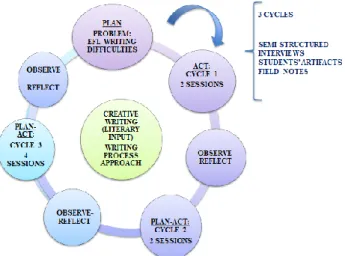
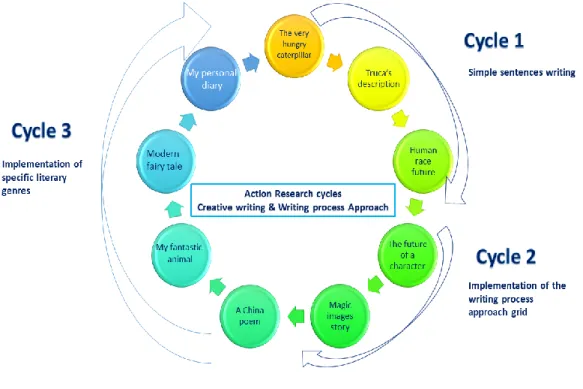
Figure 1. Action Research Cycles, 2020 (Personal Collection).
Figure 1 evidences the four phases to be developed according to Burns (2010), the first phase, planning is the identification of a problem. The diagnosis stage allows the researcher to uncover the difficulties regarding writing in EFL, this recognition was
possible through the instruments of diagnosis implemented, and it was also concluded what kind of investigation could possibly be executed and what kind of improvement of the situation could be done.
The third phase observation, proposed by Burns (2010), was put into practice and the assumptions of the teacher-researcher and the actions developed were analyzed by means of the careful review of the information collected in the field notes, the observation of the process observed in the student's written artefacts and the voices of the participants in the semi structured interviews.
The fourth phase is called by Burns (2010) as reflection, it was developed at the end of each one of the three cycles through the field notes information allowing the researcher to evaluate the effects of the action and to decide the application of changes thanks to the previous observation.
Context.
The specific population was tenth graders; this group was chosen under the
consideration that these students had lack of writing skills evidenced in the diagnosis phase, which was done initially chatting with the students. As part of the first observation, at the beginning of the year 2018, on February 27th the pupils commented in an informal chat about their habits in relation to their English skills practices; there they gave some explicit arguments supporting the difficulties they had in the writing process.
lines, writing short dialogues, filling gaps in textbooks, and completing questions and answers.
Most writing tasks mentioned by students were operational, understood as the use of just structures they were required to memorize but were not asked to write open texts; almost none of them expressed that writing experience was related to their own produced texts. These students did not describe any writing activity in which the freedom of
expression was present; then writings were mainly utilized as a tool to learn only formal aspects of the target language.
As shown in the previous paragraphs, the writing skill of this specific group is an issue that must be faced, after the reflection on what the factors influencing this problem could be, there was the necessity to design and apply three instruments that could evidence in an accurate manner the causes of this problem. The three instruments designed to delimit the problem, were an English perception survey for the students, an English language diagnostic test for the pupils and a survey applied to six teachers of other subjects to see how some habits about the writing process in the mother tongue, such as self-correction, could shape in some way habits when writing in the EFL classroom.
The lack of practice and production of creative writing texts, understood as written production based on imagination and narrative, was evident when it was asked if they developed creative writing activities in their classrooms in 2017.The answers to this item were, the 55 % said they did not do any creative writing activity and the rest, 45 % answered they did creative writing activities.
It called my attention that when they were asked to specify those kinds of creative activities, they alluded to activities such as filling gaps in a book, writing about the family and themselves, however, none of them highlighted texts in which the imagination and narrative were implemented. All this information reinforced the need of implementing plans to develop activities that privilege creative writing and give students the opportunity to express their creativity in their writing production.
Another aspect that grabbed the researcher´s attention is that only few students mentioned the usage of novels, tales and literature in general in the English class. They said the main type of texts were letters, dialogues and descriptions but with a very instructional purpose. This lack of literary resources could be considered as a weakness, if we think of literature as a useful tool to foster writing skills and creativity.
There were some other questions in the survey whose answers could reveal how students perceived their own difficulties to write in English one of the questions was aimed to see how they ranked certain elements such as vocabulary, creativity, English language structures, textual typology, cohesion and coherence and according to the rank students designated the most difficult for the majority of them were the English structure, punctuation, cohesion and coherence.
Remarkably, from the first survey, it can be concluded that students at Jorge Mario Bergoglio School had difficulties writing in English language. As a second step, to find more evidence, the English language diagnostic test (appendix A) was another tool that helped to reveal more information about the English level of the students. This test was designed to review the four English skills; the results showed different aspects among which the weakest was the written production, besides some other factors that influenced writing.
To begin with, the test contained 24 questions, 4 to evaluate listening, 8 to review the grammar knowledge, 7 to evaluate reading comprehension and 5 to review the writing skill. According to the answers, the lowest scores obtained by the students were grammar
knowledge and writing. In grammar, from the 8 questions the vast majority of the students answered the average of 4 right answers; it is necessary to say that these questions were mainly addressed to ask for the English language syntactic structure; those questions had the intention to review if the students knew the correct order of the grammar elements into the sentences and also the knowledge of the verbal tenses, these 2 factors presented
The poor command students have of the English Language Structures such as the syntax and verbal tenses misuse, affected their English writing composition. Specifically, in this English test, the items aimed to review the writing skill were divided in two kinds of questions: two of them were referred to a given text and the students should write the answers about the general idea of the text and about its conclusion; the other three questions were addressed to describe himself/herself and their closer environment. For the first two numerals, only the 40 % answered. There were some findings to analyze in this 40%. As they deduced the questions were related to the text many of them just copied textually from the text to answer the questions so, they did not use their own language, and many answers were not correct; some others wrote incomplete sentences without subject or without verbs in many of the answers. Some of them wrote texts without any coherence it is noticeable that they only took some relevant words from the text to fill the lines, but they did not connect the words to write clear ideas.
The other three questions, referred to familiar topics for them, were only answered by 50 % of the students, and the remaining 50% did not answer even a word to basic requests such as -Describe yourself, -Describe your school – Write your plans for the next year.
From the 50 % that answered, it can be highlighted that the responses were very short, in many of them there was not any verb; for example; to the request describe yourself the response was “me, ugly, intelligent, large” and there was not a variety of verbs and vocabulary.
writing process in the mother tongue, as to establish a contrastive comparison with the writing in the English Language.
In the first question, about the facility to write in the mother tongue, the six teachers interviewed said that it was not easy for this group of students to write. There was also agreement in the fact that students do not know the structure of texts and they do not write texts originated from their own initiative. In the last question when inquiring about correction, there was also a generalized answer saying that there is not a process of self-correction in the students’ texts. Finally, from the three instruments designed and
implemented the teacher-researcher concluded that there is a critical problem in the writing process of this group of students and it must be studied and solved.
Participants and sample
The group was a tenth graders class, initially 40 students, but to develop the analysis of this action research the sample taken was 12 students (6 girls, 6 boys), whose ages are between 15 and 18 years old, they showed difficulties to write in EFL and to create texts from their own inspiration, as it was evidenced in the diagnosis phase. The sample was done at random, as it is described by Cohen (2007), drawing the names out of a container, until the number of participants required 12 was reached.
All the students from the sample came from different schools (the public school where the research was done opened its doors just in 2018) and for this condition they had different writing levels and the difficulties shown in the diagnosis phase. It is relevant here to show the codification done with the participants to identify each one of them and
taking part of this investigation, the conventions were done taking into account that for the semi structured interviews the group of 12 students was divided into 2 sub-groups of 6 students each one, those conventions were also used in the artefacts and were the following:
Table 1.
Participants conventions Group 1 Tenth grade
GROUP 1
STUDENT CODIFICATION
Student 1 ST1GR1
Student 2 ST2GR1
Student 3 ST3GR1
Student 4 ST4GR1
Student 5 ST5GR1
Student 6 ST6GR1
Table 2.
Participants conventions Group 2 Tenth grade
GROUP 2
STUDENT CODIFICATION
Student 1 ST1GR2
Student 2 ST2GR2
Student 3 ST3GR2
Student 4 ST4GR2
Student 6 ST6GR2
For the effects of the codification in the interviews T: teacher.
Role of the researcher
In action research the role of the researcher is participant observant, understood as the teacher who finds a teaching dilemma, as it would be named by Burns (2010), where the teacher develops a closed observation on what he does and what the students do and also the possible meaning it can have for the researcher and for the participants; then the researcher decides to make a reflective research aimed to lead to a positive change, as Burns (2010) expressed.
The role of the researcher here can also be defined as cyclical, given the nature of the study since the researcher is involved into the action and reflection throughout the whole cycle, then the interventions were related to the specific cycles the teacher researcher was in cyclical way modifying from the teaching perspective and analysing from the researcher perspective.
Data collection instruments and procedures
The instruments designed to gather data consistent with the research questions were Semi structured interviews, artifacts and field notes.
Semi structured Interviews.
perspective, as it is expressed by Richards (cited by Heigham & Croker, 2009). Following the qualitative research method, interviews have been described by Burguess (cited by Heigham & Croker,2009) as a conversation with a purpose; the data obtained here allowed the researcher to delve into the writing experiences of the students with the writing grid and the creative writing strategies.
Specifically, the semi structured interviews (Appendix E) offered a wide perspective of the topic being worked and also Richards (cited by Heigham & Croker, 2009) suggests creating a degree of comparisons among the participant’s answers to establish common points. It was also valuable that with the semi structured interviews the researcher could enquire into the participants’ opinions.
In the process of preparing the instruments to collect data, a set of activities related to creative writing were developed with students from another course with the objective of piloting the activities and the instruments. In this particular occasion, it was designed a questionnaire (Appendix D) that was administered to the aforementioned group, and the results showed that for the purpose and nature of this research, it was better to implement semi structured interviews, given the fact that they could provide more information and the researcher could address further questions or paraphrase them to find more valuable
information.
This research had two semi structured interviews, the first was applied at the end of the first cycle and the second at the end of the third cycle, the decision of making them in the mentioned periods of time had to do with the comparison between them that the