1
FACULTAD de FILOSOFÍA Y LETRAS
DEPARTAMENTO de FILOLOGÍA INGLESA
Grado en Estudios Ingleses
TRABAJO DE FIN DE GRADO
"pro need a little bit more":
AN ANALYSIS ON SUBJECT
PRODUCTION BY HEARING
IMPAIRED CHILDREN.
Laura Fernández Merino
Tutor: Raquel Fernández Fuertes
UNIVERSIDAD DE VALLADOLID-LAURA FERNÁNDEZ MERINO
ABSTRACT
This dissertation analyses the subject production of Spanish and English Hearing Impaired (HI) children as compared to that of Typically Developed (TD) children. The data analysed are spontaneous and have been extracted from CHILDES. The analysis focuses on two properties of the null subject parameter, namely, subject overtness and subject-verb agreement, and the objective is to analyse how these two properties are instantiated in the production of Spanish and English monolingual HI children. The results indicate that similar problems appear when comparing Spanish and English HI children, and that these problems are not frequent in their corresponding age-matched TD peers.
KEYWORDS: Hearing impairment, English, Spanish, acquisition, sentential subjects, null subject parameter.
RESUMEN
Este trabajo analiza la producción de sujetos de niños con pérdida auditiva, tanto ingleses como españoles, comparada con la de niños que se desarrollan de forma normal. Los datos que se han utilizado son espontáneos y se han extraído del proyecto CHILDES. El análisis se centra en dos propiedades del parámetro del sujeto nulo, en concreto, en la naturaleza del sujeto y en la concordancia sujeto-verbo. El objetivo es analizar cómo aparecen estas propiedades en la producción de niños con pérdida auditiva con español e inglés como primera lengua. Los resultados muestran que existen problemas similares en la comparación de niños con pérdida auditiva ingleses y españoles, y que estos problemas no son frecuentes en niños de su misma edad con desarrollo normal.
UNIVERSIDAD DE VALLADOLID-LAURA FERNÁNDEZ MERINO
1. LANGUAGE ACQUISITION IN CHILDREN WITH SPECIFIC LANGUAGE IMPAIRMENT……….11
2. LANGUAGE ACQUISITION IN HEARING IMPAIRED CHILDREN…...13
3. SUBJECTS IN THE PRODUCTION OF SLI AND TD CHILDREN………15
3.1PREVIOUS WORKS IN SLI AND TD CHILDREN………..15
3.2PREVIOUS WORKS IN SLI AND TD SPANISH………..16
4. OBJECTIVES OF THE STUDY AND RESEARCH QUESTIONS……….18
1. QUESTION SET 1: ENGLISH HI AND TD CHILDREN……….18
1.1RESEARCH QUESTION 1: OVERTNESS IN ENGLISH……….18
1.2RESEARCH QUESTION 2: S-V AGREEMENT IN ENGLISH…19 2. QUESTION SET 2: SPANISH HI AND TD CHILDREN………..19
2.1RESEARCH QUESTION 1: OVERTNESS IN SPANISH….…….19
2.2RESEARCH QUESTION 2: S-V AGREEMENT IN SPANISH….19 3. QUESTION SET 3: SPANISH AND ENGLISH HI CHILDREN…………..20
3.1RESEARCH QUESTION 1: SUBJECT PROPERTIES ACROSS LANGUAGES………..20
UNIVERSIDAD DE VALLADOLID-LAURA FERNÁNDEZ MERINO
1.1RESEARCH QUESTION 1: OVERTNESS IN ENGLISH……….31
1.2RESEARCH QUESTION 2: S-V AGREEMENT IN ENGLISH…33 2. DATA ANALYSIS AND QUESTION SET 2: SPANISH HI AND TD CHILDREN………..34
2.1RESEARCH QUESTION 1: OVERTNESS……….34
2.2RESEARCH QUESTION 2: S-V AGREEMENT………36
3. DATA ANALYSIS AND QUESTION SET 3: SPANISH AND ENGLISH HI CHILDREN………..37
3.1RESEARCH QUESTION 1: SUBJECT PROPERTIES ACROSS LANGUAGES………..37
3.2RESEARCH QUESTION 2: VP LENGTH AND SUBJECT PRESENCE-OMISSION ACROSS LANGUAGES………38
7. CONCLUSIONS……….40
8. BIBLIOGRAPHY………..42
1
FOREWORD: CONTEXTUALIZATION OF THE DISSERTATION
The present undergraduate dissertation is the final formal requirement to conclude the degree
in English Studies at the University of Valladolid. The topic of this dissertation belongs to the
contents in the A2 subject “Scientific description of the English Language”, as presented in
the teaching guide of the academic year 2017-2018. Therefore, it falls within a category in
which the following subjects of the degree are encompassed: English descriptive grammar (I,
II and III), phonetics and phonology (Instrumental English I and English Phonetics and
Phonology), the origins of the English language and English/Spanish comparative grammar.
This dissertation analyses the subject production of English and Spanish native speakers,
more specifically of children with a hearing impairment. Therefore, this area of research has
helped me broaden my knowledge on the acquisition of subjects, and thus, on language
acquisition. Moreover, the fact that the children have a specific language impairment
introduces me in the research of language disorders, a topic I am very interested in.
Apart from this, deciding on my own research questions, creating my own database and
working with data and their analysis has helped me better understand how to codify and
interpret data. This dissertation has also offered me the opportunity to carry out my own
research, and thus, to guide my future professional career, as I have realized that there is a
need for research on this topic. Moreover, during the development of this dissertation, I had
made use of the knowledge acquired about bibliographical search during the degree. The
general and specific competences I have used during the elaboration of this dissertation,
which are also reflected in the official description of this degree, are the following:
- Ability to manage technological means and resources.
- Ability to identify, manage and synthesis bibliography.
2
- Research skills: investigation techniques and documentation.
- Autonomous learning.
- Ethic, critic and constructive spirit.
Moreover, as my research deals with English, but also with Spanish which is my mother
tongue, this dissertation also covers specific competences like the following:
- Capacity to write and speak in the English language.
- Capacity to understand and produce in the English language texts related to the main
professional possibilities of the degree.
- Capacity to relate linguistic knowledge with other areas and disciplines.
- Capacity to understand the English grammar and its description.
- Capacity to make use of my L1 language and to compare it with other languages.
3
1. INTRODUCTION
Language acquisition is a developmental process in which a variety of factors are intertwined.
Some of these include the following: the period of time children go through in order to
acquire the main properties of the language they are exposed to, the role played by the type of
input they receive, the education programs they attend and the different challenges they may
encounter when acquiring their mother tongue. When there are extra factors that may
influence the acquisition process, a change in the developmental process can arise. This
undergraduate dissertation considers one of these factors, in this case, hearing impairment.
Hearing impairment is a condition that affects 12.000 babies each year in the U.S. (Centers
for Disease Control and Prevention, 2015), and almost 2.000 in Spain (Encuesta INE, 2000).
This condition affects children’s acquisition process as well as their education and learning
paths. Therefore, this type of impaired acquisition must be studied in depth.
This dissertation is based on the analysis of sentential subjects as they appear in the data from
Spanish and English hearing impaired (HI) children along their language developmental path,
and thus, it contributes to provide more information about their linguistic delay. Therefore,
this dissertation takes previous studies on children with specific language impairment (SLI)
and HI children as a reference, as HI is considered a case of SLI. Moreover, the objectives of
this study are to analyse the subject production of HI children, taking typically developed
(TD) children as a control group, and to compare the differences and similarities that may
4
This study is divided into eight sections, the introduction being the first one. The second
section considers the theoretical approach that is at the bases of this work and, in particular,
the principles and parameters theory on sentential subjects, that constitutes the formal
background for this study. Then, the third section provides a general overview of the previous
studies about the acquisition of subjects by HI, SLI and TD children. The fourth and the fifth
sections state the objectives of the study and the methodology followed in the analysis. The
sixth section shows the results obtained from the analysis of the data, and the discussion of
these results. The conclusions reached after having analysed the data are gathered in the
seventh section, and finally, the last section provides the bibliography that has been consulted
for this dissertation. Moreover, the CD attached to this dissertation contains the Access
5
2. THEORETICAL FRAMEWORK
This section deals with sentential subjects and their defining properties according to some
scholars. Moreover, a brief explanation of the principles surrounding this grammatical
category will be provided, and thus, the differences that appear when analysing subjects in
two different languages, in this case, English and Spanish, will be focalised. Furthermore, the
different instances in which the null subject parameter, which is the formal framework of this
dissertation, takes place in both languages will be explained.
1. The Grammatical Properties of Subjects
According to Crystal (2008:461), a subject could be defined as “a term used in the analysis of
grammatical functions to refer to a major constituent of sentence or clause structure,
traditionally associated with the ‘doer’ of an action”, which means that the subject is the
element that performs the action of a verb. There are some scholars that have stated some
further properties to broaden the definition of this universal category. Following Andrews
(1985), there are five properties usually shared by all subjects. Firstly, one of the most
common properties is that subjects usually adopt the form of a DP (1a), although they can
also adopt the form of a PP (1b) or a clause (1c).
1) a. The house is red.
b. Between 6 and 9 will suit me.
6
Moreover, subjects are the external argument of a verb, and they typically receive nominative
case via verbal inflection. The IP (inflectional phrase) is the clause selected by the
complementizer, and thus, the one that gives the information about tense and agreement
(Haegeman, 1999).
Thirdly, subjects agree with verbs in number and person, which in English is overtly marked
in the -s for the third person singular in present tense (2a). Verbal agreement is overtly
realized in all verbs in Spanish, as verbal inflection indicates specifically which person is
doing the action (2b).
2) a. She eats chocolate.
b. Yo como chocolate, mientras que mis padres comen bizcocho.
The fourth property is that subjects are normally the leftmost constituent within a sentence
(3a), but there are some instances in which we can find another element in that position (3b)
due to emphatic or pragmatic reasons.
3) a. George wants to go to the cinema.
b. Yesterday, all my problems seemed so far away.
The final property to consider is the fact that subjects determine the number, gender, and
person of the reflexive pronoun that appears in the sentence when they are co-referential.
Thus, in the example (4), the pronoun he is the one that provides gender, number and person
features to the reflexive pronoun himself (i.e. masculine, singular and third person).
7
2. Principles and parameters: subjects across languages
The properties outlined above characterize subjects across languages. This leads us to discuss
more in depth how subjects are captured in Universal Grammar. Universal Grammar, as
proposed by Chomsky (1965), states that all human languages share a series of systems and
categories while they differ in some others, and thus, Universal Grammar is formed by a
number of principles (the common properties) and parameters (that capture differences across
languages). As the category analyzed in this dissertation is the subject, the principle that will
be focused on is the Extended Projection Principle (EPP) and the corresponding parameter
the Null Subject Parameter (NSP).
2.1 The Extended Projection Principle (EPP)
The EPP is an extended version of the Projection Principle, formulated in 1986, which stated
that “a lexical structure must be represented categorically at every syntactic level" (Chomsky,
1982:8), i.e., every verb needs a certain number of arguments. Beyond this, the principle was
developed into an extended version (EPP), which stated that every sentence must contain a
subject. Principles are universal, which means that they must occur in every language.
However, even if all sentences in all languages must have a subject (the necessity for the
subject), the nature of the subject may change from one language to the next. This variability
across languages in the case of the nature of the subject is capture in the Null Subject
8
2.2 The Null Subject Parameter (NSP)
Together with the EPP, the Null Subject Parameter (NSP) is at the basis of this dissertation.
The NSP determines if a language can drop the subject or not and, therefore, within this
parameter, there exist two types of languages, [+null subject] languages, and [-null subject]
languages. Although there are many properties that can define whether a language is [+/- null
subject], the salient property deals with whether the subject of inflected verbs can be null or
whether it cannot be null; and whether this affects both referential and non-referential
subjects. These are the two properties that will be discussed below and, as this dissertation is
focused on the analysis of two languages, English and Spanish, the following explanation of
the NSP will differentiate between both languages.
The drop of the subject is directly related to the nature of verbal inflection. Spanish has a rich
verbal inflection, which permits to know who is doing the action without necessarily having
an explicit subject. As explained before, the verbal morpheme expresses the person and
number of the subject, and thus, it allows Spanish to have both null and overt subjects. As in
example (5a), the pronominal marker mos indicates a first-person plural subject and,
therefore, the explicit pronominal subject could be null (as indicated by the presence of the
null category pro). On the contrary, English has poor verbal inflection and so it cannot
identify the subject and the subject needs to be overtly expressed. In example (5b), it is the
pronominal subject that expresses who is doing the action.
5) a. pro Vamos.
b. We go.
Examples (5a) and (5b) illustrate how Spanish is a [+null subject] language while English is a
9
Regarding the referential properties of the subjects, we can distinguish between referential
and non-referential subjects. Referential subjects deal with subjects that have a referent, and
these can have 3 different forms in Spanish: 2 overt (pronouns and DPs) and 1 null.
Therefore, regarding referential subjects, in Spanish we can find null referential subjects, as
in (5a) above or (6a), and overt referential pronouns and DPs, as in (6b) and (6c) respectively.
6) a. pro me llamó ayer.
b. Ella me llamó ayer.
c. Sus padres vienen mañana.
Non-referential subjects are subjects that do not have a referent. In Spanish non-referential
subjects are null, as in example (7).
7) pro está lloviendo.
Considering English, as it is a [-null subject] language, both referential and non-referential
subjects need to be overt. In the case of referential subjects, these can be pronouns (8a) and
DPs (8b).
8) a. She is eating chocolate.
b. My parents are worried about me.
Regarding non-referential subjects, overt expletives need to be used, which, according to
Haegeman (1999, 1.6.2.1), are “a non-referential element (...) which seems to function as a
mere filler for the subject position and which fails to contribute to the semantics of the
sentence”, i.e., they are inserted because of syntactic reasons, but they do not have lexical
meaning. Therefore, in English we can find overt expletives in sentences such as (9).
10
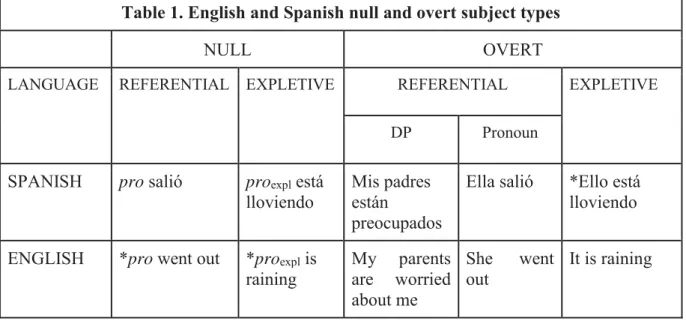
To sum up, table 1 gathers the different referential and non-referential subject forms that are
available both in English and Spanish.
Table 1. English and Spanish null and overt subject types
NULL OVERT
LANGUAGE REFERENTIAL EXPLETIVE REFERENTIAL EXPLETIVE
DP Pronoun
“*ello está lloviendo”, and, in the case of English, it is not possible to find a null referential
subject or a null expletive subject as in “*pro went out” and “*proexpl is raining”.
However, there are instances in which we can find null subjects in English, as it is the case of
imperatives (10a) and non-inflected or non-finite verbs (10b).
10) a. _ come here!
b. I want _ to go to the cinema.
These null subjects in English, however, are very much restricted syntactically speaking and,
11
3. EMPIRICAL FRAMEWORK
Given that the participants in this dissertation are SLI children, specifically HI children, in
this section, previous works regarding language acquisition by SLI1 children are reviewed.
First, the previous works regarding SLI children including their defining properties and the
way language acquisition proceeds in these cases will be analysed. Then, both English and
Spanish works on the acquisition of language in HI and SLI children will be highlighted.
Finally, a summary with some of the most relevant studies about subjects and their
acquisition by both TD and SLI children will be provided.
1. Language acquisition in children with specific language impairment
The term SLI has been used since 1980, and it refers to a condition in which children
experience significant language learning difficulties (Leonard, 1998). However, not all
difficulties are included in this nomenclature, as some scholars have defined children with
SLI using some exclusionary and inclusionary criteria, which will be explained in the
following paragraphs.
Regarding the inclusionary criteria, there are two factors to be considered when identifying
children with SLI. The first one is non-verbal intelligence, IQ: some investigators propose
that, in order to be considered as a significant intellectual disability, the IQ needs to be lower
than 75 (Plante, 1998). The second factor to be considered is verbal intelligence, that is the
language production and the difficulties regarding language. Within this categorisation,
1The term SLI will be used from now on with those works in which children’s impairment is not specified,
12
children must have cognitive, hearing, oral-motor, among other deficits to be considered
language impaired. Besides this, the receptive language age of the children must be at least 6
months below their chronological age, and their expressive language age must be 12 months
below their chronological age.
Regarding the exclusionary criteria, there are some controversies as to which children should
be excluded, as some of the typically excluded children are those with mental deficiency,
hearing loss, severe emotional disturbance, and frank neurological deficits (Gillan and
Kamhi, 2010).
Therefore, as there is some discrepancy among scholars regarding which language disorders
or difficulties should be framed within the term SLI, in this dissertation HI children have
been considered SLI children because of the following three reasons: Their delay in linguistic
development, their problems with morphosyntax and their linguistic age as opposed to their
chronological age. These will be explained in the subsequent paragraphs.
According to Leonard (1998), SLI children experience environmental deficits, either at home
or within the educational framework. HI children are deprived of linguistic stimuli as spoken
language (Meier, 1991), which is the typical language-learning environment, and this is a real
disadvantage for them when attending lessons, together with the lack of sign language
education. Therefore, linguistic input and language development are closely related, and both
are clearly deficient in HI children.
Moreover, morphosyntactic markers (i.e. the use of morphemes that mark tense and
agreement) are some of the properties that are specifically problematic for SLI children
(Bedore and Leonard, 1998), and which they also share with HI children. According to Le
Normand (2004) in his longitudinal study about fifty French HI and deaf children, there are
13
affects them in their use of gender and number inflection, as well as in their use of verbal
inflection, agreement, omission, confusion or inversion of grammatical words, including
verbs and functional words.
Finally, as it has been stated before, according to Stark and Tallal (1981), receptive language
and expressive language must be 6 and 12 months below the chronological age of TD
children, respectively. González et al. (2014) evaluated 32 children with pre-speech deafness
and hearing loss. During their study, the Reynell Developmental Language Scales III was
administered to each child, in which the child, supported by images and objects, was asked to
produce certain grammatical structures. The authors concluded that 53,1% of the children
presented a great imbalance between their linguistic age and their chronological age. In fact,
22% of the children presented a gap of more than three years. The participants, who were
between the ages of 3 and 7, had a linguistic age of 2 to 4 years. Hence, the linguistic age of
HI children is also affected, as it is the case of SLI children.
2. Language acquisition in Hearing Impaired children
The acquisition of language is one of the most recurrent research topics nowadays when
dealing with the analysis of language and its evolution. However, there is not a large amount
of data in the field of hearing impairment. Most of the works that have been conducted, and
most of the studies that have been carried out, have dealt with the benefits or the
consequences of cochlear implants and the support of sign language. But few studies are
actually concerned with the linguistic development of HI children.
González et al. (2014) studied the language development of Spanish children with digital
14
suppose a significant change in the education of deaf and hearing-impaired children.
Moreover, they analysed some of the common linguistic problems these children have, and
they found that they had problems with the production of third person singular, past tense,
passive, and subject-verb agreement. In their discussion, they highlighted the lack of research
in this field, and hence, the need to comprehend their linguistic evolution and their linguistic
delay to intervene and facilitate their education.
Gregory and Mogford (1981) carried out a longitudinal study in which they measured the
number of words produced by English deaf and TD children. They concluded that the
production time of words was belated in deaf children when compared to hearing children,
which involved a delay in the appearance of oral production. Moreover, they showed how
vocabulary was poorer in the case of deaf children, which also led to a delay in their
linguistic abilities.
Moreover, it has also be found that, together with the lack of vocabulary these children
present, they have problems with the production of simple structures, as well as with
everyday words (Quintana Alonso, 2004). In fact, this is probably a consequence of their lack
of oral exposure, and the lack of sign language support.
Regarding sign language, the importance of a signal exposure for a better language
development has also been discussed (Meier, 1991). The typical language-learning
environment includes an auditory input, which in HI children is limited, and therefore, their
15
3. Subjects in the production of SLI and TD children
In this section the literature regarding subjects in the production of English SLI and TD
children, as well as in that of Spanish SLI and TD children will be reviewed. To the best of
our knowledge, no works on HI children’s ability in this grammatical area have been carried
out.
3.1. Previous works in SLI and TD English
Regarding previous works on English SLI children, in Schaeffer’s (2002) longitudinal study,
17 English speaking children with SLI were studied during 4 consecutive years. The purpose
of this study was to compare SLI children with TD children in terms of subject production,
and he discovered that they made similar morpho-syntactic errors. His findings showed that
SLI children produced a large number of bare stems constructions in contexts of verbal
agreement. Thus, they produced sentences as in (11), in which there is no subject-verb
agreement.
11) *She drink my milkshake.
Moreover, he also found that a considerable number of examples did not have nominative
case subjects, as in (12).
12) *Me want a chocolate bar.
These types of errors were found in younger SLI children, between 1-3 years, while the older
ones produced adult-like subjects. Besides this, he concluded that the SLI children did not
have problems with null subjects, as they produced overt subjects in the same way as the TD
16
In addition to this, subjects have also been studied in comparison to objects, as in the case of
Hyams and Wexler (1993), whose study about null subjects in child language reviewed the
possible omissions that SLI children tend to do. For instance, they calculated the rate of
subject and object drop of two children with the purpose of seeing if the drop of the subject
was a grammatical option for the children. They found that in 55% of the cases the children
dropped the subjects, whilst objects were dropped only 7% of the time in obligatory contexts.
In Bloom’s (1990) study about subjectless sentences in TD child language, the interaction or
influence of the VP length was considered when producing null subjects. This possibility was
also studied by Hyams and Wexler (1993) in SLI children, and both studies found that the
presence and length of subjects is closely related to the VP length, as subjectless sentences
tended to occur in longer VPs, whilst sentences with shorter VPs had overt subjects.
To sum up, previous works about subject production in both SLI and TD English children
show that they produce similar morpho-syntactic errors and that neither of them have
problems with subject omission once the subject omission stage is overcome.
3.2. Previous works in SLI and TD Spanish
Most of the Spanish works regarding subjects deal with bilingual children or with Spanish
children acquiring English as a Second Language (ESL). Therefore, there is a lack of research
in terms of SLI children’s production of subjects in this language in a monolingual L1
context.
One of the issues that has been studied is the order of the subject within a sentence, since
Spanish has more word-order freedom than languages like English (Bel, 2005). In Bel´s
17
came to the conclusion that children exposed to a [+null subject] language acquired earlier
the syntactic rules that govern the sentence. Thus, these children were able to produce
sentences as (13) where the subject appears post-verbally, and this could be related to the
pragmatic purposes entailed by the children, rather than the possibility of dropping or
changing the position of the subject.
13) Vino la mama.
Added to this, Perales and Portillo (2007) studied the referential properties of subjects. In
their study, they analysed the differences and the relationship between subjects and their
antecedents. They concluded that null subjects have a subject as antecedent in 80% of the
cases, i.e., in a sentence as that in (14), “Juan” in the first sentence is interpreted as being the
antecedent of the null subject pro in the second sentence.
14) Juan pegó a Pedro. pro Está enfadado. (Perales and Portillo, 2007:891)
In conclusion, studies about subject problems in Spanish SLI and TD children show that they
do not have problems with the order of a subject within a sentence nor with subjects and their
18
4. OBJECTIVES OF THE STUDY AND RESEARCH QUESTIONS
As it has been mentioned in the previous section, there is a lack of, and therefore a need for,
studies on language acquisition by SLI children in general, and particularly by those with
hearing impairment. Henceforth, the principal aim of this dissertation is to contribute to
broaden this area of research, and thus, to add on further investigations.
This section presents the research questions that guide the study. Three question sets will be
presented. Since this dissertation analyzes two languages, English and Spanish, each question
set contains the corresponding research questions for each language. Given that the focus of
this study is placed on HI children, the last question set deals with a crosslinguistic
comparison between HI children from both languages.
1. Question set 1: English HI and TD children
With respect to the production of subjects by English HI when compared to TD children, two
issues will be focused: subject overtness and subject-verb agreement. The following two
research questions deal with each of these issues.
1.1. Research question 1: Overtness in English
As English is a [-null subject] language, do the HI children show a lower null subject rate
when compared to that of overt subjects? Does this rate differ from the one produced by TD
19
1.2. Research question 2: S-V agreement in English
Following the longitudinal study carried out by Schaeffer (2002), are there any problems with
S-V agreement in the HI production? Are those problems similar to the ones produced by TD
children? Moreover, problems with S-V agreement appear in SLI children between 1-3 years
(Schaeffer 2002), and so, does this error type also appear in HI children between the ages of
4-5?
2. Question set 2: Spanish HI and TD children
Within this section, the research questions dealing with the production of subjects by Spanish
HI when compared to TD children will be stated. Therefore, the following two research
questions focus on subject overtness and subject-verb agreement.
2.1. Research question 1: Overtness in Spanish
As Spanish is a [+null subject] language, do the HI children produce a higher rate of null
subjects when compared to overt subjects? Is this percentage similar to the one produced by
TD children?
2.2. Research question 2: S-V agreement in Spanish
Following the longitudinal study carried out by Schaeffer (2002), do HI children also have
problems with S-V agreement? And do TD children have similar problems in this respect?
Besides, as in Schaeffer (2002), these problems with S-V agreement appear in SLI children
20
3. Question set 3: Spanish and English HI children
This question set includes the research questions regarding the differences that could be
obtained by comparing the production of subjects in English and in Spanish as they appear in
HI children’s data.
3.1. Research question 1: Subject properties across languages
As it can be seen in the different studies about SLI children (Bedore and Leonard, (1998); Le
Normand (2004)), they usually have the same problems regarding verbal agreement and
morpho-syntax. Are these problems shared by the HI children from the two different
languages in the case of subject production?
3.2. Research question 2: VP length and subject presence-omission across
languages
According to Bloom’s (1990) study about subjectless sentences, the VP length can interact in
the production of null subjects. Taking language economy as a referent, and considering that
Spanish allows the drop of the subject while English requires the overt presence of a subject,
do Spanish HI children have less problems than English HI children in the production of
21
5. METHODOLOGY
This section deals with the methodology followed in this dissertation, and it will be divided
into two subsections: Data selection and data classification. In the first subsection, the
corpora and the participants selected for the analysis will be presented, and, in the last one,
the classification of the data and the database created for this dissertation will be explained.
1. Data selection
1.1 Corpora
In order to select the data of this study, the corpora available in the CHILDES project
(MacWhinney, 2000) were used. CHILDES is a compilation of corpora on the spontaneous
linguistic production of children and their parents. The corpora comprise the transcriptions of
the oral production and in some cases the original audio/video recordings. An explanation of
the linguistic environment of the children is also provided in each case.
As the target of this dissertation is the analysis of HI children, the corpora selected were from
the Clinical/Language Disorders folder. One of the corpora selected was the Nicholas Corpus.
This corpus was created to study the verbal and nonverbal communication of both TD and HI
English children (some with cochlear implants). Thus, the transcriptions are classified in two
sections: Normal hearing (TD) and HI. These children were given toys during the recording
sessions, and they had to play with their parents.
Besides, to analyse HI Spanish children, the MOC Corpus was selected. This corpus was
22
thus, it provides 156 files of recording transcriptions including coding of gestures. In the
recording sessions, the child played with her mother.
For the analysis of TD Spanish children, the BecaCesNo Corpus was selected. It contains 81
transcriptions of free conversations between children and adults. In this case, the children
were not recorded with their parents, but with the investigators.
1.2 Participants
For this dissertation, 4 participants were selected from the previously mentioned corpora. As
the main objective of the dissertation was to see the linguistic delay of the HI participants,
they were selected according to their age. Following the age-matching selection criterion, the
files selected for the analysis contained transcriptions of 4;4-4;72 year old children.
In the case of English children, two children were selected from the Nicholas Corpus. As it is
not specified which children have a cochlear implant, the criterion for the selection has been
the closer age-matching. The HI child selected is Paloma (4;5) and the corresponding
transcription file is “hi54f-paloma”. From the TD section, Elodie (4;7) and the transcription
file is “nh54f-elodie” were selected.
Regarding the HI Spanish children, Berta (4;5) from the MOC Corpus was selected, and from
all her recordings the chosen file was “040500”, in which she had the required age. As a TD
child, Rocío (4;4) and her “04f09” file were selected from the BecaCesNo Corpus.
2 This is the format used in CHILDES to express age: year;month. This dissertation will follow this
23
As it can be seen, all the participants are female. Although biological gender is not targeted in
this study and the criterion for participant selection is age-matching closeness, only girls have
been included to ensure that children's biological gender did not influence the results.
Once the participants were selected, their MLU was automatically calculated by using the
CLAN program called MLU. The MLU value shows the linguistic development of the
children.
To sum up, table 2 shows an overview of the participants and their corresponding MLU
values in the data selected.
Table 2. Participants selection
Child Name Language Group File selected MLU average
Age
Paloma English HI “hi54f-paloma” 2.4 4;5
Elodie English TD “nh54f-elodie” 3.5 4;7
Berta Spanish HI “040500” 2.2 4;5
Rocío Spanish TD “04f09” 5.6 4;4
Moreover, all the data used for this study with respect to the target structure were extracted
manually from the corpora and classified as explained in the next section.
2. Data classification
This section deals with the classification of the data obtained, which have been codified in an
Access database attached to this dissertation in an electronic format. The variables considered
24
2.1 Variables
The document attached to this dissertation contains 4 sheets, one per child. Each sheet was
arranged according to two general properties: child group and language group. Thus, whether
a child was a TD or an HI has been considered, as well as whether their L1 was English or
Spanish. The name of each sheet shows this classification. Table 3 gathers the name of each
sheet following this classification.
Table 3. Sheet classification
Child Name Language Group Sheet Name
Paloma English HI PALOMA HI EN CHILD
Elodie English TD ELODIE TD EN CHILD
Berta Spanish HI BERTA HI SP CHILD
Rocío Spanish TD Rocío TD SP CHILD
In each sheet, three variables were considered: Grammatical correctness, subject overtness and grammatical person.
1. Variable 1: Grammatical correctness
In this variable, the data were classified according to the correctness of the nature of subjects
and subject-verb agreement. First, whether a null subject was correct or incorrect was
considered. Thus, sentences as (14a) and (14b) in the case of Elodie, and (15) in the case of
Rocío were classified as table 4 shows.
25
b. _ put it on the table. (line 806)
15) porque pro me cai (.) en el suelo . (line 15)
Table 4. Variable 1.1: Nature of Subjects
Example Line *Null SU Null SU
*pro gave her a kiss 130 1 0
_ put it on the table . 806 0 1
porque pro me cai (.)
en el suelo .
15 0 1
*Null SU = incorrect null subject
Null SU = correct null subject (i.e. imperatives)
Besides this, whether there was subject-verb agreement or not was also considered. Thus,
sentences as (16a) and (16b) in the case of Paloma, and (17a) and (17b) in the case of Berta
were classified as table 5 shows.
16) a. * he want to climb up. (line 130)
b. is Jaime playing now ? (line 528)
17) a. yo quería coserlo . (line 429)
26
Table 5. Variable 1.2: Subject-Verb Agreement
Example Line S-V agreement No S-V agreement
* he want to climb up. 130 0 1
is Jaime playing now ? 528 1 0
yo quería coserlo 429 1 0
pro te va (=voy) a
matar. 295 0 1
2. Variable 2: Subject overtness
In this variable, whether a subject was null or overt was considered. Thus, if a subject fell
into the category of null it was classified in terms of correctness (see variable 1). Moreover, if
this null subject appeared in a non-finite sentence (18a), it was classified as such. All the null
subjects in non-finite clauses were correct, so there is only one category for these subjects.
Overt subjects as (18b) and (18c) in the case of Berta, and (19a) and (19b) in the case of
Paloma were classified according to their corresponding subtype (DP vs pronoun). Table 6
gathers some examples of this variable.
18) a. pro te voy a _ dar un mordisco (line 205)
b. y yo enseño una cosita. (line 95)
c. ese de ahí está buer@p (line 56)
19) a. I will go first (line 121)
27
Table 6. Variable 2: Subject overtness
Null subjects Overt Subjects
Example Line *Null SU Null SU Non-finite Pron DP
pro te voy a _ dar un
mordisco 205 0 1 0 0 0
pro te voy a _ dar un
mordisco
205 0 0 1 0 0
y yo enseño una cosita . 95 0 0 0 1 0
ese de ahí está buer@p 56 0 0 0 0 1
I will go first . 121 0 0 0 1 0
both of us spill the beans 134 0 0 0 0 1
3. Variable 3: Grammatical person
The third variable deals with the grammatical person of each instance. Thus, subjects as in
(20a), (20b) and (20c) in the case of Rocío, and (21a) and (21b) in the case of Elodie were
classified according to their number and person, together with the previously mentioned
variables. Therefore, once a subject was classified in terms of overtness, it was categorized
according to its number and person. Table 7 shows some instances of this variable in
combination with the other variables.
20) a. Y Mari Carmen me ha da(d)o carbo(n). (line 115)
b. pues (.) yo no se (line 161)
28
21) a. I only have this much left (line 30)
b. it looks like Lassie (line 431)
Table 7. Variable 3: Grammatical person
Overt Subjects Grammatical person
Example Line Null Pron DP 1p
sg 2p sg 3p sg 1p pl 2p pl 3p pl
Y Mari Carmen me
ha da(d)o carbo(n) . 115 0 0 1 0 0 1 0 0 0
pues (.) yo no se 161 0 1 0 1 0 0 0 0 0
pro nos iremos de
vacaciones .
185 1 0 0 0 0 0 1 0 0
I only have this much
left 30 0 1 0 1 0 0 0 0 0
it looks like Lassie 431 0 1 0 0 0 1 0 0 0
These three variables were used to classify all the data of the study.
2.2 Discarded cases
In this section the decisions taken during the processes of data extraction and data
classification will be explained. There were cases of imitation, fixed expressions and unclear
29 Regarding imitation, the children’s recording took place usually when children interacted
with their mothers, so some of the instances found in the corpora were produced as a
repetition of what the mother said. This is the case of (22).
22) *MOT: que el tiempo pasa .
*CHI: que el tiempo pasa , papi . (line 118)
This example shows the child, Berta, repeating what her mother has said, and therefore, this
utterance was not taken into account as Berta is not the one producing the original sentence.
All the imitation cases that appeared in the corpora were, therefore, discarded.
Moreover, fixed expressions were not taken into account, as they were not clauses or did not
reflect productive language and, therefore, did not have relevance for this dissertation.
Examples (23a) and (23b) are some of these instances in the case of Rocío.
23) a. Vale! (line 21)
b. otra vez ? (line 306)
There were other problematic instances in which it was unclear what the child was trying to
say. In these cases, if the researchers that carried out the data transcription clarified the
words, they were classified. On the other hand, if words were not clarified, and it was nearly
impossible to figure out what the child was trying to say, or the symbols ” xxx” appeared in
the utterance, they were not classified. There were some “xxx” cases in which the appearance
of these symbols did not affect the classification, as in the case of (24a), and others in which
they did affect, as in (24b). Examples like those in (24a) were included in the corpus while
those like the one in (24b) were removed from the corpus.
30
31
6. ANALYSIS
In this section, the results obtained from this study will be explained. Moreover, as these
results address and provide the answer to the research questions stated in the fourth section of
this dissertation, this section will be organized following the same schema as in the research
questions. Thus, the HI children’s results dealing with subject overtness and subject-verb
agreement in English (question set 1) will be presented first. Then, the ones dealing with
subject overtness and subject-verb agreement in Spanish (question set 2) will be discussed.
And finally, the ones dealing with the comparison of the subject production across both
languages (question set 3) will be explained.
1. Data analysis and question set 1: English HI and TD children
This question set deals with the production of subjects by English HI when compared to TD
children focusing on subject overtness and subject-verb agreement.
1.1. Research question 1: Overtness in English
32
Table 8. Question set 1: Research question 1 (Overtness in English)
Null SUs Overt SUs Total
Table 8 shows the subject production in the case of the English children, organized in terms
of overtness. Moreover, null subjects have also been classified according to whether they
were correct or not (variable 1). In the case of Elodie, out of the 173 subjects that she
produces, 23% are null subjects, whilst 77% are overt subjects. Moreover, within her
production of null subjects, 2.89% of them are incorrect (*Null SU). In the case of Paloma,
she produces 168 subjects, from which 10.11% are null subjects, and 89.9% overt subjects.
Besides, 6.5% null subjects are incorrect.
These results show that in the case of Paloma, the HI child, her rate of null subjects (10.11%)
is lower than that of overt subjects (89.9%), and this answers the first research question in
that she shows a lower rate of null subjects when compared to that of overt subjects.
Moreover, when comparing these results to the ones of Elodie, it can be seen that Elodie
produces a higher rate of null subjects (23%) than Paloma, who in fact, does not produce
instances of subjects in non-finite sentences. This happens partly because Paloma’s sentences
are shorter than the ones produced by Elodie. Hence, the rate of null subjects produced by
both children in English (a [-null subject] language) is lower than the rate of overt subjects
33
sentences in English typically have an over subject, while null subject use is grammatically
restricted).
As can be observed, both children produce incorrect null subjects, as illustrated in examples
(25a), in the case of Paloma (HI), and (25b), in the case of Elodie (TD).
25) a. pro will play with the beans. (line 103)
b. pro play with toys. (line 507)
Most of their incorrect null subjects refer to first person singular, as in examples (25a) and
(25b). Therefore, the rate of null subjects in Paloma (HI) is lower than that of overt subjects.
Besides, the rate of null subjects in Elodie (TD) differs from that of Paloma in that she
produces more null subjects than Paloma.
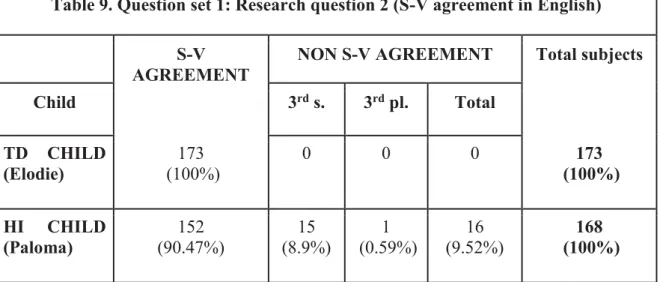
1.2. Research question 2: S-V agreement in English
Table 9 shows the results regarding research question 2.
Table 9. Question set 1: Research question 2 (S-V agreement in English)
S-V AGREEMENT
NON S-V AGREEMENT Total subjects
34
As can be seen in these results, Paloma (HI) has problems with S-V agreement in 9.52% of
cases. Moreover, from the total of non S-V agreement cases, 8.9% of the cases have to do
with the third person, as she produces sentences as (26a) and (26b) where the -s marker is
missing. On the contrary, Elodie (TD) does not have problems as 100% of her structures obey
English S-V agreement rules.
26) a. she want go the house (line 830)
b. he want to climb up . (line 528)
Therefore, these results answer this research question in that, as in Schaeffer (2002), this HI
child has problems with S-V agreement, whereas the TD child does not. These problems with
S-V agreement, as the -s in the third person singular, also appear in SLI children between the
ages of 4 and 5, in this case in those with hearing impairment. However, the percentage of
these ungrammatical cases is very low as it is below 10% of the HI child’s overall subject
production.
2. Data analysis and question set 2: Spanish HI and TD children
This section deals with the production of subjects by the Spanish HI child when compared to
the TD child focusing on subject overtness and subject-verb agreement.
2.1. Research question 1: Overtness
Table 10 gathers the corresponding results necessary to provide an answer to this research
35
Table 10. Question set 2: Research question 1 (Overtness in Spanish)
Null subjects Overt Subjects
overtness. Moreover, these results have been classified according to whether they were
correct or not (see variable 1). In the case of Berta (HI), she produces 119 subjects out of
which 92.43% are null and 7.56% are overt. Moreover, within her production of null subjects,
all of them are correct. Regarding Rocío (TD), she produces a total of 363 subjects, from
which 74% are null and 25.34% are overt. Besides, all her null subjects are correct, too.
When comparing both children, the rate of null subjects in Berta (92.43%) is higher than that
of Rocío (74%). In any case, both rates are higher than the ones of overt subjects, which is in
line with the fact that Spanish is a [+null subject] language. These results provide an answer
to research question 1 in question set 2: Berta, the HI child, produces a higher rate of null
subjects given that Spanish is a [+null subject] language, and this percentage is significantly
36
2.2. Research question 2: S-V agreement
Table 11 gathers the results related to this research question, which deals with S-V
agreement.
Table 11. Question set 2: Research question 2 (S-V agreement in Spanish)
S-V AGREEMENT NON S-V AGREEMENT
Child Total S-V agreement Total non S-V agreement Total subjects
TD CHILD
As table 11 shows, there are few cases in which the children’s sentences lack S-V agreement.
In the case of Berta (HI), from a total of 119 instances, only 3.36% are classified as non S-V
agreement. She produces 4 sentences, all of them in first person singular, in which the subject
and the verb do not agree, as in (27a) and (27b). In the case of Rocío, only 1.67% of their
sentences have non S-V agreement, but there is no person that stands out from the others,
although these examples appear in sentences with DPs as subjects, as in (28).
27) a. pro te va (= voy) a matar (line 295)
b. ataque fantasma y pro te va (=voy) a matar (line 252)
28) que estos ya se ha (=han) ido todos (line 294)
As can be seen in the case of Berta, there are just a few exceptions in which there is non S-V
agreement, hence, this answers this research question in that this Spanish HI child does not
37
age difference is a factor here: the problems do not appear in Spanish SLI children with
hearing impairment between the ages of 4-5 as they did in children between 1-3 years.
Moreover, when comparing these results to the ones of Rocío, the rate is very similar, so
neither the TD nor the HI child has problems with S-V agreement.
3. Data analysis and question set 3: Spanish and English HI children
This question set deals with the comparison of the production of subjects in English and
Spanish HI children.
3.1 Research question 1: Subject properties across languages
Table 12 shows the results from Paloma and Berta, both hearing-impaired children.
Table 12. Question set 3: Research question 1 (Subject properties across languages)
S-V AGREEMENT NON S-V AGREEMENT
Child Total S-V agreement Total non S-V agreement Total SUs
EN HI CHILD
As it could be seen in different studies about SLI children (Bedore and Leonard, (1998); Le
Normand, (2004)), they usually have problems regarding verbal agreement and
morpho-syntax. Table 12 shows that, in the case of Paloma, the English child, the rate of non S-V
agreement (9.52%) is higher than that in Berta (3.36%). Moreover, in the case of Paloma, she
38 it in 8.9% of the cases (see table 9). These problems do not appear in Berta’s production.
Berta, the Spanish child, shows few problems with S-V agreement in the case of DPs, but all
of them happen when it is first person singular, as in (29a) and (29b).
29) a. pro te mata (= mato) con la cola (line 205)
b. pro te va (=voy ) a matar (line 295)
Therefore, both children have different mistakes regarding S-V agreement even if each of
them has different specific problems: the -s in the third person in the case of Paloma, and the
non S-V agreement in cases with first person singular in the case of Berta. That is, they share
the presence of non S-V agreement cases but not the specific problems these HI children have
across languages, such as omission, confusion or inversion of grammatical words, among
others. This is expected as S-V agreement exhibit differences across the two languages as it is
morphological rich and overtly marked in Spanish but not so in English.
3.2. Research question 2: VP length and subject presence-omission across
languages
Table 13 shows the corresponding results about the production of subjects from HI children
in both languages.
39
As table 13 reflects, the rate of incorrect null subjects in the case of Paloma (6.5%) is higher
than that in Berta (0%). Moreover, Paloma does not produce any non-finite sentence subjects,
but on the contrary, Berta produces them in 13.44% of the cases. Therefore, in this case the
Spanish HI child has less problems than the English HI one in the production of
ungrammatical null subjects, given that Spanish is a [+null subject] language. These results
answer the second research question in question set 3 in that the Spanish HI child, Berta, has
less problems in the production of subjects than the English HI child. Moreover, it is
necessary to consider the VP length, as it may also interact with the production of null
subjects, as in Bloom’s (1990). Since Spanish is a [+null subject] language and it allows the
drop of the subject, sentences are shorter than those in English, which is a [-null subject
40
7. CONCLUSIONS
This section gathers the final conclusions of this dissertation. This dissertation has presented
a study on the production of sentential subjects in HI children and TD children from two
different languages, in this case, English and Spanish. After explaining the formal differences
between both languages in terms of subjects, addressing in particular the EPP and the NPP
(section 2), this dissertation has shown some of the most relevant studies done on the
acquisition process of HI and SLI children (section 3). The lack of information and research
about these children was highlighted, and although this dissertation may contribute to expand
our knowledge on HI children’s linguistic production, there is still a need for further research.
Moreover, section 4 presented the objectives of this study. These objectives dealt with the
analysis of subject production by English HI and TD children, Spanish HI and TD children,
and the comparison between the HI children from both languages. In order to analyse the
subject production, a database was created by extracting data from CHILDES and by
extracting subject data and classifying these data according to different linguistic variables
(section 5).
The analysis of these data, explained in section 6, reflected some of the common problems HI
children have with respect to two of the grammatical properties of subjects: S-V agreement
and subject omission-production. Both agreement as well as omission problems have been
detected in English; while only agreement problems appear in the case of Spanish given that
Spanish is a [-null subject] language. These results are in line with what previous studies have
41
However, this dissertation covers a small portion of the possible research topics that could be
addressed in this area, and it also deals with the analysis of the linguistic production of four
children. This suggests that a broader study based on a larger number of children could
provide more details about the problems these children have, and thus, suggest possible
solutions as to their education and linguistic environment at home. Besides, this analysis
followed an age-matching criterion, and therefore, an analysis on their production in terms of
MLU-matching could point out different findings. Moreover, a longitudinal study of HI
children could also provide further light as to the actual developmental path they follow; as
the children under investigation in this dissertation are 4-5 years old, the analysis of their
production throughout the years would reflect their linguistic development in more detail as
compared to TD children. Together with the previous ideas, this analysis focused on HI
children within the SLI category, so an analysis on SLI children with cognitive problems,
mental deficiency and so on could also highlight some problems they might share, thus
pointing to common properties SLI children have.
Finally, this dissertation analyses subject production, although some other errors did appear
in the data, such as verb omission, auxiliary omission in questions and article omission.
Hence, further research on these syntactic areas would also contribute and facilitate a possible
42
8. BIBLIOGRAPHY
Alonso Quintana, A. Un Estudio de las Dificultades del Lenguaje en la Educación
Infantil. Santiago: Servicio De Publicaciones: Universidad De La Laguna,
2004.
Andrews, A. «The Major Functions of the Noun Phrase.» Language Typology and
Syntactic Description, 1985: 62-154.
Bel, A. «Aspectos de la adquisición del orden de palabras: La posición del sujeto en
Castellano y Catalán.» Revista Electrónica de Lingüística Aplicada, 2005:
36-48.
Bloom, P. «Subjectless Sentences in Child Language.» Linguistic Inquiry, 1990:
491-504.
Centers for Disease Control and Prevention. Last modified: 23rd of October, 2015.
https://www.cdc.gov/ncbddd/hearingloss/facts.htmll (Accessed: 18th of April,
2018).
Chomsky, N. Aspects of the Theory of Syntax. Massachusetts: MIT Press, 1965.
—. Knowledge of Language. Greenwood Publishing Group, 1982.
Crystal, D. A Dictionary of Linguistics and Phonetics. Blackwell Publishing, 2008.
Instituto Nacional de Estadística. Encuesta sobre Discapacidades, Deficiencias y
43
Gilliam, S., and Kamhi, A. «Specific Language Impairment.» On The Handbook of
Language and Speech Disorders. Hoboken: Blackwell, 2010.
González, A., Silvestre, N., Linero, M., Barajas, C., Quintana, I. «Tecnologías
Auditivas Actuales y Desarrollo Gramatical Infantil.» Revista de Logopedia,
Foniatría y Audiología, 35 nº 1, 2014.
Gregory, S., and Mogford, K. «Early Language Development in Deaf Children.» On
Perspectives on British Sign Language and Deafness. London: Croom Helm,
1981.
Haegeman, L. English Grammar: A Generative Perspective. Oxford: Blackwell,
1999.
Hyams, N., and Wexler, K. «On the Grammatical Basis of Null Subjects in Child
Language.» Linguistic Inquiry, 1993: 421-459.
Instituto Nacional de Estadística. Encuesta sobre Discapacidades, Deficiencias y
Estado de Salud. Madrid: Subdirección General de Difusión Estadística, 2000.
Le Normand, M. «Evaluation du Lexique de Production Chez des Enfants Sourds
Profonds Munis d'un Implant Cochléaire sur un Suivi de trois ans.»
Rééducation Orthophonique 42, 2004: 125-140.
Leonard, L. Children with Specific Language Impairment. Cambridge: MIT Press,
1998.
Leonard, L., and Bedore, L. «Specific Language impairment and Grammatical
Morphology: A discriminant function analysis.» Journal of Speech, Language,
44
Macwhinney, B. (2000) The CHILDES project.
Meier, R. «Language Acquisition by Deaf Children.» American Scientist 79, nº 1,
1991: 60-70.
Perales, S., and Portillo, M. «Sobre las Propiedades Referenciales de los Sujetos
Nulos y Pronominales del Español oral y escrito.» Las destrezas orales en la
enseñanza del español L2-LE 2, 2007: 889-900.
Plante, E. «Criteria for SLI: The Stark and Tallal legacy and beyond.» Journal of
Speech, Language, and Hearing Research , 1998: 951-7.
Schaeffer, J., Gordishevsky, G., Hadar, G., Hacohen, A. «Subjects in
English-Speaking Children with Specific Language Impairment.» By M. Freitas.
Lisboa: Associaçao Portuguesa de Linguística, 2002:223-231.
Stark, R., and Tallal, P. «Selection of Children with Specific Language deficits.»
45
AFTERWORD: OBJECTIVES REACHED IN THE UNDERGRADUATE
DISSERTATION
After carrying out the present study, I think I have reached two of the most important
objectives as in the official description of the English degree (Universidad de Valladolid
2009: 14) which are the following:
- To provide a complete acquisition process in linguistics, culture and literature of the
English language (in this particular case, in linguistics).
- To achieve a solid instrumental competence in English in a general environment but
also in a professional one.
Regarding the first objective, with this study I have put in practice several aspects that I have
learned throughout my four-year degree, which are the following:
- Grammatical background and data compilation and analysis: English grammar I and
II (1st year), English grammar III (2nd year), and General Linguistics (2nd year)
- Comparative grammatical background and data compilation and analysis:
English/Spanish comparative grammar (3rd year).
- English language and data compilation: Applied Linguistics III and Information and
Communication Technologies Applied to English studies (4th year).
Regarding the second objective, these aspects have been combined, and they could be applied
to the two principal professional fields in our degree: teaching and research. As I have
suggested along my dissertation, this study has given me the occasion broader my knowledge
of the field of linguistics, in particular, the study of acquisition in HI children. The study of
the needs of these children could have consequences for language teaching. Moreover, given
46
research methodology used in the fields of acquisition and language learning, and I have been
able to apply the knowledge on codification and interpretation of data acquired through this