arXiv:1206.4697v1 [astro-ph.SR] 20 Jun 2012
EVIDENCE FOR ASYMMETRIC DISTRIBUTION OF CIRCUMSTELLAR MATERIAL AROUND TYPE IA SUPERNOVAE.
Francisco F¨orster1, Santiago Gonz´alez–Gait´an1, Joseph Anderson1, Sebasti´an Marchi1, Claudia P. Guti´errez1, Mario Hamuy1, Giuliano Pignata2, R´egis Cartier1
1Departamento de Astronom´ıa, Universidad de Chile, Casilla 36-D, Santiago, Chile and 2Departamento Ciencias F´ısicas, Universidad Andres Bello, Av. Rep´ublica 252, Santiago, Chile
Accepted to ApJL:June 19, 2012
ABSTRACT
We study the properties of low–velocity material in the line of sight towards nearby Type Ia Supernovae (SNe Ia) that have measured late phase nebular velocity shifts (vneb), thought to be an environment– independent observable. We have found that the distribution of equivalent widths of narrow blended Na I D1 & D2 and Ca II H & K absorption lines differs significantly between those SNe Ia with negative and positive vneb, with generally stronger absorption for SNe Ia with vneb ≥ 0. A similar result had been found previously for the distribution of colors of SNe Ia, which was interpreted as a dependence of the temperature of the ejecta with viewing angle. Our work suggests that: 1) a significant part of these differences in color should be attributed to extinction, 2) this extinction is caused by an asymmetric distribution of circumstellar material (CSM) and 3) the CSM absorption is generally stronger on the side of the ejecta opposite to where the ignition occurs.
Since it is difficult to explain 3) via any known physical processes that occurbefore explosion, we argue that the asymmetry of the CSM is originated after explosion by a stronger ionizing flux on the side of the ejecta where ignition occurs, probably due to a stronger shock breakout and/or more exposed radioactive material on one side of the ejecta. This result has important implications for both progenitor and explosion models.
Subject headings: supernovae: general — distance scale
1. INTRODUCTION
Type Ia Supernovae (SNe Ia) are important tools for understanding the evolution of the Universe because of their high luminosities and light–curve homogeneity, which led to their standardization for cosmological dis-tance measurements (Phillips 1993; Hamuy et al. 1996) and the discovery of the acceleration of the Universe (Riess et al. 1998; Perlmutter et al. 1999). They are also important because of their complex nucleosynthetic out-put and high ejecta kinetic energies (1051 erg), which
make them key ingredients for galaxy evolution theory. Unfortunately, we still lack a clear understanding of the nature of SN Ia progenitors. Although it is generally accepted that their progenitors are carbon oxygen white dwarfs (CO WD) in mass transfering binary systems (for a review, see Hillebrandt & Niemeyer 2000), there is no agreement on what their companions are, whether the CO WD reaches the Chandrasekhar mass at ignition, what the mechanism that triggers the ignition is and how the CO WD burns to form the ejecta.
Perhaps the two scenarios that best match observed SN Ia spectra and light curves are those considered in R¨opke et al. (2012): either a stably accreting car-bon oxygen white dwarf (CO WD) that reaches the Chandrasekhar mass (MCh), undergoes a thermonu-clear runaway and burns in a deflagration to detonation transition, in the MCh–single degenerate (SD) scenario (Nomoto et al. 1984; Khokhlov 1991); or a pair of CO WDs that merge and ignite dynamically in the violent double degenerate (DD) scenario (Pakmor et al. 2012).
Two significant differences between both scenarios are the typical central densities at ignition and the
distribu-tion of circumstellar material (CSM) around their pro-genitor systems. In the MCh–SD scenario the central density at ignition is sufficiently high to avoid the syn-thesis of radioactive56Ni in favor of stable iron group
ele-ments (IGEs) in the innermost regions of the ejecta. The
MCh–SD scenario has potentially abundant CSM that could be produced by either the wind of the donor star, weak nova explosions experienced by the accretor, or by mass loss due to inefficient mass transfer. In the violent DD–scenario, conversely, the primary central density is never high enough to avoid the synthesis of radioactive
56Ni in the innermost regions of the ejecta, and since
the merger and ignition happen in a dynamical time– scale there is no time to leave a significant imprint in the CSM.
TheMCh–SD scenario appears to over–produce IGEs (Nomoto et al. 1984), which are not produced signifi-cantly in the violent DD scenario. Observations of flat– topped profiles of Fe II lines in the optical and NIR at late phases has been argued to be evidence for stable IGEs in the innermost regions of the ejecta (H¨oflich et al. 2004; Gerardy et al. 2007). Moreover, significant nebu-lar velocity shifts (vneb) measured in these flat–topped profiles have been suggested as evidence for off–center ignition scenarios, which is expected inMCh–SD scenar-ios (see e.g. Nonaka et al. 2012). The relation between
vneb and other properties such as the rate of evolution of the velocity of Si absorption lines (the velocity gradi-ent) or the colors during the photospheric phase of evolu-tion (Maeda et al. 2010; Maeda et al. 2011; Cartier et al. 2011) seems to lend support to this picture.
companion star wind. The radius of the companion star has been constrained to be less than 0.1R⊙(Bloom et al. 2012; Nugent et al. 2011; Brown et al. 2011), and its mass loss, less than ≈ 10−8 M
⊙ yr−1 (Horesh et al. 2012). However, Sternberg et al. (2011) showed that SNe Ia show an excess of blue-shifted narrow Na lines, which is evidence for CSM around type Ia progenitors ejected before explosion. Particular cases, specifically SN 2002ic (Hamuy et al. 2003), SN 2006X (Patat et al. 2007, c.f. Chugai 2008), SN 1999cl (Blondin et al. 2009) and SN 2007le (Simon et al. 2009) have also provided evidence for CSM around SNe Ia, although in the case of SN 2002ic the nature of the explosion is unclear (Benetti et al. 2006).
Simon et al. (2009) noted that SNe Ia with variable narrow absorption lines tend to have broad lines and high velocity gradients. Foley (2012a) recently suggested that higher velocity at peak, redder SNe Ia are preferentially found in lower mass host galaxies, but also that they have an excess of blue-shifted absorption systems (Foley et al. 2012b). These observations highlight the importance of understanding the relation between progenitor systems and dust properties for cosmological distance determina-tions (e.g. Goobar 2008; Folatelli et al. 2010). Since SNe Ia with vneb≥0 are known to have higher velocity gra-dients, generally associated to higher velocities at peak, and to be redder (Maeda et al. 2010; Maeda et al. 2011), we investigate the relation between the presence or ab-sence of narrow Na I D1 & D2 and Ca II H & K absorp-tion lines (hereafter Na and Ca lines), a proxy for ma-terial in the line of sight, withvneb, a geometrical proxy that should depend only on viewing angle (Maeda et al. 2010) and that should therefore be independent of any evolutionary or host galaxy effects.
2. SAMPLE SELECTION AND DATA ANALYSIS
In this work we have used the sample of 25 nearby SNe Ia with measured nebular velocity shifts (vneb) de-rived by Blondin et al. (2012) and Maeda et al. (2011) for which we have measured equivalent widths (EWs) of Na (24 SNe) and Ca (23 SNe) absorption systems. The EWs were obtained from mid–resolution spectra in the public Center for Astrophysics (CfA) spectra database (Blondin et al. 2012; Jha et al. 1999; Branch et al. 2003; Matheson et al. 2008; Wang et al. 2009) for most SNe Ia, from Silverman et al. (2011) for SN2009dc, from high– resolution spectra in the European Southern Observa-tory (ESO) archive for SN 2000cx, SN 2001el and SN 2006X, from Sternberg et al. (2011) for SN 2007sr and SN 2007af, using Yaron & Gal-Yam (2012), values from the literature for SN 1986G, SN 2004eo and SN 2006dd (Phillips 1993; Pastorello et al. 2007; Stritzinger et al. 2010), and our own X–Shooter (Vernet et al. 2011) data for SN 2010ev. We note that although there are public spectra for SN 1990N and SN 2004eo, we do not use them because they appear to have been artificially smoothed in the wavelength direction, removing all evidence for narrow lines.
2.1. Equivalent width determination
We have written a Python script to measure EWs in ev-ery SN for evev-ery epoch available. The script first defines the continuum by tracing straight lines between nodes
automatically defined. The position of the nodes is cho-sen to avoid being too close to the lines being measured, and the flux associated to every node is defined by locally averaging the observed flux with typical velocity ranges proportional to the separation between nodes and a con-tinuous smoothing function. After the nodes are placed and the continuum defined, we visually inspect the spec-tra, divide the observed flux by the continuum and com-pute the area below unity within 300 km s−1 of every
line in ˚A:
wherefiare the fluxes of pixels with velocities within 300
km s−1 of the line of interest, ¯f
i is the continuum value
for every pixel, anddλ is the wavelength separation be-tween pixels. In order to obtain more robust EW deter-minations, for every SN we use the median EW among all available epochs, excluding those epochs with signifi-cantly larger errors.
We have considered four sources of error in our method somewhat conservatively: flux measurement uncertain-ties (σf), continuum flux uncertainties (σc), possible
sys-tematic deviations in our method (σsys), and the median absolute deviation (a robust error measurement) of the EWs for different epochs for every SN (σMAD). σf andσc
were obtained using the quoted flux uncertainties for ev-ery spectra at different wavelengths and propagating er-rors using equation (1) to compute the EW uncertainty,
σEW: is the uncertainty associated to the continuum at every pixel, defined as the average node flux uncertainty of the closest two nodes to every pixel, and where each node uncertainty is defined by weighting theσfi’s in the same way as the flux of every node is defined.
To determine σsys we have run our script assuming that the lines are in positions of the spectra where no low velocity absorption lines should be found, changing these positions artificially along the spectra and using quadratically averaged values of the derived EWs as the final errors. To determine σMAD we simply computed the median absolute deviation of the measured EWs at different epochs, excluding those values with relatively large errors.
2.2. Validation of the method
We have compared our measurements of the EWs with those in the literature and with those obtained from pub-licly available high–resolution spectra, as shown in Fig-ure 1. Our results are consistent within errors in 14 out of 15 measurements, with the only exception being SN 1998bu, for which we obtained a significantly higher EW, that upon visual inspection appears to be due to con-tinuum definition uncertainties. We have also compared our measurements with those obtained with IRAF’ssplot
Fig. 1.—Comparison of measured equivalent widths of blended Na absorption features due to intervening material at the distance of the SNe Ia. We show the values obtained with our Python script using mid–resolution spectra, EW(Na), and compare them with those in Blondin et al. (2009), circles, Taubenberger et al. (2011),square, and high–resolution spectra measurements,stars. Red filled symbols are SNe Ia withvneb≥0 and blue open symbols, SNe Ia withvneb<0. The dotted line shows the EW(Na)comp = EW(Na) relation. The only SN Ia with significantly different mea-surements in our sample is SN 1998bu, with vneb < 0, and for which we measure a higher EW than Blondin et al. (2009).
TABLE 1
Supernovae with available nebular velocities and their measured equivalent widths (EWs) for Na and Ca lines in ˚
A as described in the text. NA indicates that data is not available.
Name vneb[km s−1] EW(Na) EW(Ca)
SN 1986G -639±600 3.60±0.01 1.75±0.01 SN 1990N -478±600 NA NA SN 1994D -2220±220 0.05±0.22 0.06±0.25 SN 1994ae -1204±600 0.36±0.16 0.33±0.22 SN 1995D -1193±600 0.32±0.21 0.23±0.29 SN 1997bp 2539±410 1.81±0.21 1.12±0.26 SN 1998aq -1157±129 0.19±0.16 0.35±0.20 SN 1998bu -1351±305 0.63±0.12 0.07±0.16 SN 2000cx -172±600 -0.07±0.08 -0.01±0.01 SN 2001el 980±206 0.66±0.04 0.67±0.10 SN 2002bo 2258±361 2.48±0.18 1.20±0.26 SN 2002dj 2021±414 1.09±0.33 0.78±0.31 SN 2002er 582±600 1.77±0.17 1.62±0.31 SN 2003du -443±283 0.07±0.21 -0.02±0.22 SN 2003hv -2825±384 -0.09±0.25 -0.41±0.41 SN 2003kf 1070±201 0.41±0.20 0.69±0.25 SN 2004dt -2623±600 0.23±0.23 -0.02±0.36 SN 2004eo -170± 25 0.00±0.20 NA SN 2005cf -123±600 0.04±0.21 0.23±0.20 SN 2006X 2832±343 2.06±0.04 0.80±0.06 SN 2006dd -1553±201 3.22±0.08 1.00±0.10 SN 2007af 831±350 0.39±0.02 0.28±0.17 SN 2007sr 1185±600 0.29±0.01 0.09±0.26 SN 2009dc -1190±600 0.94±0.15 2.00±0.31 SN 2010ev 2145±225 0.67±0.05 0.37±0.02
velocities and equivalent widths used in this analysis are shown in Table 1.
3. RESULTS
In order to test whether SNe Ia with negative and posi-tivevnebhave different distributions of intervening
mate-rial in the line of sight, we have performed Kolmogorov– Smirnov (KS) tests of the cumulative distribution func-tion (CDF) of the measured equivalent widths of Na and Ca lines caused by intervening material in the Milky Way and in the SN host galaxies. We have also tested whether SNe Ia with negative or positive vneb have different ex-tinction or color properties using E(B-V) values obtained with SNooPy (Burns et al. 2011) and (B-V)Bmax values from SiFTO (Conley et al. 2008) best–fitting models. The KS test results are shown in Table 2.
As expected, the distribution of intervening Milky Way material between SNe Ia with negative and positivevneb
is consistent with being drawn from the same parent pop-ulation. However, the likelihood that the distribution of intervening material in their host galaxies is the same is significantly smaller. Given that the separation of the sample by the sign of vnebshould be purely geometrical, we should not expect any significant differences in the distributions of host Na and Ca lines, unless the inter-vening material is of circumstellar nature and with an asymmetric distribution.
To test whether the different distributions of EWs are caused by an unlikely combination of host galaxy prop-erties, we compare the distributions of host galaxy mor-phological types and inclinations from the Asiago cat-alogue (Barbon et al. 1999) and the higher resolution pixel based statistic NCR (James & Anderson 2006) that quantifies any association with regions of star formation (SF) using GALEX NUV (23 out of 25 SNe) and our own Hα maps (14 out of 25 SNe), separating between SNe Ia with vneb ≥ 0 and vneb < 0. We do not find any significant difference between these two populations for global (morphological type and inclination) or local (NCR statistics) host galaxy properties. The KS test
p–values are shown in Table 3.
TABLE 2
KS test for Na and Ca lines. The null hypothesis is that SNe Ia with negative and positivevnebhave the same distribution
of colors or EWs for a given line due to the Milky Way (MW) or intervening material at the distance of the SNe.
KS test E(B-V)SNooPy (B-V)SiFTO
Bmax MW Na Host Na MW Ca Host Ca p–value 0.006 0.002 0.268 0.013 0.402 0.030
TABLE 3
KS tests for environmental differences between SNe Ia with negative and positivevneb. The null hypothesis is that the
distribution of global (morphological type and inclination) and local (NCRNUV and NCRHα) host properties
distributions are the same.
KS test Morphological type Galaxy inclination NCRNUV NCRHα
p–value 0.133 0.390 0.768 0.944
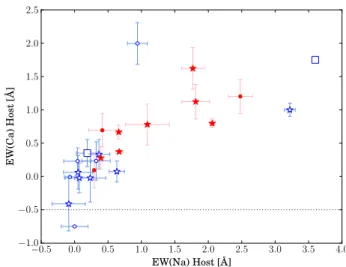
In Figure 2 we plot the measured EWs for the Na and Ca lines divided by the sign of vneb. Red filled sym-bols are SNe with vneb ≥ 0 and blue open symbols, those with vneb < 0. Stars indicate SNe Ia occurring in pixels associated to SF (NCRNUV > 0), circles
indi-cate SNe Ia occurring in pixels with no association to SF (NCRNUV = 0) and squares indicate SNe Ia with no
NCRNUV measurements. SN 2004eo, which only has a
reported non–detection of Na in (Pastorello et al. 2007) and for which we associate a typical error of 0.2 ˚A, is shown below the dotted line. In this figure, SNe Ia with
vneb < 0 appear clustered at relatively low EW values, with three exceptions at high EWs, whereasvneb≥0 SNe Ia tend to have higher EWs in general. This suggests that the intervening CSM absorbs more light opposite to the direction of where the ignition occurs.
The fact that some SNe Ia show high EWs andvneb<0 (3 out of 14) is expected, since in some cases the EWs will be due to host galaxy material and not CSM ab-sorption. Even if their high EWs are due to CSM our KS tests rule out that these exceptions are significant. In particular, SN 1986G and SN 2006dd appear to be lo-cated behind prominent dust lanes of their host galaxies and SN 2006dd has the second highest NCRNUV
statis-tic in our sample (0.827), implying a possible associa-tion with SF. However, SN 2006dd and SN 2009dc have been suggested to show some signs of CSM based on their Na line evolution (Stritzinger et al. 2010) and light curve shape (Taubenberger et al. 2011), hence we cannot rule out that their high EWs are due to CSM.
Most SNe Ia withvneb≥0 in Figure 2 have some de-gree of association with SF (NCRNUV>0), which could
be associated to higher EWs due to non–CSM in the line of sight. However, only 2 out of 10 SNe Ia with
vneb ≥ 0 are strongly associated with SF (NCRNUV ≥
0.5), whereas 4 out of 15 SNe withvneb<0 are strongly associated to SF. This suggests that higher EWs in our sample are not primarily due to host galaxy non–CSM, which is consistent with the excess of blue–shifted Na lines found by Sternberg et al. (2011), and which is sup-ported by the highp–values for the NCRNUVand NCRHα
KS tests in Table 3. It could also be argued that NCR statistics are only a measure of relative SF within galax-ies. To account for this, we have removed early–type galaxies from our sample and repeated the KS tests from Table 2, obtaining significantly lowp–values of 0.022 and
0.018 for the distribution of EW(Na) and EW(Ca), re-spectively.
4. DISCUSSION AND CONCLUSIONS
Our main conclusion is that the distribution of EWs from narrow blended Na and Ca lines differs significantly between SNe Ia with negative and positivevneb. Because the sign of vneb should be purely geometrical, it should not correlate with any host galaxy or average SN prop-erties. This suggests that part of the lines are formed by CSM ejected by the progenitor before explosion, which is found asymmetrically distributed after explosion. The differences in color found for SNe Ia with different vneb
(Maeda et al. 2011), which we confirm using SNooPy and SiFTO light curve fitting, should be explained in part by extinction due to an asymmetric distribution of CSM, and not by different ejecta temperatures with viewing angle alone.
There are two possibilities to explain this result: 1) the CSM material is asymmetrically ejected from the system
before explosion and is aligned with the side of the ejecta where ignition occurs, or 2) the CSM material is initially spherically symmetric and is affected by an asymmetric distortion after explosion, which is stronger on the side where ignition occurs.
One possible physical process that could break the symmetry of the WD and have an effect on both the direction of ignition and the distribution of CSM is rotation. However, rotation should produce cylindri-cally symmetric systems, where positive or negativevneb
should lead to the same average CSM properties in the line of sight. Another possibility is the gravitational field of a companion star, but the typical velocity offsets found for the absorbing material in Sternberg et al. (2011) im-plies that the material was ejected at a time before ex-plosion much longer than the expected orbital period of the progenitor systems, again producing some cylindrical symmetry in average.
extinc-tion after explosion. The fact that the correlaextinc-tions are found to be stronger for dust (colors) than for EW(Na) and EW(Ca) is suggestive, since they are in ascending order of ionization potential. One problem with this in-terpretation could be the constraints in radio and X–ray for CSM–ejecta interactions. This would be solved if the material were placed far enough from the ejecta, and only in some cases allow the ejecta to interact with the CSM, as was seen in SN 2002ic, SN 2006X and 2007le, or if the measured EWs are due to saturated lines in low mass, clumpy CSM with a wide distribution of velocities.
Our results provide hints about the explosion asymme-try and CSM properties of SN Ia progenitors. If a larger sample confirms that most SNe Ia with vneb ≥ 0 have high EWs of Na and Ca absorption lines, the majority of progenitors should contain significant CSM. If this is the case, most SNe Ia with vneb <0 should have more strongly ionizing fields (higher energy photons) after ex-plosion, either during shock breakout, or afterwards if more radioactive material is exposed in the ignition side of the explosion.
Finally, significant CSM is consistent with someMCh– SD or slow DD scenarios (e.g. Fryer et al. 2010) and not with violent DD scenarios. However, in our
interpreta-tion it is difficult to explain the SNe Ia with vneb ≥ 0 and low EWs, which may suggest that multiple progeni-tor scenarios are at work.
We thank the referee for providing important feed-back for this work. F.F., J.A. and G.P acknowl-edge support from FONDECYT through grants 3110042, 3110142 and 11090421. J.A., R.C., F.F, S.G., M.H. and G.P. acknowledge support provided by the Mil-lennium Center for Supernova Science through grant P10-064-F (funded by “Programa Bicentenario de Cien-cia y Tecnolog´ıa de CONICYT” and “Programa Ini-ciativa Cient´ıfica Milenio de MIDEPLAN”). This re-search has made use of the CfA Supernova Archive, which is funded in part by the National Science Foun-dation through grant AST 0907903. We have used The Weizmann interactive supernova data repository -www.weizmann.ac.il/astrophysics/wiserep. Based on observations made with the European Southern Ob-servatory telescopes obtained from the ESO/ST-ECF Science Archive Facility. Based on observations made with the NASA Galaxy Evolution Explorer. GALEX is operated for NASA by the California Institute of Tech-nology under NASA contract NAS5-98034.
REFERENCES
Barbon, R., Buond´ı, V., Cappellaro, E., & Turatto, M. 1999, A&AS, 139, 531
Benetti, S., Cappellaro, E., Turatto, M., et al. 2006, ApJ, 653, L129
Blondin, S., Prieto, J. L., Patat, F., et al. 2009, ApJ, 693, 207 Blondin, S., Matheson, T., Kirshner, R. P., et al. 2012, AJ, 143,
126
Bloom, J. S., Kasen, D., Shen, K. J., et al. 2012, ApJ, 744, L17 Branch, D., Garnavich, P., Matheson, T., et al. 2003, AJ, 126,
1489
Brown, P. J., Dawson, K. S., de Pasquale, M., et al. 2011, arXiv:1110.2538
Burns, C. R., Stritzinger, M., Phillips, M. M., et al. 2011, AJ, 141, 19
Cartier, R., F¨orster, F., Coppi, P., et al. 2011, A&A, 534, L15 Chugai, N. N. 2008, Astronomy Letters, 34, 389
Conley, A., Sullivan, M., Hsiao, E. Y., et al. 2008, ApJ, 681, 482 Folatelli, G., Phillips, M. M., Burns, C. R., et al. 2010, AJ, 139,
120
Foley, R. J. 2012, ApJ, 748, 127
Foley, R. J., Simon, J. D., Burns, C. R., et al. 2012, arXiv:1203.2916,Accepted for ApJ.
Fraser, M., Maund, J. R., Smartt, S. J., et al. 2012, arXiv:1204.1523
Fryer, C. L., Ruiter, A. J., Belczynski, K., et al. 2010, ApJ, 725, 296
Gerardy, C. L., Meikle, W. P. S., Kotak, R., et al. 2007, ApJ, 661, 995
Goobar, A. 2008, ApJ, 686, L103
Hamuy, M., Phillips, M. M., Suntzeff, N. B., et al. 1996, AJ, 112, 2408
Hamuy, M., Phillips, M. M., Suntzeff, N. B., et al. 2003, Nature, 424, 651
Hillebrandt, W., & Niemeyer, J. C. 2000, ARA&A, 38, 191 H¨oflich, P., Gerardy, C. L., Nomoto, K., et al. 2004, ApJ, 617,
1258
Horesh, A., Kulkarni, S. R., Fox, D. B., et al. 2012, ApJ, 746, 21 James, P. A., & Anderson, J. P. 2006, A&A, 453, 57
Jha, S., Garnavich, P. M., Kirshner, R. P., et al. 1999, ApJS, 125, 73
Khokhlov, A. M. 1991, A&A, 245, L25
Kotak, R., Meikle, W. P. S., Adamson, A., & Leggett, S. K. 2004, MNRAS, 354, L13
Maeda, K. et al. 2010, Nature, 486, 82
Maeda, K., Leloudas, G., Taubenberger, S., et al. 2011, MNRAS, 413, 3075
Matheson, T., Kirshner, R. P., Challis, P., et al. 2008, AJ, 135, 1598
Nomoto, K., Thielemann, F.-K., & Yokoi, K. 1984, ApJ, 286, 644 Nonaka, A., Aspden, A. J., Zingale, M., et al. 2012, ApJ, 745, 73 Nugent, P. E., Sullivan, M., Cenko, S. B., et al. 2011, Nature,
480, 344
Pakmor, R., Kromer, M., Taubenberger, S., et al. 2012, ApJ, 747, L10
Pastorello, A., Mazzali, P. A., Pignata, G., et al. 2007, MNRAS, 377, 1531
Patat, F., Chandra, P., Chevalier, R., et al. 2007, Science, 317, 924
Perlmutter, S. et al. 1999, ApJ, 517, 565
Phillips, M. M., Phillips, A. C., Heathcote, S. R., et al. 1987, PASP, 99, 592
Phillips, M. M. 1993, ApJ, 413, L105 Riess, A. G. et al. 1998, AJ, 116, 1009
R¨opke, F. K., Kromer, M., Seitenzahl, I. R., et al. 2012, ApJ, 750, L19
Silverman, J. M., Ganeshalingam, M., Li, W., et al. 2011, MNRAS, 410, 585
Simon, J. D., Gal-Yam, A., Gnat, O., et al. 2009, ApJ, 702, 1157 Sternberg, A., Gal-Yam, A., Simon, J. D., et al. 2011, Science,
333, 856
Stritzinger, M., Burns, C. R., Phillips, M. M., et al. 2010, AJ, 140, 2036
Taubenberger, S., Benetti, S., Childress, M., et al. 2011, MNRAS, 412, 2735