Facultad de Educación y Trabajo Social
Facultad de Filosofía y Letras
Máster en Profesor de Educación Secundaria Obligatoria, Bachillerato,
Formación Profesional y Enseñanza de Idiomas
TRABAJO FIN DE MÁSTER
PLURILINGUALISM, PLURICULTURALISM AND
MEDIATION IN THE CLASSROOM:
TOWARDS A NEW PERSPECTIVE
.
Autora: Sofía Arranz Ortega
Tutora: Elena González-Cascos Jiménez
“Las personas no nos quieren por lo que somos, sino por cómo les hacemos sentir”.
Abstract
This Final Master's Dissertation is based on the latest European proposal (CEFR, Companion Volume, 2018) that updates and encourages the promotion of mediation and plurilingualism – together with pluriculturalism – in all levels of language teaching. Through the development of these communicative competences in class, our students will obtain multiple benefits at individual and societal levels. They will also adapt themselves with ease to the current dynamic and globalized reality. As a result of the incipient need for communication in several languages and the increase in plurilingual contexts, our society requires of citizens to play a role as social agents and mediators through foreign languages. To this aim, teacher and student training is a must in education. Taking into account these aspects, a cross-curricular, task proposal of intervention has been designed to implement this real-life scenario in the classrooms. Its theoretical background and its methodological process lead into interesting reflections that are exposed in the conclusions of this dissertation.
Keywords: Mediation, Plurilingualism, Pluriculturalism, Action-Oriented Approach.
Resumen
CONTENTS
Presentation ... 1
Introduction ... 3
Justification ... 5
Objectives ... 7
PART ONE: THEORETICAL FRAMEWORK. ... 9
1. Language education policies in Europe: a common map, a common goal. ... 9
1.1. The Common European Framework of Reference (2001). ... 10
1.2. The Companion Volume (2018): CEFR updates. ... 11
2. The notion of mediation.... 13
2.1. Interpretations of mediation. ... 16
2.2. Mediation conceptual model. ... 17
3. Plurilingual and pluricultural competence: a plural approach. ... 19
3.1. Pluriculturality and Interculturality. ... 19
3.2. Plurilingualism and Multilingualism. ... 20
3.2.1 Narrowing Plurilingualism and Multilingualiguism in the CEFR/CV. ... 21
3.3. Plurilingual and pluricultural competences. ... 23
4. From conceptualization to practice: scales and descriptors. ... 26
4.1. Mediation scales. ... 26
4.1.1. Core scales. ... 28
4.1.2. Other scales. ... 29
4.1.3. Mediation descriptors examples. ... 29
4.2. Plurilingual and pluricultural competence scales. ... 33
4.2.1. Plurilingual and pluricultural competence descriptors examples. ... 34
5. Implications of plurilingualism and mediation in language education through the action-oriented-approach. ... 36
6. Spanish Curriculum Information. ... 39
PART TWO: METHODOLOGICAL CONSIDERATIONS... 43
7. Design of a task proposal of intervention. ... 43
7.1. Contextual and socio-educational analysis. ... 43
7.1.1. The high school (I.E.S.). ... 44
7.2. First considerations for the design of the task proposal. ... 47
7.3. Justification of the task proposal. ... 48
7.4. Aims of the task proposal. ... 50
8. Presentation of our task proposal of intervention.... 52
8.1. Task 1. ... 52
8.2. Task 2. ... 55
Conclusions. ... 62
References. ... 64
Appendices. ... 69
Appendix 1. ... 69
Appendix 2. ... 72
1 Presentation
El presente documento titulado Plurilingualism,pluriculturalism and mediation: towards a new perspective, corresponde a la asignatura Trabajo Fin de Máster con código 51774, de carácter obligatorio. Además, supone la finalización de los estudios de posgrado en Máster en Profesor de Educación Secundaria y Bachillerato, Formación Profesional y Enseñanza de Idiomas. Ha sido realizado por Dña. Sofía Arranz Ortega y tutelado por Dña. Elena González-Cascos Jiménez, coordinadora del máster en la especialidad de lenguas extranjeras y profesora del Departamento de Inglés de la Universidad de Valladolid.
El objetivo general de este Máster profesionalizante es conocer la labor docente, manejar diferentes ramas de investigación dentro del contexto educativo, así como potenciar la formación de los docentes con un carácter autónomo y continuo, sobre todo en la enseñanza de lenguas extranjeras. Durante el curso 2017/18, la realización de este posgrado ha puesto a disposición del alumnado la adquisición de competencias generales y especificas desarrolladas en las catorce asignaturas que componen su plan de estudios. Pienso que la gratitud en silencio no sirve a nadie. Por ello, es a todos los profesores de ese contexto formativo universitario, en concreto a los profesores que han formado parte de este Máster, a quienes me gustaría mostrar mi gran agradecimiento por sus enseñanzas e implicación en mi proceso formativo a la docencia. Especialmente, me gustaría dar las gracias a mi tutora Dña. Elena González-Cascos, por sus consejos en la elaboración de este Trabajo y a Dña. Pilar López Labrador, que tanto aportó en mi base de inglés y de la que tanto he aprendido en mi periodo de prácticas. Asimismo, mi agradecimiento a Dña. Raquel Fernández Fuertes y a todos los componentes de UVALAL, por contar conmigo para seguir un gran camino en la investigación de adquisición del lenguaje.
3 Introduction
The current society is characterized by its remarkable heterogeneity, which arises from the growing phenomenon of globalization. Technology, migratory movements, tourism or the economy are some of the reasons why the necessity to be in contact – online or offline – with people from all over the world has played an essential role in today's society. This growing communicative need makes it essential for us to develop broader and more dynamic perspectives in our society: an increasingly diverse and plural society. Therefore, education should help to broaden these aforementioned perspectives of knowledge, mediating between the cultural and linguistic differences and similarities of each community.
5 Justification
The elaboration of this final master dissertation comes from a personal and professional interest in contributing to the improvement of the quality of education and, in particular, the teaching of foreign languages. My previous Bachelor’s degree in English Studies and the collaboration with the UVALAL (University of Valladolid Language Acquisition Lab) allowed me to lay a firm foundation upon disciplinary contents. Necessary linguistic knowledge which was complemented with the studies of the present Master, in which I have acquired the educational perspective required to address my future professional career in the teaching of foreign languages.
7 Objectives
To expand upon what has been exposed in the previous sections, and according to the characteristics of a Master's final dissertation, the object of study is articulated in the following objectives, the general and the subsequent specific ones:
x To identify the latest educational language policy and the new situation of scenarios and curricular programs that, in the matter of mediation, are promoted by the European Council at all levels of language teaching.
x To understand the new European perspective of Education through a thorough research on the updates of the educational language policies, contrasting CEFR 2001 and CEFR/CV 2018.
x To carry out an exhaustive analysis on the new CEFR/CV that regulates the teaching of foreign languages throughout Europe: new descriptive scheme, scales and descriptors.
x To understand the broadened concept of mediation across languages and cultures as a principle and one of the keys of the new European aims in Language Education.
x To design a proposal of intervention based on plurilingualism, pluriculturalism and mediation to be implemented as cross-curricular tasks at a B1 level of every foreign language (English L2, French or German L3).
9
PART ONE: THEORETICAL FRAMEWORK.
1. Language education policies in Europe: a common map, a common goal.
The increase of education in foreign languages arises mainly for a cause: the coexistence of social groups from different origins, languages and cultures as a result of the globalization process. The fulfilment of a mutual understanding among citizens and countries underpins the concept of a strong, unified Europe on the worldwide scene. In 2018, the European continent is formed by 49 countries, out of those 28 are member countries of the European Union, all of them characterized by their own language or languages and cultures. In order to avoid any kind of conflict among these linguistic and cultural heteronomy, education plays an utmost important role.
There is a considerable contingency of new approaches pedagogies that allow an evolution towards the treatment of the study of diverse languages in the educational curriculum, as a result of the enormous need to improve the quality of teaching languages. In order to achieve this evolution, it is fundamental to involve the teaching staff through a training that allows them to approach the plurilingual context to the reality of the classrooms. The European education has some common goals and take our political decisions. These political decisions on education are made, according to Beacco et al. (2010), taking into account 2 main aspects: first, general principles or values (equality, freedom of the individual, diversity acceptance, etc.); secondly, the congruence between the measures intended to be taken and external aspects, such as, the resources available, the priorities of the society or the time required for their implementation. These two aspects are the starting point for every elaboration of educational linguistic policies carried out by the Council of Europe. Moreover, thanks to these policies, there is a growing tendency to value the teaching of foreign languages available to the modern society.
10 explained –, communication in the mother tongue, communication in foreign languages, social and civic competences, as well as cultural awareness and expression.
1.1. The Common European Framework of Reference (2001).
Since 1971, little research had been done on the field of language learning, teaching and assessment. Not until that date had the Project Group Language Learning for European Citizenship - all member countries of the Council for Cultural Co-operation- together with Canada as a participating observer, actively pursued the elaboration of this project. As a result, the Common European Framework of Reference (CEFR) for language learning, teaching and assessment represented the latest stage till 2001.
The Common European Framework provides a common basis for the elaboration of language syllabuses, curriculum guidelines, examinations, textbooks, etc. across Europe. It describes in a comprehensive way what language learners have to learn to do in order to use a language for communication and what knowledge and skills they have to develop so as to be able to act effectively. The description also covers the cultural context in which language is set. The Framework also defines levels of proficiency which allow learners’ progress to be measured at each stage of learning and on a life-long basis. (…) The Common European Framework is intended to overcome the barriers to communication among professionals working in the field of modern languages arising from the different educational systems in Europe. It provides the means for educational administrators, course designers, teachers, teacher trainers, examining bodies, etc., to reflect on their current practice, with a view to situating and co-ordinating their efforts and to ensuring that they meet the real needs of the learners for whom they are responsible. (CEFR 2001, p.1.)
11 modes could happen in written and oral forms. The learner was seen as a social agent. In other words, somebody that acts in society. Finally, the CEFR also introduced a new and potentially very innovative concept: the Plurilingualism Competence. (Coste, D., Moore, D. and Zarate, G. (1997)).
However, mediation had not been developed in the CEFR 2001 and that has been the core of the new European Commission launch: The Companion Volume (CEFR/CV, 2018) which has fully developed the competence of plurilingualism, media and literature with new descriptors, hand-in-hand with mediation. Not only that, this latest volume also works as the beginning of the conceptualization of the action-oriented approach, which will be explained in the section ‘implications of plurilingualism and mediation in language education’.
1.2. The Companion Volume (2018): CEFR updates.
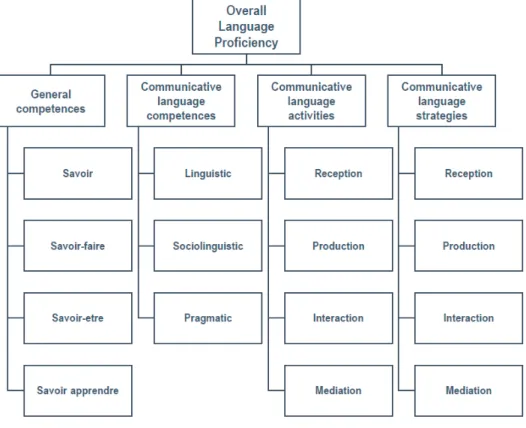
In this section, we outline the CEFR/CV Descriptive Scheme and which elements, such as interaction and mediation, are being added compared to the previous CEFR. In order to have a clear idea of the elements which will further explain in this section, it is important to see how the CEFR/CV is schematized in figure 1. (CEFR/CV, 2018 p.30)
12 On the other hand, figure 1 is not new itself. As we have mentioned, it is an update of the CEFR 2001, a document that continued with the basics of the communicative approach (Little, 2005).
The CEFR does not focus exclusively on the behavioural dimension of L2 proficiency. It also offers a scaled summary of what it calls ‘qualitative aspects of spoken language use’ – range, accuracy, fluency, interaction, and coherence (Council of Europe, 2001: 28–29) – and scaled descriptions of general linguistic range, vocabulary range, vocabulary control, grammatical accuracy, phonological control, orthographic control, sociolinguistic appropriateness, flexibility, turn-taking, thematic development, coherence and cohesion, spoken fluency, and propositional precision (Council of Europe, 2001 p.110–129).
It maintained the reception and production (written and oral) concepts through the four communicative skills. It also considers the idea of setting the focus on the speaker or hearer, together with distinguishing a two-way typology in the communicative code: accuracy or fluency. However, CEFR 2001 also launched some ideas towards a new prospective vision. The two new aspects were interaction and mediation, even though they were little explained. First, interaction deals with the idea of negotiating meaning and giving importance to that process of negotiation, such as, participating in a dialogue. In the new companion volume, the communicative language activities and their strategies form the two columns on the right, and they include reception, production, interaction and mediation. The other two left hand-side columns are the general and the communicative language competences.
Interpreting the CEFR/CV, we understand that in any communicative situation, the general competences - the so called “savoirs”: know how to be, how to do, and how to learn - work always together with the communicative language competences (linguistic, sociolinguistic and pragmatic competences), and strategies (communicative language strategies) in order to complete a task.
13 and language use, and practical tools, in the form of illustrative descriptors, to facilitate the development of curricula and orientation of teaching and learning. (CEFR/CV 2018, p.23)
The previous fragment shows that the CEFR/CV has updated the CEFR in several ways, out of them we are going to pay special attention to six principal aspects.
x First, the CEFR/CV has eliminated the idea of the native speaker which was never a target but it still existed in the previous policy. “The amendment of a small number of ‘absolute’ statements at C2 is intended to better reflect that the CEFR/CV illustrative descriptors do not take an idealised native speaker as a reference point for the competence of a user/learner.” (CEFR/CV, 2018 p.45)
x Secondly, it has also enriched some of the scales at the bottom levels and at the top level, defining ‘plus levels’ and a new ‘Pre-A1’ level. That is, enriching the description at A1, and at the C levels, particularly C2.
x In third place, it has particularly completed the CEFR with the new concepts of mediation, which has not been developed before.
x Fourthly, the CEFR/CV has also developed different constructs, in particularly, the phonological competence and the plurilingual and pluricultural competences.
x In fifth place, there are more elaborate descriptors of listening and reading in existing scales, and in the new descriptors included communicative competences of mediation. For example, activities such as “online interaction”, using telecommunications, expressing reactions to creative text and literature.
x Finally, in a sixth place, it has also made a redefinition of the pedagogical vision through the action oriented approach (AOA), in order to learn languages in real-life situations, using the target language in meaningful ways.
2. The notion of mediation.
14 disagreement by helping the two sides to talk about and agree on a solution”. Nonetheless, mediation also comprises other related connotations:
1. In the legal system: “nonbinding intervention between parties to promote resolution of a grievance, reconciliation, settlement, or compromise” (Merriam-Webster Online Dictionary). Thus, it is related to diplomatic mediation as a conflict-resolution or commercial mediation as a way of arbitration or counselling.
2. In philosophy, Hegel (1817) defines Vermittlung (mediation) as an abstract operation through which knowledge is acquired. He even distinguishes some phases in acquiring that knowledge in his work about philosophy of natural religion. “The stages of the development of experience are Consciousness, Self-consciousness, Reason, the latter leading to its highest level – finite Spiritual existence.” Meaning that we mediate for our self-knowledge.
3. In pedagogy and education, Vygotsky (1962, 1978) understands that social interaction and mediation play a fundamental role in the development of cognition. He was the first one who said that first of all there is the social interaction and mediation and then we integrate and conceptualize for ourselves.
4. Considering the intercultural aspects and symbolic competences (Kramsch, 2002). Mediation is considered as a cultural process of creating a shared safe “third space”. And Zarate (2003, 2004) also adds that mediation is acting in a plural area to bring people together and recognize and negotiate difference. All in all, in languages, we navigate at different identities, different cultures. So, there is a form of third space where we must negotiate / mediate our differences in order to understand each other. For all these reasons, it is of teacher’s duty to transfer this knowledge to their students.
15
- Language as an intermediary: “in mediating activities, the language user is not
concerned to express his/her own meanings, but simply to act as an intermediary between interlocutors who are unable to understand each other directly, normally (but not exclusively) speakers of different languages…” (CEFR section 4. English p.87.)
- Processing and reprocessing texts activities occupies an important task in our society, something that we do in our everyday life: “Mediation language activities, (re)processing texts, occupy an important place in the normal linguistic functioning of our societies” (CEFR, Section 2. English p. 14)
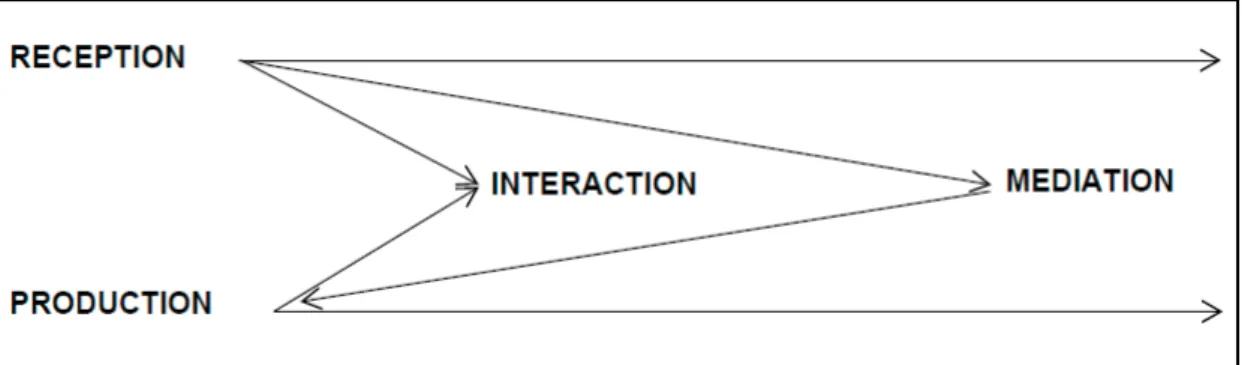
As we can see, it was not much covered. Surprisingly enough, that mediation has been already mentioned in the two previous CEFRs, in 1996 and 1998, as in figure 2.
FIGURE 2 Reception Production Interaction and Mediation Scheme (CEFR)
But, the European Council did not contemplate those concepts in the 2001 proposal. Consequently, they vanished, somehow, until 2018. Once the mediation scheme (figure 2) has arisen again in 2018 we could interpret it for its educational purpose. As we can observe, reception and production were interconnected by the role of interaction, taking a bit of both concepts and resulting in a further step, namely, mediation.
Moreover, the CEFR/CV introduces the concept of mediation as follows:
16 access. Mediation language activities, (re)processing an existing text, occupy an important place in the normal linguistic functioning of our societies. (CEFR/CV, 2018 p. 32)
Apart from the two quotes and the scheme above presented, mediation in the seminal works of the scientific literature, conceptualizes language as:
“An activity” (Thorne and Lantolf, 2007 p.171)
“A dynamic process of shared meaning, which creates and transforms itself
through interactions of individuals with their environment” in didactic of languages (Aden, 2012. p.275)
“A complex dynamic system” In applied linguistics, language acquisition
(Larsen-Freeman, 1997, 2002)
“Socialization into communities of practice” in sociolinguistics (Kramsch, 2002
p.6)
“A process that allows overcoming separation between individuals and culture/
society” in the cultural-historical activity theory as a theoretical approach in
studies on the process of transformation and learning in work-related activities (Engeström, 1999)
2.1. Interpretations of mediation.
These dimentions of mediation, above presented, were then distilled into different kinds according to three different fields of study of knowledge: social/cultural, conceptual/pedagogical and linguistic/textual. So, when talking about the legal system, diplomacy, or counseling, we are focusing on the social /cultural aspects; when we talk about the philosophical and pedagogical aspects - as an abstract operation or its role in the development of cognition - we focus on the conceptual and pedagogical aspects; and finally, considering the language, implying reformulation, code-switching1,
17 translanguaging2, moving from oral to writing or changing literature genres, we focus on linguistic and textual field of study.
This wider approach has been taken because of its relevance in increasingly diverse classrooms, in relation to the spread of CLIL, (Content and Language Integrated Learning), and because mediation is increasingly seen as a part of all learning, but especially of all language learning. (CEFR/CV, 2018 p.34).
As a result, the CEFR/CV distinguishes these six types of mediations: social, cultural, conceptual, pedagogical, linguistic or textual.
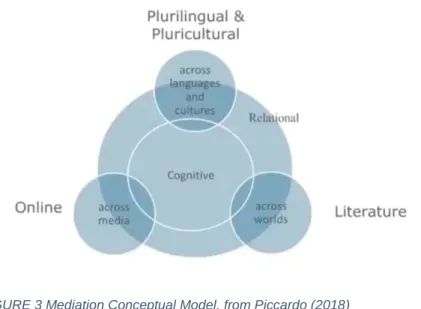
Nowadays, thanks to the advances in technology, some other types of mediation are also considered in the new updates of the last European Council document. We can also mediate in a non-shared space nor time, thanks to media, namely internet and telecommunication. In order to translate this conceptualization of media and the above mentioned mediations, the CEFR/CV has developed a mediation conceptual model (See image below), characterized for its applicability at an educational environment. That is to say, the CEFR/CV ultimate goal is to be of greater use in the teachers’ and students’ daily routines in the classroom.
2.2. Mediation conceptual model.
FIGURE 3 Mediation Conceptual Model, from Piccardo (2018)
18 The CEFR/CV proposes this conceptual model for mediation. It shows that we have always a cognitive and relational aspect, which are not separated. They are basically one embedded in the other. Psychologists like Vygotsky said “interaction and mediation play
a fundamental role in the development of cognition”. So, the two things are really
embedded one in the other. As a result, mediation can be across languages and cultures; mediation can be across words through literature, and, mediation can also be online across media. In general terms, mediation -per se- covers the two central circle but it also extends to the other three.
In the CEFR 2001, there were very few descriptors for mediation in oral interaction and almost none for written interaction. In the class only predominated the four skills, oral interaction took place within the classmates, if any, and written “interaction” could take place in very few contexts like pen friends. However, technology has played a turning point regarding this topic, nowadays we continuously interact, written and orally, through languages and cultures, media and literature. For this reason, the CV/CEFR descriptors for interaction and mediation aim to have greater consideration in the present and future education, in the classroom level, textbooks, state exams, curriculum, etc. The CV CEFR in their conceptual model have broaden and shed light into three main categories, across languages, across media, across literature. Firstly, mediation across languages and cultures – plurilingualism, as a more dynamic process than presented in the CEFR 2001- mediation across media thanks to the technological evolution in the 21th Century – it can be synchronous or asynchronous with open-ended or goal-oriented interaction – and, lately, mediating across literature – in the sense that in literature we are also mediating between the personal reactions (own emotions, internal dialogue with the author) and the formal and intellectual reaction (comparing, or critically evaluating) – .
19 at the same time, also work on those texts and concepts from a double perspective: individual and social.
3. Plurilingual and pluricultural competence: a plural approach.
The Council of Europe (2007) states that “Recognising the significance of language education in a multilingual Europe, the Council of Europe recommends the promotion of linguistic diversity in member States and plurilingualism for their citizens” (p.17).
The plurilingual and intercultural education has recently been presented as the right way to a positive social coexistence and rich in educational, economic, and social fields (Coste et al. 2009). The value of plurilingualism lies in the promotion of communication and mutual understanding. Consequently, educating in plurilingualism is a synonym of educating in respect and tolerance through adaptation and mediation.
To better understand what has meant the principal route towards a common language regulation in the Europe education - the Common European Framework of Reference, and its new updates (CEFR/CV) - it is important to delineate some of the key concepts and ideas presented through the whole of this dissertation.
First of all, we will disambiguate the notions of plurilingualism and interculturality from their respective associated concepts. Secondly, we will see the reflection of these concepts turned into competences on the education policies to set down the goals of language education.
3.1. Pluriculturality and Interculturality.
The plurilingual diversity in Europe not only exists in languages, it also implies a direct relation with the languages’ culture.
20 sociocultural competence”. So, in order to face the cultural misunderstandings that are not caused by linguistic reasons, we have to educate in mediation to this aspect.
In order to avoid confusion of terms, it is important to distinguish between interculturality and pluriculturality.
First, Beacco et al. (2010, p.16) defines pluriculturality as “the desire and ability to identify with several cultures, and participate in them – the identification with two (or more) social groups and their cultures –”. He also defines interculturality as “the ability to experience another culture and analyse that experience, that is, the competences for critical awareness of other cultures.” In other words, pluriculturality deals with the ability and identification of various cultures, whereas interculturality implies an analysis, a critical learning of other cultures. But pluriculturality and interculturality may complement each other resulting in the develop of the pluricultural competence, the one to be developed in the classroom. The same author points out some of the benefits of the acquisition of this competence:
This pluricultural competence, acquired from analysing this experience, helps individuals to understand cultural difference better, establishes cognitive and affective links between past and future experiences of that difference, mediates between members of two (or more) social groups and their cultures, and questions the assumptions of their own cultural group and milieu. Beacco et al. (2010, p.16)
3.2. Plurilingualism and Multilingualism.
Plurilingualism is contemplated in the MacMillan Dictionary as “the ability to use skills in a number of different languages for effective communication (…) and one of the goals of the CEFR.” Adopting Cots’ (2010) point of view, it should be noted that “plurilingualism should not be presented as a mere quantitative change in the number of languages present in the speaker's linguistic heritage, as this presence of additional languages affects the system general language of the learner, which naturally leads to changes of a qualitative nature"(trans. p.24)
21 the languages in the classroom, which are often ignored or segregated from the collective reality that students perceive during school hours. (p.24)
As a result, we agree that the education of foreign languages in a globalized society must be plurilingual and pluricultural – which embeds interculturality –, bearing in mind that humans use language as an instrument and as a way of integration without misunderstandings among the individuals of a society.
As stated in the CEFR and projecting the previous notions into the educational field, the purpose of plurilingual education lies on the development of the plurilingual and pluricultural communicative competences of the student. The acquisition of these competences will provide the learner with practical cognitive and linguistic resources. In this way, the progressive use of the linguistic repertoire is gradually acquired, in order to optimize the communication process among people.
3.2.1 Narrowing Plurilingualism and Multilingualiguism in the CEFR/CV.
From the CEFR 2001 section 1.3, we can establish a key distinction between multilingualism and plurilingualism. Multilingualism is there defined as “the knowledge of a number of languages or the co-existence of different languages in a given society”. On the other hand, plurilingualism is a much more dynamic process.
According to the CEFR (2001) the plurilingual competence involves “the ability to switch from one language or dialect to another, to express oneself in one language and understand the other, to call upon the knowledge of a number of languages to make sense of a text, to recognise world from a common international store in a new guise, mediate between individuals with no common language by bringing the whole of their linguistic equipment into play, experiment with alternative forms of expression in different languages or dialects, exploiting paralinguistics (mime, gesture, facial expression, etc.) or radically simplying their use of language”
As we have just observed through these quotations, the CEFR 2001 section 1.3 also embedded mediation, but not explicitly.
22 different languages at the social or individual level” and plurilingualism is” the dynamic and developing linguistic repertoire of an individual user/learner”. (p.28)
A. Multilingualism
Multilingualism can be studied at an individual level and a societal one.
- At an individual level we can distinguish several languages in which the mother tongue would be named as the L1 and, accordingly to the proficiency or usage of the other languages, they would be labelled as L2, L3, L4. L5 … respectively.
- Nonetheless, multilingualism at a societal level refers to the sum of languages that exist in the society. Taking a community aside, it can be monolingual or multilingual, embedding several languages – considered separated fields of study –.
B. Plurilingualism
23 On the other hand, plurilingualism in the CEFR/CV states that the learner’s mind is not in its original pure state but it is influenced by the learner’s mother tongue or various mother tongues and their cultures. Thus, plurilingualism is a network that facilitates multiple connections between the languages of the individual and the individual as a whole within a society. Besides, plurilingualism defends that errors are a natural process of learning, in which the process of transfer between languages and cultures (L1, L2, L3…) may be shown. Finally, the last key of this circular spiral process is the idea of the learner being aware of their own process of learning, being conscious of the learning journey. This last idea might connect to the movement initiated by Hawkins (1984) who proposed the subject “awareness of language” into the British curriculum. This approach considers two simultaneous phases: the language learning and the curiosity process. The language learning consists in learning about the language and culture, and at the same time, complementing it by stimulating not only the learners’ curiosity and interest on this field but also their observation and language analysis skills. Hawking’s objectives focused on challenging learners to ask questions about language and culture, and then, discuss the diversity of them in order to establish the basis of a general “language education”. The “general language education” was already mentioned in the CEFR (2001, p.169), but now, through mediation and plurilingualism, the CV/CEFR (2018) puts forward the awareness of the learning process, error making, and the interconnection of languages and cultures as major issues for language teaching.
3.3. Plurilingual and pluricultural competences.
In 1995, the Cannes European Council launched the White Paper On Education and Training Teaching and Learning *** Towards The Learning Society, in which its fourth general objective was written as “proficiency in three community languages”, and developed as followed:
24 characterised by different cultures. (…) Proficiency in languages helps to build up the feeling of being European with all its cultural wealth and diversity and of understanding between the citizens of Europe. (p.47)
In other words, learning a foreign language must also consider its culture learning. This attempt of an educational language policy also affirms the direct relation between language and culture, aspects that cannot be separated neither in the (high)schools nor in the educative policies. On these lines, Castro Prieto (1999) claims that “la educación juega un papel esencial por su carácter de integración social” (p. 41). She considers it to be extremely helpful for the individuals to take values such as tolerance and acceptance, in order to accomplish a better societal coexistence. Thus, it seems necessary to include the plurilingual and pluricultural competences within the foreign language learning curriculum that the CEFR/CV has recently updated.
The concept of competence is generally known for being introduced into linguistics by Chomsky in the 1960s. For him, competence was “the underlying system of rules that has been mastered by the speaker-hearer” (1965, p. 4). However, Chomsky’s decontextualized definition of competence was not broadly accepted. Almost ten years later, the linguist, Dell Hymes, introduced the notion of “communicative competence” (1972) as the ability to use language meaningfully in specific real-life situations. Later on, experts of the communicative competence understood language as “an active entity that varies according to the situation and the message that the speaker wants to convey in that language or through various languages.” Considering that, they included different aspects to the communicative approach throughout history. For instance: Canale & Swain (1980) considered the communicative approach as grammatical, sociolinguistic, and strategic. Canale (1983) added “discursive” to the previous features. However, Moirand (1982) considered it to be linguistic, discursive, referential, and sociocultural. Whereas Bergeron, Desmarais & Duquette (1984) characterized the communicative competence as linguistic, referential, sociocultural, sociolinguistic, and strategic. When developed a common European reference framework for the teaching and learning of languages in 2001, competence was defined as “the sum of knowledge, skills, and characteristics that allow a person to perform actions (CEFR, 2001. p. 9)
25 Plurilingual and pluricultural competence refers to the ability to use languages for the purposes of communication and to take part in intercultural interaction, where a person, viewed as a social agent has proficiency, of varying degrees, in several languages and experience of several cultures. This is not seen as the superposition or the juxtaposition of distinct competences, but rather as the existence of a complex and even composite competence on which the user may draw (p.105).
The CEFR/CV values and broadens for the first time the so called “uneven plurilingual competence”. The “uneven plurilingual competence” was pioneered in the CEFR 2001 (section 6, 1.3.1 – 1.3.2), considering the idea of linguistic and cultural diversity valuing dynamic and changing profiles. This competence is characterized for the following aspects:
x Plurilingualism abandons the idea of reaching a “perfect bilingualism”. We
abandon the deficient perspective that we can't say we are bilingual until we reach a perfect level - admittedly that there is a perfect level-. Studies have shown that a perfect level in bilingualism doesn't exist, Prof. François Grosjean explains these kind of myths about bilingualism in his book, Life and Reality (Harvard University Press, 2010).
x Plurilingualism is an uneven competence that continues to improve and advance but sometimes regress whenever the person does not use that language. Even though the idea of regression does not imply that the learner cannot advance again after having regressed some stages. Plurilingualism is a not compartamentalized competence because it allows interrelation and interaction between languages. In other words, it is a changing competence in that it allows code-switching. According to Cantone & Müller (2008), “Code-Switching (CS) is the ability of the bilingual speaker to use both languages within a discourse, or within an utterance according to grammatical and socio-linguistic constraints”. That is, code-switching is the ability of a plurilingual speaker to move back and forth between two or more languages depending on the context of a conversation.
26 evolve and promote our students’ plurilingual and pluricultural competences in the classroom?
4. From conceptualization to practice: scales and descriptors.
Considering all the previous sections, the concepts of plurilingualism and pluriculturalism have lately taken special importance. Following these language education policies, every committed teacher of foreign languages must be able to identify the need for new learning challenges, which speed up the development process of plurilingual and pluricultural competence across mediation. To this end, the teacher and the foreign language learner must have knowledge of the broadest educational legislation at the present, proposed by the European Commission. The ultimate purpose of these legislations is that the individual is able to adopt a vision of cultural diversity as enrichment of their language learning. However, it was not until 2018 the European Council has fully developed descriptors in the language teaching and learning education including mediation in 3 ways: across language and cultures, media and literature. The updated conceptual models and descriptors aim to accomplish new goals in the language education, adapted to the present society and real-life scenarios. For this reason, the following chapter of this dissertation is going to describe the new Companion Volume conceptual model and the new mediation descriptors and scales, which will lead us to reflect on their implications in the classroom.
4.1. Mediation scales.
What type of mediation can we use in class? In any case, teacher training on mediation is essential so they will be working on students’ attitudes towards texts, communication – linguistic and cultural diversity – and concepts. In Castro Prieto’s words, “se hace necesaria una atención especial a la formación del profesorado que prepare para los encuentros interculturales inevitables en una Europa sin fronteras, plurilingüe y multicultural” (1999, p. 43).
27 - creating space and managing tensions, counselling conflicts, regular resolution and guidance reminds more of the idea of mediation as a mediating communicator.
- whereas constructing or reconstructing meaning and knowledge which is both social and individual gives the idea of mediating concepts.
- Something that we do all the time in classes, that is reformulating transcoding, alternating language, switching oral to written, changing genres, combining texts and other modes goes to the category mediating text.
Having considered mediation in class, and in order to support students to take responsibility of their own learning process, act strategically in a communicative situation and, more specifically throughout the students’ teaching and learning, the CEFR/CV has operationalized the four categories: mediating communication, concepts, texts and strategies. Of course, in languages, there can always be an overlapping of these categories.
- Mediating a text refers to the idea of relaying specific information, explaining data of figures, processing texts, translating written texts or, listening with simultaneous note-taking.
- Mediating strategies deal with the linking to previous knowledge, breaking down complicated information, adapting language, elaborating a dense text or streamlining a text.
- Mediating concepts implies the idea of facilitating collaborative interaction in the class with peers, collaborating together to construct a meaning (for example, to make sense or understand a text while doing interaction), or encouraging conceptual thought. From, both, the teacher and the student position.
28 The CEFR/CV has summed up all the mediation categories and characteristics in one chart in order to synthesises the information.
4.1.1. Core scales.
Connected to the foreseen information, the CEFR/CV indicates that mediation occurs across languages and within one language. That is to say, mediation occurs when two people don't understand each other because they don't speak the same language (different languages). But, it also occurs across varieties of languages (dialects) and registers (from very formal to very casual register). For example, in order to present a very high academic text, the teacher would have to mediate and simplify it for their learners. In the same way as if the text would be written in another dialect or in another language. All in all, mediation must be considered as dynamic and flexible across and within languages. These mind-map is reflected at every level of the language learning process. Starting from the left hand side column of the “mediation activities” mind-map, the scales for mediation are presented in three groups. They reflect the way in which mediation tends to occur.
1. Mediating a text
► Relaying specific information – in speech and in writing
► Explaining data (e.g. in graphs, diagrams, charts etc.) – in speech and in writing
► Processing text – in speech and in writing
► Translating a written text – in speech and in writing
► Note-taking (lectures, seminars, meetings, etc.)
► Expressing a personal response to creative texts (including literature)
► Analysis and criticism of creative texts (including literature) 2. Mediating concepts
► Collaborating in a group
► Facilitating collaborative interaction with peers
► Collaborating to construct meaning
► Leading group work
► Managing interaction
29 3. Mediating communication
► Facilitating pluricultural space
► Acting as intermediary in informal situations (with friends and colleagues)
► Facilitating communication in delicate situations and disagreements
4.1.2. Other scales.
This part of “other scales” refers to the three external circles (across languages and
culture, across media, across worlds) from the mediation conceptual model, that we covered in the last part of the section no. 2.2
Thus, the “other scales” that require a form of mediation are three: plurilingual and pluricultural competence, online interaction and literature.
x Plurilingual and Pluricultural competence evokes to the concept of mediation across languages and cultures, through plurilingual and pluricultural competences. The teacher/learner builds on a pluricultural repertoire, plurilingual comprehension and, also, builds on plurilingual repertoire.
x Online Interaction is the type of mediation across media. It is undertaken through online conversation and discussion, and, goal-oriented online transactions and collaboration.
x Literature refers to mediation across worlds. It helps to express a personal response, analysis and/or criticism of a creative text. In the same way that reading helps as a leisure activity with multiple benefits in the education field, for students and teachers. Mediation literature is a big addition in the CEFR/CV, it helps the teacher not only to work on literature from a linguistic point of view, but also to deal with it in the sense of a tool that connects us with other words, both in time or in space.
4.1.3. Mediation descriptors examples.
Un
) the main points made in long
Un
provided the topic is within his/her field of intere
33 As we can see, many descriptors refer to both languages A and B. It is interesting to mention that some countries, like Austria or Greece, have already introduced this methodology in their state exams. Namely, the Austrian Reifeprüfung or matura exam. In this Reifeprüfung, students have different leaflets or documents in a language A that they need to mediate with, and relay the information in language B. (Ortega., Piccardo, 2018). These descriptors give teachers an ultimate useful tool to guide them into the new possibilities of what can be done in a class, from a renewed perspective. CEFR/CV aims to make mediation visible and give it space in the classrooms.
4.2. Plurilingual and pluricultural competence scales.
The Companion Volume refers to plurilingualism in three main scales: plurilingual comprehension, building on plurilingual repertoire and building on pluricultural repertoire. (CEFR/CV p.159-162)
• Plurilingual comprehension focuses on the comprehensive aspects, as a practical and functional ability to comprehend plurilingualism within a context.
• Building on plurilingual repertoire focuses on the linguistics aspects and calibrates the practical and functional ability to exploit plurilingualism.
• Building on pluricultural repertoire focuses on the cultural aspects.
34 bearing in mind notions such as time, space, social relations, and so forth. (Piccardo, 2018).
A number of foundational resources made it possible to develop curricula related to the Threshold Level (van Ek, 1975), subsequently published in French as Niveau Seuil (1976); The Notional-Functional Syllabus (Wilkins, 1976); Teaching Language as Communication (Widdowson, 1978); and Enseigner à communiquer en langue étrangère (Moirand, 1982). This level is mostly characterized for two features, the ability to maintain interaction and get across what you want to, in a range of contexts and the second feature, the ability to cope flexibly with problems in everyday life.
4.2.1. Plurilingual and pluricultural competence descriptors examples.
These plurilingual and pluricultural descriptors lack in the CEFR 2001, and were the reason of launching the CV/CEFR 2018 because, in human communication, when we talk we use more than one language. Not only that, when we talk we also interact with other people. So, we need to have in mind the cultural aspects too. They are always included in the paralinguistic communication, thus, they need to be taken into consideration because they can even lead us to misunderstandings.
36 5. Implications of plurilingualism and mediation in language education through the action-oriented-approach.
Castro and González-Cascos (2015) explained how the plurilingual approach in education is justified in our society:
It is the diversity of our societies, in terms of identity, cultures and languages, which demands different perspectives in education. This perspective is based on understanding education as means to contribute to and enhance the individual’s participation in society as citizens, based on an acceptance of that linguistic and cultural diversity. For those involved in education: teacher, teacher trainers, stakeholders and politics, it has become a key challenge to face (p.5).
While the CEFR 2001 dealt with the communicative approach, the CV/CEFR 2018 has been developed with the action oriented approach (AOA), in which mediation is been upgraded to the real life tasks.
Putting Spoken fluency under pragmatic competence cuts across the traditional competence / performance dichotomy used by linguists since Chomsky. As was mentioned in discussing the CEFR model, the CEFR does not continue that tradition. The view taken is that, in an action-oriented approach, competence exists only in action. (CEFR/CV p.139)
But, what is a task? According to Reilly (1988) the Task-based syllabus is characterized by the fact that:
The content of the teaching is a series of complex and purposeful tasks that the students want or need to perform with the language They are learning. [...] Language learning is subordinate to task performance, and language teaching occurs only as the need arises during the performance of a given task. Tasks integrate language (and other) skills in specific settings of language use. (p.39)
37 language through tasks or actions, giving priority to the process and the procedure on the results. According to the British Council (2008), the syllabus process, as its name suggests, focuses on the processes and faculties that are developed during learning. It requires effort on the part of the students, since it implies organization, planning and reflection on their part that allows them to improve their autonomy in activities that are carried out gradually, as for example, the writing and the phases that of their process is composed.
As Baleghizadeh (2015) states that the procedural syllabus is divided into three differentiated phases. The first, called pre-task, is mainly characterized by the interaction between the students and the intervention of the teacher, who helps the students to overcome the possible difficulties that may occur during the task. Then, the task constitutes the second phase, in that the students have to carry out a process of joint reflection that allows them to solve the task successfully, under the supervision of the teacher too. In the third phase, the marking stage, the teacher is in charge of giving feedback to the students' task. That is, checking their task and letting them know their assessment of the process that has been carried out to complete it.
All in all, working through tasks often require some collaboration with others – hence the need for language – and consequently, we will reach an overall language proficiency, fulfilling all these schematized competences.
The new action-oriented updates place the language learner as a social agent, who can construct meaning by using general and linguistic competences, not only in one language but in their plurilingual repertoire. Depending on the context, they would build and negotiate meaning using one or several languages, maintaining a plurilingual dialogue whenever they happen to be with people who can understand those languages. Therefore, in the classroom, the action oriented approach must be translated into practice through collaborative tasks and co-working.
38 small groups is likely to reflect the context, the pedagogic tradition in that context and the proficiency level of the learners concerned. In the reality of today’s increasingly diverse societies, the construction of meaning may take place across languages and draw upon user/learners’ plurilingual and pluricultural repertoires. (CEFR/CV p.27)
Thus, the CEFR/CV is characterized for being very dynamic, interactive process of planning, doing, acting and sharing. It is important to consider the CEFR/CV action oriented approach from two perspectives: the teacher’s and the learner’s side. Firstly, the teachers first set a medium or long term objective and then strategically act. But at the same time, we continue with the dynamic idea of the CEFR/CV that stablish interaction. Teachers are not alone, they belong to a community and they are bound to interact between each other. For example, drawing upon media resources, such as telecollaboration platforms, Skype, websites, other researchers, etc. Secondly, learner’s involvement in this strategic and dynamic process. Learners are linked in the process with the help of the teachers and the CEFR/CV descriptors mentioned in the third section of this dissertation. As we have seen, the CEFR/CV descriptors make things visible so the learners are able to think about the task, reflect upon mediation, interaction, and plurilingual and pluricultural aspects, make a choice on that particular context in order to, ultimately, accomplish the task.
The CEFR’s action-oriented approach represents a shift away from syllabuses
based on a linear progression through language structures, or a predetermined set of notions and functions, towards syllabuses based on needs analysis, oriented towards real-life tasks and constructed around purposefully selected notions and functions. This promotes a proficiency perspective guided by ‘Can do’ descriptors rather than a deficiency perspective focusing on what the learners have not yet acquired. The idea is to design curricula and courses based on real world communicative needs, organized around real-life tasks and accompanied by ‘Can do’ descriptors that communicate aims to learners. (CEFR/CV p.26)
39 just because at a particular level (CEFR, 2001) you have to deal with a particular notion, function or to do this grammatical point. Not only that, the action oriented approach helps both teachers and learners. It allows the student to act within that scenario, meanwhile the teachers observe their students’ learning process for a better further plan. But, students also reflect on their actions. In the last decades, resources like portfolios have been added because they also have helped the students to see more what is happening in their learning process, how they are learning, what works for them and what does not. An example of this way of assessment is the EPOSTL (The European Portfolio for Student Teachers of Languages, 2006) in which students of language teaching are encouraged to monitor their didactic knowledge, strategies, experiences, etc. In the same way, the portfolio task can be proposed at every educational level, for teachers and students, in order to accomplish a continuous progress. Nonetheless, this progress cannot be possible without encouraging a more adequate teacher training.
6. Spanish Curriculum Information.
Once we have analysed the European education policies, which guide the overall language education in the European Union, this part of the dissertation focuses on the Spanish education law. As we have seen in section “Language Education Policies in Europe” of this dissertation, some of the objectives of the CEFR in general and CEFR/CV in particular are:
- Developing plurilingualism and pluriculturalism - Encourage the learning of foreign languages - Establish the common reference levels (PreA1-C2)
- Allow to create education curriculums and syllabus designs, as well as to elaborate teaching materials.
40 abilities to implement content in order to develop activities and solve problems effectively when teaching at every educative stage. The 2006 European Reference Framework of Key Competences for lifelong learning (Reference Framework) defined eight key competences, which are also mentioned in the Spanish Real Decreto 1105/2014 (p.172):
(1) Communication in the mother tongue; (2) Communication in foreign languages;
(3) Mathematical competence and basic competences in science and technology;
(4) Digital competence; (5) Learning to learn;
(6) Social and civic competences;
(7) Sense of initiative and entrepreneurship; and (8) Cultural awareness and expression.
41 and others. Moreover, working on cultural awareness – competence 8 – through mediation also implies self-enrichment, interest and respect to preserve other cultural expressions.
The Real Decreto 1105/2014 broadens the idea that the learning of foreign languages in the school – L2 and L3 subjects – contributes to the good development of the linguistic competences (1 and 2) in the real world, and to the conscious development of linked competences connected to comprehension expression, interaction and mediation. Thus, learning foreign languages and mediation results in open-minded and positive learners and citizens who respect their own and other beliefs and ideas. Moreover, the Real Decreto 1105/2014 also encourages the Spanish learners to fulfil other skills resulting from the mentioned competences. This is the case of the intercultural competence to which Real Decreto 1105/2014 (p.423) states that “Social and civic competences, and cultural awareness and expression (…) are thus part of the skills that comprise an intercultural competence integrated in the learning of foreign languages.". In other words, learning foreign languages embeds developing competences number 2, 6, 8 and creates competence in intercultural skills.
Not only that, educational administration seeks pacific resolutions at both individual and societal levels. The Real Decreto 1105/2014 (trans p.174) affirm that “In any case, teacher programming must include the prevention of gender violence, violence against persons with disabilities, terrorist violence and any form of violence, racism or xenophobia, including the study of the Jewish Holocaust as a historical event. Sexist behaviours and content and stereotypes that involve discrimination will be avoided.”. Therefore, it is institutions’ duty to train teachers for a good implementation of these principles and values.
42 exercise their rights in respect for others, practice tolerance, cooperation and solidarity among people and groups, exercise in the dialogue, strengthening human rights and equal treatment and opportunities between women and men, as common values of a plural society and prepare for the exercise of democratic citizenship.” (trans p.176). The following objective in the Real Decreto focuses on the relationships avoiding prejudices. The text is presented as “To strengthen their affective capacities in all areas of personality and in their relationships with others, as well as reject violence, prejudice of any kind, sexist behaviors and peacefully resolve conflicts."(Real Decreto 1105/2014, p. 177). Finally, the last objective confirms the exitence of other cultures and, as a result, students must respect their culture and others’ cultures in the same way. “To know, value and respect the basic aspects of one's culture and history and of others, as well as the artistic and cultural heritage." (Real Decreto 1105/2014, p.177).
Having overviewed these objectives set in the Real Decreto 1105/2014, we want to highlight the importance of educating in one aim: avoid any conflict. Since this statement is, at first glance, quite far-fetching, our real option is to educate students that conflicts are not only negative but also beneficial whenever we learn from our mistakes. Conflicts as a way of learning whenever they allow us to reflect upon them and to benefit from them looking for new opportunities and new paths for mediation. It is a fact that conflicts may appear because of diversity in ideas, culture, language, etc. However, working and teaching our students how to mediate controversial situations at educational and social levels evokes learning in a positive way.
43
PART TWO: METHODOLOGICAL CONSIDERATIONS.
7. Design of a task proposal of intervention.
7.1. Contextual and socio-educational analysis.
The present proposal is intended to be carried out at a high school (I.E.S.) of secondary education (E.S.O.) and A-levels (Bachillerato), located in a rural town in the autonomous community of Valencia with an ascending demographic trend. This town has a population of about 4000 inhabitants. Adults are the predominating population, followed by groups of young people and children, and finally, the elderly. This upward population trend is characterized by a birth rate slightly higher than the regional average. This is a fact that favours the influx of future students in the I.E.S.
The population resembles the urban social profile in terms of their customs and occupations. The great majority of families is characterized by belonging to the middle class, formed by the parents and two offspring. Around 40% of the inhabitants are of foreign origin who, mainly, come from the East European countries and the countries of northern Europe. With respect to the economic sector, the active population of this town belongs to the tertiary sector / services, followed by the secondary sector / industry and finally the primary / agricultural sector. Regarding the average educational level in the population we can distinguish 3 large groups: approximately 30% have only primary school or graduado escolar, 50% have finished the secondary education (E.S.O.) and 20% have certified a university degree or other high education programs, apart from those previously mentioned.
The municipality provides infrastructures from which the institute can benefit, such as a municipal sports centre, swimming pools, soccer and rugby pitches located near the centre, an auditorium, “youngsters” union society, a public library with study room, plus, another library for the promotion of reading on the beach which is also equipped with computers and internet access.
44 that facilitates integration, such as, culinary courses or scrapbooking workshops. Both agreements have meant a great boost for improving the educational level of the students and initiating them in social activities. Thus, a united community be formed from the younger generations.
In addition, in this town, activities of social, cultural, historical, literary nature are also carried out. They actively involve all the inhabitants of the municipality, which participate in plays, dance performances, sports events, solidarity races, nautical activities or the town festivities "Moros y Cristianos". With the exception of the last one, these types of activities are of recent implantation. It is important to remark that they are having a very positive impact thanks to the great implication of the population with the aim to achieve a better approach to their way of living.
7.1.1. The high school (I.E.S.).
It is a monolingual high school of line 3 with an approximate average of about 60 students per course. This number of students facilitates mediation, relevant for the classroom, in connection to small groups which facilitates co-working and collaborative tasks. Among its infrastructures, it is worth mentioning that it is equipped with technological equipment in all its classrooms (interactive whiteboards and multifunctional with internet access, computer room) and has online platforms to generate reports on the daily activity of each group, to be in contact with the students’ families.
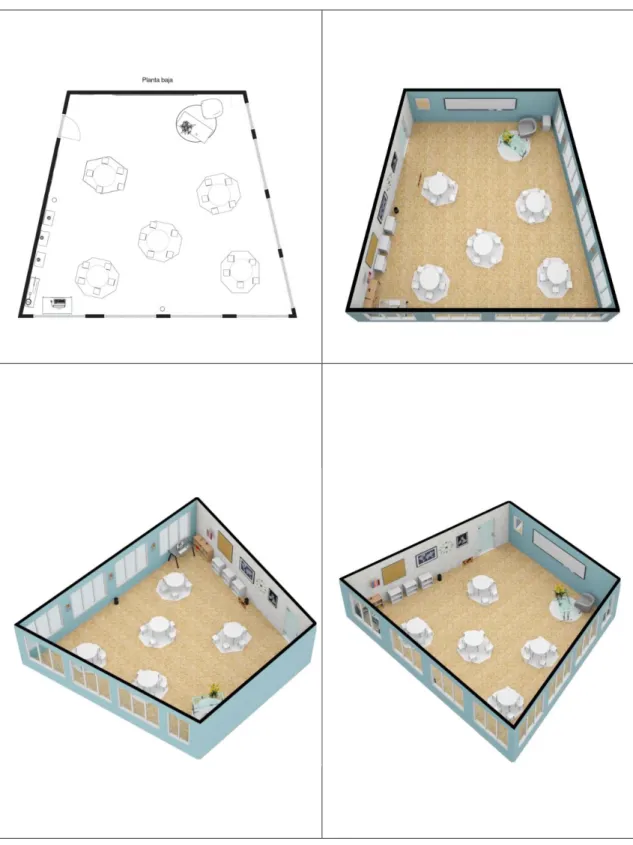
45 has a laptop or an electronic device –, a smartboard, and a mirror next to it, in which students can leave notes or positive messages on post-it papers.
46 The students of the I.E.S. come from the town in which it is located. Most of the students have accomplished their previous educational stage - primary school - in the C.E.I.P. school of the same town.
Regarding their linguistic level in foreign languages, students have a high-intermediate level (B1- B2, according to the new CEFR / CV) in at least one foreign language. In this case English is a common subject to all the students of the centre and, therefore, it is the L2. Around 40% of the students study a second foreign language (L3), that is German or French. In this second foreign language, the vast majority also has a medium domain (B1).
In addition to the aforementioned resources available, teachers are offered the possibility to participate in the Erasmus + mobility program. This is a fundamental factor in the improvement of the characteristics of the high school, since the quality of teaching offered by the teaching staff can be considerably increased, not only in terms of foreign languages, but also education in plurilingual and pluricultural values, acquisition of new perspectives, teaching methods and experiences shared among teachers (job shadowing3), contrasting educational systems, etc. These opportunities do nothing but enrich the educational reality of the teaching of foreign languages in the high school and in the teaching staff, and therefore, they also benefit the students.
As for the subjects of English, French and German, these three departments – respectively – together with the high-school provide with the presence of a language assistant per department, who come from an English-speaking country, French-speaking country or German-speaking country, during two weekly sessions. This activity allows students to interact and communicate with a native speaker and a person different to their habitual teacher. The English department also organizes annual trips to linguistic immersion camps within the national territory for a week. This department also organises exchanges with foreign students from English-speaking countries, to U.S.A, Canada, Ireland and U.K. On the other hand, the German department also organises German immersions in
47 Spain and exchanges with other high-schools from Germany, Austria and Switzerland. Finally, the French department organises exchanges to France and Canada. These factors are reflected in the notorious increase of the educational quality of the foreign languages. In addition, these activities are very successful given their high participation rate, which motivate the students to reach new objectives in different foreign languages.
7.2. First considerations for the design of the task proposal.
First of all, it is worth mentioning that, although it has been above presented a monolingual high school, this cross curricular proposal is designed to be carried out in both bilingual and monolingual educative centres. Basically, because the task proposal deals with simple and authentic linguistic models of different languages. The tasks require a learning process that can be carried out not only using the L2 but also the L1, L2 and L3. When there is competence in various languages, in plurilingualism, we aim to use the wealth of that communicative competence as a whole. This proposal announces a treatment of shared communicative and cultural features, and differences, always working using mediation.
As we have seen in several modules of this master, every educational proposal is included and based on two main parts which are then subdivided. The first, a prior curricular design, which is then subdivided in planning and sequencing. The second part corresponds to its development, and it is then formed by the intervention in class and evaluation.
First phase: The curricular design.