RESEARCH ARTICLE
The variability and interdependence of spider viscid line tensile properties
Gracia Belén Perea , Gustavo R. Plaza , Gustavo V. Guinea , Manuel Elices , Beatriz Velasco and
José Pérez-Rigueiro
SUMMARY
True stress-true strain curves of naturally spun viscid line fibres retrieved directly from the spiral of orb-webs built by Argiope trifasciata spiders were measured using a novel methodology. This new procedure combines a method for removing the aqueous coating of the fibres and a technique that allows the accurate measurement of their cross-sectional area. Comparison of the tensile behaviour of different samples indicated that naturally spun viscid lines s h o w a large variability, comparable to that of other silks, such as major ampullate gland silk and silkworm silk. Nevertheless, application of a statistical analysis allowed the identification of two independent parameters that underlie the variability and characterize the observed range of true stress-true strain curves. The combination of this result with previous mechanical and microstructural data suggested the assignment of these two independent effects to the degree of alignment of the protein chains and to the local relative humidity, which, in turn, depends on the composition of the viscous coating and on the external environmental conditions.
Key words: biomaterials, silk, flagelliform silk.
INTRODUCTION
Variability plays an ambivalent role in the performance of biological materials and, more specifically, in the performance of spider silk fibres. It is assumed that the possibility of spinning fibres within a vast range of tensile properties allows adaptation of the material to the immediate requirements of the spider (Madsen et a l , 1999; Madsen and Vollrath, 2000), which would represent an obvious evolutionary advantage (Blackledge et a l , 2012). The finding of organs and structures in the spider's spinning system that allow varying of the stresses exerted on major ampullate gland silk during its formation and, in turn, its tensile behaviour (Gosline et al., 2002; Ortlepp and Gosline, 2004) has clarified the possible mechanism by which spiders might exert this control on the mechanical properties of this material. In contrast to its advantageous biological function, variability represents a major drawback for the characterization and subsequent analysis of silk, as a large variability in nominally similar fibres prevents the drawing of firm conclusions on most aspects of silk performance (Dunaway et a l , 1995).
Consequently, analysing the variability of spider silk should be aimed at both understanding its origin and describing its extent in natural structures. The former is required for developing a sound experimental work to characterize the material, and establishing relationships between microstructure and properties, and the latter provides information on the range of properties demanded of silk in order to fulfil its biological function.
Among the silk types spun by spiders (Vollrath, 1992), viscid lines fibres are the elements that form the spiral in the Araneoidea lineage, and result from the combination of the fibres produced in the flagelliform gland and the viscous coating synthesized in the aggregate gland (Townley et al., 1991). The success of the design
of a two-dimensional web with a capture spiral is indicated by the existence of over 10,000 species of Orbicularian spiders. Among them, the Araneoidea lineage, which is characterized by the use of viscid line fibres for building the capture spiral, comprises ~95% of the species in the group. The remaining 5% corresponds to the Deinopoidealineage (Griswold, 1993; Griswoldetal, 1998), which is characterized by the use of looped cribellar fibrils on the core flagelliform fibre instead of the aqueous coating of the viscid line.
Despite its widespread distribution in terms of both species and ecological niches, the available information on the mechanical behaviour of viscid lines is scarce (Blackledge and Hayashi, 2006; Gosline et al., 1993; Vollrath and Edmonds, 1989), especially if it is compared with the large amount of information available on maj or ampullate gland silk (Heim et a l , 2009; Kaplan et a l , 1991). The presence of the viscous coating is partly responsible for this lack of information, as it prevents the detailed characterization of the tensile properties of the core fibres; however, it is assumed that this somehow modulates the overall tensile behaviour of the viscid line (Edmonds and Vollrath, 1992; Vollrath and Edmonds, 1989).
etal., 1984; Work, 1977). In this regard, it is assumed that the presence of the coating leads to a local decrease of vapour pressure, so that water evaporation from the web due to the external environmental conditions is prevented (Vollrath et a l , 1990), and the flagelliform fibre is maintained in a state of high hydration. This assumption is supported by the increase in plasticity associated with water uptake, which is not accompanied by an increase in the adhesion of the coating (Opell et al, 201 la; Opell et a l , 201 lb).
The development of a methodology for removing the viscous coating without damaging the flagelliform fibre (Guinea et al., 2010) represented a major advance in the characterization of this silk. In particular, it was shown that (1) flagelliform silk presents a ground state to which it can revert independently from the previous loading history of the fibre, and (2) clean fibres (i.e. without the viscous coating) presented a variability comparable to those of intact fibres (i.e. with the viscous coating). This second observation indicated that the presence of the coating could not be the only source of variability in this material. However, the continuation of the analysis was prevented by the absence of a reliable procedure to measure cross-sectional area and, consequently, to get an accurate determination of the mechanical properties in terms of stress-strain curves. Such a measuring procedure has been developed subsequently as presented in this work, so that a study of the variability shown by spider intact viscid line fibres (i.e. with the viscous coating) as retrieved directly from the web could be undertaken. The statistical analysis of the stress-strain curves shows their dependence on just two independent parameters, from which the experimental curves could be reconstructed in all cases. The combination of this finding with complementary results on the tensile properties of viscid lines (Guinea et a l , 2010) gives insight on the origin of the observed variability. In particular, it is suggested that the tensile properties of viscid lines may be dependent on both the alignment of the protein chains and the local relative humidity to which the fibre is subjected.
MATERIALS AND METHODS Obtaining viscid line fibres
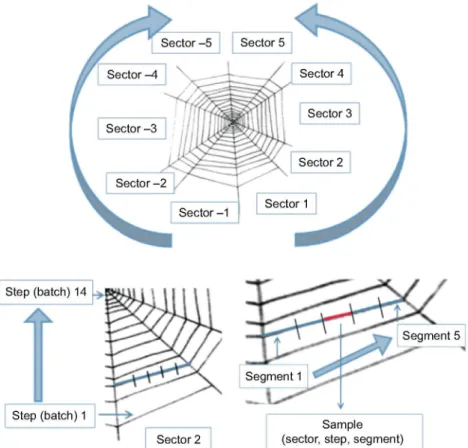
Viscid line fibres were obtained from webs built in 0.8x0.8 m wooden frames by Argiope trifasciata spiders (Forskál 1775). Fibres of 50-70 mm length were retrieved between two consecutive radii in order to have at least two adjacent samples, so that the tensile properties and cross-sectional area could be measured. All samples retrieved from a single viscid line between two consecutive radii are adjacent, and it was found in a previous work (Guinea et a l , 2010) that adjacent samples yield similar mechanical properties even in terms of force-displacement curves. Specimens were mounted in frames (Perez-Rigueiro et al., 1998) cut out of plastic sheets. Notation and labelling of silk fibres are shown in Fig. 1. Sample labelling follows the order: web sector, sector step (batch) and step segment (sample). Forty-five samples from 11 different webs built by four different spiders were used in this study.
Cross-sectional area measurement
At least one fibre from each step (batch) was used to measure its cross-sectional area. The measured area was used to compute the mechanical properties of all the segments of the batch, as it has been shown that adjacent samples have concurring mechanical properties. Cross-sectional cuts of the fibres were prepared by ultramicrotomy. Samples were mounted in plastic frames and stained by covering the fibre with a drop of Richardson's Methylene Blue stain. Samples were heated at 70°C until the drop dried, and the excess Methylene Blue was removed with distilled water. The fibre was allowed to dry overnight. Staining allows the identification of the fibre during ultramicrotomy, as the low contrast between the fibre and the embedding resin in the optical microscope represents a major difficulty during the ultramicrotomy of silk samples.
The stained fibre was placed on a previously prepared Spurr resin base in a silicone embedding mould (SPI Supplies, West Chester,
Fig. 1. Scheme of an orb web illustrating the code used for the identification of the samples with three integers (sector, step, segment). Adjacent samples were obtained from the viscid line fibres between two consecutive radii.
PA, USA) and covered with Spurr resin. This resin-silk-resin sandwich was cured at 70°C for 72 h. The resin block was cut to approximately its middle with a manual saw and the surface containing the silk fibres was polished to obtain a flat surface as smooth as possible. Initial cuts were performed in a Leica Ultracut UCT ultramicrotome with glass knife, with a facet angle of 6 deg and cross-section of 5-10 urn. Final sections of 60-90 nm thickness were cut with a diamond knife with a facet angle of 6 deg in a Sorvall Ultra Microtome MT500. It has been found that this process can be used with native (i.e. non-cleaned) samples; however, it is more efficient if samples are first subjected to a cleaning step. Removal of the coating proceeded by centrifugation as described elsewhere (Guinea et a l , 2010).
Samples were metallized with gold, and observed in a scanning electron microscope (SEM-JEOL 6300), at 10 kV and 7=0.06 nA. The cross-sectional area was computed from the cross-sectional areas as observed in the micrographs using the ImageJ program. Examples of micrographs showing the cross-sections of viscid lines are given in Fig. 2 with the coating intact (Fig. 2A) or after removal of the coating by the centrifugation step (Fig. 2B).
Tensile tests
Intact viscid line fibres mounted on plastic frames with a typical base length of 5 mm were tensile tested in an Instron 3309-622/8501 (Instron, Canton, MA, USA) appended to an environmental chamber (Dycometal CCK-25/300, Barcelona, Spain) (Guinea et a l , 2003). The value of the base length was chosen as a compromise between the requirement of obtaining a sufficient number of samples from each web, and the necessity to minimize the errors associated with uncertainties related to the initial length of the fibre, in particular for the calculation of strain. An optical extensometer (Keyence LS-7500/LA 7030M, Itasca, IL, USA) with a resolution of 0.2 urn was used for measuring the deformation of the fibre. Forces were measured with a 100 mN load cell with 0.1 mN resolution (HBM 1-Q11, Darmstadt, Germany). Tensile tests proceeded at 20°C and 35%) relative humidity (RH) with a displacement speed of 1 mm min-1.
The cross-sectional areas were used to compute true stress (a)-true strain (s) curves of the adjacent fibres from the force-displacement data. True stress was computed under the hypothesis of constant volume, a usual hypothesis for silks that was proved for the major ampullate silk (MAS) gland (Guinea et a l , 2006).
The constant volume hypothesis implies that:
A0L0=AL, (1)
where An is the initial cross-sectional area, measured from the SEM micrographs, LQ is the initial length, A is the instantaneous area and
L is the instantaneous length of the fibre.
The true stress (a) and true strain (s) are given by the expressions:
F o = —,
A
'•"[£)•
m
Data analysis
Analysis of the data followed a previous study in which the variability of A. trifasciata MAS fibres (Garrido et a l , 2002) was assessed, and consisted of the following steps. (1) Selection of an initial arbitrary set of parameters that allow the true stress-true strain curves to be described. In this case, the initial set of parameters included the values of stress at the following strains: 10% (oio%),
Fig. 2. Scanning electron microscope (SEM) micrographs used for computing the cross-sectional areas of flagelliform fibres. (A) Fibre not subjected to the cleaning step. The coating can be clearly identified surrounding the flagelliform fibres. (B) Fibre subjected to the cleaning step. The two brins that make up the fibre can be clearly observed in both cases.
20% (020%), 30% (o30%), 40% (O4o%), 50% (o50%), 60% (o60%) and 70%) (070%). No particular choice was implied in the initial set of parameters, except that it allowed a sufficiently accurate reconstruction of the experimental curve. (2) Statistical analysis to determine the dependence or independence among the parameters. (3) Determination of a functional dependence between the dependent parameters. (4) Determination of a suitable functional form for the stress-strain curve. (5) Reconstruction of the experimental curve from the set of independent parameters using the functional dependence found in 4.
RESULTS AND DISCUSSION Mechanical behaviour
1500 r
2 3 4
Displacement (mm)
Fig. 3. Force-displacement curves of intact viscid line fibres retrieved from two different webs.
Web1
Web 2
ra- 1000 -0.
H 500 :
§ § *
# I I •
§ * i J
* '
' # ' J/ § * + ,.-*
» : ! - - - . . . « . - M i * - * *
0 0.2 0.4 0.6 0.8
True strain
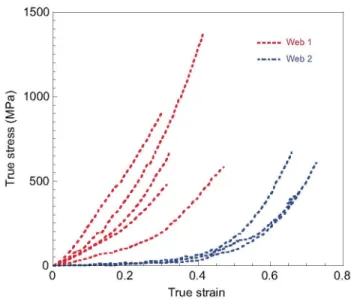
Fig. 4. True stress (a)-true strain (e) curves of the same samples presented in Fig. 3.
curves, which renders support to this methodology. Measurement of cross-sectional area revealed large variations both between samples from different webs (minimum value: 2.8 urn2; maximum value: 16.6 um2) and between samples retrieved from a single web (minimum value: 4.3 um2; maximum value: 11.5 urn2).
True stress-true strain curves corresponding to the samples shown in Fig. 3 are presented in Fig. 4. It can be seen that the use of exact measurements of cross-sectional area for calculating stresses does not lead to an improvement in the reproducibility of the tensile properties. Consequently, it is concluded that intrinsic differences must exist between the fibres that account for the observed variability.
Statistical analysis
Parameterization of stress-strain curves
Following the methodology described above, the first step of the statistical analysis requires defining a set of parameters that allow reconstruction of the true stress-true strain curves with sufficient accuracy. The initial set of parameters for describing the stress-strain curve was taken as: aio%, a20%, a30%, a40%, a50%, a60% and a70%. This set of parameters was arbitrarily chosen with the only condition that it allows a sufficiently accurate reconstruction of the experimental curves by approximating, for instance, the curve by a series of straight segments between each two consecutive parameters of the set.
Dependence/independence of the mechanical parameters The statistical dependence/independence of each pair of the initial set of parameters was assessed through the %2-test of independence (Brandt, 1998; Garrido et a l , 2002). The %2-test of independence requires calculation of the function:
X¿
•11
<=i j=\
(tiy-Npigj)
Npiqj (3)
where N is the total number of tensile tests, k is the number of intervals into which the range of values of the first parameter is divided, / is the number of intervals into which the range of values of the second parameter is divided, and «¿, is the number of tensile tests for which the first parameter lies in the interval /' and the second parameter lies in the interval j . The values of each parameter were
typically distributed into six or seven intervals, in order to allow a sufficient number of values to be included in each interval.
Pi and qj are defined as follows:
1j N
l
nv
l
nv
(4)The independence test proceeds by comparing the value of X2
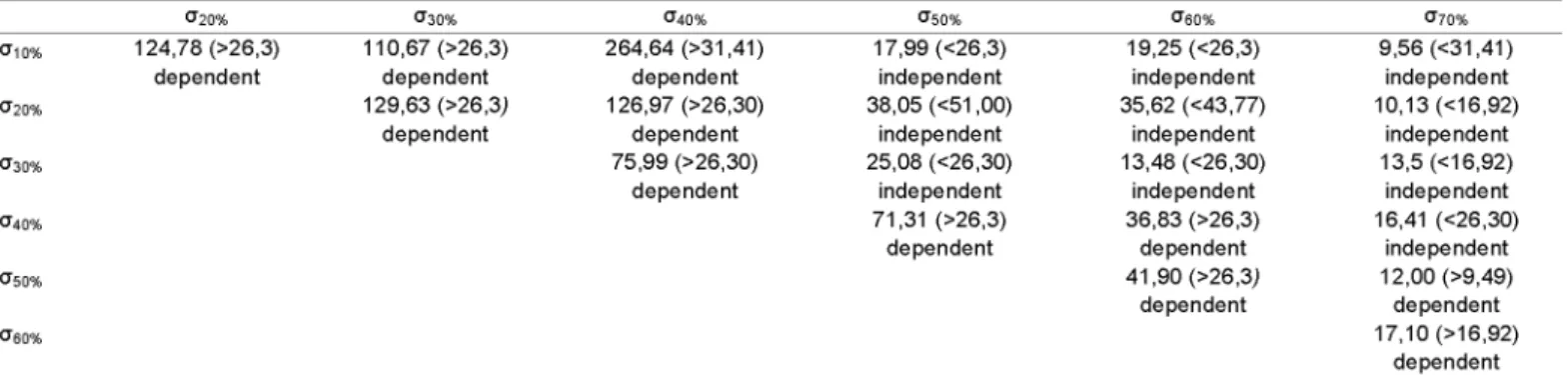
with the tabulated value of the %i_o,2 function. The number of degrees of freedom for %i_o,2 is given by the product (k-\)(l—\), and the level of significance a is assigned a value of 5% in keeping with common practice (Garrido et a l , 2002). If X2>%i_a2, the independence hypotheses has to be rejected; if X2<%i_o,2, the independence hypothesis cannot be rejected. The results of the independence test are presented in Table 1, from which it is apparent that the number of independent parameters can be reduced to two. The limit between the two ranges of the independent set of parameters can be established at approximately 040%. Consequently, it is concluded that the intrinsic variability observed in the tensile properties of viscid lines is the result of two independent mechanisms.
Determination of a functional d e p e n d e n c e b e t w e e n the d e p e n d e n t
parameters
Table 1. Results of applying the x2-test of independence to the parameters chosen to describe the true stress-true strain curves of viscid line fibres
O"20%
a10% 124,78 (>26,3) dependent O"20% O"30% O"40% O"50% O"60% O"30% O"40%
110,67 (>26,3) 264,64 (>31,41)
dependent dependent 129,63 (>26,3J 126,97 (>26,30)
dependent dependent 75,99 (>26,30)
dependent
The following strains were used: 10% (aio%), 20% (020%), 30% (030%), 40% (040%), The number on the left corresponds
function for a level of significance
O"50% 17,99 (<26,3) independent 38,05 (<51,00) independent 25,08 (<26,30) independent 71,31 (>26,3) dependent
5 0 % (0-50%), 6 0 % (a6o%)
O"60% 19,25 (<26,3) independent 35,62 (<43,77) independent 13,48 (<26,30) independent 36,83 (>26,3) dependent 41,90 (>26,3J dependent
and 70% (a7o%). to the statistical estimator X and the number on the right (in parentheses)
of a=5%. X2>% implies that the independence hypothesis between the two
corresponds to the tab parameters has to be
O"70% 9,56(<31,41) independent 10,13 (<16,92) independent 13,5 (<16,92) independent 16,41 (<26,30) independent 12,00 (>9,49) dependent 17,10 (>16,92) dependent
ulated value of the % rejected.
where chosen as reference parameters, although the forthcoming analysis is independent of this choice.
Determination of a suitable functional form for the true stress-true strain curves
Three possible functional forms were explored to account for the experimental true stress-true strain curves: second-order polynomial, third-order polynomial and exponential with an independent term. It was found that the second-order polynomial provided a poor agreement with the experimental values, and although the third-order polynomial provided a good agreement in most cases, it did not allow fitting for a few. Finally it was found that an exponential function with an independent term:
= b (eas - 1) . (5)
where a stands for the true stress and s for the true strain, reproduced with sufficient accuracy all the experimental data. The choice of an exponential form has additional support from theoretical studies of the scaling effect of the interactions in the tensile properties of viscid lines (Zhou and Zhang, 2005; Becker et a l , 2003).
Reconstruction of true stress-true strain curves
Ultimate validation of the previous analysis requires that the experimental curves can be reconstructed from the minimum set of parameters established as 020% and 050%. The reconstruction process requires the calculation of the values of the parameters a and b that appear in Eqn 5. Using the values of the two independent parameters chosen as reference parameters to reconstruct the true stress-true strain curve, 020% and 050%, the values of a and b are obtained from:
O200/
C5O0/
: b (edn - 1)
: b (eM-5 - 1)
which yields the following implicit equation:
a = 2 In Ü20°/(
(6)
(7)
(8)
Solving for a in Eqn 8 with a numerical method allows calculation of the parameter b from the equation:
O5o%
(9)
which completes the reconstruction process.
Fig. 6 compares the experimental curves presented in Fig. 4 with those calculated using the reconstruction method from the values of the parameters 020% and 050%. The concurrence of the reconstructed and the experimental curves renders support for the statistical analysis performed above.
The statistical analysis of true stress-true strain curves on its own does not provide information by which the ultimate deformational mechanisms underlying the variability observed in viscid line fibres might be identified, but establishes severe restrictions to their total number. Thus, the results presented above demonstrate that the origin of the variability observed in natural viscid lines can be traced back to two independent effects. However, the identification of these fundamental mechanisms requires the use of additional mechanical and microstructural information.
In this context, it was found (Guinea et a l , 2010) that water content influences the tensile properties of viscid line silk by comparing the tensile properties of flagelliform fibres (i.e. viscid lines without the adhesive coating) at different values of RH. The effect of water was especially evident at low strains, with a change of the elastic modulus of almost two orders of magnitude being determined by varying RH from 10% to 100% (immersion in water). These results suggest that water content (or, equivalently, local RH) might be one of the two independent mechanisms that control the performance of the fibre.
Comparison of the tensile properties exhibited by clean flagelliform and MAS fibres suggests that the second mechanism could be assigned to the different alignment of the protein chains among different samples. In particular, it has been found that the whole range of tensile properties of MAS fibres can be obtained predictably and reproducibly by a simple process consisting of stretching the fibres in water from the initial maximum supercontracted state to a pre-determined value of strain (Guinea et al, 2005). This effect has been interpreted as the result of varying the degree of alignment of the proteins with respect to the macroscopic axis of the fibre. The concurrent behaviour of clean flagelliform and MAS fibres when tested in water and, specifically, the existence of a maximum supercontracted state in both materials clearly supports this assignment as the second independent source of variability in viscid line fibres.
250
200
150
b 100
0 100 200 300 400 500 600
a20% (MPa)
700
40 60 a1 0 % (MPa)
100
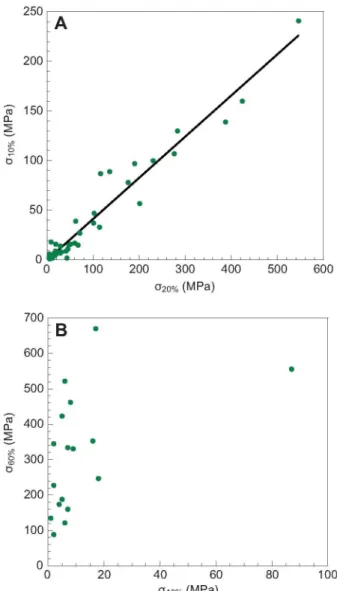
Fig. 5. Distribution of the pairs of stresses (A: Qio%, 020%; and B: Q6o% (Jio%) as obtained from tensile tests. The straight line in A is the result of a linear regression analysis. No clear correlation can be established between the values of Q6o% and Qio%, consistent with the statistical analysis of independence.
cleaning procedure and the similar behaviour shown by adjacent fibres allows calculation of the percentage of supercontraction (%SC) of intact viscid lines (i.e. with the adhesive coating) in the web as:
%SC =
¿MS
(10)
where LQ is the initial length of the intact (i.e. with the viscous coating) viscid line and ¿MS is the length of an adjacent sample subjected to maximum supercontraction. Application of this equation to the fibres analysed in this study yields a value of %SC=40±15%, with a maximum value of 56% and a minimum value of 26%. These results indicate a considerable degree of alignment of viscid line fibres, when spun to build the orb-web.
CONCLUSIONS
The study of the mechanical properties of viscid line spider silk reveals a large variability, even between fibres produced under nominally comparable conditions. The development of a
1500r
<o 1000
Q_
Web1
Web 2
Parametric fit
5 0 0
-0.4
True strain
0.8
Fig. 6. Comparison of the experimental true stress(a)-true strain (e) curves (broken lines) and reconstructed stress-strain curves (solid lines) for the two different webs presented in Fig. 4.
methodology that allows (1) removal of the aqueous coating produced by the aggregate gland and (2) accurate measuring of the cross-sectional area of the fibres led, for the first time, to a significant number of true stress-true strain curves being obtained for naturally spun viscid line fibres.
The availability of a sufficient number of true stress-true strain curves allowed us to undertake a statistical study that parallels previous analyses on A. trifasciata MAS fibres. In particular, the minimum number of independent parameters that allow reconstruction of the experimental curves was determined from a ^-statistical analysis of independence. This number was found to be two, as supported by the concurrence of the experimental and reconstructed true stress-true strain curves in all cases.
Combining these observations with previous mechanical and micro structural data suggests that the mechanisms that determine the tensile properties of viscid line fibres could be assigned to (i) the degree of alignment of the protein chains with respect to the macroscopic axis of the fibre and (ii) to the local relative humidity, which, in turn, depends on the adhesive coating and environmental conditions. Whether the spider exerts a similar active control on viscid line fibres by controlling either or both mechanisms, as demonstrated in A. trifasciata MAS, remains an open question.
ACKNOWLEDGEMENTS
Spiders were reared in Reptilmadrid S.L. by Oscar Campos. Ultramicrotomy was performed by E. Baldonedo (Centra de Microscopía Electrónica, Universidad Complutense de Madrid).
AUTHOR CONTRIBUTIONS
J.P.R. proposed the experiments and wrote the main text. G.B.P. prepared the material and conducted the mechanical tests, assisted by B.V. G.V.G., M.E. and G.R.P. contributed to the data analysis and reviewed the manuscript.
COMPETING INTERESTS
No competing interests declared.
FUNDING
REFERENCES
Becker, N., Oroudjev, E., Mutz, S., Cleveland, J. P., Hansma, P. K., Hayashi, C. Y., Makarov, D. E. and Hansma, H. G. (2003). Molecular nanosprlngs In spider capture-silk threads. Nat. Mater. 2, 278-283.
Betz, O. and Kólsch, G. (2004). The role of adhesion In prey capture and predator defence In arthropods. Arthropod Struct. Dev. 33, 3-30.
Blackledge, T. A. and Hayashi, C. Y. (2006). Silken toolkits: biomechanics of silk fibers spun by the orb web spider Argiope argéntala (Fabrlclus 1775). J. Exp. Biol 209, 2452-2461.
Blackledge, T. A., Perez-Rigueiro, J., Plaza, G. R., Perea, B., Navarro, A., Guinea, G. V. and Elices, M. (2012). Sequential origin In the high performance properties of orb spider dragline silk. Sci. Rep. 2, 782.
Brandt, S. (1998). Statistical and Computational Methods in Data Analysis. New York NY: Springer Verlag.
Cesar, L. M. M., Mendes, M. A., Tormena, C. F., Marques, M. R., de Souza, B. M., Saidemberg, D. M., Bittencourt, J. C. and Palma, M. S. (2005) Isolation and chemical characterization of PwTx-ll: a novel alkaloid toxin from the venom of the spider Parawixia bistriata (Araneldae, Araneae). Toxicon 46, 786-796 Dunaway, D. L, Thiel, B. L. and Viney, C. (1995). Tensile mechanical property
evaluation of natural and epoxlde-treated silk fibers. J. Appl. Polym. Sci. 58, 675-683 Edmonds, D. T. and Vollrath, F. (1992). The contribution of atmospheric water-vapor to
the formation and efficiency of a spiders capture web. Proc R. Soc B 248, 145-148 Garrido, M. A., Elices, M., Viney, C. and Perez-Rigueiro, J. (2002) The variability
and Interdependence of spider drag line tensile properties. Polymer (Guildf.) 43, 4495-4502.
Gosline, J. M., Denny, M. W. and Demont, M. E. (1984) Spider silk as rubber Nature 309, 551-552.
Gosline, J. M., Pollak, C. C, Guerette, P. A., Cheng, A., Demont, M. E. and Denny, M. W. (1993). Elastomerlc network models for the frame and viscid silks from the orb web of the spider Araneus diadematus. Silk Polymers 544, 328-341 Gosline, J., Lillie, M., Carrington, E., Guerette, P., Ortlepp, C. and Savage, K.
(2002). Elastic proteins: biological roles and mechanical properties. Philos. Trans. R Soc. S357, 121-132.
Griswold, C. E. (1993). Investigations Into the phylogeny of the Lycosold spiders and their kin (Arachnlda: Araneae: Lycosoldea). Smithson. Contrib. Zoo/. 539, 1-39 Griswold, C. E., Coddington, J. A., Hormiga, G. and Scharff, N. (1998) Phylogeny
of the orb-web building spiders (Araneae, Orblcularlae: Delnopoldea, Araneoldea). Zool. J. Linn. Soc. 123, 1-99.
Guinea, G. V., Elices, M., Perez-Rigueiro, J. and Plaza, G. (2003) Self-tightening of spider silk fibers Induced by moisture. Polymer (Guildf.) 44, 5785-5788. Guinea, G. V., Elices, M., Perez-Rigueiro, J. and Plaza, G. R. (2005) Stretching of
supercontracted fibers: a link between spinning and the variability of spider silk J. Exp. Biol. 208, 25-30.
Guinea, G. V., Pérez-Rigueiro, J., Plaza, G. R. and Elices, M. (2006) Volume constancy during stretching of spider silk Biomacromolecules 7, 2173-2177
Guinea, G. V., Cerdeira, M., Plaza, G. R., Elices, M. and Pérez-Rigueiro, J. (2010) Recovery In viscid line fibers. Biomacromolecules 11, 1174-1179.
Heim, M., Keerl, D. and Scheibel, T. (2009). Spider silk: from soluble protein to extraordinary fiber. Angew. Chem. Int. Ed. Engl. 48, 3584-3596.
Kaplan, D. L, Lombardi, S., Muller, W. S. and Fossey, S. A. (1991) Biomaterials Novel Materials from Biological Sources, 53pp. New York, NY: Stockton Press Madsen, B. and Vollrath, F. (2000). Mechanics and morphology of silk drawn from
anesthetized spiders. Naturwissenschaften 87, 148-153.
Madsen, B., Shao, Z. Z. and Vollrath, F. (1999). Variability In the mechanical properties of spider silks on three levels: Interspecific, ¡ntraspeclflc and ¡ntralndlvldual. Int. J. Biol. Macromol. 24, 301-306.
Marques, M. R., Mendes, M. A., Tormena, C. F., Souza, B. M., Ribeiro, S. P., Rittner, R. and Palma, M. S. (2004). Structure determination of an organometalllc 1-(dlazenylaryl)ethanol: a novel toxin subclass from the web of the spider Nephila clavipes. Chem. Biodivers. 1, 830-838.
Opell, B. D., Bond, J. E. and Warner, D. A. (2006). The effects of capture spiral composition and orb-web orientation on prey Interception. Zoology 109, 339-345 Opell, B. D., Schwend, H. S. and Vito, S. T. (2011a). Constraints on the adhesion of
viscous threads spun by orb-weaving spiders: the tensile strength of glycoprotein glue exceeds Its adhesion. J. Exp. Biol. 214, 2237-2241.
Opell, B. D., Karinshak, S. E. and Sigler, M. A. (2011b) Humidity affects the extensibility of an orb-weaving spider's viscous thread droplets. J. Exp. Biol. 214 2988-2993.
Ortlepp, C. S. and Gosline, J. M. (2004). Consequences of forced silking Biomacromolecules 5, 727-731.
Perez-Rigueiro, J., Viney, C, Llorca, J. and Elices, M. (1998) Silkworm silk as an engineering material. J. Appl. Polym. Sci. 70, 2439-2447.
Salles, H. C, Volsi, E. C. F. R., Marques, M. R., Souza, B. M., dos Santos, L. D.. Tormena, C. F., Mendes, M. A. and Palma, M. S. (2006) The venomous secrets of the web droplets from the viscid spiral of the orb-weaver spider Nephila clavipes (Araneae, Tetragnatldae). Chem. Biodivers. 3, 727-741.
Townley, M. A., Bernstein, D. T., Gallagher, K. S. and Tillinghast, E. K. (1991) Comparative study of orb web hygroscoplclty and adhesive spiral composition In 3 araneld spiders. J. Exp. Zool. 259, 154-165.
Vollrath, F. (1992). Spider webs and silks. Sci. Am. 266, 70-76.
Vollrath, F. and Edmonds, D. T. (1989). Modulation of the mechanical-properties of spider silk by coating with water. Nature 340, 305-307.
Vollrath, F., Fairbrother, W. J., Williams, R. J. P., Tillinghast, E. K., Bernstein, D. T., Gallagher, K. S. and Townley, M. A. (1990). Compounds In the droplets of the orb spiders viscid spiral. Nature 345, 526-528.
Work, R. W. (1977). Dimensions, birefringences, and force-elongation behavior of major and minor ampullate silk fibers from orb-web-splnnlng spiders - effects of wetting on these properties. Text. Res. J. 47, 650-662.