
Developing student outcomes in real world learning experiences: The case of solar decathlon in Latin America
16
0
0
Texto completo
(2) Developing Student Outcomes in Real-World Learning Experiences: The Case of the Solar Decathlon in Latin America Abstract Engineering students face a future in which professional skills (e.g., working in multidisciplinary teams, ethics, and communicate effectively) will be equally important as hard skills (e.g., design systems and solve technical problems). However, the development and assessment of these skills by the time of graduation is still a challenge for higher education institutions. In ABET terms, the student outcomes describe what students are expected to know and be able to do by the end of their undergraduate program. Thus, an ABET outcome might include a set of several skills. One strategy for developing these professional and hard skills is to expose engineering students to hands-on, real-world experiences. In this paper, a full analysis of how a multidisciplinary competition like the Solar Decathlon can contribute to the simultaneous development of various student outcomes is presented. The Solar Decathlon (SD) competition is an initiative of the U.S Department of Energy that challenges students to design, build, and operate sustainable, solar-powered, and affordable houses. A survey of all members of the team composed of students from the Universidad Icesi and the Pontificia Universidad Javeriana Cali participating in the Solar Decathlon for Latin America & Caribbean 2015 was carried out three times during the competition: at the beginning stage, in the middle of the project, and at the end of the competition. The goal was to analyze the attainment of student outcomes and their development over time. This team was comprised of 40 students from eight professional disciplines (including four industrial engineering students) for more than a year. Furthermore, this study presents how the interdisciplinary composition of the team evolved throughout the development of the project in order to fulfill the requirements of the competition. The role and participation of industrial engineers in this type of project was also examined as well as the primary personal and professional challenges experienced by the participants. Findings suggest that working and communicating effectively with students from other disciplines (i.e., multidisciplinary teaming) were among the main professional challenges students faced during the project. Likewise, respect for other people’s perspectives and different paces of work between disciplines were the most common personal challenges. Lessons learned and recommendations for future competitors (institutions and students) are also presented. Keywords: ABET outcomes, professional skills, life-long learning, multidisciplinary teamwork..
(3) Introduction The development and assessment of competencies in engineering students is always a challenge for higher education institutions. To develop and assess multiple skills through one learning strategy is even a greater challenge. In a changing society shaped by the availability of information resources on the internet, higher education institutions are seeking disruptive teaching and learning mechanisms that satisfy students’ knowledge requirements, workforce skills requirements, and the requirements of accreditation systems. ABET criterion 3 (i.e., student outcomes) has established a set of engineering outcomes that every student should attain at the end of an engineering undergraduate program.1 These outcomes can be divided into two categories, “hard skills” associated mainly with engineering techniques and problem solving; and a set of “soft skills” associated with professional practice and work environment skills. Although the means to develop each of these hard and professional skills individually has been discussed in the past, since the creation of the ABET accreditation system, educational research has been centered on assessment methods and learning methods to improve the attainment of (a)-(k) outcomes in students.2,3,4 Little attention has been given to learning strategies that develop multiple student outcomes in an integrated way and the assessment and impact of real-world learning experiences on the developing of multioutcomes.5,6 The Solar Decathlon competition is one example of a variety of alternatives available for engaging students in design-challenge activities that take them beyond the theoretical concepts learned in the classroom. The Solar Decathlon (SD) competition is an initiative of the U.S Department of Energy that challenges students to design, build, and operate sustainable and affordable solar-powered houses. The competition is divided into 10 individual contests, each worth 100 points. The ten contests include Architecture; Engineering and Construction; Energy Efficiency; Energy Balance; Comfort; Sustainability; Marketing and Communications; House Functioning; Urban Design and Affordability; and Innovation.7 Thus, the SD competition requires students from multiple disciplines to develop multiple skills in a single learning experience. Our modern times demand a clear understanding of how current strategies such as multidisciplinary hands-on projects contribute to developing professional and hard skills concurrently, and what their true impact is on future professional engineers. This paper approaches this research question based on the learning process experienced by a multidisciplinary group of students during the participation in the Solar Decathlon competition. Theoretical Background “The only thing that is constant is change,” said Heraclitus, and it truly is when dealing with learning and teaching environments. Society is changing continuously and through time a question has remained within educational systems about how people learn; recently this has been supplemented by questioning how engineers learn and in what learning environments or with what strategies they better attain that knowledge. How people learn According to the Center for Educational Research and Innovation in its publication on the Nature of Learning, there are three basic perspectives for learning: the biological perspective related to.
(4) understanding how learners interact with others for self-learning, the cognitive perspective related to understanding how learners acquire and process information, and lastly, the emotional perspective related to understanding learners’ beliefs and motivations.8 Likewise, there are three forms of learning: formative learning, associated with the ongoing construction of knowledge; inquiry-based learning, associated with solving problems from a technical perspective; and co-operative learning, defined as a means to improve social relations and a way to prepare students for the collaborative workforce. In this sense, multidisciplinary real-world projects have their basis in the emotional-cognitive learning perspective and support the cooperative form of learning (Figure 1). Co-operative projects have a key role to play in strengthening the “horizontal-connectedness,” which comes through developing and transferring knowledge across different contexts, different areas of knowledge, and unfamiliar problems in a particular community or global. Today, it is necessary to re-think not only what the best strategies within each type of learning are but also which learning experiences will contribute to the skills demanded in the workplace in the future.. Figure 1. Learning Perspectives and Learning Forms Competencies demanded today and tomorrow A variety of studies have recognized the multiple skills and competencies that workplaces currently demand from engineers.9,10 The Engineer of 2020 suggests that future graduates will require collaborating across different perspectives in a changing global economy.11 Considering rapid innovation and technological breakthroughs, future engineers will be challenged by deteriorating urban infrastructures, environmental degradation, and scarcity of food and water. Other authors (as cited in OECD, 2010) have highlighted the need for learning to generate, process and sort complex information; think systematically and critically; ask meaningful questions; be adaptable, flexible, and solve real problems8. The Research Agenda for the New Discipline of Engineering Education (2006), states that “Engineering and Society are interrelated, each one shapes the other, ” which is part of a new research area related to Engineering Diversity and Inclusiveness.12 This emerging research encourages faculty to find innovative ways to design curricula, learning experiences, and mechanisms aligned with diverse cultural and interdisciplinary backgrounds. It is paramount to change our learning systems in order to equip.
(5) engineering students with a better understanding of their impact on society and create more equitable, inclusive and respectful engineering solutions for social and global challenges. Learning Systems and Mechanisms To develop the skills previously mentioned for future engineering professionals, faculty will be required to design learning systems and mechanisms in order to engage students in challenging activities and, more importantly, awake their willingness to persevere in these types of projects whether they are formal or informal in character. Two examples of current strategies that pursue this purpose are problem-based learning (PBL) and service-learning (SL). PBL is mainly a discovery learning method where students work individually or in groups to analyze an engineering problem and providing alternative solutions for it. During this process, students are guided by an expert, but they are in charge of retrieving, organizing, analyzing, and learning the concepts or information necessary to solve the problem.13 SL can be seen as a co-operative method of learning that combines engineering education and service to the community. In SL projects, students actively engage in an organized service project in order to solve an engineering problem that enriches their curricula while simultaneously meeting the needs of a community. The Engineering Projects in Community Service (EPICS) program, for instance, aims to develop a variety of skills, including technical, communication, resourcefulness, and teamwork skills.5 Students involved in multidisciplinary real-world projects face both challenges, solving engineering problems and providing solutions in an individual manner while simultaneously serving a community purpose. The participants learn quicker from others, feel more confident, acquire more friends from different disciplines, and are more accepting of others different from themselves.14 Multidisciplinary Projects The ABET 2015 recent criteria review states that “every student should be prepared for entering the professional practice through a curriculum culminating in a major design experience based on the knowledge and skills acquired in earlier course work and incorporating appropriate engineering standards and multiple realistic constraints.”15 A major design experience would be logically more fruitful if it is developed in a multidisciplinary environment.16 According to Ollis (2004), a multidisciplinary design course should consider six basic elements: 1) to have a source of problem or idea, 2) financial support, 3) a path to leverage faculty time, 4) disciplinary integration, 5) a course/project length, and 6) a team size and composition.17 Examples of multidisciplinary design courses include: a product design challenge, a start-up for a new company, a design-build-and-operate challenge, a summer team internship in a manufacturing company, a local design within the university or a virtual company, and multiuniversity projects. International competitions such as the Solar Decathlon and the Formula Hybrid, based on the formula SAE program, are also considered multidisciplinary design experiences even though they are not included in the curricula and student participation is voluntary7,18. Koutsikouri et.al. (2006) found that success of multidisciplinary design projects appear to be related to the opportunities and constraints of organizational behavior as well as existing work processes and structures. It is a process rather than a static concept relying on effective communication between the team individuals. Critical success factors are interrelated, mutually dependent and likely to change across time.19.
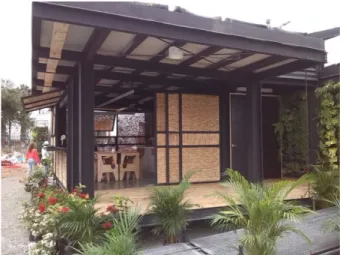
(6) Effective communication within a team is essential to fulfill any project deliverables and accomplish the common goal pursued. Thus, effective teamwork is dependent upon effective communication. The importance of effective communication in the workplace when interacting with employers, coworkers and supervisors has also been recognized. At the project level, it is one of the most critical aspects in the project’s success.20 Methodology In this work, a survey was the method used to gather information from the team. Surveys are indirect methods used to retrieve information that cannot be easily observed by the researcher.3 The team was comprised of forty students from two recognized private universities from CaliColombia, the Universidad Icesi and the Pontificia Universidad Javeriana Cali. The team housing unit (Figure 2) won second place (2nd) in the overall competition, first place in the individual contest of Electrical Energy Balance and Engineering and Construction, and third place in the individual contest of Architecture and House Functioning.. Figure 2. Housing Unit ALERO as it was displayed in the Solar Decathlon 2015 competition For the students on the team this was their first experience participating in a multidisciplinary competition. Therefore, it became a great opportunity to learn from the process for future handson design experiences. During the team’s yearlong process, a survey was administered electronically to all team members three times: at the beginning, during the design and planning phase; in the middle, during the development phase; and at the end of the competition. The goal of this survey was to get feedback from students and compare how their perceptions about learning changed over time along with the maturation and development of the project. The questions were oriented towards the emotional perspective and the co-operative learning side of the experience. The survey included three sections: motivations and engagement; competencies and challenges; and learning and improvement for future projects. Students were asked about their motivations for participating in this kind of project, their level of commitment, the skills they believed were being developed through the process, the primary personal and professional challenges, and lastly, how they would describe the overall experience. The survey format included questions with multiple answer and some free response questions. A sample of a set of questions included in the survey is presented in Figure 3 for reference..
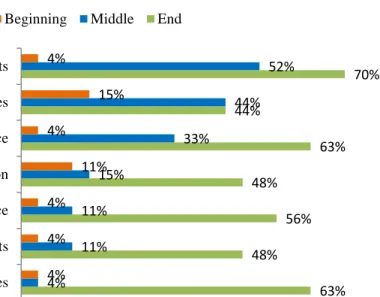
(7) The records and deliverables associated with the progress of the project collected through a shared Google drive as well as personal observation during the competition period were used as complementary sources for the current analysis and discussion.. Figure 3. Sample of the survey used to assess the learning experience of students in the SD competition Results and Discussion The results of the surveys are presented according to the three phases considered in the analysis: beginning (the design and planning phase of the project), middle (development phase of the project), and end (final phase of the project and contest week). The survey response rates were 5 students, 27 students, and 22 students for the beginning, middle and final surveys, respectively. The lowest response rate was during the design and planning phase (12.5% of the team population) and the highest response rate was obtained at the middle during the development phase (67.5% of the team population). Motivations When creating and assessing learning experiences that contribute to developing one or more student outcomes, it is important to understand the drivers that motivate students to participate or engage in this type of project. In this way, future projects can be designed taking these motivations into account. As shown in Figure 4, at the beginning, students felt attracted by the theme of the competition (i.e., sustainability) and the impact of the competition in the international level. Even though the selection of the topic and scope are critical for motivating.
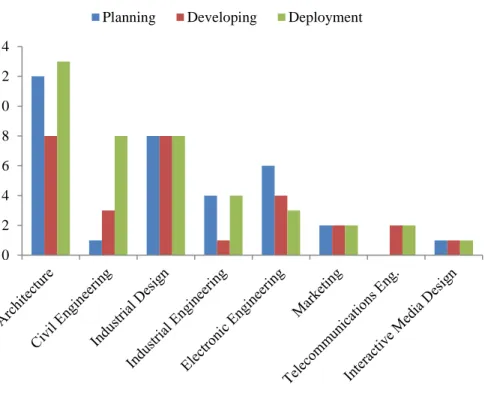
(8) students to participate in the project, during the development and final phases, their main motivations focused on the opportunity to apply their knowledge in real-world environments, the opportunity to work in a multidisciplinary team, and to learn from other disciplines, and lastly, having a new and challenging learning experience. In the case of the SD competition, there was a specific social need associated with deploying renewable energy in residential applications. However, these drivers could also come from a company or community need. The most important motivator is that participants feel their effort is worthwhile for society. Beginning Apply knowledge in real environments. End. 4%. 52% 15%. Passion for sustainability initiatives Multidisciplinary experience. Middle. 4%. Challenging experience. 4%. Engage in innovative projects. 4%. New learning experiences. 4% 4%. 44% 44% 33%. 11% 15%. Impact of the competition. 63% 48%. 11% 11%. 70%. 56% 48% 63% Percentage of students (%). Figure 4. Motivations to participate in a multidisciplinary project Since the competition rules required teams of 40 members, the total number of participants did not vary across the project. However, the number of people per discipline, as well as the individual members varied moderately (Figure 5). In the case of industrial engineering, four students joined as volunteers during the beginning phase. During the development phase, three of the four withdrew the project due to their academic loads. Later, the team recognized the need for engaging civil and industrial engineers during the project management phase. Thus, three new industrial engineering and five new civil engineering students joined the team. The role of industrial and civil engineers was associated with a need for planning the construction schedule; programming human resources, their shift schedules; and general logistics related to the assembly and disassembly phase..
(9) Planning. Developing. Deployment. 14 Number of students. 12 10 8 6 4 2 0. Figure 5. Variation in team composition across the project. Engaging Industrial Engineering Students in Multidisciplinary Real-World Projects The analysis of the role and participation of industrial engineering students in multidisciplinary hands-on projects will be focused on two aspects: first, the fact that IE formation is more process-centered than design-centered, and second, the key role that IE students could potentially play in project management. First, IE formation is more process-centered. The current undergraduate program at the Universidad Icesi, like other IE curricula, emphasizes the attainment of technical skills centered on tools and techniques for process implementation, operation, and improvement or optimization, leaving the “conceive and design” stage outside of its scope. Thus, industrial engineers (IE) tend to be more process-oriented than design-oriented, and as a result, IE students lack a formal opportunity for conceiving, creating and “materializing things”. The engagement of IE students in a multidisciplinary hands-on experience like the Solar Decathlon or independent design projects gave them the opportunity to experience the whole life-cycle of an engineered product, understanding the impact from the economic, social, and environmental perspectives. In the case of this team, IE students were supporting areas related to Health & Safety, Logistics, and Environmental Impact. All IE students felt comfortable actually “doing” real things or as in the words of one student “facing practical problems inspired by real problems”. Second, IE students could play a key role in project management. During the SD competition, it was realized that planning ahead is critical for the successful development and completion of a project. The planning of resources (i.e., materials, people, money, and time) is one of the strengths IE are well prepared for and it is an area where IE students could perform better in providing valuable input within an interdisciplinary or any kind of project. In order to achieve.
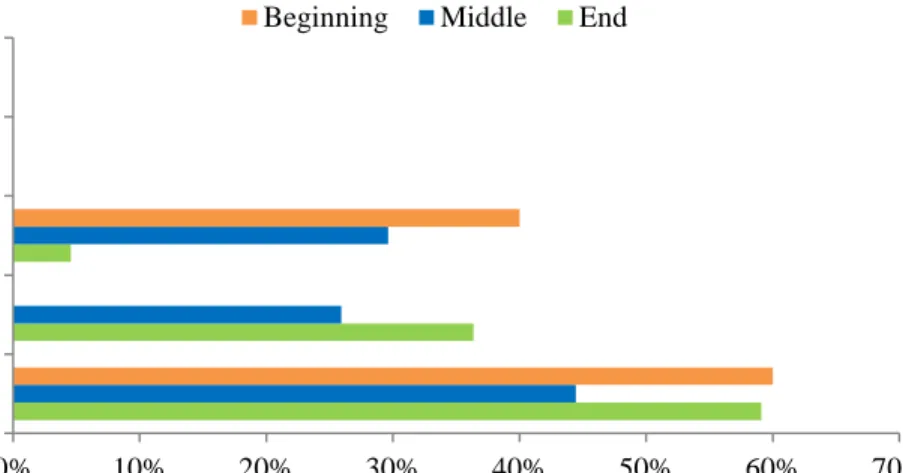
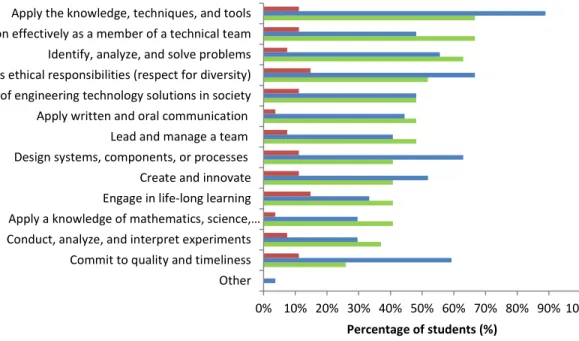
(10) this, it is important to think outside the box and prepare IE students not only for manufacturing atmospheres but also for service environments as well as social projects. Project management should go beyond a schedule sheet and should be seen as a mechanism for integrating information and keeping effective communication within the team and deliverables. Student Level of Engagement Students were asked to rate their level of engagement from very low to very high. In general, students tended to rate themselves relatively high in all cases, as shown in Figure 6. Although the “active” participation of students was not constant throughout the entire year, during the last phase, where students had to materialize the project and actually encounter the competition, this level of engagement was rated higher and was particularly noticeable at the construction site. This might be due to the fact that students felt motivated by the desire of succeeding in the competition and build the house accordingly to the plan. Students that rated their level of involvement as neutral typically did what they were assigned but did not go beyond said assignations.. Beginning. Middle. End. Very Low Low Neutral High Very High 0%. 10%. 20%. 30%. 40%. 50%. 60%. 70%. Figure 6 Level of engagement rated by students over the course of the project. Skills Developed During the Development of the Project One of the main objectives of this study is to analyze how a multidisciplinary competition like the Solar Decathlon can contribute to the simultaneous development of multiple student outcomes. Students were asked to select from a list the capabilities they considered they had developed during their experience in the SD competition. The results are presented in Figure 7. In the beginning, students tended to select what they were expecting to learn more than what they had actually attained. As expected, during the development of the project, students selected the capabilities associated with the project’s requirement at that moment. During the initial phase, the internal and external designs, as well as the engineering features for the housing unit were being decided upon. Thus, apply knowledge, techniques, and tools; and design systems, components or processes were at the top of the list. Likewise, addressing ethical responsibilities and committing to quality and timeliness was related to the deliverables and deadlines at that moment..
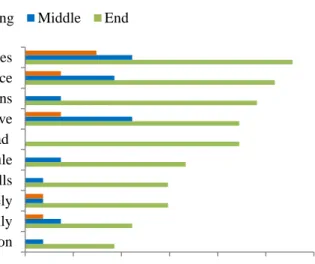
(11) During the development and final phases (i.e., implementation and construction), the majority of students recognized as important capabilities related to working effectively in a multidisciplinary team; analyzing and solving unexpected problems while constructing the housing unit; addressing ethical responsibilities during the monitoring period and juried test; and finally, the impact of the competition in the local community. For the first time, the SD competition had a record of 70,000 attendees and the students experienced the need for explaining their work in layman’s terms. In sum, findings suggest that students modified their perceptions of the skills attained over time and that learning was constructed according to the project requirements at the moment. Beginning. Middle. End. Apply the knowledge, techniques, and tools Function effectively as a member of a technical team Identify, analyze, and solve problems Address ethical responsibilities (respect for diversity) Impact of engineering technology solutions in society Apply written and oral communication Lead and manage a team Design systems, components, or processes Create and innovate Engage in life-long learning Apply a knowledge of mathematics, science,… Conduct, analyze, and interpret experiments Commit to quality and timeliness Other 0% 10% 20% 30% 40% 50% 60% 70% 80% 90% 100% Percentage of students (%). Figure 7. Perceptions of students about capabilities developed while participating in the SD competition Personal and Professional Challenges The last module of the survey asked students to identify the primary personal and professional challenges they felt had to face during the whole project. In reference to personal challenges (Figure 8), the multidisciplinary teaming with students from other disciplines and different paces of work was the main challenge. Participating in a competition like SD requires students to step outside their comfort zones, face uncertainty, and interact with other unknown classmates over an extended period. Thus, it requires the development of a high level of emotional intelligence, which students have expressed in the survey as patience, perseverance, tolerance, and managing of emotions. Conflict resolution requires an additional effort from students in order to understand others’ points of view and respect others’ ideas in order to avoid the failure of the project. This was one of the most important learning takeaways students had when participating in a multidisciplinary real-world project like the SD competition..
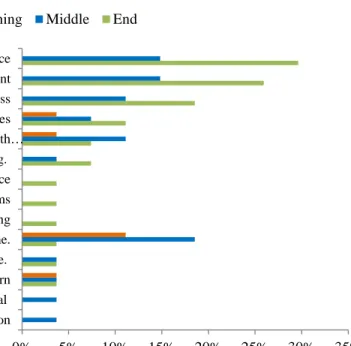
(12) Beginning. Middle. End. Multidisciplinary teaming,different work paces Patience, perseverance, tolerance Manage emotions Respect for other people´s perspective Balance academic and project Load Lack of an organized work schedule Develop new skills Apply technical knowledge effectively Communicate respectfully Oral communication 0%. 10% 20% 30% 40% 50% Percentage of students (%). 60%. Figure 8. Primary personal challenges students recognize when participating in a multidisciplinary project. In reference to primary professional challenges (Figure 9), students recognized the few opportunities they had to truly work in a multidisciplinary environment during their undergraduate program formative process. They also recognized the importance of keeping deliverables on time while complying with the quality and specifications required by the contest rules, as well as balancing the project with their own academic loads. Likewise, they valued the challenge of communicating ideas in technical and non-technical environments, as well as writing in a second language. Professional challenges also evolved over time. During the design and planning phase, some aspects were not considered to be important professional challenges, for instance, working with a limited budget or keeping duties on time. Beginning. Middle. End. Multidisciplinary teaming Keep team duties on time Communicate ideas effectively Learn diverse topics from other disciplines Satisfy the level of quality required Design according with high level… Work with a limited budget 0% 10% 20% 30% 40% 50% 60% 70% 80% Percentage of students (%). Figure 9. Primary professional challenges students recognized when participating in a multidisciplinary project..
(13) Lastly, the survey asked students how they would describe the overall experience of participating in a multidisciplinary competition like the Solar Decathlon for the first time. Students valued their participation and classified the experience as a unique opportunity for their professional and personal development. Likewise, students highlighted that difficulties made them think carefully about all possible solutions and even though it was a challenging experience, it was always an enriching and worthwhile process. Results are summarized in Figure 10. Beginning. Middle. End. An interesting and unique experience A great opportunity for my professional development Tough but an enriching process The importance of multidisciplinary experiences An opportunity for learning to work effectively with… This is real active learning. The most challenging experience An opportunity to solve real problems An opportunity to develop critical thinking Positive. Learning Increases over time. An introduction to real life. Be aware of my knowledge and what else need to learn A great opportunity for making ideas become real The importance of effective team communication. 0%. 5%. 10% 15% 20% 25% Percentage of students (%). 30%. 35%. Figure 10. How students described the overall experience in a multidisciplinary Project. Lessons learned and Recommendations for future competitors In this study, a full analysis of the contribution of a hands-on, real-world experience like the Solar Decathlon competition for developing professional and hard skills was presented. This multidisciplinary competition was the scenario to assess the attainment of multiple student outcomes. Results suggest that participating in a multidisciplinary project like the SD contribute to the development of a variety of student outcomes, mainly including the application of knowledge of engineering (outcome a), the ability to design a system with constraints (outcome c), the ability to function in multidisciplinary teams (outcome d), the ability to formulate and solve engineering problems (outcome e), and the ability to communicate effectively (outcome g). Beyond encompassing several skills, this type of multidisciplinary experience impacted engineering students by giving them a unique experience to create and innovate and prepare them for realworld environments. The lessons learned during the process are presented below..
(14) Lessons learned Select or design the project to be developed carefully. When selecting or designing a multidisciplinary real-world project, students feel highly motivated by up-to-date topics with a strong impact on the society at the local, regional, or international level. Likewise, the project should include the whole life cycle from conception, through design, implementation, and operation. Since students value the opportunity to apply their technical knowledge to real-world problems, this will increase their sense of belonging to the project and will enrich their overall experience. Planning ahead is critical. In a project like SD, planning ahead includes not only envisioning the assembly and disassembly of a housing unit, it additionally includes planning ahead in relation to faculty advising responsibilities and their academic loads, physical and non-physical university resources (e.g., labs and time of supporting areas), external resources (e.g., sponsors), students’ academic loads, and legal paperwork (e.g., insurances, contracts, credits). The overall team should be instructed in key aspects of project management. Teamwork is a critical skill in order to ensure the successful development of any project. Although traditional classes might involve some degree of teamwork experiences, it is crucial to expose students throughout their undergraduate programs to teamwork in multidisciplinary scenarios. During the development of this competition, we found that teamwork in multidisciplinary teams is one of the most difficult skills to attain. Teaming with people from other disciplines should start from the beginning of the project, providing students the opportunity to participate in teamwork workshops where they get to know each other from a human perspective. In this way, students will enter the project thinking as equals, as complementary and not as separate entities, and will be willing to collaborate easily. Second, engage students in activities that lead not only to the achievement of a common goal but also to achieve it respecting and valuing others’ opinions, and understanding each discipline’s role. This will increase the self-esteem of the team and the confidence in others’ work. Third, there should be a clear and agreed upon project schedule with deliverables and deadlines for each role and each participant. This will facilitate shared responsibilities. The lack of a decision-making strategy might lead to the failure of the team and the project. It is important to design a protocol for decision making. This protocol should consider three aspects. First, involve the entire team. If participants are part of the decision making process, actions will be easily implemented. A mechanism to allow everybody participation must be designed. Second, be based on technical criteria. Critical aspects of the project must have clear tools for evaluation; rubrics might facilitate the decision making process. Lastly, critiques should be provided in a respectful way always reinforcing positive feedback and focusing on things that should be improved. A multidisciplinary competition like Solar Decathlon challenges students in an integrated way and beyond the technical skills associated with applying knowledge, techniques and tools specifically of engineering disciplines. It challenges students for a unique learning experience that contributes to attaining other student outcomes, such as functioning effectively in multidisciplinary teams, acting with ethical responsibility, and recognizing the importance of engaging in life-long learning..
(15) Recommendations for future competitors (Institutions) In a case where two or more universities are involved, it is important to clarify roles and responsibilities based on each institution’s strengths and weaknesses. Each university should design a selection process for the students participating. Students participating in projects with a broad scope such as the Solar Decathlon must fulfill academic requirements in order to ensure continuity throughout the project. The institutions should provide the physical resources (e.g., meeting rooms, labs, and professors’ time) and academic resources (e.g., credit hours, internships, and assistantships) necessary for students’ proper involvement and acknowledgment through the whole project development. Engage students from the beginning of the project and more importantly, ensure their continuity. Even though the team composition did not vary significantly, there were variations in the students participating. Some of them engaged in specific activities, some for one semester, and some for the whole year. Since they did not know each other well, teaming was difficult to strengthen. Thus, the commitment and continuity of students in the project can be ensured through academic incentives such as thesis projects, internships, and course credits that become meaningful for the students and represent a real benefit with clear results and deliverables within the period specified for the project. Encourage periodic oral progress reports. Weekly or monthly oral progress presentations will help the team to keep track of the project’s deliverables, as well as to identify needs or new requirements from other disciplines. Likewise, they will facilitate participation and discussion of technical details and budget required, anticipating future problems, and receiving advisors’ feedback. Appointing an external project manager might be helpful in order to keep activities on track. Ideally, a sub-team of the students should work from the beginning on the project schedule, including the submission of deliverables, construction, and disassembly phase. Even though is a “student-oriented” competition, a team of professors in each discipline should support the planning, implementation, and operation phases and meet students on a frequent basis to make decisions or guide them if necessary. In other words, there should be an academic learning process concurrent to the project development. Engage students from the appropriate disciplines according to the purpose of the project. The SD was perceived as a construction competition, however, it involves more than building a housing unit. Other disciplines such as psychology, economics, business administration, and telecommunications engineering play a critical role when defining the social profile of the people for whom the housing unit will be designed, identifying community needs, determining the financial strategies associated with housing affordability, selecting the proper strategies to raise funds, and defining the role of telecommunications technology in the house performance. In sum, a single project could involve a variety of disciplines beyond engineering that might be fruitful for the project’s overall success..
(16) Bibliography 1.. ABET. Criteria for Accrediting Engineering Programs, 2015 – 2016. http://www.abet.org/accreditation/accreditation-criteria/criteria-for-accrediting-engineering-programs-20152016/. Accessed October 1, 2015.. 2.. Felder RM, Brent R. Designing and Teaching Courses to Satisfy the ABET Engineering Criteria. J Eng Educ. 2003;92(1):7-25. doi:10.1002/j.2168-9830.2003.tb00734.x.. 3.. Olds BM, Moskal BM, Miller RL. Assessment in Engineering Education: Evolution, Approaches and Future Collaborations. J Eng Educ. 2005;94(1):13-25. http://dx.doi.org/10.1002/j.2168-9830.2005.tb00826.x.. 4.. Imam MH, Tasadduq IA. Satisfaction of ABET Student Outcomes. Glob Eng Educ Conf (EDUCON), 2012 IEEE. 2012:1-6. doi:10.1109/EDUCON.2012.6201167.. 5.. Coyle LHJ and WCO and EJ. EPICS: Engineering Projects in Community Service. Int J Eng Educ. 2005;21:139-150.. 6.. Rodgers WHSBWK. COMPETING IN THE 2011 SOLAR DECATHLON. In: 2011 ASEE Annual Conference.; 2011:1-10.. 7.. DOE. Solar Decathlon. US Dep Energy. 2015. http://www.solardecathlon.gov/international-latinamerica.html.. 8.. OECD. Educational Research and Innovation. (Innovation C for ER and, ed.). Paris: Paris : Organisation for Economic Co-operation and Development; 2010.. 9.. Male SA, Bush M, Chapman E. Perceptions of competency deficiencies in engineering graduates. Australas J Eng Educ. 2010;16(1):55-67.. 10.. Harrison GP, Ewen Macpherson D, Williams DA. Promoting interdisciplinarity in engineering teaching. Eur J Eng Educ. 2007;32(3):285-293. doi:10.1080/03043790701276775.. 11.. NAE. Engineer of 2020: Visions of Engineering in the New Century. Washington, DC, USA: National Academy of Engineering; 2004. http://www.ebrary.com.. 12.. The Research Agenda for the New Discipline of Engineering Education. J Eng Educ. 2006;95(4):259-261. doi:10.1002/j.2168-9830.2006.tb00900.x.. 13.. Mayer RR. How engineers learn: a study of problem-based learning in the engineering classroom and implications for course design. 2013. http://lib.dr.iastate.edu/cgi/viewcontent.cgi?article=4209&context=etd.. 14.. Bringle RG, Hatcher JA. Implementing Service Learning in Higher Education. J Higher Educ. 1996;67(2):221-239. doi:10.2307/2943981.. 15.. ABET. Proposed Revisions to Criteria for Accrediting Engineering Programs.; 2015. http://www.abet.org/wp-content/uploads/2015/11/Proposed-Revisions-to-EAC-Criteria-3-and-5.pdf.. 16.. Haffner E, Cezeaux J, Keyser T. A multidisciplinary design experience that addresses several ABET outcomes also provides a framework for international student collaboration. Comput Ind Eng 2009 CIE 2009 Int Conf. 2009:1911-1913. doi:10.1109/ICCIE.2009.5223877.. 17.. Ollis DF. Basic elements of multidisciplinary design courses and projects. Int J Eng Educ. 2004;20(3):391397. http://www.scopus.com/record/display.uri?eid=2-s2.0-3042652970&origin=inward&txGid=0.. 18.. Formula Hybrid. Thayer Sch Eng Dartmouth. 2006. http://www.formula-hybrid.org/. Accessed January 8, 2016.. 19.. Koutsikouri, D, Dainty, A and Austin S. Critical success factors for multidisciplinary engineering projects. In: Boyd D, ed. 22nd Annual ARCOM Conference. Birmingham, UK: Association of Researchers in Construction Management; 2006:219-228. https://dspace.lboro.ac.uk/dspacejspui/bitstream/2134/5235/1/Critical success factors for multidisciplinary engineering projects .pdf.. 20.. David Prescott, Tharwat El-Sakran, Lutfi Albasha, Fadi Aloul YA-A. Engineering Communication Interface: An Engineering Multi-disciplinary Project. US-China Educ Rev. 2011;A(7):936-945..
(17)
Figure

+5
Documento similar
The expansionary monetary policy measures have had a negative impact on net interest margins both via the reduction in interest rates and –less powerfully- the flattening of the
Jointly estimate this entry game with several outcome equations (fees/rates, credit limits) for bank accounts, credit cards and lines of credit. Use simulation methods to
I do not assume that the experiences of Latin American women in Las Radiantes are the same as Latin Americans in Entrecalles; either that the experiences of Aboriginal people in
For instance, the best overall accuracy of bagging in Breast with 20% noise is achieved using a 10% sampling ratio: The test error goes from 4.1% when no noise is injected to 3.5%
In particular, different versions of the training set for the base learners can be used, as in bagging (bootstrap sampling of training data), class-switching (noise injection in
Modern irrigation is transforming traditional water irrigation norms and therefore it is critical to understand how the access mechanisms to assets (natural, financial, social),
Fernando Camacho Padilla with Najmeh Shobeiri, the director of the Spanish Language and Literature department at Allameh Tabataba’i University, and Babak Mousavifard, Director
(hundreds of kHz). Resolution problems are directly related to the resulting accuracy of the computation, as it was seen in [18], so 32-bit floating point may not be appropriate
