PRESENTATION
Also with the introduction of additional manual and automatic search with the recommendation of learning resources and instructional design based on the context, as well as recommending adjustments in learning resources. So firstly the objectives of the research will be explained, then the hypothesis will be formulated, secondly the state of affairs in the study areas and the week points will be described, thirdly outlining the proposal, then presenting the results of the proposal evaluation and finally some conclusions Pull.
PROBLEMS AND JUSTIFICATION
In general, there is little experience with web support tools that allow the teacher autonomy in educational design and ontologies, as well as the use of technologies such as intelligent agents and data mining for the application of learning resources and educational design and mechanisms for adaptive search and recommendation based on educational technology specifications and ontologies. There is also little experience of actually using the combination of social networks and semantic web (social semantic web) to structure the resources in interoperable formats and adaptive meaning in a collaborative way and also automatically searchable by the context.
OBJECTIVES
The implementation of an eLearning system can improve the interoperability, reusability and adaptability of learning resources to user characteristics and contribute to the adoption of Web 3.0.”. Implement a workflow system to enable the generation of a collaborative workflow for the customization of learning resources and metadata.
METHODOLOGY
Research literature (state of art)
Specifications and Standards - A comparative analysis of various specifications and educational standards that select IMS Consortium specifications.
Definition of the proposal
Development of the proposal
Collaborative workflow tool – System that enables management and creation of workflows to model the teaching and learning process, especially for annotation and adaptation of learning objects, learning design and metadata. Intermediate layer between LD Back-Office and LMS/social network (presentation tool of learning resources and visualization).
Validation of the proposal
Comparative and compatibility analysis to select an LMS/Open Source Social Networking to integrate with AHKME, giving LD Back-Office a Front-end.
Thesis writing and conclusions
CONTEXT OF THE THESIS
- I N THE RESEARCH GROUP
- I N A GENERAL CONTEXT
This doctoral dissertation work is one of the research directions of the Research Group for Interaction and e-Learning (GRIAL) at the University of Salamanca. In a technical sense, the implementation of the system - AHKME - was carried out with elements of computer science, and the raising of relative data to the considered processes was carried out in cooperation with pedagogical/educational workers involved in GRIAL.
PRESENTATION OF THE FOLLOWING CHAPTERS CHAPTERS
Having highlighted the state of the art of e-learning systems and tagging technologies for educational metadata, the third chapter presents a proposal for this thesis: recording AHKME with IMS specifications to introduce the concept of instructional design in this type of system and ensure its interoperability. and reusability. This is the basis for identifying some of the problems of e-learning systems and justifying some of the envisaged developments in the following sections.
INTRODUCTION
But this thesis focuses on the field of education and more specifically on the eLearning trend. Thus, in this chapter one will study information systems web trends, data availability and representation, adaptation, interoperability of data, collaboration between users and more specifically its application within eLearning.
WEB AND ELEARNING
- E L EARNING
- E L EARNING 3.0
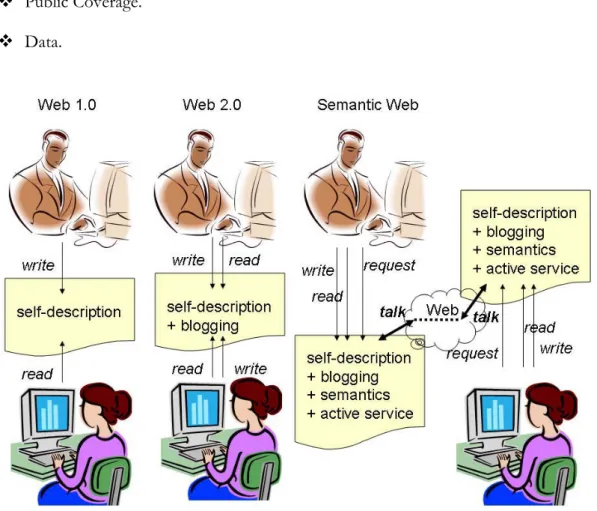
In short, Web 2.0 not only connects individual users to the Web, but also connects these individual uses together. In the Web 2.0 universe, a Google search for "Gary Price" will return a ton of unrelated hits. Web 3.0, called the "data web," uses structured data records published online in reusable and remotely queryable formats.
Twine is an example of Web 3.0 in action, combining the social elements of Web 2.0 with user-specific tools of the Semantic Web (Cho, 2008).
MARKUP TECHNOLOGIES STANDARDS AND SPECIFICATIONS FOR EDUCATION AND SPECIFICATIONS FOR EDUCATION
- M ARKING TECHNOLOGIES FOR EDUCATIONAL METADATA
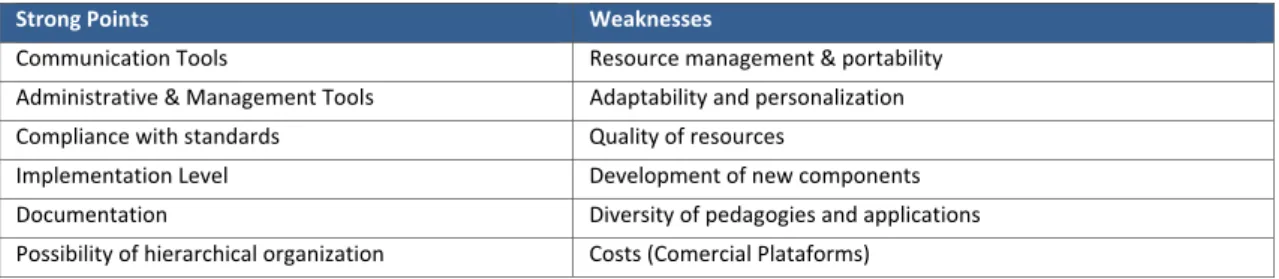
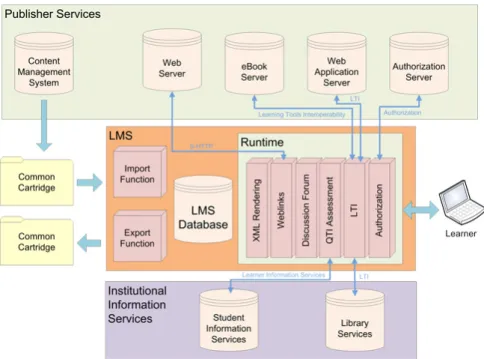
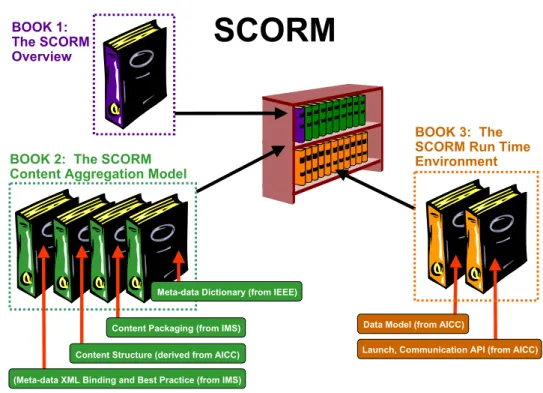
One of the other things to consider is the system's compliance with standards. SCORM becomes more of an integrator of specifications and standards than a standard in itself, so it depends on the standards it integrates. Each of the standardization organizations has specific milestones and project plans for its initiatives (CETIS, 2005).
Similarly, a course composed of different lessons or learning activities can be tagged with metadata to identify the structure of the content.
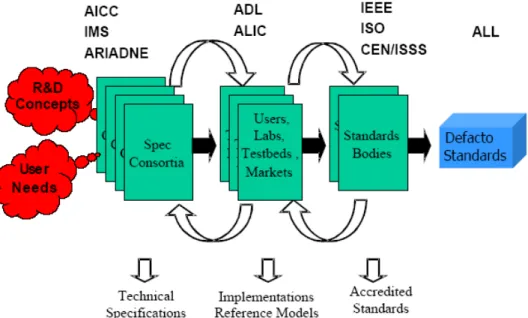
SCORM
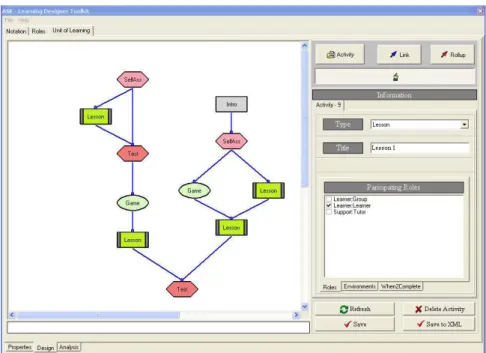
IMS LEARNING DESIGN (IMS LD)
A packet under the IMS CP is only considered a LU if it contains at the organization (within the manifest) a valid IMS LD element. IMS LD is considered a metalanguage because it does not prescribe any particular approach to instructional design and to create a flexible teaching stream that covers different needs and interests. IMS LD is oriented towards learning process based on activities and is open to any theory of learning.
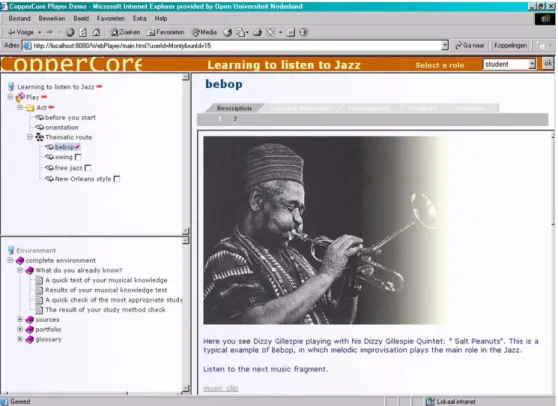
However, since February 2003 when it approved the final specification of IMS LD-EML, OUNL has stopped developing and maintaining it (Tattersall & Koper, 2003).
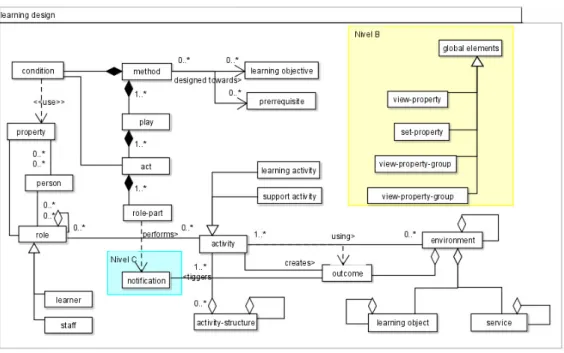
S CHEMAS
One of the greatest strengths of XML schemas is the support for data types that make it easier to describe permissible document content, to validate the correctness of data, to work with data from a database; to define data patterns and to convert data between different data types. XML Schemas implement Secure Data Communication, so that when data is sent from a sender to a receiver, it is essential that both parts have the same "expectations". Through XML, the XML schemas are extensible and thus make it possible to reuse the Schema in other Schemas; create our own data types derived from the standard types and refer to multiple schemas in the same document.
Even when documents are properly formatted, they can still contain errors, and those errors can have serious consequences (for example, five laser printers are ordered instead of five laser printers).
W EAKNESSES
These technologies are actually oriented towards instructional design experts and computer specialists, and a way for the computer to automatically process the information, but is not expected to be used directly by the ordinary user, for this reason mechanisms to facilitate their work without necessarily being informed to be of its existence must be developed. Moreover, while it is better to define learning processes that are specific to the type of students and the context they are addressing, it is also true that it is possible to reuse components designed for other courses – all of which is very common in practice happens. and modify designs and resources created by others to incorporate them into their own design. It has also been shown that the labels related to educational issues, although a standard for LO, are rarely used (en (Friesen, 2009) (Friesen & Nirhamo, 2003).
We also hope that the use and adoption of standards and specifications in different situations and contexts will generate suggestions for their optimization.
E DUCATIONAL MARKUP CONSIDERATIONS
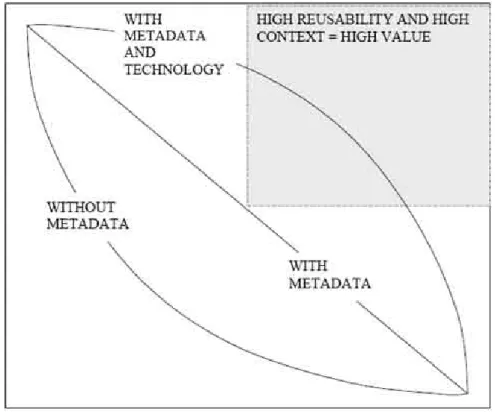
It is important to remember that the next generation of systems and learning in general must be based in some way on mechanisms for the exchange, reuse and adaptation of educational elements. This is intended as a heuristic based on a conceptual representation; There is no claim that there are reasonable quantitative measures of context. To each point in the x-y plane it is possible to assign the value of an information (or learning) object with that degree of reuse and context.
However, it is appropriate to believe that they are a reasonable reflection of the current situation.
ADAPTIVE HYPERMEDIA SYSTEMS
- C ONCEPT
- A PPLICATION AREAS
- T AXONOMY
- A DVANTAGES AND DISVANTAGES
- A DAPTIVE HYPERMEDIA FOR E L EARNING SYSTEMS
- E VOLUTION
- W EAKNESSES
- AEHS CONSIDERATIONS
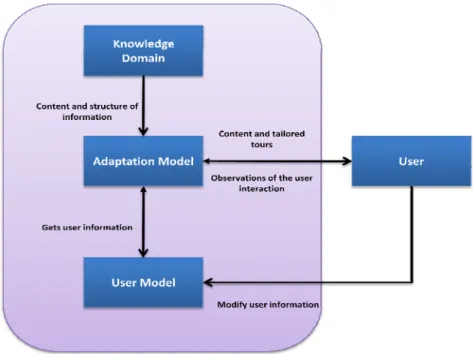
The purpose of an AHS is for the system to adapt to the user's characteristics and not the other way around, as in the hypermedia 'classic', which shows the same content and links to all users (Bra, Brusilovsky, & Houben, 1999). The domain model is the structure stored in the form of pages or nodes containing information, knowledge or area of study of the system. Moreover, the presentation of content, called personalization of presentation, takes into account adaptive features (not adaptive).
Also in the automation part of adaptive systems is the use of recommender tools that suggest adaptations related to resources and user attributes.
COLLABORATION AND RECOMMENDATION SYSTEMS RECOMMENDATION SYSTEMS
- C OLLABORATION
- R ECOMMENDATION
- R ECOMMENDER S YSTEMS
These characteristics can come from the information item (the content-based approach) or the user's social environment (the collaborative filtering approach). When building the user profile, a distinction is made between explicit and implicit forms of data collection (Fournier, 2010). Furthermore, recommendations are generally based on an “information item (the content-based approach) or the user's social environment (the collaborative filtering approach)” (MacManus, 2009b).
Of course, sometimes it may not be perfect as the user's taste may not be perfectly addressed.

WEAKNESSES OR OPPORTUNITIES FOR IMPROVEMENT IMPROVEMENT
These problems and opportunities form the basis for the main topics of the current research and, consequently, for the development of the proposal, which will be introduced in the next chapter. The main objective is to address the main issues of interoperability and reusability, but also to contribute to the adaptation and mobility of resources and the dissemination of these systems. The core of the proposal focuses on learning design and instructional management tools, as well as the process of adapting tools, leveraging collaboration, and learning from social networks.
This chapter justifies the approach, the features of the tools developed and presented, and the application scenarios.
INTRODUCTION
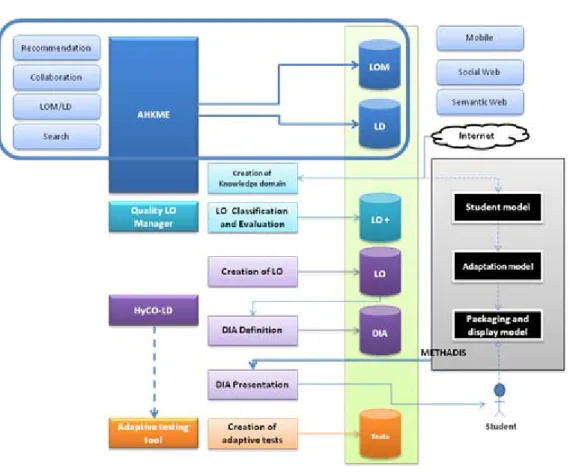
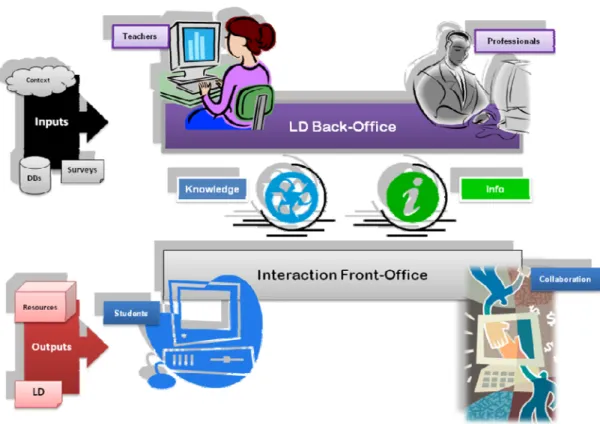
So, instead of focusing on knowing that the users have to work with tools, it focuses on simplifying and reusing the learning resources and strategies for similar learning contexts. As shown in Figure 35, the system will work simultaneously as a learning design back-office system for teachers and instructors and also as the front-end for presenting learning resources and for collaboration. It therefore tries to introduce a first version of the technologies and concepts regarding the Semantic Web or Web 3.0, which makes the Web machine-readable by annotating data on the Web based on its meaning (EmergingTech, 2011).
The goal of the system is to try to bring teachers and e-learning technologies together, using today's web-emerging concepts regarding social web and networks.
MAIN CONTRIBUTIONS
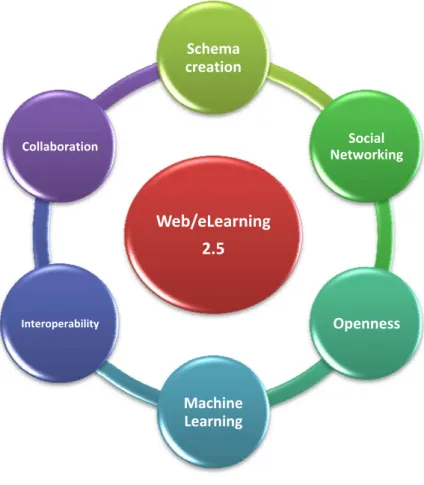
The implementation of a "middleware", middle version or bridge between web 2.0 and web 3.0 systems, due to the difficulty of implementing the web 3.0 through the advanced technologies involved for the majority of the users. Implementing a kind of Web 2.5 concept to prepare the students and teachers for the new features and technologies involved. Intelligent applications with the aim of tailoring online searches and requests specifically to users' preferences and needs.
The aim is thus to contribute to the development and application of the concept in a more straightforward and consistent way.
STANDARDS AND SCHEMA PROPOSAL
- S TANDARD AND SCHEMA ADOPTION CHOICE
- W HY IMS?
In this way, it is possible to see the level of their compliance with the specification that affects the functionality needed. When it comes to standards, it is important to pay attention to how the system level conforms to the various standards. From this analysis, it is able to verify that the IMS specifications cover most of the analyzed aspects.
Although the system allows to import different schemes or customize/create their own schemes, it is important to make the learning design process easier for the teacher, avoiding the technical knowledge about educational technologies.

AHKME
- I NTRODUCTION
- S UBSYSTEMS AND TOOLS
- AHKME-L EARNING O BJECT M ETADATA M ANAGEMENT AND
- AHKME-A DAPTATION S UBSYSTEM
One of the main contributions of this tool, but mainly of this research, technically speaking, is the XML Schema parsing feature. Figure 52 shows a snippet of parsing code that illustrates the technical details of the function. This is in line with the general preference of the adaptive hypermedia research community that adaptation is more interesting.
In Figure 69, a snippet is presented with an example of the implementation of this pseudocode after calculating the entropy of the properties. Get the position on the attribute array of the attribute for which the entropy is calculated. In Figure 70, the generation of the attribute with the most profit is presented, in the process of recommending the most important attribute for adaptation.