Sé que els esforços que fem des de la investigació són en la majoria dels casos, si no tots, invisibles i triguen anys abans que us pugueu beneficiar. Encara que una mica allunyat de Sant Boi, considera que la gent del departament de la UB també va formar part d'aquest projecte. Gràcies pel teu humor i per ser l'única persona que puc passar de la ràbia més profunda a la rialla més forta, m'encanta com eres i com estem junts.
En conseqüència, s'ha suggerit que les alteracions de la plasticitat sinàptica tenen un paper crític en la fisiopatologia del trastorn. En primer lloc, es descriu el paper de la variabilitat genètica dels gens KCNH2 i DISC1 en la modulació de la resposta funcional a l'atenció i la memòria de treball condicionada al diagnòstic. En conseqüència, s'ha suggerit que els canvis en la plasticitat sinàptica tenen un paper crític en la fisiopatologia del trastorn.
En primer lloc, es descriu el paper de la variabilitat genètica en els gens KCNH2 i DISC1 en la modulació de la resposta funcional a l'atenció i la memòria de treball d'una manera condicionada pel diagnòstic.
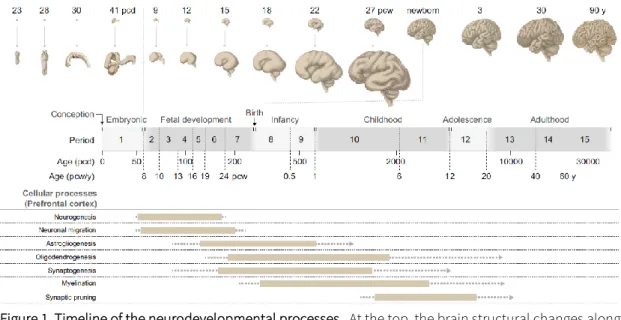
The human brain developmental continuum
While gray matter volume peaks in childhood and declines through the second decade of life, white matter volume increases until mid-to-late adolescence before slowing (Mills et al. 2016; Bethlehem et al. 2022). All of these processes are genetically orchestrated, environmentally modulated and require precise spatiotemporal transcriptional regulation (Stiles and Jernigan 2010; Silbereis et al. However, in comparative studies examining the differences and commonalities between brain development in humans, macaques and chimpanzees, it has been noted that the ontogenetic patterns, the neurogenic gene expression programs, the cytoarchitecture and the cell type composition are remarkably similar (Mora-Bermúdez et al.
Differences then lie in the spatio-temporal gene expression trajectories that display neurodevelopmental genes in humans, particularly at the embryonic, mid-fetal, and adolescent stages of development (Otani et al. Expression divergences in humans during embryonic development are assocd. with neurogenesis and neuronal differentiation and is believed to underlie the increased proliferative capacity of neural progenitor cells that support the expansion of the neocortex in humans (Mora-Bermúdez et al. In contrast, expression differences in adolescence are associated with genes related to synaptogenesis and myelination (Zhu et al. 2018).
However, these determinants also underlie the disorganization and ultimately dysfunction of the central nervous system that can be observed across the neurodevelopmental continuum in different disorders such as schizophrenia (Schmitt et al. 2014b; Owen and O'Donovan 2017).
Schizophrenia: from an epidemiological and clinical point of view
Nevertheless, evidence also suggests shared genetic signatures between schizophrenia and lifespan, cardiovascular and metabolic disorders (Andreassen et al. 2013; Muntané et al. 2021). This fact indicates that diagnostic manuals are not necessarily linked to the biological basis, suggesting that the heterogeneous presentation and course of psychiatric disorders may not represent distinct pathogenic entities but exist on a continuum (Keshavan et al. 2011; DeRosse and Karlsgodt 2015). Nevertheless, there is scant evidence to indicate that the clinical categories represent discrete entities with natural boundaries (Kendell and Jablensky 2003; Clark et al. 2017).
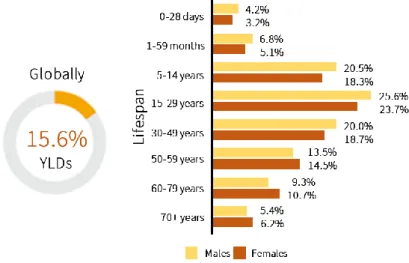
Instead, there are extensive clinical, epidemiological and genetic indicators of common features among psychiatric disorders (Anttila et al. Recently, the cognitive dimension has also been considered a core dimension, including poor sustained attention, difficulties with abstract thinking, intellectual impairment, working and long-term memory impairment and poor executive functioning (Jauhar et al. 2022) (Figure 3) Nevertheless, while positive symptoms are those that capture much of the attention and usually respond well to antipsychotic medication and psychological therapy, negative and cognitive symptoms are those that contributes most to the morbidity associated with schizophrenia (Keefe and Fenton 2007; McCutcheon et al. 2020).
Indeed, cognitive impairments usually begin before the onset of the first psychotic episode (Fusar-Poli et al. 2012), and individuals at high risk of psychosis who later develop it present with more severe negative prodromal symptoms than those who do not. have developed it (Piskulic et al. 2012).
The aetiological roots of schizophrenia
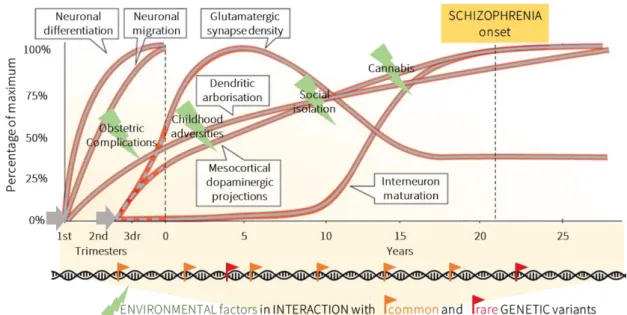
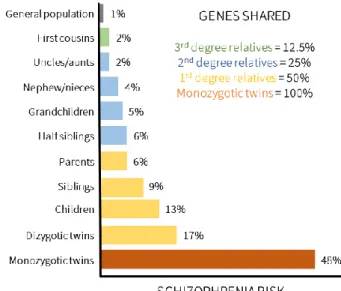
Overall, obstetric complications are not only estimated to double the odds ratio (OR) for schizophrenia spectrum disorders (Belbasis et al. 2018), but have also been associated with cognitive deficits in patients (Amoretti et al. 2022). Through meta-analysis, migration has been strongly associated with an increased risk of schizophrenia and other psychotic disorders, with a consistent effect transferred across generations (Bourque et al. 2011). Genetic determinants of schizophrenia are a major factor, as psychiatric family history is the strongest predictor of mental illness (Sandstrom et al. 2020).
Indeed, the heritability for schizophrenia has been estimated to be as high as 80% (Sullivan et al. 2003; Hilker et al. 2018), emphasizing the great importance of genetics. First, DNA methylation changes in genes from the dopaminergic, serotoninergic and glutamatergic systems have been associated with disorder predisposition (Abdolmaleky et al. Second, histone activity changes have been described in patients compared to controls (Sharma et al .
It is thus considered a highly informative measure at the research level, as higher PRSs for schizophrenia are associated with higher incidence of schizophrenia compared to the population average (Raben et al. 2022).
Pathophysiological alterations in schizophrenia
This dopaminergic dysfunction will ultimately lead to altered cortical function and to the onset of the disorder, which may be associated with striatal dopamine hyperactivity (Howes et al. 2017). These changes in gray and white matter in turn sustain partial impairment of neural communication and function (Keshavan et al. McCutcheon et al. 2020). It is expressed in excitatory cells and modulates neuronal firing patterns (Bauer and Schwarz 2018) KCNH2 genetic variability has been associated with increased mRNA levels of the primate-specific KCNH2-3.1 isoform, with specific electrophysiological properties, in the brain (Huffaker et al. 2009).
Furthermore, increases in the expression of the KCNH2-3.1 isoform cause changes in dendritic spines, cognitive impairment, and changes in neuronal function in mouse models (Carr et al. 2016). The protein interacts directly with the dopamine D2 receptor; Thus, functional changes in the gene and/or protein may interfere with the dopaminergic signaling pathway (Su et al. 2014). In addition to its association with schizophrenia risk from GWAS studies (O'Donovan et al. 2008), this gene has been associated with memory, higher schizotypy scores, a schizophrenia risk factor, in the general population (Hashimoto et al.
This channel regulates calcium influx into the cell and represents the main calcium channel in the brain with critical roles in maintaining the homeostasis of synaptic plasticity (Striessnig et al. 2014).

Neurodevelopmental and evolutionary origin of schizophrenia
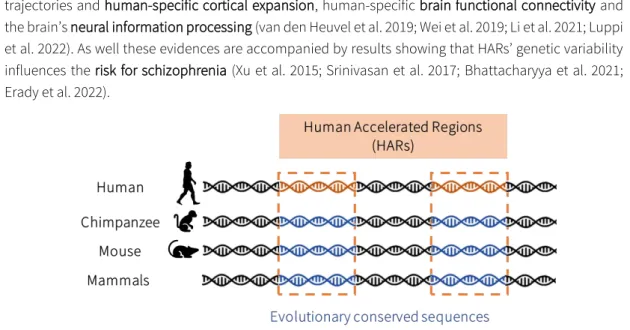
These results are centered on the assessment of the genetic influence of synaptic plasticity genes and Human Accelerated Regions (HARs) on brain functional and structural differences in healthy subjects and patients with schizophrenia. According to Journal Citation Reports (Science Edition, 2021), the journal's impact factor is 5.415, classified in the first quartile (Q1) of the field of Clinical Neurology (47/212). According to the Journal Citation Reports (Science Edition, 2021), the journal's impact factor is 4.997, classified in the second quartile (Q2) of the field of multidisciplinary sciences (19/74).
According to Journal Citation Reports (Science Edition, 2021), the journal's impact factor is 5.760, ranking it in the first quartile (Q1) of the field of clinical neurology (41/212). A systematic review of human accelerated regions in schizophrenia and related disorders: where evolutionary and neurodevelopmental hypotheses converge. According to Journal Citation Reports (Science Edition, 2021), the journal's impact factor is 6.208, ranked in the first quartile (Q1) of the field of Biochemistry &.
The PhD candidate participated in the design of the study, the literature search and the revision of the articles.
New insights of the role of the KCNH2 gene in schizophrenia: an fMRI case-
Combining fMRI and DISC1 gene haplotypes to understand working memory-
A functional neuroimaging association study on the interplay between two
A systematic review of the Human Accelerated Regions in schizophrenia and
Human-specific evolutionary markers linked to foetal neurodevelopment
Overall, the detected effects are consistent with the previously described role of these genes in the risk of schizophrenia (Hashimoto et al. 2013;). Furthermore, changes in DISC1 mRNA levels have been associated with the severity of schizophrenia symptoms and the risk of the disorder itself. Chen et al. 2022. Genetic variants in the gene region have been described that modulate cognitive function in patients with psychiatric disorders and relatives (Novaes de Oliveira Roldan et al. 2022).
These differences in brain network configuration and processing may be related to the observation of the effect of HAR's genetic variability on intelligence and sociability (Wei et al. 2019; Cheung et al. 2022). Furthermore, the A allele at DISC1-rs3738401 has also been shown to be a modulator of the response to antipsychotics (Mouaffak et al. 2011). This effect may be related to the described interaction between the DISC1 protein and dopamine D2 receptors, the main antipsychotic target (Su et al. 2014).
Furthermore, pharmacological treatment reversed behavioral and sociability impairments in CACNA1C mutant mice (Kabir et al. 2017; Hayes et al. 2019). In turn, the HARs have been consistently associated with autism and clinical syndromes such as delirium (Doan et al. 2016; Takahashi et al. 2020), which can be placed along the neurodevelopmental continuum of psychiatric disorders (Owen 2015; Owen and O'Donovan 2017).
Enrichment analyzes show that HGE-related genes harbor copy number variations associated with schizophrenia (Won et al. 2019). Pellegrini et al. 2020).
Anttila V, Bulik-Sullivan B, Finucane HK, et al (2018) Analysis of shared heritability in common disorders of the brain. Bhat S, Dao DT, Terrillion CE, et al (2012) CACNA1C (Ca v1.2) in the pathophysiology of psychiatric disease. Bird CP, Stranger BE, Liu M, et al (2007) Rapidly evolving non-coding sequences in the human genome.
Dahoun T, Trossbach S v., Brandon NJ, et al (2017) The impact of Disrupted-in-Schizophrenia 1 (DISC1) on the dopaminergic system: A systematic review.