ASSESSMENT OF THE PROGRAMME OF MEASURES FOR COASTAL LAGOON ENVIRONMENTAL RESTORATION USING COST-BENEFIT ANALYSIS
JOSÉ MIGUEL MARTÍNEZ PAZ ÁNGEL PERNI LLORENTE
FUNDACIÓN DE LAS CAJAS DE AHORROS DOCUMENTO DE TRABAJO
Nº 588/2011
De conformidad con la base quinta de la convocatoria del Programa de Estímulo a la Investigación, este trabajo ha sido sometido a eva- luación externa anónima de especialistas cualificados a fin de con- trastar su nivel técnico.
ISSN: 1988-8767
La serie DOCUMENTOS DE TRABAJO incluye avances y resultados de investigaciones dentro de los pro- gramas de la Fundación de las Cajas de Ahorros.
Las opiniones son responsabilidad de los autores.
ASSESSMENT OF THE PROGRAMME OF MEASURES FOR COASTAL LAGOON ENVIRONMENTAL RESTORATION USING COST-BENEFIT ANALYSIS.
José Miguel Martínez Paz 1,2 Ángel Perni Llorente*1
Abstract
The Marine Strategy Framework Directive and the Water Framework Directive are the standards agreed in the European Union with the aim of obtaining a good ecological status in marine and coastal waters by applying a programme of measures.
This work expounds the implementation of two economic tools to assess the Programme of Measures intended for the environmental restoration of one of the most important coastal ecosystems in Europe, the Mar Menor coastal lagoon (SE Spain).
Thus, the Cost-Benefit Analysis (and its extensions) and the Contingent Valuation Method are used to assess the aforementioned programme in terms of economic and environmental profitability. Results prove the socioeconomic and environmental profitability of the actions due to be undertaken, with rates of return of around 10%.
From a methodological point of view, there is a clear need to widen the classic CBA scheme by using the Extended CBA and the Dual CBA to gauge this type of environmental restoration actions.
Keywords: cost-benefit analysis, coastal lagoon, pollution, socioeconomic evaluation, environmental restoration, Mar Menor.
JEL classification: H43 Q28 Q57
1Dpto. Economía Aplicada. Facultad de Economía y Empresa. Universidad de Murcia. Campus de Espinardo CP 30100 (Murcia, Spain).
2Instituto Universitario del Agua y Medio Ambiente (INUAMA). Universidad de Murcia. Campus de Espinardo CP 30100 (Murcia, Spain).
*Corresponding author: Ángel Perni. Dpto. Economía Aplicada. Facultad de Economía y Empresa. Universidad de Murcia. Campus de Espinardo CP 30100 (Murcia, Spain). Tlf. +34 868 88 3374. e-mail: [email protected]
Acknowledgements
This work was partially supported by the “Consejería de Agricultura y Agua” of the Región de Murcia (Contract 70/90). We are grateful for the fellowship granted to Angel Perni by “Fundación Séneca” (Spain).
2 1. Introduction
The conservation status of marine ecosystems has important implications on welfare, which strongly depends on the goods and services they provide, such as food, raw materials, natural heritage, climate regulation, monitoring of global change and recreation tourism and education, among others (Hanley et al. 2003; EEA, 2010).
Coastal lagoons, a special kind of marine ecosystems, are among the most sensitive ecosystems to human pressures. These ecological systems undergo serious environmental problems due to inefficient exploitation of their natural resources, and to the pollution stemming from human activities developed in their vicinity, which are putting at risk their capacity to support human well-being (EEA, 2000).
The need to protect marine and coastal ecosystems has favoured the creation and implementation of ambitious laws related to environmental protection, especially in countries with a high economic development (Humphrey et al., 2000). Regarding the European Union standards, coastal lagoons are tackled by regulations of very different nature because of their exceptional situation of transition between land and marine environments (De Santo, 2011). Some of these are Directive 91/271/CEE, concerning urban wastewater treatment; Directive 91/676/CEE, on the protection of waters against pollution caused by nitrates from agricultural sources; Directive 2006/7/CE, related to the management of bathing water quality; Directive 2000/60/CE or Water Framework Directive (WFD), which sets a framework for Community action in the field of water policy; or Directive 2008/56/CE, known as Marine Strategy Framework Directive (MSFD). Whereas the first three directives take a partial approach ─they regulate specific aspects that may affect coastal lagoon management─, WFD and MSFD support a holistic management of aquatic ecosystems in general and marine ecosystems in particular, respectively. MSFD is aimed for each member state to achieve or maintain “a Good Environmental Status in the marine environment by the year 2020 at the latest”. Based on the WFD, which formally introduces the economic instruments in water management (Stemplewski, 2008), the MSFD establishes that an economic and social analysis of both seawater usage and the cost caused by its deterioration should be conducted. From these analyses, a Programme of Measures must be designed in order to achieve the aims of the directive, ensuring that the measures to be taken are environmentally efficient and technical, economic and socially feasible.
Both MSFD and WFD put special emphasis on the usage of the Economic Analysis as a basic tool for decision-making in the management of marine and coastal ecosystems. Despite the fact that this integrated approach is clear in its conceptual and theoretically explanation, its implementation into practice presents some problems, as
some recent studies have pointed out (Turner, 2007). The main analysis tool is the Cost-Effectiveness Analysis (CEA), which provides useful information for the cost and the environmental effectiveness of alternative management options in realizing a given environmental goal; for instance, to reduce pollutants concentration from dumping at a lower unit cost (Elofsson, 2010). The CEA is valid providing that the environmental goal is binding and that the costs incurred are not disproportionate, as the aforementioned EC Directives state ─although there are no guidelines as to how to consider a proportionate cost. On the other hand, the next question is raised: how to evaluate non- binding action programmes that consequently compete with other public investments for attracting funds. In this case, the primary method to evaluate public investments, the Cost-Benefit Analysis (CBA), may be applied. The CBA compares the costs and benefits of a programme, plan or project (PPP) in order to determine whether its implementation is economic and/or socially feasible, and to achieve harmonized indicators with which to compare the profitability of alternative PPPs, if it is necessary to prioritize due to budget constraints. As for indirectly productive investments, like restoration measures in coastal environments, the main drawback of implementing the CBA is to determine the benefits. Thus, what is needed is to quantify not the economic value of the environmental asset that is to be restored, but the economic value of the asset new status. Undoubtedly, this is one of the reasons why this kind of integral economic valuations is scarce in PPPs of environmental nature, especially in those involving marine ecosystems.
The aim of this work is to show the possibilities of the CBA application in the assessment of programmes of environmental restoration measures in marine ecosystems, giving the exceptional coastal lagoon Mar Menor (SE-Spain) as an example of coastal environment. The estimation of the environmental benefits is to be developed by means of a double contingent valuation method, which allows not only isolating the total economic value of the programme of measures, but also decomposing this value into its use and non-use components. This decomposition will lead to an improvement in the use of CBA by adding intergenerational equity criteria to the valuation process and facilitating the usage of dual-rate discounting strategies.
4 2. Analytical framework
2.1. Cost-Benefit Analysis
The Cost-Benefit Analysis (CBA) is an economic valuation technique taken into consideration as a decision criterion in public investment evaluation (Vining and Weimer, 2010). CBA considers the existence of social costs and benefits in the development of an economic activity, as well as the flows included in private or financial evaluations, which only take into account the market flows. These considerations are especially important in environmental PPPs since many environmental goods, such as clean air or biodiversity, lack a market value in spite of the fact that they do have an economic value, which must be fixed so as to be included in the analysis. CBA includes social profitability criteria because this aspect is evaluated in terms of the increase or decrease in global welfare, and hence criteria involving intergenerational equity and sustainability can be incorporated (Hanley and Spash, 1993).
When a PPP is evaluated by means of CBA, six general stages are fulfilled:
1. Identify all the costs and benefits.
2. Value costs and benefits in monetary units.
3. Establish the time horizon of the evaluation.
4. Fix the discount rate.
5. Make selection and/or profitability indicators.
6. Conduct a sensitivity analysis of indicators to the variables of the most uncertain value.
Once the costs and benefits of the PPP are identified and valued in monetary terms, they must be aggregated with the aim of obtaining synthetic evaluation indicators. To undertake this aggregation, it needs to be bore in mind that the resulting costs and benefits are not simultaneous in time, and because of the existing preference for the present, the discount rate must be applied in order to adjust the different times of incidence. The discount rate is intended to represent society’s preference for consumption in the present over the future (Henderson and Bateman, 1995). The higher the discount rates are, the higher the preference for present consumption will be, since the benefits to be enjoyed in the present will be more appreciated than those held in reserve to be enjoyed in the future (Gollier, 2002). If benefits and costs are given in real terms (without being affected by price increase), the discount rate is real as well, and real discount rates of around 2-3% are recommended with medium time horizons (30-75 years) (Kokoski, 2010).
With regard to selection indicators, the Net Present Value (NPV), the Internal Rate of Return (IRR) and the Payback Period (PB) are the most commonly used. NPV aggregates all benefits (B) and costs (C), given in a certain period of time usually measured in years (t), applied to a discount rate (r).
0
( ) 1
t
t t
t t
B C NPV r
r
The viability of a PPP will be confirmed whenever its NPV is greater than zero.
This indicator measures profitability in absolute terms, hence it facilitates to make a decision on whether to accomplish a certain PPP. However, the comparison among alternative PPPs is not achievable.
The Internal Rate of Return (IRR) is defined as the discount rate that zeroes out the net present value of flows of costs and benefits of a PPP. It therefore measures profitability in percentage terms and allows to compare alternative PPPs, independently of their size.
Payback Period (PB) is the length of time required for cumulative benefits returns to equal the cumulative costs of a PPP. It provides an indication of a PPP’s liquidity and risk because a shorter payback period is viewed as less risky (EC, 2008).
Once the general phases of the evaluation procedure have been described, the following analysis schemes should be differentiated:
Classical CBA (CBA): It only considers the benefits and costs of the market or those treated as such.
Extended CBA (ECBA): It considers both the costs and benefits of the market and non-market ones.
Dual CBA (DCBA): It is an extension of ECBA that applies different discount rates depending on the nature of the costs and/or benefits.
In the case of environmental costs and benefits, DCBA takes on special significance since sustainability and intergenerational solidarity are not compatible with the application of the same discount rate to both market and environmental flows, for the reason that the discount means to underestimate future generations’ preferences (Pearce and Turner, 1990; Roumboutsos, 2010). Consequently, the usual discount rate should be applied to market flows, whereas a lower discount rate (an environmental discount rate) should be used in the case of non-market goods (Almansa and Calatrava, 2007; Kula and Evans, 2010). The NPV is therefore as follows:
6
0 0
( , )
1 1
m m a a
t t
a t t t t
t a t
t t
B C B C
NPV r r
r r
Bm and Cm represent the market flows; Ba and Ca are the environmental flows; r is the usual discount rate; and ra corresponds to the environmental discount rate. In spite of the fact that selecting an environmental discount rate is not a settled issue, because of the ethical aspect of having to choose a value, there is a consensus in using reduced rates, which would tend to zero if there is absolute intergenerational equity (Sumaila and Walters, 2005).
Owing to its own nature, this approach does not permit to calculate the IRR but a substitutive profitability indicator. The Critical Environmental Rate (CER) is defined as the discount rate that, applied to the environmental effects, after the market effects have been discounted from the usual rate (r), makes the Net Present Value (NPV) be equal to zero. The CER is an indicator of “environmental profitability that the financial cost produces” (Almansa and Calatrava, 2007).
2.2. Contingent valuation
As it has already been pointed out, one of the major difficulties involving the usage of CBA is to measure a PPP’s non-market costs and benefits, and therefore to fix a price that represents its value in monetary terms to aggregate the costs and benefits to the CBA flows. As for environmental assets, it is necessary to speak about their Total Economic Value (TEV), which includes market and non-market values and consists of use values (UV) and non-use values (NUV).
UVs embrace extractive values (e.g. commercial and subsistence fishing), non- extractive values (e.g. sport fishing, tourism, landscape viewing), and indirect-use values (e.g. reading a nature magazine). NUVs are those values given by the mere existence of the ecosystem and the commitment to preserve and bequeath it to future generations (Hein et al., 2006).
Environmental Economics has developed several methodologies to calculate the TEV of an ecosystem or one/some of its components (EEA, 2010). Based on the construction of a hypothetical market, the Contingent Valuation method (CVM) is one of the most common methods in economics literature to assess environmental goods and services owing to its capacity to obtain and differentiate use and non-use values of a given ecosystem (Liu et al., 2010). In addition, guidelines dealing with CBA application
in project assessments specifically recommend the use of the CVM to value non- market benefits in environmental restoration PPPs (OECD, 2006; EC, 2008).
This work does not intend to describe the CVM foundations, which can be found in many other studies (Pearce, 2006, Bateman et al., 2002, Mitchell and Carson, 1989).
However, it is just needed to point out that the CVM consists in simulating a market by means of questionnaires for the good or service to be valued. The interviewer represents supply and the interviewee constitutes demand. Interviewees are asked what the maximum amount of money they are willing to pay to enjoy the environmental good or service is, or how much they would be willing to receive, at least, if the good or service disappears or worsens. Once all the answers have been dealt with, the obtained average value is extrapolated to the involved population as a whole in order to estimate the TEV of the good or service.
2.3. Background
The use of CBA to assess PPPs affecting both environmental and socioeconomic aspects is increasing nowadays (Birol, 2010; Vining and Weimer, 2010). Nevertheless, this methodology is rarely applied in works related to marine and coastal ecosystems. CBA has mainly been used in studies dealing with the effects of conservation policies and coastal restoration, and in marine resources management (Spurgeon, 1998; Peng et al. 2006; Turner et al. 2007; Zheng et al. 2009), some of them applying ECBA (Dixon and Hodgson, 1988 Cesar et al., 1997, Pet-Soede et al., 1999, Fahrudin, 2003).
The number of CBA studies that include the CVM results to estimate environmental benefits and costs is also growing. In fact its application was recommended by NOAA Panel to calculate the lost of non-use values as a result of the supertanker Exxon Valdez oil spill (Arrow et al., 1993). Since then this method has been profusely used to value the environmental services of marine and coastal ecosystems (Remoundou et al., 2009). A wide revision on works involving CVM application to marine ecosystems can be found in the studies carried out to EMPAFISH Project (Alban et al., 2008).
8 3. Study case: the Mar Menor coastal lagoon
3.1. Environmental setting
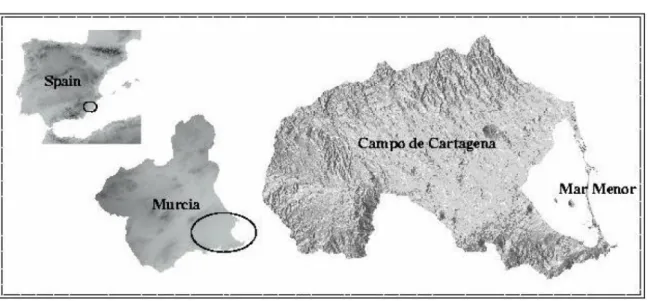
The Mar Menor, located in the southeast of Spain (Figure 1), is one of the largest coastal lagoons in the Mediterranean Sea. Its surface area is 135 Km2 and has an average depth of 2.5 m and a maximum depth of 6 m. It is a hypersaline lagoon with its salinity ranging between 42 and 47. Its average temperature is 12 ºC in winter and 30 ºC in summer. A sand coastal barrier 20 km in length, known as Manga del Mar Menor, separates the Mar Menor from the Mediterranean Sea. This lagoon is connected with the Mediterranean Sea through several channels (Martínez-Fernández et al., 2005).
Figure 1. Location of the Mar Menor lagoon
The Mar Menor receives run-offs coming from the Campo de Cartagena basin.
This watershed is drained by several ephemeral water courses called ramblas, which usually are inactive for the most part of the year. However, during rainfall periods, great volumes of water and sediments are swept along by the ramblas to the lagoon (Velasco et al., 2006). There are a large number of salt flats and salt marshes surrounded by dune systems in the mouth of these ramblas and in some depressions near the lagoon.
Its high salinity and temperature, and the diversity of wetlands located in the vicinity give the Mar Menor special environmental value owing to the great variety of allochthonous flora and fauna species which have adapted to its environmental conditions. Arthrocnumum macrostachyum, Sarcocornia fruticosa or Pancratium maritimum are some examples of plants adapted to salinity. As to ichthyology, there
are some species of high fishing interest such as Anguilla anguilla, Mugil cephalus and Sparus auratus. In addition, over 200 bird species have been located in the Mar Menor and its surroundings; for instance, Phoenicopterus ruber, Charadrius alexandriuns, Sterna albifrons, Podiceps nigricollis, Larus geneis and Himantopus himantopus (Martínez-Fernández et al., 2007).
The Mar Menor lagoon and its environs are protected at national, European and international level with the aim of preserving and protecting the current diversity of habitats and species. The Mar Menor and its salt marshes were included in the Ramsar List of Wetlands of International Importance in 1994. The Mar Menor is also considered a Special Protected Area of Mediterranean Interest (SPAMI). EU regards it as a Specially Protected Area (SPA) for birds, and five Sites of Community Importance (SCI) are located in this area. All its four inner islands are protected under the status of Protected Landscape.
3.2. Main pressures and impacts
The special geo-climatic conditions of the Mar Menor area have favoured the development of intensive agriculture, tourism, fishing and mining, causing a great impact on the lagoon. Its current ecological balance is mainly threatened by the intensive agriculture carried out in the Campo de Cartagena basin, and by the population increase triggered by the massive arrival of tourists during the summer months (Conesa and Jiménez-Cárceles, 2007). Both activities are the direct causes of the eutrophication present in the lagoon. On the one hand, the agrochemical products used in the Campo de Cartagena for the last two decades have polluted the nearby aquifers, which reach concentrations of nitrates of 200-300 mg/l. These figures far exceed the 50 mg/l established by the regulations (CHS, 2008). The aforesaid aquifers are connected to the Mar Menor through both subterranean flows and ramblas. The major input of nitrates and phosphates to the lagoon takes place through the Rambla del Albujón, whose water comes from flow returns of the agricultural activities developed in the Mar Menor draining basin (Velasco et al., 2006). For this reason, the Campo de Cartagena area has been declared vulnerable zone in relation to nitrates under Directive 91/676/EEC. On the other hand, urban and tourism growth has led to a poor wastewater treatment, which is another major threat and the reason why the lagoon has been declared sensitive area according to Directive 91/271/EEC concerning urban waste water treatment.
The Mar Menor has undergone many ecological changes that are affecting local economic activities as a result of eutrophication and other aspects that are altering the
10 lagoon natural conditions, such as widening of communication channels between the lagoon and the Mediterranean (Pérez-Ruzafa and Marcos, 2008). The following are some of the most remarkable changes: the expansion of the alga Caulerpa prolifera replacing the autochthonous phanerogams Cymodea nodosa and Posidonia oceanic;
invasion and rapid spread of Mediterranean jellyfish, with the ensuing degradation of the touristic image of the area; and the decrease in the fishing of autochthonous species substituted by other Mediterranean species (Conesa and Jiménez-Cárceles, 2007).
3.3. Measures to improve the Mar Menor water quality
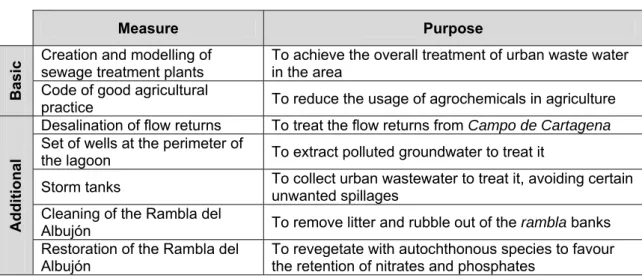
The measures proposed to improve the environmental quality of the Mar Menor lagoon are included in the reports previous to the Segura River Basin Management Plan, written by the Confederación Hidrográfica del Segura (CHS), main organism charged with the lagoon management. The action plan focuses on the reduction in diffuse pollution caused by agricultural activities in Campo de Cartagena; improvement in the treatment of wastewater coming from lagoon-side municipalities; and the subsequent treated water discharge into the Mar Menor. A summary of the measures to be implemented in order to improve water quality in the Mar Menor is shown in Table 1. They are subdivided into basic and additional measures. Basic measures are legally binding actions, which are not enough to restore the Mar Menor by themselves. For that reason, another series of additional measures are implemented to decrease the input of nutrients into the lagoon (CHS, 2008).
Table 1. Environmental restoration measures in the Mar Menor
Measure Purpose
Basic
Creation and modelling of
sewage treatment plants To achieve the overall treatment of urban waste water in the area
Code of good agricultural
practice To reduce the usage of agrochemicals in agriculture
Additional
Desalination of flow returns To treat the flow returns from Campo de Cartagena Set of wells at the perimeter of
the lagoon To extract polluted groundwater to treat it
Storm tanks To collect urban wastewater to treat it, avoiding certain unwanted spillages
Cleaning of the Rambla del
Albujón To remove litter and rubble out of the rambla banks Restoration of the Rambla del
Albujón To revegetate with autochthonous species to favour the retention of nitrates and phosphates
3.4. Overall outline of the valuation
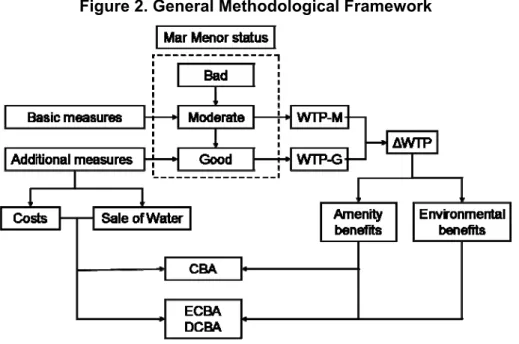
The general methodological system applied in this work is shown in Figure 2.
Two improvement scenarios have been identified according to the kind of measures taken. The first stage constitutes a moderate improvement in the lagoon ecosystem after basic measures are applied. On the other hand, when additional measures are implemented, the lagoon good environmental status would be achievable, which represents the second scenario. The CBA of the programme of additional measures considers financial costs of implementation of measures (McCrea-Strub et al, 2011), income from selling the water produced, and amenity and environmental benefits brought by the transition from a moderate to a good environmental status. An exercise of contingent valuation has been designed to estimate amenity and environmental benefits. It consists in calculating the willingness to pay (WTP) in each of the aforesaid scenarios. Given that basic measures are legally compulsory, they would be left out of the economic analysis proposed, since its purpose is to determine whether or not a project is justifiable from an economic, social and/or environmental point of view (Zanou et al., 2003).
Figure 2. General Methodological Framework
12 4. Willingness to pay for the environmental improvement of the Mar Menor
4.1. Survey design
The Contingent Valuation Method (CVM) has been used in the present work to estimate the Willingness To Pay (WTP) for the improvement of the Mar Menor environmental quality. Thus, a survey addressed to the citizens of Región de Murcia, geographical area where the lagoon is located, was conducted.
The question about the WTP was put in mixed format: one dichotomous question and two open-format questions, one for each improvement scenario. Firstly, interviewees were asked whether or not they were willing to pay an additional tax on the water bill intended for the Mar Menor environmental restoration. Secondly, they were asked about the maximum amount they were willing to pay to achieve each of the improvement scenarios. Thirdly, other questions related to psychographic and socioeconomic variables were included. In addition, interviewees were provided with a brochure describing the features of both scenarios with the purpose of reducing the uncertainty typical of this type of valuation methods (Blomquist and Whitehead, 1998).
The valuation exercise was conducted through personal interview in April 2010.
The citizens over 18 years of age of Región de Murcia were the target population1 (1.140.887 inhabitants), and the random sample size was of 344 individuals (stratified by areas of Región de Murcia), with a maximum error of estimate of 4%.
4.2. Constitution of the hypothetical market
The composition of the hypothetical market created by the contingent valuation method is structured from individuals’ answers to the dichotomous question about the WTP and the reasons for their answers. Out of the 344 interviewees, 47.7% (164) declared that they were willing to pay, whereas 52.3% (180) were not. This last group can be divided into two factions: real zeros and protest zeros. Protest answers are given by individuals who reject the valuation exercise, and declare their unwillingness to pay although they do have a positive opinion on the good (Bateman y Langford, 1997). In this study, protest zeros are constituted by those individuals who argued that
1 About 50% of the tourists visiting this area come from Murcia, where they own a second home;
thus, the summer population of the Mar Menor has been taken into account by our sampling.
“the Mar Menor environmental restoration is within the competence of the Public Administration”. A total number of 148 interviewees gave a protest answer, whereas the remaining 32 have been considered real zeros within the hypothetical market, which finally consists of 196 individuals.
4.3. WTP analysis and modelling
By using the answers of the 196 individuals who participated in the hypothetical market, the average WTP is 20.11 € per year in the moderate improvement scenario (WTP_M), and 35.35 € per year in the good improvement scenario (WTP_G). The descriptive statistics of the WTP in both scenarios is shown in Table 2.
Table 2. Descriptive statistics of the WTP (€/year) Minimum Maximum Average Median Standard
deviation
Mean confidence interval (95%) WTP_M 0 100 20.11 10 23.18 16.85 – 23.38 WTP_G 0 200 35.34 25 39.60 29.76 – 40.92
WTP_G is higher than WTP_M for all individuals, which proves answers consistency, since the environmental improvement achieved is superior in the first case. Besides, both WTPs show a positive and significant correlation.
This WTP represents the individual total economic value of the enhancement;
therefore it can be divided into use WTP and non-use WTP. The first one embodies the monetary value of the direct enjoyment of the Mar Menor, that is, amenity services (EEA, 2010), whereas non-use WTP represents the environmental value. The value of use WTP derives from the users’ WTP, while non-use WTP is calculated as the difference between users’ WTP and non-users WTP. Finally, use WTP and non-use WTP for the programme of additional measures are obtained as the increase between the WTP of both programmes, shown in Table 3.
Table 3. WTP of users and non-users (€/year)
Concept (WTP_M) (WTP_G) ∆WTP = (WTP_G) – (WTP_M)
Use WTP (Amenity) 5.30 13.65 8.35
Non-use WTP (Environmental) 15.81 24.27 8.46
14 5. Cost-Benefit Analysis of the Programme of Additional Measures
5.1. Characterization of costs
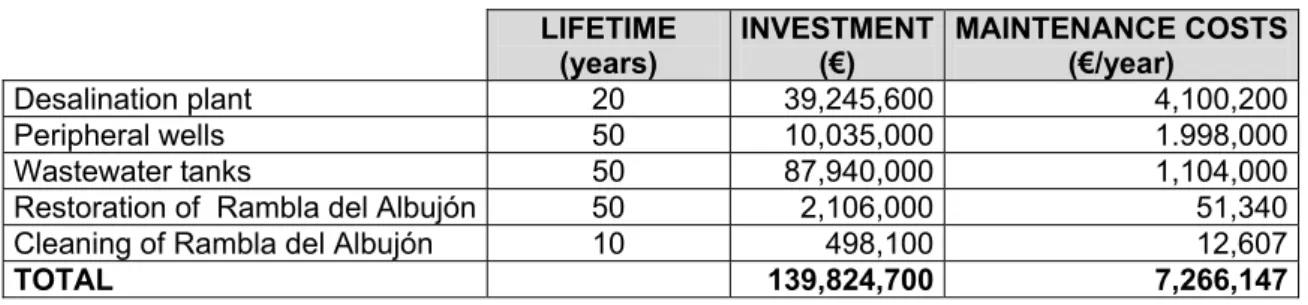
Table 4 shows the financial costs (investment and maintenance) and the lifetime of the programme of additional measures, which are included in their technical projects (CHS, 2008).
Table 4. Characterization of the measures costs
LIFETIME (years)
INVESTMENT (€)
MAINTENANCE COSTS (€/year)
Desalination plant 20 39,245,600 4,100,200
Peripheral wells 50 10,035,000 1.998,000
Wastewater tanks 50 87,940,000 1,104,000
Restoration of Rambla del Albujón 50 2,106,000 51,340
Cleaning of Rambla del Albujón 10 498,100 12,607
TOTAL 139,824,700 7,266,147
5.2. Characterization of benefits
The first thing to be considered has been the income yielded by selling the water produced in desalination plants for agricultural activities. The treatment forecast is 9.7 Hm3/year of flow returns, with a freshwater output of 7.76 Hm3/year. The price of water has been initially fixed at 0.3 €/m3, representing the opportunity cost of an alternative source of supply in the area (Colino and Martínez-Paz, 2007).
Secondly, the benefits generated by the improvement in the Mar Menor environmental quality after the implementation of additional measures have been estimated from the values of use/non-use ∆WTP achieved by means of the CVM.
These benefits are classified into environmental and amenity benefits. Environmental benefits are produced by multiplying total population by the use ∆WTP for the Mar Menor enhancement. Amenity benefits are calculated in the same way but using the population of users (81.12% of the total population).
The target population to be included in the CBA during the analysis period 2011-2059 has been determined from the recent figures of the total population over 18 years of age of Región de Murcia, by using an autorregresive model according to Hildreth-Lu procedure2.
2 The Hildreth-Lu procedure (HL) adjusts a linear model for serial correlation in the error term. This model is a variant to the Cochrane–Orcutt procedure (CO) for small samples (Aschheim and Tavlas, 1988). Taking account of a range 1 autoregressive model: PtPt1t. The error term εt can be
2
t 1 (23.710) (2.712)
; 0.991 (1, 9) 859.732; 0.000
0.110
97,840 0.929 P ;
t t stat
F p
P
R
For instance, the amount of amenity benefits would be 7,877,604 €/year in 2010 and 9,322,490 €/year in 2059, and the number of environmental benefits would be 9,838,980 €/year and 11.643.616 €/year in the same years.
5.2. Profitability indicators
The CBA of water enhancement measures in the Mar Menor will be implemented from the above-mentioned costs and benefits, and the approaches included in section 2: CBA, ECBA and DCBA.
An analysis period of 50 years has been settled, considering the measures maximum lifetime and introducing periodic replacements of the least-lasting measures.
Results of the analyses are shown in Table 5.
Table 5. Profitability indicators
Indicator CBA (2%) ECBA (2%) DCBA (2%, 1%) NPV (€) -62,154,975 274,820,021 363,180,403
IRR (%) - CER (%) - 9.55 14.70
PB (years) - 12 11
Classic CBA has been conducted by exclusively using market flows, which include costs of measures, income from water sale and amenity benefits. The NPV is - 62,154,975€, reason why the implementation of the programme of additional measures, only taking market flows into account, unprofitable and, in turn, rejected.
As ECBA indicators confirm, the implementation of the programme of measures would be fully justified from an economic and social point of view, because NPV is greater than zero and the internal return rate (9.55%) is much higher than any existing interest rate applicable in the market. The Payback Period (PB) is 12 years, meaning
serially correlated over time. 1 1
t t
t e . The CO procedure transforms the model:
t t t t
t P P P e
P 1(1)( 1 2) . Then the sum of squared residuals (et2) is minimized with respect to (α,β), conditional on ρ, using and interactive technique of bisection search for the HL (Neter et al., 1989).
16 that, in scarcely the quarter of the period, investment is recovered and the programme of measures starts generating net profits.
DCBA has been also applied due to the diverse nature of the flows of the project (market and non-market flows). To calculate DCBA the same discount rate (2%) applied to market flows has been used, with a reduced rate (1%) in the case of environmental benefits (Almansa and Martínez-Paz, 2011). It is noticeable that the NPV attained with this approach would also recommend the performance of the investment, with a Payback Period (PB) of only 11 years. The high value attained for the CER (14.70) highlights the outstanding environmental profitability of the aforementioned programme of measures.
5.3. Sensitivity analysis
One of the parameters of this analysis is the selling price of water produced in the desalinization plants. This price is uncertain at medium term because of the changes in energy price and in water policy, which is increasingly focused on the recovery of water services costs. For this reason, fluctuations in the price of the water treated in desalination plants have been considered by way of sensitivity analysis.
Variability of water prices ranges between 0 and 0.6 €/m3 (maximum price of desalinated water in the area). Table 6 presents fluctuations in the profitability indicators of the different types of CBA according to water price rises.
Table 6. Profitability sensitivity analysis of water price fluctuations Water price
( €/m3) CBA ECBA DCBA
NPV (2%) IRR (%) NPV (2%) IRR (%) NPV (2%, 1%) CER (%) 0 -133,026,777 - 203,948,219 7.79 292,308,601 7.30 0.1 -109,402,843 - 227,572,153 8.38 315,932,535 8.84 0.2 -85,778,909 - 251,196,087 8.97 339,556,469 11.06 0.3 -62,154,975 - 274,820,021 9.55 363,180,403 14.70 0.4 - 38,531,042 - 298,443,955 10.13 386,804,336 22.00 0.5 -14,907,108 1.43 322,067,889 10.70 410,428,270 46.47 0.6 8,716,826 2.32 345,691,822 11.27 434,052,204 -
Given the fact that water sale is a benefit of the programme of measures, price rise has a positive effect on profitability indicators of the three schemes. To summarize, every additional cent of euro in water price generates a 2,362,393 € increase in the NPV, and a 0.6% increase in IRR. The decision rule would not change after this analysis, since the CBA approach continues advising against the programme implementation at almost all price levels. However, approaches taking into account environmental benefits prove the programme profitable, even in the case of no profits
produced by water sale. In order to complete this section, it would be interesting to analyse the sensitivity of other CBA parameters, for instance the discount rates (Almansa and Martínez-Paz, 2011).
6. Conclusions
The necessary environment conservation has given rise to a wide spread of environmental protections rules in developed countries. The Marine Strategy Framework Directive (MSFD) and the Water Framework Directive (WFD) include the guidelines for EU marine and coastal water management. Both directives urge member states to propose a Programme of Measures aiming for the good ecological status of these ecosystems. In many cases, it is needed to implement corrective and restoration measures requiring large amounts of public investment that must be economically assessed by including social and environmental profitability criteria.
This work puts forward a methodology for the valuation of the measures implemented to environmentally enhance coastal ecosystems. This methodology, applied to the restoration programmes of the most important inland sea in the Western Mediterranean (Mar Menor, SE-Spain), comprises the Contingent Valuation method (CVM) and different approaches of the Cost-Benefit Analysis (CBA).
The CVM designed for this study has allowed to isolate the assessment of the effects produced by the environmental restoration programme of measures in the Mar Menor from the value the ecosystem itself has before the execution of such a programme. As representative mean figures of the analyzed programme, 8.5 million
€/year represent amenity benefits, and 11.1 million €/year constitute environmental benefits.
The valuation results reveal the economic unprofitability of this type of actions if analyzed with the Classic CBA. Nevertheless, if environmental benefits yielded by the ecosystem restoration are included, the planned investment is far justified. This is possible by using either a CBA with environmental externalities or a dual approach that reduces the discount rate for environmental benefits, as it has been suggested in the latest studies on environmental discount rate (Gollier, 2010). In this way Internal Rate of Return (IRR) of nearly 10% can be attained, which would far justify the public investment (EC, 2008). The Critical Environmental Rate value proves the exceptional environmental profitability produced by the financial investment in this programme of measures. All these results surpass the sensitivity analysis of the most uncertain variable in the model, water price. Despite the quantitative modification of indicators and changes in water price, the directions of the action remain invariant.
18 Finally, it is important to underline the need for an increase in the number of empirical works making use of this methodology when assessing policies of coastal and marine ecosystems conservation. These studies allow to appropriately justify public investment according to the MSFD and WFD principles, as well as to improve and adapt these valuation techniques to this field.
7. References
Alban, F., Appéré, G., Boncoeur, J., 2008. Economic Analysis of Marine Protected Areas. A literature review. EMPAFISH Project, Booklet nº 3. Editum.
Almansa, C., Calatrava, J., 2007. Reconciling sustainability and discounting in Cost- Benefit Analysis: A methodological proposal. Ecological Economics, 60, 712- 725.
Almansa, C., Martínez-Paz, J.M., 2011. What weight should be assigned to future environmental impacts? A probabilistic cost benefit analysis using recent advances on discounting. Science of the Total Environment, doi:
10.1016/j.scitotenv.2010.12.004
Arrow, K., Solow, R., Portney, P., Leamer, E., Radner, R., 1993. Report of the NOAA Panel on Contigent Valuations. Natural Resource Damage Assessment under the Oil Pollution ACT of 1990. Federal Register, 58(10), 4601-4614.
Aschheim, J., Tavlas, G. S., 1988. Econometric modelling of partial adjustment: The Cochrane-Orcutt procedure, flaws and remedies. Economic Modelling, 5(1), 2- 8.
Bateman, I., Langford, I. 1997. Non-Users Willingnes to Pay for a National Park: An Application and Critique of the Contingent Valuation Method. Regional Studies, 31(6), 571-582.
Bateman, I., Carson, B., Day, B., 2002. Economic Valuation with Stated Preference Techniques: Summary Guide. Edgar Elgar Publishing. Massachussets. USA.
Birol, E., Koundouri, P., Kountouris, Y., 2010. Assessing the economic viability of alternative water resources in water-scarce regions: Combining economic valuation, cost-benefit analysis and discounting. Ecological Economics, 69(4), 839-847.
Blomquist, G., Whitehead, J., 1998. Resource quality information and validity of willingness to pay in contingent valuation. Resource Energy Economics, 20, 179-196.
Cesar, H., Hundin, C., Bettencourt S., Dixon, J., 1997. Indonesian coral reefs - an economic analysis of a precious but threatened resource. Ambio 26(6), 345- 350.
CHS, 2008. Esquema Provisional de Temas Importantes. Confederación Hidrográfica del Segura (CHS). Ministerio de Medio Ambiente. Madrid. (Available in:
http://www.chsegura.es/chs/planificacionydma/planificacion/#eti)
20 Colino, J., Martínez-Paz, J.M., 2007. Productividad, disposición al pago y eficiencia
técnica en el uso del agua: la horticultura intensiva de la Región de Murcia.
Economía Agraria y Recursos Naturales, 7, 109-125.
Conesa, H., Jiménez-Cárceles, F., 2007. The Mar Menor lagoon (SE Spain): A singular natural ecosystem threatened by human activities. Marine Pollution Bulletin, 54, 839-849.
De Santo, E., 2011. Environmental justice implications of Maritime Spatial Planning in the European Union. Marine Policy, 35(1), 34-38.
Dixon, J., Hodgson, G., 1988. Logging Versus Fisheries and Tourism in Pallawan: an Environmental and Economic Analysis. Working Paper No. 7. East-West Environment and Policy Institute. Honolulu, Hawaii.
EC, 2008. Guide to Cost-Benefit Analysis of investment projects Directorate General Regional Policy. European Commission. Brussels.
EEA, 2000. State and pressures of the marine and coastal Mediterranean environment.
Environmental Issues Series No. 5, European Environment Agency (EEA), Copenhagen.
EEA, 2010. Ecosystem accounting and the cost of biodiversity losses: The case of coastal Mediterranean wetlands. Technical Report No. 3, European Environment Agency (EEA). Copenhagen.
Elofsson, K., 2010. Cost-effectiveness of the Baltic Sea Action Plan. Marine Policy, 34, 1043-1050.
Fahrudin, A., 2003. Extended cost benefit analysis of present and future use of Indonesian coral reefs. An Empirical Approach to Sustainable Management of Tropical Marine Resources. Kiel, Universität, Agrar- und Ernährungswissenschaftliche Fakultät.
Gollier, C., 2002. Time horizon and the discount rate. Journal of Economic Theory, 107, 463-473.
Gollier, C., 2010. Ecological discounting. Journal of Economic Theory, 145, 812–829.
Hanley, N., Spash, C., 1993. Cost-Benefit Analysis and the Environment. Edward Elgar Publishing Ltd. Cheltenham.
Hanley, N., Bell, D., Álvarez-Farizo, B., 2003. Valuing the benefits of coastal water quality improvements using contingent and real behaviour. Environmental and Resource Economics, 24, 273-285.
Hein, L., van Koppen, K., de Groot, R., van Ierland, E., 2006. Spatial scales, stakeholders and the valuation of ecosystem services. Ecological Economics, 57, 209-228.
Henderson, N., Bateman, I., 1995. Empirical and Public Choice Evidence for Hyperbolic Social Discount Rates and the Implications for Intergenerational Discounting. Environmental and Resource Economics, 5, 413-423.
Humphrey, S. Burbridge, P., Blatch, C., 2000. US lessons for coastal magement in the European Union. Marine Policy, 25, 275-286.
Kokoski, M., 2010. Getting Real: Price Deflation of Nominal Values. Journal of Benefit- Cost Analysis, 1(1), article 7.
Kula, E., Evans, D., 2010. Dual discounting in cost-benefit analysis for environmental impacts. Environmental Impact Assessment Review. doi:
10.1016/j.eiar.2010.06.001.
Liu, S., Costanza, R., Farber, S., Troy, A., 2010. Valuing ecosystem services. Theory, practice, and the need for a transdisciplinary synthesis. Annals of the New York Academy of Sciences, 1185, 54-78.
Martínez-Fernández J, Esteve M.A., Robledano F, Pardo M., Carreño, M., 2005.
Aquatic birds as bioindicators of trophic changes and ecosystem deterioration in the Mar Menor lagoon (SE Spain). Hydrobiologia 550, 221-235.
Martínez-Fernández, J. Esteve, M.A., Martínez-Paz, J.M., Carreño, F., Robledano, F., Ruíz, M., Alonso, F., 2007. Simulating management options and scenarios to control nutrient load to Mar Menor, Southeast Spain. Transitional water monograph, 1(1), 53-70.
McCrea-Strub, A., Zeller, D., Sumaila, U., Nelson, J., Balmford, A., Pauly, D. 2011.
Understanding the cost of establishing marine protected areas. Marine Policy, 35(1), 1-9.
Mitchell, R., Carson, R., 1989. Using Surveys to Value Public Goods: The Contingent Valuation Method. Johns Hopkins University Press for Resources for the Future, Washington DC.
Neter, J., Wasserman, W., Kutner. M.H., 1989. Applied Regression Models.
Homewood, IL: Irwin.
OECD, 2006. Cost-Benefit Analysis and the Environment: Recent Developments.
OECD Publishing, Paris.
Pearce, D. (ed.), 2006. Valuing the environment in Developed Countries. Edward Elgar Publishing, Cheltenham.
Pearce, D., Özdemiroglu, E., 2002. Economic valuation and stated preference techniques. Local Transport Department. London.
Pearce, D.W., Turner, R.K., 1990. Economics of Natural Resources and the Environment. Harvester, Hemel Hempsted.
22 Peng, B., Hong, H., Xue, X., Jin. D., 2006. On the measurement of socioeconomic
benefits of integrated coastal management (ICM): Application to Xiamen, China.
Ocean & Coastal Management, 49, 93-109.
Pérez-Ruzafa, A., Marcos, C., 2008. Coastal Lagoons in the Context of Water Management in Spain and Europe. In Gönenç, İ. Ethem; Vadineanu, Angheluta;
Wolflin, John P.; Russo, Rosemarie C.: Sustainable Use and Development of Watersheds. Springer Netherlands. pp. 299-321.
Pet-Soede, L., Cesar, H., Pet, J. 1999. An Economic Analysis of Blastfishing on Indonesian Coral Reefs. Environmental Conservation, 26(2), 83-93.
Remoundou, K., Koundouri, P. Kontogianni, A., Nunes, P., Skourtos, M., 2009.
Valuation of natural marine ecosystems: an economic perspective.
Environmental science & Policy, 12, 1040-1051.
Roumboutsos, A.B., 2010. Sustainability, Social Discount Rates and the Selection of Project Procurement Method. International Advances in Economic Research, 16, 165-174.
Spurgeon, J., 1998. The socioeconomic costs and benefits of coastal habitat rehabilitation and creation. Marine Pollution Bulletin, 37, 373–82.
Stemplewski, J., Krull, D., Wermter, P., Nafo, I.I., Palm, N., Lange, C., 2008. Integrative socio-economic planning of measures in the context of the Water Framework Directive. Water and Environment Journal, 22, 250-257.
Sumaila, U.R., Walters, C., 2005. Intergenerational discounting: a new intuitive approach. Ecological Economics, 52, 135-142.
Turner, R., 2007. Limits to CBA in UK and European environmental policy: retrospects and future prospects. Environment Resource Economics, 37, 253–269.
Turner, R., Burgess, D., Hadley, D., Coombes, E., Jackson, N., 2007. A cost-benefit appraisal of coastal managed realignment policy. Global Environmental Change, 17, 397-407.
Velasco, J., Lloret, L., Millán, A., Barahona, J., Abellán, P., Sánchez-Fernández, D., 2006. Nutrient and particulate inputs into the Mar Menor lagoon (SE Spain) from an intensive agricultural watershed. Water, Air and Soil Pollution, 176, 37–56.
Vining, A., Weimer, D.L., 2010. An Assessment of Important Issues Concerning the Application of Benefit-Cost Analysis to Social Policy. Journal of Benefit-Cost Analysis, 1(1), article 6.
Zanou, B. Kontogianni, A., Skourtos, M., 2003. A classification approach of cost effective management measures for the improvement of watershed quality.
Ocean & Coastal Management, 46, 957-983.
Zheng, W. Shi, H., Chen, S., Zhu, M., 2009. Benefit and cost analysis of mariculture based on ecosystem services. Ecological Economics, 68(6), 1626-1632.
F
UNDACIÓN DE LASC
AJAS DEA
HORROS DOCUMENTOS DE TRABAJOÚltimos números publicados
159/2000 Participación privada en la construcción y explotación de carreteras de peaje Ginés de Rus, Manuel Romero y Lourdes Trujillo
160/2000 Errores y posibles soluciones en la aplicación del Value at Risk Mariano González Sánchez
161/2000 Tax neutrality on saving assets. The spahish case before and after the tax reform Cristina Ruza y de Paz-Curbera
162/2000 Private rates of return to human capital in Spain: new evidence F. Barceinas, J. Oliver-Alonso, J.L. Raymond y J.L. Roig-Sabaté 163/2000 El control interno del riesgo. Una propuesta de sistema de límites
riesgo neutral
Mariano González Sánchez
164/2001 La evolución de las políticas de gasto de las Administraciones Públicas en los años 90 Alfonso Utrilla de la Hoz y Carmen Pérez Esparrells
165/2001 Bank cost efficiency and output specification Emili Tortosa-Ausina
166/2001 Recent trends in Spanish income distribution: A robust picture of falling income inequality Josep Oliver-Alonso, Xavier Ramos y José Luis Raymond-Bara
167/2001 Efectos redistributivos y sobre el bienestar social del tratamiento de las cargas familiares en el nuevo IRPF
Nuria Badenes Plá, Julio López Laborda, Jorge Onrubia Fernández
168/2001 The Effects of Bank Debt on Financial Structure of Small and Medium Firms in some Euro- pean Countries
Mónica Melle-Hernández
169/2001 La política de cohesión de la UE ampliada: la perspectiva de España Ismael Sanz Labrador
170/2002 Riesgo de liquidez de Mercado Mariano González Sánchez
171/2002 Los costes de administración para el afiliado en los sistemas de pensiones basados en cuentas de capitalización individual: medida y comparación internacional.
José Enrique Devesa Carpio, Rosa Rodríguez Barrera, Carlos Vidal Meliá
172/2002 La encuesta continua de presupuestos familiares (1985-1996): descripción, representatividad y propuestas de metodología para la explotación de la información de los ingresos y el gasto.
Llorenc Pou, Joaquín Alegre
173/2002 Modelos paramétricos y no paramétricos en problemas de concesión de tarjetas de credito.
Rosa Puertas, María Bonilla, Ignacio Olmeda
174/2002 Mercado único, comercio intra-industrial y costes de ajuste en las manufacturas españolas.
José Vicente Blanes Cristóbal
175/2003 La Administración tributaria en España. Un análisis de la gestión a través de los ingresos y de los gastos.
Juan de Dios Jiménez Aguilera, Pedro Enrique Barrilao González 176/2003 The Falling Share of Cash Payments in Spain.
Santiago Carbó Valverde, Rafael López del Paso, David B. Humphrey Publicado en “Moneda y Crédito” nº 217, pags. 167-189.
177/2003 Effects of ATMs and Electronic Payments on Banking Costs: The Spanish Case.
Santiago Carbó Valverde, Rafael López del Paso, David B. Humphrey
178/2003 Factors explaining the interest margin in the banking sectors of the European Union.
Joaquín Maudos y Juan Fernández Guevara
179/2003 Los planes de stock options para directivos y consejeros y su valoración por el mercado de valores en España.
Mónica Melle Hernández
180/2003 Ownership and Performance in Europe and US Banking – A comparison of Commercial, Co- operative & Savings Banks.
Yener Altunbas, Santiago Carbó y Phil Molyneux
181/2003 The Euro effect on the integration of the European stock markets.
Mónica Melle Hernández
182/2004 In search of complementarity in the innovation strategy: international R&D and external knowledge acquisition.
Bruno Cassiman, Reinhilde Veugelers
183/2004 Fijación de precios en el sector público: una aplicación para el servicio municipal de sumi- nistro de agua.
Mª Ángeles García Valiñas
184/2004 Estimación de la economía sumergida es España: un modelo estructural de variables latentes.
Ángel Alañón Pardo, Miguel Gómez de Antonio
185/2004 Causas políticas y consecuencias sociales de la corrupción.
Joan Oriol Prats Cabrera
186/2004 Loan bankers’ decisions and sensitivity to the audit report using the belief revision model.
Andrés Guiral Contreras and José A. Gonzalo Angulo
187/2004 El modelo de Black, Derman y Toy en la práctica. Aplicación al mercado español.
Marta Tolentino García-Abadillo y Antonio Díaz Pérez 188/2004 Does market competition make banks perform well?.
Mónica Melle
189/2004 Efficiency differences among banks: external, technical, internal, and managerial Santiago Carbó Valverde, David B. Humphrey y Rafael López del Paso
190/2004 Una aproximación al análisis de los costes de la esquizofrenia en españa: los modelos jerár- quicos bayesianos
F. J. Vázquez-Polo, M. A. Negrín, J. M. Cavasés, E. Sánchez y grupo RIRAG 191/2004 Environmental proactivity and business performance: an empirical analysis
Javier González-Benito y Óscar González-Benito
192/2004 Economic risk to beneficiaries in notional defined contribution accounts (NDCs) Carlos Vidal-Meliá, Inmaculada Domínguez-Fabian y José Enrique Devesa-Carpio
193/2004 Sources of efficiency gains in port reform: non parametric malmquist decomposition tfp in- dex for Mexico
Antonio Estache, Beatriz Tovar de la Fé y Lourdes Trujillo 194/2004 Persistencia de resultados en los fondos de inversión españoles
Alfredo Ciriaco Fernández y Rafael Santamaría Aquilué
195/2005 El modelo de revisión de creencias como aproximación psicológica a la formación del juicio del auditor sobre la gestión continuada
Andrés Guiral Contreras y Francisco Esteso Sánchez
196/2005 La nueva financiación sanitaria en España: descentralización y prospectiva David Cantarero Prieto
197/2005 A cointegration analysis of the Long-Run supply response of Spanish agriculture to the common agricultural policy
José A. Mendez, Ricardo Mora y Carlos San Juan
198/2005 ¿Refleja la estructura temporal de los tipos de interés del mercado español preferencia por la li- quidez?
Magdalena Massot Perelló y Juan M. Nave
199/2005 Análisis de impacto de los Fondos Estructurales Europeos recibidos por una economía regional:
Un enfoque a través de Matrices de Contabilidad Social M. Carmen Lima y M. Alejandro Cardenete
200/2005 Does the development of non-cash payments affect monetary policy transmission?
Santiago Carbó Valverde y Rafael López del Paso
201/2005 Firm and time varying technical and allocative efficiency: an application for port cargo han- dling firms
Ana Rodríguez-Álvarez, Beatriz Tovar de la Fe y Lourdes Trujillo 202/2005 Contractual complexity in strategic alliances
Jeffrey J. Reuer y Africa Ariño
203/2005 Factores determinantes de la evolución del empleo en las empresas adquiridas por opa Nuria Alcalde Fradejas y Inés Pérez-Soba Aguilar
204/2005 Nonlinear Forecasting in Economics: a comparison between Comprehension Approach versus Learning Approach. An Application to Spanish Time Series
Elena Olmedo, Juan M. Valderas, Ricardo Gimeno and Lorenzo Escot
205/2005 Precio de la tierra con presión urbana: un modelo para España Esther Decimavilla, Carlos San Juan y Stefan Sperlich
206/2005 Interregional migration in Spain: a semiparametric analysis Adolfo Maza y José Villaverde
207/2005 Productivity growth in European banking
Carmen Murillo-Melchor, José Manuel Pastor y Emili Tortosa-Ausina
208/2005 Explaining Bank Cost Efficiency in Europe: Environmental and Productivity Influences.
Santiago Carbó Valverde, David B. Humphrey y Rafael López del Paso
209/2005 La elasticidad de sustitución intertemporal con preferencias no separables intratemporalmente: los casos de Alemania, España y Francia.
Elena Márquez de la Cruz, Ana R. Martínez Cañete y Inés Pérez-Soba Aguilar
210/2005 Contribución de los efectos tamaño, book-to-market y momentum a la valoración de activos: el caso español.
Begoña Font-Belaire y Alfredo Juan Grau-Grau
211/2005 Permanent income, convergence and inequality among countries José M. Pastor and Lorenzo Serrano
212/2005 The Latin Model of Welfare: Do ‘Insertion Contracts’ Reduce Long-Term Dependence?
Luis Ayala and Magdalena Rodríguez
213/2005 The effect of geographic expansion on the productivity of Spanish savings banks Manuel Illueca, José M. Pastor and Emili Tortosa-Ausina
214/2005 Dynamic network interconnection under consumer switching costs Ángel Luis López Rodríguez
215/2005 La influencia del entorno socioeconómico en la realización de estudios universitarios: una apro- ximación al caso español en la década de los noventa
Marta Rahona López
216/2005 The valuation of spanish ipos: efficiency analysis Susana Álvarez Otero
217/2005 On the generation of a regular multi-input multi-output technology using parametric output dis- tance functions
Sergio Perelman and Daniel Santin
218/2005 La gobernanza de los procesos parlamentarios: la organización industrial del congreso de los diputados en España
Gonzalo Caballero Miguez
219/2005 Determinants of bank market structure: Efficiency and political economy variables Francisco González
220/2005 Agresividad de las órdenes introducidas en el mercado español: estrategias, determinantes y me- didas de performance
David Abad Díaz
221/2005 Tendencia post-anuncio de resultados contables: evidencia para el mercado español Carlos Forner Rodríguez, Joaquín Marhuenda Fructuoso y Sonia Sanabria García 222/2005 Human capital accumulation and geography: empirical evidence in the European Union
Jesús López-Rodríguez, J. Andrés Faíña y Jose Lopez Rodríguez
223/2005 Auditors' Forecasting in Going Concern Decisions: Framing, Confidence and Information Pro- cessing
Waymond Rodgers and Andrés Guiral
224/2005 The effect of Structural Fund spending on the Galician region: an assessment of the 1994-1999 and 2000-2006 Galician CSFs
José Ramón Cancelo de la Torre, J. Andrés Faíña and Jesús López-Rodríguez
225/2005 The effects of ownership structure and board composition on the audit committee activity: Span- ish evidence
Carlos Fernández Méndez and Rubén Arrondo García
226/2005 Cross-country determinants of bank income smoothing by managing loan loss provisions Ana Rosa Fonseca and Francisco González
227/2005 Incumplimiento fiscal en el irpf (1993-2000): un análisis de sus factores determinantes Alejandro Estellér Moré
228/2005 Region versus Industry effects: volatility transmission Pilar Soriano Felipe and Francisco J. Climent Diranzo
229/2005 Concurrent Engineering: The Moderating Effect Of Uncertainty On New Product Development Success
Daniel Vázquez-Bustelo and Sandra Valle
230/2005 On zero lower bound traps: a framework for the analysis of monetary policy in the ‘age’ of cen- tral banks
Alfonso Palacio-Vera
231/2005 Reconciling Sustainability and Discounting in Cost Benefit Analysis: a methodological proposal M. Carmen Almansa Sáez and Javier Calatrava Requena
232/2005 Can The Excess Of Liquidity Affect The Effectiveness Of The European Monetary Policy?
Santiago Carbó Valverde and Rafael López del Paso
233/2005 Inheritance Taxes In The Eu Fiscal Systems: The Present Situation And Future Perspectives.
Miguel Angel Barberán Lahuerta
234/2006 Bank Ownership And Informativeness Of Earnings.
Víctor M. González
235/2006 Developing A Predictive Method: A Comparative Study Of The Partial Least Squares Vs Maxi- mum Likelihood Techniques.
Waymond Rodgers, Paul Pavlou and Andres Guiral.
236/2006 Using Compromise Programming for Macroeconomic Policy Making in a General Equilibrium Framework: Theory and Application to the Spanish Economy.
Francisco J. André, M. Alejandro Cardenete y Carlos Romero.
237/2006 Bank Market Power And Sme Financing Constraints.
Santiago Carbó-Valverde, Francisco Rodríguez-Fernández y Gregory F. Udell.
238/2006 Trade Effects Of Monetary Agreements: Evidence For Oecd Countries.
Salvador Gil-Pareja, Rafael Llorca-Vivero y José Antonio Martínez-Serrano.
239/2006 The Quality Of Institutions: A Genetic Programming Approach.
Marcos Álvarez-Díaz y Gonzalo Caballero Miguez.
240/2006 La interacción entre el éxito competitivo y las condiciones del mercado doméstico como deter- minantes de la decisión de exportación en las Pymes.
Francisco García Pérez.
241/2006 Una estimación de la depreciación del capital humano por sectores, por ocupación y en el tiempo.
Inés P. Murillo.
242/2006 Consumption And Leisure Externalities, Economic Growth And Equilibrium Efficiency.
Manuel A. Gómez.
243/2006 Measuring efficiency in education: an analysis of different approaches for incorporating non-discretionary inputs.
Jose Manuel Cordero-Ferrera, Francisco Pedraja-Chaparro y Javier Salinas-Jiménez
244/2006 Did The European Exchange-Rate Mechanism Contribute To The Integration Of Peripheral Countries?.
Salvador Gil-Pareja, Rafael Llorca-Vivero y José Antonio Martínez-Serrano 245/2006 Intergenerational Health Mobility: An Empirical Approach Based On The Echp.
Marta Pascual and David Cantarero
246/2006 Measurement and analysis of the Spanish Stock Exchange using the Lyapunov exponent with digital technology.
Salvador Rojí Ferrari and Ana Gonzalez Marcos
247/2006 Testing For Structural Breaks In Variance Withadditive Outliers And Measurement Errors.
Paulo M.M. Rodrigues and Antonio Rubia
248/2006 The Cost Of Market Power In Banking: Social Welfare Loss Vs. Cost Inefficiency.
Joaquín Maudos and Juan Fernández de Guevara
249/2006 Elasticidades de largo plazo de la demanda de vivienda: evidencia para España (1885-2000).
Desiderio Romero Jordán, José Félix Sanz Sanz y César Pérez López 250/2006 Regional Income Disparities in Europe: What role for location?.
Jesús López-Rodríguez and J. Andrés Faíña
251/2006 Funciones abreviadas de bienestar social: Una forma sencilla de simultanear la medición de la eficiencia y la equidad de las políticas de gasto público.
Nuria Badenes Plá y Daniel Santín González
252/2006 “The momentum effect in the Spanish stock market: Omitted risk factors or investor behaviour?”.
Luis Muga and Rafael Santamaría
253/2006 Dinámica de precios en el mercado español de gasolina: un equilibrio de colusión tácita.
Jordi Perdiguero García
254/2006 Desigualdad regional en España: renta permanente versus renta corriente.
José M.Pastor, Empar Pons y Lorenzo Serrano
255/2006 Environmental implications of organic food preferences: an application of the impure public goods model.
Ana Maria Aldanondo-Ochoa y Carmen Almansa-Sáez
256/2006 Family tax credits versus family allowances when labour supply matters: Evidence for Spain.
José Felix Sanz-Sanz, Desiderio Romero-Jordán y Santiago Álvarez-García
257/2006 La internacionalización de la empresa manufacturera española: efectos del capital humano genérico y específico.
José López Rodríguez
258/2006 Evaluación de las migraciones interregionales en España, 1996-2004.
María Martínez Torres
259/2006 Efficiency and market power in Spanish banking.
Rolf Färe, Shawna Grosskopf y Emili Tortosa-Ausina.
260/2006 Asimetrías en volatilidad, beta y contagios entre las empresas grandes y pequeñas cotizadas en la bolsa española.
Helena Chuliá y Hipòlit Torró.
261/2006 Birth Replacement Ratios: New Measures of Period Population Replacement.
José Antonio Ortega.
262/2006 Accidentes de tráfico, víctimas mortales y consumo de alcohol.
José Mª Arranz y Ana I. Gil.
263/2006 Análisis de la Presencia de la Mujer en los Consejos de Administración de las Mil Mayores Em- presas Españolas.
Ruth Mateos de Cabo, Lorenzo Escot Mangas y Ricardo Gimeno Nogués.
264/2006 Crisis y Reforma del Pacto de Estabilidad y Crecimiento. Las Limitaciones de la Política Econó- mica en Europa.
Ignacio Álvarez Peralta.
265/2006 Have Child Tax Allowances Affected Family Size? A Microdata Study For Spain (1996-2000).
Jaime Vallés-Giménez y Anabel Zárate-Marco.
266/2006 Health Human Capital And The Shift From Foraging To Farming.
Paolo Rungo.
267/2006 Financiación Autonómica y Política de la Competencia: El Mercado de Gasolina en Canarias.
Juan Luis Jiménez y Jordi Perdiguero.
268/2006 El cumplimiento del Protocolo de Kyoto para los hogares españoles: el papel de la imposición sobre la energía.
Desiderio Romero-Jordán y José Félix Sanz-Sanz.
269/2006 Banking competition, financial dependence and economic growth Joaquín Maudos y Juan Fernández de Guevara
270/2006 Efficiency, subsidies and environmental adaptation of animal farming under CAP Werner Kleinhanß, Carmen Murillo, Carlos San Juan y Stefan Sperlich