synthesis of physical, chemical, mathematical, and computational sciences combined with engineering principles to enhance research and developments in biology, medicine, behaviour, and health. It advances fundamental concepts; creates knowledge from the molecular to the organ systems level; and develops innovative biologics, materials, processes, implants, devices and informatics approaches for the prevention, diagnosis, and treatment of disease, for patient rehabilitation, and providing an overall enhancement of healthcare.
Subject coverage:
Suitable topics for submission include but are not limited to the following areas:
• Artificial organs (hearing aids, cardiac pacemakers, artificial kidneys and hearts, blood oxygenators, synthetic blood vessels, joints, arms, and legs).
• Automated patient monitoring (during surgery or in intensive care, healthy persons in unusual environments, such as astronauts in space or underwater divers at great depth)
• Advanced therapeutic and surgical devices (laser system for eye surgery, automated delivery of insulin, etc.)
• Application of expert systems and artificial intelligence to clinical decision making (computer-based systems for diagnosing diseases)
• Biomaterials design (mechanical, transport and biocompatibility properties of implantable artificial materials)
• Biomechanics of injury and wound healing
www.inderscience.com/ijbet
Biomedical Engineering and Technology
International Journal of
Recent innovative advances in telemedicine:
standard-based designs for personal health
I. Martínez*, J. Escayola, J.D. Trigo and J. García
Aragon Institute for Engineering Research (I3A/GTC), University of Zaragoza (UZ),
c/María de Luna, 3, Zaragoza 50018, Spain Fax: +34 976 762 111
E-mail: [email protected] E-mail: [email protected] E-mail: [email protected] E-mail: [email protected]
*Corresponding author
M. Martínez-Espronceda, S. Led and L. Serrano
Electrical and Electronics Engineering Department, Public University of Navarra (UPNA),
Campus de Arrosadía s/n, Pamplona 31006, Spain Fax: +34 948 169720
E-mail: [email protected] E-mail: [email protected]
E-mail: [email protected]
Abstract: Recent advances and continuous innovations in Information and Communication Technologies (ICTs) are bringing new opportunities to biomedical engineering and healthcare applications. Their most interesting advantages are being achieved to interoperability of Medical Devices (MDs) and Personal Health Devices (PHDs), and standard-based design focused to the new paradigm of personal health (p-health). These evolutions imply new medical Use Cases (UCs) and new proposals of p-health solutions based on open and interoperable architectures in order to assure robust implementations guidelines. A key challenge is to provide a standard-based design that can be incorporated in a simple way into patient-oriented solutions and the ISO/IEEE11073 (X73) family of standards is the best-positioned international standard to reach this goal.
Keywords: biomedical engineering; healthcare applications; interoperability;
implementation guidelines; ISO/IEEE11073 standard; medical devices; medical use cases; personal-health solutions; standard-based design.
Reference to this paper should be made as follows: Martínez, I., Escayola, J., Trigo, J.D., García, J., Martínez-Espronceda, M., Led, S. and Serrano, L.
(2011) ‘Recent innovative advances in telemedicine: standard-based designs for personal health’, Int. J. Biomedical Engineering and Technology, Vol. 5, Nos. 2/3, pp.175–194.
Biographical notes: Ignacio Martínez received MS (2000), DEA (2002), and PhD (2006) Degrees in Telecommunication Engineering and Bioengineering doctoral program from the Aragon Research Engineering Institute (I3A) in the University of Zaragoza (UZ), Spain. He received Best Thesis Award (2007) in Multimedia Environments from Telecommunication Engineering Official College (COIT), Spain. His research interests include telemedicine, QoS on multimedia services and interoperability and standardisation, where he is coordinator of standard-based solutions for e-Health services with more than 30 published papers. He currently works in the development and implementation of ISO/IEEE11073 standard for medical devices interoperability within the Spanish Association for Standardisation and Certification (AENOR/CTN139) and European Normalisation Committee (CEN/TC251).
Javier Escayola received the MS (2005) and DEA (2008) in Telecommunication Engineering and Bioengineering Doctoral Programme from the Aragon Research Engineering Institute (I3A) in the University of Zaragoza (UZ), Spain. After a research period at the UZ, he is currently combining both research and Japanese studies in Nagoya, Japan. His research interests include e-health, mobile applications, multimedia services, wireless communications, biomedical applications, and interoperability and standardisation, where he has developed several research projects within the I3A research line of telemedicine. He currently works in the development and implementation of ISO/IEEE11073 standard for medical devices interoperability within AENOR/CTN139 and CEN/TC251.
Jesús Daniel Trigo received the MS in Telecommunication Engineering from the University of Zaragoza in 2005. He is currently enrolled in a Doctoral Programme from the I3A in the Department of Electronics Engineering and Communications (CPS/UZ), supported by a Spanish Government grant. He has recently undergone a research stage at the Biomedical Informatics Laboratory of the Foundation for Research and Technology – Hellas (FORTH) located in Heraklion, Crete (Greece). His main research interests include among others e-health applications and architectures, biomedical informatics or medical device interoperability and standardisation.
José García received MS in Physics in 1994 and PhD with honours in 1998 from the University of Zaragoza (UZ), Spain. He is an Associate Professor and currently Head of Department in the Department of Electronics Engineering and Communications. He is member of the Aragón Institute of Engineering Research (I3A) in the UZ, and founder and responsible for the telemedicine and e-Health group. His research interests include telemedicine, biomedical signal processing for transmission, network management and other related topics.
He has authored or co-authored more than 90 refereed international journal and conference papers and has undergone several research stages in USA, Sweden and Austria.
Miguel Martínez-Espronceda received the MS in Telecommunication Engineering from Public University of Pamplona, Spain, in 2005. Since then, he has been working at Electrical and Electronic Department of Public University of Navarra. His interests are wearable and wireless p-health solutions based on standards and medical devices interoperability. He is member of AENOR/CTN139 and, as its X73 expert, participates in CEN/TC251 WG4 and PHDWG. He is also a Student Member of IEEE and EMBS.
Santiago Led received the MS in Telecommunication Engineering from Public University of Navarre, Spain, in 2003. Since 2004 to 2008, he worked as Reader at Electrical and Electronic Engineering Department of Public University of Navarre. After that, he is involved in the development of several research projects related to e-health implementations in hospitals. His interests are electronic design of novel front-end for bioelectrical signals, wireless communications and wearable biomedical applications.
Luis Serrano received the MS in Physics from the University of Zaragoza, Spain, in 1989, and the PhD from Public University of Navarra, Spain, in 1994.
Since 1994 to 1997, he worked at Electrical and Electronic Department of Public University of Navarra. During 1997, he was working at DIBE at the University of Genoa, Italy. Since 1998, he is Assistant Professor at Public University of Navarra where his research interests are in the design of wearable ultra low-power medical devices, new e-health medical services and the development of interoperability of medical devices. Likewise, he is currently involved in several projects to promote the Social-Technology. He is a Senior Member of IEEE.
1 Introduction: state of the art in the standardisation for new p-health solutions
Through the last decade, a great progress has been achieved on healthcare applications, due mainly to the advances in the ICTs resources. The application environment has been extended from hospital-located healthcare services to the patient/user’s context. This new approach brings recently elaborated concepts like Personal Area Network (PAN) and Body Area Network (BAN) (Clemmer, 2004). Moreover, the user’s ability to get around while being followed up will bring the Ubiquitous Health (u-Health) into scene. All of these scenarios rely on specific MDs based on sensors to acquire the user’s biosignals (Electrocardiographic (ECG) signal, pulse, weight, blood pressure, etc.). Thus, they can be evaluated later either by the same user or the professional healthcare service providers.
PHD attempt to allow the user to manage the measurement process at any point when possible making use of wireless technologies and portable computing devices to report signal and events to remote supervision.
Such a freedom in elaborating high-quality sensors combined with user-centred features raises the number of MDs introduced by each manufacturer in the market.
The interoperability problem emerges because a healthcare application must be applied to every UC based only on the type of measured data along with its proprietary format adopted by every MD. It forces the system designer to use a unique set of devices. Thus, it leaves out other MDs with similar or probably better specifications and misses updates or changes because of system failures. This is the main aim because a standardisation effort is necessary (Pedersen and Hasselbring, 2004).
In this context, different institutions, organisations and research groups have been working several years ago. The European Committee for Standardization (CEN, with its Technical Committee CEN/TC251) is the main European organisation in this field, within Spanish Standardization Association (AENOR/CTN139 where our research group works) as national CEN mirror (CEN/TC251, 2009). From this joint work, an analysis of
the recent advances in biomedical engineering applied to the standard-based design is necessary. The emphasised key points within the proposal of implementation guidelines are the point-of-start for further developments. Following this survey, several contributions (Yao and Warren, 2005; Reynolds, 2007; Martínez, 2008) have been developed in Europe and EE.UU for studying the viability of standard-based implementations.
There are several norms and standards for medical information interoperability that have been or are being developed: DICOM (DICOM, 2009) for medical images, SCP-ECG (SCP-ECG, 2007) for ECG signals intercommunication, HL7 (HL7, 2009) for medical messages exchange, EN13606 CEN/TC251 (EN13606 CEN/TC251, 2009) for interoperable Electronic Healthcare Record (EHR) exchange and ISO/IEEE11073 (ISO/IEEE11073, 2009) for MD interoperability. The integration in the use of so much standards and their huge scale implantation is complex (Reynolds, 2007). Thus, the role of integration associations is even more important than standardisation organisations. In this integration effort, two initiatives stand out: Integrating the Healthcare Enterprise (IHE, 2009) that it is an organisation composed by manufacturers all around the world and with the main objective to adopt the most suitable available standards for each specific telemedicine service, and Continua Health Alliance (Continua, 2009) that is an open non-profit alliance of 22 industry-leading technology and health companies to establish an ecosystem of interoperable p-health systems that empower people and organisations to better manage their health and wellness. From this aim to develop end-to-end solutions based on the patient’s network, all the middle stages among MDs communication, EHR integration, and related protocols, should be mutually adapted so there are no further exchange problems among them.
In this direction, several protocols have been proposed to solve the aforementioned interoperability gap in MDs. Nevertheless, the standard that reached the highest development level as well as consensus and acknowledgement has been ISO/IEEE11073 (X73) (ISO/IEEE11073, 2009). Their previous versions were originally focused on covering MD interoperable communication at the Point of Care (X73PoC) of the patient.
With the emerging of new transmission technologies (like USB, Bluetooth, WiFi, or ZigBee) and wearable devices with limited capabilities, it was seen as a complex protocol that needed a revision leading to a more lightweight version. This evolution raised the creation of the most recent version for PHDs oriented to p-Health (X73PHD).
From this evolution, all the X73PHD development has been carried out by the PHD Working Group (PHDWG), within a group of numerous companies and institutions that have collaborated in the development process, bringing different perspectives to the PHDWG. Recently, its work has been adopted by Continua Health Alliance as standard de factum for MDs interoperability, and an objective of the alliance is to establish a certification programme with a consumer recognisable logo for the devices. With this certification, a device can be used in any X73-compliant healthcare applications regardless of the rest of the systems, as long as they all implement X73PHD. So far, a pulse-oximeter with X73PHD over Bluetooth as transmission protocol has been yet developed (Vena Platform, 2009) and successive X73PHD devices are expected to be developed soon.
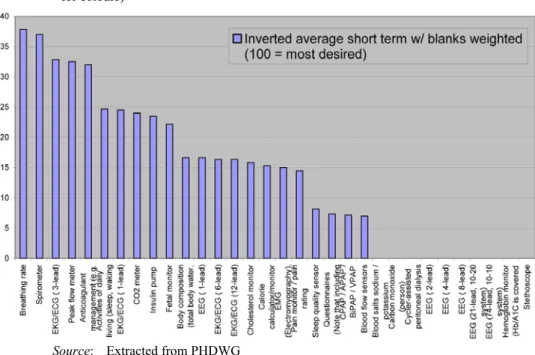
At this moment, a release of X73PHD exists along with the associated MD specifications (indexed in X73PHD as 11073-104XX): pulse-oximeter (–10404), heart rate monitor (–10406), blood pressure monitor (–10407), thermometer (–10408), weighing scale (–10415), glucose meter (–10417), cardiovascular fitness and activity monitor (–10441), strength fitness equipment (–10442), independent living activity hub (–10471) and medication monitor (–10472). Meanwhile, new ones are currently under development (Figure 1 shows the PHDWG voting results for most desirable MDs):
breathing rate, spirometer, basic ECG (3-leads), peak flow meter, INR-blood coagulation, physical activities of daily living monitor, CO2 meter, insulin pump, fetal monitor, body composition analyser, or simple EEG (1-lead), among others.
Figure 1 New MDs approved by PHDWG for inclusion in X73PHD (see online version for colours)
Source: Extracted from PHDWG
The standard follows constantly under development and new features are expected to be added to future versions, like more transmission efficiency to arise MD operational limitations, remote control for external configuration or changing possibility of MD operational parameters on demand, multi-patient enhanced compatibility, etc.
Furthermore, in our current work, we are working towards two of the priority tasks:
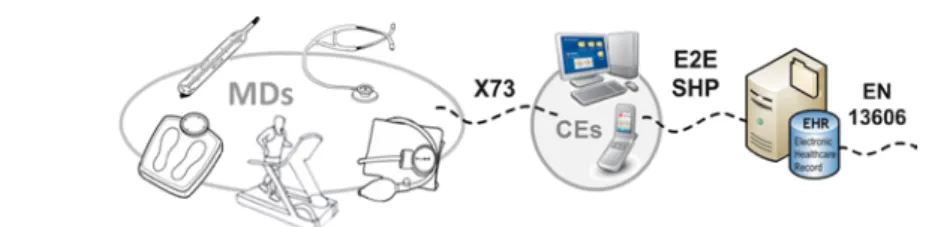
making X73PHD interoperable with other protocols (like SCP-ECG or HL7, as previously mentioned), and solving the end-to-end implementation (Martínez, 2008) since the medical data has been acquired from MDs (automatically or with minimal user’s interaction), managed by a Compute Engine (CE) through X73PHD, externally transmitted through a new protocol for End-to-End Standard Harmonization (E2E-SHP), and stored into an EHR server for their standard exchange through EN13606 (see Figure 2).
Figure 2 X73: the standard way for MDs interoperability (see online version for colours)
This paper presents an extended review of the most recent innovative advances in biomedical engineering applied to the standard-based design for ubiquitous and personal healthcare environments. Section 2 details the technical characteristics of ISO/IEEE11073, as standard solution for MDs interoperability. The required specifications as implementation guidelines for standard-based designs are described in Section 3. In Section 4, a complete analysis of new UCs and application environments focused on p-health solutions is presented. The future trends and open points related to standard harmonisation and implementation into microcontroller-based devices are discussed in Section 5. Finally, conclusions are drawn in Section 6.
2 Brief technical review of ISO/IEEE11073 as standard solution for interoperability of medical devices
The detailed description of the X73PHD standard can be found in ISO/IEEE11073 (2009). Thus, in this section, a basic description of its structure and the most interesting issues that make possible the communication between agents/MDs and managers/CEs is presented. X73PHD has thoroughly simplified the architecture of the protocol into three models (see Figure 3):
• Domain Information Model (DIM) typifies the information inside the agent as a set of objects. Each object has one or more attributes, which describe measurement data that are sent to the manager and elements that control the behaviour of the agent.
• Service model provides methods to access data that are sent between both systems (agent and manager) to establish the interchange of DIM’s data.
• Communication model describes the network architecture in which one or more agents communicate with a single manager via point-to-point connections.
For each link, the Finite State Machine (FSM) controls the system behaviour.
Figure 3 X73PHD 3 levels-distributed architecture
X73PHD evolves from X73PoC with a new protocol stack that is divided into three levels (see Figure 4):
• Device specialisations: A set of model descriptions, which collects the total of objects and attributes related to the device components, like an overall system’s configuration (Medical Device System (MDS)), Persistent Metric (PM-Store and Segments) or Metric Specifications. New agents are continuously being added, by developing their MDSs.
• Optimised exchange protocol: The main part of the standard consists of a medical and technical terminology framework (DIM), which will be encapsulated inside the Protocol Data Unit (PDU). A Service Model defines a set of messages and instructions to retrieve data from the agents based on the DIM.
• Transport layer: Data transmission will be held over a transport technology due to X73PHD identifies assumptions that require direct support by this layer, allowing various transports to be implemented (X73PoC established higher dependency between transport and upper and lower layers). Thus, transport specifications are out of the scope of X73PHD, while other Special Interest Groups (SIGs) are working towards profiles definition for Bluetooth, USB, ZigBee, etc.
Figure 4 Evolution of protocol stack from X73-PoC to X73-PHD
Source: Extracted from PHDWG
Finally, the main characteristics that X73PHD enhances the previous X73PoC are the following:
• Since the manager knows the standard specifications, the agent does not have to send its configuration unless it uses a different one. In that case, the manager will ask for that configuration to be able to work with that agent and to store this configuration for the following reconnections. This avoids the configuration procedure, which can be a high time-consuming task in the case of multi-specialised MDs (such as multi-parametric monitor with blood pressure, pulsioximeter and glucometer).
• It defines different transport profiles, taking into account conditions of communication channel (application level).
• It is independent of the transport layer. This significantly reduces the implementation problems. The protocol assumes functionalities that the selected technology should fulfil. If that would not be possible, it admits the definition of functionalities through a shim layer.
• It reduces the complexity of the objects tree of the DIM, removing redundant classes and adding new ones such as PM that allows storing measurements that can be sent when the manager requires them.
• A much more complete FSM is thoroughly described and tested to prevent any potential error during the operation of the protocol. The design of X73PHD FSM is more versatile than that used in X73PoC since it has added new functionalities such as to have the agent configuration at manager’s disposal.
3 Key points in the standard-based designs: ISO/IEEE11073-compliant implementation guidelines
To succeed when developing standard-based p-health solutions, in this case applying X73PHD over a system defined by several MDs and a CE, the following key points should be followed:
• Allow the system to incorporate much more devices than previous designs and integrate with new MDs, by making use of several transport technologies.
At this point, X73PHD defines a set of quality parameters and protocol payload that must be met, regardless of the type of transport technology both wired (USB and Ethernet) and wireless (Bluetooth and ZigBee).
• While working on mobile environments, CE will be running on a mobile platform (Smartphone, PDA). All kinds of hardware/software solutions should be evaluated prior to any development. Some of the facts to consider are: battery autonomy, complexity of usage, stability, user’s interface design, as well as programming issues, etc.
• The protocol’s traffic efficiency should be analysed so that new optimisations can be added to the protocol. For instance, although a specific MD Encoding Rule (MDER) was designed for X73PoC, X73PHD and the new specifications could require a revised version of MDER, or the data type defined in ASN.1.
• A Test Mode Graphical User Interface (GUI) should be implemented in both MD and CE to evaluate the protocol layers independently. As X73PHD is a new standard and drafts have been available for a short time, new devices could still have protocol frame errors that would lead the system to a critical failure. Also, it can be used as a verifying tool for new implementations with X73PHD.
• As noted before, PHDs usually have limited hardware/software specifications and resources. It is necessary then to optimise as much as possible the code, having microcontroller platforms as a reference. This requirement being satisfied, upgrading to a higher platform with more resources should be feasible.
• Transport technology has to be selected considering different issues. The type of signal should make some technologies more favourable against others, as data size, frequency, robustness against transmission errors, delivery priority, to name a few, may differ. At the same time, wireless transmission cannot be used, for instance in hospital environments without a proper EM-isolation, and wired technologies will significantly reduce the mobility of the equipment and patients/users.
• At a protocol software development stage, X73PHD has gathered a clear description through several revisions and the collaborative work from the members of the team.
Designing the protocol behaviour, although complex in certain aspects can be achieved with standard programming skills. On the other hand, Continua Alliance has designed a C++ library stable enough to be applied and reduce developing time.
4 New uses cases and application environments for standard-based p-health solutions
When developing the standard features and specifications, it has been necessary to define a set of closed conditions of use of the protocol. These are called UCs, and pretend to collect both standard’s potential application and end-user’s requirements. In general, the system adopts a star topology in which CE is located in the centre and MDs are distributed composing the user’s BAN or PAN.
The ‘classic’ UCs (X73PoC-based) have been initially focused on Intensive Care Units (ICUs) applications or bedside, mainly concerned about monitoring, pre- and post-surgery and bedside disease management. In short, MDs used are most of them fixed, wall powered, not designed to be wearable or at least portable.
Advances in both biomedical engineering and telemedicine potential users like fitness and personal care forced the need of a new standard, as mentioned earlier, and therefore new UCs were developed. When the initial set of devices intended to work with X73PHD was to be made, a survey was used to obtain data from the companies. In this survey, it was pointed out, for each device, the need to apply X73PHD to its communications.
Final classification was made based on the interest of experts in developing the standard or providing help for that during the process and the availability of a working group.
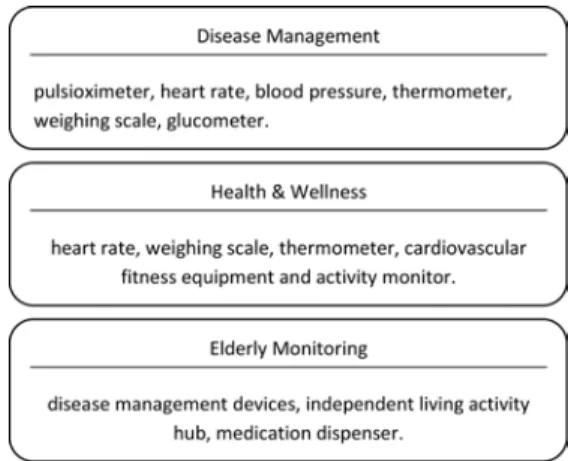
Thus, the most relevant UCs for p-health are: healthy living/wellness and fitness, imminent disease management, assisted ambient living, elderly patient care, diabetes and home monitoring of single cardiac patient. Furthermore, these UCs have been arranged in three groups, as it is shown in Figure 5, which also includes the associated MDs to be standardised to X73PHD.
Figure 5 UCs classification for standardisation to X73PHD
After a considerable period of time for understanding and developing solutions based on the standard (first making use of the classic X73PoC and later with the new X73PHD), we raised the possibility of applying the standard to new MDs and UCs, as it is detailed in this section.
While new MDs could be brought into the standard’s scene, and even X73PHD could be merged (or at least be adapted to) with other standards, the personal feature of these MDs will probably require additional modifications within the agent itself. A PHD could be used by a patient not only at home but also at an ICU from a healthcare centre, as previously mentioned, where an unknown CE is installed. In this case, patient’s biosignals repository location and user’s credentials could be allocated inside the device.
Following this idea, as the e-health application is desired to be focused in a p-health environment, UC focused on patient monitoring was considered. While home or even mobile monitoring have been widely analysed, the process of hospital admission is a challenge for p-health with the new available technologies, portable and integrated devices. Moreover, it is a representative implementation example because it is mandatory in the healthcare protocols.
Other implementation example is oriented to blood donor centre where can be found out that blood collection monitors are being used, and they are provided with a Bluetooth module that reports the donation’s log after the operation has finished. Such MD is meant to be used only at very specialised applications, far from personal use. Nevertheless, we foresee a p-health system with different application being merged in a unique platform, for which purpose normalising the communication protocols will ease and simplify the configuration/operation of these systems. At the same time, human error while manipulating devices or annotating the results gathered can be greatly lowered.
Finally, because one of the main advantages of X73PHD is its object-oriented data information model. As X73PHD combines basic classes defined and extending/adding attributes when needed, new MDs can be brought into the protocol’s specialisation list.
With this in mind, our group developed a wearable INteligent HOLTer (HOLTIN) device to be used as a proof of concept of the new 1-3 ECG lead specialisation. By that time, no ECG drafting was yet initiated, but after several surveys run by the PHDWG, it was a matter of time when a model for ECG-related devices would be created. Therefore, our ECG was provided with an additional feature, in parallel with another project under development: SCP-ECG. The ECG model for X73PHD is completed with new attributes,
so the data gathered from the device can be converted into an SCP-ECG version at the CE side.
Within our work, the healthcare environments and UCs that have been evaluated for an X73 potential implementation are the following.
A Intensive Care Units
UCI represents the clear example of local patient monitoring with a later data report to a central computer. For each patient, full monitoring equipment is set, and the data coming from all the patients are observed from the central computer. Within every patient’s box, several MDs can be found, like multi-parameter monitor, infusion pump, ECG, pulse-oximeter, heart rate monitor and capnography among others. Alert and signal management for every box is carried out by using dedicated monitors. In fact, MDs’
output has to be converted into the proprietary Flexport protocol (see Figure 6) and sent to the central system, which collects all the signals and alerts and show the overall status.
Because of this transformation step, not all devices can be used in the ICU monitoring system, even when they meet the ICU requirements. If data needs to be retrieved from the patients EHR, HL7 is the protocol used for this purpose.
Figure 6 ICU local monitoring through Flexport protocol (see online version for colours)
A system’s improvement is designed together with incorporating X73 to the communications. As noted before, MDs are chosen according to the overall monitoring application compatibility. The optimal solution should be allowed to incorporate any kind of MD, independently of any compatibility restriction. With this degree of freedom, in a device failure situation, it could be replaced with another device that, even it has more complexity or rest of specifications are unnecessary, it will meet the minimum requirements for monitoring. At the same time, parameter reporting could be achieved wirelessly (under certain security restrictions) and system status can be received not only on the supervision system but also on PHDs (see Figure 7). With this solution, ICU personnel can attend other issues while receiving updates real-time.
B Hospital admission
Within the same hospital, another potential application for X73 was found at the hospital admission process. Patient’s biosignals are retrieved so an initial status is stored, along with the patient identification number (related to the EHR). Temperature, SpO2, blood pressure and heart rate are measured, using a single multi-parameter monitor (see Figure 8). Once the values are stabilised, they are transferred to the patient’s EHR.
The hospital is using a device that even it allows to send the signal to the computer, due to protocol incompatibilities is not used. Simply, the nurse checks the data and
incorporates it manually into the patient’s form. At present, a solution is being developed that allows automating the process by adding an adaptation software layer at the computer. Although this is one feasible solution, inside the computer already coexists different application with different data format. Even if compatibility issues are solved, replacing MD for another (in case of malfunction, for instance) will make the system useless.
Figure 7 ICU distributed monitoring through X73 standard (see online version for colours)
Figure 8 Multi-parameter monitor for hospital admission (see online version for colours)
Adding X73 to the process has many advantages against the previous solution. First, the X73 protocol library is designed to provide universal communications, does not need to be revised for every MD. Second, even if the admission application that runs in the computer requires some data conversion or needs to access the MD in a specific manner (sockets, COM port, etc.), the X73 library can provide all of them, as it is being designed to support several transport technologies. Finally, it allows the possibility of adding wireless transport to the process (see Figure 9).
C Blood donor centre
At first, donors have to be checked prior to the donation process. This includes incorporating the personal information, besides the blood pressure and heart rate,
haemoglobin level, weight and height (the last two are usually provided by the donor itself). At present, all the values are manually introduced into the donor’s form, although the devices used for the measurement process allow a signal transmission. Once the check has been completed, the donor will access to the next room where the blood extraction will begin. The used blood collection monitors are Biomixer-330 with a Bluetooth module that reports the donation log (blood flow, time duration) once is finished. Such information will be attached to the donor’s EHR. In this case, the overall logging process is based on proprietary measuring devices, software and hardware (Bluetooth dongle for the PC). Although the application is highly convenient, it only works if the devices are from the same manufacturer. If for any reason, some of the devices stop working and there is no possibility to have them repaired or obtain new ones, the trolleys attached to these devices will not be used, or the whole system needs to be changed to another provider. This shows the need for incorporating standardised devices. With this achieved, even new features can be added to the system, like donor monitoring, wireless monitoring converting the MD into a more complete acquisition device.
Figure 9 X73 design of a multi-parameter monitor
As a proof-of-concept, we developed an X73PHD-demo test bed (see Figure 10) that simulates the checking process for the intercommunication between a CE/manager and the corresponding MDs (weighting scale, blood pressure device and pulse-oximeter) to obtain required vital signs for blood donor centre: blood pressure and heart rate, haemoglobin level, weight and height. The solution graph that implements the X73PHD communication module is shown in Figure 11. It includes the X73PHD FSM, data-type definition (coded in ASN.1 and C++ classes), MDER-coded frame management, and all the protocol features and layer’s function description (coded in C++). The use of frame templates generated previously (knowing the position of bytes in the transferred message) reduces frame creation process, and its X73PHD-compliant design of the transport module, allows incorporating TCP/IP connections (for Ethernet, USB, etc.) and new technologies as Bluetooth.
Figure 10 X73PHD-demo test bed for blood donor centre: (a) MD/agent application and (b) CE/manager application (see online version for colours)
(a)
(b)
Finally, a GUI has been designed, taking advance of the Microsoft Foundation Class (MFC) libraries. Several MDs (as long as the specification is included into the libraries) can be selected on the agent application for protocol and application testing, see Figure 10(a). And on the manager application, see Figure 10(b), a CE can be initialised to receive agent connections and process the data exchange. Both GUIs offer the necessary controls and message window to run depuration test, visualise the transmission/reception buffers, byte coding as well as force the system to run into different states (abort, data request, etc.).
Figure 11 Design scheme for X73PHD communication module
D Ambient Assisted Living (AAL): heart failure patients’ follow-up
Nowadays, AAL-related processes are of special interest. However, it is noticeable that a great number of hospitals and healthcare centres do not provide services for patient’s monitoring at home, or at least to allow the patient to check their status (like blood pressure, SpO2, etc.) and report them to hospital. Generally, as it has been found in many other hospitals, there exists a health self-control programme in which the user measures several vital signs following a protocol provided by the specialist and then sends the values using the computer, mobile, or just by phone.
In this context, our group has developed X73-compliant solutions for heart failure patient’s follow-up called INteligent HOLTer (HOLTIN). This system is a suitable platform to implement an X73PHD-compliant heart failure patient’s follow-up solution, based on wearable MDs with ultra low-power consumption. The system provides specialists with a wireless monitoring service to control ECG signal during long periods (several days or even weeks) in patients who suffer non-risk cardiac pathologies whose symptoms are syncopes and paroxistic arrhythmias.
Some features of the HOLTIN system are: non-invasive, low cost, reduced complexity and high autonomy. HOLTIN system is made up of several devices in a BAN/PAN topology that use wireless communication technologies as Bluetooth, General Packet Radio Services (GPRSs) and Universal Mobile Telecommunications System
(UMTS) to perform the transmission of ECG information from the patient to the remote hospital (see Figure 12).
From the X73PHD standard’s point of view, the basic devices in the HOLTIN topology are the following:
• Front-end device: This wearable device that corresponds to the agent in the X73 topology was designed having ergonomics in mind (reduced weight and dimensions, ultra low-power consumption, etc.). It is placed at the patient’s chest and carries out all the functionality related to the acquisition, processing of the ECG, detection, storage and transmission of cardiac events to the manager device via Bluetooth.
• Smartphone: This device that has the role of the manager takes care of receiving the information from the Front-end and performing the storage to transmit later to the hospital with GPRS/UMTS technology.
• Call centre: Located at the hospital, it manages all data coming from the patients and service-related information. It includes a monitoring server, the diagnostic applications used by cardiologists and other service management tools.
Using HOLTIN in a patient requires a previous step of configuration. With this configuration process, which consists of filling some patient-related information forms plus the adjustment of some parameters, the specialist or medical staff performs all the tasks required for the correct monitoring of the patient’s health state in the system:
storage of personal details, assignment to the patient of front-end and Smartphone devices, configuration of operation parameters (limits of cardiac events detection, event storage time, etc.), among others. Once the configuration process is finished, the system is ready to be used by the patient in an autonomous way.
Figure 12 HOLTIN system (see online version for colours)
The front-end equipped with a high grade of intelligence performs the detection and storage of cardiac events suffered by the patient in a continuous way. All the information captured by the MD is transmitted to the manager device by means of X73PHD-compliant Bluetooth technology thanks to the specific health applications
Bluetooth profile called Health Device Profile (HDP). This way, HOLTIN system combines features derived from the use of Bluetooth wireless technology with characteristics as interoperability and plug-and-play. A fully X73PHD-compliant specialisation for 1–3 ECG lead devices is being drafted at the moment of this writing that will be adopted in the near future once completed.
While the use of the HOLTIN service by a patient, the manager device receives not only the information about the patient’s health state but also several alarms and notifications related to the correct operation of the system. Examples of these alarms are:
battery level of the front-end, low quality of the ECG information acquired by the device and even a wrong positioning of the front-end at the patient’s chest.
All the cardiac events suffered by the patient are received at the hospital and can be analysed by the specialist to make a diagnostic. This way, the patient only needs to go to the hospital when the specialist has detected some cardiac pathology that requires treatment.
5 Future trends and open points
Owing to the protocol evolution and feature expansion towards a more efficient p-health vital signs communication framework, new functionalities could now be incorporated allowing X73 to be used in a wider range of solutions. Our research group is working in two key points: enhancements and harmonisation of real-time signals and implementation into microcontrollers devices.
A Signal handling: harmonisation and enhancements
Although the X73PHD profile was initially designed for simple PHDs, it would be beneficial that the standard could also consider some other biomedical signals more complex such as, for example, the ECG. This need has been already addressed by ISO/IEEE and a device specialisation for the ECG has been recently announced for phase II (ISO/IEEE11073-10406 Basic ECG (1–3 Lead)). Some other standards and protocols have been covering ECG signals during the last years. In this plethora of ECG standards, SCP-ECG (European), HL7 aECG (American), or MFER (Japanese) can be found among those more successful. ISO/IEEE has recently included the latest version of SCP-ECG (EN1064: 2005 + A1: 2007) in the X73 family of standards (ISO/DIS 11073- 91064). However, nothing has been addressed about how to harmonise these two protocols. To accomplish this harmonisation, there are some key issues that require further attention:
• Although some steps have already been taken, the terminology harmonisation between these two standards (as well as with other standards) is one of the most important items. It has to be investigated the correlation between the different fields defined in both standards and identify which SCP-ECG fields are already mapped in X73 and which are not.
• It is necessary to define the forthcoming ECG device specialisation in a manner that complies with SCP-ECG. Owing to the particular characteristics of ECG devices, the DIM of this specialisation might require new classes, different from those that appear in the already-defined specialisations.
Nevertheless, any modification or creation of new fields in the X73 standard must be investigated and proposed so that the SCP-ECG standard can be supported within the framework of the X73 family of standards. On the other hand, regarding the SCP-ECG protocol itself, it is expected to extend this standard so that it could cover new aspects.
The extension of the standard from diagnostic 12-lead ECG to short-term ECG or its use in telemonitoring services are some examples of possible expansions. But, in this process, the compatibility with the X73 standard has to be taken into account. In environments such as home care telemonitoring, the real-time ECG transmission is expected to be very practical. Still, the use of SCP-ECG in an X73 universe and its ability to the relevant process of ECG management in the context of patient care in and out of the hospital needs further investigation.
B Implementation into microcontroller-based devices
There is an increasing demand of high grade of ergonomics in wearable devices and especially in the recently appeared wireless scenarios. To improve the ergonomics, MD developers shall increase device’s autonomy and decrease its weight, which usually means that the board must use both batteries as small and soft as possible and low-capacity embedded processing systems to minimise the power consumption.
In this way, both MDs at the PoC and PHDs are usually built onto microcontroller-based platforms that determine the requirements of the software running on them. Also, there must be selected a transmission technology (wired or wireless), which also determines the framework for the application development, the Operating System (OS) and the resources left for the X73 module. For example, in the Bluetooth or ZigBee case, the framework is determined by the communications stack that usually provides a proprietary Real-Time Operating System (RTOS) and a proprietary Application Programming Interface (API) to access the RTOS functions. Thus, the technical requirements have to be finally translated into software implementations that have in mind to reduce processor and memory as much as possible. As far as software is concerned, this type of devices do not require a high grade of intelligence and sources code are usually written in assembler, C, or embedded C++. OS, in case it was used, is platform-dependent and its API differs strongly from some devices to others.
To simplify the process of development in microcontroller-based platforms, some work is being done thanks to the low variability of the X73PHD messages. Our proposal is distributed on the following two steps: first, the set of messages that the device needs and the sequence they should follow is determined; second, an exhaustive analysis of this set of messages (typically a dozen) to obtain patterns on them is done and the resulting ones are grouped as a resource module called the patterns library. The minimal X73PHD intelligence that does the dynamical processing is given by the so-called X73-kernel.
It is developed using Object-Oriented Analysis and Design (OOA/D) principles following a stimulus-response schema and the X73PHD specialisations.
Once developed, an implementation can be shared and it offers a RAD that will allow a novel X73PHD implementer to develop an MD with only a basic knowledge of X73 since the unique needed modules to be developed are the adaptation layer and the device drivers. To maximise interoperability, it is preferable to create a framework that shall be used by all manufactures. By the time, although mechanical, an exhaustive analysis of the X73PHD standard is required to generate the patterns library and the X73-kernel.
Work to develop an automation tool that provides automatic generation of X73-kernel and patterns library is being carried out by our group.
6 Conclusion
The need of interoperability to propose compatible and harmonised p-health solutions requires the use of standard-based design for new health environments. X73 is the European way for solving this integration lack and its implementation in new UCs and application contexts guarantees the implantation of p-health solutions transferable to the healthcare system. This standard is constantly under development and new features are expected to be added to future versions, like more transmission efficiency to arise operational limitations of personal devices, remote control for external configuration, possibility of operational parameters updating on demand, multi-patient enhanced compatibility, etc.
The lack of standard integration in biomedical environments requires efforts to develop harmonised healthcare applications like the proposed implementation guidelines for standard-based design of p-health solutions. The followed design guarantees the specific requirements for the two main standards in this context, X73 and EN13606 (both adopted as European way of medical information interoperability). These results open new challenges currently under research from our group as the integration with managements systems and the implementation of the X73PHD communication model on microcontroller-based devices. Indeed, the integration of X73PHD with management protocols (as SNMP or RMON) will contribute new functionalities as data security, dynamic and versatile monitoring, and remote configuration of PHD features (battery control, patient advices, etc.). Likewise, microcontroller-based design is addressing key features as autonomy increase and weight and size shrink owing to reduction of power consumption. From our know-how of X73 standard, a proposal of pattern-based design will make possible an X73-kernel implementation on microcontroller-based device with the standard features and functionalities supported by RTOS and ready for the inclusion of new wireless technologies as ZigBee.
Furthermore, in our current work, we are working towards two of the PHDWG priority tasks: making X73PHD interoperable with other standards for health informatics (like SCP-ECG, DICOM or HL7 within the researching work of the aforementioned initiatives IHE and Continua Health Alliance), and solving the end-to-end implementation since the medical data has been acquired from MDs (automatically or with minimal user’s interaction), managed by a CE through the X73PHD communication model, externally transmitted through a new protocol for End-to-End Standard Harmonization (E2ESHP), and stored into an EHR server for their further interoperable exchange through EN13606 standard.
Acknowledgements
This research work has been partially supported by projects TIN2008-00933/TSI, TSI2005-07068-C02-01 and TIN2009-08414 from Comisión Interministerial de Ciencia y Tecnología (CICYT) and European Regional Development Fund (ERDF), TSI-020302-2009-7, TSI-020302-2009-89 and TSI-020302-2008-35/Plan Avanza I+D from Ministerio de Industria, Turismo y Comercio, and FPI grant to M. Martínez-Espronceda (Res. 1342/2006 from Public University of Navarre).
The authors wish to thank PHDWG and Melvin Reynolds, convenor of the CEN/TC251 WGIV, for the contributions to this research. We also appreciate the contribution of
Miguel Galarraga (UPNA Associate Professor and researcher) and Adolfo Muñoz (researcher of the Instituto de Salud Carlos III, AENOR/CTN139 general manager, and CEN/ TC251 member).
References
CEN/TC251 (2009) Comiteé European Normalisation/TechnComm251, http://www.cen.eu – http://www.centc251.org, in Spain, Asociación Española de Normalización (AENOR/
CTN139) http://www.aenor.es/desarrollo/inicio/home/home.asp, Accessed 01/09/09.
Clemmer, T.P. (2004) ‘Computers in the ICU: where we started and where we are now’, Journal of Critical Care, Vol. 19, pp.201–207.
Continua (2009) Continua Health Alliance, http://www.continuaalliance.org/home/, Accessed 01/09/09.
DICOM (2009) Digital Imaging and Communications in Medicine, http://medical.nema.org/, Accessed 01/09/09.
EN13606 CEN/TC251 (2009) Electronic Healthcare Record Communication, Standard Parts 1, 2, 3, 4 and 5 (2006), http://www.medicaltech.org, Accessed 01/09/09.
HL7 (2009) Health Level Seven Devices Special Interest Group (SIG), http://www.hl7.
org/Special/committees/healthcaredevices/index.cfm, Accessed 01/09/09.
IHE (2009) Integrating the Healthcare Enterprise, http://www.ihe.net/, Accessed 01/09/09.
ISO/IEEE11073 (2009) Personal Health Devices standard (X73PHD), Health Informatics, IEEE Standards Association, Point-of-Care MD Communication Standard (X73PoC), http://standards.ieee.org/. http://www.ieee1073.org, Accessed 01/09/09.
Martínez, I. (2008) ‘Implementation of an end-to-end standard-based patient monitoring solution’, IET Commun., Vol. 2, No. 2, pp.181–191.
Pedersen, S. and Hasselbring, W. (2004) ‘Interoperability for information systems among the health service providers based on medical standards’, Inform. Forsch Entwickl, Vol. 18, Nos. 3–4, pp.174–188.
Reynolds, M. (2007) ‘Can telemonitoring systems interoperate? Review of the suitability of existing standards for adaptable telecare provision’, Healthcare Comp. Conf. of British Comp.
Soc. (HC), London, pp.104–115.
SCP-ECG (2007) Standard Communication Protocol for Computer-Assisted Electrocardiography, EN1064:2005+A1:2007. http://www.openecg.net/, Accessed 01/09/09
Vena Platform (2009) X73-compliant Pulsioximeter, Cambridge Consultants (Altran Technologies), http://www.cambridgeconsultants.com/news_pr204.html/, Accessed 01/09/09.
Yao, J. and Warren, S (2005) ‘Applying ISO/IEEE11073 standards to wearable home health monitoring systems’, Journal of Clinical Monitoring and Computing, Vol. 19, pp.427–436.