L'anàlisi complexa va ser una de les àrees més rellevants de la producció científica de Riemann. La hipòtesi de Riemann assegura que tots els zeros no trivials de la funció ζ estan a la recta crítica <(s) = 1/2. Per a la majoria d'aquestes, les propietats més fonamentals que Riemann va demostrar en el cas de la funció ζ segueixen sent conjectures.
Per tant (vegeu [8]) els zeros de la funció zeta contenen la música dels nombres primers. A la figura 1 podeu veure la gràfica de la funció π en dos intervals de mida de diferents ordres de magnitud. El contingut de l'article de Riemann [12] s'organitza en dues parts, cadascuna ocupant aproximadament la meitat de la seva longitud.
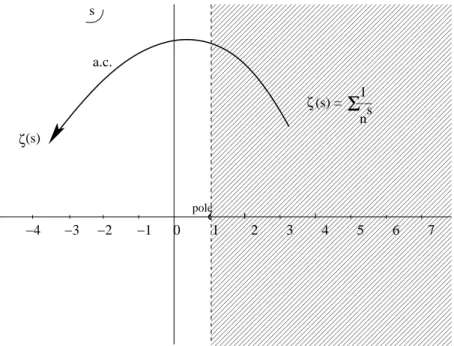
Riemann defineix la funció ζ a partir del valor comú de la suma de la sèrie harmònica i el corresponent producte d'Euler. En la terminologia actual, aquesta és l'expansió analítica de la funció donada per (3) a una funció meromòrfica en tot el pla complex excepte un pol (que resulta ser simple, del residu 1) en el punt s= 1. Per tant , la funció ξ té com a zeros exactament els zeros no trivials de la funció ζ.
En el treball de Riemann, sovint sorgeix el problema de caracteritzar les funcions analítiques en funció de les seves propietats. Des d'aleshores, les taules de nombres primers i valors de la funció π s'han expandit, sobretot des de la difusió de les calculadores electròniques. Finalment, substituint cadascuna de les sumes d'aquesta expressió en la fórmula integral de la funció ψi després de justificar la convergència.
2. veiem que la seva presència a la fórmula correspon als zeros trivials de la funció ζ. Així, tant els zeros com els canvis de signe de la funció de Riemann-Siegel coincideixen amb els de la funció ξ(12+it). Una altra aproximació a la hipòtesi de Riemann és l'estudi del creixement de la funció ζ.
Tingueu en compte que la curvatura gaussiana de les superfícies de la figura 5 és zero. Ja és una funció perquè és una nova contracció de la curvatura de Ricci. La teoria de la relativitat general pressuposava la consolidació definitiva de la geometria riemanniana i del càlcul tensorial.
La idea de curvatura s'utilitza per tant en diverses àrees de les matemàtiques, va més enllà de la geometria.

Papers published in Riemann’s lifetime
There is also a translation by W. Clifford Riemann of Riemann's introductory lecture on the foundations of geometry and a biographical sketch by Richard Dedekind, which was included in the Gesammelte Mathematische Werke. I will confine my attention to a subset which, while not perfect as seen by a historian of science, I think is fair enough to support my view that Riemann's physical output was in fact a good part of his overall scientific output. 1] to published papers—during Riemann's lifetime and posthumously—and limited his study to papers on physical issues among them.
Posthumously published papers of Riemann
Riemann papers on Physics
Riemann integrates in this paper the differential equations corresponding to the movement of gases, under different conditions of pressure and temperature. He notes that he can bring his calculations further away in the order of approximation, with respect to those previously carried out by Helmholtz, for example, which only reached the second order in the perturbative expansion. He refers to previous results by Helmholtz, Regnault, Joule and Thomson, improving their calculations, discussing the setup and improving the hypothesis in the works of these authors.
This is a very brief summary of the main mathematical formalism used in the previous paper, with the same title, to obtain the results. Indeed, it deals with the theory of the diffusion of a gas, but the only physical input in the whole paper is the mathematical equation that gives the behavior of the pressure of the gas as a function of density (i.e., its equation of state). in the absence of any heat exchange. He develops the mathematical formalism in detail and compares it with the previous results of other mathematical physicists such as Chalis, Airy, Stokes, Petzval, Doppler and von Ettinghausen (most of whom gave names to quite famous equations).
A contribution to the investigation of the motion of a uniform fluid ellipsoid, Meetings of the Royal Society of Sciences in G¨ottingen. Again, as the title makes clear, Riemann is dealing here with the motion of a uniform fluid ellipsoid, considered to be composed of isolated points attracted by gravity. This is considered to be one of the best Riemann papers in the class of those considered here, viz.
In the paper, the equilibrium configurations of the ellipsoid are identified, which has many and important applications, e.g. to study the possible shapes of celestial bodies as galaxies or clusters. Like the previous one, this is a rather mathematical article, as the only physics it contains is practically reduced to initial conditions and Newton's law. This article is generally considered to include the main results of Riemann's physical (and also philosophical) idea of the "unification" of gravity, electricity, magnetism, and heat.
It actually contains his observation about how a theory of electricity and magnetism is closely related to theories of the propagation of light and heat radiation. He presents in the paper a complete mathematical theory with "an action that does not separate" the already mentioned four cases of "gravity, electricity, magnetism and temperature". The final propagation speed of the interaction (in contrast to the prevailing concept, in the epoch, of action at a distance) is clearly presented, identifying such a speed with that of light that has been considered by many to be a truly remarkable achievement of Riemann's genius.
Some additional considerations
It suggests replacing point-like particles with infinite vibrating strings as the basic units of the physical world. A summary of the evolution of the concept of space, from the very remote times of its origin, may be as follows. General Relativity does not prescribe the topology of the universe, or its finitude or not.
Of the various techniques available to implement these processes, the regularization of zeta functions is one of the most beautiful. The zeta function in turn was actually introduced by Euler, from considerations of the harmonic series. For the Riemannζ(s), the corresponding complex series converges absolutely on the open half of the complex plane to the right of the.
In the rest of the complex plane, ζ(s) is defined as the (unique) analytic continuation of the preceding function, which turns out to be meromorphic. In recent experimental evidence for the Casimir effect [ 24 ], the agreement is also quite remarkable (considering the difficulties of the experimental setup) [ 25 ]. 3) The method of zeta regularization is based on the analytical continuation of the zeta function in the complex plane. These formulas are a specialty of the author and give enormous power to the method of zeta function regularization.
Let us summarize the main points of the so-called "physics of curved space-time" (excellent references are the books of Robert Wald [35]):. Einstein observed that solving these equations subject to the constraints of the cosmological principle led to a universe that was not static. 11 It is of the order of 10123, one of the largest discrepancies between theory and observation in the history of physics.
One of the most successful is the so-called f(R)-gravity, which is a deviation from Einstein's general theory of relativity in the way we are about to see (note that the R here again stands for Riemann: the Riemann tensor contraction). Recently, the importance of these modified gravity models has been reassessed, namely with the appearance of the so-called 'viable' model. Some of these models ultimately lead to the unification of the inflationary era with the late-accelerated era.


![Figura 5. Aproximació de π ∗ a l'interval (1, 20] amb la fórmula explícita de Riemann usant 1, 10 i 100 zeros de ζ, respectivament.](https://thumb-us.123doks.com/thumbv2/123dok_es/12389550.0/35.892.243.665.136.882/figura-aproximació-interval-fórmula-explícita-riemann-usant-respectivament.webp)
![Figura 6. Aproximació de π ∗ a l'interval [180, 230] amb la fórmula explícita de Riemann usant 10 , 100 i 1000 zeros de ζ , respectivament.](https://thumb-us.123doks.com/thumbv2/123dok_es/12389550.0/36.892.220.673.144.917/figura-aproximació-interval-fórmula-explícita-riemann-usant-respectivament.webp)