This empirical study consists of an investigation into the effects of long-term embedded, structured and supported education in secondary education on the development of information problem solving (IPS) skills. Twenty of them participated in the IPS instruction, the remaining twenty formed the control group. The article contributes to the discussion on how to design well-designed and well-embedded scaffolds in instructional programs to ensure the development and efficiency of students' IPS skills by better utilizing Internet information and fully participating in the global knowledge society .
Various studies have already reported that adolescents struggle in developing IPS processes. The researchers also point out that SPI learning should be well-designed and well-integrated into the curriculum. One of the main guiding principles used in our study is that SPI skills can be acquired embedded within a relevant and meaningful context rather than through isolated tasks (cf. Kuiper, Volman, & Terwel, 2008).
This was a large-scale intervention for that purpose. enhancing domain-specific knowledge and metacognitive awareness of students' IPS processes using scaffolding. In light of the conclusions of previous studies on IPS teaching, this study aims to prove that an effective design, implementation and analysis of IPS teaching in. Our study integrates these three variables in the design of the teaching implemented and evaluated in our research work.
A more extensive explanation of the instruction designed in our work can be found in section 2.3.1.
Method
- Participants
- Design and procedure
- Materials
- Data analysis procedure
The quasi-experimental design process had three phases: 1) a pre-test was conducted on control and experimental students at the beginning of the research project; For two academic years, the students in the experimental group learned the content of the curriculum areas through the teaching methodology routinely used by their teachers, and they also engaged in an IPS web-based learning environment embedded in the curriculum content. The IPS web-based activities of the instructional process were designed by teachers and researchers and aimed not only at training IPS skills but also at learning.
During the instructional process, students worked in pairs to solve the IPS activities together. 2008) reported and analyzed several studies dealing with instructional support in IPS, and pointed out that the collaborative nature of the instruction was one of the most important instructional variables contributing to the improvement of certain sub-skills, such as 'question formulation' and 'activating previous skills'. knowledge'. In the following paragraphs we will explain the characteristics of the intervention. i) One of the key instructional principles guiding the instructional process was the embedding of instruction to construct curricular knowledge in a real-world context. This principle provides a good scenario for embedding explicit IPS instructions to improve the Internet. search, web selection of information and organization of the web information.
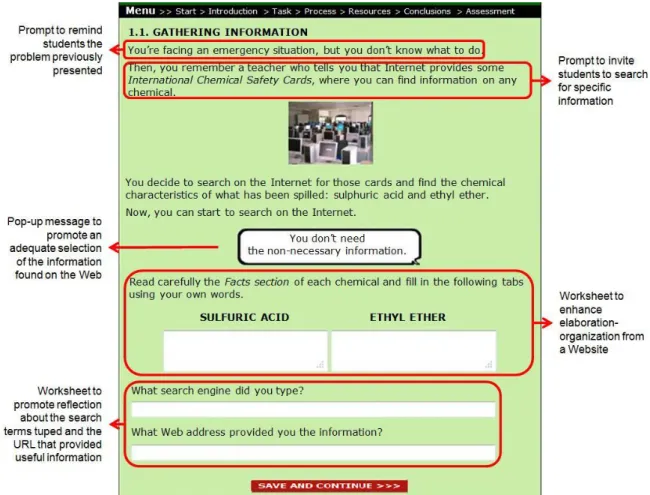
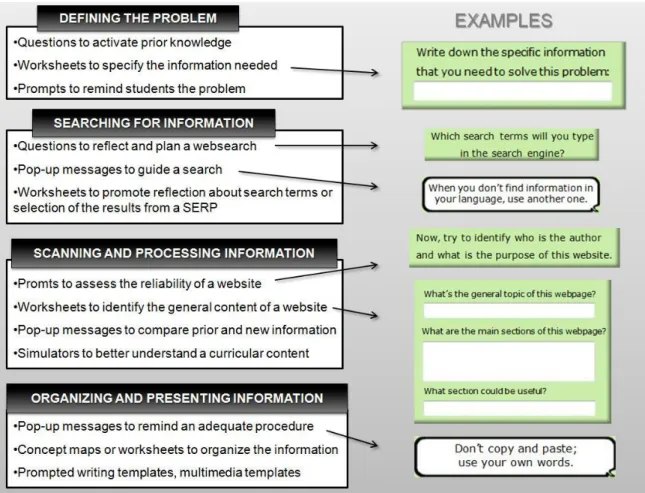
A well-designed WebQuest usually contains six phases: 1) introduction, 2) task, 3) information sources, 4) description of the process, 5) performance evaluation, and 6) conclusion. However, in a typical WebQuest, the student is provided with a pre-selected list of websites, so that the use of the Web is quite limited (Caviglia & . Ferraris, 2008). 1 provides an overview of the IPS scaffolding designed in the teaching process and some examples of how this scaffolding was displayed to the students.
2 is an example of a staged section of one of the online learning activities, this activity was titled: Toxic Waste Management. At the beginning of the first academic year and at the end of the second year, both the control and experimental groups completed the IPS task as a test. It was administered in a real classroom context to ensure ecological validity (Wopereis & van Merriënboer, 2011).
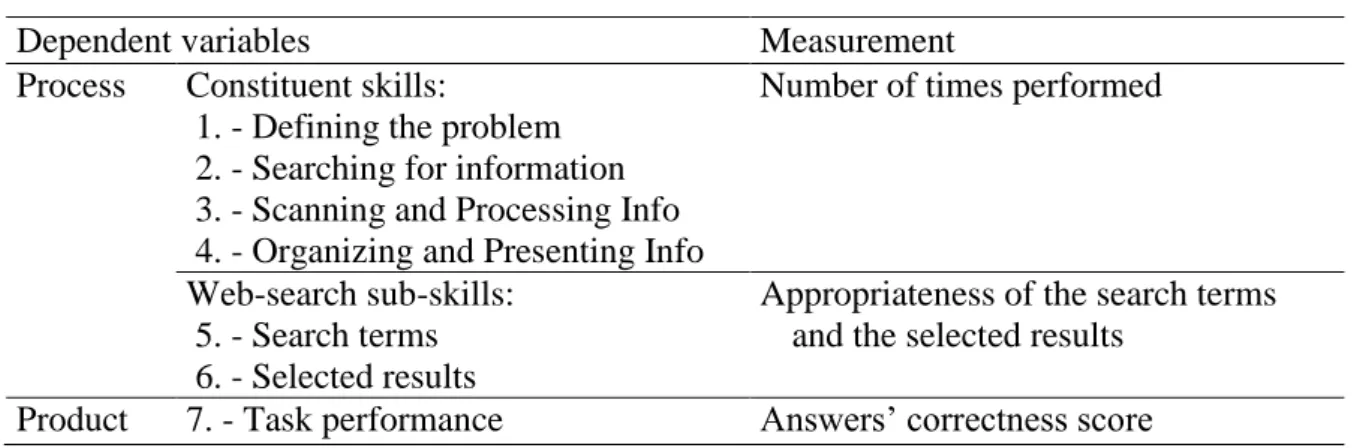
The purpose of this recording was to obtain data on the problem-solving process based on an SPI task and to analyze both the process and the product performed by the participants during the SPI task in the real classroom context in an unobtrusive way. The first part was devoted to component skills and contained the following columns: time frame, component skill performed, and duration of skill performed. The third part of each protocol was about the product (task performance) and contained the following columns: student responses and correctness of responses.
As a result of the data analysis of the pre- and post-tests, different dependent variables were obtained for the IPS process (constituent skills and sub-skills) and for the IPS product (task performance). SPSS version 18.0 software was used for the analysis of the data obtained and repeated measures ANOVA was calculated for each dependent variable, with confidence intervals between 95% and 99%, in order to determine the effect of the IPS embedded instruction on each dependent variable in experimental and control conditions.
Results
- Analyses of the pre-test
- Constituent Skills: Pre-post analyses
- Sub-Skills: Pre-post analyses
- Task Performance: Pre-post analyses
- Correlation between Process and Product
Dependent variables related to component skills, sub-skills and pre-test task performance. The differences found in the frequencies of some component skills and in the performance of the tasks will be taken into account when interpreting the results in the following sections, in order to guarantee the validity of the results in the impact of the SPI learning process. As shown in Table 4, during the post-test, the experimental group invested a greater number of times in the component skills "problem definition" and "organization and presentation of information" when solving the SPI task.
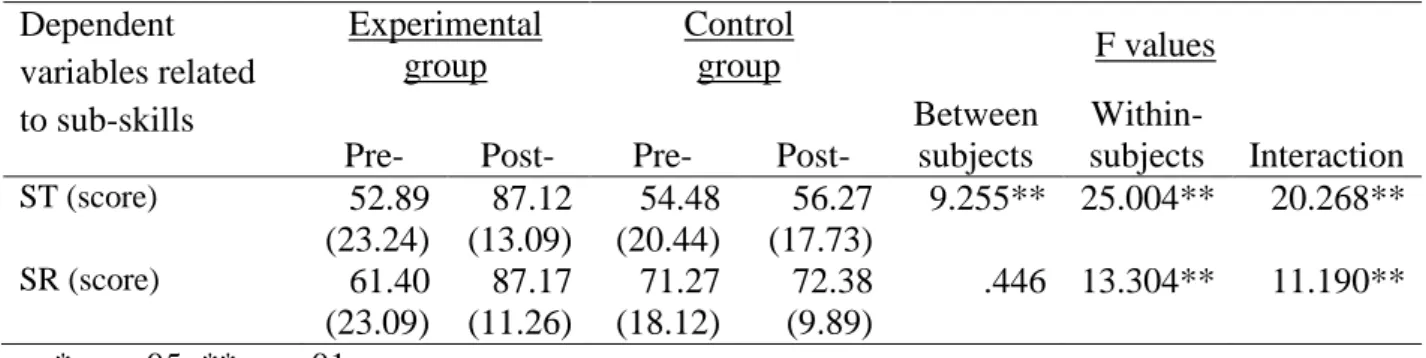
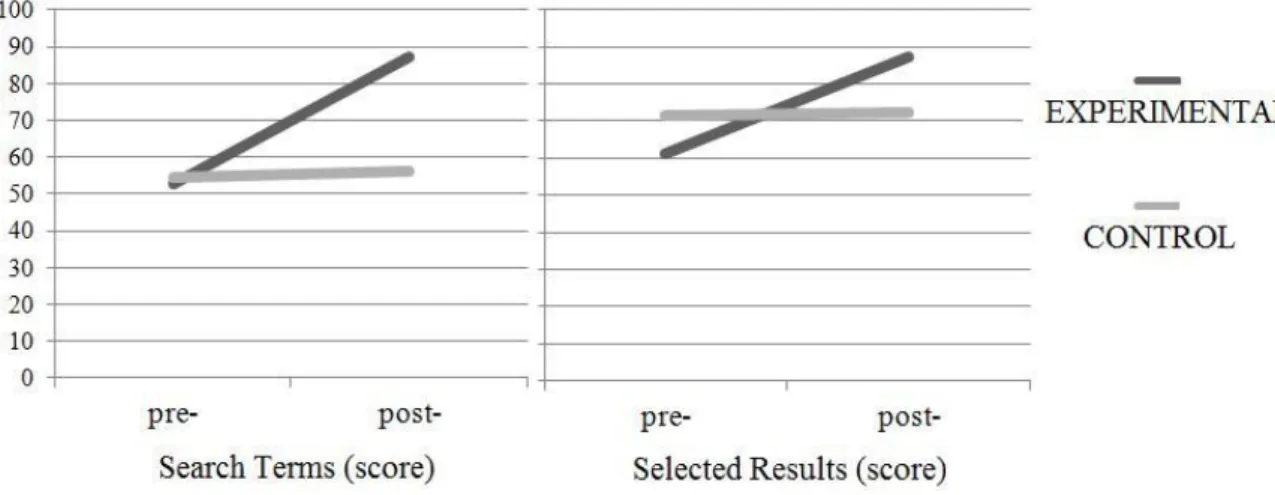
The control group, on the other hand, invested more often in the skills of 'searching for information' and 'scanning and processing information' than the experimental group. Although the control group already showed a significantly higher frequency at the pre-test, the results showed a different relationship between the number of times the skills were performed. This section analyzes the variables associated with the sub-skills “search terms” typed into a search engine, and “selected results” from the SERP retrieved by a search engine.
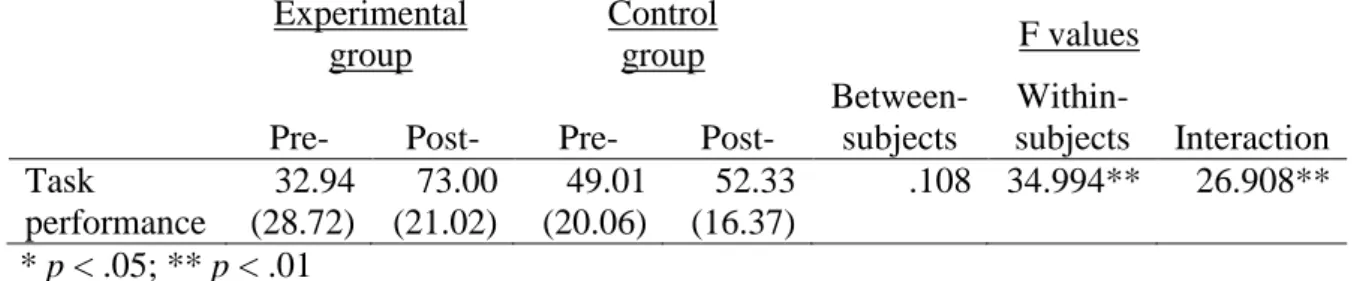
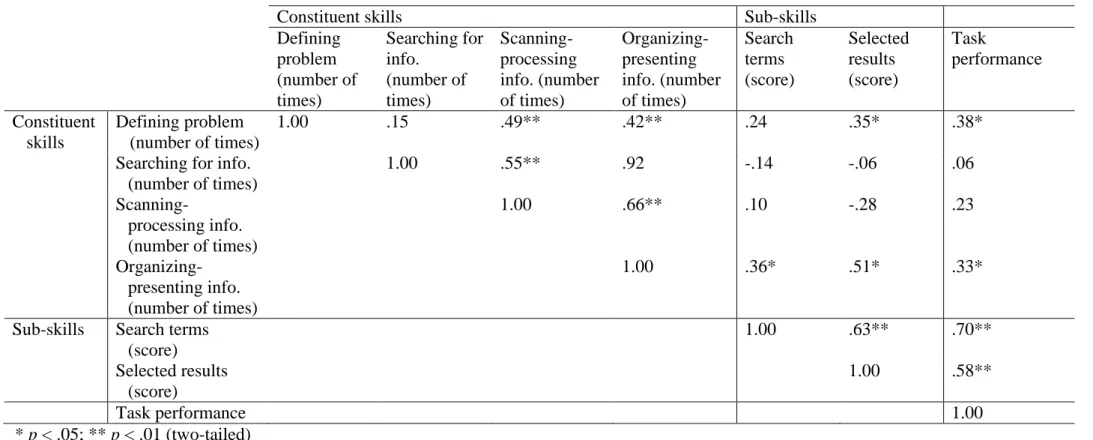
Interaction between pre-post test and experimental control condition regarding the learning process and variables related to sub-skills Search terms and selected. The ANOVA results showed that the participants of the experimental group performed their IPS tasks with a significantly higher level of correctness than the participants of the control group, as can be seen in Table 6. The more frequency in 'problem definition', the more frequency in 'scanning-processing' and 'organizing-presenting', but no more frequency in 'searching'.
In addition, some of the component skills are related to some sub-skills of Internet research, as follows. There was a correlation between the number of times "problem definition" was performed and its appropriateness. In addition, the number of times performed for "organizing-presenting information" was related to the appropriateness of "search terms" and "selected results".
Finally, participants' high level of task performance was associated with a high number of times performing the skill "problem definition" and "organization-presentation of information." A high level of task performance accuracy was also positively related to the “search term” appropriateness and “selected results” appropriateness scores. Correlation between process (dependent variables related to 'component skills' and 'sub-skills') and product (dependent variable 'task performance') in relation to post-test scores.

Discussion
Although both groups performed the skill 'scanning and processing information' more often than the skill. The experimental group could search more efficiently and therefore be able to practice other important skills more often, such as 'defining the problem', 'scanning and processing information', or 'organizing and'. These results are consistent with those reported by Monereo et al. 2000), who found that experts use more extensive search terms and more selectively select results from a hit list.
In the same vein, Lazonder (2000) reported that experts performed site location better than novices. While solving the instructional web-based activities designed in this project, experimental group students were trained to think about the search terms to type to find specific information and assess the results obtained by them. Additionally, scaffolding in the form of prompts and messages explicitly guided students to reflect and evaluate the results obtained through the SERP before selecting them.
In our opinion, all the scaffolding provided during the teaching and especially those related to 'scanning and processing the information' may help students to construct knowledge in a more efficient way. Finally, the results of the study described in this article agree with previous findings by Brand-Gruwel et al. 2009), who pointed out that the constituent skills and sub-skills involved in IPS are highly related among themselves. For example, defining the problem in depth could have contributed to searching for the information better, and to selecting results from a SERP in an appropriate way (and consequently putting less effort into the skill.
"search for information"); specifying the search terms could have made it easier to select an appropriate result; scanning and processing the information carefully could have enabled a better answer to the task. Furthermore, the close connection between the variables of the process. constitutive skills and sub-skills) and the product variables (task performance) may lead to the conclusion that students' abilities to 'keywords' entered and 'selected'. Our findings demonstrated the effectiveness of the long-term embedded, structured, and supported instruction in developing students' IPS skills and task performance.
Second, we are aware that the results presented in this study do not respond exclusively to the SPI learning process designed, implemented and evaluated in our study, but also to another key educational variable that was not recorded in our research – teachers. Teacher instruction can better support students' skill development and task performance in everyday classroom settings (Crawford, 2000). Despite the above limitations, our study showed the potential in developing students' SPI skills through designing an embedded, structured and supported IPS Guide.
Competent information searching on the World Wide Web: development and evaluation of a web training for students. The influence of surface and deep cues on primary and secondary school students' judgments of web menu relevance.