Campus Mexico City
School of Engineering and Sciences
Virtual Architecture of the Automation Pyramid based on the Digital Twin
A thesis presented by
Edwin Mauricio Mart´ınez Galicia
Submitted to the
School of Engineering and Sciences
in partial fulfillment of the requirements for the degree of Master
in
Sciences of Engineering
Tlalpan, Mexico City, June 11, 2022
This work is dedicated to all those people who have supported me with their love and patience, with their knowledge and enthusiasm.
Also, I dedicate this work to those who during this process offered me a hand and gave me a word of encouragement.
I would like to express my deepest gratitude to Tecnol´ogico de Monterrey for the aca- demic support and for all the facilities provided during my stay at this institution. Also, to CONACyT for the financial support during the master’s degree process.
To Dr. Pedro Ponce for opening the doors of his research group, for his patience, for his guidance and for all those talks that encouraged me to continue with my projects.
To Dr. Arturo Molina for the opportunity to belong to his research group.
To Dr. Jos´e Antonio Otero from CEM, for opening the doors of the Tec de Monterrey, for the confidence on me and the support to continue in the master’s program.
To my parents for their love and infinite support, to my brothers for their crucial support and love. To my beloved family.
To Hilda, for all her love, care and patience during this stage of my life that was so important to me. Thanks for your motivation and your infinite support.
To all my colleagues at Tec de Monterrey for their unconditional support and for making my stay in the master’s program more pleasant: Isa, Alex, Efra, Erick, German, Inti, Manu, Oso, Robert.
In general, to the entire academic community of Tec de Monterrey, to all those teachers and colleagues who share their knowledge selflessly and who strive for making Mexico a bet- ter country through science and their knowledge.
the Digital Twin by
Edwin Mauricio Mart´ınez Galicia Abstract
Industry 4.0 has been empowered by new emerging technologies to improve the competitive- ness in companies. One of these technologies is the digital twin (DT) which is an advanced virtual model that enables to predict, detect and classify normal and abnormal operating con- ditions in a factory or a particular production process to improve the features of a physical system.
On the other hand, the manufacturing processes generally follow standards to segment and distribute their processes, information, and implementation areas. Among the most widely recognized standards in the manufacturing industry is the ISA-95 standard that incorporates the business functions and control systems performed in a company with the objective to enhance the implementation of interfaces between business and control systems.
Some architectures, as the Automation Pyramid (AP), hierarchically place the elements that take part in a manufacturing process, from the basic elements such as sensors and actua- tors, to the decision-making systems, whose functions and shared information are defined in the ISA-95 standard.
In industry, one of the main functions of decision-making systems, such as the Manu- facturing Execution System (MES), is to provide critical data in real-time at the operational level to increase productivity and process capability of the manufacturing process. However, these systems usually do not have capabilities to offer a prompt/autonomous/learning-based response to face unpredicted changes in the course of operating resources. Therefore, when a fault condition occurs, not only quick responses are required but also predictive information to prevent future failure scenarios.
Thus, this work proposes to provide responsiveness to decision-making levels in the face of unforeseen scenarios, through the incorporation of intelligent algorithms. The main objectives of this thesis are presented below:
• To propose a complete Virtual Architecture of the Automation Pyramid based on the Digital Twin: This enables the simulation of scenarios with elements from the shop- floor to the management levels, considering the advantages that the DT provides.
• To align the proposal with international standards: The model is driven by the ISA-95 standard incorporating the functions and information flow defined in it for decision- making levels.
• To provide learning capabilities to the decision-making systems through artificial neural networks, incorporated in a model based on the DT concept: Since neural networks are
• Evaluate a manufacturing system for educational purposes through the proposed model:
The parts of the virtual model of the AP will be identified in a manufacturing cell system used for education at Tec de Monterrey. Its components will be evaluated within the framework of the proposed architecture and the elements to complete the virtual model of the AP will be identified.
As a result, this work proposes the complete virtual model of the Automation Pyramid based on the concept of the Digital Twin, where it is proposed to add autonomy capabilities to the decision-making levels through neural networks. The proposed model is aligned with the international standard ISA-95 as an alternative to be applied directly to a process or factory that can be based on the standard.
Abstract v
List of Figures x
List of Tables xi
1 Introduction 1
2 Theoretical Background 8
2.1 The ISA-95 Standard and the Automation Pyramid (AP) Concept . . . 8
2.1.1 Enterprise Resource Planning (ERP) systems . . . 10
2.1.2 Manufacturing Execution Systems (MES) . . . 13
2.1.3 The Digital Twin and its applications in industry . . . 14
3 Virtual Model of the Automation Pyramid based on the concept of Digital Twin 17 3.1 AI-based Management Information System (AI-MIS) . . . 18
3.2 Field and Control Level Model . . . 20
3.3 Supervisory Level . . . 21
3.4 Planning and Management Level . . . 22
4 Assessment of a Didactic Manufacturing System through the Virtual AP Model 26 4.1 The Modular Production System: A Didactic Manufacturing System . . . 26
4.1.1 Workstations . . . 28
4.1.2 Real-time Interface, Monitoring system, Augmented and Virtual Reality 30 4.2 Modular Production System Assessment in the Framework of the DT Model . 38 4.2.1 DT-1: 3D representation, mathematical control model and server. . . 38
4.2.2 DT-2: Supervisory Functions Model . . . 41
4.2.3 DT-3: Planning and Management Functions Model . . . 44
4.2.4 Assessment Summary . . . 44
5 DT-3 Model Approach: Artificial Neural Networks (ANNs) to solve a Production Control Task 45 5.1 Addressing the two-machine flowshop scheduling problem through ANNs . 45 5.1.1 Production Scheduling . . . 45
5.1.2 Artificial Neural Networks . . . 47 5.1.3 The two-machine flowshop scheduling problem and the Jhonson’s Rule 49
6 Conclusions 68
A Appendix A 70
Bibliography 78
2.1 Automation Pyramid based on ISA-95 standard . . . 9
2.2 Equipment Hierarchy modified from [4] . . . 10
2.3 Overview of functional enterprise/control model based on [32] . . . 12
2.4 Digital Twin Scheme . . . 15
3.1 a) Traditional AP; b) Proposed AP model based on DTs . . . 18
3.2 Proposed AI-MIS . . . 19
3.3 DT-1 Virtual Model . . . 20
3.4 DT-2 Virtual Model . . . 22
3.5 DT-3 Virtual Model . . . 23
4.1 Physical Workstations . . . 27
4.2 Virtual Workstations . . . 27
4.3 View of one module in the Virtual Laboratory Platform . . . 28
4.4 View of the application to access the Remote Laboratory . . . 28
4.5 Virtual Model of Workstation 1 . . . 29
4.6 Virtual Model of Workstation 2 . . . 29
4.7 Virtual Model of Workstation 3 . . . 30
4.8 Virtual Model of Workstation 4 . . . 31
4.9 MPS Interface in LabVIEW . . . 31
4.10 Workstation 3 Animation . . . 33
4.11 Workstation 4 Animation . . . 33
4.12 MPS view of monitoring system . . . 34
4.13 Thingmark codes to access the AR model . . . 35
4.14 AR model at Vuforia platform . . . 35
4.15 AR model for Workstation 3 . . . 36
4.16 Thingmark to access the Workstation 3 AR model . . . 36
4.17 AR model for Workstation 2 . . . 37
4.18 Virtual Model (DT) of Workstation 3 in the Process Simulate Platform . . . . 37
5.1 Flowshop scheduling problem representation . . . 49
5.2 Johnson’s Rule representation . . . 50
5.3 Flowshop schedulin problem mapped on BPN . . . 52
5.4 Implementation sequence of BPN . . . 52
5.5 Data base of times withnelements . . . 54
5.6 Neural Network toolbox interface by Matlab . . . 55
5.9 General view of the configured BPN . . . 57
5.10 Train tab from the Matlab toolbox . . . 58
5.11 Training window from the Matlab toolbox . . . 58
5.12 Example of a BPN performance after being trained . . . 59
5.13 Representation of the network in Simulink . . . 60
5.14 Network performance in Test 1 . . . 62
5.15 Network effectiveness in Test 1 . . . 63
5.16 Network performance in Test 3 . . . 64
5.17 Network effectiveness in Test 2 . . . 64
5.18 Network performance in Test 3 . . . 65
5.19 Network effectiveness in Test 3 . . . 66
5.20 Network performance in Test 4 . . . 67
5.21 Network effectiveness in Test 4 . . . 67
2.1 PS Details . . . 13
4.1 Variables in LabVIEW and OPC server . . . 34
5.1 Advantages and Disadvantages of ANNs taken from [62] . . . 48
5.2 Job scheduling example . . . 50
5.3 Job times for each Work center . . . 53
5.4 Network Features in Test 1 . . . 62
5.5 Network Features in Test 2 . . . 63
5.6 Network Features in Test 3 . . . 65
5.7 Network Features in Test 4 . . . 66
Introduction
In the last decade, with the incorporation of new technologies in industrial processes, a trans- formation in the production and management systems has been observed. With this, new schemes, models and methodologies emerge to deploy traditional production processes on environments with an increased number of intelligent elements and more connectivity.
One of this emerging trends is the Intelligent Manufacturing (IM). This term refers to the effort to design, deploy and manage business manufacturing operations and systems that activate the proactive management of the manufacturing company through informed execu- tions in time [1]. To aspire to the development of IM systems, the understanding, planning and administering real-time management of all aspects of the business and operational manufac- turing process is required and facilitated by the widespread use of sensor-based data analysis, modeling and simulation, etc. [2].
The environment where the elements belonging to the IM systems make synergy is called Industry 4.0 (I4.0). According to Federal Ministry of Education and Research of Ger- many , the I4.0 refers to the intelligent networking of machines and processes for industry with the help of information and communication technology [3]. Over the years, the I4.0 and its fundamentals have evolved with greater clarity and objectivity for its rise and credibility in the academic and industrial areas. With this evolution, some elements comprised in I4.0 become more relevant in the deployment of IM systems. One of the fastest growing techno- logical elements in I4.0 is the Digital Twin (DT). This concept was born from the availability of new elements such as smarter sensors, flexible programming platforms, and advanced ar- tificial intelligence algorithms which enable the generation of virtual models that represent the characteristics of a physical asset with high fidelity and whose interaction enables the improvement of the physical counterpart.
Under the same tendency, methodologies, architectures and even standards are evolving to adapt their contents to the incorporation of technologies with more connectivity and intel- ligence capabilities, facilitating the factories to evolve into smart manufacturing companies.
Despite the manufacturing environment continues to transform, the current standards still con- tinue as a reference to develop a manufacturing structure with order and efficiency. One of the worldwide reference standards is the ANSI/ISA-95.00.01-2000, in this work referred to as ISA-95 standard for practicality.
The ISA-95 is an international standard for the integration of enterprise and control
systems, developed by the International Society of Automation (ISA) [4]. Currently, the ISA- 95 standard is composed by 7 parts which defines the activities and information that will be exchanged between business and control systems in order to reduce the risk, cost, and errors associated with implementing these interfaces [5].
Part 1 of this standard presents a hierarchical model associated with manufacturing con- trol and business management systems. Based on this hierarchical model, some conceptual representations such as the Automation Pyramid (AP) provide an overview of what should be accomplished by process automation. By following the hierarchy set in the ISA-95, the AP concept has been used as reference to represent the functional levels and locates the ele- ments belonging to each automation processes, from the level 0, where the physical processes takes place, to the 3 and 4 levels where the operational and business management systems are identified.
The functions accomplished by the decision-making levels are driven by IT-based sys- tems such as the Manufacturing Execution Systems (MES) and Enterprise Resource Planning (ERP) systems. The ERP systems manages those activities related to sales, accounting, pur- chases, human resources, etc. While MES is focused on providing information in real-time about the activities deployed on the shop-floor and it serves as a bridge between the ERP systems and the manufacturing control (usually carried out by a SCADA system). Hence, the integration of smarter devices within the shop-floor has obliged ERP and MES to evolve into systems with more connectivity and advanced self-driven capabilities to take advantage of the large amount of data now available.
Despite having a common goal, academic research has enabled the development of in- telligent decision-making systems in different ways, under different points of view. Some au- thors propose composite intelligent systems where a digital-networked manufacturing paradigm is suggested as the future of production processes [6]. These systems are defined by human, cyber and physical activities interacting to develop production with specific manufacturing goals considering the optimization as critical point. The sensing, decision making and anal- ysis activities migrates from a human stage to the cyber-physical stage, taking the human knowledge management as a base to enhance the production efficiency [7].
In addition to Cyber Physical System (CPS) approaches, mobile technologies, cloud manufacturing systems, big data analytics, robotics, 3D printings, Industrial Internet of things (IIoT), Augmented and Virtual Reality (AR and VR), and Digital Twins (DTs) are distin- guished by authors such as [8–10], as enablers of smart factories, particularly to their appli- cation and practical implementation at decision-making levels (MES, ERP).
Regarding the Internet of Things (IoT), a tech combination with MES is addressed in [11]. Here, the authors aim to incorporate the IoT technology into a MES in a motor assembly plant analyzing the real-time monitoring capabilities throughout the manufacturing process that the IoT contributes to. Also, the IoT technology supposes to provides access to a broad range of sensor data.
With a different technology, the work presented in [12], provides intelligent features
throughout radiofrequency identification-based MES (RFID-MES). Based on the mass-customization company scenario, the authors identified inefficient scheduling due to the manual handling of
information. The work presents an RFID-enabled real-time MES for managing the data col- lection, real-time scheduling as well as real-time work-in progress tracing and tracking. RFID
devices were deployed into the production environment converting typical manufacturing re- sources into smart objects enabling their real-time tracing and tracking. The RT-MES utilized the real-time information to support the planning, scheduling, execution and control func- tions. The authors conclude that real-time data collection and scheduling help the visibility and traceability of materials and the work-in-progress inventory control.
In proposals such as the presented in [13], the authors make use of cloud-based MES systems to enable on-demand configuration of distributed applications and integration of dis- tributed systems, with the help of business approaches such as Service-oriented Architec- ture(SOA) which builds IT systems allowing business to leverage and create new assets and enables the changes required to support the business [14]. Also, the cited authors use Web- Service technologies for presenting Web-based MES for data integration among heteroge- neous systems.
In recent years, agent-based modeling has had considerable development in the real- world business area. Therefore, several approaches have been proposed to use agent-based systems for modelling decision-making systems taking advantage of its benefits: to capture emergent phenomena, to provide a natural description of a system, and to be flexible [15].
Precisely, in [16] the authors presented an agent-based architecture of a MES, considering the functional models conferred in the ISA-95 standard. They applied CPS (holons) to collect the information from the shop-floor to later be sent to the agents which processed using internet services. With this, a local optimisation focused on individual orders provided by order agents replaces globally optimisation from MES.
Following the agent-based approaches, the work presented in [17] employed knowledge- driven decision support with learning agents which are able to predict future disruptions and react automatically through the adaptive decision-making in distributed execution control and emergent scheduling. The learning capabilities were added to a previous automatic decision- making system by adding a Q-learning agent. The results shows noticeable improvement on learning capabilities with the addition of the agent-based feature.
Although there are different proposals on improving the autonomy and intelligence of decision-making systems, the literature still indicates the lack of response to unforeseen sce- narios. In [18], after conducting one of the most complete reviews of MES, the authors point out that in the implementation of decision-making systems, the shop-floor needs more than data analysis. These systems require tools to dynamically respond to unexpected changes as well as to provide them with learning capabilities which enables more defined autonomy. For example, through the MES the enterprises may access to critical data in real time and propa- gate the decision made based on it. To do the above, the decision-making systems solutions need to combine different solving tools with multiple data sources to elaborate solutions in reasonable time compatible with the planning.
In [19], it is identified two main categories of technologies employed to provide quick- ness to the manufacturing systems. These technologies are addressed as basic and emerging technologies. The authors designated the simulation, the autonomous robots, the additive manufacturing, etc. as examples of basic technologies. On the other hand, they labeled as emerging term those technologies such as the Industrial Internet of Things (IIoT), the CPS, the Augmented Reality/Virtual Reality (AR/VR), the Big Data Analitycs, the Cloud/Cloud Computing, Ciber-security, Artificial Intelligence (AI), etc. The quick response, adaptation, and organization of tasks are addressed by the authors as major challenges in order to face the
dynamic change of demand. Despite an exhaustive revision, they state the lack of autonomous evolution mechanisms and autonomous schemes of intelligent manufacturing systems to solve different defiance.
With regards the emerging terms mentioned above, one of the elements that best repre- sent a CPS is the Digital Twin (DT). Initially, the DT was defined as a nonphysical element described by digital models to represent physical elements’ behaviours in real-world environ- ments [20, 21]. Over years, some authors have worked with DT adding characteristics to the original concept. According to [22], a DT is comprised of five main elements: the physi- cal object/process, its virtual counterpart, a connection between these two elements, the data and finally, a service element. The real-world device is the base for building the virtual el- ement, the virtual one allows running ”n” quantity of simulations to enable decision-making and control of the physical asset.
Through innovative and effective tools such as DTs, it is conceivable to develop new manufacturing elements that collaborate to incorporate the new emerging CPS into the compa- nies in their current state. These tools can adapt these emerging smarter systems to processes or methodologies that already have some automation feature built-in.
Taking the concept of the automation pyramid as a reference, some authors have focused on working on it and have proposed updating the AP through the DT concept. In [23], a shop floor virtualization case was proposed. This work explored the digitalization of the four main shop-floor components: physical, virtual, service, and data shop-floor systems.
Some authors have proposed innovations in the AP decision levels. For instance, in [24], the paper focused on the practical implementation of a DT concept in a MES. The proposed DT was built to monitor energy consumption inside a laboratory dedicated to Industry 4.0.
Also, some authors have proposed modifying the architecture of MES from a static state to a flexible, dynamic information model. In [25], the proposal focused on the case-based approach to information modeling to generate new manufacturing systems that can integrate new flexible materials models. In this work, a link between classical MES and Enterprise Resource Management (ERM) is shown. The modeling was designed using the Reference Architecture Models applied to Industry 4.0 (RAMI4.0) [26].
With the transformation of the current automation systems towards systems with greater connectivity and intelligence, several authors point out a need to transform the current schemes, such as the AP, towards models that adapt or incorporate elements that provide greater connec- tivity, intelligence and prediction capacity applicable to decision making. In [27], the authors point out that the traditional pyramid does not cover current application needs, since intelli- gent automation requires the real-time exchange of information through all the layers of the pyramid, simultaneously. Thus, this work proposes a framework based on a middleware that provides interoperability between the layers of the pyramid with cloud functionalities and big data warehousing. The framework is based on features such as interoperability, virtualization, decentralization, real-time, traceability, modularity, etc. through all the layers of the tradi- tional pyramid. This proposal addresses the need to strengthen the pyramid model by adding dynamics and flexibility through the middleware that covers the lack of information exchange in real time through all the layers of the AP.
Until now, few works consider a complete virtualization of the pyramid. The main rea- son is because the MES and ERP systems, in charge of managing management and decision- making tasks, are themselves virtual systems. Although in recent years, these business and
operational management platforms have increased their capabilities to be at the level of the new industry 4.0, there are still some areas of opportunity to detonate their capabilities towards more intelligent systems. ERP systems have incorporated their platforms to cloud services, while MES have developed better ERP integration functionalities, planning and executing production orders from the ERP, and have managed to improve the collection and delivery of data for decision-making, adapting to the inclusion of devices such as sensors, controllers, machinery, etc. that now have more connectivity and intelligence.
In the state of the art, digital twins are the most used tool for digitizing the pyramid.
Before having a complete DT model, there are proposals that start from the Digital Shadow model (DS), the predecessor of the DT. In [28], together with a MES, the integration of a DS is proposed to add decision-making capabilities to the MES. According to the authors, the DS becomes a DT due to the presence of an intelligent integration layer to the MES that hosts the rules and knowledge to choose between alternatives. The model is applied to two different frameworks, the first to manage error states and the second to improve the process of an assembly line. Starting from models such as the DS, Digital Master (DM) and the relationships between variables from the workshop to the decision-making levels (System Dynamics) in [29], the DT is adopted for teaching automation concepts to students and an approach to a full virtualization of the AP is presented. The dynamics of the system is based on the simulation of some of the functions defined for the higher levels of the AP within a digital platform. The simulation of this dynamic and the rest of the elements of the lower levels of the pyramid offers an advantage in the connection between all the elements. In this way a complete digital pyramid is achieved.It is an interesting proposal, since it dispenses with the use of ERP and MES systems following the AP model and is applied to an educational model, however, the dynamics of the system still lacks prediction functions and intelligent decision making, fundamental characteristics in the DT. Through the different proposals presented in this state of the art, an attempt has been made to show the trend of the manufacturing industry towards the incorporation of more sophisticated and intelligent elements. Today, industry 4.0 begins to permeate manufacturing, driving it to have processes with better connectivity, communication, and intelligence. which opens the possibility of having more efficient and cutting-edge decision-making platforms.
Thus, the current manufacturing models must evolve towards new proposals that incor- porate technological elements that provide decision makers with a more precise vision that helps them trace the route of a product in each stage of production more efficiently. Re- cent work shows a growing need to transform manufacturing through the virtualization of the components of its processes on the path of integration towards a new reality called industry 4.0.
Even with the transformation of current manufacturing and automation systems, the AP is still valid and is point of reference for many research works. The main reason is the support provided by the internationally accepted standard ISA-95. Although the figure of the AP is still latent, there is a tendency to change its original model. Most of the proposals consider the virtualization of some of its levels. However, the common denominator of this partial digitization is the problem of interaction with the rest of the levels, rarely addressed and sometimes omitted. In an industrial environment with a greater volume of data, in the transition towards a more intelligent manufacturing, the flexible and agile flow of information between the levels of the AP is crucial for an efficient coexistence of the model, for which the
virtualization of a single stage seems to be insufficient from the perspective of this work.
In addition to the above, although ERP and MES systems have evolved to platforms that seek to join industry 4.0 adding technologies such as cloud storage, big data analysis, interac- tion with smarter devices with through the internet of things (IoT), etc., there are still areas of opportunity to be exploited to have platforms with more intelligence capable of collaborating more efficiently in decision-making through the simulation and prediction of scenarios. In other words, the initiative of this work is to provide management and planning systems with the ability to perceive, understand and act for different scenarios, through artificial intelli- gence.
In summary, there are two main reasons for having a complete model of the pyramid based on a single intelligent entity. The first of these is the difficulty of integrating with the rest of the levels when a single level is virtualized. This problem means that the now big amount flow of information in processes and systems with greater connectivity is not efficient and does not allow valuable information to be available at the time necessary for decision- making at any level, eliminating the possibility of reacting to unforeseen scenarios or in case of sudden failures, for example. The second is the lack of intelligence in current decision- making systems. Through a DT, a sudden failure prediction and response feature can be added to ERP and MES systems without human presence. In other words, taking advantage of the characteristics of the DT and with the help of artificial intelligence algorithms, in the decision- making levels of the virtual pyramid, provided with the vast amount of data available in the rest of the virtual levels, scenarios can be simulated with how many possibilities are desired for each function executed in the ERP and MES (based on the functions and information flow defined in the ISA-95 standard). The database for these simulations can also be nourished by the communication that the DT has with its ”physical” twin.
Therefore, a complete virtual model of the AP is relevant, since with the incorporation of devices with greater connectivity and sensory capabilities, the volume of data available in a manufacturing process or system has increased considerably. With the latent development of data science techniques, this information becomes valuable, because through it the future behavior of the system is understood and can be known. Currently, the existing proposals only consider the virtualization of some level of the pyramid, and little is discussed about its virtual interaction with the rest of the levels of the pyramid. Thus, in order to manage all the infor- mation that is generated and flows at all levels of the pyramid, the complete virtualization of the pyramid from the same model could facilitate communication and the flow of information between the virtual model and its physical counterpart.
”Virtualizing” the pyramid through a DT will allow the availability of information through the entire pyramid, enabling effective communication and facilitating its integration and in- teraction with its physical counterparts. Addressing the current little-discussed problem of information flow between levels by digitizing only some levels of the pyramid. In addition, the development of the DT on the same entity will enable effective communication and will facilitate its integration and interaction with their physical counterparts. Additionally, the creation of DT through artificial intelligence algorithms provides the ability to predict and respond to unforeseen scenarios at decision-making levels, something that ERP and MES systems currently do not have.
Thus, the contribution of this work is to lay the foundations for the attention of the problems exposed through the proposal of a virtual model of the complete pyramid. This
work conceptualizes a new complete AP model based on the DT concept that permits the simulation of scenarios with elements from the shop-floor to the management levels. The full virtualization can facilitate an efficient flow of information under a single platform and streamline decision-making from the lowest level to the highest levels of hierarchy. Partic- ularly, for decision-making levels, it is proposed to include neural networks’ algorithm to provide learning capabilities at these levels and provide autonomy and responsiveness to un- foreseen scenarios at different levels of the production process.
To evaluate the model, this work shows a case study of a DT applied to an educational environment. The characteristics of the proposed model are identified in a manufacturing cell system approached in the manufacturing laboratory of Tec de Monterrey CCM. In this system, augmented reality (AR) and virtual reality (VR) are included as part of the development of DT as emerging technologies. The model proposed in this work is used for the evaluation of the educational system, identifying the elements still lacking to complete a complete model of DT based on the AP.
Theoretical Background
2.1 The ISA-95 Standard and the Automation Pyramid (AP) Concept
The goal of the ISA-95 standard is to provide consistent terminology that is a basis for man- ufacturer communications that provide consistent information and operating models. In ad- dition, the ISA-95 standard allows selecting the information to be exchanged between sales, finance, logistics and production, maintenance and quality systems [30]. Besides, the ISA- 95 standard can be used as a guide for the definition of user requirements, for the selection of manufacturing execution systems (MES) suppliers, or as a basis for the development of MES and databases [31]. When well structured communication is required to integrate en- terprise control systems, the ISA-95 standard could be implemented allowing the selection of information transmitted and received between systems.
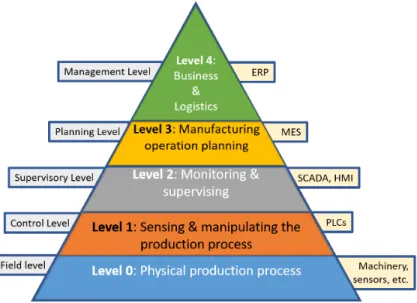
The model depicted in Fig. 2.1 shows the most accepted format of the Automation Pyramid (AP). This conceptualization is based on the hierarchical model shown in the first part of the ISA-95 standard, where the enterprise manufacturing operation is proposed in 5 hierarchical levels. The zero level consists on the industrial process per se, the machinery, sensors and the needed human resources. The subsequent level consists on the automation components, it is the interaction between the physical components and the more basic con- trol elements such as PLCs and its peripherals, sensors and actuators, in general. This level is mentioned to be the industry’s hardware where the interaction of the top-level systems and the process takes place. In the monitoring and supervision level the equipment can be supervised through human-machine interface (HMI) or supervisory control and data acquisition systems (SCADAs). Level three controls the manufacturing operations through manufacturing execu- tion systems (MES), this managing system controls what processes should be executed and the order of these. At the top level resides the economic, countable and marketing programs. The Enterprise Resources Planning systems (ERP) usually manages the inventory, the billing, the accounting and the logistics. This tool allows to take all the emitted billings in the company as well as the expenses and inventory.
The ISA-95 standard is based on models through which the interfaces, enterprises’s business systems and its manufacturing control systems are defined. The standard address benefits such as [32]:
• Reduce the user’s time to reach full production levels for new products,
• Enable vendors to supply appropriate tools for implementing integration of control sys- tems to enterprise systems,
• Enable users to better identify their needs,
• Reduce the cost of automating manufacturing processes,
• Optimize supply chains, and
• Reduce life-cycle engineering efforts.
Figure 2.1: Automation Pyramid based on ISA-95 standard
Regarding the assets belonging to the 0-2 levels, the ISA-95 standard organize these in a hierarchical fashion as illustrated in Fig. 2.2.
The ISA-95 standard structures the elements according to the types of industrial pro- cesses: batch, continuous and discrete process. In addition, it defines the equipment through which these processes are deployed. According to Part 1, production units are the lowest level of equipment typically scheduled by the level 4 or level 3 functions for continuous man- ufacturing processes. The production units are composed of elements such as sensors and actuators.
The production line and work cells are the lowest levels of equipment scheduled by the level 3 and 4 functions for discrete manufacturing processes. The process cells and units are also the lowest levels of equipment scheduled by the level 3 and 4 functions for batch manufacturing processes.
The capabilities of production units, production lines, work cells, process cells, and units are used for level 3 functions and are also often used as input to level 4 schedule, even if they are not scheduled by the level 4 functions.
On the other hand, the operational models clarify the application functionality about how the information must be used within the different hierarchical levels. The standard clearly
Figure 2.2: Equipment Hierarchy modified from [4]
determines which information has to be exchanged within systems for sales, finance, logistics and also, maintenance systems, production and quality areas. The UML models are the basis for the development of interfaces between ERP systems and MES.
In the literature, the efforts are focused on developing proposals for optimizing and apply conceptually and practically the DT concept to the elements located in the first 2 levels and a few for level 3. For the purposes of this work, it is relevant to discuss the functions executed by the planning and management levels, MES and ERP systems, respectively.
2.1.1 Enterprise Resource Planning (ERP) systems
Enterprise resource planning (ERP) is a generic name given to information systems designed to integrate and efficiently use all the resources of an enterprise. This program assists an en- terprise in coordinating processes and data that are executed from sales to accounting, from production to human resources, from stock management to purchasing. Data are entered into ERP systems at the beginning of the foreseeable period to then be transformed into informa- tion processed in different areas within the enterprise [33].
In [33], the authors address some benefits the ERP systems contribute to Industry 4.0 (I4.0) implementations:
• Real-time data can be analyzed and early indication of exceptional cases would be pos- sible,
• ERP systems can provide sales and purchasing transparency via automated business rules,
• Mobil applications may use ERP data to convey the messages not only to the manager but also to the machines running in manufacturing suits to perform expected operations,
• Through effective ERP system strategic operation could be easy and the access of in- formation to suppliers, customers, and other partners could be possible for assuring the efficiency of on-line operations, and
• Customers may be able to track the status of their orders on-line receive the information required without delay.
Some interesting proposals about the research of ERP systems are presented in the recent literature. Some of these, are related directly to the implementation of ERP systems and the inclusion of new technologies, such as cloud systems, into the traditional ERP systems [34].
While some authors conceptually sets the incorporation of new emerging technologies, there are proposals aiming to implement the combination of cloud computing and ERP systems [35]. Compared to single ERP implementation, the authors found that a hybrid solution is more suitable for the interaction with the user. Their proposal methodology undoubtedly opens the way to I4.0 technological integration.
An ERP system usually is implemented to manage transactions through company-wide business processes, by using a common database, standard procedures and data sharing be- tween and within functional areas [36]. Currently, in a broad range of production companies, the ERP systems support the production and distribution tasks and these are implemented to integrate and partially automate financial, resource management, manufacturing, commercial, and other business functions into one single system based on a database [37].
The customization of systems is a trend especially in the market for medium-sized com- panies, so the ERP plans will be offered as a service through providers. Thus, new ways of providing the software are being investigated, mainly related to the development of cloud sys- tem hosting [38]. Nowadays, accessibility to remote devices is a fundamental characteristic of personal devices and of course in industry. Remote access to information verification for decision-making is crucial towards optimizing manufacturing processes. That is why ERP system providers are facing these challenges offering mobile-capable ERP solutions [39].
In the content of ISA-95 standard are defined specific functions assigned to the levels of business enterprise management (ERP) systems. Some of these activities are summarized in the Fig 2.3.
As it is shown, the information flows between the functions that cross the enterprise/
control interface. According with the standard, a “Function” is a group of tasks that can be classified as having a common objective. These, are organized in a hierarchical manner and are identified with a name and number. The number represents an identification of the data model hierarchy level. The dotted line illustrates the boundary of the enterprise/control interface. The line is equivalent to the Level 3 - Level 4 interface [32].
The model structure reflects an organizational structure of functions. This work is based on proposing a model which emulate the functions through the concept of Digital Twin (DT).
The following functions correspond to those accomplished in the ERP and MES systems, and these will be on which the DT model will be based, as is indicated in Fig. 2.3.
Figure 2.3: Overview of functional enterprise/control model based on [32]
Order processing (OPR)
The tasks assigned to this function are:
• Customer order handling, acceptance and confirmation.
• Sales forecasting.
• Waiver and reservation handling.
• Gross margin reporting.
• Determining production orders.
Production Scheduling (PS)
Here, the function’s interface to the manufacturing control system works through a produc- tion schedule, actual production information, and production capability information. The functions and the information generated or modified by the production scheduling functions are listed in the Table 2.1.
Production Control (PC)
The main functions in production control include process support engineering (PSE), opera- tions control (OC), and operations planning (OP). These can be summarized as:
• Control of transformation of raw materials into end product in accordance with produc- tion schedule and production standards.
Production Scheduling (PS)
Functions Information generated or modified by PS Determine the production
schedule
The production schedules Identify long term raw mate-
rials requirements
The actual production versus the planned production Determine pack-out schedule
for end product
The production capacity and resource availability Determine available product
for sales
Current order status
Table 2.1: PS Details
• Plant engineering and updating of process plans, etc.
• Issue requirements for raw materials.
• Produce reports of performance and costs.
• Evaluate constraints to capacity and quality.
• Self-test and diagnostics of production and control equipment.
• Creation of production standards and instructions for Standard Operating Procedures (SOPs), recipes, and equipment handling for specific processing equipment.
2.1.2 Manufacturing Execution Systems (MES)
The Manufacturing execution systems (MES) were developed in the early 1990s as a specific application at the shop-level. These systems mainly consist on functions of production man- agement and control such as scheduling, product quality management and control, production cost control, and so on. This program aims to realize integrated production management and control in the shop-floor [20].
According to the ISA-95 standard, MES assume the role of connecting the office ERP systems to the shop-floor equipment by implementing manufacturing operational management (MOM) functions in the factories [40]. Some authors include online characteristic to the MES definition, also, adding the MES capability of accumulation of methods and tools to accomplish production, where online characteristic is used as connecting feature [41].
MES seems to be one of the cornerstones for the fourth industrial revolution (I4.0). MES ensure the cooperation between the complex activities that combine various types of tools and methods and the resulting synergy. Owing to the cooperation with different IT systems inside and outside the enterprise, the MES must have open and flexible features. These are: (i) the real-time continuous communication with the production level, (ii) the online conversion of information models, (iii) the transformation of data presented in accordance with the business model into a form that is easily interpreted and executed by the industrial control systems, and (iv) the conversion and processing of the data that is acquired from the control systems into a form that can be used by other enterprise systems [25].
Nowadays, despite the advanced implementation of MES, there are still issues to be im- proved regarding its application and expansion within the manufacturing area. Commercial MES, which is typically accompanied by an additional enterprise resource planning (ERP) system, can present a large expense to a manufacturer; this is particularly problematic for small manufacturing enterprises (SMEs),whose ability to afford such systems may be limited.
Deployment of MES and ERP systems may also require installation of dedicated hardware.
Additionally, some current MES and ERP systems do not address the information needs of individual employees and may not integrate data analytics [42]. Most of the current MES are designed for large enterprises that produce large quantities of a small number of parts, instead of customizable short-run products that are produced by many SMEs [40], something that the tendency of I4.0 to customize the products seems not to be compatible with the ide- ology. Thus, problems identified in current MES include: manual data entry by operators, lack of near-real time capability, and problems with interoperability and data sharing between different elements of the MES [43]. Therefore, some proposals have addressed certain char- acteristics which a MES must have in order to ensure its compatibility with the I4.0, which includes decentralization, mobility, connectivity and cloud integration [44].
Despite the evolution of business and resource management systems, the connection be- tween the process control devices and MES seems lacking whenever an MES is implemented.
This gap is not surprising, it reflects the fact that the two areas evolved separately and had to address totally different requirements in regard to application context or data characteris- tics. There is evidence in the industry that these two worlds are also separated by different networking concepts. In the office context, LANs are predominant whereas the control level is the domain of field buses. Hence, the gap to bridge not only concerns the linking of two different network types but also the interconnection of two different mind-sets [45].
In the beginning, the purposes of MES were focused on finite operational scheduling, resource production management, and the dispatching of production units. Also, MES would supply automated data collection and the delivery of detailed documents to work station.
The MES would also record production details and analyze performance. What “Planning”
handles superficially in batch, the MES handles continuously, up-to-the-minute, and on the spot [46].
2.1.3 The Digital Twin and its applications in industry
This concept was presented in 2003 at the University of Michigan by Grieves [21]. Over the time, several authors have added their perspective to define the digital twin (DT) con- cept [47, 48]. In [49], the authors define the DT as a kind of ultra-high-fidelity simulation which includes a health management system, historical vehicle and swift data. One of the most used definitions of DT was presented in 2012 by [50] where the DT is defined as an integrated multi-physics, multi-scale, probabilistic simulation of a complex product using the most suitable physical models to emulate the life of its related twin. In [51], it is mentioned the DT is composed of physical product, virtual product, and the connected data which links the both products. Also, the authors define some relevant characteristics of DT:
1. Real-time reflection: DT comprises the physical and the virtual space. The virtual space is the real reflection of the physical space and maintains ultra-high synchronization and
fidelity with its related real space.
2. Interaction and convergence: a) in physical space, b) between historical and real time data, and c) between physical and virtual space. Related to a), DT integrates full-flow, full-element and full-service characteristics, then, the data generated in the physical space phases can connect with each other. Regarding b), the DT data not only depends on expert knowledge but also collects data from all implemented real-timely systems.
Finally, the physical and virtual space are smoothly connected and they interact easily.
3. Self-evolution: DT can update data in real time, so that virtual models can endure con- tinuous improvement through comparing virtual space with physical space in parallel.
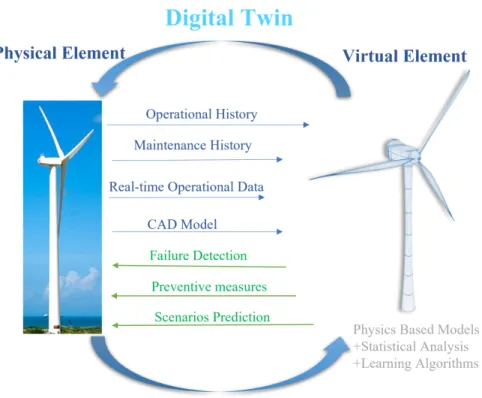
In Fig. 2.4, the Digital Twin (DT) concept is illustrated. Some authors consider that this representation is clear to highlight the essential characteristics that a DT must possess [52].
However, some others have considered that a complete DT model should have essentially five elements in its structure: physical part, virtual part, connection, data and service [23].
Some authors are proposed theoretical frameworks which considers the mentioned elements incorporating information processing layers [48].
Figure 2.4: Digital Twin Scheme
By its definition, a DT is considered a quintessential Cyber-physical system. In [20], the authors proposed a systematic framework for Ciber-physical production systems (CPPS), its processing relies on two conditions: the cohesion of three physical portions (i.e. smart part, smart shop floor and smart manufacturing operations), (2) the mapping and interaction of physical portions with virtual portions (i.e. virtual smart part, virtual smart shop floor and virtual smart manufacturing operations). The application in manufacturing of DTs is
in constant evolution, therefore, the proposal of DT application has different perspectives.
In [53], the authors presents a variety of applications in manufacturing environments for the DT. The information, representing the authors perspective, is presented in four sections: DT- based production design, smart manufacturing in DT workshop/factory, product DT for usage monitoring and DT as enabler for smart MRO (Maintenance, Repair&Overhaul).
Some proposals focused their efforts to lay the theoretical foundation for the devel- opment of DTs. In [22], the research for developing DTs comprised mainly by four parts:
DT modeling, simulation and VV&A (Verification, Validation and Accreditation), Data Fu- sion, Interaction and collaboration and Service. As relevant information, the work presents an interesting review of DT industrial applications, specifically, DT-related patents and DT applications by industrial leaders.
On the other hand, most of the DTs applied in industry are closely related with the levels below the Automation Pyramid (AP) [23]. In [47], the authors proposed a framework of DT-based smart production management and control approach, then, the authors address the main contribution of this work are: the prediction services for a satellite assembly shop- floor by integrating digital twin and big data technologies, which promotes the realization of predictive manufacturing in the product assembly stage, the framework of digital twin-based smart production management and control for a satellite assembly shop-floor and, the case study to illustrate how to apply the proposed framework practically in a satellite assembly shop-floor. Similarly, in [51] they proposed a framework for product design, manufacturing and service driven by a DT. The authors concluded they attend problem solutions about data in product life cycle, a new method for digital twin-driven product design, manufacturing and service; finally, the detailed application methods and framework of digital twin-driven product design, manufacturing, and service are investigated.
Undoubtedly,the data plays a crucial role in the application of DTs. Theoretical propos- als as well as applied knowledge of data management within DT are quite valuable. In [52], the authors address representative applications with focus on the alignment with their pro- posed reference model, they present a general data processing framework for constructing a DT. It comprises data acquisition and cleansing, data storage and time-sensitive data process- ing. The intrinsic relationship of data with the ERP and MES systems must be considered as one of the main factors to be represented through the DT concept and its application. The research in [25], focuses on the transformation from the statistic architecture of MES to flex- ible and dynamic information models. The main contribution is the case-based presentation of a new approach for information modelling that is dedicated for the new generation of man- ufacturing systems. Since the new models that are presented were applied in an existing manufacturing system of smart electronic devices production, its implementation will focus on a number of constraints that are typical in the case of the previous generation of industrial computer systems.
Certainly, the presence of DT will be more constant and with greater weight in applica- tions within the industry. A well-structured theoretical base, standards for the regulation of its application, as well as its correct implementation are part of the work that employees of the industry and the academic community must seek and continue working on. The correct evolution and application of technological elements in industry is and will be essential for the transformation of industrial life.
Virtual Model of the Automation Pyramid based on the concept of Digital Twin
This chapter defines in detail the elements of the proposed model. As mentioned above, several efforts have been made to introduce DT schemes at different levels of the Automation Pyramid (AP), however, there are no proposals that establish the application of DT to the entire structure based on ISA-95 as proposed in this work. The main reason is that MES and ERP systems are essentially digital systems, however, the lack of autonomy and response to unexpected changes in the manufacturing processes are enough to search for new alternatives in these management systems in the industrial environment. Thus, with the aim of addressing the gaps found in the literature, this work aims to set a proposal that covers the weaknesses exposed through an innovative tool such as the DT.
As discussed in 2.1.3, a Digital Twin (DT) is a virtual representation of a system, prod- uct, or service, which emulates the characteristics of its physical counterpart but in a virtual environment. Unlike the concept of Digital Shadow (DS) discussed in Chapter 1, the DT in- teracts with its physical twin, there is bidirectional communication between both entities. A fundamental part in the creation of the DT is the information collected from the operations and the history of the behavior of the physical entity. The fidelity with the virtual entity can represent the physical entity has to do with the analysis of the data on which it is based for its creation. In addition to the features already presented in chapter two, we could add the following as essential to be executed by a DT:
• Making more efficient and accurate decisions.
• Predictive analysis: Through this you can anticipate future problems or have alternatives to unforeseen scenarios.
• Digital simulations before physical simulations: The asset can be tested in a virtual environment and improvements can be identified, avoiding the investment of resources that any physical test represents.
One of the problems described in Chapter 1 is the availability of the large amount of information flowing through all the levels of the pyramid when a single element or level of the original pyramid is virtualized. Thus, from the perspective of this work, by making the entire
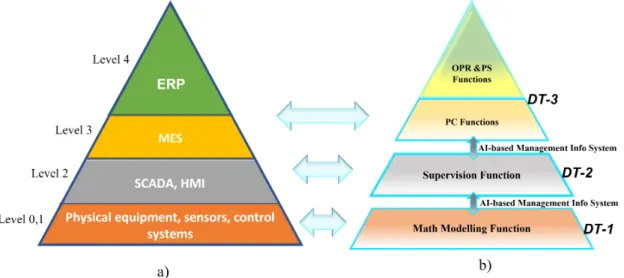
AP model virtual, when a simulation is performed, it is expected that the flow of information through the stages will be automatically managed using intelligent algorithms. As shown, this flow would be bidirectional between the levels represented by three DT models. Furthermore, with the entire virtual pyramid, the efficiency of the simulated process can be improved by running a large number of simulations in a shorter time, which would be difficult to achieve with one-stage AP virtualization. Then, the AP model based on DT is discussed below, and its general configuration is shown in Fig. 3.1.
Figure 3.1: a) Traditional AP; b) Proposed AP model based on DTs
The virtualized AP model is made up of 3 DT models. Each DT is interconnected using the AP structure having an AI-based management information system. Initially, it is proposed that the ERP and MES functions presented at the introduction of this work: Order Processing (OPR), Production Scheduling (PS), an Production Control (PC) can be executed by the DT-3.
Meanwhile, the role currently assigned to DT-2 will be supervisory. This function is one of the main characteristics of the traditional level-2 systems such as SCADA and HMI. For DT- 1, it is assigned the mathematical modeling function, which is essentially the representation of any element at level 0-1 that different simulation software such as Matlab and LabVIEW performs. Thus, the 3 DTs in conjunction with the AI-based information management system form a DT model based on the Automation Pyramid.
3.1 AI-based Management Information System (AI-MIS)
In recent years, Artificial Intelligence (AI) has proven to be a highly useful problem-solving tool for decision-making process. The application of this type of algorithms to large amounts of data allows finding behavior patterns that in turn favor decision making, prediction of future failures, process improvement, and so on.
On the other hand, with the development of industrial processes better adapted to a new reality with more connectivity, the volume of data begins to increase considerably, which poses great challenges for information capture, management and data storage. One of this
challenges is the good interpretation of the information that is contained within the large amount of data that we can obtain in a system.
Therefore, breaking down and understanding information effectively becomes a funda- mental step in the industry as smart devices integrated through the Internet of Things (IoT) can send different types of structured and unstructured data, such as sensor data, pictures, videos, audios and so on [54].
The performance of manufacturing systems could be increased as decision-making sys- tem performance improves and a cooperative operation is promoted. With this, an agile man- ufacturing process can be implemented. When agile manufacturing based on information management systems is implemented, cooperation between partner subsystems of a process increases. Hence, the entire manufacturing system then becomes a dynamic virtual enterprise that can respond quickly to market demands [55].
Thus, the interaction between the different DTs would generate a large amount of data of different types, with different structures and sizes. Therefore, the exchange of information, the selection of the type of data that must be exchanged, the weighting of the transition times, the selection of the DT to which the information must be sent, must be managed efficiently and intelligently. Therefore, it is proposed that the proposed DTs model have an information management system based on machine learning, given the nature of identification, classifi- cation and prediction of these AI algorithms. Fig. 3.2 shows the model proposed for the AI-MIS.
Figure 3.2: Proposed AI-MIS
The proposed AI-MIS model for information management between DTs is based on a model presented in [54]. The data set preparation would extract the data set from histori- cal data base, examine its structure and select through sample and variable directions. The data pre-processing usually helps to improve the data quality by making data transformations.
These shifts are related to fitting the time axis data together to avoid inconsistencies in the essential variables. Also, the outliers should be removed from the modeling data set. In addi- tion, some missing relevant data need to be addressed and finally, the scale difference among
process variables needs to be considered. Once the training data set is prepared, the machine learning (ML) algorithm is selected according to the data characteristics (different within DTs), the complexity of the data model, and so on. The ML algorithm between DTs would be different, the selection would be based on different criteria such as Akaike Information Criterion, Bayesian Information Criterion, Hannan-Quinn Criterion, etc. [56].
The proposed model is intended to be used either offline or online, according to the functions assigned to each DT, understanding as an online state the processing of information at the time it occurs, and the offline state as the processing of historical information, not performing data processing at present time.
3.2 Field and Control Level Model
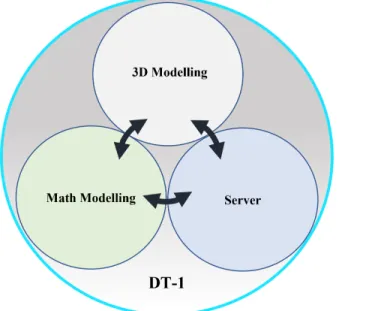
The physical elements contained in the field and control levels are commonly described by mathematical models. Usually, these elements are simulated in dedicated software such as MATLAB and LabVIEW. The DT-1 model proposes the mathematical simulation of actua- tors, sensors, and control systems to be developed in any of these platforms. To be properly synchronized with the rest of levels, these simulations must be developed with specialized hardware that supports real-time simulations. Usually, this kind of hardware is based on field programmable gate arrays (FPGAs). This characteristic enables the proper communication of all the systems integrating the virtual pyramid. Thus, the lowest two levels are proposed to be virtually modeled in the dedicated software mentioned and executed in a real-time environ- ment. The Fig. 3.3 shows the DT-1.
Figure 3.3: DT-1 Virtual Model
In addition to having a mathematical representation of the elements of the first two lev- els of the original pyramid, it is necessary to have a 3D model that represents these devices.
The representation of physical devices in 3D models is essential for user interaction. Through
CAD tools, it is possible to have a virtual representation of the physical models of any ma- chine, reason enough to include a CAD model within the DT-1.
Currently, CAD modeling software allows the interaction of its platforms with math- ematical modeling software such as LabVIEW or MATLAB. The mathematical model of an element or system supports the 3D model since it contains the mathematical expressions with the variables, constants, coefficients, etc., that best define the element in reality. This, of course, offers an advantage in the simulation by being able to have results that more accurately reflect the results of a real model. In addition to the above, to remotely access and interact with the DT-1, a virtual server is required. This server will intertwine the mathematical, con- trol and 3D representation models of the desired virtual elements. Like the communication links, the server is a key piece for the interaction between the physical and virtual twins, since the information that comes from the physical elements and with which the digital model will work will be housed in it.
The data obtained from the DT-1 can be extracted for the analysis and application of algorithms that contribute to the maintenance prediction, raw material monitoring, production analysis, etc. In fact, the information generated in this model can be available for any of the rest DTs.
3.3 Supervisory Level
The traditional AP considers SCADA and HIM systems to monitor the shop-floor production.
To simulate this characteristic, this work proposes to execute one of the supervision functions carried out by the SCADA system, incorporating the function of detecting defective prod- ucts through virtual monitoring systems based on vision. Hence, the proposed function of supervision will be simulated in a virtual environment by the DT-2.
Currently, the supervision of production through image analysis is a widely studied field.
Techniques for the classification and detection of failures based on AI are usually employed to detect anomalies in the production quality. Hence, the virtual supervisory level is proposed to use a AI algorithm to classify previous-captured images. Images with different characteristics would be stored in an image bank according with the production process. Later, these can be employed as reference to classify those processed in real-time and captured by a high precision camera. In Fig. 3.4 the DT-2 is shown.
The images will be captured by a camera whose handling software must be operating in real-time. The images, as indicated in the 3.4, are extracted from the physical production pro- cess. In the image processing stage, the images have a preparation process where their quality is improved by then successfully being interpreted in the interpretation stage. Frequently, the real environments contain backgrounds that are open to being extremely noisy for com- puter vision algorithms owing to changing lighting conditions, mechanical vibrations on the camera support, and so on [57]. Therefore, to obtain an accurate result from the selected AI algorithm, the real images must be pre-processed to eliminate all that possible graphic noise.
For instance, ensuring having proper mechanical circumstances such as non-exist mobility of the camera mount and adequate distance to the capture point, there are techniques such as the frame-difference approach to remove image background [58].
Regarding the interpretation of images, the preprocessed images will be compared with
Figure 3.4: DT-2 Virtual Model
those images preselected and stored in the image bank. The images stored will be uniquely images with non-defective patterns. These images can be of a specific subsystem, a subarea of the product, or a full view of the product to detect incorrect positions or defects, for example.
The inspection interface must be a type of HMI where the AI results can be displayed. The outputs of this AI approach will generally be vision-based inspection of determined product or product components. Furthermore, if a defective product/component is detected, the DT model must be able to display a brief pre-report with immediate actions to be executed by the operators.
3.4 Planning and Management Level
As an initial proposal, the planning and management levels are intended to be performed by AI-based learning systems as well. Due to the large number of functions that are executed at these levels, for now, it is only considered to work with the functions deployed by the ERP: Order Processing (OPR) and Production Scheduling (PS), and MES: functions related to Control of Production (PC), as indicated in Fig. 2.3. Decision-making systems, such as MES and ERP, can be considered non-linear systems since they involve a considerable variety of scenarios and combinations due to the number of inputs, outputs, relationships and conditions that are carried out in the functions that are performed at these levels.
Usually, AI-based learning algorithms such as Multilayer Neural Networks (MNNs) are used as alternative to learn linear and non-linear relationships between input and output vec- tors. This is one of the main reasons for the use of MNNs. As is known, these algorithms can carry out operations with complex non-linear relationships between dependent and inde- pendent variables, such as the functions that are executed in the ERP and MES. In addition, MNNs offer advantages such as the ability to detect all possible interactions between predictor
variables, the availability of multiple training algorithms, the ability to work with incomplete knowledge, fault tolerance (in one or more cells) , parallel processing capacity, etc [59], [60].
MNNs learn events and make decisions from the examples (database) with which they are trained. All the characteristics mentioned are adjusted to the capabilities that this proposal seeks to provide to virtual decision-making systems based on the DT. Further information about Artificial Neural Networks and particularly Back-Propagation Networks used in this work, will be discussed in Chapter 5.
MNN algorithm consists of a system of interconnected neurons, or nodes. The neuron receives signals from other neurons; the neurons’ inputs are affected by associated weights so that the output signal can be calculated as the output of an activation function. The input is the sum of the neuron’s inputs multiplied by the associated weights. The interconnection of neurons that are grouped into layers allows MNN to approximate nonlinear relationships [61].
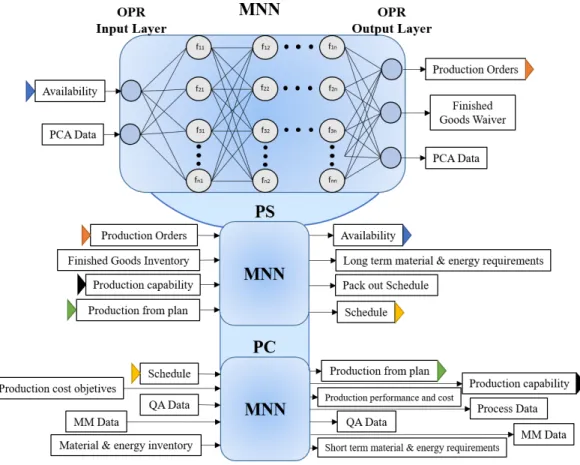
Thus, the initial proposal is to use MNN to execute the functions and tasks already mentioned by the ERP and MES systems. Fig. 3.5 shows the approach considering the MNN and the functions mentioned as part of the DT-3 virtual model.
Figure 3.5: DT-3 Virtual Model
Figure 3.5 shows a Multilayer Neural Network (MNN) in which the inputs are Avail- ability and PCA Data; those inputs are represented by only one input neuron, but they are expanded to a cluster of neurons according to the required inputs. On the other hand, the outputs are Production Orders, Finished Goods Waiver, and PCA Data; those outputs also have to be expended to accomplish the required outputs. In general terms, the MNN only
![Figure 2.2: Equipment Hierarchy modified from [4]](https://thumb-us.123doks.com/thumbv2/123dok_es/12613404.0/21.918.187.809.97.453/figure-2-2-equipment-hierarchy-modified-from-4.webp)
![Figure 2.3: Overview of functional enterprise/control model based on [32]](https://thumb-us.123doks.com/thumbv2/123dok_es/12613404.0/23.918.172.817.115.456/figure-overview-functional-enterprise-control-model-based-32.webp)