
Preventing intimate partner and sexual violence against women: action and evidence gathering / World Health Organization and London School of Hygiene and Tropical Medicine. Evidence-based prevention of intimate partner violence and sexual violence is still in its infancy and much remains to be done.
Introduction
The hidden costs of intimate partner and sexual violence
Furthermore, the average cost per person for women who experienced at least one instance of physical intimate partner violence was more than double that for men.
A public health approach to prevention
The public health approach is interdisciplinary and draws on knowledge from many disciplines, including medicine, epidemiology, sociology, psychology, criminology, education and economics. Because intimate partner violence and sexual violence are multifaceted problems, the public health approach to these forms of violence emphasizes a multisectoral response.
A life-course perspective
This step also involves adapting programs to local contexts and subjecting them to rigorous re-evaluation to ensure their effectiveness in the new environment.
What is the purpose of this document?
Given that – as noted above – women bear the overwhelming burden of intimate partner and sexual violence at the hands of men, this document focuses on intimate partner and sexual violence against women. Furthermore, most of the currently available evidence on intimate partner and sexual violence comes from studies of how it affects women.
Who should use this document?
Finally, the scope of this document does not include the significant differences that exist in the nature of and risk factors and specific prevention strategies for intimate partner and sexual violence perpetrated by women and male-to-male sexual violence. Evidence on the nature of intimate partner and sexual violence and the effectiveness of prevention efforts is, as far as possible, only selected from studies of higher quality – for example, from systematic reviews and large studies with good methods such as the use of randomized controlled trials.
Key messages
The nature, magnitude and
What are intimate partner and sexual violence?
Definition of terms
How prevalent are intimate partner and sexual violence?
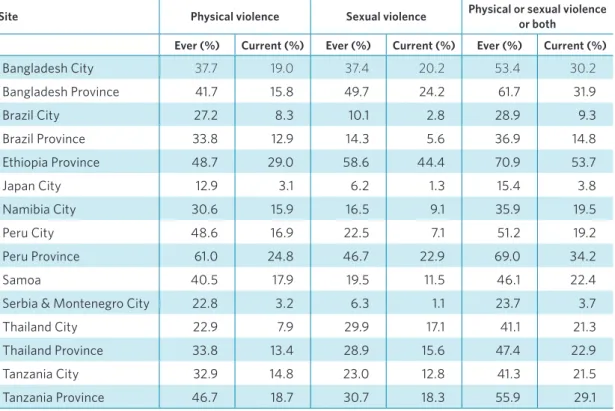
The incidence of intimate partner violence and sexual violence can be measured with reference to both victimization and perpetration. The WHO Multi-country study on women's health and domestic violence against women found that between 6% and 59% of women reported experiencing sexual violence by an intimate partner in their lifetime, with the figures for most sites showing fall between 10% and 50. % (Garcia-Moreno et al., 2005).
What are the consequences of intimate partner and sexual violence? 1
In addition, forced sexual initiation, intimate partner violence and/or sexual violence appear to increase the risk of pregnancy in early adolescence. Intimate partner violence and sexual violence against women in adulthood can lead directly to serious injury, disability or death.
Key messages Prevalence
Violence and gender inequality are more likely to increase HIV risk through indirect pathways, including chronically violent relationships where women are repeatedly exposed to the same individual and unable to negotiate condom use for safer sex (WHO/ UNAIDS, 2010). Emerging evidence from India and South Africa indicates that men who engage in violence are more likely to become infected with HIV (Decker et al., 2009; Jewkes et al., 2009).
Consequences
Qualitative research suggests that the intersections of HIV/AIDS, gender inequality, and gender-based violence may involve notions of masculinity that are based on control over women and that value male strength and toughness (Jewkes & Morrell, 2010). These ideals easily translate into sexually risky behavior, sexual predation and other acts of violence against women, as well as behavior that increases the risk of contracting HIV.
Risk and protective factors for intimate partner and
The ecological model of violence
Societal Community Relationship Individual
- Identifying risk factors
- Risk factors associated with both intimate partner violence and sexual violence
- Risk factors associated with intimate partner violence
- Risk factors associated with sexual violence
- Protective factors for intimate partner violence and sexual violence
- Gender norms and inequality
- Key messages
Three narrative reviews (two from a high-income country and one from a middle-income country) reported a consistent association between antisocial personality disorders and related traits (such as impulsivity and lack of empathy) and the perpetration of intimate partner violence or sexual violence. The role of alcohol use in experiencing intimate partner violence and sexual violence is less clear.
Risk and protective factors Intimate partner and sexual violence
For effective prevention of intimate partner and sexual violence, it is crucial to shed a strong light on how gender norms and gender inequality and inequality are connected to such violence. A thorough understanding based on solid empirical evidence is required of how gender norms and gender inequality and inequality function as risk and protective factors for and as causes of partner and sexual violence in different socio-cultural contexts. Gaining such an understanding should be a top priority for research on risk and protective factors for intimate partner and sexual violence.
Prevention implications
Primary prevention strategies – the evidence base
Introduction
Addressing risk factors at the societal level can increase the likelihood of successful and sustainable reductions in intimate partner violence and sexual violence. Legislation and policies that address broader socioeconomic inequalities are likely to reduce other forms of interpersonal violence, which in turn will help reduce intimate partner violence and sexual violence. Legislation and criminal justice systems must also be in place to deal with cases of intimate partner and sexual violence after the incident.
Assessing the evidence for different prevention approaches
Currently, as a whole, there is still insufficient evidence for the preventive effect of the criminal justice system's responses to intimate partner and sexual violence (Dahlberg & Butchart, 2005). Rigorous scientific evaluation of intimate partner and sexual violence prevention programs is even rarer in LMICs. The limited evidence base on intimate partner and sexual violence prevention has three important implications for this chapter.
Summary tables of primary prevention strategies and programmes 1
As shown in Table 5, there is currently only one strategy for the prevention of intimate partner violence that can be classified as "effective" in preventing actual violence. Contrary to the formal definitions in section 1.1 and because of the way in which programs are organised, intimate partner violence is considered here as cases of sexual violence occurring within an intimate partnership, while sexual violence is used here to refer to sexual violence. that occurs outside of intimate partnerships (i.e. committed by friends, acquaintances or strangers). However, in Table 5 and Table 6 dating violence is classified under intimate partner violence for convenience.
Outcome measures of effectiveness
- during infancy, childhood and early adolescence
- during adolescence and early adulthood School-based programmes to prevent dating violence
- during adulthood
- All life stages
Primary prevention strategies for intimate partner violence and sexual violence for which there is some evidence. However, they appear to have potential in preventing subsequent intimate partner violence and sexual violence. Media awareness campaigns are a common approach to primary prevention of intimate partner and sexual violence.
Nicaraguan backlash shows the need to engage men as well
Key messages
Approaches include adopting legislation and developing supportive policies that protect women; addressing discrimination against women; and help to move the culture away from violence - thereby acting as a foundation for further preventive work. Only one strategy has been shown to be effective in preventing intimate partner violence, school-based adolescent dating violence prevention programs—and this remains to be evaluated for use in resource-poor settings. However, there is every reason to believe that rigorous evaluations of the outcomes of existing programs and the development of new programs based on sound theory and known risk factors will lead to rapid expansion in the coming years.
Improving programme planning and evaluation
- Step 1: Getting started
- GETTInG STARTEd
- dEFInE And dESCRIBE THE nATuRE OF THE PROBlEM
- IdEnTIFy POTEnTIAlly EFFECTIVE PROGRAMMES
- dEVElOP POlICIES And STRATEGIES
- EVAluATE And SHARE lEARnInG n Plan and implement appropriate evaluation
Creating a climate for prevention requires a clear and shared vision of how primary prevention programs can prevent intimate partner and sexual violence in the first place. Leadership skills are essential in supporting those who want to make the shared vision of intimate partner and sexual violence prevention a reality. This will be critical if programs are to be sustained long enough to achieve the behavioral changes needed to reduce rates of intimate partner and sexual violence.
The role of the health sector in primary prevention
Step 2: define and describe the nature of the problem define intimate partner and sexual violence, and describe the size and
As a result, policies and plans to address such violence are often made on the basis of very little information. However, developing policies on this basis can result in misguided plans that focus on symptoms rather than the underlying causes, and thus have no impact on the problem. Ideally, intimate partner and sexual violence will be defined by authoritative epidemiological and other statistics-based reports regularly updated on the nature, extent and consequences of the problems, as well as their underlying causes and risk factors.
What are the benefits of accurate epidemiological information?
Step 3: Identify potentially effective programmes
In Chapter 3, an overview of the evidence on the effectiveness or otherwise of a wide range of programs was presented. Prior to the selection and implementation of specific programs there will be considerable advantage in undertaking a process of "formative evaluation". The answers to the above questions can then inform the theory underlying the program, its goals.
Step 4: develop policies and strategies
Moreover, efforts are likely to be much more powerful if relevant areas of activity are integrated into broader policies and strategies (for example, maternal or mental health, alcohol use, education, crime, economic development and planning urban). The extent to which a program can practically engage in such key activities is one of the guiding principles to be considered and agreed upon by key partners as part of the prioritization process (Box 8).
Step 5: Create an action plan to ensure delivery agree upon the process and timetable for implementation
Factors to consider when prioritizing programmes
Step 6: Evaluate and share learning Plan and implement appropriate evaluation
The capacity of the program to collect additional information from participants and the availability of evaluation resources should be addressed at the outset. Ultimately, the choice of outcome evaluation approach will depend on the questions to be answered and the degree of certainty required in attributing observed effects to the program. The benefits of each approach will need to be weighed against the practical and financial constraints of the programme.
Improving the evidence base through improved evaluation
- Key messages
- Getting started
- Define and describe the nature of the problem
- Identify potentially effective programmes with reference to the nature of the problem and the evidence base for prevention
- Develop policies and strategies
- Create an action plan to ensure delivery
- Evaluate and share learning
During the implementation and evaluation of the program, other parties may also have learned about the program and shown interest. Presentation of the results of the evaluation to different target groups can gain wider support from decision-makers and the community for a program and for the larger goal of preventing violence. For example, offer local statistics if possible, or show how new services can help reduce intimate partner and sexual violence for the benefit of society.
Future research priorities and conclusions
Future research priorities
In particular, much more evidence is needed on community- and societal-level risk factors, such as gender norms and gender inequality; the impact of such violence on child development, health and related outcomes through longitudinal studies, especially in low-income populations; and on educational and economic outcomes. Too often, outcome evaluations have relied on past measures rather than measuring the effects of a program on actual levels of violence.
Conclusions
In particular, research is needed to identify and develop approaches that are most feasible and cost-effective and that significantly reduce the risk factors for intimate partner and sexual violence; the severity of their findings; and the frequency of their occurrence. Although urgent, the need for evidence and further research in all these areas in no way precludes taking action now to prevent both intimate partner violence and sexual violence in all countries. It is only by taking action and creating evidence that intimate partner and sexual violence will be prevented and the field of evidence-based primary prevention of such violence will successfully mature.
Intimate partner violence and sexual violence victimization assessment tools for use in health care settings: Version 1. Children's experiences of perpetrator violence as a risk factor of intimate partner violence: a systematic review. Factors associated with attitudes toward intimate partner violence against women: a comparative analysis of 17 sub-Saharan countries.
ANNEX A
Operational definitions
Operational definitions used to measure physical and sexual violence, emotional abuse, and controlling behavior by an intimate partner.
Operational definitions used to measure physical and sexual violence, emotional abuse and controlling behaviours by an intimate partner
However, such guidelines for the classification of cases of intimate partner violence and sexual violence may only be used in a limited number of facilities and then very selectively – the resulting coding may therefore not be reliable. In such cases, it would probably be useful to establish a working group to improve classification and to develop an agreed set of guidelines on how to assign ICD codes to known and suspected cases of intimate partner violence and sexual violence. Intimate partner violence and sexual violence can have a wide range of health consequences (Chapter 1).
ANNEX B
Prevention activities that can
