Models of neutrino production in cosmic sources Cecilia Lunardini
Models of neutrino production in cosmic sources
Cecilia Lunardini
Arizona State University
Models of neutrino production in cosmic sources Cecilia Lunardini
Structure of this talk
Introduction: astrophysical ν spectrum from eV to EeV High energy neutrinos at IceCube: hypotheses and models
Active Galactic Nuclei (AGN) Tidal Disruption Events (TDEs) others
Summary and future prospects
Models of neutrino production in cosmic sources Cecilia Lunardini
Introduction
Astrophysicalν spectrum from eV to EeV
Models of neutrino production in cosmic sources Cecilia Lunardini
Unified neutrino spectrum
fig. from Vitagliano, Tamborra and Raffelt, Rev.Mod.Phys. 92 (2020) 45006 (transients not included)
sub-eV : Cosmicνbackground (CνB),νs from Big Bang Nucleosynthesis (BBN)
1 - 50 MeV : Diffuse Supernova Neutrino Background (DSNB) 0.1 - 10 PeV : diffuse extragalacticνflux (from source + cosmogenic)
Models of neutrino production in cosmic sources Cecilia Lunardini
Cν B: a dream for the (distant) future
de-coheredmass
eigenstatesfrom the first second post-Big Bang detectable withO(100) g ofH13, with precision energy measurement
sensitive to Dirac vs Majorana neutrinos, sterile states
Electron Kinetic EnergyHKeL
ElectronSpectrumHdGdEeL +m4
+mΝ -mΝ
Kend0»18.6keV Β-decayendpointHKendL
CΝB
SterileΝ
Weinberg, Phys.Rev. 128 (1962) 1457-1473 ; Cocco, Mangano and Messina, JCAP 06 (2007) 015 Long, CL and Sabancilar, JCAP 08 (2014) 038 PTOLEMY experiment, Betts et al., e-Print: 1307.4738
Models of neutrino production in cosmic sources Cecilia Lunardini
DSNB: a dream for the (near) future
Thermalνs from cosmological supernovae
neutrino image of diverseSN population detectable at
upcoming SuperK-Gd and JUNO
due to background abatement
ææ æææ ô
ôôôôôôôôô
0 10 20 30 40 50
10-4 0.001 0.01 0.1 1 10 100
EMeV Fcm-2MeV-1s-1
Experimental limits
Super-K,Ν SNO,Ν KamLAND,Ν Super-K,Ν
Super-K indirect,Ν Super-K,Ν Borexino,Ν
Bisnovatyi-Kogan and Seidov, Sov. Ast. 26 (1982) 132.
Krauss, Glashow, and Schramm, Nature 310 (1984) 191-198
Models of neutrino production in cosmic sources Cecilia Lunardini
High energy extragalactic ν s: a dream come true
Multi-decade operation at IceCube, more than 100 neutrinos detected
a mixed originpicture is emerging, 5 individual sources identified
Name Type p Ref.
NGC 1068 AGN 0.008 Aartsen et al. (2020) TXS 0506+056 blazar 0.001 Aartsen et al. (2018) PKS 1502+106 blazar 0.01 Taboada & Stein (2019) PKS 1424-41 blazar 0.05 Kadler et al. (2016) AT2019dsg TDE 0.002 Stein et al. (2020)
Bartos et al., e-Print: 2105.03792
Models of neutrino production in cosmic sources Cecilia Lunardini
High energy neutrinos at IceCube
hypotheses and models: AGN, TDEs, and others
Theme:
What can we learn on the diffuse flux from the 5 identified sources and their neutrinos?
Models of neutrino production in cosmic sources Cecilia Lunardini
Blazars and other Active Galactic Nuclei (AGN)
Models of neutrino production in cosmic sources Cecilia Lunardini
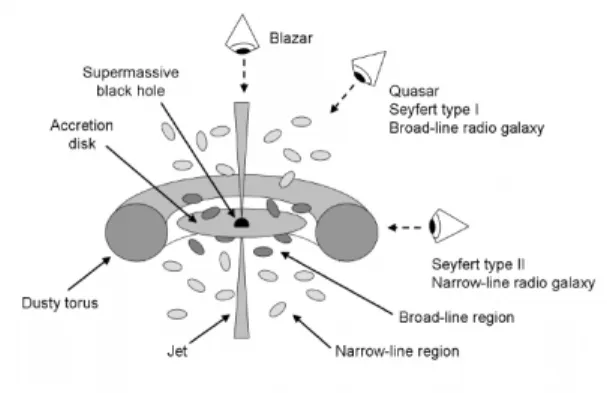
The Unified AGN model: Blazars are AGN
fig. from E. Zackrisson, PhD thesis
Blazar = on-axis view (jet pointing towards us) sub-types: BL-Lac, FSRQ, ...
Quasar, Seyfert = off axis view
Models of neutrino production in cosmic sources Cecilia Lunardini
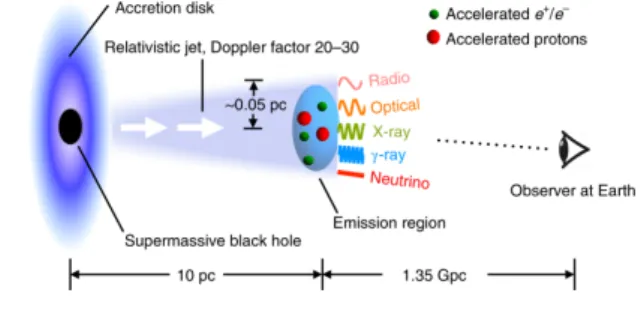
Blazars: SMBH with jet pointing to Earth
fig. from Gao, Fedynitch, Winter and Pohl, Nat. Astron. 3, 88?92 (2019)
p acceleration in internal shocks,p+γ→....→νµ, νe
account for ∼80% of total extragalactic gamma ray fux
Inoue and Totani, 2009, ApJ 702, 523; Ackermann et al., 2015, ApJ 799, 86
Models of neutrino production in cosmic sources Cecilia Lunardini
TXS0506+056: multi-messenger theory
TXS0506+056 : a flaring AGN
neutrino spectrum and fluence constrained by multi-wavelength, multi-time data fully consistent hadron/lepton/ν/γ/
time-evolving simulation required
Gao, Fedynitch, Winter and Pohl, Nat. Astron. 3, 88?92 (2019)
Models of neutrino production in cosmic sources Cecilia Lunardini
diffuse Blazar flux
sub-PeV flux not reproduced
can account for PeV events
stacking limit requires strong evolution
enhanced contribution of unresolved sources (higher baryonic loading)
suppressed FSRQ contribution
Palladino, Rodrigues, Gao and Winter, Astrophys.J. 871 (2019) 1, 41
Models of neutrino production in cosmic sources Cecilia Lunardini
Other AGN: NGC1068 as a IceCube hotspot
NGC1068 : Seyfert-2 (off-axis view AGN) and starburst galaxy ν flux higher thanγ-ray: dense environment withγabsorption Disk-corona model: p accelerated by plasma turbulence
Murase, Kimura and Meszaros, Phys.Rev.Lett. 125 (2020) 1, 011101 Inoue, Khangulyan and Doi, Astrophys.J.Lett. 891 (2020) 2, L33 Kheirandish, Murase and. Kimura, e-Print: 2102.04475
Models of neutrino production in cosmic sources Cecilia Lunardini
Disk-corona: multimessenger consistency
fits NGC1068ν spectrum at 10-100 TeV
consistent withγ-ray spectrum
Inoue, Khangulyan and Doi, Astrophys.J.Lett. 891 (2020) 2, L33
Models of neutrino production in cosmic sources Cecilia Lunardini
Diffuse flux from AGN coronae
could reproduce medium-energy IceCube data if CR carry only∼few% of thermal energy future test: MeV gamma rays
10-9 10-8 10-7 10-6 10-5 10-4
10-410-310-210-1100101 102103104 105106107 E2[GeV cm-2s-1sr-1]
E [GeV]
AGN corona AGN corona (cascade) AGN corona X (thermal e)
reacceleration
10-100 TeV (medium-energy ) GeV-TeV PeV
MeV
Murase, Kimura and Meszaros, Phys.Rev.Lett. 125 (2020) 1, 01110
Models of neutrino production in cosmic sources Cecilia Lunardini
Tidal Disruption Events (TDEs)
Models of neutrino production in cosmic sources Cecilia Lunardini
Supermassive black holes as star-shredders
a star is torn apart by SuperMassive Black Hole (SMBH) part of the debris are accreted, a flare is produced
in extreme cases, a relativistic hadronic jet forms→neutrino production!
∼90 TDEs observed, 3 with evidence of jets
Models of neutrino production in cosmic sources Cecilia Lunardini
Month/year long transients
∼1/2 of star’s mass remains bound, falls back onto the SMBH
flare fades when mass accretion rate drops below Eddington Luminosity, LEdd'
1.3 1044 ergs
M 106M
. typical duration
∆T ∼ O(0.1−1) yr
© 1988Nature Publishing Group
Models of neutrino production in cosmic sources Cecilia Lunardini
IceCube-191001A and AT2019dsg
Opt-UV by Zwicky Transient Facility (ZTF); X-rays from Swift, NICER.
neutrino detected5 months post-peak(dotted line)
p-value of 0.2% to 0.5% of random association;∼3σsignificance.
R. Stein et al., Nature Astron. 5 (2021) 510-518
Models of neutrino production in cosmic sources Cecilia Lunardini
AT2019dsg basic facts
z'0.05 (dL'230 Mpc). Optical-UV, X-ray thermal spectra.
Optical-UV
TBB= 3.35eVRBB'5 1014cm,LBB= 2.88·1044erg s−1
X-ray
TX ∼0.06 keV,RX ∼3−7 1011cm, LX ∼2.5 1043 erg s−1 ([0.3−8]keV) LX ∼4 1044 erg s−1 ([0.1−10] keV).
Radio
radio emission nearly constant with increasing radius of emission Rradio=O(1016)cm
(indication of mildly relativistic outflow)
van Velzen, et al., Astrophys.J. 908 (2021) 1, 4; R. Stein et al., Nature Astron. 5 (2021) 510-518
Models of neutrino production in cosmic sources Cecilia Lunardini
Interpretation: jetted model
hadronic jet with internal shocks
late/sustained neutrino production due to backscattered X-rays + decreasing collision radius (Rc)
Winter and Lunardini, Nat. Astron. 5, 472-477 (2021
jet
observer
fast flow
slow flow
X-ray Opt-UV
RC
RX RBB
t.AE,
t t t ?.
ammm#AMmnmmy•
I I
E_-ao⇒y Hi :v ay-,
jet
observer
fast flow
slow flow
X-ray Opt-UV
RC p
RX RBB
e.ie:779
immunoassayHitherward
.
.tl if a
• I y
T
it
I i -Rradio
Left: early times (t.17days); Right: late times (t&17days)
Models of neutrino production in cosmic sources Cecilia Lunardini
Inspiration from MHD simulations
Observed blackbody radius and bolometric luminosity match the
“Unified TDE model” for M'106M
Dai, McKinney, Roth, Ramirez-Ruiz, & Miller, Astrophys. J. 859, L20 (2018)
Unified model predicts:
jet withLphysjet '20LEdd'3 1045 ergs
M 106M
;
outflow with velocity decreasing from fast to slow away from jet funnel
Models of neutrino production in cosmic sources Cecilia Lunardini
Results: neutrino luminosity explains late observation
-50 0 50 100 150 200 250 300
41 42 43 44 45 46
t-tpeak[days]
Log10L[ergs-1]
BB
Neutrinos X-rays
observed unattenuated
isotropized Ledd
Ljetphys
Lpiso
Jet ceases
result: red (neutrino) curve; inputs: all other curves. Arrow: time of neutrino detection
numerical calculation done with NeuCosmA code
see Lunardini and Winter, arXiv:1612.03160, and refs. therein.
double peak in Lν due to interplay of decline ofLisotrX .and decrease of RC (i.e., increase in neutrino production efficiency)
→reproduces late time neutrino detection!
Models of neutrino production in cosmic sources Cecilia Lunardini
Neutrino fluence and expected number of events
Total t-tpeak<100 days t-tpeak≥100 days
3 4 5 6 7 8 9
-8 -6 -4 -2 0 2
Log10Eν[GeV]
Log10Eν2ℱμ[GeVcm-2]
GFU,Nμ∼0.05
PS,Nμ∼0.26
Eν
GFU: gamma-ray follow-up effective area ; PS: point source effective area
good agreement with likely neutrino energy
number of predicted events: Nµ∼0.05−0.26 depending on effective detector area used
Models of neutrino production in cosmic sources Cecilia Lunardini
Contribution to diffuse flux at IceCube
��������������������������������
�����������������������(����)���
� � � � � � �
-��
-��
-�
-�
-�
-�
�����[�/���]
�����[Φμ(����-���-���-�)]
������
������
�������
�������
������ ���
-������
�����
� ������
can contribute to up to∼30% of diffuse flux
low energy spectrum requires strong evolution of parameters with BH mass
Models of neutrino production in cosmic sources Cecilia Lunardini
Alternate models for TDE neutrinos
isotropic outflow interacting with UV photons non-relativistic shocks forming in the environment
neutrino production from the accretion disk (radiatively inefficient accretion flows, magnetically arrested disk states, etc.)
hot corona similar to that of AGN
Stein et al. , Nat. Astron. 5 (2021) 510-518;
Fang, Metzger, Vurm, Aydi & Chomiuk, Ap.J. 904 (2020) 1, 4;
Hayasaki & Yamazaki, ApJ, 886 114 (2019);
Murase, Kimura, Zhang, Oikonomou & Petropoulou, ApJ. 902 (2020) 2, 108
Models of neutrino production in cosmic sources Cecilia Lunardini
Other sources of high energy neutrinos
Models of neutrino production in cosmic sources Cecilia Lunardini
Supernovae? GRBs? Starburst galaxies?
Stellar sources (supernovae, GRBs):
O(10−2) of total diffuse flux
Bartos et al., e-Print: 2105.03792
Starburst galaxies:
UHECR reservoirs could fit sub-PeV flux, if distribution of spectral indices is used
Ambrosone et al., Mon.Not.Roy.Astron.Soc. 503 (2021) 3
Models of neutrino production in cosmic sources Cecilia Lunardini
Summary and future prospects
Models of neutrino production in cosmic sources Cecilia Lunardini
The emerging protagonist: SuperMassive Black Holes
The 5 identified sources all involve SMBH
Models of neutrino production in cosmic sources Cecilia Lunardini
Wishes for the future
Theory: develop a multimessenger unified SMBH model full consistency between CR,νand photon predictions dependence on SMBH mass, spin? Viewing angle?
Observation: increase point-source potential
increase sensitivity to less luminous sources (IceCube Gen-2) strengthen multi-messenger campaigns (extend telescopes networks, increase coverage in time and area)
Models of neutrino production in cosmic sources Cecilia Lunardini
Thank you!
Models of neutrino production in cosmic sources Cecilia Lunardini
Backup
Models of neutrino production in cosmic sources Cecilia Lunardini