THE IMAGE OF SCIENCE: A BOTTOM-UP APPROACH TO THE ANALYSIS OF THE RELATIONSHIP BETWEEN SCIENCE AND SOCIETY. This book presents some contributions developed in the framework of the coordinated research project: "Praxeology of Scientific Culture".
THE RELATIONSHIP BETWEEN SCIENCE AND SOCIETY: A CONCEPTUAL MODEL
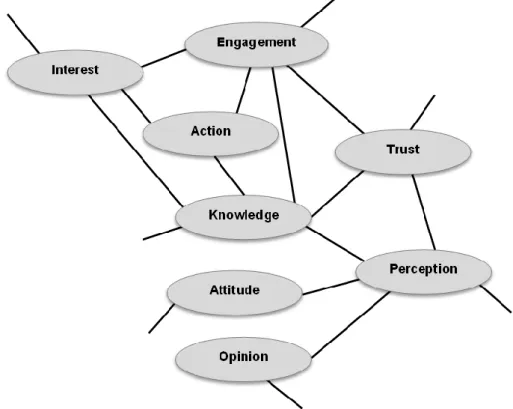
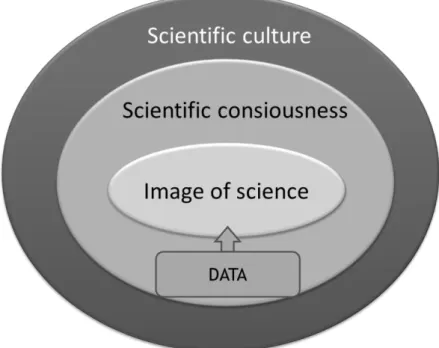
On the other hand, the desire to understand the world through analysis is another essential characteristic of the culture of science (Ziman, 1998). Representation of a part of the mental map that defines the image of science (Muñoz van den Eynde et al, 2017).
EPILOGUE
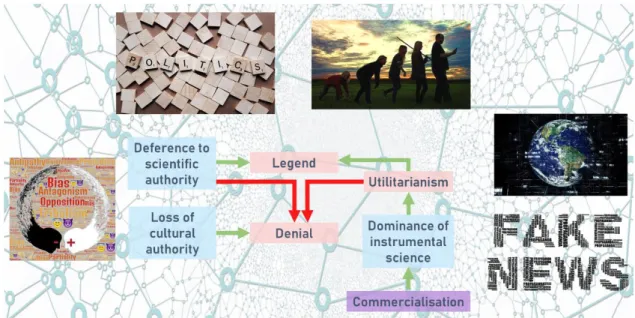
If it is assumed that the cultural authority of science means believing that science is a truth maker, then respect for scientific authority stems from cultural authority (Howell et al., 2020). Scientists must reject the discourse of the "legend of science" and avoid rejecting valuable forms of evidence because they do not fit their methodological pre-commitments.
THE ENGINEERING CULTURE: THE NEED FOR IMPROVED EDUCATION
INTRODUCTION
This scenario occurs despite widespread awareness of the undesirable social and environmental impacts of technology on various stakeholders (workers, users and citizens in general). Incorporating tools for public participation in the process of defining technical problems and creating possible solutions as an integral element of any social and environmental assessment.
ON THE CONCEPT OF CULTURE AND PROFESSIONAL CULTURE
This chapter explores the main results of the international literature on graduates' perceptions of the importance of integrating social aspects into professional practice. 3 This movement is associated with the establishment of the Department of Scientific Studies in 1964 at the University of Edinburgh, home to the Strong Program in the Sociology of Knowledge.
THE CULTURE OF ENGINEERING
Moreover, empirical approaches also exist that attempt to describe the general parameters of engineering culture in different contexts. On the one hand, studies of engineering culture and gender represent a response to the fact that both the engineering profession and academia are highly masculinized (Bastalich et al., 2007; Robinson & McIlwee, 1991; Schmitt, 2021).
THE CULTURE OF ENGINEERING AND HIGHER EDUCATION ACCREDITATION AGENCIES
Second, regarding the “mode of operation” of engineers, Godfrey & Parker note that the acquisition of competencies during their education is demanding in terms of time and intellectual effort, but gives engineering social status. Third and finally, Godfrey & Parker emphasize that the "meaning of being an engineer" is characterized by achieving above-average competence in scientific and mathematical understanding.
THE INCLUSION OF SOCIAL FEATURES IN ENGINEERING CULTURE IN HIGHER EDUCATION
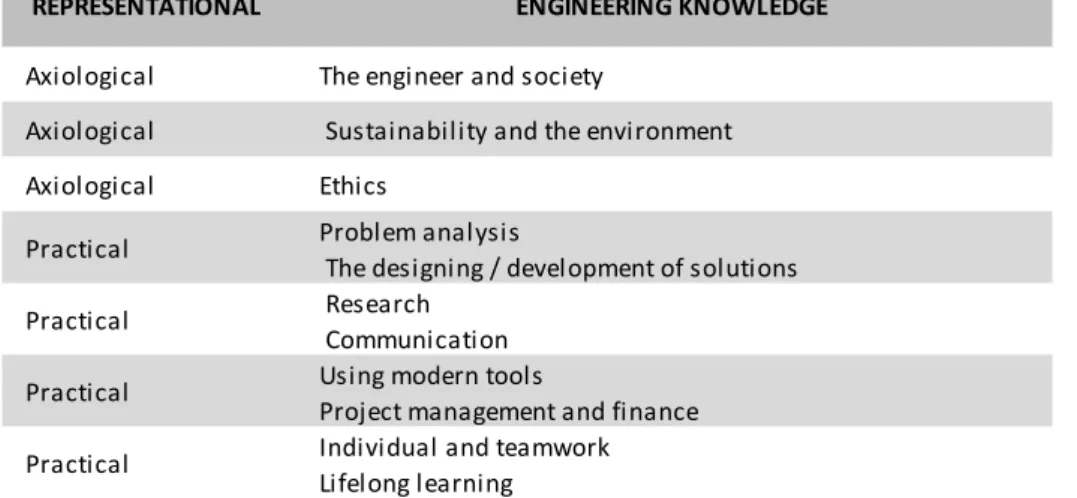
Apply ethical principles and commit to professional ethics and the responsibilities and norms of engineering practice” (WA8). The impact of engineering on society and the environment: An ability to analyze the social and environmental aspects of engineering activities.
THE ACTUAL INTEGRATION OF SOCIAL ASPECTS IN ENGINEERING EDUCATION
The importance of understanding the consequences of technology, that is, the value students place on the social implications of engineering design. Secondly, the need for a greater integration of social aspects in the core competencies that a student must acquire, i.e. the social context and the possible impacts of alternative solutions, must be integrated in the analysis of the problem and the design and development of possible solutions.
THE NEED FOR SYSTEMIC THINKING IN ENGINEERING
Systemic thinking expands the scope of analysis, establishes interrelationships between heterogeneous elements and allows improvement of the relationship between the beneficial (positive) and harmful (negative) effects of engineering activities. The need to find the appropriate balance between breadth and depth of analysis in a systematic thinking approach.
THE ASSESSMENT OF THE SOCIAL IMPACT OF ENGINEERING ACTIVITIES
For example, the choice of the material to be used must meet a number of requirements, which also include social aspects and may result in the selection or rejection of a particular material after analysis. Some are anticipated in earlier stages and included in the SIMP, but others are unforeseen impacts and the action to be taken in this case can significantly change the development of the project.
PUBLIC PARTICIPATION IN ENGINEERING
Third, at the project implementation stage, the aim is to monitor the evolution of the project by responding to all kinds of impacts. Finally, in the final phase, after completion of the project, a final evaluation takes place with the aim of learning from what happened during the project and identifying the improvements resulting from the implementation of the project. engineer and is above any other consideration.
COMMUNITY-BASED SCIENTIFIC CULTURE: WAVE OR PARTICLE?
The main objective of this paper is to analyze the concept of scientific culture at the community level or community-based scientific literacy. This chapter will begin with an initial approach to the concept of scientific culture in relation to that of scientific literacy.
SCIENTIFIC LITERACY AND SCIENTIFIC CULTURE
In this sense, the most accurate term is "scientific culture", i.e. the culture of a scientific community (or scientific communities), although, as it is not unusual to see this term used interchangeably with "scientific culture", the terminology can cause some confusion (Vogt, 2003; Quintanilla, 2010; Claessens, 2021). Nevertheless, it served to sustain and legitimize a large-scale program of spreading scientific culture centered on a concern for the management of science.
NEW PROBLEMS AND CHALLENGES
Scientific culture is often treated in isolation and decontextualized in relation to the set of interests, attitudes and cultural practices of the subjects being studied. This would be a relevant dimension of scientific culture that has perhaps too often gone unnoticed among scholars of the subject.
BACKGROUND AND ELEMENTS FOR THE ANALYSIS OF COMMUNITY-BASED SCIENTIFIC CULTURE (CBSC)
Moreover, all these cases highlight the social mechanisms of the legitimization/delegitimization of lay-produced knowledge. Rather, the core question is that of the type of perspective in recognizing the situations in which it is better to approach scientific culture in one way or another.
THE CHARACTERISATION OF COMMUNITY-BASED SCIENTIFIC CULTURE
It is qualitatively and quantitatively superior to the resources of the individuals that make up this community (which exceeds the simple accumulation of individual contributions; emergent properties are generated which are owned by the group as an agent and not by the individuals of which it is composed). Other practices are valuable in themselves by modifying the behavioral tendencies of group members to fit as closely as possible to the knowledge gained and the ways in which the perceived problem can be solved according to community criteria.
PROPOSAL FOR ANALYSIS
In the latter case, the goal is for it to be on an equal footing among the group's individuals and among all the players involved. It is equally important to provide solutions with a sufficient degree of legitimacy in relation to lack of knowledge or limitations of already existing knowledge.
PRAXEOLOGY AND SOCIAL ASYMMETRY
However, we must not forget - as is often the case - that opportunities to do science are not universal. The last part highlights the fact that asymmetry reflects inequality and that the latter weakens the democratic scientific and technological culture.
PRAXEOLOGY
Civic literacy will therefore include knowledge of the basic constructs of science (scientific vocabulary and understanding of scientific news published in the media), understanding of the methodology and dynamics of science, and the ability to understand the social impact of research and technological development. recognized (Miller, 1998). The praxeological dimension is also included in the conceptualization of the PIKA model (Perception, Interest, Knowledge and Action) developed during recent years by Muñoz van den Eynde a, 2014b.
IDENTITY
Moreover, these models provide the key to the cultural authority of science in different parts of the world (Bauer et al., 2019, p. 19). The starting point of the model is that an image (product of perception) is a complex mental map that people build based on everyday interaction with science.
ASYMMETRY
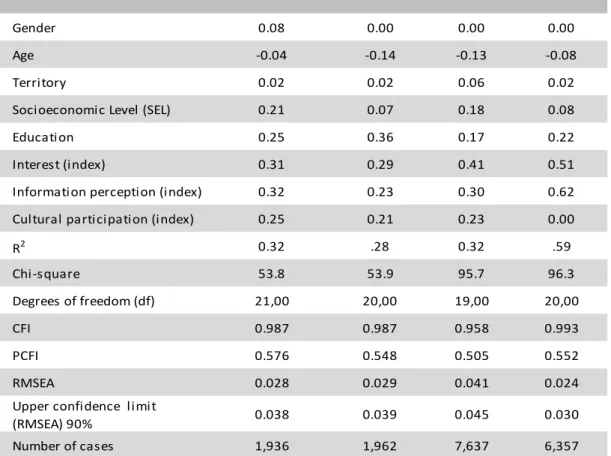
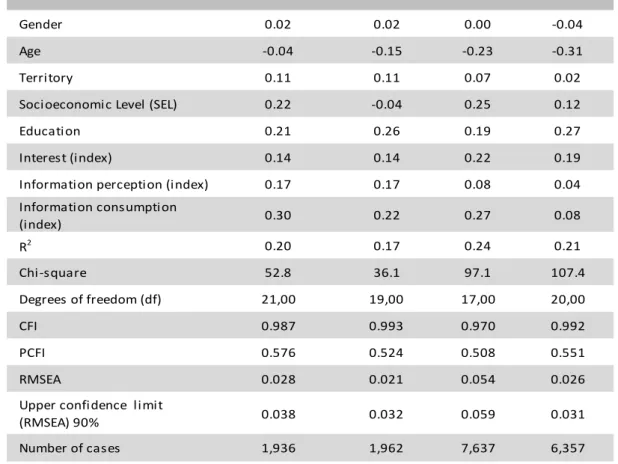
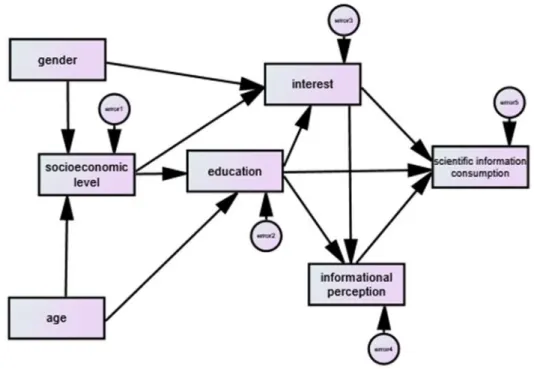
However, since chi-square is a measure that tends to increase with sample size (as in the Chile and Spain studies), additional measures such as RMSEA (Root Mean Square Error of Approximation) and CFI are also used. (Comparative Fit Index). The tension between the research topics and the length of the questionnaire largely explains this.
INEQUALITY
Moreover, it is not only a subject where the demand for information or participation of society may differ between countries or between regions within countries, but it is also about the fact that the informational and cultural offer, as well as the political Promotion policy plays a fundamental role in actions in the field of scientific culture and makes clear the social dimension of scientific culture. But also in Spain, where economic and social inequality has reached historic records in recent years due to the pandemic and the socio-economic crisis (Aspachs et al., 2020).
On the other hand, these components have been analyzed in relation to the case of Europe, taking concepts such as those of. In particular, in relation to this last type of cultures, the contribution takes a close look at the 'epistemic politics' (Luján & Todt, 2021) which guides the European assessment of HC, while in relation to the first type it will focus on possible 'citizen epistemology' (Jasanoff, 2005) derived from it.
PRAXEOLOGY IN REGULATORY SCIENCE
The purpose of this study is precisely to analyze the possible implications of designing and practicing a specific regulatory science. In particular, some of the above-mentioned features that characterize RS in the case of the regulation of health claims imposed on Member States will be analyzed in detail.
THE CASE OF THE HEALTH CLAIMS REGULATION IN EUROPE
The 2006 regulation remains in force and EFSA continues to function today as the only assessment body approved in this regard. This has happened, for example, with respect to the first to appear historically, the original US regulation of 1990 and the Japanese regulation of 1991.
EUROPEAN ASSESSMENT OF HEALTH CLAIMS
In this way, while the EFSA became the body responsible for issuing this type of benefit assessment of food, the regulatory authorities (in this case the Commission together with representatives of the Member States) would approve the use of the proposed health claims or rejected. solely on the report of said agency. The resulting reports of the assessments on each specific HC (both positive and negative) are published in the EFSA journal.
CULTURES IN THE ASSESSMENT OF HEALTH CLAIMS
26 This flexibility in the assessment system also corresponded to the need to clarify and simplify the application system. While the assessment in the European case has been made to include the culture of the services.
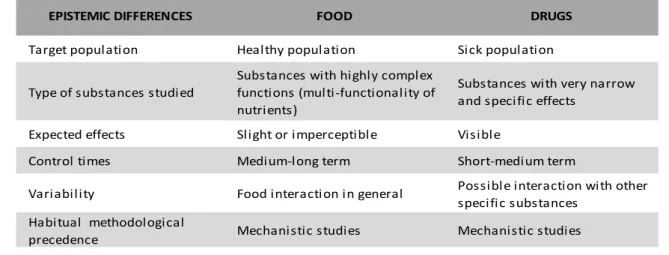
IMPLICATIONS OF THE EUROPEAN HC ASSESSMENT PRAXEOLOGY
On the one hand, the regulation not only considers consumers passively as mere recipients of the benefits (it does the same with food producers), but also in a homogeneous and limited way as possessing specific attitudes and knowledge (Sanz Merino, 2020). In the case of Japan, such trust and accountability also apply to food producers, albeit even directly binding as part of the assessment system (at least for the JFC category).
FOOD SCIENTIFIC CULTURE. A FOOD NEOPHOBIA CASE STUDY
FOOD SCIENTIFIC CULTURE
These questions led to the creation of the European Food Safety Authority (EFSA) in January 2002 as part of the development of the European Commission's White Paper on Food Safety (CE, 2000). Spontaneously declared interest in medicine and health makes up 26.2% of the total number of people interviewed in Spain, while food and consumption make up 27.1%.
FOOD NEOPHOBIA AS PART OF THE FOOD SCIENTIFIC CULTURE
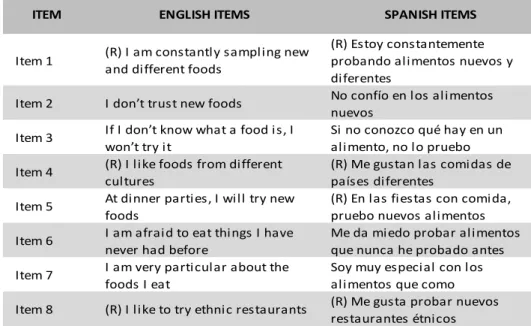
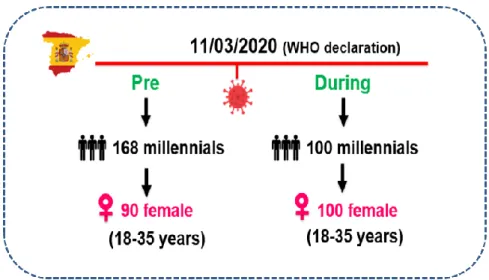
Second, a comparative analysis of levels of food neophobia was conducted among 190 Spanish millennials (18-35 years old) before and during the COVID-19 pandemic (Figure 5). Food Neophobia Scale (English version and adapted validated Spanish version used in the present study) (8 items) (Based on: Fernández-Ruiz et al., 2013).
ARE SCIENCE ACTION AND TECHNOLOGY FLOWS COMPATIBLE
REFLECTIONS AROUND CLIMATE SCIENCE SOCIOLOGY AND POLITICS
The effects of climate change affect all life forms on Earth with serious and in many cases irreversible consequences. The main global effects of climate change - global warming, rising sea levels and extreme weather events - will continue in the coming years.
SCIENCE, R&D AND INNOVATION IN ACTION
He proposes a plan for this goal, unfolded in the last third of the book: chapters 9 to 12. This question is addressed in the last part of the article, as it was mentioned in the original English title.
LAWS, POLICIES AND HUMAN ACTION: THE SPANISH LANDSCAPE
The most advanced of them, the Community of Valencia, has recently approved the preliminary draft of the Law of Valencia on Climate Change and Ecological Transition34. With the exception of the Asturian law - known as the Environmental Quality Law - they all refer to climate change in their titles.
REFLECTIONS, DOUBTS AND THE CLOUD: FROM RISKS TO COMPLEXITY
This is also reflected in the article relating to the program of social awareness and socio-economic training for the ecological transition, and in one of the goals of the 13th goal of the United Nations Sustainable Development, which states the need to "improve education, awareness and and institutional capacity in relating to climate change mitigation, adaptation, mitigation and early warning It would be presumptuous, or perhaps deliberate, to attempt to propose a solution to the problems described in the text.
THE MORE POPULAR THE CULTURE, THE MORE PUBLIC THE ENGAGEMENT: THE
Namely, Althusser asserts that ideology has no history that would connect it to the definition of the unconscious, as it is empty, a mere dream, an illusion that does not materialize into anything (Althusser, 2005). These theories allow him to move on to the hub of how ideology addresses individuals as subjects.
THE PARADE OF YŌKAI
They depict numerous images of this huge group of strange creatures tramping along, leading to the notion of Yaki Yaki, the procession or pandemonium of crazy creatures. Thus Pandemonium joined the parade, showing the incredible abundance and variety of Yōkai in the cultural imagination of the time (Dylan Foster, 2008).
YŌKAI WARS IN WESTERN TIMES
Shigeru Mizuki is a very important figure in the story of Yōkai and created new versions of the new emerging art form of manga in Japan. In the modern world of popular entertainment, it's hard not to have heard of Koyoharu Gotouge and her comic book Demon Slayer (2016).
WHAT IF AMABIE ALSO SAVED LIVES DURING THE COVID-19 PANDEMIC?
During the campaign, her signature phrase "In the name of the moon, I will punish you!". This, therefore, is the prophecy of Jinja Hime, which will be repeated in the following Amabies.

RESULTS FROM A FACEBOOK MARKETING CAMPAIGN
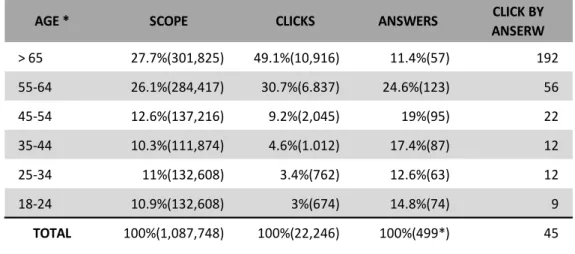
On the one hand, the research method has been blamed, providing another example of the paradigm war in social research. Since the emergence of the COVID-19 pandemic, the problem has been exacerbated, making home interviews almost impossible.
THE PIKA SURVEY
By far the most frequent action is to search for information on the Internet to properly understand news or information about science and technology. The PIKA respondents are interested in science and willing to be involved in the relationship between science and society.
INTRODUCTION: SCIENTIFIC CULTURE IN TIMES OF GLOBAL CRISIS REFERENCES
THE IMAGE OF SCIENCE: A BOTTOM-UP APPROACH TO THE ANALYSIS OF THE RELATIONSHIP BETWEEN SCIENCE AND SOCIETY REFERENCES
The politics of buzzwords at the interface of technoscience, market and society: The case of 'public engagement with science.' Public Understanding of Science. On the relationship between public perception of science and the attitude towards public funding of science.
THE ENGINEERING CULTURE: THE NEED FOR IMPROVED EDUCATION ON SOCIAL RESPONSIBILITY IN ENGINEERING STUDIES REFERENCES
Pinck (Eds.), The social construction of technological systems: new directions in the sociology and history of technology (p. 405). The Silicon Valley of Dreams: Environmental Injustice, Migrant Workers, and the High-Tech Global Economy.
COMMUNITY-BASED SCIENTIFIC CULTURE: WAVE OR PARTICLE? REFERENCES
Creación de experiencia no profesional: activismo contra el sida y creación de credibilidad en la reforma de los ensayos clínicos. De la alfabetización científica a la cultura científica: un nuevo modelo de apropiación social de la ciencia.
PRAXEOLOGY AND SOCIAL ASYMMETRY REFERENCES
Implicaciones para la validez de los estudios sobre la percepción social de la ciencia y la tecnología. El cuestionario PICA sobre percepción, interés, conocimiento y acciones relacionadas con la ciencia (Colección de Documentos Ciemat).
PRAXEOLOGIES IN REGULATORY SCIENCE - A CASE OF BENEFIT ASSESSMENT REFERENCES
1924/of the European Parliament and of the Council on nutrition and health claims on foods. The essence of nutrients: a challenge to methodological monism in the scientific substantiation of health claims.
FOOD SCIENTIFIC CULTURE. A FOOD NEOPHOBIA CASE STUDY REFERENCES
Food neophobia and associations with cultural diversity and socioeconomic status among rural and urban Australian youth. Validation and cross-national comparison of the Food Neophobia Scale (FNS) using confirmatory factor analysis.
ARE SCIENCE ACTION AND TECHNOLOGY FLOWS COMPATIBLE WITH THE DISCOURSE FOR ACTION AGAINST CLIMATE CHANGE? REFERENCES
Contribution of Working Group I to the Fifth Assessment Report of the Intergovernmental Panel on Climate Change [Stocker, T.F., D. El trilema político en la sociedad actual: un análisis desde una perspectiva interdisciplinar sobre el soporte de la evolución [The political trilemma in contemporary society: an analysis from an interdisciplinary perspective on the support of evolution.
THE MORE POPULAR THE CULTURE, THE MORE PUBLIC THE ENGAGEMENT: THE YŌKAI AMABIE TRADITION AND THE HEALTH CAMPAIGN DURING COVID-19
No es solo cambio climática: como comunicar la pandemia ambiental [It's not just climate change: how to communicate the environmental pandemic]. World Health Organization, (2017), Creative campaigns spread awareness on antibiotic resistance https://www.who.int/news-room/feature-stories/detail/creative-campaigns- spread-awareness-on-antibiotic-resistance .
THE IMAGE OF SCIENCE IN A SAMPLE OBTAINED BY “NATURAL SELECTION”
RESULTS FROM A FACEBOOK MARKETING CAMPAIGN REFERENCES
Diez años de investigación sobre la percepción social de la ciencia y la tecnología en España: ¿han cambiado las actitudes de la población?
LIST OF CONTRIBUTORS
Isu ket maysa a nangibangon a kameng ti Espaniol nga Asosiasion para iti Panagrang-ay ti Siensia (AEAC) ken kameng idi ti Lupon ti Manarawidwidna. Isu ket maysa a nangibangon a kameng ti Espaniol nga Asosiasion para iti Panagrang-ay ti Siensia (AEAC) ken kameng ti Lupon ti Manarawidwidna.
ANEX: PIKA QUESTIONNAIRE (PERCEPTION, INTEREST, KNOWLEDGE, AND ACTIONS) ON THE IMAGE OF SCIENCE
Question 1C: Which of the following sentences best describes your opinion of the information available on the Internet? Visit an online exhibition about the most remarkable developments of the year in science and technology.