The objectives of the thesis were 1) to model the drying kinetics of tomato in a greenhouse-type solar dryer;. The greenhouse-type solar dryer is located at the Universidad Autonoma Chapingo (Mexico) and has a 6-mm-thick parabolic-shaped polycarbonate cover; 15 cm thick concrete floor; two exhaust fans for the air and four air intakes;.
Background
- Drying
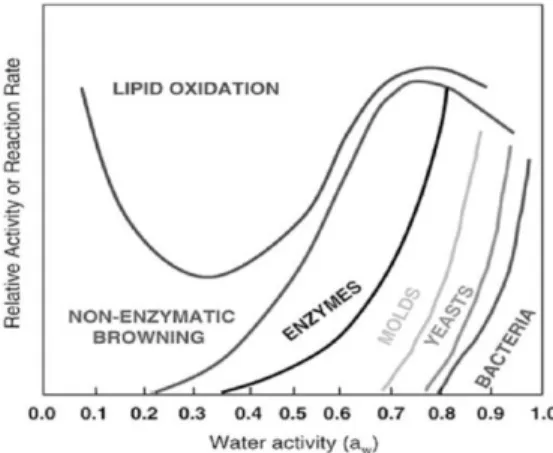
- Water activity
- Moisture content and moisture ratio
- Drying rate
- Drying rate constant
- Solar Drying
- Types of Solar Dryers
- Most common Solar Dryers
On a wet basis, the moisture content is the weight of water per unit of wet material (Eq. 1-2). 1-7 (El-Sebaii et al., 2002); 𝑀𝑒 is the equilibrium moisture content and can be determined when the moisture does not change with time after drying; 𝑀0 is the initial moisture content of the product on a dry basis, it is calculated using the equation.
Objectives
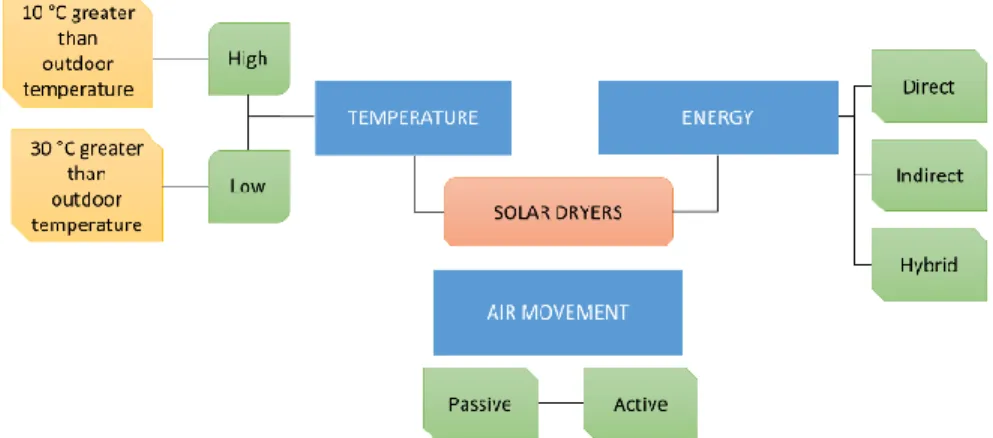
The new plants make use of alternative energies to reduce the impact of the large amount of energy needed for drying (Figure 1-11). The development and research of these dryers is still under development; however, García-Valladares et al.
Dissertation structure and overview
Overall Summary
A literature review of the state of the art in modeling Greenhouse-type solar dryers using Computational Fluid Dynamics was conducted. Using the Greenhouse-type solar dryer geometry (Figure 2-1) a calculation model was developed according to the CFD methodology.
Overall Conclusions and Outlook
The Model Predictive Controller designed in this study simulated the behavior of the system within the set points considered. 17 volume dryers is not so easy, it is necessary to consider turbulence in the models and the behavior of the indoor air to obtain better results.
Thin-layer models for tomato drying
They found that drying kinetics helped to understand the thermophysical parameters involved in the process, with the Midili-Kucuk model being the best model for their specific conditions evaluated. The Midilli Kucuk model has been demonstrated as the most common and best model to describe the drying kinetics of tomato.

Control of Greenhouse-type Solar Dryers
22 There is still great scope for research into solar dryers, where incident radiation dominates the behavior of the dryer. The prediction period is the number of time steps that, multiplied by the sampling period, gives the length of the window in which the MPC calculates the model's predictions.
Computational Fluid Dynamics of Greenhouse-type Solar Dryers 23
Both ODEs and thin-layer models do not consider any spatial variation in indoor greenhouse conditions. Two-dimensional CFD modeling of heat and mass transfer process during drying of sewage sludge in a solar dryer.

Abstract
Introduction
They found that the drying kinetics of tomatoes in an infrared radiant oven best fit the logarithmic model. 44 tunnel solar dryer to investigate the drying kinetics and perform an exergy analysis of the drying process.
Materials and Methods
The Greenhouse Solar Dryer
Finally, the best thin layer model in each research is not always the same, the Midilli Kucuk model is identified as the most common as it best describes the tomato drying kinetics. The objectives of this study were: 1) to evaluate 35 thin layer models in a greenhouse-type solar dryer to determine which model best describes the .. tomato drying kinetics and 2) to compare the accuracy of the model predictions with experimental data.
Drying experiments and data collection
Five CS215-L digital sensors (Campbell Scientific, Utah, USA C precision) were used to measure the air temperature in the greenhouse and the measured values were averaged; a CMP3 pyranometer (Kipp & Zonen 102885, Sterling, USA, accuracy 5 𝜇V /W /m2) was used for radiation measurements. For outdoor environmental variables, air temperature was measured with a HMP60 digital sensor (Vaisala, Vantaa, Finland C precision) and solar radiation with a pyranometer (Hukseflux LP02-L, Campbell Scientific, Utah, USA, 15 μV). /W /m2, precision).
Mathematical modeling
Theory and calculations
𝑀𝑅𝑜𝑏𝑠, is the observed moisture ratio (decimal), 𝑀𝑅𝑝𝑟𝑒, is the predicted moisture ratio (decimal), 𝑁, is the amount of data (an integer).
Results
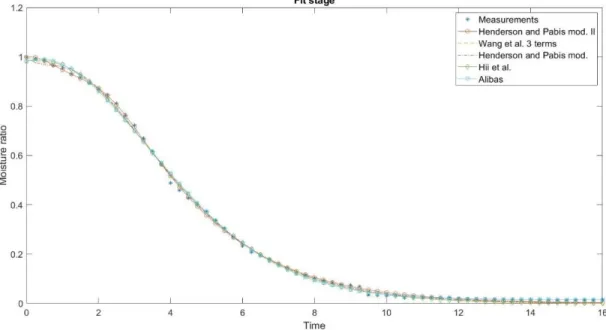
Energy is required to move the water from the inside to the surface of the product (Babalis et al., 2017). Regarding the fit phase, all models exactly follow the behavior of the data-calculated moisture ratio.
Discussion
Changes for both types of models are not always related to the solution of physical laws, but they still retain some structure and can lead to conclusions related to the physics of drying. The main difference between the structure of Newton and Henderson and Pabis original model is the constant multiplication of the exponential term.
Conclusions
However, more models should not be developed given their wide repertoire in the literature and the similarity between the mathematical structure reflected in the estimated values when fitting the models to the data.
Appendices
Acknowledments
Mathematical modeling of the thin layer of pineapple (Ananas comosus, L.): experiment with a greenhouse-type solar dryer at village scale. Drying characteristics and modeling of tomato thin-layer drying in a combined infrared-hot air dryer.
Abstract
Both control strategies maintained the product temperature below 50°C during the drying process, which is desired to preserve lycopene and vitamins in tomatoes.
Introduction
Finally, the control horizon represents the number of time steps for which the MPC will calculate the optimal control measures that minimize the objective function (Camacho & Bordons, 2007b; Drgoňa et al., 2020). Furthermore, the possibility of adding economic impact variables in the cost function makes MPC an excellent option for a greenhouse solar dryer controller (Ciglera et al., 2013).
Materials and Methods
- Greenhouse-type Solar Dryer
- Experiment
- Greenhouse-type Solar Prediction Model
- MPC Problem Statement
- Control Strategies
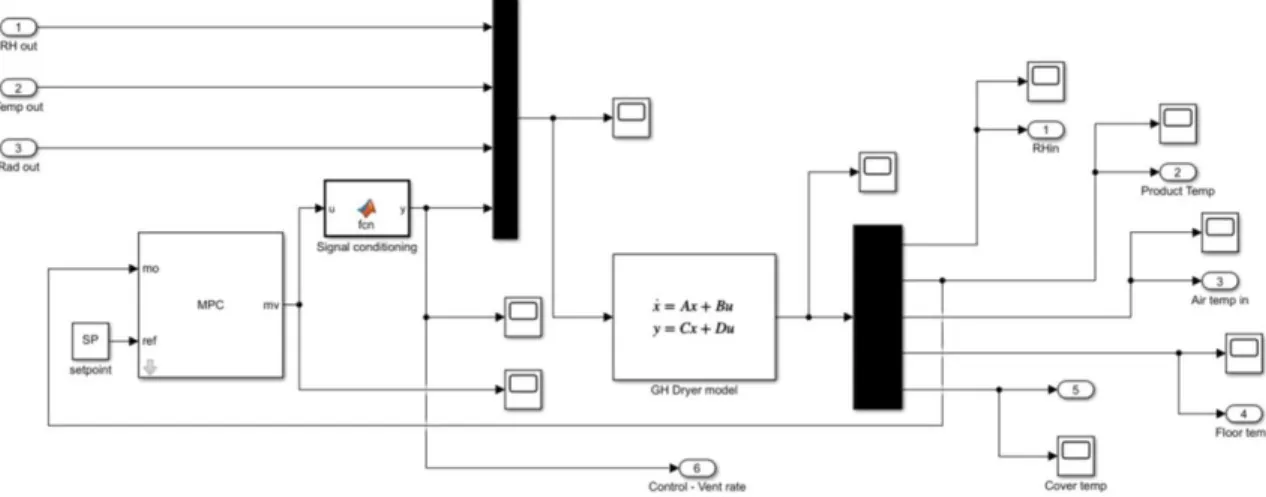
The statistics Root Mean Squared Error (RMSE), Mean Absolute Error (MAE), and model efficiency (EF) were used to measure the agreement between the model and the measurements of the real system. The first is to place the two fans activated at the same time, that is, the controller will have the values 0 or 5.2 𝑚3 𝑠−1 , called MPC1.
Results
Model simulations and Evaluation
77 0.87 for all the variables so that the model is considered a good representation of the greenhouse (Figure 5-8).

MPC Simulations
80 The MPC1 controller was considered the one with the strategy of two fans working separately. There was a reduction in the air temperature, floor temperature and increased relative humidity as a result of the MBK action (Figure 5-10).

Discussion
To our knowledge, this is the first time that the product temperature has been used to control a dryer instead of the air temperature. According to the experimental data, the air temperature can be higher than 50°C before the product temperature reaches 50°C.
Conclusions
83 means that the set point should be carefully considered as the uncertainty in the model can affect the behavior of the MPC. If the set point is 50°C, it is also expected that product temperatures above 50°C may be observed at some points due to the model predictions.
Acknowledgments
Experimental and simulated performance of a PV ventilated solar greenhouse dryer for drying peeled longan and banana. Model predictive control for optimal energy management of connected cluster microgrids with net zero energy multi-greenhouses.
Abstract
Introduction
In addition, it is a multi-scale process where macrometric variables that describe the behavior of the air inside and outside the dryer significantly affect the microscopic conditions of the product to be dehydrated (Defraeye, 2014). Most of the models developed for solar greenhouse-type dryers are based on energy balances, using ordinary differential equations (ODEs) to model the humidity and temperature behavior of the air inside the dryer (Jain & Tiwari, 2004 ; Janjai et al Kumar & Tiwari, 2006); however, when the product is involved, the so-called "thin layer" models are the most widely used.
Physical Phenomena that occur in Greenhouse-type Solar Dryers
Pre-Processing stage
The pre-processing phase includes the problem statement, as a first step, CFD codes need a domain to solve the problem, in modern software, the domain is created from a geometric model of the real system. The following steps are the mesh of the geometric model, commonly known as mesh generation as it divides the volume into sub-domains or small cells; selecting the physics and chemicals that drive the process, in other words, the mathematical models, physical and chemical laws, and assumptions needed to complete a mathematical definition of the problem; determination of fluid properties; determination of initial and boundary conditions in the domain.
Solver
Post-Processing
98 of the vector fields; Contour, 2D, 3D and surface plots to visualize the data matrices, and manipulation tools to scale, rotate, rotate and display the results.
How to build a CFD model for Drying
- Radiation model
- Species Model
- Turbulence Model
- Assumptions and Boundary Conditions
A common assumption in CFD codes to reduce the complexity of the governing equations is the Boussinesq model. 102 where 𝜌0 is the constant density of the flow, 𝛽 is the thermal expansion coefficient, and 𝑇0 is the operating temperature.
State of Art WITH CFD APPLICATION IN SOLAR DRYING
Products studied in Greenhouse-type solar Dryers
There is high variability in the volume of greenhouses that have been used for research. Moreover, when modeled, the air behavior there is observed as a reduction of the drying curve at the edges of the dryers due to the behavior of liquids in the boundary layer.

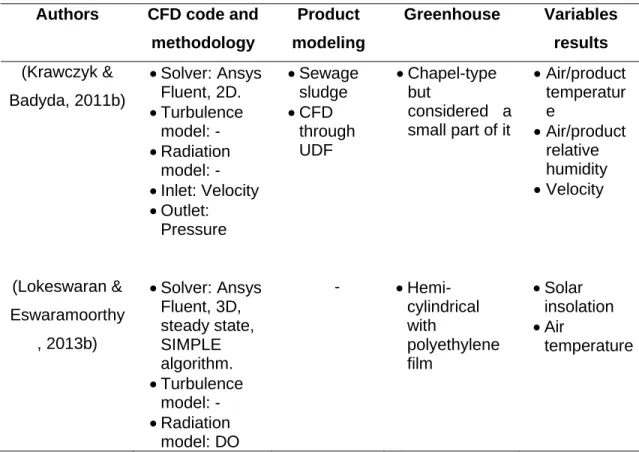
CFD modeling of Greenhouse-type solar Dryers
They discovered that the behavior of the air in the dryer is not homogeneous, and to improve this it is necessary to add a fan so that temperatures do not vary so much. However, it is not common to find the influence of the product on the relative humidity and air temperature in the greenhouse.
Conclusions
Performance and CO2 reduction analysis of a solar greenhouse dryer for coconut drying: Energy and environment. Effect of ambient conditions on drying of herbs in solar greenhouse dryer with integrated heat pump.
Abstract
Introduction
Not enough work has been done to report solar radiation (Lokeswaran & Eswaramoorthy, 2013; Román-Roldán et al., 2019; Roldán et al., 2019; Somsila & Teeboonma, 2014); and the product to be dried in 3D. The only way to improve the drying process in greenhouses is to study all variables at once.
Materials and Methods
Experimental Setup
Therefore, the objectives of the present study were 1) to develop and validate a CFD model suitable for predicting the indoor environment in a greenhouse-type solar dryer; The height of the two upper air inlets coincides with the height of the drying tables.
Instrumentation
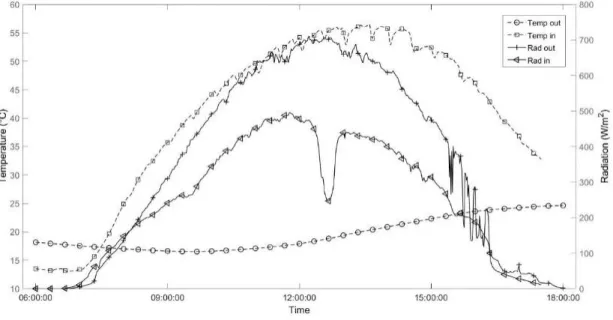
142 four air inlets covered with anti-lice mesh, and a double door to prevent heat from escaping when closed. 143 for the comparison was with the solar radiation from 10:00, where the solar radiation started to increase the temperature, but the exhaust fans were not activated.
Meshing and Simulations
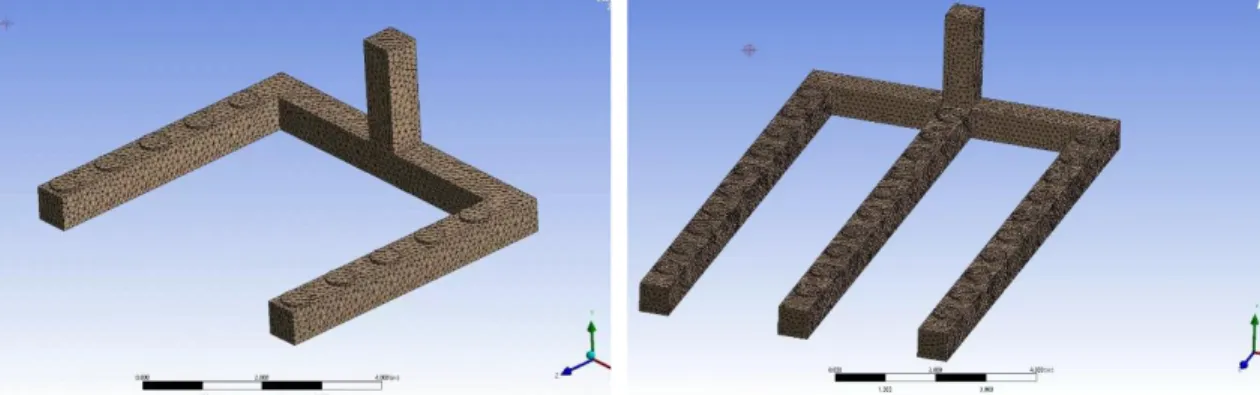
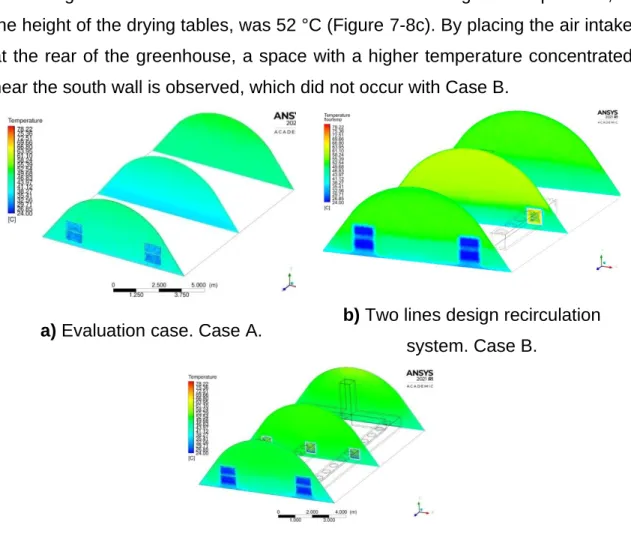
System B is located in half of the greenhouse while system C is located on the south wall. Each Evaluation Case simulation had a computational cost of 24 hours with the selected mesh.
Theory/calculations
Mathematical Models
147 where 𝜕𝑡 is a partial derivative with respect to time, 𝑇 is the temperature, 𝑈 is the velocity vector, 𝑔 is the gravity, 𝑝 is the pressure, 𝐶𝑝 is the specific heat, 𝑘 is the thermal conductivity, 𝑜 is dynamic viscosity, 𝑆ℎ and 𝑆𝑇 are the source terms for heat transfer and momentum. The 𝜇𝑗𝑇 coefficient and the source term 𝑆𝑖ℎ are due to the discretization of the convection and diffusion terms.
Boundary conditions
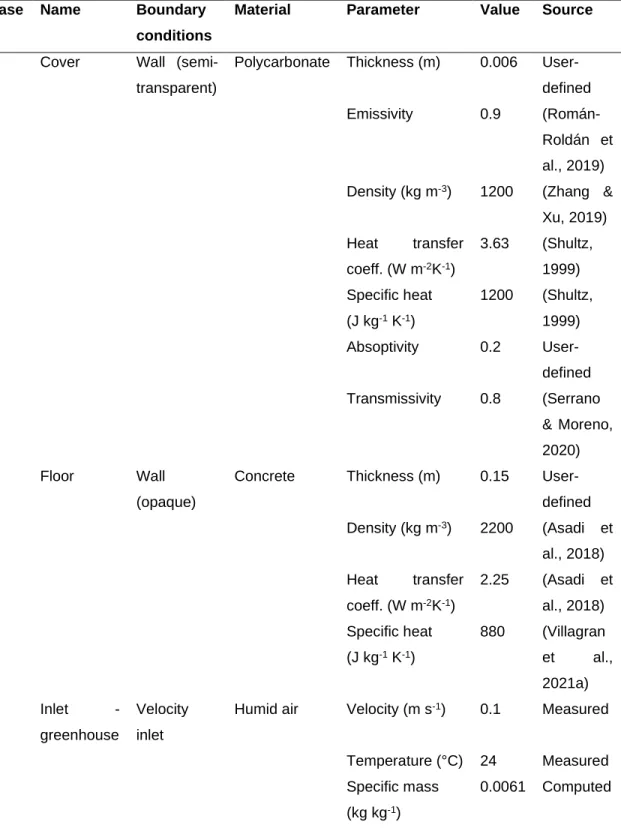
Moist air was modeled with species transport as a mixture of air and water vapor at atmospheric pressure in Chapingo. The solar radiation model used was the discrete ordinates (DO) because it allows the use of semi-transparent boundary conditions.
Results
- Evaluation
- Air temperature
- Air velocity
- Air Density
However, an improvement in the velocity and distribution of the air at the tables was observed (Figure 7-9b). The higher values were found in the lower part of the volume due to the lower temperatures, but the stratification was reduced when the air was forced to flow under the drying tables (Figure 7-10b).
Discussion
- Case A
- Case B
- Case C
- Comparison between Cases
The velocity is higher in the lower part of the dryer due to the effect of natural convection, the part near the lid being the one with the lowest speed. Again, this confirms that the air temperature is higher in the upper part due to the natural convection process that generates temperature stratification.
Conclusions
159 to the system by reducing the size of the holes and changing the layout to three holes per tube, which is an ongoing study by the authors. However, the factor of the tables and the product must be added to investigate the reduction in air velocity due to the obstruction of both.
Computational fluid dynamics analysis of heat transfer in a "chapel-type" greenhouse solar dryer coupled to an air solar heating system. Investigation of temperature and air flow inside Para rubber greenhouse solar dryer slope roof type using CFD technique.