TECHNOLOGICAL INVENTIONS OF UNIVERSITIES IN MEXICO.
A historical review between 1940 and 1970
Juan Ignacio Campa Navarro
Autonomous University of Barcelona
ABSTRAC
Between 1940 and 1970, Mexico recorded the highest economic growth rate in the last century. This growth was supported mainly by the establishment of a series of protectionist economic policies known as industrialization in substitution of importation (Industrialización por Sustitución de Importaciones - ISI) directed by the Mexican government. During this period of activity of patenting biotechnological inventions, one of its most accelerated dynamics was also recorded. In this context, this work presents a historical review of the experience of university patenting during this period, characterizing the technological results and its relationship with economic activity.
Keywords: Industrial Property Law, Patents, economic incentives, technological areas, ISI.
Mexico experienced a rapid industrial expansion and moderniza- tion between 1940 and 1970. This industrialization process was accompanied by a significant dynamic of a creation and adoption of technologies. One of the components of technological progress was the patenting activity of technological inventions. This activi- ty recorded one of its highest levels and pace. However patenting activity by educational organizations was quite low. A certain level of patenting observed came from foreign universities which took advantage of existing economic conditions in the country.
By contrast, patent registration by national organizations, public and private higher education was practically zero.
Two elements considered in this paper are the basis of the explanation for such behavior. On the one hand, patenting acti- vity of foreign educational organizations responded to changes in relative prices that came with the growth of domestic economic activity and changes in the industrial production system. In other words, foreign educational organizations were encouraged to ob- tain patents in Mexico in response to favorable economic conditions that the country offered for both exploitation and for territorial marketing of their products or patented technological processes.
In principle this logic should also expect the development of na- tive economic or social agents of a growing country. It is can be endogenously assumed that a nation that records high growth can have a greater amount of resources for research and develo- pment efforts, training of senior researchers and others, and for developing their own technological capabilities for the production and dissemination of useful industrial technological knowledge.
However, the absence of patenting activity of Mexican higher edu- cation organizations challenges such explanations, which is why we try to explore other elements. Although there are important fac- tors such as the ignorance of the benefits of patenting, insufficient or absent university-industry relationships; inadequate or absent financial programs to support research and development of techno- logies; or, the priorities of educational organizations other than the
generation of technological knowledge activities such as teaching or scientific research; are commonly used to explain the low level of patenting of such organizations. In this paper we propose that an essential element that significantly conditioned the results of patenting shown by the Mexican higher education sector was the kind of incentives shaped by the particular nature and operation of the patent regime prevailing during the period under study.
Instead of economic incentives resulting from the expansion and modernization of the industrial sector and the growth rate of the economy as a whole, were the foundation that incited the interest of Mexican educational organizations in producing technologies and to obtain patents - incentives that were established by the patent regime that determined, impeded and delayed their propensity to patent, missing an historic opportunity which is part of the pro- cess of industrialization. Therefore, we consider that virtually no patent registration by the Mexican educational organizations was more a problem of rule structure, organization and coordination, than changes in relative prices resulting from amendments to the conditions of the industry and markets.
To these ends, development work is divided into the following parts. Secondly, the different legal provisions of the current patent law are reviewed during the period of this study. While they are general, they may have affected the low propensity for Mexican educational organizations to patent. Thirdly, the results of the his- torical experience of university patenting and their relationship with economic activity are also presented. Finally, some conclu- sions are presented.
THE PATENTING OF THE HIGHEREDUCATION SYSTEM IN MEXICO
Incentives for patenting under the Industrial Property Law
One of the essential elements to explain the behavior of patenting activity in Mexico can be found in the prevailing incentives esta- blished by the Industrial Property Act of 1943 (hereinafter called the LPI- Ley de Propiedad Industrial) during the period of rapid industrialization. Although the entire regulatory framework of the legislation was in character and application generalized for all those interested in obtaining patents, some provisions of the statute could particularly affect the propensity of patenting by higher education organizations, specifically those in Mexico. In general, regulatory elements or vector incentives that probably affected the performance of educational organizations were: a) Provisions on the ownership of the property rights of patents, b) criteria for the exploitation of the patent and distribution of costs and benefits among holders or between them and the inventors should it correspond to different people c) general provisions on the design and operational rules within educational organizations for the purpose of transferring and commercializing the patented technology information.
Ownership. The LPI generally established that the owners- hip of a patent was by whomever had requested and obtained a patent for by their own account or through a representative or alternatively by a successor (arts. 9, 15 and 35). The title of a patent could therefore correspond to an individual in- ventor, a group of inventors, a company or a national or fo- reign combination that were duly accredited by the Mexican authorities. In the case of the education sector, this implied several provisions according to the laws. One way was that the patentee could be only one academic or set of researchers that on their own registered and protected the results of their research even if such activities were carried out within an
educational organization. Another possibility was that higher education organizations possessed ownership of the patents.
In this manner a university could register under its own title the results of a researcher or investigator with whom they have a working relationship only when they had seceded all rights on an invention. Finally ,an educational organization could share ownership with another similar agency, with one or a variety of companies, with one or more public or private cen- ters of investigation, or with a government agency as a result of joint efforts in research programs.
The problem with this particular design of the patent law of 1943 was that it did not lay down special provisions on arrangements for the allocation of property rights under the formulas of sha- red ownership. This implied that both negotiation and agreement on the allocation of ownership of a patent was in private practi- ce between the parties. This posed no difficulty if private agree- ments resulted from a convergence of interests and cooperation between the actors involved. However, when incentives for the right to ownership of patents of each stakeholder were not aligned, such as in the case of efforts in shared research, the asymmetric bargaining power of each contracting party could generate an in- crease in conflicts and to high negotiation costs, opening the way to contractual opportunism which resulted in barriers or lack of interest in research and technological development and patenting in educational organizations, acts that became linked to other or- ganizations or internally with fellow academic staff. Since the LPI did not establish provisions or criteria to resolve the problem of assigning ownership in the event of a conflict of interest, this lack of definition discouraged and hindered cooperation between those involved, affecting the performance of educational organizations, especially Mexican organizations that were framed in such a way that their institutional environment discouraged the investment in
technological activities, or otherwise choose not to devote efforts to patenting their technological results.
Exploitation benefits and costs. The patentee had the right and obligation to use or exploit the patent on their own account or for third parties, but if it did not comply with the obligation of exploitation their rights were restricted (art s.
41 and 42). Therefore, the exploitation in an academic envi- ronment could be performed by an individual researcher, an educational agency, or an educational organization and a company, or a combination of all of them. Just as in the case of ownership, the patent law of 1943 lacked specifications or provisions about the forms of participation or collaboration in the direct or indirect exploitation of products or patented technological processes. For example the statute does not ge- nerally nor specifically define rights and responsibilities of use by partners: who can carry out the use of rights, how these rights and mechanisms could be exercised and con- trolled for the rendition of results. The benefits and costs of individual exploitation of a patent were reserved exclusively with its owner.
While the LPI established the right of the inventor to have his name in the title of a patent, it was independent of the ownership and rights or obligations, benefits and costs that this involved. The problem again was that patent law did not establish any precept about the distribution of benefits in the case of exploitation of a patent whose ownership was shared. In the case of the education sector there weren’t provisions on the proportion or percentage of profits that corresponded to each researcher, the university, research center, company, government agency, etc. that was co- owner of a patent for its exploitation. Similarly, there did not exist provisions for a special form of benefit sharing arising from the ex- ploitation patented results obtained from joint research between
different organizations, for example between a university and a company, but the ownership of the patent only corresponded to one of them. That’s to say, whether this form of collaboration came to be under the regime of the prevailing patents, the patent hol- der was the only one able to appropriate the total profits obtained from the exploitation of the property, which largely discouraged processes of inter-agency cooperation on technological research with industrial applications when there was no mutual interest.
In an equal or more complex manner, but also not taking the patent system into account, was the situation on the distribution of benefits within a subordinate employment relationship where an academic or research group produced patented technological results but whose titles were patented and in the hands of the edu- cational organization. In neither case the LPI established precepts to rate inventions made within a framework of wage labor within a university, national technological institute, public research cen- ter, etc.,. The legislation did not understand provisions on the amount, rate or mode of participation of academic inventors in profits from exploitation. Compensatory mechanisms were also not established regarding their wage payments as prizes, bonu- ses, commodities, etc. Likewise it did not include provisions that complement the basic social aspects of subordinate employment relations that resulted from the inventive activity.1 Finally, the patent regime lacked provisions that would allow Mexican edu- cational organizations, with reference to the above provisions, to establish policies within their organizational structure or profit sharing programs and benefits that were harmonious with the efforts and personal goals of their areas of research.2
1 It wasn’t until 1976 with the reform of patent law of 1943 that there was introduce an amendment that esta- blished that inventions developed from work activities should be established and organized under the Federal Labor Law. For some questions about academic labor relationships in technological research see Kurczyn and Villanueva (2009).
2 In order to make a comparison with some recent experiences in other countries see OECD (2003); González- Albo and Zulueta (2007); Nezu (2007).
In any of the above mentioned conditions the limitations of the LPI in providing institutional mechanisms for benefit sharing between owners or between patent holders and partners, formed incentives that hindered progress in the production of patented technologies. In the case of Mexican universities where much of the research conducted was understandably within their organi- zation, the absence or inadequacy of the patent regimen to define or delineate certain criteria on modes of appropriation of profits, distribution, amounts, proportions on profits or income and acade- mic staff perceptions for maintaining a working relationship with any of these organizations, led researchers to be more interested in devoting efforts to activities other than technological applied research and basic research, teaching, etc., in response to other in- centives provided by the academic environment. Given the uncer- tainty in obtaining benefits different from academic recognition, it is likely that even a researcher who is dedicated and obtained technological results with industrial patentable value would prefer to make public the results of their research by other means than patenting- through publications in books, journals, newsletters, etc. of academic prestige3. According to this institutional weakness demonstrated by the patent law, it is reasonable to assume that the established incentives contribute to restrict and discourage production processes of patentable knowledge and hamper the propensity to patent by Mexican higher education organizations.
Another basic element in shaping incentives which parti- cularly affects the propensity to patent is the cost of patenting.
According to the patent law the costs per request and obtain a title is borne by the interested party. However, in similar manner as with benefits, there are not established provisions for alloca- ting the cost in the case that a shared title is sought or under a subordinate employment relationship. The LPI also did not define
3 Jensen & Thursby (2004); and Baldini (2006) formally model this type of behavior within educational organizations.
exemption or preferential treatment in charging fees for higher education organizations, so under no modality could it be exemp- ted from payment or received subsidized payments for soliciting, reviewing, obtaining and maintaining patents. The uncertainty in the distribution of the costs of patenting and the absence of a regime of favorable rates to the national education sector meant that were specific factors that had a negligible influence on the propensity to patent in Mexican educational organizations.4
Transfer of technology. The law of national patents gran- ted the patent owner the power to transfer their rights in who- le or in part to others of good legal standing. Both cessation (total transfer of the patent) and licensing (partial transfer) are regulated following Mexican civil law. However, similarly to what is known to occur regarding the benefits of direct ex- ploitation of a patent, the legal standards do not include spe- cific mechanisms for the distribution of profits or perceptions (royalties, bonuses, etc.) between the various participants when a license agreement is made. The patent regime does not offer criteria that would allow educational organizations to make their own decisions about marketing of the owners- hip of their patentable results, portfolio of patents, licensing arrangements and schemes of participation of costs and be- nefits. Similarly the LPI does not set guidelines or criteria, although they are general, contribute to the constitution (de- sign & operation) of technological transfer offices through which educational organizations present and reference their processes, policies or internal regulations on decisions to pa- tent technological research results product of the efforts of its research staff; the alternatives of exploitation of patents
4 A recent example of rules regarding costs of submission of patents can be found in González-Albo & Zulueta (2007).
on their own; the conditions and licensing arrangements of patented technology; and the distribution of costs and bene- fits among academic staff and educational institutions. In a broader sense the LPI was also not an important instrument of technological policy since it does not consider in its pre- cepts criteria that contribute to the creation or strengthening of forms of relationship building between the education sec- tor, private business sector and the government. Thus the institutional framework of patent law or provides for a very restrictive environment for the commercialization possibi- lities obtained by Mexican educational organizations, which reduced the propensity to patent when considering obstacles erected against technological invention.
Activity of patenting for higher education organizations in Mexico during the ISI
Patenting activity recorded by the education sector during the rapid industrialization period covers patents owned by national higher education organizations -such as universities, technical institutes and other public and private education institutions- as the number of patents granted to local or foreign higher educa- tional organizations . The level of patenting registered by both groups is presented in Table 1.
Table 1. Patents given to higher education organizations between 1940-1970
Period Total Mexican Foreign
1940 - 1950 9 0 9
1951 - 1960 5 0 5
1961 - 1970 35 1 34
1940 - 1970 49 1 48
Source: Own data based on the Industrial Property Gazette. IMPI. Various years
It is noteworthy see in Table 1 that the total patents granted in Mexico accounted for virtually all educational organizations abroad. Only one patent was granted to a Mexican university, the University of Guanajuato, in the final phase (1969) of the long period. Of the 48 patents given to the foreign education sector, 41 were given to different public and private American univer- sities (86%). Five patents were registered by an Australian pu- blic university representing 10% ,and the remaining two patents belonged respectively to a Canadian and Israeli university (4%).
Highlighting the predominance of the most active patenting American universities were the Foundation of Indiana University with 7 patents, The Regency at the University of Minnesota with 6 patents, and Ohio State University with 5 patents. However the Australian National University was also one of the most interes- ted in protecting their inventions through patents in Mexico with five titles (see complete list of universities in Table 2 at the end of the text). During the first two decades of university patenting activity , there was low but relatively stable activity. It was in the last decade of the period when a great number, 35 of 49 univer- sity patents, were granted -contributing to 71% of all registered patents. Since virtually all patent registration was made by fo- reign universities, it is assumed that the trend throughout the period responded to the high growth rate of the economy that encouraged these educational organizations to obtain patents in the country. In the period of 1960-1970 , during which the hig- hest level of educational organizations patents were registered,
the Mexican economy achieved an average growth rate of 7.1%- a rate rarely seen in other periods of national economic history.
In contrast, the meager patenting activity of Mexican edu- cational organizations didn’t seem to correspond to the expected rationality that high economic growth will encourage the pro- pensity to patent. The national academic sector was prompted to devote efforts in the production of valuable industrial and commercial technologies protected by patents seizing the oppor- tunities and benefits that the historical opportunity of intense industrialization and economic expansion offered. This appa- rent contradiction in the substantive economic logic of educa- tional organizations is cleared when we consider the nature of the Industrial Property Act 1943 and the incentives that framed the patenting decisions of these organizations. The almost zero effort to patent by Mexican universities and educational ins- titutes was due to obstacles and limitations set by absent and insufficient design of institutional framework and no changes in relative prices encountered with a protectionist regime of na- tional industrialization. We consider the adverse valuation that the national education sector made regarding incentives of the patent law exceeded the expectations of benefits that could be offered to industries and emerging markets during the ISI period given the uncertainty introduced by the lack of definitions and deficits within the patent law as noted in the previous section.
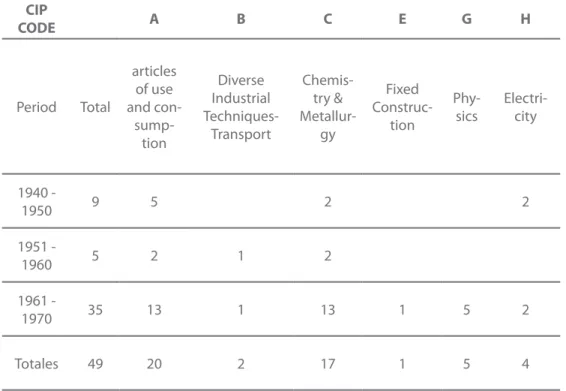
Characteristics of university patenting activity The registered patents by educational organizations represented different patterns of innovative activity. Reorganizing the patents regarding its technological classification, using the International Patent Classification (IPC), we can examine the characteristics of academic technology research as shown in Table 3.
Table 3. Patents given to universities for technological areas
CODECIP A B C E G H
Period Total
articles of use and con-
sump- tion
Diverse Industrial Techniques-
Transport
Chemis- try &
Metallur- gy
Fixed Construc-
tion
Phy-
sics Electri- city
1940 -
1950 9 5 2 2
1951 -
1960 5 2 1 2
1961 -
1970 35 13 1 13 1 5 2
Totales 49 20 2 17 1 5 4
Source: Own data based on the Industrial Property Gazette. IMPI. Various years
In Table 3 we see that university patenting activity was accen- tuated in the protection of technological areas that satisfy hu- man needs or assets and consumption (Section A of the IPC).
The number of patents granted in this field accounted for 41%
of all patents granted to the education sector within the coun- try. Followed in importance by the technological field related to chemistry and metallurgy where 17 patents representing 35%
participation in the record. In reviewing the records included in the CIP for technological subclasses, the following features of academic patenting activity are displayed.5
5 The CIP is a system of cataloging patents used by the World Organization of Industrial Property in accord with the Strasburg Accord of 1971. The structure of the classification is basically made up of Sections, Subsections, Classes, Subclasses, Groups & Subgroups. The most desegregated level presented here is Subclass, shown in Figure 1. In table 4 a description of the subclasses that were examined are presented.
Figure 1. Mexico. Principal areas of knowledge of university patents, 1940-1970.
Source: Own data based on the Industrial Property Gazette. IMPI. Various years
In chart 1 we identified that between 1940 and 1970 patents were recorded primarily in technology fields related to health and hea- ling. As shown in A61K and C07D subclasses and to a lesser ex- tent G10K and C01B subclasses, patenting activity focused on the generation of products or processes for medical, dental and sa- nitation (pink bar) and heterocyclic compounds were a result of organic chemistry and with various industrial applications inclu- ding pharmaceuticals (orange bar); and also in those inorganic chemical compounds with certain pharmaceutical and healthcare applications such as halogens, percompounds or peroxides, and different sound generating devices (green bars). Together these four subclasses covered 32 of the 49 total patents, representing 65% of total patenting activity in the education sector. The re- maining patents also included a variety of related chemical sector innovations; with the development of innovations in machinery,
equipment and tools; the food sector and a record pf related non- metallic mineral alloys (See Table 4 at the end of the text list of subclasses used herein). As noted, 86% of registered patents were owned by U.S. universities. Of the 41 patents of this group, 12 had represented the class A61K of the 16 granted to the entire foreign university sector. Five patents belonged to the class C07D of the 8 in total, while the 4 patents for G10K and C01B classes respec- tively were all owned by U.S. universities. Due to the size of the sample it cannot be confirmed that American universities observed a pattern of specialization or mastery of the technological sectors of Mexican technological development, however the concentration of patenting these technologies allows us to assume that economic conditions in these sectors were very important for the educational organizations of our northern neighbor.
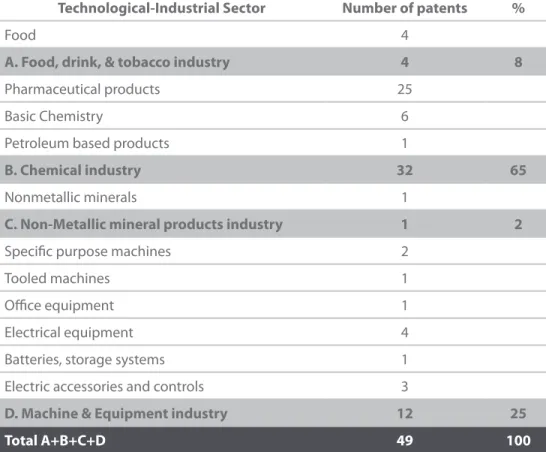
In order to see if this behavior was related to the economic activity in the country for industrial expansion under the ISI regime, tech- nological fields are grouped based on their equivalence to sectors of economic activity.6
As shown in Table 5 economic activity for the chemical in- dustry was more related to patenting activity. Thirty-two (65%
of total) of patents granted to foreign universities including the only national patent filed by a Mexican university, Universidad de Guanajuato, corresponded with the development of innovative ac- tivities within that industry. Between 1950 and 1970 the chemical industry recorded a high growth rate of 12% on average each year, much higher than in the economy as a whole (6.5%) and product manufacturing (8%). In terms of participation in the value of total manufacturing output, this industry reached an average of 11%
over the long term. Due to its dynamism an important share of production was in charge of foreign transnational companies. In terms of value of production of the chemical industry as a whole,
6 In order to establish relationships between technological subclases of the CIP and economic sublcasses we employ a table in accordance to one presented by Schmoch et. al. (2003).
the participation of foreign private sector increased from 58% in 1962 to 67% in 1970, registering an average annual growth rate of 12.9%. As a result of this performance, the rate of return on foreign direct investment (FDI) increased from 14.4% to 19.2%
between 1960 and 1970 (Sepúlveda and Chumacero, 1973). The very favorable results recorded in the national chemical industry during the ISI- high rate of output growth, high return and the significant presence of foreign firms of mostly American origin with universities from the same source could be linked- were im- portant incentives for U.S. educational organizations and others in the propensity to patent proprietary technologies in Mexico.
Table 5. Mexico. University patents &
industry-technology relationship
Technological-Industrial Sector Number of patents %
Food 4
A. Food, drink, & tobacco industry 4 8
Pharmaceutical products 25
Basic Chemistry 6
Petroleum based products 1
B. Chemical industry 32 65
Nonmetallic minerals 1
C. Non-Metallic mineral products industry 1 2
Specific purpose machines 2
Tooled machines 1
Office equipment 1
Electrical equipment 4
Batteries, storage systems 1
Electric accessories and controls 3
D. Machine & Equipment industry 12 25
Total A+B+C+D 49 100
Source: Own data from the Industrial Property Gazette. IMPI. Various years; table in agreement with technological & economic subclasses
As shown in Table 5 economic activity for the chemical industry was more related to patenting activity. Thirty-two (65% of to- tal) of patents granted to foreign universities including the only national patent filed by a Mexican university, Universidad de Guanajuato, corresponded with the development of innovative activities within that industry. Between 1950 and 1970 the che- mical industry recorded a high growth rate of 12% on average each year, much higher than in the economy as a whole (6.5%) and product manufacturing (8%). In terms of participation in the value of total manufacturing output, this industry reached an average of 11% over the long term. Due to its dynamism an important share of production was in charge of foreign transna- tional companies. In terms of value of production of the chemical industry as a whole, the participation of foreign private sector increased from 58% in 1962 to 67% in 1970, registering an avera- ge annual growth rate of 12.9%. As a result of this performance, the rate of return on foreign direct investment (FDI) increased from 14.4% to 19.2% between 1960 and 1970 (Sepúlveda and Chumacero, 1973). The very favorable results recorded in the national chemical industry during the ISI- high rate of output growth, high return and the significant presence of foreign firms of mostly American origin with universities from the same source could be linked- were important incentives for U.S. educational organizations and others in the propensity to patent proprietary technologies in Mexico.
In particular, the chemical industry corresponding to the pharmaceutical industry was the most watched patenting acti- vity relationship. Twenty-five of the 49 total patents granted to universities related to this industry, which accounted for just over half of all patents granted (51%). The pharmaceutical industry recorded a significant growth throughout the long period due to the economic and social policy undertaken by the Mexican go- vernment since the early forties of the last century.
With regard to social policy, between 1942 and 1943 the Mexican Social Security Institute (IMSS) was created and the Ministry of Health and Welfare (SSA) was reformed. Later in the sixties, the Institute for Social Security and Services for State Workers (ISSSTE) and the General Directorates of Military and Navy Social Security were established. Also during this sta- ge other special health schemes for state enterprises such as Railways, Federal Electricity Commission (CFE) or Petroleos Mexicanos (PEMEX) was formed. All of these were part of a pu- blic health program aimed at increasing the coverage of medical services provided to the population. This system or social health sector included the acquisition of huge batches of drugs from pharmaceutical companies granted for free to the beneficiaries of each scheme of therapeutic care (Bernal, 1980). This was a ma- jor boost to the internal market for the pharmaceutical industry that pushed mainly foreign companies to become established in the country and to participate in productive activities which allowed universities of the same origin to undertake patenting and innovation efforts to directly or indirectly participate in va- rious numbers of businesses.
The policy of import substitution was very important for the development of the pharmaceutical industry. By applying tariff barriers, subsidies and exemptions, the government formed a series of incentives for production of in country and semi-finis- hed drugs, which resulted in the establishment and progress of a growing number of companies and chemical-pharmaceutical laboratories.7 Between 1940-1949 18 pharmaceutical compa- nies were established in the country, 48 of 1950-1969 and 73 in 1960-1969, much of which was transnational (Soria, 1980). The expansion of the aggregate production of the pharmaceutical sector registered a rapid pace during the decades of the fifties
7 Before the measures enacted in the 1940’s, almost all of the total demand for medicine was covered by imports (Molina, 1980).
and sixties, reaching annual rates of 11 and 10% respectively.
The added value of pharmaceutical products of 284 million pe- sos registered in 1950, went to 781 million in 1960 and 2 billion in 1970. 8 Much of the pharmaceutical market by the end of ISI process was in the hands of transnational corporations. By 1969, the top 35 companies operating in the country were all foreign, and captured 65% of product value with a little over 3 billion pe- sos at the time (Soria, 1980). Given the dynamic and profitable behavior described by the industry and the role of the foreign sector, it is feasible to assume that this had a major effect on the concentration of granted patents in this sector by foreign univer- sities. In other words, educational organizations from abroad observed it convenient or of interest to register Mexican patents due to dynamic markets reflecting the domestic pharmaceuti- cal industry, regardless of the recesses that the operation of the system of Mexican patents could signify. It was also significant that an important part of the foreign private sector participation in the pharmaceutical industry was of U.S. origin. Of the total of the 30 most important businesses, 16 were recognized as un- der American control or ownership (Wionczek, et. at ., 1988).
Therefore it is not difficult to explain under these conditions the business technological predominance of the U.S., with the fact that 18 of 25 patents related to innovations in pharmaceutical industry corresponded to American universities.
Other economic sectors which registered significant dyna- mism was the producer of capital goods, particularly the indus- trial production of machinery, equipment and electrical products.
Here 8 out of 12 university patents registered were linked to this branch of economic activity (see Table 5 above). Between 1950 and 1970, the GDP of the machinery and electrical equipment industry registered an average growth rate of 13% per year with
8 Constant Pesos of 1960 according to INEGI (2009).
a share of total capital goods of 34%. Like the pharmaceutical industry, a significant share in the value of production in the in- dustry corresponded to foreign investment. In 1962 foreign com- panies registered a rate of 58.3% in the total value of the industry and by 1970 it reached 79.3%. The performance of the external sector was very dynamic, with a 15% annual average growth rate in production, surpassing the growth rate of the industry as a whole (13%). The benefits in this industry were very profitable for foreign investors. In 1960, the rate of return showed 13% and for 1970 rose significantly to 29.3% (Sepúlveda and Chumacero, 1973). Although there is no data to show us the behavior of the machinery and electrical equipment production industry disa- ggregated at country level, Sepulveda and Chumacero (1973) however propose that the participation of U.S. companies in this industry became very important. So it is not difficult to have ex- pected that the 8 total patents related to this industry were ow- ned by American universities following the pattern of behavior shown by the national companies in Mexican markets. Given the prevailing conditions, in particular in the previously revised sectors of chemical, pharmaceutical and electrical products, the major expectation of profits that were made and the large pre- sence of foreign (mainly American) investment at end of the period (1960-1970), we can assert that university patenting acti- vity abroad and especially the propensity to patent by American universities, responded to the high economic incentives offered by the Mexican industrial performance.
Moreover, for a better understanding of the limitations of the system of national patents to encourage Mexican university technological development, it would be appropriate to include a review of experiences of patenting of educational organizations in other countries, such as those in the North Atlantic and Europe.
Although at this time making a comparison is beyond the scope of this document due to limited available information and spa- ce, we can, however, make some brief remarks known about the
case of patenting educational organizations in the United States.
According to Mowery and Sampat (2000) the behavior of the American university patenting over the last century responded more to political factors and financial incentives (federal pu- blic funds) than the incentives provided by the national system of patents. But this does not mean that U.S. patent policy was not present in discussions on the definition and scope of such intellectual property rights in education. As Metlay (2006) no- tes, there was intense public and private debate on these issues before and after World War II, in which the resolution of the federal government was to leave the final decisions regarding the allocation and exercise of patent rights to the educational organizations or other related agencies at least until the early l960s. But this didn’t mean that in all of the cases over the pe- riod educational organizations or the entities created to manage patenting regulated processes with complete autonomy. As evi- dence, a report from the National Academy of Sciences (1962), design patent policy within educational organizations in several cases was formulated through consensus decisions of their go- verning boards, but also in other cases the institutional design was established based or reference to specific laws prevailing in the states or prescribed by state agencies under its control or jurisdiction. This implies, among other things, that while the American national patent regime did not directly influence the design of politics or American university patenting behavior, based on the specific points we have described here regarding the patent law: a) ownership, b) benefits and costs of exploita- tion c) benefits and costs of technology transfer, technological work related to specific institutional environments played a key role in framing patenting policy within each university corres- pondingly, promoting a wide variety of modalities (guidelines and scope) in the organization and administration of patentable technological developments and patenting activity. In contrast, due to the absence of such situations, there was virtually null
development of patented technological activities of Mexican edu- cational organizations.
CONCLUSIONS
The limited patenting activity of educational organizations as a whole does not allow for rigorous identification or tracing of specific trends of technological change in Mexico. However, it re- veals that the high incentives offered with the policy of industrial protectionism was a factor in the propensity to patent, especially for foreign (and particularly for American) public and private universities. The national education system otherwise did not respond to these opportunities. Among other factors, ceteris pa- ribus , due to the design and absent and/or insufficient Mexican patent regime that did not orient itself to operate, promote or facilitate technological exchange processes in the educational setting, but even hampered venting of the results of activities of invention and innovation of all Mexican educational organiza- tions, before the gaps and uncertainty that they suffered and were configured by such an institutional environment. This aspect of institutional weakness of the patent regime subtracted economic potential performance from educational organizations, because although the major universities in the country at the time such as the UNAM, IPN or ITESM performed a certain level of effort in activities and technological developments for industrial use, such efforts or investments did not result in patent rights with marketing possibilities and in principle to obtain their own bene- fits, thereby wasting a historic opportunity offered by a favorable economic scenario of expansion and industrial modernization.
REFERENCES
Baldini, Nicola. 2006. UNIVERSITY PATENTING AND LICEN- SING ACTIVITY: A REVIEW OF THE LITERATURE. Re- search Evaluation, Volumen 15, Número (3), pp. 197–207.
Bernal Sahagún, Victor M. 1980. LAS EMPRESAS TRANSNA- CIONALES Y EL DESARROLLO DE LA INDUSTRIA DE LA SALUD EN MÉXICO. Iztapalapa Revista de ciencias sociales y humanidades, Número (2), sin otro dato.
González-Albo Manglano, Borja y Zulueta García, María Án- geles. 2007. NORMATIVAS SOBRE PATENTES EN LAS UNIVERSIDADES ESPAÑOLAS. Brasilia, Volumen 36, número 1, pp. 69-78.
INEGI. 2009. ESTADÍSTICAS HISTÓRICAS DE MÉXICO. Méxi- co. Instituto Nacional de Estadística, Geografía e Informá- tica.
IMPI. 1940-1970. GACETA DE LA PROPIEDAD INDUSTRIAL.
México, IMPI servicios de publicación.
Jensen, Richard And Thursby, Marie. 2004. PATENT LICEN- SING AND THE RESEARCH UNIVERSITY. NBER Wor- king Paper No. 10758.
Kurczyn, Patricia; Villanueva, Fernanda. 2009. LAS INVEN- CIONES DE LOS INVESTIGADORES ASA¬LARIADOS EN LAS ENTIDADES PÚBLICAS DE INVESTIGACIÓN Y DESARROLLO EN MÉXICO. Boletín Mexicano de Dere- cho Comparado, número 125, pp. 855-879.
Ley de la propiedad industrial de 31 de diciembre de 1942. Diario Oficial de la Federación, pp. 1-23, (1942).
Metlay, Grischa. 2006. RECONSIDERING RENORMALIZA- TION: STABILITY AND CHANGE IN 20TH-CENTURY VIEWS ON UNIVERSITY PATENTS. Social Studies of Science, número 36, volumen 4, pp. 565-597.
Molina Salazar, Raúl. 1990. PRECIOS Y DIFERENCIACIÓN DE PRODUCTOS EN LA INDUSTRIA FARMACÉUTICA. En
Patricia Arias (Coordinadora). Industria y Estado en la Vida de México. México. El Colegio de Michoacán.
Mowery, David C. y Bhaven Sampat. 2000. UNIVERSITY PA- TENTS AND PATENT POLICY DEBATES, 1925-1980.
Documento presentado en Conferencia en Honor a Ri- chard Nelson, Universidad de Columbia, octubre 13 a 15 de 2000.
National Academy of Sciences. 1962. UNIVERSITY RESEARCH AND PATENT POLICIES, PRACTICES AND PROCEDU- RES. Washington, D. C. National Academy of Sciences- National Research Council.
Nezu, Risaburo. 2007. TECHNOLOGY TRANSFER, INTELLEC- TUAL PROPERTY AND EFFECTIVE UNIVERSITY-IN- DUSTRY PARTNERSHIPS. THE EXPERIENCE OF CHI- NA, INDIA, JAPAN, PHILIPPINES THE REPUBLIC OF KOREA, SINGAPORE AND THAILAND. Génova, WIPO.
OEPM. CLASIFICACIÓN INTERNACIONAL DE PATEN- TES. 2006. Recuperado de http://cip.oepm.es/descar- gas/20060101
OECD. TURNING SCIENCE INTO BUSINESS. PATENTING AND LICENSING AT PUBLIC RESEARCH ORGANISATIONS.
2003. Francia. OCDE oficina de servicios de publicaciones.
Schmoch, U., Laville, F., Patel, P. y Frietsch, R. 2003. LINKING TECHNOLOGY AREAS TO INDUSTRIAL SECTORS - FINAL REPORT TO THE EUROPEAN COMMISSION.
DG Research. Karlsruhe, Paris, Brighton: European Commission.
Sepúlveda, Bernardo y Chumacero, Antonio. 1973. LA INVER- SIÓN EXTRANJERA EN MÉXICO. México. Fondo de Cultura Económica.
Soria, Victor. 1980. ESTRUCTURA Y COMPORTAMIENTO DE LA INDUSTRIA FARMACÉUTICA EN MÉXICO. EL PA- PEL DE LAS EMPRESAS TRANSNACIONALES. Iztapala-
pa. Revista de ciencias sociales y humanidades, número 2, sin otro dato.
Wionczek, Miguel, Bueno, Gerardo y Navarrete, Jorge. 1988. LA TRANSFERENCIA INTERNACIONAL DE TECNOLO- GÍA: EL CASO DE MÉXICO. México. Fondo de Cultura Económica.