First, the evolution of the paradigm describing the relationship between science and society in the PUS field can be described as a process of deficit rectification [10] in which citizens are asked for knowledge, interest, positive attitudes or trust [11]. Second, the origins of the deficit model can be described by what is called the PUS axiom. Finally, the shift towards a more participatory perspective on the relationship between science and society has translated into the rise of 'science in society' or 'public involvement in science'.
Scientific consciousness is considered to be the specific science-related dimension of the broader construct of "consciousness". At the same time, the social environment affects the image of citizen science as a result of how society interacts with it [31]. As a result of the shift from the PUS paradigm to the PES, the study of the image of science must include engagement in the analysis of the factors that shape this image.
It was also found that there is a strong relationship between interest in S&T, being informed about it and the innovative capacity of the reference country.
KNOWLEDGE
INTEREST
PERCEPTION
It weakens the credibility of the neutral arbiter in epistemic matters, which is why it is often heard about the loss of the cultural authority of science [57]. As already mentioned, the relationship between science and society is considered to be a challenge to governance, so the involvement of the public in the management of science has become a kind of gold standard [30]. From this point of view, it is considered that citizens should participate in determining the priorities of publicly funded research [44].
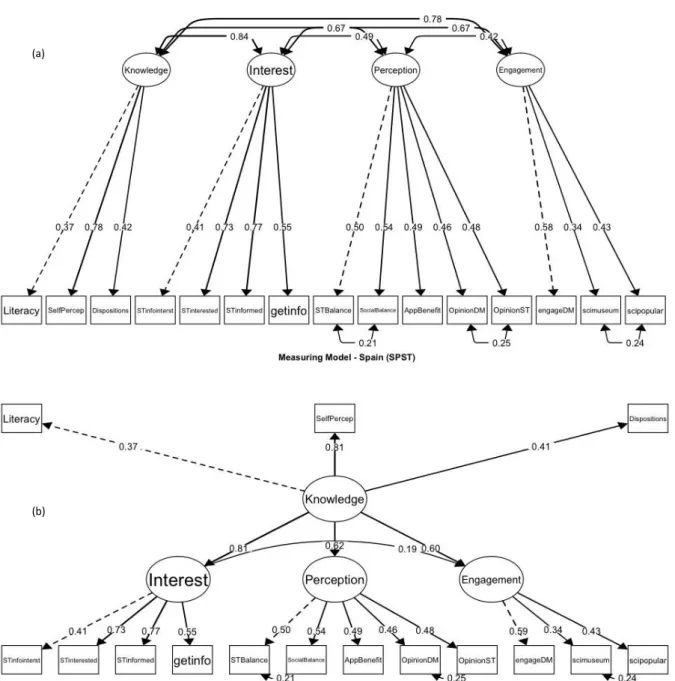
Therefore, it is considered that, despite the difficulty of estimating the costs of failed innovations, early consideration of ethical aspects and social needs to avoid social rejection contributes to a more efficient use of resources for research, development and innovation [69]. For the American Association for the Advancement of Science (AAAS), PES refers to intentional, meaningful interaction that provides opportunities for mutual learning between scientists and members of the public, and is closely related to science communication [73-75]. From previous work, it is assumed that knowledge directly predicts interest, perception and engagement in science [31].
First, the nation has been shown to have a decisive influence on the public's perception of science [77], and it is therefore assumed that there are country differences in public engagement with science that can be at least partially attributed to the country's level of science. development within V&T.
DATA
VARIABLES
Finally, the same process applies to the different sources respondents use to get information about S&T online: "Where are you most likely to go online for science and technology information?" Options are recoded by giving "0" to "Don't know" and "Refuse", "1" to. Interest is identified by the question: "How interested are you in developments in science and technology?" on a four-point scale from "1" ("Not at all interested") to "4" ("Very interested"), the value "0" is assigned. Perceived level of information is measured by the question: “How informed do you feel about developments in science and technology” with a four-point scale from “1” (“Not at all informed”) to “4” (“Very well informed” ), the value "0" is assigned to the answers "I don't know".
The perception has eight components: The social impact of science (Socinfsci) is measured by the question: "Do you think that the overall impact of science and technology on [national] society is positive or negative" with a four-point scale from "1" ("Very negative") to "4" ("Very positive"), the value "0" is assigned to the answers "I don't know". Self-perception of knowledge is the sum of four items: The answer to the item "The level of science education you received is..." with answer options: "0" ("I don't know / I don't answer")). SocialBalance is the sum of the items: "If you had to rate some aspects of science and technology similarly, which of the following would best reflect your opinion?" The response option code is the same as the element used to define STBalance.
The variable AppRisk (Risks of S&T applications) is the sum of the respondents' opinion on the risks of the following applications of S&T: (1) "The cultivation of genetically modified plants".
ANALYSIS
GSS – UNITED STATES
In the United States, the population seems to be more familiar with the knowledge of scientific textbooks (the average is well above the middle value: 6.25 over 10) than with the process of scientific research (on average slightly below the middle - 3.29 above 7). The best indicators of knowledge are knowledge about the scientific research process (sciprocess) and scientific knowledge (sciknow). Interest is best defined by interest in new scientific discoveries (the coefficient is 0.83) and, to a lesser extent, by interest in new inventions and technologies (0.69) and interest in issues surrounding space exploration (0.68).
The best indicator is the opinion about the balance between benefits and risks (balance, 0.52), followed by agreement with the statement that scientific research should be publicly supported even if it does not bring immediate benefits (advfront, 0.44). These imply that there is an overlap between interest in new medical discoveries and in new inventions and technologies, between science courses taken in high school, and between agreement with the statement on the need to publicly find scientific research (advfront) and the possibilities of offered by S&T for the next generation (nextgen). In the US, Knowledge is the central factor, with a direct and significant influence on other factors.
There is a positive and moderate correlation between Interest and Perception (r = 0.36), while Knowledge explains only 18.7% of the variance in Interest.
EUROBAROMETER 79.2
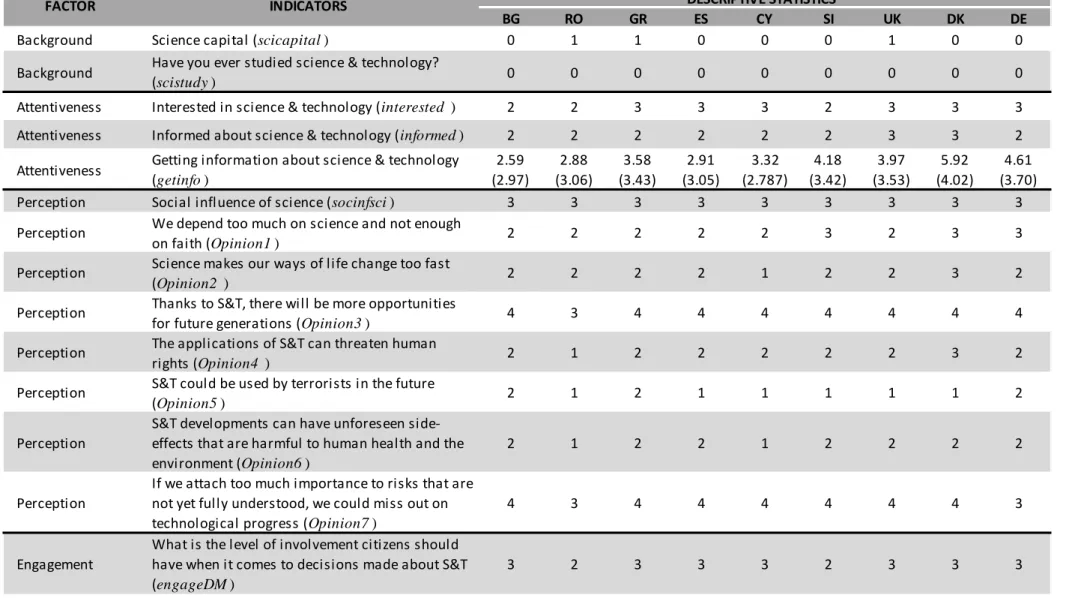
67% agree that we depend too much on science and not enough on religion, 20.83% neither agree nor disagree, and 7.30% disagree. Similarly, 71.32% agree that developments in science and technology can have unforeseen side effects that harm human health and the environment, 16.31% neither agree nor disagree, 3.24%. 89% agree that science is rapidly changing the way we live, 7.9% neither agree nor disagree, and 1.4% disagree.
Almost half of those surveyed agree that we rely too much on science and not enough on faith, about 29% disagree, and 17.65% neither agree nor disagree. Additionally, 65.75% of respondents agree that we rely too much on science and not enough on faith, 21.98 neither agree nor disagree, and 12% disagree. There are 27.63% who agree that we rely too much on science and not enough on faith, 24.68% neither agree nor disagree, and 40% disagree.
Another 34% agree that we rely too much on science and not enough on faith, 24.35% neither agree nor disagree, and 36.83% disagree.
SPST - SPAIN
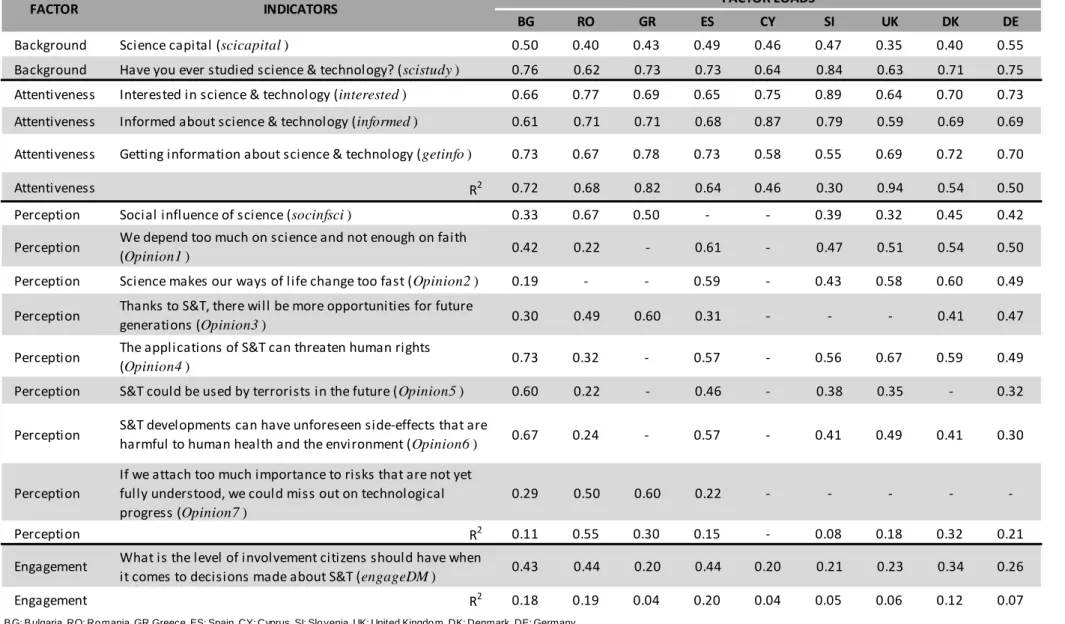
On the other hand, using indirect indicators, and regardless of the form of the structure and the level of development in S&T of the countries, the opinion on the engagement of citizens in scientific policy decisions is directly influenced by interest (attention) and indirectly by knowledge in most countries. of countries; while it is independent of perception (thoughts and attitudes). Analysis of the differences in opinion on engagement in S&T decision-making by country (Figure 12) shows two interesting findings. On the one hand, there seems to be a pattern related to the level of scientific development of the country and thus three groups can be identified.
The group of less developed countries (Bulgaria and Romania) stands out because of the percentage of citizens who do not answer the question. In terms of interest (attention), there are no major differences between countries, except in the percentages of variance explained by knowledge. In Romania and Greece the weight of positive statements is higher; in other countries the reverse is the case.
Despite the common structure, there are differences in the association structure between these factors that appear to depend on how they are measured and country. This finding suggests that the structure of the relationship between the four factors depends more on indicators than on country. Attention is closely related to motivation and thus, it appears that engagement in S&T decision-making is influenced by motivation in most countries where indirect indicators are available.
These results are a clear indication of one of the limitations of this study, i.e., the results are strongly dependent on the data set. When direct indicators (GSS and SPST) are available, knowledge explains a high proportion of the variance of engagement. On the other hand, it has been mentioned that knowledge explains 20% of the variance in interest [51].
Undoubtedly, the available indicators represent a very small part of the elements that influence people's perception of science. Therefore, it seems that the positive and negative dimensions of the perception of science should be analyzed separately.
R CODE - US GENERAL SOCIAL SURVEY 2018
Thus, the problem is the lack of other relevant items rather than the presence of bad items. 0 means that the respondents believe that they have little understanding of what it means to study something scientifically. Sciprocess variable: Knowledge of the process of scientific investigation sciprocessdf <- data.frame(scitext, odds, exptext).
We reject the null hypothesis. we can see that there are no differences between standard and robust statistics. The correction factor is 1, indicating that there are no problems due to non-normality, as expected given that we have 1148 observations. According to Muñoz et al. 2017), we derive from the hypothesis that knowledge is the predictor of interest, perception and engagement.
We can see that non-normality also does not affect the structural model modification indices (fitgss_sem_fin, minimum.value = 10).
EUROBAROMETER 79.2 2013
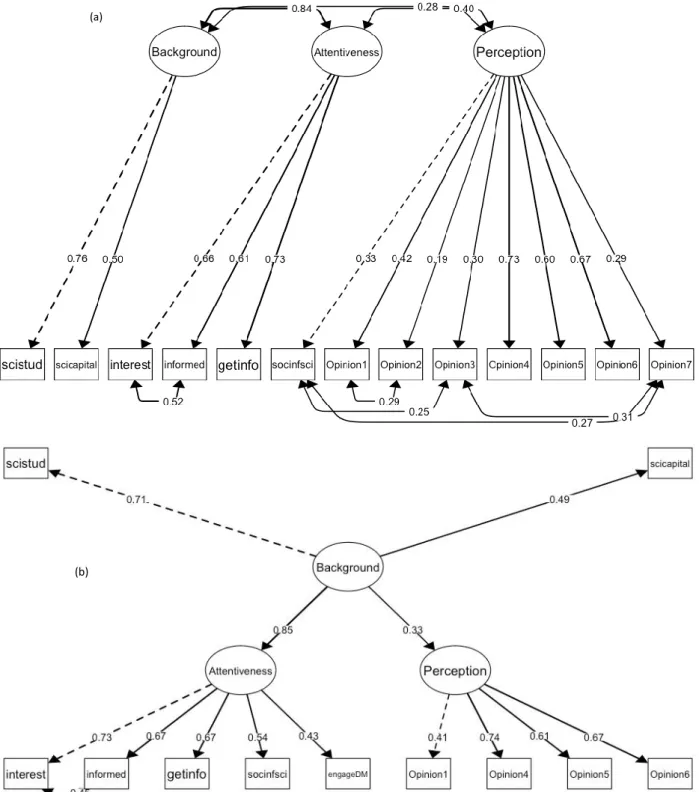
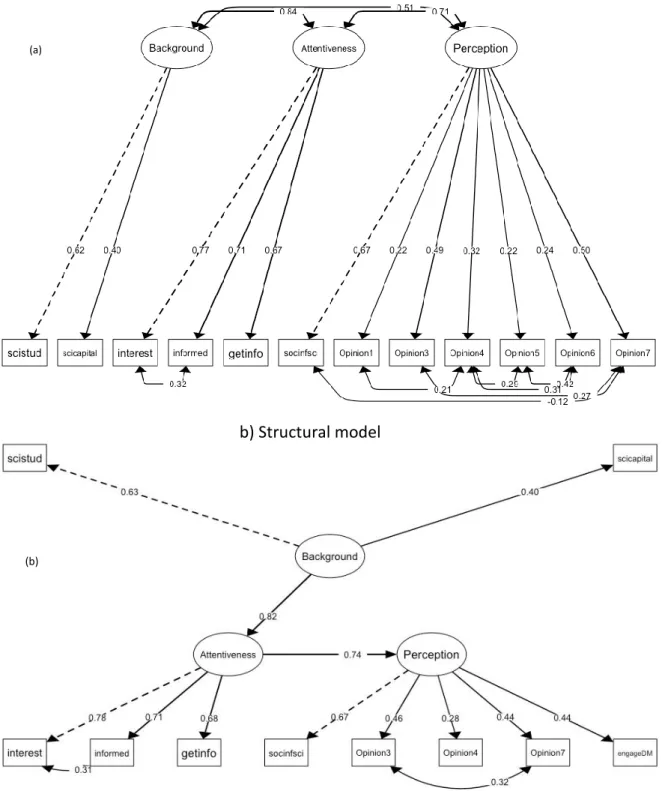
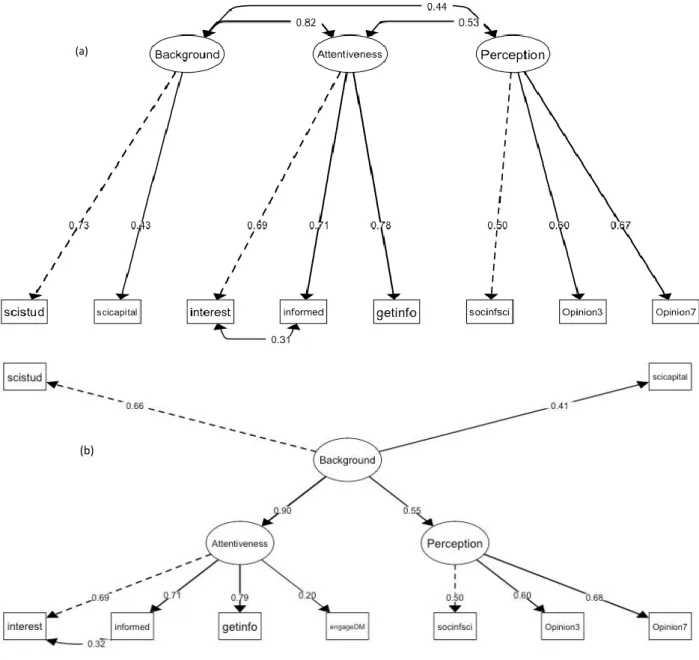
If we include a regression from perception to attention, the fit of the model improves. But the loadings are below 0.30. The fit is good, but the detection of detection predicts engageDM and there is a caveat because the detection variance is negative. This may be a sign that perception is not predicted by background, but by attention.
The fit has been improved, but the modification indices are not good enough (fitSPmm2, minimum.value = 10) SP_mm3 <-. With this adjustment, the fit is acceptable, but the regression of perception on involvement is only marginally significant, because there is an indirect relationship between the two via attention. But when we test this model, the fit increases only slightly and the percentage of variance explained in Perception decreases by almost 50%.
But since the fit is only acceptable, we analyze the possibility that other associations should be included.
SPAIN – SURVEY OF SOCIAL PERCEPTION OF SCIENCE AND TECHNOLOGY
The internal consistency is good and therefore we can obtain a single indicator by summing the 9 items.