Suggested citation: EFSA ANS Panel (EFSA Panel on Food Additives and Nutrient Sources Added to Food), 2016.
Scientific Opinion on the re-evaluation of benzoic acid (E 210), sodium benzoate (E 211), potassium benzoate (E 212) and calcium benzoate (E 213) as food additives. EFSA Journal 2016;14(3):4433, 110 pp. doi:10.2903/j.efsa.2016.4433
Available online: www.efsa.europa.eu/efsajournal
SCIENTIFIC OPINION
Scientific Opinion on the re-evaluation of benzoic acid (E 210), sodium benzoate (E 211), potassium benzoate (E 212) and calcium benzoate (E 213)
as food additives
1EFSA Panel on Food Additives and Nutrient Sources (ANS)2, 3 European Food Safety Authority (EFSA), Parma, Italy
ABSTRACT
The EFSA Panel on Food Additives and Nutrient Sources added to Food (ANS) was asked to deliver a scientific opinion re-evaluating benzoic acid (E 210), sodium benzoate (E 211), potassium benzoate (E 212) and calcium benzoate (E 213) when used as food additives. Benzoic acid and its sodium and potassium salts are rapidly absorbed after oral administration. The Panel considered that the absorption, distribution, metabolism and excretion of calcium benzoate will be similar to sodium or potassium salt and, therefore, read-across between the salts was possible. The results of short-term and subchronic studies on benzoic acid and its salts indicate that their toxicity is low. The Panel considered that the use of benzoic acid and its sodium and potassium salts as food additives does not raise a concern with respect to genotoxicity and, based on read-across, also considered that this conclusion is applicable for calcium benzoate. Moreover, the Panel noted that the available data did not indicate any carcinogenic potential. A four-generation reproductive toxicity study with benzoic acid in the diet in rats was considered by the Panel as the pivotal study and a no observed adverse effect level of 500 mg benzoic acid/kg body weight (bw) per day, the highest dose tested, was identified. From the aforementioned studies, the Panel derived an acceptable daily intake (ADI) of 5 mg/kg bw per day (expressed as benzoic acid) using an uncertainty factor of 100. Taking into account food categories for which direct addition of benzoic acid- benzoates is authorised, the group ADI was exceeded in the brand-loyal scenario in particular for toddlers and children consuming on a regular basis flavoured drinks. Considering additional exposure due to carry-over, the intake could be increased by up to two to three fold for all high-level consumers compared to the previous scenario with only direct addition to food. This results in exceedance of the group ADI in toddlers and children for the non-brand-loyal scenario. The main food categories contributing to this exceedance were unprocessed fruits and vegetables and flavoured drinks.
© European Food Safety Authority, 2016
1 On request from European Commission, Question Nos EFSA-Q-2011-00001, 2011-00002, 2011-00003 and 2011-00004, adopted on 8 March 2016.
2 Panel members: Fernando Aguilar, Riccardo Crebelli, Alessandro Di Domenico, Birgit Dusemund, Maria Jose Frutos, Pierre Galtier, David Gott, Ursula Gundert-Remy, Claude Lambré, Jean-Charles Leblanc, Oliver Lindtner, Peter Moldeus, Alicja Mortensen, Pasquale Mosesso, Dominique Parent-Massin, Agneta Oskarsson, Ivan Stankovic, Ine Waalkens- Berendsen, Rudolf Antonius Woutersen, Matthew Wright and Maged Younes Correspondence: [email protected]
3 Acknowledgement: The Panel wishes to thank the members of the former Working Group “B” Food Additives and Nutrient Sources (2011–2014) and the members of the Standing Working Group on the re-evaluation of food additives other than gums and colours: Polly Ester Boon, Dimitrios Chrysafidis, Birgit Dusemund, David Gott, Rainer Gürtler, Ursula Gundert-Remy, Claude Lambré, Jean-Charles Leblanc, Daniel Marzin, Peter Moldeus, Pasquale Mosesso, Dominique Parent-Massin, Ivan Stankovic, Paul Tobback, Ine Waalkens-Berendsen, Rudolf Antonius Woutersen and Matthew Wright for the preparatory work on this scientific opinion; and EFSA staff members: Ana Rincon and Alexandra Tard for the support provided to this scientific opinion. The ANS Panel wishes to acknowledge all European competent institutions, Member State bodies and other organisations that provided data for this scientific opinion.
KEY WORDS
food additive, benzoic acid, E 210, CAS No 65-85-0, sodium benzoate, E 211, CAS No 532-31-1, potassium benzoate, E 212, CAS No 582-25-2, calcium benzoate, E 213, CAS No 2090-05-3
SUMMARY
Following a request from the European Commission (EC), the Panel on Food Additives and Nutrient Sources added to Food (ANS) was asked to deliver a scientific opinion re-evaluating the safety of benzoic acid (E 210), sodium benzoate (E 211), potassium benzoate (E 212) and calcium benzoate (E 213) when used as food additives.
Benzoic acid, sodium benzoate, potassium benzoate and calcium benzoate (E 210, E 211, E 212 and E 213) are authorised food additives in the European Union (EU) and have previously been evaluated by the EU Scientific Committee on Food (SCF) in 1994 and 2002. The SCF established a group acceptable daily intake (ADI) of 0–5 mg/kg body weight (bw) per day for benzoic acid and its salts, also including benzyl alcohol and related benzyl derivatives used as flavourings. The Joint FAO/WHO Expert Committee on Food Additives (JECFA) has evaluated benzoic acid and its salts as food additives on a number of occasions. In 1974, JECFA established a group ADI of 0–5 mg/kg bw for benzoic acid and its salts, expressed as benzoic acid, which was reconfirmed at its most recent evaluation in 1996. JECFA has additionally reviewed benzoic acid as a flavouring substance.
Specific purity criteria have been defined in Commission Regulation (EU) No 231/2012 for benzoic acid and its salts (E 210–213). The Panel noted that the term ‘benzoic acid’ should be replaced by
‘potassium benzoate’ or ‘calcium benzoate’ in the EU specifications for potassium benzoate (E 212) and calcium benzoate (E 213), respectively. In addition, the Panel considered that if metals are used as catalysts in the manufacturing process of benzoic acid as a food additive, the maximum residual level for each metal should be specified in the EU specifications for benzoic acid (E 210). The Panel also considered that the maximum limits for the impurities of toxic elements (lead, mercury and arsenic) in the EC specification for benzoic acid and its salts (E 210–213) should be revised in order to ensure that benzoic acid and its salts (E 210–213) as food additives will not be a significant source of exposure to those toxic elements in food.
The Panel considered that when benzoic acid or its salts and ascorbic acid are used together, considerations should be given to the storage of the soft drinks and the food contact materials to minimise the formation of benzene in beverages.
The available data on absorption, distribution, metabolism and excretion (ADME) in animals and humans indicate that benzoic acid and its sodium and potassium salts are rapidly absorbed, primarily in the proximal part of the gastrointestinal tract, after oral administration. Benzoate is conjugated to glycine to form hippuric acid which is excreted in the urine. No studies appear to have been conducted on calcium benzoate, but the Panel considered that calcium benzoate also dissociates into its constituents calcium and benzoate ions in the small intestine. Consequently, the ADME of this salt will be similar to that of the sodium or potassium salts, despite differences in water solubility.
Therefore, the Panel considered read-across between the salts possible.
The results of the available short-term and subchronic studies on benzoic acid and its salts indicated that their toxicity is low, with no marked target organ toxicity, although high intakes of benzoic acid may lead to disturbances in the acid/base balance, and benzoic acid at high doses may interfere with intermediary metabolism
The Panel considered that the use of benzoic acid and its sodium and potassium salts as food additives did not raise a concern with respect to genotoxicity. Based on read-across, the Panel considered that this conclusion is also applicable for calcium benzoate.
The Panel noted that the available carcinogenicity studies on benzoic acid and its salts did not indicate any carcinogenic potential, although they were not conducted in accordance with current test guidelines and had deficiencies both in terms of design and reporting. Overall, given supporting
evidence of lack of carcinogenicity of the related substances benzyl alcohol, benzyl acetate and benzaldehyde as described by JECFA, the Panel considered that the data are sufficient to conclude that benzoic acid and its salts did not raise concern with respect to carcinogenicity.
In a developmental toxicity study in rats with benzoic acid by gavage, a no observed adverse effect level (NOAEL) of 160 mg benzoic acid/kg bw per day was observed for maternal and developmental toxicity The developmental toxicity studies in rats with sodium benzoate in the diet showed a NOAEL of 500 mg/kg bw per day comparable to the NOAEL of the dietary four-generation reproductive toxicity in rats with benzoic acid.
The four-generation reproductive toxicity study with benzoic acid in the diet in rats was considered by the Panel as the pivotal study, as this study was the longest exposure period as compared to the developmental studies. This study showed no effect on growth, fertility, lactation or survival, and provided a NOAEL, for both the parental animals and the offspring, of 500 mg benzoic acid/kg bw per day, the highest dose tested.
The Panel noted that benzoic acid and its salts may enhance hypersensitivity and/or cause skin reactions in sensitive people. Furthermore, anaphylaxis and urticaria have also been observed in sensitive individuals following exposure to benzoic acid and its salts at doses below the ADI. Several studies have shown that subgroups of patients already suffering from atopic dermatitis, pruritus, urticaria or persistent rhinitis may be intolerant even to low doses of benzoate.
The Panel noted the absence of any indication of genotoxicity of benzoic acid and its salts in vivo, together with the negative results of limited carcinogenicity studies in rats and mice. The Panel considered that the ADI cannot be derived from a prenatal developmental toxicity study with benzoic acid performed by gavage. The developmental toxicity studies in rats with sodium benzoate in the diet, showed NOAELs of 500 mg/kg bw per day (the highest dose tested) and 1310 mg/kg bw per day, respectively, comparable to or higher than the NOAEL of 500 mg/kg bw per day in the dietary multi- generation reproductive toxicity in rats with benzoic acid. From these reproductive and developmental studies, the Panel derived an ADI of 5 mg/kg bw per day (expressed as benzoic acid) applying an uncertainty factor of 100.
To assess the dietary exposure to benzoic acid-benzoates (E 210–213) from their use as a food additive, the exposure was calculated based on (1) maximum permitted levels (MPLs) set out in the EU legislation (defined as the regulatory maximum level exposure assessment scenario) and (2) the reported use levels and analytical data (defined as the refined exposure assessment scenario). Dietary exposure through this latter scenario was assessed using two sets of concentration data: reported use levels and analytical data not exceeding the MPLs for food categories for which direct addition of benzoic acid-benzoates is authorised (Annex II to Regulation No 1333/2008); and reported use levels and analytical data not exceeding the MPLs for food categories for which direct addition of benzoic acid-benzoates is authorised and analytical data for food categories which may contain benzoic acid- benzoates due to carry-over and for which data were available.
The exposure estimates in the regulatory maximum level exposure assessment scenario exceeded the ADI of 5 mg/kg bw per day for all population groups at the high levels and for toddlers and children also at the mean level.
Considering only food categories for which direct addition of benzoic acid-benzoates to food is authorised, the refined exposure to benzoic acid-benzoates (E 210–213) in toddlers and children, exceeded the ADI of 5 mg/kg bw per day at the high level (95th percentile) in the refined brand-loyal exposure estimate, while, for the non-brand-loyal scenario, the group ADI was not exceeded in any population group. Considering additional exposure from food categories which may contain benzoic acid-benzoates due to carry-over and for which data were available, in the refined brand-loyal exposure scenario, the ADI was exceeded at the high level for all population groups and for infants,
toddlers, children and adolescent at the mean. In the non-brand-loyal exposure scenario, the ADI was exceeded only for toddlers and children at the high level; at the mean level, there was no exceedance.
Considering the present toxicological database the Panel identified a NOAEL of 500 mg/kg bw per day and applying an uncertainty factor of 100, the Panel derived a group ADI of 5 mg/kg bw per day, expressed as benzoic acid, for benzoic acid (E 210), sodium benzoate (E 211), potassium benzoate (E 212) and calcium benzoate (E 213).
The Panel concluded that from the use of benzoic acid-benzoates as food additives from direct addition to food, the group ADI was exceeded in the brand-loyal scenario for toddlers and children consuming on a regular basis flavoured drinks.
Considering additional exposure from food categories which may contain benzoic acid-benzoates due to carry-over and for which data were available, the Panel concluded that exposure to benzoic acid- benzoates could be increased by up to two to three fold for all high-level consumers compared to the previous scenario for direct addition to food. This results in exceedance of the group ADI in toddlers and children for the non-brand-loyal scenario. The main food categories contributing to this exceedance were unprocessed fruits and vegetables and flavoured drinks.
.
TABLE OF CONTENTS
Abstract ... 1
Summary ... 3
Background as provided by the European Commission ... 8
Terms of reference as provided by the European Commission ... 8
Assessment ... 9
1. Introduction ... 9
2. Technical data ... 9
2.1. Identity of the substance ... 9
2.1.1. Benzoic acid ... 9
2.1.2. Sodium benzoate ... 10
2.1.3. Potassium benzoate ... 10
2.1.4. Calcium benzoate ... 11
2.2. Specifications ... 11
2.3. Manufacturing process ... 16
2.4. Methods of analysis in food ... 17
2.5. Reaction and fate in food ... 18
2.5.1. Formation of benzene from benzoic acid in the presence of ascorbic acid ... 18
2.6. Case of need and proposed uses ... 19
2.7. Reported use levels or data on analytical levels of benzoic acid-benzoates (E 210–213) in food 22 2.7.1. Summarised data on reported use levels in foods provided by industry ... 23
2.7.2. Summarised data on concentration levels in food submitted by Member States ... 23
2.8. Information on existing authorisations and evaluations ... 24
2.9. Exposure assessment... 26
2.9.1. Food consumption data used for exposure assessment ... 26
2.9.2. Exposure to benzoic acid-benzoates (E 210–213) from their use as food additives ... 28
2.9.3. Main food categories contributing to exposure to benzoic acid-benzoates (E 210–213) 32 2.9.4. Uncertainty analysis ... 32
3. Biological and toxicological data ... 34
3.1. Absorption, distribution, metabolism and excretion (ADME) ... 34
3.1.1. In vitro studies ... 34
3.1.2. In vivo studies ... 34
3.2. Toxicological data ... 36
3.2.1. Acute oral toxicity ... 36
3.2.2. Short-term and subchronic toxicity ... 37
3.2.3. Genotoxicity ... 39
3.2.4. Chronic toxicity and carcinogenicity ... 44
3.2.5. Reproductive and developmental toxicity ... 44
3.2.6. Allergenicity, hypersensitivity and intolerance ... 48
3.2.7. Other studies ... 50
4. Discussion... 50
Conclusions ... 54
Recommendations ... 55
Documentation provided to EFSA ... 55
References ... 56
Appendices ... 65
A. Summary of reported use levels (mg/kg) of benzoic acid-benzoates (E 210–213) provided by industry ... 65
B. Summary of analytical results (mg/kg) of benzoic acid provided by Member States ... 68
C. Concentration levels of benzoic acid-benzoates (E 210–213) used in the MPL scenario and refined exposure scenario using dataset 1(a) (mg/kg) ... 85
D. Summary of total estimated exposure to benzoic acid-benzoates (E 210–213) from their use as food additives per population group and survey for the MPL scenario and refined exposure scenario using dataset 1(a): mean and high level (mg/kg bw per day) ... 89 E. Main food categories contributing to exposure to benzoic acid-benzoates (E 210–213) using MPLs (> 5 % of the total mean exposure) and the number of surveys in which each food category is contributing ... 92 F. Main food categories contributing to the exposure to benzoic acid-benzoates (E 210–213) using dataset 1(a) for the “brand-loyal refined exposure scenario” (> 5 % of the total mean exposure) and the number of surveys in which each food category is contributing ... 93 G. Main food categories contributing to the exposure to benzoic acid-benzoates (E 210–213) using dataset 1(a) for the “non-brand-loyal refined exposure scenario” (> 5 % of the total mean exposure) and the number of surveys in which each food category is contributing ... 94 H. Concentration levels of benzoic acid-benzoates (E 210–213) used in the refined exposure
scenario with dataset 2(a) (mg/kg) ... 95 I. Summary of total estimated exposure to benzoic acid-benzoates (E 210–213) from their use as food additives per population group and survey for the refined exposure scenario using dataset 2(a): mean and high level (mg/kg bw per day) ... 102 J. Main food categories contributing to the exposure to benzoic acid-benzoates (E 210–213) using dataset 2(a) for the “brand-loyal refined exposure scenario” (> 5 % of the total mean exposure) and the number of surveys in which each food category is contributing ... 105 K. Main food categories contributing to the exposure to benzoic acid-benzoates (E 210–213) using dataset 2(a) for the “non-brand-loyal refined exposure scenario” (> 5 % of the total mean exposure) and the number of surveys in which each food category is contributing ... 107 L. Summary of refined estimated exposure to benzoic acid-benzoates (E 210–213) from their use as food additives considering concentration levels above the MPLs for food categories listed in Annex II to Regulation (EC) No 1333/2008 and analytical data for food categories which may contain benzoic acid-benzoates due to carry-over and for which data were available (min-max across the dietary
surveys in mg/kg bw per day). ... 108 Abbreviations ... 109
BACKGROUND AS PROVIDED BY THE EUROPEAN COMMISSION
Regulation (EC) No 1333/20084 of the European Parliament and of the Council on food additives requires that food additives are subject to a safety evaluation by the European Food Safety Authority (EFSA) before they are permitted for use in the European Union. In addition, it is foreseen that food additives must be kept under continuous observation and must be re-evaluated by EFSA.
For this purpose, a programme for the re-evaluation of food additives that were already permitted in the European Union before 20 January 2009 has been set up under Regulation (EU) No 257/20105. This Regulation also foresees that food additives are re-evaluated whenever necessary in the light of changing conditions of use and new scientific information. For efficiency and practical purposes, the re-evaluation should, as far as possible, be conducted by group of food additives according to the main functional class to which they belong.
The order of priorities for the re-evaluation of the currently approved food additives should be set on the basis of the following criteria: the time since the last evaluation of a food additive by the Scientific Committee on Food or by EFSA, the availability of new scientific evidence, the extent of use of a food additive in food and the human exposure to the food additive taking also into account the outcome of the Report from the Commission on Dietary Food Additive Intake in the EU6 of 2001.
The report ‘Food additives in Europe 2000’,7 submitted by the Nordic Council of Ministers to the Commission, provides additional information for the prioritisation of additives for re-evaluation. As colours were among the first additives to be evaluated, these food additives should be re-evaluated with the highest priority.
In 2003, the Commission already requested EFSA to start a systematic re-evaluation of authorised food additives. However, as a result of the adoption of Regulation (EU) 257/2010, the 2003 Terms of Reference are replaced by those below.
TERMS OF REFERENCE AS PROVIDED BY THE EUROPEAN COMMISSION
The Commission asks the European Food Safety Authority to re-evaluate the safety of food additives already permitted in the Union before 2009 and to issue scientific opinions on these additives, taking especially into account the priorities, procedure and deadlines that are enshrined in Regulation (EU) No 257/2010 of 25 March 2010 setting up a programme for the re-evaluation of approved food additives in accordance with Regulation (EC) No 1333/2008 of the European Parliament and of the Council on food additives.
4 Regulation (EC) No 1333/2008 of the European Parliament and of the Council of 16 December 2008 on food additives. OJ L 354, 31.12.2008, p. 16–33.
5 Commission Regulation (EU) No 257/2010 of 25 March 2010 setting up a programme for the re-evaluation of approved food additives in accordance with Regulation (EC) No 1333/2008 of the European Parliament and of the Council on food additives. OJ L 80, 26.3.2010, p. 19–27.
6 COM(2001) 542 final.
7 Food Additives in Europe 2000, Status of safety assessments of food additives presently permitted in the EU, Nordic Council of Ministers, TemaNord 2002, 560.
ASSESSMENT
1. Introduction
The present opinion deals with the re-evaluation of the safety of benzoic acid (E 210), sodium benzoate (E 211), potassium benzoate (E 212) and calcium benzoate (E 213) when used as food additives.
Benzoic acid, sodium benzoate, potassium benzoate and calcium benzoate are authorised as food additives in the EU and were previously evaluated by the EU Scientific Committee on food (SCF) in 1994 and 2002 (SCF, 1994, 2002). The Joint FAO/WHO Expert Committee on Food Additives (JECFA) has evaluated benzoic acid and its salts as food additives on a number of occasions, most recently in 1996 (JECFA, 1996, 1997). JECFA has additionally reviewed benzoic acid as a flavouring substance (JECFA 2001, 2002). Benzoic acid and its salts have also been reviewed by TemaNord (2002).
The Panel was not provided with a newly submitted dossier and based its evaluation on previous evaluations, additional literature that became available since then and the data available following an EFSA public call for scientific data.8,9,10 To assist in identifying any emerging issue, EFSA has outsourced a contract to deliver an updated literature review on toxicological end-points, dietary exposure and occurrence levels of benzoic acid-benzoates (E 210–213) which covered the period from January 2013 up to the end of 2014.
2. Technical data
2.1. Identity of the substance
2.1.1. Benzoic acid
Benzoic acid (E 210) is an aromatic carboxylic acid, the chemical name according to IUPAC nomenclature rules being benzoic acid. The Chemical Abstracts Service (CAS) Registry number is 65-85-0and the European Inventory of Existing Commercial chemical Substances (EINECS) number is 200-618-2. The molecular formula for benzoic acid is C7H6O2 and the molecular weight is 122.1 g/mol. Its structural formula is given below (Figure 1):
Figure 1: Structural formula of benzoic acid
8 Call for scientific data on food additives permitted in the EU and belonging to the functional classes of preservatives and antioxidants. Published: 23 November 2009. Available online: http://www.efsa.europa.eu/en/dataclosed/call/
ans091123a.htm
9 Call for approved food additives (sorbates, benzoates and gallates) occurrence data in food and beverages intended for human consumption. Published: 31 May 2012. Available online: http://www.efsa.europa.eu/sites/default/files/
consultation/120601.pdf
10 Call for scientific data on selected food additives permitted in the EU- Extended deadline: 1 September 2014 (batch A), 1 November 2014 (batch B) Available online: http://www.efsa.europa.eu/en/dataclosed/call/140324.htm
The most commonly known synonyms are benzenecarboxylic acid, phenylcarboxylic acid, carboxybenzene and dracylic acid (ChemID Plus, online). Benzoic acid is a white crystalline powder.
The melting range is 121.5–123.5˚C (Commission Regulation (EU) No 231/201211). It is slightly soluble in water (2.9 g/l at 20˚C) and freely soluble in ethanol (JECFA, 2006). Benzoic acid is a weak acid with a pKa of 4.19 (OECD SIDS, 2001; WHO, 2005) and will be almost completely dissociated at pH 7.
2.1.2. Sodium benzoate
Sodium benzoate (E 211) is the sodium salt of benzoic acid, the chemical name according to IUPAC nomenclature rules being sodium benzoate. The CAS Registry number is 532-32-1 and the EINECS number is 208-534-8. The molecular formula for sodium benzoate is C7H5NaO2 and the molecular weight is 144.1 g/mol. Its structural formula is given below (Figure 2):
Figure 2: Structural formula of sodium benzoate
The most commonly known synonyms are sodium salt of benzene carboxylic acid, sodium salt of phenyl carboxylic acid and benzoate of soda (ChemID Plus, online). Sodium benzoate is a white, almost odourless, crystalline powder or granule. The compound is freely soluble in water (556 g/l at 20°C) and sparingly soluble in ethanol (OECD SIDS, 2001; Commission Regulation (EU) No 231/2012).
2.1.3. Potassium benzoate
Potassium benzoate (E 212) is the potassium salt of benzoic acid, the chemical name according to IUPAC nomenclature rules being potassium benzoate. The CAS Registry number is 582-25-2 (anhydrous) and the EINECS number is 209-481-3. The molecular formula for anhydrous potassium benzoate is C7H5KO2 and the molecular weight is 160.2 g/mol. JECFA specifications refer to both anhydrous and trihydrate forms (JECFA, 2006), while EU specifications refer to the trihydrate only.
The structural formula of the anhydrous form is given below (Figure 3):
Figure 3: Structural formula of anhydrous potassium benzoate
11 Commission Regulation (EU) No 231/2012 of 9 March 2012 laying down specifications for food additives listed in Annexes II and III to Regulation (EC) No 1333/2008 of the European Parliament and of the Council. OJ L 83, 22.3.2012, p. 1–295.
The most commonly known synonyms are potassium salt of benzoic acid, potassium salt of benzenecarboxylic acid and potassium salt of phenylcarboxylic acid (ChemID Plus, online).
Potassium benzoate is a white crystalline powder (Commission Regulation (EU) No 231/2012). One gram dissolves in 2 mL of water, in 75 mL ethanol and 50 mL alcohol (90 %) (FCC, 2010-2011).
2.1.4. Calcium benzoate
Calcium benzoate (E 213) is the calcium salt of benzoic acid, the chemical name according to IUPAC nomenclature rules being calcium dibenzoate. The CAS Registry number is 2090-05-3 and the EINECS number is 218-235-4. The molecular formula for calcium benzoate (anhydrous) is C14H10CaO4 and the molecular weight is 282.3 g/mol. EC and JECFA specifications refer to the anhydrous, monohydrate and trihydrate forms. The structural formula of the anhydrous form is given below (Figure 4):
Figure 4: Structural formula of anhydrous calcium benzoate
Synonyms are benzoic acid calcium salt, calcium benzoate and monocalcium benzoate (ChemID Plus, online). Calcium benzoate exists as white or colourless crystals or as a white powder and is sparingly soluble in water (27.2 g/l at 20°C) (Commission Regulation (EU) No 231/2012; JECFA, 2006).
2.2. Specifications
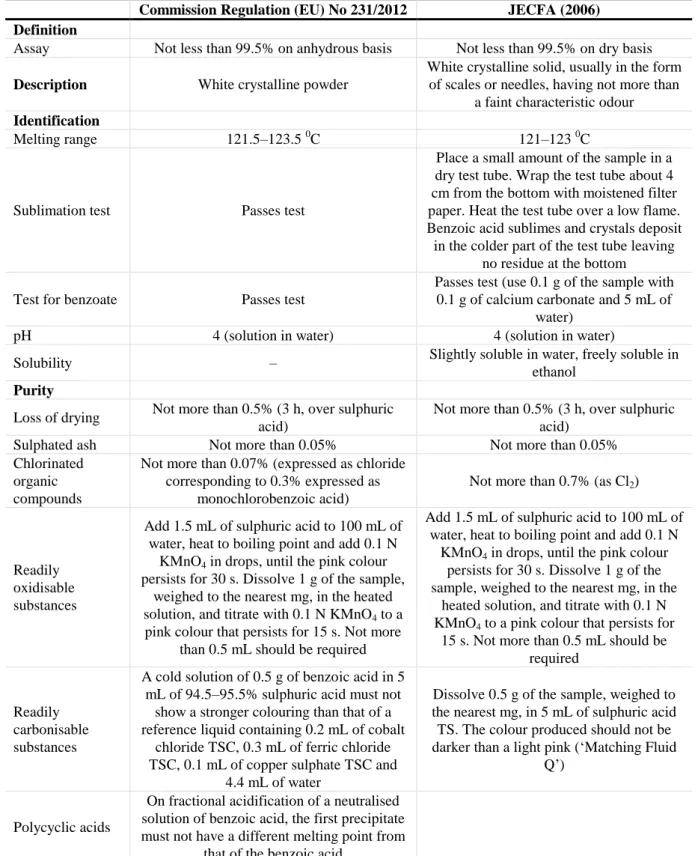
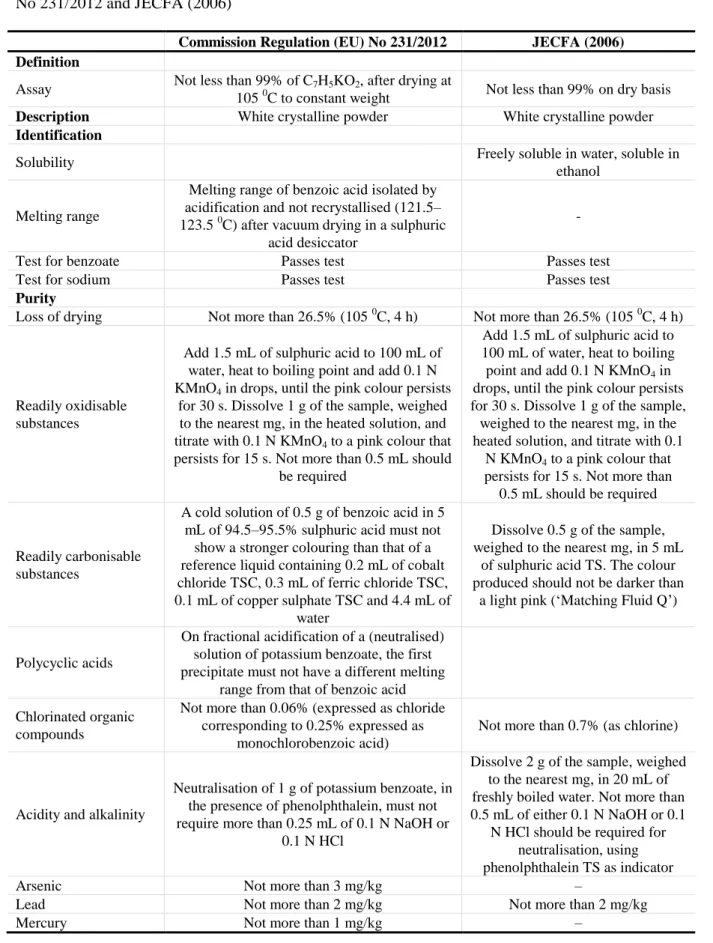
Specifications for benzoic acid and its sodium, potassium and calcium salts have been defined in Commission Regulation (EU) No 231/2012 and by JECFA (2006) (Tables 1–4).
Table 1: Specifications for benzoic acid (E 210) according to Commission Regulation (EU) No 231/2012 and JECFA (2006)
Commission Regulation (EU) No 231/2012 JECFA (2006) Definition
Assay Not less than 99.5% on anhydrous basis Not less than 99.5% on dry basis Description White crystalline powder
White crystalline solid, usually in the form of scales or needles, having not more than
a faint characteristic odour Identification
Melting range 121.5–123.5 0C 121–123 0C
Sublimation test Passes test
Place a small amount of the sample in a dry test tube. Wrap the test tube about 4 cm from the bottom with moistened filter paper. Heat the test tube over a low flame.
Benzoic acid sublimes and crystals deposit in the colder part of the test tube leaving
no residue at the bottom
Test for benzoate Passes test
Passes test (use 0.1 g of the sample with 0.1 g of calcium carbonate and 5 mL of
water)
pH 4 (solution in water) 4 (solution in water)
Solubility – Slightly soluble in water, freely soluble in
ethanol Purity
Loss of drying Not more than 0.5% (3 h, over sulphuric acid)
Not more than 0.5% (3 h, over sulphuric acid)
Sulphated ash Not more than 0.05% Not more than 0.05%
Chlorinated organic compounds
Not more than 0.07% (expressed as chloride corresponding to 0.3% expressed as
monochlorobenzoic acid)
Not more than 0.7% (as Cl2)
Readily oxidisable substances
Add 1.5 mL of sulphuric acid to 100 mL of water, heat to boiling point and add 0.1 N
KMnO4 in drops, until the pink colour persists for 30 s. Dissolve 1 g of the sample,
weighed to the nearest mg, in the heated solution, and titrate with 0.1 N KMnO4 to a pink colour that persists for 15 s. Not more
than 0.5 mL should be required
Add 1.5 mL of sulphuric acid to 100 mL of water, heat to boiling point and add 0.1 N
KMnO4 in drops, until the pink colour persists for 30 s. Dissolve 1 g of the sample, weighed to the nearest mg, in the
heated solution, and titrate with 0.1 N KMnO4 to a pink colour that persists for
15 s. Not more than 0.5 mL should be required
Readily carbonisable substances
A cold solution of 0.5 g of benzoic acid in 5 mL of 94.5–95.5% sulphuric acid must not
show a stronger colouring than that of a reference liquid containing 0.2 mL of cobalt
chloride TSC, 0.3 mL of ferric chloride TSC, 0.1 mL of copper sulphate TSC and
4.4 mL of water
Dissolve 0.5 g of the sample, weighed to the nearest mg, in 5 mL of sulphuric acid TS. The colour produced should not be darker than a light pink (‘Matching Fluid
Q’)
Polycyclic acids
On fractional acidification of a neutralised solution of benzoic acid, the first precipitate must not have a different melting point from
that of the benzoic acid
Arsenic Not more than 3 mg/kg –
Lead Not more than 2 mg/kg Not more than 2 mg/kg
Mercury Not more than 1 mg/kg –
Table 2: Specifications for sodium benzoate (E 211) according to Commission Regulation (EU) No 231/2012 and JECFA (2006)
Commission Regulation (EU) No 231/2012 JECFA (2006) Definition
Assay Not less than 99% of C7H5O2Na, after drying
at 105 0C for 4 h Not less than 99% on dry basis Description White, almost odourless, crystalline powder or
granules
White, almost odourless, crystalline powder, flakes or granules Identification
Solubility Freely soluble in water, sparingly soluble in ethanol
Freely soluble in water, sparingly soluble in ethanol Melting range
Melting range of benzoic acid isolated by acidification and not recrystallised (121.5–
123.5 0C) after drying in a sulphuric acid desiccator
–
Test for benzoate Passes test Passes test
Test for sodium Passes test Passes test
Purity
Loss of drying Not more than 1.5% (105 0C, 4 h) Not more than 1.5% (105 0C, 4 h)
Readily oxidisable substances
Add 1.5 mL of sulphuric acid to 100 mL of water, heat to boiling point and add 0.1 N KMnO4 in drops, until the pink colour persists
for 30 s. Dissolve 1 g of the sample, weighed to the nearest mg, in the heated solution, and titrate with 0.1 N KMnO4 to a pink colour that persists for 15 s. Not more than 0.5 mL should
be required
Add 1.5 mL of sulphuric acid to 100 mL of water, heat to boiling point and
add 0.1 N KMnO4 in drops, until the pink colour persists for 30 s. Dissolve
1 g of the sample, weighed to the nearest mg, in the heated solution, and
titrate with 0.1 N KMnO4 to a pink colour that persists for 15 s. Not more
than 0.5 mL should be required Readily
carbonisable substances
–
Dissolve 0.5 g of the sample, weighed to the nearest mg, in 5 mL of sulphuric
acid TS. The colour produced should not be darker than a light pink
(‘Matching Fluid Q’) Polycyclic acids
On fractional acidification of a (neutralised) solution of sodium benzoate, the first precipitate must not have a different melting
range from that of benzoic acid Chlorinated organic
compounds
Not more than 0.06% (expressed as chloride corresponding to 0.25% expressed as
monochlorobenzoic acid)
Not more than 0.7% (as chlorine)
Acidity and alkalinity
Neutralisation of 1 g of sodium benzoate, in the presence of phenolphthalein, must not require more than 0.25 mL of 0.1 N NaOH or
0.1 N HCl
Dissolve 2 g of the sample, weighed to the nearest mg, in 20 mL of freshly boiled water. Not more than 0.5 mL of either 0.1 N NaOH or 0.1 N HCl should
be required for neutralisation, using phenolphthalein TS as indicator
Arsenic Not more than 3 mg/kg –
Lead Not more than 2 mg/kg Not more than 2 mg/kg
Mercury Not more than 1 mg/kg –
Table 3: Specifications for potassium benzoate (E 212) according to Commission Regulation (EU) No 231/2012 and JECFA (2006)
Commission Regulation (EU) No 231/2012 JECFA (2006) Definition
Assay Not less than 99% of C7H5KO2, after drying at
105 0C to constant weight Not less than 99% on dry basis Description White crystalline powder White crystalline powder Identification
Solubility Freely soluble in water, soluble in
ethanol Melting range
Melting range of benzoic acid isolated by acidification and not recrystallised (121.5–
123.5 0C) after vacuum drying in a sulphuric acid desiccator
-
Test for benzoate Passes test Passes test
Test for sodium Passes test Passes test
Purity
Loss of drying Not more than 26.5% (105 0C, 4 h) Not more than 26.5% (105 0C, 4 h)
Readily oxidisable substances
Add 1.5 mL of sulphuric acid to 100 mL of water, heat to boiling point and add 0.1 N KMnO4 in drops, until the pink colour persists
for 30 s. Dissolve 1 g of the sample, weighed to the nearest mg, in the heated solution, and titrate with 0.1 N KMnO4 to a pink colour that persists for 15 s. Not more than 0.5 mL should
be required
Add 1.5 mL of sulphuric acid to 100 mL of water, heat to boiling point and add 0.1 N KMnO4 in drops, until the pink colour persists for 30 s. Dissolve 1 g of the sample,
weighed to the nearest mg, in the heated solution, and titrate with 0.1
N KMnO4 to a pink colour that persists for 15 s. Not more than
0.5 mL should be required
Readily carbonisable substances
A cold solution of 0.5 g of benzoic acid in 5 mL of 94.5–95.5% sulphuric acid must not
show a stronger colouring than that of a reference liquid containing 0.2 mL of cobalt chloride TSC, 0.3 mL of ferric chloride TSC, 0.1 mL of copper sulphate TSC and 4.4 mL of
water
Dissolve 0.5 g of the sample, weighed to the nearest mg, in 5 mL
of sulphuric acid TS. The colour produced should not be darker than
a light pink (‘Matching Fluid Q’)
Polycyclic acids
On fractional acidification of a (neutralised) solution of potassium benzoate, the first precipitate must not have a different melting
range from that of benzoic acid Chlorinated organic
compounds
Not more than 0.06% (expressed as chloride corresponding to 0.25% expressed as
monochlorobenzoic acid)
Not more than 0.7% (as chlorine)
Acidity and alkalinity
Neutralisation of 1 g of potassium benzoate, in the presence of phenolphthalein, must not require more than 0.25 mL of 0.1 N NaOH or
0.1 N HCl
Dissolve 2 g of the sample, weighed to the nearest mg, in 20 mL of freshly boiled water. Not more than 0.5 mL of either 0.1 N NaOH or 0.1
N HCl should be required for neutralisation, using phenolphthalein TS as indicator
Arsenic Not more than 3 mg/kg –
Lead Not more than 2 mg/kg Not more than 2 mg/kg
Mercury Not more than 1 mg/kg –
Table 4: Specifications for calcium benzoate (E 213) according to Commission Regulation (EU) No 231/2012 and JECFA (2006)
Commission Regulation (EU) No 231/2012 JECFA (2006) Definition
Assay Not less than 99% after drying at 105 0C Not less than 99% on dry basis Description White or colourless crystals, or white powder White or colourless crystals, or
white powder Identification
Solubility Sparingly soluble in water
Melting range
Melting range of benzoic acid isolated by acidification and not recrystallised (121.5–
123.5 0C) after vacuum drying in a sulphuric acid desiccator
-
Test for benzoate Passes test Passes test
Test for sodium Passes test Passes test
Purity
Loss of drying Not more than 17.5% (105 0C, to constant
weight) Not more than 17.5% (105 0C, 4 h)
Water-insoluble matter Not more than 0.3% Not more than 0.3%
Readily oxidisable substances
Add 1.5 mL of sulphuric acid to 100 mL of water, heat to boiling point and add 0.1 N KMnO4 in drops, until the pink colour persists
for 30 s. Dissolve 1 g of the sample, weighed to the nearest mg, in the heated solution, and titrate with 0.1 N KMnO4 to a pink colour that persists for 15 s. Not more than 0.5 mL should
be required
Add 1.5 mL of sulphuric acid to 100 mL of water, heat to boiling point and add 0.1 N KMnO4 in drops, until the pink colour persists for 30 s. Dissolve 1 g of the sample, weighed to the nearest mg, in the heated solution, and titrate with 0.1
N KMnO4 to a pink colour that persists for 15 s. Not more than
0.5 mL should be required
Readily carbonisable substances
A cold solution of 0.5 g of benzoic acid in 5 mL of 94.5–95.5% sulphuric acid must not
show a stronger colouring than that of a reference liquid containing 0.2 mL of cobalt chloride TSC, 0.3 mL of ferric chloride TSC, 0.1 mL of copper sulphate TSC and 4.4 mL of
water
Dissolve 0.5 g of the sample, weighed to the nearest mg, in 5 mL
of sulphuric acid TS. The colour produced should not be darker than
a light pink (‘Matching Fluid Q’)
Polycyclic acids
On fractional acidification of a (neutralised) solution of calcium benzoate, the first precipitate must not have a different melting
range from that of benzoic acid Chlorinated organic
compounds
Not more than 0.06 % (expressed as chloride corresponding to 0.25 % expressed as
monochlorobenzoic acid)
Not more than 0.7% (as Cl2)
Acidity and alkalinity
Neutralisation of 1 g of calcium benzoate, in the presence of phenolphthalein, must not require more than 0.25 mL of 0.1 N NaOH or
0.1 N HCl
Dissolve 2 g of the sample, weighed to the nearest mg, in 20 mL of freshly boiled water. Not more than 0.5 mL of either 0.1 N NaOH or 0.1
N HCl should be required for neutralisation, using phenolphthalein TS as indicator
Fluoride Not more than 10 mg/kg Not more than 10 mg/kg
Arsenic Not more than 3 mg/kg –
Lead Not more than 2 mg/kg Not more than 2 mg/kg
Mercury Not more than 1 mg/kg –
The Panel noted that in the EU specifications for potassium benzoate (E 212) and calcium benzoate (E 213), ‘Readily carbonisable substances’ are described as ‘a solution of 0.5 g of benzoic acid’;
however, the term ‘benzoic acid’ should be replaced by ‘potassium benzoate’ or ‘calcium benzoate’, respectively.
From the general information on the manufacturing process (see Section 2.3), several by-products might be formed (benzaldehyde, benzyl alcohol, benzyl benzoate, benzyl formate, benzyl acetate, biphenyl, methyl biphenyls and phthalic acid) next to residual toluene used as raw material. The Panel considered that a maximum limit for toluene and any by-products produced during the manufacturing process of benzoic acid as a food additive should be included in the EU specifications. In addition, the Panel noted that some catalysts (e.g. cobalt naphthenate) can be used in the manufacturing process.
Therefore, the Panel also considered that if metals are used as catalysts in the manufacturing process of benzoic acid as a food additive, the maximum residual level for each metal should be specified in the EU specifications.
The Panel noted that according to the EU specifications for benzoic acid and its salts, impurities of the toxic elements lead, mercury and arsenic are accepted up to a concentration of 2, 1 and 3 mg/kg, respectively. Contamination at those levels would have a significant impact on the exposure to these metals, for which the exposure already are close to the health-based guidance values established by EFSA (EFSA CONTAM Panel 2009, 2010, 2012).
2.3. Manufacturing process
According to Maki and Takeda (2000), benzoic acid is produced, worldwide, by liquid-phase oxidation of toluene with molecular oxygen. Originally the oxidation reaction was carried out at 140 °C and ca. 0.2 MPa with a cobalt naphthenate catalyst (0.1%). Other oil-soluble cobalt salts were also used as catalysts. The purity of toluene is critical because sulphur compounds, nitrogen compounds, phenols and olefins inhibit the oxidation reaction. The oxidation reaction is a free-radical chain process. Peroxides are reaction intermediates. In a typical modern process, the oxidation is conducted at 165 °C and 0.9 MPa. The pressure of the liquid discharged from the reactor is reduced to atmospheric, and unreacted toluene is recovered. Benzoic acid is purified by rectification. The bottom residue is extracted to recover the cobalt catalyst. In the oxidation reaction, several by-products are formed: benzaldehyde, benzyl alcohol and benzyl benzoate. Other esters, including benzyl formate and benzyl acetate, are also present. Biphenyl and methyl biphenyls are formed in smaller amounts.
Small amounts of phthalic acid can also be present. For food and pharmaceutical uses, benzoic acid is upgraded by further processing. Sublimation, recrystallisation and neutralisation processes have been proposed. To remove phthalic acid, whose presence is not allowed for food uses, treatment with amines and rinsing is required.
According to industry (Doc. provided to EFSA n. 2), ‘production of benzoic acid is by liquid-phase oxidation of toluene in the presence of a cobalt catalyst. Air is the source of oxygen in this free radical reaction. Reaction by-products include benzaldehyde, acetic acid, formic acid and benzyl alcohol.
Crude benzoic acid is recovered by distillation’ and ‘for sodium benzoate production sodium hydroxide (caustic soda) is added to benzoic acid’.
Sodium benzoate is produced by the neutralisation of benzoic acid with sodium hydroxide (Maki and Takedi, 2000; Doc. provided to EFSA n. 2). Potassium benzoate is obtained in high yield by reacting an aromatic hydrocarbon solution of benzoic acid, such as that which is obtained from the toluene oxidation process, with potassium hydroxide preferably in concentrated aqueous solution, thereby precipitating solid potassium benzoate (Hills, 1975). No information was available regarding the manufacture of calcium benzoate; the ANS Panel assumed that it is manufactured similarly, by reaction of benzoic acid with calcium hydroxide, or other calcium salt. The Panel noted that if limestone is the source of calcium carbonate which is used in the production of calcium benzoate,
then calcium benzoate could be contaminated with aluminium. In its opinion on the re-evaluation of calcium carbonate (E 170) as a food additive (EFSA ANS Panel, 2011), the ANS Panel noted that limestone may contain aluminium at concentrations up to 190 mg/kg. Therefore, specifications for the maximum level of aluminium in calcium benzoate may be required.
2.4. Methods of analysis in food
The Panel noted that a vast number of methods have been described for the determination of benzoic acid and benzoate salts in foods. From the available literature it is evident that the decision on the appropriate method of analysis that should be used may depend primarily on the matrix in which the benzoic acid and benzoate salts are present, although there are some analytical methods which appear to apply to all matrices. High-performance liquid chromatography (HPLC) (Mandrou et al. 1998;
Pylypiw and Grether 2000, Tfouni and Toledo 2002; Techakriengkrai and Surakarnkul 2007; Mota et al. 2003), ion chromatography (Xie et al. 1999) and capillary electrophoresis (CE) (Han et al. 2008;
Wei et al. 2011) techniques were frequently applied for the analysis of preservatives including benzoic acid and benzoate salts in foodstuffs. Gas chromatographic (GC) methods have also been used where sample pre-treatment involving liquid–liquid extraction, anion-exchange clean-up and precipitation of proteins was often needed (De Luca et al. 1995; González et al. 1999; Dong and Wang 2006).
Kokya et al. (2012) have developed a dispersive liquid–liquid micro-extraction (DLLME) method based on the dispersion of tiny droplets of the extraction liquid within aqueous solution which is followed by GC analysis.
The Panel decided to refer to these publications for more details on the method of analysis of benzoic acid and its salts in a specific food item.
More specifically, the simultaneous determination of sorbic and benzoic acids in tomato sauce and ketchup using HPLC was performed by Nour et al. (2009).
A validated HPLC method for the measurement of benzoic acid in soft drinks has been described by Ene and Diacu (2009).
A novel reversed-phase HPLC method for simultaneous determination of potassium sorbate and sodium benzoate in soft drinks was described by Can et al. (2011) and in beverage, vinegar and fruit jam by CE after online pre-concentration by dynamic pH junction by Zhang et al. (2011).
The determination of benzoic acid residue from fruit juice by gas chromatography with mass spectrometry detection technique was described by Sen et al. (2011).
The analysis of nine food additives, including benzoic acid, in red wine by ion-suppression reversed- phase HPLC using trifluoroacetic acid and ammonium acetate as ion-suppressors was described by Zhao et al. (2012). The simultaneous determination of 11 preservatives in foods, including benzoic acid in various foodstuffs by using ultrasound-assisted emulsification micro-extraction followed by gas chromatography-mass spectrometry (GC-MS), was described by Yang et al. (2012).
The evaluation of analytical performance parameters and uncertainty budget of the HPLC method with UV diode array detection on a reverse phase column for traceable determination of benzoic acid in soft drinks was described by Jurcovan et al. (2012).
The quantification for benzoic acid in processed foods using quantitative proton nuclear magnetic resonance spectroscopy was described by Ohtsuki et al. (2012).
The determination of benzoic acid in milk by solid-phase extraction and ion chromatography with conductivity detection was described by Wang et al. (2013).
The determination of five organic acid preservatives, including benzoic acid, in fruits and beverages diluted with a phosphate buffer solution followed by liquid chromatography analysis was described by Lin et al. (2013).
HPLC and liquid chromatography-mass spectrometry/mass spectrometry (LC-MS/MS) methods were developed and validated for the quantitative analysis of sodium benzoate and potassium sorbate in tomato ketchup and orange juice by Gören et al. (2015) and the outcome of a proficiency testing of a number of accredited laboratories was presented.
2.5. Reaction and fate in food
Benzoic acid and its salts are primarily used as food additives (preservatives) in acidified foodstuffs and beverages such as fruit juice, soft drinks and carbonated drinks. Information on the stability of the salts of the benzoic acid in food is very limited, but the benzoate anion is chemically stable, and degradation in food or reactions with food components are not anticipated, with the exception of the reaction with ascorbic acid under certain conditions described below.
2.5.1. Formation of benzene from benzoic acid in the presence of ascorbic acid
Small amounts of benzene can be formed from benzoic acid in the presence of ascorbic acid and transition metal ions like copper(II) and iron(III) (Chang and Ku 1993; Gardner and Lawrence 1993;
McNeal et al., 1993). The chemical reaction is catalysed by metal ions, which are present at low concentrations in drinking water. The studies performed by Chang and Ku (1993), Gardner and Lawrence (1993) and McNeal et al. (1993) were summarised by the German Federal Institute for Risk Assessment (BfR, 2005).
In 2006, the European Commission and Member States had become aware of the potential formation of benzene under certain conditions in soft drinks from the reaction of benzoic acid and other ingredients. The issue was considered in the meetings of the Standing Committee of the Food Chain and Animal Health in July and December 2007 (EC, 2007a, b). ‘The Committee noted that the reformulation work by the industry appeared to be working given the limited number of samples in which levels of benzene were above 10 µg/L. However it was considered that further monitoring would be useful although no further formal action was considered necessary by the Commission at this time’.
The Norwegian Scientific Committee for Food Safety reported results of analysis of benzene content in 16 soft drinks containing both sodium benzoate and ascorbic acid; 13 samples contained non- detectable levels of benzene and three samples contained benzene at levels between 0.7 and 4.7 mg/L (VKM, 2007).
In Germany, the concentrations of benzene measured in non-alcoholic beverages were below the EU drinking water limit of 1 µg/L while higher concentrations were found in previous years (Steinbrenner et al., 2010).
Therefore, the Panel considered that combining ascorbic acid with benzoic acid in soft drinks could lead to the formation of benzene from benzoic acid. The Panel noted that benzene is a genotoxic carcinogen classified by the International Agency for Research on Cancer as carcinogenic to humans (Group 1) (IARC, 2012), that the World Health Organization (WHO) has derived a guideline value
for benzene in drinking water of 10 µg/L (WHO, 2011), that according to the Council Directive 98/83/EC12 the maximum level of benzene in drinking water is 1 µg/L in the European Union and that the German Federal Institute for Risk Assessment considered that the concentration of benzene in beverages should be as low as reasonably achievable (BfR 2013).
2.6. Case of need and proposed uses
Maximum levels of benzoic acid-benzoates (E 210–213) have been defined in Annex II and Annex III to Regulation (EC) No 1333/2008 on food additives, as amended. These levels are defined by the Panel as maximum permitted levels (MPLs) in this document.
Currently, benzoic acid-benzoates (E 210–213) are authorised as food additives in the EU with MPLs ranging from 150 to 6,000 mg/kg in foods. The Panel noted that benzoic acid-benzoates (E 210–213) are authorised in combination with sorbic acid-sorbates (E 200, 202, 203) and p-hydroxybenzoates (PHB; E 214, 215, 218, 219) (Regulation (EC) No 1333/2008).
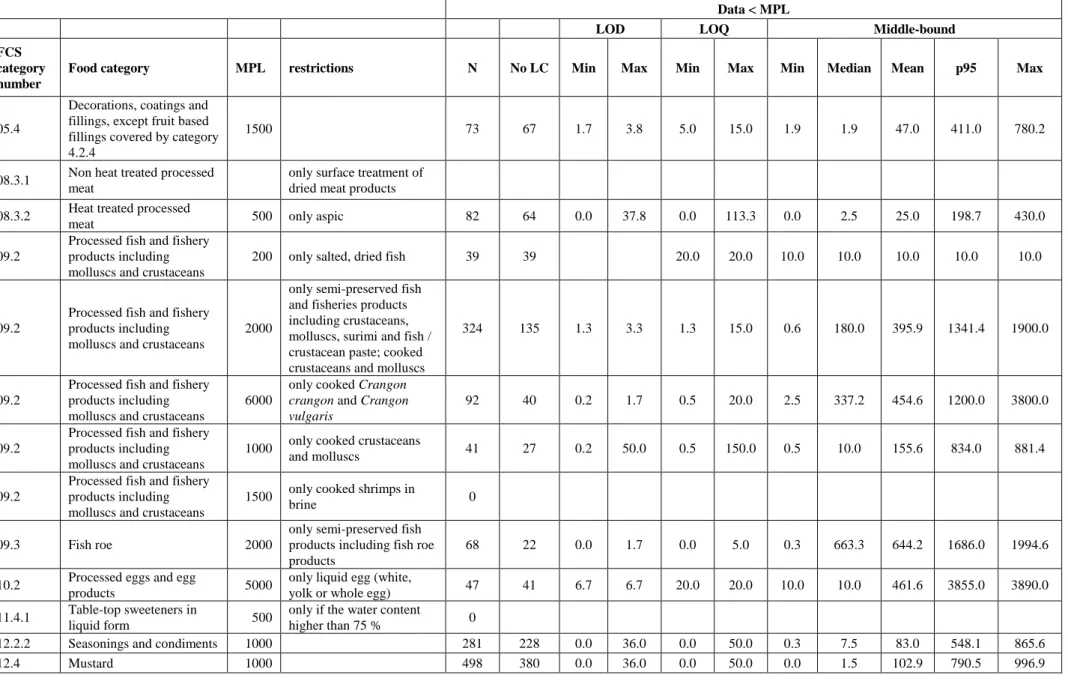
Table 5 summarises foods that are permitted to contain benzoic acid-benzoates (E 210–213) and the corresponding MPLs as defined in Annex II to Regulation (EC) No 1333/2008.
Table 5: MPLs of benzoic acid-benzoates (E 210–213) in foods according to Annex II to Regulation (EC) No 1333/2008
FCS category number
FCS food category E -number MPL (mg/L or mg/kg as appropriate)
Restrictions/exception
01.4 Flavoured fermented milk products including heat-treated products
E 200–213 300(a),(b) Only non-heat treated dairy- based desserts
04.2.2 Fruit and vegetables in vinegar, oil or brine
E 200–213 2,000(a),(b) Only vegetables (excluding olives)
04.2.2 Fruit and vegetables in vinegar, oil or brine
E 210–213 500(a),(b) Only olives and olive-based preparations
04.2.4.1 Fruit and vegetable preparations excluding compote
E 210–213 500(a),(b) Only seaweed preparations, olives and olive-based preparations
04.2.4.1 Fruit and vegetable preparations excluding compote
E 210–213 2,000(a),(b) Only cooked red beet 04.2.5.1 Extra jam and extra jelly as
defined by Directive 2001/113/EEC
E 210–213 500(a),(b) Only low-sugar and similar low-calorie or sugar-free products, mermeladas 04.2.5.2 Jam, jellies and marmalades and
sweetened chestnut puree as defined by Directive 2001/113/EEC
E 210–213 500(a),(b) Only low-sugar and similar low-calorie or sugar-free products; mermeladas 04.2.5.3 Other similar fruit or vegetable
spreads
E 200–213 1,500(a),(b) Only marmelada 04.2.5.3 Other similar fruit or vegetable
spreads
E 210–213 500(a),(b) Other fruit-based spreads, mermeladas
04.2.5.3 Other similar fruit or vegetable spreads
E 210–213 1,000(a),(b) Only dulce de membrillo
FCS category number
FCS food category E -number MPL (mg/L or mg/kg as appropriate)
Restrictions/exception
05.2 Other confectionery including breath refreshening microsweets
E 200–219 1,500(a),(b),(c) Except candied, crystallised or glacé fruit and vegetables 05.2 Other confectionery including
breath refreshening microsweets
E 200–213 1,000(a),(b) Only candied, crystallised or glacé fruit and vegetables
05.3 Chewing gum E 200–213 1,500(a),(b)
05.4 Decorations, coatings and fillings, except fruit-based fillings covered by category 4.2.4
E 200–219 1,500(a),(b),(c)
08.3.1 Non-heat-treated processed meat
E 200–219 Quantum satis
(a),(b)
Only surface treatment of dried meat products 08.3.2 Heat-treated processed meat E 210–213 500(a),(b) Only aspic
09.2 Processed fish and fishery products including molluscs and crustaceans
E 200–213 200(a),(b) Only salted, dried fish
09.2 Processed fish and fishery products including molluscs and crustaceans
E 200–213 2,000(a),(b) Only semi-preserved fish and fisheries products including crustaceans, molluscs, surimi and fish/crustacean paste;
cooked crustaceans and molluscs
09.2 Processed fish and fishery products including molluscs and crustaceans
E 200–213 6000 Only cooked Crangon
crangon and Crangon vulgaris 09.2 Processed fish and fishery
products including molluscs and crustaceans
E 210–213 1,000(a),(b) Only cooked Crustaceans and molluscs
09.2 Processed fish and fishery products including molluscs and crustaceans
E 210–213 1,500(a),(b) Only cooked shrimps in brine
09.3 Fish roe E 200–213 2,000(a),(b) Only semi-preserved fish
products including fish roe products
10.2 Processed eggs and egg products
E 200–213 5,000(a),(b) Only liquid egg (white, yolk or whole egg)
11.4.1 Table-top sweeteners in liquid form
E 200–219 500(a),(b) Only if the water content higher than 75 % 12.2.2 Seasonings and condiments E 200–213 1,000(a),(b)
12.4 Mustard E 200–213 1,000(a),(b)
12.5 Soups and broths E 200–213 500(a),(b) Only liquid soups and broths (excluding canned)
12.6 Sauces E 210–213 1,000(a),(b) Only emulsified sauces with a
fat content of less than 60%
12.6 Sauces E 200–213 1,000(a),(b) Only emulsified sauces with a fat content of 60% or more;
non-emulsified sauces
12.6 Sauces E 210–213 500(a),(b) Only emulsified sauces with a
fat content of 60% or more 12.7 Salads and savoury-based
sandwich spreads
E 200–213 1,500(a),(b)