The emerging economies, which suffered from a clear slowdown in growth in 2012, recovered in the final months of the year. Job losses accelerated in the last quarter of the year, rising to 6.4%, according to National Accounts figures.
Santiago Carbó Valverde 1 and Francisco Rodríguez Fernández 2
The mortgage debt market debate in Spain: A snapshot
Annex 1 shows what the financial accounts provided by the Bank of Spain call "the debt of Spanish households in the form of loans and securities other than shares". Spanish household debt in the form of loans and securities other than shares (% of GDP).
The securitized mortgage debt market: The relevance of Spain
Total outstanding covered bonds and MBS in the UK in 2011 was €777 billion, followed by Spain with €683 billion. Since these securities have been widely sold throughout Europe and elsewhere, it seems clear that any feature that affects the development of mortgage loans – from their default rates to any change in mortgage law in Spain – is of critical importance to international investors.
The quality of mortgages
A large part of the credit growth during the years before the crisis was financed by securitization. In particular, continued unemployment rates or future increases in interest rates could cause NPL ratios to rise.
Mortgages and foreclosures
In any case, although these default dampening factors are important, they highlight the fact that macroeconomic risks can have a significant potential impact on increasing mortgage defaults. Although default dampening factors are important, they highlight the fact that macroeconomic risks can have a significant potential impact on increasing mortgage defaults.
Contrasting social perceptions with financial sector reality
The EU points out that "on average, Spanish households today pay around 40% less on a monthly mortgage payment compared to the end of 2008". As the EC points out, credit misclassifications in the retail portfolio (including mortgages) have been found to be almost negligible (less than 0.1%), while they were higher in the SME portfolios.
General assessment
In the Spanish economy, proposals for a retroactive change to move to a non-recourse mortgage system have been rejected by the government. Although the final law is still subject to parliamentary debate, we believe the outcome will be a regulatory reform that better reflects the size, structure and reputational characteristics of the Spanish mortgage debt market.
María Arrazola 1 , José de Hevia 2 , Desiderio Romero-Jordán 3 and José Félix Sanz-Sanz 4
Current forecasts for macroeconomic and demographic factors affecting Spain’s property market suggest a robust recovery in the Spanish property sector is
Introduction
About two-thirds of this amount consists of loans and credits related to the real estate sector; the rest consists of real estate assets. Whether the SAREB can successfully fulfill its task will depend on many factors, but the conditions in the real estate market in which it will operate will undoubtedly be crucial.
The Spanish housing market 1995-2012
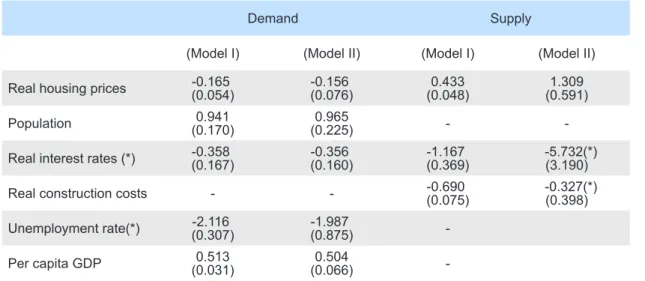
A significant drop in housing prices was not enough to stimulate the housing market, and the non-price factors that pressured the housing market (population, income, unemployment or ease of borrowing) ceased after the 2008 crisis. This is due to the fact that the non-price factors that put pressure on the housing market (population, income, unemployment or ease of borrowing) ceased after the 2008 crisis.
Elasticities of supply and demand in the Spanish housing market
In the run-up to the crisis, the population grew by 1.6% per year. Nevertheless, it is worth noting that, as with prices, demand is much less sensitive to real interest rates than supply.
Ignacio Blasco and Fernando Azpeitia 1
Life insurance products do not cannibalize bank products or traditional savings from customers of credit institutions. Customer base and commercial information utilization that credit institutions have from customers' experience in commercializing insurance products.
Distribution of insurance products through banking networks
The credit institutions in Spain can make their distribution network available to the bancassurance operator. The distribution of insurance products through credit institutions can be structured in different business models depending on the interests and objectives of both the insurance company and the credit institution.
Consolidation of the Spanish financial sector and effects on bancassurance
In this case, the insurance subsidiary is fully owned by the credit institution, so that there is full vertical integration in the organizational structure of the credit institution. Consolidation of the Spanish financial sector and effects on bancassurance (the totality of depository institutions in the country) increased to 192 institutions: 65 banks, 46 savings banks and 81 credit unions. In this context, we can examine some of the most recent transactions that have taken place in the bancassurance sector.
Bankia's purchase of 50% of the life insurance and pension business of ASEVAL, subsidiary of the former Bancaja, from AVIVA for 608 million euros.
María Paz Espinosa 2
The tariff deficit
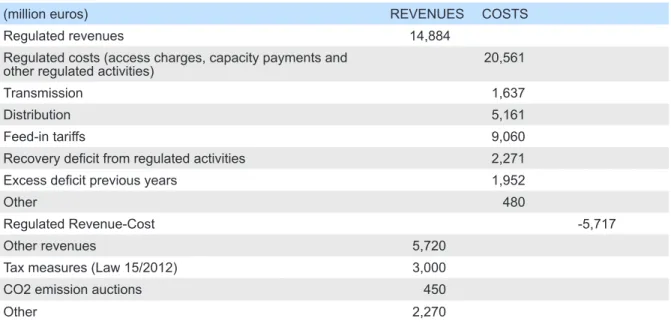
The reasons behind the shortage of regulated activities are due to the organization of the electricity system, which makes it increasingly difficult to reduce its size. In the short term, solutions to the shortage necessarily include increasing the price for end users and/or reducing the cost of electricity services.
Consumer prices
Given the recent trend of strong increases in consumer electricity prices (double-digit increases in the last three years), and the evolution of the deficit over that period (Exhibit 1), it does not seem feasible to eliminate the tariff deficit just by further increasing consumer prices. Furthermore, electricity prices affect international competitiveness as they can represent a significant component in the cost structure of many service-providing business and industrial firms.
The cost of electricity
In any case, measures that promote competition in the wholesale market can only be beneficial to the tariff deficit. In Spain, investment in renewable energy and the level of the import tariffs imply payments of 8.4 billion euros in 2012 and 9.1 billion euros for 2013, to be added to the cost of other regulated activities. Appropriate regulation is crucial, not only because it affects the price paid by consumers (around half of the electricity bill paid by Spanish end-users is related to the cost of regulated activities) and the level of the tariff shortfall , but also if the prices set in the regulated segment affect competing segments.
Appropriate regulation is critical, not only because it affects the price consumers pay and the level of tariff gap, but also because the prices set in the regulated segment affect the competing segments.
Prospects for the future
They pay the same price regardless of the generation cost at the time of consumption. By September 2012, member states were expected to complete a cost-benefit evaluation of the roll-out of smart meter systems (Directive 2009/72/EC). This price increase leads to a higher cost of the energy produced for the electricity system.
Since the estimated increase in the cost of energy is over 2.6 billion euros, the net effect of the taxes is much lower9.
Conclusion
However, the Government Budget Bill for 2013 excludes compensation for generation outside the continent from being included in the National Budget. If this is ultimately the case, the tariff deficit could increase by around 1.7 billion euros. The tax measures introduced by Law 15/2012 (a tax rate of 7% for all energy produced, plus additional taxes differentiated according to the type of technology) are supposed to generate tax revenues of 3.0 billion euros in 2013.
Finally, it is worth noting that over 20% of all regulated costs for 2013 are related to past deficits (4.2 billion euros), making it very difficult for the electricity system to generate a surplus that could cover this deficit .
Da Espinosa ken Pizarro-Irizar (2012) ket tinuladda ti epekto dagitoy a buis kadagiti aldaw-a-nasakbay a presio ti merkado ken nasarakanda a ti promedio a maudi a presio ket ngumato iti agarup a €11/MWh. 2012a), Ti Epekto ti Mapabaro nga Enerhia iti Merkado ti Kuriente ti Espania, Dagiti Nota ti Leksion ti Teknolohia ti Impormasion 9, p. 2012b), Ti epekto dagiti mapabaro a taudan ti enerhia iti inaldaw a merkado ti koriente. Powell, Andrew (1993), Ti agpasango a panagtagilako iti maysa nga imperpekto a merkado: ti kaso ti koriente ti UK, Repaso ti Ekonomia p. Sáenz de Miera, G., Del Rio González, P. 2008), Panagsukima ti epekto dagiti mapabaro nga eskema ti suporta ti koriente kadagiti presio ti koriente: ti kaso ti bileg ti angin idiay Espania, Patakaran ti Enerhia 36, p. 2012), Depisit ti taripa ken ti kinapateg ti ortodoksia iti panagregulasion ti sektor ti koriente, Spanish Economics Papers 134, p.
Prepared by the Regulation and Research Department of the Spanish Confederation of Savings Banks (CECA).
Prepared by the Regulation and Research Department of the Spanish Confederation of Savings Banks (CECA)
Royal Decree-Law on measures to support entrepreneurs, stimulate
Prepared by the Regulation and Research Department of the Spanish Confederation of Savings Banks (CECA). plus reserves) for investments in multilateral trading systems (in line with practice in regulated markets) has been eliminated. In particular, it has been extended to include local groups of councils and local entities in the Basque Country and Navarre. A forecast of payment schedules is included, along with a definition of how interest will be calculated in the event that an installment is not paid on the agreed date.
It was the legal rate of interest that the debtor must pay in case of late payment.
Draft bill on savings banks and banking foundations (pending parliamentary
This plan must be made public and will be subject to the prior approval of the Bank of Spain, which will determine its minimum content. In the event that a savings bank owns more than 50% of the shares of a credit institution or exercises control over the institution, according to Article 42 of the Commercial Code, and it is transformed into a banking foundation, it cannot. Montes de Piedad (charitable pawnbrokers) can be considered to be part of the social work of the foundation, and therefore can be included in the savings banks, banking foundations or credit institutions that they control.
SEFO - Spanish Economic and Financial Outlook Vol. 2010, on governing bodies and other aspects of the legal framework for Savings Banks;.
Draft Royal Decree modifying the requirements for good reputation,
By the institution concerned, when it applies to the Bank of Spain for authorization to conduct banking business, when new appointments are made and whenever circumstances arise that make it advisable to assess eligibility. By the Bank of Spain, when authorizing the creation of a bank, when it is notified of new appointments, or whenever it deems necessary to determine whether the members of the board are suitable for their positions.
Funcas Economic Trends and Statistics Department
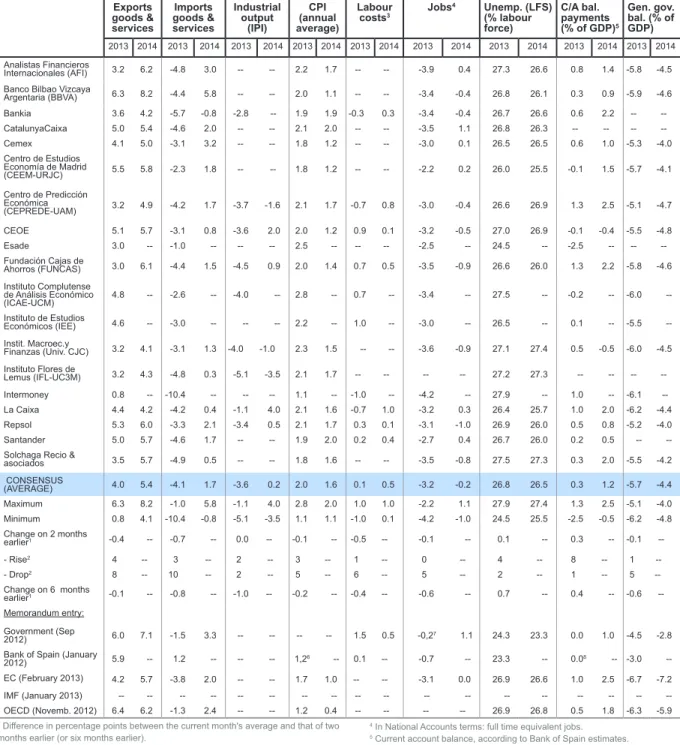
The GDP forecast for 2013 remains unchanged at -1.5%
The forecast for 2014 stands at 0.7%
Industrial activity has resumed its downward trend
Falling inflation
The outlook for employment is negative
The trade imbalance has been corrected
The government deficit targets will be hard to meet
The outlook for the global context is brighter
Interest rates on government debt are not expected to rise further
The euro is overvalued
Expansionary monetary policy is warranted
1 Change in percentage points between the average of the current month and that of two (or six) months ago. 1 Change in percentage points between the average of the current month and that of the previous two months (or six months ago).
KEY FACTS
Annual percentage change Graph 1.4 - Gross fixed capital formation Annual percentage change Graph 1.2 - Contribution to GDP growth. Annual change in percentage Chart 1.4 - VSHB, structure by sectors Percentage of added value with basic prices. Social Security Subsidiaries in industry (left) Manufacturing PMI index (right) Chart 1.- General activity indicators Percentage of change from the previous period and index.
Highlights
Commentary on "Financial Savings and Debt": In the third quarter of 2012, there was a 1.9% decline in financial savings relative to GDP across the economy, which is relatively less compared to the 2.6% decline recorded in the previous quarter. On the other hand, the financial savings of households slowed down significantly, from 3.5% in the previous quarter to 1.1%. Credit system" as an approximation of the net position on the interbank market (end of the month).
It is worth noting that both variations are driven by changes in the series due to the transfer of assets from nationalized financial institutions to Sareb.