SEFO
SPANISH AND INTERNATIONAL ECONOMIC & FINANCIAL OUTLOOK
VOLUME 11 | number 4, July 2022
The Spanish economy in the context of a shift in monetary policy
The ECB’s policy conundrum Spanish economic forecasts for 2022-2023
The financial risks posed by inflation
The yield curve and the bank- public debt nexus
The shifting income structure of Spanish banks
Readiness of the Spanish insurance sector in a shifting economic and financial
environment
Revenue and employment at Spanish manufacturing firms
WHAT MATTERS
SEFO
Spanish and International Economic & Financial OutlookVOLUME 11 | number 4,Orders or claims:
Funcas
Caballero de Gracia, 28 28013 Madrid (España) Teléfono: 91 596 54 81 Fax: 91 596 57 96 [email protected] www.funcas.es
ISSN: 2254 - 3880 9772254388005
9772254389002
SEFO is a bi-monthly Economic Journal published by Funcas and written by its experts, on the most pressing issues facing the Spanish and international economy / financial system today.
Readers can find this and archived issues of SEFO at www.funcas.es. Please contact us to request permission to republish an article at [email protected]
Electronic Edition
An electronic edition of this Journal is available at
http://www.funcas.es/Publicaciones
Board of Editors Carlos Ocaña Santiago Carbó José Félix Sanz Raymond Torres
Managing Editors Alice B. Faibishenko Juan Núñez
Board of Trustees Isidro Fainé Casas (President) José María Méndez Álvarez-Cedrón (Vice president)
Fernando Conlledo Lantero (Secretary) Manuel Azuaga Moreno
Carlos Egea Krauel Miguel Ángel Escotet Álvarez Amado Franco Lahoz Pedro Antonio Merino García Antonio Pulido Gutiérrez Victorio Valle Sánchez Gregorio Villalabeitia Galarraga
Contact [email protected]
Web Site www.funcas.es Orders or Claims:
Funcas, publications
Tel.; +34-91-5965481, Fax: +34-91- 5965796, e-mail: [email protected] Printed in Spain
Editorial and Production Funcas
Caballero de Gracia, 28. 28013 Madrid (Spain)
Ownership and Copyright:
© Funcas 2012
ISSN print edition 2254-3899 ISSN electronic edition 2254-3880 Depósito Legal: M-10678-2012 Prints: Cecabank.
SEFO
SPANISH AND INTERNATIONAL ECONOMIC & FINANCIAL OUTLOOK
This page was left blank intentionally.
Letter from the Editors
oncerns about global economic prospects have intensified since the last issue of Spanish and International Economic & Financial Outlook (SEFO). The OECD’s June forecasts project global growth of 3% this year, down almost 1.5 points from its prior estimate, and the organisation has flagged the risk of stagflation. The invasion of Ukraine has compounded existing tensions in the energy and commodities markets, spilling over to other prices and driving inflation to levels not seen in the developed world since the 1980s.
Importing nations, notably including the EU, are facing a loss of purchasing power that is weighing on the recovery expected in the wake of the pandemic. The inflationary environment is prompting monetary policy tightening, led by the Federal Reserve, followed by the ECB.
Given the importance of the monetary policy shift to the economic outlook for Europe and Spain, we start off the July issue of SEFO with a focus on the ECB´s policy debate. The European Central Bank’s Governing Council faces a conundrum as it speeds up the withdrawal of stimulus to tackle accelerating inflation. The rapid tightening of monetary policy and expectations of its future path threatened to incite financial market fragmentation through widening spreads on sovereign bonds across the eurozone over the spring of 2022. The Governing Council of the ECB must walk a fine line between unwinding its unconventional monetary policy tools, while
preventing the fragmentation of European financial markets and potential disruption of the monetary transmission mechanism.
This challenge is complicated by the fact that much of the potential for disruption lies in the minds of market participants. In order to maintain the ability to shape market expectations, the Governing Council requires credibility, yet that credibility suffered a hit as the ECB had to walk back much of its forward guidance from late 2021. Fortunately, the Governing Council appears to have a plan, and that plan appears to be working. The next two meetings will be crucial in deciding just how much it can deliver.
Within this context, the July SEFO then takes a look at the economic prospects for the Spanish economy. Despite an extremely modest expansion in the first quarter of the year, Spain’s economy is still expected to grow by 4.2% in 2022. Investment, goods and non-tourism services exports and tourism are expected to drive growth until the third quarter. Thereafter, headwinds related to inflation, high energy prices, geopolitics and more restrictive monetary policy will cause growth to slow significantly. GDP is expected to grow by 2.0% in 2023 (lower than the previous March forecast of around 3.3%).
Over the forecast horizon, high and persistent inflation is expected to dampen households’
purchasing power and real consumption.
Investment will still be supportive, partly
C
IV
driven by Next Generation EU (NGEU) funds.
While the pace of job creation should slow, the unemployment rate could fall below 12% by the end of the projection period. Spain’s balance of payments should remain favourable with strong tourism earnings offsetting rising energy import costs. As growth slows into 2023, household and corporate balance sheets appear to be in a position to sustain higher interest rates, especially when compared to the 2011-2014 financial crisis.
Public finances are more vulnerable to the turn in monetary policy. They should remain sustainable if growth continues and deficits are gradually reduced. Risks to growth include geopolitics (war in Ukraine) and higher energy prices, along with monetary tightening and the prospect of fragmentation in eurozone financial markets.
We then shift our attention to inflation and its possible implications. Major monetary policy decisions were taken in June to curb rising inflation, which increasingly exhibits considerable structural traits. While central banks are acting, they acknowledge that if the exogenous supply factors contributing to high inflation persist, more aggressive measures would be needed. Central bank action also appears to be more aggressive than initially contemplated in response to rising market expectations. The timing of interest rate hikes should be cautious, due to possible impacts on consumers and businesses, especially if the economy and labour market were to deteriorate.
To the extent that inflation remains at elevated levels (even less than present), the real interest rate will remain clearly negative. One of the markets most exposed to the rate environment is the property market and, relatedly, the mortgage market, albeit the impact in Spain is expected to be moderate. In Spain, new home prices increased at 10.1% year-on-year in the first quarter of 2022, with resale house prices not far behind, at 8.2%. Concurrently, home mortgages have been growing at around 1.2% year-on-year in recent months. Despite the sources of concern and uncertainty, business lending has been growing at a rate of 1% to 1.7% year-on-year from January to April 2022, but risks are rising. One such risk is a higher-than-expected increase in borrowing
costs, especially if the sovereign risk premium rises, which would have significant knock-on effects for private sector financing.
Rising inflation and the subsequent monetary policy response will also impact sovereign yield curves. The upward shift in yield curves since mid-2021 carries major implications for European banks. On the positive side, interest rate tightening foreshadows a period of increasing short-term rates, which will support retail bank net interest income following five years of negative rates and downward pressure on margins. On the negative side, rate hikes portend adverse effects for European banks through two channels: i) higher borrowing and energy costs may impact households’ and businesses’ ability to service their debts with implications for rising non-performing loans; and, ii) the direct and immediate losses on public debt securities held by the banks on their balance sheets. The effect of losses on bank balance sheets related to public debt securities threatens reviving memories of the sovereign-bank risk loop unleashed in the eurozone between 2010 and 2012 via the bank- public debt nexus, but there are noteworthy mitigating factors. In the case of Spain, two factors mitigate the fact that domestic sovereign debt exposures are slightly above the European average in terms of their sensitivity to impairment losses on those portfolios. The first is the average maturity of the public debt portfolios, which is shorter in Spain than in Europe and the second is how those exposures are classified for accounting purposes, which, among other things, translates to lower volatility.
The ultra-low rate environment has also exerted pressure on banks’ net interest income, forcing them to seek out alternative sources of income in order to generate returns at the level expected by investors. The average net interest margin hit a record low of 0.8% of assets in 2021, dropping to 49% as a share of total income.
In parallel, fee and commission income has increased, and now accounts for 31% of total income. The composition of both interest income and fee mix has also evolved over the years.
Compared to European banks, Spanish banks stands out for having the highest share of interest income in total earnings and among the lowest share of fee and commission income in total earnings. Fee and commission income, measured as a percentage of average total assets, is in line with the eurozone average.
Finally, within the financial sector, we assess the implications of the current economic environment on the insurance sector. The bottlenecks caused by the pandemic and the war in Ukraine are sending prices soaring and leading to inflationary pressures not seen in decades.
Major central banks have announced sharp and sustained rate hikes, while clouds have gathered over forecasts for Spain´s economic growth.
Spain´s insurance sector has traditionally proven highly resilient and capable of adapting to shifting market environments. The changes taking hold will impact the sector’s investment portfolios and trigger a business response mainly in life insurance and traditional savings products, which have suffered from under-development in recent years due to a period of protracted low interest rates. The anticipated economic slowdown could also negatively impact demand for certain non- life products. Finally, inflation is expected to increase the costs of claims as not all segments can pass on rising costs to client premiums.
Lastly, we close the July SEFO with an analysis of the impact of the pandemic and the post-pandemic recovery within Spain´s manufacturing sector. At the headline level, the Spanish manufacturing industry appears to have fully overcome the harsh effects of the pandemic, with revenue and hiring back to pre-pandemic levels. However, the new geopolitical paradigm and supply side frictions are weighing on growth once more. The situation in the transport materials sector is of particular concern, with revenue and employment still 10% and 8%
below 2019 levels. Meanwhile, other sectors have fully recovered and have grown revenues and workforces above pre-pandemic levels, except for the textile and clothing and the paper, publishing, and graphic arts sectors. While revenue is back
above pre-pandemic levels for these two sectors, firms have taken advantage of the pandemic to find efficiencies and downsize their labour forces.
At the opposite end of the spectrum, sectors experiencing strong sales growth, such as the food, beverage and tobacco and chemicals and pharmaceuticals sectors, are generating new jobs.
VI
This page was left blank intentionally.
What´s Ahead (Next Month)
Month Day Indicator / Event
August 2 Social Security registrants and official unemployment (July) 2 Tourist arrivals (June)
5 Industrial production index (June)
12 CPI (July)
18 Foreign trade report (June) 30 Retail trade (July)
30 Preliminary CPI (August)
31 Balance of payments monthly (June)
September 1 Tourist arrivals (July)
2 Social Security registrants and official unemployment (August) 8 ECB monetary policy meeting
9 Industrial production index (July) 12 Non-financial accounts, State (July)
12 Non-financial accounts, Regional Governments and Social Security (June)
13 CPI (August)
20 Foreign trade report (July)
23 Balance of payments quarterly (2nd quarter)
23 Quarterly National Accounts (2nd quarter, 2nd release) 29 Preliminary CPI (September)
30 Retail trade (August)
30 Non-financial accounts, State (August)
30 Non-financial accounts, Regional Governments and Social Security (July)
30 Non-financial accounts, General Government (2nd quarter) 30 Quarterly Non-financial sector accounts (2nd quarter) 30 Balance of payments monthly (July)
This page was left blank intentionally.
What Matters
The ECB’s policy conundrum
Higher and more persistent than expected inflation disrupted the ECB’s initial forward guidance from late 2021. As the ECB pivots to unwind stimulus more aggressively to tame inflation, it must minimize fragmentation risk and the disruption of monetary policy transmission across eurozone financial markets.
Erik Jones
Spanish economic forecasts for 2022-2023
Despite a weak start to the year and headwinds from high energy prices and double-digit inflation, Spain’s prospects for the next few months remain favourable. However, after the end of the tourism season, the loss of consumers´ purchasing power along with more restrictive financial conditions and geopolitical risks mean growth is expected to slow considerably from the end of 2022.
Raymond Torres and María Jesús Fernández
5
13
The financial risks posed by inflation
Rapid monetary tightening in response to persistent inflation carries serious risks for business and consumer borrowers. A higher-than-expected increase in borrowing costs would have significant knock-on effects for private sector financing with the property and mortgage markets particularly exposed following a period of robust growth, albeit the impact in Spain is expected to be moderate.
23
Readiness of the Spanish insurance
sector in a shifting economic and financial environment
Increasing interest rates and rising inflation bring a mixture of opportunity and concern for Spain’s insurance sector. Rising rates should support life insurance and savings products, while slowing growth and higher inflation may erode demand and margins for other products and segments.
Daniel Manzano and Aitor Milner, A.F.I.
45
The shifting income structure of Spanish banks
While recording among the lowest share of fee and commission income as a percent of total earnings compared to other EU banks, in line with their peers, Spanish banks too adapted to the low interest rate environment by raising fee and commission revenues. With interest rates on their way up and volatility increasing, rising net interest income and trading gains for Spanish banks may help reverse downward pressures on profitability.
Joaquín Maudos
37
The yield curve and the bank-public debt nexus
For banks, higher rates mean better interest income, but also higher debt servicing costs for households and businesses and a decline in the value of securities held on banks´ balance sheets. In this context, for the first time since the Eurozone Crisis, the bank-public debt nexus is under renewed scrutiny, as monetary tightening unsettles markets and yield curves shift up.
Marta Alberni, Ángel Berges and María Rodríguez, A.F.I.
31
Regulation and Economic Outlook
Recent key developments in the area of Spanish financial regulation
61
Prepared by the Regulation and Research Department of the Spanish Confederation of Savings Banks
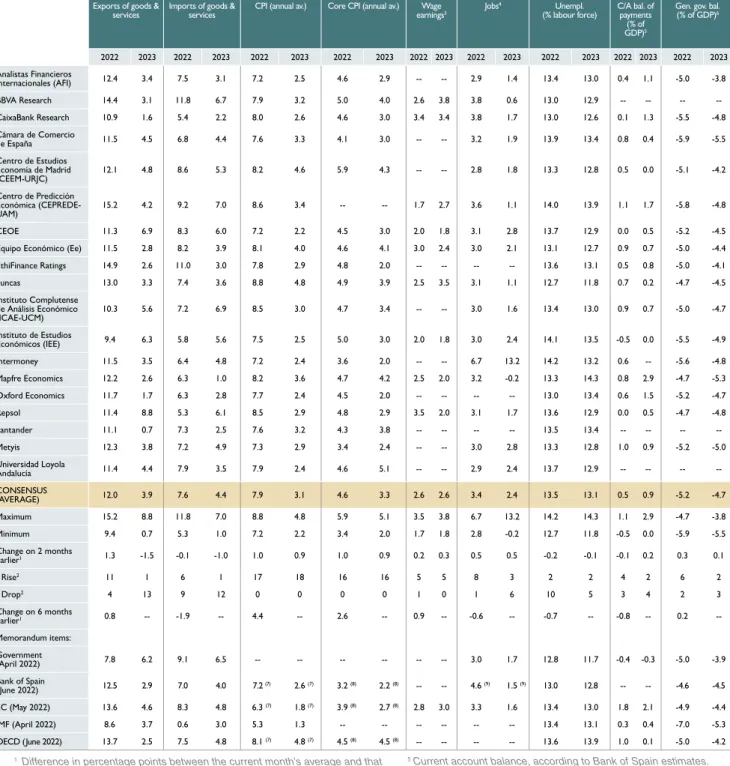
Spanish economic forecasts panel: July 2022
63
Funcas Economic Trends and Statistics Department
Key Facts
Economic Indicators
71
Financial System Indicators
109
Revenue and employment at Spanish manufacturing firms reach pre-pandemic levels
Spain’s manufacturing industry has overcome the pandemic induced bust, but sector level trends appear to be diverging.
In most sectors, revenue and employment are above pre- pandemic levels, while other sectors have used the pandemic to find efficiencies and downsize workforces, with the transportation material sector struggling with shortages and the green transition.
María José Moral
53
This page was left blank intentionally.
The ECB’s policy conundrum
Higher and more persistent than expected inflation disrupted the ECB’s initial forward guidance from late 2021. As the ECB pivots to unwind stimulus more aggressively to tame inflation, it must minimize fragmentation risk and the disruption of monetary policy transmission across eurozone financial markets.
Abstract: The European Central Bank’s Governing Council faces a conundrum as it speeds up the withdrawal of stimulus to tackle accelerating inflation. The rapid tightening of monetary policy and expectations of its future path threatened to incite financial market fragmentation through widening spreads on sovereign bonds across the eurozone over the spring of 2022. The Governing Council of the ECB must walk a fine line between unwinding its unconventional monetary policy tools, while preventing the fragmentation of European financial markets and potential disruption of the monetary transmission mechanism.
This challenge is complicated by the fact that much of the potential for disruption lies in the minds of market participants. In
order to maintain the ability to shape market expectations, the Governing Council requires credibility, yet that credibility suffered a hit as the ECB had to walk back much of its forward guidance from late 2021. Fortunately, the Governing Council appears to have a plan, and that plan appears to be working. The next two meetings will be crucial in deciding just how much it can deliver.
Introduction
On December 16th, 2021, European Central Bank (ECB) President Christine Lagarde announced the Governing Council’s plan to wind up the pandemic emergency purchase program (PEPP) by the end of the next quarter.
[1] Her message was cautiously optimistic.
Erik Jones ECB POLICY
6 Funcas SEFO Vol. 11, No. 4_July 2022 The critical phase of the pandemic-induced emergency had ended and the recovery of the eurozone’s economy had taken root. Inflation was already accelerating, but the Governing Council could confidently look through it to a medium-term when expected price inflation would be below the 2 percent target for
‘price stability’. Therefore, some monetary accommodation remained necessary. Indeed, the Governing Council planned to expand net purchases under the regular (i.e., non- pandemic) asset purchase program to smooth the transition away from the pandemic emergency program. Policy rates would not come up until net purchases under the regular asset purchase program ended. Prior to the meeting, Largarde made it clear that market participants should not expect that kind of normalisation of monetary policy until after the coming calendar year (see Arnold and Lagarde, 2021).
Six months later, inflation was much higher than the Governing Council anticipated.
(see Table 1). Some of this was due to the
Russian invasion of Ukraine and the impact that had on food and energy prices. However, much of the elevated inflation was due to the surprising resilience of pre-war trends, including continued supply chain disruptions due to the ongoing pandemic. By this point it was clear to almost everyone on the Governing Council that it might not be possible to ‘look through’ currently high rates of inflation.
The ECB’s own estimates showed that price inflation would be above the 2 percent target for the rest of the forecast period.
Consequently, Lagarde used her June 9th monetary press conference to announce that net asset purchases would cease by the end of the second quarter. [2]She also promised that policy rates would increase by 25 basis points (or one quarter of one percent) when the Governing Council meets on July 21st. She committed to another rate increase the following September, conceding that it could be larger than 25 basis points if the revised estimates showed higher than expected inflation. She also insisted that the Governing Council would not allow this ‘normalisation’
“ The question now is whether the Governing Council can deliver both in terms of price stability and in holding together the monetary transmission mechanism. ”
Table 1 Successive ECB forecasts
Forecast Date 2021 2022 2023 2024
HICP Price-Inflation
December ‘21 2.6 3.2 1.8 1.8
March ‘22 2.6 5.1 2.1 1.9
June ‘22 2.6 6.8 3.5 2.1
Real GDP Growth
December ‘21 5.1 4.2 2.9 1.6
March ‘22 5.4 3.7 2.8 1.6
June ‘22 5.4 2.8 2.1 2.1
Source: European Central Bank (https://www.ecb.europa.eu/mopo/strategy/ecana/html/table.en.html).
The ECB’s policy conundrum
of monetary policy to disrupt the monetary policy transmission mechanism. In practice that means she promised to hold down the spread between long-term government bond yields across the euro area.
The reaction within the markets to this change in policy was not immediately favourable.
Many market participants complained that the Governing Council was too far behind the curve of accelerating inflation. They worried that the ECB remained too committed to its forward guidance and too timid in the pace of removing monetary accommodation. As a result, these market participants argued, Lagarde ran a real risk of losing control over inflation expectations. If she did, she would not face another sustained period of high
inflation like many European countries saw in the 1970s. Instead, she would have to make a much sharper policy correction in the near future as the Governing Council over-corrected its own errors. Such a policy adjustment would be very unfavourable for highly indebted countries, with Italy a particular concern.
Hence market participants started speculating against long-term Italian sovereign debt prices, and in doing so, widened the yield spread between Italian and German bonds.
This development threatened to disrupt the monetary transmission mechanism. The Governing Council responded by calling an
‘ad hoc’ or emergency meeting on June 15th. At the end of that meeting, the Governing Council promised to do whatever it takes to achieve its objectives without breaking Europe’s monetary union. [3]The details for
150 170 190 210 230 250 270
26/05/2022 27/05/2022 28/05/2022 29/05/2022 30/05/2022 31/05/2022 01/06/2022 02/06/2022 03/06/2022 04/06/2022 05/06/2022 06/06/2022 07/06/2022 08/06/2022 09/06/2022 10/06/2022 11/06/2022 12/06/2022 13/06/2022 14/06/2022 15/06/2022 16/06/2022 17/06/2022 18/06/2022 19/06/2022 20/06/2022 21/06/2022 22/06/2022 23/06/2022 24/06/2022 June 9thpress
conference
June 15th'ad hoc' meeting
Exhibit 1 Spread BTP over BUND
bps
Source: Il Sole 24 Ore.
“ Given that national central banks hold the risks associated with
their purchases of the securities from their own country, including
government bonds, the gains and losses from any portfolio reallocation
decisions could have important redistributive implications across
governments and households. ”
8 Funcas SEFO Vol. 11, No. 4_July 2022 this new action remained unclear, but market participants reacted with reassurance and the spread declined as a result (see Exhibit 1).
The question now is whether the Governing Council can deliver both in terms of price stability and in holding together the monetary transmission mechanism.
Sequencing
To understand the complexity of the challenge, it is useful to review the sequencing that the Governing Council announced as part of its forward guidance for normalizing its monetary policy stance. The initial plan was to run down net purchases on both the pandemic emergency and regular asset purchase programs, then to continue monitoring economic activity until it looked as though expected inflation would converge on or marginally overshoot two percent per annum over the forecast period before starting to raise the policy rates. Along the way, the Governing Council would continue to reinvest the maturing principal on its existing holdings. Simultaneously, the ECB would run down the third round of targeted long-term refinancing operations introduced during the pandemic to encourage banks to lend to firms at concessionary interest rates.
This sequencing is important for two reasons.
The first is redistributive. Any increase in policy rates will immediately put downward pressure on bond prices. If the ECB were to continue to make net asset purchases in such an environment, as ECB Executive Board Member Isabel Schnabel explained last November, central banks would be willingly accepting losses on their balance sheets that would ultimately lead to losses for the average taxpayer, and the continuation of net asset purchases would benefit mostly wealthier households (see Schnabel, 2021).
Of course, such losses apply only to the extent to which the central banks are looking to sell their holdings before they mature. This
is how policy rate increases interact with decisions to reinvest the maturing principal of any holdings rather than allow the central bank’s balance sheet to shrink. It also suggests the challenges associated with portfolio re- allocation decisions to sell any one group of assets before it matures to expand holdings of (and therefore demand for) other assets – particularly across countries. Given that national central banks hold the risks associated with their purchases of the securities from their own country, including government bonds, the gains and losses from any portfolio reallocation decisions could have important redistributive implications across governments and households.
The second reason for the sequencing relates to effectiveness. Increases in the ECB’s policy rates help to withdraw liquidity from the market and so reduce monetary accommodation. This occurs via two channels, the first is mechanical and relates to how banks pass along the costs of meeting their own liquidity requirements via the interbank market. The other is psychological and relates to how market participants speculate against asset price movements as they anticipate the implications of future policy moves for macroeconomic and market performance.
This is also referred to as the expectations channel. Whether and how smoothly any change in the policy rates can withdraw monetary accommodation and so slow down the pace of economic activity and therefore price inflation depends upon how much impact it has through both channels.
The ECB’s targeted long-term refinancing operations effectively shut down the mechanical transmission of policy rate rises through the banking system because banks can use these long-term concessionary loans to meet their liquidity requirements, at least for the next several months. The first tranche of the pandemic emergency lending was €1.3
“ Banks will not only respond to policy rate increases by changing the
cost of borrowing for customers, but they will anticipate them. ”
The ECB’s policy conundrum
trillion and will mature only at the end of June 2023. Another €700 billion will mature in quarterly increments through the end of June 2024. The last two bundles –€98 billion and €52 billion– will run off by the end of that year. This large liquidity overhang explains why very few banks in the euro area try to meet their regulatory liquidity requirements either through the interbank market or through the ECB’s main refinancing operations. For example, euro area banks borrowed only
€700 million in the weekly liquidity auction that was concluded on June 22nd. [4]
When euro area banks do not get their liquidity at a cost close to the main refinancing rate, then any movement in that rate will not translate mechanically into borrowing costs.
That does not mean that there is no impact of a rate rise. On the contrary, banks will not only respond to policy rate increases by changing the cost of borrowing for customers, but they will anticipate them. Banks have been raising the cost of mortgages consistently for the past six months, leading the ECB to warn about a possible fall in house prices (see Arnold, 2022). The point to underscore is that this impact is largely psychological and reflects market assessments of what the ECB’s policy moves mean for future asset prices. Moreover, because these market assessments rely on various different factors, this psychological or expectations channel is relatively more volatile than the mechanical influence of monetary policy changes as they operate through the need for banks to meet their regulatory liquidity maintenance requirements through the interbank market.
The ECB’s original sequencing for withdrawing from its unconventional monetary policy stance was designed to minimize both the political sensitivities surrounding the central banks’ large asset holdings and the implicit constraints that would arise if the ECB had to
shrink or restructure its balance sheet. That sequencing was also intended to restore the mechanical transmission of monetary policy changes, while at the same time providing clear guidance for market participants as they shaped expectations about how the normalization of monetary policy would impact on future asset prices. In essence, the strategy was to ensure that the Governing Council maximized both its flexibility and its effectiveness. Both elements were always going to be important; no one imagined that exiting from the ECB’s unconventional policy stance was ever going to be easy (see Jones, 2017). The huge expansion of the ECB’s balance sheets alongside government borrowing during the pandemic has only increased the degree of complexity.
Acceleration
Unfortunately, the pace of events has accelerated beyond expectations. As a result, much of the sequencing announced by the Governing Council in its forward guidance appears to be collapsing. The ECB is ending net asset purchases before increasing the policy rates, but only by a short period of time, and the huge overhang of liquidity created by the targeted long-term refinancing operations remains in place. Worse, market participants initially reacted to the acceleration of policy tightening by speculating that some assets would suffer more dramatic price declines than others. That is why the spread between Italian and German government bonds suddenly started to widen. Such movements threatened to disrupt the mechanical transmission of monetary policy changes by creating a division between Italian and German interbank markets. Those markets may not be necessary for routine liquidity operations in the banking system at the moment, but they are essential if the ECB is to be able to run down its targeted long-term refinancing operations without creating significant financial distress in Italy.
“ The promise to create some kind of ‘anti-fragmentation’ tool to hold
European interbank markets together appears to have succeeded
both psychologically and in more mechanical terms. ”
10 Funcas SEFO Vol. 11, No. 4_July 2022 Therefore, it was necessary for the Governing Council to reassure the markets that any relative movement in Italian and German government bond prices could be contained sufficiently for the cross-border interbank market to function efficiently over the next two-to-three years. That is why the Governing Council held its ad hoc meeting on June 15th. This acceleration of events has challenged the effectiveness of ECB policy. The promise to create some kind of ‘anti-fragmentation’
tool to hold European interbank markets together appears to have succeeded both psychologically and in more mechanical terms.
Market participants are willing to accept that the Governing Council knows what it is doing and that it will do whatever it takes to preserve the monetary transmission mechanism.
The challenge now is for the Governing Council to address Isabel Schnabel’s distributive implications, both across households and across national governments. To understand why, imagine what such an anti-fragmentation tool would need to respond to if an increase in speculation caused a further widening of the Italian and German spreads. There is an important debate about conditionality here that this discussion ignores. Governments that receive support under such a program should demonstrate they are not subject to moral hazard. But how that demonstration takes place is for another argument. Instead, the focus is on the identification of relative gains and losses.
The first line of defence would be to redistribute the reinvestment of the principal on the pandemic emergency purchase holdings of
€1.7 trillion from bonds that trade at a relatively high price to bonds that are under pressure in the markets. According to reporting from Bloomberg Business, roughly €17 billion in assets from that program mature each month, of which €12 billion could be redirected (see Randow and Migliaccio, 2022). This volume is small relative to the €20 billion in monthly net asset purchases that are coming to an end.
However, this volume is considerable relative to the share of purchases directed at countries that could face market speculation. This commitment is sufficient to restore the status
quo through the end of 2024, which is the period when the ECB expects to continue reinvesting the maturing principal on its pandemic emergency program purchases. The net result would be to redistribute holdings from one group of countries to another, so to bolster government bond prices (and therefore hold down relative borrowing costs) for the target group. Such distributive consequences would be significant, but arguably proportionate to the need to sustain the monetary transmission mechanism – especially given the challenges associated with winding up the concessionary long-term refinancing operations introduced during the pandemic.
The next line of defence would be to bolster the purchase of assets facing speculation in the markets by anticipating the sale of holdings for those countries not facing speculation.
This becomes more complicated because any sale of assets before they mature would have to take place in secondary markets and so would likely be below the par value that the bonds would garner as they mature. The result would be to impose losses on the central banks (and hence taxpayers) of those governments that sell their holdings early to the advantage of central banks (and governments) of those countries facing speculation. The gains would come not only in terms of high bond prices but also in the yield to maturity of the assets that are purchased. It could be possible to mitigate this discrepancy by anticipating the portfolio redistribution across time rather than matching new purchases with early sales. However, this would increase liquidity and so work against the normalization of monetary policy (and the removal of monetary accommodation) necessary to push back against inflation. Hence it is more likely that the Governing Council will need to ‘sterilize’
any net asset purchases for countries facing speculation with sales on other parts of its asset portfolio to remain consistent with its goal of promoting price stability.
The proportionality of this second line of defence is more controversial given the greater distributive consequences. Nevertheless, the ECB has been clear that there is no a priori objection to this kind of instrument. That is what the ‘ad hoc’ Governing Council meeting
The ECB’s policy conundrum
concluded. As a result, market participants face a high level of uncertainty in speculating how aggressively the ECB might commit to this line of defence. If speculation has calmed in the aftermath of that meeting, it is because few in the markets are willing to risk underestimating the Governing Council’s commitment. So far, the ECB’s
‘anti-fragmentation’ tool is a success in terms of shaping market expectation in that sense.
Beyond politics
The challenge will come if the Governing Council needs to step up the pace of its monetary policy normalization. This will come by either raising policy rates more quickly or by reconsidering the pace at which it runs down the size of its balance sheet both in terms of its pandemic emergency purchases and its other accumulated asset holdings. In such an environment, market expectations for the relative strength of government bond prices will depend on many factors beyond the Governing Council’s commitment– because governments in Europe face very different macroeconomic challenges while relying on equally varied political coalitions. Some differentiation in government bond prices is warranted in such circumstances, and the temptation in the markets will be to find just how much variation the Governing Council will be willing to tolerate.
The distributive consequences of accelerating the normalization of monetary policy would also become more important. Here Schnabel’s observation is critical, because slimming down the ECB’s balance sheet, while simultaneously raising interest rates will impose losses on central banks – particularly if the structure and pace of that balance sheet consolidation depends upon disposing assets before they mature. This may require a third line of
defence to redistribute losses across national holdings to offset the distribution of gains that arise from the operation of any anti- fragmentation instrument, real or implicit.
The mistake would be to assume that the problem the ECB faces is purely or even primarily political. There is a clear tension between the Governing Council’s need to stabilize the monetary transmission mechanism and its ability to shape the course of actual and expected inflation. That tension emerges from the way in which the normalization of monetary policy interacts with the way that policy has an impact on the markets, both mechanically and through the psychology of market participants. The Governing Council has managed to strike a fine balance in terms of convincing market participants to hold judgement. What the Governing Council does in the July and September meetings will determine the policy’s overall effectiveness.
Notes
[1] For the text of the December 16th 2021 monetary policy statement and related press conference. https://www.ecb.europa.
e u / p r e s s / p r e s s c o n f / 2 0 2 1 / h t m l / e c b . is211216~9abaace28e.en.html
[2] For the text of the June 9th 2022 monetary policy statement and related press conference. https://www.ecb.europa.
e u / p r e s s / p r e s s c o n f / 2 0 2 2 / h t m l / e c b . is220609~abe7c95b19.en.html
[3] The statement following the ad hoc meeting can be found here: https://www.ecb.
europa.eu/press/pr/date/2022/html/ecb.
pr220615~2aa3900e0a.en.html
[4] The ECB publishes data for its open market operations here: https://www.ecb.europa.eu/
mopo/implement/omo/html/index.en.html
“ Some differentiation in government bond prices is warranted given
governments´ differing macroeconomic and political circumstances,
and the temptation in the markets will be to find just how much
variation the Governing Council will be willing to tolerate. ”
12 Funcas SEFO Vol. 11, No. 4_July 2022
References
Arnold, M. (2022). ECB Warns a House Price Correction Is Looming as Interest Rates Rise.
Financial Times (25 May 2022). https://www.
ft.com/content/4ca7ff91-35bc-428e-8690- e3617afab47c
Arnold, M. and Lagarde, C. (2021). Says EU Inflation Passing “Hump” and 2022 Rate Rise
“Very Unlikely”. Financial Times (3 December 2021). https://www.ft.com/content/dfd205bd- bb19-46f2-9a75-47af00a843b5
Jones, E. (2017). Now for the Tricky Part:
Unwinding the European Central Bank’s Unconventional Monetary Policy Stance. SEFO – Spanish Economic and Financial Outlook, 6(3), pp. 7-17. https://www.funcas.es/wp-content/
u p l o a d s / M i g r a c i o n / A r t i c u l o s / F U N C A S _ SEFO/031art02.pdf
Randow, J. and Migliaccio, A. (2022). ECB Likely to Offset Bond Buying under New Crisis Tool.
Bloomberg Business (16 June 2022).
Schnabel, I. (20221). Speech by Isabel Schnabel, Member of the Executive Board of the ECB, at a virtual conference on Diversity and Inclusion in Economics, Finance, and Central Banking, Frankfurt am Main, 9 November 2021. https://
www.ecb.europa.eu/press/key/date/2021/html/
ecb.sp211109_2~cca25b0a68.en.html
Erik Jones. Professor and Director of the Robert Schuman Centre for Advanced Studies at the European University Institute
Spanish economic forecasts for 2022-2023
Despite a weak start to the year and headwinds from high energy prices and double-digit inflation, Spain’s prospects for the next few months remain favourable. However, after the end of the tourism season, the loss of consumers´ purchasing power along with more restrictive financial conditions and geopolitical risks mean growth is expected to slow considerably from the end of 2022.
Abstract: Despite an extremely modest expansion in the first quarter of the year, Spain’s economy is still expected to grow by 4.2% in 2022. Investment, goods and non-tourism services exports and tourism are expected to drive growth until the third quarter. Thereafter, headwinds related to inflation, high energy prices, geopolitics and more restrictive monetary policy will cause growth to slow significantly. GDP is expected to grow by 2.0% in 2023 (lower than the previous March forecast of around 3.3%).
Over the forecast horizon, high and persistent inflation is expected to dampen households’
purchasing power and real consumption.
Investment will still be supportive, partly driven by Next Generation EU (NGEU) funds.
While the pace of job creation should slow, the unemployment rate could fall below 12%
by the end of the projection period. Spain’s balance of payments should remain favourable with strong tourism earnings offsetting rising energy import costs. As growth slows into 2023, household and corporate balance sheets Raymond Torres and María Jesús Fernández
ECONOMIC FORECASTS
14 Funcas SEFO Vol. 11, No. 4_July 2022 appear to be in a position to sustain higher interest rates, especially when compared to the 2011-2014 financial crisis. Public finances are more vulnerable to the turn in monetary policy. They should remain sustainable if growth continues and deficits are gradually reduced. Risks to growth include geopolitics (war in Ukraine) and higher energy prices, along with monetary tightening and the prospect of fragmentation in eurozone financial markets.
Recent performance of the Spanish economy
According to the recently revised national accounts, Spain’s GDP expanded by 0.2%
in the first quarter of this year. This weak performance represents a significant loss of momentum compared to the robust growth experienced in the second half of 2021.
The slowdown in growth is mainly attributable to a slump in private consumption, which, despite registering modest growth in nominal prices, contracted by 1.9% in real terms. The result is that private consumption remains about 8.1% below pre-COVID levels.
Growth near historic highs in capital goods investment offset weakness in private consumption. The strong performance of capital goods investment in the first quarter of 2022 followed vigorous growth in the preceding quarter, making this component of demand the best-performing during this period of recovery. Investment in capital goods now stands 16.8% above its pre- pandemic level.
Exports of goods and services also expanded during the first quarter, with the trend in exports of non-tourism services standing out.
Due to strong growth in recent quarters, the exports of non-tourism services will stand at 11.7% above pre-pandemic levels as of the end of the first quarter of 2022. International tourism has also contributed to the recovery, although the pace of growth eased in the first quarter of 2022 by comparison to the second half of 2021 due to the imposition of restrictions in a number of countries in late 2021 aimed at curtailing the spread of the Omicron variant.
Growth in employment, measured as the number of hours worked, increased by 3.2%
in Q12022, outpacing GDP growth by a substantial margin. As a result, productivity per hour worked remains below pre-pandemic levels.
The household savings rate came in at -0.8%
of gross disposable income. However, this variable tends to be highly unfavourable during the initial months of the year. Moreover, the fall in the savings rate is considerably smaller than was customary in the same period in the years prior to the pandemic. Adjusting for seasonality, the savings rate came to 7.5% in Q12022, which is below the level recorded throughout 2021, but still slightly above the average for the pre-pandemic expansionary period, 2014-2019.
Looking ahead to the second quarter of 2022 PMI readings point to continued economic growth, underpinned by the services sector, but with manufacturing expected to remain weak. Tourism looks likely to put in a very strong performance. The number of international tourists visiting Spain in May was 88% of the May 2019 figure. Domestic tourism is also very buoyant, with the number of overnight hotel stays by Spanish residents in April revisiting pre-pandemic levels.
Judging by the retail sales index in May, consumption is recovering. Car sales in April and May were also higher compared to the previous quarter, albeit remaining well below last year’s figures. Industrial orders for consumer goods also look to be recovering, despite the dip in the consumer confidence index. Elsewhere, employment remained very dynamic throughout the second quarter according to the Social Security contributor reports, with the recovery in the hotel sector standing out.
Inflation stayed above forecast levels throughout the second quarter. This trend was more noticeable for core inflation, suggesting that increases in production costs are being passed on to end consumer prices to a higher degree than anticipated. In addition to energy products, growth in food prices was notable at over 10%. Non-energy goods and services
Spanish economic forecasts for 2022-2023
registered lower, but still significantly above target, rates of price growth of close to 4%.
Forecasts for 2022-2023
The outlook is clouded by the turbulence that is engulfing the global economy on three fronts: (i) geopolitical tensions and, more specifically, the war in Ukraine; (ii) the energy crisis; and, (iii) the shift in monetary policy prompted by the persistence of inflation.
Each of these factors is dampening growth forecasts, while at the same time inflation projections lie considerably above central bank targets.
During the next few months, the rebound in tourism, ongoing positive trade dynamics (goods as well as non-tourism services) and labour market buoyancy are expected to continue to support growth. However, these tailwinds will probably lose steam towards the end of the peak tourism season, just as the geopolitical tensions, energy crisis, and more restrictive monetary policy gain force, thereby weighing on internal demand.
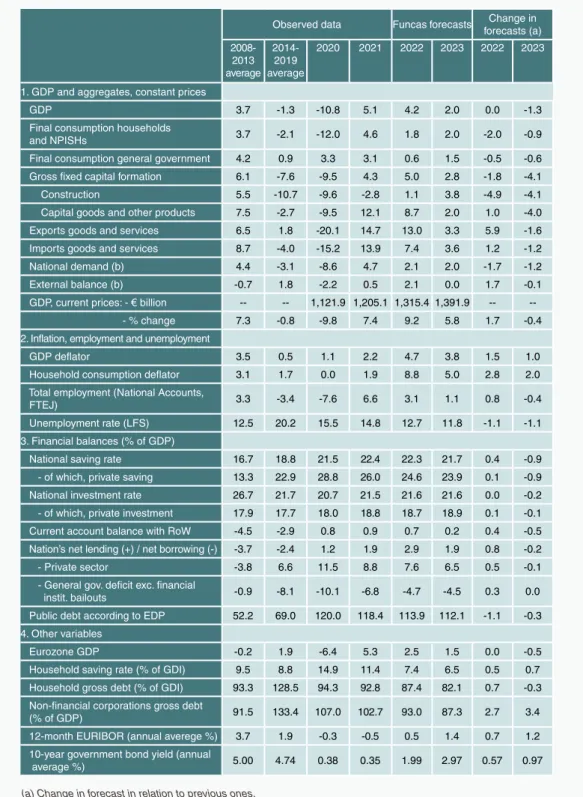
Overall, we expect the expansionary forces to offset recessionary pressures for the year as a whole, and as a result still forecast headline GDP growth of 4.2% (unchanged from our previous forecasts). While our forecast headline growth rate is unchanged, we now expect the contribution from domestic demand to fall to 2.1 points (1.7 points below our March forecasts). This downward revision
is primarily attributable to consumers’ loss of purchasing power resulting from rampant inflation. Nominal household gross disposable income is expected to increase at 6% (thanks to moderate wage growth combined with employment gains), implying a contraction of 2.6% after adjusting for CPI inflation.
Households are likely to draw down excess savings accumulated during the pandemic to fund spending, enabling slight growth in private consumption, albeit at a slower pace than projected in the March forecasts. Non- energy companies are also facing margin contractions because of the surge in the cost of energy and other raw materials. That said, despite tighter margins, investment is still expected to expand partly due to accelerating execution of the recovery plan financed by the NGEU funds.
In contrast to domestic demand, we have raised our forecast for the contribution to GDP growth of net exports to 2.1 points (up 1.7 points from March). This upward revision is fuelled by the recovery in receipts from tourism to pre-pandemic levels and, to a lesser degree, the recovery in external sales of goods and non-tourism services. Imports, on the other hand, are expected to increase in parallel with growth in domestic demand, translating into slower growth relative to that in exports.
We are forecasting a sharp slowdown in 2023, specifically GDP growth of 2%, down
“ We are forecasting a sharp slowdown as from this autumn, leading to GDP growth of 2% in 2023, down 1.3 percentage points from the previous projections. ”
“ We expect the expansionary forces to offset recessionary pressures
until the end of the tourism season, and as a result still forecast
headline GDP growth of 4.2% in 2022 (unchanged from our previous
forecasts). ”
16 Funcas SEFO Vol. 11, No. 4_July 2022 1.3 percentage points from the previous set of forecasts. This downgrade reflects the end of the rebound in tourism and reduced export demand in line with a prospective slowing of growth across the EU as a result of the risks associated with Russian gas supplies. Even if Russian gas supplies are not cut off entirely, a reduction is expected to detract one point from eurozone growth in 2023. The contribution of the external sector to economic growth is therefore expected to turn neutral next year, in marked contrast with the dynamism predicted for this year.
Domestic demand, meanwhile, is expected to register a small recovery, but not sufficient to totally offset the reduced contribution of the external sector. Household consumption is predicted to recover a small part of the ground lost this year, assuming both that salaries stage a slight recovery, and that the savings rate dips further, to below the long-run average.
Nevertheless, by the end of 2023, spending on private consumption in real terms would still be around 3% below pre-pandemic levels.
On the other hand, investment, though losing steam as a result of prevailing uncertainty and interest rate increases, should remain a driver of growth thanks to the European funds.
Inflation will continue to shape the economic outlook. Assuming that energy prices continue to rise until next spring before stabilising, particularly in the case of gas, we are forecasting the consumption deflator at 8.8% this year and at 5% in 2023 (Exhibit 1). These forecasts incorporate the Spanish government’s newest anti- inflation plan. As for the GDP deflator, the variable that best reflects internal prices, we are projecting significantly lower rates of 4.7% and 3.8% in 2022 and 2023, respectively. The gap between consumer prices and the GDP deflator is at a historical high since the 1970s. This extremely large differential between internal and external prices evidences the exceptional nature of the import price shock and the loss of purchasing power which is currently being borne by the Spanish economy.
Despite the surge in import prices, the external accounts are expected to remain in surplus throughout the projection period (Exhibit 2). The nation’s net lending position is attributable to the growth in tourism receipts, partially offsetting the higher cost of the energy bill, as well as transfers from Europe under the scope of the NGEU scheme.
1.0 1.3
-0.6
2.5
3.5
0.9 1.1
2.2
4.7
3.8
0.8
0.0
1.9
8.8
5.0
-2 0 2 3 5 6 8 9
2015/2019 2020 2021 2022 2023
Compensation per employee GDP deflator Private consumption deflator
Exhibit 1 Salaries and prices
Annual average growth (Percentage)
Source: INE and Funcas (forecasts).
Spanish economic forecasts for 2022-2023
Job market dynamics are predicted to continue (Exhibit 3), albeit marked by slowing growth in tandem with the sharp economic
slowdown. We are forecasting the creation of 600,000 jobs by the end of 2023, driving unemployment to below 12%.
Forecast 2.1
0.8 1.0
0.7
0.2 2.4
1.2
1.9
2.9
1.9
0.0 0.5 1.0 1.5 2.0 2.5 3.0
2019 2020 2021 2022 2023
Current account surplus Net lending position
Exhibit 2 External accounts
Percentage of GDP
Source: Bank of Spain and Funcas (forecasts).
Forecast
50.4
48.5
51.5 52.0
58.6
57.4
58.9 59.0
14.1
15.5
12.7 11.8
11.6 12.3 13.0 13.7 14.4 15.1 15.8
47.7 49.7 51.7 53.7 55.7 57.7 59.7
2019 2020 2021 2022 2023
Employment rate (left) Participation rate (left) Unemployment rate (right)
Exhibit 3 Labour market
Percentage
Source: INE and Funcas (forecasts).
18 Funcas SEFO Vol. 11, No. 4_July 2022 The public deficit is set to come down this year thanks to the interplay of automatic stabilisers, coupled with inflation dynamics.
However, little progress is expected on addressing the prevailing imbalances in 2023 on account of the economic slowdown, public sector pay increases and indexation of certain budget headings, such as pensions. The deficit is forecast at around 4.5% of GDP in 2023, which is close to its structural level, with public debt at around 112%.
The persistence of inflation has forced the ECB to re-evaluate its stance and is compelling it to raise its key rates. That shift needs to be gradual, however, so as not to accelerate the economic slowdown, and be accompanied by firewalls against financial fragmentation (for which the exact mechanism has yet to be defined at the time of writing). Our forecasts
envision an increase in the deposit facility to 1.5% by the end of the projection period. That would be consistent with EURIBOR trading around that threshold and a yield on 10-year Spanish bonds of close to 3%.
Risks
These forecasts are subject to a high degree of uncertainty around key drivers such as the duration of the war in Ukraine and the trend in energy prices. A negotiated end to the conflict would improve the outlook for inflation substantially and inject confidence all around.
That would be propitious to using the savings buffer built up during the pandemic out of precaution to invest and spend. All of which would revitalise the economy. To the contrary, a perpetuation of the armed conflict or its extension to other countries could ultimately lead to stagflation.
26.0
39.0
32.7
15.3
20.4
30.1
14.1 16.5
26.1
17.3 20.4
27.2 21.0
27.3
31.3
0 5 10 15 20 25 30 35 40
Households Non-financial corporates Govt.
2011-2014 average 2015-2019 average 2021 2022 (forecast) 2023 (forecast)
Exhibit 4 Interest payments
Billions of euros
Source: INE and Funcas (forecasts).
“ Strong economic growth, private sector deleveraging in recent years (which has not reverted in spite of the pandemic) and the banks’
relatively healthier exposure have made balance sheets more
resilient compared to a decade ago. ”
Spanish economic forecasts for 2022-2023
The extent to which monetary policy is able to cope with stagnation tendencies is another crucial issue. As already noted, these forecasts contemplate moderate interest rate increases, in line with what the market is discounting.
The result would be an increase in household and corporate financial burdens, albeit to levels relatively affordable by comparison with the 2011-2014 financial crisis (Exhibit 4).
Strong economic growth, private sector deleveraging in recent years (which has not reverted in spite of the pandemic) and the banks’ relatively healthier exposure compared to the past, have made balance sheets more resilient compared to a decade ago.
In the case of the public sector, however, the anticipated monetary policy tightening will have a more pronounced effect considering the scale of the existing imbalances.
However, the public sector should remain in a sustainable position so long as economic growth continues and a credible roadmap for gradually correcting the deficit is put in place.
Unquestionably, the creation by the ECB of an effective anti-fragmentation mechanism would also help contain financial risks.
Raymond Torres and María Jesús Fernández. Funcas