SEFO
SPANISH AND INTERNATIONAL ECONOMIC & FINANCIAL OUTLOOK
VOLUME 10 | number 5, September 2021
Monetary policy at a crossroads
The spike in Spain’s inflation and its impact
The ECB’s new look
The Fed’s new monetary policy strategy: Could added flexibility impair financial stability?
Stress tests and other challenges for Spanish banks Banks poised for the ECB’s debut climate risk stress tests
Scant use of capital buffers during the pandemic: Potential stigma effect
An analysis of Spanish exports WHAT MATTERS
SEFO
Spanish and International Economic & Financial OutlookVOLUME 10 | number 5, SeptOrders or claims:
Funcas
Caballero de Gracia, 28 28013 Madrid (España) Teléfono: 91 596 54 81 Fax: 91 596 57 96 [email protected] www.funcas.es
ISSN: 2254 - 3880
9772254389002
SEFO is a bi-monthly Economic Journal published by Funcas and written by its experts, on the most pressing issues facing the Spanish and international economy / financial system today.
Readers can find this and archived issues of SEFO at www.funcas.es. Please contact us to request permission to republish an article at [email protected]
Electronic Edition
An electronic edition of this Journal is available at
http://www.funcas.es/Publicaciones
Board of Editors Carlos Ocaña Santiago Carbó José Félix Sanz Raymond Torres
Managing Editors Alice B. Faibishenko Juan Núñez
Board of Trustees Isidro Fainé Casas (President) José María Méndez Álvarez-Cedrón (Vice president)
Fernando Conlledo Lantero (Secretary) Manuel Azuaga Moreno
Carlos Egea Krauel Miguel Ángel Escotet Álvarez Amado Franco Lahoz Pedro Antonio Merino García Antonio Pulido Gutiérrez Victorio Valle Sánchez Gregorio Villalabeitia Galarraga
Contact [email protected]
Web Site www.funcas.es Orders or Claims:
Funcas, publications
Tel.; +34-91-5965481, Fax: +34-91- 5965796, e-mail: [email protected] Printed in Spain
Editorial and Production Funcas
Caballero de Gracia, 28. 28013 Madrid (Spain)
Ownership and Copyright:
© Funcas 2012
ISSN print edition 2254-3899 ISSN electronic edition 2254-3880 Depósito Legal: M-10678-2012 Prints: Cecabank.
SEFO
SPANISH AND INTERNATIONAL ECONOMIC & FINANCIAL OUTLOOK
This page was left blank intentionally.
Letter from the Editors
he recovery continues to gain traction in the EU and the outlook remains positive, despite lingering supply chain bottlenecks. The ECB has accordingly revised upwards its forecasts for both growth and inflation. Outside the EU, recent trends have been less favourable than anticipated due to the expansion of the Delta variant and intensification of labour shortages in the US and UK.
Under current perspectives, the main advanced economy central banks continue to see the spike in inflation as a transitory phenomenon underpinned by reversible factors such as the growth in semiconductor prices and tightening caused by the sharp turnaround of the global economy. The monetary authorities do not foresee significant changes in the factors underpinning low rates of inflation seen in recent years. Hence, the moves by the ECB and the Fed to become more flexible around their inflation targets so as to accommodate ad-hoc spikes. That said, although they are maintaining their positions, there is growing pressure for the main central banks to initiate tapering and a normalization of interest rates due to the increase in inflation.
Within this context, the September issue of Spanish and International Economic
& Financial Outlook (SEFO) sheds some light on the recent increase in inflation and its impact. Specifically, we analyse the outcome of the ECB’s recent monetary policy strategy
review, as well as the Fed’s new monetary policy strategy, announced last summer. In the case of the latter, we focus on possible repercussions for financial stability.
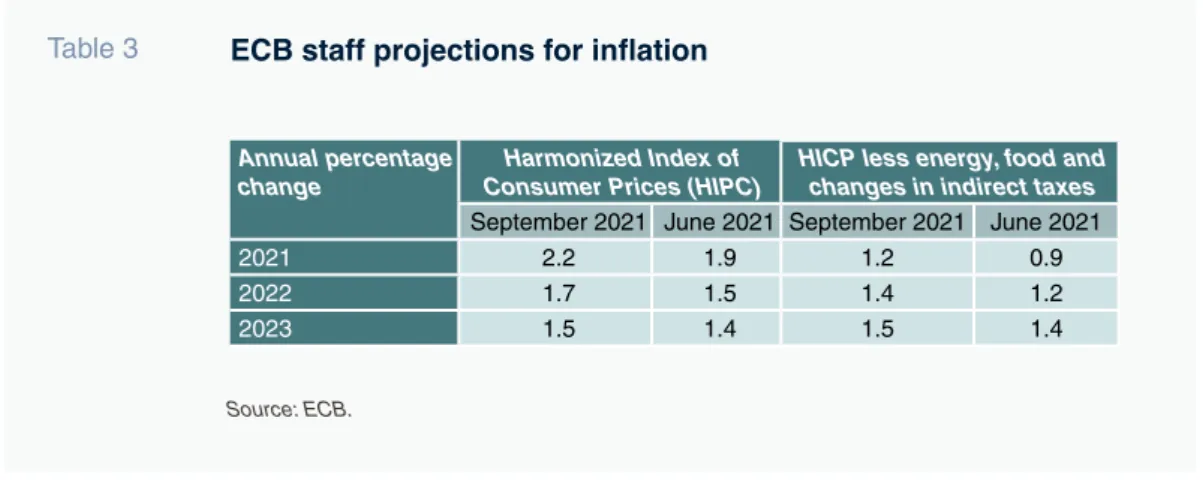
Annual inflation has been on an upward trajectory since the beginning of the year, with Spanish CPI increasing from negative readings in February to 3.3% in August.
Rising input costs and the abrupt nature of the global recovery are primarily responsible for this trend. However, the pandemic has also accelerated nascent structural transformations, such as digitalisation and the green energy transition, entailing significant relative price changes. While energy costs have sharply risen, core inflation has remained more subdued, suggesting price growth is so far limited to imported goods, with many analysts viewing the rise in inflation as largely temporary. However, this outlook is based on three considerations relating to, first, the duration of supply chain bottlenecks and of the external cost shock, second, the possibility of second-round effects, and third, the evolution of inflation expectations. More broadly, rising inflation poses challenges for central banks. While their use of unconventional monetary policies helped reduce the impact of the crisis, it may have also constrained their ability to respond to a sustained period of inflation. Importantly, if markets perceive any weakening of central bank independence from governments’ fiscal
T
IV
policies, this could undermine the credibility of central banks and make it more difficult to maintain the low interest rate environment.
In the case of Europe, the ECB announced the results of its monetary policy strategy review in July. Significantly, the Governing Council has adopted a 2% symmetric inflation target.
However, the way monetary policy makers push back against any deviation from their target is not symmetrical. The new strategy also envisions the eventual inclusion of owner-occupied housing in its inflation calculations, though this will not take effect immediately. The strategy introduces three constraints on the Governing Council’s room for manoeuvre. One stems from the ‘proportionality of its decisions and potential side effects’. The second is the need to preserve the function of the monetary transmission mechanism while the third relates to the need to maintain financial stability. Lastly, the new monetary strategy places the spotlight on monetary policy interest rates, while saying less about the use of other less conventional policy instruments, like direct asset purchases or TLTROs. The distinction between these instruments matters because the logic behind any recalibration can differ and because of their role in determining the proportionality of monetary action. Lagarde may have delivered on her promise to transform how the ECB makes monetary policy, however, she will face her first major test as the ECB seeks to unwind its unconventional monetary policy instruments.
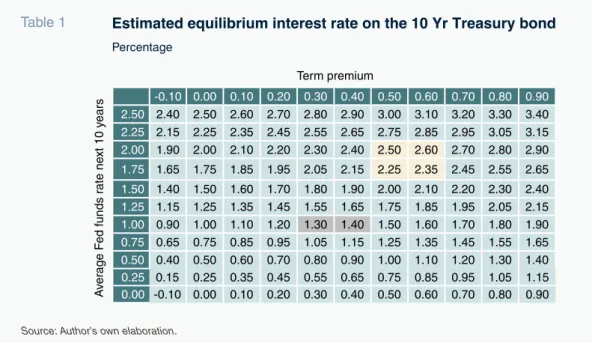
In the US, last year, the Federal Reserve amended its monetary policy to provide it with greater flexibility in accommodating its dual mandate of price and financial stability, while also increasing symmetry around the inflation target. In analysing the possible effects of the change in the Federal Reserve’s strategy, the trend in sovereign bonds is key. Since the Federal Reserve announced the change in its strategy in August 2020, the yield on 10-year Treasuries has increased by a little over 50 basis points, with medium-term bond yields widening by a little less. Analysis shows that nearly 83% of the movement in the bond yield until May is attributed to the shift in inflation expectations. In addition,
the term premium and real rate of interest have also exerted a structural upward impact on yields. Since the new strategy was announced, the US inflation figures have come in higher than expected while other factors (expansionary fiscal plans, vaccine announcements, etc.) make it hard to isolate the effect of the strategy shift on inflation expectations. Looking forward, it is likely that the new monetary policy environment will result in the 10-year US Treasury rising to a moderately high range of 2.25%-2.60%, which is unlikely to undermine financial stability.
The September SEFO then shifts attention over to the financial sector, in particular to the outcome of the European authorities’ traditional stress tests on the European banking system, as well as provides some insights as to the debut of the ECB’s climate stress tests scheduled for next year. On a related note, we assess possible explanations behind the phenomenon across banks of scant use of capital buffers during the pandemic, despite regulators’ and supervisors’
encouragement to do so.
This summer’s European stress tests occurred at a time of shifting expectations for the European banking sector, including the return of dividend payments and a challenging monetary environment. The tests, which covered 75% of European banking assets, used the banks’
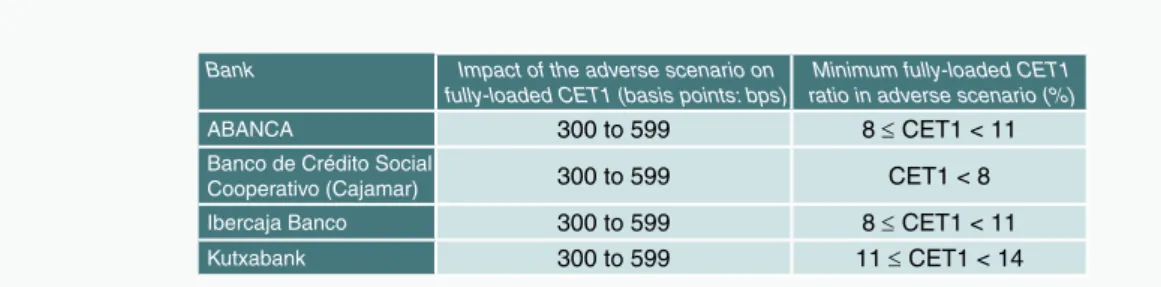
common equity tier 1 (CET1) ratio as of year-end 2020 as their baseline and examined the period of 2021 to 2023. The regulators concluded that European banks have enough capital to withstand an adverse economic scenario. Banks’ average CET1 ratio fell 5.2 percentage points under the adverse scenario, with credit risk, market risk, and income generation capacity the main drivers of capital depletion. The starting CET1 levels for the Spanish banks is generally lower, but capital depletion in the adverse scenario is also lower.
This indicates that although the Spanish banks continue to present slightly below average capital ratios, they are more resilient than the average European bank. Importantly, the results of these tests will influence Pillar 2 Guidance and the Supervisory Review and Evaluation Process. On top of these pressures, banks will have to contend
with an uneven regulatory environment with FinTechs and growing sensitivity surrounding ESG-related issues.
The ECB’s first round of climate stress tests in 2022 will consider two classes of risks stemming from climate change – physical risks and transition risks. To the extent that climate risks impact banks’ ability to meet their capital requirements and execute their strategic plans, it is necessary to assess banks’ resilience to different climate change scenarios. Importantly, these tests differ in several ways from the conventional biannual stress tests. Firstly, the ECB and not the EBA will design the tests, engage with banks and report the results. The climate tests will provide the supervisor with an initial assessment of the state of play in the banking system and an idea of its capital sufficiency in the event of adverse climate scenarios. Although the climate tests will apply to all significant institutions, there will be some variation. Notable changes are also anticipated, mainly affecting the banks’ ability to identify relevant information related with the climate impact of their investment portfolios.
Lastly, the scenario used will be determined by the Network for Greening the Financial System (NGFS). Given the novelty of the tests, coupled with data insufficiency and heterogeneity, it is likely that the results for the banks tested will vary widely based both on geographical location and sectors. Looking forward, the future integration of climate risks into the mainstream stress tests is a distinct possibility.
One of the fundamental new aspects of Basel III compared to its previous iterations is the introduction of capital buffer requirements.
While most capital buffers are set either as a fixed amount or established during the supervisory cycle, the countercyclical buffer can be adjusted in a discretionary manner depending on economic trends. Due to the unprecedented nature of the COVID-19 crisis, regulators and supervisors permitted banks to utilise their capital buffers, including the countercyclical buffer. Despite also curbing dividend payments and committing to a generous timeframe to allow banks to replenish their initial capital positions, banks have not
taken advantage of the more flexible treatment of capital buffers. Results from econometric analysis show a reduction in an entity’s capital ratio is penalised by the market, confirming the hypothesis of a ‘stigma effect’. However, if it is accompanied by a reduction in regulatory capital and the entities continue to hold the same margin over the minimum required, that penalty is mitigated. These findings suggest regulators should consider fine-tuning the current buffer system to increase releasability.
Finally, we analyse the impact of COVID-19 on Spain’s external sector, particularly the extent to which the COVID-19 crisis has shifted the Spanish economy’s international competitiveness, creating new opportunities for Spanish businesses. While the drop in Spanish imports and exports post-COVID-19 (close to 40%
year-on-year) was comparable to the contraction sustained in the wake of the Global Financial Crisis of 2008, the rebound, with year-on-year growth in exports of over 70% in April 2021, has been far more dynamic. This raises the question of whether Spain is simply catching-up after trade flows were interrupted in 2020 or whether this is the beginning of a significant structural change in Spanish trading patterns. Although it is still too soon to provide a clear answer to that question, initial data point to a structural shift.
Spain’s long-standing non-energy trade deficit turned into a surplus in the first half of 2021.
Additionally, the food industry was the sector which made the biggest contribution to the recovery in exports, fuelled mainly by non-EU markets. The fact that the food sector is a core component of Spain’s export effort, and has a history of robust export oriented productive capacity, is a possible indicator of a structural improvement in the Spanish economy’s international positioning.
VI
This page was left blank intentionally.
What´s Ahead (Next Month)
Month Day Indicator / Event
October 4 Social Security registrants and official unemployment (September)
4 Tourists arrivals (August)
4 Eurogroup meeting
6 Industrial production index (August)
11 Financial Accounts Institutional Sectors (2nd. quarter)
14 CPI (September)
19 Foreign trade report (August) 21-22 European Council meeting
28 Labour Force Survey (3rd.quarter) 28 Preliminary CPI (October) 28 ECB monetary policy meeting 29 Retail trade (September)
29 Non-financial accounts: Central Government, Regional Governments and Social Security (August)
29 Non-financial accounts, State (September) 29 Balance of payments monthly (August) 29 GDP 3rd. quarter, advance estimate
November 3 Social Security registrants and official unemployment (October) 3 Tourists arrivals (September)
5 Industrial production index (September)
8 Eurogroup meeting
12 CPI (October)
22 Foreign trade report (September) 29 Preliminary CPI (November)
29 Non-financial accounts: Central Government, Regional Governments and Social Security (September)
29 Non-financial accounts, State (October) 30 Retail trade (October)
30 Balance of payments monthly (September)
This page was left blank intentionally.
What Matters
The spike in Spain’s inflation and its impact The upward trend in Spanish inflation has been driven by rising input costs, the abrupt nature of the global recovery and nascent structural transformations accelerated by the pandemic.
While the immediate effect is a slowdown in the pace of recovery, further ahead, if global inflation becomes sustained, the perception of central bank independence will be key.
Raymond Torres
The ECB’s new look
The results of the ECB’s monetary strategy review announced in July suggest Christine Lagarde has succeeded in her promise to transform how the ECB works and how it communicates with the outside world. However, her first real test will come as the Bank begins to unwind its unconventional monetary policy instruments.
Erik Jones
5
15
The Fed’s new monetary policy strategy: Could added flexibility impair financial stability?
The new monetary policy strategy adopted by the Federal Reserve last year has impacted both inflation expectations and the risk premia. However, analysis suggests it is unlikely to push yields high enough to threaten financial stability.
25
Scant use of capital buffers during the pandemic: Potential stigma effect
In order to alleviate the pressure wrought by COVID-19 on the banking sector, regulators and supervisors permitted banks to utilise capital buffers prescribed under Basel III, including the so-called countercyclical buffer and the capital conservation buffer. Econometric analysis shows that the
‘stigma effect’ most likely explains banks’ hesitancy to take advantage of this flexibility.
Javier Restoy and Ángel Berges, A.F.I.
49
Banks poised for the ECB’s debut climate risk stress tests
The ECB’s climate stress tests slated for 2022 will differ from traditional stress tests in terms of governance, objective, methodology, scenarios and scope. Nevertheless, the ECB’s deep engagement with this issue suggests a high probability that climate risks will be integrated into conventional stress tests in the future.
Ángel Berges and Jesús Morales, A.F.I.
39
Stress tests and other challenges for Spanish banks
The stress tests carried out by the European authorities showed that the Spanish banking sector looks highly resilient to adverse scenarios, despite the fact that the scenario modelled for Spain was among the toughest in the eurozone.
Nevertheless, transition towards an even more stringent regulatory environment in terms of capital adequacy suggests that Spanish banks will have to continue to bolster their own funds over the coming years.
Santiago Carbó Valverde and Francisco Rodríguez Fernández
33
Regulation and Economic Outlook
Recent key developments in the area of Spanish financial regulation
65
Prepared by the Regulation and Research Department of the Spanish Confederation of Savings Banks
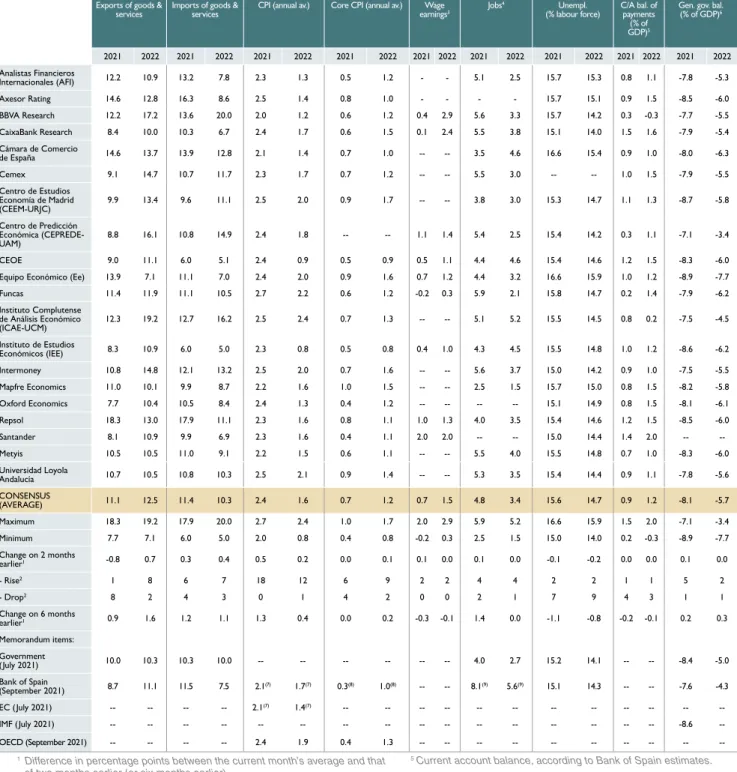
Spanish economic forecasts panel: September 2021
67
Funcas Economic Trends and Statistics Department
Key Facts
Economic Indicators
75
Financial System Indicators
113
An analysis of Spanish exports post-
COVID-19: An opportunity in times of change?
Following the drop in international trade caused by COVID-19, Spain saw a strong rebound in exports. While it is too soon to say whether this marks a turning point for Spanish exporters, some early data point to a structural shift in Spain’s trading patterns.
Ramon Xifré
57
This page was left blank intentionally.
The spike in Spain’s inflation and its impact
The upward trend in Spanish inflation has been driven by rising input costs, the abrupt nature of the global recovery and nascent structural transformations accelerated by the pandemic. While the immediate effect is a slowdown in the pace of recovery, further ahead, if global inflation becomes sustained, the perception of central bank independence will be key.
Abstract: Annual inflation has been on an upward trajectory since the beginning of the year, with Spanish CPI increasing from negative readings in February to 3.3% in August. Rising input costs and the abrupt nature of the global recovery are primarily responsible for this trend.
However, the pandemic has also accelerated nascent structural transformations, such as digitalisation and the green energy transition, entailing significant relative price changes.
While energy costs have sharply risen,
core inflation has remained more subdued, suggesting price growth is so far limited to imported goods, with many analysts viewing the rise in inflation as largely temporary.
However, this outlook is based on three considerations relating to, first, the duration of supply chain bottlenecks and of the external cost shock, second, the possibility of second-round effects, and third, the evolution of inflation expectations. More broadly, rising inflation poses challenges for central banks.
Although they are maintaining their positions, Raymond Torres
INFLATION
6 Funcas SEFO Vol. 10, No. 5_September 2021 there is growing pressure for the main central banks to initiate tapering and a normalization of interest rates due to the increase in inflation.
Moreover, while their use of unconventional monetary policies helped reduce the impact of the crisis, it may have also constrained their ability to respond to a sustained period of inflation. Importantly, if markets perceive any weakening of central bank independence from governments’ fiscal policies, this could undermine the credibility of central banks and make it more difficult to maintain the low interest rate environment.
Introduction
Since early this year, prices have been rising sharply in Spain as in most advanced economies. The consumer price index has gone from registering negative rates throughout the pandemic to surpassing the targets set by central banks. Moreover, there has been a shift in expectations driven by
the acceleration in electricity prices and the worsening of supply chain bottlenecks. As a result, some prominent forecasters are even talking about the return of inflation as a major economic policy challenge and a threat to the period of moderation observed so far this century.
The purpose of this paper is, following a brief overview of the factors behind the run-up in prices so far, to examine the macroeconomic impact and the implications for economic policy, with a specific focus on Spain.
The prevailing inflation spike
The year-on-year rate of change in the consumer price index (CPI) has been on an upward trajectory since the beginning of this year. In Spain, CPI has gone from negative readings in February to 3.3% in August (Exhibit 1). The trend in the rest of the eurozone has been broadly similar. In
“ In Spain, CPI has gone from negative readings in February to 3.3% in August, a slightly more pronounced trend than in the rest of the eurozone. ”
5.3
3.03.3
-2 -1 0 1 2 3 4 5 6
Jan. 20 Feb. 20 Mar. 20 Apr. 20 May. 20 Jun. 20 Jul. 20 Aug. 20 Sep. 20 Oct. 20 Nov. 20 Dec. 20 Jan. 21 Feb. 21 Mar. 21 Apr. 21 May. 21 Jun. 21 Jul.21 Aug. 21
US Eurozone Spain
Exhibit 1 CPI
Year-on-year rate of change
Sources: ECB and national statistics offices.
The spike in Spain’s inflation and its impact
Germany, for example, year-on-year CPI is running at close to 4% according to the latest available data. And in the US, headline inflation is above 5%.
The current readings are still moderate with respect to the heady inflation of the 1970s (in Spain, CPI peaked at 28.4% in August 1977).
They are also slightly below the inflation rates observed during the period of growth that culminated in the financial crisis. However, what is exceptional about this situation is the combination of growing price pressure with ongoing short-term rates at close to zero or even in negative territory (Table 1). [1]
Supply-side factors are behind this trend, specifically the rising costs for all manner of natural resources and supplies because of the pandemic. The international metals index has increased by 26% year-to-date, while the food price index is up 14.4%. Energy prices have also shot up by 35%, with gas prices having doubled (Exhibit 2).
The driving force of these price jumps is the abrupt nature of the global recovery. During the “hard” lockdown, supply contracted in key sectors such as technology parts. In the case of natural resources, the downward trend in productive capacity due to underinvestment was exacerbated by the pandemic. In such a context of limited supply, the sudden rebound in global demand for goods from the first quarter of 2020, spearheaded initially by China and followed later by the US, has generated supply frictions and delays in international shipping. All of which has made the price of imported supplies more expensive.
Additionally, the pandemic has accelerated pre-crisis structural transformations, such as digitalisation and the green energy transition.
The alteration of consumption patterns and working arrangements (surge in online commerce, teleworking, etc.) spurred sharp growth in demand for digital products. By the same token, the stimulus measures, in tandem with growing awareness of the consequences
“ What is exceptional about this situation is the combination of growing price pressure with ongoing short-term rates at close to zero or even in negative territory. ”
Table 1 Interest rates during periods of inflationary stress
2003-2007 average
Jul. 2008 Nov. 2011 Aug. 2021
Spain
Interest rate 4.0 5.9 4.0 1.4
CPI 3.2 5.3 3.5 3.2
Difference 0.8 0.6 0.5 -1.8
Eurozone
Interest rate 4.4 5.5 4.0 1.3
CPI 2.1 3.9 3.0 3.0
Difference 2.3 1.6 1.0 -1.7
Note: The interest rate refers to loans to the non-financial private sector with a maturity of more than one year.
Sources: ECB and Funcas.
8 Funcas SEFO Vol. 10, No. 5_September 2021 of climate change, have shone the spotlight on renewable energies and the need to decarbonise. The price of CO2 has doubled so far this year (Exhibit 2). The green transition is also responsible for the increased demand for metals such as copper, cobalt, magnesium and lithium.
Stress in the markets for natural resources, energy products and technological parts has spilt over to production costs (Exhibit 2).
According to the purchasing managers survey for Spain, the industrial production cost indicator, which was in negative territory at the end of 2020, is under increasing pressure (the industrial purchase price PMI reached 80 in May, close to the series’ high). In the case of services, purchaser prices are also heading north, albeit with somewhat of a lag compared to industrial prices (PMI of 61). Industrial prices, meanwhile, continue to climb higher.
In August, energy prices registered year- on-year growth of 41.6%, while non-energy
industrial prices rose by 8.4% -the fastest pace since 1985.
The impact on core inflation and the economic recovery
The upward trend in production costs is spilling over to the CPI, but only partially, for now. The energy component of the CPI index is registering sharper growth. Stripping out the step effect, shaped by the anomalous price depression that characterised the lockdown, the trend remains ascendant. Since January, the energy CPI has been rising at an average monthly rate of close to 1%.
The other components of the index, however, have barely moved (Exhibit 3). Excluding energy products, CPI is still at under 1% per annum, just 0.2 percentage points above the year-end 2020 level. The goods CPI is at even lower levels, suggesting that producers are not passing along the increase in costs to their customers, assuming margin compression
0 10 20 30 40 50 60
0 20 40 60 80 100 120 140
1M20 2M20 3M20 4M20 4M20 6M20 7M20 8M20 9M20 10M20 11M20 12M20 1M21 2M21 3M21 4M21 5M21 6M21 7M21 8M21
Metals & minerals Gas CO2 (€/tonne) - rt. axis
Exhibit 2 Global price of natural resources (2010=100) and of CO2 in the EU
Sources: World Bank and EMBER.
“ Excluding energy products, CPI is still at under 1% per annum, just
0.2 percentage points above the year-end 2020 level. ”
The spike in Spain’s inflation and its impact
instead. Nor are services showing any clear signs of inflation.
Other indicators also point to limited passing on of the rise in external costs to internal prices.
For example, the GDP deflator extended its path of muted growth of around 1% per annum (with data until the second quarter).
Wage growth is similarly moderate. The wage cost index and the collective bargaining agreements negotiated since the start of the year reveal slower growth than observed during the period of zero inflation. The result
is a loss of purchasing power, especially for less affluent households, where the incidence of energy and food spending is higher.
It is therefore too soon to talk about an inflationary process in Spain or the rest of the eurozone; rather we are seeing growth in the prices of essentially commodities and imported goods. This is akin to an external shock, which erodes the real income of enterprises, by squeezing their margins, and of households, by eating into their purchasing power. That is why most analysts are predicting that the inflation shock will
1.6
0.7
0.0 0.2 0.4 0.6 0.8 1.0 1.2 1.4 1.6 1.8
Jan. 20 Feb. 20 Mar. 20 Apr. 20 May. 20 Jun. 20 Jul. 20 Aug. 20 Sep. 20 Oct. 20 Nov. 20 Dec. 20 Jan. 21 Feb. 21 Mar. 21 Apr. 21 May. 21 Jun. 21 Jul.21 Aug. 21
Eurozone Spain
Exhibit 3 Core inflation
Year-on-year rate of change
Sources: INE and Eurostat.
Table 2 Impact of spike in CPI in 2021
Before the
spike in CPI After the
spike in CPI Difference (billions of
euros) Households
Real disposable income (change in %) 1.8 0.9 -7.5
Pent-up savings (% of 2020 GDI) 8.2 8.0 -0.6
Non-financial corporates
Energy costs (% of GVA) 5.9 6.4 11.3
Note: Refer to the text for the methodology.
Source: Funcas.
10 Funcas SEFO Vol. 10, No. 5_September 2021 prove transient. The situation is different on the other side of the Atlantic, where there are more tangible signs of core inflationary dynamics. In some segments of the US labour market there are concerning shortages as well as an uptick in labour costs that depict a risk of a more protracted bout in inflation than in Europe.
Either way, the inflationary pressures are having an adverse impact on the recovery.
The energy price shock is undermining households’ purchasing power while eroding the real value of the surplus savings built up during the pandemic. In Spain, the loss of household purchasing power is estimated at close to 7.5 billion euros (Table 2). [2] On the corporate side, the effect is bigger, due to the significant impact of rising input costs on margins. The non-financial corporations are expected to forego at least 11.3 billion euros of profits as a result of the price shock. Naturally,
companies can increase their sales prices to offset the margin contraction. However, that would only exacerbate the loss of purchasing power in the household segment.
Outlook for inflation and economic policy challenges
Although core inflation remains relatively low for now, the outlook hinges on three considerations. Firstly, the external cost shock could last for longer than currently anticipated. The green energy transition requires adjustments that will take time, intensifying the scarcity of certain inputs and putting upward pressure on energy prices. Funcas estimates that Spanish CPI will continue to climb higher, reaching 4%
this autumn, before starting to trend lower as prices soften. However, if the energy markets are less benevolent, the impact would be significantly higher (Exhibit 4).
ECB projections for the eurozone also assume
“ Funcas estimates Spanish CPI will continue to climb higher, reaching 4% this autumn, before starting to trend lower as prices soften. ”
3.1 3.7
-1.0 0.0 1.0 2.0 3.0 4.0 5.0
2019 2020 2021 2022
CPI, not persistent CPI, persistent
Exhibit 4 Projected CPI with and without persistent increases in electricity prices
Percentage
Note: The ‘not persistent’ scenario is based on the assumption that electricity will fall back by 15%
between now and year-end. The other scenario assumes electricity prices remain constant at current levels.
Source: Funcas.
The spike in Spain’s inflation and its impact
the inflationary impact will be transient. The consensus forecast, too, is that inflation will fall below the ECB’s target in 2022. However, those forecasts are predicated on the belief that the pressure on production costs will ease.
Elsewhere, the bottlenecks in the semi- conductor sector could linger, at least until the recent incentives to support capacity growth take effect. These incentives include the US sector recovery plan estimated at $30 billion, plans to set up a manufacturing facility in Germany, and new investments in existing factories in Asia.
Secondly, much depends on second- round effects. So far, although businesses could also offset the increase in their costs by hiking their sales prices, the current competitive environment is keeping a lid on things. However, if competing firms were to simultaneously raise prices, this could unleash a spiral of price hikes.
Similarly, wage-earners could demand compensation for the loss of purchasing power.
A lot depends on their bargaining power vis-à-vis the companies. In Spain, where unemployment is still above 16%, the prospect of greater wage pressure is improbable for the labour market as a whole. However, the situation is different in other countries within the eurozone. In Germany and France, for example, some hospitality firms are finding it hard to hire skilled labour, while in construction, one of the sectors benefitting the most from the recovery, there is a chronic shortage of tradespersons. These pressures could spill over to the entire eurozone. Likewise, in the US, such demands could prevail in the high-tech and services sectors where labour is scarce. For now, unemployment and/or inactivity are still above pre-pandemic levels, evidencing considerable slack productive capacity. But hysteresis effects and rapid changes in the demand for certain skills could
change the picture in low-unemployment economies.
Thirdly, expectations play a vital role and are as important, if not more so, than supply supply-side factors. According to the Bank of International Settlements (BIS), agents take their price and salary decisions based on the expectation that inflation will be low. [3]
Those expectations are the result of monetary policy credibility, earned during the 1980s battle against the high inflation ‘regime’.
However, if expectations were to become unanchored, inflation could come out of its long hibernation and get stuck around levels that are far higher than those observed in recent decades.
In this regard, it is important to remember that a key facet of advanced economies’
deflationary policies during the 1980s was the decoupling of monetary policy from fiscal policy. Previously, it had been fairly common for governments to raise financing directly by means of cash advances and other liquidity injections from the central banks. However, in the 1980s, central banks switched their focus to their financial stability mission, leaving governments to finance themselves via the financial markets, mainly by issuing public debt securities. Thanks to the strict separation of monetary policy from fiscal policy, the central banks gained credibility, facilitating the unwinding of inflation expectations. The flip side of the coin was the abrupt increase in interest rates during the years of transition towards low inflation, weighing on output and employment.
Nowadays, legal requirements protect central banks’ autonomy. For example, the treaty establishing the ECB limits the scope for monetising the public deficit.
In practice, however, the policy mix has changed following the use of unconventional monetary measures (such as the buyback of
“ In Spain, where unemployment is still above 16%, the prospect of greater
wage pressure is improbable for the labour market as a whole. ”
12 Funcas SEFO Vol. 10, No. 5_September 2021 public bonds in the secondary markets and keeping rates at negative levels) during the financial crisis. While those instruments are compatible with the legal framework that safeguards the ECB’s autonomy, their use for such a protracted period of time may have had unintended effects that curtail the effectiveness of monetary policy. These include the emergence of zombie firms kept alive by ultra-low rates, and weaker incentives for balanced budgets. It has also interfered with the interest rate structure, making it hard to allocate funds to the more productive sectors. The pandemic crisis has forced the authorities to intensify their use of quantitative easing to support governments’
financing of business support measures.
Greater coordination between monetary and fiscal policies has been the right decision given the severity of the crisis. However, it has reduced the margin for monetary policy manoeuvre in the hypothetical event
of an inflationary episode (Exhibit 5).
In the eurozone, for example, tighter monetary conditions would increase the cost of public debt and force governments, particularly the more indebted ones, to make significant fiscal adjustments that would certainly end up hurting the recovery. Zombie firms, on the other hand, would disappear in relatively short order, hurting the banks’ asset quality.
Lastly, the rolling back of the debt purchase programme and other quantitative easing measures would bring the monetary union’s shortcomings to light. That union remains incomplete, despite long-promised reforms such as the European deposit insurance scheme.
The Next Generation EU plan, focused on transforming the European economy, will not be able to replace a more accommodative monetary policy or play a sufficiently stabilising role.
The risk of financial fragmentation, therefore, would increase and, with it, the risk premiums weighing on the more indebted economies, such as Spain.
“ In the eurozone, tighter monetary conditions would increase the cost of public debt and force governments to make significant fiscal adjustments that would certainly end up hurting the recovery. ”
0 1,000,000 2,000,000 3,000,000 4,000,000 5,000,000 6,000,000 7,000,000 8,000,000
€
Factors unrelated to monetary policy Monetary policy
Exhibit 5 ECB consolidated balance sheet
Millions of euros
Source: ECB.
The spike in Spain’s inflation and its impact
“ For now, the rise in production costs is not generating an inflationary cycle in internal prices and wages in Spain or in the rest of the eurozone. ”
Central banks would therefore be in a bit of a bind if inflation proved long-lasting. They would undoubtedly react with moderation, as much of the economy depends on rates remaining low. However, central banks also have to stick to their monetary stability commitments, which include independence with respect to fiscal policy, so as to not unanchor expectations.
There are few signs that markets have priced in the risk of fiscal dominance. Yields on public debt have increased, as have the inflation expectations implicit in swap rates, but the adjustment looks small, no doubt thanks to the credibility of central banks built up over the years.
In short, the developed world’s main central banks believe the current bout of inflation will prove transient and will not require a shift in their current monetary policy direction. [4] It is true that the rise in the CPI in recent months essentially reflects the higher cost of natural resources, energy products and technological supplies as a result of the sudden and simultaneous global recovery. For now, therefore, the rise in those production costs is not generating an inflationary cycle in internal prices and wages in Spain or in the rest of the eurozone.
Looking forward, however, the unanchoring of inflation expectations cannot be ruled out: it all depends on how long the current episode of higher costs last and, above all, on the markets’ perception of the central banks’ level of dependence with respect to the various states’ fiscal policies. Perceived excessive fiscal dominance would undermine the credibility of the financial stability target and make it hard to control inflation in the face of external cost shocks, such as those currently playing out. All of which highlights the need for the central banks to build buffers and embark on a gradual reversal of
their crisis-related monetary measures as the recovery gains traction.
Conclusion
The spike in prices is attributable to external factors that have not yet unleashed an inflationary process, neither in Europe nor in Spain, where high unemployment and idle capacity are acting as countervailing forces.
A slowdown in the recovery pace, however, seems unavoidable. Looking forward, the duration of the prevailing episode of higher costs and the credibility of central banks’
independence will be key to preventing the unanchoring of inflation expectations.
Notes
[1] Refer to Borio, C. (2021).
[2] This estimate is derived from the difference in CPI between the start of the year and September, applied to disposable household income (flow effect) and the savings built up during the crisis (shock effect).
[3] Refer to BIS (2021).
[4] ECB (2021).
References
Borio, C. (2021). Navigating by r*: safe or hazardous?. Bank for International Settlements (BIS), https://www.bis.org/speeches/sp210915.
htm
BIS (2021). Annual report. Bank for international Settlements.
ECB (2021). Macroeconomic projections, September 2021. https://www.ecb.europa.eu/
pub/projections/html/index.en.html
Raymond Torres. Economic Perspectives and International Economy Division, Funcas
This page was left blank intentionally.
The ECB’s new look
The results of the ECB’s monetary strategy review announced in July suggest Christine Lagarde has succeeded in her promise to transform how the ECB works and how it communicates with the outside world. However, her first real test will come as the Bank begins to unwind its unconventional monetary policy instruments.
Abstract: The ECB announced the results of its monetary policy strategy review in July.
Significantly, the Governing Council has adopted a 2% symmetric inflation target.
However, the way monetary policy makers push back against any deviation from their target is not symmetrical. The new strategy also envisions the eventual inclusion of owner- occupied housing in its inflation calculations, though this will not take effect immediately.
The strategy introduces three constraints on the Governing Council’s room for manoeuvre.
One stems from the ‘proportionality of its decisions and potential side effects’. The second is the need to preserve the function of the monetary transmission mechanism while the third relates to the need to maintain financial stability. Lastly, the new monetary
strategy places the spotlight on monetary policy interest rates, while saying less about the use of other less conventional policy instruments, like direct asset purchases or TLTROs. The distinction between these instruments matters because the logic behind any recalibration can differ and because of their role in determining the proportionality of monetary action. Lagarde may have delivered on her promise to transform how the ECB makes monetary policy, however, she will face her first major test as the ECB seeks to unwind its unconventional monetary policy instruments.
Introduction
When Christine Lagarde was named to succeed Mario Draghi as European Central
Erik Jones ECB POLICY
16 Funcas SEFO Vol. 10, No. 5_September 2021 Bank (ECB) President in September 2019, she promised to transform how the ECB works and how it communicates with the outside world.
That promise took almost two years to deliver, thanks largely to the COVID-19 pandemic. By summer 2021, however, Lagarde was ready to unveil the ECB’s new look. The results of the strategic review came out on July 8th;[1]
the first meeting of the Governing Council to apply the new rules took place less than two weeks later.
For most ECB watchers, however, the extent of the change became apparent during the press conference held on July 22nd to announce the monetary policy decisions. [2] As Lagarde outlined the results of the Governing Council meeting, she did so in a language and format that was a sharp break from tradition. In the discussion that followed, journalists struggled to pin down the implications of what she said despite Lagarde expressing her hope that the message she delivered was clear. By the September 9th press conference, the new pattern of communication was less unfamiliar.
[3] Nevertheless, it was obvious that Lagarde’s ECB is now very different.
Three elements are distinctive in the ECB’s new way of making and communicating monetary policy. The first is the identification of price stability and the approach monetary policymakers should take in trying to achieve that objective. The second is the link between interest rates and bond purchases or between conventional and more unconventional
monetary policy instruments and settings. The third lies in the structure of forward guidance, meaning both assertions about how economic data inform policy actions and the language with which those assertions are made. By implication, this element also relates to the control over the messaging coming from the ECB President and other members of the Governing Council.
When you add these elements together, they suggest that Lagarde’s new look ECB is likely to be more transparent and accountable, but also more predictable and slower moving. In her July 22nd press conference, Lagarde summarized the new approach as
‘steady hands’ and ‘patience in order to gain confidence’. [4] What remains to be seen is whether such an approach will be flexible enough to respond to what could be rapidly changing circumstances. Given the potential for central bank liquidity created during the global economic and financial crisis, the European sovereign debt crisis, and the COVID-19 pandemic to translate into accelerating price and wage inflation, the test of this new policy framework may be close at hand.
Fulfilling the mandate
The monetary strategy announced on July 8th contains several innovations. [5] The Governing Council will have a symmetrical target of expected inflation over the medium- term of two percent per annum, instead of the old asymmetrical target that defined price stability as being below but close to two
“ Lagarde’s new look ECB is likely to be more transparent and accountable, but also more predictable and slower moving. ”
“ The change will take some of the structural bias out of the inflation
variance so that households in countries with consistently higher
price increases in owner-occupied housing feel less systematically
disadvantages by the common monetary policy. ”
The ECB’s new look
percent. The distinction here is subtle. This new target does not define price stability as a two percent annual rate of inflation, or as two percent plus or minus a fixed variation, up or down. Instead, it describes the conditions within which ‘price stability’ as a policy objective will be achieved. By implication, the actual measure of inflation is not a measure of the success of the policy. Actual inflation may turn out to be above or below two percent per annum depending upon the circumstances. So long as expected inflation is close to the target, then the Governing Council will be fulfilling its mandate.
The target is symmetrical. That means the Governing Council should worry as much about inflation that is too low as inflation that is too high. The reason is to ensure that price inflation has a positive buffer. Rates of inflation that are too low put downward pressure on wages. They also put downward pressure on interest rates which limits monetary policymakers’ room for manoeuvre.
At the same time, excessively high interest rates tend to accelerate as they fold into wage negotiations and price setting. This symmetry of concern explains how a forward-looking target connects to price stability. So long as economic actors anticipate that the inflation buffer will remain positive and consistent, they will leave enough room for actors to respond to any deviation in the private sector and for monetary authorities to push back against any excesses.
The way monetary policy makers push back against any deviation from their target is not symmetrical, however. On the contrary, the approach to that target is sensitive to the challenges monetary policymakers face when their main policy rates are close to zero, and so allows for some overshooting when responding to inflation rates that are systematically too low. The idea is that monetary policymakers will need to be more aggressive when their instruments are less effective.
Once they have restored the positive inflation buffer, however, they can recalibrate their approach to focus more tightly on the target.
In this sense overshooting from below is better than overshooting from above, because the ability for monetary policymakers to correct
course is stronger when inflation is higher than when it is lower.
The new strategy also changes the measure of inflation. Eventually, the statistics will include price changes for owner-occupied housing. The objective is to make the index for consumer prices more representative of the impact on households. In this way, the goal of price stability will be more consistent with the lived experience of consumers. That should make the actions of the Governing Council more transparent. Nevertheless, such transparency will always be limited. The new index will still reflect aggregate conditions across the monetary union. No household lives in that aggregate, and there will continue to be variation in performance around the mean. What the change will do is take some of the structural bias out of that variance so that households in countries with consistently higher price increases in owner-occupied housing feel less systematically disadvantages by the common monetary policy.
The new strategy took effect as soon as it was announced. Even so, not every aspect became operational at the same time. The change in the target and the approach have immediate effect; the change in the price bundle will have to wait until European and national statistical authorities are able to compile standardized measures to feed into the harmonized index.
Lagarde made it clear in her July 22nd press conference that this statistical adjustment is a policy priority both for the ECB and for the European Commission, which houses the European statistical agency, Eurostat. [6]
Designing, collecting, and testing the new data will nevertheless take time. In the interim, the Governing Council will look at separate indexes for house price inflation as one source of information among many for how prices in the euro area are developing.
The strategy introduces three constraints on the Governing Council’s room for manoeuvre. One stems from the ‘proportionality of its decisions and potential side effects’. [7] The idea is that the pursuit of price stability should not do unnecessary damage to the real economy, meaning growth and employment; it should not impose undue financial costs on savers
18 Funcas SEFO Vol. 10, No. 5_September 2021 or investors either. This is a soft constraint insofar as such analysis is routinely baked into monetary policymaking; it is even softer when the judgments around the necessity of specific policy actions must be made.
The other two constraints are more rigid. The first of these is the need to preserve the function of the ‘monetary transmission mechanism’, which is the collection of financial channels through which monetary policy decisions translate into economic activity. The ECB cannot use its instruments to steer the economy if this transmission mechanism is broken. The second more rigid constraint is the need to maintain financial stability.
The new strategy underscores that
‘financial stability is a precondition for price stability’. [8] This is true not only because there is no monetary transmission mechanism when the financial system is at risk of collapse, but also because a collapse in the financial system tends to propagate quickly through the real economy. Hence, the Governing Council can only fulfil its mandate if the financial system is stable, and the monetary transmission mechanism is functioning.
Calibrating the instruments
The new monetary strategy places the spotlight on the monetary policy interest rates.
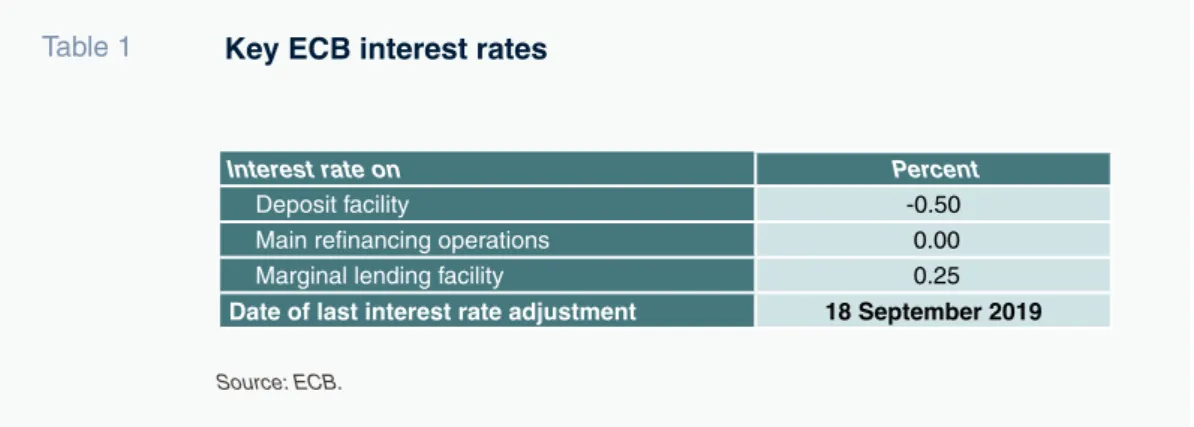
This includes the deposit rate paid to banks for holding excess reserves with their central bank, the main refinancing rate charged to commercial banks when they borrow money from their central bank to meet their liquidity maintenance requirements, and the marginal lending rate charged to commercial banks when they need to borrow additional funds to meet their requirements during the liquidity maintenance period. These are the standard instruments of monetary policy that central bankers use in normal times to steer the economy, raising or lowering the deposit rate to change the incentives for commercial banks to hold excess liquidity and moving the lending rates to influence the cost of borrowing and therefore the cost banks pass on when lending.
Currently, these instruments are set in non- standard ways. The deposit rate is negative, thereby acting as a tax on excess reserves rather than a form of remuneration. The main refinancing rate is zero yet banks rarely if ever access that rate because they can get liquidity more cheaply from one another as banks with
“ Under the new strategy, that recalibration of interest rates can only begin once there are clear signs that inflation rates are accelerating consistently enough to rise above the two percent target over the medium-term. ”
Table 1 Key ECB interest rates
Interest rate on Percent
Deposit facility -0.50
Main refinancing operations 0.00
Marginal lending facility 0.25
Date of last interest rate adjustment 18 September 2019 Source: ECB.
The ECB’s new look
excess liquidity seek to pay a lower tax on their holdings. Although the marginal lending facility remains positive, it is accessed even less frequently (Table 1).
The question is when the Governing Council will begin to raise its policy rates to bring them into something that looks more normal.
This would involve a deposit rate that is either zero or positive with the two lending rates significantly above zero. Under the new strategy, that recalibration can only begin to take place once there are clear signs that inflation rates are accelerating consistently enough to rise above the two percent target over the medium- term. Explaining what that looks like is a matter for forward guidance and not policy calibration – it tells market participants how to anticipate a policy change rather than telling policymakers how much to alter the settings on their instruments. By implication, the actual decision to reset the instruments lies somewhere in the future.
When the Governing Council debated this point during the July monetary policy meeting, the main questions surrounded whether and how policymakers would recognize when it was time to act.
The new strategy says less about the use of other policy instruments, like direct asset purchases or targeted long-term refinancing operations (TLTROs). These are the instruments the Governing Council developed as interest rates approached the zero lower bound. Their goal is to address the constraints
within which monetary policymakers operate.
The longer-term refinancing operations were created initially to underpin financial stability.
The direct asset purchases served the same goal but also ensured the continued operation of the monetary transmission mechanism.
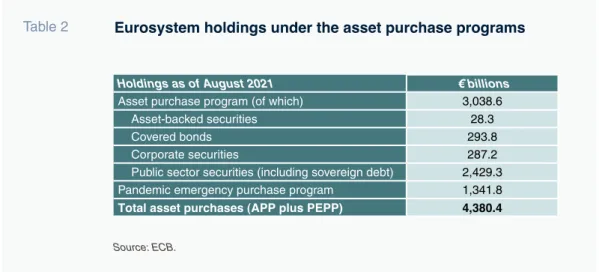
The use of these instruments expanded during the pandemic as policymakers struggled to contain the economic consequences of societal lockdowns and prolonged social distancing requirements. The use of these instruments has been dramatic, amounting to more than
€ 4 trillion in direct purchases since 2015 (Table 2).
The distinction between standard and less conventional instruments is important in the new strategy because the logic behind any recalibration of those instruments can be different. For example, a lift-off in interest rates will depend upon achieving the Governing Council’s price stability objective. Conversely, a recalibration of asset purchases under the
‘pandemic emergency purchase program’
(PEPP) reflects an end to the pandemic emergency due to the success of the vaccination program. This distinction was central to the September monetary policy decisions, where the Governing Council announced that it would scale back its purchases under the PEPP during the fourth quarter of 2021, while at the same time admitting that it remained far from achieving its mandate. [9]
The distinction between standard and non- standard instruments is also important to
Table 2 Eurosystem holdings under the asset purchase programs
Holdings as of August 2021 € billions
Asset purchase program (of which) 3,038.6
Asset-backed securities 28.3
Covered bonds 293.8
Corporate securities 287.2
Public sector securities (including sovereign debt) 2,429.3
Pandemic emergency purchase program 1,341.8
Total asset purchases (APP plus PEPP) 4,380.4 Source: ECB.
20 Funcas SEFO Vol. 10, No. 5_September 2021 interpret the proportionality of monetary actions. At her July press conference, Lagarde was asked how she would defend the ECB against the charge that its asset purchases during the pandemic constitute monetary financing. Her response was to reject the premise of the question; given the scale of the economic crisis, ‘we had to do what we had to do’. [10] The safeguards against monetary financing can apply once the crisis is past. The
‘proportionality’ of the Governing Council’s actions swings both ways in that sense.
The challenge of having monetary instruments deployed for different reasons is to ensure coherence in any monetary accommodation or tightening. The PEPP may be intended to respond to the unique circumstances created by the pandemic, but those additional asset purchases are nevertheless having an impact on market expectations of inflation.
Consequently, withdrawing those purchases will have a reverse impact. The Governing Council may see the scale down announced in September as a ‘recalibration’, in Lagarde’s formulation, but market participants will still see it as a (modest) monetary tightening.
Explaining the separate logic behind the decision is also a challenge. Already in July, journalists were quizzing Lagarde about the Governing Council’s ‘knowledge of pandemics’; [11] when the question came up again in September, Lagarde pivoted to focus on when ‘the economy will have recovered in such a way that the downward impact of the pandemic on our inflation outlook has been resorbed.’ [12] She then admitted that the real questions surrounding the PEPP will be addressed only in December. That is also when the Governing Council will debate the future of the more general ‘asset purchase program’, and the TLTROs. In other words, where the July Governing Council focused narrowly on the new strategy for interest rates, the
December Governing Council will focus on those more unconventional instruments.
Managing expectations and controlling the message
The ECB’s communication with markets is another tool for monetary policy insofar as it plays a crucial role in shaping market expectations. The new strategy complicates that communication in subtle ways. The problem is not the identification of the numerical target but in connecting that target to macroeconomic data and explaining how changes in those data inform changes in the policy instruments. Consider three illustrations, all related to the use of monetary policy interest rates: the identification of the
‘medium-term’; the assessment of changes in expectations; and the tolerance of
‘overshooting’, particularly when monetary policy makers start with interest rates close to the zero lower bound.
The identification of the medium-term is complicated because it involves official forecasts, surveys of professional forecasters, and market indicators. When the Governing Council deliberated about how to communicate this notion to the market in its July 2021 policy meeting, the Chief Economist, Philip Lane, came up with a three-fold test: inflation should reach the target well before the end of the official forecast period, that inflation should be ‘durable’, and that inflation should be reflected in underlying movements of the most stable parts of the price index (meaning those that exclude energy and food). The members of the Governing Council broadly accepted this formulation. Nevertheless, they were divided on whether the focus for attention should lie closer to the present, on actual inflation rates, or further into the future, on longer-term expected rates. The problem is that focusing on the present risks introducing