SEFO
SPANISH AND INTERNATIONAL ECONOMIC & FINANCIAL OUTLOOK
VOLUME 11 | number 6, November 2022
A preview and assessment of Spain´s budget for 2023
Outlook for the Spanish economy in the wake of the energy crisis
General Budget and Budgetary Plan for 2023: A comprehensive analysis
An assessment of the main revenue and expenditure figures in the 2023 general state
budget
Social Security budget for 2023 The ECB´s normalisation
strategy: Uncertainty and legacies TLTRO and bank liquidity in the new rate scenario
Rising interest rates: Initial effects on credit
An analysis of non-performing WHAT MATTERS
Spanish and International Economic & Financial OutlookVOLUME 11 | number 6, November 2022
Orders or claims:
Funcas
Caballero de Gracia, 28 28013 Madrid (España) Teléfono: 91 596 54 81 Fax: 91 596 57 96 [email protected] www.funcas.es
ISSN: 2254 - 3880 9772254388005
9772254389002
SEFO is a bi-monthly Economic Journal published by Funcas and written by its experts, on the most pressing issues facing the Spanish and international economy / financial system today.
Readers can find this and archived issues of SEFO at www.funcas.es. Please contact us to request permission to republish an article at [email protected]
Electronic Edition
An electronic edition of this Journal is available at
http://www.funcas.es/Publicaciones
Board of Editors Carlos Ocaña Santiago Carbó José Félix Sanz Raymond Torres
Managing Editors Alice B. Faibishenko Juan Núñez
Board of Trustees Isidro Fainé Casas (President) José María Méndez Álvarez-Cedrón (Vice president)
Fernando Conlledo Lantero (Secretary) Manuel Azuaga Moreno
Carlos Egea Krauel Miguel Ángel Escotet Álvarez Amado Franco Lahoz Pedro Antonio Merino García Antonio Pulido Gutiérrez Victorio Valle Sánchez Gregorio Villalabeitia Galarraga
Contact [email protected]
Web Site www.funcas.es Orders or Claims:
Funcas, publications
Tel.; +34-91-5965481, Fax: +34-91- 5965796, e-mail: [email protected] Printed in Spain
Editorial and Production Funcas
Caballero de Gracia, 28. 28013 Madrid (Spain)
Ownership and Copyright:
© Funcas 2012
ISSN print edition 2254-3899 ISSN electronic edition 2254-3880 Depósito Legal: M-10678-2012 Prints: Cecabank.
SEFO
SPANISH AND INTERNATIONAL ECONOMIC & FINANCIAL OUTLOOK
This page was left blank intentionally.
he weakening of the global economy that was already present at the time of publication of the previous Spanish and International Economic & Financial Outlook (SEFO) has been confirmed at the time of writing this November issue. Economic indicators point towards recession at the end of the year – the global purchasing managers´ index (global PMI) is below 50, marking the threshold for a contraction. The European economy is one of the hardest hit by the energy crisis. In its latest projections, the European Commission places the eurozone on the brink of recession, with an anticipated growth of 0.3% in 2023, compared to 2.3% in the July forecast. In the case of Spain, the recession is anticipated to be short-lived, with growth for 2023 as a whole still coming in positive.
The supply shock generated by the sharp rise in commodities prices, especially energy, is the main factor behind the global and European slowdown. Although price pressures have eased somewhat, the economy is still suffering despite the boost at the beginning of this year. Moreover, major central banks are becoming increasingly explicit in their willingness to cool demand to moderate the second-round effects of inflation.
Within this context, the November issue of SEFO starts off by presenting our most recent update on the outlook for the Spanish economy. The combined result of recent
revisions to GDP figures reflect GDP growth of 6.7% year-on-year in the first half of 2022, up from the initially published rate of 6.3%, driven essentially by foreign demand, followed by investment, particularly in capital goods.
That said, all signs point to an exacerbation of the slowdown increasingly on display in recent months, driven by the loss of household purchasing power as a result of inflation and the consequent increasing impact on household consumption. As well, the intensification of the energy crisis during the winter season could potentially lead to supply disruption, particularly in countries, such as Germany and Italy, which could lead to recession, with adverse consequences for Spanish exports.
Growth this year is forecast at a solid 4.5%, up 0.3pp from our last forecast, albeit expected to be highly uneven by quarter and in terms of drivers. The economic weakness will be more tangible in 2023, when the Spanish economy is expected to grow by 0.7%, compared to our last forecast of 2% and inflation too is set to come down over the coming months, albeit remaining high. Geopolitical tensions are injecting a high degree of uncertainty into the forecast scenarios, with more downside than upside risk. Within this context, taming inflation, the economy´s ability to withstand rising interest rates and the persistence of the structural public deficit constitute the main risks for the Spanish economy.
We then turn our focus over to fiscal issues, specifically to the budget for 2023, currently
T
making its way through Parliament. While the 2023 Budget presented in early October is a vital document, the 2023 Plan presented to the European Commission one week later provides a more holistic approach for an analysis that takes into account upcoming fiscal measures designed to help vulnerable households and firms, which are set to have a material impact on both the revenue and expenditure sides of the budget equation. Indeed, the 2023 Budget starts from a 2022 tax revenue forecast clearly below the level derived by extrapolating tax collection figures available to date, which means that the rate of growth in tax revenues needed to deliver the forecast contemplated in this document will be much lower. Given that the government continues to target an overall public deficit of 3.9% in 2023, the figure established in the 2022-2025 Stability Programme presented last spring, the required deficit reduction will be much smaller, around one third of the initially contemplated amount.
In short, per the 2023 Budget, there is little justification for concern over its consistency and sharply expansionary nature, failure to comply with the Country Specific Recommendation (CSR) or any mismatch between public spending and revenue. The healthy momentum in tax revenue in 2022 means the deficit and tax collection targets for 2023 are very modest and achievable, even if the macroeconomic situation ends up far worse than the government is forecasting. Nonetheless, the 2023 Budget is undermined by its omission of the fiscal package to be deployed in 2023 in response to the energy and inflation crisis which means that a more accurate assessment of the state of Spain’s public finances in 2023 ultimately depends on the details of this package and its estimated cost. The probability of an economic downturn and the potential for a greater gap between revenues and costs thus calls for a highly selective package of additional fiscal measures to allow for some discretionary measures in case new needs emerge over the coming quarters.
Drilling down in greater detail, the 2023 Budget is underpinned by an optimistic GDP growth forecast (2.1%). It assumes a revenue- GDP elasticity of 1.1 and an expenditure-GDP
elasticity of just over 0.6, which would unlock a reduction in the deficit from 5.0% in 2022 to 3.9% in 2023. On the revenue side, the forecast growth of 7.6% (at all levels of government) is shaped by the sharp growth in inflation (71.4%
according to AIReF). Other contributing factors to the favourable revenue outlook include the measures set to take effect in 2023, with a net positive contribution to the state’s coffers of 2.71 billion euros. The new sources of tax revenue stem mainly from essentially temporary measures (92.9% and 92.6% of tax revenue gains in 2023 and 2024, respectively) rather than genuine tax reform, as promised to Brussels for the first quarter of 2023 and upon which the release of 7 billion euros in European funds is conditional.
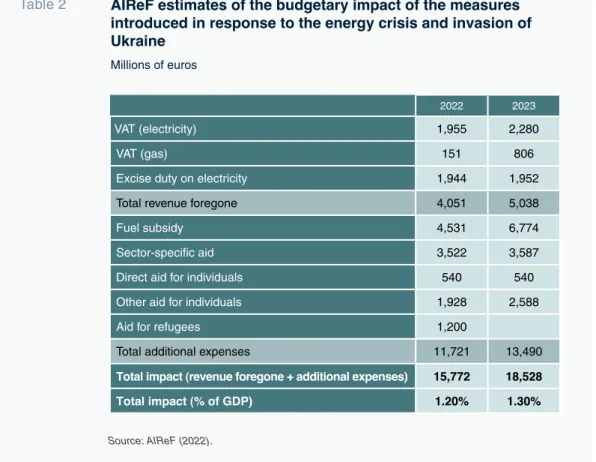
On the expenditure side, the estimated figures are sensitive to the pending decision as to the rollover to 2023 of the household and business aid put in place in 2022, whose overall cost, if not adjusted, would be around 18 billion euros.
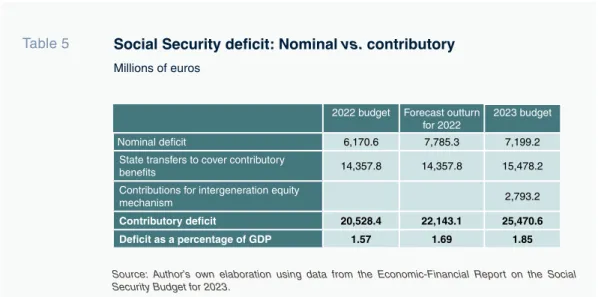
As regards Social Security, the indexation of contributory pensions is the main driver of the budgeted growth in Social Security expenditure in 2023. The increase in the number of pensioners and in the average pension could imply higher than budgeted spending. On the revenue side, the main development is the first-time application of an additional common contingency contribution of 0.6% to fund the so-called intergenerational equity mechanism. The separation of funding sources between contributory and non- contributory contributions, in line with the Toledo Pact recommendations, and the contribution to balancing the budget is addressed by state transfers, which now account for over 20% of non- financial income. The nominal deficit is forecast at 7.18 billion euros in 2023 and is once again covered by a new loan from the state. However, the overall hole in the contributory section of the Social Security system could reach 25.47 billion euros, equivalent to 1.8% of GDP. By year-end, the Social Security’s debt with the state will stand at over 106 billion euros. The real problem, however, is not the volume of debt piled up with the state but rather the financial sustainability of the Social Security system in the medium- and long-term.
which will determine the system´s overall health.
In the last section of the November SEFO, we examine issues relevant to the financial sector. First, we assess recent ECB policy action, including both interest rate normalisation as well as changes to its monetary policy toolkit. Second, we look at some of the potential implications of those actions on lending, as well as loan quality.
The ECB is facing an extraordinary situation in which it is unable to rely on an economic slowdown alone to curb inflation. Reduced worker bargaining power has raised the risk of a cost-of-living crisis with a negative impact on consumption, without necessarily reducing underlying inflation, which apart from commodity prices, according to some economists, is being driven to some degree by global corporations’
price– and margin-setting power. Only with decisive and swift action can the ECB exhibit its determination to bring inflation back in line with levels compatible with its symmetric target of 2% and keep inflation expectations solidly anchored. In line with these objectives, after 13 years of monetary accommodation, interest rate normalisation has begun in 2022 and is progressing at a rapid pace, despite still high levels of uncertainty, largely underpinned by geopolitical tensions arising from the invasion of Ukraine. As well, the ECB this year has also embarked on normalisation of its monetary policy toolkit. Instruments, such as its longer-term refinancing operations (TLTROs) and its asset purchase programmes, a significant legacy from the last period of monetary accommodation, are in the process of being unwound, bringing about a reduction in the size of the ECB´s balance sheet.
Specifically, the European Central Bank’s special liquidity facilities known as targeted longer-term refinancing operations, or TLTROs, were designed to be one of the key mechanisms for monetary policy transmission via the banking system by providing the latter with a
of financing was to boost the provision of credit to the real economy, the truth is lending barely grew, primarily due to scant demand in the context of deep macroeconomic uncertainty, firstly due to ensuing pandemic developments and later due to the energy crisis aggravated by the invasion of Ukraine. The advantageous TLTRO terms intrinsic in the design of these instruments now clash, however, with the new monetary policy objectives implemented by the ECB to halt inflation: rapid rate hikes and liquidity absorption via the withdrawal of its unconventional asset purchase programmes. The TLTROs, as currently configured as regards cost and terms, constitute somewhat of an anomaly in the prevailing context of monetary tightening, which is why the ECB, at its last Governing Council meeting, changed the terms applicable to the various rounds of TLTROs in order to better align them with those of other key monetary policy instruments. Beyond the negative impact on their earnings of the elimination of that source of liquidity and the associated carry trade, foreseeably offset by the favourable effect of the rate increases on their net interest margins, the European and Spanish banking systems have sufficient liquidity to handle the maturity or, if they so decide, prepayment of their TLTRO funds thanks to their excess reserves. Meanwhile, growth in retail deposits and funds and bond market issuance is expected to be sufficient to cover the anticipated growth in credit next year.
All of this policy action at the ECB level will have implications on borrowers at the country level within the EU. Rising interest rates are translating into a considerable increase in borrowing costs over a short period of time.
Households and companies will face difficulties in tackling this situation not only because of tighter financing conditions, but also because they come in the wake of a very long period of exceptional financial and inflationary circumstances. As of last August, the average rates being charged in Spain were still below the European average
in 12-month consumer loans (4.16%) but were higher (7.39%) in longer-dated paper (up to 5 years). In the mortgage segment, the average rate being charged is among the lowest in the eurozone, France being the only one of the larger European economies to charge less (1.58%).
In the first eight months of the year, average mortgage rates climbed 0.59 percentage points higher. As for business lending, the rates trend is less consistent. In the wake of notable growth in 2020 (6.3% year-on-year), fuelled by the support and public guarantee schemes rolled out during the pandemic, growth in lending has slowed significantly and has become more volatile, contracting, for example, by 0.2% in June only to register growth of 2% in August. On the whole, in Spain, lending has slowed in the wake of the efforts made to keep credit flowing to the private sector during the pandemic, mostly targeting the business segment. Specifically, the increase in interest rates is already materialising in a degree of retrenchment in lending activity, particularly in the mortgage segment.
Apart from impacting lending dynamics, it will also be important to assess the impact of ECB policy action on loan non-performance across euro area banks. Despite the intensity of the two crises sustained by the Spanish economy in the last three years (the COVID-19 crisis and the energy crisis exacerbated by the Ukraine-Russia war), the Spanish banks’ non-performing loan (NPL) ratio has not increased, in part thanks to the measures rolled out to mitigate the impact of those events (furlough and credit relief schemes, etc.). However, in the corporate segment, a detailed analysis by sector reveals considerable differences in absolute NPL ratios and in the trend in recent years. Although a majority of sectors has reported a decrease in their NPL ratios, in those more vulnerable to the impact of the pandemic, that ratio has increased, for example, in hospitality (whose NPL ratio has increased by 4 pp to 9.26%) and activities related with leisure and entertainment (up 7.6 pp to 14.75%).
By comparison with the EU, the arts, recreation and entertainment sector stands out sharply, with an NPL ratio in Spain twice the European average. Given the downward revision of GDP
growth forecasts for 2023, with high inflation leading to rate hikes and the attendant tightening of financing conditions, non-performance will in all likelihood hit an inflexion point in the coming months. Against that backdrop, the banks would be well advised not to relax their provisioning policies, in line with guidance from supervisory authorities.
Month Day Indicator / Event
December 2 Social Security registrants and official unemployment (November)
2 Tourists arrivals (October)
5 Eurogroup meeting
9 Industrial production index (October)
14 CPI (November)
15 ECB monetary policy meeting 15 Foreign trade report (October) 15-16 European Council meeting
23 Non-financial accounts: Central Government, Regional Governments and Social Security (October)
23 Non-financial accounts, State (November) 23 Balance of payments quarterly (3rd. quarter) 23 GDP (3rd. quarter, 2nd. estimate)
29 Retail trade (November)
30 Balance of payments monthly (October) 30 Preliminary CPI (December)
30 Quarterly sector accounts (3rd. quarter)
January 4 Social Security registrants and official unemployment (December)
4 Tourists arrivals (November)
11 Financial Accounts Institutional Sectors (3rd. quarter) 31 Balance of payments monthly (November)
Note: Due to the timing of the publication of the National Statistics Institute (INE) data release calendar for 2023, at the time we went to print, complete information for January indicators/events was unavailable.
This page was left blank intentionally.
Outlook for the Spanish economy in the wake of the energy crisis
Spanish GDP growth for this year has been revised upwards and is now forecast at a solid 4.5%. Within a context of high uncertainty, underpinned by geopolitical tensions, high energy prices and tighter monetary policy, downside risks are significant and economic weakness will be more tangible in 2023, with inflation possibly easing somewhat, though remaining stubbornly high over the projection period.
Raymond Torres and María Jesús Fernández
General Budget and Budgetary Plan for 2023:
A comprehensive analysis
An analysis on the 2023 Budget reveals there is little justification for concern over its consistency and sharply
expansionary nature, failure to comply with the country-specific recommendation (CSR) or any mismatch between public spending and revenue. Nonetheless, a more accurate assessment of Spain’s public finances for 2023 will ultimately depend on the details and costs of the forthcoming package of additional fiscal measures for that year due to the war in Ukraine.
Santiago Lago Peñas
5
15
An assessment of the main revenue and expenditure figures in the 2023 general state budget
The 2023 general state budget is underpinned by an optimistic GDP forecast of 2.1%, which would unlock a reduction in the deficit from 5.0% in 2022 to 3.9% in 2023. Nonetheless, positive performance on the revenue side is underpinned mainly by sharp inflation, together with essentially temporary measures set to take effect in 2023, rather than tax reform, while expenditure figures are largely structural and also remain sensitive to upcoming decisions on extension of support measures into the coming year.
Desiderio Romero-Jordán
25
TLTRO and bank liquidity in the new rate scenario
The ECB´s targeted longer-term refinancing operations, or TLTROs, were designed to be one of the key mechanisms to keep credit flowing through the banking system to the real economy during the crisis. Beyond the negative impact on banks´ earnings of recent changes to TLTRO terms in order to better align them with other monetary policy instruments, the European and Spanish banking systems have sufficient liquidity to handle the maturity or prepayment of their TLTRO funds, as well as to meet anticipated credit growth next year, thanks to their excess reserves, evolution of retail deposits and funds, and planned bond market issuance.
Marta Alberni, Ángel Berges and María Rodríguez, Afi
53
The ECB´s normalisation strategy:
Uncertainty and legacies
The ECB is facing an extraordinary situation in which it is unable to rely on an economic slowdown alone to curb inflation.
Only with decisive and swift action on normalisation of both interest rates and its monetary policy toolkit, comprised of legacy long-term liquidity injections and asset purchases, can the ECB prove its determination to bring inflation back in line with official targets and anchor inflation expectations.
Ignacio Ezquiaga, Afi
45
Social Security budget for 2023
While the indexation of contributory pensions constitutes the main driver of Social Security expenditure growth in 2023, an increase in the number of pensioners as well as growth in average pensions could prompt a greater than budgeted expenditure outlay. Although the budgetary deficit for 2023 will yet again be covered by state lending, the size of the contributory shortfall could reach 1.8% of GDP.
Eduardo Bandrés Moliné
37
Regulation and Economic Outlook
Recent key developments in the area of Spanish financial regulation
79
Prepared by the Regulation and Research Department of the Spanish Confederation of Savings Banks
Spanish economic forecasts panel: November 2022
85
Funcas Economic Trends and Statistics Department
Key Facts
Economic Indicators
93
Financial System Indicators
131
Social Indicators
137
considerable increase in borrowing costs, putting a strain on households and companies, which had grown accustomed to exceptionally lax financial conditions. In parallel, the increase in rates is already materializing in the form of some retrenchment in lending in Spain, particularly in the mortgage segment.
Santiago Carbó Valverde and Francisco Rodríguez Fernández
An analysis of non-performing loans: Spain in the European context
Despite the intensity of the two crises sustained by the Spanish economy in the last three years (the COVID-19 crisis and the energy crisis exacerbated by the war in Ukraine), measures rolled out to mitigate the impact of those events have helped to avert an overall increase in Spanish banks’
non-performing loan ratios, albeit differences across industry sectors are noteworthy. However, given the challenging economic backdrop for 2023, non-performance will likely hit an inflexion point in the coming months, requiring the maintenance of adequate provisioning.
Joaquín Maudos
69
This page was left blank intentionally.
Outlook for the Spanish economy in the wake of the energy crisis
Spanish GDP growth for this year has been revised upwards and is now forecast at a solid 4.5%. Within a context of high uncertainty, underpinned by geopolitical tensions, high energy prices and tighter monetary policy, downside risks are significant and economic weakness will be more tangible in 2023, with inflation possibly easing somewhat, though remaining stubbornly high over the projection period.
Abstract: The combined result of recent revisions to GDP figures reflect GDP growth of 6.7% year-on-year in the first half of 2022, up from the initially published rate of 6.3%, driven essentially by foreign demand, followed by investment, particularly in capital goods. That said, all signs point to an exacerbation of the slowdown increasingly on display in recent months, driven by the loss of household purchasing power as a result of inflation and the consequent increasing impact on household consumption. As well, the intensification of the energy crisis during
the winter season could potentially lead to supply disruption, particularly in countries, such as Germany and Italy, which could lead to recession, with adverse consequences for Spanish exports. Growth this year is forecast at a solid 4.5%, up 0.3pp from our last forecast, albeit expected to be highly uneven by quarter and in terms of drivers. The economic weakness will be more tangible in 2023, when the Spanish economy is expected to grow by 0.7%, compared to our last forecast of 2% and inflation too is set to come down over the coming months, albeit remaining
Raymond Torres and María Jesús Fernández
high. Geopolitical tensions are injecting a high degree of uncertainty into the forecast scenarios, with more downside than upside risk. Within this context, taming inflation, the economy´s ability to withstand rising interest rates and the persistence of the structural public deficit constitute the main risks for the Spanish economy.
Foreword
The energy markets have been dictating the plight of the Spanish economy since early 2021. The sharp increase in oil and gas prices has had spillover effects on the cost of electricity, transport and, ultimately, the entire production chain, with the war in Ukraine emerging as a compounding factor (Torres and Fernández, 2022). All of which has sent inflation soaring and brought economic momentum to an abrupt standstill.
In this paper, after a brief overview of recent trends, we present our economic forecasts for the rest of this year and 2023.
Recent performance of the Spanish economy
According to the revised national accounts figures, Spanish GDP registered growth of 1.5% in the second quarter of this year, which is significantly higher than initially estimated (1.1%), offsetting the simultaneous downward revision to the first-quarter growth figure. The 2021 quarterly figures were also revised and the upshot of all of the changes made was that GDP grew by 6.7% year-on-year in the first half of 2022, up from the initially published rate of 6.3%.
The main source of growth in the first half was foreign demand, more specifically the recovery in international tourism. The next biggest driver was investment, particularly in capital goods. Private consumption, meanwhile, rebounded in the second quarter, but only barely offset the contraction sustained in the first quarter, so that the stagnation observed for several quarters now continues. Lastly,
“ The manufacturing and services PMIs have been moving lower and both are now below 50, the threshold flagging contraction. ”
-60 -48 -36 -24 -12 0 12
28 34 40 46 52 58 64
2016 2017 2018 2019 2020 20212022 Manufacturing PMI (left) Industrial confidence index (right)
Exhibit 1 Economic indicators
Source: IHS Markit.
0 6 12 18 24 30 36 42 48 54 60
2016 2017 2018 2019 2020 2021 2022 Services PMI
public spending declined in real terms in the first two quarters of the year.
Employment, measured in hours worked as per the national accounts, increased in both quarters, albeit remaining 0.8% below the 2019 average. Productivity per hour worked is another indicator yet to revisit pre-pandemic levels. The number of Social Security contributors continued to register healthy monthly growth throughout the first half, albeit much lower than in the second half of 2021.
As for the third quarter, based on data up to September, consumption is showing no signs of a rebound, whereas tourism is continuing to recover, although at a considerably slower pace than in the second quarter. Within the industrial sector, some areas, including metallurgy and chemicals, hit hard by the inflation in energy and commodities, reported falling business volumes. However, the remaining sectors were stable or growing, with the jump in activity in the automotive industry standing out. Nevertheless, the manufacturing and services PMIs have been moving lower and both are now below 50, the threshold flagging contraction (Exhibit 1).
Contributor numbers continued to grow throughout the summer, without really giving clear signs of slowing; however, adjusting for seasonality, the figures warrant caution at this time.
Headline inflation peaked at 10.8% in July, with core inflation peaking at 6.4% in August.
Price growth was highest in food products:
13.2% year-on-year in August. As for energy products, fuel prices have come down in recent months, in tandem with the drop in oil prices, whereas electricity prices remain extraordinarily volatile.
Besides oil, other commodity prices have trended lower in recent weeks, as have shipping costs, which nevertheless remain well above pre-pandemic levels. There are also signs of reduced friction in global supply chains. The industrial price index, the benchmark for the trend in inflation across the production chain, has been easing slowly since the end of spring. Inflationary pressures may therefore be abating somewhat.
In the real estate market, the volume of home purchases has been stabilising, albeit around a relatively high number – the highest since early 2008 – following sharp growth in 2021.
House prices, meanwhile, continue to rise, although at a slowing pace.
Lastly, the public deficit came in at 30.46 billion euros in the first half, compared to 55.68 billion euros in the same period of 2021. Tax revenue dynamics have remained remarkable and on the spending side matters are being helped by the rollback of the social coverage implemented during the COVID-19 pandemic.
Forecasts for 2022-2023
All signs point to an exacerbation of the slowdown increasingly on display in recent months. The main driver is the loss of household purchasing power as a result of prevailing inflation and a foreseeably greater impact on private consumption by comparison with the first half of the year: household savings are back near long-run average levels, which means that many families no longer have a liquidity buffer to make up for the loss of real income (Exhibit 2).
Moreover, the energy crisis induced by the invasion of Ukraine will be felt more intensely during the upcoming winter season and could trigger stoppages in certain sectors, such as
“ The industrial price index, the benchmark for the trend in inflation
across the production chain, has been easing slowly since the end of
spring; thus, inflationary pressures may be abating somewhat. ”
the metallurgy or fertiliser sectors, that cannot pass their higher costs onto end prices. The manufacturing sectors in the countries most dependent on Russia for gas, such as Germany and Italy, are facing supply cuts that will almost certainly translate into recession, with adverse consequences for Spanish exports
(IMF, 2022). Our forecasts are underpinned by the assumption that GDP in the eurozone will contract by 0.2% in 2023 and that energy prices will continue to climb higher until next spring, at which point they will remain high, in line with the levels currently being discounted by the futures market (Exhibit 3).
-15.2
23.6 27.8 34.3
-87.2
51.5 65.0
39.5
-100 -80 -60 -40 -20 0 20 40 60 80
2020 2021 2022 2023
Gross disposable income Final consumption expenditure Forecast
Exhibit 2 Household disposable income and private consumption
Change, in billions of euros
Source: Funcas, based on INE data.
0 25 50 75 100 125 150 175 200 225 250
J F M A M J J A S O N D J F M A M J J A S O N D IQ 2Q3Q4Q
2021 2022 2023 24
TTF gas prices (as discounted by futures for the dotted lines)
Gas prices in Iberian market (as discounted by futures for the dotted lines)
Exhibit 3 Gas prices
Euros per MWh
Sources: Mibgas and TTF ICE.
Lastly, given inflation’s staying power, the main central banks have embarked on a path of rate tightening with the aim of cooling demand and thereby mitigating the risk of second- round effects. Our forecasts contemplate additional increases in the ECB’s deposit facility rate up to a terminal rate of 2.5% in the second quarter of 2023, from which point we expect rates to be largely stable. The yield on the 10-year bond is expected to rise to 3.5%
during the projection horizon.
Against that backdrop, following slim (but positive) growth in the third quarter thanks to lingering momentum in tourism and exports, GDP could contract in the last quarter of this year and first quarter of 2023, so constituting a short recession. We are forecasting the possibilitiy of a slight recovery from the second quarter, in line with reduced pressure from energy prices and, later, a pause in monetary tightening.
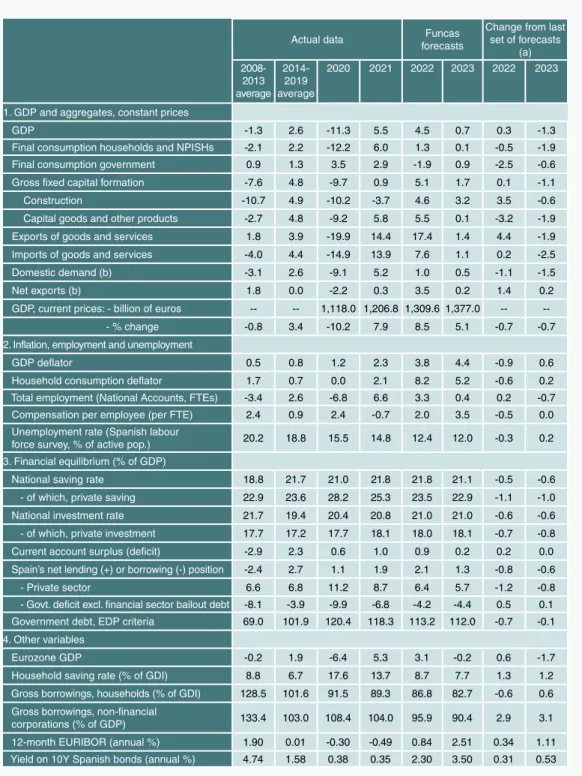
Growth this year is forecast at a solid 4.5%, up 0.3pp from our last forecast (Table 2).
However, that growth is expected to be highly uneven (after the momentum of the first half, GDP is expected to eke out scant growth of 0.2% in the third quarter and to contract by 0.4% in the fourth quarter) by quarter and in terms of drivers. Growth will be driven mainly
by the momentum in exports, with net trade expected to contribute 3.5% points (up 1.4pp from our July forecasts). Internal demand, on the other hand, is expected to contribute a meagre 1pp to GDP growth (down 1.1pp from our last set of forecasts), due to the impact of inflation on private and public consumption.
Investment is the only driving force within internal demand, buoyed by the momentum in exports, growth in corporate profits and stimulus provided by the European funds.
The economic weakness will be more tangible in 2023, when the Spanish economy is expected to grow by 0.7%, compared to our last forecast of 2%. We have lowered our forecasts for all components of demand. Most notable is the expected continued stagnation of private consumption against the backdrop of an energy and inflation crisis that is undermining consumer confidence despite the small degree of wage recovery anticipated.
Global uncertainty and the impairment of the European economy are also likely to weigh heavily on investment, so that internal demand is now expected to contribute just half a point to GDP (down 1.5pp from our last set of forecasts). Likewise, external demand is expected to lose steam as the international economy stutters. However, as imports will slow in tandem with internal demand,
“ The manufacturing sectors in the countries most dependent on Russia for gas, such as Germany and Italy, are facing supply cuts that will almost certainly translate into recession, with adverse consequences for Spanish exports. ”
“ Following slim (but positive) growth in the third quarter thanks to
lingering momentum in tourism and exports, GDP could contract in
the last quarter of this year and first quarter of 2023, constituting a
short recession; but a slight recovery is possible from the second
quarter, in line with reduced pressure from energy prices and, later,
a pause in monetary tightening. ”
net trade should still make a small positive contribution to growth, of an estimated 0.2pp (our last forecast contribution: 0pp).
Inflation may start to come down over the coming months, albeit remaining at high levels. Assuming that energy prices continue to rise until next spring before stabilising, at the levels being discounted by the futures market, we are forecasting the consumption deflator at 8.2% this year and at 5.2% in 2023 (Exhibit 4), which is not significantly different from our July forecasts. As for the GDP deflator, the variable that best reflects internal price dynamics, we are forecasting a significantly lower rate of 3.8% this year, and a rate of 4.4% next year. The increase in the GDP deflator in 2023 is attributable to the increase in wages anticipated next year (we are now expecting employee remuneration to increase by 3.5%, up one and a half points from our forecast for 2022).
The increase in the energy bill will hurt Spain’s goods trade deficit, eroding the current account, which will nevertheless remain in surplus territory thanks to Spanish exports’
strong competitive positioning. Thanks to that, and transfers from Europe under the scope of the Next Generation funds (which do not compute for current account calculation purposes), Spain will continue to report a solid overall external surplus throughout the projection period: its net lending position is forecast to reach 1.3% of GDP in 2023.
The labour market is also likely to feel the slowdown but shouldn’t give back the gains notched up in recent months. Our forecasts call for the creation of 220,000 jobs (net) between July 2022 and December 2023, 60,000 fewer than in the first half of this year (adjusted for seasonality and on a full time equivalent basis).
That slim growth will, however, be sufficient
“ Investment is the only driving force within internal demand, buoyed by the momentum in exports, growth in corporate profits and stimulus provided by the European funds. ”
1.0
2.4
-0.7
2.0
3.5
1.0 1.2
2.3
3.8 4.4
0.8 0.0
2.1
8.2
5.2
-2 0 2 3 5 6 8 9
2015-2019 2020 2021 2022 2023
Compensation per employee GDP deflator Private consumption deflator Forecast
Exhibit 4 Prices and wages
YoY growth, %
Source: INE and Funcas forecasts.
to ward off a sharp increase in unemployment of the magnitude observed during previous recessionary episodes. Unemployment is expected to hover at around 12% until the end of 2023.
The public deficit is set to come down this year thanks to the interplay of the automatic stabilisers, coupled with inflation dynamics.
However, little progress is expected on addressing prevailing imbalances in 2023 on account of the economic cooling and indexation of pensions. The deficit is forecast at around 4.4% of GDP in 2023, which is close to its structural level, with public debt at 112%.
In short, fiscal policy faces the challenge of tackling the costs of inflation while addressing
budgetary imbalances. The European funds have the potential to make a significant contribution to that task but their execution is spotty to date (Table 1).
Main risks
Geopolitical tensions, particularly the various possible outcomes for the war in Ukraine, mean these forecasts are subject to a significant degree of uncertainty. With all due caution, there is more downside than upside.
Firstly, the energy crisis could prove harsher than forecast, making it hard to tame inflation and exacerbating the risk of recession in the eurozone. The gas market (and its ramifications for electricity), the most sensitive to that Table 1 Execution of NGEU-funded sector projects
Millions of euros
Forecast public investment
Tenders Completed or
in progress Upcoming Total
Chips 12,250 0 252 252
Renewable energy 6,920 2,100 736 2,836
Electric vehicle 4,300 3,015 971 3,986
Aerospace 2,193 621 490 1,111
Digitalisation of water cycle 1,940 200 0 200
Farming-food chain 1,800 373 230 603
Language economy 1,100 5 329 334
Cutting-edge healthcare 900 384 298 682
Circular economy 492 0 492 492
Shipping 310 230 0 230
Care economy 22 102 124
Total 32,205 6,950 3,900 10,850
Total including electric
mobility plan (MOVES) 7,889 11,789
Source: Funcas estimates based on tender reports.
“ The public deficit is forecast at around 4.4% of GDP in 2023, which
is close to its structural level, with public debt at 112%. ”
geopolitical tension, is of greatest concern. An intensification or spillover of the conflict in Ukraine would have immediate repercussions for oil and gas prices, triggering a deep recession in Europe.
The economy’s ability to withstand the rise in interest rates is another source of risk. Unlike the last crisis, financial risks look moderate today, although a lot depends on the pace of monetary policy normalisation. Moreover, past experience suggests that interest rates affect the economy and financial system in a non-linear manner. The risks at the start of the rate tightening process could be small. For example, in Spain, growth slowed gently between 2005 and mid-2007 despite sharp rate increases. At that juncture the additional rate increases were marginal but sufficient to tip the economy into recession.
Today’s situation is not comparable thanks to deleveraging in the Spanish private sector and healthy momentum in the labour market (a key enabling factor of the “manageable” scenario depicted in these forecasts). Nevertheless, if rate increases are too aggressive there is a risk of a prolonged recession. [1]
Lastly, the persistence of a significant structural public deficit is a threat at a time when the ECB is rolling back its support. Now, more than when interest rates were negative, fiscal sustainability depends on the credibility of the reform path and the transformational impact of public budgets, particularly with respect to the investment projects financed from the European funds.
Notes
[1] The European Systemic Risk Board (ESRB) has warned that financial risk is increasing in the EU. Refer to https://www.esrb.europa.
eu/pub/pdf/warnings/esrb.warning220929_
o n _ v u l n e r a b i l i t i e s _ u n i o n _ f i n a n c i a l _ system~6ae5572939.en.pdf
References
IMF. (2022). World Economic Outlook, October.
Torres, R. and Fernández, M. J. (2022). The conflict in Ukraine and the Spanish economy.
SEFO, Vol. 11, No. 2. Retrievable from: https://
www.sefofuncas.com//The-war-in-Ukraine-and- implications-for-Spain/The-conflict-in-Ukraine- and-the-Spanish-economy
Raymond Torres and María Jesús Fernández. Funcas
Table 2 Economic forecasts for Spain, 2022-2023
Annual rate of change in percentages, unless otherwise indicated
Actual data Funcas
forecasts
Change from last set of forecasts
(a) 2008-
2013 average
2014- 2019 average
2020 2021 2022 2023 2022 2023
1. GDP and aggregates, constant prices
GDP -1.3 2.6 -11.3 5.5 4.5 0.7 0.3 -1.3
Final consumption households and NPISHs -2.1 2.2 -12.2 6.0 1.3 0.1 -0.5 -1.9
Final consumption government 0.9 1.3 3.5 2.9 -1.9 0.9 -2.5 -0.6
Gross fixed capital formation -7.6 4.8 -9.7 0.9 5.1 1.7 0.1 -1.1
Construction -10.7 4.9 -10.2 -3.7 4.6 3.2 3.5 -0.6
Capital goods and other products -2.7 4.8 -9.2 5.8 5.5 0.1 -3.2 -1.9
Exports of goods and services 1.8 3.9 -19.9 14.4 17.4 1.4 4.4 -1.9
Imports of goods and services -4.0 4.4 -14.9 13.9 7.6 1.1 0.2 -2.5
Domestic demand (b) -3.1 2.6 -9.1 5.2 1.0 0.5 -1.1 -1.5
Net exports (b) 1.8 0.0 -2.2 0.3 3.5 0.2 1.4 0.2
GDP, current prices: - billion of euros -- -- 1,118.0 1,206.8 1,309.6 1,377.0 -- -- - % change -0.8 3.4 -10.2 7.9 8.5 5.1 -0.7 -0.7 2. Inflation, employment and unemployment
GDP deflator 0.5 0.8 1.2 2.3 3.8 4.4 -0.9 0.6
Household consumption deflator 1.7 0.7 0.0 2.1 8.2 5.2 -0.6 0.2
Total employment (National Accounts, FTEs) -3.4 2.6 -6.8 6.6 3.3 0.4 0.2 -0.7
Compensation per employee (per FTE) 2.4 0.9 2.4 -0.7 2.0 3.5 -0.5 0.0
Unemployment rate (Spanish labour
force survey, % of active pop.) 20.2 18.8 15.5 14.8 12.4 12.0 -0.3 0.2
3. Financial equilibrium (% of GDP)
National saving rate 18.8 21.7 21.0 21.8 21.8 21.1 -0.5 -0.6
- of which, private saving 22.9 23.6 28.2 25.3 23.5 22.9 -1.1 -1.0
National investment rate 21.7 19.4 20.4 20.8 21.0 21.0 -0.6 -0.6
- of which, private investment 17.7 17.2 17.7 18.1 18.0 18.1 -0.7 -0.8
Current account surplus (deficit) -2.9 2.3 0.6 1.0 0.9 0.2 0.2 0.0
Spain’s net lending (+) or borrowing (-) position -2.4 2.7 1.1 1.9 2.1 1.3 -0.8 -0.6
- Private sector 6.6 6.8 11.2 8.7 6.4 5.7 -1.2 -0.8
- Govt. deficit excl. financial sector bailout debt -8.1 -3.9 -9.9 -6.8 -4.2 -4.4 0.5 0.1 Government debt, EDP criteria 69.0 101.9 120.4 118.3 113.2 112.0 -0.7 -0.1 4. Other variables
Eurozone GDP -0.2 1.9 -6.4 5.3 3.1 -0.2 0.6 -1.7
Household saving rate (% of GDI) 8.8 6.7 17.6 13.7 8.7 7.7 1.3 1.2
Gross borrowings, households (% of GDI) 128.5 101.6 91.5 89.3 86.8 82.7 -0.6 0.6 Gross borrowings, non-financial
corporations (% of GDP) 133.4 103.0 108.4 104.0 95.9 90.4 2.9 3.1
12-month EURIBOR (annual %) 1.90 0.01 -0.30 -0.49 0.84 2.51 0.34 1.11
Yield on 10Y Spanish bonds (annual %) 4.74 1.58 0.38 0.35 2.30 3.50 0.31 0.53 (a) Percentage-point change between the current estimates and the last set of forecasts.
(b) Contribution to GDP growth in percentage points.
Sources: 2008-2021: INE and Bank of Spain; Forecasts 2022-2023: Funcas.
Table 3 Quarterly forecasts for the Spanish economy
Percentage change at constant prices, unless otherwise indicated Forecasts in shaded area
Period GDP Private consumption
Public consumption
GFCF Exports Imports Contrib. to growth (1)
Employ.
(2)
Unemp.
rate Domestic
demand
Net exports
2014 1.4 1.7 -0.6 4.1 4.5 6.8 1.9 -0.5 1.0 24.4
2015 3.8 2.9 2.0 4.9 4.3 5.1 3.9 -0.1 3.2 22.1
2016 3.0 2.7 1.0 2.4 5.4 2.6 2.0 1.0 2.8 19.6
2017 3.0 3.0 1.0 6.8 5.5 6.8 3.1 -0.2 2.9 17.2
2018 2.3 1.7 2.3 6.3 1.7 3.9 2.9 -0.6 2.2 15.3
2019 2.0 1.1 1.9 4.5 2.2 1.3 1.6 0.4 3.3 14.1
2020 -11.3 -12.2 3.5 -9.7 -19.9 -14.9 -9.1 -2.2 -6.8 15.5
2021 5.5 6.0 2.9 0.9 14.4 13.9 5.2 0.3 6.6 14.8
2022 4.5 1.3 -1.9 5.1 17.4 7.6 1.0 3.5 3.3 12.4
2023 0.7 0.1 0.9 1.7 1.4 1.1 0.5 0.2 0.4 12.0
QoQ change, in % Unemp.
rate
1Q21 -0.2 -0.1 0.6 -1.9 2.2 0.5 -0.8 0.6 0.6 16.0
2Q21 1.4 2.2 0.7 1.1 2.2 6.0 2.5 -1.1 1.0 15.3
3Q21 3.1 2.1 0.5 -0.8 5.7 2.7 2.1 1.0 3.3 14.6
4Q21 2.3 0.3 -1.8 -0.1 5.5 1.9 1.0 1.2 0.9 13.3
1Q22 -0.2 -1.2 -0.3 3.3 5.2 1.0 -1.8 1.6 -0.1 13.6
2Q22 1.5 1.2 -1.3 2.5 4.9 2.8 0.5 0.9 1.0 12.5
3Q22 0.2 0.1 0.4 0.3 0.5 0.5 0.2 0.0 0.4 11.7
4Q22 -0.4 -1.0 0.4 -0.2 -0.4 -0.8 -0.5 0.1 -0.7 11.6
1Q23 -0.4 0.0 0.3 -0.4 -2.3 -1.4 0.0 -0.4 -0.6 12.5
2Q23 0.5 0.3 0.3 0.7 1.5 1.3 0.4 0.1 1.0 12.1
3Q23 1.0 0.4 0.3 1.2 2.8 1.9 0.5 0.4 0.6 11.8
4Q23 0.4 0.4 0.3 1.2 0.5 0.8 0.5 -0.1 0.4 11.5
Year-on-year growth rates
1Q21 -4.4 -4.5 4.4 -6.1 -6.0 -3.7 -3.6 -0.8 -2.7 --
2Q21 17.9 23.3 4.1 17.5 40.5 40.8 17.6 0.3 18.9 --
3Q21 4.2 4.0 3.1 -3.0 15.2 14.3 3.8 0.4 6.4 --
4Q21 6.6 4.5 -0.1 -1.7 16.4 11.6 4.9 1.7 6.0 --
1Q22 6.7 3.4 -1.0 3.5 19.9 12.2 3.8 2.8 5.3 --
2Q22 6.8 2.4 -2.9 4.9 23.1 8.8 1.9 4.9 5.2 --
3Q22 3.8 0.4 -2.9 6.0 17.1 6.4 0.0 3.8 2.3 --
4Q22 1.1 -0.9 -0.8 5.9 10.5 3.6 -1.6 2.7 0.6 --
1Q23 0.9 0.3 -0.2 2.3 2.6 1.1 0.2 0.6 0.0 --
2Q23 -0.1 -0.6 1.4 0.5 -0.8 -0.4 0.0 -0.2 0.0 --
3Q23 0.6 -0.3 1.3 1.4 1.5 1.0 0.4 0.2 0.2 --
4Q23 1.4 1.1 1.2 2.8 2.4 2.6 1.4 0.0 1.3 --
(1) Contribution to GDP growth in percentage points. (2) Full-time equivalent jobs.
Source: INE and Funcas (forecasts).
General Budget and Budgetary Plan for 2023: A comprehensive analysis
An analysis on the 2023 Budget reveals there is little justification for concern over its consistency and sharply expansionary nature, failure to comply with the country- specific recommendation (CSR) or any mismatch between public spending and revenue.
Nonetheless, a more accurate assessment of Spain’s public finances for 2023 will ultimately depend on the details and costs of the forthcoming package of additional fiscal measures for that year due to the war in Ukraine.
Abstract: While the 2023 Budget presented in early October is a vital document, the 2023 Plan presented to the European Commission one week later provides a more holistic approach for an analysis that takes into account upcoming fiscal measures designed to help vulnerable households and firms, which are set to have a material impact on both the revenue and expenditure sides of the budget equation. Indeed, the 2023 Budget starts from a 2022 tax revenue forecast clearly
below the level derived by extrapolating tax collection figures available to date, which means that the rate of growth in tax revenues needed to deliver the forecast contemplated in this document will be much lower. Given that the government continues to target an overall public deficit of 3.9% in 2023, the figure established in the 2022-2025 Stability Programme presented last spring, the required deficit reduction will be much smaller, around one third of the initially
Santiago Lago Peñas
contemplated amount. In short, per the 2023 Budget, there is little justification for concern over its consistency and sharply expansionary nature, failure to comply with the CSR or any mismatch between public spending and revenue. The healthy momentum in tax revenue in 2022 means the deficit and tax collection targets for 2023 are very modest and achievable, even if the macroeconomic situation ends up far worse than the government is forecasting.
Nonetheless, the 2023 Budget is undermined by its omission of the fiscal package to be deployed in 2023 in response to the energy and inflation crisis which means that a more accurate assessment of the state of Spain’s public finances in 2023 ultimately depends on the details of this package and its estimated cost. The probability of an economic downturn and the potential for a greater gap between revenues and costs thus calls for a highly selective package of additional fiscal measures to allow for some discretionary measures in case new needs emerge over the coming quarters.
General budget or budgetary plan?
The general state budget for 2023 (2023 Budget), presented on October 6th, 2022, before Congress, creates an analytical dilemma:
whether to focus on an analysis of its figures, or alternatively, prioritise the 2023 Budgetary Plan of the Kingdom of Spain 2023 (2023 Plan) sent a week later, on October 15th, to the European Commission (Ministry of Finance and Civil Service, 2022a and 2022b).
Naturally, for micro-analytical purposes, with its focus on spending programmes and projects, the 2023 Budget is a vital document. However, the Plan is a better
source for a holistic approach focused on internal consistency, between revenue and expenses, and external consistency, with the macroeconomic environment. Moreover, the Plan also allows for an analysis that takes into consideration the latest figures and information about probable or highly probable developments on both the revenue and spending sides of the budget equation.
For the first time in history, the 2023 Plan, includes two scenarios.
The so-called Scenario 1 encompasses all the revenue and spending measures featured in the 2023 Budget, and the core aspects of the draft budgets for the regional governments for 2023. Scenario 2, meanwhile, layers in a package of revenue and spending measures, not yet defined and passed, designed to protect the households, workers and companies most affected by the crisis. In other words, a sort of selective rollover of the initiatives deployed in 2022. The second scenario also factors in the expected revenue from the new tax on large fortunes, currently making its way through parliament (1.5 billion euros), and the upside in corporate tax revenue unlocked by the limit on the ability to offset tax losses agreed by the coalition government at the end of September (244 million euros).
Revenue performance in 2022
The 2023 Budget starts from a tax revenue forecast for 2022 that is clearly below the level derived by extrapolating the tax collection figures available to date (Exhibit 1).
Tax revenue between 2020 and 2022 has trended systematically above the level that might be expected in light of the GDP growth recorded. Several factors underpin that
“ The 2023 Budget starts from a tax revenue forecast for 2022 that
is clearly below the level derived by extrapolating the tax collection
figures available to date, which means the starting point will actually
be significantly higher so that the rate of growth in tax revenue needed
to deliver the forecast contemplated in the 2023 Budget will be much
lower. ”
outperformance: the effect of income support measures, such as the furlough scheme, which have eased the correlation between GDP dynamics and household income, particularly in 2020 and 2021; inflation for the past year, which very swiftly increases VAT tax bases and then more gradually inflates those of the direct taxes; a strong job market, which has done away with the threshold of GDP growth of 2%
needed for robust job creation in Spain;
and the shrinkage of the shadow economy, thanks to the mainstreaming of digital payment methods and greater awareness on the part of the economic agents of the costs of living in the informal economy when it comes to accessing protection schemes of various kinds.
What that means is that the starting point will actually be significantly higher so that
the rate of growth in tax revenue needed to deliver the forecast contemplated in the 2023 Budget will be much lower. Table 1 makes that point clearly. If we use the 2022 figures contemplated in the budget as our reference, tax revenue is forecast to grow by 7.6% in 2023, above the growth in nominal GDP forecast by the Spanish government (6.0%), Bank of Spain (5.9%) and Funcas (5.1%). [1] However, if the starting level is that contemplated in the 2023 Plan, which extrapolates the collection data reported by the tax authorities through October, that percentage narrows to merely 4%. The first figure implies a revenue elasticity of over 1, whereas the second implies an elasticity of well under 1 and is therefore conservative. Particularly in light of the fact that there are new taxes looming: excise duty on plastic packaging and new temporary levies in the energy and financial sectors. According
“ Compared to the 5% of GDP featured in the 2023 Budget, the Bank of Spain is forecasting a deficit of 4.3%; AIReF, a deficit of 4.4% and Funcas one as low as 4.2%, helped by the interplay of the automatic stabilisers and inflation. ”
Exhibit 1 Like-for-like tax revenue to August 2022
Year-on-year rate and 12-month moving average (in green)
Source: AEAT (2022). Information updated as of October 30th, 2022.
-10 2016 -5
0 5 10 15 20
2017 2018 2019 2020 2021 2022
Tax (%)
to the 2023 Plan, the aggregate revenue from those new taxes is estimated at 3.99 billion euros, which is more than twice the net cost of the changes in personal income tax, VAT and corporate income tax included in the fiscal package agreed by the coalition government on September 30th (1.81 billion euros).
The extraordinary revenue dynamics also has a direct impact on the deficit forecast for 2022. Compared to the 5% of GDP featured
in the 2023 Budget, the Bank of Spain is forecasting a deficit of 4.3%; AIReF, a deficit of 4.4% and Funcas one as low as 4.2%, helped by the interplay of the automatic stabilisers and inflation (Funcas, 2022). In other words, between 0.6pp and 0.8pp lower (Exhibit 2).
Given that the government continues to target an overall public deficit of 3.9% in 2023, the figure established in the 2022-2025 Stability Programme presented last spring, Table 1 Tax revenue contemplated in the 2023 state budget and
budgetary plan
Billions of euros
2022 2023 Difference Difference (%)
2023 Budget 320.3 344.6 24.3 7.6
2023 Plan 331.2 354.3 23.1 7.0
Difference 10.9 9.7
Note: Growth in tax revenue as per 2023 budget by comparison with forecast 2022 revenue as per the Budget Plan.
Source: Authors’ own elaboration based on Ministry of Finance and Civil Service figures (2022a).
5.0
4.4 4.3 4.2
0.0%
1.0%
2.0%
3.0%
4.0%
5.0%
Government AIReF Bank of Spain Funcas
Exhibit 2 Forecast deficit for 2022
Percentage of GDP
Source: Authors’ own elaboration.