SEFO
SPANISH AND INTERNATIONAL ECONOMIC & FINANCIAL OUTLOOK
VOLUME 12 | number 1, January 2023
Perspectives for the global and Spanish economy in 2023
The global economy in times of polycrisis
Outlook for the Spanish economy in the face of falling energy prices Managing the risks of
quantitative tightening in the euro area
Monetary policy 2023 and interest rate increases: Outlook and impact
Corporate finance: Banks versus capital markets
Importance and characteristics of the bancassurance business in Spain
Spain’s trade competitiveness relative to the eurozone
Digitalisation of Spanish WHAT MATTERS
Spanish and International Economic & Financial OutlookVOLUME 12 | number 1, January 2023
Orders or claims:
Funcas
Caballero de Gracia, 28 28013 Madrid (España) Teléfono: 91 596 54 81 Fax: 91 596 57 96 [email protected] www.funcas.es
ISSN: 2254 - 3880 9772254388005
9772254389002
SEFO is a bi-monthly Economic Journal published by Funcas and written by its experts, on the most pressing issues facing the Spanish and international economy / financial system today.
Readers can find this and archived issues of SEFO at www.funcas.es. Please contact us to request permission to republish an article at [email protected]
Electronic Edition
An electronic edition of this Journal is available at
http://www.funcas.es/Publicaciones
Board of Editors Carlos Ocaña Santiago Carbó José Félix Sanz Raymond Torres
Managing Editors Alice B. Faibishenko Juan Núñez
Board of Trustees Isidro Fainé Casas (President) José María Méndez Álvarez-Cedrón (Vice president)
Fernando Conlledo Lantero (Secretary) Antón Joseba Arriola Boneta
Manuel Azuaga Moreno Carlos Egea Krauel Miguel Ángel Escotet Álvarez Amado Franco Lahoz Pedro Antonio Merino García Antonio Pulido Gutiérrez Victorio Valle Sánchez
Contact [email protected]
Web Site www.funcas.es Orders or Claims:
Funcas, publications
Tel.; +34-91-5965481, Fax: +34-91- 5965796, e-mail: [email protected] Printed in Spain
Editorial and Production Funcas
Caballero de Gracia, 28. 28013 Madrid (Spain)
Ownership and Copyright:
© Funcas 2012
ISSN print edition 2254-3899 ISSN electronic edition 2254-3880 Depósito Legal: M-10678-2012 Prints: Cecabank.
SEFO
SPANISH AND INTERNATIONAL ECONOMIC & FINANCIAL OUTLOOK
This page was left blank intentionally.
Letter from the Editors
he international context has improved somewhat in Europe and beyond since the previous November issue of Spanish and International Economic & Financial Outlook (SEFO). While the global landscape remains highly uncertain, some of the factors behind the surge in inflation and the current phase of economic weakness seem to have receded in recent months. First, energy prices – the main source of the “stagflation” shock – have moderated significantly to price levels present before the outbreak of the war in Ukraine, facilitating the de-escalation of energy inflation. This, combined with the unusually mild winter in Europe so far, has helped to reduce the risks emanating from the spectre of a gas supply cut. While geopolitical risks remain high, the worst-case scenarios that were weighing on business and consumer confidence over the past year (spillovers from the war, nuclear threat, etc.) are now looking less likely. Indeed, in its latest forecast for 2023, the ECB predicts positive growth in the eurozone of 0.5%.
Within this overall macroeconomic context, we start off by examining the outlook for the global economy in 2023. The global economy is heading into the new year trying to digest the nasty surprises ensuing since the beginning of 2020, which have ushered in the biggest imbalance between supply and demand of recent decades. The pandemic, the bottlenecks in international shipping, the war in Ukraine and the surge in energy prices have
altered the dynamics that have driven business cycle patterns since the financial crisis of 2008. That accumulation of shocks is proving a challenge for economic policy response in the short-term and threatening to alter the ecosystem in which the global economy has been moving since the end of the 1970s, characterised by flexibility and maximisation of production efficiency via global value chains. Although there are more questions still than answers about how this process will play out and a good number of fronts are still open, 2023 should shed some more light on key future international economic trends.
While it is too soon to rule out the odd quarter of contraction in one of the major economic blocs, current signs point more to a relatively soft economic landing, without traumatic effects on employment, rather than to a full- scale recession. Indeed, the global economy could grow by around 2.5% in 2023, although with a significant slowdown in growth in both advanced economies and emerging economies. In the near-term, the key lies with the trend in inflation, the real barometer for the instability sustained by the economy in recent years. The search for new equilibriums in prices, economic policy and geopolitics will be among the main variables to watch in 2023.
We then drill down on economic perspectives for Spain, presenting our latest economic forecasts. After upward revisions in the first and second quarter GDP figures, growth in the first half of last year stood
T
at 7.3% year-on-year, up from the initially published 6.7%, while GDP rose just 0.1% in the third quarter of 2022. The combination of labour market resilience and an easing of inflationary pressures arising from lower energy prices, coupled with higher than anticipated natural gas storage levels in Europe, means that the economy is likely to have performed better towards the end of the year than initially thought. Meanwhile, the public deficit continues to beat expectations, once again thanks to higher than forecast tax revenue.
As of September, the overall deficit was running at 2.3% of GDP, compared to 6.3% in 9M21. The adjustments made by the National Statistics Office to the initially reported GDP figures, coupled with the let-up in energy prices, have prompted an upward revision to our growth forecasts. In 2022, we are now expecting GDP growth of 5.2%, up 0.7pp from the last forecast, as a result of the new official figures. Growth is expected to fall back to 1% in 2023, mainly because Spanish households no longer have a savings buffer to prop up their consumer spending. With the broader European economy gradually rebounding, growth is forecast at 1.8% in 2024, which would finally put the Spanish economy back at pre-pandemic levels. The government deficit is forecast at 4.3%
of GDP in 2023, with public debt at 110%. Those readings should improve in 2024 in tandem with the economic recovery. These forecasts remain subject to a significant level of global uncertainty.
But fiscal sustainability will depend on the credibility of the targets set for correcting current imbalances and the transformational nature of the investments financed using the NGEU funds.
Subsequently, we shift our focus to monetary policy, first looking at the challenges and implications of the unwinding of QE at the EU level. And then specifically to the perspectives of monetary policy for the year ahead, and what this means for banks.
The Governing Council of the European Central Bank (ECB) agreed on October 27th, 2022, to encourage early repayment of loans given out to banks through targeted long-term refinancing operations during the COVID-19 pandemic. On
December 15th, the Governing Council announced that it would slow down the reinvestment of the maturing principal on assets held within the large-scale asset purchase programme to shrink those holdings by roughly €15 billion per month starting in March 2023. These two decisions are important to reduce surplus liquidity in the euro area and to improve the functioning of the ECB’s monetary transmission mechanism.
Nevertheless, they pose important risks for commercial banks, central banks, government finances, and the ECB itself. Managing those risks will progressively dominate concerns in the Governing Council as the pace of interest rate rises that started in July 2022 begins to slow in the second quarter of 2023.
In 2023, the effort to fight inflation will go beyond the battle for economic and financial stability, with the institutional credibility of monetary policy itself in play. The roadmap looks set, marked by successive official rate increases for at least much of the year. Pricing in monetary policy changes, EURIBOR has traded significantly higher since July 2022. That said, the average rates effectively applied by the Spanish banks have increased more gradually. After initial sharp upward movements, the benchmark rate appears to have largely discounted the monetary policy shift and the outlook for further official rate hikes, so that it should sustain lower growth in 2023. Within this context, just as the banks have played a crucial role in providing credit during the pandemic, they will remain key in the prevailing uncertain climate. It is important, however, to consider their situation from a broad perspective.
Several recent studies by supervisory bodies suggest that, although the banks’ income could increase on the back of higher rates, they face a number of challenges, some bigger than others, including higher funding costs, shrinking lending volumes and an uptick in non-performance due to economic weakness.
The changing interest rate dynamics are also having an important impact on corporate financing in Europe, with the role of the banks increasing its significance once again relative to
overly reliant on bank lending to the detriment of the capital markets, in contrast to the US model, where corporates tapped the markets far more intensely. To that end, in 2015, the European Commission launched its Capital Markets Union (CMU) initiative with the clear aim of correcting that bias, prompting a significant number of Spanish and European companies to début as bond market issuers. Tension in the corporate bond market since the start of the inflationary spiral towards the end of last year has driven a sharp increase in secondary market rates, as well as a sharp contraction in primary market issuance, making it impossible for many of those companies to tap the markets, forcing them back to the bank channel they had previously abandoned.
That has led to a rebound in lending volumes to large enterprises, which are taking advantage of the fact that although the banks have increased the interest rates they charge for those loans, the increase has been less intense than the spike in market funding costs. As an example, activity in the Spanish corporate bond market, which had been registering strong growth since the middle of the last decade, in terms of both issuance volume and number of issuers, totally collapsed in 2022, accompanied by a very sharp increase in average yields on that market to over 4%. That said, indeed, bank and market corporate finance are compliments, rather than substitutes, with the banks acting as a back-up option when the bond markets are temporarily unable to finance the productive apparatus. The banks’ role is all the more noteworthy considering the fact that they themselves have also seen their ability to issue affected by the bond market crisis.
Lastly, as regards the banking sector, this SEFO assesses the relevance and recent performance of the bancassurance sector in Spain. Of the 199 insurance providers doing business in Spain, 33 have ties to the main banking groups. Their weight in the country’s insurance business, especially the life insurance segment, and their contribution to their parent banks’ domestic earnings are very significant.
periods of significant loan loss provisioning.
That is true of the banking crisis of the last decade and, more recently, the COVID-19 crisis.
Even during more normal times, the relative contribution of the bancassurance business to the banking sector’s earnings is very substantial, lending earnings stability and solidity to the banks with the most developed such businesses.
We close this SEFO with two articles related to Spanish corporates. First, we analyse the recent external competitiveness of the Spanish economy.
Second, we explore the level of digitalisation of Spanish companies in a European context.
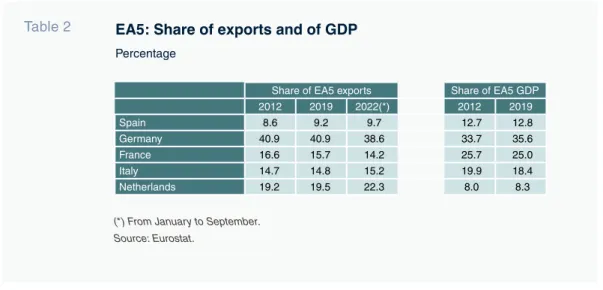
The piece on external competitiveness explores whether there are any signs that the prevailing inflationary dynamics could be undermining the competitiveness of Spanish goods exports. The analysis encompasses the euro area’s five largest economies: Germany, France, Italy, Spain and the Netherlands. Spanish exports registered nominal growth of 40% between 2012 and 2021, the highest rate among the five benchmark economies. The data corresponding to the first three quarters of 2022 suggest that momentum has continued, with Spain ranking as the country with the second-highest export growth compared to the same period of 2019. Analysis of the cost- competitiveness data suggest that the Spanish export sector has been competitive on the cost side, both before and since the pandemic-induced crisis. Thus, the Spanish economy is capable of improving its internal cost competitiveness and transforming those gains into export growth. In addition to this, it is likely that some Spanish firms are positively affected by the current reorganization of globalization, leaning towards shorter and safer supply chains. Nevertheless, Spain’s export intensity remains below its weight as an economy within the universe of benchmark economies.
The European Company Survey (ECS) 2019 data show that business digitalisation is a multidimensional phenomenon marked
by heterogeneous patterns. Differences in digitalisation at the firm level across Europe are attributable to country factors (productivity differences), sector-market factors (technology and demand) and company factors (size, competitive advantage, organisational capital).
Public policies designed to support digitalisation across Europe need to take these factors into consideration. In contrast to the Spanish economy’s relatively low productivity levels, overall, Spanish companies are relatively highly digitalised. In fact, they rank among the highest in the EU. However, a high percentage of Spanish companies use digital technology to control worker performance (relative to alternative uses in companies in more productive countries) and have relatively low levels of organisational capital (complementary to digital capital). This, together with the lower incidence of delegation among the Spanish companies, could mean that they are missing out on the opportunity created by their investments in digitalisation to lift productivity.
Month Day Indicator / Event
February 2 Social Security registrants and official unemployment (January)
2 Tourist arrivals (December) 2 ECB monetary policy meeting
7 Industrial production index (December) 9-10 Special European Council
13 Eurogroup meeting
15 CPI (January)
16 Foreign trade report (December)
28 Balance of payments monthly (December) 28 Preliminary CPI (February)
March 2 Social Security registrants and official unemployment (February)
3 Tourist arrivals (January)
7 Industrial production index (January) 10 Retail trade (January)
13 Eurogroup meeting
14 CPI (February)
16 ECB monetary policy meeting 16 Foreign trade report (January) 23-24 European Council
24 Balance of payments quarterly (4th quarter 2020)
24 Quarterly National Accounts (4th quarter 2020, 2nd estimate) 30 Retail trade (February)
30 Preliminary CPI (March)
31 Institutional Sectors Non-financial quarterly accounts (4th quarter 2020)
31 Non-financial accounts, State (Dec., Jan. and Feb.) 31 Non-financial accounts: Central Government, Regional
Governments and Social Security (Dec. and Jan.)
31 Non-financial accounts, Total Government (4th quarter 2020) 31 Balance of payments monthly (January)
This page was left blank intentionally.
The global economy in times of polycrisis
2022 was characterised by uncertainty, economic and financial markets volatility, and most importantly, an acceleration in the regime shift in which the global economy is immersed.
Although many questions remain unanswered, 2023 should shed some more light on key future international economic trends, with the search for a new equilibrium in prices, economic policy and geopolitics the main variables to watch.
José Ramón Díez Guijarro
Outlook for the Spanish economy in the face of falling energy prices
The combination of labour market resilience and an easing of inflationary pressures arising from lower energy prices, coupled with higher than anticipated natural gas storage levels in Europe, means that the economy is likely to perform better than initially thought. Albeit economic uncertainty weighs heavily on forecasting, in 2024, the Spanish economy is expected to reach pre-pandemic growth levels, with fiscal indicators improving in tandem with recovery; however, fiscal sustainability will depend on the credibility of the targets set for correcting current imbalances and the transformational nature of the investments financed using the NGEU funds.
Raymond Torres and María Jesús Fernández
5
13
Managing the risks of quantitative tightening in the euro area
Recent quantitative tightening decisions undertaken by the ECB are important to reduce surplus liquidity and improve the functioning of the monetary transmission mechanism in the euro area. Nevertheless, they pose important risks for commercial banks, central banks, government finances, and the ECB itself.
Erik Jones
23
Importance and characteristics of the bancassurance business in Spain
The weight of bancassurance in Spain´s insurance business and its contribution to parent banks’ domestic earnings are very significant. As a result, as evidenced by the recent COVID-19 crisis, as well as in normal times, the relatively substantial contribution of the bancassurance business lends earnings stability and solidity to the banks with the most developed such businesses.
Daniel Manzano, Afi
49
Corporate finance: Banks versus capital markets
Tension in the corporate bond market since the start of the inflationary spiral towards the end of last year has driven a sharp increase in secondary market rates, as well as a sharp contraction in primary market issuance, forcing many corporates back to the bank financing channel they had previously abandoned.
Nonetheless, rather than seeing this development as a setback, it reflects the complimentary rather than substitutive nature of bank and market corporate financing, with the banks acting as a back-up option when the bond markets are temporarily unable to finance the productive apparatus.
Marta Alberni, Ángel Berges and María Rodríguez, Afi
41
Monetary policy 2023 and interest rate increases: Outlook and impact
The monetary policy roadmap for 2023 will continue to prioritize the fight against inflation, with successive official rate increases at least for much of the year, although accompanied by a slower increase in EURIBOR. Within this context, the banks will continue to play a key role in credit provision to the economy, yet while they could face improved income prospects, notable challenges exist within the prevailing uncertain climate.
Santiago Carbó Valverde and Francisco Rodríguez Fernández
33
Regulation and Economic Outlook
Recent key developments in the area of Spanish financial regulation
73
Prepared by the Regulation and Research Department of the Spanish Confederation of Savings Banks
Spanish economic forecasts panel: January 2023
79
Funcas Economic Trends and Statistics Department
Key Facts
Economic Indicators
87
Financial System Indicators
125
Social Indicators
131
Spanish exports registered nominal growth of 40% between 2012 and 2021, the highest rate among the euro area’s five largest economies. While the Spanish economy is capable of improving its internal cost competitiveness and transforming those gains into export growth, Spain’s export intensity remains below its weight as an economy within the universe of benchmark economies.
Ramon Xifré
55
Digitalisation of Spanish companies: An EU comparison
In contrast to the Spanish economy’s relatively low
productivity levels, overall, Spanish companies are relatively highly digitalised. However, a high percentage of Spanish companies use digital technology to control worker performance (relative to alternative uses in companies in more productive countries) and have relatively low levels of organisational capital (complementary to digital capital).
Pilar Rivera-Torres and Vicente Salas-Fumás
65
This page was left blank intentionally.
The global economy in times of polycrisis
2022 was characterised by uncertainty, economic and financial markets volatility, and most importantly, an acceleration in the regime shift in which the global economy is immersed.
Although many questions remain unanswered, 2023 should shed some more light on key future international economic trends, with the search for a new equilibrium in prices, economic policy and geopolitics the main variables to watch.
Abstract: The global economy is heading into the new year trying to digest the nasty surprises ensuing since the beginning of 2020, which have ushered in the biggest imbalance between supply and demand of recent decades. The pandemic, the bottlenecks in international shipping, the war in Ukraine and the surge in energy prices have altered the dynamics that have driven business cycle patterns since the financial crisis of 2008.
That accumulation of shocks is proving a challenge for economic policy response in the short-term and threatening to alter the ecosystem in which the global economy has been moving since the end of the 1970s, characterised by flexibility and maximisation
of production efficiency via global value chains. Although there are more questions still than answers about how this process will play out and a good number of fronts are still open, 2023 should shed some more light on key future international economic trends. While it is too soon to rule out the odd quarter of contraction in one of the major economic blocs, current signs point more to a relatively soft economic landing, without traumatic effects on employment, rather than to a full-scale recession. Indeed, the global economy could grow by around 2.5% in 2023, although with a significant slowdown in growth in both advanced economies and emerging economies. In the near-term, the José Ramón Díez Guijarro
key lies with the trend in inflation, the real barometer for the instability sustained by the economy in recent years. The search for new equilibriums in prices, economic policy and geopolitics will be among the main variables to watch in 2023.
Times of change for the international economy
2022 marked another twist in the plot that has been jolting the global economy since the onset of the pandemic. In early 2022, the economic climate continued to be marked by limited global supply on account of bottlenecks in transportation and logistics and demand whetted by both the recovery in mobility and the savings set aside during the pandemic. Although that mismatch started to push prices higher in the spring of 2021, the central banks initially opted not to respond to the spike in inflation, trusting that it would prove transitory and that supply would catch up with consumers’ new preferences. Indeed, as late as in December 2021, the financial markets were not really discounting interest rate increases in the following 12 months.
[1] Despite the complex environment, there was faith that things would return gradually to normal once the most virulent stage of the pandemic was behind us.
Everything changed on February 24th, when Russian troops invaded Ukraine. The new supply side shock caused by the ensuing surge in energy prices and the uncertainty caused by the first major armed conflict on European soil in the twenty-first century threatened to unleash a process of global stagflation, particularly when natural gas prices approached €350/MWh at the end of August, following the announced closure of the main gas pipelines bringing gas from Russia to north-eastern Europe. For much of last year, therefore, the feeling was that the
international economy was facing its biggest challenge in recent decades due to the existence of multiple, disparate and overlapping shocks which threaten to alter dynamics across the main economic variables. In the words of the historian, Adam Tooze, we are facing a polycrisis, a diversity of simultaneous shocks which interact with each other, in which the
“whole is more overwhelming than the sum of the parts”. [2]
That sensation of exceptional economic conditions was borne out in surprising trends in a good number of economic and financial variables. In 2022, we saw inflation in the OECD reach its highest levels in nearly four decades (topping 10% towards the end of the summer), Germany report its first trade deficit since 1981 and the dollar appreciate to levels not seen in recent decades against currencies of the calibre of the sterling (37-year high) and the yen (32-year high).
In short, the changes engulfing the international economy since 2020 only intensified last year. The key characteristics of that process of change include:
■The biggest gap between global supply and demand since the end of the 1970s. The disruption caused by the pandemic has coincided with the effects of the expansionary fiscal programmes set in motion in the spring of 2020, creating significant imbalances in the goods and services markets. Although those imbalances narrowed over the course of 2022 thanks to economic cooling and gradual resolution of the bottlenecks, their effects will take time to dissipate.
■Transformation of the globalisation process due to factors such as increased political risk and the value chain fragility exposed. Although the first symptoms
“ The global economy is facing a polycrisis, a diversity of simultaneous
shocks which interact with each other, in which the ‘whole is more
overwhelming than the sum of the parts.’ ”
emerged at the beginning of the financial crisis, when the percentage of GDP accounted for by goods and service exports peaked (2008), the events of the past three years have triggered a boom in concepts such as “strategic autonomy”, “friend- shoring” and “nearshoring”. That search for supply security at the cost of efficiency and, as a result, the attempt to bring some production back home, is beginning to be seen in the economic policy programmes being devised on both sides of the Atlantic since the onset of the pandemic. The risk is the potential for the abuse of aid and benefits for national companies in the process, with legitimate medium-term objectives such as digitalisation and energy transition masking protectionism. The biggest exponent of that new economic policy thrust was the last plan passed by the Biden Administration (US Inflation Act)
last summer, which sets aside $80 billion of aid for production on American soil-a move that is bound to trigger a response by the European Commission in the form of an updated aid framework for regional companies. The risk is, therefore, that we could go from a phase of strategic autonomy to one of all-out strategic competition between economic blocs.
■A regime change in inflation. After nearly 15 years of prices trending below central bank targets, in 2022, inflation hit a decades- long high due to the cumulative impact of:
production bottlenecks; rising energy and food prices; an accelerating energy transition (greenflation); and, the effects of several years of largely unchecked monetary and fiscal expansion. Moreover, core inflation is already running at around 5% or 6% and showing scant signs of
“ There is a risk therefore, that we could go from a phase of strategic autonomy to one of all-out strategic competition between economic blocs. ”
10098 102 104 106108 110 112 114116 118 120
Jan-21 Feb-21 Mar-21 Apr-21 May-21 Jun-21 Jul-21 Aug-21 Sep-21 Oct-21 Nov-21 Dec-21 Jan-22 Feb-22 Mar-22 Apr-22 May-22 Jun-22 Jul-22 Aug-22 Sep-22 Oct-22 Nov-22 Dec-22
Eurozone Germany France Italy Spain
Exhibit 1 Eurozone: Headline CPI
Rebased: 100 = January 2021
Source: Eurostat.
coming down in the near-term, evidencing how the more volatile components of CPI are beginning to have a very considerable impact on the other components. That drastic shift in the inflation trend threatens to erode household purchasing power, increase inequality, trigger sharp financial market corrections and/or increase the risk of financial instability, among other risks.
The positive reading is that the root of all these problems – bottlenecks at the earliest stages of the production process – is beginning to show signs of normalisation, which, coupled with a reduction in energy prices, has been pushing headline inflation lower in recent months. The big question is how long it will take for inflation to return to 2% and, therefore, affect central bank
decision-making. And, more importantly, how will inflation trend after the impact of the various shocks has been digested.
That will determine the fit for purpose of targets that have been in use for nearly four decades and of the strategy designed right before the pandemic, when the central banks’ problems were exactly the opposite of those faced today.
■The most intense monetary policy normalisation effort of recent decades, with the central banks jumping from denial to action (or even overreaction). The monetary authorities’ response across both developed and emerging economies has implied a cumulative increase in interest rates since the end of 2021 of close to four percentage points. According to the Bank
“ The big question is how long it will take for inflation to return to 2% and, therefore, affect central bank decision-making and, more importantly, how will inflation trend after the impact of the various shocks has been digested. ”
-2.0 -1.0 0.0 1.0 2.0 3.0 4.0 5.0 6.0
2-Jan 2-Feb 2-Mar 2-Apr 2-May 2-Jun 2-Jul 2-Aug 2-Sep 2-Oct 2-Nov 2-Dec 2-Jan 2-Feb 2-Mar 2-Apr 2-May 2-Jun 2-Jul 2-Aug 2-Sep 2-Oct 2-Nov 2-Dec 2-Jan
Germany France Italy Spain US
Exhibit 2 Sovereign bond yields
10Y
Source: Bloomberg.
of International Settlements in Basel, 2022 marked a record for rate increases (200 increases of 25 basis points), smashing the last record which dated back to 2006 (120 increases). That means monetary policy is contractionary in a large swath of countries.
The good news is that financial tightening has taken place in the absence of worrying episodes of financial stability (with the exception of the mini crisis in the UK), despite a sharp correction all year long in the bond and equities markets. [3]
■Marked labour market resilience. In nearly all major economies, employment levels are above those of 2019 and in many cases unemployment rates are near record lows (3% in Germany). Indeed, the biggest miscalculation in the forecasts published towards the start of the pandemic was the prediction of significant job losses in the short- and medium-term. The snapshot three years on is very different from that anticipated. In fact, the problem in many areas of the OECD labour market is a significant number of vacancies and (once again) the inability of supply to react to demand. It seems clear that the healthy employment dynamics are largely underpinned by the various furlough schemes in Europe (emulating Germany’s Kurzarbeit scheme) which preserved ties between companies and employees throughout the crisis. However, we are beginning to see structural changes related with the pandemic (working from home), demographics (the
baby boomers are beginning to retire and the pool of newcomers is much smaller) and even sociological factors (the Great Resignation).
■The end of the economic policy measures applied during the pandemic. The combo of ultra-lax monetary and fiscal policies is over. The very nature of the supply shocks, which are affecting inflation differently from growth (fuelling the former and weighing on the latter) is driving divergence between fiscal and monetary policy. In times such as these, neglecting budget discipline by pursuing unchecked fiscal policies would make it harder for the monetary authorities to attain their goals and increase the risk of financial accidents. The free bar is closed and the markets will not tolerate stepping on the accelerator and break at the same time, as was made clear during the crisis in the UK last September.
In sum, 2022 was once again characterised by unpleasant surprises of all kinds, uncertainty and volatile economic and financial variables.
Above all, however, it was marked by an acceleration in the regime shift in which the global economy is immersed.
2023: In search of a new equilibrium Although the international economy has rung in the new year with weak vital signs, there are symptoms of improvement in the various macroeconomic imbalances, pending the outcome of the economic cooling underway in
“ According to the Bank of International Settlements in Basel, 2022 marked a record for rate increases (200 increases of 25 basis points), smashing the last record which dated back to 2006 (120 increases). ”
“ Indeed, the biggest miscalculation in the forecasts published towards
the start of the pandemic was the prediction of significant job losses
in the short- and medium-term. ”
the three major economic regions (US, China and the eurozone). For now, it looks as if the scale of economic deterioration feared towards the end of 2022 has not materialised thanks to labour market resilience, favourable energy price trends in the last quarter, stabilising expectations following their collapse when the war broke out and the delayed effects of the expansionary fiscal measures rolled out at the height of the pandemic (pent-up savings, NGEU funds, etc.).
The good news, therefore, is that the probability that the sharp slowdown in GDP growth will end in a global recession in the first half, as was feared at the end of the summer, is diminishing. The sense is that the economy is absorbing the effects of the supply shocks, heightened geopolitical risk and interest rate hikes much better than expected. Meanwhile,
concern over the energy scenario has abated because at this stage of the winter the spectre of gas rationing in Europe can be virtually ruled out because: current gas reserve levels are high (over 85%), gas consumption is falling considerably (by 10% between January and November by comparison with long-run levels) and LNG is flowing into Europe at a dynamic pace. In fact, gas futures for 2023 have plummeted from nearly €190/MWh at the end of August to €70 euros/MWh as of the first half of January, with the spot price hovering around €50/MWh during some trading sessions. In parallel, oil prices have largely stabilised at around €80-90/bbl, implying a substantial improvement in the energy price assumptions used in economic forecasting exercises undertaken barely three months ago (more than offsetting the impact of the unexpected increase in rates).
“ In times such as these. neglecting budget discipline by pursuing unchecked fiscal policies would make it harder for the monetary authorities to attain their goals and increase the risk of financial accidents. ”
0 50 100 150 200 250 300 350
Jan-21 Apr-21 Jul-21 Oct-21 Jan-22 Apr-22 Jul-22 Oct-22 Jan-23 Apr-23 Jul-23 Oct-23 Jan-24
Jan 13th Oct 31st
Aug 30th
Exhibit 3 Gas prices. TTF and futures
Source: Bloomberg.
Therefore, although it is too soon to rule out the odd quarter of contraction in one of the major economic blocs, current signs point more to a relatively soft economic landing, without traumatic effects on employment, than to a full-scale recession. Indeed, the global economy could grow by around 2.5%
in 2023, shaped by a significant slowdown in growth in both advanced economies (1% vs.
2.4% in 2022) and emerging economies (4%
vs. 7% in 2022). Given the scant visibility at present, it is hard to extrapolate the business cycle profile but logic would dictate that this quarter will be the weakest in Europe, whereas in the US the effects of the Fed’s rate increases are likely to be felt more towards the spring and summer. That being said, the current forecasts are framed by significant volatility as they are conditioned by a range of disparate factors including the reopening of China, events in Ukraine and the sensitivity of financial stability to the central banks’ last movements until they reach their terminal rates given that public and private borrowing levels are so high.
In the short-term, the key lies with the trend in inflation and, by extension, the speed with which the current imbalances correct.
The number of pleasant surprises in the latest inflation readings mark a shift with respect to the panorama just a few months ago. All signs suggest that the initial phase of price correction could be complete by this summer, with inflation closing in on 4% in the US and EMU alike. That will not necessarily be
sufficient for the central banks, especially if the news about the trend in the key components is not good. The doubts being voiced by the monetary authorities (especially the ECB) about the second phase of the disinflationary process to reach the targeted 2% will shape the entire economic scenario in 2023 and 2024. It is not the same if the central banks complete their rate tightening in the first half of this year at levels close to those currently being discounted by the market (3.25%-3.5%
in the EMU and 4.75%-5% in the US) as if there is another acceleration of tightening. By the same token, monetary stability requires governments and central banks to coordinate more intensely. It is not easy to move from a situation akin to fiscal dominance to one in which short-term macroeconomic stability is once again a priority.
As a result, the search for new equilibriums in prices, economic policy and geopolitics will be key in 2023 – a year which should start to paint a picture of what the new economic normal will look like once the recent instability is a thing of the past. During the transitory phase, in which the old is dying and the new cannot be born, we will continue to witness major debates, such as China’s role over the coming decade, the limits to global indebtedness, the future of globalisation and the implications of the energy transition process.
Notes
[1] Christine Lagarde herself virtually ruled out the possibility of interest rate increases in 2022
“ The sense is that the economy is absorbing the effects of the supply shocks, heightened geopolitical risk and interest rate hikes much better than expected. ”
“ The doubts being voiced by the monetary authorities (especially the
ECB) about the second phase of the disinflationary process to reach
the targeted 2% will shape the entire economic scenario in 2023 and
2024. ”
at her press conference following the ECB Governing Council meeting of December 2021.
[2] “Welcome to the world of polycrisis” – Financial Times (October 28th, 2022).
[3] Losses on 60/40 portfolios topped 15%.
José Ramón Díez Guijarro. CUNEF
Outlook for the Spanish
economy in the face of falling energy prices
The combination of labour market resilience and an easing of inflationary pressures arising from lower energy prices, coupled with higher than anticipated natural gas storage levels in Europe, means that the economy is likely to perform better than initially thought. Albeit economic uncertainty weighs heavily on forecasting, in 2024, the Spanish economy is expected to reach pre-pandemic growth levels, with fiscal indicators improving in tandem with recovery; however, fiscal sustainability will depend on the credibility of the targets set for correcting current imbalances and the transformational nature of the investments financed using the NGEU funds.
Abstract: After upward revisions in the first and second quarter GDP figures, growth in the first half of last year stood at 7.3% year- on-year, up from the initially published 6.7%, while GDP rose just 0.1% in the third quarter of 2022. The combination of labour market resilience and an easing of inflationary pressures arising from lower energy prices, coupled with higher than anticipated natural
gas storage levels in Europe, means that the economy is likely to have performed better towards the end of the year than initially thought. Meanwhile, the public deficit continues to beat expectations, once again thanks to higher than forecast tax revenue.
As of September, the overall deficit was running at 2.3% of GDP, compared to 6.3% in 9M21. The adjustments made by the National Raymond Torres and María Jesús Fernández
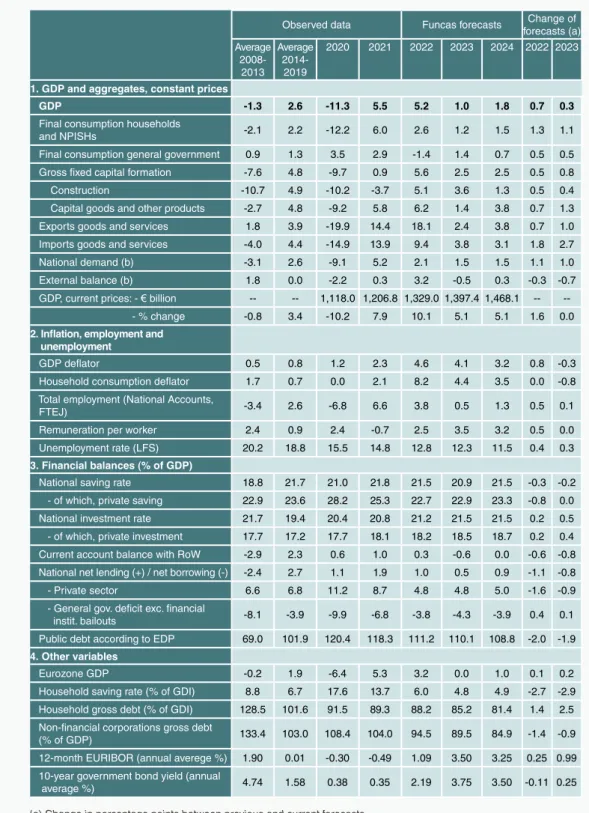
Statistics Office to the initially reported GDP figures, coupled with the let-up in energy prices, have prompted an upward revision to our growth forecasts. In 2022, we are now expecting GDP growth of 5.2%, up 0.7pp from the last forecast, as a result of the new official figures. Growth is expected to fall back to 1%
in 2023, mainly because Spanish households no longer have a savings buffer to prop up their consumer spending. With the broader European economy gradually rebounding, growth is forecast at 1.8% in 2024, which would finally put the Spanish economy back at pre-pandemic levels. The government deficit is forecast at 4.3% of GDP in 2023, with public debt at 110%. Those readings should improve in 2024 in tandem with the economic recovery. These forecasts remain subject to a significant level of global uncertainty.
But fiscal sustainability will depend on the credibility of the targets set for correcting
current imbalances and the transformational nature of the investments financed using the NGEU funds.
Recent economic performance in Spain
According to the revised quarterly national accounts, GDP rose by a mere 0.1% in the third quarter of 2022. However, the first and second quarter figures were revised considerably higher to put GDP growth in the first half at 7.3% year-on-year, up from the initially published 6.7%.
Consumer spending was virtually stagnant in real terms, albeit rising 1.8% in current terms. In other words, the volume of goods and services purchased by households was stable despite the growth in prices, which translated into higher expenditure in current
“ The savings buffer built up between 2020 and 2021, together with healthy employment dynamics, is what propped up consumption in spite of the loss of household purchasing power. ”
0 5 10 15 20 25 30
2013 2014 2015 2016 2017 2018 2019 2020 2021 2022
Average 2013-2019: 6.9%
Exhibit 1 Household savings rate
Percentage of gross disposable income
Source: INE.
terms. That, coupled with a 1.1% drop in gross disposable household income, drove the savings rate considerably lower, to 5.7%, which is below the average of 6.9% observed between 2013 and 2019 (Exhibit 1). Growth in the buffer built up between 2020 and 2021 has, therefore, ceased, although it is likely that its existence, together with healthy employment dynamics, is what propped up consumption in spite of the loss of household purchasing power, to the detriment of the savings rate.
Investment in capital goods increased slightly but it was the government spending component of domestic demand that made the biggest contribution to third-quarter GDP growth. Foreign trade detracted from growth:
real tourist spending barely budged, having normalised and even topped pre-pandemic levels in previous quarters (Exhibit 2), while the modest growth in exports was insufficient to offset the bigger increase in imports.
As for the fourth quarter, the manufacturing PMI points to a sector contraction, albeit smaller than expected. Indeed, the manufacturing industrial production index to November deteriorated just a little –it was worse in the energy-intensive segments.
The confidence indicators also lost ground and capacity utilisation fell back. In services, however, the PMI reading remained in growth territory, albeit just barely. Overnight stays in hotels rose, as did air and rail passenger numbers.
The number of Social Security contributors increased by 0.6% in the fourth quarter, which is very close to prior-quarter levels, pointing to continued labour market resilience.
Although seasonally-adjusted employment fell in December, the contraction is not, for now, significant, as it came on the heels of an exceptionally strong November result.
Something similar took place in June and
96.4 106.9
0 20 40 60 80 100 120
Jan-20 Mar-20 May-20 Jul-20 Sep-20 Nov-20 Jan-21 Mar-21 May-21 Jul-21 Sep-21 Nov-21 Jan-22 Mar-22 May-22 Jul-22 Sep-22 Nov-22
Tourist arrivals Tourist spending
Exhibit 2 Tourism
Rebased to Jan. 2020 = 100
Source: INE.
“ The labour market is showing signs of a slowdown, but it is too soon
to talk about a change in employment dynamics. ”
July, possibly suggesting a mere change in seasonal patterns. Private sector non-farming employment increased by 0.6% in the fourth quarter, down from growth of 0.8% in the third quarter. There are signs of a slowdown, therefore, but it is too soon to talk about a change in the employment trend. Overall in 2022, Social Security contributors increased by 3.8% from 2021, with the private non- farming sector registering growth of 4.8%.
Headline inflation peaked at 10.8% in July.
Since then, the downward trend in energy product prices has pushed that indicator down to 5.7% as of December. Core inflation, on the other hand, having stabilised at around 6.3%
between August and November, unexpectedly jumped to 7% in December. The biggest concern is the sustained growth in processed food prices, where inflation stood at 16.4% in December.
On the cost side, inflationary pressures have eased considerably. For example, against expectations, oil prices have corrected from an average of $117.5 per barrel in July to
$81.5 in December. Gas prices, meanwhile, which peaked in August, at over €200/MWh, dropped to €60 in October and November before going on to head back to almost €100 in December, which is still considerably above pre-war and pre-pandemic levels. Industrial commodity prices have also come down but remain at relatively high levels, while shipping costs are nearly back at pre-pandemic registers and the global supply chain bottlenecks seem close to resolution.
All of which is beginning to trickle through to the industrial price index. Excluding energy prices, the index has virtually stopped rising, suggesting that industrial prices are stabilising
all along the production chain, albeit marked by certain differences from one product to the next. The prices of intermediate goods are actually falling but food product prices continue their upward trend, suggesting that the pressure being exerted by food prices on CPI still has a way to go.
All of the above, coupled with higher than anticipated natural gas storage levels in Europe (which, together with seasonably mild weather, has allayed the spectre of supply cuts this winter), means that the economy is likely to have performed better towards the end of the year than initially thought.
Spain reported a current account surplus of 0.2% of GDP in the first nine months of 2022.
The trade surplus in tourist services has fully recovered to pre-pandemic levels but the goods deficit has deteriorated sharply, to its highest level since 2008. That development is the result of a burgeoning energy deficit and a shift in the non-energy goods balance of payments from surplus to deficit.
Meanwhile, the public deficit continues to record better than expected figures, once again thanks to higher than forecast tax revenue. As of September, the overall deficit was running at 2.3% of GDP, compared to 6.3% in 9M21.
Forecasts for 2022-2024
The adjustments made by the National Statistics Office to the initially reported GDP figures, coupled with the let-up in energy prices, have prompted us to revise our growth forecasts upwards. In 2022, we are now expecting GDP growth of 5.2%, up 0.7pp from our last forecast.
“ All of the above, coupled with higher than anticipated natural gas
storage levels in Europe (which, together with seasonably mild
weather, has allayed the spectre of supply cuts this winter), means
that the economy is likely to have performed better towards the end
of the year than initially thought. ”
Growth is expected to fall back to 1% in 2023, mainly because Spanish households no longer have a savings buffer to prop up their consumer spending. That figure is, however, up 0.3pp from our October forecast, shaped by lower energy price assumptions than we were using before. We are now forecasting gas prices at
€90/MWh (a conservative assumption, as it is higher than the Mibgas forward price), down from our last estimate of €120. That scenario is conducive to a continued reduction in CPI, alleviating the loss of households’ purchasing power and the impact of energy costs on the business sector. The resulting expansionary impact should offset the contractionary shift in monetary policy, becoming more apparent from the spring.
We have revised all components of internal demand upwards, most particularly private
consumption, which is now expected to register slight growth (and not the stagnation previously foreseen). Investment, also revised upwards, is expected to be the main driver of demand over the projection period with the impetus generated by the NGEU funds more than compensating for the negative impact of higher interest rates. Foreign trade, however, is expected to detract from growth as a result of the outlook for weak growth across Europe (the eurozone economy as a whole is expected to register zero growth this year, with some important export markets like Germany expected to contract).
The quarterly growth pattern forecast for this year is markedly heterogeneous. After a small contraction in the first quarter, the economy is expected to expand at a quarterly pace of close
“ Investment, also revised upwards, is expected to be the main driver of demand over the projection period with the impetus generated by the NGEU funds more than compensating for the negative impact of higher interest rates.” ”
75 80 85 90 95 100 105
2019 2020 2021 2022 2023 2024
4Q2022=98.6 4Q2023=99.6 1Q2024=100.1
Forecasts
Exhibit 3 GDP
Rebased, 4Q19 = 100
Source: INE and Funcas.
to 0.4% the rest of the year. Carrying over from there, and with the broader European economy gradually rebounding, growth is forecast at 1.8% in 2024, which would finally put the Spanish economy back at pre- pandemic levels (Exhibit 3). All components of both domestic and external demand are expected to make a positive contribution next year.
The downtrend in consumer inflation initiated towards the end of 2022 is expected to continue, despite the stickiness of core inflation (i.e., controlling for volatile energy and unprocessed food prices). The private consumption deflator is currently forecast at 4.4%, down 0.8pp from our last set of forecasts, shaped by the reduction in energy prices.
The GDP deflator, which best reflects the underlying dynamic, is forecast at 4.1% (down 0.3pp). That forecast assumes containment of potential second-round effects. Indeed, we are forecasting moderate growth in average
wage-earner pay and corporate profits per unit produced of 3.5% and 3.9%, respectively.
Inflation is expected to come down further in 2024. We are forecasting consumption and GDP deflators of 3.5% and 3.2%, respectively, the former still above the ECB’s target, however.
The anticipated slowdown in global growth, particularly in Europe, will undermine Spain’s trade deficit, eroding the current account in 2023. On the flip side, the global recovery forecast in 2024 by the IMF should turn that tide, helped by the Spanish companies’
strong competitive position. Overall, thanks to the Next Generation EU funds, the external balance is expected to remain in surplus territory (net lending position) throughout the entire forecast horizon.
The labour market is likely to feel the slowdown but not to give back the gains notched up in recent months. We are forecasting net job
“ Inflation is expected to come down further in 2024, yet still above the ECB’s target. ”
2.7
-2.0
0.9
-5.8
-0.1
1.6
-7 -6 -5 -4 -3 -2 -1 0 1 2 3 4
2015-2019 2020 2021 2022 2023 2024
Forecast
Exhibit 4 Gross real disposable income of households
Growth rate
Source: INE and Funcas.
creation of 100,000 in 2023 and another 250,000 in 2024 (in FTE terms). If so, unemployment would come down to 11.5% by the end of the projection horizon, which would still be the worst figure in the EU.
The public deficit has come down significantly thanks to the interplay of the automatic stabilisers, coupled with inflation dynamics.
However, little progress is expected on addressing prevailing imbalances in 2023 on account of the economic cooling and indexation of pensions. The deficit is forecast at around 4.3% of GDP in 2023, with public debt at 110%. Those readings should improve in 2024 in tandem with the economic recovery.
Lastly, in light of the inflation dynamics, the main central banks have embarked on a path of rate tightening with the aim of cooling demand
and thereby mitigating the risk of second- round effects. Our forecasts contemplate additional increases in the ECB’s Deposit Facility Rate up to a terminal rate of 3.25% in the second quarter of 2023, from which point we expect rates to be largely stable until early 2024, when they could start to come down (Exhibit 5). Monetary policy will be echoed in market interest rates. We are forecasting EURIBOR at close to 3.75% over the coming months, before starting to drop slightly as market expectations for additional ECB rate hikes dissipate. As a result, mortgaged households with floating-rate loans could see their debt service burden increase by a total of 6.3 billion euros over the next two years.
The trend in public bond yields is expected to be similar, increasing the country’s interest payments by around 9 billion euros in total between now and 2024.
“ We are forecasting EURIBOR at close to 3.75% over the coming months, before starting to drop slightly as market expectations for additional ECB rate hikes dissipate. ”
-1.00 -0.50 0.00 0.50 1.00 1.50 2.00 2.50 3.00 3.50 4.00
Jan-19 Mar-19 May-19 Jul-19 Sep-19 Nov-19 Jan-20 Mar-20 May-20 Jul-20 Sep-20 Nov-20 Jan-21 Mar-21 May-21 Jul-21 Sep-21 Nov-21 Jan-22 Mar-22 May-22 Jul-22 Sep-22 Nov-22 Jan-23 Mar-23 May-23 Jul-23 Sep-23 Nov-23
Deposit Facility Rate Euribor 12-month
Forecasts
Exhibit 5 Interest rates
Percentage
Source: Bank of Spain and Funcas.